

Returning wedding rentals after a Sunday reception comes down to one question: when the party ends on Sunday night, who is responsible for the tables, linens, glassware, and decor until the rental company’s truck pulls away on Monday? This guide maps that hand-off so the answer is written down before the wedding, not argued about afterward.
Quick answer
Rental companies commonly treat a weekend event as a short rental that ends with a return or pickup on the next business day, and many put the renter in charge of the items from the moment they are delivered. Plan returning wedding rentals as five hand-offs: delivery and count, setup, Sunday-night teardown, staging for pickup, and the Monday pickup or drop-off with a final count. Name one owner for each hand-off, photograph the staged items, keep every piece of paper, and check the final invoice against your contract. Contracts differ, so your signed agreement overrides anything general written here.
Why a Sunday reception changes the return job
A Saturday wedding has a familiar rhythm: setup in the morning, party at night, pickup on Monday. A Sunday wedding compresses everything. The same people who danced until the last song may be due at work in the morning, the venue may have a firm end time, and the rental company may handle Sunday and Monday on very different schedules. Returning wedding rentals after a Sunday reception is less about heavy lifting than about timing and clear ownership.
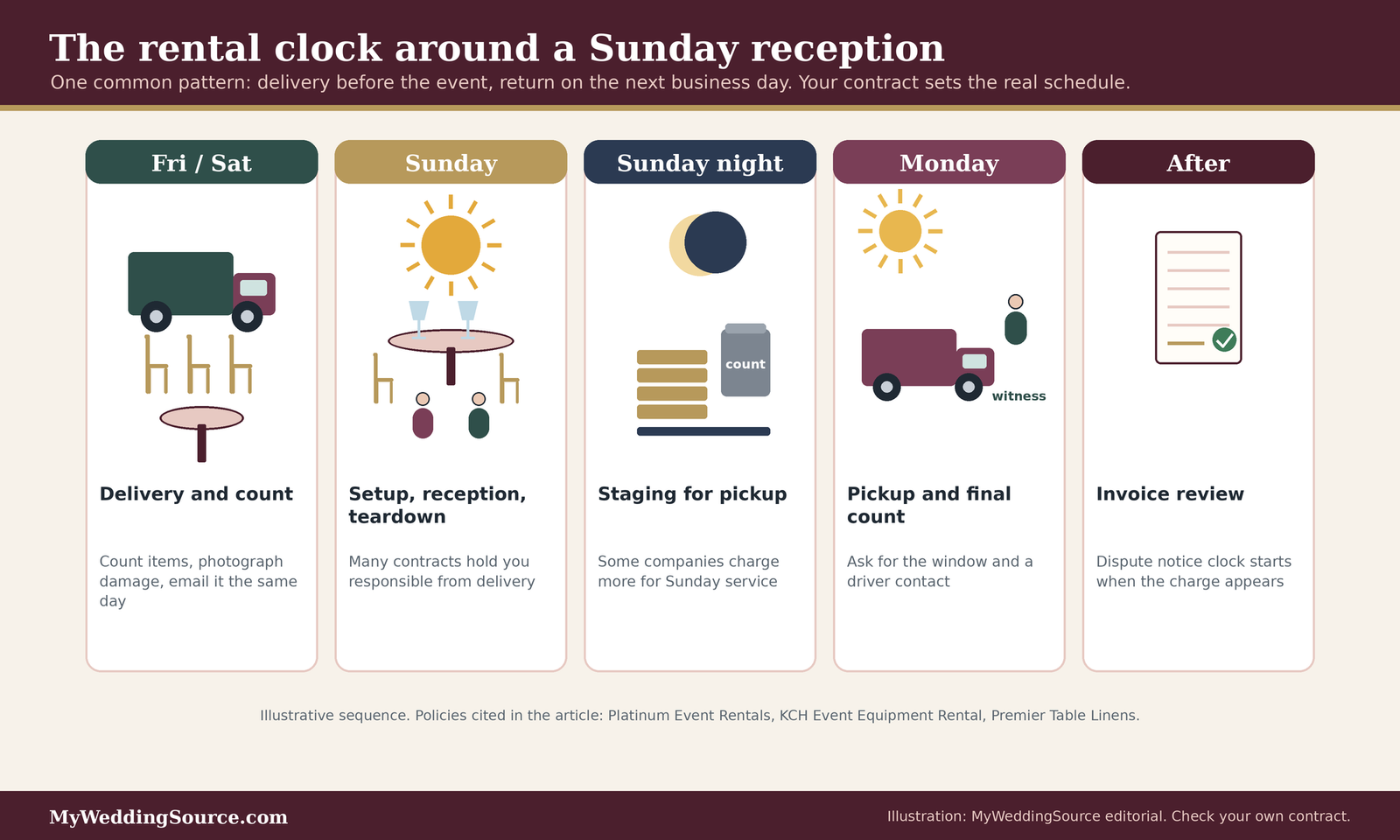
The rental clock around a Sunday event
Rental pricing and responsibility run on a clock, and the clock does not stop because the party did. Understanding where it starts and ends is the first step toward handling returning wedding rentals calmly.
Where the clock usually starts
Several rental companies describe their rental period as spanning a few days around the event. One Maryland-area event rental company, Platinum Event Rentals, says on its policy page that its rentals run three days, with delivery or pickup the day before the event and return the day after, and that weekend rentals are typically returned the Monday after. That is one company’s policy, not an industry rule, but it shows the usual pattern: you are responsible for the goods from delivery through return, not only during the reception.
A second pattern appears in contracts that say responsibility begins when you take possession. A linen supplier, Premiere Events, states that you are accountable for its linens once you take possession, and that ordinary food and drink stains are acceptable while wax, ink, and holes are not. A software vendor for rental businesses, Rentopian, makes the same point from the business side and advises renters to clarify whether responsibility begins at drop-off or only during the event.
Why Sunday costs and schedules can differ
The rental company’s own calendar matters. Platinum Event Rentals says Sunday delivery or pickup costs an extra $40 each way and that its customer-will-call option is not available on Sundays. It also says deliveries or pickups between 7:00 pm and 6:00 am add $250, and that narrower time windows cost more. KCH Event Equipment Rental, in Maryland, lists customer pickups Monday through Saturday and returns Wednesday through Monday, and its page does not mention Sunday pickups or returns.
Those are only two companies, and your area may differ. The useful lesson is to ask your rental company three things in writing: what happens if the event ends on Sunday, whether Sunday-night pickup is possible and what it costs, and what the pickup window is on Monday. Do not assume that a pickup scheduled for Monday morning is guaranteed to arrive at 8:00 am.
Who is actually in the room on Monday
The rental company may be perfectly punctual and still find nobody to hand the items to. Many problems around returning wedding rentals are not damage or fees but a locked venue, an empty porch, or a stack of linens that nobody counted.
The couple will probably not be there
By Monday morning, many couples are traveling, sleeping, or back at work. If the plan depends on the couple being present at pickup, the plan is fragile. Choose a person who is not in the wedding party’s busiest roles and who will be reachable on Monday: a sibling, a friend, a family member who lives locally, or a venue coordinator who agrees in writing to receive the pickup.
An event rental guide from In The Event recommends naming one point of contact for all rental issues, someone who handles pickup and delivery timing, talks with the rental company, and makes sure items are returned in good condition after the event. If you hire a planner or day-of coordinator, check whether their contract includes the return, because many day-of services end at the last dance.
The venue may not be open to the truck
A rental company cannot collect from a building it cannot enter. Party Rental Ltd. notes in its planning guidance that buildings may require loading dock access, elevator capacity, or a certificate of insurance, that homes need someone present at delivery, and that parks and beaches may have access rules and operating hours. Each of those applies to pickup as well as delivery. Ask the venue whether its staff will be on site Monday morning, where items may be staged overnight, and whether it requires its own approval for outside vendors to enter.
What your rental agreement already says about returning wedding rentals
Most of the answers to returning wedding rentals are already printed in the rental agreement, in clauses people tend to skim. Reading them a week before the wedding, instead of the Monday after, turns surprises into decisions. Allied Event Solutions suggests reviewing your contract about a week out to confirm return times and adjust quantities if needed, and that habit is worth borrowing.
Possession, risk, and who counts
The words in a contract that matter most are the ones that say when you become responsible and how a count is proven.
Possession and risk of loss
Look for the sentence that says when risk passes to you. It may say delivery, it may say event start, or it may say nothing at all. If it says nothing, ask the company to confirm in writing. This matters when something is stolen from a porch overnight on Saturday, or when a guest knocks over a stack of chairs on Sunday afternoon. The contract, not an assumption, decides who pays.
KCH Event Equipment Rental’s policy illustrates how specific this can be. It says customers are responsible for the setup location and ground conditions, and that they must state those at booking because they cannot be changed after the driver leaves the warehouse. A venue change or a different tent site discovered after booking is exactly the kind of detail that should be reported early.
Counts and condition notes
Premiere Events says to check and count everything when you receive it, and to report any damage before your event, because items returned damaged are assumed to have been undamaged on receipt unless you said otherwise. Treat that as a general good habit. Count items at delivery with the driver if possible, photograph anything already chipped, stained, or cracked, and send those photos to the company the same day. Rentopian similarly recommends reporting damage found on arrival, ideally with photos or video.
Fees, waivers, and return conditions
Fees for returning wedding rentals tend to appear in three places: the damage waiver, the return conditions, and the late or missing-item charges.
The damage waiver
A damage waiver is a fee, usually a percentage of the rental total, that relieves you of some or all charges for accidental damage. Rentopian describes waivers as typically between 5 and 15 percent of the rental total. KCH’s policy says its waiver is included by default at 10 percent of equipment rental charges, that you can decline it when booking, that it covers accidental damage only, and that it does not cover loss, theft, vandalism, unexplained disappearance, or misuse. Platinum Event Rentals charges 8 percent on all rental items for normal cleaning and maintenance, and says losses or theft caused by customer negligence are not covered by that charge.
The three companies use similar words for different bargains. Before you sign, ask what a waiver covers, what it excludes, and whether it is refundable. KCH says that once you keep the waiver it is non-refundable.
Return conditions
Return conditions are the instructions for how things come back. KCH says equipment must be broken down and stacked where it was delivered unless other arrangements were made, that every item must be accounted for at pickup, and that charges apply for missing items or equipment that is not neatly stacked. Platinum Event Rentals says customers do not need to clean rented equipment but that glassware, flatware, and china must be free of food debris, and that broken items must be returned broken or they will be treated as stolen.
If you plan to hire a team to break down tables and rack glassware on Sunday night, give them the return conditions in writing so that they follow the rental company’s rules and not their own habits.
The paper trail
Returning wedding rentals is easier to defend when you can show what happened and when.
What to keep
Keep the signed agreement, the order confirmation, any amended invoices, photos of the delivery and the staged return, the text or email thread with the company, and any receipts for payments or deposits. Store them in one folder that a trusted helper can reach on Monday. The folder is also useful if you later need to dispute a charge, which is covered in the money section below.
What to do when the contract is silent
When a contract does not answer a question, ask in writing and wait for a written reply. A phone call is helpful, but a short email afterward that says “To confirm what we discussed” creates a record. Do not rely on a verbal promise that someone will “take care of it” on Monday.
The responsibility map for returning wedding rentals
The core deliverable of this guide is a map: five hand-offs between delivery and the final count, and a name next to each one. The map does not replace your contract. It organizes the contract’s answers so the people helping you can follow them without reading twenty pages.

The five hand-offs
Think of each rented item in returning wedding rentals as a baton passed through five points. The risk of something going missing or getting damaged is highest at the points where nobody is sure who holds it.
Hand-off one: delivery and count
The rental company delivers; someone on your side counts and signs. This person should open the order list, count the items against it, check for visible damage, photograph problems, and confirm where the items were placed. If the venue receives deliveries on your behalf, ask the venue contact to do this and to send you the photos.
Hand-off two: setup and use
During the event, the setup team places items and the caterer, venue, and guests use them. Responsibility is shared in practice, but under most agreements you remain the renter. Ask the caterer in writing whether they handle the rented china, glassware, and flatware, and who racks and counts them after service.
Hand-off three: Sunday-night teardown
When the party ends, someone must collect, count, and stage items. This is where wax gets left on linens, centerpieces get separated from their rented vases, and glasses get mixed with the venue’s own. Assign a named teardown lead, not a crowd.
Hand-off four: staging for pickup
Rental companies expect items in a specific condition and place. KCH says equipment should be broken down and stacked where it was delivered unless other arrangements were made. Stage items in that spot, photograph the staged pile with a timestamp, and record the count on a note you leave with the items.
Hand-off five: pickup and final count
For returning wedding rentals, the last step is that the rental company collects and a person on your side watches the count. If the company counts alone and later reports missing items, you have no way to compare. If someone must leave a key or a lockbox code instead, photograph the staged items immediately before the driver arrives and again after they leave.
Who holds each hand-off
A map is only useful with names. The names should be people, not roles, and every owner needs a backup.
The renter of record
In returning wedding rentals, the person whose name is on the rental agreement is the renter of record. Under most agreements, that person is financially responsible regardless of who actually handled the items. If the renter of record is one of the couple, name a delegate in writing for Monday, and tell the rental company who may sign the pickup receipt.
The venue, caterer, and planner
The venue may own a portion of the items, such as banquet tables, chairs, or a glassware stock. The caterer may supply their own serviceware. A planner may manage rented decor. Ask each to confirm in writing which items are theirs, which are rented from a third party, and who is responsible for each category after the event. This is the most commonly skipped step in returning wedding rentals, and it is the easiest to fix before the wedding.
The helper who is there Monday
Choose the Monday helper for returning wedding rentals early and share the folder of paperwork. Give them a one-page summary: company name, phone number, pickup window, where items are staged, what the count should be, and what to do if the truck is late. Tell them they are not expected to resolve disputes, only to witness the count and take photos.
A printable return roster
Use the roster below as a worksheet. Fill in names and times, then give a copy to each owner.
The roster
| Hand-off | Owner (name) | Backup | Deadline | What counts as done |
|---|---|---|---|---|
| Delivery count and photos | Delivery day | Count matches order, damage photographed and emailed | ||
| Setup placement notes | Before guests arrive | Floor plan shared with setup team | ||
| Caterer rack-and-count of serviceware | End of service | Caterer’s written count handed to teardown lead | ||
| Sunday-night teardown | Venue end time | Items grouped by category and counted | ||
| Staging and photos | Before venue closes | Timestamped photos of staged items and the count note | ||
| Monday pickup witness | Pickup window | Signed receipt or photo of the truck count | ||
| Invoice review | Day after final invoice | Invoice compared with contract and photos | ||
| Dispute decision | Within the card issuer’s notice window | Decision made about whether to contest any charge |
How to use it
Copy the roster for returning wedding rentals into a shared note or print one page for each owner. Review it at the rehearsal dinner or the last vendor check-in, and send it to the Monday helper with the paperwork folder. A roster adds little work and removes the most common cause of problems: two people each assuming the other one has it.
Sunday-night teardown without the scramble
The teardown window is short and the people doing it are tired. A plan that fits that reality will do more for returning wedding rentals than a perfect plan nobody can follow at 11 pm.
The last hour at the venue
For returning wedding rentals, note that most venues set an end time for the event and a separate time for guests and vendors to be out. Know both before the wedding.
Know the venue’s out-by time
Ask the venue when the building must be empty, whether overnight staging is allowed, and whether vendors may return Monday morning for pickup. If the venue will not allow overnight staging, you may need to arrange Sunday-night pickup, which, as noted above, one company says costs extra on Sundays and again between 7:00 pm and 6:00 am. Ask for the cost before choosing.
Sequence the teardown
Sequence the work of returning wedding rentals from fragile to sturdy and from rented to owned. A reasonable order is serviceware and glassware first, then linens, then centerpieces and decor, then furniture, then anything larger. Keep rented items separate from items that belong to the couple, the venue, or the caterer, using painter’s tape or labeled bins, so that nothing owned is sent away and nothing rented is left behind.
Boundaries with the venue and the caterer
Remember that the venue and caterer are often the most useful partners in returning wedding rentals, but only if their role is defined.
Questions for the caterer
Ask who racks and counts the glassware, whether broken glass is kept for the rental company, and whether the caterer’s staff return rented china and flatware to the rental company’s crates. If the caterer’s contract includes the service but not the count, add it to your roster as a separate task.
Questions for the venue
Ask where rentals may stay overnight, whether the space is secure, whether the venue will sign for pickup, and whether Monday access carries a fee. If the venue requires insurance documentation from rental companies, ask whether the rental company has already submitted it so that the truck is not turned away.
Overnight storage and security
In returning wedding rentals, items staged overnight are exposed to weather, theft, and mix-ups.
Indoor, outdoor, and weather
Indoor staging is preferred. If items must stay outdoors, ask the rental company in writing whether they may be left uncovered. Linens are especially vulnerable: Premiere Events and others tell customers to let cloths air-dry completely before bagging, because damp linens bagged overnight can develop mildew. If a rain delay or spill leaves linens wet, tell the rental company immediately instead of waiting. Premier Table Linens, a separate linen company, advises that wet or damp linens be returned right away.
Theft and unexplained disappearance
KCH’s waiver excludes loss, theft, vandalism, and unexplained disappearance, and Platinum Event Rentals excludes losses caused by customer negligence from its cleaning charge. Those lines mean that an unlocked porch or an unwatched pile may leave you paying the full replacement cost. If you cannot lock the staging area, consider a person who stays until pickup, a locked room at the venue, or an earlier pickup arranged with the company.
Item by item: how different rentals go back
Returning wedding rentals is not the same for every item. A stack of folding chairs, a rack of wine glasses, and a tent need different handling. This section covers the common categories, and your company’s rules may differ.
Linens and napkins
In returning wedding rentals, linens are the most frequent source of fees because they stain, burn, and mildew, and because they are easy to lose in the rush.
What the rules commonly say
Several companies publish similar rules. Hill Country Event Rentals, in its linen damage policy, says normal food and drink stains do not incur extra charges because its standard laundering handles them, while burns, candle wax, paint, permanent marker, bleach, tears, adhesive residue, mold from wet returns, and missing pieces can. It says not to wash, dry, iron, or dry clean linens yourself. Premiere Events adds that you should shake out petals, confetti, glitter, and food, let cloths air-dry before bagging, and use the supplied bags. It says missing bags and hangers carry charges, and that damage caused by not following its instructions can be charged at three times the rental cost. KCH asks that linens be dry and free of food and debris, and to air-dry damp ones before packing.
Those are four companies and four slightly different rules, which is the point: read yours.
A practical linen routine
Assign one person to linens. Shake each cloth outside, fold it, and place it in the company’s bags. Keep candle wax away from linens by choosing flameless candles or placing candles on a rented tray, if the company allows it. If wax lands on a cloth, do not scrape or iron it, and tell the company so they can handle it. Count by size and color, and write the count on a note inside the bag.
Glassware, china, and flatware
Small items are easy to count wrong and easy to break.
Racking and counting
In returning wedding rentals, glassware usually goes back in the rental company’s racks or crates. Ask the caterer or bartender to return glasses to the original racks, grouped by type. KCH gives an example of the stakes: a wine glass that rents for about 50 cents may cost about $8 to replace, which means losing or breaking a few dozen glasses can exceed the rental price of the whole set. That is KCH’s example, not a universal price, so ask for yours. For more on bar planning, see our guide to wedding bar glassware rental.
Breakage and broken pieces
KCH’s guidance is to keep broken pieces and report the damage promptly, and Platinum Event Rentals says broken items must be returned broken or they may be considered stolen. Keep a small labeled box for broken glass and china and give it to the rental company with the count. If the damage waiver applies to accidental breakage, the evidence helps you use it.
Furniture, lounge pieces, and tables
Furniture is heavy, bulky, and sensitive to condition.
Chairs and tables
When returning wedding rentals like furniture, fold, stack, and place chairs and tables in the spot the company delivered them from, or in the spot you agreed with the company. If the venue’s own chairs are in the same room, mark rented ones. Check for scratches and spills and photograph the staged stack. For lounge sofas, ottomans, and tables, see our guide to lounge furniture rentals for weddings, which covers how upholstered rentals differ from standard folding furniture.
Dance floors and ground protection
Ground conditions matter. KCH says customers are responsible for the setup location and ground conditions, which is a reminder that grass, soil, and irrigation should be reported at booking. Our guide to a dance floor rental over grass explains how floors sit on uneven ground, and it is worth reading before you decide who is responsible for the site after the event.
Tents, power, and large equipment
Large equipment among your returning wedding rentals usually needs the rental company’s own crew.
Tents and structures
Tents are normally installed and removed by the company. KCH says tents should be staked when possible and weighted when staking is not possible, and that it is not responsible for damage to underground cabling, utilities, or irrigation. Platinum Event Rentals says canopies and heaters require cancellation at least seven days ahead. Because tent crews often work on a separate schedule from table and chair pickup, confirm the tent takedown day separately.
Generators and power equipment
For rented power, confirm refueling terms, who is responsible for the unit overnight, and when it will be collected. Our guide to wedding generator rental lists what to ask before the event. A generator left running past the planned time can add fuel and rental charges.
Decor, florals, and signage
Decor is where returning wedding rentals and owned items mix.
Rented arches, backdrops, and stands
Arches, backdrops, and stands often come from a decor company with different terms than a table and chair company. Ask which items are included, whether florals attached to rented structures are your responsibility to remove, and whether you must return the item clean. Our guide to wedding backdrops covers what to ask when planning them.
Mixing owned decor and rentals
If you own some decor and rent the rest, label each piece. Put owned items in clearly marked bins to be taken home or listed for resale, which is covered in our guide to wedding decor resale, and put rented pieces aside for the truck. A mislabeled vase is the sort of small mistake that leads to either a missing-item fee or an owned item leaving with the wrong truck.
Monday pickup, drop-off, and mail-back returns
Rental companies handle returning wedding rentals in three main ways: they come and collect, you take items to them, or you ship them back. Each way moves responsibility differently, so returning wedding rentals starts with knowing which kind you have.
When the company picks up
Truck pickup is the most common arrangement for returning wedding rentals for tables, chairs, tents, and large orders.
Before the truck arrives
Confirm the window the day before, and ask for a phone number for the driver or dispatcher. Check that the staged items match the count note, that crates are closed, and that anything owned is separated. Send the Monday helper the contract summary, so they know what to expect and what not to sign.
During and after the pickup
The helper should watch the loading, take photos of the truck count or the loaded crates, and ask for a signed or emailed receipt if the company offers one. If the driver says items are missing, the helper should photograph the staged area and call the renter of record rather than agreeing to a number. Allied Event Solutions says items are picked up together with the rest of the order, so a single missed crate is easy to overlook, which is a reason to count at the end, not only at the start.
When you drop items off
Doing the return yourself trades lower fees for more work and more risk when returning wedding rentals.
The window and the days
KCH describes customer pickup as three rental days for the price of one delivered rental day, with items returned on the last day, and lists returns Wednesday through Monday. Platinum Event Rentals says its customer-will-call option is not available on Sundays. If you plan to carry items back yourself, confirm the return day and the hours, and do not assume Sunday-night return is possible.
Transporting safely
Plan the vehicle, the people, and the route before the wedding. In The Event notes that if you collect items yourself, you should plan transportation and have the equipment needed to move everything safely. A dolly, rope or straps, and a second person can prevent damage in transit that a waiver may not cover.
When linens ship back
Some linen suppliers use prepaid shipping labels and a short return deadline, which changes how returning wedding rentals works for linens.
The shipping label and deadline
Premier Table Linens says linen should be returned with the prepaid UPS label on the first business day following the event, and that the customer must arrange pickup or drop off the package. It adds that a lost label can cost $15 to replace, that late returns may be charged a fee, and that each contract’s linen should return under its own label. If your reception is on Sunday, the first business day is Monday, so the packing needs to be finished on Sunday night.
Count, pack, and photograph
Premier Table Linens tells customers to count the linen, place it in the boxes it arrived in, and make sure it has no food, flowers, or other debris. Add a note with the count inside the box, photograph the closed boxes with the label visible, and keep the tracking number. Do not combine orders in one box.
Money: deposits, waivers, and final charges
Returning wedding rentals is also a billing task. The final invoice is the last chance to catch an error, and it is easiest to catch when you know what the company charges for.
Cost watch
Where money tends to move after a Sunday reception: Sunday delivery or pickup surcharges, after-hours windows, damage waiver percentages, cleaning or maintenance fees, late return fees, replacement costs for lost or broken items, and missing bag or hanger charges. The figures in this guide come from individual companies’ published policies as of the date checked in the sources section, and they are examples only. Ask for your company’s schedule of fees in writing, and compare the final invoice with the signed contract.
Reading the final invoice
Review the final invoice for returning wedding rentals with the contract and the photos in front of you.
Compare line by line
Check the item list and quantities against the order and your count. Check each fee against the contract: waiver percentage, delivery and pickup charges, Sunday fees, after-hours fees, cleaning fees, and any damage or replacement line. A fee that is not in the contract deserves a question. A fee that is in the contract may still be wrong if your photos show the item was in good condition.
Ask before you pay or dispute
Ask the company in writing to explain any charge you do not understand, and to send the evidence they are relying on, such as photos of damaged items. Many disagreements end at this step because the company can correct a miscount or accept your photos. If the answer does not resolve it, the card dispute process below is the next option, and the timing matters.
Waivers, deposits, and a worked estimate
A damage waiver is a trade: a known fee now in return for less exposure to damage charges later.
A simple estimate
Here is a worked estimate, and it is our own arithmetic, not a quote from any company. Suppose a rental order totals $2,400. At a 10 percent waiver, as in KCH’s policy, the waiver would be $240. At 8 percent, as in Platinum Event Rentals’ maintenance charge, it would be $192. At the 5 to 15 percent range Rentopian describes, it would be $120 to $360. Now suppose 30 glasses break and each costs about $8 to replace, using KCH’s example price. Replacement would be about $240. In that scenario, the waiver and the replacement cost are similar, but the waiver would not help with a lost crate or a stolen item, and a clean return would make the waiver an unused cost.
The point is not that a waiver is good or bad. It is that you can estimate your exposure before you sign.
Deposits and cancellations
Platinum Event Rentals requires a 50 percent deposit to reserve an order and says it is nonrefundable, and KCH also requires 50 percent, with its own cancellation rules. Deposits are a booking matter, not a return matter, but they affect what you can negotiate afterward. Before the wedding, ask how and when the deposit is applied to the final balance and whether any portion is held for damage.
Disputing a charge on a credit card
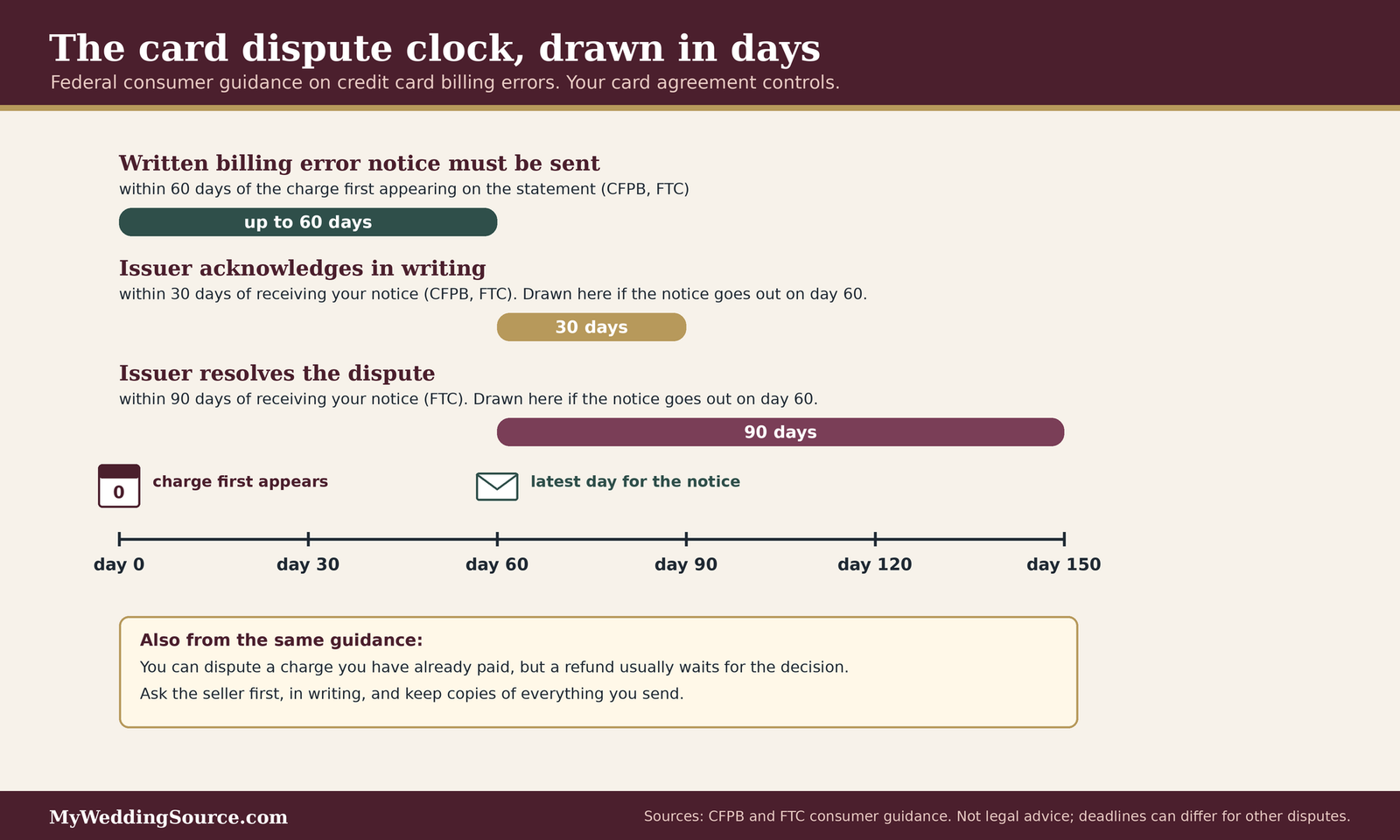
If a charge for returning wedding rentals is wrong, the card issuer’s dispute process is a federal protection for billing errors, with strict deadlines. This guide does not give legal advice, and your card agreement controls.
The clocks that matter
The Consumer Financial Protection Bureau says to call the card company right away, send a written billing error notice, and keep copies of everything. It says the written notice must be sent within 60 calendar days after the charge first appeared on your statement, and that the company then has 30 days to confirm it received the dispute unless it has already finished resolving it. The Federal Trade Commission adds that the issuer must resolve the dispute within 90 days of receiving the complaint, and that if you disagree with the outcome you must act within 10 days or by the payment deadline, whichever is later.
The CFPB also says you can still dispute a charge you have already paid, though you probably will not get the money back until the company decides in your favor.
What to send and what to try first
The FTC says to write to the issuer’s billing-inquiry address, which may differ from the payment address, and to include your name, address, account number, and a description of the error, with copies of supporting records and never originals. For disputes about goods or services, the FTC explains that protection can depend on conditions such as trying to resolve the problem with the seller first and the purchase being made within your home state or within 100 miles of your billing address, with a minimum amount, and that state rules vary. The CFPB notes that disputes about defective goods or services may need a different process. In practice, ask the rental company first, keep that conversation in writing, and then read your card issuer’s instructions.
Insurance and liability: what to check
Insurance for returning wedding rentals is where general statements stop being safe. Policies differ, and what one provider covers another may not.
Policies you may already have
Before buying anything, find out what you have.
Homeowners and renters policies
Event Helper, an event insurance provider, says your homeowners insurance may already offer some protection for rented equipment, and that coverage for rented gear may be offered at booking or included in the rental price. Call your insurer or agent and ask directly whether rented items are covered at your home, at a venue, and in transit. Ask for the answer in writing. We cannot tell you what your policy covers.
Venue and vendor requirements
Some venues require proof of liability insurance, and Party Rental Ltd. mentions that buildings may require a certificate of insurance from the rental company. Ask your venue what documents it requires and who supplies them, so that a Monday pickup is not delayed by missing paperwork.
Event insurance and rented property
Event liability policies are sold by several providers, and their descriptions of rented property differ.
Two providers, two descriptions
Event Helper says that damage to rented equipment is not covered under its Special Event General Liability policies, and that the renter is responsible for planning how to cover it. Insurance Canopy, an insurance agency, says in its educational material that wedding liability coverage can address damage to a venue or rented equipment, for example broken chairs or a stained carpet, but not damage to the host’s own property or decor, and that venues are not automatically covered unless added as additional insureds. It also lists exclusions including events that run past 2:00 a.m. or overnight.
Both statements can be true because they describe different policies. That is why the wording of your policy decides, and why a general description should never replace reading it.
What to ask an agent
Ask whether the policy covers rented property, whether it covers damage during teardown and while items are staged overnight, whether theft is covered, what the deductible is, whether the venue must be named as an additional insured, and whether any time limits apply. Keep the answers with your rental paperwork. We do not sell insurance or recommend a policy, and this is not insurance or legal advice. Our overview of wedding insurance explains the general categories.
Edge cases that change the plan
Most plans for returning wedding rentals fit the pattern above. Some do not, and those are the ones that cost money when the plan is a guess.
Calendar and schedule surprises
Dates are the most common source of trouble in returning wedding rentals.
A holiday Monday
If your Sunday wedding falls on a long weekend and you are returning wedding rentals, the first business day may be Tuesday, and a rental company may be closed or running a reduced schedule on Monday. We have not found a published rule that applies everywhere, so ask directly: what is the return day, does the pickup window move, and does the rental period or fee change? Get the answer in writing.
A late or missed pickup
If the window passes and no truck arrives, call the dispatcher, note the time, and photograph the staged items. Platinum Event Rentals says late or unarranged pickups and returns may incur extra fees, and it is reasonable to ask the company to confirm in writing that any delay is not the renter’s fault. Do not leave items outdoors without permission if rain is forecast.
Several vendors and several return rules
Many weddings use more than one rental supplier, which complicates returning wedding rentals.
Splitting items by vendor
Use separate piles and separate count notes for each company, because their pickup days, conditions, and fees differ. Premier Table Linens asks that each contract’s linen return under its own label, and the same logic applies to crates from different companies. Mark each pile with the company’s name.
A planner or venue who handles some rentals
If your planner or venue ordered some rentals on your behalf, ask whose name is on each agreement. Responsibility generally follows the signature, but contracts differ. Ask the planner or venue in writing to confirm who handles returns and whether any fees pass through to you. Our guide on wedding vendor due diligence can help you ask these questions consistently.
Couples who leave town
A Sunday reception often leads straight into travel, and returning wedding rentals has to fit around it.
Honeymoon on Monday
If you leave Monday, returning wedding rentals still needs the pickup witness and the dispute decision both need to be delegated. Give your helper the folder, tell the rental company in writing who is authorized, and make sure someone can forward the final invoice to you. The dispute window runs from when the charge first appears on your statement, and the CFPB says the written notice is due within 60 calendar days, so do not let a bill sit unopened for a month.
Out-of-town venues
If the venue is far from home, the rental company may add delivery fees or require different timing, and your helper may not know the area. Ask the company how far it travels and whether remote sites require different windows. In The Event notes that deliveries outside standard business hours or to remote sites may cost extra. For wider planning of the weekend, see our guide to wedding weekend event planning.
Questions to ask before you sign
These questions turn the map for returning wedding rentals into a contract conversation. Ask for answers in writing and keep them with the agreement. Each group is also a good checklist for a vendor call.
Questions to ask about returning wedding rentals
- When does my responsibility for the items begin and end?
- What is the return or pickup day if my event ends on Sunday, and what is the pickup window?
- Is Sunday-night pickup available, and what does it cost?
- What condition must items be in, and where must they be staged?
- What does the damage waiver cover and exclude, and is it refundable?
- How will you count items at pickup, and will you give me a written count?
- What are the fees for late returns, missing items, and damaged linens?
- Who may sign for pickup on my behalf?
About timing and access
These questions confirm when the truck comes and whether it can get in.
Pickup day, window, and delays
Ask what the pickup window is, how you will be told if it changes, and what happens if the truck is late. Ask whether the Monday pickup could shift for a holiday or weather.
Venue access and paperwork
Ask whether the company needs a loading area, a contact at the venue, a certificate of insurance, or a gate code. Confirm that the venue has agreed to all of it in writing.
About condition and fees
These questions define what counts as damage and what counts as normal wear.
Normal wear and damage
Ask what the company considers normal wear, especially for linens and glassware, and what the fees are for burns, wax, ink, mildew, missing pieces, and breakage. Hill Country Event Rentals’ policy separates normal food and drink stains from damage, and your company may draw the line elsewhere.
Waivers, deposits, and final billing
Ask when the final invoice will be sent, how fees are itemized, how to question a charge, and whether any deposit is held against damage. Ask for the process and the deadline in writing.
FAQ: returning wedding rentals after a Sunday reception
Timing and pickup
When are wedding rentals usually returned after a Sunday reception?
Often the next business day, which is Monday, though policies vary. Platinum Event Rentals says weekend rentals are typically returned the Monday after, and also charges extra for Sunday delivery or pickup. Your contract sets the real day and window, so ask for both in writing before the wedding.
Can the rental company pick up on Sunday night?
Some can, some cannot, and it may cost extra. One company says Sunday pickup costs $40 more and that pickups between 7:00 pm and 6:00 am add $250. Another lists no Sunday pickups on its page. Ask your company whether Sunday-night pickup exists, what it costs, and whether the venue allows it.
What if nobody can be there on Monday?
Ask the venue whether its staff can receive the pickup, or ask the company whether a signed authorization and staged items are enough. Choose a helper who is not in the wedding party, give them the paperwork folder, and tell the company in writing who may sign. Leaving items unattended may shift risk to you.
Condition and damage
Do I need to wash rented linens before returning them?
Usually not, and often you should not. Hill Country Event Rentals says not to wash, dry, iron, or dry clean its linens, and KCH says customers should not wash linens. Shake out debris, let damp cloths air-dry before bagging, and follow the instructions in your own contract.
What counts as damage to rented linens?
Policies differ, but several treat ordinary food and drink stains as normal and burns, candle wax, ink, paint, tears, and mold as damage. Premiere Events and Hill Country Event Rentals both draw that line in their published rules. Ask your company for its list and photograph any problems when linens arrive.
Is a damage waiver worth it?
It depends on the company, the items, and your tolerance for surprise charges. Published waivers range from about 5 to 15 percent of the rental total, and they usually cover accidental damage only, not loss or theft. Estimate your exposure with the contract’s replacement prices, then decide. This is not financial advice.
Charges and disputes
What if the final invoice has a charge I do not agree with?
Ask the company in writing to explain it and send its evidence, then compare that with your contract and photos. If it stays unresolved, the Consumer Financial Protection Bureau says a written billing error notice must reach the card company within 60 calendar days after the charge first appears. Keep copies of everything.
Does my wedding insurance cover damaged rentals?
It depends on the policy. One event insurance provider says damage to rented equipment is not covered by its special event liability policies, while another agency describes liability coverage that can address damage to rented equipment or a venue. Read your policy wording, ask the agent in writing, and check your homeowners or renters policy.
Your next steps
Before the wedding
Read the agreement and fill the roster
Set aside thirty minutes about a week out to plan returning wedding rentals. Read the return clauses, note the pickup day and window, and complete the return roster with names and backups. Our wedding rental planning checklist can help you confirm quantities and delivery details at the same time.
Brief the people who will help
Send the Monday helper the folder, the roster, and a one-page summary. Add the teardown lead and caterer contact. If the groomsmen’s attire is also rented, see our guide to groomsmen rental returns so suits and shoes do not get lost in the same shuffle.
After the wedding
Finish the return and check the invoice
Finish returning wedding rentals by photographing the staged items, watching the count, and keeping the receipt. When the final invoice arrives, compare it with the contract. Put the rest of your post-wedding errands on one list with our after-wedding checklist, and for owned decor that is not going back to a company, see wedding keepsake storage.
Review your card statements
Look at your card statements for the rental charges, and note the date each charge appeared. Our guide to wedding credit card reconciliation walks through matching charges to vendors. For the wider plan, use our wedding planning checklist.
Sources & methodology
How we built this guide
What we relied on
This guide draws on federal consumer guidance on disputing credit card billing errors, published policy and help pages from event and linen rental companies, an industry software vendor’s blog on damage waivers, and two insurance providers’ educational pages. Company policies are cited as examples of how one business handles returns, because rental terms differ by company and region. The worked waiver and glass-breakage estimate is our own arithmetic and uses example prices from one company’s published policy. We checked these pages on November 12, 2026, and policies, fees, and rules can change, so confirm current terms with your own rental company and card issuer.
What we did not do
We did not review your rental contract, your insurance policy, or your card agreement, and we did not test any company’s return process. Nothing here is legal, insurance, or financial advice. Contracts, state law, and card terms differ, and your signed documents control. Where a statement comes from a company or an insurance seller, we attribute it, because its advice reflects its own products. We have no financial relationship with any company named.
Source list
Government and consumer-protection sources
- Consumer Financial Protection Bureau, How do I dispute a charge on my credit card bill: https://www.consumerfinance.gov/ask-cfpb/how-do-i-dispute-a-credit-card-charge-en-61/
- Federal Trade Commission, Using credit cards and disputing charges: https://consumer.ftc.gov/articles/using-credit-cards-and-disputing-charges
Rental company and industry sources
- Platinum Event Rentals, Policies and FAQs: https://www.platinumeventrentals.com/?p=31
- KCH Event Equipment Rental, Frequently asked event and rental questions: https://cdn.shopify.com/s/files/1/0622/0097/1455/files/Frequently_Asked_Event_and_Rental_Questions_1659940932.pdf
- Premier Table Linens, How does the return process work for rental: https://help.premiertablelinens.com/article/how-does-the-return-process-work-for-rental
- Premiere Events, Linen rental and return instructions (August 2023): https://premiereeventsonline.com/wp-content/uploads/2023/08/Linen-Rental-and-Return-Instructions-8_2023.pdf
- Hill Country Event Rentals, Linen damage policy: https://intercom.help/hill-country-event-rentals/en/articles/15805555-linen-damage-policy
- Party Rental Ltd., Questions to ask before you start your event rental order: https://help.partyrentalltd.com/questions-to-ask-before-you-start-your-event-rental-order
- Allied Event Solutions, Five things you need to know about event rentals: https://www.alliedpartyrentals.com/5-things-you-need-to-know-about-event-rentals/
- In The Event, Tips for first-time party rental users: https://intheevent.com/tips-for-first-time-party-rental-users/
- Rentopian, Implementing an effective damage waiver policy: https://rentopian.com/?p=406
Insurance sources
- Event Helper, How is my rented equipment covered: https://www.theeventhelper.com/articles/how-is-my-rented-equipment-covered
- Insurance Canopy, Wedding liability insurance: https://www.insurancecanopy.com/?p=138959