

A destination wedding checklist works when every task has a date, a reason, and an owner, so this one runs from the first legal-rules check a year out to the paperwork you file after you are home.
You have picked a place, maybe a resort in the Caribbean, a villa in Italy, or a lodge in the mountains, and now the real question is not “what do we book?” but “what do we do first, and what happens if we do it in the wrong order?” At home, a late decision usually costs a little money. Abroad, a late decision can mean a passport that does not arrive in time, a marriage that is only symbolic, or a room block that leaves you paying for empty beds. The checklist below is built around those consequences, so each step explains why it sits where it does.
Think of this page as the master sequence, and think of the other pages on this site as the detail behind individual lines. Guests have their own cost picture, which we cover in destination wedding guest costs. Honeymoon coverage, cancellation terms, and marriage-license checks each get their own section below, with links to the deeper guides where they help. Here we stitch those pieces into a single timeline.
One scope note before the list. This is general educational information, not legal, medical, financial, or insurance advice. Entry rules, marriage laws, and contract terms differ by country and by agreement, and they change, so every rule below points you to an official source to check rather than asking you to trust a summary.
Why a destination wedding changes the timeline
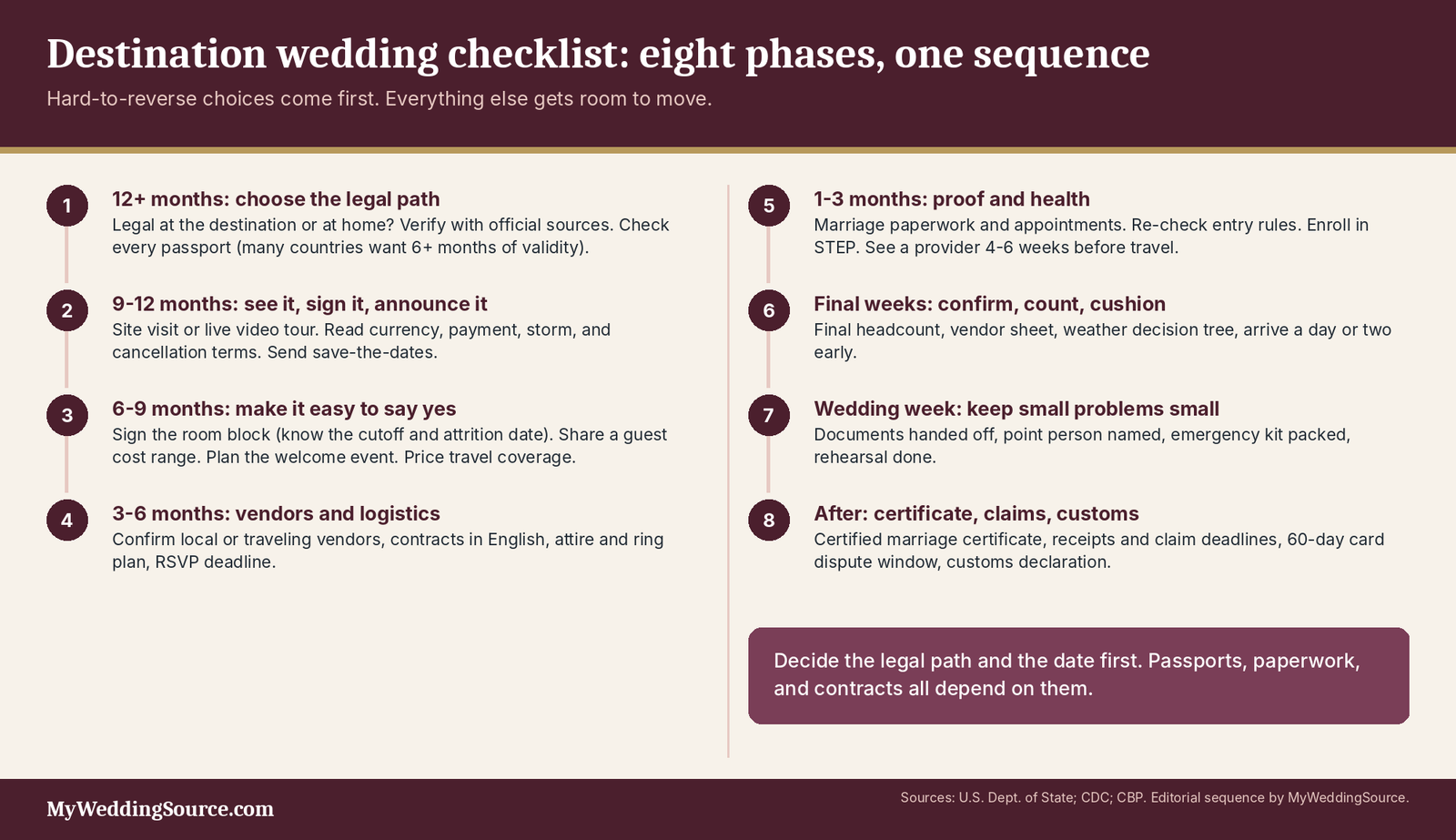
A hometown wedding lets you fix problems by driving across town. A destination wedding adds government processes, international travel, time zones, currency, and guests who need months of notice to take time off, so the same tasks start earlier and have fewer second chances. The two sections below show how the phases fit together and which early decisions move every later date.
The timeline at a glance
Why destination weddings start earlier than local ones
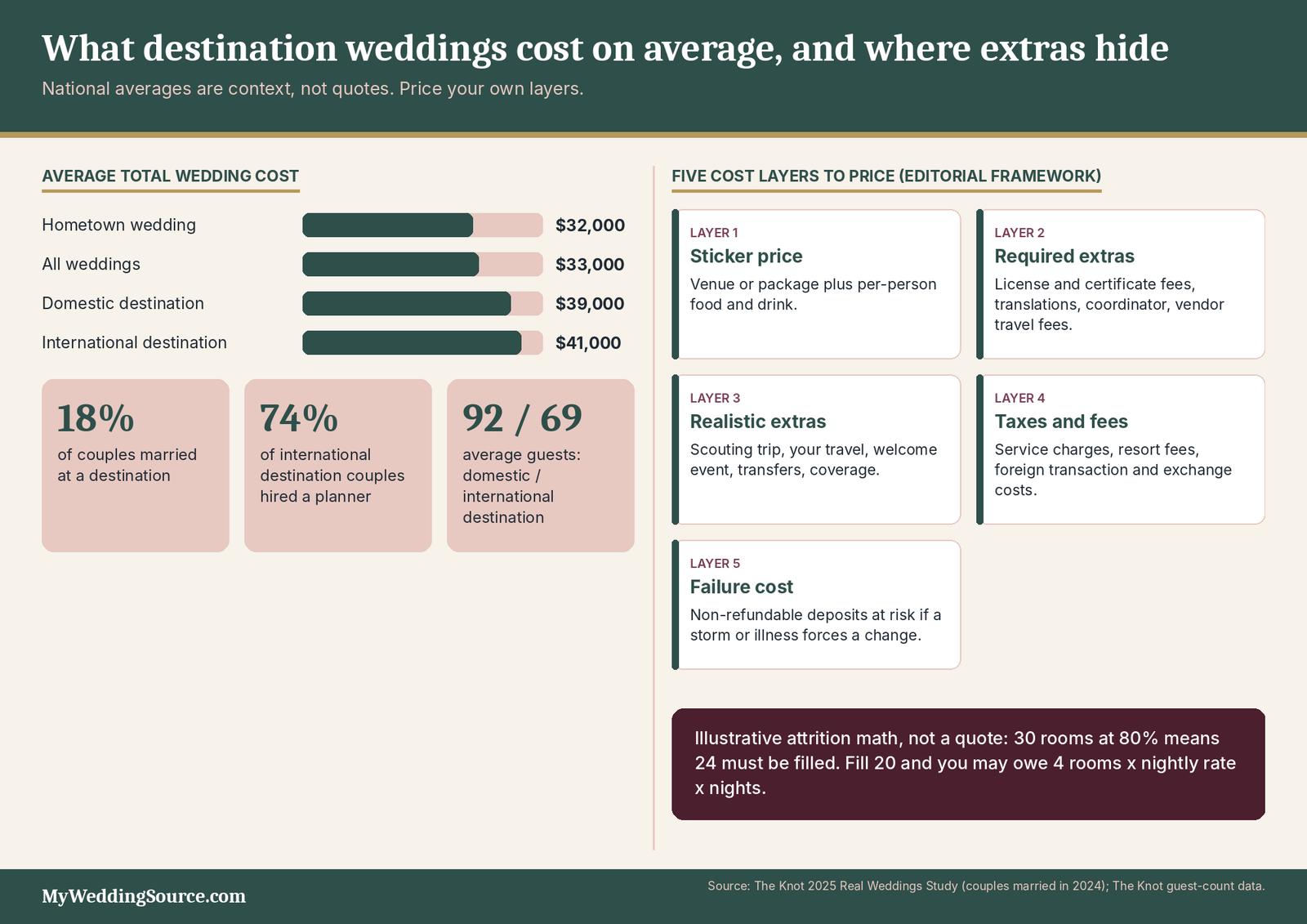
The Knot’s 2025 Real Weddings Study, which surveyed nearly 17,000 couples who married in 2024, found that 18% of couples had a destination wedding, and that 74% of international destination couples hired a planner, compared with 32% of hometown couples. Those numbers hint at why: the logistics are heavier and the vendors are farther away. Guests also need time to request leave and price flights, which is why save-the-dates for a travel wedding go out earlier than for a local one. Starting early does not require deciding everything early; it means getting the hard-to-reverse choices (country, legal path, venue, dates) settled first so everything else has room to move.
How the eight phases fit together
Read the table as a dependency chain rather than a to-do list. The legal path and the date determine your documents timeline. The venue contract determines your payment schedule and cancellation exposure. The room block and guest notice determine how many people can realistically attend, which feeds back into your catering or package minimums. If you want the same sequence for a local wedding, the month-by-month wedding timeline guide is the companion, and this page shows what shifts when borders are involved.
| Phase | Main jobs | Hardest to reverse |
|---|---|---|
| 12+ months out | Legal path, budget layers, passport check, planner or agent choice | Country and season |
| 9-12 months | Site visit, venue or resort contract, save-the-dates, room block request | Signed contract and deposit |
| 6-9 months | Room block signed, guest travel info, welcome event plan, insurance bought | Attrition clause |
| 3-6 months | Vendors sourced and confirmed, invitations, shipping and attire plans | Vendor deposits |
| 1-3 months | Marriage paperwork, entry authorizations, health visits, final payments | Document appointments |
| Final weeks | Headcount, timeline, weather plan, travel buffers, vendor confirmations | Final guarantee |
| Wedding week | Arrivals, license steps, rehearsal, welcome event, emergency kit | Hours, not days |
| After | Certificate, document filing, vendor reconciliation, customs, claims | Claim and filing deadlines |
Three decisions that reset every date
Season and storm windows
Weather is a calendar item, not just a rain plan. The National Hurricane Center says the Atlantic hurricane season runs June 1 to November 30, peaking around September 10 with most activity from mid-August to mid-October. NOAA’s Climate Prediction Center says the eastern Pacific season runs May 15 through November 30. If your destination is in the Caribbean, along the Gulf of Mexico, or on Mexico’s Pacific coast, an off-peak date or a dependable indoor backup becomes part of the contract conversation. The checklist treats storm season as a cost and timing question: it affects venue pricing, insurance timing, and whether a cancellation clause works for you.
Distance, entry rules, and travel advisories
How hard a place is to reach affects which guests will come, and entry rules can differ sharply from one destination to the next. The State Department’s country pages cover entry and exit requirements for each destination, and its travel advisories use four levels: exercise normal precautions, exercise increased caution, reconsider travel, and do not travel. Check the advisory and the entry section for your destination at three moments: when you shortlist, when you sign, and about a month before departure. A higher advisory level can change what insurance will cover and what your guests are willing to risk, so it belongs in the decision rather than as an afterthought.
Guest model: who realistically comes
Destination weddings are smaller. Per The Knot’s published guest-count data, domestic destination weddings average 92 guests and international ones 69, compared with 117 overall and 123 for hometown weddings. That gap matters for package minimums, room blocks, and feelings: a plan built for 120 who “might come” is not the same as a plan built for 60 who will. Decide early whether you want a small celebration with a core group, a larger event with a welcome party and a second, casual gathering at home later, or a mix, since each model changes your room block size, your catering minimum, and your timeline.
Legal marriage or symbolic ceremony: decide this first
The single most expensive misunderstanding in destination planning is assuming that a beautiful ceremony abroad is automatically a legal marriage. It might be, or it might not, and the answer depends on the destination’s law, not on what the resort’s brochure implies. Settling this early shapes your documents, your timeline, and your name-change paperwork later.
Two paths and what each requires
Most couples end up on one of two paths, or a hybrid. Each has different paperwork and different risks, summarized in the table below. The table after these sections lines up the two paths so you can see where the paperwork, the risk, and the aftermath differ.
Marrying legally at the destination
The U.S. Department of State says plainly that you must follow local laws when marrying abroad, that local law decides who can perform the marriage, and that U.S. embassy and consulate employees cannot perform marriages in foreign countries. Requirements vary but may include a residency period, age rules, parental consent for younger applicants, and proof that any previous marriage has ended, and documents may need to be translated into the local language and authenticated. The consequence is that a legal wedding abroad adds paperwork months before departure, usually involving notarized or certified copies of documents, and sometimes an appointment you cannot reschedule from home.
Marrying legally at home and celebrating abroad
The State Department page also notes that a legal marriage in the United States followed by a celebration abroad avoids the complexity of obtaining a foreign marriage certificate. Many couples use this path, either by signing the license at a courthouse before the trip or by having a licensed officiant handle the legal portion at home. The trade-off is practical: you hold two events, or a quiet legal step and a larger ceremony, and you need to settle which date is your anniversary. If you choose this route, verify your home jurisdiction’s rules directly with the issuing office, and see marriage license vs. marriage certificate for the difference between the two documents.
The hybrid: legal first, ceremony later
A common hybrid has a civil ceremony at home with a few witnesses, followed by a ceremony abroad that is deliberately symbolic. Its advantage is that nothing about your legal status depends on a foreign office, a translator, or a weather delay. Its risk is only communication: tell your destination officiant and venue that the ceremony is symbolic so they do not file local paperwork you do not need, and tell guests how you want it described. Whichever path you choose, put the decision in writing with your planner or venue, since a coordinator who assumes you are legally marrying on-site will start different paperwork than one who assumes you are not.
| Legal at destination | Legal at home, celebrate abroad | |
|---|---|---|
| Governing rules | Destination’s law and officials | Your home state or county rules |
| Paperwork timing | Months ahead, often with translations | Standard license window at home |
| Biggest risk | Missing or unauthenticated document | Two events to schedule and explain |
| After the wedding | Obtain, and possibly authenticate, a foreign certificate | Standard certificate from your home jurisdiction |
| Best fit | Couples who want the destination date to be the legal date | Couples who want fewer dependencies on foreign offices |
How to verify the rules for your destination
Never rely on a blog post, a resort FAQ alone, or a friend’s experience to decide whether your documents are enough. The State Department recommends checking with the office that issues marriage certificates or the tourist information bureau of the country where you plan to marry, and that is the right instinct: official sources first, then the venue’s coordinator for how they run the process. Treat anything you read here, including the examples below, as a pointer to the official source rather than a replacement for it.
Where to look, in order
Start with the State Department’s marriage page and your destination’s country page, then go to the destination government’s own site or its official tourism board, and only then ask the venue’s wedding coordinator how they handle it. If you work with a destination planner, ask for the official source behind every requirement they cite and note the date you checked it. The State Department also says some countries require proof of legal capacity to marry, such as an affidavit of eligibility, and notes that the U.S. government cannot attest to your marital status. If an affidavit must be notarized abroad, you may need an appointment at a U.S. embassy or consulate.
What varies, with three official examples
Requirements truly differ, and a short comparison shows how much. The examples below come from each place’s own official pages as reviewed in October 2026, and they are illustrations of variety rather than a guide to your destination, since rules change and individual circumstances matter. Notice how many separate variables appear across just three places: waiting periods, document formats, who may officiate, and what counts as the legal record afterward.
| Destination | What the official source says | Source |
|---|---|---|
| Hawaii (U.S.) | No state residence or citizenship requirement, no waiting period; license valid 30 days and only in Hawaii; both applicants appear together; officiant must be state-licensed; $65 | Hawaii Dept. of Health |
| Jamaica | Visitors can marry 24 hours after arrival if a license application was made first; documents must be translated into English and notarized; the marriage register is not a legal document, so a certified certificate must be requested | Jamaica consulate (Miami) |
| The Bahamas | Couples may apply the day after arrival; passport, birth certificate, and photo ID required; two witnesses; $120 fee including one certified certificate; local clergy perform the ceremony, sunrise to sunset | Bahamas Ministry of Tourism |
Why a “yes” from the resort is not enough
A resort coordinator will usually know the local process well, but their job is to run weddings, not to guarantee that your marriage is recognized at home. The State Department says a marriage done abroad is valid in that country if it follows local law, and that whether another country recognizes it depends on that country’s own laws; for U.S. recognition it suggests contacting the attorney general’s office of the state where you live. If legal status matters to you for immigration, taxes, insurance, or a name change, treat the on-site coordinator as a helper and the official sources as the authority. Ask them to tell you which documents they will hold, which they will return, and how long a certified certificate takes.
After the ceremony: certificates, authentication, and names
The paperwork does not end at the altar. A foreign certificate may need translation, and some institutions at home, from the Social Security Administration to a bank, may want specific versions. Plan this at the start so you do not discover the requirement from a clerk three months after the wedding.
Getting the certificate
The State Department says to contact the office that issues marriage certificates in the destination country, and Jamaica’s example above shows why it matters: a ceremony register is not the legal certificate. Ask your planner who requests the certificate, how many certified copies come with the fee, how long it takes, and how it reaches you. Request extras up front if the fee structure allows, since name-change and records offices at home often want certified copies rather than photocopies.
Apostilles and authentication
Documents moving between countries sometimes need to be authenticated so another country’s officials will accept them. The State Department’s Office of Authentications says it issues both apostilles and authentication certificates, that the type depends on the country where the document will be used, and its page lists mail-in service with a four-week processing time and a $20 per-document fee at the time we reviewed it. Whether you need this at all depends on the specific documents and countries involved, which is why asking for the exact list early beats guessing. State-issued documents are often authenticated by a state office instead, so confirm the right office for each document.
Name change and records
If you plan to change your name, the certificate you hold determines how smoothly it goes. The sequence at home is its own project, and the main destination-specific lesson is to confirm before you leave whether the certificate you will receive is the document the agencies will accept. When the answer is uncertain, a legal ceremony at home plus a celebration abroad removes the question entirely, which is one reason many couples choose it.
12 to 9 months out: lock the foundations
The first quarter of the timeline is where the expensive, hard-to-reverse choices live: the budget structure, the documents, the help you hire, and the venue contract. Done in this order, they make everything after them cheaper. Done out of order, you can find yourself holding a signed contract for a date that your legal path or your guests cannot support.
Twelve or more months out: money, documents, and help
Build the budget in layers, not as one number
A destination budget has more layers than a hometown one, and the surprises tend to come from the layers that never appear on a venue’s price sheet. The Knot’s 2025 Real Weddings Study put the average destination wedding at about $39,000 for domestic destinations and $41,000 for international ones, against $32,000 for hometown weddings and $33,000 overall, for couples who married in 2024. Those are national averages across very different places and guest counts, not quotes, and a modest destination can cost less than a lavish hometown wedding. The more useful exercise is to list the layers for your own plan, as the callout below does, and then price each one with real quotes.
Check every passport now, including yours
The State Department’s guidance says that many countries require passports to have at least six months of validity remaining, that some require two or more blank pages, and that you should plan around the return date because some travelers need six months of validity after getting home. Its processing-times page lists routine service at 4 to 6 weeks and expedited service at 2 to 3 weeks, says the busiest period runs from late winter through summer, and suggests applying between October and December when it is quieter. At the time of our review, the fee chart showed a $130 application fee for an adult book, a $35 acceptance fee for first-time applicants, and an optional $60 expedite fee. Because your destination’s own rules may ask for more than these general points, use the destination’s country page for the final answer, and tell your wedding party and parents to check their expiration dates the day you announce.
Choose your help: local planner, travel agent, or both
The Knot’s study found that 74% of international destination couples hired a planner, against 52% of domestic destination couples and 32% of hometown couples. That is a pattern, not a rule, but it reflects what a local planner does: speaks to vendors in their language, knows what the venue permits, and can show up at the property when you cannot. A travel agent handles a different job: flights, room blocks, transfers, and often group rates. Some planners offer travel services, and some agents work with weddings, so ask each candidate exactly what is included, and use the question list in wedding planner questions as a starting point. The table below shows how the responsibilities typically divide, though the exact split depends on the contract.
| Job | Destination planner | Travel agent | You |
|---|---|---|---|
| Vendor sourcing and on-site oversight | Usually | Rarely | If no planner |
| Venue walkthroughs and local permits | Usually | Rarely | If no planner |
| Group airfare and room block | Sometimes | Often | If neither |
| Guest transfers and excursions | Sometimes | Often | If neither |
| Legal paperwork steps | Guides, does not decide | Rarely | Always owns the final check |
| Travel insurance purchase | No | Can arrange | Always reads the policy |
Nine to twelve months out: see it, sign it, announce it
Visit the site, in person or virtually
A scouting trip tells you what photographs cannot: how long the transfer from the airport really takes, whether the ceremony spot has shade at the time you plan to marry, how noise carries, how the staff handle questions, and whether the walkways work for guests who use mobility aids. If a trip is not realistic, ask the venue or your planner for a live video walkthrough at the time of day you would marry, plus the names of couples who married there recently and are willing to talk. If you do travel, book a tasting and a meeting with the person who will actually run your event, not just the sales contact. General venue questions about capacity, rain plans, and vendor rules apply here too, and the rest of this section adds the travel-specific ones.
Read the contract for the travel-specific terms
Beyond the usual clauses, a contract for a faraway venue needs a few extra checks. Confirm which currency the price and each payment are in, and what happens to your cost if exchange rates move. Ask whether the quoted price includes taxes and service charges, what the minimum guest or spend commitment is, what the hurricane or severe-weather terms say, and whether a renovation or closure clause lets the property change your date or space. Ask which law and language govern the agreement, and request an English version you can read even if the signed one is local. Until you understand what each deposit buys back, hold off on paying, and for a contract with real money at stake, consider having an attorney review it.
Send save-the-dates and open the room-block conversation
Once the date is firm, send the save-the-date with a simple website that lists the destination, the likely cost range, and the dates of any events. Guests deciding whether to attend need time to ask for leave, check passports, and price flights. At the same time, ask the venue or hotel for room-block terms in writing, because rates, cutoffs, and attrition rules are easier to negotiate before you have announced anything. If a room block is not available, ask which nearby hotels the venue works with, so guests are not left to guess.
6 to 9 months out, then 3 to 6: guests, rooms, and vendors
The middle of the timeline turns your plan into something guests can act on. Your job shifts from deciding to coordinating: sign the room block, publish travel details, and bring in the vendors who will make the day run. The tasks here tend to be less glamorous than choosing a venue, but they decide whether guests arrive informed and whether vendors arrive prepared. Treat these two phases as a pair, with guest information first and vendor logistics second.
Six to nine months out: make it easy to say yes
Guests rarely decline a destination wedding because they do not care. They decline because the cost, time off, or logistics feel unclear. Clear information, early, is the most effective thing you can offer.
Room blocks, cutoffs, and attrition
A hotel room block comes in two common forms. A courtesy block holds rooms at a group rate until a date with no financial commitment, while a contracted block guarantees rooms and carries an attrition clause, a minimum number of rooms the group must fill, with a penalty if it does not; one hotel-industry explainer describes the cutoff date as the deadline after which unbooked rooms are released. Terms vary by property, so treat that as a vocabulary guide and get the real numbers in writing. Here is an illustrative example, not a quote: a block of 30 rooms with an 80% attrition clause means 24 rooms must be filled, and if only 20 are booked, you could owe the hotel for 4 rooms times the nightly rate times the nights in the block. At a rate of $250 for three nights, that is $3,000, which is why destination couples often prefer a smaller contracted block plus a flexible courtesy overflow.
Show guests the real cost, early
The Knot’s Guest Study, a survey of 1,000 U.S. adults in 2024, found that attending the average wedding costs $610, about $270 per guest for hometown weddings, $840 for out-of-town guests who drive, and $1,680 for those who fly. Those are overall figures rather than destination-specific ones, but they point in one direction: travel is the largest cost for most guests. Share an estimated range for flights, lodging, and meals on your wedding website, name which events are optional, and consider whether a second gathering at home would let some people celebrate without traveling. That transparency also protects your guest count, because a guest who understands the cost early is more likely to decide quickly. The step-by-step math from the guest side is in destination wedding guest costs.
Plan a welcome event and a guest itinerary
A welcome event gives out-of-town guests a reason to arrive a day earlier and gives you a low-pressure moment to greet everyone, since the wedding day itself leaves little time for conversation. Keep it simple, with casual food and a set end time, and schedule it for the evening before the ceremony so travel delays do not eat into it. Build a one-page itinerary that shows arrival windows, transfer times, dress codes, and which events are optional. Leave genuine free time too, because guests who spent a month’s savings to get there usually want to see the place as well.
Three to six months out: vendors, attire, and logistics
Sourcing vendors from afar
You have three realistic routes: local vendors who work at your venue regularly, vendors who travel with you from home, and a mix. Local vendors know the venue, the permit rules, and the supply chain, while traveling vendors know your style but add travel fees, lodging, and meals to the invoice, often on top of their usual rate. Whichever route you choose, ask for galleries or references from weddings at your venue within the last year or two, hold video calls rather than relying on email alone, and request contracts in English or with a reliable translation. For photography, the usual contract questions apply, and add one more: what happens if the photographer’s flight is canceled and who covers the replacement?
Attire, rings, and what travels with you
Decide early what flies in a carry-on, what ships, and what is purchased or rented locally. Rings, important documents, medications, and anything irreplaceable belong in your carry-on and never in checked luggage. If you buy items abroad, U.S. Customs and Border Protection says travelers must declare purchased merchandise on a customs declaration form, notes personal exemptions of $200, $800, or $1,600 depending on the countries visited, and recommends keeping receipts handy. Shipping attire or decor in advance can reduce airport stress but adds customs and delivery risk, so ask your venue whether they accept deliveries and for how long they will hold them.
Invitations, RSVPs, and travel details
Set the RSVP deadline to line up with the room-block cutoff and with the point where guests need to buy flights, which is usually earlier than a local wedding would need one. Ask guests for what you actually need: attendance, arrival and departure dates for transfers, dietary needs, and accessibility needs, collected through a secure form instead of repeated email threads. Avoid collecting passport numbers or other sensitive identifiers unless a vendor genuinely requires them, and if one does, send them through the vendor’s secure process rather than a group chat. Finally, remind guests to check their own passports and entry rules, since those are individual responsibilities that you cannot manage for them.
Contracts, currency, payments, and travel coverage
Money questions get sharper when a wedding crosses a border. Deposits may be due in another currency, the vendor may not take a credit card, and the people who could fix a problem are in a different time zone. This section is general education, not financial, legal, or insurance advice, and the aim is to help you ask better questions before you pay.
Contracts, currency, and payment risk
Know the currency and the schedule
Ask for a payment schedule that lists each amount, due date, currency, and what the payment secures. If the contract is in a local currency, your final cost moves with the exchange rate, so ask whether a dollar price can be fixed in writing or whether the venue can quote both and say when the rate is locked. When you send money abroad through a regulated transfer provider, the Consumer Financial Protection Bureau says you generally see the total cost, the exchange rate if one applies, and the amount expected to arrive, warns that the recipient may receive less because of fees charged by the recipient’s bank and foreign taxes, and says you can generally cancel within 30 minutes after sending unless the money has already been picked up or deposited. Ask the vendor which fees they expect to absorb and which you will pay, because “the venue got $5,000” and “you sent $5,000” are not always the same number.
Choose payment methods you can dispute
The Federal Trade Commission’s guidance is blunt: anyone who insists you pay in only one of a few specific ways, such as a wire transfer, crypto, or gift cards, is probably a scammer, and it recommends paying by credit card when possible because cards offer more protection. That advice meets reality when a small overseas vendor can accept only a bank transfer, which is legitimate in many places, so the question becomes how to verify before you send. Confirm the account details by phone using a number you found independently, not one in the email asking for money, check that the account name matches the contract, and keep every confirmation. For card payments, the CFPB explains that you can dispute a charge for something you did not receive by writing to your card company within 60 days of the statement showing the charge, so calendar that window when a service date is far from the payment date.
Read the cancellation and force-majeure clauses
Deposits at faraway venues are often structured in tiers, with more of your money becoming non-refundable as the date approaches. Before signing, ask which events release you from the contract, whether a government travel advisory or a storm counts, and whether you can move the date rather than cancel. The mechanics of reading these clauses are covered in wedding cancellation and postponement, and the main destination-specific point is to ask how the venue defines a covered disruption at the destination, since a storm that shuts a resort may not stop a guest from flying in. Whatever the venue says, get any exceptions in writing, and keep a single file with every contract, receipt, and email.
Travel coverage basics
Which kind of coverage solves which problem
The National Association of Insurance Commissioners describes four main travel coverages: trip cancellation, travel medical, emergency medical evacuation, and accidental death or flight accident. Cancellation reimburses prepaid travel costs when a covered reason, such as illness, stops you from going. Medical coverage and evacuation matter because the CDC says that travelers are usually responsible for paying hospital and other medical expenses out of pocket at most destinations and suggests confirming whether your health insurance covers care abroad and considering added coverage for emergency evacuation. Event or wedding insurance is a separate product, which typically addresses the event rather than the trip; read it for what it covers and excludes. The table below sets out the differences, and honeymoon travel insurance coverage goes deeper on policy benefits and claim denials.
| Coverage type | Generally addresses | Commonly excluded or limited |
|---|---|---|
| Trip cancellation or interruption | Prepaid, non-refundable trip costs when a listed reason applies | Reasons not on the list, such as a change of mind or some work conflicts |
| Travel medical | Illness or injury costs while traveling | Pre-existing conditions, activities the policy excludes |
| Emergency evacuation | Transport to suitable care and, sometimes, home | Events that did not require evacuation; limits vary |
| Wedding or event insurance | Event-level losses and sometimes liability | Anything the policy does not list; read the exclusions |
Buy early, and read the exclusions
Timing matters as much as price. The NAIC says coverage generally is not useful for events already underway and that buying after a named storm typically excludes claims related to that storm. It also tells consumers to check whether any pre-existing medical conditions will exclude them and to confirm requirements for prior approval before seeking care. In practice that means pricing a policy soon after your first non-refundable deposit rather than waiting, reading the covered-reasons list, the exclusions, and the claim filing deadlines, and asking whether the policy covers each person traveling or only you. If you rely on a credit card’s built-in benefits, confirm what they cover, what you must have paid with the card, and what the claim process requires.
What the airline owes you versus what insurance pays
Insurance is not the only protection for airfare. The Department of Transportation’s refund page says a consumer is entitled to a refund if the airline cancels a flight, regardless of the reason, and also if the airline significantly delays or changes a flight, with examples such as a departure or arrival several hours off schedule, a different airport, or more connections. For tickets bought directly from an airline, a refund must be issued automatically if you reject the alternatives. That does not help when you cancel for your own reasons, and it does not cover hotels or vendors, so the fare rules you booked under still matter. Keep the distinction clear: an airline refund covers a failure by the airline, while insurance covers listed events that affect you.
1 to 3 months out and the final weeks: documents, health, and confirmations
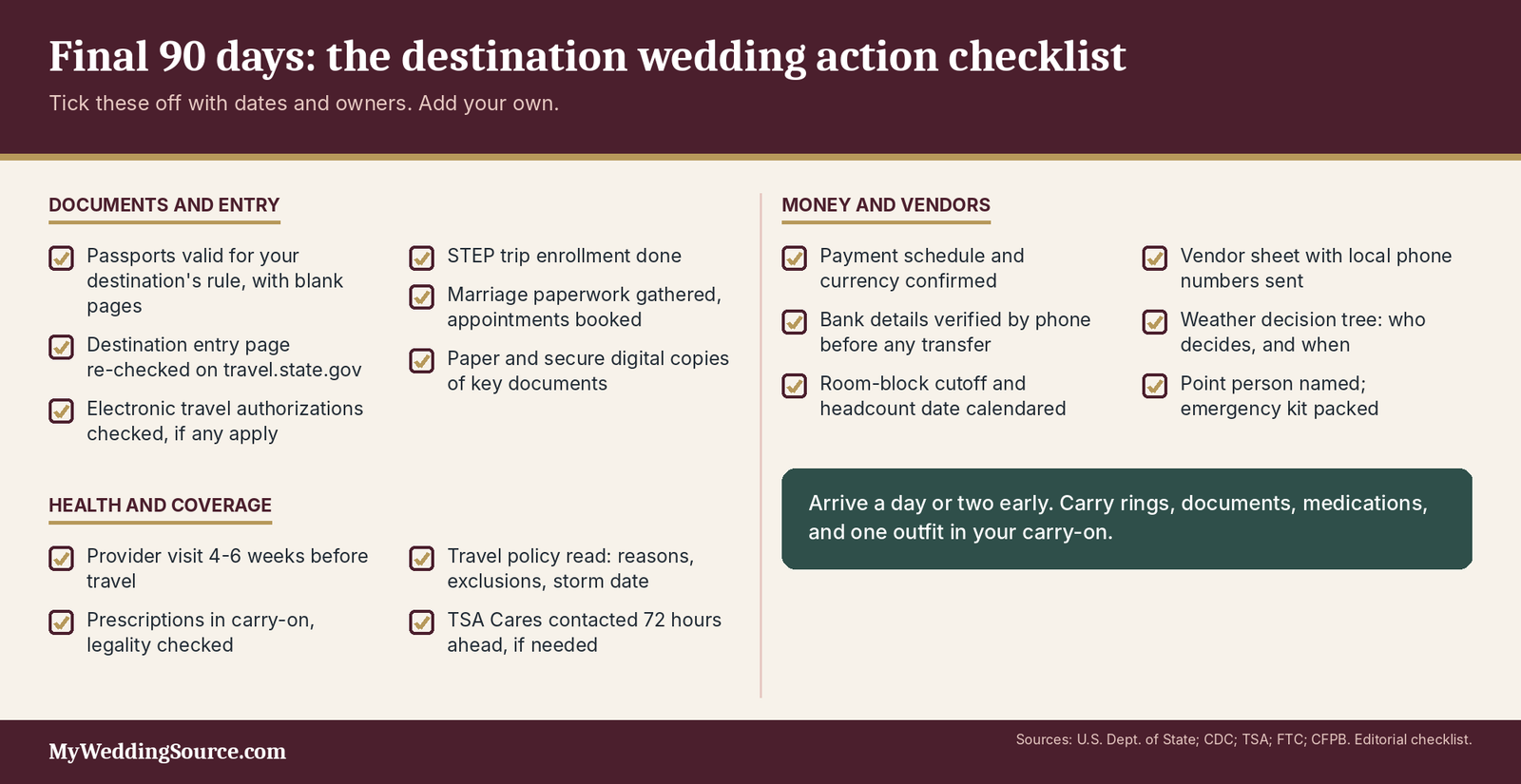
The last quarter of the timeline is about proof: proof that everyone can enter the country, proof that the legal steps are done, and proof that every vendor is ready. This is also when small gaps, like an expired document or an unconfirmed pickup time, can turn into the story couples tell for years. None of it is complicated, but all of it has lead times. The sections below sort the work by how long it takes to fix if you leave it late.
One to three months out: paperwork and health
Re-check entry rules, authorizations, and enrollment
Look at your destination’s State Department page again for entry and exit requirements, because a rule that applied when you chose the venue may have changed. Some destinations ask visa-exempt visitors to obtain an electronic authorization before travel. For example, the European Union has described its planned ETIAS authorization for visa-exempt travelers, including U.S. citizens, as scheduled for the last quarter of 2026 at a cost of 20 euros, and the EU has revised the timelines for it and its Entry/Exit System before, so check the EU’s official travel site for the current status. Whatever the destination, enroll your trip in the State Department’s Smart Traveler Enrollment Program, a free service that sends alerts from U.S. embassies and consulates and helps them contact you in an emergency.
Book health appointments and plan medications
The CDC advises seeing a health care provider or travel health specialist at least 4 to 6 weeks before you leave, and checking the CDC’s destination page for recommended vaccines or medicines. Bring your itinerary and planned activities to the appointment. The State Department adds that you should carry enough prescription medication for the entire trip, keep it in your carry-on, and confirm it is legal at the destination, since some drugs legal in the U.S. are not legal abroad. If you or a guest uses a medical device or needs assistance through airport screening, TSA recommends contacting TSA Cares at least 72 hours before departure.
Gather the legal paperwork and book the appointments
If the ceremony is legal at the destination, gather originals, certified copies, translations, and notarizations in the format the official source specifies, and book any required appointment with the marriage officer, registrar, or consulate. The Hawaii example earlier shows the kind of detail to watch for: both applicants appear together to pick up the license, and the license must be used within 30 days and only within the state. For a legal marriage at home, apply within the issuing office’s window, as described in marriage license verification. In either case, decide who carries the originals, make scans stored securely, and confirm who returns or files the signed document after the ceremony.
The final weeks: confirm, count, and cushion
Lock the headcount and confirm every vendor
Most venues and caterers need a final guest guarantee by a set date, and your room block has its own cutoff, so write both dates at the top of your planning document. Send each vendor a one-page schedule with arrival times, load-in windows, the point of contact on site, and a local phone number you can reach. Confirm final payments, the method, and who receives them, and ask for a receipt each time. Check the plan for the person who will have the license, the rings, and the vendor envelopes, because the day-of tasks that go missing are usually the ones nobody owned.
Make a weather and storm decision tree
Decide in advance what triggers a switch to the indoor option, who makes the call, and when. If your date falls within hurricane season, follow the National Hurricane Center rather than social media, and add the date when a named storm would affect your coverage. The outdoor wedding rain plan guide covers backup options in detail. Ask the venue to describe, in writing, what happens to your food, setup, and fees if a storm forces the ceremony indoors, since an indoor space that holds 60 comfortably may not hold 90.
Build travel-day buffers
Plan to arrive at least a day or two before the first event, and avoid the last flight of the day on the final travel leg before the ceremony. Keep rings, documents, medications, and one outfit in your carry-on in case a bag is delayed. The DOT’s archived Fly Rights guide says airlines may cover reasonable expenses while a missing bag is located, and that you should report a delayed bag before leaving the airport and insist on a written report. Share your itinerary with a trusted person at home and with your planner, and make sure the name on each ticket matches the passport it will be used with.
Wedding week and after: the first arrival to the last form
The week of a destination wedding is shorter than it feels. Most of the work is already done, and what remains is keeping small problems small. The weeks after are quieter but carry deadlines of their own, mostly paperwork, money, and claims.
Wedding week
Arrival day and the first 24 hours
Aim to arrive with at least one full day before your first scheduled event. On arrival, confirm your room, your vendors’ arrival windows, and the contact numbers on your one-page schedule, and take photos of your passport pages and documents to store securely. Resist the urge to schedule anything that requires you to be fresh and photogenic within hours of landing. If you arrive at an international airport late at night, ask your planner or the hotel to arrange the first transfer, so the first thing you handle is not a stranger’s price quote in a language you do not speak.
The day before: rehearsal, documents, and handoffs
Use the day before to walk through the ceremony site at the time you will actually marry, to meet the officiant if you have not already, and to hand over any documents the officiant or registrar holds. Confirm in person who is responsible for the license or certificate paperwork, where it will be signed, and who returns it. Check the forecast, confirm the weather decision with the venue, and prepare labeled envelopes for final vendor payments or gratuities, following the local custom your planner describes. Finish the day with a short list of who is doing what the next morning, since the couple should not be the people carrying the rings, the paperwork, and the champagne.
An emergency kit and a named point person
Pack a small kit with safety pins, fashion tape, stain remover, basic first aid, a sewing kit, pain relievers, any prescription medications in original containers, phone chargers and adapters, and copies of key documents. More important than the kit is a named point person who is not the couple, such as the planner, a friend, or a family member, who has the vendor contact sheet and the authority to make small decisions. Add the details you would need in an emergency: the nearest hospital, the address of the nearest U.S. embassy or consulate, and your travel insurance assistance line. The State Department notes that STEP enrollment helps embassies contact you in an emergency, so your point person should know you are enrolled and which email receives alerts.
After the wedding
Secure the certificate and start the records chain
First, confirm the marriage is properly documented. If the ceremony was legal at home, make sure the signed license was returned to the issuing office by its deadline and order certified copies, and remember that a license and a certificate are different documents. If it was legal abroad, request the certified certificate from the issuing office, and ask whether it needs translation or authentication before U.S. agencies or other institutions will accept it. Store the originals in a safe place, scan them securely, and give your planner a deadline for delivering any documents they hold, so that nothing relies on a verbal promise.
Reconcile payments, claims, and credits
Compare every final invoice with your contract, confirm any security deposits returned, and note the dates by which you must file insurance claims. Policies set their own deadlines and documentation requirements, so check yours the first week back and gather receipts, medical records, airline notices, and written vendor statements while they are fresh. If a vendor failed to deliver and you paid by credit card, the 60-day dispute window from the statement date is short, so raise it quickly. For airline credits or refunds, keep the airline’s written notice and confirmation, and follow up if the refund does not appear within the time the airline stated.
Customs, gifts, and thank-yous
When you return, CBP says all travelers must complete a declaration form listing purchased merchandise, and that personal exemptions of $200, $800, or $1,600 apply depending on the countries visited, with a minimum time abroad for most destinations. The same page recommends keeping receipts in your carry-on, and says that if in doubt, declare. Ask guests, where practical, to send gifts to your home address rather than the destination, which spares everyone the shipping problem. Finally, send thank-you notes while the photos are fresh, and include a note to the venue staff and vendors who made the trip work, since that kind of follow-up helps them and your relationships with them.
What couples forget
Every destination wedding has a short list of things nobody planned for, not because couples are careless but because the missing piece sits between two jobs. The table below collects the most common ones, and the sections after it explain how to cover them for guests and for yourselves. Reading it now is cheaper than discovering it from an airport gate or a hotel front desk.
| Often forgotten | Why it slips | What it can cost | Fix |
|---|---|---|---|
| Passport name vs. ticket name | Booking before the name decision | Denied boarding or change fees | Match the ticket to the passport you will carry |
| Accessibility on site | Photos hide steps and surfaces | Excluded guests | Ask for written access details |
| Prescription rules abroad | Assumed legal everywhere | Confiscation or medical gap | Check the destination, carry supply in cabin |
| Room-block attrition date | Buried in the contract | Payment for empty rooms | Calendar the cutoff and the check-in date |
| Vendor meals and lodging | Not in the quote | Surprise add-ons | Ask what the contract requires |
| Document copies | Digital only | Delay if a phone fails | Keep paper and secure digital copies |
| Local holidays and closures | Different calendar | Closed offices or vendors | Check the local calendar early |
| Insurance timing | Bought too late | Storm or condition exclusions | Buy soon after first deposit |
What guests need that couples forget to ask
Accessibility and mobility
The State Department says that each destination has its own laws on disability discrimination and accessibility, that some places have little or no legal protection, and that for air travel the protections come from the Air Carrier Access Act. In practice, that means you cannot assume a ramp, a step-free path, an accessible bathroom, or a vehicle that takes a wheelchair, and photographs often hide uneven surfaces. Ask the venue and hotel for written details, include a line on the RSVP inviting guests to share needs privately, and review the warning signs in accessible wedding venue red flags. Remind guests that TSA recommends contacting TSA Cares well in advance of travel if they want screening assistance.
Older relatives, kids, and health needs
Long travel days, heat, altitude, and unfamiliar food can affect older relatives and young children more than they affect the couple, so build in rest and an easy way to opt out of events. The CDC advises travelers to see a provider before leaving, and you can share that link on your wedding website without giving medical advice yourself. For dietary needs and allergies, ask guests on the RSVP and then ask your venue or caterer how they handle each one, since procedures differ by kitchen and country. Consider whether a livestream or a later home celebration would let people who cannot make the trip be part of the day.
Time off, travel days, and the people left behind
A destination wedding often asks guests to give up several days of leave plus travel days at both ends, and some cannot arrange childcare or pet care in time. Publishing the dates, itinerary, and optional events early lets them plan rather than guess. Make clear what is expected and what is optional so guests who can only attend the ceremony do not feel they must attend everything. If you are inviting only some people to the welcome event or a day trip, say so plainly and kindly, which prevents the awkward hallway conversations that are hard to fix once everyone has arrived.
What the two of you forget for yourselves
Names, tickets, and passports
If you plan to change your name after the wedding, think about the sequence now. Airline tickets generally need to match the name on the passport you will travel with, and a passport in your pre-wedding name will not match a ticket booked in a post-wedding name, so check the airline’s and the State Department’s guidance before booking the honeymoon. Many couples keep the passport in the existing name for the trip, book flights to match, and do the name change after returning. Whatever you choose, make sure everyone booking travel on your behalf, from the planner to your parents, uses the same name the passport carries.
Cash, tips, taxes, and vendor extras
Ask your planner about local tipping customs, which differ from U.S. habits, and keep small bills for gratuities that are paid in cash. Ask whether vendors need meals and a place to rest, whether overtime applies if the schedule runs long, and whether the venue charges a service fee, corkage, or a fee for outside vendors. Tell your card issuers about your travel, bring a backup card, and check foreign transaction fees before you travel. If an ATM or payment terminal offers to charge you in dollars instead of the local currency, compare the rate with your card’s, because the convenience often costs more.
Phones, power, and paper backups
Check your phone plan’s international options before you leave, or arrange a local or electronic SIM so you can reach vendors from the airport. Pack the right plug adapters, and save offline copies of your itinerary, confirmations, vendor contacts, and document scans. Print the few things you cannot afford to lose, like the officiant’s contact, the venue address in the local language, and your insurance policy number. A shared folder that your planner and point person can open makes it easy to find anything when a phone dies or a battery fails at the worst moment.
FAQ: destination wedding checklist questions
These are the questions couples ask most often once the timeline above starts to feel real. Answers are general; confirm anything legal or financial with the official source or a qualified professional. Each answer links back to the section with the full explanation, so you can go deeper where it matters to you.
Legal, travel, and paperwork questions
Do we have to get legally married at the destination?
No. The State Department notes that legally marrying in the United States and holding a celebration abroad avoids the complexity of obtaining a foreign marriage certificate, and many couples choose that route to reduce dependence on foreign offices and translations. A legal ceremony abroad is possible if the destination’s rules allow it and you can complete the paperwork on time, but it is a choice with trade-offs, not a requirement. Decide early, write down the choice, and make sure your planner and officiant know which path you are on. If you are unsure, the home-license route is the more predictable one.
How early should we start passports and paperwork?
As early as you can, ideally the day the date is set. The State Department currently lists routine passport processing at 4 to 6 weeks and expedited at 2 to 3 weeks, and says the busiest period runs from late winter through summer. Those times can change, and a destination’s marriage paperwork may need documents that take longer to obtain than a passport, such as certified copies or authenticated records. A reasonable rule is to start document gathering at least six months before the wedding for a legal ceremony abroad, and sooner if any document must be mailed, translated, or authenticated.
Does the resort’s wedding coordinator make sure our marriage is valid at home?
Not necessarily. A coordinator can manage the local process, but the State Department says whether another country recognizes a foreign marriage depends on that country’s own laws, and for recognition at home it suggests contacting the attorney general’s office of the state where you live. Ask the coordinator which documents they will file, what you will receive afterward, and how long a certified certificate takes. If the legal validity matters for a name change, immigration, or benefits, verify it with the appropriate official source before the wedding rather than after.
Money, guests, and timing questions
How much should we budget for a destination wedding?
There is no single figure, because place, guest count, and scope drive the total. The Knot’s 2025 Real Weddings Study reported average spending of about $39,000 for domestic destination weddings and $41,000 for international ones, compared with $32,000 for hometown weddings, based on couples who married in 2024. Use those numbers only as context, then build your own budget in layers: venue and food, required extras, travel and scouting, fees and taxes, and a reserve for failure costs. A smaller guest list can offset higher per-person travel and venue costs, which is one reason destination weddings tend to be smaller.
What happens if a hurricane or other disruption hits?
It depends on your contract, your insurance, and the timing of your coverage. Atlantic hurricane season runs June 1 to November 30 and the eastern Pacific season runs May 15 to November 30, so a date in those windows should come with a written storm plan and a clear understanding of what the venue will do. Ask what the contract says about moving the date, using an indoor space, and refunding or crediting deposits. Check your travel policy’s rules on named storms, since coverage bought after a storm is named typically excludes claims related to it.
Is travel insurance worth buying for a destination wedding?
It can be, and the answer depends on how much money is non-refundable and how much risk you are comfortable carrying. Add up the deposits, flights, and prepaid lodging that you could not recover, and compare that with the policy price, the covered reasons, and the exclusions. Medical and evacuation coverage may matter even if cancellation does not, since the CDC says travelers are usually responsible for medical bills out of pocket at most destinations. Compare policies by reading the documents rather than the marketing, and remember that cancellation, medical, and event coverage are separate products.
Your next steps
The checklist is long, but the first moves are short. Do these in order, and the rest of the timeline gets easier. The steps below are split into what to do this week and what to do before any money changes hands, because those are the two moments when a small action has the biggest effect.
This week
Choose the legal path and write down your sources
Decide whether the ceremony will be legal at the destination or symbolic with a legal marriage at home, and write that choice at the top of your planning document. Then save the links to the State Department’s marriage page, your destination’s country page, and the destination’s official marriage-requirements page, with the date you checked each one. Send the same note to your planner or venue coordinator so everyone is working from one plan. Set a reminder to recheck those pages every three months, since rules and fees can change.
Check passports and set the first deadlines
Look at the expiration date and blank pages on every passport in the wedding party, starting with your own, and apply or renew where needed, remembering the State Department’s guidance on six months of validity. Add three dates to your calendar: the date you must decide on the venue, the date your room-block cutoff would need to fall, and the date by which guests should have a save-the-date. If you want a second pair of eyes, ask a friend to check the calendar against the timeline table at the top of this article.
Before you pay a deposit
Ask the venue and vendors these questions
Ask for answers in writing, and compare them across the venues on your shortlist so you are looking at like-for-like terms. If a vendor is reluctant to put terms in writing, that is information in itself. If the stakes are large, an attorney’s review of the contract is a reasonable cost.
Set up payment and coverage protection
Pay deposits by a method you can dispute where the vendor allows it, verify bank details by phone before any transfer, and keep a record of each payment. Price a travel policy soon after the first non-refundable deposit, read its covered reasons and exclusions, and confirm whether it covers everyone traveling. Then store the contract, receipts, and policy in a shared folder that your point person can open, so the plan survives a lost phone or a missed email.
Sources & methodology
- U.S. Department of State: Marriage — local-law requirement, consular role, recognition, documents, and certificate guidance
- U.S. Department of State: Travel industry guidance on passports — six-month validity and blank-page guidance
- U.S. Department of State: Passport processing times — routine and expedited processing and busy seasons
- U.S. Department of State: Passport fees, October 2026 — adult application, acceptance, and expedite fees
- U.S. Department of State: Smart Traveler Enrollment Program — free embassy alerts and emergency contact
- U.S. Department of State: Travelers with disabilities — accessibility laws by destination, Air Carrier Access Act, and medication guidance
- U.S. Department of State: Office of Authentications — apostilles, authentication certificates, processing time, and fee
- CDC Travelers’ Health: Before you travel — provider visit timing, overseas health coverage, and evacuation coverage
- TSA Cares — screening assistance and the 72-hour notice recommendation
- U.S. DOT: Airline ticket refunds — refunds for canceled or significantly changed flights
- U.S. DOT: Fly Rights — delayed baggage guidance (archived page; verify current rules)
- U.S. Customs and Border Protection: What to expect when you return — declarations, exemptions, and receipts
- National Hurricane Center: Climatology — Atlantic season dates and peak
- NOAA Climate Prediction Center: Eastern Pacific hurricanes — eastern Pacific season dates
- FTC Consumer Advice: ways scammers ask you to pay — payment-method red flags and credit card protections
- CFPB: Sending money internationally — disclosures, fees, and cancellation windows
- CFPB: What is a chargeback? — 60-day billing-error window
- NAIC: Considering travel insurance — coverage types, timing, and pre-existing conditions
- The Knot: Average destination wedding cost — destination share, costs, planner use (2025 Real Weddings Study, couples married 2024)
- The Knot: Average wedding guest list size — destination guest counts
- The Knot: Wedding guest cost — Guest Study cost to attend (1,000 U.S. adults, 2024)
- Hawaii Department of Health: Marriage licenses — example of a destination-state license process
- Consulate General of Jamaica (Miami): Marriage requirements — example of an international destination’s official requirements
- Bahamas Ministry of Tourism: Marriage license — example of an international destination’s official requirements
- European Union External Action Service: ETIAS — planned authorization for visa-exempt travelers
- Engine: Courtesy room blocks — room block vocabulary (a vendor explainer; terms vary by hotel)
Methodology. Government and agency statements (State Department, CDC, TSA, DOT, CBP, NOAA, CFPB, FTC, NAIC, state and national marriage offices) are treated as verified facts as of the October 2026 review, and we link each to its source. The Knot figures are survey findings with the year and sample noted, and the room-block example, the scouting-trip range, and the attrition math are illustrative examples, not quotes. Everything about ordering, buffers, and what to ask is editorial judgment based on those sources. The three destination examples show variety only and are not a guide to any specific place.
Freshness. Recheck marriage requirements, passport fees and processing times, entry authorizations such as ETIAS, and travel advisories every three months and again 30 days before travel. Verify any destination rule on the destination’s official site at the time you plan, and reconfirm insurance terms and airline refund rules at purchase. The Knot figures will update with its next Real Weddings Study.