

Learning how to pack a travel-friendly wedding beauty emergency kit comes down to one honest question: which small beauty problems could actually appear between your front door and the end of the reception, and which of the things that fix them are allowed, safe, and light enough to bring through an airport?
Quick answer
Build the kit around problems, not products: a breakout or shine, a smudge, a snag in a nail or a strand, dry lips and mouth, a scent or sweat issue, and a broken tool. Then sort every item by how it travels. In a carry-on, TSA says liquids, gels, creams, pastes, and aerosols must be in containers of 3.4 ounces (100 milliliters) or less, all inside one quart-sized bag. Spare lithium batteries and power banks must ride in the cabin, and TSA lists cordless curling irons as carry-on only. Favor solid and powder formats, keep the heavy duplicates in a checked bag only if you can live without them, and read the grid in this guide before you pack.
This guide is about packing, not about beauty trends. It assumes you are traveling by air with a wedding in the picture: your own, a destination wedding, a bridesmaid’s weekend, or a honeymoon that begins right after the ceremony. It also works for a long car trip with a stop at a hotel, where the same weight and heat questions apply even though airport rules do not.
Two pieces of context before the details. First, this is a companion to our general wedding emergency kit guide, which covers the whole day: clothing, first aid, paper, and logistics. This article narrows to hair, skin, face, nails, mouth, and scent, and adds the layer that a general kit rarely mentions: what security screening and airline cabins allow. Second, this guide gives packing information, not medical advice. If you have a skin condition, an allergy, or a prescription, your clinician decides what you use, and you should follow their instructions over anything here.
What a travel-friendly wedding beauty emergency kit is for
A travel-friendly wedding beauty emergency kit has a narrower job than most online lists suggest. It does not need to recreate a vanity. It needs to fix the handful of small things that go wrong when you are traveling in clothes you would rather not ruin, in a hotel room you do not know, with a professional appointment you do not want to miss. When you think about how to pack a travel-friendly wedding beauty emergency kit, the word that matters most is “emergency.” A kit that holds forty products is a second suitcase, not a kit.
The job of the kit
The kit exists for three situations. The first is a repair: something moved, smudged, snagged, or broke, and you need to fix it in a few minutes. The second is a substitution: your checked bag is delayed, a product leaked, or a tool will not work with the outlet, and you need to get through the event anyway. The third is a bridge: you need something that holds your look in place until a professional can step in again. Almost every useful item belongs to one of those three jobs.
Repairs
Repairs are the most common reason people open the kit. A flaked eyeliner line, a lipstick on a tooth, a flyaway, a chipped nail, a pimple that appeared overnight. Each repair is small, and each is quick if the tool is within reach. The kit works best when the repair items sit together in one pouch you can find in the dark, rather than spread across three bags and a purse.
Substitutions and bridges
A substitution covers what you would do if your bag were delayed. A bridge covers what you would do if your stylist is running late or you have to leave the room before a touch-up. Neither needs a lot of product. It needs a plan, and a plan is mostly a short list of things you would be miserable without, written down before you pack. Our guide to the wedding beauty timeline shows where those moments tend to fall in the months before the wedding.
How this differs from a general emergency kit
A general kit holds safety pins, a sewing kit, and stain pens. A travel beauty kit is different in three ways. It is regulated more heavily by airport rules, because so many beauty products are liquids, creams, or aerosols. It is more sensitive to heat and time, because products that sit in hot cars or luggage compartments can degrade. And it is more personal, because skin and hair are not interchangeable between people the way a safety pin is.
Why airport rules matter more here
Many beauty products fall into the categories TSA limits in carry-on bags: liquids, gels, creams, pastes, and aerosols. A general kit can often skip the topic. A beauty kit cannot, because a full-size foundation, a bottle of setting spray, and a can of hairspray are all affected by the same rule. The practical result is that the kit has to be designed around the container size, not just around the contents.
Why personal fit matters more here
A bridesmaid cannot borrow your skin care, and you should not borrow hers. The FDA’s advice on using cosmetics safely is plain on one point: do not share makeup. That means a shared kit for a bridal party should be built from individual items, or from single-use applicators, rather than from products everyone dips into. We return to this in the hygiene section below.
Before you pack: the rules that shape the kit
Packing is easier when you know the rules first, and the rules are the first thing to learn about how to pack a travel-friendly wedding beauty emergency kit that will actually clear security. This section collects what TSA and the FAA say about the items that appear most often in a beauty kit. It reflects the pages we read on November 12, 2026, and rules change, so use it as a starting point and check the agency pages before you fly.
The liquids rule in plain terms
TSA’s liquids rule applies to everything in your carry-on that is a liquid, aerosol, gel, cream, or paste. The agency describes cosmetics, gels, creams, and aerosols as falling under the same rule as liquids and pastes. The rule has two parts: a limit on the size of each container, and a limit on how the containers are packed.
The container limit
Each container in your carry-on must hold 3.4 ounces (100 milliliters) or less. TSA states that larger containers go in checked baggage. The limit applies to the size of the container, not to how much is left in it, which is a point travelers often miss. A half-empty 6-ounce bottle is still a 6-ounce bottle. If you want to bring a product you already own, the usual solution is to move a small amount into a small container, which we cover in the decanting section.
The bag limit
Carry-on liquids, aerosols, gels, creams, and pastes go in one quart-sized bag, which TSA says should be separated from your other carry-on items at the checkpoint. The agency’s page does not state a limit on how many containers can go in that bag beyond the size requirement, so the practical limit is what physically fits and closes. Treat the bag as a budget, not as a minor detail. Every item you put in the quart bag is something you cannot spend that space on elsewhere.
Aerosols, hair tools, and batteries
Three beauty categories attract special instructions: aerosols such as hairspray and dry shampoo, hair tools with batteries or fuel, and spare batteries or power banks. The rules are different for each, and getting one wrong can mean a confiscated item or a problem at the gate.
Aerosols
TSA’s “What Can I Bring?” entries treat aerosols in toiletries like other restricted liquids. For hair spray, the agency lists carry-on as allowed at 3.4 ounces (100 milliliters) or less per container, and checked bags as allowed with special instructions. In checked bags, release buttons or nozzles need caps or another cover to prevent accidental discharge, and the agency gives per-person total limits of 70 ounces (2 kilograms) or 68 fluid ounces (2 liters), with each container capped at 18 ounces (0.5 kilogram) or 17 fluid ounces (500 milliliters). The FDA adds a separate note about sprays: use them in well-ventilated areas and away from open flame.
Hair tools and batteries
TSA’s entry for cordless curling irons says units powered by lithium batteries or gas or butane fuel are allowed only in carry-on bags, not in checked bags. It also says the heating element needs a securely fitted safety cover, the device needs to be protected from accidental activation, and gas refills and spare cartridges are not permitted. TSA lists corded curling irons as allowed in both carry-on and checked bags with special instructions. For the underlying battery rules, the FAA’s PackSafe guidance says spare lithium batteries, including power banks, must go in carry-on bags and need their terminals protected from short circuit. For rechargeable lithium-ion batteries, it describes 100 watt-hours per battery as the threshold for traveling without airline approval, and it notes that airlines may set stricter limits.
Medications and anything medical
Some of what people put in a beauty kit is, in the eyes of security, a medication: a prescription skin treatment, eye drops, an antihistamine, a steroid cream. TSA treats these differently from cosmetics.
What TSA says about medically necessary liquids
TSA says reasonable quantities of medically necessary liquids, gels, and aerosols are allowed beyond the standard 3-1-1 limits. You must tell the officer before screening begins, and remove the items from your carry-on for inspection. They may be screened visually, by X-ray, or tested for explosive traces, and TSA says that if an item alarms and the alarm cannot be resolved, it may not be allowed. The agency also recommends labeling pills and other solid medications to help the process go smoothly. Keep medical items separate from your cosmetics so that the officer can see the difference at a glance.
What this guide cannot tell you
Several items people ask about are not covered by the pages we read: nail polish, nail polish remover, perfume, razors, tweezers, nail clippers, and scissors. The TSA pages we read did not address them, and the agency’s own pointer for such items is to contact AskTSA. We have not invented rules for them. If you plan to carry a manicure scissors or a razor, check the current TSA listing for that exact item and ask the airline about any differences. The packing grid later in this guide marks these as “check TSA” rather than guessing.
Decide what kind of trip you are packing for
The right kit depends on how you are traveling, because the same item can be easy on one trip and awkward on another. A bride flying alone to a beach wedding with a checked dress box has a very different problem from a groomsman driving two hours to a hotel. Before you build the list, decide which of three trip shapes you are in, because how to pack a travel-friendly wedding beauty emergency kit for a flight is not the same as how to pack one for a drive.
Three trip shapes
Most weddings involving travel fall into one of three shapes, and each one changes how much the airport rules matter and how much backup you can reasonably leave at home.
Carry-on only
Carry-on only is the strictest shape. Everything liquid must fit the quart bag, every tool must pass the battery rules, and nothing can be left to chance. This is the shape for people who do not want to risk a delayed bag, and it is also the shape where choosing solid and powder formats pays off most. If you are in this shape, treat the quart bag as the scarce resource and build around it.
Carry-on plus a checked bag
Many people carry the essentials and check the rest. This gives room for full-size products, but it creates a split: some things must ride in the cabin, some can ride below, and a few cannot be checked at all. The most important rule of this shape is to carry in the cabin anything you would need within twenty-four hours if the checked bag did not arrive. That is a planning habit, not an agency rule, and it is the single most useful line in this guide for a destination wedding. Our destination wedding checklist covers the wider set of things to keep with you.
Driving or train, with a hotel stay
Road and rail trips relax the liquid rule but add a different problem: heat and time. A car parked at a venue in summer is a hot box. The FDA warns that products can spoil if stored somewhere too warm, and its eye-cosmetics page advises against storing cosmetics above 85 degrees Fahrenheit, noting hot cars as a particular concern. A beauty kit left in a trunk for an afternoon is not a safe kit.
Who carries the kit
A kit that is not with the right person at the right time is just luggage. Decide who has it before you pack it.
One kit or several
For the person getting married, one personal kit is usually enough, handed to a trusted person on the wedding day. For a bridal party, a single shared kit saves weight but runs into the hygiene rule: do not share makeup. A better design is a shared “repair pouch” of single-use items and tools, plus a personal pouch for each person’s own products. Our guide to wedding party coordination is useful if you are deciding who is responsible for what.
The handoff
On the wedding day, the person carrying the kit needs to know what is in it and where each thing is. A one-page note, taped inside the lid of the pouch, solves most problems. It should list the contents in the order you would reach for them, the name and phone number of your hair and makeup professional, and one line saying what not to touch, such as a product you have an allergy to.
Start with beauty problems, not products
The most common mistake in how to pack a travel-friendly wedding beauty emergency kit is to start at a drugstore shelf and buy whatever looks useful. A better method is to start with the problems you are actually likely to have, ranked by how much damage they would do to your day, and then choose the smallest possible item that fixes each one.
A simple sorting method
Write the problems down first. Then sort them by how likely they are, how fixable they are in five minutes, and whether you can borrow the fix from someone else or from the venue. The result is a short list of things that really earn a place.
Three questions for each item
Ask three questions. How likely is it that I will need this? If I need it and do not have it, how bad is the result? And can I replace it where I am going within an hour, from a pharmacy or a hotel front desk? An item that is unlikely, low in damage, and easy to replace does not belong in the kit. An item that is likely, high in damage, and hard to replace does.
Be honest about your own skin and hair
The people who get the best result from a kit are the ones who include their own history. If your skin flares in dry hotel air, include the product that you already know helps. If your hair frizzes in humidity, include the one thing that has worked on you before. A kit built from your own record is more useful than a kit built from a generic list, and it is also more likely to be short.
Why kits get bloated
Beauty kits grow because every possible problem has a product, and every product has a convincing advertisement. The result is a bag full of items that were each justified once and are collectively too heavy.
Duplicates and “just in case” items
Look for duplicates: two concealers, three lip products, four hair ties. Keep one of each, plus a spare only for the items that break or disappear, such as hair elastics and bobby pins. Remove anything that exists only for a problem you have never had.
Items the venue or the professional already supplies
Your hair and makeup professional will usually bring their own touch-up supplies, and many venues keep basic first-aid and sewing items. Ask. If the professional is leaving after the portraits, ask what they would recommend you carry for the reception. Our bridal hair and makeup planning guide lists questions to put to a stylist, and our hair and makeup schedule guide explains how the timing usually works.
What to pack for skin and face
For a travel-friendly wedding beauty emergency kit, skin and face are where most emergencies show up in photos, and also where product choice matters most for travel, because creams and liquids are the hardest items to carry. The best approach is a mix of small travel-size containers and solid formats that do not count against the quart bag.
Breakouts, shine, and redness
These are the problems brides and grooms ask about most. The right fix depends on what your skin is doing and on what you have tested before the trip.
Use only what you have already tested
The most important rule for a travel kit is to bring nothing new. A product you try for the first time in a hotel room the night before a wedding is a gamble, and the FDA’s advice is to stop using a product and contact a healthcare provider if you have a rash, redness, burn, or other unexpected reaction. If you want to try something, do it weeks ahead. Our guide to sensitive-skin bridal beauty goes into how to test products and what to avoid, and our wedding facial timing guide explains why treatments close to the wedding carry risk.
Shine and blotting
For shine, blotting papers or a pressed powder in a compact are the usual solution, and neither is a liquid. They add almost no weight, and they do not need the quart bag. If you wear a long-wear base, check with your makeup professional whether blotting or powder is better for it, since a product designed to stay in place may behave differently from a standard foundation. If you have oily skin, our guide to wedding makeup for oily skin is relevant.
Sun, dryness, and lips
Travel exposes skin to sun, wind, and dry cabin air, and each of them can change how your face looks on the wedding day.
Sunscreen and its rules
The FDA says sunscreen with broad-spectrum protection and an SPF of at least 15 helps protect against skin cancer and early skin aging, and it advises reapplying at least every two hours, more often if you are swimming or sweating. It also notes that spray sunscreens can catch fire and that some contain alcohol, so keep them away from open flames. For packing, a stick or a small lotion tube in a container of 3.4 ounces or less avoids the aerosol problem entirely. Sunscreens are drugs under the law and are required to have expiration dates; if yours has none printed, the FDA says to discard it three years after purchase.
Lip balm and dry skin
Lip balm in a stick is a solid and does not count against the liquid limit as a liquid, but TSA’s rules on creams and pastes can apply to balms in tubs or squeeze tubes, so a stick is the simpler choice. Dry cabin air tends to dry lips and hands. A small, plain moisturizer in a travel container, in your quart bag, is a reasonable addition if your skin is prone to dryness. If a product contains an ingredient you know you react to, leave it at home.
Eyes, lashes, and makeup repairs
Eye makeup is where the hygiene rules are strictest, and where packing mistakes can cause real harm.
Mascara, liner, and replacements
The FDA’s eye-cosmetics page says manufacturers usually recommend discarding mascara two to four months after purchase, that you should not add saliva or water to mascara, and that you should never apply or remove eye makeup in a moving vehicle. It also says to throw away eye makeup used during an eye infection. If your mascara is near the end of its life, buy a new one before the trip rather than carrying an old one. If you plan to wear false lashes, remember that the FDA treats lashes and their adhesives as cosmetics and advises checking the ingredients, since the eyelid area is delicate.
A small repair set
A practical eye repair set is short: cotton swabs, a few single-use applicators, a small container of makeup remover or micellar water within the 3.4-ounce limit, and a pencil liner or compact you already use. Cotton swabs let you correct a smudge without adding product. Single-use applicators solve the problem of testers and shared tools. Our guide to wedding makeup artist sanitation shows what clean practice looks like, which is a good standard to copy in your own kit.
What to pack for hair
In a travel-friendly wedding beauty emergency kit, hair is the other big category, and it is where the battery and aerosol rules matter most. A hair emergency is usually one of three things: something came loose, something frizzed or went flat, or a tool failed.
Holding and repairing
Pins, elastics, and clips are light, solid, and unaffected by airport rules. They are the best value in any hair kit.
Pins, elastics, and clips
Bring more bobby pins and hair elastics than you think you need, in colors that match your hair, because they are the items that disappear. A few larger clips and a comb help with repositioning. If you are wearing a veil or hair piece, ask your stylist which pins and combs they used and carry spares of the same type. Our guide to wedding veil comb security covers how veils stay in place, and our hair trial guide explains how to rehearse the look.
Brush and comb choice
One small brush or comb that suits your hair type is enough. A wide-tooth comb for curls, a tail comb for sectioning, a soft brush for smooth styles. Choose the one your stylist uses on you. Bringing a bulky brush adds weight for little benefit.
Sprays, creams, and heat tools
This is where the airport rules bite. Aerosols, creams, and battery-powered tools each have their own limits.
Hairspray, dry shampoo, and creams
A travel-size hairspray of 3.4 ounces or less can go in the quart bag. Dry shampoo is usually an aerosol and follows the same rule, and a powder dry shampoo in a non-aerosol container may be a simpler alternative if it is available for your hair color. Hair creams and serums count as creams or liquids and need small containers. In a checked bag, aerosol nozzles need caps or another cover, and the total and per-container limits described earlier apply.
Heat tools and cordless options
If you plan to bring a curling iron or flat iron, decide first whether it is corded or cordless. A corded tool is allowed in carry-on and checked bags according to TSA’s page, and it needs a compatible outlet and a cool-down plan before packing. A cordless tool powered by a lithium battery or by gas or butane is carry-on only, with its heating element covered and the device protected from accidental activation, and refills and spare cartridges are not allowed. The FAA says devices with lithium batteries should be in carry-on baggage and, if checked, must be fully off and protected from accidental activation. Because this is a fast-changing area of airline policy, check your airline’s page on the day before you fly.
What to pack for nails, hands, and the ring finger
Nails and hands are in every ring photo, so they earn a small place in a travel-friendly wedding beauty emergency kit, and a snag or chip is one of the most common small beauty problems on a wedding day. Fortunately, the fix is small and mostly solid.
Nail repairs
A repair kit for nails is a tool problem, not a product problem. The smaller it is, the better it travels.
Files, buffers, and sticks
A small emery board and a cuticle stick are light and unaffected by liquid rules. If you have a snag, filing it smooth is usually enough to stop it catching. Our guide to wedding nails covers how manicure choices hold up over a wedding week, and our guide to manicure shapes for different ring styles explains why shape matters if a ring will sit against a nail.
Polish, remover, and clippers
Nail polish, polish remover, scissors, and clippers are the items for which we did not find a rule on the TSA pages we read, so we have marked them “check TSA” in the grid below. Polish and remover are liquids, so at minimum they need small containers inside the quart bag if you bring them. If you have gel or dip nails, a touch-up bottle is rarely the right fix, because a chipped gel manicure usually needs a professional. Ask your nail technician what, if anything, to carry.
Hands, cuticles, and the ring
Hands are dry in cold weather, in airplanes, and after repeated hand washing. They are also where the rings sit.
Hand cream and ring care
A small hand cream tube in the quart bag handles most dryness. If you wear a new ring that rubs, a skin-friendly barrier such as a bandage or a plain balm stick is a better quick fix than a new product. If you have a history of ring rash or a metal allergy, see our guide on wedding band metal allergies and ask your clinician before the wedding.
Spare small items for the ring photos
If ring photos are planned, a lint-free cloth, a small microfiber, and a travel-size glass wipe can save you from fingerprints on a ring. These items are dry and light, and they are especially useful if your hands are cold or damp on the day.
What to pack for mouth, scent, and body
These are the quiet details that guests and photographers notice, and they are also very easy to get wrong when you are traveling.
Mouth and breath
Teeth, breath, and lips are small, easy to pack, and mostly solid.
Floss, mints, and a travel toothbrush
A travel toothbrush, floss, and a small pack of mints or gum fit into any pouch. Toothpaste is a paste and needs a container of 3.4 ounces or less in your quart bag. If you are whitening your teeth, follow the instructions of your dentist and do not start a new product on the trip. Our guide to teeth whitening before wedding photos explains why timing matters and what to avoid.
Lip products
Keep lip products to your tested favorites. A stick lipstick or a tinted balm is solid, easy to pack, and does not count as a liquid, while glosses and liquid lip colors do. If you wear a long-wear lip color, ask your makeup professional what removes it safely, since the wrong remover can leave lips dry on the day.
Scent, sweat, and comfort
Sweat and scent are the problems most people hesitate to mention and most appreciate being prepared for.
Deodorant and body products
A stick deodorant is solid and travels easily. Aerosol deodorants are allowed in a carry-on in containers of 3.4 ounces or less, according to TSA, and a clear antiperspirant stick avoids marks on dark clothing. Our summer wedding heat plan covers sweat and comfort in warm weather in more detail.
Fragrance
Perfume is a liquid, so it needs a small container. Many people travel with a travel-size atomizer or a solid perfume. If you are going to a wedding where guests may have fragrance sensitivities, think before you apply more on the day, and see our guide to hosting a wedding for guests with severe fragrance sensitivities and our guide on choosing a wedding fragrance.
Choose containers and decant safely
Because the quart bag is the scarce resource in any travel-friendly wedding beauty emergency kit, the container is almost as important as the product. A bad container leaks, loses its label, or holds more than the limit.
Choosing travel containers
Containers come in many types, and the right one depends on the product.
Size and material
Choose containers marked 3.4 ounces or 100 milliliters or less, which is the limit TSA states for carry-on. Smaller is easier. Look for containers that say they are leak-resistant, and test them at home with water before you trust them with a product. Silicone tubes are easy to squeeze for creams, small pots work for balms, and a mini spray bottle works for water-based liquids. Avoid glass in a carry-on pouch that will be thrown around.
Labels and original packaging
Label each container with the product name. When something is moved out of its original container, you lose the ingredient list and the batch information. Take a photo of the original label and keep it in your phone, so that you can check ingredients if a reaction occurs, and so that you can report a problem to the manufacturer or the FDA if one is needed. The FDA says that you can report cosmetic complaints, such as a rash or a bad smell, through its reporting page.
Decanting hygiene
Moving product from one container to another creates a chance for contamination.
Clean tools and clean hands
Wash your hands, and use a clean spatula or a clean pump rather than your fingers. The FDA’s advice is to wash your hands before using a product and to keep containers clean and tightly closed. Wipe the container with a clean tissue before you fill it, and let it dry fully.
Know when to buy instead
Not every product is worth decanting. Eye products, products with active ingredients, and anything you only partly trust are better bought in travel size or left at home. A decanted product is only as clean as the process used, and for eye-area products the risk is higher. Many brands sell travel sizes; this is often a better path than moving a product yourself.
What this kit costs
The cost of a travel kit is mostly in what you buy new. We did not verify current prices, and airline baggage fees vary, so use your own receipts. A few habits keep the cost down. Build the kit from products you already own and use. Buy travel-size versions only for items you cannot decant safely. Choose solid formats that last a long time. Check your airline’s baggage fee before deciding whether to check a bag at all, because the fee may cost more than replacing a few products at your destination.

The carry-on compliant beauty kit packing grid
This is the working tool of the guide, and the most direct answer to how to pack a travel-friendly wedding beauty emergency kit without breaking a rule. The grid lists common items by category and shows how each is usually handled at the airport, based on the agency pages we read, with a plain note where the pages were silent. Use it as a draft, then confirm any item you are unsure about with TSA and your airline.
How to read the grid
The columns show what the item is, how it is usually carried, what the agency pages say, and any caution. The “carry-on” column is for what rides in the cabin. The “checked” column describes what we found for the checked bag.
The status labels
“Quart bag” means the item is a liquid, gel, cream, paste, or aerosol and must be in a container of 3.4 ounces or less inside the single quart-sized bag. “Cabin” means the item is solid or dry and can go in the carry-on without the quart bag, as far as the pages we read go. “Cabin only” means the item should not be checked. “Check TSA” means we did not find a rule and you should look up the exact item.
What the grid does not cover
The grid does not cover international rules, which can differ from U.S. rules. It also does not cover airline-specific policies, which can be stricter than TSA’s, and it does not replace advice from your clinician about medication.
The grid
How the rows are ordered
Rows run from face to hair to tools to body, roughly the order you would pack them. Read across a row: the format tells you which rule applies, the carry-on and checked columns tell you where the item can ride, and the note flags the usual trap.
| Item | Format | Carry-on | Checked bag | Note |
|---|---|---|---|---|
| Foundation, concealer (liquid or cream) | Liquid or cream | Quart bag, 3.4 oz or less | Allowed in larger sizes | Stick or powder versions skip the quart bag |
| Pressed powder, blotting papers | Solid | Cabin | Allowed | Light and flat; good first pick |
| Mascara, liquid liner | Liquid | Quart bag | Allowed | Replace mascara if it is old; do not add water or saliva |
| Pencil liner, brow pencil | Solid | Cabin | Allowed | Sharpen at home; check the sharpener with TSA |
| Lipstick (stick), lip balm (stick) | Solid | Cabin | Allowed | Gloss or tubs of balm count as cream or liquid |
| Hairspray, dry shampoo (aerosol) | Aerosol | Quart bag, 3.4 oz or less | Allowed with nozzle cover and limits | Do not spray near flame; limits per person apply |
| Hair creams, serums, gel | Cream or gel | Quart bag | Allowed in larger sizes | Decant only if you can do so cleanly |
| Bobby pins, elastics, clips, comb | Solid | Cabin | Allowed | Carry extra; cheap and light |
| Corded curling iron or flat iron | Electric tool | Allowed with special instructions | Allowed with special instructions | Check voltage and outlet at your destination |
| Cordless curling iron (lithium or gas) | Battery or fuel tool | Cabin only, cover on heating element | Not allowed | No gas refills or spare cartridges |
| Power bank, spare lithium batteries | Battery | Cabin only, terminals protected | Not allowed | 100 watt-hours or less without airline approval |
| Sunscreen (lotion) | Cream or lotion | Quart bag | Allowed | Check the date; spray sunscreens can catch fire |
| Moisturizer, hand cream | Cream | Quart bag | Allowed | Plain, tested products only |
| Deodorant (stick) | Solid | Cabin | Allowed | Aerosol versions follow the aerosol limit |
| Toothpaste | Paste | Quart bag | Allowed | Travel tube is simplest |
| Floss, mints, toothbrush | Solid | Cabin | Allowed | Carry in the pouch you reach for most |
| Nail file, cuticle stick, cotton swabs | Solid | Cabin | Allowed | Wooden or paper versions are simplest |
| Nail polish and remover | Liquid | Check TSA | Check TSA | Small containers if you bring them |
| Scissors, tweezers, razor, clippers | Tool | Check TSA | Check TSA | Check the exact item on TSA’s list |
| Perfume | Liquid | Quart bag | Check TSA | Atomizer or solid perfume is simplest |
| Medications, eye drops | Medical | Declare at the checkpoint | Keep with you | Not a cosmetic; follow your clinician |
What to verify first
Before you rely on the grid, verify three things: any item marked “check TSA,” any battery-powered tool, and any aerosol you plan to check. Those are the rows where a wrong guess costs the most.
Edge cases the grid cannot settle
Some situations do not fit neatly into a row, and these are where problems arise.
Items that alarm at security
TSA says that if a screened item alarms or cannot be screened, it gets additional screening and, in some cases, may not be allowed. Dense powders, tightly packed pouches, and items in unlabeled containers are more likely to need a second look. Keeping the quart bag at the top of your carry-on and out of the way makes it easy to present.
Different airlines and international legs
Airlines can set their own limits on power banks, as the FAA notes. For international trips, other countries have their own rules, which we did not verify. If your trip includes a layover or a flight outside the United States, check the rules for each country on your route. TSA’s page on liquids notes a narrow exception for certain duty-free liquids bought abroad in tamper-evident bags, and it says to pack over-limit items in checked baggage anyway.

How to pack a travel-friendly wedding beauty emergency kit in layers
The practical answer to how to pack a travel-friendly wedding beauty emergency kit is to split it by how you will reach for it. One tangled bag means emptying everything onto a hotel bed to find a bobby pin. Three pouches solve that.
The three-pouch method
The method sorts items by the rule that governs them, which also makes airport screening simpler.
The quart bag
This is the single clear bag TSA requires for carry-on liquids, gels, creams, pastes, and aerosols. Keep it flat, keep it accessible, and do not overfill it so that it cannot close. Put the items you are least willing to lose into this bag, since it is the one that officers handle and sometimes the one that is checked more closely. Add a small sticker or a note inside with your name.
The dry pouch and the tool pouch
The dry pouch holds solids and powders: pressed powder, blotting papers, pencil liners, pins, elastics, files, swabs, floss, and mints. The tool pouch holds anything with a battery, a cord, or a cover: a power bank, a cordless tool with the heating element covered, and a corded tool if you carry one in the cabin. Keeping the tool pouch separate makes it easy to put the batteries in the cabin and to take the tool out at the checkpoint if you are asked.
Keeping the kit cool, clean, and dry
How a kit is stored matters nearly as much as what is in it.
Heat and time
The FDA’s eye-cosmetics page advises against storing cosmetics above 85 degrees Fahrenheit and flags hot cars. Its general guidance adds that products can spoil if stored somewhere too warm or too moist, and that a change in color or smell is a reason to throw a product away. Treat the kit like perishable food: bring it inside, keep it out of direct sun, and do not leave it in a parked car or on a sunny windowsill. Our winter wedding weather plan covers the opposite problem of cold, which can affect some products too.
Leaks and breakage
Pressure changes and shaking can push liquid out of a container that seemed fine at home. Close each cap firmly, put each container upright in the quart bag, and place the bag inside a second bag if you are nervous. Keep absorbent items such as tissues and cotton pads with the liquids so that a small leak does not spread. If something leaks into the kit, replace the product rather than trying to rescue it.
Hygiene, sharing, and reactions
A travel kit that gets passed around a bridal party can become a way to pass infections around. The FDA’s guidance is a good rule for the whole trip.
Do not share makeup
The FDA’s guidance on using cosmetics safely says not to share makeup. For eye products, it adds that even close friends should not swap them because others’ bacteria may be harmful, and that testers carry higher contamination risk, so use clean single-use applicators if you sample one.
What to share and what not to share
Safe to share: pins, combs that are wiped between users, tissues, a clean bag of single-use applicators, and a charger. Not safe to share: mascara, liner, lip products, and anything that touches the eyes or mouth. If a friend needs a lipstick, give her a fresh disposable applicator or let her use her own.
Single-use items
A small bag of single-use sponges, cotton swabs, and tissue strips makes a shared kit safer. They weigh almost nothing, and they remove the main reason people reach into someone else’s products. They also make it easy for a stylist or a friend to help you without cross-contamination, which matches the practice described in our guide on makeup artist sanitation.
Reactions on the road
Travel is a bad time to discover a reaction, because you are far from your regular clinician and from your own products.
Stop and report
The FDA says that if you have a rash, redness, burn, or other unexpected reaction to a cosmetic, you should stop using it and contact your healthcare provider, and it lists a way to report cosmetic complaints. Photograph the label and the product before you throw it away. If a reaction affects your eyes or breathing, seek urgent medical care rather than relying on a travel kit.
Allergy history
If you have a known allergy or a skin condition, put that in the note inside the kit, and tell the person who carries it. Ask your professional which product to avoid, and carry what your clinician advises. This guide does not give medical advice, and it cannot tell you what is safe for your skin.
Edge cases and what to do when something goes wrong
Even a careful kit meets surprises. These are the common ones, with the plan for each.
Delayed or lost bags
A delayed bag is the main reason people want a travel-friendly wedding beauty emergency kit in the first place.
The twenty-four-hour carry-on
If you check a bag, carry enough in your cabin bag to cover the first day: the products you cannot easily replace, the tool you cannot do without, and any medication. Everything else can be bought. A hotel front desk or a nearby pharmacy can usually supply basics, though stock varies. For a destination wedding, add a plan for the dress and garment bag, covered in our guide to wedding dress shipping for destination weddings.
What the airline owes you
The California Attorney General’s consumer page says airlines must usually compensate you for lost, delayed, or damaged bags, and refers travelers to the Department of Transportation’s baggage page for details. It also says airlines must post their contracts of carriage online. Keep your receipts, report the problem at the airport before you leave, and read your airline’s terms. This guide is not legal advice, and what you can claim depends on the airline and the situation.
Hot tools, outlets, and gear that fails
Tools fail in hotel rooms for dull reasons, and most are avoidable.
Outlets and power
A tool that works at home may not work at your destination if the outlet or the voltage is different. We did not verify voltage rules for specific countries. Check the label on the tool and the destination’s outlet type before you leave. A power bank in the cabin, with its terminals protected, is a useful backup for phones, but it is not a replacement for a hair tool power source.
A tool you cannot bring
If a cordless tool is not allowed in your checked bag and you do not want to carry it, the solution is to plan a different style, or to ask your stylist whether they will bring the tool. For a wedding day, a professional is usually bringing their own. Our guide to bridal hair and makeup planning suggests how to ask.
Honeymoon and multi-event trips
A wedding trip often continues into a honeymoon, which adds another set of problems.
Reusing the kit
The kit you packed for the wedding can usually serve the honeymoon, with changes for climate and activity. Swap formal repairs for sun and swim items, and keep the same pouch system. If you are traveling directly from the wedding, the pouch system saves time at the airport. Our honeymoon planning guide covers the wider trip.
Shaving and grooming on the road
Shaving close to the wedding can irritate sensitive skin, and razors and sharp tools are an item where you should check TSA’s current list. We cover this in our guide to wedding-day shaving for sensitive skin, and in our guide to beard grooming before the wedding.
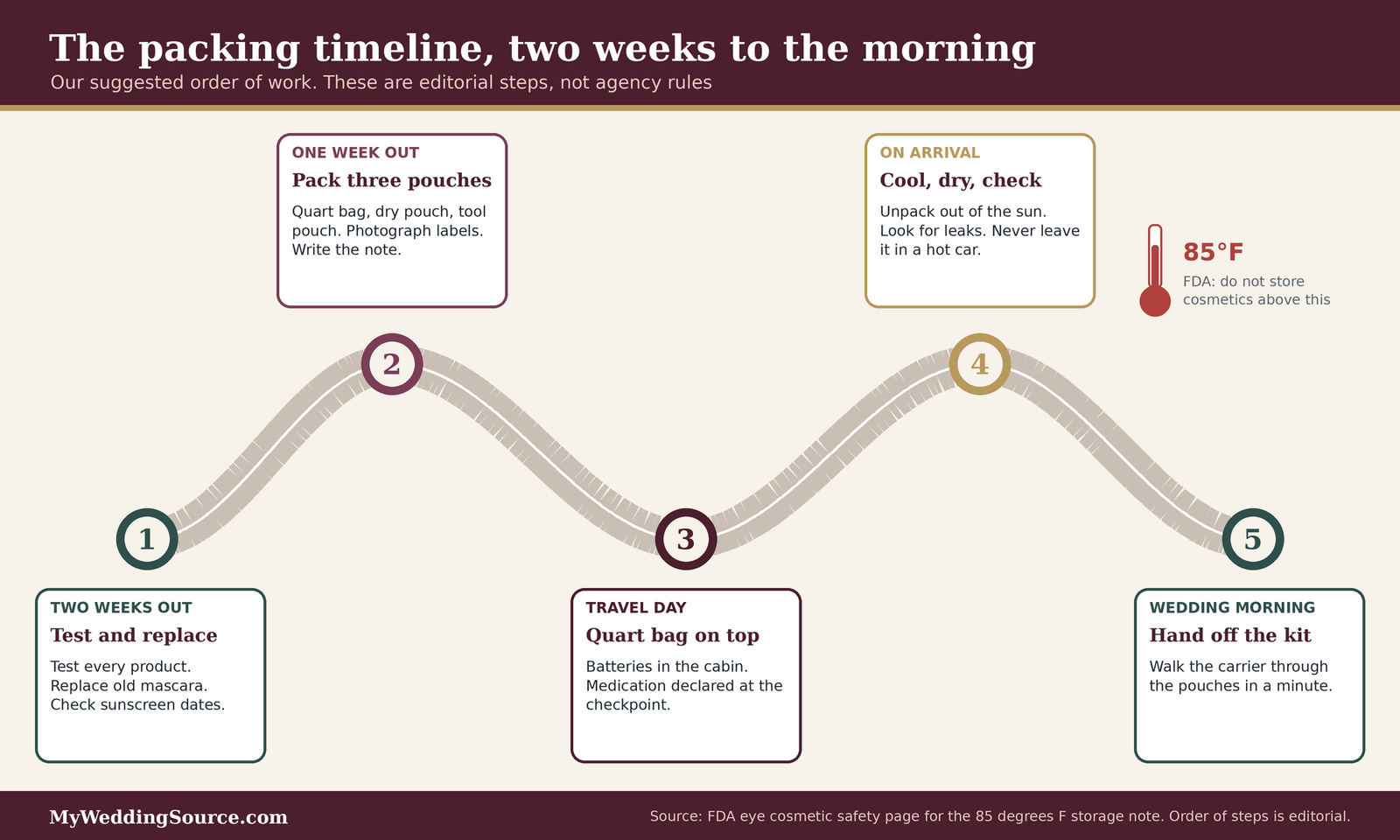
A packing timeline from two weeks out to the wedding morning
How to pack a travel-friendly wedding beauty emergency kit is easier to handle when it is built over time instead of the night before. The timeline below is our suggestion, not an agency rule.
Building the kit
Most of the work happens before the final week.
Two weeks before
Write the problem list, check the grid, and test every product you plan to carry. Buy or decant small containers, and replace anything old, especially mascara. Check expiration dates and discard anything that has changed in color or smell. This is also the time to check your airline’s page for power bank and battery rules.
The week before
Pack the three pouches and weigh them. Photograph the labels, write the note for the person carrying the kit, and put the quart bag where you can reach it. If you have a stylist, confirm what they will bring so that you do not duplicate it. Our wedding week checklist covers what else belongs in this stretch.
Travel day and wedding morning
The kit has to survive the trip and then be ready to use.
Airport and arrival
Keep the quart bag on top of your carry-on and be ready to take it out. Keep batteries and power banks in the cabin. On arrival, unpack the kit into a cool, dry place, check for leaks, and keep the tool pouch near an outlet. Do not leave the kit in a parked car.
The morning of the wedding
Hand the kit to the person who will carry it, with the note. Walk them through the three pouches in under a minute. Leave the products you use daily out of the kit, and keep a short list of what is in it on your phone. After the reception, check what was used and restock for the next event.
Questions to ask before you finalize your kit
These are questions to settle before you finish deciding how to pack a travel-friendly wedding beauty emergency kit, for yourself and for the people who will help you. Write the answers down so they survive the busy week.
Questions for yourself
About your items and your trip
These questions cover the contents, the airport rules, and who carries what.
Questions worth asking
- Which three products would I most regret not having if my checked bag were delayed?
- Which of my items are liquids, gels, creams, pastes, or aerosols, and does each fit in a container of 3.4 ounces or less?
- Do I carry any cordless tool, power bank, or spare battery, and are they in my carry-on with the terminals protected?
- Which items did TSA’s pages not cover, and have I checked each with TSA or my airline?
- Which products have I tested in the last few weeks, and which are new?
- What will my hair and makeup professional bring, and what do they recommend I carry?
- Who is carrying the kit on the wedding day, and have they seen the note?
- Do I have an allergy or a medication that someone else needs to know about?
Turning answers into changes
If an answer is “I am not sure,” that item either gets checked against the TSA or FAA page this week or comes out of the kit. A short kit with confirmed items beats a long one with guesses.
Questions for professionals
A stylist, a nail technician, and a clinician each know something the others do not.
Questions for your stylist and makeup artist
Ask which products they will bring, what they would carry for a touch-up, and which of your own items conflict with the look. Ask about pins and combs for any veil or hair piece, and what to avoid before the trial.
Questions for your clinician or dentist
Ask about medications and travel, about any skin treatment close to the wedding, and about teeth whitening or other dental products. Bring the labels for anything you plan to carry through security.
FAQ: travel-friendly wedding beauty emergency kit questions
Packing and airport rules
How do I pack a travel-friendly wedding beauty emergency kit for a carry-on?
Sort everything by format. Liquids, gels, creams, pastes, and aerosols go in containers of 3.4 ounces or less inside one quart-sized bag, per TSA. Solids and powders go in a dry pouch, and batteries go in a separate tool pouch. Choose solid versions where you can, and check any item the grid marks “check TSA.”
Can I bring hairspray in my carry-on?
Yes, up to 3.4 ounces (100 milliliters) per container, and it must fit in your quart bag, according to TSA’s hair spray entry. In a checked bag it is allowed with nozzle covers and per-person limits. Because airline rules can change, confirm on the day you fly, and do not spray near flames.
Can I bring a cordless curling iron or a power bank?
TSA lists cordless curling irons with lithium batteries or gas as carry-on only, with the heating element covered and the device protected from accidental activation. The FAA says spare lithium batteries and power banks must be in the cabin with terminals protected. Airlines can set tighter limits, so check yours.
Do medications count against the liquid limit?
TSA allows reasonable quantities of medically necessary liquids, gels, and aerosols beyond the 3-1-1 limits, but you must declare them at the checkpoint and take them out for inspection. Keep them apart from your cosmetics. This is not medical advice, so follow your clinician’s instructions for travel and storage.
Safety, sharing, and replacement
Is it safe to share makeup with my bridesmaids?
The FDA says not to share makeup, and to avoid swapping eye cosmetics even with close friends because others’ bacteria may be harmful. Use single-use applicators for testers and give each person her own products. Sharing pins, combs wiped between users, and tissues is a safer way to help each other.
How long should I keep mascara before the wedding?
The FDA says manufacturers usually recommend discarding mascara two to four months after purchase, and that you should not add water or saliva to it. If your mascara is near that range, buy a fresh one before the trip, and replace it if you have had an eye infection.
What if my checked bag does not arrive?
Carry a first-day set in your cabin bag: the items you cannot easily replace, any medication, and a tool you rely on. The California Attorney General’s consumer page says airlines must usually compensate for lost, delayed, or damaged bags. Keep receipts and report the problem before leaving the airport.
How hot is too hot for my makeup bag?
The FDA’s eye-cosmetics page advises not storing cosmetics above 85 degrees Fahrenheit and flags hot cars as a concern. Its general advice adds that products can spoil in places that are too warm or too moist. Keep the kit inside with you rather than in a parked car, and discard anything that changes color or smell.
Your next steps
Plan the kit
List the problems and test the products
Write down your five most likely beauty problems, then choose the smallest item that fixes each. Test each product at home, and replace old mascara and sunscreen. Our wedding planning checklist can help you place this task in your timeline, and our bridal skincare timeline shows when to stop trying new products.
Check the rules for the exact items
Open the TSA, FAA, and airline pages for each item in your travel-friendly wedding beauty emergency kit in the grid you are unsure about. Write the date you checked, and recheck within a few days of flying.
Pack and hand off
Pack the three pouches
Fill the quart bag, the dry pouch, and the tool pouch. Photograph the labels, add the note, and put the quart bag where you can reach it. If you are checking a bag, set aside a first-day set for the cabin.
Brief the person who carries the kit
Walk them through the pouches, show them the note, and tell them what to do in an emergency. For the wider set of items that cover clothing, first aid, and logistics, see our wedding emergency kit guide.
Sources & methodology
How we built this guide
What we relied on
This guide draws on pages published by the Transportation Security Administration, the Federal Aviation Administration, and the U.S. Food and Drug Administration, plus a state attorney general’s consumer page on airline baggage. We read the pages directly and checked them on November 12, 2026. Rules about what can be carried change, and airlines can set stricter limits than TSA, so confirm the current rule for each item before you fly. Where the pages did not cover an item, such as nail polish remover, scissors, razors, or perfume in checked bags, we say so and do not guess. The packing grid is our own organization of those rules, and the suggestions about timing, pouches, and which items to prioritize are editorial judgment, not agency requirements.
What we did not do
We did not test products or containers, and we did not verify international rules, airline-specific policies, voltage requirements, or prices. This guide is general information, not medical, dermatological, dental, or legal advice. If you have a skin condition, an allergy, a prescription, or a question about a reaction, ask your clinician.
Source list
Government and regulatory sources
- Transportation Security Administration, Liquids, Aerosols, Gels, Creams, and Pastes rule (3-1-1): https://www.tsa.gov/travel/security-screening/liquids-rule
- Transportation Security Administration, What Can I Bring? (cordless curling irons, aerosols, deodorant): https://tsa.gov/travel/security-screening/whatcanibring/all?page=11
- Transportation Security Administration, What Can I Bring? (hair spray): https://tsa.gov/travel/security-screening/whatcanibring/miscellaneous?page=5
- Transportation Security Administration, Medications: https://tsa.gov/travel/tsa-cares/disabilities-and-medical-conditions/medications
- Federal Aviation Administration, PackSafe: Lithium batteries: https://www.faa.gov/hazmat/packsafe/lithium-batteries
- Federal Aviation Administration, PackSafe: Portable electronic devices containing batteries: https://www.faa.gov/hazmat/packsafe/portable-electronic-devices-with-batteries
- U.S. Food and Drug Administration, Cosmetics: https://www.fda.gov/cosmetics
- U.S. Food and Drug Administration, Using Cosmetics Safely: https://www.fda.gov/cosmetics/resources-consumers-cosmetics/using-cosmetics-safely
- U.S. Food and Drug Administration, Eye Cosmetic Safety: https://www.fda.gov/cosmetics/cosmetic-products/eye-cosmetic-safety
- U.S. Food and Drug Administration, Expiration Dating: https://www.fda.gov/expiration-dating
- U.S. Food and Drug Administration, Tips to Stay Safe in the Sun: From Sunscreen to Sunglasses: https://www.fda.gov/consumers/consumer-updates/tips-stay-safe-sun-sunscreen-sunglasses/
State consumer sources
- California Attorney General, Consumer information on airlines: https://www.oag.ca.gov/consumers/general/airlines