

Beard grooming before the wedding comes down to two decisions you can make early: what your face will look like on the day, and which appointments, products, and shaving habits will get it there without a red, bumpy, or freshly nicked surprise in the photographs.
Quick answer
Pick a beard path (keep, shape, or shave) several months out, book your barber about a month ahead, and schedule the haircut roughly five to seven days before the wedding, which is where most of the groom-grooming sources we read land. Shave or tidy a few days ahead rather than on the morning, so any nick or ingrown hair has time to settle. For skin that flares, the American Academy of Dermatology advice is consistent: soften the hair, use a sharp razor, shave with the grain, and see a board-certified dermatologist if bumps persist. Nothing here replaces that advice for your own skin.
Why beard grooming before the wedding needs its own plan
Most wedding timelines treat a groom’s grooming as a single line item: “haircut.” A beard changes that line into a small project. Hair on the face grows on its own schedule, the skin underneath can react to razors, products, and stress, and the person who shapes it is a vendor whose calendar fills up around peak wedding dates. Planning beard grooming before the wedding is mostly a matter of putting those three moving parts in the right order.
A beard is a skin question as much as a style question
It is easy to think about a beard only as a shape. In practice, the first thing that can go wrong in the weeks before a wedding is not the outline but the skin. Irritation, flaking, breakouts, and razor bumps are common enough that dermatology groups publish routine advice on them, and a flare-up that appears three days before the ceremony is hard to hide in close-up photos.
The skin under the hair does the work
Yale Medicine’s overview of beard and mustache skin problems lists irritation from shaving, ingrown hairs, patchy growth, beard dandruff, acne, and bumps that need a medical look. None of these is unusual, and several are made more likely by the same things that happen before a wedding: a new razor, a new product, a new haircut, and more stress than usual. That is why this guide spends as much time on the skin as on the barber chair.
Your barber is a vendor with a calendar
A barber who knows your face, your hair, and your skin is worth more than a more expensive stranger. SuitShop’s groom facial-hair guide makes the same point from the other direction: it advises against waiting until the last minute, because you may end up with someone unfamiliar with your preferences. Treat the barber like any other wedding vendor, with a booking date, a clear brief, and a plan for the day. Our wedding vendor timeline shows where this booking sits next to the rest.
What this guide covers and what it leaves out
This guide to beard grooming before the wedding is written for anyone who wears or plans to wear facial hair at their wedding: grooms, partners, wedding party members, and officiants. It builds a barber appointment plan and a shaving-irritation plan, lists questions to ask a barber, and walks through edge cases such as patchy growth, curly hair, and sensitive skin.
What you will find here
You will find a countdown from the first trial visit to the wedding morning, a growth timeline for anyone who wants to grow a beard in time, a shave routine based on American Academy of Dermatology guidance, a barber question list, a hygiene checklist you can observe from the chair, and a set of edge cases with a plan for each. Where a source is a barbershop, retailer, or shaver manufacturer, we say so, because those sources reflect what they sell.
What it does not do
This is not medical advice and it does not diagnose anything. We cannot tell you whether a bump is a razor bump, an infection, or something else, and the dermatology sources we cite say that any lump that grows, bleeds, or changes should be looked at promptly. We also do not recommend specific product brands. If you have a skin condition, a history of reactions, or a prescription treatment, follow your clinician’s advice over anything here.
Choose your beard path first
Every later decision depends on one early choice. There are three broad paths, and each has a different timeline, a different skin risk, and a different relationship with the barber. Making the choice months ahead is the single cheapest thing you can do for beard grooming before the wedding, because it lets you practice.
Keep the beard
If you already wear a beard and the people at your wedding know you with it, SuitShop’s advice is simple: do not make a drastic change on the wedding day, and if people are used to your beard, keep it. Keeping it still involves choices about length, edges, and neckline, and those choices are part of beard grooming before the wedding.
Decide the shape and length
Choose the shape you want to see in photos and stick to it; consistency is the easiest win in beard grooming before the wedding. Ask the barber to follow your natural growth pattern instead of inventing a new outline, so the result still looks like you. Bring photos of your own beard at a length you liked, not only photos of other people’s. Our wedding photographer shot list is a good place to remember that close portraits are part of the day.
Plan the maintenance
A kept beard needs a routine, not a single appointment. Ohio State Wexner Medical Center dermatologist Susan Massick describes a simple pattern: wash the face twice a day, shampoo the beard about twice a week, follow with conditioner, and avoid over-washing, which strips natural oils. Start that routine early enough to learn how your skin responds, since a steady routine is the quiet backbone of beard grooming before the wedding.
Shape or trim down
Many couples want the same beard in a tidier form: shorter, cleaner on the cheeks, or with a sharper neckline. This path has a hidden cost, because trimming exposes more skin to blades and gives short hairs the chance to curl back.
Trim in steps, not in one leap
If you plan to go much shorter, do it in stages across several appointments. Tie the Knot, a Scottish wedding site, suggests one or two practice cuts in the months before the wedding to confirm the style. Each stage of beard grooming before the wedding lets you see how the new length looks in daylight, in a suit, and in a photo, and it lets your skin adjust.
Watch the neckline
The neck is where ingrown hairs often form, according to Yale Medicine’s dermatology overview, which suggests keeping a beard or scruff there where possible. If your barber wants to raise the neckline for the wedding, ask whether a slightly lower line would be easier on your skin.
Shave clean
Going clean-shaven can be a deliberate choice or a request from your partner, and it carries the most skin risk of the three paths if your skin is reactive. It is also the path where the timing of the last shave matters most.
Practice the shave early
SuitShop suggests visiting a barber for a straight-razor shave several months ahead to see how your skin reacts and how quickly your hair grows back, so you can time a hot-towel shave. Tie the Knot adds that you should not try a hot-towel shave for the first time on the day. Both pieces of advice reflect the same point: the wedding is the wrong moment to learn how your skin behaves after a professional shave.
Decide who shaves you
A professional shave can be relaxing and thorough, but it is another appointment, another set of blades, and another chance for a nick. Murdock London, a barbershop brand, suggests asking your barber about timing because it depends on your skin and beard, and advises not shaving on the morning of the wedding or the night before. Whether you shave yourself or book a barber, plan the last full shave a few days ahead; it is the step in beard grooming before the wedding with the least room for error.
How to decide between the three
A decision tree is less useful than three honest questions, so here they are.
Ask about your skin first
If you get razor bumps, a beard or scruff may be the calmer choice. The American Academy of Dermatology notes that if you can stop shaving and let hair grow out, that removes the cause of the bumps. If your skin is calm after shaving, clean-shaven is an easy option.
Ask about your calendar
If the wedding is under a few weeks away, growing a new beard is not realistic, and the patchy stage described below would land on the wedding. If you have several months for beard grooming before the wedding, any path is open. If you are somewhere in between, shaping what you already have is the lowest-risk path.
Beard growth timing: count backward from the date
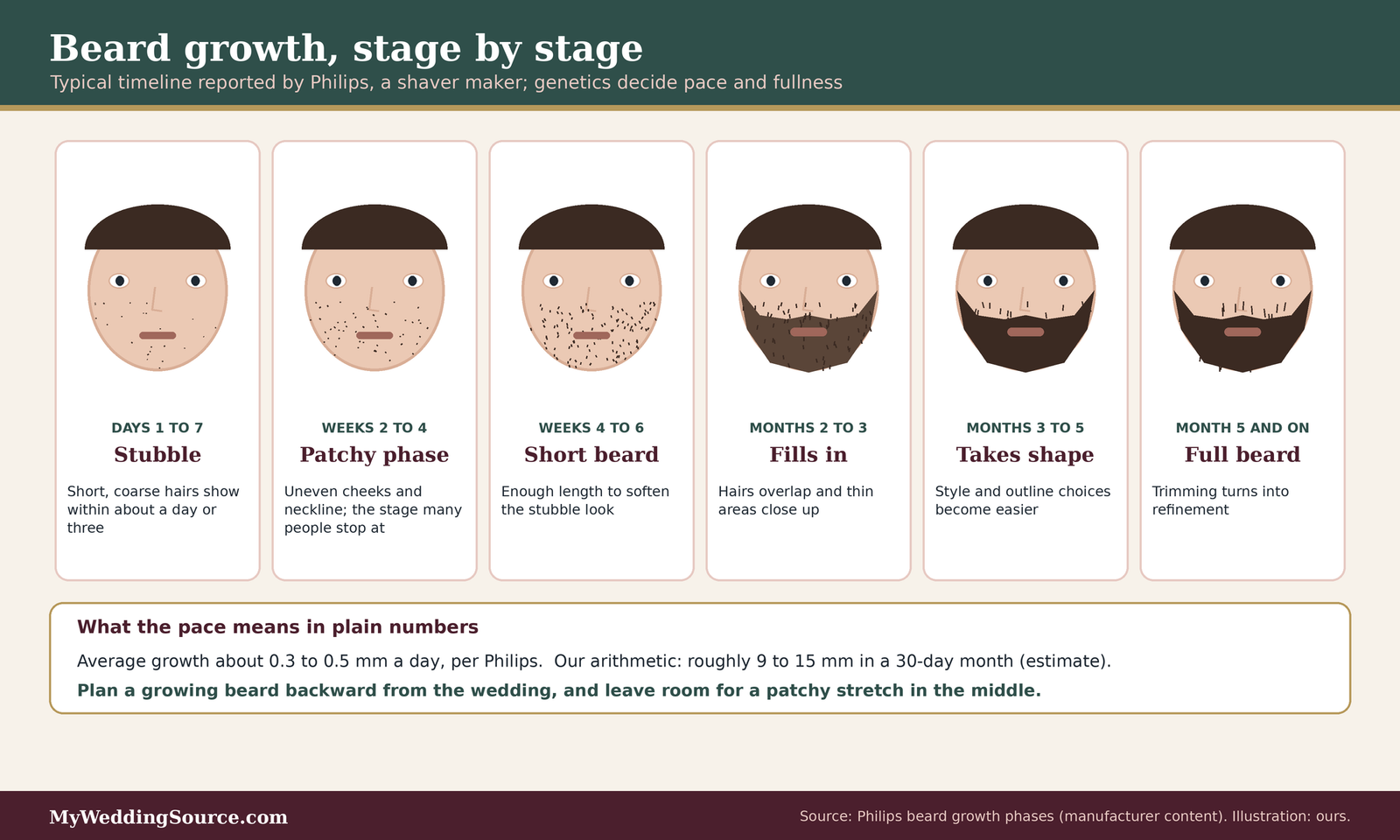
Anyone who plans to grow or regrow a beard as part of beard grooming before the wedding should count backward from the wedding, then add a buffer. The stages below come from Philips, a shaver and trimmer manufacturer, so treat the dates as typical rather than exact. Philips itself says timing varies from person to person and that genetics control how follicles respond and how full the beard gets.
What the stages look like
Philips describes a series of phases, and the drawing above follows them. Stubble appears within about the first week. A patchy phase follows in weeks two to four. A short beard shows from about week four to six, density builds in months two and three, shape arrives in months three to five, and a full beard takes form around month five and beyond.
The patchy stretch is where plans fail
The patchy phase is the one most people want to skip, and it is the biggest timing risk in beard grooming before the wedding. Philips says many people give up there, though slower-growing hairs simply need more time. If you are growing a beard for the wedding, make sure the patchy stage does not fall inside the last month, because the face you will see in engagement photos and the face you will see at the altar should not be two different experiments.
Genetics set the ceiling
The American Academy of Dermatology’s beard advice says that sparse or patchy growth is determined by genetics and that nothing changes inherited patterns, although choosing a style that lets you trim thin areas, letting the beard grow so longer hairs fill in gaps, and using beard wax to hold hairs in place can make it look fuller. It also advises talking to a dermatologist before using minoxidil on the face, because on the face it commonly causes raw, irritated skin.
Planning a growing beard
If you want a full beard, the arithmetic is straightforward. Philips puts average facial hair growth at roughly 0.3 to 0.5 millimeters a day. Our own estimate from those figures is about 9 to 15 millimeters in a 30-day month, which is a guide for planning and not a promise.
Start earlier than you think
Because a full beard takes around five months or more in Philips’s timeline, and because you want at least one trial trim before the wedding, a person who is clean-shaven today and wants a full beard should plan on starting well before the half-year mark. If you have less time, a short, well-kept beard in the four-to-six-week range is a realistic target.
Book the first barber visit during the patchy stage
For beard grooming before the wedding that begins from scratch, a barber can shape a beard that is still filling in, which keeps the edges tidy while growth catches up. Booking a visit during the patchy phase also tells you early whether the beard is going to cooperate. If it is not, you still have time to switch to a shorter style or a clean shave without a rush.
The barber appointment plan
This is the core of beard grooming before the wedding: a sequence of visits with a purpose for each. The ranges below for beard grooming before the wedding are drawn from several grooming sources, and where they differ, the drawing and the text say so. No single source sets a rule, so use them to build your own plan with your barber.

Months out: the trial visit
The first appointment for beard grooming before the wedding is a test. SuitShop recommends beginning to practice your shaving and haircut timing as soon as you are engaged and visiting a barber several months ahead, and Tie the Knot suggests one or two practice cuts in the months before the wedding. MR PORTER’s journal adds that new styles should be tried with a barber in the months prior so you are not nervous on the day.
What to test
Test the beard shape, the length, the neckline, and, if you want one, a straight-razor shave. Look at the result in daylight and on camera. Take a front photo and a side photo so you can compare later.
What to write down
Note how long the result lasted, how your skin felt that evening and the next morning, and how long before the edges looked untidy. Those notes tell you how often you will need a visit before the wedding and whether a close shave irritates you.
About a month out: booking the chair
SuitShop suggests booking your barber about a month ahead. If your wedding falls on a peak date or in a busy season, book earlier, because a barber’s calendar fills with other events too. That is our reasoning, not a figure from a source, so ask the barber how far ahead the chair fills.
Book the final visit, not only the next one
When you book, ask for two slots: the main appointment in the final week and a backup slot a day or two later. If a conflict arises, a backup is easier to keep than a scramble. Our wedding vendor timeline can help you see where this fits next to hair, makeup, and photography schedules.
Share the date and the plan
Tell the barber the wedding date, the time of day, the photo plan, and whether you will do a first look. If you are on the same morning schedule as your groomsmen, ask about group timing. Our first look photos guide covers how that part of the day is usually scheduled, which tells you how early your face needs to be ready.
The final week: the haircut and the tidy
Several sources land in the same window. Salonory Studio suggests a haircut five to seven days before the wedding so hair has time to grow out a little without looking messy. Murdock London suggests one week before. Tie the Knot says three to seven days, with fades closer to the event. MR PORTER notes that longer hair is best trimmed a week or two ahead so it can settle, while shorter cuts and skin fades are better a few days before.
Match the timing to the cut
The shorter the cut, the closer to the date it should be. A long, textured cut benefits from a settling period, and a tight fade looks its sharpest closer to the event. If you cannot decide, ask the barber which of those two categories your cut falls into.
Include the beard in the same visit
MR PORTER suggests asking your barber to tidy the beard and brows during the haircut if they look unruly. Doing both at the same visit saves a trip and lets one person balance the shapes. Salonory adds that a beard trim is not essential but helps you feel comfortable, and that neat edges matter if you keep the beard.
Wedding morning: a light touch only
Murdock London advises against shaving on the wedding morning because of the risk of a rash at the altar, and against shaving the night before because of stubble at the reception. M Room, a barbershop, mentions a wedding-morning visit for a wash and styling as a final touch. Salonory says that if you book a straight-razor shave on the day, book early enough that your skin can rest and any nicks can stop bleeding.
What is reasonable that morning
A comb, a small amount of beard oil or balm if your skin tolerates it, and a quick tidy of stray hairs with a trimmer are enough for most people. Anything new, including a new product, belongs in the trial period and not on the morning.
What to leave alone
Leave scrubs, peels, and new treatments alone. MR PORTER advises avoiding heavy use of retinols and acids in the run-up because they can leave skin red and peeling. If you want a facial, see our wedding facial timing guide.
The shaving irritation plan
Shaving is where most beard grooming before the wedding goes wrong, because the skin pays for every shortcut. The plan below follows American Academy of Dermatology (AAD) guidance and adds timing so you can decide when to stop experimenting. It applies whether you shave your whole face, only your cheeks and neck, or only the neckline.

Why bumps form
The AAD describes razor bumps, also called pseudofolliculitis barbae, as irritated bumps that form after shaving. Hairs cut short by a razor can curl back into the skin, and the skin reacts to the trapped, ingrown hair. The drawing above shows the idea: a short, sharp hair that curls back in on the left, and a softened hair cut with the grain on the right.
Who gets them
The AAD says razor bumps are common in people who shave and especially in men with darker skin tones, and that men with coarse, curly facial hair are particularly prone to them. Yale Medicine’s dermatology overview adds that curly hair can curl back into the skin during the stubble phase and that razors that lift hair before cutting make this worse.
Why timing matters
Bumps can take weeks to settle. In beard grooming before the wedding, the AAD says that when you stop shaving and let the beard grow, bumps should lessen within about a month and clear within about three months, although new ones can form while the hairs are growing back. That is why a person with a bump-prone neck should decide on the beard path early: a new shaving routine will not fully show its results inside a week.
A shave routine that follows dermatologist advice
The AAD’s pages give a consistent routine. We have combined the points below and kept the wording our own. Use it for your trial shaves, then for the real one, so that beard grooming before the wedding never depends on a new product.
Before the razor touches skin
Wash with a non-comedogenic cleanser. Soften the hair by shaving at the end of a shower, or by holding a warm, wet washcloth on the beard area for about five minutes. The AAD’s beard guidance also describes applying a pre-shave gel for about 30 seconds, then a fragrance-free shaving cream left on for two to three minutes. Another AAD page suggests one to two minutes of lather, so a range of one to three minutes is a safe way to read the two. Never dry shave.
While you shave
Shave in the direction the hair grows. To find it, pull the skin taut and look in a mirror. Use short strokes, go over each area no more than twice, rinse the blade after each stroke, and avoid pressing hard or stretching the skin. The AAD says that a dull blade greatly raises the risk of bumps. It suggests replacing single blades after five to seven shaves, and cleaning an electric razor on a similar schedule. If your hair grows in several directions, the AAD suggests brushing it daily with a soft toothbrush to train it to lie one way.
After the shave
Rinse off the cream with warm water, then press a cool, damp washcloth on the skin for about five minutes. Apply an aftershave formulated for razor bumps and irritated skin, and stop using it if it burns or stings. Finish with a moisturizer that suits your skin. Yale Medicine’s overview recommends a fragrance-free, emollient moisturizer after shaving.
How often to shave before the wedding
Frequency is where the AAD’s own advice reads two ways. One page suggests shaving daily or at least every two to three days so hair has less time to curl back. Another says shaving less often gives hairs time to curl into the skin and that letting hair grow out removes the cause of the bumps. That tension is real, so the right answer depends on your skin and your barber’s advice.
If you shave every day already
Stay with your routine and do not change razors, creams, or aftershaves in the final weeks of beard grooming before the wedding. The final full shave should come a few days before the wedding, which matches SuitShop’s advice to shave a few days ahead so any cuts or ingrown hairs have time to fade.
If you shave only when you must
If you shave rarely and your skin is calm, a single professional shave a few days before is a reasonable plan. If bumps are common for you, ask a dermatologist or your barber whether keeping a short beard or scruff would suit the wedding better, as Yale Medicine suggests for the neck.
When to stop and get help
Sometimes the right plan is to stop. The AAD says that if bumps continue after you change your shaving habits, you should see a board-certified dermatologist, because untreated razor bumps can cause lasting changes such as deep grooves and raised scars. Persistent skin problems or hair loss warrant a visit too, because symptoms such as acne can resemble ingrown hairs or other conditions.
Do not pick or pluck
The AAD advises against plucking hairs out of bumps or stretching the skin while shaving, because both can cause new bumps or worsen existing ones. A warm compress can help loosen a trapped hair, and over-the-counter hydrocortisone may reduce redness and swelling according to a Harvard dermatology tips page. Neither replaces a clinician’s advice if the bumps are many or painful.
Check for anything unusual
The AAD and Yale Medicine both say that a lump that grows, bleeds, or changes should be examined promptly, since skin cancers can hide under facial hair. If a bump is new, changing, raised, asymmetrical, or bleeding, book a dermatologist rather than waiting until after the wedding.
Questions to ask your dermatologist or clinician
- Are the bumps on my neck razor bumps, or something else that needs different treatment?
- Would keeping a short beard or scruff suit my skin better than shaving?
- Which razor, blade count, or electric option do you suggest for my hair type?
- Is it safe for me to use an over-the-counter hydrocortisone or dandruff shampoo, and for how long?
- What should I stop using before the wedding?
- How long before the wedding should I stop trying new products?
Skin care under the beard
Good beard grooming before the wedding rests on a calm skin barrier. Dermatology sources agree on a short list of basics, and they agree more than the product market does. The advice below is general information from dermatology groups and an academic medical center, not a treatment plan.
Washing and moisturizing
Ohio State Wexner Medical Center’s Dr. Massick recommends washing the face twice a day and shampooing the beard about twice a week, followed by conditioner, which can be rinsed in the shower. She cautions against over-washing, which strips natural oils and causes dryness. A Harvard-hosted dermatology tips page recommends a sulfate-free, moisturizing shampoo and conditioner made for beards two to three times a week.
Moisture matters
Beards, like scalp hair, may need extra moisture, according to the same Ohio State source. Beard oil can be applied as needed to moisturize the skin and soften the hair. The Harvard-hosted page suggests a leave-in oil or balm after showering, massaged into both skin and hair.
Brush and comb gently
The same page recommends brushing daily with a boar bristle brush to spread skin oils along the hairs, and combing with a wide-tooth comb to detangle and set the style. It also notes that dull trimmers and scissors tug at coarse hair and can cause irritation and ingrown hairs, so sharp tools matter.
Beard dandruff
The AAD describes dandruff beneath the beard, sometimes called beardruff, as flakes, itchy rash, scaly skin, or greasy patches under the beard. Yale Medicine says it is an immune reaction to Malassezia yeast on the skin, causes a flaky, scaly rash, and is not a hygiene problem.
What dermatology sources suggest
The AAD’s beard page suggests brushing the beard daily before washing to loosen flakes, then using a dandruff shampoo with 2% zinc pyrithione, 1% ketoconazole, or 1% selenium sulfide at least weekly, with 1% hydrocortisone applied at night after washing for the first week and then weekly when skin feels scaly. Yale Medicine says to apply a 1% ketoconazole shampoo to dry skin, leave it on for five minutes, then shower.
What to avoid and when to see someone
Yale Medicine notes that the AAD says petroleum jelly can worsen the condition, and that the rash is chronic and often returns after treatment stops. The AAD advises seeing a dermatologist if the rash persists or if you develop acne-like bumps, pain, or broken skin. Start any treatment well before the wedding so you know how your skin responds.
Acne and breakouts under the beard
The AAD suggests washing twice daily with a gentle cleanser containing salicylic or glycolic acid, applying it with fingertips in small circles without scrubbing, and avoiding touching the beard and face. It says to expect results in two to three months, and to try a different treatment if there is no improvement after a month.
Beard oil is not always a friend
The AAD’s beard page recommends a small amount of non-comedogenic beard conditioner but no beard oil for beard acne, because dryness can trigger more oil and breakouts. Yale Medicine likewise says to avoid beard oil if you break out easily. That is the opposite of the general moisture advice above, and it is why skin type matters more than any trend.
Do not wait for the last week
Because acne treatments take weeks to show results, a person with breakouts should see a clinician months out, not days. MR PORTER’s grooming article suggests treating a blemish on the day with an antibacterial product, concealing it, and setting with translucent powder, and for severe cases seeing a dermatologist. Treat that as a day-of rescue, not a plan for beard grooming before the wedding.
Reading product labels
A new product is the most common surprise in the last month of beard grooming before the wedding. The FDA says cosmetics are not FDA-approved before sale but are FDA-regulated, and that companies that market them are responsible for their safety. Its page on fragrances explains that fragrance can be listed on a label as simply “fragrance,” and that some people are allergic or sensitive to certain fragrance components even when those ingredients are safe for most people.
Fragrance-free is not a promise
The FDA says there is no federal standard or definition for terms like “hypoallergenic,” “fragrance-free,” or “for sensitive skin,” so these claims alone do not indicate safety for allergic people. The FDA suggests reading the ingredient list, contacting the manufacturer with questions, and seeing a healthcare provider if you suspect an allergic reaction, bringing the product you think caused it.
Report a reaction
If you have an adverse reaction after using a cosmetic, the FDA says you can submit a report through its cosmetic complaint pages and the MedWatch program. Patch testing is the most common way to investigate allergies, according to the FDA, and typically takes two to three office visits, so do not leave suspicion of an allergy to the last month.
What this costs
We did not find a reliable national price list for barber services, beard care products, or dermatology visits, and prices differ by city, shop, and insurer, so we are not printing numbers. To budget, ask each barber for a written price list for the trial visit, the pre-wedding haircut and beard tidy, a straight-razor shave if you want one, and any wedding-party package. Ask whether a trial visit counts toward the final service. Ask your insurer whether a dermatology visit for a skin problem is covered. Tipping customs vary by shop and region, so ask the shop what is usual.
Working with a barber: questions, hygiene, and what to bring
A good barber appointment is a short briefing followed by careful work. The list below turns beard grooming before the wedding into specific questions you can ask on the phone or at the trial visit, and the hygiene section tells you what you can check with your own eyes.
Questions to ask before you book
Ask these at the trial visit or when you call. A barber who answers clearly and without hesitation is usually a better fit than one who changes the subject.
Questions to ask your barber
- Do you have experience with wedding grooming, and can I see photos of beards like mine?
- How far ahead do your Fridays and Saturdays fill, and what is your backup if you are sick?
- Do you recommend a haircut and beard trim in the same visit, and how many days before the wedding?
- How do you handle skin that bumps or reddens after a shave, and would you advise against a close shave for me?
- Which products do you use on my skin, and can I see the ingredient list?
- How do you clean and disinfect clippers, scissors, and razors between clients?
- Do you use a new blade for each straight-razor shave?
- Do you offer a wedding-morning or on-site service for a wedding party, and what is the price list in writing?
- What is your cancellation and reschedule policy?
Questions about the work
Ask about experience with beard grooming before the wedding, timing, and how the barber handles your hair type and skin. The AAD and Yale Medicine both note that curly hair and some skin types are more prone to bumps, so a barber who does not ask about your skin history before shaving is missing a step.
Questions about the business
Ask about the price list, the cancellation policy, and who will actually cut your hair on the day. If the shop is large, ask for the same barber at the trial and the final visit, so that the person who knows your face does the last cut.
What you can check about hygiene
Rules for barbershops come from state licensing boards, so they differ by state, and we did not find a single national standard. Two boards publish clear public guidance that shows what to look for when you plan beard grooming before the wedding. The California Board of Barbering and Cosmetology’s consumer fact sheet and the Virginia Board for Barbers and Cosmetology’s disinfection reminders both cover tools and shop practices.
What the boards say to watch for
California’s fact sheet advises confirming the shop is licensed, making sure the barber washes their hands before your service, asking how tools were disinfected, and asking the barber to wear gloves if they have open cuts, sores, or rashes on the hands or face. It also says to consider rescheduling if the barber is sick, and, if the barber hesitates to explain disinfection or does not know the requirements, to take your business elsewhere.
How tools are disinfected
Both boards describe the same basic idea. Tools are cleaned first, because disinfection works only on clean items, then immersed in an EPA-registered disinfectant that is labeled bactericidal, virucidal, and fungicidal, for the contact time on the label. California’s sheet says that is usually about 10 to 15 minutes, and Virginia says to mix immersion disinfectant fresh each day. Items that cannot be disinfected, such as emery boards, nail buffers, and facial sponges, must be thrown away and new for each client. Towels and upholstered chairs can be cleaned but not disinfected, according to Virginia’s reminders.
If you are nicked
Nicks happen. California’s fact sheet says that if a blood-contact incident occurs, such as a nick from a razor or an ear nip from shears, you should ask for a tissue or cotton ball to stop the bleeding, wash the wound with soap and water, report the incident to the salon owner or supervisor, and seek medical treatment if necessary. This is another reason to schedule a professional shave a few days before the wedding rather than on the morning, and why SuitShop advises letting any cuts fade ahead of time. Licensing rules where you live may differ, so check your own state board.
What to bring and say at the trial visit
A trial visit for beard grooming before the wedding works best when you arrive with a small brief. For a model of how a trial works, our wedding hair trial guide uses the same idea for bridal hair: show what you want, test it, and note what to change.
Bring references and a plan
Bring two or three photos of looks you like, one photo of your face with its current beard or stubble, and a note of the wedding date, the time of day, and what you plan to wear. If you are still choosing attire, our groomsmen suits vs. tuxedos guide and wedding tuxedos guide help you settle the neckline and collar that your beard will sit against.
Say what has irritated you before
Tell the barber about any razor bumps, product reactions, medications, or skin conditions. If you use a prescription or an over-the-counter treatment for dandruff or acne, mention it. This is general information for the barber and does not replace advice from your dermatologist.
Edge cases and what to do about them
A neat plan for beard grooming before the wedding is easy when your skin is calm and your beard grows evenly. These are the cases where it is not, and each one changes how you approach beard grooming before the wedding.
Curly or coarse hair and darker skin tones
The AAD says razor bumps are especially common in people with darker skin tones and in men with coarse, curly facial hair. Yale Medicine says curly hair can curl back into the skin during the stubble phase and that a razor that lifts hair before cutting makes this worse. For people in this group, the safest plan for beard grooming before the wedding is often the one that avoids a very close shave.
Choose a longer stubble or a short beard
The AAD says that stopping shaving and letting the beard grow is the way to remove the cause of the bumps. If that does not fit your look, ask a barber about a short, even length rather than a close shave, and keep the neckline natural. Yale Medicine says laser hair removal is an option for problem areas, though it is expensive, and that is a conversation for a dermatologist, well ahead of the wedding.
Train the direction of growth
If the hair grows in different directions, the AAD suggests brushing it daily with a soft toothbrush so it lies one way. That is slow work, so begin during the trial period, not the last week.
Sparse or patchy growth
Yale Medicine says thin facial hair often runs in families, that male-pattern balding can affect the beard, and that alopecia areata, an autoimmune condition, causes patchy loss. It recommends seeing a dermatologist to find the cause and discuss treatment. The AAD’s advice for fuller-looking results includes choosing a style that lets you trim thin areas.
Pick a style that works with your growth
Two- or three-day scruff may suit a person with spotty growth better than a full beard, according to Yale Medicine. The right style is the one that looks intentional in your own photographs.
Do not start a new treatment late
The AAD says minoxidil on the face commonly causes raw, irritated skin and advises talking to a dermatologist before using it. A new treatment started shortly before the wedding is the wrong experiment, so settle it long before.
Sensitive skin, redness, and a reactive face
If your skin flushes, stings, or reacts to new products, your plan for beard grooming before the wedding is to change less, not more. Our sibling guide on shaving for sensitive skin on the wedding day goes deeper on that specific question, and the FDA’s guidance on fragrance and allergens explains why a fragrance-free label alone is not a guarantee.
Patch test early
The FDA suggests reading ingredient lists and testing a small amount first when the label advises it. For anything that will go on your face, try it on a small area well before the wedding, and stop if you see itching or redness. If you suspect an allergy, see a healthcare provider.
Skip last-minute treatments
MR PORTER’s article lists facials, peels, and clinic treatments as options, and advises starting early so you have time to adjust if your skin reacts and avoiding heavy retinols and acids close to the date. Our wedding facial timing guide goes through the same logic for skin appointments.
Photos, heat, and a long day
Beard grooming before the wedding is also a photography question, so it overlaps with the photo plan. Close-up portraits, engagement photos, and detail shots all show the skin and edges.
Plan for engagement photos and portraits
If you have engagement photos scheduled, use them as a free dress rehearsal for your beard length and skin. Our engagement photos guide explains how to use that session. Compare the photos with your trial notes and adjust the final trim accordingly.
Plan for heat and a long day
A long day in warm weather can mean sweat, shine, and irritation along the neckline. M Room suggests blotting papers for shine, and MR PORTER suggests a tinted moisturizer for camera-ready skin. If your wedding is in summer, our summer wedding heat plan covers keeping the whole party comfortable.
The wedding party and out-of-town barbers
Beards are not only the groom’s concern, and beard grooming before the wedding can involve the whole party. Groomsmen, fathers, and officiants may also wear them.
Coordinate the wedding party
You cannot dictate other people’s faces, but you can share a simple request: neat edges, a trim a few days before, and no new look on the day. Our wedding party attire guide and best man duties guide cover how to keep the group on one schedule. If the group will visit the same barber, ask about a wedding-party booking in advance.
Traveling for a destination wedding
If you are traveling, arrange the last haircut and beard tidy close to home or at your destination with a barber you have vetted, and bring a trimmer and razor you have already used. Keep a small kit in your carry-on. Our wedding emergency kit guide shows what to pack for small repairs on the day.
The wedding week and the wedding day
The final week of beard grooming before the wedding is for protecting what you have already built, not for new experiments. Our wedding week checklist sits alongside this plan and shows where grooming fits in the rest of the week.
Wedding week
By this point in beard grooming before the wedding, your barber appointment, your last full shave, and your skin routine should all be settled.
Hold your routine steady
Keep the same cleanser, moisturizer, shaving cream, razor, and aftershave you used during the trial period. Murdock London’s advice not to shave on the morning of the wedding or the night before, and SuitShop’s advice to shave a few days ahead, both point to the same plan: finish the main grooming earlier in the week and let the skin rest. Ohio State’s advice to clean regularly but not excessively fits too.
Keep a short checklist
A short list helps: haircut done, beard tidied, last full shave done, trimmer and comb packed, beard oil or balm and moisturizer packed, and the barber’s number saved in case of a change. Our wedding planning checklist is useful for the rest of the work.
The wedding morning
Murdock London’s advice not to shave that morning is worth following if you can. If you do have stray hairs or a missed spot, a trimmer with a guard is gentler than a close blade.
A short morning routine
Wash your face, pat dry, and moisturize. Use a small amount of any beard product you have already tested. Comb the beard, check the edges in good light, and stop. A calm routine does more for your skin than a clever one, and that holds for all of beard grooming before the wedding.
Have a fallback
If a nick, bump, or redness appears, MR PORTER suggests treating a blemish right away with an antibacterial product and concealing it, with translucent powder to set. Keep a small kit of cotton swabs, a styptic or clean tissue, and a gentle moisturizer in your bag. Ask the photographer or a trusted friend to help check the edges before photos.
FAQ: beard grooming before the wedding
Timing and appointments
When should I book the barber for the wedding?
For beard grooming before the wedding, SuitShop suggests booking about a month ahead and visiting a barber several months ahead for a trial. If your date is in a busy season, ask how far ahead the barber’s calendar fills. Booking earlier costs nothing and gives you a trial visit to test the shape, the length, and how your skin reacts.
How many days before the wedding should I get a haircut?
Sources vary slightly. Salonory Studio suggests five to seven days, Murdock London suggests one week, Tie the Knot suggests three to seven days, and MR PORTER suggests a week or two for longer hair but a few days for a short cut or fade. Ask your barber which category your cut falls into.
Should I shave the morning of the wedding?
Murdock London advises against shaving on the morning, because of the risk of a rash at the altar, and against shaving the night before, because of stubble at the reception. SuitShop suggests a few days ahead. Ask your barber for timing that fits your skin and your beard.
How long does it take to grow a beard for a wedding?
Philips, a shaver manufacturer, describes a short beard at about four to six weeks and a full beard from around five months, with a patchy phase in weeks two to four. Genetics set the pace. If the wedding is closer than a few weeks, shaping your current beard is safer.
Skin and irritation
How do I prevent razor bumps before the wedding?
In beard grooming before the wedding, the American Academy of Dermatology suggests softening hair with a warm cloth or a shower, using moisturizing shaving cream, shaving with the grain with a sharp razor and no pressure, and applying a cool cloth and aftershave afterward. If bumps continue after you change habits, it advises seeing a board-certified dermatologist.
What should I do about beard dandruff or itching?
The AAD describes beardruff as flakes, itchy rash, or scaly skin under the beard and suggests brushing, an over-the-counter dandruff shampoo with ingredients such as ketoconazole or zinc pyrithione, and seeing a dermatologist if it persists. Yale Medicine says it is not a hygiene problem. Start any treatment weeks before the wedding.
Is it safe to try a new beard oil or product close to the wedding?
It is better not to. The FDA says terms such as hypoallergenic or fragrance-free have no federal definition, and that reactions can show up as itchy, red rashes. The AAD says to skip beard oil if you break out easily. Test new products well ahead, in a small area first.
What should I ask a barber about hygiene?
The California barbering board suggests confirming the shop is licensed, asking how tools were disinfected, and noting whether the barber washes their hands. Boards describe cleaning, then immersing tools in an EPA-registered disinfectant. Rules differ by state, so check your own board. If a barber cannot explain their process, consider going elsewhere.
Your next steps
Decide and book
Choose your beard path
For beard grooming before the wedding, decide whether you will keep, shape, or shave, and write down the reason. If you are growing a beard, count backward from the date using the growth timeline and add a buffer for the patchy stage.
Book the trial and the final visit
For beard grooming before the wedding, book a trial visit months out and the final haircut and beard tidy about a month ahead, with a backup slot. Use our wedding beauty timeline to see how grooming sits next to the rest of the beauty schedule, and our sibling pre-wedding beauty and grooming timeline for the full groom plan.
Protect your skin
Lock your routine early
Choose a cleanser, a razor, a shave cream, an aftershave, and a moisturizer, and use them for the whole trial period. If bumps, dandruff, or acne appear, see a dermatologist well before the wedding.
Vet your vendors
Ask the hygiene and price questions above, get the price list and cancellation policy in writing, and keep the paperwork with your other vendor contracts. Our wedding vendor due diligence checklist shows how to do this for any vendor.
Sources & methodology
How we built this guide
What we relied on
This guide combines American Academy of Dermatology public pages on razor bumps, shaving, and common beard problems; Yale Medicine and Ohio State Wexner Medical Center dermatology overviews; FDA pages on cosmetics, fragrances, and allergens; consumer fact sheets from two state barbering boards; and grooming advice from barbershops, a men’s retailer, a wedding site, and a shaver manufacturer. Where a statement comes from a business, we say so, because a business’s advice reflects what it sells. The monthly growth figure is our own arithmetic from a manufacturer’s average and is an estimate. We checked these pages in November 2026 and did not verify whether they have changed since.
What we did not do
We did not test products, interview barbers, or give medical advice. Skin, hair, and barbering rules vary by person and by state. Ask your barber, check your state board, and see a board-certified dermatologist for persistent skin problems. We do not recommend specific brands.
Source list
Government, regulatory, and licensing sources
- U.S. Food and Drug Administration, Cosmetics: https://www.fda.gov/cosmetics
- U.S. Food and Drug Administration, Fragrances in Cosmetics: https://www.fda.gov/cosmetics/cosmetic-ingredients/fragrances-cosmetics
- U.S. Food and Drug Administration, Allergens in Cosmetics: https://www.fda.gov/cosmetics/cosmetic-ingredients/allergens-cosmetics
- California Board of Barbering and Cosmetology, Infection control fact sheet for consumers: https://www.barbercosmo.ca.gov/consumers/infect_cont_factsheet.pdf
- Virginia Board for Barbers and Cosmetology, Disinfection reminders: https://www.dpor.virginia.gov/Boards/BarberCosmo/Disinfection
Dermatology and medical sources
- American Academy of Dermatology, Razor bump prevention tips: https://www.aad.org/public/everyday-care/skin-care-basics/hair/razor-bump-prevention
- American Academy of Dermatology, Razor bumps: https://www.aad.org/public/razor-bumps
- American Academy of Dermatology, DIY treatment for common beard problems: https://www.aad.org/public/everyday-care/skin-care-secrets/face/diy-treatment-common-beard-problems
- Yale Medicine, Beard and mustache skin problems: https://www.yalemedicine.org/news/beard-mustache-skin-problems
- Ohio State Wexner Medical Center, Is a beard bad for your health?: https://wexnermedical.osu.edu/blog/is-a-beard-bad-for-your-health
- Harvard-hosted dermatology tips page, A dermatologist’s top tips for a healthy beard: https://websites.harvard.edu/piesev/a-dermatologists-top-tips-for-a-healthy-beard
Barbershop, retailer, and manufacturer sources
- SuitShop, Groom facial hair do’s and don’ts: https://suitshop.com/blogs/news/groom-facial-hair-dos–donts/
- Salonory Studio, How long before the wedding should a groom get a haircut: https://studio.salonory.com/education/how-long-before-wedding-should-groom-get-haircut/
- Murdock London, How to wedding: five grooming tips: https://www.murdocklondon.com/uk/themurdockman/5-grooming-tips-for-the-groom
- M Room, Barber’s tips for grooms to be: https://mroom.com/fi/en/articles/barbers-tips-for-the-groom/
- MR PORTER Journal, So, you’re getting married? Here’s how to look your best: https://www.mrporter.com/en-it/journal/grooming/groom-beauty-skin-prep-hair-before-wedding-facial-24328630
- Tie the Knot, Keeping trim: a groom’s guide for hair and beard: https://tietheknot.scot/keeping-trim-your-grooms-grooming-guide-for-hair-and-beard-for-the-big-day/
- Philips, Beard growing phases: https://www.philips.co.uk/c-e/mens-grooming-blog/beard-care/beard-growing-phases