

Choosing among wedding manicure shapes compared for different ring styles comes down to three things you can check with your own hand: how the nail edge looks beside the outline of your ring, whether the ring’s hardware can catch on that edge, and whether the shape will survive a day of hugging, dressing, and holding a bouquet.
Quick answer
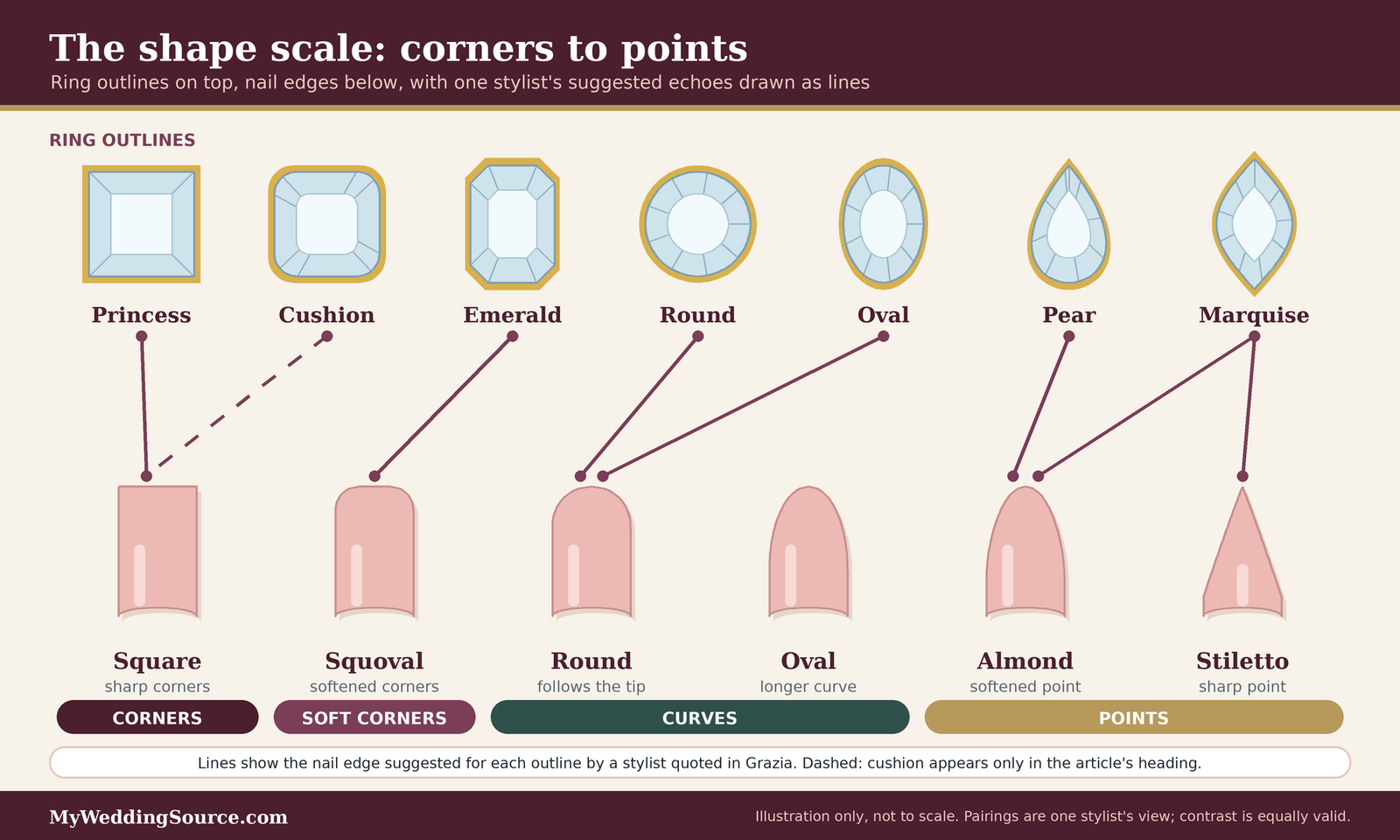
Treat wedding manicure shapes compared for different ring styles as a scale that runs from corners (square) through soft corners (squoval and round) to curves (oval) to points (almond and stiletto). A stylist quoted by Grazia suggests echoing a ring’s outline, so square nails for princess and cushion cuts, rounded nails for round and oval stones, almond or stiletto for pear and marquise, and squoval for emerald cuts. That is one stylist’s view, and contrast is equally valid. Practical limits matter more than matching: GIA notes that raised prongs and cathedral settings can catch on fabric, and dermatologists advise slightly rounding fingernail corners so they do not snag. When in doubt, a short squoval or soft square is the lowest-risk starting point to test beside your ring.
How wedding manicure shapes compared for different ring styles works
Most nail-shape advice is written as if your hand were a blank canvas, which is why wedding manicure shapes compared for different ring styles needs a different starting point. In real life, a ring sits on one of those fingers every day, and your photographer will frame the two together more often than almost anything else on your body. This guide to wedding manicure shapes compared for different ring styles treats the ring as the fixed point and the nail as the variable you can still change. Our approach to wedding manicure shapes compared for different ring styles is built on that idea, and it tries to be honest about what is known and what is only a styling opinion.
What this comparison covers and what it leaves out
Before the shapes, it helps to say what kind of evidence sits behind them, because nail-shape advice mixes facts, trade reports, and taste.
The question behind wedding manicure shapes compared for different ring styles
You have an engagement ring, or you are about to choose one, and you need to pick a nail edge for the wedding. You might also be wearing a new band on the same hand. The practical question is which of the wedding manicure shapes compared for different ring styles looks right beside your ring and also behaves well with it. That is a narrower question than “which nail shape is trending,” and it is the one we answer. Our broader wedding nails guide covers color, nail systems, and the wedding-morning schedule, so this article stays on wedding manicure shapes compared for different ring styles.
What evidence exists for wedding manicure shapes compared for different ring styles
There is no published test that measures wedding manicure shapes compared for different ring styles in any rigorous way, or which nail shape flatters which ring. What exists is a mix. Dermatology sources describe how to trim and file safely. GIA describes how ring settings sit and which ones can catch on fabric. A nail brand, Essie, publishes a guide to how shapes suit different nail beds and how breakable each one is. A manicurist quoted in a British magazine, Marina Sandoval in Grazia, links nail shapes to specific stone outlines. Wedding publications add trend notes. We attribute each of these by name, and where we add our own reasoning, we label it as an editorial judgment. None of this is a rule for wedding manicure shapes compared for different ring styles, and your own hand under real light is the final test.
The scale from corners to points
Every common nail shape can be described by what its free edge does at the corners and at the center. Once you see that, wedding manicure shapes compared for different ring styles becomes a matter of placing both on the same line.
Corners, curves, and points as one line
Picture the free edge, the part of the nail that extends past the fingertip. A square nail has a flat top and two sharp corners. A squoval keeps the flat top and rounds the corners. A round nail follows the curve of the fingertip. An oval stretches that curve into a longer ellipse. An almond narrows toward a softened point, and a stiletto ends in a sharper point. Read in that order, the shapes move from straight edges and corners, to curves, to points.
Putting ring outlines on the same line
Stone outlines can be placed on a similar line. A princess cut is a square with corners, a cushion is a square with rounded corners, an emerald cut is a rectangle with clipped corners, a round stone is all curve, an oval is an elongated curve, and pear and marquise shapes end in points. The infographic above, a visual scale of wedding manicure shapes compared for different ring styles, puts the nail shapes on the lower line and the stone outlines on the upper line. Where the Grazia stylist’s suggestions connect a nail shape to a stone, we draw that link. Where the suggestion is ours, we say so.
Echo, contrast, or stay quiet
Matching is one of three reasonable strategies for wedding manicure shapes compared for different ring styles, and nothing in the sources says it is the correct one. Seeing all three makes the choice feel less like a test and more like a decision.
Echo the ring
Echoing means choosing a nail edge that repeats the ring’s outline. Marina Sandoval, quoted in Grazia, argues that squared-off nails reinforce the sharper feel of a princess cut and that rounded nails embrace the symmetry of a round stone. The appeal is visual coherence: the eye reads the hand as one designed object. The risk is that two strongly shaped elements can compete, especially if both are pointed or both are very angular.
Contrast the ring or keep the nails quiet
Contrast means choosing an edge that differs on purpose, such as a rounded nail beside an angular stone, so the ring stands apart. A quiet approach goes further in wedding manicure shapes compared for different ring styles and keeps the nail simple so the ring does the talking. The Knot describes short square nails as understated and says the plain design keeps attention on the engagement ring. Zola’s nail artist, Zola Ganzorigt, recommends vanilla French nails because they will not steal the spotlight from the ring. Neither source claims that a quiet nail is the only good choice. Both are describing one way to put the ring first.
The common wedding manicure shapes, one at a time
The shapes below are the ones salons offer most often, and they are the options in wedding manicure shapes compared for different ring styles. For each, we describe how it looks and how it behaves, drawing on Essie’s published nail-shape guide, The Knot, and dermatology filing advice. Essie is a nail brand, so its statements about these shapes reflect a product company’s experience rather than a laboratory test, and we note that where it matters.
Square and squoval
Square and squoval share a flat top. They differ in whether the corners are left sharp or softened, and that small difference changes both the look and the snag risk.
Square nails
Essie describes square nails as timeless and versatile, spanning the full width and length of the nail and standing up well to bumps and stress. It suggests square for narrow nail beds. The Knot calls short square nails understated and says they keep the focus on the engagement ring. The trade-off is the two corners. Dermatologists at the American Academy of Dermatology advise cutting fingernails almost straight across and then slightly rounding the corners so they do not snag on clothing or furniture. A fully sharp square corner works against that advice, which is why we would test a softened version first.
Squoval nails
A squoval is a square with softened corners. Essie says squoval is flat at the top with curved sides, flattering on most nails, and rarely breaks easily, and it lists squoval and round as shapes that suit almost any finger and nail length. For a wedding, that combination of a clean line and rounded corners matches the dermatology advice about snagging, which makes squoval a sensible default to test first. Our judgment is that it is the safest bet when you are unsure, because it asks the least of the nail and the dress.
Round and oval
Round and oval nails both follow the curve of the fingertip. Round stays close to it, and oval stretches it into a longer line.
Round nails
Essie describes round nails as classic and easy to shape, with no sharp corners to snag, which makes them low-maintenance. Essie also recommends squoval or round for short nails because they are less likely to break. On the hand, a round nail tends to read as soft and natural, which is why it pairs easily with a modest ring and with a plain polish. If you want your nails to disappear into the background of your ring photos, round is one of the quietest options.
Oval nails
Essie calls oval elegant and elongated and says it suits rounded cuticles or long nails, but it adds that oval can be more fragile than square. Essie also notes that for wide nail beds, oval or almond can create a slimming peak. On a ring hand, an oval nail extends the line of the finger, which some people like beside an oval or round stone. The trade-off is strength. If your nails tend to split, ask how the technician would reinforce an oval, or choose a shorter length.
Almond, ballerina, and stiletto
These three move toward the point end of the scale. They look the most dramatic, and they ask the most from the nail underneath.
Almond nails
Essie describes almond as sophisticated, adding length and drama, and says it suits long, wide nails because thin nails can look claw-like. It also says almond is prone to cracks and recommends a strengthening base coat. The Knot calls short almond nails sleek, simple, and timeless and lists them among its wedding nail trends. In its 2026 trend piece, The Knot also reports a shift toward shorter nails after years of extra-long coffin and almond shapes. Taken together, the sources suggest that a short almond is a current, wearable choice and that a long almond is a more demanding one.
Ballerina and stiletto nails
Essie describes ballerina as a softer, contemporary blend of square and almond that suits wider nails, and notes that its length and thinness make it more prone to breakage. It describes stiletto as long with a sharp point, bold and glamorous, suited to longer nails, higher in upkeep, and more prone to breakage. These shapes sit at the far end of wedding manicure shapes compared for different ring styles and are rarely made from short natural nails. According to a Grazia article, extensions such as acrylic or BIAB can supply the length an almond needs, which brings the nail system into the decision, a topic we cover below.
How shape interacts with finger and nail-bed proportion
Your own hand changes how any of the wedding manicure shapes compared for different ring styles reads. Two people can file the same almond and get different results because the nail bed, the part of the nail you see, is a different width and length.
Nail-bed width
Essie ties the choice of shape partly to nail-bed width. It says wide nail beds can be flattered by oval or almond because they create a slimming peak, while narrow nail beds suit square. If you are unsure which category you are in, hold a ruler across your ring-finger nail, then compare it to your other fingers. The ring finger deserves the closest look, because it is the nail that sits right next to the ring in every hand photo.
Finger length
Essie suggests longer fingers can carry square-edged shapes such as square or ballerina, while shorter fingers can look longer with a curved peak, such as almond, oval, or round. Retailers who write about ring shapes make a similar point. Happy Jewelers, a retailer, says elongated stones such as oval, pear, and marquise can add visual length on short fingers. Both are commercial sources describing common styling habits, not measured results. If you are matching a ring to your hand and a nail to your ring, it helps to remember that the stone and the nail are both adding to the line of the finger, so using two lengthening elements may exaggerate the effect. That observation is our own reasoning.
Wedding manicure shapes compared for different ring styles, by stone outline
This is the center of wedding manicure shapes compared for different ring styles. Below, each common stone outline gets a suggested nail edge from the one published source we found that links them, followed by an alternative and a caution of our own. Treat the first suggestion as a styling idea from Marina Sandoval, quoted in Grazia, and the alternative as our editorial judgment. Our engagement ring shapes guide shows each stone outline in more detail if you are still choosing.
Rounded stones: round, oval, and softened squares
Rounded outlines are the easiest place to start with wedding manicure shapes compared for different ring styles, because most nail shapes sit comfortably beside a curve.
Round stones and the shapes that suit them
Sandoval, quoted in Grazia, recommends rounded nails to embrace the symmetry of a round stone. A squoval is a close alternative, because its softened corners keep the hand looking calm without repeating the circle exactly. A very long almond beside a round stone would add a strong point to an otherwise symmetrical ring, which some people want and others find busy. Hatton Jewellers, quoted in the same article, says round and oval rings are designed to maximize light. That is a jeweler’s description of its own products, and it is a reason to keep the nail simple so the stone stays the brightest thing on the hand.
Oval stones
Grazia groups oval with round, so the suggestion is again rounded nails. An oval nail is the closest echo of an oval stone, since both are elongated curves. Essie notes that oval can be more fragile than square, so if your nails split easily, a rounded squoval is a sturdier alternative that still avoids sharp corners. If you choose a long oval nail beside an oval stone, check the stack in a mirror, because two long curves can read as one extended line, which suits some hands and overwhelms others.
Straight-edged stones: princess, cushion, and emerald
In wedding manicure shapes compared for different ring styles, straight edges and clipped corners ask for a little more attention, because the nail can either repeat them or soften them.
Princess and cushion stones
Grazia’s heading pairs princess and cushion, and Sandoval’s quoted advice is that squared-off nails reinforce the sharper feel of these diamond shapes. Note that Grazia’s body text discusses only the princess cut, so the cushion pairing rests on the heading alone. A cushion cut has rounded corners, so a squoval is a reasonable alternative in our view. GIA adds a practical point for pointed stones: sharp-pointed shapes such as princess and marquise are more likely to chip, and a bezel setting suits them well.
Emerald stones
For emerald cuts, Sandoval recommends a squoval, which she describes as an oval with square edges. That makes sense visually, because an emerald cut is a rectangle with clipped corners, and a squoval is a rectangle with softened ones. GIA notes that step cuts such as the emerald show color and clarity more, which is a reason to keep polish sheer or neutral so nothing competes with the stone’s clean lines. That last point is our reasoning, not a stylist’s rule.
Pointed stones: pear and marquise
Pointed stones are the only outlines in wedding manicure shapes compared for different ring styles where the source suggests pointed nails, and they are also where the practical trade-offs are largest.
Pear stones
Grazia’s stylist recommends almond or stiletto nails to play off the points of pear and marquise cuts, and the article links an almond style to a pear-shaped diamond. An almond echoes the taper of a pear well. The cost is the one Essie describes: almond adds length and drama but is prone to cracks, and it suits long, wide nails. If your nails are short, a soft oval is a lower-risk alternative that still leans toward the taper without requiring extensions.
Marquise stones
A marquise is pointed at both ends, which makes it the most dramatic outline on this list. Sandoval’s suggestion is almond or stiletto. The same article notes that acrylic or BIAB extensions can supply the length an almond needs, and Essie says stiletto is long, high in upkeep, and more prone to breakage. For a wedding day, we would weigh how much repair risk you are willing to carry. A shorter almond, or an oval with the same direction but less point, gives most of the visual conversation with fewer risks.
Rings without a single stone outline
Not every ring has one dominant shape, and wedding manicure shapes compared for different ring styles still applies. Halos, three-stone designs, pavé bands, and plain bands each ask a different question of the nail.
Halo and three-stone rings
GIA describes a halo as a ring of smaller accent stones that frames the center stone and can make it look larger, and a three-stone ring as a center stone flanked by two side stones. In both, the outline you see is the overall silhouette rather than the center stone alone. We would match the nail to that overall silhouette. A halo around a round stone is a larger circle, so round or squoval nails sit comfortably beside it. A three-stone with an emerald center is a long rectangle, so a squoval is a natural partner. This is our reasoning, because the sources do not address halo or three-stone rings directly.
Bands, pavé, and vintage designs
A plain band has no outline to echo, so the nail can follow your hand instead of your ring, using Essie’s nail-bed and finger-length notes. For pavé bands, GIA notes that the stones are set closely together with tiny beads or prongs, and that these settings need occasional maintenance. A rough nail edge can snag small details, so smooth filing matters more with textured bands. For vintage or heirloom designs, which often have more open metalwork, a rounded edge is the cautious choice. That last point is our recommendation, since the sources do not cover antique settings.
| Stone outline | Suggested edge (Grazia’s stylist) | Alternative (our judgment) | Watch for |
|---|---|---|---|
| Round | Rounded | Squoval | Long almond can compete with the circle |
| Oval | Rounded | Rounded squoval | Oval nails are more fragile per Essie |
| Princess | Square | Soft square | Sharp corners can snag |
| Cushion | Square (heading only) | Squoval | Source body text covers princess only |
| Emerald | Squoval | Short square | Keep polish sheer so the clean lines show |
| Pear | Almond or stiletto | Short almond or oval | Almond is prone to cracks per Essie |
| Marquise | Almond or stiletto | Short almond | Length may need extensions |
| Halo or three-stone | Not covered | Match the overall silhouette | Check snag risk at the halo edge |
| Plain band | Not covered | Follow your nail bed | Smooth filing matters most |
How to read the table
The table of wedding manicure shapes compared for different ring styles is a starting point for the trial described later, not a verdict, and some cells reflect our reasoning rather than a published rule.
When the table of wedding manicure shapes compared for different ring styles and your eye disagree
If a row in the wedding manicure shapes compared for different ring styles table suggests one shape and you prefer another, trust what you see. The suggested edge is a styling convention, and conventions were never meant to override preference. The test is whether you like the hand in a photograph taken in ordinary light.
When your ring is not on the list
Some rings, such as asymmetrical or bypass designs, fit no row. Pick the row that matches the most visible edge, then adjust. If you are unsure, a squoval is the most flexible of the wedding manicure shapes compared for different ring styles in the table, since Essie describes it as flattering on most nails.
Settings and snags: where ring hardware meets the nail edge
Looks are only half of wedding manicure shapes compared for different ring styles. A ring and a nail edge are both small, hard objects that live on the same hand, and some combinations catch on fabric more than others. This section uses GIA’s descriptions of setting types, which are some of the more authoritative statements available, and pairs them with dermatology advice on shaping the nail.
How settings sit and what GIA says about snagging
GIA describes how each setting holds a stone and, in several cases, how likely it is to catch on clothing. Read those descriptions as a ladder from lowest to highest.
Low and smooth settings
GIA says a flush setting, where the stone sits level with the band, is highly durable and unlikely to snag. It says a bezel, with its metal rim, offers protection against chips and has smooth edges that are less likely to catch on clothing or gloves. It says channel settings protect stone edges and are also less likely to catch on clothing. If your ring is in one of these styles, the ring is the smoother partner, and the nail edge is the part that can still snag a delicate dress.
Raised and open settings
GIA says the raised edges of prong settings can sometimes catch on fabrics, and that cathedral settings, with metal arches that lift the center stone above the band, are more likely to catch on clothing or objects. It also says a tension setting leaves much of the stone exposed, so a hard blow can shift or loosen it. With these rings, the hand already has one catch point, and adding a long, sharp nail edge adds a second. Our guide to prong settings and our overview of engagement ring settings explain how each design sits on the finger.

Choosing a nail edge that behaves with the setting
In wedding manicure shapes compared for different ring styles, the nail edge is the part you can still change cheaply, so it is worth using it to reduce the number of things on one hand that can snag.
Round the corners, whatever the shape
The American Academy of Dermatology advises cutting fingernails almost straight across and then using a file to round the corners slightly so they do not snag on clothing or furniture. It also advises filing in one direction, because back-and-forth filing can weaken nails. These steps apply to every shape in this guide, including square. A square nail with softened corners is closer to a squoval, which is another way of saying the safest square is not fully square.
Match the setting height to the nail length
This is editorial judgment, not a published rule: if your ring has a raised setting such as a prong or cathedral, a shorter nail with softened corners keeps the number of catch points on the hand low. If your ring is low and smooth, you have more freedom to try length or a point. When you try on the dress and veil for the first time, wear the ring and the nails you plan to wear on the day, because a snag on a sample piece of tulle tells you more than a general rule.
The wedding band and the stack
Many people wear more than one ring on the same finger by the wedding day, and the stack changes both the look and the snag profile.
Pairing a band with the engagement ring
GIA recommends making sure that the engagement ring and wedding band silhouettes match and fit together when you plan to wear both. Our guide to pairing a wedding band with an engagement ring covers the fit in detail, and our guide to wedding rings covers the broader choices. For nails, the stack mostly matters because it can make the ring finger look fuller, which affects how a long nail will read.
Sizing and swelling on the day
Fingers can swell with heat, activity, and time of day, which affects how a ring sits and how often you adjust it. If you fiddle with the ring, a rough nail edge can catch on it. Our ring sizing guide explains how to check fit across the day. A smooth, softened edge is a small detail that makes the ring easier to turn without catching.
Length, strength, and what the shape must survive on the wedding day
Any of the wedding manicure shapes compared for different ring styles that looks right in the salon mirror still has to get through dressing, hugging, eating, and holding a bouquet. This section looks at strength and length, using Essie’s descriptions and The Knot’s trend reporting, with clear labels where we add judgment.
Shape and fragility
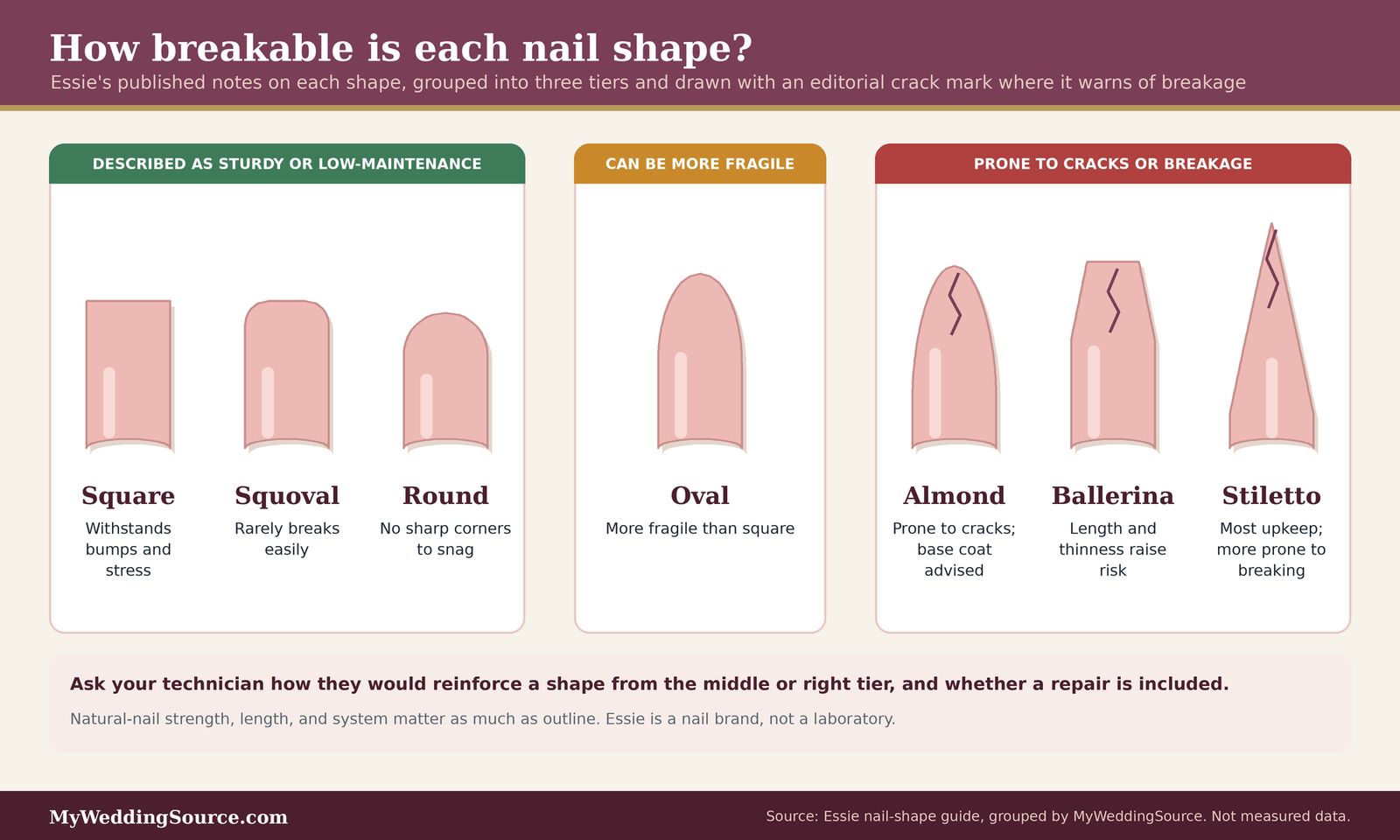
Essie’s guide is unusually specific about how likely each of the wedding manicure shapes compared for different ring styles is to break, which makes it a useful, if commercial, source. The infographic below reorders those statements into one ladder. It is an editorial summary of what Essie says, not a measurement.
Shapes the source describes as sturdier
Essie describes square nails as withstanding bumps and stress, and squoval as rarely breaking easily. It describes round as low-maintenance with no sharp corners to snag, and it recommends squoval or round for short nails because they are less likely to break. These are the shapes to favor if your wedding week is busy, if you work with your hands, or if you are prone to chips.
Shapes the source says need support
Essie says oval can be more fragile than square, almond is prone to cracks and benefits from a strengthening base coat, ballerina is more prone to breakage because of its length and thinness, and stiletto needs more upkeep and is more prone to breakage. None of this makes those shapes unwise. It means you should ask a technician how they would reinforce the nail, what a repair would cost, and whether they will give you a touch-up kit for the day.
Length and the shift toward shorter nails
Length changes the practical picture of wedding manicure shapes compared for different ring styles as much as shape does. A short squoval and a long squoval behave differently, even though the outline is the same.
What The Knot reports about length
In its 2026 trend article, updated in December 2025, The Knot reports that short nails are trending, and that extra-long coffin and almond shapes had been the norm for elaborate designs before a shift toward shorter nails. That is a trend report, and trends change, so we use it as a reason to consider a shorter length, not as a rule. Its separate guide to short wedding nails describes short square and short almond nails as simple, timeless choices.
Length and daily function
This part is our judgment. Shorter nails are easier to live in when you are dressing, zipping, and holding a bouquet, and they leave less nail to catch on a ring, a veil, or a dress. A medium-length squoval gives you room to show a shape without committing to the upkeep of a long one. Our guide to bouquet weight is a reminder that you will be gripping something for a while, and a short, smooth nail makes that easier.
Polish color, accents, and finish beside the ring
Once you have settled wedding manicure shapes compared for different ring styles, polish can either support the ring or pull attention away from it. These notes are limited to what the sources say.
Metal tone and quiet finishes
The Knot suggests a gold French tip as a match for a gold engagement ring because it adds shine without distracting from the ring. Zola’s nail artist recommends vanilla French nails because they will not steal the spotlight from the engagement ring. Zola Ganzorigt also advises skipping rhinestones and decals so the ring can shine. The Knot’s 2026 trend article describes sheer polish, including a single coat that lets the natural nail show through, and a light dusting of chrome for a subtle glow. These are styling suggestions from publications and named nail artists, and none is tested.
Accents and embellishments
The Knot notes that an accent nail on the ring finger can draw attention to the engagement ring, with a silver accent nail as one example. In the 2026 trend piece, a celebrity manicurist suggests placing jewels or pearls under the free edge, which keeps the top of the nail classic. Zola’s artist suggests that if you use embellishments, you apply them close to the event to reduce the chance of losing them. If your nail shape already has a strong outline, we would keep the finish simple, and if the shape is simple, an accent has more room to work.
Nail systems and shape: what can be sculpted and what it costs your nails
A shape from wedding manicure shapes compared for different ring styles is easiest to keep when the nail underneath supports it. The system you choose, meaning natural nails with polish, gel, dip powder, acrylic, or extensions, decides how much shape and length you can hold, and each carries its own trade-offs.
Natural nails and polish
Natural nails with regular polish are the baseline, and they limit length but also limit risk.
What natural nails can hold
Natural nails can be filed into squoval, round, or soft square at almost any length that does not tear. In our judgment, almond and stiletto need more length than many natural nails can hold without cracking, which is likely why extensions come up in the Grazia article for those shapes. Cleveland Clinic’s overview of nail systems suggests that regular nail polish is likely the least harmful option compared with gel, dip, or acrylic. If your goal is a shape that behaves well with a ring and carries the least risk, natural nails with a soft shape are the straightforward answer.
Why a trial matters for natural nails
Natural nail shapes depend on your nail plate, and a technician can show you in a few minutes whether a shape holds. File one nail to a sample shape, put your ring on, and look at the hand in daylight. Our guide to wedding nails explains how to book that trial and what to bring.
Gel, dip powder, acrylic, and extensions
These systems add strength and length, and they also add chemistry, filing, and removal to your list of decisions.
What each system adds and what it risks
Cleveland Clinic describes gel as looking and applying like regular polish, with a strong finish that lasts, but notes that curing under UV lamps raises skin-damage concerns and that removal is harsh and can make nails brittle. It describes acrylic as very strong, able to add length, and capable of causing allergic contact dermatitis, and it describes dip powder as sturdy and durable but involving extensive filing and shared powder jars that raise hygiene concerns. The American Academy of Dermatology notes that acrylics require filing the natural nail until it feels rough, which thins it, and that gel is more flexible than acrylic. It recommends soak-off gels over those that must be filed off and notes that LED lights expose you to less UV radiation than UV lights.
Safety points from the regulator
The FDA states that it generally regulates nail products as cosmetics, that most do not require FDA approval before sale, and that state and local authorities oversee salon operations and manicurist licensing. It notes that artificial nails are mostly acrylic polymers, but traces of reactive monomers can remain and can cause redness, swelling, and pain in people sensitized to methacrylates. It advises reading labels, avoiding skin contact with methacrylate-based products, and reporting bad reactions to a healthcare provider and then the FDA. If you have had a reaction to nail products before, discuss it with a dermatologist before choosing a system. This guide does not give medical advice.
Removal, breaks, and the shape you will have afterward
Whatever system you choose, the wedding is not the end of your hands, and what happens after matters for your nails.
Plan the removal
The American Academy of Dermatology advises wearing artificial nails only for special occasions to give your nails time to recover, and Zola’s nail artist says improper removal is the main cause of nail damage and suggests having removal done professionally or being very gentle. Cleveland Clinic similarly says home removal of gel can cause more damage. If you plan to switch from extensions to your natural shape after the honeymoon, book that appointment in advance.
Allow time for the natural nail to recover
WeddingWire advises avoiding gel manicures in the months before the wedding because frequent application and removal can cause ridges, saving gel for the wedding day, and limiting buffing because it can thin nails. These are one publication’s suggestions, and the guidance differs from other sources, which is a reason to ask your technician how they prepare the nail. Our wedding beauty timeline and bridal skincare timeline place nails within the larger weeks-before schedule.
What this actually costs
We did not find a reliable national price average for nail services, so we do not publish one. What changes a quote is usually the system, the length, and whether repairs and removal are included. When you compare quotes, ask whether the shape itself is part of the price, whether a change of shape or added length costs extra, and whether a repair on the wedding week is included. Write each quote down in the same format so you compare like with like. Prices vary widely by region and salon.
A shape trial: how to test before you commit
A shape trial turns the advice on wedding manicure shapes compared for different ring styles into a decision made with your own ring and your own hand. It takes less time than a full manicure, and it tells you more than any chart.
Before the appointment
Preparation takes ten minutes and prevents most of the common regrets.
Bring your ring and your photos
Bring the engagement ring you will wear, and the wedding band if you will wear it on the same hand. Zola’s nail artist advises trying several designs or shades during salon visits before choosing a favorite, and The Knot suggests bringing saved photos to your manicurist as inspiration. Add your dress fabric if you can, even a swatch, because lace and tulle are where snags happen.
Decide which of the wedding manicure shapes compared for different ring styles to compare
Choose two or three of the wedding manicure shapes compared for different ring styles from the table above, ideally one echo, one contrast, and one quiet option. Write down why you chose each. This keeps the conversation with the technician specific, and it gives you something to look back on when you decide.
At the appointment
The appointment is where you see the shapes on your own hand, so spend most of it looking.
Try one nail at a time
Ask the technician to file or shape one nail, or to show press-on samples if the salon offers them, rather than finishing a full set. Compare the sample nail to the same hand without it, with the ring on. Look in daylight if you can, because salon lighting can look quite different from a wedding venue.
Take photographs of your hands
Photograph the hand with the ring from above and from the side, and photograph it holding something, such as a bouquet-size object or a glass. Cameras show proportions that a mirror hides. This is our suggestion, based on the fact that hands and rings are photographed often at weddings, as Zola’s article and WeddingWire both note.
After the appointment
A trial is only a trial if you live with it for a few days, and the checks below take only a few minutes each.
Run a snag test
Wear the shape for a few days and notice whether it catches on knit sweaters, your hair, a zipper, or the fabric swatch. If it does, round the corner more or shorten the length. This is practical judgment, and it follows the dermatology advice to round corners so they do not snag.
Decide and write it down
Write down the shape, the length in a plain description such as “just past the fingertip,” the system, and the polish. Our wedding photographer shot list guide shows how to ask for ring and detail photos, and the written note helps the technician repeat the same result on the day or in the wedding week.
Edge cases: when the standard advice does not fit
The comparison of wedding manicure shapes compared for different ring styles above assumes healthy nails of average length, a ring you have already chosen, and a bride who wears polish. Many real situations break one of those assumptions, and the sections below say what to do about each.
Short, damaged, or sensitive nails
Not every nail can be filed into every shape, and some nail changes are a health question rather than a styling one.
Very short or bitten nails
With very short nails, there is little free edge to shape. Essie recommends squoval or round for short nails because they are low-maintenance and less likely to break, and The Knot notes that short nails can work without polish as a clean natural manicure. WeddingWire advises that nail biters start months earlier, and it recommends stopping biting and picking and not ripping out hangnails, since that can cause infection. If you are growing nails out, plan for an in-between shape and tell the technician what length you are aiming for.
Changes you should have checked
The American Academy of Dermatology advises consulting a dermatologist if you notice changes in your nails’ color, texture, or shape, since some changes can signal disease or infection. If a nail has lifted, split, or changed color, do not cover it with a system and shape it for a photograph. Get it looked at first. This guide is general information and does not diagnose anything.
Rings that are not settled
The shape of a ring is not always fixed by the time you are choosing nails, and that changes how much a match is worth.
A ring you have not chosen yet
If you are still shopping, you have an unusual advantage, because you can try rings on with the nail shape you already wear or plan to wear. Try each ring on your hand rather than judging on a screen, and pay attention to how the setting sits against your nail edge. Our guide to engagement rings and complete engagement ring guide explain how to compare options, and the ring sizing guide helps with fit.
Heirloom, resized, or about-to-change rings
If a ring is an heirloom or is about to be resized, the setting may sit differently on your finger by the wedding. GIA notes that some settings, such as tension and channel designs, can be hard or impossible to resize, and that pavé settings can be hard to resize and need occasional maintenance. For wedding manicure shapes compared for different ring styles, choose the nail shape after the ring is final, and if resizing is pending, treat the first trial as provisional. Our engagement ring insurance guide is a useful companion if you are worried about a ring you cannot easily replace.
Hands that do not match the usual picture
A wedding has more hands than the bride’s, and the advice changes a little for each.
Grooms and partners who wear no polish
The Knot’s 2026 trend piece quotes Rebecca Isa of Zoya recommending buffed, healthy nails with a natural shine for grooms. A clean, short, rounded or squoval edge needs no polish and photographs well beside a plain band. The AAD advice on trimming, filing in one direction, and leaving cuticles alone applies to everyone. Our beard grooming guide is a sibling article in this cluster for other grooming steps.
A ring on a different hand or finger
Some people wear their engagement ring on the right hand, wear a band on a different finger, or hold a ring until the ceremony. The same logic applies: the nail next to the ring is the one that matters most. If you wear several rings, treat the whole hand as the outline, and use the settings and snag guidance above for each one.
Questions to ask before you book
Good questions keep a conversation about wedding manicure shapes compared for different ring styles specific. Ask for the answers in writing, and keep them with your trial notes.
Questions worth asking before you book
- Can you file one nail or show a sample before doing a full set, and will you save my exact shape?
- How do you shape the corners so they do not catch on fabric or my ring?
- Which system do you recommend for this shape and length, and why?
- How would you reinforce an oval, almond, or longer nail?
- What happens if a nail breaks the week of the wedding, and is a repair included?
- Is the shape or length part of the quoted price, or does it change it?
- How do you clean tools, and are tools or powders shared between clients?
- How will you remove the product afterward, and can I book that now?
About the technician and the products
These questions confirm that the person doing the shaping can deliver the result you tested.
Skill, licensing, and hygiene for your shape appointment
The FDA notes that state and local authorities oversee salon operations and manicurist licensing, so ask to see the technician’s license and check what your state requires. The American Academy of Dermatology advises disinfecting tools regularly, and Cleveland Clinic raises hygiene concerns about shared powder jars. Ask what the salon does about both. A salon that welcomes these questions is usually one you can trust with a longer appointment.
Products and reactions
Ask which product and brand will be used and whether you can see the ingredient label, since the FDA notes that products sold at retail must list ingredients. If you have had a reaction to a nail product, say so before the appointment. The FDA advises reporting bad reactions to your healthcare provider and then to the FDA.
About the schedule and the paperwork
Decisions about wedding manicure shapes compared for different ring styles fall apart when they are not written down. A few lines of paperwork prevent the most common misunderstandings.
Timing and touch-ups
Zola’s nail artist suggests booking the manicure one to two days before the wedding so it looks fresh. Ask the technician what their schedule looks like that week, how long a repair takes, and whether they will give you a small kit for touch-ups on the day.
What to put in writing
Write down the shape, length, system, polish, price, and cancellation policy. If you are paying a deposit, ask what happens if you need to change the date. Our wedding planning checklist covers the broader paperwork, and the written note is the thing that lets a technician repeat your trial result on the day.
FAQ: wedding manicure shape questions
Matching shape to ring
Do I have to match my nail shape to my ring?
No. Matching is one of three reasonable strategies, alongside contrast and a quiet nail. A stylist quoted by Grazia suggests echoing the ring’s outline, but nothing in the sources we reviewed treats that as a rule. Choose what you like on your own hand, and make sure it is comfortable and low-snag.
What nail shape suits a round or oval engagement ring?
A stylist quoted by Grazia recommends rounded nails for both round and oval stones, to embrace the stone’s symmetry. A squoval is a close alternative with softened corners. Essie notes that oval can be more fragile than square, so choose a shorter length if your nails split easily.
Which shape works best with a pear or marquise ring?
Grazia’s quoted stylist suggests almond or stiletto to play off the points. Essie says both need more support and are more prone to breakage, so extensions may be needed for length. A short almond or soft oval is a lower-risk way to lean in the same direction.
Practical limits
Can long nails catch on a prong or cathedral setting?
GIA says prong settings can sometimes catch on fabrics and cathedral settings are more likely to catch on clothing or objects. It does not address nails directly, so the combination is our judgment. Shorter nails with softened corners reduce the number of things that can catch. Test the combination with your dress fabric.
Which shape is the most durable for a wedding day?
Essie describes square as withstanding bumps and stress, and squoval as rarely breaking easily. It recommends squoval or round for short nails. A short squoval is a sensible low-risk choice. Durability also depends on your nails and the system used, so ask your technician how they would reinforce it.
Planning and safety
Should I choose my nail shape before or after I buy my ring?
After, if you can. The ring’s outline and setting are the fixed points, and the nail is the part you can still change. If the ring is not final, treat your nail shape as provisional. GIA notes that some settings are hard to resize, so a resize can change how the ring sits.
When should I book the wedding manicure?
Zola’s nail artist suggests booking one to two days before the wedding so it looks fresh. Book a shape trial earlier, ideally weeks ahead, so you have time to adjust. Also ask your technician when to schedule any removal after the honeymoon, since removal planning affects nail recovery.
Are gel or acrylic nails safe to wear for the wedding?
Dermatology sources describe trade-offs. The American Academy of Dermatology notes that acrylics need heavy filing and recommends soak-off gels over those filed off, and the FDA notes that methacrylate products can cause reactions in sensitized people. This is general information, not medical advice. Ask a dermatologist if you have had a reaction.
Your next steps
Narrow the shape
Pick three shapes from the table
Choose one of the wedding manicure shapes compared for different ring styles that echoes your ring, one that contrasts, and one quiet option. Write down why you chose each, and note the length you would wear. Our wedding nails guide helps with color and system decisions after the shape is settled.
Check the ring and the setting
Note your ring’s setting type and how high it sits, using GIA’s descriptions, because wedding manicure shapes compared for different ring styles depends on both. Put the ring on and look at where the setting meets your nail edge. If you are still choosing, our engagement ring settings guide is a useful next read.
Test and book
Run the trial
Book a short appointment, bring the ring and a fabric swatch, and compare one sample nail from each shape. Take photographs and run the snag test for a few days. Our wedding beauty timeline and the sibling guides on pre-wedding beauty and grooming timing and wedding facial timing help you place the appointment among your other beauty steps.
Lock in the details
Write down the shape, length, system, polish, price, and policy, and book the wedding-week appointment, so your choice among wedding manicure shapes compared for different ring styles survives the busy weeks. For the wider plan, use our wedding planning checklist and wedding emergency kit guide, and add a file and a clear coat for touch-ups.
Sources & methodology
How we built this guide
What we relied on
This guide combines a federal regulator’s page on nail care products, dermatology guidance on trimming, filing, and artificial nails, a Cleveland Clinic overview of nail systems, GIA’s descriptions of ring settings and buying considerations, a nail brand’s guide to nail shapes, a retailer’s guide to diamond shapes and finger length, and wedding-industry articles from The Knot, Zola, WeddingWire, and Grazia. Where a statement comes from a publication, brand, retailer, or a person quoted in it, we say so. The groupings, the echo-versus-contrast framing, the setting-and-nail snag reasoning, and the trial steps are our own editorial judgment, and the infographics are editorial illustrations, not measurements or data. We checked all sources on November 12, 2026.
What we did not do
We did not test nails, measure wear, or survey salons, and we found no published study that measures which nail shape flatters which ring. The stone-to-shape pairings come from a single stylist quoted in one article, so treat them as one view. We did not find a reliable national price figure for manicures, so we publish none. This is general information, not medical advice. See a board-certified dermatologist about reactions or persistent nail changes, and check your state’s rules for salon licensing.
Source list
Government, clinical, and professional sources
- U.S. Food and Drug Administration, Nail care products: https://www.fda.gov/cosmetics/cosmetic-products/nail-care-products
- American Academy of Dermatology, How to trim your nails: https://www.aad.org/public/everyday-care/nail-care-secrets/basics/how-to-trim-nails
- American Academy of Dermatology, Artificial nails: tips for reducing nail damage: https://www.aad.org/public/everyday-care/nail-care-secrets/basics/pedicures/reduce-artificial-nail-damage
- Cleveland Clinic, Acrylic, gel, or dip nails: https://health.clevelandclinic.org/acrylic-gel-or-dip-nails-understanding-the-pros-and-cons-for-your-health/
- GIA, Guide to engagement ring settings: https://4cs.gia.edu/?p=39609
- GIA, Tips for buying an engagement ring: https://4cs.gia.edu/en-us/blog/tips-for-buying-an-engagement-ring/
Brand, retailer, and wedding-industry sources
- Essie, Best nail shapes for your hands: https://www.essie.co.uk/tips-and-trends/best-nail-shapes-for-your-hands
- Grazia, How to match your nail shape to your engagement ring: https://graziadaily.co.uk/beauty-hair/nails/best-manicures-for-your-engagement-ring-shape
- Happy Jewelers, How to choose the best diamond shape for your finger: https://happyjewelers.com/blogs/education/how-to-choose-the-best-diamond-shape-for-your-finger
- The Knot, Short wedding nails: https://www.theknot.com/content/short-wedding-nails
- The Knot, 2026 wedding nail trends: https://www.theknot.com/content/wedding-nail-trends
- Zola, Wedding nail trends with a celebrity nail artist: https://www.zola.com/expert-advice/zola-ganzorigt-reveals-wedding-nail-trends
- WeddingWire, How to have healthy nails for your wedding day: https://www.weddingwire.com/wedding-ideas/how-to-have-healthy-nails