

Wedding fragrance selection is less about finding the most admired bottle and more about choosing a scent your skin tolerates, that travels the right distance, and that is still pleasant by the last dance, so it helps to test on purpose instead of buying on a first impression.
Quick answer
Start your wedding fragrance selection two to three months out. Sample on blotter paper first, then wear one finalist at a time on clean skin for a full day, with a few days between candidates. Watch your skin, your nose, and your head, not only the smell. Choose a concentration that suits how close people will stand to you, apply to a few points rather than everywhere, and pack a small travel atomizer for one or two light touch-ups. If anyone close to you is scent-sensitive, decide on a lighter plan in advance. This guide is general information, not medical advice.
What wedding fragrance selection is really deciding
Most people begin wedding fragrance selection by smelling a card at a counter and asking whether they like it. That is a fine first step, but wedding fragrance selection adds conditions that a counter does not: hours of wear, close hugs, photographs, a warm room, heavy fabric, flowers, food, and a crowd with different noses. A thoughtful wedding fragrance selection process treats the scent as one more part of the day that needs a plan.
Three questions behind every scent
Before comparing bottles, it helps to separate the questions you are actually answering. Each one has a different test, and mixing them up is how people end up with a lovely smell that is wrong for the day.
How does it smell to you
This is the part everyone already does. Smell is personal, and a fragrance can read differently on two people because of skin chemistry, according to both Zola and The Knot. Zola, in an article written with the fragrance brand Snif, advises choosing a scent you genuinely love rather than one that is fashionable or that photographs well. That is sensible advice for wedding fragrance selection: you will smell it on yourself all day, and you will smell it again every anniversary you choose to wear it.
How far does it travel
Projection is how far a scent reaches from your body. A fragrance that feels intimate to you can feel loud to a guest in a receiving line, and one that vanishes in a drafty tent may be right for a quiet indoor ceremony. Treat projection as a separate setting from how pleasant the scent is, and give it its own line in your wedding fragrance selection notes. Later in this guide we use retailer descriptions of projection to build a simple way to think about it.
How long does it last and how does it change
Longevity covers two things: how many hours you can smell it, and how the character shifts as the top, heart, and base layers come and go. Scento, a fragrance subscription retailer, notes that top notes fade within about half an hour, heart notes last a few hours, and base notes linger longest. A fragrance you love in the first minute may not be the one you are wearing at dinner.
Who shares the air with you
A wedding is a rare event where one person’s scent reaches dozens of others in close quarters. Thinking about those people early makes wedding fragrance selection easier, because it turns an abstract preference into practical limits.
Partner, parents, and wedding party
The people closest to you will hug you, stand beside you in photographs, and dance with you. They will also be the first to tell you honestly when a scent is too much. For wedding fragrance selection as a couple, Zola suggests narrowing your options and letting your partner weigh in, since your partner may dislike certain notes. It is worth extending the same invitation to a parent or a trusted friend, with one rule: they report what they notice, and you decide.
Guests who may be sensitive
Research on American adults, summarized on PubMed, found that about 30.5 percent of people in two national telephone surveys found scented products worn by others irritating, and about 19 percent reported health problems such as headaches or breathing difficulty from air fresheners or deodorizers. Those are survey results from two time periods, not a prediction for your guest list, but they are a useful reminder that a scent is not neutral to everyone in the room. Our guide on hosting a wedding for guests with severe fragrance sensitivities covers the guest side in depth.
What this guide covers and what it leaves out
Setting boundaries at the start keeps our wedding fragrance selection advice honest, because fragrance sits where personal taste, product safety, and health overlap.
What you will get
You will get a practical wedding fragrance selection method: a way to understand concentration, notes, and projection, a plain-language explanation of sensitivity, allergy, and irritation, a printable test card for sampling and application, a day-of schedule for application and touch-ups, a list of questions for sellers and vendors, and a set of edge cases such as hot weather and scent-sensitive guests.
What you will not get
You will not get a list of the best bottles, because taste and skin vary and we did not test products. You will also not get medical advice. If you have a history of skin reactions, asthma, migraines, eczema, or a diagnosed allergy, a clinician is the right person to ask before you add a new fragrance, and we say so again where it matters.
Concentration, notes, and longevity explained
Wedding fragrance selection gets easier once the labels on the box mean something. Two ideas do most of the work: how concentrated the fragrance oil is, and how the scent unfolds in layers. Neither guarantees how a scent will behave on your skin, but both help you compare candidates fairly.
The concentration ladder
Fragrances are sold in several strengths. The names are familiar: parfum or extrait, eau de parfum, eau de toilette, and eau de cologne. The main difference is how much fragrance oil is in the bottle compared with the carrier liquid.
Typical oil percentages from retailers
According to Ulta Beauty’s fragrance concentration guide, parfum is about 20 to 30 percent fragrance oil, eau de parfum about 15 to 20 percent, eau de toilette about 5 to 15 percent, and eau de cologne about 2 to 5 percent. Scento gives a similar picture, with extrait at roughly 20 to 40 percent, eau de parfum at 15 to 20 percent, eau de toilette at 5 to 15 percent, and eau de cologne at 2 to 5 percent. Scento also says these are usual ranges rather than rules, and that fragrance houses publish their own figures. We are quoting retailers here, not a regulator, so treat the numbers as approximate.
Typical longevity claims, and why to treat them as claims
Ulta says parfum typically lasts about 8 to 12 hours or more and eau de parfum about 6 to 8 hours. Scento gives about 8 to 12 hours or more for extrait, 6 to 8 for eau de parfum, 4 to 6 for eau de toilette, and 2 to 4 for eau de cologne. These are retailer estimates under general conditions. Your own skin, the weather, and what you apply the fragrance over will move the real number up or down, which is why the test card later in this guide asks you to check at set intervals.

The notes pyramid
Perfumers talk about top, heart, and base notes. The idea is simple, and it matters for a wedding because the scent that greets you when you spray is not the scent you wear through the evening.
Top, heart, and base in plain words
The Knot describes perfumes as built in layers, top, heart, and base, that blend into the scent you smell. Scento says top notes tend to fade within about half an hour, heart notes usually last a few hours, and base notes linger longest, and it recommends judging a fragrance across all three stages instead of only the first impression. In practice that means a quick spray on a paper card tells you about the top, while a full day on skin tells you about the base.
Scent families as a shortcut
The Knot names four broad families, floral, fresh, woody, and amber, and suggests that scents you already enjoy, such as candles or perfumes you own, can show which family you lean toward. That is a handy shortcut for wedding fragrance selection when the counter feels overwhelming: start from what you already like, sample two or three neighbors in that family, and widen only if nothing fits.
Why the same bottle lasts differently on different people
Even with a fixed concentration, hours of wear vary. Planning for that variation is part of sensible wedding fragrance selection.
Skin, moisture, and climate
Scento says oily skin tends to hold fragrance longer while dry skin lets it evaporate faster, and suggests applying an unscented moisturizer before perfume for dry skin. It also notes that heavier concentrations can feel overwhelming in hot weather. Those are retailer observations rather than laboratory findings, but they line up with common experience, and they are easy to test in your own routine.
Fabric, hair, and layering
Where the scent lands changes how it lasts. Scento suggests spraying veils or clothing linings instead of visible outer fabric, which also protects delicate material from marks. Layering matching products, such as a body lotion in the same scent, is a common way to stretch wear, but each added product is another chance for a skin reaction, so we suggest adding layers one at a time during testing. Our guide to wedding hair trials is a good place to schedule a scent check alongside your styling products.
Scent projection: how far is too far
Projection is the part of wedding fragrance selection that most guides skip. It is also the part guests notice. A fragrance that reaches across a small room is not wrong, but it should be a choice.
Reading projection from a retailer’s description
Projection is a looser idea than concentration, and wedding fragrance selection has no official scale for it. Retailers describe it in plain words, and those words are useful if you treat them as relative.
What Scento says about each strength
Scento pairs its concentration ranges with projection labels: extrait has intimate projection, eau de parfum moderate, eau de toilette subtle, and eau de cologne very light. The page does not define distances, so we do not either. Use the labels only to rank candidates against each other, and trust your own helpers’ reactions for the real picture.
Why a strong scent is not always a long reach
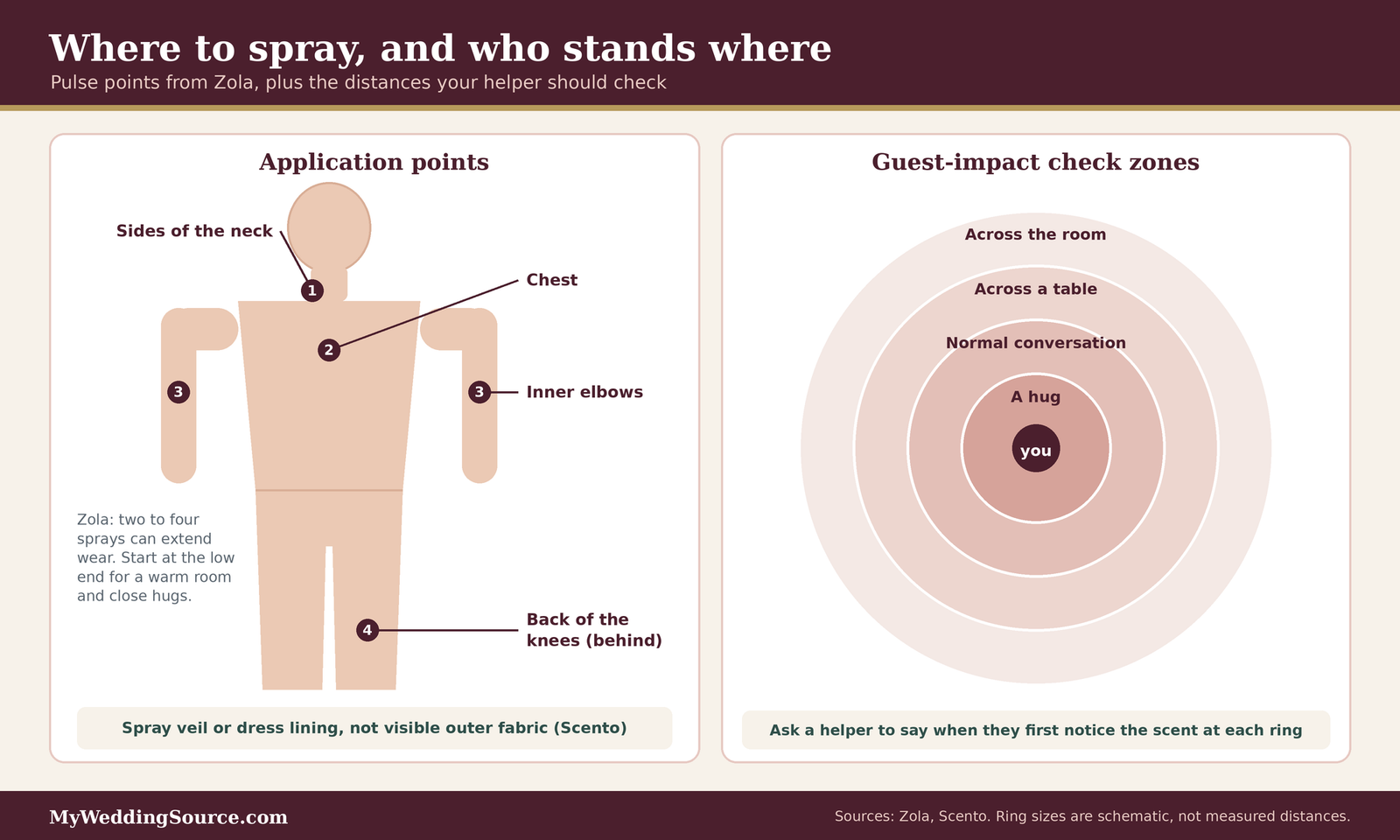
Concentration and projection are related but not identical. Retailer labels are general, and an individual fragrance may reach farther or sit closer than its category suggests. That is why it helps to test projection directly: ask a helper to stand at a normal conversational distance and say when they first notice the scent and whether it stays pleasant.
Close quarters on the wedding day
Think about where people will actually stand near you. Wedding fragrance selection has to work in those moments, not in an empty room.
Hugs, the receiving line, and photographs
In the receiving line you will hug dozens of people in a short span, often within a few inches of faces. Group photographs put you shoulder to shoulder with family. A light application on your torso and a low-projection fragrance generally suit those moments better than a heavy neck spray. If you like a bold scent, consider placing it on points that sit farther from guests’ faces, such as the back of the knees, a spot Zola lists among the pulse points.
Ceremony seating and the dance floor
A ceremony seats guests in rows with a warm room or a warm afternoon, while a dance floor adds heat and movement that make any scent bloom. If you will be indoors in a small space, step down a level in strength from what you would wear outdoors. Our wedding reception guide is a useful place to check how long you will be in a crowded space.
Shared scents and signature scents
Some couples want wedding fragrance selection to produce a scent that belongs to the day. Done lightly, it can be a pleasant detail. Done heavily, it adds to a room that already has flowers, candles, and food.
A shared scent for the couple or the wedding party
The Knot mentions couples who have the wedding party wear a shared unisex scent so that it fills the reception space. That idea only works when everyone tolerates the scent and agrees to wear it, and it multiplies the sensitivity risk across several people. If you try it, ask each person first, offer an opt-out without explanation, and make the opt-out easy.
A memory anchor over several months
The Knot also describes one bride who wore her scent to the venue tour, the menu tasting, the bachelorette party, the rehearsal dinner, and the week before the wedding, so that the fragrance became tied to those moments. It is an appealing idea, and it doubles as a long test period: wearing the scent through the months of planning gives you many chances to notice how your skin and your helpers respond.
Allergies, sensitivity, and your own skin
This is the section of our wedding fragrance selection guide to read slowly. Fragrance reactions range from nothing at all to a rash that lasts weeks, and the language people use for them is often loose. Knowing the difference helps you choose and helps you describe what happened if you ever speak to a clinician.
Allergy, sensitivity, and irritation
The words are used interchangeably online, but they describe different things, and the symptoms point to different next steps.
What each term usually means
Healthline describes an allergy as the immune system identifying a specific ingredient as foreign and mounting an inflammatory response. Irritation or sensitivity, in its description, is a direct reaction of skin or airways to a chemical irritant without a full immune response, typically fading within hours. Healthline adds that most perfume reactions are considered sensitivities rather than true allergies. This is a consumer health site, not a diagnosis, so use it as a vocabulary, not a verdict.
What reactions can look like
The Mayo Clinic describes contact dermatitis as an itchy rash that appears only where the skin touched the trigger, which can look like raised bumps or blisters, dark thickened patches, or dry cracked skin depending on skin tone. It says the rash usually appears within days of exposure, though it can begin within minutes to hours, and typically lasts two to four weeks. It lists fragrances and perfumes among the possible triggers. Healthline separately lists sneezing, a stuffy nose, headaches, and nausea as sensitivity symptoms. Swelling of the mouth, lips, or tongue, or trouble breathing, needs emergency care.
Reading labels without over-trusting them
Labels help, but fragrance labeling in the United States has gaps that are easy to miss. Wedding fragrance selection is a good moment to learn them, because you will probably buy products in several categories: perfume, lotion, hair products, and deodorant.
What the FDA says about the word fragrance
The FDA explains that cosmetics must list ingredients, but fragrance and flavor ingredients can be listed simply as fragrance or flavor, because the law does not require companies to reveal trade secrets and fragrance formulas are complex mixtures that are likely to qualify. The FDA also says it does not have the same legal authority to require allergen labeling for cosmetics as it does for food. In practice, the word fragrance on a label can stand for many components, and you usually cannot see which.
Unscented is not the same as fragrance-free
The FDA notes that products labeled unscented may still contain fragrance, added to mask the smell of other ingredients, and suggests that people concerned about fragrance sensitivity choose fragrance-free products, read ingredient lists carefully, and contact the manufacturer with questions. Allergic Living makes the same point, advising that unscented products often contain ingredients that mask odors. During testing, that matters because the lotion you use under a perfume can add a fragrance of its own.
When to bring in a professional
No wedding fragrance selection guide can judge whether a reaction is allergic. A clinician can, and there is a good case for asking early instead of in the week of the wedding.
Signs worth a call
The Mayo Clinic suggests seeing a doctor if itching prevents sleep or daily activities, if the rash is severe, widespread, or not improving within three weeks, if it affects the eyes, mouth, face, or genitals, or if you are concerned about how it looks. Seek immediate care for signs of infection such as fever or pus, or for any trouble breathing. These are general guidelines, not a substitute for your own provider’s advice.
Patch testing and timing
Allergic Living says a dermatologist can patch-test a person against a set of common fragrance ingredients, and Healthline says a doctor or allergist can apply small amounts of allergens to identify a specific trigger. Because we cannot say how long an appointment will take in your area, if you have had reactions before, consider asking about testing early in your planning, not close to the wedding. Our sensitive-skin bridal beauty guide goes further into planning around a reactive skin barrier.
The fragrance sensitivity and application test card
This is the working tool of the guide, the part of wedding fragrance selection you can print. It turns wedding fragrance selection into a short experiment with notes, so the decision does not depend on one afternoon at a counter. The card has two parts: a daily record for each finalist and a short guest-impact check you complete with a helper.
How to run the test
Keep the experiment simple and the conditions consistent, because wedding fragrance selection by comparison only works when only one thing changes at a time. The point is to change one thing at a time, so you can tell what caused what.
Set the ground rules
Zola suggests testing after a fresh shower with only unscented lotion or skincare, wearing each candidate for a full day, and waiting 48 to 72 hours before trying the next so each can be judged on its own. Scento suggests starting with five to ten scents on paper blotters, trying no more than three or four at a sitting to avoid nose fatigue, and then testing a few top picks on clean, moisturized skin over a full day, repeated on at least two separate days. We have combined those suggestions into the card below, but they are retailer advice, not a clinical protocol.
Test one spot first, as a precaution
Allergic Living suggests dabbing a little of a single scent behind the ear for a week as a way to check a single fragrance, and says that if the skin stays calm, the scent is likely safe. We would treat that as a cautious screening step, not a guarantee, and we would skip the test entirely if you already know you react to fragrance. If you notice redness, itching, a rash, or burning, wash the area, stop testing that scent, and consider asking a clinician.
The card
Copy this table into a notes app or print it, and keep it with your other wedding fragrance selection notes. Fill one block per finalist. The first row is the baseline day, with no new fragrance, so you know what your normal skin and nose feel like.
| Day | What I wore and where | Sprays | Check at 1 hour | Check at 4 hours | Check at 8 hours | Skin, same evening | Skin, next morning | Nose, head, breathing | Helper’s comment |
|---|---|---|---|---|---|---|---|---|---|
| Baseline | Nothing new; unscented lotion only | 0 | |||||||
| Finalist A, day one | Inner elbow and chest | 2 | |||||||
| Rest | Nothing new | 0 | |||||||
| Finalist A, day two | Same points, same sprays | 2 | |||||||
| Rest | Nothing new | 0 | |||||||
| Finalist B, day one | Inner elbow and chest | 2 | |||||||
| Finalist B, day two | Same points, same sprays | 2 |
The numbers in the card, two sprays and three-day gaps, are starting points drawn from the retailer ranges quoted above, not rules. Change them to suit your own product and routine, but keep them the same across finalists.
What to record at each check
At each interval, write one line on how strong the scent feels to you, what you notice in the heart notes, and whether the scent has become unpleasant. Separately, note any skin changes, any sneezing, nasal congestion, headache, nausea, or tightness in the chest. A fragrance that you like and that gives you a headache by hour four is a clear fail, however good it smelled at the counter.
What to record for the next morning
Skin reactions can show up later than the smell does. The Mayo Clinic notes that a contact dermatitis rash usually appears within days of exposure, so the next-morning column matters. If a rash appears on the day of the test, or a day or two afterwards, stop and see how long it takes to settle before testing anything else.
The guest-impact check
A fragrance can pass the personal test and still be too much for the people nearby. A second, shorter check catches that, and it is the step most wedding fragrance selection advice leaves out.
Ask a helper to stand close
Ask a friend, a parent, or your partner to stand at a normal conversational distance and tell you three things: when they first notice the scent, whether it is still pleasant after ten minutes, and whether it reaches them across a table. Ask one helper who is not shy about telling you the truth. Do the check indoors, in a room similar to your venue, if possible.
| Setting | Question for the helper | Pass | Adjust |
|---|---|---|---|
| Hug | Is it noticeable in a hug, and is that pleasant? | ||
| Conversation | Do you notice it at a normal talking distance? | ||
| Across a table | Do you notice it at a dinner table distance? | ||
| After hours | Is it still pleasant later in the day? | ||
| Mix | Does it clash with the lotion, hair product, or flowers I will use? |
Adjusting without starting over
If a scent is too strong for the room, there are several adjustments before you give up on it. Use fewer sprays, shift to points farther from the face, or apply to the lining of a garment, as Scento suggests, instead of skin only. If it is still too much after two adjustments, move on. Wedding fragrance selection works best when you keep two finalists in play until the late stage.
Reading your results
A card full of notes is only useful if you know how to decide from it, and good wedding fragrance selection depends on that last step. A simple rule keeps the decision clear.
Fail fast on health signals
Any skin reaction, headache, nausea, or breathing difficulty is a reason to drop a candidate, even if everything else was perfect. The American Lung Association notes that fragrances can cause headaches, dizziness, nausea, fatigue, and irritation of the eyes, nose, and throat, and can worsen asthma and COPD symptoms, and that people with asthma, allergies, eczema, or migraines may be more vulnerable. If you recognize yourself in that list, discuss testing with your clinician first.
Rank what is left
Among candidates that pass on health, rank them on three things in order: the guest-impact check, how the scent develops by hour eight, and whether you still like it on day two. Keep the top two. The final choice can wait until you have worn both in the same conditions as the wedding, such as a similar level of activity and a similar room.
An application plan for the day itself
Once wedding fragrance selection is done, the plan matters as much as the bottle. A good plan protects your clothing, keeps the scent within the limits you tested, and leaves room for a touch-up.
Where and how much
A common mistake is to treat the scent as part of the outfit and apply heavily at the end. A calmer approach is to apply early, lightly, and to places where it will not rub off onto fabric.
Pulse points and body heat
Zola lists the inside of the elbows, the back of the knees, the chest, and the sides of the neck as pulse points, where body heat helps the scent diffuse, and says two to four sprays can extend wear depending on the intensity you want. Scento recommends one or two sprays for touch-ups. For a wedding, we suggest the lower end of those ranges for a first application, because the room will be warm and the people near you will be close.
Protecting the dress and veil
Scento suggests spraying veils or clothing linings rather than visible outer fabric. We could not find a primary source that gives a firm rule for every fabric, so ask your dress boutique or tailor what they recommend, and test on a hidden spot. A simple habit is to apply scent before you put on the dress and let it dry fully first. Our wedding emergency kit guide is a useful place to add a stain remover and blotting cloth for the day.
The timeline of the day
A fragrance behaves differently at dawn than at midnight, and wedding fragrance selection should account for that. Mapping your application against the schedule helps you decide when a touch-up is worth it.
Morning and getting ready
For wedding fragrance selection to pay off, plan to apply after your skin care is done and your hair and makeup are finished, so the scent does not clash with sprays, powders, or setting products. Our wedding beauty timeline shows where scent can sit in the order of preparation, and the bridal makeup guide covers the products that come before it.

Ceremony, photographs, and reception
Top notes will already have faded by the time the ceremony starts, so the scent guests meet is mostly the heart. Photographs are not affected by scent, but you will be close to others in them. If you expect a long gap between the ceremony and dinner, plan one light touch-up before the reception and no more. Our wedding photographer shot list can help you see how long the portrait window is likely to run.
Touch-ups and travel
In wedding fragrance selection, touch-ups should be small, quick, and predictable. They are the one part of the plan that is easy to forget until the day.
What to pack
Scento suggests carrying a travel atomizer or an 8 ml vial, planning one or two light reapplications such as after photos or before the reception, and using only one or two sprays each time. Put the vial in the same bag as your emergency items, not in a bridesmaid’s purse that may be elsewhere. Label it clearly if several people are packing similar items.
Who holds it, and who reapplies
Decide in advance who carries the vial and when you will use it, so it does not become another thing to remember in the moment. Reapplying in a private space away from guests is both courteous and practical, since a spray in a crowded hallway reaches everyone in it.
Coordinating scent across the whole wedding
Your fragrance is not the only scent at the wedding, so wedding fragrance selection should include the other scents. Flowers, candles, food, hair products, and the venue itself all contribute. A thoughtful approach to wedding fragrance selection looks at them together.
Flowers, candles, and the venue
Strongly scented flowers and candles can overlap with your perfume and with each other, and they can bother guests more than a perfume does, because they fill a room.
Flowers and floral scent
Some flowers are far more fragrant than others, and a bouquet held close to your face brings both together. If you wear a floral perfume, consider whether the bouquet adds to it or competes with it. Our guides to wedding flowers and to planning flowers around pollen allergies can help you ask your florist about scent as well as color.
Candles, diffusers, and incense
The American Lung Association advises skipping air fresheners, scented candles, and incense, and encourages ventilation when scented products are used. That is general guidance for reducing exposure, and it is easy to apply to an event: ask the venue whether it uses plug-in air fresheners or scented cleaning products, and prefer unscented candles if you want candles.
Hair, makeup, and the people who touch your skin
The artists who prepare you bring their own products, and many contain fragrance, which can complicate wedding fragrance selection. If you have tested a perfume carefully, it makes sense to test the whole routine as well.
Ask for ingredient lists in advance
Ask your hair and makeup artists which products they plan to use and whether fragrance-free versions exist. The FDA suggests contacting the manufacturer with questions about ingredients, and an artist can often pass that question along. If you are prone to reactions, schedule a trial as the Zola and Scento guides suggest for fragrance: one product change at a time. See our guide to hair and makeup schedules for how to fit this in.
Nails, spray tan, and other beauty services
Salons often use products with strong smells, and a spray tan has its own scent. Plan these services so they do not overlap with your fragrance test days, or you will not know which product caused a reaction. Our guides to wedding nails and the wedding spray tan explain the timing, and the wedding facial timing guide shows when to avoid new skin products.
The partner, groom, and wedding party
Your partner’s fragrance affects your day as much as your own, so wedding fragrance selection is partly a shared decision. The same testing logic applies, with a few extra considerations.
Two scents in one embrace
If you and your partner both wear a fragrance, test them together. Some pairings work and some do not, and the clash is most noticeable up close. Scento suggests pairing compatible families, such as a floral with a woody scent, or choosing fragrances that share a common note. Our guide to beard grooming before the wedding covers the grooming products that sit close to a fragrance, such as beard oil and aftershave.
Boutonnieres, corsages, and small florals
Small florals sit close to the face and chest, right where a fragrance is applied. Ask your florist how fragrant a boutonniere or corsage will be, and check it against the wearer’s cologne. Our boutonniere and corsage guide covers the options.
Questions to ask sellers, vendors, and venues
Good questions replace guesswork in wedding fragrance selection, and they are especially useful for a product whose ingredients are not fully listed. Ask for answers in writing where it matters, and keep them with your notes.
Questions worth asking
- What concentration is this, and does the house publish its own oil percentage?
- Can I take a sample or a small size home before I buy a full bottle?
- Is there a return or exchange policy for opened bottles, and what is the window?
- Does this product list ingredients, and can the maker tell me about common fragrance allergens?
- Is the lotion or body product in this line fragrance-free or scented?
- Will my hair and makeup artists use scented products, and are fragrance-free versions available?
- Does the venue use air fresheners, scented cleaning products, or candles, and can they be turned off for my event?
- Will my florist tell me which flowers and greens are most fragrant?
- Is there a guest with a known sensitivity, and what scent plan will we follow in their area?
Questions for the perfume seller
These questions help you compare options fairly and avoid surprises after purchase. They are the ones to take to a counter, a boutique, or a subscription service.
Concentration, size, and returns
For wedding fragrance selection, ask for the concentration and whether the house publishes its own figure, as Scento notes some do. Ask whether you can buy a mini or a sample, which The Knot recommends before committing to a full size, and ask about return rules for opened bottles. Scento suggests buying the full bottle about three to four weeks before the day, so ask whether the seller can hold stock for you or ship in time.
Ingredients and allergens
The FDA says fragrance can be listed simply as fragrance, so a seller may not be able to tell you the components. Ask what they can share, and whether the maker offers a contact for ingredient questions. If you know you react to a particular ingredient, bring that name and ask whether it is listed.
Questions for vendors and the venue
Vendors and the venue shape the air your guests breathe. These questions are easiest to ask early, when you are discussing the rest of the plan.
Florist, planner, and caterer
Ask the florist about the most fragrant stems, the planner about any scented items they plan to bring, and the caterer about strong cooking smells near the seating area. If you are building a larger vendor checklist, our vendor due diligence guide shows how to keep these conversations organized.
Venue cleaning and air handling
Ask whether the venue uses scented cleaning products or plug-in air fresheners, and whether doors and windows can be opened. The American Lung Association suggests ventilation when scented products are used. Put anything you agree to in your notes or in the venue contract notes, and confirm it in the week of the wedding using the wedding week checklist.
Writing it down
A written plan means that nobody has to remember your wedding fragrance selection preferences on a busy day. It also helps your planner or a friend step in.
What goes in the scent notes
Include your chosen fragrance and how many sprays, the touch-up plan and who carries it, any guest sensitivities and the agreed response, and the vendor commitments you collected. Keep it to one page.
Who gets a copy
Share the page with your planner, your day-of helper, and your hair and makeup lead. If you do not have a planner, one trusted friend is enough. Our wedding planning checklist can hold the page alongside everything else.
Where the money goes
We did not find reliable current prices for wedding fragrance, and prices vary widely, so we do not quote any. In general, the places where money goes are sample sets or minis for testing, a full bottle, a backup bottle or mini in case of loss, a travel atomizer, and any matching body product. Scento and The Knot both suggest sampling before committing to a full size, which tends to cost less than buying two full bottles and returning one, if the return policy even allows it. Ask about return rules before you buy.
Edge cases and judgment calls
Not every wedding fits a standard plan, and wedding fragrance selection is no exception. These situations come up often enough that it is worth thinking through them in advance.
Heat, humidity, and outdoor weddings
Weather changes how a scent behaves, and it changes how people feel about it, so outdoor wedding fragrance selection deserves its own test. A hot day makes any fragrance feel stronger, and a breezy outdoor ceremony can carry it farther than you expect.
Warm weather and heavier concentrations
Scento notes that heavier concentrations can feel overwhelming in hot weather, so lighter options may suit warm days better. If your wedding is in summer or in a warm destination, test your finalists in similar heat, and consider stepping down a concentration. Our summer wedding heat plan covers the rest of the warm-weather picture.
Wind, tents, and close seating
A tent traps scent and a breeze scatters it. In a tent, apply less. Outdoors in wind, the scent may disappear quickly, and a light touch-up is more likely to be useful. Test the scent in a similar setting if you can.
Sensitivity, health conditions, and pregnancy
Some people have good reasons to avoid or change fragrance, and wedding fragrance selection can include choosing none. A wedding is a good time to ask for help instead of pushing through.
Skin conditions, asthma, and migraines
The American Lung Association lists people with asthma, COPD, allergies, or eczema, and people with migraines or chemical sensitivities, as more vulnerable to fragrance effects. If that describes you, a fragrance-free wedding may be the better choice, and it removes one variable from a busy day. A clinician can advise on what is reasonable for you.
Pregnancy and medications
The American Lung Association also lists pregnant people among those who may be more vulnerable. We cannot give medical advice, and we did not find a source that gives firm guidance on specific medications or on skin treatments that make skin more reactive. If you are pregnant, taking a medication that affects your skin, or have recently had a skin treatment, ask your provider before adding a new fragrance.
A fragrance-free wedding and other alternatives
In wedding fragrance selection, choosing no fragrance is a legitimate choice, and sometimes the kindest one. There are also lighter alternatives for people who want something scented.
How to do a fragrance-free day
Choose fragrance-free products for everything that touches your skin, as the FDA suggests for people concerned about sensitivity, and ask your vendors to do the same. Tell your wedding party plainly. The Allergic Living article suggests that some hospitals and schools have no-scent policies, which shows how common the practice is outside weddings.
Lighter options for scent lovers
If you want some fragrance without much projection, consider a lighter concentration, a single spray on the lining of a garment, or a scented item that stays private, such as a handkerchief in a pocket. These are our suggestions, not tested methods. Check any scented item against the skin and nose rules in this guide.
When plans change
Even careful wedding fragrance selection can end with a surprise. A quick plan for the common ones prevents panic.
The favorite stops working
A scent that was fine in testing can sit differently when you are nervous, warm, or wearing new products. If it feels wrong on the day, stop applying, wash the area if you need to, and use your backup or go without. Having a second finalist or a mini ready is the simplest protection.
A reaction close to the wedding
If you develop a rash or other symptoms close to the day, wash the area, stop all new products, and contact your clinician. The Mayo Clinic notes that a rash can last two to four weeks, so do not expect a quick fix. Our emergency kit guide can help you plan for small skin problems, and a calm backup plan matters more than a perfect scent.
FAQ: wedding fragrance selection questions
Choosing and testing
When should I start wedding fragrance selection?
Scento suggests starting about two to three months before the wedding, narrowing your choices around eight to ten weeks out, and finalizing three to six weeks out. That gives you time to wear finalists on separate days and to react if your skin objects. Treat these as retailer guidelines and adjust them to your own calendar.
How many fragrances should I test at once during wedding fragrance selection?
Scento recommends no more than three or four at a sitting on paper blotters to avoid nose fatigue, and Zola suggests wearing one candidate on skin for a full day, then waiting 48 to 72 hours before the next. Testing slowly lets you judge each scent on its own instead of blending them together.
Should I wear my usual perfume on the wedding day?
You can, and many people do. If your usual scent passes the guest-impact check in the room and weather you expect, familiarity is an advantage, since you already know how your skin responds. If you want something new for the occasion, test it as carefully as a stranger would be tested, and keep your usual scent as a backup.
Allergies and guests
Is unscented the same as fragrance-free?
No. The FDA notes that unscented products may still contain fragrance added to mask other smells, and suggests choosing fragrance-free products if you are concerned about sensitivity. Read ingredient lists carefully and ask the manufacturer when the label is unclear, especially for lotion and hair products you will use during testing.
What should I do if I get a rash after testing a scent?
Wash the area, stop using the product, and avoid new products until it settles. The Mayo Clinic suggests seeing a doctor if the rash is severe, widespread, affects the face, eyes, or mouth, or has not improved within three weeks. Seek urgent care for trouble breathing, swelling of the mouth or tongue, or signs of infection.
How do I handle guests who are sensitive to scent?
Ask, privately and early, what would help, then agree on a plan such as a lighter application, seating away from heavy florals, or fragrance-free products on your end. Our guide on hosting guests with severe fragrance sensitivities has more. You cannot control what every guest wears, but you can control your own choices and the venue’s.
Application and longevity
How many sprays should I use?
Zola says two to four sprays can extend wear depending on intensity, and Scento suggests one or two for touch-ups. For a warm room and close hugs, we suggest starting at the lower end, then adjusting after the guest-impact check. More is not always better, since stronger scent can cause more problems for you and for those near you.
How do I make my wedding fragrance last all day?
Scento suggests an unscented moisturizer or a matching body product under the perfume, particularly for dry skin, and a travel atomizer for one or two light touch-ups. Concentration also matters, since higher concentrations tend to last longer, according to retailers. Longevity still varies by person, so use your test card for your own numbers.
Your next steps
Start the test
Build a shortlist of scents you already like
Begin wedding fragrance selection by picking scent families you enjoy from candles, perfumes you own, or samples, then choose a handful of candidates. Request samples or minis, and start with paper blotters before skin.
Run the test card
Print the card, choose two finalists, and wear them on separate days in the conditions you expect on the wedding day. Add a helper for the guest-impact check, and drop any candidate that causes a health signal.
Make the plan
Write a one-page scent plan
Record your chosen scent, spray points, touch-up plan, and any vendor commitments. Share it with the people who help on the day, and add it to your wedding planning checklist.
Check the week before
In the week of the wedding, confirm your vial is packed, your vendors have your notes, and the venue has agreed to any scent requests. Use the wedding week checklist to keep these items together.
Sources & methodology
How we built this guide
What we relied on
This guide combines U.S. regulatory information on fragrance labeling, clinical and consumer-health descriptions of contact dermatitis and fragrance reactions, survey research on how common scent irritation is, and published advice from fragrance retailers and wedding publishers on testing, concentration, and application. Where a statement comes from a retailer, we say so, because retailer advice reflects what the seller sells. We checked these pages during November 2026, and pages change, so recheck anything that matters before you act on it.
What we did not do
We did not test fragrances, run patch tests, or measure projection. The test card, the guest-impact check, and the touch-up suggestions are our own planning tools built from the sources below, not clinical protocols. We did not give medical advice. If you have a history of reactions, asthma, migraines, eczema, or are pregnant, ask a clinician before adding a new fragrance.
Source list
Government and clinical sources
- U.S. Food and Drug Administration, Fragrances in Cosmetics: https://www.fda.gov/cosmetics/cosmetic-ingredients/fragrances-cosmetics
- U.S. Food and Drug Administration, Cosmetics (overview, safety responsibilities, MoCRA): https://www.fda.gov/cosmetics
- Mayo Clinic, Contact dermatitis, symptoms and causes: https://www.mayoclinic.org/diseases-conditions/contact-dermatitis/symptoms-causes/syc-20352742
- CDC Stacks, Fragrances Can Cause or Trigger Work-Related Asthma (California Work-Related Asthma Prevention Program newsletter): https://stacks.cdc.gov/view/cdc/223882
- PubMed, Prevalence of fragrance sensitivity in the American population: https://pubmed.ncbi.nlm.nih.gov/19326669/
Health organizations and consumer-health sources
- American Lung Association, Fragrances: https://www.lung.org/clean-air/indoor-air/indoor-air-pollutants/fragrances
- Healthline, Perfume allergy: https://healthline.com/health/allergies/perfume-allergy
- Allergic Living, Perfume and the Scent Sensitive: https://www.allergicliving.com/2010/07/02/perfume-for-the-scent-sensitive/
Retailer and wedding-publisher sources
- Ulta Beauty, Eau de toilette vs. parfum: https://www.ulta.com/discover/beauty-education/eau-de-toilette-vs-parfum
- Scento, Perfume concentrations explained: https://www.scento.com/blog/perfume-concentrations-explained-from-edt-to-extrait
- Scento, How to choose a wedding day fragrance: https://www.scento.com/blog/how-to-choose-a-wedding-day-fragrance
- Zola, How to choose your signature wedding fragrance: https://zola.com/expert-advice/choose-your-signature-wedding-fragrance
- The Knot, Signature scent for your wedding: https://www.theknot.com/content/signature-scent