
Wedding makeup artist sanitation is the set of habits that keep brushes, products, hands, and surfaces clean between one face and the next, and you can check most of it with a few polite questions before you book and a few minutes of watching at your trial.
Quick answer
Ask four things: how brushes and tools are cleaned between people, how products are taken from their containers without dipping into them, what the artist does about eye products and applicators, and what happens if you or the artist is unwell or has a skin reaction. A prepared artist can answer each in a sentence or two and will not mind that you asked. Wedding makeup artist sanitation rules differ by state, so treat the examples in this guide as illustrations and confirm what your own state board requires. This guide is general consumer information, not medical or legal advice.
What wedding makeup artist sanitation covers
Most couples hear “hygiene” and picture a clean-looking kit, but wedding makeup artist sanitation is about process more than appearance. Clean-looking is a good sign, but it is not the same thing as clean. Wedding makeup artist sanitation is really a chain of small decisions about what touches whose skin, in what order, and what happens to each tool afterward. Understanding the chain makes the questions easier to ask and the answers easier to judge.
In this guide we use the word sanitation loosely, the way clients do, to include cleaning, disinfecting, and single-use habits. Regulators use these words more precisely, and where that matters we say so.
The scope of a hygiene review
A useful review looks at everything that moves between people on a service day. That list is longer than brushes. It includes the artist’s hands, the products and the way they are dispensed, the tools that touch skin, the cape or towel on your shoulders, the surface where tools rest, and the seat or chair you sit in. If any one of these is handled carelessly, the rest of the routine does not fully make up for it.
The touch points worth naming
Think in terms of five touch points. Hands touch your face, so handwashing comes first. Brushes, sponges, and spatulas carry product, so how they are cleaned and replaced matters. Containers hold product that will be used again, so how it is portioned matters. Disposable items such as cotton pads, wands, and sponges are meant to be used once. Linens and capes touch your neck and shoulders. When you ask about wedding makeup artist sanitation, you are really asking about these five.
What a review does not cover
A conversation about wedding makeup artist sanitation is not a skills test, a product review, or a medical screening. It will not tell you whether the artist’s style suits you, whether a foundation will last through a long reception, or whether you will react to a particular ingredient. For skin that reacts easily, our guide to sensitive skin bridal beauty covers that side of planning, and a clinician is the right person for medical questions.
Who sets the rules
In the United States, rules for makeup services are not uniform. Some states license makeup artists directly, some fold the work into cosmetology or esthetics licenses, and some leave certain makeup-only services lightly regulated. For wedding makeup artist sanitation, the practical lesson is that “licensed” can mean different things in different places, and the best protection is to ask what the artist’s license covers and what the artist’s own standard is.
State rules differ, so use them as examples
To see what regulators actually write down, we read two state sources. The California Board of Barbering and Cosmetology publishes health and safety rules, and Texas publishes general health and safety standards for cosmetology establishments and practitioners. The California rules say, in plain terms, that makeup brushes should be cleaned and dried between uses and stored clean, that creams and cosmetics should be kept in clean, closed containers, that portioning should not contaminate what remains, that pencil cosmetics should be sharpened before each use, and that practitioners should wash their hands before serving each client. The Texas text describes hand washing before services, cleaning and disinfecting reusable items before each client, and throwing away single-use or porous items after one client. These are two states, and they may not apply where you are getting married.
What we could and could not confirm
The Texas text we read does not address makeup or cosmetics specifically, so its general rules may apply to some materials but we cannot say exactly which. We also could not find a single national rule that tells a wedding makeup artist how to sanitize. The U.S. Food and Drug Administration regulates cosmetic products, not artists’ working habits, and its cosmetics pages point consumers to safe-use information and a way to report problems. If your wedding is in another state, check that state’s board website, or ask the artist which rules they follow.
Why wedding mornings raise the stakes
A single appointment with a makeup artist is already close contact. A wedding morning adds volume, speed, and the wish for everything to go smoothly, and those three factors are the reasons wedding makeup artist sanitation matters more on this day than on an ordinary one.
Many faces, one kit
For wedding makeup artist sanitation, the key fact is that a typical wedding morning has more than one client for one artist, or a small team sharing space. The same kit works on the bride, a mother, bridesmaids, and sometimes a flower girl, often in a single block of hours. That is normal, and it is why a clear routine for changing from one person to the next is the most useful thing to ask about. Our guides on how to schedule hair and makeup for a large bridal party and the wedding hair and makeup schedule explain how the time is usually divided.
The reset between clients
Between two people, a careful artist usually has to do a few things: wash or sanitize their hands, swap used tools for clean ones, discard single-use items, and wipe or change the surface. None of these steps takes long, but all of them take longer than skipping them. If you see a schedule where six people are booked with no gap at all, the schedule itself may be telling you where the corners will be cut.
Why a tight schedule is a hygiene question
Time pressure is the main reason good wedding makeup artist sanitation habits slip. When you review a quote, check that the time per person includes room for the reset, not just the application. We discuss this again in the cost section, because the cost of clean practice is mostly time.
Close contact and the eye area
The eye area deserves its own attention in wedding makeup artist sanitation because the products used there sit close to the surface of the eye and on the lash line. Mascara wands, liner, and lash adhesive all travel between the container and the eye, and a wand that goes back into a tube carries whatever it touched with it.
What eye-health sources say
The American Academy of Ophthalmology advises people not to share eye makeup, to use only fresh applicators, to avoid store samples that many people have touched, and to throw away eye makeup after about three months, noting that creamy and liquid formulas are especially prone to growing bacteria. The FDA’s older consumer update on eye cosmetics, last updated in 2008, gives similar advice: do not share eye makeup, keep applicators clean, do not add saliva or water to thin a product, and use single-use applicators when sampling. Both sources are written for individuals, but the logic transfers directly to a professional kit that serves many people.
What this means for a professional kit
In wedding makeup artist sanitation, if a product is not meant to be shared, a professional needs a way to avoid sharing it in practice. One approach, which you can ask about, is to use disposable applicators for eye products, to portion product onto a clean surface instead of working from the container, and to keep an eye on how old each product is. We are describing questions to ask, not a standard we can verify for every artist, and we note which statements come from sources and which are our own suggestions.
The artist hygiene audit: kit and brush handling
This is the center of the guide. The audit below is a way to review wedding makeup artist sanitation. It is a way for you to compare what you hear and see against what regulators and eye-health sources describe. It is not a certification, and an artist who does everything differently may still be perfectly careful. Use it to start a conversation, not to grade a person.
Brushes and tools
Brushes carry product and skin cells from one face to the next, so the way an artist handles them between clients is the most visible part of wedding makeup artist sanitation, and the easiest to ask about.
What good looks like between clients
The California rules say makeup brushes should have debris removed, be cleaned with a cleansing agent such as a brush cleaner or alcohol, be dried, and then be stored clean, and that used brushes go into a container labeled as dirty, soiled, or contaminated. The practical picture is a kit with two clear zones: a clean zone and a used zone. The key signal is that a used brush never goes back into the clean zone without being cleaned, and that an artist can tell you which is which at a glance. An artist may carry more than one set of brushes for a large party so there is time to clean between uses, which is a sensible question to ask.

What deep cleaning means
Cleaning between clients is different from a thorough clean at the end of the day. Ask when the artist deep-cleans brushes and how, and whether brushes are dried fully before they are packed away. Regulators in the two states we read describe cleaning and drying, not a particular brand or method, so the useful answer is a specific routine, not a product name.
Storage and transport
Storing clean items apart from soiled ones is a theme in both the California and Texas texts: clean tools in a clean, closed or covered place, soiled tools somewhere separate. For a mobile artist, that means a case or pouch that can be kept clean and a separate bag or container for used items. A single open brush roll where used and unused brushes sit side by side is a reasonable thing to ask about.
Products and dispensing
Products are the second half of the audit for wedding makeup artist sanitation. The container stays in use for months, so one careless dip can affect every later person who uses it.
Pots, palettes, and creams
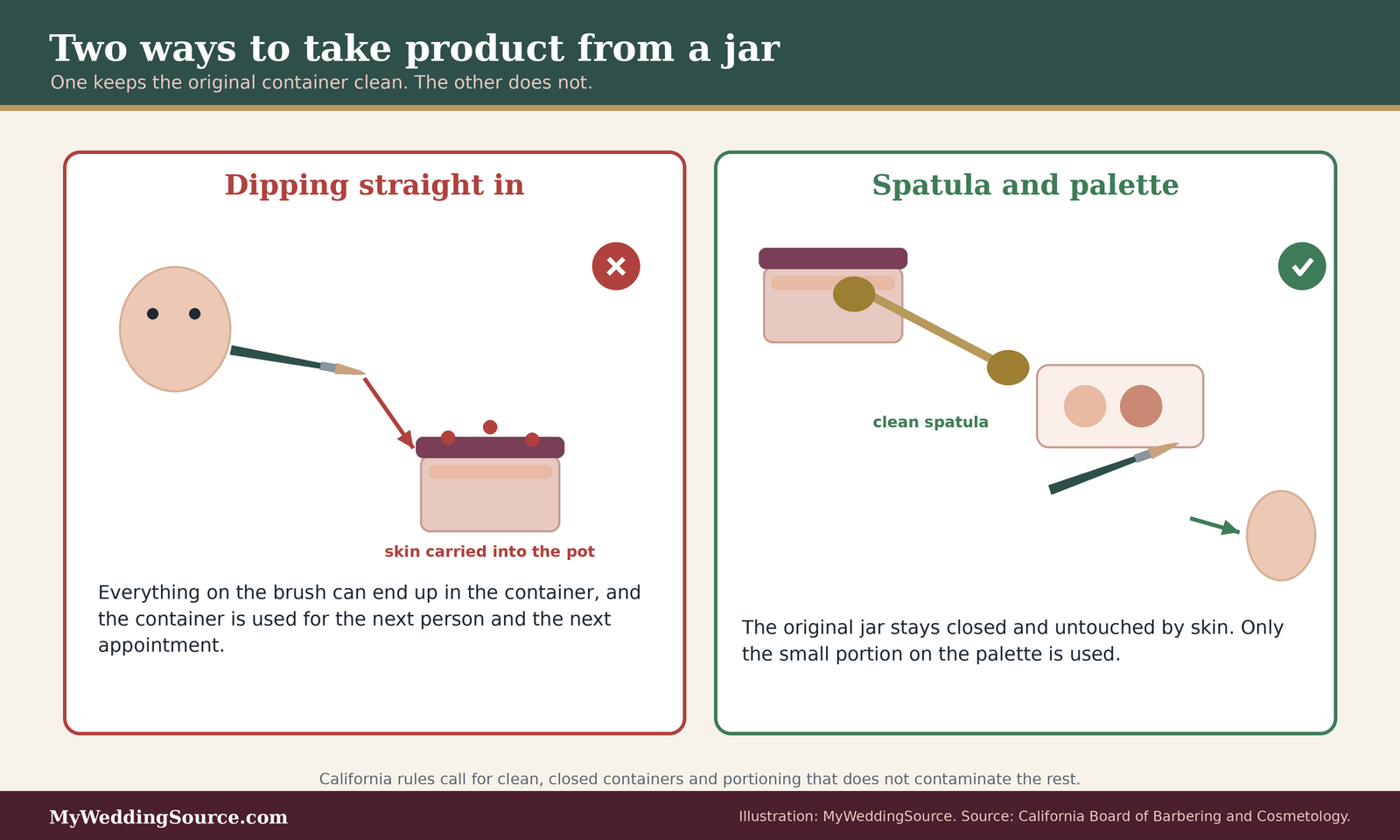
The California rules say liquids, creams, and other cosmetics should be kept in clean, closed containers and that portioning should not contaminate the remainder. In practice, the question to ask is how the artist takes product out of a pot or a palette. A clean spatula, a disposable scoop, or a pump that never touches a face all keep the original container separate from the skin. A brush or finger dipped directly into a shared pot is the habit that those rules are aimed at. One approach is a clean palette, where the artist places a small amount of product and uses only that during a service.
Mascara and eye products
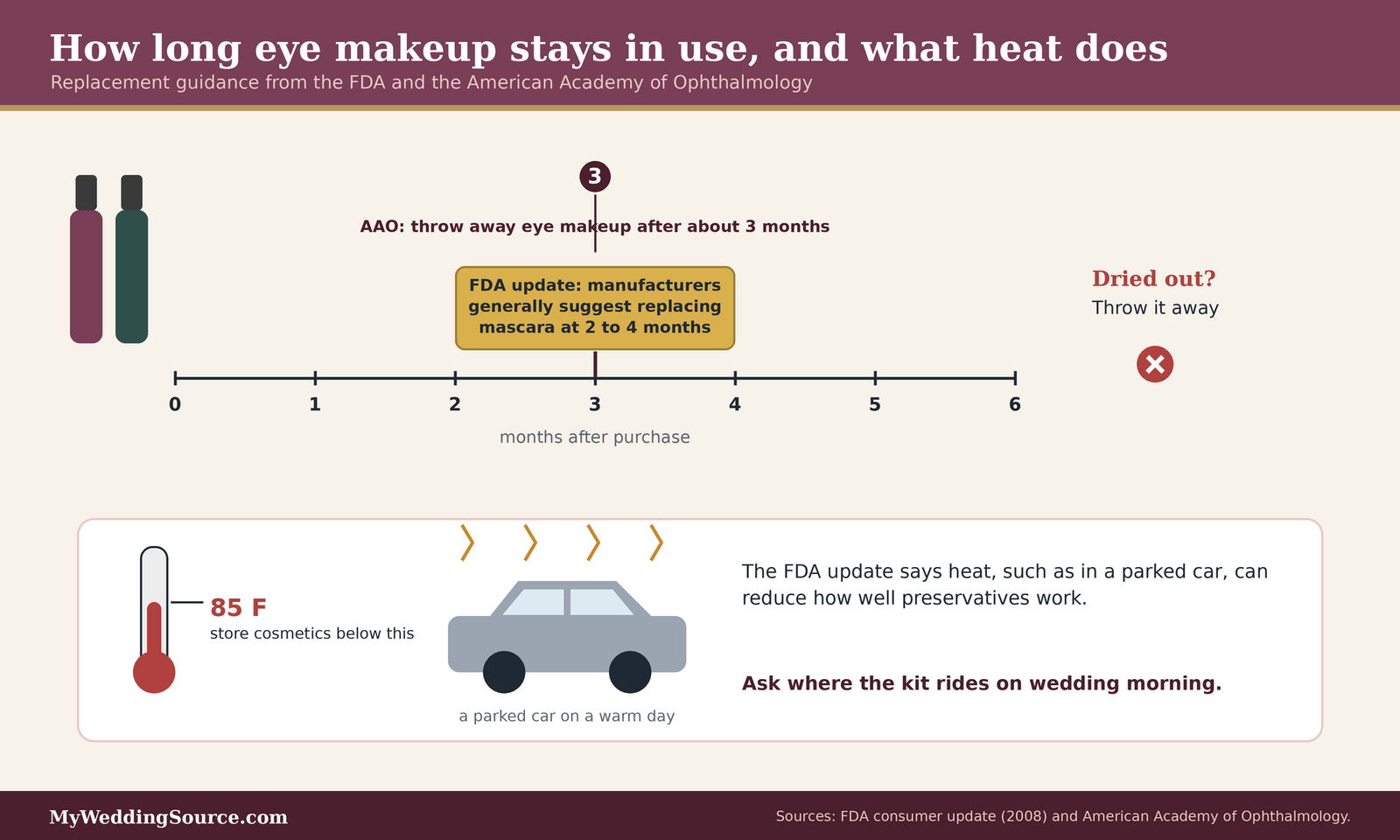
Mascara is the product most sources single out. The FDA’s consumer update says manufacturers generally suggest replacing mascara two to four months after purchase and advises discarding dried-out mascara, and the American Academy of Ophthalmology suggests about three months for eye makeup. For a professional, the practical equivalents are disposable mascara wands for each client and a habit of never putting a used wand back in the tube. Ask how the artist applies mascara to more than one person from a single tube.
Lip products and pencils
Lip products and pencils touch the mouth and the area around it. The California rules call for sharpening pencil cosmetics before each use, which removes the layer that touched the last person. For lipstick, a clean spatula or disposable applicator can take color from the bullet or pot, so the product itself never touches a lip. These details are easy to see at a trial if you watch the work.
Hands, surfaces, and linens
Tools and products are only part of wedding makeup artist sanitation, because other things touch you too. The artist’s hands, the surface where products rest, and anything that sits against your skin also matter.
Hand washing and sanitizer
Both state sources we read call for hand washing before serving each client. The California Board adds that soap and water is the most important step and that alcohol sanitizers help but are less effective on dirty or greasy hands, and the Centers for Disease Control and Prevention recommends scrubbing with soap for about twenty seconds, and says that if soap and water are not available, a hand sanitizer with at least sixty percent alcohol is the fallback. At a wedding, sinks may not be nearby, which is why sanitizer is often used between clients. It is reasonable to ask how the artist handles hand cleaning when a sink is far away.
Surfaces, capes, and towels
The Texas text asks for clean towels for each client and a single-use cape or a neck strip or towel that keeps the cape off the client’s neck, and the California rules say used towels and similar items go into a closed container until laundered. For a mobile appointment, ask what goes on your shoulders and what goes under the tools. A fresh cape, drape, or paper towel under the tray is a small visible sign that the routine is deliberate.
Single-use items
The California rules list items that touch the client and cannot be disinfected, such as sponges, cotton pads, and gloves, as items to throw away after one client. Many makeup tools fit that description, including disposable mascara wands, lip applicators, and sponge wedges. If an artist reuses a sponge on several faces, that is a question for them, not a verdict.
Reading the audit scorecard
The table below turns the points above into a single sheet you can use during a consultation or trial. It describes what to look for and what should prompt a question. A single “red flag” is a reason to ask, not a reason to leave.
| Area | What a careful routine usually looks like | What should prompt a question | Plain way to ask |
|---|---|---|---|
| Hands | Washes or sanitizes before each person | Moves from one client to the next without cleaning | “How do you clean your hands between clients?” |
| Brushes | Clean and used brushes kept apart | Used brushes returned to the clean roll | “How do you keep used brushes separate?” |
| Pots and palettes | Product taken out with a clean spatula or onto a palette | Fingers or brushes dipped into shared pots | “How do you take product from a container?” |
| Eye products | Disposable wands and applicators, replaced on a schedule | Same mascara wand back in the tube | “What do you use for mascara and liner on each person?” |
| Pencils and lips | Pencils sharpened, lip color taken with a clean tool | Same pencil used on several people without sharpening | “How do you handle lip and pencil products?” |
| Sponges and pads | Single-use or cleaned between people | One sponge used on a whole group | “Are sponges single-use?” |
| Linens | Fresh cape or drape, covered used-item container | Same cape for everyone | “What goes on my shoulders?” |
| Surface | Clean tray, fresh paper or wiped surface | Open, cluttered tray with products everywhere | “How do you keep your station clean?” |
| Illness and skin | Will reschedule or cover the area if skin is irritated or infected | No stated policy | “What is your policy if someone is ill?” |
How to use the scorecard
Take the wedding makeup artist sanitation scorecard to a consultation as a mental checklist, not a clipboard. If you prefer not to ask all nine questions, ask the ones in the first four rows: hands, brushes, containers, and eye products. These carry most of the risk and are the easiest for an artist to answer.
Scoring without being unfair
An artist who explains a different method than the one in the table is not failing the audit. A good answer is specific, consistent, and unembarrassed. A vague answer such as “we’re very clean” is less informative than a clear description of one routine, even a different one.
Questions to ask before you book
Questions about wedding makeup artist sanitation work best when they are specific, friendly, and sent in writing so that the answers can go into your booking file. You are asking the same way you would ask about overtime or travel fees: as an ordinary part of choosing a vendor.
Questions to ask a makeup artist about hygiene
- How do you clean your hands between clients, and what do you do if there is no sink nearby?
- How are brushes and tools cleaned between people, and do you bring enough clean tools for my party?
- How do you take product out of pots, palettes, and tubes so the original container stays clean?
- What do you use for mascara, liner, and lip color on each person?
- Which items are single-use, and which are cleaned and reused?
- What is your policy if you or one of my party is ill, has a cold sore, or has irritated or broken skin?
- How do you handle someone who reacts to a product during the service?
- Which state license do you hold, and what does it cover?
Questions for the first message
The first message is a good moment to ask short questions that do not feel like an interview. A line such as “Could you tell me a little about how you keep your kit clean between clients?” is polite and specific.
A short message you can adapt
You might write: “We are booking hair and makeup for six people and would like to understand your routine. How do you handle brushes, products, and eye makeup between clients? Do you bring enough clean tools for a group? Thank you.” You can add that you are asking everyone you speak to, which is true and removes any sense of suspicion.
What a good reply sounds like
A good reply on wedding makeup artist sanitation is concrete and calm. It names a routine such as using disposable applicators for eye products, cleaning tools between clients, and portioning product onto a palette. It does not need to be long. If the answer is a pause followed by “I’ve never been asked that,” the pause is information too, and the next question can be gentle: “What would you do in that situation?”
Questions about licensing and insurance
Licensing and insurance are related to wedding makeup artist sanitation but are not the same thing. A license usually means the artist has met a state’s requirements, which may include training in health and safety. Insurance is a separate matter that covers certain kinds of claims.
Licensing
Ask which license the artist holds and what it covers in your state. Because states differ, an answer that makes sense in one state may not in another. If the wedding is in a different state from the artist’s usual work, ask whether the artist is licensed to work there. Our guide to wedding vendor due diligence walks through the broader process of checking any vendor, and we are not able to tell you what any particular state requires.
Insurance and liability
Ask whether the artist carries liability insurance and whether a venue requires a certificate. Some venues ask vendors for proof of insurance, so this question may serve a second purpose. We cannot advise you on what coverage you need. A planner or an attorney can help if the question is important to you.
Questions to ask a team or studio
When you book a studio instead of an individual, there is often one lead and several assistants. The wedding makeup artist sanitation routine then depends on all of them, not only the person you spoke to.
Who will be doing the work
Ask who will be at your wedding and whether the lead’s routine applies to everyone. Our guide to wedding vendor subcontractors explains why it helps to know exactly who is arriving. If a sub-artist is booked, ask that the same kit standards apply and that the contract names who is responsible.
How the studio trains the team
It is reasonable to ask how the studio makes sure that every artist follows the same routine. A short written policy, a checklist, or a consistent kit setup all count as answers on wedding makeup artist sanitation. You are not asking for paperwork, only for evidence that the routine is shared and not improvised.
What to watch at the trial and on the day
Your trial is the best chance to see wedding makeup artist sanitation in action. You are already in the chair, and you can watch the routine without making it a performance. Our guide to the wedding hair trial explains how trials usually work, and the same trial is a natural time to notice kit habits.
Using the trial as a quiet inspection
You do not need to hover. A few observations during a normal session will tell you most of what you need.
What to notice in the first five minutes
Notice whether the artist cleans their hands before starting, how the station is arranged, whether brushes come out of a clean case, and whether a cape or drape goes on before product goes near your face. Notice how product is taken from containers. If something looks different from what you expected, you can ask about it as the work continues.
How to ask without making it awkward
The easiest way is curiosity. “I noticed you used a little palette for that. Is that how you work with everyone?” is a friendly way to learn the routine. An artist who is proud of their routine will usually be glad to explain it.
Watching the wedding morning
On the wedding day, the wedding makeup artist sanitation routine should match what you saw at the trial, scaled up for more people.
The first client sets the pattern
If you are first in the chair, you will see the routine at its clearest. If you are later in the schedule, you can observe how the artist resets between people. A clear sequence of cleaning hands, swapping tools, and discarding disposables is what you hope to see.
Helping the routine along
You can help by making space. Give the artist a clean, well-lit surface and, if possible, a place close to a sink. Our guide to the wedding morning beauty room setup covers how to set up the space so the work runs smoothly, and our guide to professional bridal makeup versus DIY discusses the choice of who does the work in the first place.
Edge cases that change the plan
The audit of wedding makeup artist sanitation above assumes a healthy client, a standard kit, and a normal setting. Real weddings often include exceptions, and each exception raises a slightly different question about wedding makeup artist sanitation.
Sensitive skin, allergies, and patch tests
If you or someone in your party has skin that reacts, wedding makeup artist sanitation and the product question overlap. A clean routine reduces one risk, which is contamination, but it does not tell you whether an ingredient will suit your skin.
Patch testing and ingredients
Patch testing is a common suggestion for sensitive skin, and a dermatologist can tell you how to do it properly. We could not open the dermatology pages we tried, so we do not give a procedure here. Ask the artist to show you the ingredient lists on the products they plan to use, and ask whether you can bring your own products. The FDA’s cosmetics pages list allergens and fragrance as consumer topics, and we have not been able to read those pages in full, so we recommend starting from the product labels and from your clinician’s advice.
Using your own products
Some people bring their own foundation or skincare for the artist to use. An artist may agree, and some will ask that the product be brand new or unshared. Ask what they prefer. If you bring your own eye products, bring new ones, and do not share them with the party. The sharing advice from the eye-health sources applies to your own items as much as to the artist’s.
Illness, infections, and skin conditions
Both sides of the appointment can be unwell. A wedding makeup artist sanitation policy that covers both is a sign of a thoughtful professional.
When the artist is unwell
The California Board guidance says licensees should stay home when they are sick, and lists conditions that call for refusing service, including pink eye until a clinician approves a return. We cite it as an example of what a regulator may say, not as a rule that applies in your state. For your wedding, the useful question is what the artist’s backup plan is if they cannot attend, and our guide to the wedding vendor replacement policy explains how replacements are usually handled.
When a client has an eye infection or open skin
The Centers for Disease Control and Prevention describes pink eye as causing redness, swelling, watering, itching, and discharge, notes that viral and bacterial forms are highly contagious, and advises people with symptoms not to return to school or work. The FDA’s consumer update and the American Academy of Ophthalmology both advise avoiding eye makeup during an eye infection and throwing away the eye products in use at the time. The California and Texas texts both say not to work on skin that is inflamed, infected, or broken. If you or someone in your party has symptoms, tell the artist before the day, and ask a clinician before deciding what to do. A good artist will want to know.
Airbrush, lashes, and specialty tools
Some services use tools beyond brushes and sponges. We did not find a government or professional source that sets out how to clean airbrush equipment or lash adhesive between clients, so these remain questions to ask, not standards we can describe.
Airbrush equipment
If you are considering airbrush makeup, ask how the artist cleans the tool between clients and which parts touch the skin or are replaced. Our comparison of airbrush versus traditional bridal makeup covers how the two methods differ in look and wear. The hygiene answer should be as clear as the look answer.
Lashes and adhesives
For strip lashes and lash adhesive, ask whether lashes are new for each person, how adhesive is dispensed, and what happens if there is irritation. If you plan to wear lashes, a trial is a good time to find out how your eyes respond.
Venues, travel, and limited access to water
Not every wedding morning has a clean counter and a sink, and that changes wedding makeup artist sanitation in practice. Hotel suites, barns, tents, and family homes all change what is possible.
Working without a nearby sink
If there is no sink in the room, the artist may rely on hand sanitizer between clients. The CDC says soap and water is best in most situations and that sanitizer with at least sixty percent alcohol is the fallback, and the California Board notes that sanitizer is less effective on dirty or greasy hands. A good question is how the artist handles this at a venue with no water nearby. You can help by picking a room near a restroom.
Heat and storage
The FDA’s consumer update recommends storing cosmetics below eighty-five degrees Fahrenheit because heat, such as in a parked car, can reduce the effectiveness of preservatives. On a summer wedding morning, ask where the kit will be kept and whether products will sit in a hot car. Our guide to the summer wedding heat plan covers keeping everyone, and everything, cool.
The bridal party, guests, and children
Weddings often include people who are not clients in the ordinary sense: a nervous mother, a toddler, a guest who wants a quick touch-up.
Who goes first, and who goes last
If one person has sensitive skin, a cold sore, or a recent eye issue, ask whether that person should go last or have disposable tools reserved for them. These are decisions for the artist and the client together, and they are worth deciding before the morning.
Quick touch-ups and guests
Quick touch-ups for guests can be the weak point in a routine because they happen between scheduled services. Ask how the artist handles them and whether it is simply a policy to decline. Our guide to bridal makeup touch-up kits covers what to carry for yourself, which is the cleanest solution for most touch-ups.
A sample morning, step by step
Abstract rules about wedding makeup artist sanitation are easier to judge when you can picture them. The sequence below is an illustration built from the points in this guide. It is not a standard, and a careful artist may order things differently. Use it to picture what a deliberate routine might look like and to notice which steps you would want to ask about.
The sequence for each person
Think of each person’s appointment as three short phases: before they sit, while they are in the chair, and after they stand up.
Before you sit down
The artist cleans their hands, which the state and CDC sources describe as soap and water when available and a sanitizer of at least sixty percent alcohol when it is not. A fresh cape or drape goes on, and a clean surface or paper sheet goes under the tray. Clean brushes come out of the clean zone, and a small amount of each product goes onto a palette, so the original containers can stay closed and untouched by skin. If you wear contact lenses, putting them in before the eye makeup begins is a practical question to settle with your own eye-care professional.
While you are in the chair
Anything that touches your face and then returns to a container is the thing to watch. A sponge or brush that goes back into a pot, or a wand that goes back into a tube, is the pattern the audit tries to catch. A careful artist will usually work from the palette, use a disposable applicator for eye products, and set used tools in the used zone. If a brush falls on the floor, a careful artist sets it aside for cleaning instead of picking it up and carrying on, and it is fair to be glad when that happens.
After you stand up
Used items are collected, disposable items go in the trash, and the cape or towel goes into a container for laundering. The station is wiped or the paper is replaced before the next person sits. This is the step most easily skipped when a schedule runs late, so it is the one to ask about when you review the timing.
What changes for the first and last person
Position in the schedule changes what you see and what you can influence.
If you are first
The first person gets the cleanest start, which is a small reason some couples choose the first slot. It also means you can watch the routine from the beginning and ask questions while the morning is calm. If you are first, you are also the person who sets the tone, so a friendly question about how the artist resets between people signals that you care without making it an issue.
If you are last, or somewhere in the middle
Later clients rely on the reset between people. This is where a visible routine matters most, because you have not seen the beginning. A relaxed way to check is to ask, before your turn, whether you can see which tools are clean. A confident artist can usually show you.
Green flags, red flags, and fair variation
Not every difference in wedding makeup artist sanitation is a problem, and not every problem looks dramatic. Telling them apart helps you act on what matters and let go of what does not.
Signals worth a follow-up question
A signal is a prompt for a question, not a conclusion. Each of these deserves a calm question before you decide anything.
Habits you can see
An artist who dips fingers or brushes into shared pots, puts a mascara wand back in the tube after it has touched a face, moves between clients without cleaning their hands, or uses one sponge on many faces is following a routine that the sources we read advise against. If you see one of these, ask about it politely and see how the artist responds.
Answers you can hear
A reply of “everything is sterile” with no description deserves a follow-up. So does a reply that discourages the question. The words matter less than whether the artist can describe what they actually do. Be careful with the word “sterile” in particular, because it has a specific meaning in medical settings and is rarely what a beauty service means.
Variations that are fine
Different artists have different systems for wedding makeup artist sanitation. A system you have not seen before can still be a careful one.
Different tools, same principle
One artist may use disposable applicators for nearly everything. Another may carry many brushes and clean them in rotation. A third may use a palette for every product. All of these can keep the original containers clean and the used tools separate, which is the principle that matters.
Different amounts of ceremony
Some artists narrate every step and others work quietly. Neither style tells you about hygiene. What tells you is whether the sequence of cleaning hands, using clean tools, and discarding disposables is consistent across the morning.
What hygiene does to the contract and the cost
Wedding makeup artist sanitation is rarely a line item, but it shapes time, supplies, and sometimes the price. Understanding that helps you read a quote fairly.
Cost note
We did not find a reliable source that prices hygiene practices for wedding makeup, so we give no dollar figures. The most useful way to think about cost is time. As an illustration, if an artist allows about three minutes to reset between clients, which is our own assumption and not a standard, a party of six would use about eighteen minutes of reset time across the morning. That time has to be in the schedule or it will be taken from somewhere else. Ask whether supplies such as disposable applicators are included in the quote or billed separately, and read our guide to wedding hair and makeup cost for how quotes are usually built.
Reading a quote with hygiene in mind
A quote is a good place to see whether the time and supplies for wedding makeup artist sanitation have been built in.
Time per person and the gap between people
Check the time allowed per person and whether the schedule leaves any room between clients. A schedule with no gaps may be efficient, but it leaves no margin if anything runs late. If the schedule is tight, ask how the artist handles delays without skipping steps.
Supplies and add-ons
Some artists include disposable supplies in their base fee and others list them separately. Neither is wrong. Ask so that the number you compare across artists includes the same things.
Putting hygiene into the contract
You do not need contract clauses about wedding makeup artist sanitation, but a few lines can reduce ambiguity.
What a short clause might say
If it matters to you, a short line such as “Artist will use clean tools for each client and disposable applicators for eye products” gives both sides the same understanding. We are not lawyers, and this is not legal advice. Our guide to wedding vendor contracts explains what to look for in general, and a legal professional can advise on specific wording.
Cancellation and illness
Ask what happens if you or the artist is ill close to the date, including whether there is a substitute and how deposits are handled. Settling this in advance is kinder to everyone than working it out on the morning.
If something goes wrong
Most appointments end without any problem, and good wedding makeup artist sanitation is part of why. When one does not, it helps to know what to do and whom to tell.
Reacting during or after the service
A reaction can show up as redness, itching, swelling, or stinging. The right response is medical, not cosmetic.
Stop, remove, and ask for help
If a product stings or you see swelling, ask the artist to stop, remove the product gently, and consider seeing a clinician if symptoms continue. We cannot diagnose anything. The point of a calm routine is that it is easy to pause. Keep a note of the products used, which an artist can tell you, because a clinician may ask.
Eye symptoms after a service
If you notice eye redness, discharge, or pain after the wedding, see a clinician. The CDC lists redness, swelling, watering, itching, burning, and discharge as common symptoms of pink eye. We cannot tell you the cause of any symptoms, and a clinician can.
Reporting and records
Documentation helps whether you are speaking to the artist, a venue, or a regulator.
Tell the artist and keep notes
Tell the artist what happened, in writing if you can, and note the date, the products used, and what you observed. A good artist will want to know, because it affects their other clients.
Reporting to a regulator
The FDA’s cosmetics page lists a way to report a cosmetic-related complaint, such as an allergic reaction to a product. We could not open that page when we checked, so use the FDA cosmetics page linked in our sources to find the current reporting steps. For concerns about an artist’s conduct, your state’s licensing board is the place to ask.
FAQ: wedding makeup artist sanitation questions
Before you book
Is it rude to ask a makeup artist about their hygiene routine?
No. It is an ordinary vendor question, like asking about overtime or travel fees. Keep it friendly and specific, such as asking how brushes are cleaned between clients and how product is taken from containers. A prepared professional can usually answer in a sentence or two, and a calm, specific reply is a good sign.
Does a license guarantee good wedding makeup artist sanitation?
A license means the artist met their state’s requirements, which can include health and safety training, but requirements vary by state and a license cannot promise how any individual works on a given day. Ask what the license covers where you are marrying, then ask the practical questions about brushes, products, and hands.
Trial and wedding day
How do I check hygiene at my trial without being awkward?
Watch the ordinary routine and ask out of curiosity. Notice whether the artist cleans their hands, uses a cape or drape, and takes product out with a clean tool or palette. A friendly comment such as “I noticed you used a palette, is that how you work with everyone?” opens the conversation without sounding like an inspection.
What if there is no sink in the getting-ready room?
Ask the artist how they handle it. The CDC says soap and water is best in most situations and that a sanitizer with at least sixty percent alcohol is the fallback, and the California Board notes sanitizer works less well on dirty or greasy hands. If you can, choose a room near a restroom so the artist can wash.
Skin and health
Should someone with a cold sore or pink eye skip makeup?
Tell the artist before the day and ask a clinician for advice. State guidance we read says not to work on skin that is inflamed, infected, or broken, and eye-health sources advise avoiding eye makeup during an eye infection. The right decision depends on the situation, and neither we nor the artist can diagnose it.
Can I bring my own products for the artist to use?
Often yes, though some artists have preferences about unopened or unshared products. Ask in advance, and bring new items rather than ones you have shared. Eye-health sources advise against sharing eye makeup, and that advice applies to your own products as much as to the artist’s.
Cost and contracts
Does careful hygiene make wedding makeup cost more?
We found no source that prices it, so we cannot give a figure. The clearest effect is time, since cleaning hands and resetting tools between people takes minutes. Ask whether the quote allows room for that, and whether disposable supplies are included or billed separately, so you can compare artists on the same basis.
Should hygiene be written into the contract?
You do not need elaborate clauses, but one plain line about clean tools for each client and disposable applicators for eye products can reduce ambiguity. This is general information, not legal advice, and a legal professional can help with wording. Also settle what happens to the booking and deposit if you or the artist is ill.
Your next steps
Before you book
Send the short message
Send each artist on your list the same short, friendly message about wedding makeup artist sanitation, covering brushes, products, and eye makeup, and keep the replies together. Our guide to bridal hair and makeup planning and the wedding beauty timeline help you decide when to start.
Add hygiene to the vendor file
Put the answers next to the quote and contract. If you are comparing several vendors, the wedding planning checklist is a good place to keep the whole process in one list.
At the trial and on the day
Watch, then ask
Use the wedding makeup artist sanitation scorecard as a quiet mental guide during the trial, and ask one or two curious questions about anything that is new to you. Our overviews of wedding makeup and bridal makeup cover the look side of the same appointment.
Pack for the unexpected
Keep a small kit of your own for touch-ups and small problems, including new eye products you have not shared. Our wedding emergency kit guide has a longer list.
Sources & methodology
How we built this guide
What we relied on
This guide combines two state health and safety texts for cosmetology practitioners (California and Texas), a California Board consumer document on communicable disease and infection control, eye-health guidance from the American Academy of Ophthalmology and the FDA, CDC pages on hand washing and pink eye, an EPA page on registered disinfectants, and the FDA’s cosmetics landing page. State rules are examples only and may not apply where you are marrying. The FDA eye cosmetics update is dated 2008, so we treat it as long-standing general advice and not as a statement of current policy. The sources were checked on November 12, 2026. The three-minute reset example in the cost note is our own assumption, offered as an illustration.
What we did not do
We did not inspect any artist, test any product, or give medical or legal advice. We could not open several pages we tried, including the FDA pages on potential contaminants, allergens, and complaint reporting, and two American Academy of Dermatology pages, so we do not describe their contents. We found no government source that sets out how to clean airbrush equipment or lash adhesive between clients. Rules differ by state, so confirm current requirements with your state licensing board and ask your clinician about any skin or eye concern.
Source list
Government and regulatory sources
- California Board of Barbering and Cosmetology, Article 12, Health and Safety: https://www.barbercosmo.ca.gov/laws_regs/art12.shtml
- California Board of Barbering and Cosmetology, Safe Salon: communicable disease: https://barbercosmo.ca.gov/consumers/safesalon_communicable_disease.pdf
- Texas Administrative Code, 16 TAC section 83.102, Health and Safety Standards, General Requirements: https://www.law.cornell.edu/regulations/texas/16-Tex-Admin-Code-SS-83-102
- U.S. Food and Drug Administration, Cosmetics: https://www.fda.gov/cosmetics
- U.S. Food and Drug Administration, Consumer Update on eye cosmetics safety (last updated November 10, 2008, archived copy): https://webarchive.library.unt.edu/eot2008/20090511200007/http://www.fda.gov/consumer/updates/eyecosmetics041708.html
- U.S. Environmental Protection Agency, Selected EPA-registered disinfectants: https://www.epa.gov/pesticide-registration/selected-epa-registered-disinfectants
Clinical and public health sources
- American Academy of Ophthalmology, Eye makeup: https://www.aao.org/eye-health/tips-prevention/eye-makeup
- Centers for Disease Control and Prevention, About conjunctivitis (pink eye): https://www.cdc.gov/conjunctivitis/about/index.html
- Centers for Disease Control and Prevention, Clean hands: https://www.cdc.gov/clean-hands/about/index.html
- Centers for Disease Control and Prevention, Standard precautions for infection control (healthcare setting): https://www.cdc.gov/infection-control/hcp/basics/standard-precautions.html