
Sensitive-skin bridal beauty is mostly a communication problem: your skin needs fewer surprises, and your vendors need the same short, accurate list of what to use, what to avoid, and what has already been tested, so this guide shows how to build that list and run trials around it.
Quick answer
For sensitive-skin bridal beauty, change one thing at a time, test it well before the wedding, and write the results on a single page that every vendor receives. Patch test new products in a low-risk spot, give each one about a week before adding the next, and treat labels such as “hypoallergenic” and “unscented” as marketing, not proof, because the FDA says they have no federal definition or may still include fragrance. Freeze your routine in the last two weeks, keep a bridal-day kit of products that already passed, and see a clinician about any reaction that is severe, spreads, involves the face or eyes, or does not settle. This guide is general information, not medical advice.
Why sensitive-skin bridal beauty needs its own plan
Most wedding beauty advice assumes skin that tolerates whatever the makeup artist opens. If your skin stings, flushes, itches, or breaks out easily, that assumption is the risk. A calm sensitive-skin bridal beauty plan replaces improvisation with information, and it starts by deciding what the plan is actually protecting.
What the plan is protecting
A wedding day asks your skin to look even, hold makeup for many hours, tolerate sweat, tears, hugging, and flash photography, and do it while you are tired and excited. A reaction on that day is not only uncomfortable. It can mean redness in photographs, a rushed change of products, and a lot of stress that nobody wanted to spend on a face.
Comfort comes first
In sensitive-skin bridal beauty, the primary goal is that you feel fine, not that you look flawless. Skin that is burning or itching is a medical signal, and no schedule is worth ignoring it. Build the plan so that stopping a product is always an acceptable move, even a week before the wedding.
Photographs are the secondary goal
The second goal of sensitive-skin bridal beauty is a predictable result in photographs and in person. Predictable does not mean untouched: it means the products that touch your face have been used before, on your skin, in the same combination. Our guide to wedding makeup covers the look itself, and this guide covers the safety net underneath it.
What this guide does and does not cover
This guide is about coordination: how to test, how to record, how to talk to vendors, and how to respond if something goes wrong. It is not a diagnosis tool and it does not recommend treatments. Nothing here replaces a dermatologist or an allergist, and the guide does not tell you which products are safe for you, because nobody can know that without knowing your skin.
What we leave to your clinician
Questions such as “do I have an allergy,” “should I stop a prescription cream,” or “is this rash infected” belong with a clinician. We will point out where it makes sense to book that appointment early, because specialist waits can be long and wedding dates do not move.
What we can offer
What we can offer is a structure. You will get a one-page Skin Sheet template, a label-reading approach based on what the FDA says labels can and cannot tell you, a trial calendar, vendor scripts, a decision path for reactions, and a list of edge cases that often get missed. Used together they make sensitive-skin bridal beauty less of a gamble.
What sensitive skin means, and what it does not
“Sensitive skin” is a description people use for skin that reacts readily. It is not a single condition, and it does not tell a vendor what to avoid. That is why this guide asks you to replace the label with specifics before you talk to anyone.
Sensitive is a description, not a diagnosis
When someone says their skin is sensitive, they might mean stinging with certain cleansers, redness in heat, a history of eczema, a known fragrance problem, or one bad experience with a hair dye. Each of those calls for a different response, and a vendor who only hears “sensitive” will guess.
Replace the label with observations
Write down what has actually happened. For example: “Burned and turned red after a particular sunscreen,” “itchy bumps around the eyes with one mascara,” “never reacted to a mineral foundation I use daily.” Specific, dated observations are far more useful to a makeup artist than the word sensitive, and they are also what a dermatologist will ask for.
Separate known triggers from suspected ones
Sort your list into three groups. Known triggers are products or ingredients a clinician has identified, or that have caused the same reaction more than once. Suspected triggers are things you only have a hunch about. Safe-so-far products are ones you have used repeatedly without trouble. Mark each group clearly, because vendors should treat them differently.
Reactions come in more than one kind
The Mayo Clinic describes two main types of contact dermatitis. Irritant contact dermatitis is the most common type, a nonallergic reaction in which a substance damages the skin’s outer protective layer. Allergic contact dermatitis is an immune reaction to something you have become sensitized to. Many people have both at once, which is part of why guessing is unreliable.
Irritant reactions
Irritant reactions are about how much, how often, and how harsh. According to the Mayo Clinic, a strong irritant can cause a reaction after a single exposure, while a mild one such as soap and water may take repeated exposure. The American Contact Dermatitis Society notes that irritant reactions can show up within minutes or hours. For a bride, that means harsh scrubs, strong acids, and repeated cleansing in the final weeks can be a problem even for someone with no allergy at all.
Allergic reactions
Allergic reactions work differently. The Mayo Clinic says sensitization usually develops after many contacts over years, and that once you are sensitized, even a small amount can trigger a reaction. The American Contact Dermatitis Society says allergic reactions typically develop from about one day to a couple of weeks after exposure. This timing matters for planning: a product that looks fine on the day of a trial might still cause a delayed reaction.
A calm approach to sensitive-skin bridal beauty
The core idea of sensitive-skin bridal beauty is simple. You reduce the number of unknowns, you test what remains, you document everything in one place, and you give that place to every person who touches your face, scalp, or hands. The rest of this guide fills in the details of each step.
The four moves
Think of the whole approach as four moves that repeat for each product category: narrow, test, record, share. Narrow means choosing fewer products on purpose, which is the simplest lever in sensitive-skin bridal beauty. Test means giving each one a fair trial. Record means writing down what happened. Share means making sure the vendor sees it before your appointment, not during it.
Narrow the list of products
Every new product is a new variable, and fewer variables make sensitive-skin bridal beauty easier to manage. Ask yourself which items are essential and which are nice to have. A bride who keeps her usual cleanser, moisturizer, and sunscreen unchanged and only adds a makeup base and a primer has two variables to track. A bride who changes five things has five.
Test, record, share
Testing and recording are covered in detail in later sections. For now, remember that sharing is the step most people skip. A flawless trial is wasted if the artist on the day has not seen the notes and reaches for a different foundation because the one you tested looked too light on the trial photos.
When to start
Start sensitive-skin bridal beauty earlier than feels necessary. The reason is not that reactions are likely, but that the process has built-in waiting: you give a product time to show whether it causes a problem, you need a replacement if it does, and the replacement needs its own wait. Our wedding beauty timeline and bridal skincare timeline lay out the wider schedule, and this guide fits inside it.
A planning estimate, not a rule
As a rough estimate of our own, many people planning sensitive-skin bridal beauty with sensitive skin will want about three months before the wedding to begin deliberate testing, and at least a month to cover any retest. If you are closer than that, the same approach works with fewer products: shrink the list instead of squeezing the same list into less time.
What to do if time is short
With only a few weeks left, change nothing about your daily routine, pick a single face-product combination from items you already use, and ask your makeup artist whether they can work with your own foundation or a small number of tested items. Short timelines are a reason to simplify, not to test faster.
Build your Skin Sheet: the one page every vendor sees
The most useful tool in sensitive-skin bridal beauty is not a product. It is a one-page summary of your skin history, your tested products, and your ground rules. Call it a Skin Sheet. It keeps your makeup artist, hairstylist, nail technician, and any other vendor working from the same facts, and it keeps you from retelling your history at every appointment.
What goes on the sheet
Keep it to one page, because sensitive-skin bridal beauty runs on short, current information. Vendors read short documents, and a short document is easier to update after each trial. The content falls into five blocks.
Block one: what happened and what you avoid
List known triggers and suspected triggers separately, with dates and a brief description of what happened. Add a sentence on how you responded, for example “washed it off and the redness settled within a day.” Do not diagnose yourself. Write observations, not conclusions, and note which items a clinician has confirmed.
Block two: what has passed
List the products you have used repeatedly without trouble, with brand, product name, and the ingredient list photographed or copied. This is the most valuable block, because it gives a makeup artist something concrete to build from. A foundation that has passed three months of daily wear is more useful information than any promise on a label.
Block three: what is in testing
List products currently being tested, the date you started, and where on your body you placed them. Mark the status clearly: in progress, passed, or stopped. Update this block after every trial so nobody uses a product that has not finished its test.
Block four: ground rules for vendors
Write the rules in plain sentences. For example: “Please use only products from the passed list on my face,” “Please use clean, single-use applicators for anything near the eyes,” “Please ask me before swapping a product,” and “Please show me the label of anything new.” Keep the tone friendly. Most professionals are glad to have clear instructions.
Block five: emergency information
Add the name of the person who will help if something goes wrong, which clinician to contact, and any medication you carry. This block matters most for the day of the wedding. Our wedding emergency kit guide covers general supplies, and you can add your own passed items to it.
A template you can copy
The template below is intentionally plain. Paste it into a note on your phone, fill it in over a few evenings, and send the current version to each vendor at least a week before your appointment.
The text of the sheet
Skin Sheet for [name], wedding on [date] Known triggers (confirmed by a clinician or repeated): [item, what happened, date] Suspected triggers (not confirmed): [item, what happened, date] Passed products (used repeatedly without trouble): [brand, product, ingredients photographed] In testing (not yet cleared): [product, start date, test site, status] Ground rules: Please use only passed products on my face. Please ask before swapping anything. Please show me the label of anything new. Please use clean or single-use applicators. If something goes wrong: Contact [person, phone]. Clinician: [name, phone]. I carry [medication, if any].
How to keep it current
Use one master copy and date every version. When a vendor asks for the “latest list,” you want to send a single file, not explain which message had the update. Archive the old versions so you can show a clinician the sequence if a reaction happens.
How to share it without making it awkward
Sensitive-skin bridal beauty is easier when the vendor feels informed rather than challenged. How you present the sheet changes how it is received.
Send it before the first conversation
Attach the sheet to your inquiry email and say what you hope to learn: whether the vendor can work within the passed list, whether they will do a trial, and how they handle ingredient questions. A vendor who answers clearly and quickly is showing you something about how they will work on the day. A vendor who dismisses the sheet is also telling you something. Our vendor due diligence checklist covers other questions to ask before you sign.
Put key requests in the contract or booking confirmation
Verbal agreements are easy to lose in a busy morning. Ask that the booking confirmation mention the trial, the use of tested products only, and the right to decline a product on the day. For the wider approach to agreements, see our vendor contract guide. We are not offering legal advice, and the wording is for you and the vendor to agree on.
Reading an ingredient list as a planner
You do not need to be a chemist to use ingredient lists well. You need to know what the list can tell you, what it cannot, and how to turn it into a comparison between products you have tolerated and products you are about to try. The FDA’s consumer pages on allergens and fragrance are the basis for most of what follows.
What labels do and do not tell you
U.S. retail cosmetics are required to carry an ingredient declaration, which the FDA says falls under the Fair Packaging and Labeling Act. That list is where you start. It is not the whole story, and some of the loudest label claims carry no formal meaning.
Words with no federal definition
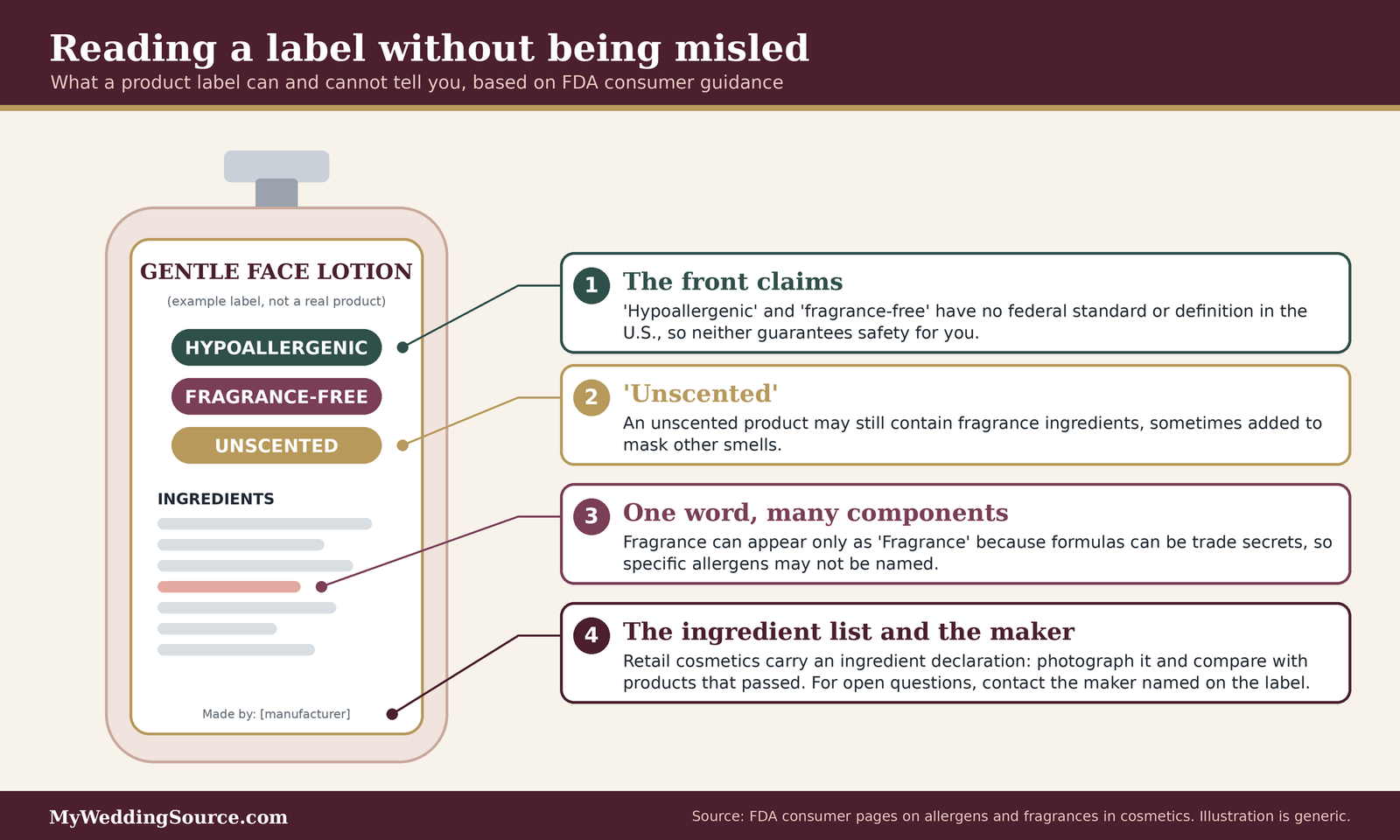
The FDA states that claims such as “hypoallergenic” and “fragrance-free” have no federal standard or definition in the United States, so they do not guarantee that a product is safe for you. Treat them as a vendor’s description, not as evidence. If a product’s sensitivity claim matters to you, ask the maker what the term means for that product and what testing, if any, supports it.
Fragrance can hide many ingredients
The FDA explains that fragrance and flavor ingredients can be listed simply as “Fragrance,” because labeling law cannot force companies to reveal trade secrets and fragrance formulas are complex mixtures. Specific fragrance allergens may therefore not be named. The FDA also notes that an “unscented” product may still contain fragrance ingredients, sometimes added to mask the smell of other components.
Ingredient families worth discussing with your clinician
Some ingredient families appear again and again in guidance on allergic reactions. Seeing one on a label is not a reason to panic, and not seeing one is not a guarantee of safety. The point is to have a short conversation with a clinician about which, if any, apply to you.
Families the FDA names as common allergen groups
The FDA’s allergen page lists several groups of common allergens in personal care products: natural rubber latex, fragrances, preservatives (it names MIT, CMIT, and formaldehyde releasers as examples), dyes (including PPD and coal-tar dyes), and metals such as nickel and gold. Think of these as categories to ask about, not a list of banned items. A clinician can tell you which matter for your history.
Using the list to compare, not to judge
The most reliable use of an ingredient list is comparison. Put the label of a product that has worked beside the label of the one you want to try, and look at what is new. If a new foundation shares nearly every ingredient with your tolerated one and adds one unfamiliar item, that item is the thing to ask about, and the thing to watch in the patch test.
Photograph, store, and organize the labels
Ingredient lists change, and packaging gets thrown away. Keeping a record is cheap insurance.
Photograph before you throw away packaging
Take a clear photo of the ingredient panel of every product you test, at the time you buy it, and keep it in a folder with the product name and date. The FDA notes that formulations can change over time in its hair dye guidance, and the same caution is reasonable for other products. If a product is reformulated, your old photo shows what you tested.
Ask the maker when a label raises a question
The FDA suggests contacting the manufacturer listed on the label if the label does not answer your questions. Keep the request specific: name the product, quote the part of the label you are unsure about, and ask your question in writing so you have a record of the answer. The reply is information, not a guarantee, and you still run your own test.
Trial design: one change at a time
A trial in sensitive-skin bridal beauty only tells you something if you can tell what caused the result. If you start a new cleanser, a new foundation, and a new sunscreen in the same week and your skin reacts, you will not know which one to blame. The central rule of sensitive-skin bridal beauty trials is to change one thing at a time and wait.
The at-home patch test
An at-home patch test is a simple, low-stakes way to see how your skin responds to a product before it goes on your face. It is not a medical allergy test and it cannot promise you will not react. It is a reasonable first filter.
A common method
Healthline describes a typical approach: choose a spot about the size of a quarter on the inner forearm or the bend of the elbow, where the product will not be rubbed off or washed often, and apply the product there twice a day for about seven to ten days, using the amount you would normally use. For rinse-off products, leave the product on only as long as the directions say. For face products, the same source suggests a small area behind the ear along the jawline, and for hair products the back of the neck.
What it can and cannot tell you
Healthline is also clear about the limits: a patch test helps predict irritation but does not guarantee you will not react, and facial skin may respond differently from the forearm. Some actives, such as retinol and glycolic acid, can cause temporary irritation even without an allergy. This is why a clean patch test is a green light to try the product carefully, not a certificate of safety.
When to stop
Healthline lists signs to stop: discoloration, itching, burning or stinging, rash, swelling, warmth, blisters, hives, very dry or cracked skin, or tenderness. If any appear, wash the product off promptly and do not use it again. Write down the product name and ingredients so you can avoid them. If the reaction is severe or does not improve, see a dermatologist.
Staggering trials on a calendar
The patch test method suggests about a week to ten days per product. The American Contact Dermatitis Society adds that allergic reactions typically develop from about a day to a couple of weeks after exposure. Together, that means a product that looks fine after two days has not necessarily finished its test, and a calendar that gives each product its own window protects you from a false all-clear.
Plan around the windows
As a rough planning estimate of our own, allow about ten days for each new item you want to clear. With about twelve weeks to work with, subtract the final two-week freeze described below and you have ten weeks, which is room for roughly six items in sequence plus one spare slot for a retest. The numbers are arithmetic, not clinical advice: they simply show how quickly a long wish list runs out of calendar. Spend the slots on the items that matter most.

Decide the order by risk
Put the products that stay on your skin for the longest, or go near your eyes, earlier in the sequence, since they have the most time to cause trouble and the most expensive consequences if you need to replace them. Face makeup that will be on for twelve hours, primers, and anything for the eye area belong near the front. Items that are rinsed off quickly, or that touch a part of the body you can easily cover, can go later.
The final two-week freeze
In the last two weeks before the wedding, stop introducing new products. This is a planning rule, not a medical one: it gives you a margin for delayed reactions and leaves time to recover if something does flare. It also lowers the temptation to try a “last-minute miracle” product from a friend.
What the freeze includes
The freeze covers anything new on your face, scalp, hands, or body: skincare, makeup, hair color, nail products, spray tan, fragrance, and even a new laundry detergent or a new shampoo, since the National Eczema Association lists shampoo and detergent among everyday products that can carry irritants for people with eczema. If you are unsure whether something counts, treat it as new.
What the freeze does not include
Keep using your usual, passed routine. The freeze does not mean stopping a prescribed treatment or a product that has worked for you, and it does not replace advice from your clinician. If your clinician tells you to change something, follow that instead.
Working with each vendor
In sensitive-skin bridal beauty, different professionals handle different products and tools, and each has its own questions. The Skin Sheet is the common thread, but the conversation changes with the service. This section gives you the main points for each kind of vendor in sensitive-skin bridal beauty planning.
Makeup artist
In sensitive-skin bridal beauty, the makeup artist touches the largest area of your skin for the longest time, so this is usually the most important conversation. Our bridal makeup and wedding hair and makeup planning guides cover booking and scheduling; here we focus on safety.
Ask for the kit, not just the look
Ask what brands and product lines the artist uses, and whether they can provide ingredient lists in advance. Ask how they clean tools between clients, and whether they use single-use applicators for items near the eyes. The FDA advises against sharing eye cosmetics and says that if you sample a tester you should use single-use applicators such as clean cotton swabs. A professional kit used on many clients deserves the same attention.
Plan the trial around your Skin Sheet
Book the trial early enough to leave a patch-test window for anything new. Ask the artist to use only passed products on your face at the trial, and to note anything they add. If they want to use a product that is not on your passed list, ask for the label in advance and run your own patch test first. Our guide to airbrush versus traditional makeup explains one common choice you may want to discuss, and you should ask any vendor for the ingredient list for whichever method you pick.
Plan for skin type as well as sensitivity
Sensitive-skin bridal beauty sits alongside other skin concerns. If your skin is also oily or mature, see our guides to wedding makeup for oily skin and wedding makeup for mature skin, and bring that information to the same conversation.
Hairstylist and colorist
Hair products touch the scalp, hairline, neck, and ears, and for sensitive-skin bridal beauty hair color deserves its own discussion. The FDA’s hair dye guidance is direct and worth following.
Color needs its own patch test
The FDA advises doing the skin test directions on the label before every use of a hair dye, even if you have used the product before without trouble, and notes that a negative test does not guarantee you will not react. The FDA also says formulations can change over time. If you plan to color your hair before the wedding, schedule it early, outside the final freeze, and tell the colorist about any past reaction.
Do not use hair dye on brows or lashes
The FDA says coal-tar hair dyes must not be used on eyebrows or eyelashes because of the risk of eye injuries, including blindness, and states that no color additives are approved for dyeing eyebrows or eyelashes. If a salon or a friend offers to tint your brows or lashes with a hair dye, decline. Our hair trial guide covers trial scheduling, and you should add the product conversation to it.
Ask about styling products and tools
For sensitive-skin bridal beauty, ask what holds the style: sprays, gels, pomades, and any scented finishing products. Fragrance is a common concern, so ask for a fragrance-free option and ask to see the label. If a stylist is not sure what is in a product, ask them to find out, or bring your own. The FDA says “unscented” may still mean fragrance is present, so ask about ingredients rather than relying on the front label.
Nails, brows, lashes, tanning, and facials
Smaller services often get less attention in sensitive-skin bridal beauty planning and sometimes cause the biggest surprises. Each one involves adhesives, dyes, or active products that your trial plan should cover. See our guides to wedding nails, spray tans, and facial timing for the general schedule.
Lash extensions and adhesives
The FDA treats false eyelashes, extensions, and their adhesives as cosmetics and notes that because the eyelids are delicate, you should check adhesive ingredients to avoid allergic reactions or irritation. Ask the lash technician for the adhesive’s ingredient list and for a patch or small trial before the full set, and plan that trial well before the wedding so you have time to recover and change course.
Henna, “black henna,” and temporary tattoos
If your tradition or your photographer’s ideas involve henna, be careful. The FDA says plant-based henna is approved only as a hair dye, and that some “black henna” products may contain undisclosed ingredients; it reports allergic reactions, some of which caused scarring. The FDA also says black henna tattoos can contain PPD and may raise your risk of hair dye allergy. Ask in advance exactly what paste will be used, ask for its ingredients, and talk to a clinician if you have any history of reactions.
Spray tans and facials
For a spray tan or a facial, ask for the full product list for the session, ask which products touch your face, and ask for a small test or a lighter first session if you are concerned. Do not schedule a new facial or an exfoliating treatment close to the wedding, since irritation can appear within minutes or hours according to the American Contact Dermatitis Society, and recovery takes time.
The ingredient and patch-testing communication checklist
This is the core deliverable of the guide: a stage-by-stage checklist of what to say, send, and confirm, from the first inquiry to the morning of the wedding. Print it or copy it into your planning notes. Each stage names the question, the person it goes to, and what a good answer looks like.
Before you book a vendor
The aim at this stage is to learn whether a vendor can work with your needs at all, before you pay a deposit. A short exchange now saves a difficult one later.
Send the Skin Sheet with your inquiry
Attach the current version and ask three things: can you work within a list of passed products, will you hold a trial, and will you share ingredient lists on request. A clear and friendly yes is a good sign for sensitive-skin bridal beauty. A vague reply is a reason to ask a follow-up before you commit.
Check the policies that affect you
Ask how the vendor handles a client who needs to decline a product on the day, whether a trial is included or charged, and whether there is a fee to reschedule a trial if you need to wait for a patch test. Ask these in writing. If you are comparing several vendors, our wedding hair and makeup cost guide explains how pricing usually works.
Before the trial
At this stage the goal is to make sure nothing arrives at the trial that you have not reviewed. Many trial problems come from a surprise product.
Ask for the product list in advance
Ask the artist or stylist for the brands and product names they plan to use and the ingredient list for each one that will touch your skin. Compare the lists with your passed products. For sensitive-skin bridal beauty, anything new should go through a patch test before the trial if you have time, or be removed from the trial plan.
Prepare your own kit
Bring your passed products to the trial. If the artist wants to use your foundation, you will learn how it performs in photographs and whether it lasts. If the artist wants to use theirs, you will learn whether the look is worth testing. Either way, the trial is a chance to compare, not a commitment to switch.
After the trial
The trial is only half the work in sensitive-skin bridal beauty. What happens in the days afterward tells you whether the products passed.
Watch your skin and write it down
Notice and record how your skin looks and feels at the end of the day, the next morning, and over the following week. Include small things, such as tightness, itching, a few new bumps, or redness that lasts. The American Contact Dermatitis Society says allergic reactions typically develop from about a day to a couple of weeks after exposure, so a delayed response is possible.
Update the Skin Sheet and send it back
Move each product from “in testing” to “passed” or “stopped,” add dates, and send the updated sheet to the vendor with a short thank-you. If something failed, name the product and ask for an alternative from the same vendor, along with its ingredient list.
In the last two weeks
The final fortnight of sensitive-skin bridal beauty is about holding steady and confirming logistics. Our wedding week checklist covers the broader tasks; here we focus on skin.
Confirm the final product list in writing
Ask each vendor to confirm the exact products they will use on you. Compare those with the passed list one more time. If anything has changed, for example a substitution because of stock, ask for the label before the day, not at the start of your appointment.
Hold the freeze
No new products, no new treatments, no experiments with friends’ recommendations. If something irritates you, stop the item that caused it and contact your clinician, rather than adding a product to calm it down without advice.
On the day
On the day, a short, calm routine keeps your sensitive-skin bridal beauty plan intact when everyone is busy. Our hair and makeup schedule guide for large bridal parties helps with timing when several people are being styled.
Give your sheet to a trusted person
Make sure a bridesmaid, family member, or planner has a copy of the Skin Sheet and knows who to call. If you are rushed, they can speak up for you when someone picks up an unfamiliar bottle.
Keep your passed products within reach
Keep a small bag with your passed products, clean applicators, and anything your clinician has told you to carry. If a vendor reaches for something that is not on the list, you have the option to use your own. The sibling guide on packing a travel-friendly wedding beauty emergency kit can help you assemble it.
If a reaction happens
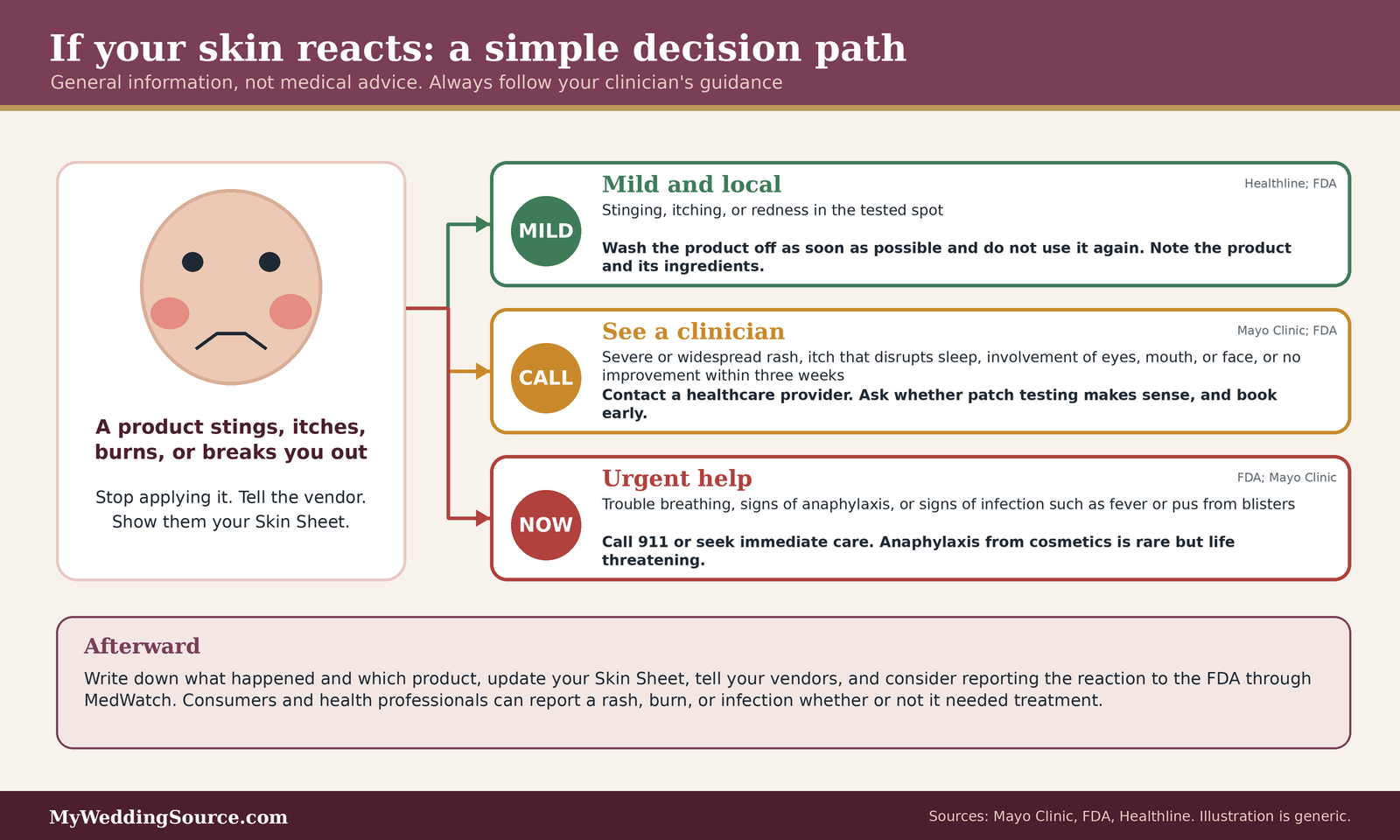
Even with careful sensitive-skin bridal beauty planning, a reaction can happen. Having a decision path in advance keeps you from improvising when you are stressed or short of time. The infographic below summarizes the main branches, based on the guidance of the Mayo Clinic, the FDA, and Healthline.
First response
The first priority is to stop the exposure and take care of your skin. This section is general information, not medical advice, and you should follow a clinician’s guidance for your situation.
Stop the product and wash it off
Healthline’s advice for a patch test reaction is to wash the product off as soon as possible and not use it again. The FDA’s complaint page says to stop using the product and contact a healthcare provider, and notes that the FDA does not give medical advice. If a vendor applied the product, tell them to stop applying it and show them the Skin Sheet.
Know the signs that need urgent help
The FDA says anaphylaxis from cosmetics is rare but life threatening, and advises calling 911 and seeking medical attention immediately if anaphylaxis symptoms occur. The FDA lists hives, itching, rashes, facial swelling, and respiratory effects as possible symptoms of an allergic reaction. The Mayo Clinic advises seeing a doctor for a rash involving the eyes, mouth, face, or genitals, and seeking immediate care for signs of infection such as fever or pus from blisters.
Follow-up and documentation
After the first response, the goal is to understand what happened and to make sure it does not happen again. Good records help your clinician and protect your plan.
See a clinician and ask about patch testing
The FDA says that for suspected allergies you should consult a healthcare provider, who may recommend patch testing. The American Contact Dermatitis Society describes clinical patch testing as placing allergens on the back for two days, then checking for reactions and returning about two days later for a second reading, with further readings possible. That process needs time, so if you suspect an allergy, book early rather than a week before the wedding.
Use the results to plan
If testing identifies specific allergens, the American Contact Dermatitis Society says treatment centers on avoiding them, and describes its Contact Allergen Management Program, which helps patients find personal care products free of their specific allergens, available through member physicians after patch testing. Ask your clinician whether that applies to you, and add the results to your Skin Sheet.
Report the problem
The FDA says consumers and health professionals can report a rash, redness, burn, hair loss, infection, or illness, whether or not it needed medical treatment, through the MedWatch online form, by mail or fax, or by phone through the Food and Cosmetics Information Center. The FDA also says it can accept reports about product problems such as contamination. Reporting is voluntary for you. Under the Modernization of Cosmetics Regulation Act, the FDA says responsible persons, such as manufacturers, must report serious adverse events to the agency within fifteen business days.
Edge cases that are easy to miss
In sensitive-skin bridal beauty, some situations fall between the usual categories, and they are where plans most often break down. Think through each one before it surprises you.
Skin conditions and medications
If you have eczema, rosacea, psoriasis, or take prescription skin treatments, the plan should involve your clinician directly. The National Eczema Association advises seeing a healthcare provider for a diagnosis and a customized plan, since eczema can resemble other skin conditions, and this guide cannot adjust your treatment.
Eczema and flare triggers
The National Eczema Association lists harsh skincare routines, fragrance, sweat and humidity, and stress among common flare triggers. For a bride, the last two are close to unavoidable on the day. Planning for sweat, such as shade, fans, and breaks, and for stress, such as a clear schedule, may matter as much as the product list. Our summer heat plan and wedding planning stress guide help with both.
Prescription products and timing
If your clinician has prescribed something that affects the skin, ask whether a particular treatment or facial service is a good idea close to the wedding, and ask whether any prescribed product should go on before or after makeup. Do not stop or change a prescription for the sake of a beauty plan without asking.
Fragrance, flowers, and the room itself
Your skin is not the only place a sensitivity can show up, and sensitive-skin bridal beauty overlaps with the rest of the wedding.
Fragrance from other people
Hair spray, perfume, and the scented products of other people in the room can be a problem even if your own products are fragrance-free. Our guide on hosting a wedding for guests with severe fragrance sensitivities covers coordinating this, and our sibling guide on wedding fragrance selection discusses choosing your own scent. If you wear perfume, test it as you would any other product, on a spot where it will not touch broken skin.
Flowers and plants
Contact with plants can also cause a rash. The Mayo Clinic lists plants among common causes of contact dermatitis, so consider how bouquets, boutonnieres, and garlands will touch your skin. If you have pollen sensitivities, see our guide on planning flowers for a wedding with pollen allergies.
Metal, adhesives, and accessories
Skin-contact items beyond makeup often appear on a wedding day, and they can cause reactions that look like a makeup problem.
Jewelry and metals
The FDA lists nickel and gold among metals that are common allergens in personal care contexts, and the Mayo Clinic names nickel among common allergens. If rings, earrings, or hair accessories touch your skin for many hours, plan ahead. Our guide to wedding band metal allergies covers rings in detail.
Adhesives and tapes
Lash glue, body tape for a neckline, bra adhesives, and hair extension bonding all have their own ingredient lists. For sensitive-skin bridal beauty, treat each one like any other product: ask for the label, test on a small area of skin well before the day, and note the result on the Skin Sheet.
Travel, groups, and last-minute changes
A sensitive-skin bridal beauty plan has to survive real life, which often includes travel, other people’s schedules, and surprises.
Destination weddings and unfamiliar water
Travel changes your routine: different water, different climate, and different local products. Pack your passed products in your carry-on, and if you must buy something at your destination, treat it as a new product with its own test. Our destination wedding checklist covers the logistics.
Bridesmaids and shared appointments
If your bridal party shares a makeup artist, ask the artist to keep your station and tools separate, or to do your face first with fresh applicators. Remember that your bridesmaids may have their own sensitivities, so invite them to share a short list too. The wedding party coordination checklist can help you collect that information in one place.
Retouching after the fact
If redness appears despite your best efforts, photographs can sometimes be retouched, but retouching has limits and policies. Our guide on wedding photo retouching requests explains how to ask. Treat retouching as a backup, not a plan.
Money, time, and backup plans
Careful sensitive-skin bridal beauty testing has costs that are easy to overlook: extra trials, duplicate products, and appointments that must be moved. None of it needs to be expensive, but a few decisions made early keep it from becoming a surprise.
What this actually costs
The main costs of a careful plan are trial fees, duplicate or travel-size products for testing, and any clinician visit. Prices vary widely by region, vendor, and insurance, so we do not quote figures. Ask each vendor in writing whether the trial is charged, whether a second trial is possible, and what happens to the deposit if you need to change products. Buying small sizes for testing before committing to full sizes is a common way to limit waste, and a bride-only product list keeps the cost of the day itself predictable.
What trials and backups cost
Think about the money side of sensitive-skin bridal beauty in three buckets: services, products, and professional advice. Treating them separately makes it easier to see where a small change saves the most.
Services
Ask whether the trial is a separate fee, whether the vendor will repeat it if a product fails, and whether there is a charge if your timetable shifts. Some vendors fold a trial into a package and some do not, so confirm in writing. Our guide to vendor overtime rates is worth a look if a longer morning schedule might change your quote.
Products and professional advice
Test products in the smallest size available, and keep the receipt so you can return a product that fails if the store allows it. For clinician visits, ask what is covered by your plan, and ask whether a referral is needed for patch testing. Neither of these is a place to cut corners if you suspect a true allergy.
Backups that protect the plan
A backup plan for sensitive-skin bridal beauty is simply a second option you have already tested. It turns a failed product from a crisis into an inconvenience.
Keep a second passed option for the essentials
For the items that matter most, such as a foundation, a primer, or a setting product, try to have a second product that has passed. If the first one fails or is discontinued, you can swap without starting over. This is also a good reason to start early.
Decide in advance who can say no
Agree with your artist that you may decline any product on the day without argument, and agree with your support person that they will back you up. A clear rule beforehand removes pressure when the morning gets busy.
Questions to ask before you commit
These questions turn the principles of sensitive-skin bridal beauty into short, direct requests. Ask them in writing where you can, and keep the answers with your Skin Sheet.
Questions worth asking about sensitive-skin bridal beauty
- Can you work only from a list of products I have already tested?
- Will you share ingredient lists for everything that touches my skin, in advance?
- How do you clean tools between clients, and do you use single-use applicators near the eyes?
- Is a trial included, and can I reschedule it if I need a patch-test window?
- What would you do if I react to a product on the morning of the wedding?
- Can I decline any product on the day without a charge?
- What exactly is in the adhesive, dye, paste, or tint you plan to use?
Questions for vendors
Vendors respond best to specific, practical questions about sensitive-skin bridal beauty. These help you learn how they work without suggesting they are doing anything wrong.
Before the trial
Ask for the brands, product names, and ingredient lists. Ask which items are professional-use only and whether the same product is available at retail. Ask whether the vendor has worked with clients who have sensitive skin and what they did, without asking for names or private details.
On the day
Ask who will be doing your skin prep, whether a second pair of eyes will review the product list, and how the vendor will handle a request to stop. Ask them to show you the label of anything that is not on your passed list before it touches your skin.
Questions for manufacturers and clinicians
In sensitive-skin bridal beauty, sometimes the right person to ask is the maker of the product or a clinician who knows your history.
Questions for the maker
If a label leaves a question open, the FDA says to contact the manufacturer listed on it. Ask what the maker means by terms such as “sensitive skin,” “hypoallergenic,” or “fragrance-free,” whether the fragrance line includes essential oils or other scent ingredients, and whether the formula has changed recently. Keep the reply in your folder.
Questions for your clinician
Ask whether patch testing makes sense for you, how far ahead to book, and how to plan around the results. Ask whether any of your regular products or prescriptions interact with the services you plan to book. Ask what symptoms should send you to urgent care.
Frequently asked questions
Short answers to the questions people ask most often about sensitive-skin bridal beauty planning. For anything involving your health, a clinician has the final word.
Testing and timing
How early should I start testing products for my wedding?
A common planning target is about three months, which leaves room for several one-at-a-time tests and a retest. Patch tests are usually run for about a week to ten days per product, so a long list needs a long runway. If you have less time, shorten the list rather than testing several items together.
Does a clean patch test mean a product is safe for my face?
No. A patch test helps predict irritation but does not guarantee you will not react, and facial skin can respond differently from the forearm. Allergic reactions can also appear from about a day to a couple of weeks after exposure. Treat a clean result as permission to try carefully, then watch your skin.
Labels and ingredients
Is “hypoallergenic” or “fragrance-free” a guarantee for sensitive skin?
No. The FDA says these claims have no federal standard or definition in the United States, so they do not guarantee safety. Read the ingredient list, compare it with products you already tolerate, and ask the manufacturer what the claim means for that specific product if it matters to you.
Can an “unscented” product still contain fragrance?
Yes. The FDA says an unscented product may still contain fragrance ingredients, sometimes added to mask the smell of other components. Fragrance can also appear on a label only as the single word fragrance. If scent is a concern for you, look for the ingredient list rather than relying on the front of the package.
Vendors and the wedding day
What should I send my makeup artist about my skin?
Send a one-page summary: confirmed and suspected triggers, products you have used without trouble, anything in testing, and a few friendly ground rules. Ask for their product and ingredient lists in advance and for a trial. A written summary prevents repeating your history and helps everyone use the same facts.
Can I use hair dye or lash tint safely before the wedding?
Follow the label’s skin-test directions before every use of hair dye, since the FDA says to test each time and that a negative result is not a guarantee. The FDA also warns against using hair dye on eyebrows or eyelashes, because it can cause serious eye injuries. Ask a clinician about any past reaction first.
If something goes wrong
What should I do if I react to a product?
Wash the product off, stop using it, and contact a healthcare provider, as the FDA and Healthline advise. Seek urgent care for trouble breathing, facial swelling, or signs of infection. Write down the product and ingredients, and consider reporting it to the FDA. See a clinician if the rash is severe or does not improve.
Do I need a dermatologist before the wedding?
Not necessarily, but it is worth booking one if you have had repeated or severe reactions, a rash that does not settle, or any reaction near the eyes or mouth. Patch testing takes several visits, so start early. Your clinician can tell you which steps fit your skin, and which do not.
Your next steps
This week
Write your first Skin Sheet
To start sensitive-skin bridal beauty on the right foot, spend an evening listing known triggers, suspected triggers, and products that have worked, and photograph the ingredient panels of your daily products. A draft is enough. You will refine it after each trial, and the Skin Sheet becomes the backbone of your sensitive-skin bridal beauty plan.
Choose your testing order
Pick the few items that matter most, put the longest-wearing and eye-area products first, and put dates on a calendar with about ten days each. Check the schedule against our wedding planning checklist and your wedding beauty timeline.
Before you book
Send the sheet and ask your questions
Email the sheet to your top vendors with the questions from this guide, and compare the answers in writing. If you are also planning a close shave for the groom or a partner with sensitive skin, our sibling guide on wedding-day shaving for sensitive skin may help.
Book a clinician visit if you need one
If you suspect an allergy, ask about patch testing now instead of after your first reaction. Early appointments leave room to adjust the plan without pressure.
Sources & methodology
How we built this guide
What we relied on
This guide draws on the U.S. Food and Drug Administration’s consumer pages on cosmetics, allergens, fragrances, labeling, hair dyes, eye cosmetics, tattoos and henna, complaint reporting, and the Modernization of Cosmetics Regulation Act, along with clinical and patient-organization pages from the Mayo Clinic, the American Contact Dermatitis Society, the National Eczema Association, and Healthline. Every page was fetched and read on November 12, 2026. Where a statement comes from one source, we attribute it. The planning timelines in this guide, such as about ten days per trial and about three months of lead time, are our own arithmetic and judgment, not clinical advice, and the infographics are our own editorial illustrations.
What we did not do
We did not test products, diagnose skin conditions, or recommend specific brands. We could not verify the details of individual vendors’ policies, and practices differ from one professional to the next. The American Academy of Dermatology and American Academy of Allergy, Asthma and Immunology pages we tried to read were not retrievable at the time, so we did not rely on them. This guide is general information, not medical or legal advice. See a licensed clinician about any reaction or condition.
Source list
Government and regulatory sources
- U.S. Food and Drug Administration, Cosmetics: https://www.fda.gov/cosmetics
- U.S. Food and Drug Administration, Allergens in cosmetics: https://www.fda.gov/cosmetics/cosmetic-ingredients/allergens-cosmetics
- U.S. Food and Drug Administration, Fragrances in cosmetics: https://www.fda.gov/cosmetics/cosmetic-ingredients/fragrances-cosmetics
- U.S. Food and Drug Administration, How to report a cosmetic product-related complaint: https://www.fda.gov/cosmetics/cosmetics-compliance-enforcement/how-report-cosmetic-product-related-complaint
- U.S. Food and Drug Administration, Cosmetics labeling: https://www.fda.gov/cosmetics/cosmetics-labeling
- U.S. Food and Drug Administration, Hair dyes: https://www.fda.gov/cosmetics/cosmetic-products/hair-dyes
- U.S. Food and Drug Administration, Eye cosmetic safety: https://www.fda.gov/cosmetics/cosmetic-products/eye-cosmetic-safety
- U.S. Food and Drug Administration, Tattoos and permanent makeup fact sheet: https://www.fda.gov/cosmetics/cosmetic-products/tattoos-permanent-makeup-fact-sheet
- U.S. Food and Drug Administration, Modernization of Cosmetics Regulation Act of 2022: https://www.fda.gov/cosmetics/cosmetics-laws-regulations/modernization-cosmetics-regulation-act-2022-mocra
Clinical, patient-organization, and consumer-health sources
- Mayo Clinic, Contact dermatitis: symptoms and causes: https://www.mayoclinic.org/diseases-conditions/contact-dermatitis/symptoms-causes/syc-20352742
- American Contact Dermatitis Society, Contact dermatitis FAQ: https://contactderm.org/patient-support/contact-dermatitis-faq
- National Eczema Association, Causes and triggers of eczema: https://nationaleczema.org/eczema/causes-and-triggers-of-eczema/
- Healthline, How to do a skin patch test: https://www.healthline.com/health/self-skin-patch-test