

Bridal party size looks like a head count, but it is really a bundle of decisions about space, money, closeness, and how much you are willing to ask of the people you love, so the right number is the one you can defend calmly to any friend or relative who asks.
Quick answer
There is no required number. Etiquette authorities say a couple need not match attendants side for side, and published reporting describes the typical party today as about eight people in total, roughly four per side. Use that as context, not a target. A workable default for bridal party size is the smallest group that still includes the people you could not imagine standing anywhere else, then add names only when a person passes three tests: you speak regularly, they will plausibly still be in your life in five years, and they can afford the role without strain. Expect each extra attendant to add cost, scheduling, and photo time, and decide before you ask anyone, because asking is much easier than un-asking.
What bridal party size actually decides
When people search for the right bridal party size, they usually want a number. The honest answer is that the number falls out of other choices you make first. Treat bridal party size as the last line of a short calculation rather than the first, and the pressure that makes the decision feel so heavy tends to ease.
This guide is built for the moment when you have a draft list of names and a lingering worry that it is too long, too short, or lopsided. It does not repeat how to choose dresses or suits, what each attendant does, or how to plan the whole wedding. Our guides on wedding party attire and wedding etiquette cover that wider ground. Here the focus is narrower: how to arrive at a size, what more attendants actually change, and how to test your answer against situations that tend to break a plan.
The number is a symptom of four other decisions
Most disagreements about bridal party size are really disagreements about something else. Someone wants a friend included, which is a question about closeness. Someone worries about the cost to attendants, which is a question about money. Someone points at the chapel, which is a question about space. Someone remembers a cousin’s wedding where everyone stood in a long row, which is a question about style. Naming the real question makes it easier to resolve.
Guest count, venue, budget, relationships, and timing
Five inputs genuinely move your bridal party size. Guest count matters because a party of twelve in front of thirty guests can feel like a second audience, while the same party in front of two hundred feels proportionate. This is our own observation about proportion, not a measured rule, so treat it as a prompt to picture your room. Venue matters because a ceremony space has a physical front: a narrow garden path, a cramped chapel step, or a courthouse room each set a practical ceiling. Budget matters because every attendant triggers some cost for you (gifts, flowers, sometimes hair and makeup or lodging) and a larger cost for them. Relationships matter because the point of the role is to have witnesses you trust. Timing matters because a large party means more fittings, more schedules, and more people who must be in the same place on the same day.
If you are still deciding the larger frame, our plan a wedding guide walks through the order of early decisions, and the small wedding planning guide covers what changes when the guest list is short.
Hard limits versus social pressure
It helps to sort every reason you have for a larger or smaller party into one of two piles. A hard limit is something a fact can verify: the venue’s front area can safely hold only so many people, a vendor or officiant has a rule, an attendant has told you plainly they cannot travel, or your budget has a ceiling you have already agreed on. Social pressure is a feeling about what others will think: a sister will be hurt, a future in-law expects a role, a friend was in your wedding party so you feel you owe her one back.
Hard limits deserve to be respected. Social pressure deserves to be acknowledged and then answered with something other than a seat in the lineup. Etiquette guidance from the Emily Post Institute notes that there is no requirement for how many attendants a couple has, that the two sides need not be equal in number, and that former bridesmaids do not have to be invited back or a fiancé’s sister given a spot, though offering one can be a generous gesture. In other words, the rulebook is more relaxed than the family group chat.
What the published data says about party size, and its limits
Couples reasonably want to know what is typical. It is worth looking at the bridal party size figures carefully, because the way they are reported makes them easy to over-read.
About eight in total, down from about ten
Reporting from Axios in January 2026 says the average wedding party has shrunk to about eight people, or four per side, and attributes to The Knot a figure of ten in 2019. The same article cites a Zola survey finding that 85 percent of engaged couples say they plan to have a wedding party. The article does not describe how any of those figures were gathered, so we treat them as directional: parties appear to be getting a little smaller, and most couples still want one. We could not verify the underlying survey methods, sample sizes, or whether “wedding party” counts ushers, junior attendants, and flower girls, so do not build a plan on a single decimal point.
If you want to see how this plays out in a full budget, the average wedding cost guide explains how headline averages are built and why they are poor targets.
What not to infer from an average
An average bridal party size of eight does not mean eight is correct for you. It averages couples who chose none, couples who chose two, and couples who chose fourteen. It also says nothing about whether those attendants were happy, solvent, or well used. Two cautions follow. First, averages describe what couples did, not what was good for them. Second, a shrinking trend can reflect costs that make couples more careful, a theme we return to when we look at what attendants spend. Use the average to relax, not to benchmark your bridal party size. If your list is six or eleven, that is not a mistake.
What more attendants actually change
Growing your bridal party size does not just fill space at the front of the room. They change money, scheduling, the ceremony, photographs, and fairness in ways that are easy to miss when you are focused on who you would hate to leave out. This section walks through each effect so you can price a name before you add it.
The money consequences
The cost of a wedding party falls on two groups: you, and the people you ask. Both deserve a number before an invitation goes out, because the money is part of the bridal party size decision.
What you cover, and what usually falls to attendants
Under traditional etiquette, attendants pay for their own wedding clothing and accessories, plus their own transportation, and the hosts are expected to provide lodging. The Emily Post Institute describes bridesmaids as responsible for their dresses, alterations, shoes, accessories, and travel, along with their share of a group gift. In practice, couples often take on extras: bouquets and boutonnieres, a thank-you gift for each attendant, and sometimes hair and makeup or a getting-ready space. The Knot’s guide to groomsmen costs says groomsmen typically pay for attire, the bachelor party, travel and lodging, accessories, and a gift for the couple. Whatever your approach, put the policy on paper before you ask. Our wedding party costs guide goes line by line through who tends to pay for what.
What the published averages say
Two figures from The Knot are useful because the methodology is disclosed. In The Knot’s 2025 Real Weddings Study, which drew on responses from 16,956 U.S. couples married in 2024 and recruited from The Knot and WeddingWire members, bridesmaids spent an average of $128 on their dress, essentially flat since 2021. By generation of the couple, the average was $146 for Gen X weddings, $131 for millennials, and $118 for Gen Z. The Knot’s groomsmen guide cites an average of $160 per wedding party member on a gift for the couple, from its 2023 Real Wedding Guest Study. These are averages across respondents, they do not include alterations, accessories, shoes, travel, or parties, and your own attendants may spend far more or less.
A separate Zillow Rentals analysis, announced in August 2025, put the cost of attending one wedding plus one bachelor or bachelorette weekend at about $2,010, comparing it with a typical monthly U.S. rent of $2,072. The release says it drew on The Knot and Bankrate for that estimate and does not itemize what is included. It also does not separate wedding party members from guests, so it describes attendance generally, not the cost of being in the party. We cite it because it shows how quickly the whole experience can add up for a close friend, not because it predicts what your attendants will pay.
Cost reality check
Published averages are not quotes. The $128 bridesmaid dress and $160 gift figures are survey averages from The Knot, and the $2,010 attendance figure is a Zillow estimate whose components are not itemized. Add a line for alterations, shoes, accessories, travel, and any pre-wedding events when you picture what each attendant will spend, and treat the sum as a conversation topic, not a promise. Our own arithmetic in this guide is labeled as an estimate wherever it appears.
The effect on couple-borne cost: a transparent estimate
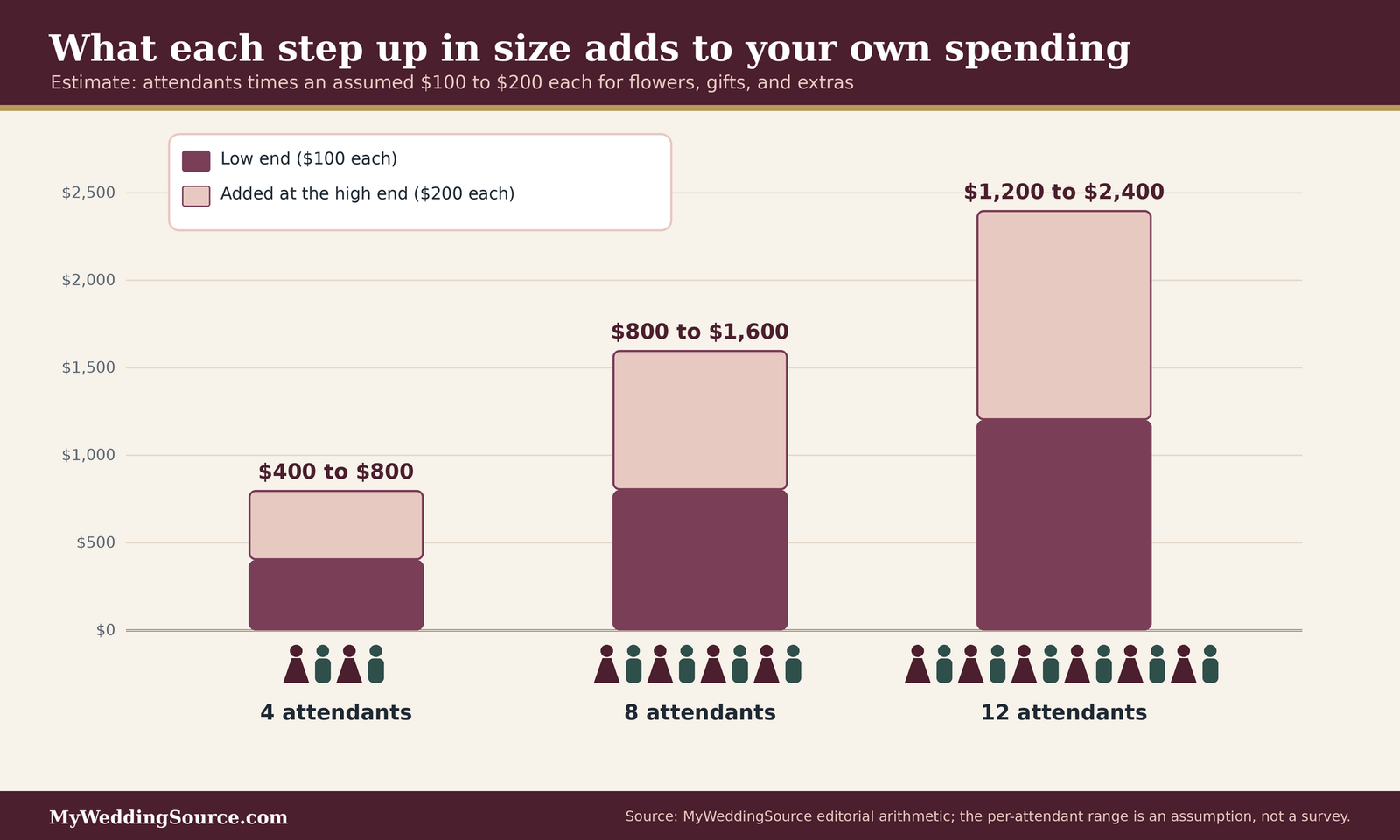
You can estimate what each step up in bridal party size adds to your own spending with a simple formula. Because we cannot source a single typical figure for flowers, gifts, and extras, treat the numbers here as assumptions you replace with your own quotes.
The per-attendant formula
Multiply the number of attendants by what you expect to spend on each. A per-attendant figure typically includes a bouquet or boutonniere, a thank-you gift, any hair and makeup you decide to cover, and a share of rehearsal-dinner and lodging costs. Our editorial assumption for illustration is a range of $100 to $200 per attendant, which is not a survey result. At that range, four attendants would add roughly $400 to $800, eight about $800 to $1,600, and twelve about $1,200 to $2,400. These are our own arithmetic, not vendor quotes. If your florist charges more for large bouquets or your gifts are modest, the lines move accordingly.
Why the formula understates the real cost
The formula captures only what you pay. It leaves out the attendants’ outlay, the hours you spend coordinating, and the less visible cost of friction. A large party has more calendars to align, more opinions about attire, and more group messages to manage. If you expect planning to feel stressful already, our wedding planning stress guide explains how to keep the workload from growing faster than the help.
The effect on scheduling and logistics
Every step up in bridal party size adds a person who must be measured, fitted, informed, and present at several times. The cost of a person is partly time, and time can be priced even if the numbers here are estimates.
Attire timelines multiply with headcount
David’s Bridal suggests ordering bridesmaid dresses six to eight months before the wedding, noting that standard production often takes about twelve to sixteen weeks, with custom colors and the May-through-October season adding time, and that alterations can take two to three weeks, longer in busy months. It suggests starting fittings three to four months out. For groomsmen, Generation Tux suggests getting fitted and finalizing about two to three months before the wedding, with rentals typically delivered about fourteen days before and any problems reported within forty-eight hours. Each of those steps repeats for each attendant, and out-of-town attendants add shipping and fit uncertainty. Our bridesmaid dresses and groomsmen suits versus tuxedos guides cover those choices in detail.
Ordering rules protect you when something is late
When dresses are ordered online for a bigger bridal party size, delivery promises matter. The Federal Trade Commission’s guidance on its Mail, Internet, or Telephone Order Merchandise Rule says a seller needs a reasonable basis for any shipping time it states, generally must expect to ship within thirty days if it states none, and must offer a choice to wait or cancel for a prompt refund if it cannot ship on time. This is general consumer information, not legal advice, and the details depend on the seller and the order. The practical lesson for a large party is to keep order confirmations, promised dates, and delay notices for every dress, because one late order in a party of ten can affect your timeline even if nine others arrive early.
The effect on the ceremony and the photographs
The most visible effect of bridal party size is also the most easily underestimated. A larger party changes how long the processional takes, how crowded the front looks, and how long formal photographs require.
The aisle and the front of the room
Our own estimate is illustrative: if each entrance takes about twelve seconds in single file, four attendants add about forty-eight seconds, eight about ninety-six, and twelve about a hundred and forty-four, while walking in pairs roughly halves those times. The point is not the exact seconds, since pacing varies by venue and music. It is that a long processional is a design choice. Space matters more than time: a narrow chapel step or a short garden path may physically limit how many people can stand comfortably in view of guests. Our wedding processional order and wedding ceremony guides walk through the sequence, and a rehearsal walk-through in the real space is the surest test. See our wedding rehearsal guide for how to run one.

Group photos and the time they take
A larger bridal party size also means more combinations for formal photos: the full group, each side, the couple with each attendant, and perhaps smaller groupings. The time is driven by the number of combinations and by how long it takes to gather people, so a longer list can quickly crowd a cocktail hour. This is our own reasoning, not a sourced rule. If photographs matter, ask your photographer how many minutes they typically allow for group photos and how that changes with ten people instead of six, and build the answer into your timeline. Our wedding photographer shot list guide explains how to plan the list so the people closest to you are not squeezed.
The effect on fairness and the guest experience
Money and minutes are measurable parts of bridal party size. Feelings are not, but they are often what couples are really weighing.
Who feels left out, and when
Every bridal party size has a boundary, and someone is always just outside it. The people most likely to feel the sting are those whose closeness is real but not the closest: a cousin you grew up with, a college friend you see twice a year, a sibling’s partner. A larger bridal party size moves the line outward and creates a new group just beyond it. A smaller party creates fewer near misses but makes each exclusion more visible. Neither is safer. What helps is a clear principle about bridal party size you can say out loud, such as “we chose our closest people from each side and kept it small,” rather than a series of individual exceptions that invite comparisons.
The guests who are not in the party
Guests experience your bridal party size decision too. A very long processional can feel like a wait, and a long delay for photographs can stretch a cocktail hour. But guests rarely care about the count, and they usually care a great deal about being fed, seated, and comfortable. If a larger party means a shorter break before dinner, the guests pay for the party size. That is the cost most couples forget to price.
Build your decision matrix
A bridal party size matrix turns a vague worry into a set of comparable answers. The one below uses the factors that genuinely change the answer, and it is meant to be filled in with your own facts before you talk to anyone.
The matrix itself
How to read the rows
Read across each row, find your situation, and note the direction it pushes. Few weddings fall cleanly in one column, so use it to see where your pressures conflict.
| Factor | Pushes toward a smaller party | Pushes toward a larger party | What to check first |
|---|---|---|---|
| Guest count | Fewer than about fifty guests, where a long lineup can dominate the room (our rule of thumb) | Large guest count where the party is in proportion | Picture the front of the room with your actual numbers |
| Venue space | Narrow aisle, shallow chapel step, outdoor path | Wide stage, long aisle, deep platform | Ask the venue for the usable front area and any limit |
| Attendant budgets | Several attendants with tight finances | Attendants who say cost is not an issue | Ask in a way that makes an honest no easy |
| Your budget | Tight ceiling for flowers, gifts, and extras | Room for per-attendant costs | Run the per-attendant formula with your own quotes |
| Relationships | Few people who pass all three closeness tests | Many people who pass them | Apply the three tests to each name |
| Family dynamics | Few obligations to blend | Blended families, siblings from several households | Decide how you will honor people outside the party |
| Timeline | Short engagement | Long engagement, time for fittings | Count months until attire must be ordered |
| Style of wedding | Intimate, informal, or micro event | Formal, traditional, large event | Match the lineup to the tone of the day |
What the matrix cannot tell you
It cannot tell you how a particular friend will feel, what your photographer allows, or what your venue permits. Those answers come from conversations and documents, which the later sections cover.
How to use the matrix without false precision
The bridal party size matrix gives directions, not scores. It would be tempting to add up the columns and trust the winner, but that would pretend to a precision the topic does not support. Instead, look for the factor that is hardest to change, usually venue space or a budget ceiling, and let that one set the outer limit. Then use relationships to fill the space.
Use ranges and thresholds, not a single number
Think in ranges when you settle on a bridal party size. A couple might conclude that four to six feels right and treat anything from three to seven as acceptable. Stating a range protects you from the awkwardness of a missed target: if a friend declines or a cousin must be added, you remain inside the range and nobody has to renegotiate. Ranges also help when two people on a team disagree. If one partner wants four and the other wants eight, a range of five to six may turn out to be a place both can live.
Show where two options tie
Sometimes two bridal party size options score the same. A party of five and a party of six may both fit the space, the budget, and the relationships. When that happens, break the tie with the least reversible factor. Adding a sixth attendant is easy at the start and awkward later, so if you are unsure, begin with five and add one if it truly feels wrong. An invitation that is withdrawn is far worse than an invitation that is never sent.
Three tests for every name
For bridal party size, the most useful tool for the relationship row is a short set of questions applied to each person. They are our own working method, informed by the kinds of concerns couples and etiquette writers raise, and they are meant to be asked honestly in private.
The three questions
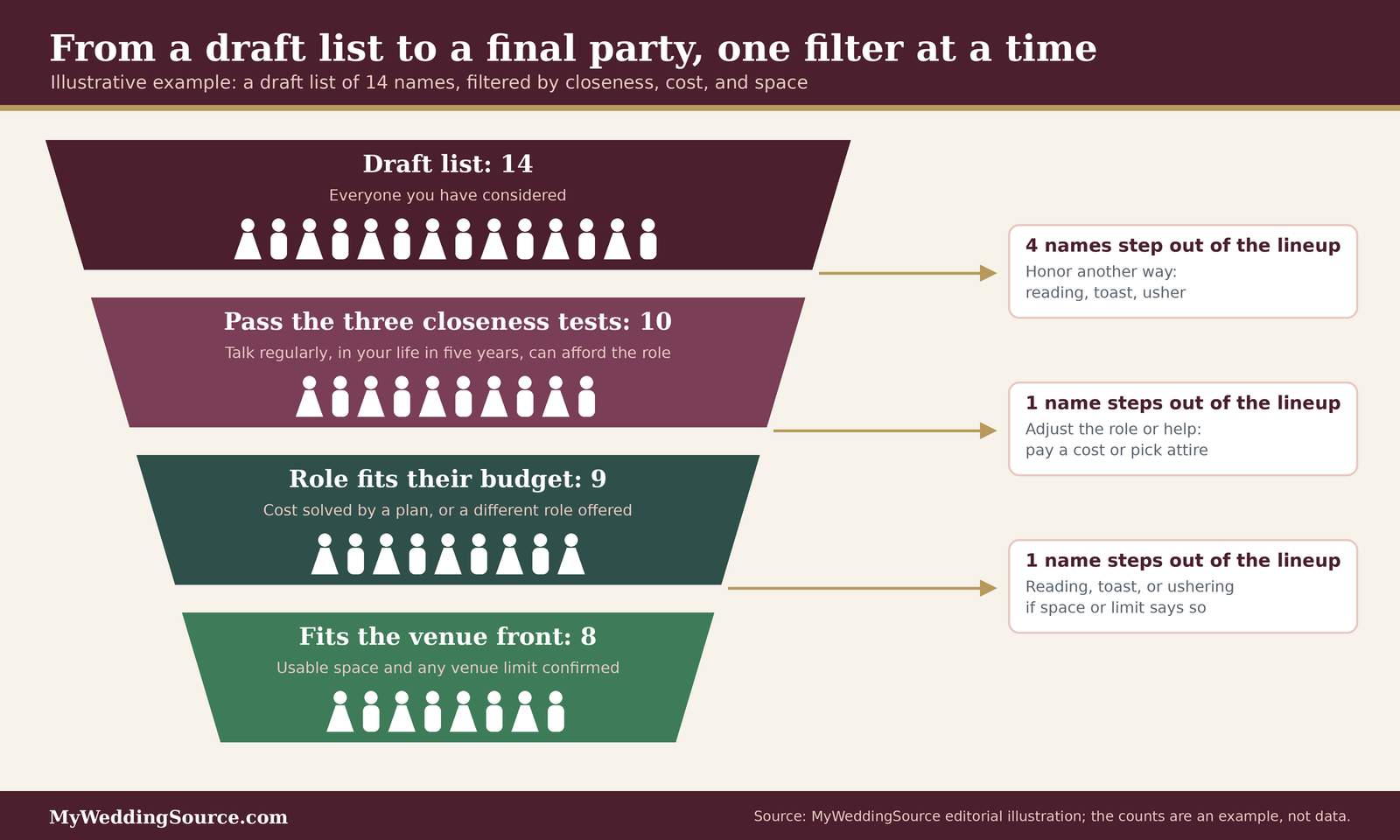
First, do you and this person talk regularly, beyond reacting to each other’s posts? Second, will this person plausibly still be part of your life in five years? Third, can they afford the role, including attire, travel, and events, without strain? Names that clearly pass all three belong on the list. Names that pass two and fail the third are an invitation to adjust the role, not to drop the person: you might cover a cost, or invite them to do a reading instead. Names that fail the first two are better honored in another way.
How to handle a name that fails a test
A friend who is close but cannot afford the role is not a bad candidate. She is a candidate whose cost is solved by a different structure: a dress she already owns, a simple attire color, or an offer to pay for part of it. The Emily Post Institute notes that if the group falls for a dress they cannot afford, the bride may offer to pay the difference, and that planning should begin with a conversation about budget. If a relationship is fading, the fair move is a smaller role or none, not a seat that turns into an obligation neither of you wants.
Ways to honor people without adding to the lineup
A small bridal party size does not mean a small thank-you. Most couples have more important people than seats, and the solution is to find roles that fit.
Roles with real meaning
A reading, a toast, a blessing, a duty during the ceremony, or a moment with the couple before the processional can each recognize someone without placing them in the formal lineup. Emily Post describes ushers as guiding guests, handing out programs, and helping with accessibility needs and directions, which gives relatives a meaningful job. The Emily Post Institute also notes that groomsmen can double as ushers when there are no separate ushers. Ask the person in advance and be specific, so the role feels like a gift and not a consolation prize.
What to say when someone asks why they were not included
Prepare one calm sentence. Something like “We kept the group small and chose a few people from each side, and we hoped you would give a reading” works better than a long explanation. Do not apologize for the decision itself, and do not compare people. If the conversation goes on, repeat the principle rather than adding reasons.
Uneven, mixed, and alternative arrangements
Tradition shapes bridal party size by suggesting that a bride has bridesmaids and a groom has groomsmen in matching numbers. Modern weddings rarely follow that pattern, and the numbers rarely match.
Uneven numbers
An uneven bridal party size is common and fine. The Emily Post Institute says the couple need not have the same number of attendants on each side, and nothing in the etiquette sources we read treats symmetry as a requirement.
Why symmetry is not required
Symmetry matters mostly for photographs and for the visual of the processional. Both can be handled without adding a person you do not want. Pair attendants differently, have one attendant walk alone, or let the lineup stagger at the front, and have the officiant place people so the sides look balanced. An attendant added only to even the numbers may feel like a prop, and the friend asked purely for balance is likely to notice.
Practical ways to hide the imbalance
If you still want visual balance, a few moves help. Arrange people at varied angles instead of a straight line. Place a flower girl or ring bearer at one end. Have attendants enter in a mixed order, alternating sides. Ask your photographer for a layout that works with the numbers you have. A rehearsal in the real space will show which arrangement looks best, and the wedding processional order guide describes common sequences.
Mixed and alternative roles
Many couples now mix genders on each side or use titles that fit the person. The sources we read set no required structure for who stands where, so the couple decides.
Titles and roles that fit the person
Terms such as best woman, groomswoman, bridesman, and honor attendant are used by couples who want titles to match the person. The choice is a matter of preference and comfort, not a rule. If a friend is asked to stand with the other side, tell them plainly what that means for attire and duties, and let them choose what to wear within the palette. Our wedding party attire guide discusses coordinating mixed groups.
A wedding with no formal party
Some couples skip the lineup entirely, and the reasons are usually cost, intimacy, or a desire to avoid ranking friends. A zero-attendant wedding still needs people to do the jobs: someone to hold rings if you want that, witnesses where your jurisdiction requires them, and helpers for the day. Check the rules for witnesses with your local clerk or officiant, since requirements differ by place, and see our marriage license guide for the paperwork side. For small events, our micro wedding planning guide explains how to scale roles down.
Test the matrix with contrasting scenarios
A bridal party size matrix is only useful if it holds up when you apply it. The two scenarios below are illustrative composites we wrote for this guide, not real couples, and the numbers are assumptions you can change.
Two couples, two answers
Reading the comparison
The table below compares the two composites and shows the threshold that would flip each recommendation.
| Small and simple | Large and complex | |
|---|---|---|
| Guests (assumed) | About forty | About one hundred fifty |
| Venue | Restaurant room with a short walk to the front | Wide church aisle and deep platform |
| Relationships | Two very close friends, one sibling each | Many siblings, blended families, long-time friends |
| Attendant budgets | One friend is between jobs | Mixed, several with tight budgets |
| Recommended range | Two to four in total | Six to ten in total |
| Per-attendant couple cost (assumed $100 to $200) | Roughly $200 to $800 | Roughly $600 to $2,000 |
| Threshold that flips it | A third close friend who clearly passes all three tests, or a venue that allows a longer lineup | A venue limit on the front area, or several attendants who cannot afford the role |
| Best fallback | One honor attendant per partner, extra people given readings | Fewer attendants plus ushers, or a smaller group in formal photos |
Why these two cases
We chose a small, simple case and a large, complex case because they stress different constraints. Real weddings usually sit between them, so look for the row in the table that matches your tightest limit.
Walking through the small scenario
The first couple is settling bridal party size for a small dinner-style wedding. They have two friends who clearly pass all three tests, plus a sister and a brother who matter to them.
Why a short list works here
With about forty guests, a lineup of four to six would be a large share of the room. A short walk to the front and an intimate setting both favor a small group. The couple chooses one honor attendant per partner and asks their siblings to give readings. The friend between jobs is offered a role that does not require buying anything, and the couple explicitly says so. The result avoids ranking friends and keeps the day light.
What would change the answer
If a third close friend passes the tests, the couple can add one without straining the room, because three or four per side is still proportionate in a venue that allows it. If the venue turns out to have only a tight space at the front, the range shrinks regardless of closeness. The thresholds, not the average, decide.
Walking through the large scenario
The second couple, deciding bridal party size for about a hundred and fifty guests, has a wide aisle and a large extended family with several households.
Why a longer list can work, and where it breaks
A party of eight to ten fits the space and the formality. But the couple’s list exceeds their limits when attendants’ budgets are weighed: several friends have said, in private conversations, that costs are a concern. The couple decides that attire will be a color palette with attendants choosing their own dresses and suits, and they cover hair and makeup for a few people. They also plan more time for photographs and tell the photographer the numbers. The total per-attendant cost in our estimate rises, so the couple confirms the ceiling before asking anyone.
Why the preferred option changes
The small couple prefers fewer because of space, closeness, and proportion. The large couple prefers more because of family structure and proportion, but only to the extent that budgets and the venue allow it. The reason the bridal party size answer flips is not that bigger is better. It is that the binding constraint changes. In the first case the binding constraint is proportion, in the second it is cost and logistics. Identify your binding constraint, and the answer follows.
Turn the analysis into a rule
By now you have a matrix, three closeness tests, and a way to price a name. The last step is to turn them into a rule you can say aloud, so you stop relitigating the list every time someone asks about it.
The default and the exception
Rules about bridal party size work best when they have an obvious default and a named exception. Without the exception, a rule becomes rigid. Without the default, it becomes a list of special cases.
A default when uncertainty remains
When you cannot decide on bridal party size, choose the smaller of the two sizes you are considering, or one honor attendant per partner plus any person who clearly passes all three tests. This default follows from a simple asymmetry: you can add an attendant in the months before the wedding with little harm, while removing one risks a real rift. The Emily Post Institute says to give people time to consider because the role involves money and time, and a smaller starting list gives you more freedom on the timeline. Write the default bridal party size down so both partners can see it.
The exception that overrides the default
A default should give way when a real fact calls for it. A sibling whose absence would cause lasting harm, a longtime friend who has been a witness to your relationship, or an attendant whose role is essential (such as someone who will help a relative with mobility during the day) each justify exceeding it. The exception should be specific and rare. If every name qualifies as an exception, you do not have a default, you have a longer list, and you should return to the matrix.
Who must agree, and what to gather
Before anyone is asked about bridal party size, there are people who need to be on the same page and facts to collect. This is the step most couples skip.
Who must agree
At minimum, both partners. If a parent or other family member is paying for part of the wedding, include their expectations in the conversation, but keep the final list between the two of you if you can. Our how to pay for a wedding guide explains how contributions can create expectations, and it is worth settling who has a say before names are floated. Agree, too, on the policy for costs, since one partner’s generosity can create a standard the other cannot meet.
The quotes, measurements, and guest information to obtain
Gather four things about bridal party size before inviting anyone. First, the usable front area and any limit from the venue or officiant. Second, a rough per-attendant cost from your own florist and gift plans, using your own quotes in place of our assumed range. Third, the attire timeline from your chosen retailer, including production and alteration times. Fourth, your own guest count range, so you can judge proportion. For help estimating the larger budget, the wedding budget calculator is a good place to start.
Questions to ask before you finalize the party
- Of the people on the list, who passes all three closeness tests, and who passes only two?
- What is the usable front area at the ceremony site, and does the venue or officiant set a limit?
- What will each attendant likely spend, and have we said who covers attire, travel, and events?
- What will we spend per attendant on flowers, gifts, and extras, using real quotes?
- How many minutes does our photographer allow for group photos, and does the number change with a larger party?
- What role can we offer each person who is not in the lineup, and have we asked them?
- What is our default size, our range, and the exception we would allow?
Asking people well
How you ask matters nearly as much as whom you ask, whatever bridal party size you land on. The invitation is where the cost, the timeline, and the exit all get said aloud.
When and how to ask
Timing gives people room to say yes or no honestly, and the format signals how much you care about the answer.
A timeline for asking
The Emily Post Institute says you may ask as soon as the engagement is announced and suggests finalizing the party within about six months for an average engagement, or about three months for a short one. Working backward from attire timelines gives a practical outer limit: if dresses are best ordered six to eight months out, as David’s Bridal suggests, the party should be settled before then so fit and delivery are not rushed. A shorter engagement can work with a smaller bridal party size and more flexible attire. The wedding planning timeline and wedding planning checklist guides show where this fits.
The format of the ask
Ask your closest people in person or by phone if you can, and use a message only when distance requires it. A gift or card is optional, and it is no substitute for a clear conversation. State the date, the role, any costs, and the schedule of events, then say plainly that you want an honest answer and that no is fine. An attendant who agrees without knowing the cost is more likely to resent it later.
What to say, and what to put in writing
The invitation is also a small contract of expectations. It does not have to be formal, but it does need to be clear.
Say the costs and commitments aloud
Tell each person what you expect them to buy, whether you will cover anything, which events you hope they will attend, and what the time commitment looks like. The Emily Post Institute stresses that duties are lighter than some horror stories suggest: fittings, parties, the rehearsal, and the rehearsal dinner. Saying so can reassure a nervous friend. If a bachelor or bachelorette event is planned, make clear whether attendance is expected, who pays, and what a lower-cost alternative looks like. Put the decision on the organizer, not the couple, whenever possible.
Give people a graceful exit
Offer a way to step back later without losing the friendship. Circumstances change, and an attendant may face a job loss, a pregnancy, or a move. Agree in advance that they can shift to a smaller role, such as a reading or a seat with family, if the original one becomes impossible. A couple who has made that offer in advance has far fewer difficult conversations later. For gifts that recognize attendants, see our bridesmaid gifts and groomsmen gifts guides.
A short plan you can use this week
If you read only one section on bridal party size, read this one. It turns the guide into a sequence you can finish in a few evenings.
Write it down
Bridal party size feels lighter once it is on a page, because the page lets you look at the problem instead of living inside it.
The one-page worksheet
Write your names in a column. Next to each, put a yes, maybe, or no for each of the three tests. Next to that, list the role you would offer if the person is not in the lineup. Below the column, write your venue limit, your per-attendant cost, your default size, and your range. This is the whole bridal party size decision on one sheet, and it is what you show your partner.
The conversation with your partner
Sit down with the sheet and talk through one principle: which factor is the hardest to change. Let it set the outer limit, then let relationships fill the space. If you disagree about specific names, return to the three tests instead of arguing about how much you like each person. If you are still stuck, our wedding planning stress guide suggests ways to make decisions in smaller pieces.
Check it against reality
A bridal party size worksheet is only as good as the facts under it. Before you ask anyone, test the numbers.
Walk the space
Stand where the lineup will stand and imagine your number of people there. If you cannot visit, ask the venue for photographs of weddings with similar numbers. Look at how much space guests will see and whether people at the ends would be visible. Photographs and a rehearsal will tell you more than any rule of thumb.
Check the costs against the people
Look at each attendant’s likely spending at your bridal party size, and ask yourself whether you would be comfortable if every person on the list were asked to spend the published averages plus alterations and travel. If the answer is no for someone, adjust the role or plan to help. The aim is not to avoid asking. It is to ask in a way that does not put anyone in a position they would not have chosen.
Common questions about bridal party size
Choosing a number
Is there a right bridal party size?
There is no required number. The Emily Post Institute says couples need not have equal numbers on each side, and news reporting describes a typical party of about eight in total. Choose by venue space, budget, and closeness, then pick a range you can live with instead of one number.
How many attendants fit a small wedding?
For a small guest list, a few attendants usually feels proportionate, and one honor attendant per partner is a common simple choice. This is our own rule of thumb, not a standard. Picture the front of your actual room, and honor other people with readings, toasts, or ushering instead of extra lineup spots.
Do both sides need the same number?
No. Etiquette guidance says the bride need not have the same number of bridesmaids as the groom has groomsmen. If the imbalance bothers you in photographs, pair people differently, stagger the lineup, or have one attendant walk alone, rather than adding someone only to make the numbers even.
Can we skip a wedding party entirely?
Yes. Many couples skip the lineup because of cost, intimacy, or a wish not to rank friends. You still need helpers for tasks such as holding rings or witnessing the license where your jurisdiction requires it, so check local rules with the clerk or your officiant and say your plan plainly to loved ones.
Costs and fairness
What do attendants usually pay for?
Etiquette guidance says attendants usually pay for their own attire, alterations, accessories, and travel, with hosts providing lodging. The Knot reports average bridesmaid dress spending of $128 for 2024 weddings and an average gift of $160 per party member in an earlier study. Individual totals vary, so discuss costs before asking.
How do we avoid hurting someone we leave out?
Name your principle, such as choosing a few closest people from each side, and offer a meaningful role like a reading or toast. Ask in person if you can, avoid comparing people, and do not add a name only out of guilt. A sincere alternative role, actually delivered, matters more than the lineup spot.
When should we ask people to be in the party?
Etiquette guidance says you can ask once the engagement is announced and suggests settling the party within about six months, or three for a short engagement. Because dresses are often ordered six to eight months out, according to David’s Bridal, ask early enough to leave room for production, shipping, and alterations.
What if an attendant needs to back out?
Agree on a graceful exit when you ask. Offer a smaller role, such as a reading or reserved family seating, so the person can step back without losing the friendship. Keep order confirmations and any replacement-dress timeline handy, since a late change can affect fittings and delivery for the whole group.
Your next steps
Decide the size
Fill in the one-page worksheet
List every name, mark the three closeness tests, and write your venue limit, per-attendant cost, default size, and range. Share it with your partner before anyone else sees it, and agree on one principle you can say aloud when asked.
Walk the space
Stand where the lineup will stand, or ask the venue for photographs, and confirm the usable front area. For the larger picture of how this fits with the rest of your plan, use the wedding planning guide.
Ask and plan
Ask people clearly
Ask in person or by phone, say the costs and dates plainly, and offer a graceful exit. For attire next, read bridesmaid dresses and groomsmen suits versus tuxedos, and for roles, see maid of honor duties and best man duties.
Plan the photographs and the aisle
Tell your photographer your final numbers and ask how much time group photos need. Our wedding photographer shot list and wedding processional order guides help you plan both.
Sources & methodology
How we built this guide
What we relied on
This guide draws on etiquette guidance from the Emily Post Institute about attendants, attire costs, and timing; The Knot’s published survey averages for bridesmaid dress and groomsmen gift spending; a Zillow Rentals press release on the cost of attending wedding events; news reporting on the average size of wedding parties; retailer timing advice from David’s Bridal and Generation Tux; and the Federal Trade Commission’s business guidance on ordering merchandise by mail or internet. Where a statement comes from a retailer or a survey, we say so. The per-attendant cost, aisle-time, and decision-matrix content are our own illustrative arithmetic and judgment, labeled as estimates in the text, and the two scenarios are composites we wrote, not real couples.
What we did not do
We did not survey couples, test dress or tuxedo suppliers, or verify the methodology behind the Axios-reported party-size figures, which the article does not describe. We did not find a current, methodology-disclosed survey of average wedding party size from The Knot or Zola that we could open, so the “about eight” figure is secondhand. This is general information, not financial or legal advice. Witness and paperwork rules differ by place, and retailer timelines differ by order, so confirm them with the clerk or seller.
Source list
Etiquette and survey sources
- Emily Post Institute, Inside weddings: the wedding party: https://emilypost.com/advice/inside-weddings-the-wedding-party
- Emily Post Institute, Wedding attendants: https://emilypost.com/advice/wedding-attendants
- Emily Post Institute, Inside weddings: wedding attire: https://emilypost.com/advice/inside-weddings-wedding-attire
- Emily Post Institute, Ceremony seating arrangements: https://emilypost.com/advice/ceremony-seating-arrangements
- The Knot, Average bridesmaid dress cost: https://theknot.com/content/average-bridesmaid-dress-cost
- The Knot, What groomsmen pay for: https://theknot.com/content/what-groomsmen-pay-for
- Axios, Wedding party costs and size (January 17, 2026): https://www.axios.com/2026/01/17/wedding-party-bridesmaid-groomsmen-cost
- Zillow Group, Rent or RSVP? press release (August 28, 2025): https://zillow.mediaroom.com/2025-08-28-Rent-or-RSVP-Gen-Z,-millennials-make-housing-sacrifices-to-attend-wedding-events
Government and retailer sources
- Federal Trade Commission, Business guide to the Mail, Internet, or Telephone Order Merchandise Rule: https://www.ftc.gov/business-guidance/resources/business-guide-ftcs-mail-internet-or-telephone-order-merchandise-rule
- David’s Bridal, When to order bridesmaid dresses: https://www.davidsbridal.com/content/marriage-tips/everything-you-need-to-know-about-when-to-order-bridesmaid-dresses
- Generation Tux, How far in advance to rent a tuxedo or suit: https://generationtux.com/blog/wedding-planning/how-far-in-advance-should-i-rent-my-tuxedo-or-suit