

Wedding cancellation and postponement are two different events in almost every vendor contract, and the difference in wording, fees, and deadlines usually matters more than how sad or urgent the decision feels, so the calmest first move is to read what you signed before you tell anyone anything.
Quick answer
Wedding cancellation and postponement are governed first by each vendor’s written contract, then by the law of your state, which differs from place to place. Postponing is often cheaper than canceling, but only if the contract defines postponement and the vendor is free on the new date. Deposits are frequently non-refundable, force majeure clauses depend on their exact words, and event insurance usually excludes a change of heart. Read every cancellation and rescheduling clause, ask for new terms in writing, and consider a lawyer for large amounts. This guide is general information, not legal advice.
How wedding cancellation and postponement work in a contract
Most of what couples feel during a crisis is emotional, but most of what happens next is administrative. A planned wedding is a bundle of separate agreements, each written by a different business with its own habits. This section explains the vocabulary so that when you open the paperwork, you know what you are looking at.
Two events, two sets of terms
A contract is a written promise about who does what, when, and for how much. Wedding vendors usually write their promises around a date. That is why wedding cancellation and postponement are rarely treated as the same thing, even when the practical result for you is similar.
What canceling usually means on paper
In wedding cancellation and postponement alike, the first question is what the document says. Canceling normally ends the agreement. The vendor stops holding your date, and the contract tells you what you still owe and what, if anything, comes back. Many agreements describe this through a schedule that depends on how far ahead of the event you give written notice. The clause may keep the deposit, require a further percentage of the total price, or require the full balance once the date is close. Because the details are the vendor’s own, there is no single standard figure you can count on. The only reliable number is the one printed in your document.
What postponing usually means on paper
Postponing normally keeps the agreement alive and moves the service to a new date. The contract may allow one free move, charge a rescheduling fee, require you to choose from a short list of dates, or say nothing at all. Where it says nothing, you are negotiating rather than exercising a right. Zola’s advice for couples who move a date makes the same point from the planning side: expect rescheduling to cost more than the original arrangement in some cases, because a vendor may charge a change fee or price a different season or weekday differently. Treat any postponement terms as new terms and ask for them in writing.
Why a date change can still be treated as a cancellation
The most expensive misunderstanding in wedding cancellation and postponement is assuming that a moved date is automatically a moved contract. The vendor’s language decides.
The vendor sells a date, not just a service
This is the quiet engine behind most disputes over wedding cancellation and postponement. A photographer, a band, or an officiant can usually work one wedding on one day. When you release that date, the vendor may have turned down other couples to hold it. A contract that treats your request as a cancellation can therefore keep the deposit and ask you to sign a new agreement for the new day. Whether that is fair or enforceable depends on the exact wording and on your state, which is why this guide keeps pointing you back to the document.
What to look for in the wording
Search for the words reschedule, postpone, change of date, transfer, and substitute date. Also look for any window, such as notice required a set number of days before the event. A clause that allows a transfer of the deposit to a new date is very different from one that treats every date change as a termination. If your contract has no such wording, ask the vendor to add a short written amendment before you move anything.
The documents that make up your plan
Couples tend to remember the venue contract and forget the smaller documents that carry their own terms.
The main agreements
Every decision about wedding cancellation and postponement starts from this list. List every signed or paid item: venue, caterer, photographer, videographer, planner or coordinator, florist, band or DJ, officiant, rentals, hair and makeup, transportation, cake, attire, stationery, and travel. Next to each, note the deposit paid, the balance due, and the cancellation and rescheduling clauses. Our wedding vendor contract red flags guide goes deeper on what each clause means, and a one-page list like this becomes the backbone of every decision that follows.
The easy-to-miss paperwork
Hotel room blocks, shuttle reservations, rental tents, custom orders, online store terms, and insurance policies all have terms too. A custom item may be non-returnable from the moment it is made. A hotel block may carry an attrition clause. Online checkout terms count as an agreement. Gather these before you decide, because small contracts can add up to a large bill when nobody reads them.
Deposits, retainers, and refund schedules
Money is the first thing couples ask about in any conversation about wedding cancellation and postponement. The honest answer is that it depends on what each payment was called in the contract, so start by learning the labels.
What a deposit actually buys
A deposit is not a down payment on a product that will be delivered later in the way a retail purchase works. For many wedding vendors it is the price of holding your date.
Deposit versus retainer versus prepayment
For wedding cancellation and postponement planning, vocabulary is half the battle. A deposit usually reserves the date and counts toward the total. A retainer is often described as payment for the vendor’s time and availability, and a contract may state that it is non-refundable. A prepayment or installment is a scheduled share of the total price. The labels matter because a contract can say a deposit is non-refundable while saying nothing about later installments. Ask each vendor, in plain words, which payments are refundable, transferable to a new date, or lost.
Why many deposits are non-refundable
In wedding cancellation and postponement, this often surprises couples. When a vendor accepts your booking, it may decline other inquiries for that date, and a last-minute cancellation is hard to refill. Many contracts say so and set the deposit as the vendor’s compensation. Zola’s postponement advice suggests budgeting for the possibility that two to three vendor deposits will not be returned. We treat that as a planning rule of thumb from a wedding publisher, not as a legal guarantee, and your own contracts may be kinder or harsher.
Sliding scales and cancellation fees
Venues and caterers in particular often tie what you owe to how close the event is. The idea is easy to picture even when the numbers differ.
How a sliding refund scale tends to work
Many contracts for wedding cancellation and postponement use this logic in some form. The farther from the event you cancel, the more a vendor can resell the date, and the less you owe. As the date approaches, the share you owe rises, often until the full price is due. The illustration below shows only the shape of that idea. It does not show real percentages, because real percentages vary by contract, and we found no authoritative source that sets a standard figure.

How to read the schedule you were given
Find the notice date that the clause measures from. Some contracts count from the date they receive written notice, others from the date of the event. Look at whether payments you already made count toward the amount owed. Calculate the number in dollars for several possible notice dates and write it next to each vendor. That small table turns a vague fear into a decision you can compare.
When a fee might be challenged
Contracts that set a fixed amount for breach are common. Courts look at whether that amount is a reasonable estimate or a punishment.
What liquidated damages are
Cornell Law School’s legal reference describes liquidated damages as a preset sum, or a formula, that a party owes if it breaches a contract. It says the amount is meant to compensate the injured party, must be clearly stated, and must be agreed before signing. It also says courts will not enforce a clause that is punitive, illegal, unconscionable, or contrary to public policy. In plain terms, a cancellation fee that bears a sensible relationship to the vendor’s likely loss is more likely to stand than one that looks like a penalty.
Where the law differs, and why we stop there
The Uniform Commercial Code, as published by Cornell, says an excessive amount set in advance can be unenforceable as a penalty and gives a default rule for refunds of buyer payments in certain sales of goods. Wedding agreements are often mostly about services, and each state has its own cases and statutes. We cannot tell you whether a specific fee in your contract would be upheld. If the amount is large, a short consultation with a local attorney, or your state attorney general’s consumer office, is better than any rule from a website.
Vendor by vendor: where cancellation and postponement exposure sits
Each type of vendor has a different cost structure, so the same decision lands differently across your list. The patterns below are common planning observations, not rules. Check your own paperwork.
Venue and catering
These two usually make up the largest share of a wedding budget, so they deserve the most careful reading.
Venue terms to look for
Venue terms drive the cost of wedding cancellation and postponement more than any other single contract. Look for the site fee, any food and beverage minimum, service charge, and taxes. Look for how the contract handles a change of date: some venues will move your deposit to another open date, some charge a rescheduling fee, and some treat the change as a cancellation. Ask how many dates they have open in the season you prefer, because a flexible clause is useless if no suitable date exists. The contract guide linked earlier covers minimums and service charges in more depth.
Caterer terms to look for
Caterer terms matter in wedding cancellation and postponement because food orders follow the headcount. A caterer often orders food and staffing against a guest count. Look at the guarantee date, the minimum number you are charged for regardless of attendance, and what happens to the count if the event moves. If you postpone, ask whether the new date keeps today’s menu pricing or resets to the current price list. If you scale down rather than cancel, ask whether the minimum can be renegotiated in writing, because quietly inviting fewer people can leave you paying for the original number.
Photography, music, and officiant
These are people who sell their time on one day. That is why their contracts are often the strictest about dates.
Why date-bound vendors are strict
Date-bound vendors set the tone for wedding cancellation and postponement terms. One photographer can usually cover one wedding on a given day. That is the reason these vendors so often call a retainer non-refundable. The same logic is why the new date matters more than the fee: if your preferred photographer is booked on every date you can offer, a postponement may become a switch of vendors, and a switch means a new deposit. Ask early which dates they have open before you announce anything.
How to protect the relationship
These vendors are small businesses with their own budgets and schedules. Zola’s guidance on postponing stresses being polite and fair and working toward a solution that suits everyone. That advice is practical as well as kind: a vendor who feels respected may offer a transfer or a waived fee that no clause required. Contact them directly, explain briefly, and propose one or two clear options rather than an open question.
Flowers, rentals, attire, and stationery
These are product-heavy categories where timing of production matters more than the date of the event.
Made-to-order items
Made-to-order items complicate wedding cancellation and postponement because production begins early. A gown, a custom sign, a monogrammed napkin, and printed invitations are made for you. Once production starts, the maker has costs that cannot be recovered. Ask for the production stage and what stage-based fee the contract describes. A dress shop may let you keep a dress for a later date; a stationery printer may not be able to reuse a date-specific print. Our wedding invitations and save-the-date cards guides explain how date-specific printed items work.
Perishable and rented items
Flowers are ordered close to the event and rentals are reserved for a date. The earlier you give notice, the more likely a vendor can resell the stock or reuse the date. Ask for any restocking or delivery-cancellation fee in writing, and ask whether a rental deposit moves to a new date or lapses. These items are rarely the largest cost, but they tend to be the most flexible, so they are good ones to settle early.
Force majeure, impracticability, and the clauses that decide outcomes
Wedding cancellation and postponement become a legal question when something outside your control interferes. The only way to find out where you stand is to read the clause, so this section explains how such clauses are usually discussed.
What force majeure means
Force majeure is a clause that can release parties from their obligations when an extraordinary event prevents performance. It is not a general escape hatch.
The plain-language definition
For wedding cancellation and postponement disputes, this clause is the one people mention first. Cornell’s legal reference describes force majeure as a contract provision that releases both parties from their obligations when an extraordinary event directly prevents performance, an event beyond a party’s control that was not caused by fault or negligence. It notes that these events are often called acts of God and can include natural events like floods and storms as well as human events like war. The clause does not apply just because performance has become inconvenient or more costly.
Why the exact words matter
The same source explains that courts do not generally treat an economic downturn as force majeure, and that some jurisdictions, such as New York, read these clauses narrowly and excuse performance only if the clause lists the specific event. It adds that courts have excused performance in some pandemic cases where the clause expressly listed a natural disaster, and have refused to extend general language in others. The lesson is practical: a clause that names the event you face is stronger than one with vague language, and the words control.
Beyond force majeure
Other doctrines exist, but they are narrow and fact-specific, so treat this as vocabulary, not as a plan.
Frustration of purpose
Cornell’s description says frustration of purpose can excuse a party when an unforeseeable event destroys the main purpose of the contract, and that courts apply the doctrine narrowly. It also says the doctrine does not apply to foreseeable events. Whether a wedding contract would qualify in a given situation is a question of facts and local law that only a lawyer can answer.
What a vendor cancellation changes
Wedding cancellation and postponement are not always the couple’s choice. Nearly everything above looks at the couple canceling. If a vendor cancels or cannot perform, the contract usually states what you receive back, and many couples simply expect a full refund. Ask the vendor to confirm in writing what they will refund and when. If the vendor is slow or refuses, keep your records and contact your state consumer protection office. The Federal Trade Commission also explains how to dispute card charges for services not delivered, covered in the next part of this guide.
The duty to limit your loss
Several legal systems expect an injured party to take reasonable steps to avoid making losses worse. That affects how you should behave once you know the date is at risk.
What mitigation means
Cornell describes the duty to mitigate as limiting what an injured party can collect to losses that reasonable efforts could not have avoided, and says that once one side signals it will not perform, the other must take reasonable steps to prevent further loss. The classic example it gives involves a contractor who kept building after being told to stop, and could not increase damages that way. We mention it only to explain why prompt, written notice is generally safer than silence.
Why prompt notice helps
Telling a vendor early gives them time to resell your date or reassign staff, which may reduce what they can fairly ask you to pay, and it may open the door to goodwill. It does not by itself change what the contract says. Be factual in your notice, keep a copy, and send it the way the contract requires, whether that is email, certified mail, or a portal.
Insurance, credit cards, and other safety nets
Once you know what your contracts say, the next question is who else might share the loss. Three layers are worth checking: any event insurance, the way you paid, and goodwill from the vendor.
Event cancellation insurance
Policies differ widely, so the only dependable facts are the ones in your own policy documents. Our wedding insurance guide covers the product in depth, and this section covers what matters during a cancellation or postponement.
What policies commonly cover and exclude
Insurance is the safety net most couples hope will cover wedding cancellation and postponement. NerdWallet’s overview says wedding insurance typically includes liability coverage and optional cancellation or postponement coverage that reimburses costs when you must cancel or delay for reasons outside your control, such as venue damage from a hurricane. It lists common exclusions, including cold feet or a change of heart with few exceptions, rain as opposed to extreme weather, loss of an engagement ring, switching vendors after paying a deposit, COVID-19 related claims, and known or pre-existing conditions. Read your own policy, because exclusions vary by insurer and by state.
Timing and cost
The same article says policies can range from under one hundred dollars for a single coverage type to more than one thousand dollars for a combined liability and cancellation policy, with price depending on guest count, location, coverage, deductibles, and limits. It also advises buying when you begin paying non-refundable deposits, because some insurers sell policies up to two years ahead, and it notes that coverage for extreme weather may need to be bought at least fifteen days before the wedding. Buying after a problem is known is usually too late, since known circumstances are commonly excluded.
Paying by credit card
How you paid can change your options even when the vendor refuses a refund. Federal rules cover credit card billing errors, and they include goods or services that were not delivered as agreed.
What the federal rules say
A card dispute is a separate track from wedding cancellation and postponement negotiations with the vendor. The Federal Trade Commission explains that you must write to the card issuer within sixty days after the first bill with the error was sent to you. The issuer must acknowledge the complaint in writing within thirty days unless it has resolved the problem, and must resolve the dispute within ninety days. While a dispute is open you can withhold the disputed amount, and the issuer may not take collection action on it. The statute behind this, 15 U.S.C. section 1666, uses the same time frames and says the issuer cannot treat a charge for undelivered goods or services as correct unless it determines they were actually sent.

What a dispute does not do
A dispute is not a refund for a decision you made. The Consumer Financial Protection Bureau says a charge can sometimes be reversed, which is sometimes called a chargeback, and tells consumers to contact the card company to see whether they can dispute a charge. It does not promise an outcome, and your card agreement may add details. If you changed your mind about a service the vendor was ready to deliver, a dispute may not apply. If a vendor failed to deliver, it might. Keep the vendor’s written statements, because the issuer may ask for them.
Other ways to recover or reduce cost
Not every loss is final. A short list of practical options can recover part of what is at stake.
Transfers, credits, and partial reuse
Ask each vendor whether the deposit can transfer to a new date, convert to a credit for another service, or be applied to a smaller event. Ask whether rentals can be released, whether stationery can be reused with a change-the-date insert, and whether a gown can be stored. None of these is guaranteed. They are options that vendors sometimes grant because they would rather keep the relationship than lose the booking.
Reselling and reassigning
Some items can be sold or reassigned: a hotel block for another event, travel credits, tickets, or attire. Look at the terms first, since some items are non-transferable. Treat any resale as an outcome you hope for, not a number you budget.
Deciding between postponing and canceling
Any decision between postponing and canceling is easier when you compare it on paper rather than in your head. This section gives a way to do that, whatever the reason behind it.
Gather the real numbers
Choices feel enormous when they are vague. A simple comparison replaces dread with arithmetic.
Build a two-column cost sheet
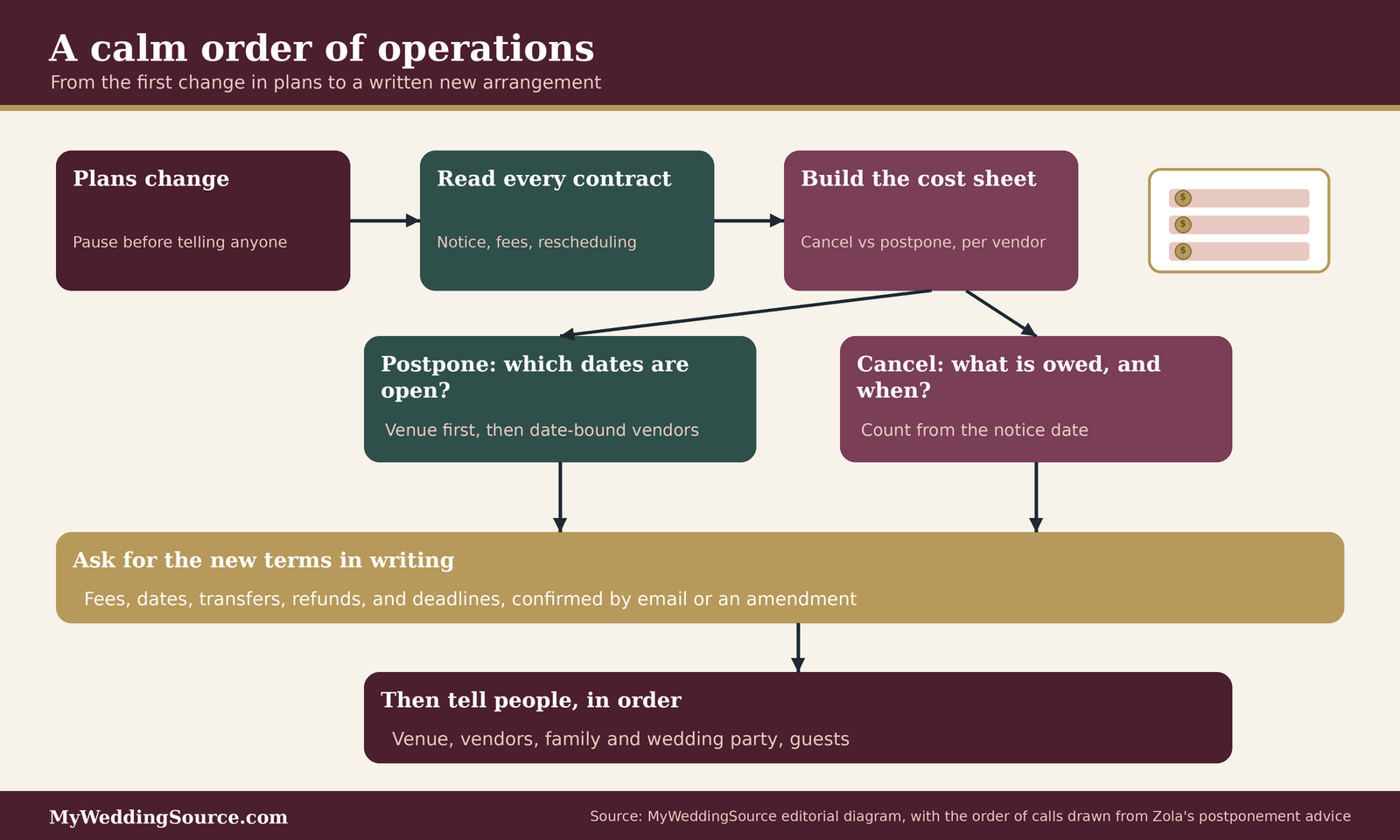
The cost sheet is the practical center of any wedding cancellation and postponement decision. For each vendor, write what you would owe if you canceled at today’s date, and what you would owe or pay extra if you postponed. Include any rescheduling fee, any price difference for a new season or weekday, and any deposit that would be lost. Add your own arithmetic for non-contract costs such as new stationery, travel changes, and time off work. Label totals as estimates until the vendor confirms them in writing. Our wedding budget calculator can hold the sheet.
Check availability before you commit
A postponement is only as good as the dates that exist. Ask the venue first, because it is usually the least flexible piece, then the date-bound vendors, then the rest. Zola’s guidance suggests exactly that order, and also notes that a venue’s availability does not guarantee that your photographer, florist, or caterer will be free. Ask for two or three candidate dates and hold none until each key vendor confirms in writing.
Compare the options on more than money
Money is only one input. The others matter just as much to how you will feel in a year.
What each path asks of you
Wedding cancellation and postponement ask different things of you, beyond money. Postponing asks for patience and keeps most of the plan intact, but it also means repeating decisions, informing guests again, and carrying uncertainty. Canceling the large event ends the uncertainty and may open options such as a smaller ceremony, an elopement, or a micro wedding. Our micro wedding planning and small wedding planning guides explain what changes at a smaller scale. Zola’s postponement article lists a city hall ceremony, an elopement, or a micro wedding as backup ideas if you still want to marry on the original date.
Check in with each other
If more than one person pays or decides, say aloud what each of you can accept. Disagreements about money and family are common during a stressful change, and our wedding planning stress guide covers how to keep a plan from turning into a conflict. A decision both people can explain calmly to a vendor is more durable than one made in a rush.
When the decision is not yours alone
Sometimes other people are involved: parents who paid, a partner who wavers, or a vendor who cancels first.
Who owns the contracts
Look at whose names appear on each agreement and whose card paid. A contract usually binds the person who signed it. If a parent or relative paid a deposit, ask them before assuming where a refund goes. Our how to pay for a wedding guide explains how to document who contributed what. Clarity now avoids hard conversations later.
When a vendor cancels or changes terms
If a vendor cancels, closes, or proposes new terms, do not sign anything you do not understand. Ask for the refund policy in writing, keep your own records of payments, and check how you paid. If a vendor does not respond, the card dispute rules in the previous section and your state’s consumer protection office are the places to start. We cannot tell you what you are entitled to, because that depends on your contract and state law.
Telling vendors, family, and guests
How you communicate can protect both money and relationships. A short, factual process works better than a long one.
A sensible order of calls
Zola’s advice for a postponement is to take a moment, then contact the venue and vendors before telling the wider guest list. That order avoids announcing a new date nobody can support.
Start with the venue and the largest contracts
Good habits in wedding cancellation and postponement begin with a written record. Email first so there is a written record, then follow with a call if useful. State the situation briefly, name your two or three preferred paths, and ask for a written response. Do not agree to a new date or a verbal fee waiver without confirming it in a document. If a vendor says yes on the phone, ask them to send a short email stating what was agreed.
Then family and wedding party
Once you know what is possible, tell the people closest to you, so they hear it from you and not from social media. They can help with guests who need travel changes. Our wedding etiquette guide covers wording and expectations around sensitive announcements.
Reaching guests
Guests need clear facts and a way to ask questions, particularly when they have booked travel.
What the notice should say
A guest notice about wedding cancellation and postponement should be short and warm. Say what changed, say whether a new date is set, and say where updates will appear, such as your wedding website. If the date is not yet known, say when you expect to share it. Zola suggests updating your wedding website and app before sending change-the-date cards. Keep the tone warm and brief and avoid blaming anyone.
Helping with travel
Guests may need to cancel flights or hotels. Zola’s guidance suggests sharing how to cancel or rebook any room block and giving a direct contact if you can get refunds or flexibility. Airline policies are separate, so tell guests to check their own bookings promptly. If you are canceling entirely, a personal note to the closest guests is a considerate extra step.
Gifts, registries, and the engagement ring
Cancellation raises questions that are partly etiquette and partly law. The law differs by state, and we did not find an authoritative source that settles it for every state.
Gifts and the registry
We did not fetch an authoritative etiquette source on gifts for this guide, so we will not state a rule. A practical approach is to ask the people who gave you gifts how they would like to handle them, and to decide with your partner what you are comfortable with. Our wedding registry guide covers how registries handle changes. If a guest paid for something non-refundable, such as a personalized item, use your judgment and be gracious.
The engagement ring
Who keeps an engagement ring after a canceled wedding is a legal question that varies by state and by circumstance, and courts reach different results. We cannot say what applies to you. If it is disputed, speak with a local attorney. Our engagement ring insurance guide covers protection of the ring itself while it is in your possession.
Rebuilding the plan after a change
Whether you postponed or canceled the large event, a clean restart saves money. The rebuild is mostly a matter of order and records.
Keep a clean paper trail
A paper trail is the difference between a smooth conversation and a long argument about who said what.
What to keep and where
Records are the quiet hero of wedding cancellation and postponement. Create one folder, digital and paper, with every contract, receipt, payment confirmation, and message. Save emails as files, log phone calls with the date, time, and person’s name, and note any verbal promise with a request for written confirmation. If you paid by card, keep statements, because the federal billing error process relies on written notices and statement dates. Our wedding planning checklist can help you list what exists.
What to put in a written notice
A good notice names the contract, the event date, what you are asking for, and the date you expect a reply. State facts, not accusations. Send it by the method the contract names, and keep proof of sending. If the contract has a notice address, use it exactly. Where the amount at stake is large, consider having a lawyer review the notice before it goes out.
Reset the timeline
A new date creates a new sequence. Some things are easier the second time and some are harder.
Start with the venue and the calendar
After wedding cancellation and postponement, the calendar becomes the first thing to rebuild. Pick the date range first, then check the venue, then the date-bound vendors. Our wedding planning timeline guide shows a sensible order of bookings and can be adapted to a shorter or longer runway. If your new date falls in a busy season, expect the venue to have fewer options and perhaps different pricing.
Update your budget honestly
Treat spent money as spent, and list what you may recover as a separate line labeled uncertain. Then compare the new total with what you can afford, using our average wedding cost guide only as a rough reference, since local prices differ. Honest numbers help you decide whether to keep the same size or scale down.
Honeymoon and travel
Travel bookings often have their own rules and sit outside the wedding contracts.
Check airline and hotel terms
Flights, hotels, and tours may allow changes or credits for a fee, and the terms vary. Zola’s postponement advice notes that hotels are usually flexible while airline changes may cost extra, so it recommends acting quickly. Our honeymoon planning guide covers how to keep a trip flexible, and any travel insurance has its own exclusions and deadlines.
Decide whether to keep the trip
You may choose to take the honeymoon as planned, move it with the wedding, or turn it into a smaller trip. Consider whether work leave is tied to the old date. A short written change request to each provider records what you asked for and when.
Cost, questions, and plain-language checklists
This section pulls the money and the questions together so you can use them in a conversation.
Where the money tends to go
Costs in wedding cancellation and postponement usually come from five places: lost non-refundable deposits, rescheduling or change fees, price differences on a new date, minimum guarantees that do not shrink with your guest list, and costs outside vendor contracts such as travel, stationery, and attire. We found no authoritative source giving a standard percentage for any of them, so every figure should come from your own contracts. Zola’s postponement advice suggests budgeting for two to three vendor deposits that may not be returned, which is a planning rule of thumb, not a guarantee.
Questions to ask each vendor
A short, consistent list lets you compare vendors fairly and gets answers in writing.
Questions to ask before you move or end a contract
- Which of my payments are refundable, transferable, or non-refundable?
- Does my contract treat a date change as a reschedule or as a cancellation?
- Is there a rescheduling fee, and does the price change on a new date?
- What dates do you have open, and for how long can you hold them?
- What notice do you need, in what form, and counted from when?
- Does the contract name pandemics, government orders, or severe weather as force majeure events?
- If you cannot perform, what do you refund, and by when?
- Can the minimum or guarantee be changed in writing if the event is smaller?
Questions for the venue and caterer
Ask what counts as the guarantee date, whether the food and beverage minimum is fixed, what happens to taxes and service charges on a new date, and whether a downsized event can use a smaller space. Ask for the answers by email.
Questions for photographers, music, and planners
Ask whether the retainer moves, whether a second date within a certain period costs less, and whether another team member can cover a date if the lead is booked. Ask for any substitution rules in writing.
Questions for yourself
Some of the most useful questions are not for vendors.
What can I afford to lose
Write down the largest amount you could lose without long-term harm, and compare it with the worst case in your cost sheet. This is personal finance, not advice, and a financial professional can help with large amounts.
What do we want the day to feel like
If a smaller or later event would feel better, that is a valid reason for a different path. A plan that fits your values is easier to defend to vendors and family than one that merely copies the original.
Common mistakes in wedding cancellation and postponement
Most expensive errors in a change of plans are small and avoidable. These are common pitfalls that follow from the sources we reviewed and from how wedding contracts are typically structured.
Mistakes about timing
Timing mistakes often cost more than any negotiation can recover.
Waiting to tell vendors
Delay is a common mistake in wedding cancellation and postponement. Silence can look like indecision, and it can shrink the vendor’s chance to resell your date. Cornell’s description of mitigation explains why prompt notice generally protects an injured party from avoidable losses. A short, factual message early is better than a perfect message late.
Missing a notice deadline
Deadlines shape wedding cancellation and postponement outcomes more than people expect. Contracts may require written notice by a certain date, by a specific method, or to a named address. A phone call may not count. Card disputes also have a clock: federal rules call for written notice within sixty days after the statement with the error was sent. Put every deadline on a calendar.
Mistakes about paperwork
Paperwork errors turn small disagreements into disputes.
Relying on verbal promises
Verbal promises are risky in wedding cancellation and postponement. A friendly yes on the phone is not a contract change. If a vendor agrees to waive a fee or move a deposit, ask for a short email or an amendment. Without it, the original contract is usually the document that controls.
Signing a new agreement too quickly
A new date often comes with a new contract. Read it as if it were your first. Check that it keeps any protection you negotiated, such as a transfer right, and does not quietly reset the cancellation schedule to the strictest terms.
Who to ask for help
This guide is general information, not legal or financial advice. Contracts and laws differ, and the stakes can be high.
Official and professional help
Several kinds of professional can help you with a specific problem.
Consumer protection offices and card issuers
Your state attorney general or consumer protection office can explain local rules and take complaints, and the FTC and CFPB accept complaints about card and billing problems. The FTC’s guidance says you may file at ReportFraud.ftc.gov and with the CFPB if a card dispute fails. Contact your card issuer using the billing-inquiry address, as the FTC advises, not the payment address.
Attorneys and mediators
For wedding cancellation and postponement disputes over large amounts, professional help is worth considering. A local attorney can read your contracts, explain how your state treats cancellation fees, and draft a notice. Some areas have low-cost legal clinics or mediation services. For small amounts, a polite conversation may cost less than a consultation, but for larger amounts a short review can save more than it costs.
Support for you
Canceling or postponing a wedding is stressful, and it is fine to ask for help with the emotional side too.
Lean on people you trust
Wedding cancellation and postponement are emotional as well as administrative. Zola’s advice begins by suggesting that you give yourself time to grieve the original date before making calls. That is a human step, not an administrative one, and it is a reasonable first move.
Take one decision at a time
Wedding cancellation and postponement are easier to manage in small steps. You do not need to settle every vendor in one day. Sequence the work: read, calculate, call the venue, then the others. Our wedding planning guide offers a broader frame for deciding what to tackle first.
FAQ: wedding cancellation and postponement questions
Deposits and fees
Is a wedding deposit refundable if I postpone?
It depends on the contract. Some vendors transfer a deposit to a new date, some charge a rescheduling fee, and some treat the change as a cancellation and keep it. Ask which payments move, in writing, before you announce a new date. This is general information, not legal advice.
Can a vendor keep my whole deposit when I cancel?
Often the contract says so, especially for date-bound vendors. Courts may decline to enforce a fee that works as a penalty rather than a reasonable estimate of loss, but that depends on your state and the exact clause. For large amounts, a local attorney can review it.
Contracts and law
Does force majeure cover a canceled wedding?
Only if the clause fits the event. Cornell’s legal reference says the clause releases parties when an extraordinary event directly prevents performance, that economic downturns generally do not count, and that some jurisdictions require the event to be named. Read your clause and ask a lawyer when the amount is large.
What if the vendor cancels or cannot perform?
Check what the contract promises you in that case, and ask the vendor to confirm any refund and date in writing. Keep payment records. If you paid by card, the federal billing error process may apply to services not delivered. Your state consumer protection office can also explain local options.
Insurance and payment
Does wedding insurance cover cold feet?
Usually not. NerdWallet’s overview lists a change of heart among common exclusions, though a few insurers offer limited optional coverage with conditions. Policies also tend to exclude known circumstances, so buying after a problem appears rarely helps. Read the policy wording and ask your agent before relying on it.
Can I dispute a wedding charge on my credit card?
If a vendor did not deliver what was agreed, you may be able to. The FTC says to write to the card issuer within sixty days after the first bill with the error was sent. A dispute does not cover a change of mind, and the outcome is not guaranteed.
People and etiquette
Who should I tell first when plans change?
Zola’s guidance suggests contacting the venue and vendors first, then close family and the wedding party, then the guest list. That order lets you offer a new date only once you know what is possible. Put every change from a vendor in writing before you announce anything.
Do guests get a refund for travel I asked them to book?
Not from you by default, and rules differ by provider. Zola suggests telling guests how to cancel or rebook any room block and giving them a direct contact. Airlines set their own policies, so guests should check their bookings promptly. Whether to offer help is your decision.
Your next steps
Take stock this week
Read every cancellation and rescheduling clause
Begin the work of wedding cancellation and postponement with the paper. Open each contract and highlight the notice requirement, the refund or fee schedule, and any rescheduling language. Copy the figures into one sheet so you can compare vendors. Our wedding vendor contract red flags guide explains the clauses you are likely to find.
Check your safety nets
Wedding cancellation and postponement costs may be softened by insurance or card protections. Find any event insurance policy and read its exclusions. Note which card paid each vendor and when the statement was issued. Our wedding insurance guide explains what these policies usually involve, so you can ask better questions of your agent.
Make the call in order
Contact the venue first and put everything in writing
Ask about open dates, fees, and whether the deposit moves. Then contact the other vendors in order of how date-bound they are, and send a short email after each call to confirm what was agreed.
Then tell your people
Once you know what is possible, tell family and the wedding party, then update your website and send the notice to guests. For wording and etiquette, see our wedding etiquette guide.
Sources & methodology
How we built this guide
What we relied on
This guide combines plain-language legal references from Cornell Law School, the federal text of the Fair Credit Billing Act provision on billing errors, consumer guidance from the Federal Trade Commission and the Consumer Financial Protection Bureau, a NerdWallet overview of wedding insurance, and Zola’s postponement advice. Where a statement comes from a publisher or retailer, we attribute it, because their advice reflects their own perspective. Claims we could not confirm from a fetched source were removed from the earlier version of this article, including typical deposit percentages and the details of any one state’s rules. Any arithmetic or illustration is our own and is labeled as an estimate.
What we did not do
We did not review your contracts, test any vendor’s terms, or consult a lawyer. Contracts, insurance policies, and state laws differ, and this guide does not give legal, financial, or insurance advice. For a specific dispute or a large amount, ask a licensed attorney in your state, your state attorney general’s consumer office, or your insurer.
Source list
Government and legal references
- Federal Trade Commission, Consumer Advice, Disputing credit card charges: https://consumer.ftc.gov/articles/disputing-credit-card-charges
- Consumer Financial Protection Bureau, What is a chargeback?: https://www.consumerfinance.gov/ask-cfpb/what-is-a-chargeback-en-1969/
- Cornell Law School, Legal Information Institute, 15 U.S.C. section 1666, Correction of billing errors: https://www.law.cornell.edu/uscode/text/15/1666
- Cornell Law School, Legal Information Institute, Wex, Force majeure: https://www.law.cornell.edu/wex/force_majeure
- Cornell Law School, Legal Information Institute, Wex, Liquidated damages: https://www.law.cornell.edu/wex/liquidated_damages
- Cornell Law School, Legal Information Institute, Wex, Mitigation of damages: https://www.law.cornell.edu/wex/mitigation_of_damages
- Cornell Law School, Legal Information Institute, Wex, Frustration of purpose: https://www.law.cornell.edu/wex/frustration_of_purpose
- Cornell Law School, Legal Information Institute, Uniform Commercial Code section 2-718, Liquidation or limitation of damages: https://www.law.cornell.edu/ucc/2/2-718
Wedding and insurance publishers
- Zola, How to postpone your wedding: https://www.zola.com/expert-advice/how-to-postpone-your-wedding
- NerdWallet, Wedding insurance: what it covers and what it costs: https://www.nerdwallet.com/article/insurance/wedding-insurance