
A cocktail attire wedding asks for a dressy, evening-ready outfit, but the version that works for you depends on three things the invitation rarely prints: the clock, the venue, and the weather.
You said yes, the card says “cocktail attire,” and then the details arrive: a 4:30 p.m. ceremony on a lawn, dinner in a converted barn, a late October forecast that swings from 68 degrees to 44 between the vows and the last dance. The phrase itself is easy to define, and our guide to what cocktail attire means does that job in depth. What the phrase cannot do is tell a guest whether a satin midi dress survives wet grass, whether a suit jacket will be a comfort or a sauna, or whether block heels or loafers are the smarter shoe. This article starts where the definition stops and works through the situations guests actually face.
Instead of repeating the dress-code ladder, we organize everything around decisions: venue, season and time of day, complete outfits for any gender, fabrics and shoes, which rules bend, and how to pay less. A final section is written for couples, because a few extra words on an invitation can save dozens of guests an anxious shopping trip. Statements about what guides recommend are attributed in the text, with the sources and dates collected at the end; where something is our judgment or an illustration, we say so.

How do you read a cocktail attire invitation when the details are missing?
Most invitations print a single phrase in a corner and leave the rest to the guest. That is not a flaw; space on a card is tight, and The Knot’s wedding-website dress code guide says fuller explanations belong on a details card or the website. The skill, then, is knowing which details change the outfit and where to find them in a few minutes.
What does the phrase settle, and what does it leave open?
What “cocktail attire” settles for every guest
The Knot’s cocktail guide, updated June 15, 2026, places the code between semi-formal and formal, which gives you a floor and a ceiling. The floor is a polished outfit that would not look out of place at a nice dinner; the ceiling is anything that reads as black tie, such as a tuxedo or a ball gown. Within that band, The Knot lists mini, knee-length, and midi dresses, dressy jumpsuits and pantsuits, and a suit and tie or a tailored blazer with dress pants. Because the band is wide, two guests can dress very differently and both be right. That wide band is also why your attention should move quickly from the label to the details that decide where in the band you land.
The three questions the phrase leaves open
Three facts do most of the work: what time the event starts, what kind of place it is, and what the weather will do. The Knot’s cocktail guide says as much in a single line: “Start with the location, time of day and time of year,” and all three, it adds, should give you clues right away. Time of day decides color and fabric weight, because Emily Post’s guest-attire guidance separates daytime and evening versions of each level of formality. The venue decides shoes, hems, and how dressy to lean, since a ballroom and a vineyard can carry the same label and feel quite different. Weather decides layers, and it is the variable that is easiest to check too late. Write those three facts at the top of a note before you open a single shopping tab, and the rest of this article becomes a lookup instead of a research project.
Where to find the missing details in ten minutes
Start with the wedding website, which usually has a page for attire, travel, and frequently asked questions. The Knot’s guide recommends that couples put the dress code on a dedicated page, the homepage, event pages, and the FAQ, and that the FAQ describe typical weather, so a guest who checks one page should find it. Next, search the venue’s own site for photos from past events, which show the room and the ground more honestly than any description. Then check the wedding party’s colors, if listed, so you can avoid matching them. If the website and the invitation disagree, the website is usually the newer and more detailed source, and a short text to a member of the couple settles it.
How do you use a formality dial instead of a fixed outfit?
What nudges your outfit one step dressier
Think of cocktail attire as a dial with a default setting and a few reasons to turn it up. A historic hotel, a country club, a museum, or a city rooftop at night supports a dressier reading, and so does an evening start, a plated dinner, or a ceremony in a house of worship. Turning the dial up does not mean a tuxedo or a gown; it means a richer fabric, a longer hemline within the midi range, a darker suit, a more structured shoe, and jewelry or a tie that looks deliberate. The Knot’s guidance that formal wear starts where floor-length dresses and tuxedos begin is a useful ceiling to keep in mind. Staying one notch below that line is how you look elevated without looking like you misread the card.
What to do when the signals point in different directions
Signals often conflict, such as a black-tie-adjacent venue with a “cocktail” card, or a barn with an 8 p.m. start. When that happens, weight the couple’s own words first, the venue second, and the clock third. Then choose the outfit that can be adjusted on the day: a dark dress or suit that works anywhere, plus a layer or accessory that tips it up or down. A jacket worn or removed, a tie added or dropped, and a wrap picked up or left in the car all move the dial without a second outfit. This keeps your shopping to one decision and your wardrobe flexible on the day.
| Signal | Turn the dial | Example adjustment |
|---|---|---|
| Evening start, plated dinner | Up | Satin or crepe, darker color, dressier shoe |
| Hotel, club, museum, rooftop | Up | Midi length, structured jacket, polished metals |
| Afternoon start | Down | Lighter color, softer fabric, lighter-weight jacket |
| Farm, vineyard, backyard, beach | Down | Block heels or wedges, fabric that resists wrinkles and wind |
| Couple says “dressy” or “festive” | Up | Add sparkle, velvet, or a bold accessory |
| Website says “tie optional” | Down | Tailored blazer, open collar with a polished shirt |
Which cocktail outfit fits which venue?
The same dress can look right in a ballroom and wrong on a lawn, and the reason is rarely the dress. Venues differ in floor, climate control, lighting, and how much walking they require, and each of those changes what a guest can wear comfortably for seven hours. Use the descriptions below as starting points, and let the wedding website’s photos correct them.
How do indoor venues change what you wear?
Hotel ballrooms, country clubs, and museums
These rooms tend to support the dressier end of cocktail attire, because the carpet, chandeliers, and plated service all signal an event. A midi dress in satin or crepe, a jumpsuit with a defined waist, or a dark suit with a tie all look at home. Heels are workable on the flat floors, but hotel ballrooms are often air-conditioned to a chill, so a wrap or blazer is not decoration. These venues are also where a floor-length dress becomes tempting, and where The Knot’s note that floor-length belongs to formal and black-tie events is worth remembering. Stay at the midi mark or just below and you will match the room without overshooting the invitation.
Restaurants, lofts, breweries, and industrial spaces
Urban and industrial venues often feel more relaxed than the code on the card, with exposed brick, concrete floors, and shared tables. That makes them a natural setting for a sharp pantsuit, a slip-style dress under a tailored jacket, or a dark suit worn with a slightly more modern shirt. Concrete is hard on feet over a long night, so dressy flats, low block heels, or polished leather shoes with cushioned insoles are practical choices. Pick fabric that tolerates a lot of motion, and test the outfit by sitting, reaching, and hugging before you commit.
A house of worship followed by a separate reception
When the ceremony is in a church, temple, mosque, synagogue, or gurdwara, the building may set rules that override the reception’s code. Emily Post’s guest-attire guidance tells guests to consider whether the service is religious and whether bare shoulders, bare arms, or open-toed shoes would be offensive, and WeddingWire’s fall-wedding guide suggests pants or a flowy skirt below the knee and a cover-up for strapless looks. A wrap, a jacket, or a scarf lets one outfit serve both rooms: covered for the ceremony, uncovered for the party. If you are unsure about head coverings or footwear, a short question to the couple is easier than improvising at the door. Specific traditions, such as Hindu and Jewish ceremonies, are covered in our wedding guest dress code guide, which is the better place to check them.
How do outdoor and hybrid venues change what you wear?
Lawns, gardens, and vineyards
Grass and gravel are the reason guests ruin shoes, not the dress. The Knot recommends chunky heels for outdoor weddings and warns that stilettos and kitten heels sink into grass, so block heels, wedges, or dressy flats are safer, and men’s leather soles can slip on damp turf. Hems that clear the ground matter more than hem length, because a midi that skims wet grass collects water and stains. Lighter, flowing fabrics suit warm daytime garden events, while a vineyard in a cool region may need the layering of a fall wedding. Our outdoor wedding rain plan guide explains how a rain plan moves a ceremony indoors, which is worth knowing because it changes your shoes and layers at the last minute.
Barns, farms, and ranches
A barn pairs a rustic setting with a polished invitation, and the temperature inside can be a surprise in either direction. WeddingWire’s fall-wedding guide suggests softer silhouettes, such as a long-sleeve floral maxi with ruffles or lace, and brogues with a tweed or solid suit for men at barn or farm weddings, while the cocktail standard still leans toward knee-to-midi lengths. Floors may be gravel, packed dirt, or old boards, so closed-toe shoes with a stable heel are more useful than a delicate sandal. Barns are often drafty in cooler months and hot in summer without air conditioning, which makes breathable layers more useful than heavy ones. If you are weighing the venue itself, our barn wedding venues guide covers the building side of the decision.
Beaches, lakesides, and rooftops
Water and height add wind, and wind rewrites the outfit. The Knot’s beach-formal guide suggests suits in blue or tan, not black, in linen or seersucker, an elevated maxi, a high-low or midi dress, or a classy jumpsuit or pantsuit, and says stilettos are a no-go on sand. It also recommends skipping strapless styles for more support in the wind. The Knot’s cocktail guide separately notes that linen and other lightweight fabrics can work for seaside events, even though cotton and seersucker read as too casual indoors. A weighted hem, a fitted jumpsuit, or a structured skirt will behave better than a flyaway chiffon, and a rooftop’s wind can be as strong as a beach’s.
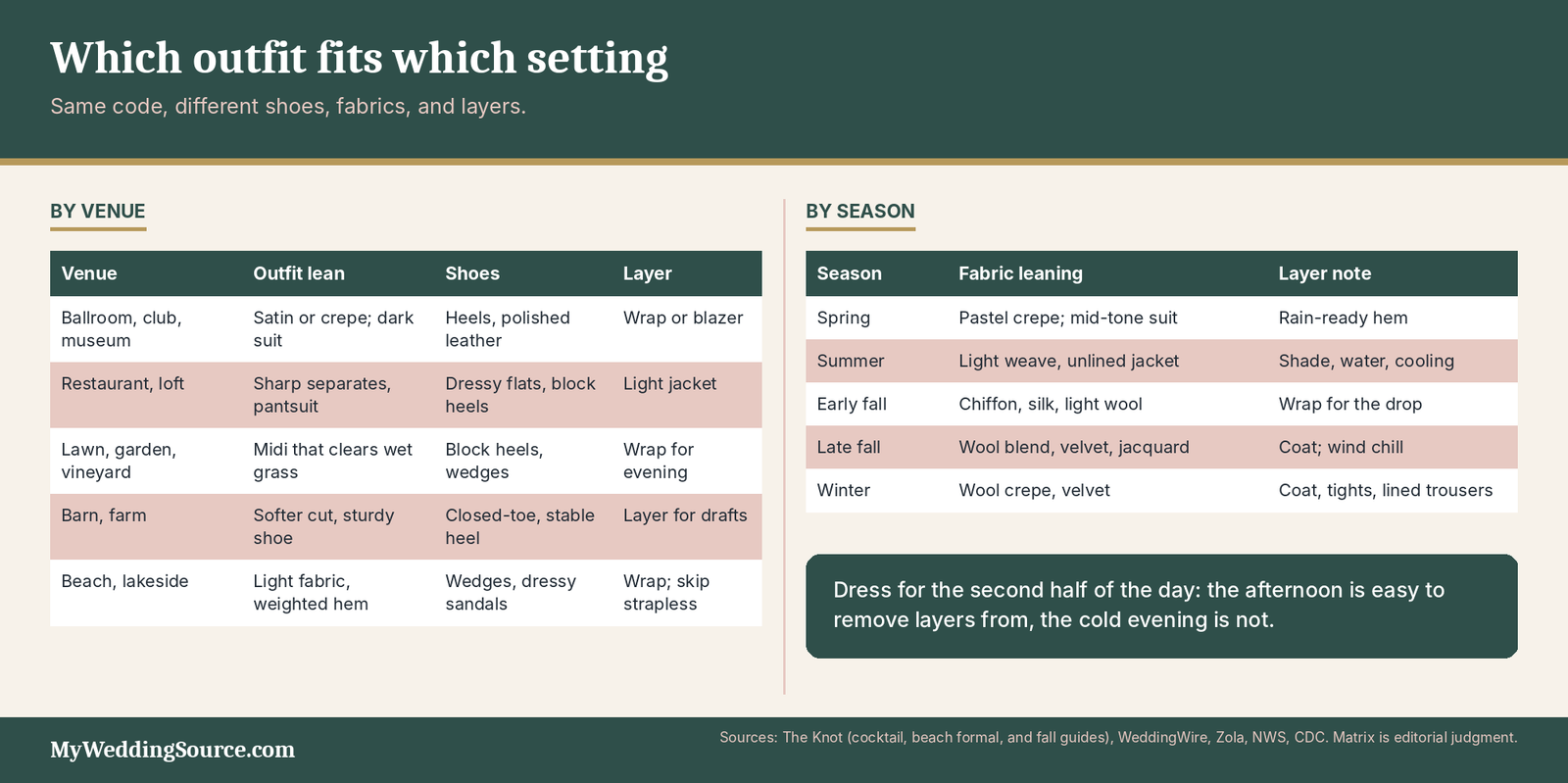
| Venue | Outfit lean | Shoes | Layer | Watch for |
|---|---|---|---|---|
| Ballroom, club, museum | Dressier: satin or crepe, dark suit | Heels, polished leather | Wrap or blazer | Over-air-conditioning; floor-length overshoot |
| Restaurant, loft, brewery | Sharp separates, pantsuit | Dressy flats, block heels | Light jacket | Hard floors, long standing |
| Ceremony in worship space | Covered shoulders and knees | Closed or easy-to-remove | Scarf, jacket | Venue rules; ask the couple |
| Lawn, garden, vineyard | Midi that clears wet grass | Block heels, wedges | Wrap for evening | Sinking heels; damp hems |
| Barn, farm, ranch | Softer cut, sturdy shoe | Closed-toe, stable heel | Layer for drafts | Gravel; heat or chill |
| Beach, lake, rooftop | Lightweight, weighted hem | Wedges, dressy flat sandals | Wrap | Wind and sand; strapless risk |
How do season and time of day change a cocktail outfit?
Season and clock are the two variables that guests tend to treat as afterthoughts, and they are the two that change the most. A wedding that starts at 2 p.m. in June and one that starts at 6 p.m. in November can share a dress code and have almost no outfit in common. The Knot’s 2026 Real Weddings Study found that fall was the most popular season for weddings, and that 76% of couples married between May and October, so most guests will meet cocktail attire in warm or transitional weather.
What should you wear in each season?
Spring and summer: lighter weight without looking casual
Warm-weather cocktail attire is a balancing act between breathability and polish. The Knot’s cocktail guide says light, bright colors suit summer, and that lightweight fabrics such as linen can work for seaside or summer events, even though cotton, cotton blends, and seersucker can read as too casual elsewhere. A good compromise is a fabric that is light in weight but dressy in finish, such as a crepe, a lightweight silk blend, or a fine wool-blend suit with an unlined or half-lined jacket. Spring adds unpredictable rain and pollen, so a dress that tolerates a damp hem and a jacket that can be taken off at the ceremony are worth more than another accessory. The CDC’s heat guidance identifies adults over 65, pregnant people, children, people with disabilities or chronic conditions, and people taking certain medications as being at higher risk in hot weather, so those guests should plan for shade, water, and an exit to air conditioning.
Fall: where fabric weight changes month by month
September can still feel like summer, and November can feel like winter, so the same dress code asks for different cloth. The Knot’s fall-wedding guide recommends lighter chiffon or silk in September, mid-weight wool blends, flannels, or tweeds in October, and velvet, jacquard, and heavy wool blends in November. Its color suggestions include jewel tones such as emerald, sapphire, and ruby, earth tones such as rust, terracotta, and olive, and classic darks such as charcoal, navy, and burgundy. Fall also brings the widest daily temperature swings, so the outfit has to work at 70 degrees in the afternoon and 45 after sunset. Our fall wedding weather and seasonal cost guide covers those swings from the couple’s side, and a guest can use the same idea: dress for the second half of the day, then plan to peel layers off.
Winter: the coat is part of the outfit
Winter weddings make the outerwear decision as important as the dress. Zola advises bringing a coat to winter weddings in case you spend time outdoors, and the National Weather Service explains that wind chill, the way cold feels on exposed skin, is defined only when the air temperature is at or below 50 degrees Fahrenheit and the wind is above 3 mph. Its chart gives the example that 0 degrees with a 15 mph wind feels like minus 19, and it notes that bright sunshine can raise the wind chill by roughly 10 to 18 degrees. In practice, a breezy 45-degree patio after sunset will feel colder than the number on your phone. Choose long sleeves, opaque tights or lined trousers, and a coat that matches the outfit’s formality, so you do not need to hide a good look under a puffer.
How does the time of day change the outfit?
Afternoon weddings: lighter, softer, and still dressed
Emily Post’s guest-attire guidance splits each level of formality into daytime and evening versions, and The Knot says lighter hues and patterns suit daytime while deeper solid shades suit evening. For a ceremony at 2 p.m., that points to softer colors such as sage, dusty blue, or rose, floral or printed fabrics if they have a dressy finish, and lighter-weight tailoring. Daytime weddings also tend to involve more outdoor time, which means sunlight, wind, and uneven ground. A midi dress in a printed crepe or a suit in mid-gray or mid-blue looks intentional in daylight, where a very dark satin can look heavy. The cocktail standard still applies; you are changing the palette, not the effort.
Evening weddings: deeper, shinier, more structure
After dark, cocktail attire leans toward deeper colors and fabrics with sheen, which is what The Knot’s cocktail guide describes when it says satin and velvet suit evening events. Think midnight blue, burgundy, emerald, plum, charcoal, or black, with metallic accents in shoes, jewelry, or a clutch. Evening events usually involve a seated dinner, speeches, and dancing, so the outfit needs structure that holds up when you sit and move. A tuxedo, The Knot says, should not be worn at cocktail-level events, so a velvet jacket with ordinary trousers is the safer way to add evening drama.
Split-day weddings: when one outfit has to do two jobs
Many weddings start with an afternoon ceremony and end with a late reception, and guests are left with one outfit for two lighting conditions. A mid-tone base, such as navy, teal, deep green, or charcoal, works in sunshine and under string lights. Then use removable pieces to shift register: take the jacket off for the dance floor, swap the tie for an open collar if the couple’s website says tie optional, add a metallic wrap, or change from flats to heels in the car. Pack a small bag with a second pair of shoes, a lint roller or tape for the afternoon grass, and a layer for the late evening. This is also the case for choosing wrinkle-resistant fabric, because you may sit through both a ceremony and a long dinner before the dancing starts.
| Season | Afternoon version | Evening version | Layer and climate note |
|---|---|---|---|
| Spring | Pastel or print crepe; mid-tone suit | Deeper solid, light shine | Rain-ready hem; light jacket |
| Summer | Light color, breathable weave | Lightweight satin, unlined jacket | Shade, water, cooling; CDC heat risks |
| Early fall | Chiffon or silk, lighter wool | Jewel tones, satin | Wrap for the temperature drop |
| Late fall | Wool blend, flannel, tweed | Velvet, jacquard, heavy wool blends | Coat; plan for wind chill |
| Winter | Wool crepe, knit-and-satin mix | Velvet, deep colors | Coat, tights, lined trousers; NWS wind chill |
What do complete cocktail outfits look like for any gender?
Dress codes were written for two outfits, yet the people who receive cocktail invitations wear dresses, suits, jumpsuits, skirts, and combinations of all of them. The Knot’s nonbinary attire guide makes the point that formality is carried by fabric, fit, and finish more than by garment, and the builds below follow that logic. Each one lists the pieces, so you can assemble an outfit from your own closet or a rental, whatever label is on the tag.
What are the dress, skirt, and jumpsuit builds?
The dress build: cut, hem, and straps
The Knot lists mini, knee-length, and midi dresses as cocktail-appropriate and places floor-length dresses at formal and black-tie events. The sturdiest cuts are the wrap, the fit-and-flare, the sheath, and the slip dress with a jacket, because each keeps its shape when you sit, hug, and dance. Straps matter more than most shoppers realize: a strapless dress that needs tugging all night pulls your attention away from everything else, and The Knot’s beach-formal guide specifically recommends skipping strapless styles in the wind. A hem between just above the knee and mid-calf is the most flexible range across venues. Sit down in the dress before you buy it, since a cut that looks right standing can ride up or gap when seated.
The jumpsuit and pantsuit build
The Knot names jumpsuits and pantsuits as full cocktail options when the fabric and tailoring are dressy. Look for wide-leg or straight-leg trousers in crepe, satin, or a drapey woven cloth, a defined waist or a belt, and a hem that clears the floor in the shoes you will actually wear. A matching blazer turns a plain jumpsuit into a suit, and a camisole or silk shell under a jacket gives you two ways to dress it. Jumpsuits have one practical weakness, restroom logistics, which a side zip, wrap front, or two-piece style solves. For a wider shopping discussion, our guide to wedding guest dresses compares cuts and fabrics across dress codes.
What are the suit and tailoring builds?
The suit and tie build
For a suit, The Knot recommends a suit and tie or a well-tailored blazer with dress pants, in navy, gray, or black. Its stylist source says ties have become more flexible, but that “traditionally, cocktail attire means a tie,” which is why we treat the tie as the default unless the couple says otherwise. The details that signal evening are small: a dress shirt with a clean collar, a tie in a solid or restrained pattern, a belt that matches the shoes, and leather dress shoes rather than casual footwear. A mid-tone or darker suit reads more evening than a light one, and wool or a wool blend in a smooth finish looks dressier than rough linen. Our groom’s wedding attire guide explains suit construction and fit, which is useful for any guest buying a suit.
The blazer, trousers, and tie-optional build
If the website says tie optional or the weather is hot, a tailored blazer with dress trousers and a polished shirt is a legitimate cocktail outfit. The Knot’s cocktail guide names the blazer-and-trousers pairing alongside the full suit. To keep the look sharp without the tie, choose a shirt with a firm collar, a jacket with structure rather than an unlined casual one, and pocket or lapel details that show intent. Dressy flats, loafers, or oxfords belong here, while sneakers do not; The Knot says men’s sneakers fit only dressy casual weddings. If you are unsure whether the tie is expected, carry one in your pocket and decide when you see the room.
Gender-expansive combinations without the costume effect
The Knot’s nonbinary guide suggests, for cocktail, versatile separates such as a navy or gray suit or a dress that hits at or just below the knee, and it shows that skirts, jumpsuits, capelets, and tuxedos can all be matched to the formality rung. The way to avoid a costume effect is to choose one lead idea and keep everything else conventional: a skirt with a tailored jacket, a suit with a silk shell, or a dress with a structured blazer. Mixing a formal element from each tradition works when the fit is consistent, so a tailor matters more than a label. Choose shoes and accessories that serve the formality level rather than the gender coding of the garments.
Which fabrics, shoes, and accessories hold up through the whole day?
A cocktail outfit is judged at hour six, not at the mirror. Fabrics wrinkle, shoes pinch, and layers go missing, and the pieces that looked fine in a fitting room often fail when you sit through a ceremony, stand for cocktail hour, and dance. This section turns the dress code into material and footwear choices, so you can pick pieces that last through the full schedule.
Which fabrics read as cocktail and which struggle?
Evening fabrics that signal polish
The Knot’s cocktail guide lists silk satin, silk chiffon, silk georgette, jacquard, and beaded or embellished fabrics as appropriate, with satin and velvet particularly suited to evening events. Fabric carries more of the formality than the silhouette does, so a satin slip dress and a cotton slip dress can share a pattern and sit two dress codes apart. For suits, wool or a wool blend in a smooth finish reads dressier than heavy tweed or rough linen. If silk is out of budget, polyester satin, crepe, and viscose blends can drape similarly, though they hold heat and show creases differently. Check the care label before you buy, because dry-clean-only pieces add a cost that belongs in your budget.
How to test a fabric before you commit
Do three quick tests in the fitting room or at home. First, the sit test: sit for five minutes, stand up, and check for creases, gaping, or rides. Second, the squeeze test: crush a corner of the fabric in your fist for a few seconds, then release; heavy creasing means you will be steaming at the venue. Third, the heat and static test: walk around in dry indoor air, or under a ceiling fan, and see whether the fabric clings to tights or skin and whether it feels warm after ten minutes. These tests are our editorial suggestion rather than a published standard, but they are cheap and they predict real problems. A fabric that fails two of three is a poor candidate for a long day, whatever the price tag says.
| Fabric | Usually reads as | Works best | Trouble spots |
|---|---|---|---|
| Satin, silk blends | Evening | Evening, indoor | Water spots; creases; heat |
| Crepe | Cocktail, versatile | Any season, any venue | Can cling; shows sweat |
| Velvet | Evening, festive | Fall and winter nights | Too hot in warm rooms |
| Chiffon, georgette | Soft, dressy | Daytime, warm weather | Wind and static; snags |
| Jacquard, brocade | Dressy, textured | Fall, winter, evening | Weight; dry-clean cost |
| Wool or wool blend | Tailored | Suits; cool weather | Too warm in summer |
| Linen | Relaxed | Beach, seaside, daytime | Wrinkles; reads casual indoors |
| Cotton, seersucker | Casual | Daytime outdoor only | Underdressed at evening events |
Which shoes and finishing pieces matter most?
Shoes by ground, not just by outfit
The Knot recommends chunky heels for outdoor weddings and notes that stilettos and kitten heels sink into grass and sand, while its fall-wedding guide suggests chunky block heels, dressy wedges, or leather dress boots. The Knot’s cocktail guide adds that heels are optional but flats must be dressy, such as a satin or patent ballet flat, and it suggests oxfords, loafers, or derbies for men. Match the shoe to the ground you will walk on and the hours you will stand. For a lawn, a block heel or a wedge keeps you upright; for a ballroom, almost any dressy shoe works; for a cobblestone street or a gravel path, a flat with grip is more elegant than a stumble. Break in new shoes for a week at home, and pack a second pair if the ceremony and reception are in different places. The shoe is the piece guests regret most, and it is the cheapest piece to fix in advance.
Bags, jewelry, ties, and the small items that finish the outfit
A small clutch or crossbody that closes holds the essentials without becoming a prop on the dance floor. Jewelry at cocktail level can be a statement piece in one place, such as earrings or a necklace, rather than a layered mix that catches on fabric. For suits, a tie in a solid or restrained pattern, a pocket square that complements rather than matches, and leather that coordinates with the belt are enough. The Knot says baseball caps are never appropriate and that hats should come off indoors. Pick one accent that carries personality, such as a metallic shoe or a patterned tie, and keep the rest quiet.
Coats, wraps, and umbrellas
Outerwear is the item guests forget and then wish they had. The Knot recommends a shawl, wrap, or dress coat even for an indoor event, since ceremonies often start outside or in a drafty entrance, and Zola recommends a coat for winter weddings. Choose a layer that coordinates with the outfit, such as a dark wool coat, a tailored blazer, or a pashmina in a neutral shade, so you are not hiding a good outfit under a bulky jacket. Keep a compact umbrella in the car in any season, because a rain plan may move the party under a tent or indoors on short notice.
What should you avoid at a cocktail attire wedding, and which rules actually bend?
Etiquette about wedding clothing is a mix of firm norms and soft habits, and guests get into trouble by treating them all the same. Some choices are widely discouraged because they compete with the couple or break the code, while others are flexible once you know the context. The sorting below separates what almost every guide agrees on from what depends on the invitation, the venue, and the community.
Which choices are almost always off the table?
The white family: white, ivory, cream, and champagne
The Knot advises staying away from any outfit that is predominantly white, cream, or ivory, and Zola’s guest guide names white, cream, and ivory directly. The Knot’s formal-attire page adds champagne and light-colored suits to the list of shades to skip, because they can photograph as white. It also draws a useful line on pattern: a blue dress with white flowers is fine, while a white dress with blue flowers is not. A white dress shirt under a suit is acceptable, and white shoes are generally fine when the rest of the outfit stays clear of the list. The one exception is a couple who asks all guests to wear white, which will be stated on the invitation or website.
Jeans, shorts, sneakers, flip-flops, and caps
The Knot’s cocktail guide lists jeans, shorts, and sneakers as not appropriate for cocktail attire, and it says flip-flops and casual sandals are out as well, while open-toed dressy shoes are acceptable. Its broader etiquette guide calls denim a no-go unless the wedding is Western-themed, and says a baseball cap is never appropriate. The reasoning is about level, not snobbery: these items belong to everyday and athletic dressing, so they signal a different event than the one on the card. If heat or a long walk makes you want comfort, the answer is a dressy flat, such as the satin or patent ballet flat The Knot suggests, or a polished loafer, not a sneaker. A fashion sneaker worn with a suit is a style choice some guests make, but at a cocktail-attire wedding it is a risk you should take only if the couple’s website says it is welcome.
Matching the wedding party or competing with the couple
Zola advises checking whether you are wearing the same color as the bridesmaids, and The Knot suggests looking at the wedding website to see what the attendants will wear. Red can also draw attention away from the couple, according to The Knot, and large trains, veils, or headpieces that look bridal are best left to the person getting married. A simple test is whether you could stand beside the couple in a family photo without looking like part of the wedding party. Festive weddings loosen this, since The Knot’s festive guidance says guests need not worry about outshining the couple, but white and the attendants’ colors stay off the list. When the party’s colors are not published, a friend or sibling in the wedding party can tell you in one text.
Which rules bend, and when?
Black: fine in the evening, worth a second look elsewhere
The Knot’s cocktail guide lists black among the safe suit colors, and a black dress or suit is a staple at evening and formal events. The caution comes from context: The Knot notes that black can feel somber at casual daytime weddings, and some traditions treat black as inauspicious at celebrations, so a quick check is wise when the ceremony follows a cultural or religious tradition you do not know. If you wear black, add color or shine so the outfit reads celebratory rather than funereal, such as a jewel-toned wrap, a metallic shoe, a colorful tie, or distinctive jewelry. For a daytime garden ceremony, a mid-tone navy or deep green is often a more natural choice. Black is neither forbidden nor automatic; it is a color to place deliberately.
Floor-length dresses and where the line really is
The Knot is direct: steer clear of floor-length dresses, which are more appropriate for formal or black-tie weddings. Yet Emily Post’s black-tie page accepts a dressy cocktail dress at black tie, which shows the line is soft from both sides, and The Knot’s own formal page describes floor-length or ankle-length dresses as typical at formal events. A tea-length or mid-calf hem sits comfortably inside cocktail attire, so if you love a longer line, choose that, not a gown. A floor-length dress in a casual fabric, such as a cotton maxi, is the case The Knot’s stylist says would likely be too casual unless the event is on a beach. If the couple’s website says “cocktail attire, long dresses welcome,” follow the couple; otherwise, stay at the calf.
Tuxedos, bow ties, and tuxedo-adjacent pieces
The Knot’s tuxedo guidance says tuxedos are typically for black-tie evening events and should not be worn at cocktail-level events or anything more casual. That does not mean you must avoid every tuxedo element. A velvet dinner jacket with plain trousers and a standard tie, or a suit in a deep midnight color, adds evening presence without reading as black tie. The Knot’s cocktail guide also gives a pairing rule for accessories: if you wear a printed bow tie, the pocket square should be a solid color that matches the print, or the other way around. If you own a tuxedo and want to use it, break it up by wearing the jacket with different trousers or the trousers with a different jacket, so the look stays on code.
| Situation | Verdict | What to do instead |
|---|---|---|
| Ivory or champagne dress | Avoid | Choose a deep color, or a print where white is the accent |
| Black suit or dress, evening | Usually fine | Add color or shine; check cultural expectations |
| Floor-length gown | Usually too formal | Tea-length or mid-calf; save the gown for formal or black tie |
| Tuxedo with bow tie | Usually too formal | Dark suit and tie, or velvet jacket with plain trousers |
| Cotton or seersucker | Daytime outdoor only | Crepe, satin blend, or fine wool for evening |
| Dressy sneakers | Risky | Satin or patent flats, loafers, derbies, or oxfords |
| Matching the bridesmaids | Avoid | Check the website for the wedding party’s colors |
| Strapless dress in wind | Risky | Add straps, a wrap, or a structured fabric |
How do you shop, rent, or borrow without overspending?
A cocktail outfit has to be right on the day, but it does not have to be new. Guests can wear, borrow, rent, buy, or buy resale, and the cheapest route depends on how often they will wear the outfit again. The Knot’s Guest Study, a survey of 1,000 U.S. adults aged 18 to 54 who attended at least one in-person wedding in 2024, reports an average cost of $610 to attend a wedding across travel, lodging, gifts, and attire. That page does not break out the outfit’s share, so we cannot quote an attire figure, and the arithmetic below is illustrative.
What are your options, and what does each cost?
Re-wearing and borrowing: the cheapest route
The Knot’s guest-cost guidance says the easiest way to save on attire is to wear something you already own, and a dark suit, a classic dress in a jewel tone, or a pair of tailored trousers can serve many cocktail invitations with changes in accessories. Borrowing from a friend is a close second, but agree in advance who pays for cleaning and what happens if something is damaged. Re-wearing carries only small costs, such as dry cleaning or a hem, which we estimate at under about $60 depending on the shop and the work. The exception is a very distinctive outfit worn in front of the same friend group in photos, where a different jacket, shoes, or jewelry keeps it fresh. You do not owe a couple a brand-new outfit.
Renting: menswear, dresses, and subscriptions
Menswear rental is the most transparent market, because prices are posted. As of October 12, 2026, Generation Tux’s homepage listed tuxedos from $139 and featured suits and tuxedos at $159, while The Black Tux listed suits from $169 and tuxedos at $189; these are starting prices, not quotes. Generation Tux also states that orders arrive 14 days before the event, that you should try them within 48 hours, and that returns are due within three days after. For dresses and separates, The Knot’s September 2026 roundup of rental sites lists Nuuly and BNTO at $98 a month for six items, FashionPass at $125 a month for two orders of five items, and Rent the Runway memberships from $129 a month for five items, with one-time rentals priced by item for four or eight days. Rent the Runway’s own homepage, as our editors read it on October 12, 2026, showed an introductory first-month price and a higher regular monthly rate, which is a reminder to read the live price page before you commit. Rentals suit one-off formal looks, and subscriptions suit a season with several weddings.
Buying new, buying resale, and cost per wear
Buying makes sense when the piece suits a code you will meet again. The Knot’s tuxedo-versus-suit guide puts an entry-level new suit at about $200 and a three-piece suit at roughly $300 to $800 or more, while dresses and jumpsuits vary too widely for a single figure, so compare three prices from three sources and then add extras. Resale and thrift can cut the price sharply, but check final-sale policies, inspect seams and linings, and budget for dry cleaning and alterations. Illustrative arithmetic, not a quote: a $200 suit worn four times costs $50 per wear before cleaning, while a $159 rental worn four times would cost $636. If you will wear the piece only once, the comparison flips toward renting or borrowing.
| Route | Cost layers | Best when | Watch for |
|---|---|---|---|
| Re-wear | Dry cleaning, small hem or fix (editorial estimate) | You own an on-code piece | Fit changes; same photos |
| Borrow | Cleaning; agreed damage terms | A friend has your size | Who pays for damage |
| Rent a suit or tux | From $139 to $189 listed (Oct. 12, 2026); $150 to $300 typical (The Knot) | One-off formal look | Delivery date, return deadline, fees |
| Subscription | $98 to $129 a month (The Knot, Sept. 2026) | Several weddings in a season | Cancellation rules; item limits |
| Buy new | About $200 for an entry-level suit (The Knot); dresses vary | Code you will meet again | Return window, alterations |
| Resale or thrift | Varies; editorial estimate only | Budget and patience | Final sale; condition; cleaning |
When should you buy, and what should you confirm first?
The six-week window and the first alteration
Work backward from the date. Confirm the code, the weather range, and your budget about eight weeks out; buy or reserve by about six weeks; and book alterations by about four, because tailors tend to fill up in busy wedding months. These intervals are editorial suggestions, not an industry standard, and a rental needs less lead time than a custom hem. Shoes should be ordered with the outfit so the tailor can hem to the heel height you will actually wear. If your wedding is on a holiday weekend, a travel day may take a day off your timeline, so our Thanksgiving weekend wedding guide is worth a look.
What to ask about fit, returns, and exchanges
Before you pay, ask four questions: how long you have to return or exchange, whether returns cost money, whether sale items are final, and what happens if the outfit does not fit. Keep tags on until you have tried everything together, including shoes, layers, and undergarments. Rent the Runway one-time rentals, according to The Knot’s roundup, include a free backup size, which is the kind of protection worth asking about at any retailer. If the wedding is out of town, our destination wedding guest costs guide shows how the outfit fits into the whole trip budget. A small rule helps: spend on the pieces that must fit well, such as the jacket, the trousers, or the dress bodice, and save on pieces that are forgiving.
What should couples write on the invitation so guests dress right?
If you are the couple, the dress-code line is a service to your guests as much as a statement of style. A small amount of extra information prevents most of the anxious texts, and it costs nothing. The Knot’s wedding-website dress code guide, updated April 1, 2026, gives a practical frame: state the level, add venue rules, describe the ground and the weather, and say where else the details live.
Which words and details help guests most?
Choosing the label and adding one sentence
Use the term you mean, and then add one sentence that tells guests what you picture. The Knot’s guide suggests wording such as “black-tie attire requested” on the card, with a fuller explanation on a details card or the website, and it gives examples like “Please wear your best tuxedo, dark suit or evening gown.” Following that pattern, a cocktail version might read: “Cocktail attire. Think a dress, jumpsuit, or suit in a dressy fabric; we will be outdoors for the ceremony, so plan for grass.” The sentence helps guests of every gender and budget, because it describes the level rather than prescribing a garment. Avoid vague words such as “dressy” alone, which guests read differently, and skip the word “formal” if you do not want tuxedos.
Telling guests about the ground, the weather, and the venue rules
The Knot’s guide recommends mentioning terrain and footwear, suggesting flats or wedge heels for lawns and sandals for beaches, and describing the venue’s typical weather in the FAQ and updating it a week or two before the event. It also says to note venue requirements, such as banned denim or sneakers, and items to avoid when relevant. These details change what guests buy, so they are worth more than a long description of your vision. A sentence like “The ceremony is on grass and the reception tent will be cool after sunset; bring a wrap” saves a dozen individual replies. If a rain plan moves guests indoors, say so, since shoes and layers depend on it.
Color requests, cost, and kindness
The Knot’s guide says to ask politely for colors, sequins, or a palette and not to make these absolute requirements, which is good advice for guests who are watching their budgets. A dress code is also a shopping instruction, and with $610 the average cost to attend a wedding in The Knot’s Guest Study, an outfit purchase can feel significant. Describe the level, welcome re-wears and rentals, and avoid requiring specific colors that most guests do not own. A warm line such as “Wear something you feel great in at this level of dressiness; dresses, suits, and everything in between are welcome” signals that you care about comfort and inclusion. You will get more of what you want by making it easy.
Where should the details live, and how do you handle questions?
Using the card, the website, and the FAQ together
The Knot’s guide recommends placing the dress code in the lower corner or bottom center of the invitation, or on a details card, and on the website in a dedicated dress code page, the homepage, individual event pages, and the FAQ under a question like “Is there a dress code?” Each event can have its own code, which matters for a casual welcome party followed by a cocktail-attire ceremony. The guide also suggests linking to a guide or adding photos or a Pinterest board for unusual dress codes, which helps if your meaning differs from the standard one. Keep the wording consistent across the card and the website, and update the website first when plans change. For card-wording samples, see our wedding invitation wording guide.
Updating the forecast and the rain plan
Weather information is the detail guests most want and couples most often forget. The Knot’s guide suggests refreshing the weather note a week or two before the wedding, and the same logic applies to rain-plan changes and ceremony start times. A short update on the website, plus a line in your reminder email, reaches almost everyone who needs it. If a heat wave or cold snap arrives, say so plainly and invite guests to remove jackets or add wraps. This is also the moment to tell guests about practical amenities, such as a coat check, shade, a heated tent, or fans, since these change what they wear.
| Wording on the card | How guests are likely to read it | One sentence to add |
|---|---|---|
| Cocktail attire | Dress, jumpsuit, or suit and tie | “Ceremony outdoors on grass; flats or block heels recommended.” |
| Cocktail attire, tie optional | Blazer and trousers are fine | “Dresses, suits, and separates all welcome.” |
| Festive cocktail attire | Add shine or color | “Sequins, velvet, and bold color are encouraged; please skip white.” |
| Semi-formal | About the same, sometimes less dressy | “Think dressy dress or suit; ties welcome.” |
| Dressy | Ambiguous; could be anywhere on the ladder | Replace with a named level plus one detail. |
| Cocktail, winter | Heavier fabrics; coat needed | “Please bring a coat; coat check available.” |

FAQ: Cocktail attire wedding questions
Questions about the outfit
Is a floor-length dress too formal for a cocktail attire wedding?
Usually, yes. The Knot’s cocktail guide says to steer clear of floor-length dresses, which it considers more appropriate for formal or black-tie weddings, and The Knot’s formal-attire page lists floor-length or ankle-length dresses as typical at formal events. A tea-length or mid-calf dress gives you a longer line without crossing into formal territory. The main exception is a couple who says on the website that long dresses are welcome, in which case the couple’s instruction outranks the general guide. If you are torn, choose the midi.
Do I have to wear a tie to a cocktail attire wedding?
Traditionally, yes. The Knot’s cocktail guide quotes its stylist source as saying that “traditionally, cocktail attire means a tie,” while noting that a tie can be optional with a turtleneck or in summer. If the website says tie optional, a tailored blazer, a crisp shirt, and polished shoes are a legitimate cocktail outfit. When there is no guidance, wear the tie, since you can always remove it in a warm room but cannot add one you did not bring. Keep a spare in your jacket pocket if you want the choice.
Can I wear flats instead of heels?
Yes, as long as the flats are dressy. The Knot’s cocktail guide says heels are optional but that flats should be dressy, such as a satin or patent ballet flat, and it suggests oxfords, loafers, or derbies for men. Open-toed shoes are acceptable at cocktail attire, while flip-flops and casual sandals are not. On grass, a flat with a firm sole or a block heel is more reliable than a thin heel that sinks. Choose cushioning if the venue has concrete or cobblestone floors.
Questions about the situation
What should I wear to an outdoor cocktail attire wedding in the fall?
Dress for the second half of the day. The Knot’s fall guide points to lighter chiffon or silk in September, wool blends or tweeds in October, and velvet or heavy wool blends in November, and its cocktail guide suggests deeper shades for evening. Add block heels or wedges for grass, plus a wrap, blazer, or coat for the temperature drop after sunset. Check the forecast the week before, and the wedding website for any rain-plan changes.
What if I show up and everyone else is dressed differently?
It happens, and it is rarely as noticeable as it feels. If you are slightly more dressed up, remove the jacket or tie and carry on, since being a notch above the room is easier to fix than being a notch below. If you are slightly underdressed, a borrowed blazer, a wrap, or a bold accessory can narrow the gap, and a quick trip to the restroom for a hair or makeup refresh helps. Remember that guests are there for the couple, not for an outfit review. Most people will have forgotten your clothes by the time the first dance begins.
Is it okay to rent my outfit for a cocktail attire wedding?
Yes, and for one-off formal looks it can be the more economical choice. The Knot reports typical tuxedo rentals at $150 to $300 and lists subscription plans from about $98 to $129 a month, and rentals reduce storage and cleaning decisions. Read the delivery, return, late-fee, and damage terms first, and order early enough to try the outfit and swap a size. If you will wear the outfit several times, buying or re-wearing may cost less per wear.
Your next steps
The decisions in this article shrink to a short list of actions, and the free ones come first. Reading, asking, and checking the forecast cost nothing; spending comes after you know the venue, the time, and the weather. If you keep one rule, keep this one: do not buy or rent anything until you have written down the five facts below.
This week
Write down the five facts
Open the invitation and the wedding website, and record five things: the exact dress-code phrase, the start time, the venue and the ground, the date and a forecast range, and any restrictions or colors to avoid. The Knot’s cocktail guide frames the same idea in one line: start with the location, time of day, and time of year, and all three should give you clues right away. Add the wedding party’s colors if the website lists them. Having the five facts in one note also makes it easy to ask the couple a specific question if something is missing. Do this before you shop, because it prevents the most common mistake: buying an outfit for the label and not the setting.
Choose your route: re-wear, borrow, rent, or buy
Look at your closet first, then at friends, then at rentals, and only then at buying. Decide by how often you will wear the piece again, not by price alone: a one-time formal look favors renting or borrowing, while a dark suit or a classic dress in a deep color earns its place across seasons. Set a ceiling for the total, including shoes, alterations, cleaning, and accessories, and write it next to the five facts. If you are buying, decide which piece must fit best, usually the jacket, trousers, or bodice, and spend your alteration budget there. A two-minute budget note now can save you from a rush purchase three days before the wedding.
Before you pay or reserve anything
Confirm the terms in writing
Before you pay, find the return or exchange window, the rental period, late-fee and damage terms, shipping and cleaning charges, and whether sale items are final. For a rental, confirm the delivery date is ideally two weeks before the wedding, the window Generation Tux states for its own orders, so there is time for a swap. Ask whether a backup size is included, since Rent the Runway offers one on one-time rentals according to The Knot. Screenshot the terms and keep the confirmation email. If a seller cannot tell you the terms clearly, buy from someone who can.
Run a full dress rehearsal
A week before the wedding, put on everything: the outfit, the shoes, the layer, the bag, and the accessories. Sit for ten minutes, walk up and down stairs, raise your arms, hug someone, and dance for one song in your living room. Check the fabric for creases and the shoes for rubbing, steam or press what needs it, and pack a small kit of safety pins, fashion tape, and a stain pen, plus flats or a second layer in the car. Check the forecast again and compare it with the couple’s website. If something fails the test, you still have time to fix it cheaply.
Sources & methodology
- The Knot: A Guest’s Guide to Cocktail Wedding Attire (updated June 15, 2026) — definition, garments, fabrics, shoes, tie guidance, what to avoid, and daytime versus evening color advice.
- The Knot: Wedding Website Dress Code (updated April 1, 2026) — where couples place dress codes, wording examples, terrain, weather, and color-request guidance.
- The Knot: Formal Wedding Attire — formal as the rung above cocktail; white, ivory, cream, and champagne guidance.
- The Knot: What Not to Wear to a Wedding — denim, shorts, caps, sneakers, red, and white cautions.
- The Knot: Nonbinary Wedding Attire — gender-inclusive guest outfit ideas by dress code.
- The Knot: Beach Formal Attire — beach-formal fabrics, colors, and footwear.
- The Knot: What to Wear to a Fall Wedding — fall fabrics by month, colors, shoes, and layers.
- The Knot: Festive Attire — festive attire as a cocktail and semi-formal mix with added shine.
- The Knot: Tuxedo vs. Suit — when tuxedos are appropriate and entry-level suit and tuxedo prices.
- The Knot: Tux Rental Cost — typical rental price range, accessory prices, and handling fees.
- The Knot: Best Clothing Rental Sites for Every Wedding Event — subscription prices and rental terms (September 2026).
- The Knot: Wedding Guest Cost — Guest Study average cost to attend and the savings tip about wearing something you own.
- The Knot: Real Weddings Study 2026 — couples’ reported formality, season, and month data (couples married in 2025).
- Zola: What to Wear to a Wedding — semi-formal (cocktail attire) grouping, colors to avoid, and winter coat advice.
- Emily Post: Wedding Guest Attire — formal, semiformal, and informal guidance by time of day, and religious-service considerations.
- Emily Post: Black Tie Dress Code — black tie and black-tie optional definitions, including dressy cocktail dresses.
- WeddingWire: What to Wear to a Fall Wedding — barn, farm, and house-of-worship outfit suggestions.
- National Weather Service: Wind Chill Chart — wind chill definition, thresholds, and the sunshine adjustment.
- CDC: Heat and Health — groups at higher risk in hot weather and hydration guidance.
- Generation Tux and The Black Tux — listed menswear rental starting prices and delivery and return windows (homepages, October 12, 2026).
Methodology. Dress-code definitions are editorial syntheses of The Knot, Zola, Emily Post, and WeddingWire pages; no official body defines these terms, so we attribute each statement and note where sources differ. Statistics are survey findings: The Knot’s Real Weddings Study 2026 (couples married in 2025) and its Guest Study (1,000 U.S. adults, fielded October 2024). Prices labeled “listed” are retailer starting prices as of October 12, 2026, prices labeled with The Knot are published ranges, and anything labeled “editorial estimate” or “illustrative” is our own arithmetic, not a quote. The season, venue, fabric, and edge-case matrices, the three-part fabric test, and the timeline are editorial judgment informed by those sources. Weather and heat statements follow the National Weather Service and the CDC and are general information, not medical advice.
Freshness note. Recheck rental and subscription prices and terms before you buy, since retailer homepages and roundups change often, and reread the couple’s wedding website the week of the event. Review The Knot, Zola, and Emily Post pages each spring and fall for updated guidance. Source pages last reviewed October 12 to 14, 2026.