
The kindest way to cut a wedding guest list is to decide on rules before you decide on names, apply those rules to everyone in the same way, and then tell the people who are affected early, warmly and in your own words.
Quick answer
To cut a wedding guest list without hurting relationships, start with your real number (budget divided by cost per guest, or the venue limit), agree with anyone who is paying or helping who gets a say, and write two or three category rules such as no plus-ones for casual dating partners or no coworkers below your own team. Score the remaining names with a short test, cut from the bottom, and keep the policy consistent. Say no to children or plus-ones by addressing envelopes carefully and by telling people yourself. Avoid cutting the reception while keeping the ceremony, and do not uninvite people after invitations are mailed.
Almost every couple discovers the same thing in the first month of planning: the list in your head and the list in your budget are not the same list. The first one is full of people you love. The second one is full of seats you can pay for. When the gap is big, you need to cut a wedding guest list that you only just finished writing, and that feels like a small betrayal of everyone you are about to remove.
This guide is about that moment. It does not teach you how to build a list from scratch, because our wedding guest list guide already does that. It starts where that guide stops, with a list that is too long and a calendar that is moving. You will learn how to calculate the number you can afford, how to decide who has a say, which rules cut fairly, how to score a name when your heart says one thing and your spreadsheet says another, what to say to the people who are cut, and how to repair a relationship if a cut goes badly.
The central idea is simple. Most hurt feelings come from three things: a decision that looks personal, a rule that is applied unevenly, and news that arrives sideways. If you cut a wedding guest list by category, apply the category to everyone, and tell people yourself, you remove most of the sting before it starts.
Why it is so hard to cut a wedding guest list
It is hard to cut a wedding guest list because a guest list is not a spreadsheet. Every row is a person with a history, and every history comes with a story about what you owe each other. A cousin who babysat you. A college roommate you see once every two years. A boss who has been generous. A parent’s friend who has known you since you were small. Each one feels like a reasonable claim, and each claim is partly true.
Three forces make it worse. The first is social proof. Weddings are public, and guests compare notes. If two friends from the same group are treated differently, they will talk about it. The second is obligation. Many people on a first-draft list are there because you feel you must invite them, not because you want them there. The third is parental pressure, which is often kind and sometimes loud, because parents may feel that the wedding is also a statement about their own community.
The good news is that these forces respond to structure. When your reasons are clear, written down and applied in the same way to everyone, the conversation changes. People can disagree with a rule, but it is much harder to take a rule personally. That is why this guide spends more time on rules and scripts than on spreadsheets.
Start with the number: how many guests can you actually host?
Before you cut a wedding guest list by even one name, find the number you are cutting toward. There are three limits, and the lowest one wins: your budget, your venue and your time.
Budget. Guest count is the largest lever in a wedding budget because food, drink, rentals, stationery and favors all scale with it. One 2026 summary of The Knot’s Real Weddings Study puts the average U.S. wedding at about $34,200 with roughly 117 guests, and gives an average of about $290 per guest. Treat that as a rough reference, not a promise. Your own cost per head is a better figure: take your catering and bar quote, add rentals, stationery, favors and any per-person service fee, and divide by the number of guests it covers.
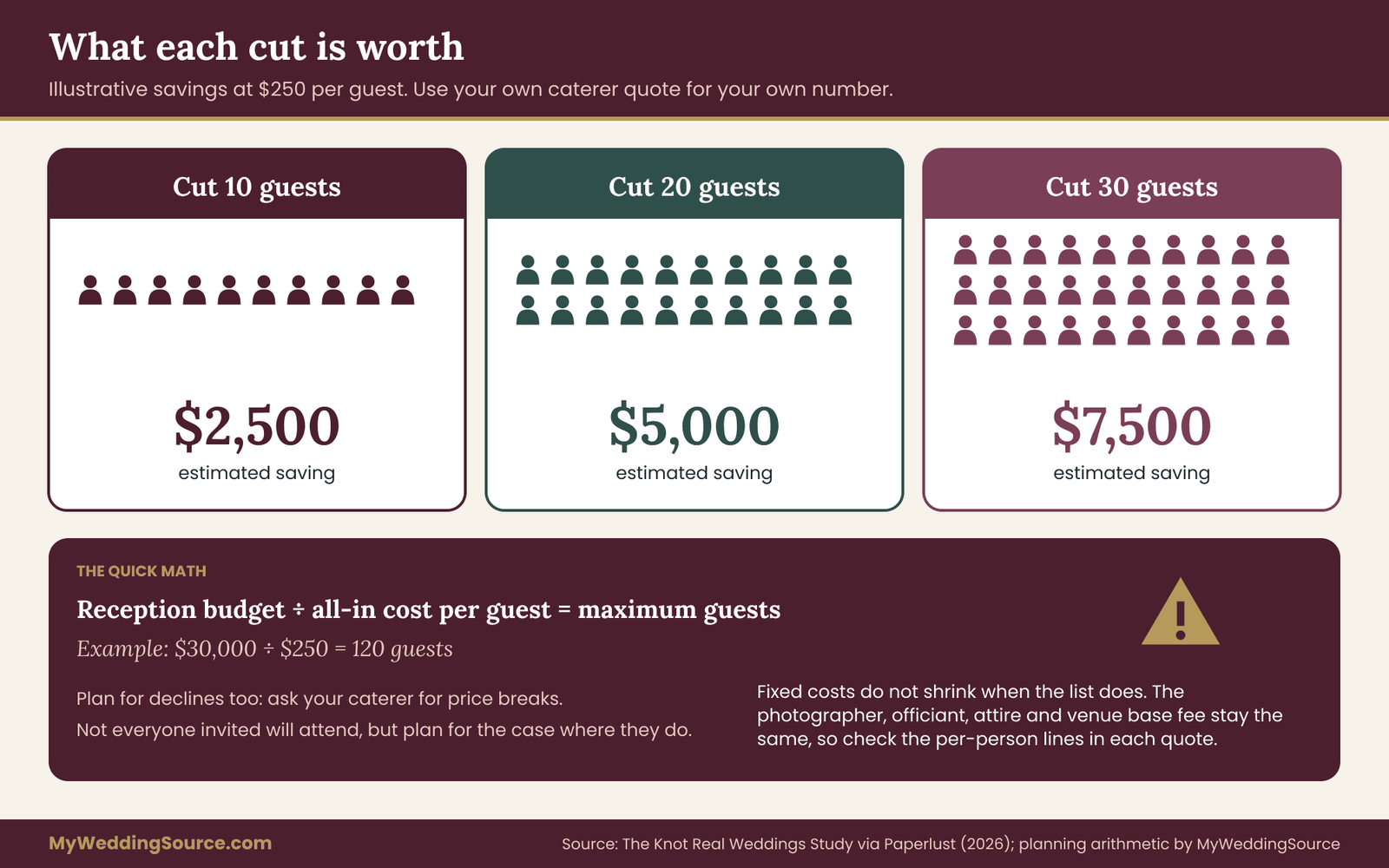
A planning formula used by many venues is simple: maximum guests equal your total reception budget divided by your cost per guest. If you have $30,000 for the reception and your all-in cost is $250 a head, you can host 120 people. If your list is 160, you have a $10,000 problem, and the cut is a financial decision, not a verdict on anyone’s friendship.
Venue. Every venue has a legal capacity and a comfortable capacity. A room that fits 150 for a cocktail party may feel tight for a seated dinner with a dance floor. Ask for the seated-dinner number, with a dance floor, and use that.
Time. A long ceremony or a long receiving line is a real constraint. If you want to speak to every guest, a large list is a tall order, and it is worth deciding in advance how much of the day you want to spend greeting people.
Plan for the decline rate
Not everyone you invite will come. The share who decline depends on how far you ask people to travel, how much notice you give and how close they are to you. One venue planning guide suggests that about 75 to 85 percent of invited guests accept a local wedding, and that decline rates for destination weddings run from 30 to 40 percent. The Knot’s data on guest counts shows the same pattern: hometown weddings average more guests than domestic destination weddings, which in turn draw more than international ones.
This matters because it changes how many names you need to remove when you cut a wedding guest list. If you can seat 100 and expect an 80 percent acceptance, you can send about 125 invitations. The risk is that everyone says yes, so build a plan for that case too: a B-list you can hold back, or a headcount you could still afford if the number rose by ten. Be careful with this trick when the decline rate is uncertain, because overshooting can cost more than the extra invitations save.
Write down your target and your ceiling
Write two numbers on a sheet and keep them visible: a target (the number you want) and a ceiling (the number you can afford and fit if every invitation is accepted). Your invitation count should land between them. Having a ceiling in writing helps with the conversation that comes next, because it turns “can’t we squeeze in one more table?” into “the ceiling is 120, so we need to take someone out to put someone in.”
Decide who has a say before you decide who stays
The second step is political, not mathematical. Before you cut a wedding guest list, decide who has a vote. If you skip this step, you can spend a week cutting names only to have a parent restore them.
A common approach is to divide the list by who is paying and who is hosting. Some couples split the invitations into thirds: one third for the couple, one third for each set of parents. Others use a 50/50 split between the two partners, with parents contributing from each side’s allocation. Both are fair, and both prevent the situation in which one family’s list expands while the other’s shrinks.
If parents are contributing money, it is reasonable for them to have a voice, and it helps to be explicit about how much. A simple conversation can handle most of it: “We have a ceiling of 120. We would like to keep 60 for friends and our own relatives, and we can give each of you 30 seats. Would you like to draw up your own list within that number?” Giving a parent a number is kinder, and more effective, than giving a parent a rejection.
If parents are not contributing, they still have feelings, and those feelings deserve a hearing. The final decision belongs to the couple, and a calm, specific explanation goes a long way. We cover the exact words later in this guide.
Agree on one rule for how decisions get changed
Once the numbers are set, agree on a single process for changing the list: nobody adds a name without removing one. This rule is easy to explain and easy to defend, and it protects your ceiling. Put it in writing in a shared document, so that it stays true when someone has had a long week.
Choose your rules before you cut a wedding guest list
A good rule is a statement about a category, not a person. “We are not inviting coworkers” is a rule. “We are not inviting Dana” is a judgment. Rules protect relationships because they depend on a principle you apply in the same way for everyone, so nobody can feel singled out.
Strong rules share four traits. They are simple enough to say in one sentence. They are fair, meaning they apply to both partners and to all families. They are honest, meaning they match your actual reason, such as budget or room size. And they are sticky, meaning you can keep them when someone pushes back.
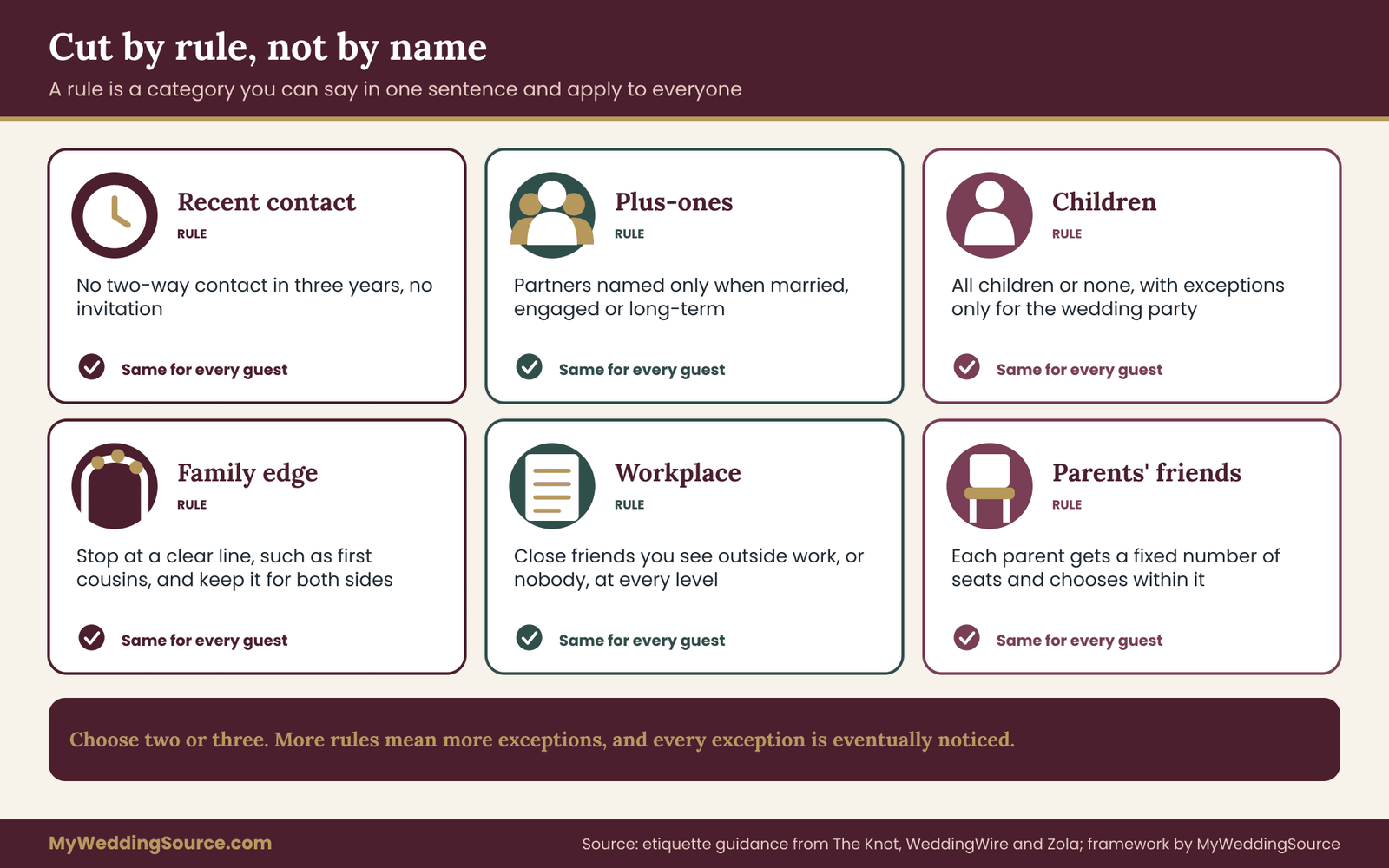
Here are rules that work for many couples. Pick two or three, not ten, because more rules create more exceptions.
- The recent-contact rule. If you have not spoken in three years, they are off the list. If you hesitate at all about a name, that hesitation is useful information.
- The reciprocity rule. Attending someone’s wedding years ago does not create a permanent debt. Your list should reflect your life now.
- The plus-one rule. Married, engaged or long-term partners are invited by name. Other guests are invited alone, unless they will know nobody there.
- The kids rule. To cut a wedding guest list fairly, either everyone’s children are invited or none are, with the exception of the wedding party and immediate family.
- The family-edge rule. Family stops at a clear line, such as first cousins, and you do not invite some second cousins but not others.
- The workplace rule. Invite your close work friends or nobody, and apply it to everyone at the same level. Some couples invite only people they see socially.
- The parents’ friends rule. Each set of parents gets a number of seats, and they choose how to use them.
The rule that matters most is the one that treats groups consistently. A well-known piece of etiquette advice is that you avoid offense by leaving out a whole group rather than inviting only a few people from it. Inviting three of five cousins invites questions. Inviting none of the second cousins, or all of them, invites none.
What each cut is worth when you cut a wedding guest list
Before you cut a wedding guest list, it helps to see which cuts actually move the budget. Some groups are large and cheap to remove, and others are small and emotionally expensive. The table below uses a round, illustrative cost of $250 per guest. Swap in your own figure, because a plated dinner in a major city and a buffet in a small town are very different numbers.
| Cut | Typical size | Estimated saving at $250 a head | Emotional cost |
|---|---|---|---|
| Plus-ones for casual dates | 8 to 15 guests | $2,000 to $3,750 | Low, if the rule is clear |
| Children of guests | 10 to 20 guests | $2,500 to $5,000 | Medium, parents need notice |
| Coworkers beyond close friends | 6 to 12 guests | $1,500 to $3,000 | Low, if applied to everyone |
| Second cousins and beyond | 10 to 25 guests | $2,500 to $6,250 | Medium, family reactions |
| Friends you have lost touch with | 5 to 12 guests | $1,250 to $3,000 | Low to medium |
| Parents’ extended network | 10 to 30 guests | $2,500 to $7,500 | High, needs a seat allocation |
These ranges are planning illustrations, not research findings, and your own list will differ. The pattern is what matters. The cheapest cuts, emotionally, are plus-ones and friends you have lost touch with. The most expensive are family and parents’ friends, because those groups have long memories. Start with the first kind of cut, because it can be large enough to solve most of the problem.
A related point is that the savings may be smaller than the headcount suggests. Photography, the officiant, attire and the venue’s base fee do not fall when you trim guests. One 2026 budgeting guide notes that these fixed costs stay the same whether you host 50 or 150, which is why the per-guest cost of a small wedding is often higher than that of a large one. Use the walk-through to decide where to cut a wedding guest list, then check the actual savings with your caterer’s quote.
Cut a wedding guest list differently for different kinds of weddings
The right way to cut a wedding guest list depends on the type of wedding you are planning. The same list can be a good fit for one format and a poor fit for another.
A small or micro wedding
If you are planning a wedding of fewer than 50 people, the first rule is that everyone must have a clear reason to be there. Immediate family, grandparents and a handful of closest friends often make up the entire list. With a small count, you can usually avoid a B-list, because the difference between 38 and 42 is small. The challenge is that every exclusion is highly visible, so explain it early. Many small-wedding couples add a celebration later for the wider circle.
A destination wedding
A destination wedding helps you cut a wedding guest list without a single hard conversation. The Knot’s data shows that domestic destination weddings average fewer guests than hometown weddings, and international ones fewer still. Because travel is a barrier, you can often invite a wider group without worrying that everyone will come. The etiquette point is to give plenty of notice, ideally with a save-the-date, and to understand that some guests will decline for reasons of cost. Do not take it personally, and do not hold a B-list for a destination wedding unless you can still give new guests enough time to book.
A traditional or large wedding
For a large wedding, the number of cuts needed may be smaller, but the politics may be harder. Large families, community expectations and several generations of guests mean that a single exception can raise a flood of questions. A clear category rule, a firm seat allocation for parents and a strong B-list system are especially important here.
A two-event wedding: ceremony plus later celebration
Some couples marry in a small ceremony and hold a larger party months later. This approach lets you cut a wedding guest list for the ceremony and include everyone at the party. It works best when both events have a clear purpose and a clear guest list. Be honest in your invitations about what the second event is, and avoid calling it a “reception” if the legal ceremony has already taken place elsewhere.
An elopement with a celebration after
An elopement removes the guest list entirely for the ceremony. The celebration afterward can then be as large or as small as you like. The key to avoiding hurt is timing and tone: announce the elopement warmly and early, and extend the invitation to the party at the same time, so that people do not feel they were excluded from the main event.
When you and your partner disagree on how to cut a wedding guest list
Many couples face the most stress not from outside pressure but from each other. One partner has a large family and a wide friend group. The other has a small circle. One partner sees a guest list as a community; the other sees it as a dinner party. Neither view is wrong, but they can collide.
Here is a process that helps.
Start with the shared goal. Say it out loud: “We want a wedding that feels like us and that we can afford.” The list is a means to that goal, not a measure of loyalty.
Make separate lists first. Each partner writes their own list without comment from the other. Do not compare at this stage. This avoids the habit of defending names before they are even on the table.
Share the totals before the names. If your combined count is 150 and your ceiling is 110, you know the gap. Divide the gap fairly, either equally or in proportion to the size of each side’s list.
Agree on a veto for each person. A small number of protected names, perhaps three to five each, are not up for debate. These are the people each partner cannot imagine the day without. After that, apply the rules to everything else.
Use the five-question test together. Score each borderline name separately and compare. Differences in scores show where you need to talk, and they are a calmer basis for discussion than “you always want to invite your friends.”
Set a time limit. Give yourselves two sessions of an hour each. If you are still stuck, bring in a neutral friend or a planner. A decision made imperfectly is better than a debate that lasts a month.
Treat the final list as a shared decision. Once the list is set, defend it together. When a relative objects, the answer is “we decided,” not “my partner decided.”
Score every name before you cut a wedding guest list
Rules usually remove a big chunk of the list, but they rarely finish the job when you cut a wedding guest list. The rest are the genuinely hard cases: people who are inside your rules but who do not all fit inside your ceiling. For those, use a short, honest test, and ask the questions about the person, not about what you owe them.
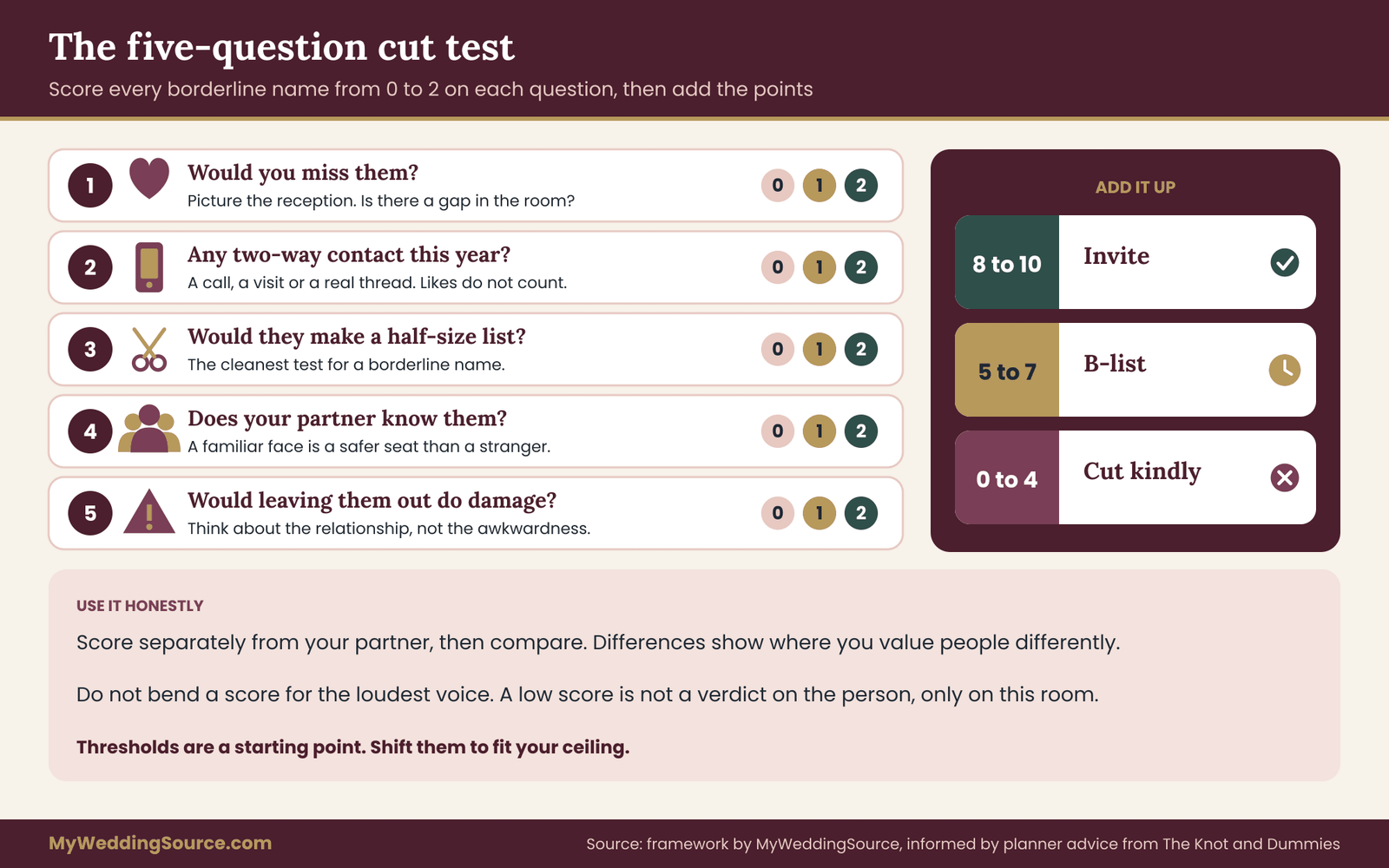
Score each name from 0 to 2 on the following five questions, then add the points.
- Would you miss them? Imagine looking across the room during the reception. If their absence would leave a gap in your picture of the day, give two points. If you would notice but it would pass, give one. If you would not notice, give zero.
- Have you been in touch in the past year? A real, two-way conversation counts, whether it is a phone call, a visit or a long text thread. Likes on a post do not.
- Would you invite them if the list were half the size? This is the cleanest test of a borderline name. Two points for an easy yes, one for maybe, zero for no.
- Does your partner know and like them? A guest who is a stranger to your partner is not disqualified, but a mutual friend is a safer fit. Two points for a person your partner knows well, one for a passing acquaintance, zero for a stranger.
- Would leaving them out cause real damage? Think about the relationship, not about awkwardness. A grandparent’s sibling might score two. A work acquaintance might score zero.
A total of eight to ten is a firm invite. Five to seven is a B-list candidate. Four or fewer is a cut. These thresholds are a starting point, and you can shift them to match your ceiling, but the discipline of scoring each name against the same questions is the real value.
How to use the scores honestly
Two habits keep the test fair. First, score names separately from your partner, then compare. Differences reveal where you value people differently, and that is a conversation worth having on its own. Second, do not adjust a score because of who is asking. If the scores are applied the same way for everyone, they protect you. If you bend them for the loudest voice, the rest of the list will notice.
Remember that scoring a name low is not a verdict on the person. Someone can matter a great deal to you and still fall outside this particular wedding’s size. A cap of 80 people has room for 80 people, and that is a fact about the room.
Cut a wedding guest list by group, not by person
When you work through the list, go group by group. This keeps your decisions consistent and makes your reasons easy to explain. For each group below, you will find the usual dilemma, a rule that works and a note on what to avoid.
Coworkers and bosses
Work invitations are the most common source of list inflation when you cut a wedding guest list, because they come in a cluster and carry professional stakes. A good rule is the close-friend rule: invite the colleagues you see outside work, and skip the rest. If you do invite a boss, it is polite but not required. If you invite one person from a team, be ready for the others to notice.
The simplest policy is to invite nobody from the office, which treats everyone alike and avoids a ripple through the department. If that is too strict, invite your immediate team or the people who have attended your own events. Keep wedding talk low-key at the office, and do not hand out invitations in view of others. Many etiquette writers suggest that the fewer details you share at work, the fewer expectations you create.
Extended family
Families are tricky when you cut a wedding guest list because the lines are blurry. Do you invite aunts and uncles, first cousins, second cousins, great-aunts? A clear boundary, applied evenly, is your friend. A common rule is to invite aunts, uncles and first cousins, and stop there. If your family is very large, you may limit the list to those you see regularly.
Be careful of half-measures. Inviting some cousins and not others, or one branch of the family and not another, is the fastest way to cause an argument at the next family dinner. If you cannot invite everyone in a category, consider inviting no one in it, and add a gathering after the wedding where everyone can celebrate.
If you have a relative who is likely to be hurt, such as a grandparent’s sibling, call them personally before the invitations go out. That small gesture often matters more than the invitation itself.
Parents’ friends and family friends
Parents often want to invite friends, neighbors and colleagues, partly out of pride and partly out of reciprocity. The best fix is a seat allocation. To cut a wedding guest list with parents involved, give each set of parents a number of seats, and let them decide how to use them. This hands them real power and a real limit.
If a parent is paying for a large part of the wedding, a larger allocation is fair. If a parent has a long list of people who cannot all fit, suggest they host a separate celebration, such as a lunch or an open house after the wedding. Parents are sometimes happy to take the role of host.
Old friends and friends you have drifted from
This is where the recent-contact rule does most of its work when you cut a wedding guest list. A friend you have not talked to in years is not a guest, even if you were close once. A useful question is whether you would be comfortable if they came and you spent five minutes with them. If the answer is yes, they may belong on a B-list. If the answer is uncertain, they belong off the list.
Do not let guilt do your inviting. One wedding-industry writer offers a simple standard: if someone is on your list only because you feel bad leaving them out, take them off. Having been invited to their wedding does not oblige you to invite them to yours.
Plus-ones
Plus-ones are the line item that grows quietly, so they are often the first place to cut a wedding guest list. Each one is a stranger to you and often to everyone else, and each costs the same as any other guest. The cleanest rule is to invite partners by name when they are married, engaged or in a long-term relationship, and to invite other guests alone, with a few exceptions for people who will otherwise know nobody.
Be consistent and honest about the rule. A date who has been around for six months might not qualify, and a partner of six years does. If the venue or caterer has room later, you can extend a plus-one after the first round of RSVPs, which turns a refusal into a pleasant surprise.
Children
Children add to the count in two ways: the child, and often the parent who needs to bring them. An adults-only wedding can help you cut a wedding guest list noticeably and is common in the U.S., especially for evening events. Children’s meals typically cost less than adult plates but not nothing, and they add rentals, favors and staffing.
The kids rule works best when it is uniform: either all children are invited or none, with a clear exception for the wedding party and immediate family. If you are inviting a flower girl and a ring bearer, mention it to parents in advance so they are not surprised. Our guide to the flower girl and ring bearer rehearsal shows how to include them without making the day feel like it is for children.
Exes, former in-laws and complicated relationships
Do not invite an ex because you feel awkward about leaving them out. When you cut a wedding guest list, remember that a guest who makes you or your partner uncomfortable is a cost, not a courtesy. The exception is a former partner who is part of your shared family, such as a co-parent.
For relationships that are strained but not broken, ask yourself whether you want that person in your photographs. If the honest answer is no, you can stop there.
Social media and the “everyone” problem
Do not announce your wedding date or guest list online in a way that invites questions. Many couples find that the fewer people know the date in advance, the fewer people expect an invitation. A wedding website with a password is a useful tool for guests who are invited, and it lets you limit what the wider world sees.
Alternatives to cutting someone completely
Sometimes the choice is not “invited” or “not invited.” There are middle paths that let you honor a relationship without adding a seat at the dinner.
- A post-wedding gathering. A casual party a few weeks later, such as a backyard barbecue, a brunch or an open house, lets everyone who did not make the cut celebrate without the cost of a formal dinner. It works best when it has a clear name and a relaxed tone, so it does not feel like a consolation prize.
- An engagement party. An earlier, smaller gathering can include friends and family who will not make the wedding list. Be careful of the old etiquette that anyone invited to an engagement party should also be invited to the wedding. Many modern couples treat it as a separate event, but it is wise to say so.
- A ceremony-only or cocktail-hour tier. This works in some cultures and venues, but it is delicate. Anyone invited to the ceremony is usually expected at the reception, and a split in the guest list can feel like a rank. If you use it, make sure the invitation says exactly what the guest is being invited to.
- A live-stream or video. For relatives who cannot travel, a simple live-stream of the ceremony lets them take part in the moment. It adds no seats and little cost.
- A personal visit or a call. For a few people, a conversation matters more than an invitation. A call from you, before the news reaches them, can turn a sore point into a gesture of respect.
- A shared memory afterward. Send a photo, a short video or a thank-you note. The point is that being left off the list does not have to mean being left out of the story.
Each alternative should be offered honestly. Do not dangle an invitation that you cannot extend, and do not promise a gathering you do not plan to hold. A small, real gesture is better than a large, vague one.
Tricky cases when you cut a wedding guest list
Some names do not fit neatly into a category, and they tend to cause the most worry. These are the situations couples ask about most often, with a way to think through each one.
Members of your wedding party. Your bridesmaids, groomsmen and attendants are invited, and so are their partners if they are engaged, married or in a long-term relationship. For other attendants, you can offer a plus-one as a courtesy, especially if they are traveling alone, but you do not have to. Apply the rule to everyone in the wedding party in the same way.
Your officiant and vendors. An officiant who is a friend or relative is usually invited as a guest. Vendors such as photographers and DJs are not guests, and they usually need a meal, not a seat at a table. Budget for vendor meals separately from your guest count.
A friend’s new partner. If a friend has recently started dating someone, you can invite them alone, or add the new partner if they will otherwise know nobody. The best test is whether the couple is likely to still be together in a year, and your own comfort with a person you have not met.
Someone who just got engaged or married. A newly engaged friend is a reasonable plus-one candidate by name. A newly married friend’s spouse should be invited, because partners are invited by name once they are married.
Guests who cannot travel. An elderly relative who is unlikely to attend still deserves an invitation, if they fall inside your rules. It is a kindness to be asked, and many will decline graciously. If you do not invite them because of travel, call them yourself.
An estranged parent or relative. This is a deeply personal call. If you decide not to invite someone, consider telling them directly, or having a trusted relative do so, so that they do not discover it by surprise. If you decide to invite, think through seating, timing and a plan for how you will handle a difficult moment.
A coworker who is also a friend. Treat them as a friend if you see them socially outside work. If you invite one close coworker and not others in the same team, be ready for questions. A simple, honest line is that you invited the friends you see outside work.
A friend who has invited you to every event. Generosity is not a debt. You can value the friendship without matching every invitation. If it feels right to invite them, do. If not, a heartfelt personal conversation is more valuable than a seat at a table you cannot afford.
Someone dealing with a loss or illness. If a guest is facing a hard time, invite them if you would normally do so, and make it easy for them to say no. A warm note can help: “We would love to have you there, and we completely understand if it is not the right time.”
A friend who might drink too much or cause drama. It is fair to consider how a guest’s behavior will affect other people. If you decide not to invite them, apply a rule you can explain, and speak to them privately.
Children of your friends. If your friends have children, and your rule is no children, tell them early. Parents may need to arrange childcare, and they will be grateful for the notice. Some couples ask a trusted relative to organize a supervised room, but that adds cost and complexity.
Family expectations, culture and community when you cut a wedding guest list
In many families and communities, a wedding is not only the couple’s event. It is an occasion for relatives, neighbors, religious communities and elders, and the guest list may be expected to reflect that. To cut a wedding guest list can feel like cutting people from a circle of belonging.
If this describes your family, start by asking what the invitation represents. In some communities, an invitation honors a relationship across generations, and leaving someone out can be taken as a break in that relationship. In others, it is an act of hospitality and is flexible. Knowing which applies helps you decide where you have room and where you do not.
Then look for ways to honor the community without inviting everyone to the dinner. Some families host an open house, a blessing, a prayer gathering or a tea for neighbors, so that the wider circle takes part in the celebration even if they do not sit at the main meal. Others invite elders to the ceremony and the first part of the reception, then let the party continue with a smaller group. These choices should reflect the family’s own customs, and it is worth asking an elder what is acceptable.
When parents expect a large list, the seat-allocation approach is especially helpful, because it makes the limit concrete and lets elders choose. Explain the numbers kindly: “We can host 120 people, and we want to share those seats fairly.” Most parents respond better to a shared problem than to a refusal.
Finally, remember that your own comfort matters. A wedding that is too large to enjoy is a loss for everyone. The goal of the list is to protect the quality of the day, so that the people who are there can feel your gratitude.
How to run an A-list and B-list without anyone finding out
A B-list is a second group of guests you invite only if people on your A-list decline. It is controversial in the etiquette world, and it is also one of the most practical ways to cut a wedding guest list without cutting too deep. The Knot’s advice on B-lists, and the wedding planners it consulted, comes down to one point: it can work if the people on the B-list never feel like they were second.
Use these ground rules.
Keep the tiers short. An A-list is the people you cannot imagine the day without. A B-list, which helps many couples cut a wedding guest list without cutting too deep, is the group you would love to have, but whose absence would not break the day. Anything below that is a cut, not a tier. A C-list is almost always a mistake, because the time it takes to reach it is longer than the time you have.
Separate the groups that talk. Do not put two friends from the same circle on different lists. If one gets an invitation in March and the other in May, they will compare. Group the B-list so that nobody on it knows anyone on the A-list, or invite whole groups at the same time.
Mail the first round early. The B-list only works if the second round of invitations can still go out well before the wedding. If you send the A-list invitations too late, there is no time for the B-list, and you are stuck.
Set an RSVP deadline that leaves room. The first deadline should leave at least a few weeks for the B-list to receive invitations and reply, and for you to give the caterer a final number. A date near the wedding does not leave enough time to invite anyone else.
Never explain the tier. A B-list invitation should look exactly like an A-list one. It is rude, and unnecessary, to say “someone dropped out.”
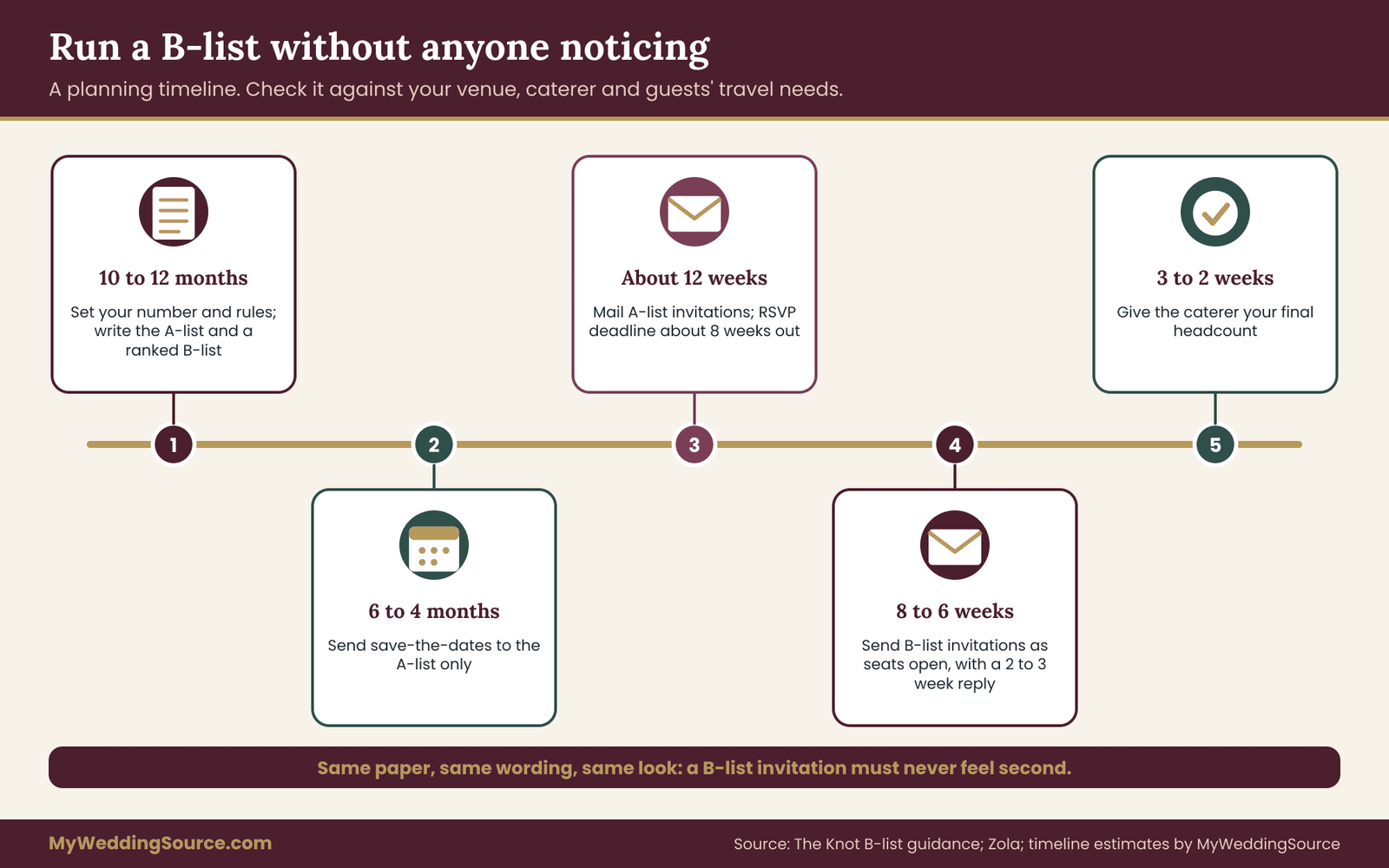
Build a realistic timeline
The timeline in the infographic is a planning estimate. Check it against your own venue, your caterer’s deadline and the travel needs of your guests. For a destination wedding or a holiday weekend, add more time at every step.
The key habit is to decide your B-list before the first invitation goes out. Name the people, rank them and know in advance who gets the first spare seat. When the first “no” arrives, you will be ready, and you will not have to cut a wedding guest list under pressure.
When a B-list is a bad idea
A B-list is risky when your circles overlap heavily, when your wedding is small enough that everyone will know who came, or when you would feel guilty enough to apologize. In those cases, it may be kinder to settle on one list and live with it. A single list is honest and consistent, and nobody has to wonder about their place.
What to say: scripts for the hard conversations
Scripts are not about being slick, and they matter most when you cut a wedding guest list for the first time. They help you stay calm when someone is hurt, because they give you the first sentence when your own mind goes blank. Adjust each one to your voice and keep it short. A short, kind, firm reply is better than a long explanation.
A few principles apply to every conversation:
- Tell people yourself if you can, before they hear it from someone else.
- Lead with the relationship, not the policy.
- State the reason briefly and do not invent an excuse that can be disproved.
- Do not apologize for the decision. You can be sorry that someone is disappointed without being sorry that you made the choice.
- Do not negotiate on the phone. If someone asks you to reconsider, say you will think about it and mean it.
To a close friend who was cut
“I want to tell you this myself because you matter to me. We have a hard limit of 80 people, and we had to make some painful choices. You are not on the guest list, and I hate that. I would love to celebrate with you separately, and I would like to take you to dinner after the wedding if you are free.”
To a coworker who asks
“We are keeping it to family and a small group of close friends, because of the size of the venue. It is a small day, and we are not inviting anyone from the office. I am so glad you asked, though, and I would love to show you pictures.”
To a relative who assumes they are invited
“We have capped the list at immediate family and first cousins, because of the room. I wanted to tell you before the invitations go out, because you are important to us. I hope you understand that this was about numbers, not people.”
To a parent who wants to add guests
“I know how much you would love to have them there. We have 120 seats, and we have agreed to 30 for each of you. If you want to add someone, we need to take someone off your list to make room. Would you like to look at the names together?”
To a friend who asks why they were not invited
“We had to make some very hard cuts, and we followed a rule for each group. I am sorry that it landed this way, because I care about you. If it helps, I would love to take you to lunch when we are back.”
To someone who says they were hurt
“I am sorry it hurt, and I can hear that it did. I do not want to make excuses. We were working within a very tight budget and had to make decisions that we did not enjoy. I value our friendship and I hope we can talk about it.”
To someone who asks for a plus-one
“We are only able to invite guests by name, because of the room. I know that is not what you were hoping for, and I am sorry. If it changes, I will tell you right away.”
Notice what these scripts leave out. There is no mention of the other people who were invited, no comparison between guests and no blame. The less you explain, the less there is to argue with.
Say it clearly on the invitation: envelopes, RSVP cards and your website
Much of the pain when you cut a wedding guest list comes after the invitations go out, when a guest arrives with an extra person or a family of five. You can prevent most of that with careful addressing and a clear website.
Address the envelope to exactly who is invited. Traditional etiquette treats the name on the envelope as the invitation. If the inner envelope or the outer address says “Mr. and Mrs. Smith,” the children are not invited. If it says “Ms. Jones and Guest,” a plus-one is. If you want to be extra clear, address the inner envelope with the names of everyone invited, and nobody else.
Do not put “no kids” or “adults only” on the invitation itself. Many etiquette experts consider this poor form, and WeddingWire recommends clearly marking who is invited instead. If you want a stronger signal, put a line on the wedding website or tell people in conversation, which several experts treat as acceptable. One example given by etiquette writers for the website is a simple note that the ceremony and reception are for adults.
Pre-fill the RSVP card. A line such as “We have reserved 2 seats in your honor” makes it clear how many people are invited, and leaves no room for additions.
Use your wedding website as a quiet second voice. An FAQ page can say, “We are not able to accommodate additional guests, and we thank you for understanding.” Zola suggests that if capacity allows, you can extend plus-ones after you receive regrets, which turns a refusal into a happy surprise.
Tell your inner circle. Word of mouth is a polite and effective way to spread the message. Let your wedding party, parents and close friends know your policy so they can pass it on when people ask.
When people push back
Pushback will come, even with perfect scripts. Plan for it.
The “just one more” request. Say that you would love to but that you have a ceiling. If you give way for one person, you will be asked by the next. Offer instead to add them if a spot opens.
The guilt trip. “After everything I did for you” is a feeling, not an argument. Acknowledge the feeling, restate your reason in a sentence, and avoid a debate. It is acceptable to end the conversation kindly if it keeps going.
The relative who threatens not to come. If an invited guest says they will not attend unless a particular person is invited, you have a choice. Often the kind answer is to accept that they may not come, because yielding sets a pattern for the rest of the list.
The parent who wants to restore a cut. Use the seat allocation. A parent who has a number can make their own tradeoffs, and a parent who has no number will fight for everyone.
The friend who says nothing but goes quiet. Silence is common. Reach out once, briefly, and make clear that you value the friendship. Do not chase.
What not to do when you cut a wedding guest list
A few moves cause more harm than the cut itself.
- Do not uninvite someone after invitations are mailed. This is the most painful thing you can do, and it is very hard to repair. If you must make a change, such as a venue downsize, speak to the person yourself.
- Do not cut the reception and keep the ceremony. The advice in a widely cited etiquette guide is that anyone you invite to the ceremony should also be invited to the reception, so do not try to cut costs by trimming only the reception list.
- Do not hint. Saying “we might be able to squeeze you in” to someone you cannot invite creates false hope.
- Do not let the B-list leak. Keep the list private and do not mention rounds.
- Do not make exceptions for the loudest voice. An exception for one person is a debt to everyone else.
- Do not post about it online. Photos of the venue, counting seats or a joking caption about who is not invited can reach people before you do.
- Do not apologize in an essay. Two sentences are enough.
When to cut a wedding guest list: a month-by-month view
Timing changes how painful it feels when you cut a wedding guest list. A cut made early, in conversation, feels like a plan. A cut made late, after people have bought dresses or booked flights, feels like a reversal. Here is a general sequence.
Twelve to ten months before. Settle your budget, set your target and ceiling and choose a venue. This is the best time to cut a wedding guest list, because you have not told anyone a date and no one has made plans. Write your first draft and your first set of rules.
Nine to seven months before. Finalize the list, including the A-list and B-list. Talk to your parents and anyone who is contributing. Make the personal calls to the people who will be most affected.
Six to four months before. Send save-the-dates to the A-list and to anyone who needs travel notice. This is the point at which the list becomes real, and it is wise not to send a save-the-date to anyone who may not receive an invitation.
Three months before. Mail the first round of invitations if you plan a B-list, with an RSVP deadline that leaves time for the second round. For destination weddings, mail them earlier.
Eight to six weeks before. Send the B-list invitations as spaces open. A reply deadline of two to three weeks keeps your caterer’s final count on track.
Three to two weeks before. Give the caterer and the venue your final number, which is usually due shortly before the event. Confirm seating and any special needs.
These timings are a planning guide, and your venue and vendors may have different deadlines. The main point is that the earlier you cut a wedding guest list, the gentler the process.
Use messengers carefully
When you cut a wedding guest list, you will not talk to every person yourself, and other people will become messengers. Parents, wedding party members and siblings will be asked about the guest list, often by people who are hurt. Equip them.
Give your closest helpers a short script and a clear boundary. A simple line works: “They have kept the list to family and close friends because of the room, and I know they hope you understand.” Ask them not to share details, not to speculate and not to promise anything. If someone presses, the helper can say, “I’d love to help, but that is a question for them.”
Be especially careful with group chats. A message sent to a group chat can be read by dozens of people and is impossible to retrieve. Keep sensitive conversations to individual messages or calls, and ask your wedding party to do the same.
If a helper becomes a source of conflict, thank them and take the conversation back. Your wedding party is there to support you, not to defend your decisions.
How it changes the rest of your planning when you cut a wedding guest list
A shorter list is not only a smaller bill. It changes many other decisions, and it is worth thinking through the ripple effects.
Venue. A smaller list may open up venues that were too small before, or make a more intimate space a better choice. It can also mean you pay for more space than you need, so ask about minimums.
Catering and bar. Most caterers price by the person, and many set a minimum count. A smaller count may qualify you for a different package or force you to choose between a plated dinner and stations. Ask about price breaks at certain numbers.
Rentals and seating. Tables, chairs, linens and place settings are counted per guest. A cut of ten guests may remove a whole table, which can alter the room layout and the dance floor.
Stationery and favors. Invitations are counted by household, and favors by guest. If you cut a wedding guest list early, you order less.
Transportation and lodging. Shuttles and room blocks are based on guest numbers. A smaller count may mean a smaller block and fewer buses.
Speeches and the schedule. A smaller crowd shortens the receiving line, the dinner service and the toast schedule. Our guide to rehearsal dinner toasts covers how to size speeches for the room.
Run these ripple effects through a single spreadsheet whenever you cut a wedding guest list, so that every decision reflects the new number. The savings are real, but only if you tell every vendor.
After you cut a wedding guest list: keeping and repairing relationships
To cut a wedding guest list is not a single moment. It continues through the invitation period, the wedding itself and the months afterward. The way you handle those stages will decide whether a cut stays a small disappointment or grows into a long-term rift.
Protect the relationship while the invitations are out
Between the first mailing and the wedding day, people will talk. Some will learn they were not invited, some will wonder, and some will ask. Keep your messages consistent and kind. If you hear that someone is upset, reach out directly instead of waiting for it to pass.
A short note or call to the most important people who were cut can make a large difference. It does not need to apologize or explain at length. Something like “I wanted you to hear it from me, and I want you to know how much you mean to us” is enough. For many people, being told personally is half of what they need.
What to do on the wedding day if an uninvited guest appears
It is rare, but it happens: someone shows up with a date who was not invited, or a child who was not on the list. Prepare a plan with your coordinator, planner or a trusted friend. The best approach is a quiet, warm conversation away from other guests, offering a practical solution if you can, such as a seat at a smaller table, or a polite explanation if you cannot. Do not make a scene, and do not ask the couple to handle it themselves.
If a guest is clearly trying to push a boundary, a kind and direct sentence from a family member often works better than one from the couple. Decide in advance who will take that role.
Gifts, announcements and the people who were not invited
Guests who are not invited are not expected to send a gift. If you send them an announcement after the wedding, make clear that it is an announcement and not a request. A friendly photo and a short note are enough. Our guide to wedding gift etiquette explains how to handle gifts from people who were not at the party.
If someone who was not invited sends a gift anyway, thank them warmly and personally. Our wedding thank-you card wording guide has examples, including notes for gifts from people who could not attend.
Mend a rift with a small, specific gesture
Not every cut goes smoothly. If a friend or relative is still hurt a few weeks later, the best repair is small and specific. Invite them to coffee or dinner, share a photo album, or send a handwritten note that says what the friendship means. Avoid explaining the decision again, which can feel like a defence. Listen, acknowledge the hurt and move on to the relationship.
Give it time. Some people need a month or two before the sting fades. Most relationships recover, especially when the cut was applied fairly and communicated kindly. If someone remains upset despite your best efforts, you can hold the line gently and trust that the friendship can survive on a longer timeline.
Check your list for regret before you mail anything
Once you have finished the cuts, do a regret check. This is a short review you do a week before invitations are mailed, when the decisions are still reversible.
- Read the list aloud with your partner. Imagine each person walking in. Does anyone make you feel flat? Does anyone’s absence make you feel sad?
- Look for lopsided groups. Are you inviting four people from one group and none from another with a similar tie? Check that the rules are visible in the list.
- Check the ceremony and reception match. Everyone at the ceremony should be at the reception, and nobody should be listed for one without the other.
- Check the plus-one rule. Review every plus-one and make sure the policy is applied evenly.
- Count the B-list. Make sure you have enough names to cover your expected declines, and that the B-list does not exceed the available time.
- Ask one trusted person. A friend or sibling who is not directly affected can spot patterns you cannot.
If something feels wrong on the regret check, change it now. A mistake you fix before you mail the invitations costs nothing, and a mistake you discover afterward can be very hard to repair.
Three worked examples
Numbers help. Here are three simplified scenarios showing how the steps combine. They are illustrations, not data.
Example one: the budget squeeze
A couple has a reception budget of $27,000 and an all-in cost of $270 per guest, which puts the ceiling at 100. Their first-draft list has 138 names. They choose three rules: no plus-ones for casual dating partners, no coworkers beyond two close friends, and no second cousins. That removes 31 names. They score the remaining 107 and find seven that fall below the cut line. The final list is 100, and they hold six names in reserve for a B-list.
Example two: the parent who wants more
A couple has a ceiling of 120 seats. They give each set of parents 25 seats and keep 70 for themselves. One parent’s list runs to 48 names. Instead of cutting, the couple shares the 25-seat limit, and the parent chooses. They also offer to host a lunch for the rest after the wedding. The parent selects 25 and hosts a relaxed brunch. Nobody needs a script, because the limit was clear from the start.
Example three: the small wedding that grew
A couple plans an intimate wedding of 40 and finds themselves at 72 after adding family and friends. They look at the three limits and realize the venue holds only 50. They apply the family-edge rule to include siblings, parents, grandparents and one close friend for each, and invite no one else. They announce a celebration for everyone else in the following spring. It is hard, but the reason is clear, and nobody takes it personally.
Myths that make it harder to cut a wedding guest list
A few beliefs keep couples stuck. Naming them helps you set them aside.
Myth: Everyone you cut will be hurt. Most people understand a limit when it is explained kindly and applied evenly. Many guests are relieved not to travel, pay for a gift and dress up for another event. A hurt reaction is possible, but it is not the default.
Myth: A wedding is a duty to everyone who has known you. A wedding is a celebration you host, and you choose the guests. You can honor a relationship with a card, a call or a later gathering without a seat at the dinner. When you cut a wedding guest list, you are not erasing anyone from your life.
Myth: If you do it perfectly, nobody will complain. Someone may still be disappointed. The goal is not zero disappointment but a process you can defend: rules that are fair, communication that is kind and a response that is steady.
Myth: The bigger the list, the better the wedding. Many couples say the best moments came from a room full of people they knew well. When you cut a wedding guest list thoughtfully, you often get more time with each guest, shorter lines and a calmer day for the two of you.
Myth: You must explain every cut. You do not owe a full account to everyone. A short, true reason is enough, and you can decline to discuss it further.
Myth: Cutting is a sign that you are selfish. Choosing a size that fits your budget and your values is responsible. A couple who cuts a wedding guest list to avoid debt or exhaustion is looking after the marriage, not just the party.
Questions to ask yourself when you still cannot decide
Sometimes the rules and the scores leave a few names in a gray zone. These questions can break the tie.
- If you had to cut a wedding guest list by ten more names tomorrow, would this person survive the cut?
- Would you be comfortable explaining the decision to them, in person, in one sentence?
- Would you rather have this guest or a better table, a better band or a longer dinner?
- If the wedding were smaller by exactly one table, whose table would you protect?
- Five years from now, will you be glad this person was in your photographs?
- Are you inviting them for you, for your partner or because someone else would be upset?
- Does the name appear on the list because of love, or because of fear?
Write your answers down, and notice patterns. If most answers point the same way, trust them. If a name makes you feel fear, check whether that fear is about the person or about a conversation you are avoiding. A conversation, however hard, is cheaper than a seat you cannot afford.
A seven-day plan to cut a wedding guest list
If your list is too long and the clock is running, a focused week can get you there. This plan assumes about an hour a day.
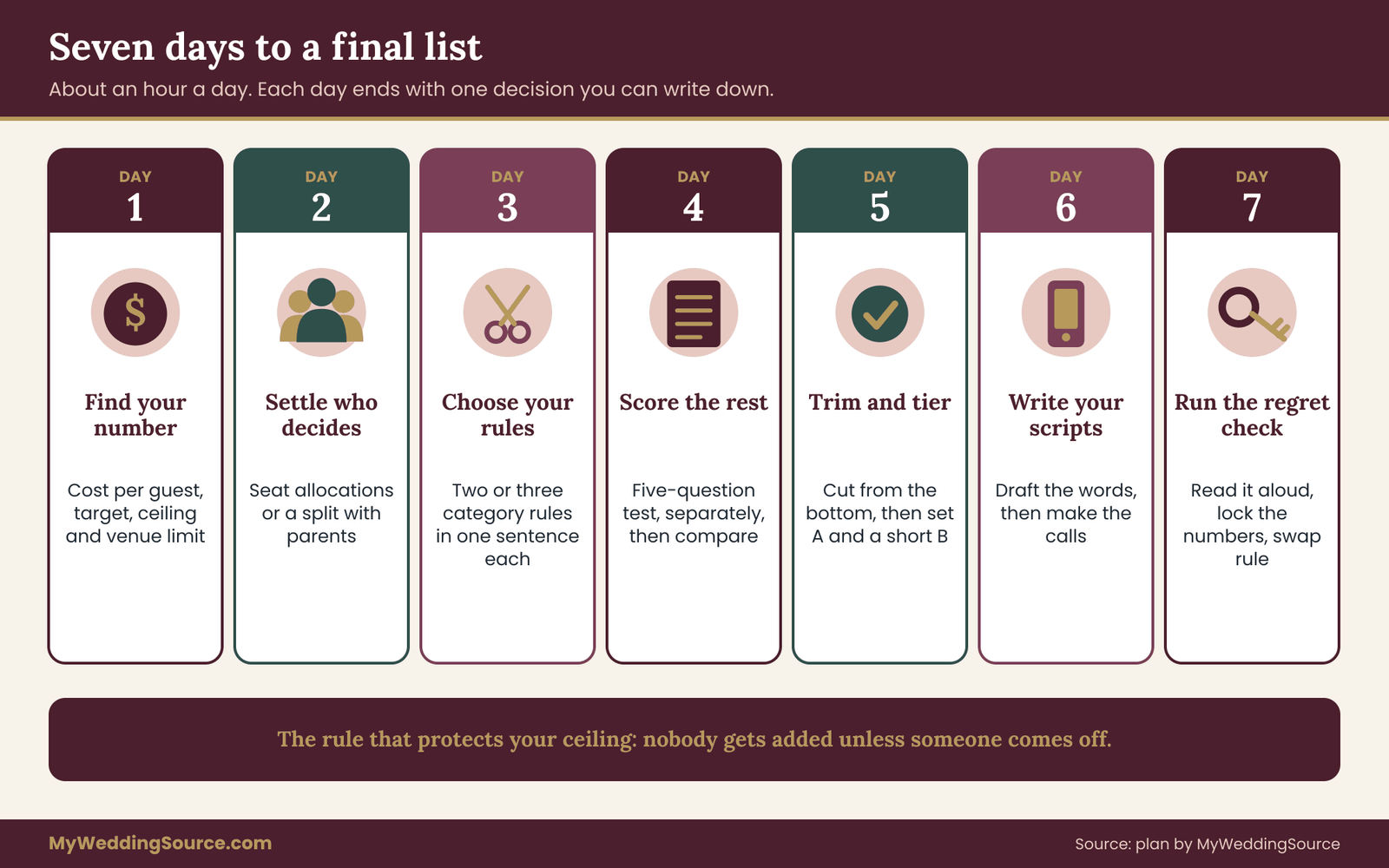
Day one: find your number. Calculate your cost per guest, set a target and a ceiling, and note the venue limit.
Day two: settle who has a say. Talk to your partner and to any parent or family member who is contributing. Agree on seat allocations or a split.
Day three: choose your rules. Pick two or three category rules that you can explain in one sentence each.
Day four: score the rest. Apply the five-question test to every name still on the list, each of you separately, and compare.
Day five: trim and tier. Cut a wedding guest list from the bottom, then divide the rest into an A-list and a short B-list.
Day six: write your scripts. Draft what you will say to your closest friends, relatives and parents. Call the people who need a personal conversation.
Day seven: run the regret check. Read the list aloud, check consistency and lock the numbers. Share the final list with the people who need it, and set a rule that changes require a swap.
Common mistakes when you cut a wedding guest list
- Cutting people instead of categories. A personal decision invites a personal reaction.
- Waiting too long. The later you cut a wedding guest list, the more people expect an invitation and the less time you have for a B-list.
- Cutting the reception only. A ceremony-only invitation reads as a rank.
- Making exceptions quietly. Every exception is eventually discovered.
- Over-explaining. A long defence invites a long debate.
- Letting guilt choose the list. A guest who is there out of guilt is a seat you could have given to someone you wanted.
- Ignoring the decline rate. Without a plan for acceptances, you can cut too deep or too shallow.
- Forgetting the aftermath. A cut does not end at the invitation. It ends when the relationship is healthy again.
FAQ
How do I cut a wedding guest list without offending anyone?
To cut a wedding guest list kindly, cut by category instead of by person, apply each rule to everyone in the same way, and tell the people who are affected yourself, before they hear it from someone else. Keep your explanation brief and warm, and avoid hints or false hope. You cannot prevent every disappointment, but a consistent and kind approach prevents most of the damage.
Who should I cut first when I cut a wedding guest list?
Start with the people least likely to attend and least central to your life: plus-ones you have never met, acquaintances you have not spoken to in years, coworkers outside your close circle and distant relatives. These are the cuts that usually save the most money and cause the least hurt. Then work toward closer groups only if you still need to, using the same rules for everyone.
Is it rude to have an A-list and a B-list?
Etiquette writers disagree. Some consider it rude, and others see it as a practical tool. A B-list works when you keep the groups separate, send the first invitations early and make the second round look exactly like the first. It does not work when guests learn they were a second choice. If your circles overlap heavily, a single list may be the safer choice.
How do I say no kids or no plus-ones without being rude?
Address the invitation to exactly the people you are inviting, and avoid writing “no kids” on the invitation itself. Say it on your wedding website, in conversation and through your wedding party, so that word travels. If you need to be clearer, a simple line such as “Adults-only ceremony and reception” is considered acceptable by several etiquette experts. Apply the same rule to everyone.
Can I uninvite someone after sending invitations?
Avoid it. Uninviting someone is one of the most hurtful things you can do and is hard to repair. If a change is unavoidable, call the person yourself, explain briefly and sincerely, and offer something real, such as a separate celebration. Prevent the situation by finalizing your list before you mail anything.
What if a parent insists on inviting people I cannot afford?
Give each parent a seat allocation and let them choose within it. If they want to add someone, they must remove someone. If they have a long list, suggest that they host a separate celebration, such as a lunch or an open house, after the wedding. A clear number is easier to accept than a refusal.
How many guests should I cut to save money?
Each guest costs roughly your all-in cost per head, which is often several hundred dollars at a full-service reception. To cut a wedding guest list by 20 guests at $290 would save about $5,800, though the exact number depends on your caterer, venue and rentals. Fixed costs such as the photographer and officiant do not fall when the list shrinks, so check your quotes for per-person lines.
Should I invite someone just because they invited me to their wedding?
Not necessarily. Having been invited to someone’s wedding does not create a permanent debt, and your list should reflect your life now. If you are still close, it is easy to say yes. If you have drifted apart, you can decline to invite them without guilt. Apply the same rule to everyone with a similar history.
Your next steps
- Calculate your number. Divide your reception budget by your all-in cost per guest, and check the venue’s seated-dinner capacity. Write down a target and a ceiling.
- Agree on who decides. Talk to your partner and to anyone contributing, and settle seat allocations.
- Pick two or three rules. Choose category rules you can explain in a single sentence.
- Score the borderline names. Use the five-question test, separately, and compare.
- Set up an A-list and a short B-list. Plan the timeline so the second round can still go out.
- Write your scripts and make the calls. Reach the most important people before they hear it elsewhere.
- Run the regret check. Do it a week before you mail invitations.
For the beginning of the process, see our wedding guest list guide, and for guidance on every part of the day, our wedding etiquette hub is a good next stop. Once the list is settled, our wedding marriage wishes guide can help the guests you did invite write something heartfelt.
Sources
This guide draws on published wedding-industry and etiquette guidance. Cost figures vary widely by region and vendor, so use your own quotes for your own numbers. All scripts and examples are original.
- The Knot: How to Narrow Down Your Wedding Guest List – relationship-based cutting advice from planners.
- The Knot: How to Invite B-List Wedding Guests – A-list and B-list etiquette.
- The Knot: Average Wedding Guest List Size – hometown, domestic destination and international guest counts.
- WeddingWire: How to Cut Your Wedding Guest List – criteria for hard cuts.
- WeddingWire: How to Politely Tell Guests Things They Don’t Want to Hear – wording for no kids and no plus-ones.
- Zola: How to Make a Wedding Guest List – A-list and B-list, no-kids policies and trimming strategies.
- Zola: How to Word Wedding Invitations with No Plus One – extending plus-ones after regrets.
- Zola: How to Stick to a Small Wedding Guest List – keeping to a small list.
- Dummies: How to Cut Back a Wedding Guest List – the ceremony and reception rule and the hesitation test.
- Reader’s Digest: How to Say No to Kids at a Wedding – etiquette experts on word of mouth and adults-only wording.
- The American Wedding: How to Cut Your Guest List Without Hurting Anyone’s Feelings – tiers and leaving out whole groups.
- Easy Weddings: 10 Ways to Cut Down Your Guest List Without the Grief – guilt, parents and realistic limits.
- Paperlust: Big Wedding vs Small Wedding – average cost and guest count figures for 2026.