

The right outfit comes from reading the invitation first and shopping second, so this guide to wedding guest dresses (and jumpsuits, suits, and separates) walks you from decoding the dress code to checking return windows before you pay.
You have an invitation on the fridge, a date on the calendar, and a browser tab full of options in six shades of green. The real decision is not “which dress is prettiest” but “what is this couple actually asking me to wear, and how do I get there without overspending or getting stuck with something that does not fit?” Most wardrobe regret at weddings traces back to skipping that first question. A guest who orders a floor-length gown for a 2 p.m. backyard ceremony, or a sundress for a candlelit evening reception in a historic hotel, usually did not make a style error. They made an information error.
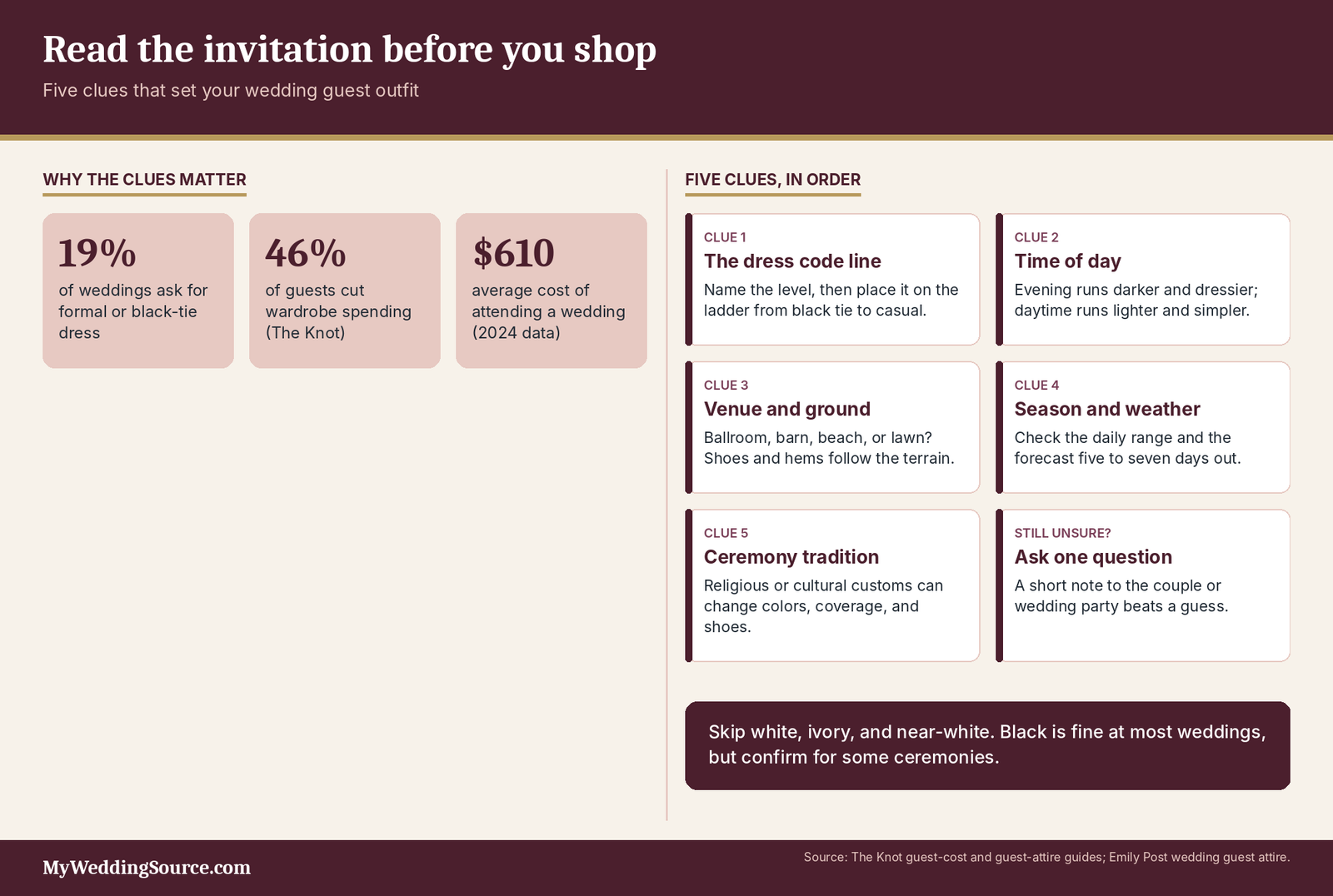
Dress codes are also less standardized than they look. The Knot’s guest-attire cheat sheet calls semi-formal “the most popular dress code for a wedding,” and the same publication’s guest-cost page reports that semi-formal is the most common expectation while roughly one in five weddings (19%) asks for formal or black-tie dress. That means most invitations fall into a gray zone where time of day, venue, season, and the couple’s own cues matter as much as the label. Add religious and cultural ceremonies, outdoor terrain, a fall temperature swing, and a budget, and “just find a dress” becomes a small project worth planning.
This guide is written for guests of every gender, size, and budget. It covers dresses, but also jumpsuits, suits, separates, and culturally specific attire, and it treats size-inclusive shopping and rental as ordinary options rather than special cases. You will find the etiquette rules that hold up (white and near-white, bridal-adjacent looks, when black is fine), a dress-code ladder from white tie to casual, season and terrain logistics, a shopping timeline with return-window math, and a cost-per-wear framework with clearly labeled illustrative numbers. For the other side of the same question, the groom-focused piece on suit styles, colors, and accessories covers what the couple chooses for themselves.
How to Decode the Invitation Before You Shop
The invitation, the wedding website, and the venue together tell you almost everything you need to know, and most guests only read one of them. Treat the three as a set of clues that should agree with each other. When they do, you can shop with confidence. When they conflict, which is common with cocktail-hour language on an otherwise casual barn invitation, the conflict itself is your cue to send one short message to the couple.
What the Dress Code Line Actually Tells You
A dress code line is a promise about formality, and a few words can carry a lot of weight. Reading it well means knowing which words are firm and which are suggestions. The two notes below split the situation into the two cases you will meet most often: an invitation that names a code, and one that stays silent.
When the invitation names a dress code
If the invitation says “black tie,” “formal,” “cocktail,” “semi-formal,” or “festive,” take it at face value and place it on the formality ladder in the dress-code section below. The Knot ranks black tie as a strict, often evening-only standard with “not much wiggle room,” while semi-formal and cocktail allow far more flexibility in hemline, color, and accessories. Words like “optional” and “attire requested” deserve attention: “black-tie optional” means a tuxedo or floor-length look is welcome but a very polished dark suit or elevated midi dress is also accepted. When a code sounds unusual, such as “garden chic” or “dressy casual,” the couple has probably described it somewhere else too, often on the wedding website, where examples or a mood board may be posted.
Couples are encouraged to be brief on the invitation itself. The Knot’s guidance for couples on wording dress codes suggests naming the formality level and adding specifics for unusual requests, and it recommends noting venue or terrain details such as a grass lawn on the website. If you see a short phrase on the invitation and a longer explanation online, the website version is the one the couple wrote when they had room to be specific. Check the FAQ or dress-code tab before you buy anything.
When the invitation says nothing at all
A missing dress code is information, not an invitation to guess. Emily Post’s guidance is blunt: “The wedding invitation and the time of the wedding will be your best guide to its formality.” In practice, that means working backward from the other clues. An evening ceremony in a hotel ballroom reads very differently from a Saturday morning ceremony in a park, even if neither mentions attire.
When clues stay ambiguous, a short, friendly message works better than guessing. Something like “We are so excited. Is there a dress code, and is the ceremony outside?” takes ten seconds to send and rarely feels like a burden, especially because couples often field this question repeatedly. If you would rather not ask the couple, a member of the wedding party, a parent, or another guest who has already asked can usually tell you. As a fallback, “dressy” is the safest default: one step more polished than your best business-casual outfit, with room to dress down by removing a jacket or switching shoes.
The Clues Around the Dress Code
The words on the card are only part of the picture. The setting, the hour, and the ceremony itself shape what will look right in the room and photograph well in the album. Two short checks, one on time, venue, and season and one on religious or cultural tradition, cover most of what the card leaves out.
Time of day, venue, and season
Time of day is the strongest unwritten rule. Emily Post’s formality chart separates daytime from evening at every level: a formal daytime wedding calls for a cocktail or dressy afternoon dress (or a dark suit), while a formal evening wedding moves toward a long evening dress or a very dressy cocktail dress, depending on local custom. Evening generally means darker colors, richer fabrics, and more polish. Daytime leans lighter in color and weight, with less sparkle.
Venue adds a second layer. A cathedral, a vineyard, a rooftop, a beach, a courthouse, and a backyard each carry their own norms, and a venue can change what “cocktail” means. The same label that suggests a short dress and heels at a downtown loft may mean a long skirt and block heels on a farm. Season is the third layer: heavy velvet in July and a thin slip dress with no wrap in a November evening are both avoidable mistakes. If the wedding is outdoors, assume the ground, the wind, and the temperature will influence the outfit as much as the dress code does. The fall wedding weather and seasonal costs guide covers temperature swings in detail, and the weather section below draws on it.
Religious and cultural ceremonies
Religious and cultural traditions can override the general rules, and the guidance varies by community, family, and venue. Emily Post tells guests to consider whether the service is secular or religious, whether the couple’s tradition requires head coverings, and whether bare shoulders, bare arms, or open-toed shoes might be inappropriate. Local custom matters too, since some regions and congregations are more conservative than others. The table below summarizes what published guides commonly mention. It is a starting point for a question you ask the hosts, not a rulebook.
| Setting | What guides commonly mention | Confirm with the hosts |
|---|---|---|
| Jewish (Orthodox, Conservative, Reform) | Modest dress with covered shoulders; kippot usually provided; Reform is typically more relaxed (The Knot, My Jewish Learning) | Modesty level, head coverings, seating |
| Hindu | Avoid all-white and all-black bases; shoes are often removed; bring a scarf in case of head covering (Aza Fashions) | Colors to avoid, ceremony location, floor seating |
| Sikh (gurdwara) | Head covering for everyone, shoes removed, modest cuts, floor seating (Aza Fashions) | Head-covering supplies, which events have this rule |
| Chinese | Guests are often advised to skip red because brides frequently wear it (WeddingWire) | Whether the couple wears red and any guest color request |
| Church or house of worship | Consider covered shoulders and a serious tone for the ceremony (Emily Post) | Whether a wrap is expected during the service |
A word of caution on sources: advice on color varies even between guides. WeddingWire’s color guide suggests avoiding red at Chinese weddings and often at Indian weddings because the bride usually wears red, while a retail guide from Indian-fashion brand Aza Fashions lists deep red among festive colors for Hindu wedding guests. Both can be true in different families, which is why the practical answer is the same every time: ask someone close to the couple. Also note that the Aza Fashions guides come from a retailer, so their outfit suggestions may lean toward what the brand sells. For the cultural basics, they are still useful as examples of what attendees commonly hear from hosts.
The Real Etiquette Rules: White, Bridal Colors, Upstaging, and Black
Wedding guest etiquette has a handful of rules that nearly every source agrees on and a long tail of folklore that no longer holds. Sorting one from the other saves you from both extremes: the guest who avoids every color the internet has ever called risky, and the guest who assumes nothing applies. The underlying principle is simple. The couple is the visual focus of the day, so guests dress to complement the occasion and avoid looks that could be mistaken for the couple’s own attire.
Looks That Compete With the Couple
The most useful way to think about “what not to wear” is by effect rather than by color chart. Ask whether someone glancing across the room, or looking at a photo a decade from now, could confuse you with a person in wedding attire. That test is stricter than a color list in some ways and kinder in others, because it lets you wear almost anything that does not read as bridal.
White, ivory, and the near-whites
White remains the one color nearly every guide tells guests to skip. WeddingWire’s color guide says “white is still the main color you can’t wear to a wedding” and extends the rule to ivory, cream, off-white, and patterns that are mostly white: “if it’s close to white, don’t wear it.” The reasoning is practical, not symbolic. Photographers capture crowds, and a guest in a white lace dress can look like a second bride (or a second person in wedding dress) in group shots and candids.
Super-light pastels are the gray zone. WeddingWire says a very pale shade is acceptable if it keeps its color in sunlight, and the test is simple: if it looks white in a photo taken with a phone flash, choose something else. Check the fabric in daylight and under indoor lighting before you commit, and take a quick photo of yourself in it. If the photo washes out, that answer is your answer.
Remember that a wedding may not feature a white dress at all. Couples of any gender combination wear white, ivory, color, suits, or cultural attire, so do not assume “the bride” is the person to avoid matching. The safe version of the rule is to skip white and near-white no matter who you expect to be wearing it, unless the couple has explicitly asked guests to wear white.
Metallics, champagne, and bridal silhouettes
Beyond white itself, a few other choices can read as bridal. WeddingWire’s guide also cautions against ensembles that are mostly champagne, gold, or pale silver, since those shades can look like wedding-dress colors in photos. The same source suggests avoiding the bridesmaids’ color if you know it and any color featured prominently on the invitation. Heavy beading or sparkle suits formal or black-tie evening events, but during the day or at informal weddings it can feel out of place.
Silhouette matters as much as color. A long, white-adjacent gown with a train, a veil-like wrap, or a bridal-style corset bodice invites comparison even when it is technically green or blue. A fascinator or head covering is fine in many settings, but a large, bridal-looking headpiece may confuse the room. None of this means your outfit should be dull. It means you can have drama in cut, color, or accessory without borrowing the visual language of the wedding dress, and that restraint usually photographs better anyway.
The same logic applies to a guest who is part of the wedding’s inner circle. If you are a parent, grandparent, or officiant, ask what the couple and the wedding party are wearing so you can coordinate rather than compete, and share your plan with anyone dressing for a similar role.
Colors That Have Exceptions
Some old rules have softened, and some new ones come from the couple rather than from etiquette books. Treat the couple’s stated preferences as the final word, and use general etiquette for everything else. The two cases below, black and couple-specific requests, are where guests most often second-guess themselves.
When black is fine
Black is no longer off-limits at most modern weddings. WeddingWire notes that colors once treated as taboo are now acceptable at “(most) weddings,” and the dress-code guidance from The Knot treats black-tie evening wear as a standard rather than an exception. Black is a natural choice for formal or evening events, black-tie optional, and urban weddings where a black jumpsuit, tuxedo-style suit, or evening dress is the norm.
The caveats are cultural and tonal. The same WeddingWire guide says black is viewed as unlucky in Hindu ceremonies, and Aza Fashions describes an all-black base as inauspicious for more traditional families, while allowing a small black accent. At daytime garden weddings and many religious ceremonies, head-to-toe black can feel heavy. A good compromise is to pair black with a bright wrap, bold jewelry, or a colorful shoe so the outfit reads as celebratory. The question to ask is not “is black allowed?” but “does black fit this setting and this family?”
If you are unsure, ask. A quick note to a friend of the couple, or the wedding website FAQ, will usually settle it, and a guest who checks is almost never judged for it.
When the couple asks for something specific
Occasionally a couple sets rules that break the general ones. Some weddings request a color palette, a theme, a specific fabric such as velvet, or even all-white or all-black attire. In that case the couple’s request replaces the standard guidance. The Knot’s advice for couples says color or pattern requests should be polite rather than absolute, so look for the tone of the wording, and if you cannot tell whether “we love jewel tones” is a hint or a requirement, ask.
If you disagree with a request, the etiquette path is still to comply or to decline gracefully, not to arrive in something that undermines the day. A guest who cannot afford or fit a requested look can reach out, since many couples will gladly offer alternatives, and a rental or a borrowed piece may solve the problem at lower cost. A guest with a disability, a body that does not fit standard garments, or a faith-based modesty practice should never feel obligated to hide that; a short note to the couple is a normal part of RSVPing and often gets a warm, practical answer. Hosts want guests who are comfortable, and comfortable guests are better guests.
Dress Code by Level: What to Wear From White Tie to Casual
Dress-code labels are most helpful when you can place them on a ladder. The ladder below follows The Knot’s definitions and Emily Post’s formality chart, then translates them into options for guests who wear dresses, jumpsuits, suits, separates, or traditional attire. Because the vocabulary is gendered in many guides, the table describes garments rather than people.
The Formal End of the Ladder
Formal weddings are the ones where the label matters most and the penalty for under-dressing is the most visible. Two groupings cover this end of the ladder: white tie and black tie, then black-tie optional and formal, and each has a distinct set of garment choices.
White tie and black tie
White tie is rare in the United States today and shows up mainly at very formal evening events. Black tie is far more common, and The Knot describes it as often required for evening weddings at upscale venues, with little flexibility. For dress wearers, that means a floor-length gown, one that reaches the floor or the top of the shoe, with refined jewelry. For suit wearers, it means a tuxedo; full tails and cummerbunds are not required, and black bow ties or standard ties are acceptable.
Jumpsuits can work at black tie if they are made of formal fabrics such as satin, crepe, or velvet, have a floor-sweeping line, and are styled with evening accessories. Traditional formal attire such as a sari, lehenga, sherwani, or barong can be fully appropriate and often more striking than Western formalwear. Black-tie rental is common for tuxedos and gowns, so cost does not have to be a barrier.
Black-tie optional and formal
Black-tie optional blends black tie with formal. According to The Knot, that means floor-length evening gowns or elevated midi dresses, and tuxedos or elegant dark suits with upscale shoes. The practical read is that a long dress or tuxedo is welcome and a very polished dark suit or sophisticated midi is fully acceptable. Evening events lean more formal, and early afternoon weddings step down a notch.
“Formal” is slightly less strict. The Knot offers a rule of thumb that applies broadly: “When in doubt, go more dressed up than you think.” Floor-length dresses, sleek jumpsuits, and elegant cocktail dresses work, and a darker, well-tailored suit and tie is always appropriate. A good test is the shoe: if you are wearing something you would also wear to a work gala, you are in the right zone. Formal also allows room for personality through a statement bag, jewelry, or a colorful jacket, as long as the overall look is polished.
The Middle and Relaxed Levels
Most weddings you will attend fall here, which is exactly why this zone causes the most confusion. The labels overlap, the venue can shift their meaning, and two invitations with the same words may call for noticeably different outfits.
Cocktail and semi-formal
The Knot describes cocktail as giving guests “more flexibility with hemlines, colors and patterns,” with embellishment through accessories encouraged. Short or midi cocktail dresses, elegant jumpsuits, and suits with a crisp shirt work, and structured silhouettes pair well with statement jewelry or a bold bag. Semi-formal is “the most popular dress code for a wedding,” in The Knot’s words, and it is less embellished than cocktail: midi dresses, wrap dresses, jumpsuits, and well-fitted suits in nice fabric, with quiet elegance rather than heavy sequins.
If the invitation says cocktail, the sibling piece on cocktail attire for weddings goes deeper on what that label means and how to adjust it for season and time of day. The short version is that cocktail and semi-formal overlap, and the venue and time of day decide the tie-breaker. An evening ceremony pushes you toward the cocktail end; an afternoon ceremony at a casual venue pushes you toward semi-formal.
Casual, beach, and festive
“Casual” at a wedding is still dressier than everyday casual. The Knot says “a wedding is still a formal event, after all,” and suggests business-casual as a reference point: an elevated sundress or long dress with simple accessories, or a navy blazer with a button-down and trousers. Denim is generally too casual unless the couple has said otherwise, and WeddingWire notes a denim jacket can work for cooler weather at a casual event.
Beach and resort weddings call for breezy fabrics and non-restrictive silhouettes: flowy midi or maxi dresses, linen suits, or button-downs, with tropical colors and punchy prints welcome. The Knot says “no to formal gowns, yes to midi dresses.” Festive dress codes, common around the winter holidays, ask for sparkle, luxe fabrics, and bold accessories. The advice is to choose “the most showstopping version” of whatever formality the code modifies, so festive black tie is different from festive casual.
Dresses Are One Option Among Many
A page about wedding guest dresses has to be honest that a dress is only one way to meet a dress code. Every level of formality has equivalent options for people who do not wear dresses. The two notes below cover jumpsuits, suits, and separates first, and then cultural attire and gender-neutral dressing.
Jumpsuits, suits, and separates
A jumpsuit or tailored set can match any level of the ladder. In a formal fabric and with elevated accessories, it works for black-tie optional and formal. In a lighter fabric with simple jewelry, it suits cocktail and semi-formal. Separates such as a silk skirt with a structured top, or tailored trousers with a dressy blouse, give you outfits you can mix into your regular wardrobe, which improves cost per wear. Emily Post’s chart already lists dressy pantsuits and trouser-and-blouse combinations at semi-formal and informal levels, so these options are mainstream, not alternative.
For suit wearers, the fabric and color decide the formality. A charcoal or navy wool suit in a smooth finish reads formal, a linen or cotton blend reads relaxed, and velvet or brocade reads festive. If you want help matching a suit to the occasion, the groom’s attire guide covers lapels, colors, and accessories that apply to any guest in a suit.
Cultural attire and gender-neutral choices
Traditional attire from your own heritage is almost always welcome, and often admired. A kente cloth outfit, a barong, a sari, a hanbok, a kilt, a qipao, or a guayabera may be perfectly formal or festive depending on fabric and accessories. If you are attending a wedding from a culture that is not yours, borrowing a style is generally best done when the hosts have invited it, such as an Indian wedding where guests are encouraged to wear South Asian clothing, and it helps to ask whether a particular piece is worn for specific ceremonies.
Gender-neutral dressing is simply a matter of choosing garments by formality. Most invitations do not require a particular gender expression, so you can wear a gown, a suit, a skirt with a blazer, or any combination that reads at the right level. If the invitation uses gendered language and you are unsure how it applies to you, the same short note to the couple solves the problem. Couples who care about their guests’ comfort are usually relieved to answer it.
| Dress code | Typical cues | Dress, jumpsuit, or separates | Suit or tailored options |
|---|---|---|---|
| White tie | Rare; very formal evening | Floor-length gown or formal traditional attire | Tailcoat or formal traditional attire |
| Black tie | Evening; upscale venue | Floor-length gown; formal-fabric jumpsuit | Tuxedo; black or standard tie |
| Black-tie optional | Evening or afternoon; formal | Floor-length or elevated midi; dressy jumpsuit | Tuxedo or elegant dark suit |
| Formal | Strong but less strict | Floor-length, sleek jumpsuit, dressy cocktail | Dark, well-tailored suit and tie |
| Cocktail | Evening; city or hotel | Short or midi dress; elegant jumpsuit; dressy skirt set | Suit with crisp shirt; color welcome |
| Semi-formal | Most common; flexible | Midi or wrap dress; jumpsuit; polished separates | Suit in nice fabric; tie optional by setting |
| Casual or dressy casual | Daytime; relaxed venue | Elevated sundress or long dress; dressy separates | Blazer, button-down, trousers |
| Beach or resort | Sand; warm climate | Flowy midi or maxi; linen sets | Linen suit or button-down |
| Festive | Holiday theme | Sequins, velvet, bold accessories | Velvet, brocade, patterned tie |
Season, Weather, and Terrain: Dressing for the Actual Day
A dress code tells you how formal to be. It does not tell you whether you will be cold, hot, sinking into a lawn, or sitting on a floor cushion for 45 minutes. Guests who plan for those conditions look relaxed in photos, because they are not constantly adjusting a wrap, rescuing a heel, or hiding a shiver. This section turns the setting into practical choices.
Season and Climate
Season shapes fabric, color, and layering more than it shapes formality. A black-tie wedding in July and a black-tie wedding in December can share a dress code and still call for very different outfits. Fall gets its own note because it is the season with the widest same-day swings, and the other seasons share a second note.
Fall: big temperature swings in a single day
Fall is the season when guests most often misjudge conditions. The fall wedding weather guide makes a point that is easy to miss on a calendar: the daily range matters more than the seasonal average. Its example is a 68-degree afternoon that follows a 45-degree morning and leads into a 50-degree evening, and it notes that early fall swings can reach 25 degrees or more within a single day. For a guest, that means an outfit that works at the 4 p.m. ceremony may feel thin by the 7 p.m. reception, especially if cocktail hour is outdoors.
The same guide cites NOAA’s Climate Prediction Center, which pointed toward warmer-than-average conditions across most of the country from September through November, tied to a strengthening El Niño, while the Old Farmer’s Almanac predicted cooler and drier conditions for several regions. These are seasonal outlooks that deal in probabilities, not forecasts for a given Saturday, and the two sources use different methods. NOAA publishes its official outlooks on the Climate Prediction Center seasonal outlook page, and the practical move is to check the real forecast five to seven days out. Two other fall details matter for guests: sunset moves earlier by several minutes each week, so an outdoor ceremony that feels warm in golden light can cool quickly, and guests traveling from warmer climates often underestimate how cold a fall evening feels.
Summer, winter, and spring
In summer, fabric weight and breathability do most of the work. Look for lighter weaves, lining that does not trap heat, and silhouettes that allow airflow, and avoid fabrics that show every drop of sweat if you expect to be outside for long. Pale colors are cooler to wear but need the white test from the etiquette section, and a dark outfit in direct sun can be uncomfortable without a plan for shade. Pack a small fan, a spare shirt or undershirt if you run warm, and a breathable layer for air-conditioned reception rooms, which are often colder than the ceremony was hot.
In winter, formal does not have to mean freezing. Velvet, crepe, wool, and heavier satin work indoors, and a good coat is part of the outfit, not an afterthought. Ask about coat check, since a venue without one means your wrap stays on your chair all night. Spring is the mirror of fall: warm afternoons, cool evenings, and rain that can arrive with little notice. A light jacket, shawl, or blazer that coordinates with the outfit solves most of it, and a pair of shoes you can walk in on wet grass matters more than an exact color match.
Outdoor Logistics: Grass, Sand, and Long Ceremonies
Outdoor weddings add terrain and weather variables that the dress code rarely mentions. The couple may have a rain plan, and the outdoor wedding rain plan guide explains how those plans work, but guests should still assume that conditions can change what is practical. Ground, sand, and wind can change which shoes and hems are practical, and guests who plan for them look composed instead of hurried.
Grass, gravel, and heels
Thin heels sink into lawn and catch in gravel, boardwalk slats, and cobblestones, and they can turn a pleasant arrival into a careful shuffle. The fixes are cheap: block heels, wedges, or flat dress shoes spread weight across the ground. Heel protectors that add a wider base to a stiletto exist, and if you wear a mid-heel, clear stoppers can make a small difference. A pair of flats in a tote for the reception is a common solution, and the dress code rarely penalizes it.
Check the website for terrain hints, since couples are encouraged to note venues with grass lawns, gravel paths, or a long walk from the parking area. If the details are missing, ask whether the ceremony is on grass, whether the ground will be soft after rain, and how far guests walk. Also consider long hems: a floor-length dress that drags on wet grass or sand will pick up dirt and moisture, so a hemline that clears the ground, or a skirt you can lift with a hand, is easier to manage.
Beach and resort weddings
Beach weddings reward simplicity. The Knot’s guidance for beach and resort codes suggests flowy maxi dresses, floral prints, bright colors, and non-restrictive silhouettes, with flat sandals fine if the ceremony is on sand and loafers or boat shoes appropriate for linen suits. Sand, wind, and humidity influence the choice: lightweight fabrics that move well in a breeze are more comfortable than structured gowns, and a hem that does not drag in wet sand saves cleaning costs later.
Plan the path from ceremony to reception. A beach ceremony followed by a reception in a restaurant or ballroom may need a quick shoe change, so pack both. If you are traveling, the destination wedding guest costs guide covers the travel and lodging side of the same trip, and it helps to remember that packing a formal outfit costs checked-bag space, steaming time, and sometimes a hotel iron request. A wrinkle-resistant fabric earns its place in a suitcase.
Comfort Across a Ten-Hour Day
Weddings are marathons. A guest might arrive at 3 p.m. for a 4 p.m. ceremony and still be on the dance floor at 10 p.m., and the outfit has to handle standing, sitting, eating, hugging, and dancing. Shoes come first because they cause most of the trouble, followed by layers, pockets, and sitting tests.
Shoes you can last in
Shoes are the single most common cause of mid-evening misery. Break in new shoes at home for several short sessions before the wedding, and wear them with the socks, hose, or insoles you plan to use on the day. A pair that fits in the shop at 11 a.m. may feel different after hours of standing, because feet change over a long day, so if a shoe is borderline in the store, it will probably be worse by evening. For dress shoes that are good-looking but not forgiving, pack a flat alternative.
Comfort should not be framed as a compromise on style. There are dress-code-appropriate shoes in every height and width, and sizes and widths vary by brand, so reading the product page for width options and return policies is part of shopping. Guests who use mobility aids, orthotics, or have foot conditions should choose what lets them participate fully, and the etiquette answer is that no dress code outranks that.
Layers, pockets, and sitting
A few small features change the experience. A neckline or strap that stays put without constant adjustment, a waistband that tolerates a full dinner, and a fabric that does not cling or wrinkle when you sit are worth testing in the fitting room. Try the “wedding guest test”: sit, reach overhead, bend to hug a child, and take a few dance steps. If the outfit passes in the mirror but fails those moves, return it or have it altered.
Pockets are a practical bonus: a dress or jumpsuit with pockets frees you from carrying a bag during the ceremony. A wrap, shawl, jacket, or blazer handles temperature swings and religious modesty requirements alike, which makes it one of the most useful accessories for a guest. For religious ceremonies with floor seating, such as some Hindu or Sikh events described earlier, choose a garment you can sit on the floor in comfortably and shoes that slip off without help.
Rent, Buy, Thrift, or Borrow: Choosing Where to Shop
Once you know the formality, the season, and the terrain, you can decide how to get the outfit. Buying new is only one of four routes, and the right one depends on the dress code, the schedule, your budget, and whether you expect to wear the outfit again. Rental, resale, and borrowing have each become ordinary choices for guests, and none signals anything about taste or means.
Comparing the Four Routes
Each route trades off price, risk, and effort. The table at the end of this section summarizes the trade-offs, and the sections below explain the details that decide which route fits. Pricing details come from retailer pages that change often, so confirm current numbers before you reserve or buy.
Renting: how it works and what it costs
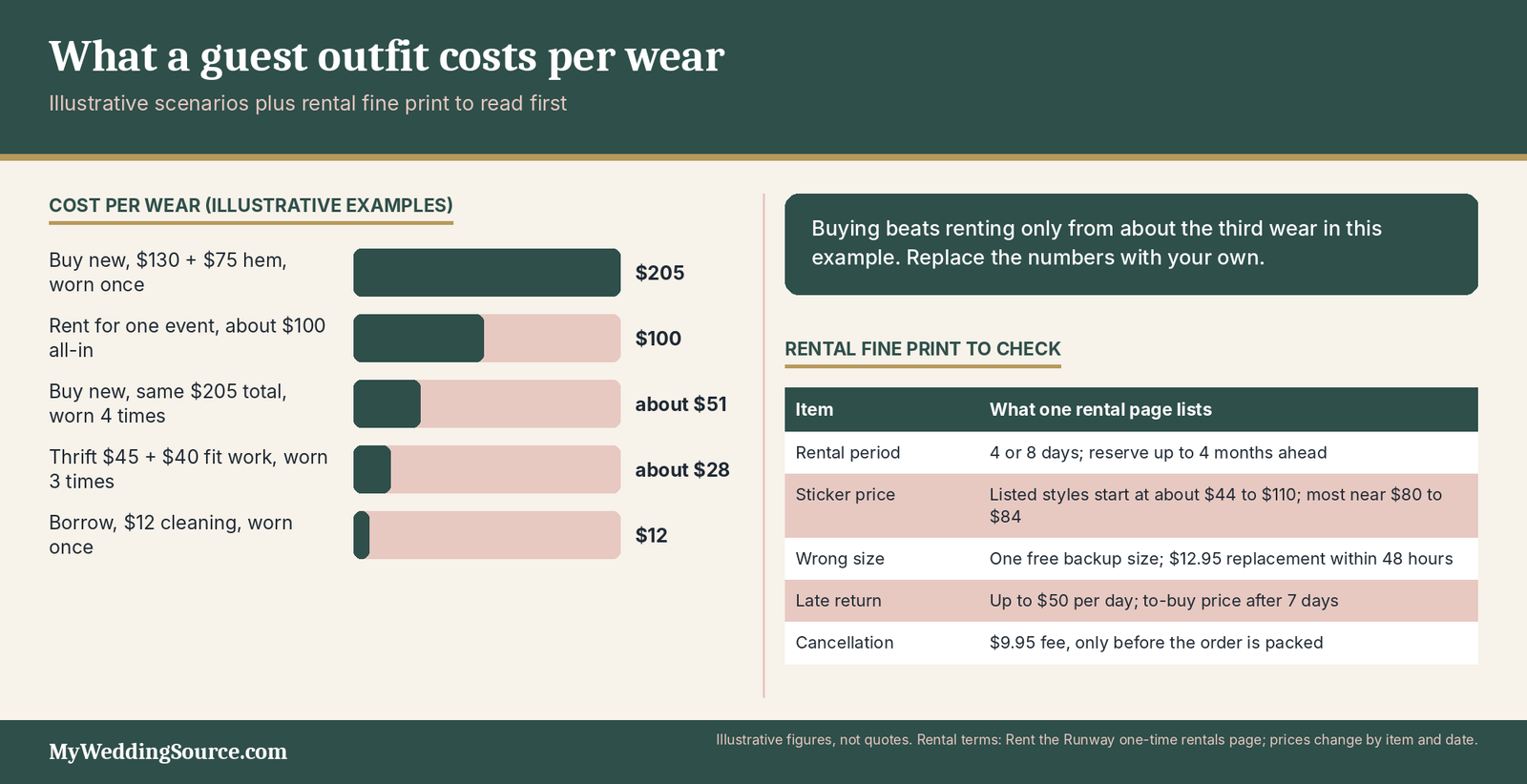
Rental has two main models. One-time rentals charge per event for a set period, and subscriptions charge a monthly fee for a set number of items. On Rent the Runway’s one-time rentals page, listed event rentals start at about $44 to $110 per item, with most of the listed styles starting at roughly $80 to $84, though that page is a snapshot and prices change by dress, date, and promotion. Rentals run for 4 or 8 days, can be reserved up to four months ahead, and include one free backup size on eligible styles. If an item does not fit, a replacement costs $12.95 for shipping and tax, and it must be requested within the first 48 hours of the rental period.
The Knot’s March 2024 roundup of Rent the Runway wedding-guest picks gave a wider spread: starting prices from about $30 to about $265 for dresses and jumpsuits, with membership plans running about $89 to $169 per month. The two sources use different samples and dates, so treat the combined range of roughly $30 to $265 per rental as a planning band rather than a price quote. Subscription models differ: Rent the Runway’s homepage lists a subscription at $99 for the first month and then $164 per month for a set number of items per shipment, and Nuuly lists $98 per month for six items, with a discounted option to buy a piece you want to keep. A subscription pays off only if you will use several items in a month, which is rarely true of a single wedding.
Fine print matters. Rent the Runway’s page lists late fees of up to $50 per day, charges the “to buy” price if an item is not returned within seven days after the return date, and sets a drop-off deadline of noon on or before the return date. Cancellation is possible only before the order is packed, with a $9.95 fee. Read the terms for any service you use, because policies differ.
Buying new, thrifting, and borrowing
Buying new makes sense when you want a specific item, you expect to wear it again, or you need an unusual size or fit that rental inventory does not cover. A reliable way to lower the price is to choose a style that works for several events, and to treat tailoring as part of the budget. The Knot’s guest-cost reporting suggests the simplest saving of all: “The easiest way to save money on your attire is by wearing something you already own,” and it also mentions swapping clothes with friends.
Thrifting and resale are growing options. ThredUp’s 2026 Resale Report, as reported by Retail Dive, projects the U.S. secondhand apparel market will reach $78.8 billion by 2030, with about 7.3% average annual growth and a 2025 growth rate nearly four times faster than the broader clothing market. For a guest, that translates to a deeper supply of occasion dresses and suits on resale sites and in consignment shops. Allow time for hunting, check measurements against your own, and read photos and descriptions for condition.
Borrowing from a friend or relative is usually the least expensive route. The caveats are fit, the fear of spills, and timing. Ask about care instructions, agree on who pays for cleaning if something happens, and return the item promptly.
| Route | Typical cost | Best when | Watch for |
|---|---|---|---|
| Own it or swap | $0 to a few dollars for cleaning | Dress code matches something you have | Photo repeats; fit and condition |
| Rent (one-time) | Roughly $30 to $265 per rental, sticker price | One event, a specific look, tight closet space | Late fees, return deadline, limited sizes on some styles |
| Thrift or resale | Varies widely by item and seller | You want to keep it; time to search | Condition, measurements, return rules |
| Buy new | Varies by retailer and fabric | You will rewear it; unusual fit | Return window, alteration costs |
Shopping Inclusively and Getting the Fit Right
Fit is not a character flaw, and nobody should feel they need to hide anything. The goal is an outfit that fits the body you have on the day of the wedding, and the practical challenge is that many retailers carry fewer styles in some sizes than others. The notes below cover how to check size ranges and how to account for height, mobility, and other needs.
Size-inclusive shopping
Start with size ranges, which are often stated on retailer or rental pages. Nuuly’s page lists sizes from XXS to 5X, with plus, petite, tall, adaptive, and maternity assortments, and Rent the Runway’s own size range is listed on its Finding Your Fit page. Because ranges and inventory change, check the specific item and not just the brand. Look for the measurement chart rather than relying on the size label, and compare your bust, waist, hip, and inseam measurements against it, since sizes differ between brands.
A handful of habits help. Order two sizes when the return policy allows. Read recent reviews for notes on stretch, length, and torso fit. Look at product photos on a range of body types when the retailer shows them. Choose fabrics with some give if you are between sizes, and consider styles with adjustable features such as wrap closures, ties, smocking, and stretch panels. When a retailer does not offer your size, a made-to-order or custom tailor may be an option, as may a thrift find that you adjust. No guide, including this one, should tell you what to hide. The question is what fits well and makes you comfortable.
Fit for different bodies and needs
Petite and tall guests often need hemline adjustments; guests with mobility needs may prefer easy closures, shorter lengths that do not trip, and fabrics that move. Maternity assortments exist at some rental services, and guests who wear adaptive clothing can look for magnetic closures, side zips, and seated-friendly cuts. Because these choices are about function, ask yourself how the outfit works over a ten-hour day, then look for the style that fits that picture.
If you are not sure about a particular garment, a wrap, belt, or tailored jacket can adjust the proportions without major changes, and a local tailor can often resolve a fit problem for less than the cost of a second garment. The next section covers timing and costs for that kind of help.
Timeline, Returns, Alterations, and Finishing Touches
Most guest-outfit stress comes from timing rather than taste. An outfit ordered three weeks out leaves room for a wrong size, a late shipment, and a hem adjustment. The same outfit ordered nine days out leaves room for none of them. This section lays out a schedule, explains how to read return terms before you pay, and covers the tailoring and finishing touches that make an outfit look intentional.
A Schedule That Leaves Room for Surprises
Think of the timeline as a series of small buffers. Each one costs nothing if the step goes smoothly and rescues the outfit if it does not. The table and the return-policy notes below put dates and fine print on those buffers.
A realistic shopping timeline
Start with the information, then shop. As soon as the invitation arrives, check the website for the dress code, the venue, and any terrain notes, and decide whether you need to ask anything. Choose a route about six to eight weeks out. That window is an editorial recommendation, not an industry rule: it gives you time to order, try on, return or exchange once, and still schedule tailoring. The table below shows how the steps stack up. If you rent, note that Rent the Runway’s one-time rentals can be reserved up to four months ahead, so earlier is possible, but rentals run for 4 or 8 days and are meant to arrive shortly before the event.
| When | What to do | Why it helps |
|---|---|---|
| On invitation | Read website; note dress code, venue, time; ask questions | Avoids buying for the wrong formality |
| 8 to 6 weeks out | Pick route; shortlist options; check size and return rules | Leaves time for an exchange |
| 6 to 4 weeks out | Order or reserve; try on at home with shoes and undergarments | Fit problems appear while you can still fix them |
| 4 to 2 weeks out | Book alterations; confirm lead time with the tailor | Tailors may be busy in wedding season |
| 1 week out | Break in shoes; steam or press; pack a repair kit; check forecast | Last chance for a backup plan |
| 2 to 3 days out | Recheck the forecast; pick layers; charge phone; confirm transport | Weather decisions need current information |
| Day of | Dress with time to spare; carry flats, wrap, and a small kit | Absorbs minor surprises |
Reading return and rental policies before you pay
Return policies are set by each retailer, and they vary more than most shoppers expect. The FTC’s online-shopping guidance says a site must say whether you can return an item for a full refund, and it advises you to check who covers return shipping, how long you have to send the item back, and whether restocking fees apply. The FTC also notes that sellers often have different refund and return policies for sale items, especially clearance merchandise, which matters because the last-minute dress you found on sale may be final sale. If you pay by credit card, the FTC says, you have stronger protection if something goes wrong, and you can dispute a charge for an item you never received or that arrived wrong or defective. That guidance is general information, not legal advice, and card-dispute rules and deadlines apply to your own account and issuer.
Rental policies add deadlines. On Rent the Runway’s one-time rentals page, returns are free through a UPS drop-off, but the item must be dropped off by noon on or before the return date, with late fees of up to $50 per day and a charge of the “to buy” price if the item is not returned within seven days after the due date. A good habit is to put the return date and cutoff time in your calendar the day the package arrives. Before you commit to any seller, take a screenshot of the return policy and the delivery estimate, since pages change.
Alterations and Accessories
A small amount of tailoring is often the difference between a garment that fits well and one that looks borrowed. Accessories do the rest. Typical alteration ranges and the role of wraps and jewelry follow, with the caveat that local prices vary.
Alterations: what to expect
Hemming, taking in sides, adjusting straps, and replacing or adding zippers are the common requests for guest outfits. Thumbtack’s published tailoring cost guide lists national average ranges of roughly $73 to $107 for hemming or cuffing, $95 to $143 for overall fit, and $91 to $142 for adding, removing, or adjusting straps, along with local examples such as an alteration shop charging $25 to take in skirt sides. The guide does not state a year, and prices depend heavily on the fabric, the lining, the complexity of the garment, and your region, so treat the numbers as a planning range and get a quote from a local shop.
Bring the shoes you will wear and the undergarments you plan to wear, since a hem or a fit measured without them can be off by inches. Ask about the lead time when you book, because tailors can be busy before major wedding dates, and give yourself a buffer. Rentals are different: services generally expect the garment back unaltered, so use temporary fixes such as hem tape, a belt, or clips and check the rental terms first. If your size falls between two, ordering the larger size and adding a belt or a few safety pins is usually safer than ordering a smaller size and hoping it stretches.
Accessories, wraps, and finishing touches
Accessories give you the most flexibility per dollar. A wrap, shawl, or blazer takes care of cold and modesty needs, and a clutch that holds a phone, a lipstick or lip balm, and a small repair kit saves a trip to the car. Jewelry should match the formality: pearls or diamonds for black tie, statement pieces for cocktail, and simple pieces for casual. If you do not own formal accessories, some rental services rent them too, and The Knot’s Rent the Runway roundup lists a designer clutch at a rental price of $20.
Mind the details that photograph. Press or steam the outfit the day before and check seams, hems, and any visible tags. Decide on a plan for undergarments that suits your neckline and fabric, and choose hosiery or tights if the weather or dress code calls for them. The same logic holds for guests in suits: one or two deliberate accessories, such as a pocket square or a good watch, look more polished than a crowded outfit.
Budget Math and Cost Per Wear
An outfit costs more than its price tag. A $90 dress with a $75 hem, a $40 pair of shoes, and a $15 wrap is a $220 purchase, and it is easy to underestimate the total until you add the pieces. This section shows how to build the full number and how to use cost per wear without letting it justify a purchase you do not need.
What a Guest Outfit Really Costs
Wedding guests face a stack of costs, and attire is one layer among travel, lodging, and gifts. Understanding the stack helps you decide where to spend and where to save. The first note builds the full number, and the second explains cost per wear without overselling it.
The layers of cost
The Knot’s guest-cost reporting puts the average cost of attending a wedding at $610, based on its 2024 Guest Study of 1,000 U.S. adults, up $30 from the prior year. Attire is one of the factors in that total, though the page gives no average dollar figure for it. The same page reports that 46% of guests said the economy had forced them to cut wardrobe spending, a 4% increase over 2023. Local weddings with no travel or lodging averaged $270 in the same reporting, while guests who drove averaged $840 and guests who flew averaged $1,680, which is a reminder that the outfit is often the smaller line.
Add the smaller layers deliberately: shoes, hosiery, undergarments, jewelry, a wrap, dry cleaning, shipping or tax, return postage, and a buffer for one alteration. A realistic budget starts at the bottom of that stack and adds them up before you pick a dress.
Cost per wear, honestly
Cost per wear is a simple formula: total cost divided by number of times you wear the item. The Fitzroy, a Canadian rental company, frames it as purchase price plus maintenance costs divided by wears, with an example in which a CAD $139 piece worn 100 times costs about $1.39 per wear while the same piece worn twice costs about $70. The idea is sound, but it only works if you actually rewear the garment, so be honest about how often you will do so. A formal gown that suits one particular wedding may get one wear, while a midi dress in a neutral color, a jumpsuit, or a suit with separate pieces may get several.
The table below shows illustrative scenarios with made-up but plausible numbers, labeled as illustrative examples, not quotes. The rental line uses the roughly $85 starting price seen on one rental page plus an assumed $15 for tax and shipping; the purchase lines use hypothetical prices; the alteration figures sit within the ranges quoted above or at the low end of local examples. Your numbers will differ, so replace them with your own.
| Scenario (illustrative) | Total cost | Wears | Cost per wear |
|---|---|---|---|
| Rent a dress for one event: $85 plus about $15 tax and shipping | $100 | 1 | $100 |
| Buy new: $130 dress plus $75 hem | $205 | 1 | $205 |
| Buy new, same dress worn to four events | $205 | 4 | about $51 |
| Thrift: $45 dress plus $40 minor fit work | $85 | 3 | about $28 |
| Borrow from a friend, $12 for cleaning | $12 | 1 | $12 |
In this example, buying beats renting only from roughly the third wear, because two rentals at $100 each ($200) still cost slightly less than the $205 purchase. That breakeven shifts with every price, so run it with your own numbers. A useful rule is to rent when you expect one wear, thrift or borrow when the look matters but the budget is tight, and buy when the piece will earn its place in your closet.
Spending Where It Counts
Not every layer of the outfit deserves the same budget. Knowing what shows, what lasts, and what you can borrow lets you put money where it matters. The notes below separate spending priorities from the harder case of a very tight budget.
Where to spend and where to save
Fit usually deserves the largest share. A modestly priced garment that fits well looks more expensive than a pricier one that does not, so a tailoring line item often beats a more expensive dress. Shoes come second, because discomfort affects how you move and how long you stay. Accessories offer a strong trade, since a wrap or statement earrings can transform a simple dress and may be borrowed or rented.
Save on items that only photograph once or are rarely noticed, such as a one-time fabric that will be dry cleaned only once. Consider swapping with friends or using a clothing exchange. The Knot’s reporting mentions clothing swaps as a way to refresh a wardrobe without buying. If you have several weddings in a season, think in terms of a small capsule: two outfits that mix with different accessories, such as a jumpsuit that works with a blazer or wrap for one event and a dressy top for another.
Budgeting when money is tight
Attending a wedding is a choice you make with your own budget, and no one needs an explanation for that. If attire is the hurdle, tell the couple honestly that you are planning an outfit around your budget, and ask whether a particular style would be welcome. Many couples care far more about who is in the room than what everyone is wearing. Compare options in order of cost: something you already own, a swap, a rental, a resale find, and then new.
Set an upper limit before you shop, include tailoring and accessories in it, and stick to the plan. If you are traveling, the Thanksgiving weekend wedding guide shows how holiday timing can inflate the larger travel and lodging costs that sit beside the outfit. This is general education, not personalized financial advice, and your own circumstances decide what you can spend.
Last-Minute Fixes and the Mistakes Worth Avoiding
Sooner or later, something goes sideways: a zipper sticks, a package is late, the forecast turns, or a guest discovers the invitation’s fine print the night before. Most of these problems have inexpensive fixes if you know the order of operations. The mistakes section afterward collects the errors that cause the most regret, with a quick table you can screenshot before you shop.
When the Wedding Is Days Away
Time pressure narrows options but rarely eliminates them. The first step is to separate problems that need a replacement from problems that need a repair. A week or less is workable for most outfits, and day-of problems are usually small if you carry a few basics.
If you have a week or less
Start with what you own, since a workable option is often already in your closet. Compare it against the dress code and the white test, then fill gaps with accessories. If you need a new piece, local stores that let you buy and take home the same day remove shipping risk, and they are often easier to return in person. Rental services may offer expedited options, but the rental terms matter: Rent the Runway’s one-time rental period is 4 or 8 days, and its page notes that replacements for a poor fit cost $12.95 within 48 hours, so confirm that a delivery date leaves time for a swap.
If a hem or seam needs work, ask a local tailor whether rush service is available and what it costs, because the cost guide you saw earlier does not list rush fees. A hem that can be fixed with hem tape and a steamer may not need a tailor at all. Borrowing from a friend of a similar size can also work, and a quick message to the group chat often turns up options. If all else fails, a clean, dark, well-fitted outfit with polished shoes meets the requirement at most levels below black tie.
Day-of emergencies
Pack a small kit: safety pins, fashion tape, a mini sewing kit, blister bandages, stain-removal wipes, a lint roller, deodorant, and a phone charger. Small tears, loose hems, and wardrobe slips are far less stressful when the fix is in your bag. For spills, blot rather than rub, and use a damp cloth if the fabric allows. For a stuck zipper, ask a friend to help rather than force it.
Weather changes are the other common surprise. If the forecast turns colder, a jacket, wrap, or an extra layer from the car makes a big difference. If rain arrives, check whether the couple has a plan and where the covered areas are. The outdoor wedding rain plan guide explains how couples handle weather, and the key detail for a guest is that a plan B may change the walking route or the shoes you wanted. Keep a pair of flats in the trunk and a small umbrella in the bag.
The Mistakes That Cause the Most Regret
Mistakes usually come from skipping a step, not from poor taste. Most are avoidable with a little advance information. The first note covers etiquette and fit errors with a quick reference table, and the second covers planning habits.
Etiquette and fit mistakes
The most common etiquette errors are wearing white or near-white, dressing a level below the invitation, ignoring a stated color or theme, and assuming a religious setting follows the same rules as a secular one. Fit mistakes include buying without checking the return window, skipping a try-on with shoes and undergarments, and counting on a garment to stretch. The table below pairs each risk with its cause and a fix.
| Mistake | Why it backfires | What to do instead |
|---|---|---|
| Wearing white, ivory, or near-white | Can read as bridal in photos; most guides advise against it | Pick a color; test pale shades in daylight and flash |
| Dressing below the dress code | Stands out in photos and at the venue | Match the label and the time of day |
| Ignoring the venue or terrain | Sinking heels, cold wind, or wet hems | Check the website; choose block heels and layers |
| Assuming black or red is fine everywhere | Some traditions treat these colors differently | Ask the hosts; add color if unsure |
| Buying without reading return terms | Final-sale or restocking fees can lock in the cost | Read the policy; screenshot it; pay by credit card |
| Skipping alterations | A near-fit garment looks borrowed | Book tailoring early; bring shoes |
| Waiting until the last week | Shipping and sizing problems leave no buffer | Start six to eight weeks out |
| Overspending on a single-use outfit | Cost per wear stays high | Compare rent, borrow, thrift, and buy |
Behind these items is a pattern. Guests who ask early and read terms before they pay rarely run into the costly ones. If a policy is unclear, ask the seller to confirm it in writing before you buy.
Planning and mindset mistakes
A less obvious mistake is shopping before you know the setting. The same dress can be right for a garden ceremony and wrong for a candlelit ballroom, and a purchase made before you read the website can lock you into a return you did not plan for. Another is treating the dress code as a ranking of who tried hardest. The goal is to fit the room and respect the couple, not to compete.
A third mistake is making the outfit about your body instead of about your comfort. Comparisons and last-minute worries about how an outfit “looks on you” are not a requirement of any dress code. Choose the garment that feels good to wear, fits well, and meets the occasion, and then stop worrying. The couple invited you because they want you there, and an outfit you forget you are wearing has done its job.
FAQ: Wedding Guest Dresses and Dress Code Questions
These are the questions readers ask most often. The answers apply across dress codes and formality levels, and they are general guidance, since each couple’s wishes and each community’s customs vary. Short answers appear here, and the sections above carry the longer reasoning and sources.
Etiquette Questions
Etiquette questions come down to two principles: do not compete with the couple, and respect the setting. Everything else is a judgment call. The three questions below apply those principles to black, white, and silent invitations.
Can I wear black to a wedding?
Yes, at most modern weddings. WeddingWire notes that black is no longer off-limits for most weddings, and it is a natural choice for formal and evening events. The exceptions are cultural and tonal. Black is viewed as unlucky in Hindu ceremonies according to WeddingWire, and some traditional families see an all-black base as inauspicious, so a quick question to the hosts is wise. At daytime or garden weddings, black can look heavy, and a bright wrap, bold jewelry, or a colorful shoe lightens it.
Is it ever acceptable to wear white, ivory, or cream?
Only when the couple has asked guests to wear white. Otherwise, avoid white, ivory, cream, off-white, and patterns that are mostly white, since they can look bridal in photos. Very pale pastels are a gray area that depends on how the color looks in sunlight and under a flash. If you love an almost-white shade, hold it up against a white sheet of paper, and if the paper looks brighter and your garment looks pale gray or cream, choose another color.
What do I wear if the invitation does not mention a dress code?
Use the time of day, the venue, and the wedding website to estimate formality, then choose something dressy. Emily Post says the invitation and the time of the wedding are the best guide to formality, and The Knot reports that semi-formal is the most common expectation. When in doubt, send a short note to the couple or a member of the wedding party. Dressing one notch above your assumption is usually safer than dressing below it.
Shopping Questions
Shopping questions mostly concern timing, price, and returns, where a few checks save the most money. The two questions below cover rental value, timing, and sizing, which are the points where guests most often feel stuck.
Is renting a wedding guest dress worth it?
It can be, when you expect to wear the outfit once and want a specific look. One-time rental prices in the sources above ranged from roughly $30 to $265, with late fees and return deadlines to keep in mind. If you would wear a purchased piece at least three times, buying or thrifting may cost less per wear, based on the illustrative numbers in the budget section. Check the size range, the backup-size policy, and the return deadline before you reserve.
How far ahead should I shop, and what if I wear a larger size?
Plan on six to eight weeks as an editorial recommendation, which leaves room for a return or exchange and tailoring. For size-inclusive shopping, check each retailer’s stated size range and measurement chart, order two sizes when the return policy allows, and read reviews for notes on length and stretch. Services such as Nuuly list sizes from XXS to 5X with plus, petite, tall, and adaptive assortments, while Rent the Runway lists its own range on its fit page, so verify the specific item and date.
Your Next Steps
The sequence below turns this guide into a short to-do list. Do the first group this week, and use the second group as a checklist before you spend money. Each group has two items, and none requires spending anything until you reach checkout.
This Week
These steps are free and take about an hour in total. They protect you from the most expensive mistakes. Do them in order, because the second step depends on what the first one reveals.
Read the clues and ask one question
Open the invitation, the wedding website, and the venue page, and write down the dress code, the start time, the venue, and whether any part of the event is outdoors or in a house of worship. Compare these against the ladder in this guide and decide which row you are in. If one detail is unclear, send a short, friendly message to the couple or to a member of the wedding party. Save the reply, because it will help if you shop online and need to confirm a style later.
Set a budget and pick a route
Decide on a total that includes the outfit, shoes, tailoring, and accessories, and then compare the four routes: own or swap, rent, thrift, and buy. Use the cost-per-wear table and replace the illustrative numbers with your own. Put the wedding date, the return deadline, and a tailor appointment on your calendar. If you plan to rent, check the reservation window and the size range now, since limited sizes and dates are the most common source of disappointment.
Before You Pay
These checks take a few minutes at the checkout page, and they are where most surprises can be prevented. Run the first list before you click pay and the second the night before the wedding.
The checkout checklist
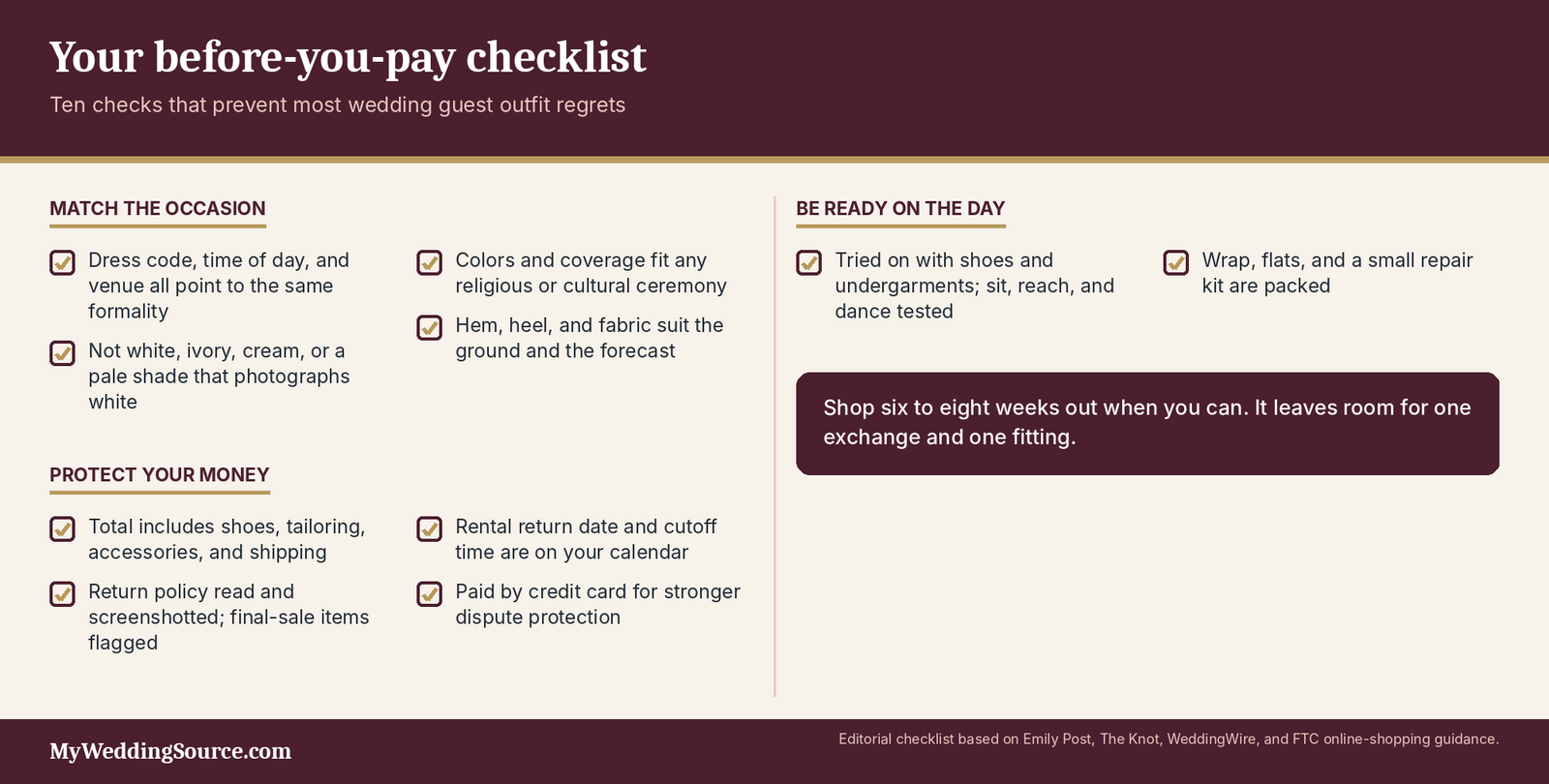
Confirm the dress code match, the white test, the length for the terrain, and your measurements against the size chart. Read the return policy, including final-sale rules, restocking fees, return shipping, and deadlines, and take a screenshot. Pay by credit card if you can, since the FTC says it offers stronger protection if something goes wrong. Check the delivery date against your try-on window, and if you are renting, note the return deadline and cutoff time.
The day-before checklist
Try the full outfit with shoes, undergarments, and accessories. Steam or press it, check the forecast, and pack a wrap, flats, and a small repair kit. Charge your phone, confirm your transportation, and decide when you will arrive. If you rented, put the return label and the drop-off time in your phone. Then close the closet door, because the outfit is ready and the rest of the day is about the couple.
Sources & methodology
- Emily Post: Wedding guest attire — invitation and time of day as formality guides, formality chart, religious and cultural considerations
- The Knot: Wedding guest attire cheat sheet — definitions of black tie through festive dress codes and garment suggestions
- The Knot: How to word a wedding dress code — how couples communicate dress codes, venue and terrain notes
- The Knot: Average wedding guest cost — $610 average guest cost, 46% wardrobe cutback, dress-code popularity, wear-what-you-own tip
- WeddingWire: Colors you can’t wear to a wedding — white and near-white, black, red, metallics, pastels, denim, cultural exceptions
- Rent the Runway: One-time rentals — rental periods, listed starting prices, backup size, fees, return rules
- The Knot: Rent the Runway wedding guest dresses (March 2024) — starting-price spread for dresses and jumpsuits, membership range
- Nuuly — subscription price, item count, size range, buy-to-keep option
- Thumbtack: Tailoring and alterations costs — national average alteration ranges and local examples
- The Fitzroy: Rent vs. buy guide — cost-per-wear formula (Canadian rental company, CAD)
- Retail Dive: ThredUp 2026 Resale Report coverage — U.S. secondhand apparel growth and projection
- FTC: Online shopping — return and refund policy checks, credit card and dispute advice
- My Jewish Learning: Being a guest at a Jewish wedding — modest dress, wraps, head coverings
- The Knot: What to wear to a Jewish wedding — Orthodox, conservative, and Reform guidance
- Aza Fashions: Hindu wedding guest guide — colors, modesty, shoes (retailer blog)
- Aza Fashions: Sikh wedding guest guide — gurdwara head covering, shoes, seating (retailer blog)
- NOAA Climate Prediction Center: Seasonal outlooks — how official seasonal outlooks are issued
- MyWeddingSource: Fall wedding weather and seasonal costs — daily temperature swings, sunset timing, outlook comparison
This guide separates verified facts, survey findings, retailer-published prices, illustrative examples, and editorial judgment. Dress-code definitions and etiquette points come from named publications and reflect common practice, not law. Survey figures come from The Knot’s published studies, rental prices are snapshots of retailer pages that change by item, date, and promotion, and the cost-per-wear scenarios are illustrative examples, not quotes. Timelines such as six to eight weeks are editorial recommendations, and cultural guidance varies by family and community, so confirm with the hosts.
Freshness note: recheck rental prices, return terms, and size ranges at the time you shop, since Rent the Runway, Nuuly, and other services update them often. Recheck tailoring costs with a local shop, and review the forecast five to seven days before the wedding. This article was researched in October 2026 and should be reviewed each fall and spring.