
A wedding dress code is a short phrase on an invitation that tells you how formal the day will feel, and once you know how to read it, you can choose an outfit calmly instead of guessing, overspending, or texting the couple at midnight.
Quick answer
Treat the wedding dress code as a formality level, not a list of garments. From most to least formal, the common levels are white tie, black tie, black-tie optional, formal, cocktail, semi-formal, dressy casual, and casual. Theme words such as beach, festive, or Western change the details but not the level. Find the couple’s words on the invitation or wedding website first, then use the time of day, the venue, and the season to confirm. When you are between two levels, dress at the higher one, skip white and near-white, and ask the couple one specific question if the wording is unclear.
This guide to the wedding dress code is written for guests who want to get the outfit right and for couples who want to write a wedding dress code that guests can actually follow. It does not replace what the couple tells you. Wedding wedding dress codes are conventions, and the sources we read agree on the broad picture while differing at the edges, so we point out those edges instead of pretending there is one official rulebook. Where we give prices, we say who published them and what they include, and where we do our own arithmetic, we label it as an estimate.
How a wedding dress code works and where to find it
Most guests do not struggle with the idea of dressing up, and a wedding dress code rarely asks for more than that. They struggle with the vocabulary. A wedding dress code uses a few borrowed terms from formal-event etiquette, and the terms overlap, so two reasonable people can read the same phrase differently. Before you shop, it helps to understand what the wedding dress code is trying to do and where the couple usually hides the clues.
What a wedding dress code actually communicates
A wedding dress code is a promise about the room. When a couple writes “black tie,” they are telling you that most people will be in tuxedos and floor-length gowns, and that they would like the photographs and the atmosphere to match. When they write “casual,” they are telling you the day will be relaxed, but they are almost never inviting everyday clothes. A wedding dress code protects guests from standing out by accident, and it protects the couple’s vision for the day.
Formality, not a garment list
The most useful way to read a wedding dress code is as a position on a ladder. Each rung describes how dressed up the room will be, and many garments can sit on the same rung. A floor-length gown, a sleek jumpsuit, and an elegant long skirt with a refined top can all be at home at a formal wedding. A dark suit, a three-piece suit, and a tuxedo can all work at black-tie optional. If you think in terms of fabric, fit, and finish rather than in terms of one required outfit, you will rarely be wrong.
Why the labels disagree at the edges
Emily Post groups dress into formal, semiformal, and informal, and then splits each by daytime and evening. The Knot’s attire cheat sheet runs a longer ladder that includes black-tie optional, cocktail, dressy casual, and several theme codes. MasterClass defines black-tie optional on its own terms, and a couple’s wedding website may use a phrase that none of them define. None of this is a contradiction. It means that the middle rungs, especially formal, cocktail, and semi-formal, blur into each other. When the label is ambiguous, the safest reading is the one that is slightly more dressed up, and the safest action is to read the rest of the invitation for confirming clues.
Where couples put the clues
Couples do not always print the wedding dress code in the same place, and some never print it at all. Knowing where to look saves you a message to the couple and makes the one message you do send more specific.
The invitation line and the wedding website
The Knot’s guidance for couples is to put a few words in the lower corner or bottom center of the invitation, and to use the wedding website for the longer explanation, including suggested items, weather or venue notes, and any restrictions. That means the invitation might say “cocktail attire” while the website adds that the ceremony is on grass and the reception is in a heated tent. Check the homepage, a dedicated attire or wedding dress code page, the FAQ, and each event page, because a welcome party, a ceremony, and a brunch can each have different codes. If your invitation came with a details card, read it before anything else.
Time of day, venue, and season as backup clues
Emily Post’s advice is that the invitation and the time of the wedding are the best guides to formality, and that the setting matters as well. An evening ceremony in a hotel ballroom points up the ladder. A late-morning ceremony in a garden points down it. A house of worship adds its own expectations about coverage. The season changes fabrics and shoes more than it changes the level. We cover those adjustments in detail later, and our guide to wedding etiquette places attire inside the wider set of guest manners.
The formality ladder from white tie to casual
The ladder below is the backbone of every wedding dress code you will meet. We describe each rung in plain terms, using The Knot’s attire cheat sheet, Emily Post’s guest attire advice, and MasterClass as our main references. Where they differ, we say so.
The top rungs: white tie, black tie, black-tie optional, and formal
These are the evening-leaning wedding dress code levels. Most guests will meet black tie or black-tie optional a few times in life, and white tie almost never.
White tie and black tie
White tie is the most formal code and is rare at weddings. The Knot describes full-length evening gowns for women and, for men, a black tailcoat with matching trousers, a white shirt, a white vest, and a bow tie. If you receive a white-tie invitation, the couple is describing a very specific and very formal evening, and it is reasonable to ask them for guidance and to plan to rent.
Black tie is the code most guests think of as “fancy.” The Knot describes floor-length gowns for women and a tuxedo for men, with a black or standard bow tie. Emily Post notes that a tuxedo is expected when an invitation says black tie. A tuxedo is not just a black suit: The Knot’s tuxedo-versus-suit explainer lists satin lapels, a satin stripe down the trouser leg, a shirt designed for studs and cufflinks, and patent or highly polished shoes. The same source says a black suit is not an acceptable substitute at a white-tie or black-tie event. Our dedicated guide to the black-tie wedding goes deeper into the details if the wedding dress code on your invitation is this one.
Black-tie optional and formal
Black-tie optional is the permission slip. MasterClass describes it as an event where black-tie attire is welcome but not required, while dressy attire is. For men, that means a tuxedo is fine, and a dark suit in charcoal or navy is also fine. For women, a darker floor-length evening dress in a rich fabric is the most formal option, and a more conservative cocktail dress is acceptable. The Knot adds that this code leans more upscale in the evening and a little less formal in the early afternoon.
Formal is less strict than black tie. The Knot says that when you are unsure, you should dress up, and it lists floor-length dresses, sleek jumpsuits, and elegant cocktail dresses for women and a well-tailored darker suit with a tie for men. Emily Post’s formal category separates daytime from evening: a dressy afternoon or cocktail dress and a dark suit during the day, and a long evening dress or dressy cocktail dress, with a tuxedo or dark suit, in the evening. In practice, “formal” and “black-tie optional” are close neighbors, and a dark suit with a good tie or a floor-length dress works for both.
The middle and relaxed rungs: cocktail, semi-formal, dressy casual, and casual
These are the wedding dress code levels most guests will see. The Knot’s 2026 Real Weddings Study, which surveyed 10,474 U.S. couples married in 2025, found that 60% of couples described their wedding as semi-formal and 19% as formal or black tie. That means the middle of the ladder is where most of your wedding invitations will land.
Cocktail and semi-formal
Cocktail attire allows more freedom with hemlines, color, and pattern, and accessories do a lot of the work. The Knot lists structured midi or shorter dresses with statement jewelry for women, elevated jumpsuits and separates, and a suit and tie with a crisp shirt for men, with room for color that fits the venue. We have a separate guide to cocktail attire that covers hemlines, fabrics, and examples by season.
Semi-formal sits just below. The Knot calls it the most common wedding dress code and describes it as polished but less embellished than cocktail: midi or wrap dresses and refined jumpsuits for women, avoiding heavy beading or sequins, and a suit and tie in a nice fabric for men. Emily Post’s semiformal category splits by time of day, with a dressy afternoon dress, suit, or pantsuit during the day and a cocktail dress or dressy pantsuit in the evening, paired with a dark suit for men. The practical difference between cocktail and semi-formal is how much shine and drama you add. If you cannot tell which the couple means, a well-made dress or suit with restrained accessories will be accepted under both.
Dressy casual and casual
Dressy casual is a dressed-up version of business casual. The Knot suggests an upscale dress, matching set, or pantsuit in an elegant fabric for women, and a blazer with nice trousers for men, with ties optional. Casual is relaxed but still elevated: a long sundress with a nice neckline and simple accessories, or a navy blazer with a button-down shirt and khakis. Emily Post’s informal category agrees in spirit, suggesting a sports jacket or blazer with slacks and an optional tie for men, and an afternoon dress or a dressy skirt or pants with a blouse for women.
The word to hold onto in a casual wedding dress code is “elevated.” Casual at a wedding means you have not been asked to wear a tuxedo, not that you may wear what you wore to the grocery store. Our wedding etiquette guide explains why guests tend to be most comfortable when they dress a little above the room rather than a little below it.
Reading the ladder at a glance
Seeing every wedding dress code together makes the differences easier to remember. The table below is our own summary of what the sources above describe, arranged so you can scan for your code. It describes typical expectations, not rules, and the couple’s own wording always wins.
One table for all the rungs
| Code | Typical time | Common looks for dresses and similar | Common looks for suits and similar | Flexibility |
|---|---|---|---|---|
| White tie | Evening | Full-length evening gown | Black tailcoat, white vest, bow tie | Very little |
| Black tie | Evening | Floor-length gown | Tuxedo, bow tie | Little |
| Black-tie optional | Evening, some afternoon | Floor-length dress or conservative cocktail dress | Tuxedo or dark suit | Moderate |
| Formal | Afternoon or evening | Floor-length dress, sleek jumpsuit, elegant cocktail dress | Well-tailored dark suit and tie | Moderate |
| Cocktail | Late afternoon or evening | Midi or shorter dress, elevated jumpsuit or separates | Suit and tie, color welcome | Fairly wide |
| Semi-formal | Any time | Midi or wrap dress, refined jumpsuit, little heavy beading | Suit and tie in a nice fabric | Wide |
| Dressy casual | Any time | Upscale dress, matching set, pantsuit | Blazer with nice trousers, tie optional | Wide |
| Casual | Daytime, relaxed settings | Long sundress, nice neckline | Blazer or button-down with khakis | Widest, still elevated |

How to use the table without over-trusting it
Use the ladder as a starting point for any wedding dress code and test it against the invitation. If the wedding dress code and the time of day disagree, for example “formal” on an invitation for a late-morning backyard ceremony, treat the wedding dress code as the couple’s stated wish and the setting as a reason to choose lighter fabrics and sturdier shoes rather than a lower level. If the wedding dress code and the venue disagree, ask. A single clear question to the couple, such as “Would a dark suit be right for black-tie optional, or are most people wearing tuxedos?” is almost always welcome.
Where the sources disagree
Two disagreements are worth knowing. First, Emily Post treats “cocktail” as a type of dress rather than as a separate code, while The Knot and most invitations treat it as its own level. Second, “formal” is a separate code in The Knot’s guidance and in wedding-website wording, but MasterClass presents black tie as the formal designation and black-tie optional as its relaxed cousin. None of these differences changes what you should wear. They explain why the same phrase on two invitations can feel slightly different. ## How theme and setting words change a wedding dress code
Many invitations pair a level with a second word: beach formal, festive cocktail, creative black tie, garden party, Western. The second word adjusts the details of the outfit. It rarely lowers the level. If you hold the level steady and let the theme word choose the fabrics, colors, and shoes, you will avoid most mistakes.
Setting-led codes: beach, garden, rustic, and daytime
Setting-led parts of a wedding dress code tell you about the ground under your feet and the weather on your shoulders. They matter most for shoes, fabrics, and layers.
Beach formal and beach casual
The Knot describes beach formal as the most polished beach code, still relaxed enough for sand. For men it suggests a suit in a lighter color, such as blue or tan, rather than black, with a tie or bow tie unless the invitation says otherwise. For women it suggests an elevated maxi, midi, or high-low dress, or a classy jumpsuit or pantsuit, in colors that range from pastels to formal metallics. It names linen, cotton, and seersucker as breathable choices, and it warns that thin stiletto heels sink into sand and that strapless styles may not hold up in wind. For women, block heels or a dressy wedge are the practical alternatives. Beach casual, in The Knot’s wedding-website examples, means shirts with slacks or shorts, sundresses, and sandals instead of heels. If you are flying to the wedding, our guides to beach wedding planning and beach wedding dresses show what the couple is probably imagining.
The Knot’s destination-wedding guest advice adds a point that applies to any outdoor setting: check the forecast and the start and end times of the ceremony. A heavy gown in afternoon heat is miserable, and a short dress can be cold once the sun goes down, so plan a light layer for the evening.
Rustic, barn, garden, and Western
Rustic, Western, and country codes suit fields, barns, and similar venues. The Knot lists flowy dresses with details such as puff sleeves, lace, or fringe for women, and pearl-snap Western shirts, bolo ties, and optional jackets or vests for men. It says dark, polished denim without holes is acceptable at a Western-themed wedding and that cowboy boots or dress shoes both work, while shorts and sneakers do not. Garden and barn weddings are more often about shoes than about style: lawns, gravel, and old wooden floors all punish thin heels. The Knot’s fall-wedding advice suggests chunky block heels, dressy wedges, or leather dress boots on lawns and garden paths. If the venue is on your invitation, our pages on garden wedding venues and barn wedding venues describe the surfaces and weather guests commonly meet.
Style-led codes: festive, creative, and color requests
Style-led wording in a wedding dress code asks you to add personality, not to change the level.
Festive
The Knot describes festive as a glamorous version of whichever base code is listed, such as cocktail, formal, or black tie. That means sparkle, embellishment, a statement silhouette, and bold accessories for women, and for men suits in textures like velvet or brocade with patterned ties and pocket squares. If the invitation says only “festive,” treat it as festive cocktail: a dressy outfit with a visible dose of shine or color. A holiday-season wedding is a common home for this code, and our page on holiday wedding etiquette covers how couples and guests handle the overlap between wedding and holiday dress.
Creative black tie and color requests
Creative black tie is a formal code with permission to play, such as a patterned dinner jacket, a velvet blazer, a colorful gown, or an unusual accessory. The Knot’s fall guidance notes that costumes are appropriate only if the invitation calls for them, which is a good rule for every creative code. The safe way to use the extra freedom is to change one element and keep the rest classic. Color requests, such as “jewel tones” or “garden pastels,” are meant to help the photographs look cohesive. If a couple asks for a palette, follow it, and check the website for the colors the wedding party is wearing so that you do not match them by accident.
How to dress for religious and cultural ceremonies
The wedding dress code on the invitation is usually about formality. A religious or cultural ceremony may add expectations about coverage, head coverings, shoes, and colors that the invitation does not mention. Emily Post says that a house of worship may make bare shoulders, bare arms, or open-toed shoes inappropriate, and that the couple’s faith or culture may require head coverings. The couple would rather answer a question than see a guest guess.
What to check before the ceremony
A short checklist lets you check the wedding dress code against the ceremony and cover the most common issues without turning the question into a research project.
Ask about coverage, head coverings, and shoes
Ask the couple, a parent, or a member of the wedding party three plain questions: Are there expectations about covering shoulders, knees, or the neckline? Will head coverings be provided or expected? Will we remove our shoes at any point? These questions take less than a minute to answer and avoid most surprises. The Knot’s what-not-to-wear guidance adds that religious settings or venues may require covered shoulders or no slits, which is a good reason to pack a wrap or jacket even if you think you will not need it.
Separate the ceremony from the reception
Many couples hold the ceremony in a place with stricter expectations and the reception in a place that is relaxed. You can often dress for the stricter setting and change one layer afterward, such as adding a jacket or removing a wrap or head covering. A shawl, a blazer, and a pair of comfortable shoes in your bag give you flexibility across both settings. Our wedding ceremony guide explains how the order of events usually runs, which helps you plan where to change.
What two common traditions ask of guests
These examples come from David’s Bridal’s published guest guides, which are retailer guidance and not a religious authority. Traditions vary among families, regions, and congregations, so treat them as a starting point for a conversation with the couple.
Jewish weddings
David’s Bridal describes modesty as focused on shoulders, knees, and neckline, with dresses at or below the knee with sleeves or a jacket, or a tailored pantsuit, for women, and a suit or dress pants with a button-down and tie for men. It notes that Orthodox and many Conservative ceremonies provide kippahs for male guests, including guests who are not Jewish, and that Orthodox communities may expect married women to cover their hair, so a lightweight scarf or shawl is a good backup. It also describes variation among Orthodox, Conservative, and Reform communities, with Reform weddings generally allowing more contemporary formal wear. The guide adds that a synagogue ceremony usually calls for more conservative dress than a hotel or outdoor reception, and suggests asking the couple or following the lead of other guests when unsure.
Hindu weddings
David’s Bridal describes jewel tones such as royal blue, emerald, purple, magenta, bright pink, and golden yellow as festive and auspicious. It says deep red, crimson, maroon, and bright red are generally reserved for brides, though small red accents in prints or embroidery are fine, and that white and black are associated with mourning and are generally avoided at celebrations. For coverage it suggests covering shoulders, avoiding low necklines, and bringing a dupatta or scarf for head covering during sacred moments. For shoes, it recommends footwear that is easy to slip off, since guests may need to go barefoot when entering temple spaces, and notes that heels can work for receptions and dancing. Again, when in doubt, ask the couple or their families.
What every guest can wear, whatever their gender, body, or style
The ladder behind a wedding dress code describes formality. It does not require a particular body, gender, or garment. The Knot’s own descriptions often list options for several styles, such as jumpsuits, pantsuits, and separates, and note that formal attire allows jumpsuits or pantsuits in any color.
How the codes work outside the dress-and-suit binary
A formal wedding dress code is easiest to meet when you think in terms of cut, fabric, and finish.
Match the level with the pieces you like
The Knot’s nonbinary wedding attire guide suggests that guests follow the wedding dress code as a way of honoring the couple’s vision while personalizing the outfit to reflect their identity. It recommends shopping for separate pieces rather than a complete outfit from one gendered collection, and using accessories, jewelry, hair, and makeup to make a strict code feel personal. For black-tie events it mentions examples such as pairing a black bow tie with a gown, and for cocktail and semi-formal events it suggests flowy pants, oversized dresses, relaxed suit colors, and personal details like lapel pins or scarves. The guide also suggests asking yourself whether the couple understands and respects your identity before deciding how far to push the boundaries. Those are good questions for anyone, not only nonbinary guests.
Wording a code that includes everyone
For couples, a clear way to include everyone is to state the formality level and describe looks, not garments. “Black-tie optional: a tuxedo or dark suit, or an evening gown or cocktail dress” is the kind of wording The Knot’s wedding-website guidance shows, and “formal: a suit in any color, a cocktail dress, or an elegant pantsuit” is similar. Adding a line such as “wear whatever formal outfit you feel your best in” removes any doubt that the level matters and the garment does not. A link to a mood board of example outfits shows guests what you mean at a glance.
How to get a good fit and feel at ease all day
An outfit that matches the code but pinches, slips, or sags will feel less formal than a simpler one that fits.
Fit before price
Our editorial view, not a finding from any survey, is that a well-fitted outfit tends to look more formal than a more expensive one that fits badly. If your suit sleeve, dress hem, or waist is off, a tailor can often correct it, and our guide to wedding dress alterations covers the basics of alterations. Whatever the garment, ask the tailor how long the work will take before you buy, and try the finished outfit again with the shoes and undergarments you plan to wear.
The movement test
Before the wedding, put on the full outfit and do the things you will do at the wedding: sit for an hour, climb stairs, lift your arms for a hug, bend to pick up a dropped napkin, and dance for a song or two. If a zipper pulls, a strap slides, a hem trips you, or a shoe rubs, fix it now. If you will be on your feet for a long ceremony or reception, our wedding emergency kit guide covers small fix-it supplies worth packing for a long day, and a few blister pads and safety pins in your bag cost very little.
What to avoid wearing as a wedding guest
The avoid list for a wedding dress code is shorter than most guests expect. It comes down to not competing with the couple, not under-dressing for the level, and not overlooking the setting.
Which colors cause problems
Color is the part of any wedding dress code where tradition and photography both matter.
White, ivory, cream, and anything that photographs as white
The Knot calls not wearing white an unsaid rule. It says to avoid ivory, cream, beige, and anything that could photograph as white, and notes that white shoes are generally fine if the rest of the outfit avoids those colors. It says floral and patterned dresses work when the main color is dark or bright and white is only a small accent, and that dresses with white or cream backgrounds, sparse patterns on pale fabric, or very pale dresses that may look white in photos should be avoided. A white button-down shirt under a suit or tuxedo is fine, and a mostly black outfit with a little white is usually fine too. The exception is explicit: if the couple asks all guests to wear white, follow that request, and look for it on the invitation or website.
Black, red, and matching the wedding party
The Knot says black works for black-tie or formal weddings but can feel too somber at less formal events, where it may look like you are dressed for a funeral or working as a server. It says red risks seeming attention-seeking, though a tasteful red outfit that draws compliments without overshadowing the couple can be fine. Neither is a hard rule, and cultural traditions differ: in the Hindu wedding guidance above, for example, red is reserved for brides and black is associated with mourning. The practical test is to ask yourself whether the color matches the tone the couple has set. Also check the wedding website for the wedding party’s colors so that you do not match them.
Which choices read as too casual or too flashy
The second half of the avoid list is about level.
Denim, shorts, sneakers, and hats
The Knot says denim is usually inappropriate except at a Western-themed wedding, and that shorts are rarely acceptable except at very relaxed destination weddings. It says sneakers are out at black-tie and formal weddings, that men can wear nice, not-worn-out sneakers only at dressy casual events, and that loafers are fine from cocktail attire up. It adds that hats should be removed indoors, especially in religious venues, and that baseball caps are never appropriate. Our wedding party attire guide shows how the people standing with the couple are usually dressed, which can help you judge the room.
Overdressing and competing with the couple
Guests can also miss the mark by dressing above the room. The Knot’s what-not-to-wear guidance gives examples of dresses that miss the wedding dress code, such as an evening gown at a semi-formal wedding or a midi dress at a black-tie event. The point is not to dress down to avoid being noticed. The point is to dress at the level the couple chose. If you want to wear something dramatic, keep it to one element, such as a statement piece of jewelry or a bold shoe, and keep the rest of the outfit quiet. Mothers, grandparents, and other family members have extra considerations, and our guide to mother of the bride dresses explains how color coordination often works for them. ## How season, weather, and time of day change what you wear
The season rarely changes the level of the wedding dress code. It changes the fabric, the shoes, and the layers. A guest who understands that distinction can wear the same level of outfit in July and in November and still be comfortable both times.
What works for a fall wedding
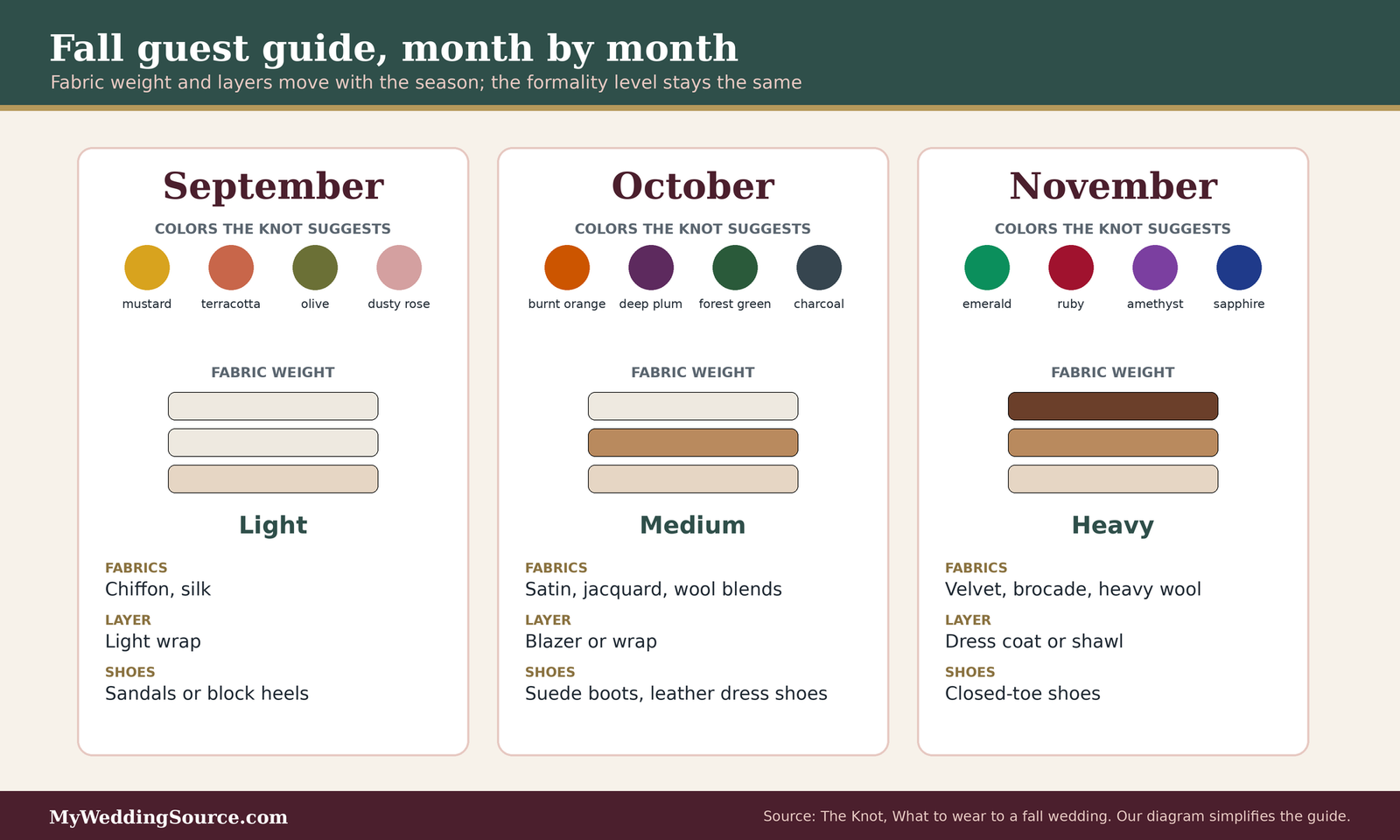
The Knot’s fall-wedding guide is the most detailed source we found on how clothing changes by month, and we summarize it here. It describes jewel tones, earth tones, and classic darks as seasonal colors, and velvet, satin, silk, jacquard, brocade, wool blends, and tweed as seasonal fabrics.
September and October
In September, the guide says late-summer heat often lingers, so lighter fabrics such as chiffon or silk, and brighter fall shades such as mustard, terracotta, olive, and dusty rose, work well, with short sleeves, sleeveless dresses, and jumpsuits suiting the weather. For men it suggests a light gray or navy suit with a patterned tie or pocket square instead of heavy wool or velvet.
In October, it suggests warmer, more dramatic colors such as burnt orange, terracotta, and deep plum, and pieces like long-sleeve satin midis, jacquard, high-neck jumpsuits, or a slip dress with a blazer or wrap. For men it suggests mid-weight wool blends, flannels, or tweeds in forest green, charcoal, navy, or black. Suede boots, leather dress shoes, or a velvet clutch add texture.
November and the layer question
In November, the guide suggests saturated jewel tones, velvet suits, and crystal accessories, with heavier fabrics such as jacquard, wool blends, and velvet for warmth. It says closed-toe shoes are essential, especially if snow is possible, and recommends a plush shawl, faux-fur wrap, or dress coat for indoor events and warm layers for outdoor events. It also says to bring a layer even for indoor events, because venues can still feel chilly. For outdoor events, it recommends denser fabrics, such as velvet, brocade, or heavy satin, because lighter options like chiffon and linen blow around in autumn wind.
What about heat, sun, and cold
A wedding dress code can be accurate and still be uncomfortable if the weather is extreme. These points are general safety information from public-health sources, not medical advice, and anyone with a health condition should follow their clinician’s guidance.
Heat and sun
The CDC says people at higher risk from heat include adults 65 and older, infants and young children, pregnant people, people with conditions such as asthma or heart disease, and people who work or exercise outdoors. It lists muscle cramps, unusually heavy sweating, shortness of breath, dizziness, headaches, weakness, and nausea as warning signs, and recommends shade, regular breaks, and drinking water throughout the day. It also suggests limiting sugary or salty drinks, caffeine, and alcohol, which is worth remembering at a reception with an open bar. For a summer outdoor wedding, that means choosing breathable fabrics, a lighter color if the wedding dress code allows, and a plan for water. Our summer wedding heat plan covers the planning side for couples.
The American Academy of Dermatology recommends broad-spectrum, water-resistant sunscreen with an SPF of 30 or higher, reapplied about every two hours outdoors and after sweating or swimming, and notes that SPF 30 blocks about 97% of UVB rays. It also suggests seeking shade between 10 a.m. and 2 p.m., and wearing a wide-brimmed hat, sunglasses with UV protection, and lightweight protective clothing where you can. At a formal outdoor ceremony, a wrap, a hat that suits the wedding dress code, and a pair of sunglasses are consistent with that advice and with most wedding dress codes.
Cold and wind
The National Weather Service explains that wind chill is how cold it feels on exposed skin because wind draws heat from the body, and it is defined for air temperatures at or below 50 degrees Fahrenheit and winds above 3 miles per hour. Its example is that air at 0 degrees with a 15 mph wind has a wind chill of minus 19 degrees. You are unlikely to meet numbers like that at a wedding, but the principle matters for a winter ceremony outdoors: a few minutes of exposure in a thin dress can feel much colder than the thermometer reads. A coat that suits the outfit, closed-toe shoes, and warm layers that you can remove indoors are better than a thin dress with nothing over it. Our guide to winter wedding weather planning covers the couple’s side of the same problem.
Time of day, light, and photographs
The time of the ceremony affects both the level and the look.
Daytime and evening
Emily Post’s dress guidance separates daytime from evening in each category. Daytime formal is a dressy afternoon or cocktail dress and a dark suit, and evening formal is a long evening dress or dressy cocktail dress, with a tuxedo or dark suit. The Knot’s daytime code allows more playful colors, patterns, and fabrics, with jeans, athleisure, and sneakers off-limits. As a rule of thumb that is our own synthesis of those sources, darker tones and richer fabrics lean toward evening, and lighter tones and lighter fabrics lean toward daytime.
How your outfit will look in photographs
The Knot’s white-guest guidance notes that very pale dresses can look white in photographs, which is a reminder that the camera and your eyes do not always agree. Flash and bright sun can wash out pale colors, and a very busy pattern can look different in a photograph than in a mirror. If you are close to the couple, or you are in the family photographs, take a quick photograph of your outfit outdoors, and one indoors under artificial light, before the day. Our wedding photographer shot list shows which group photographs couples commonly request, which tells you who is likely to be in the frame.
What dressing for a wedding costs, and how to spend less
Guests often feel they must buy a new outfit for every wedding, whatever the wedding dress code. Sometimes that is the right call, and sometimes a rental, a borrowed piece, or a re-wear is better. The numbers below come from published surveys and retailer pages. They are not quotes, and your price will differ.
What the numbers say
The Knot’s Guest Study, which surveyed 1,000 U.S. adults aged 18 to 54 in October 2024, found that the average cost to attend a wedding was $610, with $270 for a hometown wedding, $840 when driving, and $1,680 when flying. The study does not break out an attire figure, so we cannot say what share of those totals went to clothing. The same study found that 46% of guests said the economy led them to scale back wardrobe spending. Treat these as survey averages, not budgets.
What guests spend
Before you decide what to buy, it helps to see where clothing fits among the other costs of attending.
What the survey tells us, and what it does not
The Knot’s study reports an average gift of $150 and shows that travel is the largest swing factor: flying added far more to the average than any outfit would. Because attire is not reported separately, anything we say about outfit costs is an illustration, not a finding. As a thought experiment, if a guest at a hometown wedding spent $200 on a new suit, that one purchase would equal about 74% of the $270 hometown average, and the same $200 would be about 12% of the $1,680 flying average. That is our own arithmetic, and it only shows that the same outfit matters more to a tight budget at a local wedding than at a destination one. Our destination wedding guest cost breakdown looks at the travel side in more detail.
Why the outfit is often the easiest cost to control
You cannot change the airfare, but you can change the outfit. A re-wear, a rental, or an item from your closet that fits the level costs little. That is also where the 46% figure comes in: nearly half of guests in that survey said they were already cutting back on wardrobe spending, so choosing a rental or re-wear is common, not embarrassing.
Buy, rent, or re-wear: how the numbers compare
The right choice for your wedding dress code depends on how many times you will wear the item and how well it fits. We use cost per wear as a simple comparison.
Cost per wear, worked through
The Knot’s 2025 and 2026 guides put a new entry-level suit at about $200, a three-piece suit at roughly $300 to $800 or more, and a purchased tuxedo at around $300 and up. Its tuxedo rental guide says major retailers average about $150 for a rental, with a typical range of $150 to $300, and cites a flat $12 damage and handling fee at two of the retailers it reviewed. The Knot’s Real Weddings Study 2025 put the average male partner’s ceremony attire rental at $205, though that figure covers everything from suits to custom tuxedos.
Using an assumed $200 suit, our arithmetic is $200 per wear if you wear it once, about $67 if you wear it three times, $40 if you wear it five times, and $20 if you wear it ten times. A $150 rental plus a $12 fee, worn once, is $162 per wear. The comparison shows that renting wins if you will wear the item once and do not need it again, and buying wins if you will wear it repeatedly. These are illustrations with assumed wear counts, not predictions about your closet.

Rentals, subscriptions, and peer-to-peer
The Knot’s rental roundup lists several clothing services. Nuuly and BNTO charge $98 a month for six items, FashionPass charges $125 a month for two orders of five items, and Rent the Runway starts at $129 a month for five items and also offers one-time rentals that can be kept for four or eight days. It describes peer-to-peer options such as Louvelle, By Rotation, and Pickle, where specific terms depend on the lender. It notes that some services include dry cleaning, and that Rent the Runway’s one-time rentals come with a free backup size. Prices and terms change, and a membership is only a good value if you will use the other items in it, so read the current terms before you pay.
Extras and failure costs that catch guests off guard
The sticker price of an outfit for a wedding dress code is rarely the whole cost.
The small items add up
The Knot’s tuxedo rental guide notes that small add-ons such as cufflinks, studs, pocket squares, and cummerbunds run about $10 to $15 each, and larger items such as vests and shoes about $30 each, and that none are required. It also advises watching for “damage waiver” or “rental insurance” charges, which signal extra fees. For a dress, the equivalents are alterations, shapewear or undergarments you may need for a particular neckline, shoes, a wrap, a clutch, and dry cleaning after the wedding. Adding these up before you buy helps you see whether a more expensive base garment saves money overall.
What a late change costs
Failure costs are the ones that appear in the last week: a rental that does not fit and needs a replacement, a hem that needs same-week alterations, a shoe that hurts, or a last-minute outfit purchase at full price. A try-on at least two weeks before the wedding, a confirmed return window, and a backup option you could wear if the first fails turn most of these into small problems. The Knot’s rental roundup notes that Rent the Runway includes a free backup size on one-time rentals, and The Black Tux, according to The Knot’s tuxedo guide, offers free at-home try-ons, both of which are examples of how some companies reduce the risk of fit problems. ## How couples can write a wedding dress code guests can follow
A wedding dress code only works if guests can interpret it. The most common problem is not that guests ignore it. It is that the couple used a phrase that sounds clear to them and is ambiguous to everyone else. These steps are drawn from The Knot’s guidance on dress code wording and from the ladder above.
Choose the level and word it plainly
The wedding dress code level you pick should match the rest of the day, and the words you use should leave little room for guessing.
Match the level to the venue, time, and budget you are asking guests to meet
A black-tie request asks guests to rent or buy formal wear. A semi-formal request asks most guests only to wear a good suit or dress they may already own. The Knot’s Real Weddings Study found that 60% of couples described their weddings as semi-formal and 19% as formal or black tie, with an average guest count of 117, so semi-formal is common and familiar to most guests. Our guide to black-tie weddings discusses what the higher level asks of everyone, and the wedding invitations page covers where printed details usually go.
Use a short phrase on the invitation and a longer explanation online
The Knot suggests keeping the invitation wording brief and moving details to the wedding website or a details card. It also suggests matching the tone of the wording to the formality of the event, skipping obvious rules for formal events, and listing reminders such as no sneakers or jeans for casual ones. A simple pattern is the level on the invitation, a sentence of examples on the website, and a note about the weather and ground surface. Our wedding invitation wording guide covers the printed side of this decision.
Help guests succeed before they ask
Most guests will not email a question, so the website has to do the work of explaining the wedding dress code.
Build a wedding dress code page
A dedicated page with the level, a few outfit examples, the venue surface, the expected weather, and the answer to “can I wear white or red?” settles most questions. If there is a cultural or religious requirement, state it in plain words, with a kind explanation, and tell guests whom to contact with questions. If you have a welcome party, a rehearsal dinner, or a brunch, give each event its own line, as The Knot suggests.
Answer questions the same way every time
When guests do ask, give the same answer to everyone. If one guest is told that a dark suit is fine and another is told a tuxedo is expected, the room will look uneven. Your RSVP page and your wedding RSVP etiquette plan are a natural place to repeat the wedding dress code and invite questions. If your wedding party’s attire is different from the guests’, our wedding party attire guide explains how couples usually coordinate it.
A decision method you can reuse
The sections above describe each wedding dress code in turn. This section turns them into a method that you can apply to any invitation, in about ten minutes.
The five-factor check
The matrix below lists the factors that most often change what you should wear, and what to do about each one. It is our own synthesis of the sources named earlier, not a published standard.
The matrix
| Factor | What to look for | How it changes the outfit | When to ask the couple |
|---|---|---|---|
| Stated level | The words on the invitation or website | Sets the rung on the ladder | If the words are ambiguous or missing |
| Time of day | Ceremony and reception start times | Darker and richer after dark, lighter in daytime | If the invitation conflicts with the time |
| Venue and ground | Indoor, lawn, sand, historic building | Changes shoes, hem length, and fabrics | If the website does not describe the surface |
| Season and forecast | Temperature, wind, rain, sun | Changes fabric weight and layers | Rarely; check the forecast instead |
| Ceremony tradition | Faith or culture of the ceremony | May add coverage, head covering, and shoe rules | Always, if you are unsure |
How to use the matrix in ten minutes
Write the stated level at the top of a page. For each of the other four factors, write one line about what you know. Then write the outfit that satisfies all five. If two factors pull in opposite directions, such as a formal wedding dress code and a hot outdoor setting, keep the level and change the fabric: a floor-length dress in a breathable fabric, or a lightweight dark suit, still satisfies both. If you cannot write a line for a factor, that is the question to ask the couple.
Worked scenarios
The scenarios below are illustrations, not real weddings. Each lists the assumptions, our suggestion, and the threshold at which the suggestion would change.
Four illustrative cases
| Scenario and assumptions | Suggested approach | What would flip it |
|---|---|---|
| Evening hotel ballroom, invitation says black-tie optional, guest owns a navy suit | Wear the navy suit with a crisp white shirt, dark tie, and polished shoes; the wedding dress code explicitly welcomes a dark suit | The website says most guests will wear tuxedos, or the invitation says black tie |
| Late-morning garden ceremony in September, warm forecast, invitation says semi-formal | A midi dress or lightweight suit in a seasonal color, with block heels or dress shoes that will not sink into grass | A forecast of heavy rain or heat above what you can comfortably wear, which would push you toward a lighter fabric or a rain layer |
| Outdoor November ceremony, invitation says formal, cold evening reception | A floor-length dress or dark suit in a heavier fabric, closed-toe shoes, and a coat or shawl that suits the outfit | An indoor ceremony, which would let you carry the coat to the reception instead of wearing it through the ceremony |
| Beach resort ceremony, invitation says beach formal, guest is flying | A lightweight suit in a light color or an elevated maxi dress, with block heels or dressy sandals | A ceremony that begins at dusk or moves to a ballroom, which would raise the formality of the shoes and fabrics |
What these cases have in common
In each case, the level stayed fixed and the details moved. That is the main idea of this guide. If you remember one rule, it is that the wedding dress code names the level, and the setting picks the fabric and the shoes. Our wedding planning guide shows where attire fits in the wider decisions a couple makes, which is a useful frame if you are on both sides of the invitation.
Questions to ask
If you are a guest, one of these usually settles it:
- Is the ceremony indoors or outdoors, and what is the ground like?
- Are most guests wearing tuxedos, or is a dark suit or dress just as common?
- Are there any coverage, head covering, or shoe expectations at the ceremony?
- Are there colors I should avoid, other than white?
- Does the wedding dress code apply to the welcome party and the brunch as well?
If you are a couple, check with yourselves:
- Would a guest who reads only the invitation know what to wear?
- Does the website describe the weather, the surface, and any restrictions?
- Have we told guests whom to ask?
Reading the code
What does black-tie optional mean for a guest?
It means dressy attire is expected, but a tuxedo or floor-length gown is not required. According to MasterClass, men can wear a tuxedo or a dark suit in a color such as charcoal or navy, and women can wear a floor-length evening dress or a conservative cocktail dress. Dress at least at cocktail level, and lean upward in the evening.
What is the difference between cocktail and semi-formal?
Cocktail allows more shine, color, and pattern, and accessories do much of the work. Semi-formal is described by The Knot as polished but less embellished, and it is the most common wedding dress code. If you are unsure which applies, a well-made dress or suit with restrained accessories usually fits both.
What if there is no dress code on the invitation?
Look at the wedding website, the time of day, the venue, and the season, and ask the couple or a friend of theirs if you are still unsure. Emily Post says the invitation and the time of the wedding are the best guides to formality. If you cannot find an answer, dress at a semi-formal level and avoid white.
Can I wear black to a wedding?
Often yes. The Knot says black works for black-tie and formal weddings and can feel too somber at less formal ones. Some traditions, including those described in David’s Bridal’s Hindu wedding guidance, associate black with mourning. If you are unsure, choose a deep jewel tone or a dark navy instead.
Fit, budget, and special situations
Do I have to wear a tuxedo to a black-tie wedding?
For men, a tuxedo is the expected choice, and Emily Post notes that one is expected when an invitation says black tie. The Knot says a black suit is not an acceptable substitute. If you do not own a tuxedo, renting is common, and The Knot’s rental guide cites typical prices of $150 to $300, plus small fees and accessories.
Is it acceptable to wear the same outfit to two weddings?
Generally yes, particularly if the guest lists do not overlap. Our own suggestion is to change the accessories, such as the wrap, jewelry, shoes, or tie, so that the photographs look different. Nearly half of guests in The Knot’s survey said they were cutting back on wardrobe spending, so re-wearing is common.
What do I wear if the wedding dress code seems to conflict with the weather?
Keep the level and change the fabric. For heat, choose breathable fabrics and bring water and sun protection. For cold, add a coat or shawl and wear closed-toe shoes. The Knot’s destination guidance advises checking the forecast and the ceremony’s start and end times, and bringing a light layer for evening.
How do I dress for a religious ceremony I am not familiar with?
Ask the couple or a family member about coverage, head coverings, and shoes, and bring a wrap or jacket as a backup. Emily Post notes that the couple’s faith or culture may require head coverings. If you cannot ask, dress modestly and follow the lead of other guests on arrival.
Your next steps
Before you shop
Find the words and place them on the ladder
Read the invitation, the website, and any details card. Write down the stated level and the time, venue, and season. If the wording is ambiguous, send the couple one specific question. Our wedding etiquette guide puts attire in the context of wider guest manners, and the plus-one wedding etiquette page is useful if you are bringing a guest who will need the same information.
Decide whether to buy, rent, or re-wear
Count how many times you are likely to wear the item, add alterations and accessories, and compare the cost per wear. If you will wear it once, rent or borrow. If you will wear it repeatedly, buy, and choose a color and cut you like.
Before you pay or rent
Confirm terms in writing
Check the return window, the late and damage fees, the size-exchange policy, and the delivery date. Ask what happens if the item does not fit or arrives damaged, and schedule alterations early.
Do a full try-on and keep a backup
At least two weeks before the wedding, put on the full outfit, including shoes, undergarments, and layers. Walk, sit, and lift your arms. Pack a backup option and a few small repair supplies. If you are wearing a bridesmaid dress or groomsmen suit chosen by the couple, follow their instructions first.
Sources & methodology
How we built this guide
What we relied on
This guide combines published attire definitions from The Knot, Emily Post, and MasterClass, two Knot surveys (the Real Weddings Study for couples married in 2025 and the Guest Study fielded in October 2024), retailer and rental pages for prices, David’s Bridal’s published guest guides for two religious traditions, and public-health guidance from the CDC, the American Academy of Dermatology, and the National Weather Service on heat, sun, and cold. Where a statement comes from a retailer or rental service, we say so, because it reflects what the seller offers. The cost-per-wear figures, the percentage comparisons to survey averages, the decision matrix, and the scenarios are our own arithmetic and synthesis, and they are illustrations, not quotes or predictions.
What we did not do
We did not survey guests, test garments, or verify any couple’s wishes. Dress codes are conventions that differ by region, family, and community, and the sources disagree at the edges. Religious and cultural guidance here is general and comes from a retailer, so please confirm details with the couple. Nothing here is medical advice. Prices and terms change, so check them directly before you buy or rent.
Source list
Government and public-health sources
- Centers for Disease Control and Prevention, Heat and your health: https://www.cdc.gov/heat-health/about/index.html
- National Weather Service, Wind chill chart: https://www.weather.gov/safety/cold-wind-chill-chart
- American Academy of Dermatology, Sunscreen FAQs: https://www.aad.org/sun-protection/sunscreen-faqs
Etiquette and industry research
- Emily Post, Wedding guest attire: https://emilypost.com/advice/wedding-guest-attire
- MasterClass, Black tie optional: https://www.masterclass.com/articles/black-tie-optional
- The Knot, Real Weddings Study overview: https://www.theknot.com/content/wedding-data-insights/real-weddings-study
- The Knot, Real Weddings Study data read-out (PDF): https://images.theknot.com/rules/2026/the-knot-real-weddings-study-data-read-out-2026.pdf
- The Knot, Wedding guest cost (Guest Study): https://www.theknot.com/content/wedding-guest-cost
Attire, rental, and cultural guides
- The Knot, Wedding guest attire cheat sheet: https://theknot.com/content/wedding-guest-attire-cheat-sheet
- The Knot, Wearing white to a wedding: https://theknot.com/content/wearing-white-to-wedding
- The Knot, What not to wear to a wedding: https://www.theknot.com/content/what-not-to-wear-to-a-wedding
- The Knot, What to wear to a fall wedding: https://www.theknot.com/content/what-to-wear-to-a-fall-wedding
- The Knot, Wedding website dress code wording: https://theknot.com/content/wedding-website-dress-code
- The Knot, What to wear to a beach formal wedding: https://www.theknot.com/content/what-to-wear-beach-formal
- The Knot, Destination wedding guest dresses: https://www.theknot.com/content/destination-wedding-guest-dresses
- The Knot, Nonbinary wedding attire: https://www.theknot.com/content/nonbinary-wedding-attire
- The Knot, Tuxedo vs. suit: https://www.theknot.com/content/tuxedo-vs-suit
- The Knot, Tux rental cost: https://www.theknot.com/content/tux-rental-cost
- The Knot, Best clothing rental sites: https://www.theknot.com/content/best-clothing-rental-sites-for-every-wedding-event
- David’s Bridal, What to wear to a Jewish wedding: https://www.davidsbridal.com/content/wedding-looks/what-to-wear-to-a-jewish-wedding-respectful-guest-attire-guide
- David’s Bridal, Choosing an outfit for a Hindu wedding: https://www.davidsbridal.com/content/wedding-traditions/how-to-choose-the-perfect-outfit-for-a-hindu-wedding