

Hotel wedding venues can put your ceremony, dinner, dance floor and guest rooms under one roof, and the questions that decide whether that is a good deal are about the food and beverage minimum, the service charge and tax on top of it, the room block’s attrition clause, the ballroom’s real capacity and the vendor rules, not the photos of the chandeliers.
You are standing in a hotel lobby with a catering manager, a printed floor plan and a packet that says “from $189 per person.” The ballroom looks polished, the guest rooms are upstairs, your out-of-town relatives will not need a rental car, and nobody has to bring in a single rental chair. Then the quieter questions start. Does that per-person number include the service charge and tax, what happens if you have 95 guests instead of 120, who is liable if only half the room block fills, and can your florist or DJ actually load in through the service elevator?
Hotels are experienced at weddings, which is a real advantage, but they are also businesses with food and beverage minimums, room inventory to protect and house rules written for the next event on the calendar.
This guide sits within our wedding venues library and is for couples comparing hotel wedding venues who want to shop with open eyes rather than talk themselves out of a place they like.
It sorts the kinds of hotels that host weddings, explains how food and beverage minimums, service charges and taxes stack up, shows what a package usually includes and leaves out, and walks through ballroom capacity, ceiling and AV limits, vendor and alcohol rules, room blocks and attrition, bridal suites and guest convenience, accessibility, noise and curfews, contracts, insurance, comparisons with other venue types, timing, red flags and a tour checklist.
Nothing here assumes a particular guest count, budget, religion, style or family arrangement, because a 40-person dinner in a boutique hotel’s private dining room and a 250-guest ballroom reception raise many of the same questions at different scales.
Two honest limits before we start. Hotel pricing is set property by property and changes with the day of the week, the season and local demand, so every figure below is a published example or a labeled illustration, not a quote for any hotel you are considering. And contract, tax and building-code rules differ by state and city, so the examples show how real hotels and agencies handle a question rather than what your property or jurisdiction will require. Get the answers that matter in writing before you pay a deposit.
Which Kinds of Hotel Wedding Venues Exist, and Which One Fits You?
“Hotel” covers a wide range of buildings, and the type you tour predicts most of what follows: how many weddings the staff handles in a season, how flexible the ballroom is, how much the guest rooms cost and how many other guests will be sharing the elevator. The Knot’s hotel wedding guide (updated October 2025) points to resorts, city hotels and large downtown properties as typical examples, and the published packages it lists range from 20-guest minimums to ballrooms that hold 400 or 500.
Sorting the property into a type before you compare prices keeps you from putting a 60-room boutique inn next to a convention hotel as if they were the same product.
What types of hotels host weddings?
What does a full-service city or convention hotel offer?
A full-service city hotel usually has a dedicated catering and events department, one or more ballrooms with divisible walls, a back-of-house kitchen sized for banquets, and a loading dock and service elevators built for events. These properties handle several weddings, corporate meetings and conferences in the same week, which means the processes are well rehearsed and the staff can answer logistics questions quickly. The trade-off is that your event is one line on a busy calendar, rooms can be shared with other groups, and the house rules are standardized rather than flexible.
Ask how many events the hotel hosts on a typical Saturday, whether another wedding or a conference will be in the building, and which spaces are exclusively yours for the evening.
What does a resort or destination hotel offer?
Resorts add outdoor ceremony sites, ocean, mountain or golf-course views, spa and pool amenities and a guest-room mix that often includes suites and cottages. Published resort examples show the range: The Knot’s guide describes a Hilton Head Island resort that handles all catering in-house for 70 to 500 guests, a Pennsylvania resort that includes hors d’oeuvres, dinner, cake and beverages in its packages for up to 250 guests, and a California coastal hotel whose packages include a four-hour open bar and a four-course plated dinner.
Resorts also tend to carry resort fees, outdoor-space curfews and weather contingencies that city hotels do not, so they deserve a closer read of the room rate and the rain plan. Our guide to all-inclusive wedding venues covers the resort-package model in more depth, and this guide stays on the hotel contract itself.
What does a boutique or historic hotel offer?
A boutique or historic hotel is typically smaller, with a restaurant, a rooftop or a courtyard serving as the event space, and sometimes the option to buy out the entire property. The appeal is character and a more personal relationship with the events manager, and the limits are real: fewer guest rooms for a block, a smaller kitchen, stairs or older elevators and noise rules tied to neighbors or other guests.
A Pittsburgh boutique hotel’s published listing on Here Comes the Guide, for example, shows a 250-guest indoor ceremony capacity, a 200-guest seated reception capacity and a rooftop with an additional rental fee on Fridays and Saturdays, which gives a sense of how capacity shifts by space and by format. Ask whether a full buyout is possible, what it costs, and whether other guests will be in the common areas during your photos.
What about suburban, airport and select-service hotels?
Smaller select-service properties near highways or airports sometimes have a modest ballroom, a limited kitchen and a catering menu built for meetings rather than weddings. They can be a sensible choice for a small weekday celebration or a rehearsal dinner, and their guest-room rates are often lower, but the event experience varies widely.
Ask to see photos of weddings actually held in the room, ask whether catering is handled by an in-house chef or by an outside contractor, and check the ceiling height, the carpet and the lighting, since a room designed for meetings may need more work to feel like a celebration. For many couples, the most sensible use of this type is as the lodging partner for a wedding held somewhere else.
Who tends to be happy with a hotel wedding?
Which couples gain the most from a hotel?
The couples who tend to get the most from a hotel are those with many out-of-town guests, those who want one team to manage food, bar, setup and guest rooms, and those who want a weather-proof plan that does not depend on a tent. Wedinspire’s pros-and-cons guide lists the combined ceremony, reception, lodging and catering as the main convenience, along with fewer outside vendors and an indoor backup when the property also has outdoor space.
If you picture guests walking to the elevator at the end of the night instead of finding a ride, a hotel solves a problem that blank-slate venues leave to you. These are advantages worth pricing, and our wedding venues guide shows how to weigh them against other venue types.
Which couples may find a hotel frustrating?
Couples who want a very personal look, a long late-night party, a fully outside caterer or a bar stocked by friends may find the structure of a hotel limiting. Wedinspire notes that hotel packages can limit choice, decor can be restricted, noise rules can force music to stop at a set time and large hotels can feel less unique. None of that is a reason to cross hotels off, since many couples gladly trade flexibility for predictability, but it is worth deciding before the tour which of your priorities are fixed.
If a particular caterer, a cultural menu tradition or a late-night dance floor is non-negotiable, ask about those first so you do not fall in love with a ballroom that cannot deliver them.
Does a hotel suit a small or intimate wedding?
Hotels can be a good fit for smaller weddings, especially boutique properties and restaurants that host private dining, because the food and beverage minimum may be easier to meet with a smaller room and the staff can handle every detail. Published examples show a lower bound: The Knot lists a 20-guest minimum for one Orlando resort and a 50-guest minimum for a Boston hotel’s packages. The risk for a small group is the minimum itself, since a Saturday evening minimum designed for a 150-guest ballroom can be higher than the cost of feeding 40 people.
Ask whether weekday, brunch or Sunday pricing exists, whether a private dining room has a lower minimum, and whether a ceremony fee or room rental applies on top.
Does a hotel suit a larger or multi-day wedding?
For larger weddings and multi-day celebrations, a hotel can be one of the easiest places to hold a welcome reception, a rehearsal dinner, the wedding and a farewell brunch in the same property. The Knot’s average guest count in its 2026 study was 117, and couples who spent more than $41,000 averaged about 141 guests, so a ballroom that seats 200 to 300 is within reach of many weddings and leaves room for a dance floor and stage.
The planning load grows with the number of events, though, since each one has its own minimum, service charge, setup window and guest count. Ask for a single proposal that lists every event and its charges, so you can see the full bill instead of a series of separate quotes.
What Do Hotel Wedding Venues Cost? National Benchmarks and Published Examples
Hotel wedding costs are hard to pin down because the venue, the food, the bar, the staff and sometimes the rentals are bundled in a single per-person price. National venue figures, which usually separate the space from catering, can therefore make hotels look cheaper or more expensive than they are, depending on what each survey counted. The sensible approach is to look at the national benchmarks, then at published hotel examples, then at the way your own quote is structured, and to treat each as a different kind of evidence.
What do national benchmarks say about venue cost?
What does The Knot’s 2026 study report?
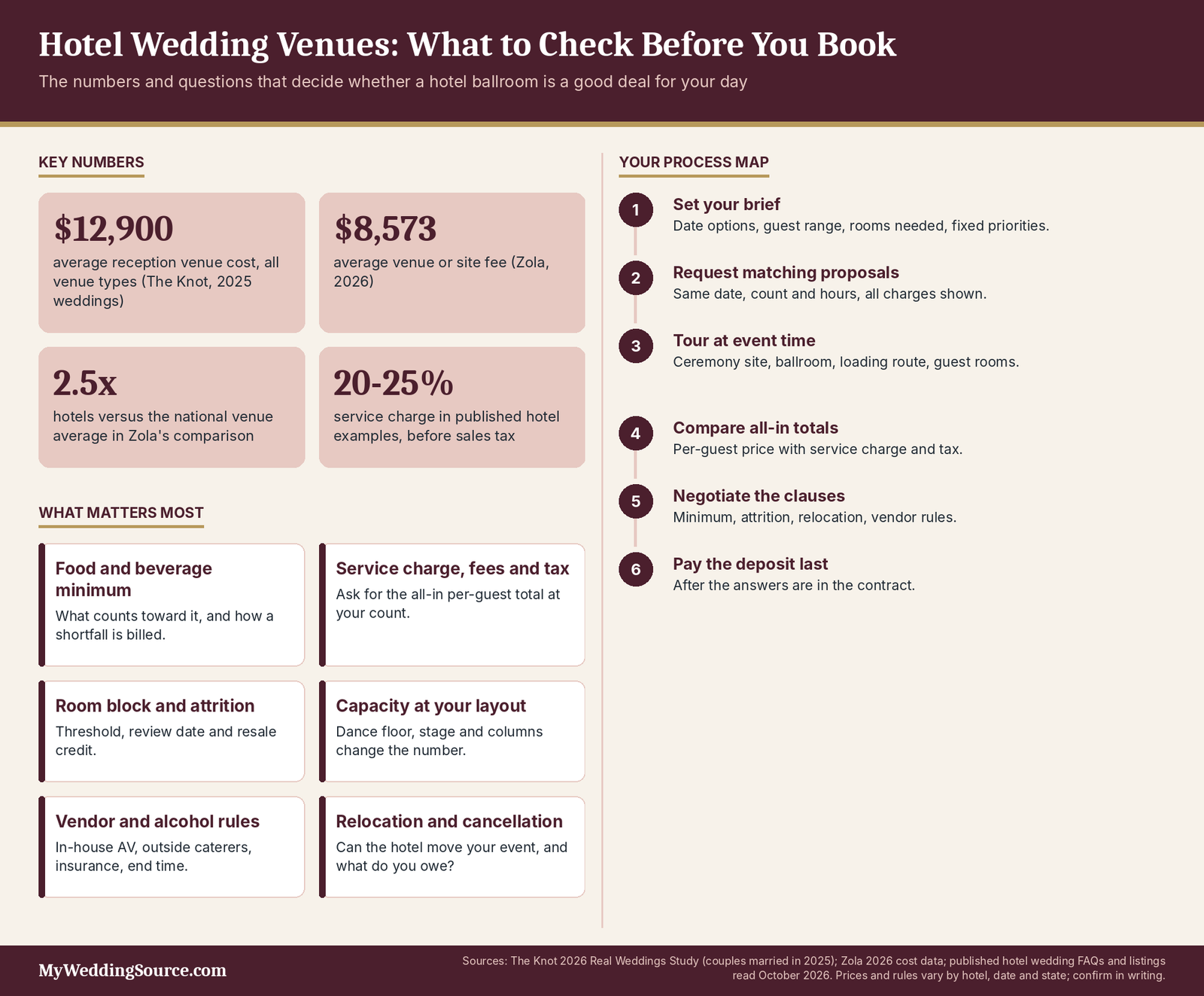
The Knot’s 2026 Real Weddings Study, which surveyed 10,474 U.S. couples married in 2025, reported an average total wedding cost of $34,200, an average guest count of 117, an average reception venue cost of $12,900 and an average catering cost of $80 per person. The Knot’s reception venue cost page (updated May 2026) breaks the venue figure down by guest count: about $6,500 for weddings with 1 to 50 guests, $10,400 for 51 to 100 guests and $16,000 for 101 or more guests.
The same page reports that 74% of couples’ reception venue fees included rentals, 41% included catering, 37% included alcohol and 7% covered the space only. These numbers describe all venue types together and do not separate hotels, so they are a starting yardstick and not a hotel price.
What does Zola’s 2026 data say, and what about hotels?
Zola’s 2026 cost data, updated in March 2026, reports an average total wedding cost of $36,000, an average venue or site fee of $8,573 with a typical range of $6,900 to $10,300, and an average catering cost of $6,927 with a typical range of $5,500 to $8,300. Zola also notes that hotels cost about 2.5 times the national venue average, which by our arithmetic implies roughly $21,000, though Zola’s article does not state a dollar figure for hotels, and it describes barns and outdoor gardens as lower-cost venue types.
Treat the multiple as a signal that hotels sit in the higher part of the price distribution for the space-plus-service package, not as a price you will be quoted. The two studies use different definitions, and The Knot’s $12,900 and Zola’s $8,573 should not be mixed in a single comparison.
Why do venue numbers and hotel quotes look so different?
A national venue figure answers one question, which is how much couples paid for the place, while a hotel quote answers another, which is how much the place, the dinner, the bar and the staff will cost together. When a hotel quotes $189 per person, that number may include a dinner, a multi-hour bar, cake service, linens and standard rentals, which the national data would have split among venue, catering, bar and rentals. The comparison that matters is therefore your total for the same package of things at each venue, not the headline fee.
When you compare a hotel to a barn or a garden, add the catering, bar, rentals, staffing and coordination the other venue leaves out, as our wedding venues guide explains.
What does per-person pricing look like in published hotel examples?
Published figures vary widely, which is the point of looking at several. The Knot’s hotel wedding guide quotes a Hilton South Florida caterer who says fully catered weddings at the venues she oversees generally run $120 to $160 per person.
A Michigan hotel’s 2026 Friday and Sunday package starts at $109 per person plus a 24% taxable service fee and 6% sales tax, a Pittsburgh boutique hotel’s listing shows packages from $189 per person with a 24% service charge, and a third-party summary of a Dallas luxury hotel’s wedding pricing reports food and beverage packages from $219 to $299 per guest in 2025. The spread reflects city, day of the week, brand tier, bar hours and what is bundled, and it is a good reminder that a national average cannot stand in for a quote.
How do location, day and season change the price?
How much does the state or city matter?
Geography moves the venue number more than almost any other factor. The Knot’s 2026 state data shows average reception venue costs ranging from $3,770 in Wyoming and $4,020 in Idaho to $21,300 in New York and $27,710 in New Jersey, with California at $15,310, Texas at $9,520 and Florida at $12,510. Those are all-venue averages by state of wedding, not hotel prices, and big-city hotels sit well above the state figure in most markets. Use the state number to sanity-check whether a quote is in the right neighborhood for your region, then ask the hotel’s catering office for the current wedding rate card for your date.
Do Friday, Sunday and weekday dates cost less?
Often they do, and published examples show it. The Michigan hotel’s 2026 Friday and Sunday package is offered only on select Fridays and Sundays, and a Pittsburgh boutique hotel’s listing shows food and beverage minimums of $20,000 to $30,000 that vary by day of the week and time of year. An Indianapolis hotel’s wedding FAQ says the food and beverage minimum varies by room, date, time and season. If your guest list can handle a Friday evening, a Sunday celebration or a weekday brunch, ask for the minimum on each, because a lower minimum can matter more to your total than a lower per-person price.
How does season change the minimum and the room rate?
Peak wedding months and local events raise both the food and beverage minimum and the guest-room rate, while off-peak months can bring negotiating room. Hotels set room rates by demand, so a block in the same city can cost far more on a weekend with a convention, a marathon or a football game than on an ordinary weekend.
Ask the catering manager what dates in your preferred month are already holding large groups, and ask the sales office to quote the block rate for each candidate date, since a date that is $2,000 cheaper on the food side can cost your guests more on the room side. Our Labor Day travel seasonal check shows how holiday weekends shift travel costs and crowding.
What do published hotel examples add up to?
The table below collects published figures from the examples we read in October 2026. They are single properties, often from marketing pages or third-party summaries, so they illustrate how structures differ and are not a price list. Where a source did not state a number, the table says so.
| Property and source | Published figures | Service charge and tax | Notes |
|---|---|---|---|
| Hotel Crescent Court, Dallas (Tulle summary of a couple’s PDF, Oct 2025) | $30,000 F&B minimum for 120 guests; $3,500 room rental; $4,000 ceremony fee | 25% service charge and 10% event fee (both taxable) plus 8.25% sales tax | Third-party summary; planner and liability insurance required |
| Hotel Monaco Pittsburgh (Here Comes the Guide listing) | $20,000 to $30,000 F&B minimum; packages from $189 per person; $2,000 ceremony fee | 24% service charge | Rooftop adds $3,000 to $6,000 on Fridays and Saturdays |
| Royal Park Hotel, Rochester, MI (2026 Friday and Sunday package) | From $109 per person ++; complimentary wedding-night stay | 24% taxable service fee and 6% sales tax | F&B minimums apply but no amount is stated |
| The Cliff House (resort FAQ, undated) | About $85 per person catering minimum for an evening reception | 20% service charge plus 9.03% sales tax | 25% deposit, $500 of it non-refundable |
| South Florida Hilton venues (caterer quoted by The Knot, Oct 2025) | $120 to $160 per person fully catered | Not stated | One caterer’s general range, not a rate card |
How Do Food and Beverage Minimums, Service Charges and Taxes Stack Up?
The most common surprise in a hotel proposal is not an exotic fee. It is the ordinary arithmetic of a minimum, a service charge and a tax rate, each applied to the one before it. Pricing here is complicated rather than shady: hotels train their sales staff to quote a per-person number because it is easy to compare, and the add-ons are standard line items in the hospitality business. Your job is to turn the per-person number into a total for your date and guest count before you fall for it.
How does a food and beverage minimum work?
What is a food and beverage minimum?
A food and beverage minimum, often written F&B minimum, is the least amount you agree to spend on food and drink in the space you have reserved, and it is often what secures the room. A Colorado resort’s wedding FAQ describes its catering minimum as covering hors d’oeuvres, salad, entree, dessert and bar, with an estimate of about $85 per person for an evening reception. An Indianapolis hotel’s FAQ describes the minimum as the spend that guarantees the event space and says it varies by room, date, time and season.
In practice the minimum is a floor, so a package that costs more than the minimum simply meets it, and room rental is often waived or included once the floor is met.
What counts toward the minimum, and what does not?
The usual rule is that taxes, service charges, rental fees and sometimes labor fees sit on top of the minimum and do not count toward it. The Dallas hotel example reported by Tulle describes a $30,000 minimum for a 120-guest reception that excludes rental fees, taxes and service charges, which means the spend that satisfies the minimum is food and beverage before those add-ons. Ask for a written list of what counts, including whether the cake, a tasting, the late-night snack, bartender fees and corkage or cake-cutting fees apply.
If a line you plan to buy does not count, your effective minimum is higher than the number on the first page of the proposal.
What happens if you spend less than the minimum?
Contracts commonly bill the shortfall as a room rental fee. The Indianapolis hotel’s FAQ says any shortfall is billed as a room rental fee that is subject to service fees and taxes, which is a good illustration of why a gap can cost more than the gap itself. In an illustrative example, not a quote, a $20,000 minimum with a 24% service charge and 8% tax and only $17,000 of actual spend produces a $3,000 shortfall that becomes about $4,018 after the same charges.
That is money spent on nothing, so if your guest count is near the edge, ask whether the minimum can be lowered, whether it falls by guest count or whether you can add an event, such as a welcome drink hour, to use it.
Can the minimum be negotiated?
Sometimes, and the leverage comes from date flexibility more than from persuasion. Minimums often vary by day and season, as the Pittsburgh and Indianapolis examples show, so a Friday or Sunday date can lower the number before any negotiation begins. Other levers include booking a smaller room, combining the ceremony and the reception in one space to avoid a second fee, agreeing to a block of guest rooms in exchange for a lower minimum, and asking whether the hotel will count a rehearsal dinner or a farewell brunch toward the total.
Hotels have different rules, so ask what they can adjust and in what order, and get any change reflected in the contract rather than in an email.
What do service charges, event fees and taxes add?
How large is the service charge?
Published hotel examples show service charges between 20% and 25%. The Colorado resort lists 20%, the Pittsburgh boutique hotel lists 24%, the Michigan hotel lists 24% taxable and the Indianapolis hotel’s FAQ lists 24% on top of the minimum and says it cannot be discounted. The Dallas luxury hotel example lists 25% plus a separate 10% event fee. The percentage usually applies to food and beverage and sometimes to rentals and labor, so ask what it applies to, whether it is a gratuity for the team or an administrative fee that the hotel keeps in part, and whether any additional tip is expected.
Is the service charge taxed, and is it a tip?
It depends on the state and on how the charge is described. The IRS treats a mandatory charge as a service charge and not a tip: under Revenue Ruling 2012-18, a payment counts as a tip only if it is free from compulsion and the customer controls the amount, so an automatic percentage is a service charge and is treated as wages for payroll purposes. State sales tax treatment varies.
A Texas administrative rule effective in 2007 treats reasonable mandatory gratuities as non-taxable if they are separated from the meal price, identified as a gratuity and paid to qualified employees, while the Dallas hotel example reports that the service charge there is taxable. A Virginia Tax Commissioner ruling from 2015 concluded that mandatory gratuities were taxable only to the extent they exceeded a 20% limit. These are different rules in different places, which is why the contract should state whether the charge is taxed, and you should confirm with the hotel and, if needed, a tax professional.
What do the percentages add up to?
A stack of percentages compounds. The Dallas hotel example estimates that its 25% service charge, 10% event fee and 8.25% sales tax add roughly 35% to 40% to base catering and rental charges, and a simple model with a 24% service charge and 8% tax, in which tax applies to the service charge, multiplies the food and beverage subtotal by about 1.34. That means a $185 per-person package becomes roughly $248 before any optional items. When you compare two hotels, ask each to show the per-person price with all mandatory charges included, which is the number to place side by side.
How do other mandatory charges show up?
Look for labor and setup charges that appear outside the percentage stack. Published examples list bartender fees of $200 each at one bartender per 75 guests, chef attendant fees of $200 each for stations, a $250 exit cleanup fee, a $50 driver gratuity for a getaway car and a $2,000 to $4,000 ceremony fee. Not every hotel charges these, and some include them in the package, so ask for an itemized list that shows labor, ceremony, cake service, parking, security, coat check and AV. A short list now is easier than a long invoice later.
What does an illustrative 120-guest hotel quote look like?
The table below builds one illustrative Saturday quote step by step, using assumed rates drawn from the range of published examples. It is an example of structure, not a quote or a price for any property. Assumptions: a $185 per-person package for 120 guests, a $20,000 food and beverage minimum that the package meets, a 24% service charge on food, beverage and bartender fees, an 8% sales tax on everything shown, a $2,000 ceremony fee, a $1,200 in-house AV package, a late-night snack at $12 per guest and two bartenders at $200 each.
| Cost layer | What it covers | Amount |
|---|---|---|
| Sticker price | $185 per person x 120 guests | $22,200 |
| Required extras | Service charge (24%) on food, beverage and bartender fees | $5,770 |
| Required extras | Ceremony fee | $2,000 |
| Realistic extras | Late-night snack ($12 x 120), two bartenders, in-house AV | $3,040 |
| Taxes | 8% sales tax on all lines above | $2,641 |
| All-in estimate | About $297 per guest | $35,650 |
The result is about 61% above the sticker price, which is why the single most useful sentence in a hotel tour is “please show me this at my guest count with all mandatory charges.”
What Do Hotel Wedding Packages Include, and What Do They Leave Out?
Packages are the reason hotels feel simple, and they are also the reason two quotes can be impossible to compare. A package is a bundle of choices the hotel has already made for you: a number of courses, a bar tier, a set of linens and a timeline. The skill is reading the inclusion list the way you read an ingredient list, with an eye to what is absent as well as what is there.
What do hotel wedding packages usually include?
What does the food and bar portion usually cover?
Most packages bundle passed hors d’oeuvres, a multi-course dinner, cake service, coffee and a bar of a stated length. The Pittsburgh boutique hotel’s listing describes a five-hour open bar, passed hors d’oeuvres, a three-course dinner with your cake, waived cake-cutting and cookie-plating fees and a coffee station. The Michigan hotel’s 2026 package lists tray-passed appetizers, a choice of entree, salad, rolls, a starch and vegetable, coffee and tea and a four-hour premium bar. Bar hours and liquor tiers differ, so ask whether beer and wine only are included, what the call, premium and top-shelf tiers contain, and how the hotel charges when guests order beyond the package.
What rentals, linens and setup are included?
The Knot’s guide says hotels often include venue rental, catering, staffing, tables, chairs, linens, setup and coordination, which fits the pattern in its venue-cost data: 74% of couples’ venue fees included rentals. House china, glassware, standard linens in a limited color range and chairs are usually part of the package, while specialty linens, upgraded chairs, lounge furniture and a custom dance floor are charged separately. Ask to see the standard linen colors and the chair style on the property, and ask what an upgrade costs per item, because the upgrade list is often where a package becomes a budget item.
What perks do hotels commonly add?
A complimentary wedding-night room for the couple is common in the published examples: the Michigan hotel lists a luxury-category room, the Pittsburgh hotel lists a one-night stay in an updated suite, and The Knot lists a similar perk at several resorts. Other perks include a tasting for the couple, a champagne toast, a discounted room rate for guests, a spa credit and an anniversary stay. Perks are real value, but they are not equal, so ask for each one in writing with the room category, the dates it can be used and whether it applies on a Friday or Sunday booking.
How much coordination comes with the package?
Hotel catering managers and banquet captains coordinate the food, the room setup and the timeline for the hotel’s own services. That is not the same as a wedding planner or a day-of coordinator who manages your vendors, your ceremony, your family and your photographer. The Dallas hotel example reports that a professional wedding planner is required, which shows that even a luxury hotel may expect an outside coordinator to carry the non-hotel work. Ask what the hotel’s event manager does on the day, when they leave and who is responsible for your florist, DJ and photographer, and decide early whether adding a planner fits your budget.
What do packages leave out, and how do you compare them?
What upgrades and add-ons push the total up?
The list of add-ons in published examples is long. The Dallas hotel summary lists late-night snacks at $7 to $21 per guest, premium liquor upgrades of $4 to $5 per guest per hour and wine upgrades of $5 to $10 per guest per hour. Other common add-ons are chef-attended stations, a champagne toast, specialty cocktails, a cocktail-hour upgrade and a dessert display. None of these is unreasonable by itself. The issue is that each one lands in the service-charge-and-tax stack, so a $10 per-person upgrade costs closer to $13 to $14 by the time it reaches the invoice.
Which logistical charges hide outside the package?
Look beyond food. Parking can be a real line: the Colorado resort’s FAQ says valet parking is reserved for hotel guests first and overnight parking costs $15 per vehicle per night, and the Salem hotel’s FAQ notes that its parking lots are free but not guaranteed. Other charges include AV, security, coat check, a ceremony fee, early setup access, a separate room for vendors and a cleaning or exit fee. Add each to your spreadsheet as a separate line, since the total across them can equal the cost of a major vendor.
How do you compare two package quotes fairly?
Ask each hotel to quote the same date, the same guest count, the same number of bar hours, the same ceremony location and the same services, then convert each to an all-in per-guest total. Compare food, bar, ceremony, rental, labor, AV, parking and guest-room perks in separate columns so a lower package price is not hiding a higher fee elsewhere. This is the apples-to-apples comparison our venue contract hidden costs guide recommends for any venue. A short spreadsheet with six columns is enough, and it turns a gut feeling about “who is cheaper” into a number.
What should a package proposal and a banquet event order show?
A good proposal lists the date, the room, the start and end times, the guest count, the menu, the bar package, the fees, the deposit schedule and the cancellation terms. After the contract is signed, hotels usually produce a banquet event order, sometimes called a BEO, which lays out the plan for each event in detail. Ask for a sample BEO from a recent wedding with the personal details removed, since it shows how the hotel thinks about setup times, who delivers the cake, where the DJ plugs in and which charges apply on the day.
If the hotel does not use that term, ask what document their kitchen and banquet team work from.
How Many Guests Will a Hotel Ballroom Really Hold, and How Should the Room Be Laid Out?
A capacity number on a hotel’s website is a maximum for a defined layout, usually without a dance floor, stage or buffet. The room you can comfortably use for a wedding with a band, a head table and a dance floor holds fewer people than the number that sells the room. The difference is a design question and a safety question, and it is worth settling with a floor plan, not a brochure.
What does a capacity number actually mean?
What is the difference between a capacity chart and fire code?
A capacity chart is the hotel’s own planning tool and lists how many guests fit in a room in styles such as banquet rounds, theater, reception and classroom. Fire and building codes set a separate occupant load for the space, which the fire marshal or building department enforces. The International Building Code uses floor-area factors for assembly spaces, such as about 15 net square feet per person for tables and chairs, about 7 for chairs only and about 5 for standing, and it requires the occupant load of an assembly room to be posted near the main exit.
A hotel’s seated capacity and its legal occupant load are separate numbers, so ask for both and ask where the occupant load sign is posted.
How does capacity change with the format?
The same room holds different numbers depending on how you use it. The Pittsburgh boutique hotel’s listing shows indoor capacities of 250 for a seated ceremony, 400 for a standing cocktail hour and 200 for a seated reception, with outdoor capacities of 100, 130 and 90 for the same formats. The Dallas hotel summary lists a ballroom with a 200-guest seated reception capacity and another ballroom that holds 250 for an indoor ceremony but 175 for a reception. Ask for capacity in writing for the format you plan, such as rounds of ten with a 16-foot dance floor, a head table and a DJ, not for the maximum.
Does the ballroom divide, and what does that do to your space?
Many ballrooms are divisible by air walls, which can create smaller rooms for smaller groups. A wall that divides your room from a neighbor’s can transmit sound, so ask which section you would occupy, whether another event will be next door and how thick the wall is. If the ballroom is divided into thirds, ask how the hotel decides which third is yours, and whether you pay for the full room or a portion. A smaller section of a big ballroom can feel intimate or cramped, depending on how the ceiling, the lighting and the carpet are handled.
What if your guest count changes?
Guest counts move after the invitations, and hotels have a guaranteed-count deadline, often a few days before the event, after which you pay for the guaranteed number even if fewer attend. A fall in attendance can leave you paying for empty seats. In an illustrative example, if you guarantee 120 guests at $185 per person and 105 attend, the 15 empty places cost about $3,716 after a 24% service charge and 8% tax, which is money spent on meals no one ate.
Ask for the guarantee deadline in days, whether you can raise but not lower the count, what the overage policy is and whether the hotel sets a few extra meals.
How should the room be laid out?
How do you plan the ceremony, cocktail hour and dinner flow?
Hotels often turn one room into several during the evening, a process called a room flip. The ceremony may be held in a ballroom, the guests move to a foyer for cocktails and the staff turns the ballroom into a dinner space in 45 to 60 minutes. A flip works well when the timeline gives staff enough time and the foyer is large enough to hold cocktails, but it can fail when the cocktail space is small or shared with other guests. Ask how long the flip takes, how many staff do it, where guests wait and what happens when the ceremony runs late.
What about columns, sightlines and the dance floor?
Ballrooms often have columns, low-hanging chandeliers, ceiling soffits or wall sconces that shape what guests can see. Ask for a floor plan with the columns marked, and ask where the head table, band or DJ and dance floor would sit. A dance floor needs more space than many couples expect, and some hotels charge a rental fee for a portable floor or limit its size. If a floor is too small for your guest list, the room feels crowded exactly when you want it to feel lively.
Where do the DJ, the band and the stage go?
The sound setup, the stage and the dance floor take space away from tables, which is the reason capacity drops with a band. Ask for the footprint your entertainer requires and ask the hotel where it would go, how guests would reach the bar and restrooms around it and how load-in works. The kitchen, the bar and the bandstand compete for the same walls and doors, so show the hotel’s event manager your entertainer’s technical rider early.
How do you test a layout before you sign?
Ask the hotel to draw your layout to scale, with tables, a head table, the dance floor, a DJ table, a cake table, a gift table and a photo area, using your estimated guest count plus a small cushion. A diagram on paper reveals whether your real plan fits, and it costs nothing. If the hotel shows you only a stock diagram, ask whether the event manager can produce a custom drawing before the contract is signed, and keep a copy with the contract.
What Ceiling, AV, Lighting and Power Limits Should You Check in a Hotel Ballroom?
A ballroom is built for flexibility, which means its limits are less visible than a barn’s, and they tend to appear in the technical details: how high the ceiling is, where lighting can be hung, who supplies the sound system and how much power is available at the wall. These details shape your decor, your entertainment and your costs, and they are easier to address on a tour than at a load-in meeting a week before the wedding. Hotels differ here, so the examples below show the kinds of rules to ask about rather than the policy at your property.
What are the AV and entertainment rules?
Does the hotel require its in-house AV?
Many hotels keep audiovisual services in-house or with a contracted partner, and some require you to use them for sound, projection and lighting. An event-production blog, AVFX, describes in-house AV as a major profit center for venues and notes that in-house pricing often runs higher, and it recommends asking whether outside AV companies are allowed. A wedding DJ usually brings their own speakers, but the hotel may still charge for a microphone, a projector or lighting in a ballroom. Ask whether outside entertainers can plug into the house system, whether there is a fee for it and whether the hotel needs a technician on site.
What are the union, labor and load-in rules?
Some hotels use union or in-house labor for load-in, rigging and power connections, and may require one hotel worker to accompany each outside crew member. AVFX suggests asking about truck docks, elevator access, the distance from the dock to the room and overtime if the install window starts early or ends late. For a wedding, the same principle applies to a band’s gear, a florist’s large installations and a rental company delivering a dance floor. Ask where vendors enter, when they can arrive, how long they have to set up and whether the hotel charges for elevator or dock time.
How much power is available, and where?
A ballroom has a set number of outlets and circuits, and heavy gear such as lighting, a video wall or a band’s amplifiers can exceed them. AVFX recommends asking how many circuits the room has, whether outside AV can tie into the building’s power connections and whether an electrician is needed. For most weddings, the question can be simpler: where are the outlets, which ones are on the same circuit and who can reset a breaker if a power strip trips? A DJ, a photo booth and an uplighting rental can all draw power in the same corner, so give the hotel your vendor list early.
What sound limits apply?
Some hotels set sound limits for the ballroom to protect guests in nearby rooms, and some require music in outdoor spaces to end earlier than indoor music. The Cliff House FAQ states that a DJ or band in its ballroom requires 10 sleeping rooms to limit noise complaints, and The Knot’s hotel guide notes that outdoor spaces at hotels often have curfews and limits on audiovisual services. Ask about decibel limits, whether the hotel uses a sound monitor and what the hotel does if a guest complains. If the answers differ for your ceremony site and your reception room, get both in writing.
How do ceiling, lighting and decor rules shape the room?
How high is the ceiling, and what can you hang?
Ceiling height and the type of ceiling decide whether you can hang florals, draping, lights or signs. A Chicago hotel’s published rigging sheet, for example, lists a 29-foot ceiling in its grand ballroom, allows only certified hang points on a permanent grid, requires a rigging plot at least 21 days before load-in and charges extra for late requests. That is a convention-level example, and most wedding ballrooms will have simpler rules, but the principle holds: anything overhead usually needs approval and may need a licensed rigger. Ask for the ceiling height at its lowest point, whether you may hang anything, who must do it and what the lead time is.
Can you use candles, uplighting and open flame?
Fire codes limit open flames in assembly spaces, and hotels often set their own candle policy, such as flameless candles only or candles enclosed in glass. Uplighting is often permitted but may require a hotel-approved vendor or a certificate of insurance. Ask what the policy is for candles, sparklers, cold sparks, fog and haze machines, since these affect smoke detectors and sprinklers. The safest approach is to describe your plan to the events manager and get the answer in writing, which also protects your florist and lighting vendor from a day-of surprise.
What decor can you bring, attach or remove?
Hotels often restrict taping, nailing or attaching items to walls, columns, ceilings and carpet, and may require that decor be removed at a set time after the event. Ask about confetti, petals, glitter, rice, balloons and large installations, since cleaning fees apply in many properties. If you plan signage, a flower wall or a welcome sign in the lobby, ask who approves it and whether the lobby is a shared space. A quick sample list of allowed and disallowed decor is common, and asking for it early saves your florist a lot of redesign.
Can you use the hotel’s Wi-Fi or stream the ceremony?
If you plan to stream the ceremony for guests who cannot travel, ask about Wi-Fi capacity in the room and whether a dedicated line is available. Hotel Wi-Fi is often designed for light use by guests and may be throttled in a ballroom, and a streaming vendor may need a wired connection. Cell service inside a large hotel can also be uneven in basements and interior ballrooms. Ask whether the hotel has a business-class line for events, what it costs and whether the IT staff can be on call, since a dropped stream is a bigger problem than a missing decoration.
Which Vendor, Catering and Alcohol Rules Apply at a Hotel Wedding?
The flexibility to bring your own vendors is where hotels differ most from blank-slate venues, and the rules are usually in the contract’s vendor section. Some hotels allow any licensed, insured vendor, some require you to choose from a preferred list and some require in-house catering and bar for everything. The practical question is not whether the hotel has rules but whether the rules fit the team you want to hire.
Which vendors can you bring?
What is the difference between preferred and required vendors?
A preferred vendor list is a set of vendors who have worked at the property and know the load-in, and you may or may not be required to choose from it. The Cliff House FAQ says its preferred vendor list is optional, while the Indianapolis hotel’s FAQ says outside vendors must be licensed businesses with proof of insurance. WedInspire notes that hotel packages may require using the hotel’s or in-house suppliers, so check the contract for exclusivity language. A required vendor list can be a fair arrangement when it improves coordination, but it should be disclosed before you sign.
What insurance and paperwork do outside vendors need?
Hotels commonly ask outside vendors for a certificate of insurance naming the hotel as an additional insured, and some require it for vendors who bring gear into the building. The Dallas hotel summary reports that the couple must carry liability insurance and that all vendors must be insured. Ask for the hotel’s required coverage amounts, the deadline for certificates and whether your vendor’s existing policy is enough. A photographer or DJ who works at hotels regularly will have a process, while a friend who is a hobbyist may not, so factor that in when you decide who to hire.
What about photographers, florists and bakers?
Photographers need access to public spaces, guest rooms and sometimes the roof, and the hotel may limit where lights and tripods can be used. Florists need delivery windows and elevator access, bakers need refrigeration and a place to deliver cake, and some hotels charge a cake-cutting or plating fee when the cake comes from outside, as WeddingWire’s venue question list mentions. The Pittsburgh listing says cake-cutting and cookie-plating fees are waived in its package, which shows how a fee can turn on or off depending on the booking. Ask the hotel about access times for portraits, and ask your photographer which public areas they plan to use.
Can you bring an outside caterer?
In most hotels the answer is no for the main meal, since in-house catering is the core business. The Indianapolis hotel’s FAQ says outside caterers are allowed only for ethnic cuisine the venue does not provide, only from its preferred ethnic vendors, and that the food and beverage minimum still applies. Some hotels make exceptions for cultural, religious or dietary needs, such as a kosher or halal meal, or for a dessert from a family bakery, and the exception often carries a fee. If an outside caterer is important to you, ask about the exception policy before you tour, and ask what the hotel charges for kitchen access.
How do alcohol and special diets work in a hotel?
Can you bring your own alcohol?
Usually not. The Hawthorne Hotel’s FAQ states that alcoholic beverages may not be brought into the hotel by a client or guest because of state liquor laws, and that alcohol consumed in guest rooms must be purchased through catering or the hotel’s restaurants. Liquor licensing varies by state, so the rule at your hotel may differ, but hotels that hold a liquor license are generally responsible for the alcohol served on the property. If a signature bottle or a family wine matters to you, ask whether a corkage fee applies and what it covers, and expect the answer to be no in many places.
How are the bar and the bartenders priced?
Hotels price bars by package, by consumption or by the hour. The Hawthorne FAQ describes open and cash bar options, with open bars charged by consumption or flat hourly rate, and notes that prices include staffing fees, taxes and gratuity, while the Dallas example lists bartenders at $200 each, one per 75 guests. Ask which model you are quoted, what the overage policy is on a consumption bar and whether the bar closes at a set time. A tab-based bar gives control and a flat package gives certainty, and the right choice depends on how your guests drink.
How do hotels handle allergies and dietary needs?
Hotel kitchens serve many events and are usually used to handling dietary requests, but the process matters. Ask how the kitchen records allergies, how meals for guests with restrictions are plated and labeled, who the contact is on the day and whether the chef will meet with you. For guests with serious allergies, the hotel’s food and beverage staff can explain preparation but cannot offer medical guarantees, so guests should use their own judgment and speak to the staff directly. A written list of allergies, sent with the guest-count guarantee, helps the kitchen plan.
How do cultural and religious menus work?
Menus for kosher, halal, vegetarian, vegan or other traditions may require a different kitchen, a certified caterer or a particular preparation process. Some hotels have relationships with certified providers, and some allow an outside certified caterer to work in the kitchen under specific conditions. Ask early, since a hotel’s standard menu may not meet the standard your family expects, and this is the area where an exception policy matters most. If your tradition has requirements for the ceremony, such as a canopy, an officiant or a space layout, ask the hotel’s events team whether the ballroom can accommodate them and what the room-flip schedule allows.
How Do Room Blocks and Attrition Work at a Hotel Wedding?
A room block is the part of a hotel wedding that is most likely to surprise you, since it is a separate contract with its own risk. The hotel holds a set of rooms at a negotiated rate for your guests, and in exchange it wants some assurance that the rooms will be filled. The details decide whether the block is a free convenience or a financial liability, and this section covers the hotel-specific points, with our dedicated guide to wedding room blocks going deeper on the guest side.
How do room blocks work?
What is the difference between a courtesy block and a contracted block?
A courtesy block, sometimes called an open block, holds rooms at a group rate without a financial commitment, and unbooked rooms return to the hotel’s inventory at the cutoff date. A contracted block, sometimes called a closed or guaranteed block, commits you to a minimum number of rooms in exchange for better rates and perks, with a penalty if the guests do not book. Beach Bride’s guide describes a courtesy block as having no deposit, no attrition clause and no financial risk, and describes a contracted block as unlocking comp rooms, better rates and perks, but carrying attrition liability.
EventPipe suggests starting with a courtesy block for most weddings and reserving contracted blocks for destination events with strong travel commitment.
How big should the block be?
Count the out-of-town guests and divide by two as a high estimate, since many travel as couples or families and some book elsewhere. EventPipe and A Practical Wedding both suggest this approach, and EventPipe adds that most hotels require about 10 rooms to qualify for group rates, with a block making sense when there are roughly 15 or more out-of-town guests in a market with limited hotel supply. Start smaller than you think, and ask whether rooms can be added later if demand is strong. A block that is too large creates risk, while one that is too small sends guests to full-price rooms.
What cutoff date and rate should you expect?
The cutoff date is the day unbooked rooms return to the hotel, and rates after the cutoff are usually higher. Beach Bride reports that cutoffs for contracted blocks commonly fall 30 to 60 days out and that discounts usually run 5% to 20% off the public rate for blocks of 10 or more rooms, while EventPipe cites group discounts of 10% to 40%. These are blog estimates and not guarantees, so ask for your property’s rate and what is included, such as taxes, parking and breakfast.
A Practical Wedding suggests asking whether the group rate is inclusive of taxes and fees, whether there is a minimum stay and whether rooms can be added later.
Do you get anything for filling the block?
Some contracted blocks earn complimentary rooms. Beach Bride reports a common ratio of 1 comp room per 10 rooms booked, while A Practical Wedding says ratios of 20:1 or 25:1 are common for blocks of about 20 or more rooms. A hotel-specific example from a state agency’s contract addendum shows one free room for every 50 reserved room-nights, which illustrates that ratios vary by contract and negotiating power. Ask for the comp formula in writing, ask when comps are credited and whether room-nights or rooms count.
How does attrition work, and how do you reduce the risk?
What is an attrition clause?
An attrition clause requires you to fill a minimum share of the rooms you reserved, and if you do not, you pay a penalty covering the hotel’s lost revenue on the unused rooms. Joy’s glossary says most contracts set the minimum between 75% and 90% of the block, with 80% the most common, and that penalties can be percentage-based, revenue-based or sliding-scale. Joy gives an example: a 30-room block at $200 per night with an 80% threshold requires 24 rooms, so 20 rooms filled leaves a shortfall of 4 rooms, or $800 before taxes.
The person who signs the contract carries the risk, so read this clause as carefully as the food and beverage minimum.
How do the numbers play out in different scenarios?
The table below shows how threshold, pickup and a resale credit change the bill. Scenario A is Joy’s published example. The others are illustrative arithmetic using an assumed $200 nightly rate and are not quotes.
| Scenario | Block and threshold | Rooms picked up | Shortfall and possible charge |
|---|---|---|---|
| A: Joy example | 30 rooms, 80% (24 required) | 20 | 4 rooms, $800 before tax |
| B: Lower threshold | 30 rooms, 70% (21 required) | 20 | 1 room, $200 |
| C: Resale credit | 30 rooms, 80% (24 required), hotel resells 3 | 20 plus 3 credited | 1 room, $200 |
| D: Two nights | 30 rooms x 2 nights = 60 room-nights, 80% (48 required) | 40 room-nights | 8 room-nights, $1,600 |
Which attrition terms can you negotiate?
Joy suggests asking for a lower threshold such as 70% instead of 80%, a review date two to four weeks before the cutoff so you can release unneeded rooms, a resell credit and a smaller starting block. Beach Bride adds cumulative calculation across nights instead of per-night, stepped reductions and a housing audit clause, and lists red flags such as personal liability for the full room rate instead of the shortfall, no force majeure clause and a prepayment or credit-card hold on the entire block.
A trade-publication article on hotel contracts points out that attrition and cancellation clauses should work together and both should include a resell clause. Ask for these terms before you sign, and if the hotel will not move on any of them, consider a courtesy block.
How do you track pickup and communicate with guests?
EventPipe recommends putting the hotel name, booking link and cutoff date in the save-the-date and on the wedding website, then sending reminders at 30 days and 14 days before the cutoff and reviewing the first 48 hours of bookings after each message. Request the rooming list one to two weeks before the cutoff, and ask the hotel to send you weekly pickup reports. If pickup lags at the three-week mark, you have time to send targeted reminders, request a reduction or release rooms under the review-date clause. Treat the block like a small project with a date, a dashboard and an owner.

How Do the Bridal Suite, Guest Rooms and Parking Shape the Guest Experience?
The reason many couples choose a hotel is that guests can walk from the ballroom to bed, and the bridal party can get ready a few floors above the ceremony. That convenience is real, but it depends on details that sound minor on a tour: check-in times, room types, parking rules and the true price of a room once fees are included. Treat these as part of the venue contract, because they determine what the weekend feels like for the people you invited.
What should you ask about suites and getting-ready space?
What does a complimentary night or suite include?
Many hotels include a wedding-night room, and the details vary: the Michigan hotel’s 2026 package lists a luxury-category room, while the Pittsburgh hotel’s listing describes a one-night stay in an updated suite. Ask for the room category, whether breakfast is included, whether late checkout is available and whether the offer applies on a Friday or Sunday booking. A complimentary night is worth the price of a room, but it is not the same as a bridal suite for getting ready, so ask for both if you need both.
Can you get ready in a hotel room, and when does it open?
Standard check-in times can collide with a morning photo schedule, since the Indianapolis hotel’s FAQ lists check-in at 3:00 p.m. and check-out at 11:00 a.m., with early check-in based on availability. If your photographer wants getting-ready shots at 11:00 a.m., ask the hotel to guarantee an early check-in or day-use room in writing, and ask what it costs. Also ask where hair and makeup artists can set up, whether the room has enough outlets and light and whether a second room is available for the other partner’s party.
Where can vendors stage and store things?
Cake, flowers, gift boxes and a band’s cases need somewhere to wait before the event starts. Ask whether the hotel offers a vendor room, a cold-storage space and a secure place for gifts and cards, and whether those carry a fee. The planner perspective in a hospitality-training blog lists on-site tables and chairs, built-in sound equipment, ample parking and discounted guest rooms among the features planners look for in a hotel, which is a decent checklist for your tour. A hotel with a back room for deliveries and a freight elevator makes your vendors’ day easier.
How does the hotel help or complicate things for guests?
What do guests actually pay for a room?
The group rate is only meaningful if it is the total price. The Federal Trade Commission’s rule on unfair or deceptive fees, effective May 12, 2025, requires businesses that advertise short-term lodging, including hotels, to disclose the total price including mandatory fees upfront, with taxes and government charges allowed to be shown separately. The FTC’s staff guidance does not directly address banquet space or group room blocks, so do not assume the rule resolves your contract, and ask the hotel to state the all-in nightly price, including resort fees, parking and taxes.
A Practical Wedding’s list of block questions includes whether the rate is inclusive of taxes and fees, whether parking has in-and-out privileges and what amenities are standard.
What about parking, shuttles and breakfast?
Parking is a surprising line item. The Colorado resort’s FAQ says overnight parking costs $15 per vehicle per night, and that valet is reserved for hotel guests first, while the Salem hotel’s FAQ says its lots are free but not guaranteed and recommends valet. Hotels also offer perks that you can negotiate, such as shuttle service, welcome bag delivery, late bar and brunch space, which A Practical Wedding lists along with a typical $2 to $4 per-bag delivery fee that you can ask to have waived. Pick two or three perks that matter to your guests, and ask for them in the contract.
Who gets which rooms?
Room types and placement matter more than most couples expect. A Practical Wedding suggests matching the room mix to your guest list, with doubles for friends and families sharing and king or queen rooms for couples, and requesting rooms on different floors so groups are not stacked on top of each other. Ask the hotel to reserve a few accessible rooms in the block, a few rooms near the elevator for older guests and a quiet floor for families with babies. A short guest guide that lists room types and prices on your wedding website reduces the number of calls you handle.
How do you make the weekend easier for out-of-town guests?
Put the hotel name, booking link, cutoff date and check-in time on the website, and tell guests whether the ceremony is in the same building. Include the shuttle schedule, parking instructions and a phone number for the hotel’s group sales contact. If guests will travel from far away, consider a second, lower-priced hotel option, since a single price point can exclude people. Our November wedding checklist shows what to confirm with the hotel in the final 30 days.
How Accessible Is a Hotel Wedding Venue for Guests With Mobility, Hearing, Vision or Health Needs?
Hotels are covered by federal accessibility law and often have better access than older venues, but a ballroom wedding adds places where access can fail: a stage with steps, a dance floor with a lip, an outdoor ceremony site across a lawn or a back-of-house route used by staff only. Accessibility works best as a set of specific questions, which is why our guide to accessible wedding venue red flags goes deeper, and this section covers the hotel angle.
What does the law say about hotels?
Are hotels covered by the ADA?
Yes. The Department of Justice’s Title III primer lists hotels among the places of public accommodation, which also include stores and restaurants, and says covered businesses must modify policies when necessary, communicate effectively, remove barriers in existing buildings and build or alter facilities to be accessible. The primer says that local grandfather provisions do not exempt businesses from ADA obligations. That does not mean every route in a given hotel is fully accessible, only that the hotel has legal duties you can reasonably ask about.
What is readily achievable barrier removal?
Existing buildings must remove barriers when that is easily accomplishable without much difficulty or expense, and the obligation scales with the size and resources of the business. The primer lists access from parking and sidewalks, access to goods and services and restrooms among the priorities. For a wedding, this is a practical question: if a ramp, a portable platform or a route change would make the stage or ceremony space usable, ask the hotel whether it can provide it. Do not assume a “no” is final until you have asked for the alternative.
What about service animals and communication needs?
The primer defines a service animal as a dog individually trained to do work or tasks related to a person’s disability and says staff may ask only whether the animal is required because of a disability and what task it is trained to perform. It also says businesses must communicate effectively with guests who are blind, have low vision, are deaf or hard of hearing, or have speech disabilities, with solutions that depend on the situation, including interpreters in some cases. If a guest needs an interpreter, a quiet space or a written program, tell the hotel early so it can plan, and budget for any interpreter you arrange yourself.
Who is responsible for what in a mixed venue?
The hotel is responsible for its building and services, and you are responsible for the choices your vendors and plans create, such as a stage, a photo backdrop or a seating chart that blocks an aisle. A rented dance floor or a temporary stage may fall outside the hotel’s own accessible features. Ask the event manager how those items are handled, and add a line to the vendor instructions that routes must stay clear.
What should you check on the tour?
Can a wheelchair user reach everything?
Walk the route from the entrance and the accessible parking to the ceremony, the cocktail space, the dinner, the restrooms, the bar and the dance floor, using the same elevators guests would. Check door widths, automatic openers, turning space around tables and whether the head table or stage has a ramp. Ask how many accessible guest rooms the hotel has, how they are assigned to a block and what features they offer, such as a roll-in shower or visual alarms. A hotel that answers these questions without hesitation is showing you how it works with other guests.
What about hearing, vision and sensory needs?
Ask whether the ballroom has assistive listening, what the lighting is like during the reception and whether there is a quiet room. Loud music, strobing effects and fog machines can affect guests with sensory needs, and a small quiet space with water and seating can make a long evening workable. If a guest uses a cane or a guide dog, a clear, uncluttered path and good lighting matter more than decor. Add a sentence on your website asking guests to tell you what they need, and then follow up.
What about older guests and children?
Elevators, benches, a coat check near the entrance and seating near the restrooms help older guests, and a kids’ table or a quiet room helps families. Ask whether the hotel can set up a room for a nursing parent or a nap, and whether a babysitting service is available. These details are rarely in a brochure, but they are inexpensive for a hotel to provide.
How do you document what the hotel promises?
Put accessibility commitments in the contract or in a written addendum, with room numbers or categories where possible. Verbal assurances on a tour are friendly, but they are not enforceable, and staff change. A one-page list of what you asked and what was promised, emailed to the event manager for confirmation, is a good record.
What Do Noise Limits, End Times and Other Events in the Building Mean for Your Reception?
A hotel is a shared building, which is both its strength and its constraint. Your guests may be asleep two floors above the dance floor, another group may be using the room next door and the staff must reset the ballroom for a breakfast the next morning. These realities show up as end times, noise rules and contract clauses that let the hotel move or modify your event.
What time does the party end?
What do published end times look like?
The Indianapolis hotel’s FAQ says outdoor music must end at 11:00 p.m., receptions must end at midnight and event length depends on food and beverage purchases. The Cliff House requires 10 sleeping rooms if a DJ or band plays in its ballroom, to limit noise complaints. The Knot’s hotel guide says outdoor spaces at hotels often have curfews and limits on audiovisual services. Ask for the hard stop for music, bar service, guests and vendors, and whether the hotel can extend by the hour for a fee.
How do last call and cleanup work?
Bars usually close before the music stops, and hotels often require vendors to load out by a set time. Ask when the bar closes, when the lights come up and when the room must be empty, and ask what the overtime charge is. If you plan an after-party in a suite or the lobby bar, ask about the hotel’s noise rules for guest rooms, which are different from the ballroom’s rules.
Can you plan a late-night event?
If you want a late-night dance floor, ask about a later license, a separate lounge or an after-party space, and compare properties on this point. WedInspire notes that smaller hotels may be better for late-night celebrations, while larger hotels have more guests to protect. A hotel with a late bar may require a minimum spend, which A Practical Wedding lists as a negotiable perk.
Who else is in the building, and what can the hotel change?
Will another event share the space?
WeddingWire’s venue question list includes whether other weddings will be held at the same time, and the same question applies to conferences and group blocks. Ask which other events are on the calendar for your date, how the hotel separates guests, where your photos can be taken and whether public areas will be closed to other guests. A large hotel may host two weddings on the same evening with separate ballrooms, and that can be fine when the hotel manages it well.
What happens if the hotel renovates or changes ownership?
Hotels renovate, rebrand and sell, and the work may overlap with your date. A North Carolina state agency’s hotel addendum asks the hotel to report ownership or management changes promptly, to disclose construction during the event and to allow termination without penalty if the work would harm the program. A wedding contract is rarely drafted by a state attorney, but the same questions are reasonable: ask what renovation is planned, whether the hotel will disclose changes and what your remedies are if the space is unusable.
What is a relocation clause?
Some contracts let the hotel move your event to a comparable space if needed, and a meetings-industry article lists relocation of attendees and construction as two of five key clauses to update. For a wedding, a relocation clause could move your ballroom to a smaller room or a different floor. Ask for the right to approve any substitute space, a size and quality standard, a price adjustment and the right to cancel with a refund if the new space does not work.
What if the weather or an emergency interrupts the event?
Hotels may have an outdoor ceremony site with a backup room, and the backup must be agreed in advance. The Indianapolis FAQ says backup space for outdoor events must be blocked and agreed upon. Ask who decides, by what time, and what the backup’s capacity and cost are. A fire alarm, a power outage or a storm can also interrupt a ballroom event, so ask what the hotel’s emergency plan is.
What Should a Hotel Wedding Contract and Insurance Cover?
A hotel contract is usually a package of documents: a banquet or catering agreement, a guest-room block agreement and sometimes a separate ceremony or buyout addendum, each with its own deposit, deadlines and penalties. Hotels draft these documents for hundreds of events, so the language is standard, but standard does not mean untouchable. This section covers the clauses that matter most and the insurance questions that go with them, as general education and not legal advice, since terms and state laws vary. Our guides to wedding venue contract hidden costs and wedding vendor contract red flags cover the general clauses, and the table below focuses on hotel-specific ones.
Which clauses matter most?
How do deposits and payment schedules work?
Published examples show the pattern. The Cliff House FAQ says securing a date requires a signed contract and a 25% deposit based on the facility fee, catering minimum and ceremony fee, with $500 of it non-refundable, while the Indianapolis hotel’s FAQ lists final payment due five business days before the event, and the Salem hotel’s FAQ says the final estimate is due five days before the wedding. Ask what the deposit is, when each payment falls due, what is refundable and what happens to the deposit if you change the date. Add the dates to your calendar the day you sign.
What is the guaranteed count, and what is overset?
The guarantee is the guest count you commit to, usually a few days before the event, and you pay for it even if fewer guests attend. The Salem hotel’s FAQ says the final guest count is typically due the week of the wedding. Ask the exact deadline, whether you can raise the count after the guarantee, how many extra meals the kitchen prepares as a cushion, and whether you pay for the guaranteed number or the actual number if attendance is higher. A $3,716 gap on a 15-guest drop, as in our illustration above, is the cost of a missed deadline.
How do cancellation and force majeure work?
Cancellation clauses usually set a sliding scale of what you owe as the date approaches, and force majeure clauses address events outside both parties’ control. A meetings-industry article advises that force majeure wording should list possible events and that attrition and cancellation clauses should work together. A state agency’s hotel addendum caps cancellation fees at 50% of estimated room, food, beverage and space costs, which shows what a negotiated clause can look like, although a couple will rarely have the same leverage. Ask what you owe at 12 months, 6 months, 90 days and 30 days, and what the hotel owes you if it cancels.
What about price changes and who is liable?
Hotels often say prices are subject to change until the contract is signed and firm afterward, as the Salem hotel’s FAQ does, while the Indianapolis FAQ says the service charge and sales tax are subject to change and cannot be discounted. Ask whether food prices are locked at signing or can rise before the event, and whether a rise in the tax rate passes through. Also read the indemnification and liability clause, which can shift responsibility for guest or vendor damage to you.
Which hotel-specific clauses and insurance questions deserve a second look?
| Clause | What it does | Risk if vague | What to ask |
|---|---|---|---|
| Food and beverage minimum | Sets the floor on food and drink spend | Shortfall billed as rental plus charges | What counts, and can it be lowered? |
| Guaranteed count | Locks the paid headcount | Paying for empty seats | Deadline, ability to raise, overage rule |
| Attrition (rooms) | Penalizes unfilled block rooms | Shortfall billed to the signer | Threshold, review date, resale credit |
| Relocation | Lets the hotel move your event | Smaller or lower-quality room | Approval right, size standard, refund |
| Renovation and ownership | Covers construction or brand changes | Noise, closed amenities, new policies | Disclosure and termination rights |
| Service charge and tax | Adds percentage fees | A bill far above the sticker | Rates, what they apply to, taxed or not |
| Outside vendors | Restricts who can work | Surprise fees or banned vendors | List, insurance, exceptions |
What insurance will the hotel require of you and your vendors?
The Dallas hotel summary reports that the couple and all vendors must carry liability insurance, and the Indianapolis hotel’s FAQ says outside vendors must be licensed businesses with proof of insurance. Hotels commonly ask for a certificate naming the hotel as an additional insured, with minimum amounts. Ask what coverage is required, when the certificate is due and whether a one-day event policy meets the requirement. If you have a homeowner or renter policy, ask your insurer whether it covers a rider for events.
What does wedding insurance cover, and what does it not?
Zola’s wedding insurance guide (updated February 2024) separates cancellation and postponement coverage, deposit coverage if a vendor fails, liability coverage and liquor liability, and it lists common exclusions such as a change of heart, pre-existing conditions and ordinary rain in most policies. The guide also says some states require purchasing at least two weeks before the event for extreme-weather cancellation coverage, and that liability can wait until you know your headcount. Cancellation insurance, event liability, vendor insurance and a hotel’s own coverage are four different things, so ask which one answers each risk.
Who is liable for alcohol and guest injuries?
Zola’s guide says liquor liability may be included in some wedding liability policies or sold separately and that the venue serving the alcohol may be responsible for maintaining it. In a hotel the bar is usually run by the hotel’s licensed staff, so ask who carries liquor liability for your event, whether your policy adds anything and what the hotel’s insurance covers. General education, not legal advice: for a large event, an insurance agent or an attorney can read the clauses with you.
Should you ask a professional to read the contract?
A short consultation can be worthwhile when the numbers are large, the contract is heavily customized or the hotel will not edit key clauses. A planner who has worked at the property can tell you which terms are routine and which are unusual. If you cannot get an edit, ask the hotel to explain the reason in writing, which sometimes reveals a flexible alternative.
How Does a Hotel Compare With Other Wedding Venue Types?
Comparing venue types is mostly a question of what each fee covers and who owns the gaps. A hotel bundles food, staff and lodging, a blank-slate venue such as a barn leaves rentals and restrooms to you and a resort-style package can bundle everything including the stay. The table below sketches the differences in general terms, since prices vary by market and every venue is different.
How do the common venue types differ?
| Venue type | What the fee usually covers | Where costs show up | Good fit when |
|---|---|---|---|
| Hotel ballroom | Space, in-house food and bar, staff, standard rentals | Service charge, tax, F&B minimum, room block, AV | Many out-of-town guests, weather-proof plan |
| Barn or farm | Space, sometimes tables and chairs | Rentals, restrooms, heating or cooling, catering | You want a blank slate and have time to manage it |
| All-inclusive venue | Space, food, bar, often decor and coordination | Upgrades, service charge, tax | You want one bundled price |
| Outdoor or garden | Space and sometimes basic rentals | Tent, rain plan, power, restrooms | You want open air and a flexible layout |
| Restaurant or private dining | Room, menu and staff | Minimum spend, limited layout | Small guest list, food-focused day |
Where does a hotel come out ahead?
A hotel tends to come out ahead when guests need rooms, when weather is a concern or when you want one team to run food, bar and setup. A barn shows the other side, where the rental fee is lower but heating, restrooms, tables and permits can become your line items. The Knot’s study shows that 74% of couples’ venue fees included rentals, 41% included catering and 37% included alcohol, so a hotel that includes all three sits at the bundled end of the range.
Where does a hotel fall behind?
A hotel can fall behind on style flexibility, a late finish, outside vendors and a sense of place. Zola places hotels at about 2.5 times the venue average, which signals that the bundled price is at the higher end, even though it also covers items other venues leave out. Compare per-guest totals, not headline fees.
What about all-inclusive and resort packages?
An all-inclusive venue bundles more, sometimes including decor, a coordinator and lodging, and the price is easier to read. The hotel model usually separates lodging into a room block and charges the guests, while a resort package may include rooms for the wedding party. Our all-inclusive wedding venues guide explains how to compare these packages line by line.
When does a hotel save money, and when does it not?
When does it save money?
It saves money when guests would otherwise need transportation, when the package includes rentals you would have to hire separately and when staff and coordination replace several vendor fees. The Knot’s hotel guide says hotels often include rental, catering, staffing, tables, chairs, linens, setup and coordination, and that costs can drop when guests stay on site because you need fewer shuttles. Price the full list at your alternative venue before deciding.
When does it cost more?
It costs more when the minimum is high for your guest count, the service charge and tax stack on top of everything, and add-ons such as AV, valet and upgrades accumulate. A hotel can also cost more if your tastes require outside vendors or custom decor that the hotel charges to accommodate. A real difference of a few thousand dollars on a $35,000 total is a decision, not a surprise, as long as you saw it coming.
How should you decide?
Make a one-page comparison with each venue’s all-in total at your guest count, then add a column for the things you value, such as guest convenience, weather certainty, style freedom and a late end. The cheapest option is not always the one you will be happiest with, and the most polished one is not always necessary. Decide which of your priorities are fixed, then pick the venue that meets them with the fewest unknowns.
When Should You Book, and What Does the Planning Timeline Look Like?
Hotel dates and room blocks both depend on demand, and the timeline is more compressed than most couples expect, because the food and beverage guarantee, the rooming list and the final payment all land in the last few weeks. Knowing when each piece is due lets you plan a calm month before the wedding instead of a scramble.
When should you book?
How early should you book a hotel?
The Knot’s hotel guide says popular hotels are in high demand, so book early to secure your preferred date. Beach Bride suggests starting room-block talks 12 to 18 months out for peak season and 9 to 12 months for off-peak, while EventPipe suggests 6 to 9 months for standard weddings in moderate-demand markets, which shows that lead times depend on the market. Book the ballroom first, then the block, since the venue contract anchors everything else.
How do dates and local events affect availability?
Large conferences, sports events and holiday weekends fill hotels, so ask what else is in town on your dates. A date that looks open can sit next to a convention, which raises room rates and traffic. Our Labor Day travel seasonal check is a reminder that holiday weekends change both guest costs and availability.
Is a weekday or off-peak date worth it?
If your guest list allows, Friday, Sunday and weekday dates can lower the food and beverage minimum, as the published examples show. Off-peak months may also soften the room rate. The savings are largest when the date is flexible and the guest count is stable, so ask the hotel which dates in your window have the lowest minimum.
What happens between signing and the wedding?
| When | What to do with the hotel | Why it matters |
|---|---|---|
| At booking | Sign the banquet agreement; negotiate minimum, attrition and relocation | Sets the terms for every later step |
| 9 to 12 months out | Decide on courtesy or contracted block; launch booking link | Guests need time to book |
| 6 to 8 months out | Send save-the-dates with hotel details; schedule a tasting | Guests plan travel; menu choices begin |
| 2 to 3 months out | Review pickup; confirm vendor access and certificates | Lets you adjust the block or the count |
| 2 to 4 weeks out | Receive the rooming list; draft the BEO; confirm perks | Catches errors before the final bill |
| Final week | Submit the guaranteed count; pay the final balance; share the schedule | Fixes the bill and the plan |
What can you do in the final month?
Confirm the rooming list, the BEO, vendor load-in times, the room flip schedule, the early check-in and any negotiated perks, and send the guaranteed count by the deadline. Our November wedding checklist lists what to confirm in the final 30 days.
What should you do on the day?
Introduce your coordinator to the banquet captain, hand over a printed timeline and confirm who approves changes and who signs the final bill. Keep the contact number for the hotel’s manager on duty, and ask where vendors can store cases and boxes. A quick walk-through of the room before guests arrive catches a missing chair or a misplaced table.
How do you handle the final bill?
Hotels often prepare an estimated bill before the event and a final invoice after, and the final balance may adjust for overages or changes. The Salem hotel’s FAQ describes refunds or overages going to the credit card used for the final payment. Review the invoice against the BEO, ask about any line you do not recognize and keep a copy for your records.
Which Red Flags and Green Flags Should Shape Your Hotel Decision?
Flags are signals to investigate, not verdicts, and most hotels will show a mix. A hotel that answers pricing questions directly, shows a sample BEO and puts promises in writing is easier to trust than one that avoids the all-in number, although the second may still be workable if the contract fixes the gap.
What are the red flags?
Which pricing red flags matter?
Be cautious when a hotel will not show an all-in per-person total, will not explain what counts toward the minimum, quotes only “plus plus” pricing or will not say whether the service charge is taxed. An unexplained event or administrative fee, a minimum that is much higher than a published example for a similar property and a refusal to itemize labor charges are also worth a question. A hotel may have good reasons, but you are entitled to hear them.
Which contract red flags matter?
Be cautious about personal liability for the full room rate on unbooked rooms, no resale credit, a relocation clause with no standard for substitute space, an attrition threshold above 90%, a short guarantee window and rates that can change after signing. Beach Bride lists personal liability for full room rates, no force majeure and prepayment of the entire block as walk-away signals. A hotel that will not discuss any change to its form is a signal to compare other properties.
Which logistics red flags matter?
Be cautious when you cannot see the actual room, the loading route or the restrooms, when the hotel cannot say who else is in the building that day, when a capacity claim is not backed by a layout and when the end time or vendor rules are vague. A ballroom that cannot hold your layout is a bigger problem than a high price.
What are the green flags, and how do you weigh a mix?
Which green flags build confidence?
A sample BEO, a written all-in estimate, a clear list of what counts toward the minimum, a flexible attrition clause with a resale credit, a named point of contact and a willingness to show a recent wedding setup are all encouraging. So are straightforward answers about service charges and a hotel that tells you what it cannot do before you ask.
How do you weigh a mixed picture?
Rank your priorities and treat the contract items that can cost thousands, such as the minimum, attrition and relocation, as more important than cosmetic ones. If a hotel scores well on convenience but poorly on flexibility, ask whether the weak points can be negotiated. If they cannot, decide whether the strengths are worth it.
When is it time to walk away?
Walk away when the hotel refuses to put key promises in writing, pressures you to sign the same day or cannot explain a major charge. There is almost always another property that can deliver most of what you want with fewer unknowns. Your Plan B is also your negotiating leverage.
What Should You Ask and Look For on a Hotel Tour?
A hotel tour is a sales visit and a due-diligence visit at the same time, and productive tours are planned, since the catering manager is also managing several other couples. Arrive with a short list of questions, ask to see the spaces you would actually use and leave with a written proposal. Our wedding venues guide has general venue questions, and this section is hotel-specific.
How should you prepare for the tour?
What should you send before the visit?
Send your date options, estimated guest count, ceremony plan, bar preferences and room block needs, and ask for a proposal at that count with all mandatory charges. Ask for the sample contract, a sample BEO, floor plans, a rate card for guest rooms and the vendor rules, so you can read them before you arrive.
What should you bring?
Bring a list of priorities, a tape measure or a phone with a measuring app, a notebook and a partner or friend who will notice different things. Photograph the room from the entrance, the head table spot and the dance floor, and record the ceiling height and the location of columns.
What should you do during and after the tour?
| Topic | Ask the hotel | Get in writing |
|---|---|---|
| Price | All-in per-guest total at my count | Itemized proposal |
| Minimum | What counts, and what is the shortfall rule? | Definition in the contract |
| Room | Capacity at my layout, columns, ceiling height | Floor plan and capacity |
| Rooms | Block type, attrition, comps, resale credit | Block agreement |
| Rules | End time, outside vendors, alcohol, decor | Policy list |
| Changes | Relocation, renovation, ownership | Clause and remedy |
| People | Who is my contact, and who works the day? | Named contacts |
What should you look at during the tour?
See the ceremony space, the cocktail area, the ballroom, the restrooms, the bridal suite, the loading route and a sample guest room. Visit at the time of day your event would run, if you can, and check light, noise and traffic. Ask where other events would be and how guests would find the entrance.
What should you ask at the end?
Ask what the next step is, how long the date is held, what the deposit is and whether you can have the contract to review overnight. Ask for the proposal by email with a date it is valid until, and ask what could change the price.
How do you follow up after the tour?
Compare proposals the same day, while the details are fresh, by building the per-guest all-in total. Send follow-up questions in writing, and keep each answer. Once you pick a hotel, ask for edits on the clauses that matter, and pay the deposit only after the changes are in the contract.

FAQ: Hotel Wedding Venues
Cost and booking questions
Are hotel wedding venues more expensive than other venues?
Often the headline total is higher, but the comparison depends on what each venue’s fee covers. Zola’s 2026 data puts hotels at about 2.5 times the national venue average, while The Knot’s 2026 study reports a $12,900 average reception venue cost across all venue types. A hotel’s price usually bundles food, bar, staff, standard rentals and sometimes a complimentary room, so a barn or garden with a lower rental fee can end up near the same total once catering, rentals and coordination are added.
The fair comparison is an all-in per-guest total for the same date, guest count and hours, which our venue comparison section and the wedding venues guide walk through.
What is a typical food and beverage minimum at a hotel?
There is no reliable national figure, and published examples vary by city, room, day and season. A Pittsburgh boutique hotel’s listing shows $20,000 to $30,000 per event, a Dallas luxury hotel’s pricing summary reports $30,000 for a 120-guest reception, and a Colorado resort’s FAQ describes a catering minimum of about $85 per person for an evening reception. Those figures are illustrations of structure and not quotes for your date. Ask the hotel for the minimum on each date you are considering, what counts toward it and what happens if you fall short.
Is the service charge the same as a tip?
Not necessarily. Under IRS Revenue Ruling 2012-18, a mandatory percentage is treated as a service charge and not a tip, because a tip is free from compulsion and set by the customer. Hotels differ on how the charge is distributed, which parts go to staff and which are administrative, and states differ on whether it is subject to sales tax. Ask the hotel to explain what the percentage covers, whether it is taxed and whether any additional gratuity is expected, and ask for the answer in the contract.
Rooms, rules and logistics questions
Do we have to book a room block at a hotel venue?
Most hotels do not require one, though some do. The Knot’s hotel guide notes that one Orlando resort requires a room block, and others offer discounted blocks that start at 10 rooms. A courtesy block carries no attrition risk, while a contracted block can earn better rates or comp rooms in exchange for a commitment, so the right choice depends on how many guests will travel and how certain you are. Ask whether the block is required for the ballroom, and see our room block guide for the guest-side details.
Can we bring our own caterer, DJ or alcohol to a hotel wedding?
It depends on the hotel, and the answers differ by category. Outside alcohol is generally not allowed, as the Salem hotel’s FAQ says, citing state liquor laws, and outside caterers are often limited to exceptions such as a cuisine the hotel does not offer, as the Indianapolis hotel’s FAQ describes. Entertainers and photographers are more often allowed, usually with proof of insurance. Ask for the vendor policy in writing before you tour, and ask what fees apply to outside vendors.
What happens if our room block does not fill?
In a courtesy block, unbooked rooms return to the hotel at the cutoff with no penalty to you. In a contracted block, the attrition clause can bill you for the shortfall below the agreed threshold, as in Joy’s example where 20 of 30 rooms picked up at an 80% threshold left a four-room shortfall of about $800 before taxes. Ask for a lower threshold, a review date and a resale credit, and track pickup weekly. If you are worried about the risk, start with a smaller or courtesy block.
Your Next Steps
The aim of a hotel search is a proposal you can read in five minutes and a contract that matches it. These steps turn the checks above into a short sequence, and none of them needs a commitment.
This week
What should you decide before you contact hotels?
Write down your date options, a guest count range, the format of your ceremony and reception, how many guests will need rooms and which three priorities are fixed, such as an end time, a vendor or an accessible route. Check whether your list leans toward a Friday, Sunday or weekday date, since that can lower the minimum. This one-page brief makes every proposal comparable, and it keeps you from negotiating against yourself.
Which hotels should you contact, and what should you ask for?
Pick two or three properties of the type that fits your list, and ask each for a proposal at the same guest count, date and hours, with every mandatory charge shown. Request the sample contract, a sample BEO, the capacity chart with a layout for your format, the vendor rules and the guest-room rate for your dates. Compare the proposals in a simple spreadsheet and note which questions each hotel answered clearly.
Before you pay a deposit
What should be confirmed in writing?
Get the all-in per-guest total, the minimum and what counts toward it, the service charge and tax treatment, the guarantee deadline, the attrition percentage and resale credit, the end times, the vendor and alcohol rules, the relocation and renovation terms and the deposit and cancellation schedule. Put any perk, such as a complimentary night or a waived fee, in the contract. Save the signed documents and a calendar of every deadline in one place.
What should you do if the hotel will not change a clause?
Ask why, ask whether there is a package or date that offers different terms and ask for the answer in writing. If the clause could cost thousands, such as attrition, relocation or a high minimum, compare another hotel, since the alternative is also negotiating leverage. For a large contract, a short review by an attorney or an experienced planner can be money well spent.
A useful companion piece: Fake Wedding Venue Listing: Warning Signs and How to Verify the Business.
Sources & methodology
- The Knot: The Average Wedding Cost — 2026 Real Weddings Study (10,474 U.S. couples married in 2025): $34,200 average cost, 117 guests, $12,900 reception venue, $80 per person catering.
- The Knot: Average Cost of a Reception Venue — venue cost by guest count and state; 74% rentals, 41% catering and 37% alcohol included (updated May 2026).
- The Knot: Hotel Weddings — hotel pros and cons, Hilton South Florida $120 to $160 per person, room-block minimums, outdoor curfews (updated October 2025).
- The Knot: 2026 Real Weddings Study data read-out (PDF) — 141 average guests for couples spending over $41,000.
- Zola: How Much Does a Wedding Cost — 2026 average cost, $8,573 venue or site fee, hotels at about 2.5 times the venue average (updated March 2026).
- Zola: Wedding Insurance Guide — cancellation, deposit, liability and liquor coverage and exclusions (updated February 2024).
- Joy: What is an attrition clause? — 75% to 90% attrition thresholds, the 30-room example and negotiation points.
- Beach Bride: Destination wedding room block guide — courtesy versus contracted blocks, comp ratios, cutoffs and red flags (blog guidance).
- EventPipe: How to book a hotel block for a wedding — block sizing, timing, reminders and perks to request.
- A Practical Wedding: How to reserve hotel blocks — block types, questions for hotels and negotiable perks (published 2019).
- Tulle: Hotel Crescent Court wedding cost — third-party summary of one Dallas hotel’s pricing, minimum, service charge, event fee and tax (October 2025).
- Here Comes the Guide: Hotel Monaco Pittsburgh — F&B minimum range, per-person packages, ceremony fee, service charge and capacities.
- Royal Park Hotel: 2026 Friday and Sunday wedding package (PDF) — package starting price, 24% service fee and 6% tax.
- The Alexander (Dolce by Wyndham): wedding FAQ — F&B minimum shortfall rule, 24% service charge, vendor and end-time rules.
- The Cliff House: weddings FAQ — catering minimum estimate, service charge and tax, deposit terms, parking and sleeping-room requirement.
- Hawthorne Hotel: wedding FAQ — outside alcohol rule, bar pricing, final payment timing and parking.
- The Tax Adviser: IRS Rev. Rul. 2012-18 on tips and service charges — mandatory charges treated as service charges, not tips.
- Sales Tax Institute: Texas gratuity tax rule — Texas 34 TAC 3.337 treatment of mandatory gratuities (effective 2007).
- Virginia Tax: Ruling of the Tax Commissioner 15-10 — example of a state ruling on taxability of mandatory gratuities (January 2015).
- FTC: Rule on Unfair or Deceptive Fees FAQs — total-price rule for short-term lodging, effective May 12, 2025.
- ADA.gov: Title III primer — hotels as public accommodations, barrier removal, effective communication and service animals.
- ICC: IBC egress guide for Group A occupancies (PDF) — assembly occupant load factors and posting of occupant load (commentary excerpt).
- Meetings & Conventions: Updating important hotel contract clauses — force majeure, attrition, resale and relocation clauses (May 2016).
- UNC School of Government: hotel contract addendum (PDF) — example of negotiated cancellation, attrition, relocation and renovation terms (not a wedding contract).
- AVFX: Avoiding costly event venue pitfalls — in-house AV, labor, rigging, ceiling and power questions.
- Palmer House Hilton: rigging quick sheet (PDF) — one hotel’s rigging rules (2021), used as an example of overhead limits.
- WeddingWire: Questions to ask a wedding venue — venue question list (May 2021).
- Wedinspire: Pros and cons of hotel wedding venues — convenience, package and restriction trade-offs.
- Typsy: What wedding planners look for in a hotel venue — planner criteria such as parking, seating and sound equipment (April 2022).
This article separates four kinds of information. The Knot and Zola figures are survey and platform findings for weddings in 2025 and early 2026; the hotel prices, minimums, service charges, fees and policies are published examples from single properties or third-party summaries, read in October 2026, and are not rate cards or quotes; the 120-guest hotel quote, the $4,018 shortfall, the $3,716 guarantee example and the attrition scenarios other than Joy’s are our own illustrative arithmetic at assumed rates; and the advice on questions, red flags and comparisons is editorial judgment.
We did not find a reliable national dataset on hotel wedding venue costs or typical food and beverage minimums, so we do not state one, and the roughly $21,000 implied by Zola’s 2.5 times comparison is our arithmetic, not a Zola figure. Contracts, taxes, insurance, accessibility and building codes are general education, and terms and state laws vary, so confirm details with the hotel, your state tax agency, local officials, an insurance agent and, where needed, an attorney.
Freshness note: sources were read in October 2026. Recheck The Knot and Zola cost data when their next annual studies publish (typically early in the year), ask each hotel for its current rate card, minimum, service charge and tax treatment for your date, and verify attrition, relocation, vendor and end-time terms in the contract, since hotel policies, brands and local rules change.