

Wedding venue load-in restrictions decide when your caterer, florist, band, and rental crew can reach the room, which door and elevator they must use, and how long they have before guests arrive, so reading them early turns a hidden source of day-of stress into a schedule you control.
Quick answer
Ask the venue to put its wedding venue load-in restrictions in writing before you sign, then check three things on a walk-through: when vehicles may arrive and leave, where they unload and which route the equipment takes, and who is allowed to be in the building at that hour. Published examples include a load-in window of about two hours at one venue, a twenty-minute limit at a dock at another, and written approval for early or late deliveries at a third. Wedding venue load-in restrictions differ from one site to the next, so treat these as examples, copy the numbers that apply to your site into your vendor schedule, and keep the answers in your contract file.
What wedding venue load-in restrictions are and why they matter
A wedding is a temporary production. Tables, linens, flowers, food, speakers, a cake, a photo booth, and sometimes a dance floor all arrive in vehicles, move through a building or across a lawn, and then leave again a few hours later. Wedding venue load-in restrictions are the venue’s rules for that movement. They cover the hours a building will accept vehicles, the entrance vendors must use, the equipment vendors must bring, the insurance they must carry, and what happens to boxes and trash afterward.
Couples often discover wedding venue load-in restrictions late because they live in a vendor packet or a license agreement rather than on the venue’s gallery page. This guide shows you how to find them, read them, test them against a floor plan, and turn them into a schedule your vendors can follow.
Why the rules exist
A venue is a workplace, a neighbor, and a piece of property all at once. Understanding that mix helps you see why a restriction that seems fussy usually has a reason behind it.
Safety and building operations
Vehicles, hand trucks, and people share a small area at a loading dock, and a university safety guide tells people on a dock to stay aware of nearby vehicles, equipment, and other people. Venues also protect floors, elevators, and doors from damage, and some keep dock space free for the building’s other tenants or deliveries.
Neighbors, permits, and shared spaces
Some venues sit in a busy downtown, a historic block, or a residential street where trucks cannot idle at the curb. Others share a loading area with a restaurant, a hotel, or an office. In those places the venue may have limits on vehicle height, parking, and time at the dock that that are hard to change.
Why they matter to your wedding day
A restriction only matters if it touches your schedule, your budget, or a guest’s experience. Wedding venue load-in restrictions touch all three, usually in ways that are easy to fix months ahead and hard to fix on the day.
They set the true length of your vendor day
Your venue booking may say the space is yours from noon, but a florist cannot start work until a vehicle can unload, and a band cannot start a sound check until its equipment is in the room. When wedding venue load-in restrictions limit the hours of access, they also limit how early each vendor can begin, which our guide to the wedding vendor timeline treats as the first line of a backward-planned day.
They create costs you may not have budgeted
Published venue policies show fees for early arrival, late departure, storage, and disposal. One venue lists an hourly charge per event room for vendors who arrive early or stay late, and another lists a minimum fee when materials stay overnight. We cover real examples in the cost section below, and our guide to vendor overtime rates explains how vendors charge when a day runs long.
What venues commonly restrict
No single rulebook applies to every venue, because each venue writes its own. Still, the policies we reviewed for this guide share a family of topics. Knowing the topics lets you read an unfamiliar vendor packet quickly and spot what is missing. A useful habit is to sort every line of a packet into one of the topics below, because wedding venue load-in restrictions that fit no topic are usually a sign you should ask a question.
The topics that show up again and again
When we read published vendor policies from a university alumni centre, two private event venues, and a university program space, the same themes appeared. The details below are examples from those documents, attributed to each venue, and they are not rules for your venue.
Hours and windows
One alumni centre says its front desk is staffed on set hours and that deliveries must be coordinated within them and arrive on the day of the event. It says early or late deliveries are not permitted unless the venue contact authorizes them in writing. Another venue says qualified vendors can load in and set up within two hours and charges an hourly fee per event room for early arrival or late stay. A third restricts pickup to a morning window after the event.
Entrances, docks, and parking
Venues tend to name the door. One requires loading through a specific street entrance and coordinated with staff. Another says vendors load in at the back of the building, never the front door, and may not use valet or front-area parking. A university program space tells caterers to use the dock next to its parking garage and says vehicles left there for more than twenty minutes are ticketed and towed. That page is dated 2013, so it shows the type of rule and should not be read as current.
Insurance and paperwork
Two of the venues ask vendors for a certificate of insurance. One asks for current paperwork a week before setup and expects subvendors to carry their own coverage as well, and it also offers a vendor liability option for vendors who lack insurance. Our guide to wedding vendor subcontractors explains why a vendor’s helpers and sub-hires matter here.
Equipment and carrying
One venue tells vendors to bring their own ladders, dollies, and hand trucks, and says venue staff will not help with loading or unloading. Another describes elevator size, and says tables seven feet or longer do not fit the elevators and must be carried up stairs. Others restrict what may be attached to walls, ceilings, and floors, and require approval before anything is fixed in place.
Trash, strike, and storage
Venues also write rules for the end of the day. One requires that all materials leave the premises that night and sets a minimum storage fee if they do not. Another requires trash, pallets, boxes, and event materials to be removed offsite and lists a minimum charge for disposal, plus a daily storage fee for items left behind. Our guide to returning wedding rentals after a Sunday reception covers the pickup side of this problem.
A table of the examples we found
The table below lines up what four published policies say on the same questions. It is an illustration of how much policies differ, built from each venue’s own pages, and each entry is attributed in the sources list. Details may have changed since the pages were published, and one page is dated, so always get your own venue’s current wedding venue load-in restrictions in writing.
How to read the table
Read across a row to see the variety, and read down a column to see what a venue may leave unsaid. A blank cell is a question to ask, not an assurance that nothing applies.
What the table cannot tell you
The table cannot tell you which of these wedding venue load-in restrictions your venue actually enforces. Some venues write strict policies and apply them gently, and others write short policies and enforce them strictly. Ask the venue’s event manager how its wedding venue load-in restrictions work in practice.
| Question | Alumni centre (Canada) | Private event venue (ballroom) | Private event venue (production team) | University program space |
|---|---|---|---|---|
| Delivery timing | Same day, within staffed hours; written approval otherwise | Load-in and setup in about two hours; fee for early or late | Entrance and timing coordinated with staff | Contact the venue with a date and time |
| Where vehicles go | Marked loading stalls; vehicles registered at the desk | Back of the building and service gate; no valet or front parking | A named street entrance | Dock beside the garage |
| Time limit at the dock | Move vehicles to paid parking after unloading | Wait on the street if the gate is closed | Not stated on the page | Twenty minutes before ticketing and towing |
| Elevator | Two passenger elevators, no freight elevator | Not addressed | One elevator with a posted weight limit | Not addressed |
| Insurance | Refer to a separate page | Paperwork due a week before | Refer to the license agreement | Certificate of insurance |
| After the event | Everything leaves that night; storage fee otherwise | Trash may not cross the ballroom | Pickup window; disposal and storage fees | Host handles cleanup |
What venues often say nothing about
Silence is information too. A short policy page rarely covers everything a vendor needs, and the gaps are where a day-of surprise tends to hide.
Items a policy page may leave out
We did not see height clearances for the dock in the policies we read, apart from elevator interiors. Several did not address elevators, insurance, parking, or curfew on the page we read and pointed to a separate agreement instead. If your venue’s page is the same, ask for the full document.
How to ask without sounding difficult
A direct request works better than a broad one. Try asking for a one-page load-in sheet that lists the door, the hours, the vehicle limits, the elevator size, and the contact on the day. Venues that host events regularly often have one.
Dock access: how a loading dock works for a wedding
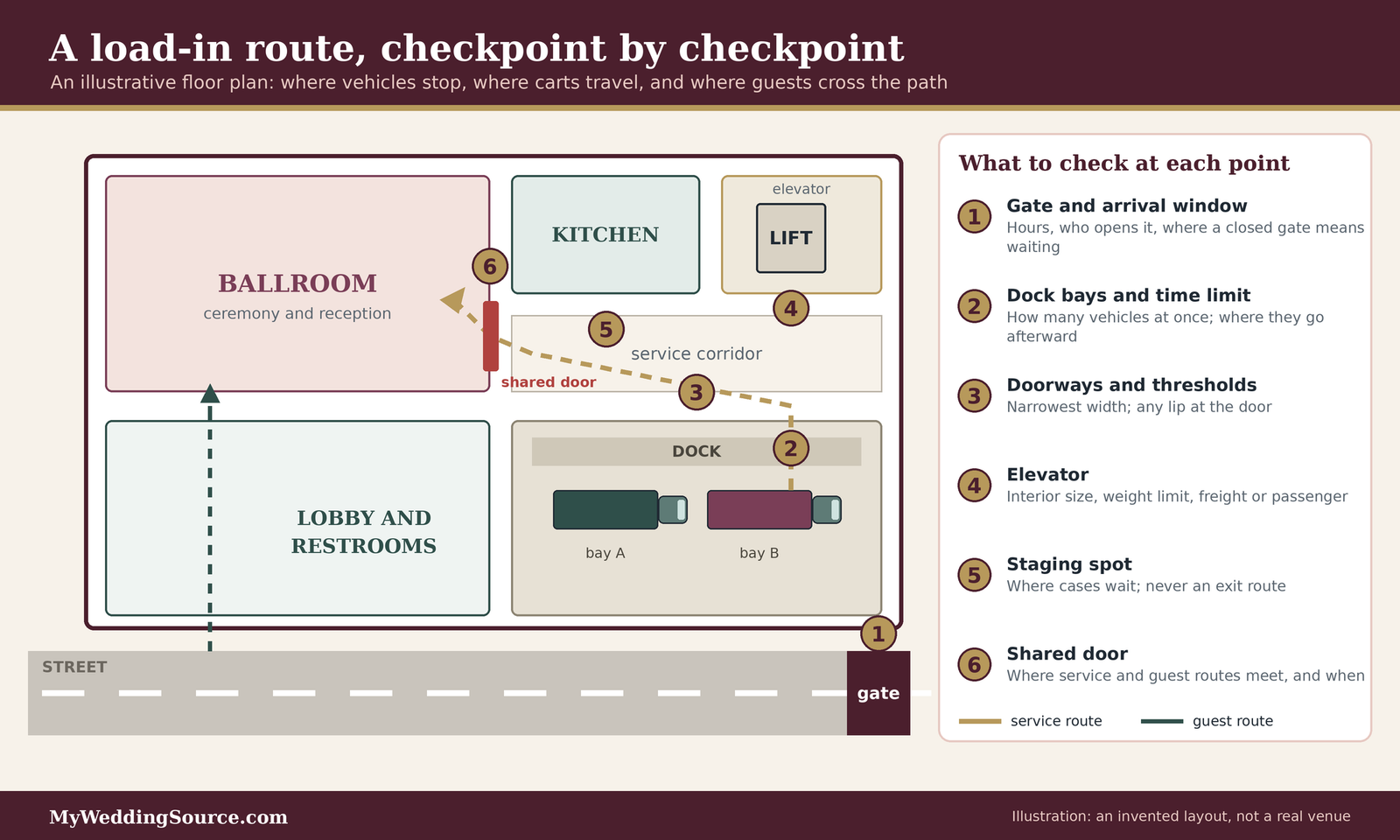
Many couples picture a wedding load-in as a van pulling up to a door. At a venue with a dock, it is closer to a small airport: a limited number of bays, a clock, a gatekeeper, and a rule about who may stand where. Wedding venue load-in restrictions are mostly dock restrictions, so it helps to understand the dock itself.
What a dock is and is not
A loading dock is a raised platform where vehicles back up to a building so goods can move on and off at floor height. Not every venue has one, and the ones that do rarely built it for wedding vendors.
Raised docks, ground-level doors, and service gates
Some venues have a raised dock with bays. Others have a ground-level service door, a gate to a back lot, or a curbside drop zone. One alumni centre in our sources describes loading stalls beside parking stalls on one side of the building. A private venue describes a service gate vendors must call ahead to open. Ask which of these your venue has, because the answer decides how a box truck, a van, and a florist’s car can arrive. Of all the wedding venue load-in restrictions you will read, the ones about the dock or gate usually carry the most weight.
Who else uses the dock
A dock shared with a restaurant, hotel kitchen, or other tenant has its own traffic. Ask whether other deliveries run on the same day and whether the venue reserves dock time for you. A program space in our sources asks vendors to give a delivery date and time so access can be arranged, which is a sign of a dock that is scheduled rather than first come, first served.
What dock safety guidance asks of people on a dock
You are not responsible for dock safety, and vendors and venue staff are. But the guidance gives you a sense of why the venue may insist on certain behavior, and it helps you spot a venue that has no wedding venue load-in restrictions at all.
Vehicles, edges, and docks after dark
A university safety guide for loading docks says wheels should be chocked and the vehicle secured with a restraint before a lift truck works at the dock, and that guardrails or similar protection are needed at edges higher than thirty inches. It advises using docks in daylight when possible, avoiding poorly lit docks at night, and getting the building manager’s permission before loading after hours. It also says a dock should not be used as a building entrance or exit.
What this means for a wedding vendor
It means a late-night strike by a tired crew, in the dark, at a raised dock with an unguarded edge, is a situation a careful venue wants to avoid. If your reception ends late, ask what the venue expects for after-hours loading and whether it has lighting and a staff member who can supervise. This is general safety information and not a substitute for the venue’s own procedures.
Dock time is a scarce resource
When several vendors need the same bays, the schedule becomes the real restriction. Even a generous venue can only unload so many vehicles at once.
Counting bays and minutes
One alumni centre in our sources lists two loading stalls and says large events need a loading plan created with vendors. Two stalls, a florist, a caterer, a rental company, a band, and a baker add up quickly. If each stop takes a while, the line grows. We show a worked example in the scheduling section, using invented numbers so you can swap in your own. Dock capacity is the clearest case of wedding venue load-in restrictions shaping a schedule instead of merely decorating a contract.
The twenty-minute lesson
A twenty-minute dock limit, as one university program space states, is generous for a van with a few cases of flowers and impossible for a full rental delivery. When you see a time limit among the wedding venue load-in restrictions, ask each vendor how long unloading takes, and ask the venue where a vehicle goes once it has unloaded. The alumni centre’s answer is to move it to a paid lot or street parking after unloading.
Elevators, stairs, and the carry
Many wedding venues are not on one level. The ceremony may be on a rooftop, the reception on the second floor, and the dock in the basement. An elevator’s size and capacity then become part of the schedule, because every table, case, and speaker must fit through it or go up the stairs.
Reading an elevator spec
Elevator limits are specific numbers, and they are easy to ask for. The examples below are from published policies, and your venue’s numbers will differ.
Interior size and weight limit
One alumni centre lists two passenger elevators that measure six feet long, four and a half feet wide, and seven and a half feet high, with a limit of one thousand pounds, and states there is no freight elevator. A private venue lists an elevator with an interior five feet wide, seven feet three inches high, and four feet four inches deep, limited to the lesser of twelve people or two thousand pounds, or any lower limit posted inside. It also says coverings are placed in the elevator during load-in and load-out.
What does not fit
The alumni centre says tables seven feet or longer do not fit the elevators and must be carried up the stairs. That single sentence changes your rental order, because a long banquet table that the elevator cannot take needs an alternative. Ask the rental company for the folded dimensions of every large item, and ask the venue whether stairs are allowed for carrying. Elevator limits are some of the most concrete wedding venue load-in restrictions, because they are measured in feet and pounds.
Planning the carry distance
The distance from the vehicle to the room is as important as the dock itself. A short walk with a cart is easy. A long one through a kitchen, across a lobby, and up a ramp is not.
Walk the route with a measuring tape
On your site visit, walk from the unloading point to the room as a vendor would, with the same kind of cart. Note doorways, thresholds, ramps, turns, and any step. Our floor-plan check, below, turns this walk into a list you can share with every vendor. If your layout work is still open, our guide to the reception floor plan shows how service paths fit into a room plan.
Who carries what
A private venue in our sources says staff will not help with loading or unloading, and that vendors must bring their own dollies and hand trucks. Other venues may offer staff for a fee, and some require union labor or house staff. Ask who does the carrying and what it costs before you assume a vendor’s crew will manage. Staffing is one of the quieter wedding venue load-in restrictions, since it rarely appears in a floor plan.
Building a vendor load-in schedule that fits the rules
Once you know the venue’s windows, the dock capacity, and the elevator limits, you can build a schedule that respects them. The schedule is the practical output of reading wedding venue load-in restrictions, and it is the document vendors use.
Start from the earliest and latest times
Every schedule has two anchors: the moment the venue opens the building, and the moment it must be empty. Everything else fits between them.
Find the venue’s opening and closing limits
Look for the earliest time vendors may arrive, the latest time guests may stay, and the time everything must be out. If the venue says vendors may not arrive before a stated hour, no vendor can be asked to. If it requires materials to leave the same night, strike must fit before that deadline.
Work backward from the ceremony
Our guide to the wedding vendor timeline shows how to work backward from the ceremony. The venue’s windows are the constraint you then fit onto that timeline, and wedding venue load-in restrictions are the reason the timeline cannot simply start whenever a vendor prefers. If the sum of the vendors’ setup times is longer than the window, you need to change something now, such as an earlier access time, a different vendor, or a simpler setup.
Stagger arrivals around the dock
Vendors need different amounts of time and different amounts of dock space. A staggered plan gives each vendor a turn.
A worked example with invented numbers
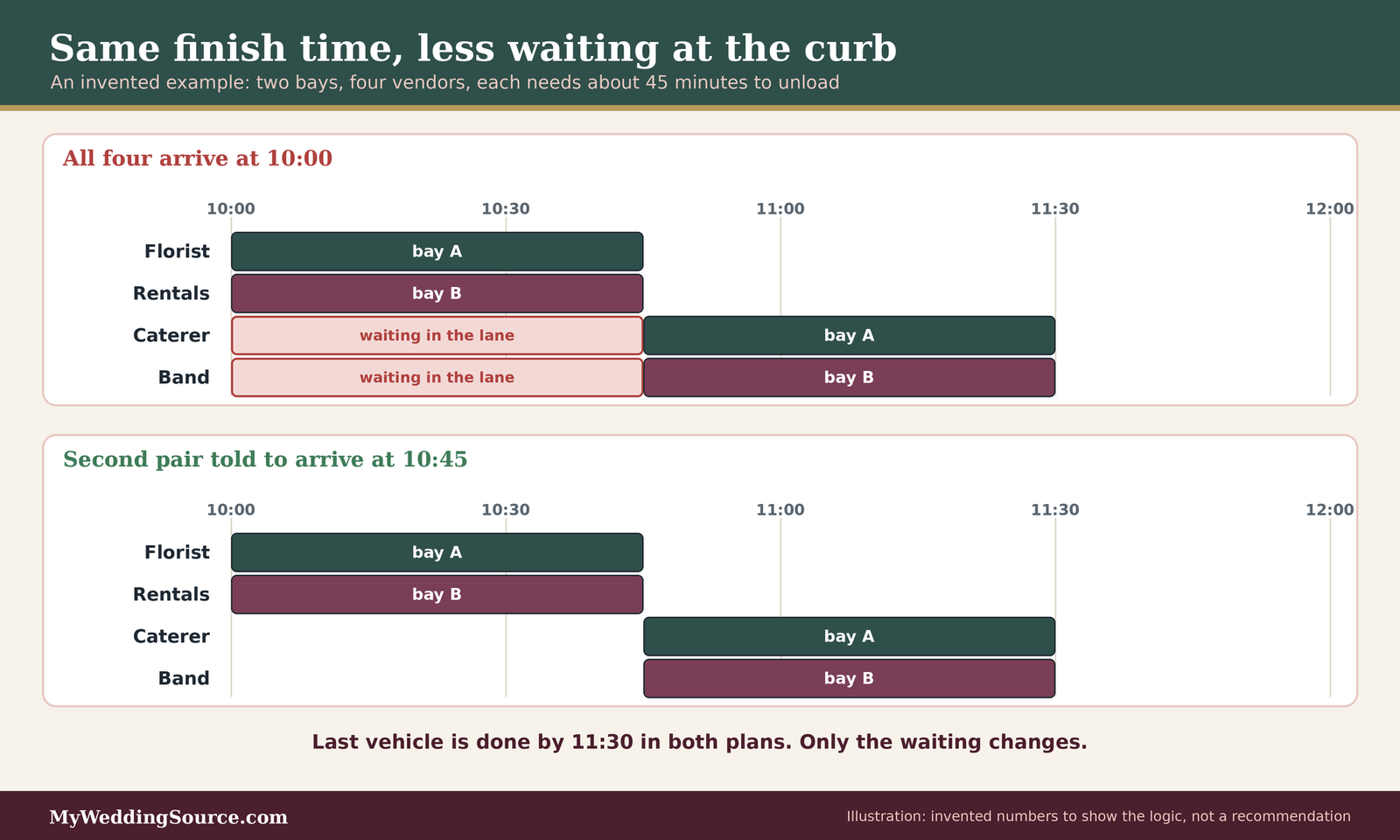
Imagine a venue with two bays and four vendors who each need about forty-five minutes to unload. If all four arrive at ten o’clock, two idle at the curb for forty-five minutes while two unload, and the last vehicle finishes at eleven thirty. If the second pair is told to arrive at ten forty-five, the last still finishes at eleven thirty, but nobody idles in the lane, and a dock limit such as twenty minutes is never tested. The finish time does not change. The waiting does. These numbers are made up to show the logic and are not a recommendation, so replace them with your vendors’ own estimates.
Give each vendor a window, a door, and a contact
Each vendor should receive an arrival window, the name of the door or gate, the parking instruction, the person to call at the venue, and the route to the room. A vendor who has these five items rarely needs to call you on the day, which is the real test of whether your wedding venue load-in restrictions have been translated into something usable. Our guide to wedding vendor meals covers another item that belongs on the same sheet.
Plan for the vendors who arrive twice
Some vendors visit more than once. A rental company may drop off in the morning and collect at night. A florist may deliver arrangements and return for a second installation.
Deliveries, pickups, and the second trip
Count each trip as a separate dock event. A venue that says deliveries must arrive the day of the event, and that items must be picked up the day or evening of the event, is describing two dock events for every rental. A venue with a morning pickup window after the event is describing a third constraint if your rentals leave on a Sunday.
Rentals that cannot wait at the venue
A venue that does not accept deliveries on your behalf cannot hold a stack of boxes for you. A private venue in our sources says staff will not accept or sign for vendor deliveries and rentals that are not part of the agreement. If a vendor wants to deliver the day before, ask the venue in writing first.
The service-aisle and accessible-route floor-plan check
This is the working tool of the guide. Floor plans for weddings usually show tables, a dance floor, and a head table. They rarely show how a cart gets from the dock to the kitchen, or whether a guest using a wheelchair can reach the restroom while a caterer’s cart is parked in the hallway. This check puts both routes on the same plan, so conflicts between wedding venue load-in restrictions and guest access show up on paper first.
The check has two layers. The service layer follows vendors from the vehicle to the room. The access layer follows guests, including guests who use wheelchairs or walkers, from arrival to every place they will need to go. The federal numbers in this section come from the U.S. Access Board’s guide to the ADA Standards. They describe design requirements for buildings and not a promise about any one venue, and your venue’s actual layout and local codes govern.
Layer one: draw the service route
Start with a printed floor plan, ideally to scale. If the venue cannot provide one, sketch it on a site visit and pace out distances.
Mark the unloading point and the room
Put a mark where vehicles stop, a second mark at the door of the room, and draw the path a cart would follow between them. Count doors, thresholds, turns, ramps, stairs, and elevators along the path, and note which are narrow. Mark any point where the path crosses a guest route, such as a lobby or the bar queue.
Mark the pinch points and the staging spot
A pinch point is any place a cart cannot pass another cart or a person. Mark each one. Then mark where equipment waits before it goes into the room, such as a corridor corner, a pantry, or a closed room. Ask the venue whether the staging spot is allowed, because a staging spot that also serves as an exit route may not be.
Layer two: draw the accessible route
The ADA Standards for Accessible Design, published by the Department of Justice in 2010, set minimum requirements for places of public accommodation and commercial facilities. Many venues that host paying guests may fall under these rules, but the standards apply to design and construction, and a building’s age and history affect which version applies, so the rules below are a yardstick and not a guarantee.
The numbers that matter on a route
The Access Board’s guide gives these figures for accessible routes. The continuous clear width is at least thirty-six inches, and it can narrow to thirty-two inches at a point such as a doorway, for no more than twenty-four inches of length. Where a route turns around an element narrower than forty-eight inches, the guide gives larger widths at the turn. Passing space is required at least every two hundred feet, and it can be a sixty-by-sixty-inch area or a T-shaped space. Walking surfaces should have a running slope no steeper than one in twenty and a cross slope no steeper than one in forty-eight. A change in level greater than a half inch must be bridged by a ramp, curb ramp, or elevator, and smaller changes must be beveled. Surfaces must be firm, stable, and slip resistant.

Turn the numbers into a walk-through
On your site visit, bring a tape measure and check the narrowest point on the path from the arrival drop-off to the ceremony, the restrooms, and the reception seating. If any point measures less than thirty-six inches, note whether it is a doorway, because a doorway has a smaller minimum. Check every threshold with your fingers, and note any lip that looks higher than a half inch. If you find a point that fails, do not decide alone whether it is acceptable. Ask the venue how guests with mobility needs normally use the space. Our guide to the accessible wedding guest experience goes deeper on that conversation.
Layer three: put the two routes on one plan
The most useful moment in the check is when the two routes meet. That is where a day-of problem usually starts.
Find the conflicts
Look for places where the service path and the accessible route share a corridor or door. Typical conflicts include a corridor that doubles as a staging spot, a ramp that vendors use for carts during setup and guests use for arrival, and a service door next to an accessible restroom. Mark each conflict and write the time of day when it happens. Conflicts that trace back to wedding venue load-in restrictions, such as a single shared door, are the ones to raise with the venue first. A conflict that only occurs during load-in, hours before guests arrive, may need only a rule. A conflict that persists during the reception needs a different layout.
Decide who keeps each route clear
For every shared route, name a person who keeps it clear. In the United States, the Department of Justice’s rule for public accommodations says accessible features must be kept in working order, and it allows isolated or temporary interruptions for maintenance or repairs. That rule is written for the facility’s operator, so the venue is the first person to ask about it. For a wedding, a coordinator or a venue manager is usually the right person to check the route before guests arrive. We offer this as a planning suggestion and not as legal advice.
Fire safety, exit routes, and what cannot sit in a hallway
Load-in produces clutter. Boxes, cases, empty crates, and carts collect near doors, and a hallway that is easy to move through at noon can become an obstacle by evening. A venue’s fire rules decide what may sit where, and your local fire authority sets them. Fire-related wedding venue load-in restrictions are the ones a venue is least likely to relax.
What a federal workplace rule says about exit routes
The federal workplace safety rule on exit routes is written for employers, not for wedding couples. It is a helpful reference because it shows the kinds of things fire safety rules protect.
Keep exit routes free of stored materials
The rule on maintenance and safeguards for exit routes says materials or equipment should not be stored in an exit route, even temporarily, and that exit routes should be kept free of flammable decorations and furnishings. It also says exit doors should be free of decorations or signs that block their visibility, and that exit signs should stay visible. It says exit routes should be lit well enough for a person with normal vision to see along them, and that exit signs should be illuminated, with letters at least six inches tall.
What this means for your decor and cases
It means a rental crew that stacks chairs in a corridor near an exit, or a florist who hangs a garland across an exit sign, may break a rule the venue takes seriously. Ask the venue where vendors can stage cases and empties. Do not assume a hallway is a storage room because it is empty. This is general information about a federal workplace rule and is not your venue’s fire code, which your local authority determines.
Candles, haze, and other items venues restrict
Fire safety also shows up in the venue’s lists of prohibited items. These lists appear in vendor packets and affect load-in because the items arrive in a vendor’s vehicle.
What the venue lists we read prohibit
One private venue in our sources prohibits third-party catering, sparklers, haze, fog, fireworks, and snow, bans water-soluble confetti indoors, and no longer allows candles down the aisle. It also prohibits duct tape and requires pre-approval before anything is attached to walls, ceilings, or floors, and it asks for prior arrangements when a setup needs more than three dedicated twenty-amp circuits. Another says its property has no rigging points and requires scissor lifts to be supervised by its facilities director.
Why to raise these early
A florist who plans a hanging installation, or a band that needs a fog machine, may not be able to do either at a venue with wedding venue load-in restrictions like these. Share your vendors’ plans with the venue weeks before the wedding, not on the morning. Wedding venue load-in restrictions about decor and equipment are easiest to work around when a vendor learns of them while the design is still flexible. Our guides to wedding lighting and the wedding audio and lighting checklist list the equipment vendors commonly bring. We do not give instructions for electrical or rigging work. Those tasks belong to licensed professionals and the venue’s technical staff.
Power at load-in
Electrical needs are part of load-in because equipment arrives with its own demands.
Ask for power requirements early
A venue in our sources asks for electrical and power requirements at least fifteen days before the event. Another asks for prior arrangements if a setup needs more than three dedicated circuits. If your band, caterer, or photo booth needs power, ask them for the figures and give them to the venue in writing.
When the venue cannot supply what you need
If the building cannot supply the power, an outdoor or tented wedding may need a generator. Our guide to wedding generator rental explains the questions to ask. A licensed electrician or the generator company should handle connection and safety.
Weather, daylight, and after-hours loading
Load-in takes place outdoors even when the wedding is indoors. Vehicles stand at a curb or a dock, crews carry cases across a lot, and the weather decides how long that takes. Weather is the one factor that wedding venue load-in restrictions rarely mention but always affect.
Weather at the dock
The National Weather Service’s safety pages describe hazards that matter to a crew working outdoors.
Lightning and wind
The National Weather Service says there is no safe place outside when thunderstorms are nearby and that if you can hear thunder, you are likely within striking distance. Its wind page says sustained winds of forty to fifty miles per hour can cause isolated damage, and that loose objects can become dangerous projectiles. A crew carrying a tall floral arch, a rental tent wall, or a stack of chairs from a truck is carrying objects like this. Our guide to wedding ceremony wind limits covers how wind changes outdoor setups.
Flooding and low docks
The National Weather Service says floods can build slowly or arrive within minutes, sometimes without visible rain. A low-lying dock, a back lot, or an underground garage can be affected. If your venue’s service area sits low, ask whether it has flooded and what vendors do when it does.
Daylight and after-hours work
Load-in in the dark brings its own limits.
Early morning and late-night windows
A university safety guide advises using docks in daylight when possible and obtaining permission before loading after hours. A wedding that ends late often means a late strike, so ask the venue whether after-hours load-out is allowed, who must be present, and whether the area is lit.
Plan the last hour as carefully as the first
Couples spend hours on the first vendor arrival and minutes on the last departure. But a tired crew at the end of the night is the case where rules matter most. Put the strike plan on the same schedule as the setup, name who locks up, and ask what happens if a rental company cannot collect that night.
Insurance, fees, and contract language
Money questions about load-in are usually small individually and large together, and wedding venue load-in restrictions are often where the small ones begin. The best time to ask is before you sign, when you can still choose a different venue or negotiate.
Certificates of insurance at load-in
A certificate of insurance is a document that shows a vendor carries liability coverage. Venues commonly ask for one, which in our reading is a way to make sure damage on their property can be paid for.
What the venues we read asked for
A program space in our sources says vendors must provide a certificate of insurance. A private venue says current paperwork is due a week before setup and that subvendors and suppliers need their own coverage, and it offers vendor liability insurance for vendors who lack it. Ask the venue what limits it expects and who sends the certificate. Our guide to wedding insurance covers couple-purchased coverage, and that is a separate product from a vendor’s certificate.
Who is responsible when something is damaged
Ask the venue what happens if a vendor scratches a floor or damages an elevator. One venue in our sources says repair costs for damage during the license period may be deducted from the security deposit. Our guide to wedding vendor contracts explains what to look for in each agreement. This is general information and not legal advice, so ask an attorney if you need it.
What the published fees look like
- Early arrival or late stay: one event venue lists an hourly charge per event room, plus staffing costs.
- Storage after the event: a university alumni centre lists a minimum storage fee when materials stay past the night of the event.
- Disposal and left-behind items: an event venue lists a minimum charge per item for disposal and a minimum daily storage fee for items left behind, with disposal after a stated number of days.
- Unregistered vehicles: the alumni centre says unregistered vehicles may be ticketed or towed at the owner’s expense.
Treat these as examples of the type of charge, not as typical prices. Ask your venue for its own fee schedule and whether the fee falls on you or on the vendor.
Fees that show up on the invoice
Fees are easier to avoid when you know where they come from.
Time, storage, and disposal
Most of the fees in the policies we read come from time and space. A venue charges for time when a vendor arrives early or stays late, and for space when materials stay overnight. A third kind is disposal, when a vendor leaves boxes, pallets, or crates behind. Build these into your vendor schedule so no vendor creates them. Most fees tied to wedding venue load-in restrictions can be avoided with a clear schedule. Our guide to venue cost shows how these items fit a venue budget.
Ask who pays
When a vendor causes a fee, ask whether your contract passes it to you. A line in the vendor’s agreement that says the client pays for overtime caused by the vendor’s late arrival is worth a conversation before signing. Our guide to vendor travel and lodging fees covers other charges that arrive outside the quote.
Edge cases and special sites
Not every wedding fits the standard picture of a venue with a dock and a freight elevator. Special sites bring their own wedding venue load-in restrictions, and many of them are less visible.
Venues without a dock
Many beautiful sites were not built for deliveries.
Gardens, barns, and lawns
At a garden or barn site, the load-in path may be a gravel drive, a lawn, or a farm lane. Check where vehicles may drive and park, what a wet lawn does to a loaded cart, and whether the venue protects turf. Our guides to garden wedding venues, barn wedding venues, and dance floor rental over grass cover ground-surface questions.
Tented and outdoor weddings
A tent needs a crew, and the crew needs access before everyone else. Check the venue’s rules on stakes, utilities, and vehicle access on the lawn. Our outdoor wedding infrastructure checklist and our guide to portable restrooms cover service vehicles that also need a path, since restroom trailers and generators arrive by truck.
Upper floors, historic buildings, and shared properties
Some of the most memorable sites are the hardest to load.
Upper floors and narrow stairs
A rooftop or upper-floor room may rely on a single elevator or stairs. Ask for the elevator’s interior size and weight limit, ask whether tables or racks must be carried by hand, and ask how many trips that means. If a rental company’s items cannot fit, ask for alternatives, such as smaller tables, and for the rental company’s folded dimensions.
Historic buildings and shared properties
Older buildings may have narrow doorways, steps, or restrictions on what can be attached to walls. They may also be subject to rules from a historic preservation body or a building owner. Ask the venue which wedding venue load-in restrictions come from the venue and which from elsewhere. Where a street permit is involved, wedding venue load-in restrictions may overlap with city rules. Our guide to wedding permits explains the usual types, and local rules vary.
Hotels, multi-room venues, and several weddings in one day
Busy properties add scheduling pressure.
Hotels and banquet staff
A hotel may have a loading dock, a banquet captain, and a union or house crew. Ask who may carry and whether an outside vendor can use the service elevator. Ask whether the hotel charges a fee for outside vendors. Our guide on how to calculate venue capacity is a companion for hotel ballroom questions. A hotel may have its own wedding venue load-in restrictions for outside vendors, so ask whether a written version exists.
Back-to-back events
If another event ends shortly before yours begins, the room may not be ready until the last minute. Ask what time the previous event ends, what the flip crew does, and when your vendors may enter. A venue with a short turnaround may restrict early access for that reason. Our guide to the wedding weekend covers multi-day schedules.
Questions to ask before you sign
Questions about wedding venue load-in restrictions are best asked in writing, early, and to the person who runs events on the day. Keep the answers with your contract.
Questions to ask the venue
- What are the earliest arrival and latest departure times for vendors, and what do early or late arrivals cost?
- Which door, gate, or dock do vendors use, and how many vehicles can unload at once?
- Is there a time limit at the dock, and where do vehicles go afterward?
- What are the interior dimensions and weight limit of the elevator, and is there a freight elevator?
- Who carries equipment, and what must vendors bring themselves?
- What insurance paperwork do vendors need, when is it due, and who receives it?
- Where may vendors stage cases and empties, and which hallways must stay clear?
- Which items are prohibited, and which need approval before they are attached or installed?
- What are the trash, storage, and pickup rules, and what do they cost?
- Who is the contact on the day, and is that person reachable during load-in and strike?
Questions for the venue
Venue questions should produce a document, not a conversation, because wedding venue load-in restrictions are only useful when they are written down.
Ask for a one-page load-in sheet
Ask whether the venue has a vendor guide or a load-in sheet. If it does, read it with the questions above. If it does not, ask for answers by email. Our guide to questions to ask a wedding venue covers the broader list.
Ask what has gone wrong before
Ask the event manager what usually goes wrong on a wedding day and how the venue handles it. A venue that has solved these problems will answer quickly and specifically. A venue that has not may answer generally.
Questions for your vendors
Each vendor knows their own equipment and unloading time better than you do.
Ask for the numbers
Ask each vendor for the number of vehicles, the vehicle size and height, the number of people, the time needed to unload and set up, and the largest single item they carry. Compare those against the venue’s limits. Our vendor due diligence checklist covers the wider vetting conversation.
Ask what they have done at the venue before
A vendor who has worked at the venue can tell you how the dock really works. If none of your vendors have, consider a planner or coordinator who has. Our guide to wedding planners and coordinators covers what each does.
A load-in sheet you can send to every vendor
A single page works better than a stack of attachments. The sheet below is our suggested format, and every line on it comes from a topic covered earlier in this guide.
What the sheet should say
Put the wedding date and the venue’s address at the top, followed by the arrival window for that vendor, the door or gate, the parking instruction, the on-site contact with a phone number, and the route to the room. Add the elevator size and weight limit, the stair rule, and the insurance deadline. Close with the strike time and the trash rule. Keeping wedding venue load-in restrictions to one page makes it far more likely that a driver reads them before arriving.
How to keep it accurate
Send the draft to the venue for a check before it goes to vendors, and ask the venue to confirm that the wedding venue load-in restrictions on the sheet match its current policy. Date the sheet, and if anything changes, send a new version and ask each vendor to confirm receipt. A single dated sheet is easier to defend than a series of texts if a question arises later.
FAQ: wedding venue load-in restrictions
The basics
What are wedding venue load-in restrictions?
They are the venue’s rules for how vendors bring equipment in and take it out. They cover arrival and departure times, which door or dock to use, parking, elevator use, insurance paperwork, and trash and storage. Each venue writes its own, so ask for them in writing before you sign and share them with every vendor. Wedding venue load-in restrictions are not standardized across the industry.
When should I ask about wedding venue load-in restrictions?
Ask before you sign the venue contract, and again when you finalize your vendor schedule. Early answers let you change a vendor, a layout, or a venue if the wedding venue load-in restrictions do not fit. Late answers leave you with fewer options. Keep the written answers with your contract and send the relevant parts to each vendor.
Do all venues have a loading dock?
No. Some have a raised dock, others a ground-level service door, a gate to a back lot, or only a curbside drop. Gardens, barns, and lawns may have a driveway. Ask which applies, how vehicles reach it, and how far a cart must travel to the room.
Times, fees, and paperwork
How long do vendors usually get to load in?
It varies. One private venue in our sources says qualified vendors can load in and set up within two hours, while a university alumni centre says load-in time is included in the booking and extra time is available for a fee. Ask each vendor how long they need, then compare it with the venue’s window.
What happens if a vendor breaks wedding venue load-in restrictions on timing?
Policies differ. One venue lists an hourly charge per event room plus staffing costs, and another requires written approval for early or late deliveries. Ask the venue what it charges, who pays, and whether a contract passes the cost to you. Put the vendor’s window in the vendor agreement as well.
Do wedding venue load-in restrictions require vendor insurance?
Many venues ask for a certificate of insurance, and some ask for it a week or more before the event. Some also expect subcontractors to carry coverage. Ask the venue what it expects and when it is due, and ask each vendor to send the certificate directly. This is general information, not legal advice.
Access and safety
How do I check that guests who use wheelchairs can reach everything?
Walk the route from drop-off to the ceremony, restrooms, and seating with a tape measure. The Access Board’s guide gives a continuous clear width of at least thirty-six inches for accessible routes, with a narrower allowance at doorways. Also ask who keeps routes clear during load-in. The venue’s actual layout governs.
Do wedding venue load-in restrictions allow cases in the hallway?
Usually not, but ask. A federal workplace rule on exit routes says materials should not be stored in an exit route, even temporarily, and local fire authorities set their own rules. Ask the venue where vendors may stage cases and empties, and write the answer into the vendor sheet.
Your next steps
Collect the rules
Request the written load-in rules
Email the venue and ask for its vendor guide or load-in sheet, which is where wedding venue load-in restrictions usually live. If the venue has none, send the question list above and keep the replies with your contract. Our guide to outdoor wedding venues can help you compare sites with wedding venue load-in restrictions in mind.
Share the rules with each vendor
Send each vendor the parts of the wedding venue load-in restrictions that apply to them and ask them to confirm the arrival window, door, vehicle size, and insurance in writing. Ask who their contact at the venue will be.
Test the plan
Walk the route on a site visit
Use the floor-plan check on your next visit. Bring a tape measure, a printed plan, and a phone to photograph each pinch point. Mark conflicts and ask the venue how each is handled.
Put it on the schedule
Add arrival windows, door instructions, and strike times from your wedding venue load-in restrictions to your vendor schedule. Our guide to the wedding vendor timeline shows how, and our wedding rental planning checklist covers deliveries and pickups. If you want the broader plan, see how to plan a wedding.
Sources & methodology
How we built this guide
What we relied on
This guide combines federal accessibility design guidance, a federal workplace rule on exit routes, National Weather Service safety pages, a university loading dock safety guide, and the published vendor policies of four venues: a university alumni centre in Canada, two private event venues, and a university program space. Where a statement comes from a venue’s policy, we attribute it to that venue and treat it as one example, not a norm. The worked dock-schedule example uses invented numbers, and the floor-plan check is our own editorial method. We checked these sources on November 12, 2026. Venue policies change, so the details may be out of date by the time you read them.
What we did not do
We did not visit these venues, test any dock or elevator, or verify that any policy is currently enforced. This guide is not legal advice, electrical or rigging advice, or an accessibility compliance review. It gives no universal occupancy limits, because local fire and building authorities set them for each site. Ask your venue, your local authority, and a licensed professional about your own site.
Disclosure
Source list
Government and regulatory sources
- U.S. Access Board, Guide to the ADA Standards, Chapter 4: Accessible Routes: https://www.access-board.gov/ada/guides/chapter-4-accessible-routes/
- U.S. Access Board, ADA Accessibility Standards: https://www.access-board.gov/ada/
- U.S. Department of Justice, 2010 ADA Standards for Accessible Design: https://www.ada.gov/law-and-regs/design-standards/2010-stds/
- 28 CFR 36.211, Maintenance of accessible features (Legal Information Institute): https://www.law.cornell.edu/cfr/text/28/36.211
- 29 CFR 1910.37, Maintenance, safeguards, and operational features for exit routes (eCFR): https://www.ecfr.gov/current/title-29/subtitle-B/chapter-XVII/part-1910/subpart-E/section-1910.37
- National Weather Service, Weather safety: https://www.weather.gov/safety
- National Weather Service, Wind safety: https://www.weather.gov/safety/wind
- National Weather Service, Lightning safety: https://www.weather.gov/safety/lightning-safety
University safety guidance
- University of California, Irvine Environmental Health and Safety, Loading dock safety reference guide: https://www.ehs.uci.edu/safety/_pdf/loading-dock-safety-reference-guide.pdf
Venue policies cited as examples
- Robert H. Lee Alumni Centre (University of British Columbia), Loading bay, deliveries, set-up and tear-down: https://alumnicentre.ubc.ca/planning-toolkit/planning-guide/loading-bay-deliveries-set-up-tear-down/
- The Bell Tower on 34th, Vendor requirements: https://thebelltoweron34th.com/vendor-requirements
- The Hibernia, Rules and regulations (2022): https://thehiberniasf.com/wp-content/uploads/2022/09/Hibernia-Rules-and-Regulations.pdf
- Duke in DC, Deliveries and catering supplies (page dated 2013): https://dukeindc.duke.edu/?p=45