
Wedding menu planning gets easier once you stop asking “what do we want to serve?” and start asking “what does every person in this room have to be able to eat?” This guide shows you how to build a menu that works across ages, beliefs and medical needs, how to check it against your caterer’s real practices, and where the trade-offs sit course by course.
Collect dietary and age information on the RSVP, sort it by seriousness (medical first, then religious, then ethical, then taste), and build one shared base menu that most guests can eat as served. Add a small number of clearly designed alternatives for the groups the base misses. Get every allergen and ingredient answer from the caterer in writing, and agree on how special meals reach the right person. No kitchen can promise zero risk, so treat an allergy as a process, not a menu item.
Picture a Saturday dinner for 140. Table 6 has a four-year-old who eats four things, a grandfather who cannot chew steak, and a bridesmaid with celiac disease. Table 9 has a vegan couple, two guests who keep halal, and an uncle who will announce that he “eats everything” and then quietly skip the sauce. Somewhere near the dance floor is a guest with a tree nut allergy who has not mentioned it to anyone, because she assumes the couple has enough to worry about.
None of that is unusual. It is what a normal wedding guest list looks like once you count honestly. The challenge in wedding menu planning is not finding one perfect dish. It is designing a meal where nobody is quietly left with bread and a garnish, and where the people with real medical limits are protected by a process and not by luck.
This article is a working method for wedding menu planning. You will collect the right information, translate it into a coverage plan, test it against what your caterer can actually do, and set up the service so the plan survives a busy Saturday night. It is long because the decisions are layered, so use the headings to jump to the part you need.
A good menu does three jobs at once. It feeds people safely, it feels generous, and it fits the schedule of the day. Most wedding menu planning advice talks about the second job. The first and third are where meals go wrong.
Feeding people safely means allergens, cross-contact, temperatures and texture. A guest with a severe allergy is not choosing between two entrées. They are deciding whether it is safe to eat at all. A toddler is not picking a favorite food. The size and shape of the food matters for choking risk.
Feeling generous means no one gets the sad plate. Vegetarian guests who receive a side-dish assembly while everyone else gets a main course notice, and so do their tablemates.
Fitting the day means courses that come out on time, a cocktail hour that does not run a hundred people out of appetite, and speeches that do not leave dinner cooling on the pass. A menu that is brilliant on paper but forces the kitchen into twelve separate preparations will be late and will make mistakes.
Think coverage, not compromise
Couples often assume that wedding menu planning for a mixed group means a bland average. It does not. The better frame is coverage: every guest group has at least one dish in every course that they can eat as served, and ideally one they are excited to eat.
Coverage is a design property of wedding menu planning that you can check. For each course, ask which groups can eat which dishes without modification. If a group has no safe dish in a course, you have a gap, and the fix is a design change, not an apology. Later in this guide you will build a coverage map to see those gaps before the caterer does.
The shape of a menu that works
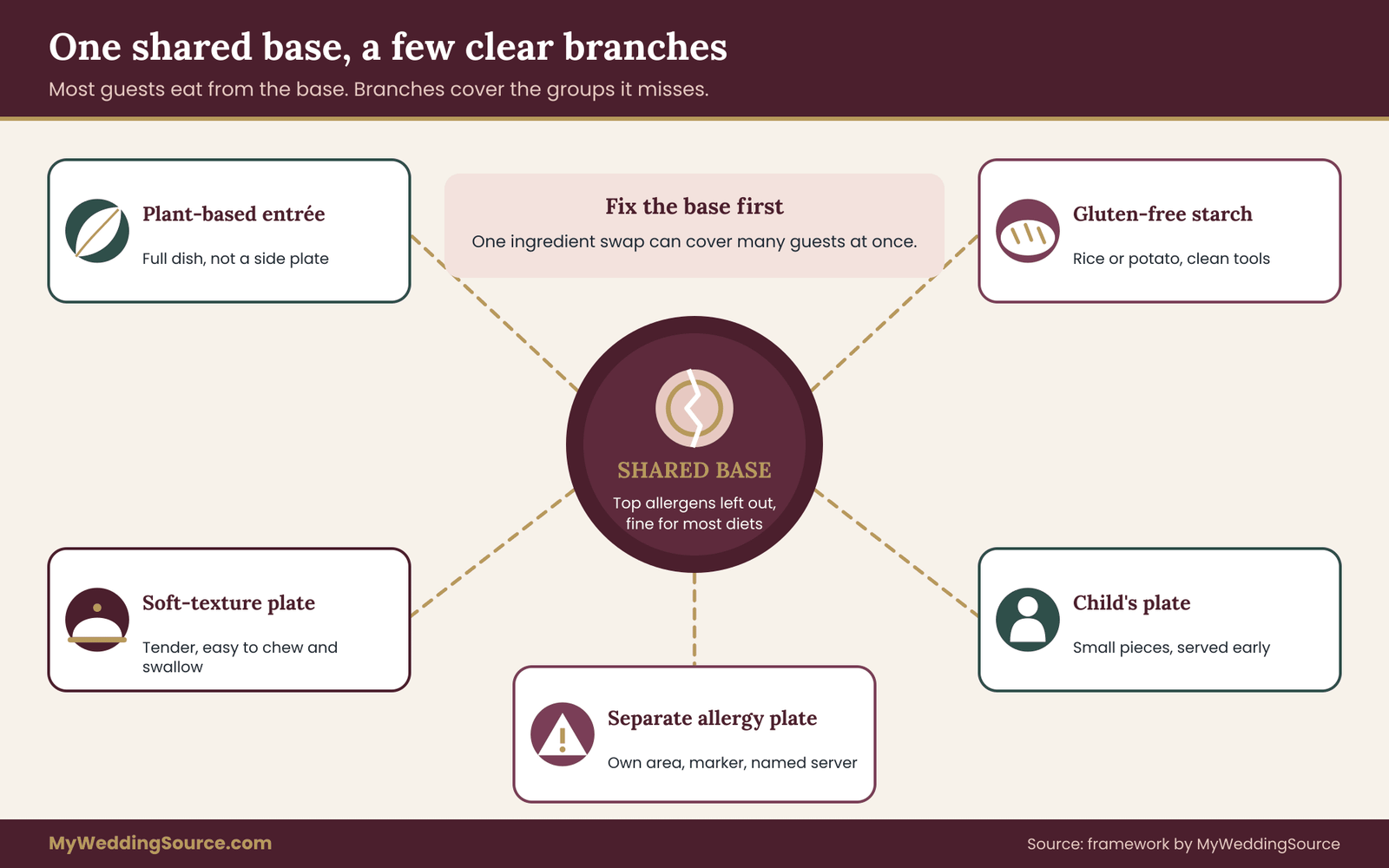
Wedding menu planning that serves mixed rooms well tends to share a shape. There is a shared base: a handful of dishes, sauces and sides that are free of the most common allergens and acceptable to the broadest range of diets. Around the base sit branches: specific alternatives for the groups the base does not reach, such as a plant-based entrée, a gluten-free starch, a soft-texture option or a child’s plate.
The shared base is where wedding menu planning takes most of your effort. A base that already works for vegetarian, dairy-free and gluten-free guests means fewer special meals, fewer kitchen errors and less awkwardness at the table. We come back to this idea repeatedly, because it is the most reliable way to reduce risk and cost together.
Collect the information before you design anything
You cannot finish wedding menu planning around needs you do not know about. The RSVP is the cheapest, most reliable moment to ask, and the questions you choose decide how useful the answers are.
What to ask on the RSVP
Keep the form short and specific, because wedding menu planning is only as good as the answers it starts from. One open box labeled “dietary restrictions” produces answers like “none,” “vegetarian-ish” and “no mushrooms,” which tell you almost nothing. Instead, give people a few clear fields.
- Entrée choice, if you are offering a choice at all.
- A yes or no question: “Do you have a food allergy or medical diet we need to plan for?”
- If yes, a short box: “Please tell us what the allergy or diet is, and whether it is severe.”
- A separate question for dietary practices: vegetarian, vegan, halal, kosher, pescatarian, or other.
- For children: age on the wedding date, so you can plan portions and food shapes.
Separating allergies and medical needs from preferences matters more in wedding menu planning than it looks. It lets you treat the first group with the seriousness they require, and it stops a mild dislike from clogging the list that the chef is trying to protect guests from.
Sample wording
Here is wording you can adapt for a paper reply card or an online form.
“Do you have a food allergy or medical dietary need we should plan for? If so, please tell us what it is. If it is severe, please say so and we will follow up with you directly.”
“Do you follow a dietary practice (for example vegetarian, vegan, halal or kosher) that would change what you can eat at the dinner?”
Notice two small choices. The first sentence promises a follow-up, which tells guests with serious needs that someone will read what they write. The second asks about practices neutrally, without suggesting that a practice is a problem to be handled.
Follow up on the serious ones personally
An RSVP line is not enough for a severe allergy. Guests who write “tree nuts, severe” deserve a quick personal message. Ask what exactly they avoid, whether trace amounts matter, whether they carry emergency medication and how they prefer to be served. Some guests want to speak to the chef. Others would rather be left alone and handed a safe plate. Let them decide.
A short message might read:
“Thanks for letting us know about your allergy. We want to get this right. Can you tell us exactly what you avoid, whether very small amounts are a problem, and whether you would like to talk with the caterer directly or have us handle it? We will make sure your meal is prepared and served separately.”
Treat what they say as fact. You are not trying to second-guess whether an allergy is “really” serious. You are collecting instructions for a kitchen.
Privacy and tone
Health information is personal. Keep the spreadsheet with allergy and medical details limited to you, your partner and the caterer, and do not post it in a group chat. At the event, do not announce who has which restriction. Name cards, seating charts and table cards should carry only what the server needs, such as a small symbol, not a medical history.
The seriousness ladder
When you read the answers, sort them by how much is at stake, because in wedding menu planning that decides how much of the menu you will bend for each group.
Medical needs. Severe food allergies, celiac disease, diabetes, kidney conditions and swallowing difficulties. A mistake can make a guest ill. These get first claim on your attention and your kitchen’s care.
Religious and cultural practices. Halal, kosher, certain fasting practices and other observances. A mistake is serious to the guest, though not usually physically dangerous. Take these as seriously as the guest does.
Ethical or lifestyle choices. Vegetarian, vegan and similar. A mistake is a breach of the guest’s values and is easy to avoid with planning.
Tastes and dislikes. “No mushrooms,” “I don’t like fish.” Nice to honor, never essential.
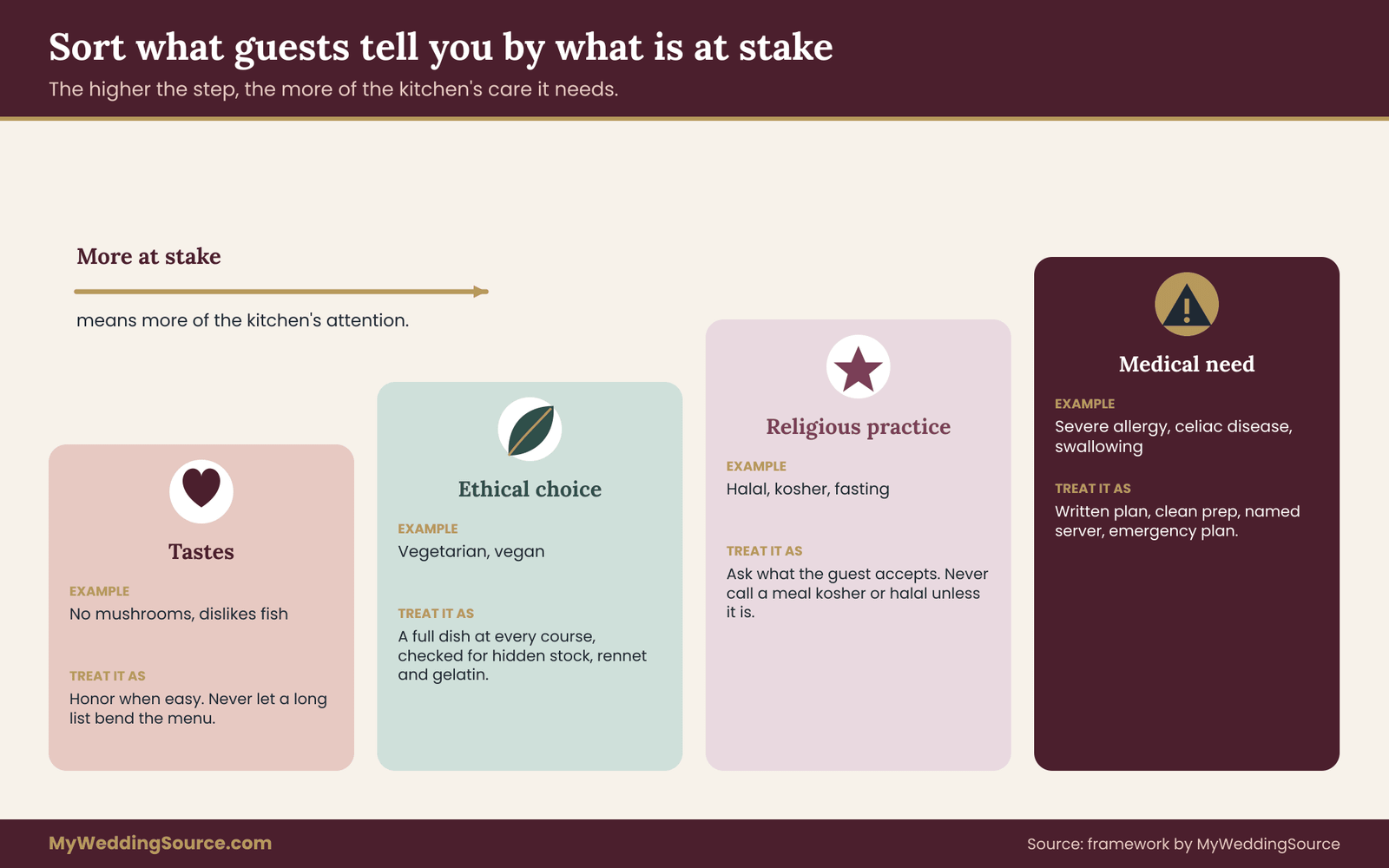
Putting the answers in this order helps your wedding menu planning in two ways. It tells you where a mistake is costly, and it lets you push back on yourself when the preference list grows long. A menu cannot honor every dislike, and it should not try to.
What to do with plus-ones and late responders
Guests often reply for a plus-one without knowing their needs. Ask the guest to find out, or send a short follow-up to the named plus-one. For guests who do not reply by the deadline, assume nothing. Send one polite reminder with the dietary question included, and ask your caterer to hold a small allowance for unexpected needs on the day.
Build one list the kitchen can use
When you have the answers, put them in one wedding menu planning spreadsheet. Useful columns, listed here as fields to track, are the guest’s name, table number, the type of need, the exact wording, severity, whether you have followed up, and what the caterer has confirmed. Update it every time a guest changes their answer. Send the caterer a cleaned version, not your raw notes, and ask them to confirm back in writing that they have understood each item. ## Build a coverage map for your wedding menu planning
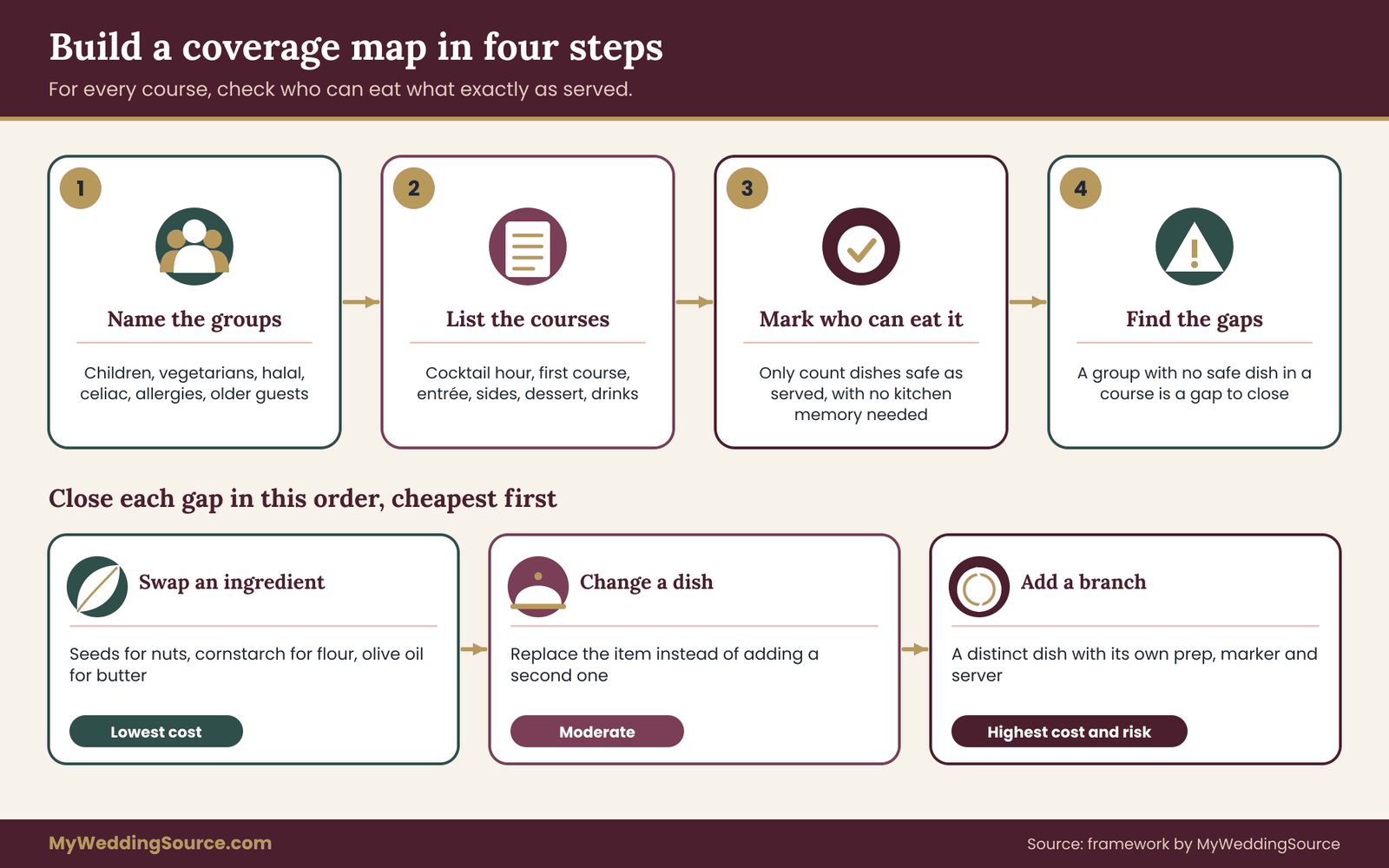
A coverage map is a plain list for wedding menu planning that answers one question: for each course, who can eat what without modification? You do not need software. A page of paper, or a shared note, is enough.
Step one: name your groups
From your RSVP data, write down the groups that actually exist in your guest list. Do not invent groups, and do not list every individual. Typical groups include children under about five, other children and teens, adults with no restrictions, vegetarians, vegans, guests who keep halal, guests who keep kosher, guests with celiac disease or gluten sensitivity, guests with a specific allergy such as peanuts or shellfish, and older guests who need soft textures or low sodium.
Some guests belong to more than one group. A vegan guest with a soy allergy is a single plate with two constraints. Mark those overlaps because they are where most mistakes happen.
Step two: list the courses
Write out the courses in order: cocktail hour, first course or salad, entrée, sides, dessert, late-night snack, and any special stations. Include the drinks, since a surprising amount of allergen exposure and religious concern hides in beverages and garnishes.
Step three: mark what each group can eat as served
For every course, go through your draft dishes and note which groups can eat each one exactly as it will be served. “As served” is the key phrase. A dish that a vegetarian can eat if the chef omits the bacon is not covered. It is a request that someone has to remember.
Write the result in plain sentences. For example:
- Cocktail hour: Everyone except guests allergic to shellfish can eat the stuffed mushrooms. The shrimp skewers exclude vegetarians, vegans, halal and kosher guests, and anyone with a shellfish allergy.
- First course: The beet salad is safe for vegetarians, vegans and gluten-free guests. It contains walnuts, so guests with tree nut allergies are not covered.
- Entrée: The roasted chicken covers most guests. It does not cover vegetarians, vegans or guests who need halal-certified meat.
Step four: find the gaps and fix them
Read the lists and look for any group that has no safe dish in a course. That is a gap. Fix gaps in your wedding menu planning in this order.
- Change an ingredient in the base. Swap walnuts for pumpkin seeds in the beet salad, and the nut-allergy gap disappears.
- Choose a different dish. If the cocktail hour has no dairy-free option, replace one of the cheese-based items rather than adding a separate dairy-free dish.
- Add a branch. If a change to the base would spoil the dish, add a distinct alternative for the group that needs it, and plan how it is made and served.
The “swap before you add” rule
In wedding menu planning, each added dish increases cost, kitchen complexity and the number of places something can go wrong. Changing one ingredient in a shared dish costs almost nothing and covers many guests at once. Before you approve a special meal, ask whether a swap in the base would remove the need for it.
Typical swaps that widen coverage with little loss: a dairy-free sauce on a main dish where cream is not essential, rice or potatoes instead of couscous or orzo as a starch, olive oil in place of butter for vegetables, seeds in place of nuts on salads, and a gluten-free flour or cornstarch to thicken sauces. A sauce served on the side lets each guest choose, and it makes the main dish safer for more people.
Keep a short “never” list
In wedding menu planning, some ingredients are not worth the risk at a large event. If a few of your guests have severe peanut or sesame allergies, consider removing peanuts and sesame from the whole menu, rather than managing them. A kitchen that never opens a bag of peanuts has no peanuts to cross into anything else. Decide on this list with your caterer and tell guests with severe allergies about it, so they know what you have done.
With the method in hand, here is how each part of the meal behaves in practice.
The cocktail hour
The cocktail hour is the most forgiving course for coverage, because guests pick for themselves. It is also where cross-contact tends to happen, because trays move through crowds and passed appetizers get handled by multiple staff.
Aim for a spread in which most items are free of the common allergens, and label every item clearly. A small card that names the dish and flags the main allergens does more good than a long explanation from a server. Offer at least one substantial vegan item, since vegan guests often arrive hungry and find that a plate of cheese and crackers is not a meal. Our guide to the wedding cocktail hour covers pacing, quantities and layout.
Be careful with shared dips, communal serving spoons and fried items cooked in common oil. A fryer used for shrimp and then for vegetable spring rolls transfers shellfish proteins to the rolls. Ask your caterer which items are fried and in what oil.
The first course
In wedding menu planning, a salad or soup is a good place to put the shared base to work. A simple salad with a dressing on the side can be vegan, gluten-free and nut-free all at once. A cream-based soup needs a plant-based alternative or should be avoided if you do not want an extra preparation.
For plated dinners, decide whether the first course is pre-set on the table, which saves time and lets the kitchen concentrate on the entrée, or served at the moment guests sit down. Pre-set courses raise a cross-contact question, because items sit on the table for a while. Ask your caterer how they cover or protect them.
The entrée
This is where most couples agonize over wedding menu planning, and where the most mistakes happen. You have four main strategies.
One entrée for everyone, designed to be inclusive. A roasted vegetable and grain dish in a sauce that contains no major allergens can serve almost every group. It is the simplest approach and works best for smaller weddings, or when the main dish is plant-based on purpose.
Two entrées, one of them plant-based. This covers vegetarians, vegans and many other diets in one branch, and it is the most common arrangement. The plant-based dish should be as carefully made as the meat option and should not be the leftover from another course.
Three entrées. Useful when the group is large and varied, but costly and complicated. It requires pre-selected choices, name cards that show the choice, and a kitchen that can handle three plating lines.
Stations or family-style. Guests take what they want. This increases flexibility and lowers the number of special meals, though it can raise cross-contact risks, as discussed below.
Whatever you choose in wedding menu planning, give vegetarian and vegan guests the same standard of care you give anyone else. A main dish that is just the side dishes with the meat removed tells them what you think of their dinner.
Side dishes
Sides are your best tool for widening coverage in wedding menu planning. If three or four sides are free of dairy, gluten and nuts, most guests can build a full plate from them even if the main dish does not suit them. Roasted seasonal vegetables, potatoes or rice dishes, and simple grain salads dressed with oil and lemon are reliable. Mark each side with what it contains.
Dessert
In wedding menu planning, dessert is where guests with restrictions are most often forgotten. A single cake serves most people and excludes a few. Consider a second, simple option, such as fresh fruit, a dairy-free sorbet, or a flourless dessert free of the major allergens. Offer it to everyone, not only to guests who ask, so nobody has to explain.
If you serve a dessert station or a late-night snack, the cross-contact problem returns, because items are close together and guests serve themselves. Separate the allergen-free options physically, give them their own utensils, and label them. If the cake is made by a separate baker, ask them for an ingredient list and ask how they prevent cross-contact.
Drinks
Beverages are easy to overlook in wedding menu planning. Guests who do not drink alcohol need more than water and soda: a nonalcoholic option that looks and feels festive. Some drinks hide allergens, including milk and nut-based syrups and liqueurs. Garnishes can add citrus, herbs or egg whites. If guests keep halal, ask whether any alcohol or alcohol-based flavorings are used in dishes or mocktails. For a longer look at drink service, see our guide to wedding bar service planning.
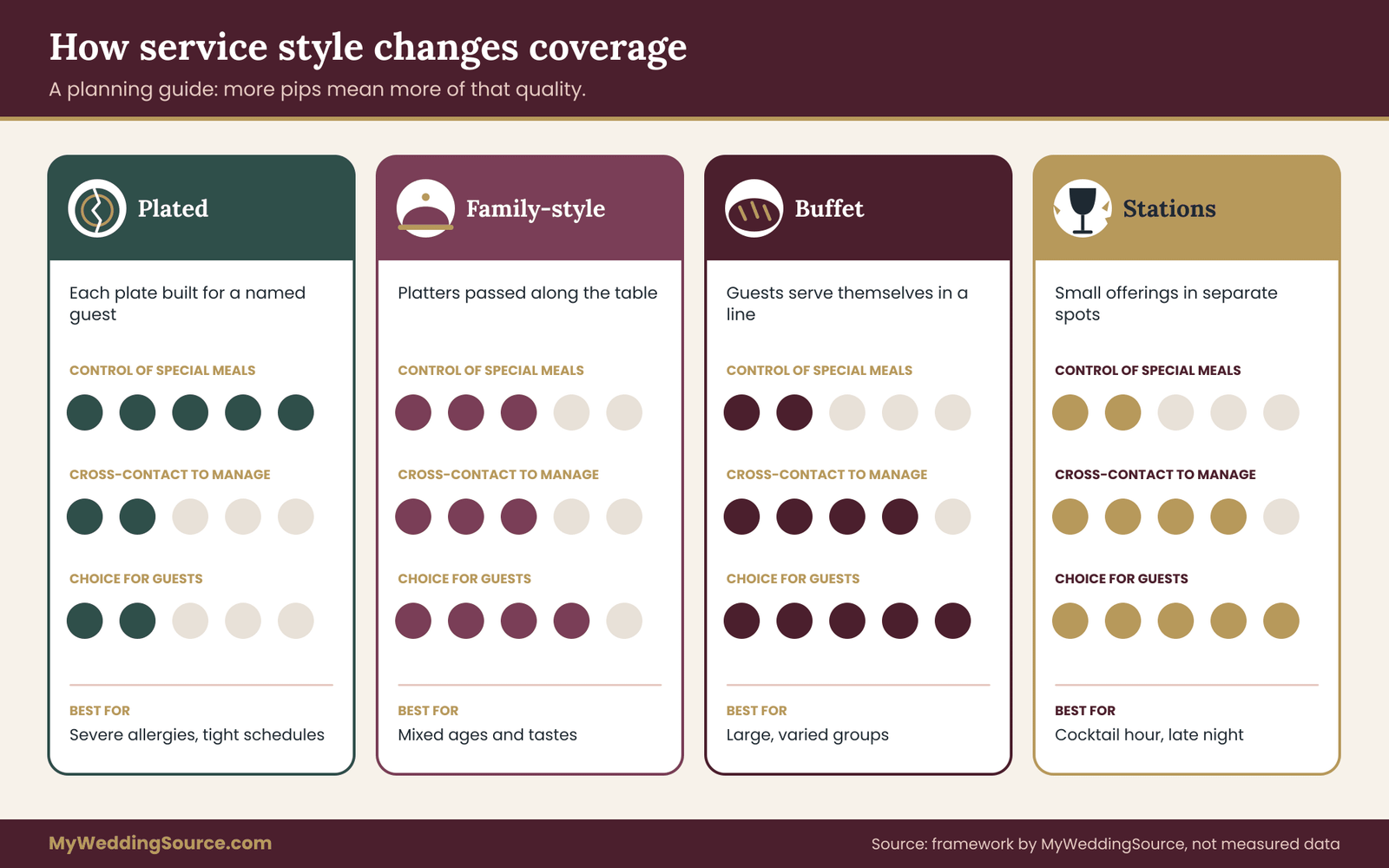
How the food reaches the guest affects coverage as much as what the food is. Each service style has strengths and weaknesses for a mixed group.
Plated service
Plated service gives you the most control over individual meals. Each plate can be built for a specific guest, and a name or table card can match meals to people. This is the best format for guests with severe allergies, because a separate plate can be prepared in a clean area and delivered by a specific person.
The costs are time and complexity. Pre-selected choices require early decisions from guests, and mistakes happen when servers cannot tell which plate belongs to whom. Plated dinners also run on a fixed schedule, so speeches have to fit around the plates, or food cools.
Family-style service
Platters are passed along the table. Guests can take what they need, which lowers the number of special meals and suits groups that include many different tastes and ages. Large dishes of vegetables and starches make good use of the shared base.
The risks are real. Shared serving spoons move between dishes, and one guest’s spoon can end up in the wrong bowl. Guests with a severe allergy cannot safely take food from a shared platter that others have handled. Family-style works best when the table is told which dishes are safe for which needs and when serving spoons are separate for each platter. It is a poor fit for the guests most at risk, who still need a separate plated meal.
Buffet service
A buffet gives guests the widest choice and can be the most inclusive format for varied tastes. It is also the format with the highest cross-contact risk, since many people use the same line and the same utensils. Guests with allergies may need to be served first by a staff member, from fresh, uncontaminated dishes, before the line opens.
Buffets also put pressure on food safety, because dishes stay out for a long time. We cover temperatures and timing in the food safety section below.
Food stations
Stations let guests choose among several small offerings, and they can lighten the load on any single dish. They suit cocktail hours and long receptions. The cross-contact risk is similar to a buffet, with the added problem that stations are often staffed by different people with different habits. Make sure each station has its own tools and labels, and that the staff at each station can answer questions about ingredients.
Choosing a style for a mixed room
There is no single best format for wedding menu planning. A useful rule: the more severe the needs in your group, the more control you need, and the more you should lean toward plated service or at least a plated option for those guests. The more varied the tastes, the more a shared format helps. Many weddings combine them, for example a buffet or family-style meal for most guests and a separately prepared plated meal for guests with severe allergies. ## Wedding menu planning for guests of every age
Age changes more than appetite. It changes what is safe to chew, how long a guest can sit, when they need to eat, and what they will actually touch. A menu that works for a thirty-year-old may fail a four-year-old and a seventy-eight-year-old for entirely different reasons.
Young children
Small children are the hardest group to design for in wedding menu planning, because the requirements pull in two directions: they need food that is plain enough that they will eat it, and shaped safely enough that they will not choke on it.
The Centers for Disease Control and Prevention lists foods that are common choking hazards for young children. They include whole or large pieces of fruit such as grapes and cherry tomatoes, raw hard vegetables such as carrots, whole nuts and seeds, nut butter in thick spoonfuls, hot dog rounds, large chunks of cheese, popcorn, chewy or hard candy, and tough pieces of meat. The advice is consistent: cut food into small pieces, mash where suitable, and avoid small, hard or sticky items for young children.
In practice, that means a child’s plate at a wedding should not be an adult plate in miniature. Ask your caterer to cut fruit, such as grapes, lengthwise, to serve soft cooked vegetables, and to avoid whole nuts, popcorn and hard candies on children’s plates and at children’s tables. At a family-style or buffet meal, remember that a toddler will take a handful of whatever is nearest. Parents are the first line of defense, but the menu can make their job easier.
Timing matters as much as the food. Children are often fed before the adults, sometimes at a separate time or table. If they sit through a long ceremony, then a long cocktail hour, they will be hungry and tired by the time the entrée arrives. Serve children’s meals early, as soon as they are seated, or arrange a small snack beforehand. A well-fed child makes the whole evening easier for everyone.
Ask the caterer about children’s pricing and portion sizes. Many caterers offer a lower-priced child’s meal with a simple menu, such as pasta, chicken pieces and fruit. Check that the child’s menu is made in the same kitchen with the same allergen care as the adult menu, since a child with an allergy needs the same protection as an adult. If you are deciding who to invite, our wedding guest list guide walks through the children question.
Older children and teenagers
Older kids and teens can usually eat the adult meal, but they often eat a lot more than a small portion and have strong preferences. A teenager with a growth spurt may eat as much as an adult. Plan portions accordingly, and do not assume that a “kids’ meal” fits every guest under eighteen.
This group is also where the “picky eater” and the “genuine restriction” blur. A teen who refuses everything except plain pasta may be a picky eater or may have a sensory aversion or medical reason. Ask the parents. A short note on the RSVP is better than a surprise.
Adults in their middle years
For most adult guests, the main wedding menu planning issue is not age but the mix of diets and tastes. Remember that middle-aged guests are also the group most likely to be managing a medical diet, such as diabetes, high blood pressure or cholesterol. They will not usually mention it, and they do not need you to change the menu, but they appreciate options that are not heavy on sauces and sugar. Offer a lighter first course, vegetables that are not drowned in butter, and a dessert that is not the only sweet option.
Pregnant guests
Pregnant guests are often advised to avoid certain foods, such as raw or undercooked fish, unpasteurized dairy and some deli meats. They are best placed to decide what is right for them. What you can do is make it easy: label dishes clearly, and tell the caterer that raw or undercooked items should be marked. Offer at least one fully cooked item at every course and a festive nonalcoholic drink.
Older guests
In wedding menu planning, older guests are the group whose needs are most often missed because they are not mentioned and are not obvious. Several things matter.
Texture and chewing. Some older guests have dental problems or swallowing difficulties. Tough meat, crusty bread, raw vegetables and nuts can be hard to manage. A braised or slow-cooked entrée, soft sides and a tender dessert are easier. Offer a softer option to guests who ask, and make sure it is not embarrassing to request.
Swallowing difficulties. Guests with dysphagia may need foods of a certain texture, sometimes pureed or finely minced, and thickened drinks. This is a medical need, and it deserves the same attention as an allergy. Ask the guest or a family member what is required, and ask the caterer whether they can provide it.
Sodium, sugar and medications. Many older guests follow low-sodium or low-sugar diets. A kitchen that salts everything heavily and offers only a sugary dessert does not serve them. Sauces on the side, fresh fruit and unsweetened options help. Some medications also interact with certain foods or alcohol. Do not guess. Let the guest decide.
Timing and comfort. Older guests may need to eat at a predictable time and should not be kept waiting through long delays. Seat them near the kitchen door or a restroom if that helps, and make sure they are served early. Where a long cocktail hour is planned, provide seating and a few substantial items so they do not stand and wait.
Appetite. Older guests often eat smaller portions. Offer a smaller portion if asked, and do not interpret an untouched plate as an insult to the chef.
Putting ages together at the table
Seating can help your wedding menu planning too. Placing families with young children near each other, and near the exit, lets them leave easily. Seating older guests where it is quiet and near a restroom helps them stay comfortable. If your caterer plates by table or by section, tell them which tables hold children and which hold guests with severe allergies, so staff can plan service accordingly.
Dietary practices: vegetarian, vegan, halal, kosher and more
In wedding menu planning, dietary practices are rules that a guest follows by choice, belief or tradition. They are not medical, but they are not trivial. A guest who keeps halal or kosher is making a serious commitment, and a mistake can make them unable to eat anything at all.
Vegetarian and vegan guests
Vegetarian guests do not eat meat or fish. Many eat dairy and eggs. Vegan guests avoid all animal products, which includes dairy, eggs, honey and sometimes sugar processed with bone char, though most vegans will not hold a caterer to that last point. The categories vary, so ask guests what they eat and avoid.
The commonest failure in wedding menu planning is the vegetarian plate that is an afterthought. Avoid it by treating the plant-based entrée as a full dish: a proper protein such as beans, lentils, tofu or tempeh, a flavorful sauce, vegetables, and a satisfying starch. Check the details. Vegetable stock, cheese made with animal rennet, Worcestershire sauce, gelatin and lard in pastry can all appear in dishes labeled vegetarian.
Plant-forward menus, where the main dish is plant-based for everyone, are an effective way to solve the problem. They remove the “special” plate completely, since everyone eats the same thing, and they often reduce allergen and halal issues at the same time.
Pescatarian and flexible diets
Pescatarian guests eat fish but not other meat. Flexitarian and “mostly vegetarian” guests are more flexible. If your entrée choice includes a fish dish, make sure it does not carry hidden meat products such as bacon or a meat-based sauce. For guests who say they are “mostly vegetarian,” ask what they actually need. The question is usually simple to answer, and it means the guest’s plate does not become a guessing game.
Halal
Halal means permissible under Islamic dietary law. It excludes pork and its derivatives and alcohol, and it requires that meat come from animals slaughtered in a prescribed way. For a caterer, a halal meal usually means one of two things: either all meat is sourced from a halal supplier, or a separate halal meal is prepared for the guests who need it.
If you have halal-observing guests, ask the caterer whether they can source halal meat, and whether they can provide documentation from the supplier. Check the less obvious items: alcohol in sauces, desserts and extracts, gelatin made from pork, and shared cooking surfaces. Some guests are comfortable with a vegetarian or seafood meal prepared in a clean kitchen, and some insist on halal meat. Ask the guest what they accept.
Kosher
Kosher refers to Jewish dietary law. It involves rules about which animals may be eaten, how they are slaughtered and prepared, and the separation of meat and dairy, plus rules about utensils and kitchens. Observance varies widely. Some guests keep strictly kosher and will eat only food prepared under rabbinical supervision. Others keep a looser form and avoid certain foods only.
This is the area of wedding menu planning where the label “kosher-style” can cause real harm. A menu that avoids pork and shellfish and does not mix meat and dairy is not kosher, and a guest who keeps kosher cannot eat it. If you tell a guest that a meal is kosher, it should be certified, prepared in a supervised kitchen or provided as a sealed, pre-packaged meal. Do not use the term loosely. If you cannot arrange a certified meal, say so, and ask the guest what they prefer. Many kosher-observant guests are used to bringing their own food or eating a simple fruit and vegetable plate.
Hindu, Jain and Buddhist practices
For wedding menu planning, note that many Hindus, Jains and Buddhists follow vegetarian practices, and some avoid specific foods such as onions, garlic or root vegetables. Some Hindu guests avoid beef specifically. Jain practice is among the strictest, often excluding root vegetables. These traditions are diverse, and individual observance differs. Do not assume. Ask each guest, and do not use stereotypes to decide.
Fasting and religious calendars
In wedding menu planning, remember that some guests may be fasting on the day of your wedding, for example during Ramadan, Lent or other observances. A fasting guest may not eat during certain hours, or may avoid specific foods. If your wedding date falls in or near such a period, ask guests who may be affected whether they need a meal at a particular time, a packed meal to take home, or a seating arrangement that does not make them feel excluded. It is a kindness that costs very little.
Low-carb, keto and similar diets
Many guests follow low-carb, keto, paleo or other self-chosen diets. These are choices, not medical needs, and you do not need to build the menu around them. A well-designed menu with a good protein and vegetables serves most of these guests anyway. If your sides are mostly starches, a vegetable-heavy option helps.
What not to do
In wedding menu planning, do not ask a guest to prove their diet. Do not tell a guest that a dish is “basically” halal, kosher or vegan. Do not serve a vegetarian guest a dish with a meat garnish and expect them to pick it off. And do not put a tag on a plate that reads “special meal” in a way that draws attention. A small, discreet symbol or a table number is enough. ## Allergies, celiac disease and medical diets
This is the part of wedding menu planning where the stakes change. A food allergy is not a preference. The reaction can be severe and sometimes life-threatening, and it can be set off by a very small amount of the wrong food. Celiac disease is an autoimmune condition in which gluten damages the gut, and it requires strict avoidance. Treat both as safety questions.
The major allergens
Federal law in the United States identifies nine foods as major food allergens: milk, eggs, fish, crustacean shellfish, tree nuts, peanuts, wheat, soybeans and sesame. Sesame became the ninth on January 1, 2023, when the FASTER Act took effect. Packaged foods sold in stores must declare these allergens on their labels. That rule helps you when you read an ingredient list on a package. It does not govern what a caterer does in a kitchen, and it does not cover the many people who are allergic to foods outside the list, such as mustard, celery, corn or certain fruits.
So the list is a useful starting point for wedding menu planning conversations with the caterer, not a boundary. Always ask the guest what they are allergic to, and pass on the exact words.
Cross-contact is the real risk
Most serious problems come from cross-contact, which is the unintentional transfer of an allergen from one food to another. Cooking does not remove it. A guest who is allergic to shellfish can react to a tiny amount of shrimp protein on a cutting board, in fryer oil or on a serving spoon.
Food Allergy Research and Education, a major patient organization, describes the basic habits that reduce cross-contact in a kitchen: washing hands and changing gloves between items, cleaning and sanitizing surfaces and equipment between tasks, using clean tools for each dish, preparing allergy meals on a protected surface, and watching shared sources such as fryer oil, shared refrigerator shelves and condiments. If a mistake happens, the meal should be remade from the start, not fixed.
Cross-contact is more likely at a wedding than in a small restaurant, because the kitchen is temporary, the staff may be hired for the night and the volume is high. That is why the process matters as much as the menu.
Gluten-free, celiac disease and sensitivity
Gluten is a protein in wheat, barley and rye. For guests with celiac disease, even small amounts matter. In the United States, the Food and Drug Administration set a definition for “gluten-free” on packaged food labels: the product must contain less than 20 parts per million of gluten. That standard applies to labeled packaged foods.
A caterer’s “gluten-free” menu item is a different matter. The caterer may follow careful practices, or may simply mean “no bread on the plate.” Ask them. How do they prevent cross-contact with wheat? Do they use separate surfaces, utensils and cooking water? Are sauces thickened with flour? Is the fryer shared? Are the tortillas, pasta or bread in the dish made in a way that guarantees gluten-free handling? An honest caterer will tell you what they can and cannot do.
Distinguish three situations. A guest with celiac disease needs strict avoidance and careful handling. A guest with non-celiac gluten sensitivity may react to gluten but may be more flexible about trace amounts. A guest who avoids gluten by choice can be served an item that is simply made without gluten-containing ingredients. Ask the guest which applies.
Other medical diets
Allergies and celiac disease are the common cases in wedding menu planning, but guests may follow other medical diets.
- Diabetes. Guests need to manage carbohydrates. A balanced plate, a dessert that is not the only sweet and an option of fruit or a smaller portion help.
- Kidney disease. Some guests limit potassium, phosphorus and sodium. They will usually know what to avoid. Offer simple dishes with ingredients listed.
- Heart conditions and high blood pressure. Lower sodium and fewer rich sauces help.
- Swallowing difficulties. Texture-modified foods may be required, as noted above.
- Eating disorders and recovery. A guest may prefer certain foods or to avoid certain situations. If a guest mentions a need, respect it and ask nothing further.
In each case, the principle of wedding menu planning is the same: ask the guest, record the exact need, and plan with the caterer.
What a caterer should be able to tell you
Before you commit, ask the caterer these wedding menu planning questions, and expect specific answers.
- Which dishes on the menu contain each of the nine major allergens? Can you give me a written ingredient and allergen list?
- How do you handle a guest with a severe allergy? Who prepares the meal, where, and with which equipment?
- How do you label special meals, and how do servers know which plate goes to which guest?
- Do you use shared fryers, grills or prep surfaces? How do you clean between uses?
- How are your staff trained on allergens? Is the lead trained in food allergy safety?
- Do any dishes come from outside suppliers, such as bread, desserts or sauces? Can you confirm their ingredients?
- Can the guest speak directly with the chef before the event or on the night?
- Do you have a safe, sealed backup meal for a guest if something goes wrong?
- What is your process if a guest has a reaction?
- Will you put this process in writing?
If the caterer is dismissive (“we handle it all the time”) or avoids the question, treat that as important information. A good caterer welcomes the questions because they show you care about the details.
Do not ask for a promise nobody can make
You will sometimes hear “we can make it completely allergy-safe.” Be careful with that sentence. No kitchen can promise zero risk, and a caterer who claims to is either unfamiliar with the problem or unwilling to be careful with it. What you want is a clear process, documented steps and honest limits. The American Academy of Allergy, Asthma and Immunology notes that its own event planning guidance is not a substitute for formal food allergy training, and that caterers need detailed knowledge of ingredients and preparation to label accurately.
The handoff chain on the night
Wedding menu planning does not end in the kitchen. Even a perfect kitchen fails if the plate goes to the wrong person. The handoff from guest to plate is a chain, and every link has to hold.
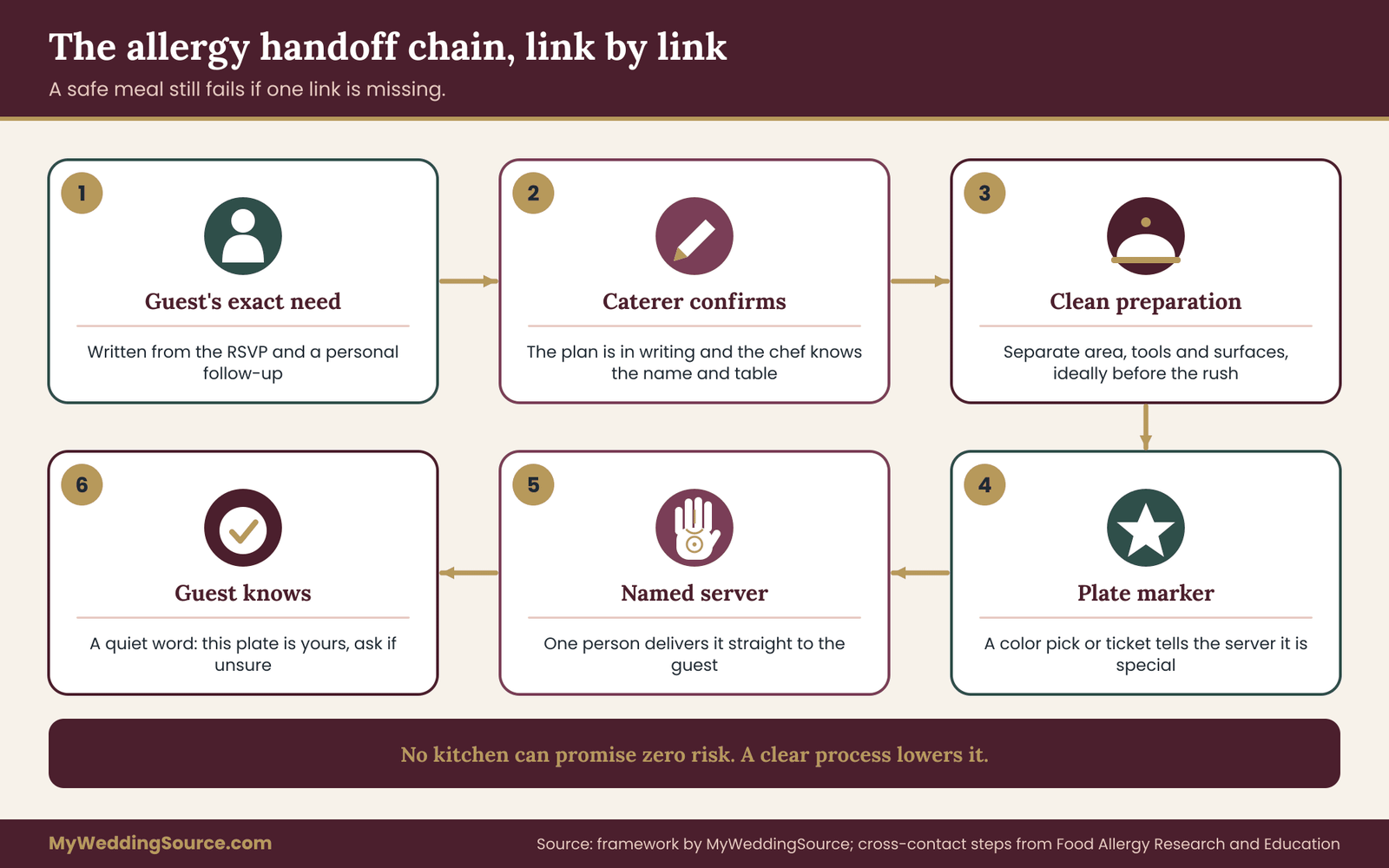
Link one: the guest’s information. The RSVP and your follow-up produce an exact statement of the guest’s need.
Link two: the caterer’s confirmation. The caterer confirms in writing what they will do, and the chef knows the name and table of each guest.
Link three: the kitchen. The special meal is prepared on clean equipment, often first, before the kitchen is busy, and separated from other dishes.
Link four: the marker. The plate carries a clear marker, such as a color-coded pick or a ticket, that tells the server it is a special meal.
Link five: the server. A specific person is responsible for delivering the plate directly to the guest and confirming the guest’s name.
Link six: the guest. The guest is told, quietly, that their meal is the special one, and that they can check with the server or manager if they are unsure.
Assign a person on your team, usually a day-of coordinator or a trusted family member, to confirm with the catering lead that the chain is in place before service begins.
Be ready if something goes wrong
Even with every precaution, a reaction can happen. Know where the nearest emergency services and hospital are. Ask guests with severe allergies whether they carry emergency medication and where it is. Make sure at least a few people at the event know what is happening and where the guest’s medication is. If a guest has a reaction, call emergency services immediately. Do not wait. This is not the moment for etiquette. Tell the venue manager and the caterer your emergency plan in advance, and ask them for theirs.
Verifying the caterer: what to see, ask and document
Wedding menu planning depends on trust, and trust is stronger when it is backed by evidence. A caterer who sounds confident and a caterer who can show you their process are not the same thing. This section turns your questions into steps you can follow.
Use the tasting to test the plan, not only the flavor
A tasting is usually the only chance in wedding menu planning to see how a caterer works before the wedding. Use it for more than taste.
Bring your dietary list. Ask the caterer to show you how they would serve each special meal. If they offer a gluten-free or nut-free plate, ask how it was made. Try the plant-based dish as seriously as you try the meat dish. Ask whether the plates would look the same at 140 covers as they do at a tasting for two, because a dish that works for a small group can fall apart at scale.
If you cannot taste every alternative, prioritize the ones that matter most: the main plant-based dish, the gluten-free option and the children’s meal.
Get the details in writing
Verbal assurances fade, and wedding menu planning needs a paper trail. Ask for a written menu with ingredient and allergen information, and a written description of how special meals will be handled. A good caterer will do this routinely. If the information changes, ask for an updated version.
The written document should include the final menu with every dish named, the allergens or ingredients present in each, the plan for special meals, and the caterer’s contact for the day. Keep it with your contract.
Check licensing and food handling
In wedding menu planning, remember that caterers operate under local health regulations, which vary by city and county. Ask whether the caterer holds the required local food service license, and whether staff hold food handler certification where it is required. You can verify licensing with your local health department. If a venue has an in-house kitchen or an exclusive caterer, ask for the same information. Our vendor due diligence checklist shows how to confirm a vendor’s credentials and what documents to ask for.
Ask about everyone who touches the food
Wedding menu planning often involves several parties: the caterer, a separate baker, a bar company and sometimes the venue’s staff. Each one needs the same information. Ask your caterer how they communicate with the baker and the bar. Ask the baker for ingredient lists. Ask the venue whether it has restrictions on outside food and whether their kitchen is shared with other events.
Contract clauses worth reading
Read the contract with your dietary plan beside you. Look for clauses on the following.
- Menu changes and substitutions. Can the caterer substitute an ingredient without your approval? A substitution can introduce an allergen.
- Final guest count and special meal count. When is the deadline, and how do changes affect the price? Are special meals charged differently?
- Overage and extras. What happens if more guests show up than expected, or if a special meal is needed on the night?
- Allergen protocol. Does the contract refer to your written plan, or is it silent?
- Responsibility. What does the caterer say about its liability? Do not rely on a verbal “we’re insured.” Ask for the certificate.
- Leftovers and takeaway. Do local rules or the caterer’s policy limit what can be taken home?
This is not legal advice, and rights and obligations vary by contract and by state. If a contract is large or unusual, a lawyer can review it. For the costs that come from special meals, our wedding budget guide shows where to put them.
A sample message to a caterer
Here is a short email you can adapt after you have the RSVP data.
“We are finalizing our menu and want to make sure it works for everyone. Here is our current list: [number] guests with a severe allergy (details attached), [number] vegetarian, [number] vegan, [number] halal, [number] gluten-free and [number] children under ten. Could you send a written allergen and ingredient list for each dish, confirm how you will prepare and serve the special meals, and tell us how your team will match each plate to the right guest? We would also like to talk through the plan with your chef before the final count.”
It does three things. It gives the numbers so the caterer can plan. It asks for evidence in writing. And it asks for a conversation with the person who actually cooks. ## Keeping the food safe from kitchen to table
A wedding menu can be perfectly designed and still make guests ill if the food sits too long at the wrong temperature. Food safety is a separate layer of wedding menu planning, and a mixed group makes it more important, because young children, older adults, pregnant guests and people with certain medical conditions are more vulnerable to foodborne illness.
The temperature rules
The basic idea is the temperature danger zone. Bacteria grow quickly between roughly 40°F and 140°F, so perishable food should be kept cold at or below 40°F or hot at or above 140°F until it is served. County and state health departments give the same guidance for buffets: hot food should be held at 140°F or above and checked with a food thermometer, and cold food should be held at 40°F or below, with platters set over ice if they will sit out.
A second rule is time. Perishable food should not stay at room temperature for more than two hours unless it is being kept hot or cold. When the air temperature is above 90°F, as at a summer outdoor reception, the limit drops to one hour. These are general public health rules, and your caterer works under local regulations that may add detail. Ask them how they will meet them.
What this means for service
Ask your caterer these practical questions.
- Hot holding. What equipment keeps the hot dishes at temperature, and does it reach 140°F? Some warming devices only keep food warm, not hot enough.
- Cold holding. How will salads, cold appetizers, dairy dishes and desserts stay cold? Are they kept on ice or in refrigerated units?
- Timing. How long will each dish sit out? If the line opens late because of speeches, what happens to the food?
- Refilling. Staff should replace a nearly empty dish with a fresh, full one, not top up the old one, because food that has been out for a while should not be mixed with fresh food.
- Utensils. Each dish needs its own serving utensil, and utensils should be replaced if they fall or are used for another dish.
Outdoor and hot-weather events
Heat changes wedding menu planning. A buffet in direct sun, a cake in a hot tent and a cheese platter at an afternoon reception all have shorter safe windows. Provide shade for food, keep cold food on ice, and ask the caterer to bring out dishes in smaller batches. If the weather is unpredictable, our guide to an outdoor wedding rain plan covers how to set trigger times and backup arrangements, and the same thinking applies to food setup.
Desserts, late-night food and leftovers
Cream-filled and custard desserts, fresh fruit and anything with egg or dairy need cold storage until just before serving. A late-night snack that was prepared earlier and has been sitting out is a common food safety problem. Ask when it will be made and how it will be kept.
Leftovers are another question. Food that has been out for more than the safe window should be discarded, not packed up and taken home. Check your caterer’s policy and local rules. If guests are taking food home, decide in advance what is safe to send and how it should be packed.
Children, older guests and food safety
Young children and older adults are at higher risk of serious illness from foodborne bacteria. If you are serving children’s meals early, keep them hot or cold until they are served. For older guests who are served late, make sure the plate has not been sitting under a heat lamp for a long time. These are small habits that matter.
Your venue’s kitchen
If your venue has an on-site kitchen, ask about its inspection history and whether the kitchen is shared with other events or services. If your caterer is using a temporary setup, ask how it will be arranged, including handwashing facilities, refrigeration, power and water. A good caterer will have a plan. Our wedding venues guide explains what to ask a venue about kitchens, vendors and restrictions.
Counting special meals and pricing them
Counting is where wedding menu planning meets the budget. The way you count affects both the safety of the meal and its cost.
Count from the RSVPs, not from a rule of thumb
You may read that a certain percentage of guests will have dietary restrictions. These numbers vary widely by source and by group, and they are not a substitute for your own data. Your guests are not the national average. Use your RSVP answers. If twelve guests have told you they are vegetarian, plan for twelve vegetarian meals, plus a small cushion, and ask your caterer what cushion they prefer.
A small, honest cushion
Not everyone reads the RSVP carefully, and some guests will change their minds. Ask your caterer how many extra special meals they usually keep, and whether the extras are charged. A common arrangement is that the caterer prepares a few more plant-based or gluten-free meals than the count, because those are the most common surprises. The cushion is cheaper than a guest with nothing to eat.
Understand how special meals are priced
Pricing varies. Some caterers charge the same for every entrée, including special meals. Some charge more for a specially prepared plate, such as a certified halal or kosher meal, or for a plate prepared separately for an allergy. Some include one vegetarian option in the base price. Ask the caterer how they price each of the following and put it in writing.
- A plant-based entrée
- A gluten-free or allergen-free plate
- A children’s meal
- A halal or kosher meal, if sourced separately
- Vendor meals for photographers, musicians and planners
The cost of complexity
Each extra dish adds ingredients, labor and plating time. If your caterer has to prepare four entrées, plan for a higher cost than for two. This is why the “swap before you add” rule matters. A shared base that already covers most needs lowers the number of special meals and often the cost per head.
Where to find the savings
If budget is tight, adjust your wedding menu planning in ways that keep coverage: simplify the number of entrée choices, use seasonal vegetables, choose a family-style format that lowers plating labor, or lean on plant-based dishes, which tend to cost less per portion than premium meats. Do not cut the allergy process or the written confirmation. That is the part that protects people.
The final count
Your contract will set a deadline for the final guest count, often one to two weeks before the event. The exact date varies, so check yours. Send the caterer the final numbers for each category, including the special meals and children, and ask for confirmation in writing. After the deadline, changes may not be possible or may cost more. Keep your own list up to date until then.
The numbers and names below are invented to show how the method works. They are not data from a real wedding.
The couple and the guest list
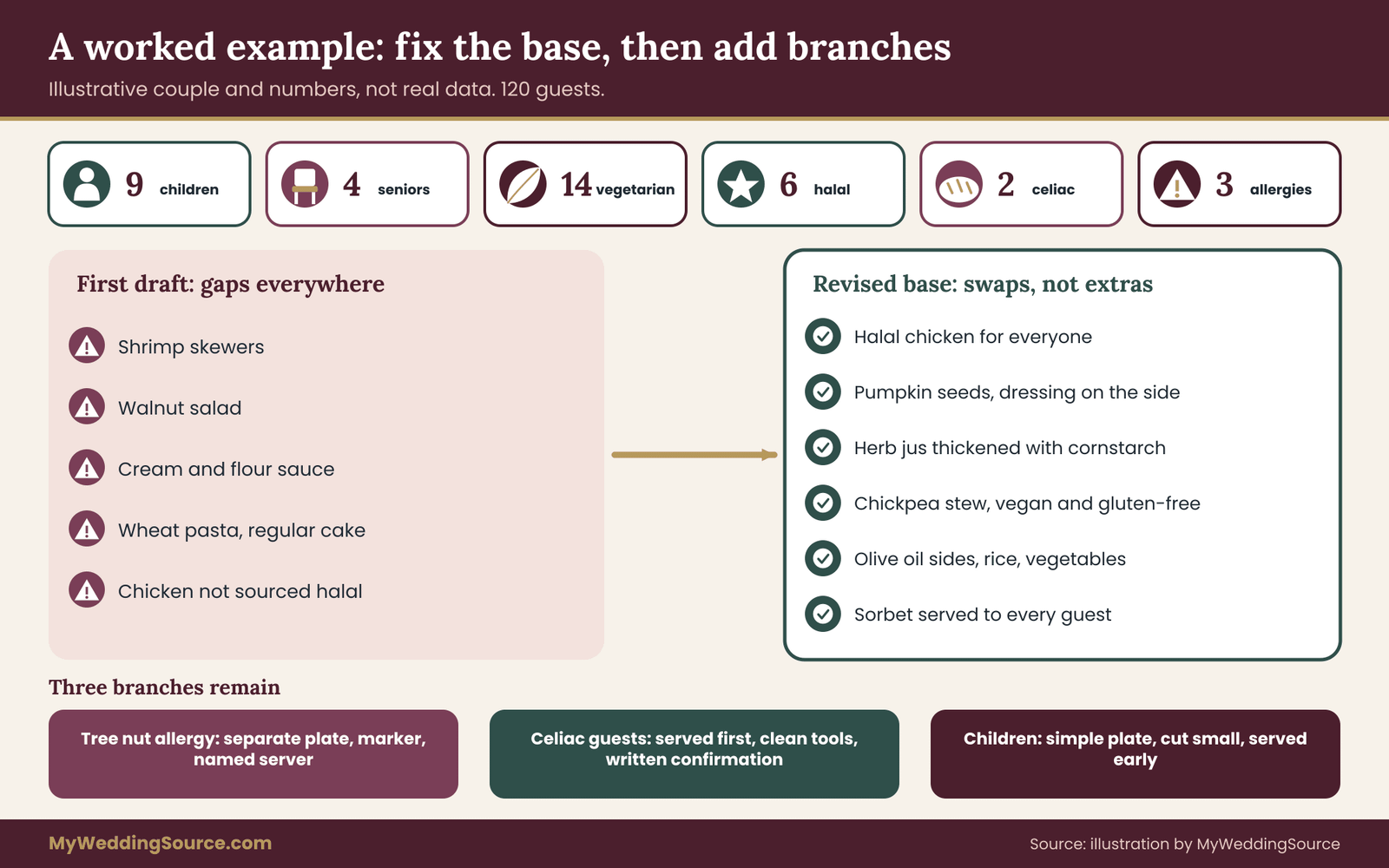
Priya and Marcus are planning a Saturday dinner for 120 guests. Their RSVPs show the following groups. Some guests belong to more than one.
- 9 children, ages 3 to 12
- 4 older guests who need softer food
- 14 vegetarian guests, including 4 vegan
- 6 guests who keep halal
- 2 guests with celiac disease
- 3 guests with allergies: one severe tree nut allergy, one shellfish allergy and one egg allergy
- 1 guest who is pregnant
Step one: sort by seriousness
They sort the list. At the top are the two guests with celiac disease and the three with allergies, since those are medical needs. Next come the six halal guests. After that are the vegetarians and vegans, then the children and older guests, whose needs are about safety and comfort, and finally a short list of dislikes.
Step two: draft the courses
The couple and their caterer draft a menu. The first version includes shrimp skewers at the cocktail hour, a salad with candied walnuts, a chicken entrée in a cream sauce and a vegetarian pasta, wheat-based sides and a three-layer cake.
Step three: find the gaps
Mapping coverage shows the gaps quickly. The shrimp skewers exclude vegetarians, halal guests and the shellfish-allergic guest. The walnut salad excludes the tree nut guest. The cream sauce excludes the vegan guests and could carry gluten. The pasta is not gluten-free. The cake contains eggs, dairy and wheat, so it leaves out the egg-allergic guest, the celiac guests and the vegans. Halal guests are not covered unless the chicken is sourced halal.
Step four: fix the base first
Rather than add six special meals, they change the shared base of their wedding menu planning.
- The cocktail hour swaps shrimp for roasted mushroom and chickpea bites and a platter of marinated vegetables, both free of the nine major allergens and suitable for vegetarians and vegans. A small number of chicken skewers, made with halal chicken, stay on the menu.
- The salad uses toasted pumpkin seeds in place of walnuts, with the dressing on the side.
- The caterer sources all chicken from a halal supplier, so the six halal guests eat the same entrée as everyone else, and no separate halal meal is needed.
- The chicken is braised in a herb and stock sauce thickened with cornstarch, not cream and flour. It is tender enough for the older guests, and gluten-free by design.
- The second entrée is a chickpea and vegetable stew over rice, which is vegan, gluten-free and filling. Vegetarians and vegans choose it, and others are welcome to.
- Sides are roasted vegetables and rice, both made with olive oil.
- Dessert is a cake for most guests, plus a fruit sorbet served to everyone, which covers the vegans, celiac and egg-allergic guests.
Step five: add only the branches that remain
The base now covers the vast majority of guests. Three branches remain. The guest with the severe tree nut allergy gets a plate prepared separately in a clean area, with a marker on the plate, handed to her directly by a named server. The guests with celiac disease get the same dish as everyone else, served first from clean equipment, with a written confirmation from the caterer about cross-contact. The children get a simple plate of pasta, soft vegetables and cut fruit, served early.
The result
In their first draft, they were looking at six or more distinct special preparations and several gaps. In the revised menu, they have one separately prepared plate, a gluten-free handling procedure and a children’s meal. Most guests eat the same food. Nobody is singled out. Costs are lower than the original plan would have been, and the kitchen has a clear job.
The couple ends by sending the caterer a written summary, asking for confirmation of each step, and scheduling a short call with the chef before the final count.
Wedding menu planning has a rhythm. The details depend on your date, your caterer and your contract, so treat these steps as a sequence and not a calendar.
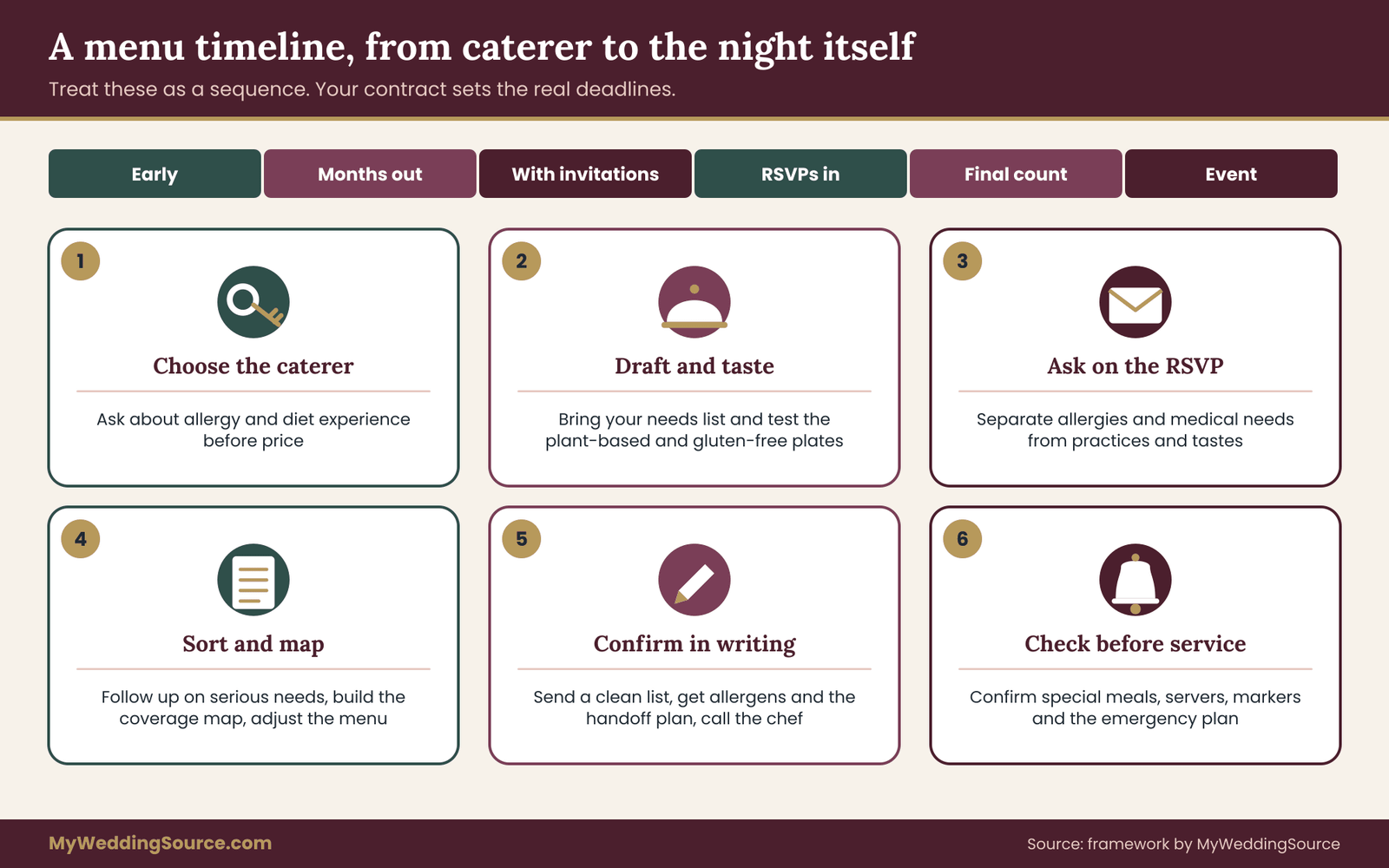
Early on, once you have a date and a venue: choose a caterer, or confirm the venue’s catering requirements. Ask about experience with allergies and diets before you ask about price. Our wedding vendor timeline shows where catering fits among the other bookings.
Several months out: draft the menu and hold the tasting. Bring your dietary needs to the tasting. Ask for the written allergen and ingredient information.
With the invitations: send the RSVP with the dietary questions. Ask for replies by your deadline, which is usually a few weeks before the event so you can give the caterer a final count.
After the RSVPs arrive: sort answers, follow up personally with guests who have severe needs and build the coverage map. Adjust the menu if the gaps are large.
Before the final count deadline: send the caterer a cleaned list. Ask for written confirmation of the special meal plan, the allergen declarations and the handoff procedure. Hold a short call with the chef.
In the last days: reconfirm the plan with the caterer and the day-of coordinator, share it with the people who will serve, and prepare table cards or markers.
On the day: check in with the catering lead before service. Confirm that the special meals are ready, that servers know who they are for and that the emergency plan is known. A rehearsal dinner or welcome event is a good place to test the same process on a smaller scale, and our guide to wedding weekend event planning covers how to structure those meals. ## Mistakes that cause most wedding menu planning problems
Most failures come from the same short list of habits. Knowing them helps you avoid them.
Asking one vague question. A single “dietary restrictions” line collects half-answers. Separate allergies, practices and preferences, and follow up on serious needs.
Treating every request as equal. A severe allergy and a dislike of mushrooms are not the same, and the chef needs to know which is which. Sort by seriousness.
Designing the vegetarian plate last. The plant-based dish is the one that gets the least attention and the most complaints. Plan it first, taste it at the tasting and give it the same care as the others.
Using labels loosely. “Kosher-style,” “allergy-friendly,” “nut-free” and “gluten-free” can mean very different things in a kitchen. Ask what the label means, and get it in writing.
Relying on memory and verbal promises. A chef who says “we’ll remember” on the phone may not be the person working on the night. Put the plan in writing and keep it with the contract.
Forgetting the vendors outside the kitchen. The baker, the bar and the late-night food truck are all part of the meal. Each needs the same information.
Skipping the handoff. The most common real-world failure is a safe meal delivered to the wrong person. A named server and a plate marker prevent it.
Letting the schedule starve the food. Long speeches, late arrivals and photo sessions leave food cooling or warming on a table. Agree with the caterer on a service timeline and stick to it, and ask your venue or planner to protect it.
Adding dishes instead of fixing the base. Each extra dish adds cost and risk to wedding menu planning. Look for a swap in the shared menu first.
Ignoring children and older guests. Menus designed around adult tastes miss two groups who need food cut, softened or served early.
Not telling the guest what you did. A guest with a serious allergy wants to know what to expect. A short message that says what the caterer will do and who will bring the plate gives them confidence and lets them speak up if something is wrong.
What this guide cannot do
This wedding menu planning guide is general. It is not medical, dietary or legal advice, and it cannot replace the instructions of a guest’s doctor or the training of a food allergy professional. Allergen rules, food safety regulations, licensing and contract rights vary by state, county and caterer, so check the local requirements and the specific contract. The examples are illustrations, not data. If a guest has a serious medical condition, the guest and their doctor are the experts on what is safe, and your role is to follow their instructions and build a process around them.
FAQ
How do I plan a wedding menu for guests with different dietary needs?
Good wedding menu planning collects needs on the RSVP, sorts them by seriousness and builds one shared base menu that most guests can eat as served. Then add a few clear alternatives for the groups the base misses. Confirm every ingredient and allergen detail with the caterer in writing.
What should I ask guests about food on the RSVP?
For wedding menu planning, ask three things: whether they have a food allergy or medical diet, whether they follow a dietary practice such as vegetarian, vegan, halal or kosher, and, for children, their age. Keep allergies and medical needs separate from preferences, and offer to follow up personally on anything serious.
How many entrée choices should we offer?
In wedding menu planning, two is the most common and usually enough, with one plant-based option. A single inclusive entrée works for small weddings, and three can serve a very varied group but adds cost and complexity. More choices mean more pre-selection, more plating lines and more chances for a plate to go to the wrong person.
Can a caterer guarantee a meal is allergy-safe?
Be careful with anyone who promises that. A kitchen can follow strict practices and reduce risk, but no process removes it entirely. Ask the caterer to describe the steps they take, put them in writing and agree on how special meals are prepared, marked and delivered.
Is gluten-free the same as safe for celiac disease?
Not always. In the United States, a packaged food labeled gluten-free must contain under 20 parts per million of gluten, but a caterer’s menu item is not automatically held to that standard. Ask how the kitchen prevents cross-contact with wheat, barley and rye, and whether utensils, surfaces and fryers are shared.
What should I serve children at a wedding?
Serve simple, familiar food that is cut into small pieces, and serve it early. For young children, the Centers for Disease Control and Prevention lists whole grapes, nuts, hot dog rounds, large chunks of cheese, popcorn and hard candy as choking hazards. Ask the caterer to prepare and cut children’s food with those in mind.
Does “kosher-style” mean a meal is kosher?
No. A menu that avoids pork and shellfish or separates meat and dairy is not kosher unless it is prepared and supervised under kosher certification. If a guest keeps kosher, ask what they accept, and offer a certified or sealed meal if you can. Do not describe a meal as kosher unless it is.
What if a guest tells us about an allergy at the last minute?
Tell the caterer straight away and ask what they can do. A good caterer will have an allergen-aware backup, such as a simply prepared plate, and a clear process. Talk to the guest, find out exactly what they need and make sure someone is responsible for delivering the meal. If the guest cannot be served safely, a packaged or prepared meal from a trusted source can be the safe choice.
Your next steps
Start your wedding menu planning with three actions this week. First, rewrite your RSVP dietary questions so they separate allergies and medical needs from practices and preferences. Second, list the guest groups you already know about, and sketch a coverage map for each course. Third, write the questions from this guide that you want to ask your caterer, and ask for the answers in writing.
Then work through your wedding menu planning in order: fix the shared base, add only the branches you need, confirm the handoff and verify the contract. Keep your master list up to date until the final count. If you want to see where the menu sits among all your other tasks, our wedding planning checklist gives you the full sequence.
Sources
- Food allergies overview, U.S. Food and Drug Administration
- Update on sesame allergen labeling on food packages, U.S. Food and Drug Administration
- Choking hazards, Centers for Disease Control and Prevention
- Event planning and food allergy awareness, American Academy of Allergy, Asthma and Immunology
- Cross-contact prevention poster, Food Allergy Research and Education
- Parties and gatherings with food allergies, Food Allergy Research and Education
- FDA sets definition of gluten-free for labeling, Celiac Disease Foundation
- Food safety fact sheet for buffet dining, Mohave County Public Health
- Buffet food safety, Minnesota Department of Health
- Buffet food facts, Kansas State University Research and Extension
- Tips for caterers, Food Allergy Canada
- How to handle wedding guests’ food allergies, WeddingWire
- Wedding menu dietary restrictions, Loverly
Dessert is part of the meal, not an afterthought. Pair this with our wedding cake timeline so the cake, the plated courses and the dietary needs line up.
Most food waste is decided at the menu stage. Our guide to wedding waste reduction planning shows how to audit catering, rentals and cleanup before the day.
Serving fish or shellfish? Learn how to check sustainable seafood claims before they land on the menu.