

Engagement ring insurance appraisals put a dollar figure on the cost of replacing your ring, and that figure is rarely the same as what you paid, so the useful question is not “what is it worth?” but “will my coverage actually pay what it would cost to replace?”
Quick answer
An insurance appraisal estimates the replacement value of your ring: roughly what a jeweler would charge for a new, nearly identical one today. That is usually different from your purchase price (what you paid on one day, possibly with discounts) and much higher than resale value (what a buyer would pay for it used). Use the replacement-gap worksheet in this guide to compare three numbers: the appraisal, your policy’s limit, and your deductible. Update the appraisal about every two to three years, and sooner after a repair, a reset, or a big move in metal or stone prices. This guide is general information, not insurance, legal, tax, or financial advice.
What engagement ring insurance appraisals are for, and what they are not
Most couples meet engagement ring insurance appraisals at an awkward moment: the proposal is behind them, the ring is on a finger, and an insurance agent or an online quote form asks for “a current appraisal.” The request sounds like paperwork, but it is really a question about how much money your coverage should be built around. Getting the number right means knowing what an appraisal measures, what it leaves out, and how it differs from the other papers that came with the ring.
One document, several possible values
An appraisal is an opinion of value written by a person who has examined the piece, and the word “value” has more than one meaning. The same ring can carry several defensible numbers on the same day, depending on the question the appraiser was asked. Engagement ring insurance appraisals are written to answer only one of those questions, so it helps to see the others side by side.
Replacement value is the number engagement ring insurance appraisals report
For engagement ring insurance appraisals, replacement value, sometimes called retail replacement value, is the realistic cost of buying a new equivalent from a jeweler who regularly sells that kind of piece. Jewelers of America describes it as the most common type of appraisal value and notes that it often exceeds fair market value because it reflects a new item. A retailer, Robinsons Jewelers, puts the same idea in plain terms: an insurance appraisal assumes a brand-new, nearly identical piece bought at retail today, including the retail markup. When an insurer asks for engagement ring insurance appraisals, this is the figure it wants.
Fair market value is the used-ring number
It is not what engagement ring insurance appraisals measure. Fair market value describes what a willing buyer and a willing seller would agree on for the ring in its current, pre-owned condition. Jewelers of America says it is generally the standard for charitable donations and estate appraisals. The IRS uses a similar definition in its guidance on donated property: the price on the open market between a buyer and seller who both know the relevant facts and neither of whom is forced to act. If you ever plan to sell, donate, or divide a ring, fair market value is the number that matters, and a replacement-value document is the wrong paper for the job.
Liquidation value is the fast-sale number
A third category, immediate liquidation value, describes what a ring might bring in a forced or quick sale. Jewelers of America says it is usually low and tends to come up in situations such as some divorce settlements or estate liquidations, depending on the jurisdiction. Lemonade, an insurer, lists it the same way: a lower figure for a rushed sale. You are unlikely to need it for engagement ring insurance appraisals, but you should know it exists because a low number on a document is not automatically an error. It may simply be an answer to a different question.
Appraisal, grading report, and receipt do different jobs
A ring usually arrives with a stack of papers, and couples tend to treat them as interchangeable. They are not. Each one answers a different question, and insurers and claims adjusters read them differently.
A grading report describes the stone
A diamond grading report documents a stone’s characteristics: measurements, shape, clarity, color, cut, carat weight, and any known treatments. GIA describes it as an objective assessment of quality rather than a statement of price, and says a report does not give monetary value. It also notes that appraisers often rely on a report like this when they assign a value, and that most appraisers and insurance companies regard GIA reports highly. Jewelers of America adds that grades come from a laboratory’s opinion and can differ between labs, which is one reason to know which lab graded your stone. A report is a strong supporting document for engagement ring insurance appraisals, but it is not one.
A sales receipt records a transaction
A receipt shows what you paid, on what day, to whom, and usually a description of the item. The Gem Society makes the point bluntly: a receipt, even one with gem identification, is not an appraisal, and price is not the same thing as value. Insurers differ on how much weight a receipt carries. BriteCo says a detailed receipt may be enough for a newer, well-documented piece, while an older, inherited, upgraded, or vaguely described piece typically needs a fresh appraisal. Lemonade says a receipt can stand in if the purchase was within the last five years. Treat these as individual insurer practices, not universal rules.
Engagement ring insurance appraisals estimate value in dollars
The appraisal is the document that attaches a monetary estimate to the whole piece, stone and mounting together, as of a stated date and for a stated purpose. GIA defines it as an estimate of monetary worth that rests on current market conditions and quality, and adds that an appraisal does not promise what the ring would fetch on the market. That last point is worth underlining. A replacement-value figure is not a prediction of what a buyer will pay, and it is not a promise of what an insurer will pay either. It is one input into a coverage decision, which is why engagement ring insurance appraisals should be read together with the policy.

Replacement value versus purchase price: why the numbers differ
Many people expect engagement ring insurance appraisals to match the receipt. When it does not, they wonder whether the jeweler overcharged or the appraiser is inflating. Usually neither is true. The two numbers measure different things on different dates, and a gap in either direction can be normal. The sections below explain the common reasons these figures differ, so a surprising figure becomes a question you can ask instead of a reason to panic.
Why an appraisal can come in higher than you paid
One of the most common surprises in engagement ring insurance appraisals is a figure above the purchase price, and it is common enough that insurers and appraisers treat it as routine. It does not mean you received a bargain or that anyone made an error, but it does mean you should understand the source of the difference before you insure to the higher number.
Discounts, promotions, and trade-ups
The price on your receipt reflects the deal you negotiated, a promotion, a trade-in credit, or a gift arrangement. Replacement value reflects the ordinary retail price of an equivalent piece, which is what you would face if you walked into a store after a loss. If a ring was discounted, bought during a sale, or partly paid for with credit from an older stone, the appraisal may reasonably sit above the amount of money that left your account. This is one of the main reasons that coverage built on the receipt alone can leave a gap.
Metal and stone prices move
Gold, platinum, and diamond prices change over time, and retail prices follow with a lag. BriteCo notes that an insurance valuation can change over the years even if the ring itself has not changed at all. Robinsons Jewelers suggests updating sooner after a major shift in gold or diamond prices. If you bought the ring several years ago, the cost to rebuy it may have moved in either direction, which is a reason for periodic updates rather than a one-time appraisal and a drawer.
Retail markup is the benchmark
Replacement value in engagement ring insurance appraisals deliberately includes what a retailer adds on top of materials and labor. Robinsons Jewelers lists markup, store overhead, expertise, and any brand premium among the reasons an insurance appraisal exceeds the number a used-ring buyer would pay. Jewelers of America says values should not exceed a fair retail selling price, and that overvaluing items is illegal under FTC guidelines and unethical under appraisal organizations’ standards, which is a useful check on any document that seems unusually high. The benchmark is a normal retail price, not the highest price anyone has ever listed.
Why an appraisal can come in lower than you paid
A figure below your purchase price in engagement ring insurance appraisals can feel insulting, but it is information. Before you argue with the appraiser, look at the possible causes.
Retail pricing, sales, and fashion premiums
Some retail tags are high on purpose so that a discount looks generous. If you paid a large premium for a brand, a designer setting, or a trendy style, an independent appraiser may value the materials and workmanship below what you paid. This is not an error, and it does not mean the ring is worth less to you. It means the replacement estimate reflects what comparable pieces sell for, not what one seller charged. Ask the appraiser to explain how they chose their comparison market.
Grade, treatment, or origin differences
A stone can be described differently by different parties. A seller’s description may have rounded a grade upward, or a treatment may not have been mentioned. The FTC’s revised Jewelry Guides say it is deceptive to fail to disclose a treatment that significantly affects a stone’s value, and to misrepresent a diamond’s weight. If an appraiser’s findings differ from the sales paperwork, compare both against an independent laboratory report where one exists. The Gem Society also cautions that telling natural stones from synthetic ones is not always easy even for experienced professionals, which is why a physical examination by a trained appraiser matters.
Custom work and sentiment
A custom or heavily reworked ring raises two problems. First, the appraiser may have no direct retail equivalent to compare, so the estimate rests on the cost to recreate the design, which can be higher or lower than expected. Second, the emotional value of a family stone or a one-of-a-kind design is real but is not what an insurance appraisal measures. For custom jewelry, NerdWallet reports that a standard policy may pay for a comparable piece rather than an exact replica, so ask your insurer how they treat one-of-a-kind items.
What neither number tells you
Both the receipt and the appraisal can be mistaken for answers to questions they do not address. Keeping their limits in mind prevents the two most common planning errors.
Neither is resale value
Engagement ring insurance appraisals do not forecast a sale. If you want to know what you could sell the ring for, neither document says. Robinsons Jewelers offers a non-binding range of roughly twenty to fifty percent of original retail value for pre-owned pieces, because a buyer must allow for cleaning, repair, holding costs, and their own margin. That range comes from one retailer and is not a rule, but it illustrates the scale of the difference. In the worked example later in this guide we use it only as an illustration and label it accordingly.
Neither is a promise of what a policy pays
Even well-documented, current engagement ring insurance appraisals do not decide a claim by themselves. The policy decides how much is paid, in what form, and under what conditions. Some policies pay in cash. Others, according to NerdWallet, repair or replace through a jeweler instead of paying you directly. The appraisal is evidence of the replacement cost, and the policy’s wording controls the rest. For a broader look at how policy terms interact with paperwork, see our guide to engagement ring insurance and its hidden costs.
How engagement ring insurance appraisals fit into the insurance chain
Think of a claim as a chain with four links: the ring, the paperwork about the ring, the policy, and the payout. Engagement ring insurance appraisals are the second link. A gap in any link shows up at the end, usually when it is hardest to fix. This section walks through the common policy types and the places where the appraisal number gets trimmed on its way to the payout.
Homeowners and renters policies: low limits by default
Many couples reading about engagement ring insurance appraisals assume their existing homeowners or renters policy already covers the ring. It might cover part of the loss, but the limits, the covered causes, and the deductible usually keep the payout well below what a replacement would cost.
Dollar sublimits on jewelry
ValuePenguin, which is part of LendingTree, reports that homeowners policies commonly cap jewelry coverage at a low dollar amount, often between one thousand and two thousand dollars. NerdWallet describes a similar picture: a theft sublimit of about fifteen hundred dollars is common on homeowners policies, and renters policies often have theft limits of a thousand or fifteen hundred. These are typical figures reported by publishers, not guarantees about any single policy. The National Association of Insurance Commissioners guide notes that valuables like jewelry may be worth more than a policy’s normal limits, which is why an endorsement exists.
Named perils versus accidents
ValuePenguin explains that standard homeowners policies cover listed perils such as theft and fire, and that accidental loss, such as a ring slipping down a drain, is generally not covered. That matters because many real-world ring losses are accidents rather than burglaries. When you read your own policy, look for the language on “mysterious disappearance” and accidental loss. If those events are excluded, no appraisal, however accurate, will create coverage the policy does not contain.
Scheduling an item on an endorsement
The NAIC describes a scheduled personal property endorsement, also called a personal article floater, as a way to cover items whose value may exceed the policy’s normal limits, naming jewelry as an example. ValuePenguin adds that floaters commonly have no deductible and may cover loss away from home. NerdWallet notes that a scheduled coverage generally calls for an appraisal. This is the point where engagement ring insurance appraisals stop being optional paperwork and become a condition of coverage.
Scheduled and stand-alone jewelry policies: where engagement ring insurance appraisals become a requirement
A scheduled endorsement or stand-alone jewelry policy lists the ring by description and amount. That specificity is why insurers ask for proof of value, and why the number you provide matters.
Receipt or appraisal
Requirements for engagement ring insurance appraisals vary by company, ring, and amount. NerdWallet reports that GemShield requires an appraisal for pieces worth five thousand dollars or more and may accept a detailed receipt for cheaper items. BriteCo says it usually wants an appraisal or strong documentation, with receipts working for newer, well-described pieces. Lemonade says its Extra Coverage option requires an appraisal. Because these practices differ, ask your insurer what it will accept before paying for an appraisal, and ask whether a receipt that is only a few years old would suffice.
A schedule amount is often a ceiling, not an agreed value
Property Casualty 360, an industry publication, explains that under the standard ISO scheduled-jewelry wording it analyzed, the value of a scheduled item is not agreed in advance. The insurer pays the least of four figures: the item’s actual cash value at the time of loss, the reasonable cost to repair it, the reasonable cost to replace it with a substantially identical item, or the scheduled amount. In that wording the scheduled amount acts as a ceiling. The author also notes that other carriers’ forms may differ, so treat this as one example of how the wording can work, not as a description of every policy. Ask your insurer to show you the loss-settlement paragraph and say in your own words how it reads.
Repair-and-replace versus cash
NerdWallet notes that many specialty policies are repair-and-replace, meaning the insurer pays a jeweler rather than handing you cash. It reports that BriteCo pays up to one hundred twenty-five percent of the appraised value if replacement costs more than expected but offers no cash payout, that Jewelers Mutual offers no cash payout, and that Lavalier pays your chosen jeweler directly. These descriptions come from a third-party article and could change, so verify with each insurer. The point for appraisal purposes is that if the insurer replaces the ring, the replacement cost matters more than the dollar figure on paper.
Where the gaps open up
In practice, a gap is the difference between what replacing the ring would cost and what you would actually receive. It can open in several places, and it often opens quietly.
A stale value
Old engagement ring insurance appraisals are the most common source of a gap. If engagement ring insurance appraisals are old and prices have risen, the scheduled amount may be lower than the cost of a replacement. Where the schedule is a ceiling, as in the wording described above, the shortfall falls on you. The Gem Society recommends reappraisal about every three years so that coverage stays adequate and premiums stay fair, and Robinsons Jewelers suggests every two to three years. Lemonade’s page gives a useful warning from the other direction: it says a receipt can substitute only if the purchase was recent, and an older appraisal may need updating before it is accepted for new coverage.
A description that does not match the ring
Engagement ring insurance appraisals and policy schedules are descriptions. If the schedule says one carat and the ring is a different weight, or the metal, color grade, or setting differs from the paperwork, a claim can turn into an argument about identity. Compare the schedule line against the appraisal and grading report word for word. The Gem Society says a complete appraisal lists weight, dimensions, cut, clarity, and color for each gem, whether it is natural or synthetic, any detected treatments, and the metal’s karat, color, type, and weight. The same level of detail on your policy schedule protects you.
The deductible and the sublimit
Even with a perfect appraisal, a deductible reduces the payout, and a sublimit caps it. NerdWallet gives a simple example: a twelve-hundred-dollar bracelet with a thousand-dollar deductible would pay two hundred dollars. For an engagement ring, the same logic applies at larger numbers. Always run the deductible and any sublimit through your numbers before you decide you are covered. The worksheet in the next section does exactly that.
A worksheet for the appraisal-to-insurance replacement gap
This is the practical core of the guide. The worksheet turns engagement ring insurance appraisals from a document you file into a calculation you can repeat. It takes about fifteen minutes with your policy and paperwork in front of you. It does not tell you which policy to buy, and it does not replace advice from a licensed agent. It shows you where the money would fall short if you filed a claim today.
The worksheet, line by line
Work through the lines in order. Lines A through D are facts from your paperwork. Lines E through H are arithmetic. If you do not know a number, write “ask” and put the question on your list for the insurer or the appraiser.
Gather the numbers
This step is the foundation of your engagement ring insurance appraisals review. Copy each figure from the document that contains it, and note the date on each.
| Line | What to write | Where to find it |
|---|---|---|
| A | Purchase price you paid, before sales tax | Sales receipt or invoice |
| B | Appraised replacement value, and the appraisal date | Appraisal document |
| C | Amount your policy lists for the ring (schedule amount or limit) | Policy declarations or schedule page |
| D | Deductible that applies to a ring claim, or “none” | Policy declarations |
| E | Sublimit that applies if the ring is not scheduled (for example, a theft limit on jewelry) | Homeowners or renters policy |
| F | Loss-settlement wording: pays cash, repairs or replaces through a jeweler, or pays the lesser of several figures | Policy conditions |
| G | Causes of loss covered: theft only, or also accidental loss and mysterious disappearance | Policy conditions |
| H | Annual premium for the ring | Declarations or billing |
Compute the gaps
Now use those facts to find three gaps. Each is an estimate that depends on your policy’s wording, so read each result as a prompt for a question, not a verdict.
| Gap | Formula | What it tells you |
|---|---|---|
| Appraisal gap | B minus A | How far the replacement estimate sits above or below what you paid. Positive is common. |
| Coverage gap | B minus C | How much of the replacement cost your listed amount would not reach. Zero or negative means the listed amount meets or exceeds the appraisal. |
| Payout gap | B minus (the lesser of B and C, then minus D) | The shortfall in a total-loss scenario, if your policy pays the lesser of replacement cost and the scheduled amount, then subtracts the deductible. |
| Unscheduled gap | B minus (E minus D) | The shortfall if you rely only on a sublimit, for a covered cause such as theft. For accidents the sublimit may not apply at all. |
| Premium check | H divided by C | The annual cost per dollar listed. Compare with the one to two percent range that several publishers report for stand-alone policies. |
Read the result
Interpret the numbers from engagement ring insurance appraisals with the policy open beside them. If the coverage gap is positive, your listed amount is lower than the appraisal. Ask whether the insurer will raise it and what the premium change would be. If it is negative by a large margin, you may be paying for coverage the loss-settlement wording will never use, especially if the schedule is a ceiling rather than an agreed value. If the payout gap is large only because of the deductible, decide whether a lower deductible is worth the premium. If the appraisal date is more than a couple of years old, put a reappraisal on your calendar before you adjust anything else, since all the other numbers depend on it.
A worked example with hypothetical numbers
The figures below are invented to show the arithmetic, not to suggest typical prices or premiums. Each calculation is our own, labeled an estimate, and it rests on the assumptions listed.
The ring and the paperwork
Imagine a ring bought for seven thousand dollars before tax. A later insurance appraisal estimates replacement value at eight thousand four hundred dollars. The appraisal gap is therefore fourteen hundred dollars, or twenty percent above the purchase price. Perhaps the ring was bought on promotion, or prices have moved since, or the appraiser uses a different retail benchmark. For illustration we also apply Robinsons Jewelers’ non-binding twenty-to-fifty-percent range for pre-owned jewelry to the purchase price, which gives a resale illustration of about fourteen hundred to thirty-five hundred dollars. That is an illustration only, not a forecast.
Four coverage choices
| Choice | What is on paper | Estimated payout | Gap against the eight-thousand-four-hundred-dollar appraisal |
|---|---|---|---|
| 1. Homeowners policy only | Theft sublimit of fifteen hundred dollars; one-thousand-dollar deductible | About five hundred dollars | About seven thousand nine hundred dollars; accidents likely excluded |
| 2. Scheduled at the purchase price | Seven thousand dollars; no deductible | Seven thousand dollars | Fourteen hundred dollars |
| 3. Scheduled at the appraisal | Eight thousand four hundred dollars; no deductible | Eight thousand four hundred dollars | None |
| 4. Scheduled above the appraisal | Twelve thousand dollars; no deductible; ceiling-style wording | Eight thousand four hundred dollars | None, but premium is based on the higher amount |
The sublimit in choice one is the typical figure reported by NerdWallet, and the deductible is an assumption. The no-deductible assumption for scheduled coverage reflects ValuePenguin’s statement that floaters often have none, so check your own policy. If a policy repairs or replaces instead of paying cash, the insurer’s cost to replace controls, not the schedule number.

What the example shows and does not show
Choice three costs only a little more than choice two. Using the one-to-two-percent range that ValuePenguin and NerdWallet report for stand-alone policies, our estimate of the annual premium is about seventy to one hundred forty dollars on seven thousand dollars and about eighty-four to one hundred sixty-eight dollars on eight thousand four hundred. The difference is roughly fourteen to twenty-eight dollars a year in this example. Choice four shows the opposite mistake: if the policy pays the lesser of the listed figures, insuring far above replacement cost raises the premium without raising the payout. The example does not show your actual premium, and policies priced by risk class, location, or ring type can differ widely.
What the paper trail can cost
Appraisal fees vary by appraiser. Lemonade says appraisers may charge a flat fee per item or an hourly rate, and gives a typical hourly range of fifty to one hundred fifty dollars. Trustpilot’s blog gives the same hourly range and adds that costs rise with complexity, gemstones, and the appraiser’s expertise. Gemworld’s GemGuide lists the size of the main diamond, a flat fee per item, and an hourly rate as common bases. Stand-alone jewelry policies are commonly reported at about one to two percent of insured value per year, which is our source’s range and not a quote. Ask for a written fee estimate before any work begins, and plan on repeating the appraisal every few years.
Using the worksheet again
The worksheet for engagement ring insurance appraisals is not a one-time exercise. Each event that changes one of the inputs deserves a rerun.
At renewal
Policies change at renewal, and so can the way engagement ring insurance appraisals are used, sometimes in ways that are easy to miss. Pull out the new declarations page and recheck lines C through H. Jewelers Mutual, according to NerdWallet, adjusts coverage limits every two years, and BriteCo adjusts coverage each year. If your insurer does something similar, find out how it chooses the new number and whether it replaces the need for a fresh appraisal. Do not assume an automatic adjustment tracks the retail replacement cost of your specific ring.
After a repair, resize, or reset
Your engagement ring insurance appraisals should follow any physical change to the ring. Work on the ring can change what it is worth to replace. A resize adds or removes metal, a repair may replace prongs or a side stone, and a reset places the stone in a new mounting. Our guide to ring resizing before the wedding explains how that process works and what to ask. Afterward, ask the appraiser whether the description needs to change. Robinsons Jewelers and BriteCo both suggest reappraising sooner after repairs, redesigns, or resets.
After a price shift, a gift, or an inheritance
Large moves in gold or diamond prices, a stone added to the ring, or a ring received from family are all good reasons to rerun the numbers. If the ring came to you from a relative, the original receipt may not exist or may no longer reflect reality. BriteCo says inherited, custom, or upgraded pieces usually call for a new appraisal. Mention the change when you request quotes so the insurer can tell you what documents it needs.
Choosing an appraiser you can trust
The quality of engagement ring insurance appraisals depends almost entirely on the person who writes them. There is no single license that sets a floor. Jewelers of America says no federal or state rules require appraiser education or certification, and the Gem Society says no regulations currently govern who may appraise gems. That puts the burden on you to check credentials and watch for conflicts.
Credentials worth looking for
Look for a combination of gemological training, appraisal training, and experience. No one credential proves quality, but a pattern of them tells you the person takes the work seriously.
Gemological training
Jewelers of America describes a Graduate Gemologist diploma from GIA or an equivalent as minimum gemological training. Trustpilot’s blog agrees that a G.G. is the baseline and lists NAJA, the American Society of Appraisers, and the American Gem Society as sources of additional training. BriteCo mentions GIA continuing education alongside NAJA, ASA, and ISA membership. A gemologist can identify and grade stones, which is necessary but is a different skill from valuing a finished piece.
Appraisal training and professional standards
Jewelers of America says membership in a national appraisal body such as the National Association of Jewelry Appraisers requires continuing education and conformity with USPAP, the Uniform Standards of Professional Appraisal Practice. The International Society of Appraisers’ code of ethics, which we read, says members must act impartially and follow USPAP and the society’s report-writing standards. Ask the appraiser which standards they follow and whether they can point to the organization’s published code.
Experience and references
When you compare people who write engagement ring insurance appraisals, look at the whole record. Jewelers of America also lists manufacturing knowledge, broad jewelry experience, and continuing-education certificates as markers. The Gem Society recommends asking for references, credentials, and professional memberships. A few minutes on the phone usually tells you more than a website. A good appraiser explains the process, tells you what the report will contain, and quotes a fee before starting.
Conflicts of interest and fee structures
An appraisal is an opinion, and opinions are shaped by incentives. A few arrangements deserve special caution.
The seller as the appraiser
The Gem Society warns that the jeweler or vendor who sold the piece may not be qualified or independent, and that you should never accept an appraisal from someone who wants to buy the piece. That does not mean every seller-provided appraisal is wrong, and many jewelers hold credentials. It does mean you should ask who wrote it, what credentials they hold, and whether they will stand behind the figure if an insurer questions it. If the seller’s appraisal is higher than a neutral appraiser would produce, you may pay extra premium for coverage the insurer will not honor.
Fees based on a percentage of value
Gemworld’s GemGuide calls percentage-of-value fees unethical in the appraisal industry, because the appraiser would earn more by inflating the number. The International Society of Appraisers’ code says members may not base a fee on a percentage of the appraised value or on whether they plan to buy the item. Trustpilot’s blog lists a fee based on the value of the piece among its red flags. If a quote is phrased as a percentage of the value, ask for a flat or hourly alternative, or choose someone else.
Insurer-preferred jewelers
Jewelers of America notes that some insurers have arrangements with particular jewelers: after a loss you must use a designated shop, which the insurer pays an amount that may be below retail or the appraised value, so you may receive a comparable piece. Whether your insurer works this way is a question for your policy and agent, not for the appraiser. The appraisal still has value as a record, but ask how replacement would work in practice and whether you can choose the jeweler.
What to expect in cost and turnaround
Costs and timelines vary, and we found few precise public figures, so treat everything here as a starting point for your own quotes.
Fee ranges
Fees for engagement ring insurance appraisals are set by each appraiser. Lemonade and the Trustpilot blog each report an hourly range of fifty to one hundred fifty dollars and note that some appraisers charge a flat fee per item instead. GemGuide says the size of the main diamond often drives the price and cautions that a brief, one-line appraisal that only states a value usually lacks the detail an expensive engagement ring needs. The cheapest option is not automatically the worst, but a very low price may buy a very thin document.
Asking before you drop off the ring
Practical questions protect the ring while engagement ring insurance appraisals are being prepared. Lemonade advises asking about price up front and lists no physical inspection, pressure to sell, and large upfront fees as red flags. Before you leave a ring anywhere, ask how long it will be out of your hands, whether the appraisal is done while you wait, how the ring is stored and insured while in the shop, and when you will have the written report. Take photos of the ring before you hand it over.
What a useful appraisal contains, and how to proofread one
Two engagement ring insurance appraisals can reach the same dollar figure and still differ enormously in value to you. One identifies every component and states its basis. The other is a single line with a number. The first can support a claim; the second invites a dispute.
Anatomy of complete engagement ring insurance appraisals
Several sources list what complete engagement ring insurance appraisals contain. They overlap heavily, which is helpful, and the combined list below follows them.
Stone and metal details
The description is the backbone of engagement ring insurance appraisals. The Gem Society says a complete report names each gem’s precise weight, dimensions, cut, clarity, and color, states whether it is natural or synthetic and where it originated if natural, and notes any detected treatments. For the mounting, it lists karat, color, type, and weight of the metal. Trustpilot’s blog adds design details and a summary of overall quality and condition. If your ring is a pave or halo design with many small stones, ask how the appraiser counts and describes them, as the setting affects replacement cost. Our guide to engagement ring settings explains how those styles differ.
Identification and administration
Several sources agree that the document should carry your name and contact information, the date, the appraiser’s name, business, qualifications, and signature, and a clearly stated value. BriteCo adds photographs and the appraiser’s business name. Lemonade says the certificate should list a description, the appraised value, the owner’s details, and the date. Photographs matter because they show the ring’s condition on the date of the report, and condition evidence can matter in a dispute.
A stated basis of value
The most important line in engagement ring insurance appraisals is the one many documents omit: what kind of value the number represents. The Gem Society says a report should list a retail value, which is the replacement value, and a wholesale value, the cash or liquidation figure. An insurance document should say plainly that it states replacement value and describe the market it was based on. If the paper says only “appraised value,” ask which kind. A number without a purpose is hard to use.
Proofreading the draft before it goes to the insurer
When the report arrives, read your engagement ring insurance appraisals as if you were the claims adjuster. A few minutes of checking can prevent a bigger problem later.
Compare it to the grading report and the receipt
Cross-checking is the quickest way to test engagement ring insurance appraisals. Check that weight, color, clarity, shape, and any laboratory report number match what is on your grading report, if you have one. If an appraiser lists different grades, ask why, since graders and appraisers can differ and the explanation may be innocent. Also compare it to the sales receipt. Differences in weight or treatment are worth raising with both the seller and the appraiser, and the FTC’s Jewelry Guides emphasize that material treatments and weights should not be misrepresented.
Check the basis, the date, and the tax treatment
Confirm that the basis of value is stated, that the date is current, and that the figure is for the ring as it is now, with any recent repairs or changes. Jewelers of America says sales tax should be listed separately from the item’s value, which keeps the figure clean. Ask the appraiser whether the value was set with reference to a retail market that matches the place where you would shop for a replacement.
Check the wording of the schedule line
If you plan to schedule the ring, write out the description you want on the policy and compare it with the appraisal. Ask the insurer to show you the schedule entry before it takes effect. A mismatch in the item’s description between your engagement ring insurance appraisals and the policy is an easy fix at the start and a hard one after a loss.
Warning signs on the document or the process
A handful of signs suggest your engagement ring insurance appraisals may not serve you well.
A single line with no detail
GemGuide says a one-line appraisal that only states a value usually lacks enough detail for an expensive ring. If your engagement ring insurance appraisals leave you unable to tell what was examined, how it was measured, and what the value represents, ask for a fuller report. Insurers may also reject engagement ring insurance appraisals that lack required details.
A number that seems chosen in advance
Honest engagement ring insurance appraisals are never reverse-engineered. The International Society of Appraisers’ code says members may not accept assignments that call for a predetermined opinion or conclusion. If an appraiser asks what number you want, or offers to adjust a figure to match your policy, walk away. An inflated number is not a favor. It can lead to higher premiums, a denied claim, or worse. Jewelers of America says overvaluation is illegal under FTC guidelines and unethical under national appraisal organizations’ standards.
Pressure to sell, upgrade, or buy elsewhere
A sales agenda has no place in engagement ring insurance appraisals. Lemonade lists pressure to sell among its red flags. An appraiser who is also pitching you a new stone, a setting upgrade, or a trade-in has a conflict. A good visit for engagement ring insurance appraisals ends with a written report and, if you ask, advice about care and repair, but not a sales pitch.
When to get engagement ring insurance appraisals, and when to update them
Engagement ring insurance appraisals age. The ring does not change, but the market, the policy, and your life do. A timeline helps you decide when each of those changes calls for a fresh document.
The first of your engagement ring insurance appraisals
The first appraisal usually follows a purchase or a proposal, and the timing depends on the insurer and the gift.
Soon after the purchase
Plan engagement ring insurance appraisals early enough that coverage does not wait on them. If you want a scheduled policy, ask the insurer whether a recent receipt is enough or whether it requires an appraisal. Lemonade says a receipt can suffice if the purchase was within the last five years, and BriteCo says receipts work for newer, well-documented pieces. If an appraisal is required, schedule it before the policy needs to start so that coverage is not delayed. Some people prefer to wait until after the engagement is public. That is a personal choice, but keep the ring covered in the meantime in some way.
Between the proposal and the wedding
The period between a proposal and a wedding is full of changes: a resize, a band fitted, a setting adjusted, a name or address change on paperwork. Our guides on ring sizing and wedding ring metals explain choices that may affect what you need to document. If you are adding a wedding band, ask the appraiser to describe each piece separately. Appraised separately, each piece can be listed and updated on its own.
Routine updates
After the first of your engagement ring insurance appraisals, the question becomes how often to repeat it. Sources agree on the general idea but not on a single number.
What the sources suggest
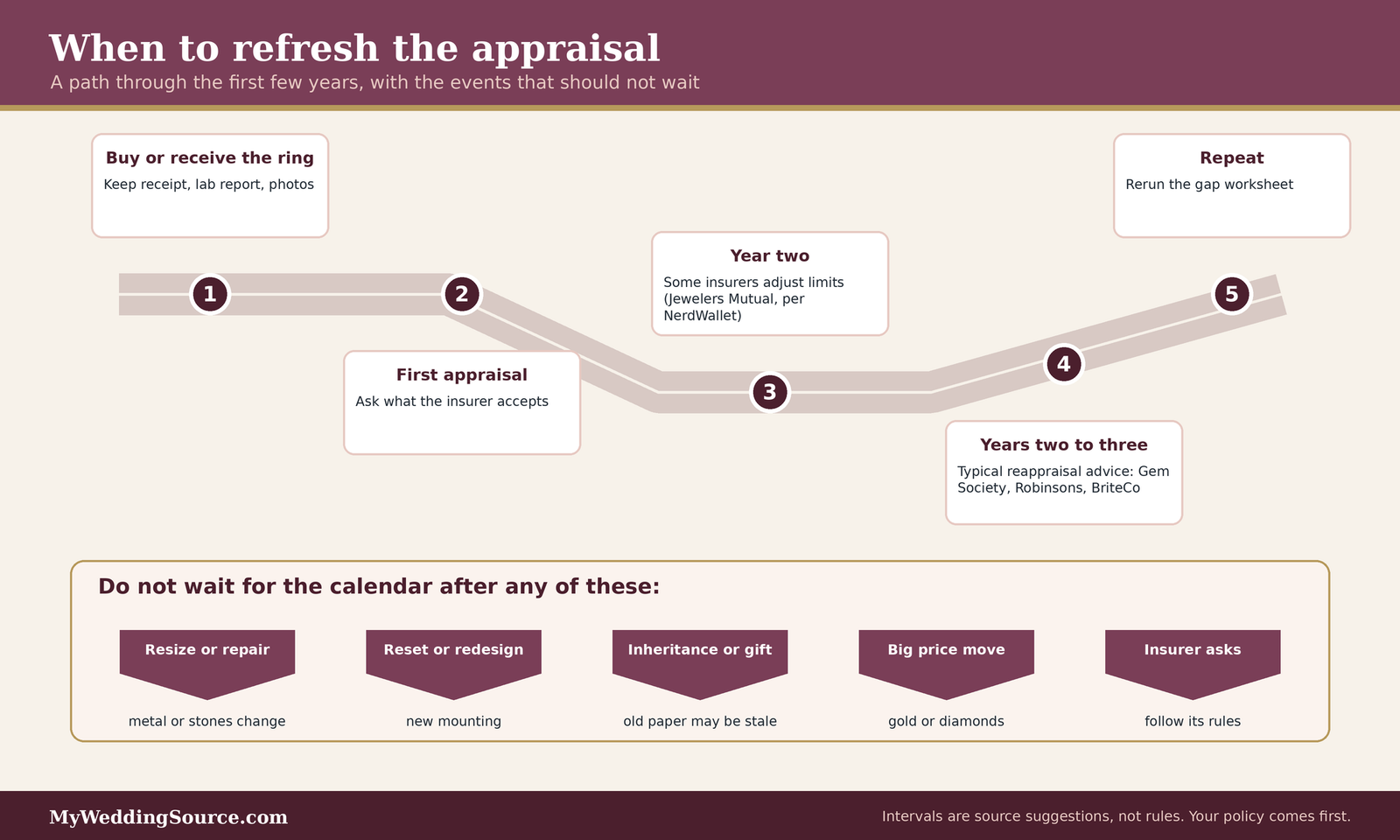
The Gem Society advises reappraising about every three years. Robinsons Jewelers suggests every two to three years. BriteCo recommends about every three years and sooner after market or ring changes. NerdWallet reports that Jewelers Mutual adjusts limits every two years and BriteCo adjusts coverage annually, which suggests insurers also expect values to move. Jewelers of America says appraisals should be updated periodically without giving a number. Our reading is that two to three years is a reasonable default, but your policy and market conditions may call for something different.
How to decide for your own ring
The right schedule for engagement ring insurance appraisals depends on the ring and the policy. A few questions help you choose. How long since the last appraisal? Has the policy’s required documentation changed? Has the ring been repaired, resized, or reset? Have gold or diamond prices moved sharply? If the answers are quiet, a longer interval may be fine. If any answer is yes, update sooner. Treat the date on your paperwork as a prompt, and set a calendar reminder when you receive each appraisal.
Event-based triggers
Certain events should prompt an update regardless of the calendar.
Work on the ring
Work on the ring is the clearest trigger for new engagement ring insurance appraisals. Resizing, repairs, prong retipping, stone replacement, and resetting can change the description and the replacement cost. After any such work, ask the jeweler for a written description of what was done, and ask the appraiser whether a new document is needed. Our guide on prong settings explains why prongs are a common place for wear and repair.
Changes in the market, the policy, or the owner
A big move in metal or diamond prices, a new policy, a change of insurer, a move to a new state, a divorce, or an inheritance can all affect what you need. Ask the insurer whether the existing appraisal will carry over or whether they want a fresh one. If a ring changes hands, ask who should be named on the policy and the paperwork. That is a question for the insurer and, where legal ownership is involved, for a qualified professional, not something this guide can answer.
Edge cases that change the advice
Not every ring fits the standard picture. The situations below come up often enough to deserve their own guidance. In each, the principle is the same: describe the actual ring accurately, say what kind of value the number represents, and ask the insurer what it will accept.
Lab-grown diamonds and moissanite
Lab-grown stones and moissanite are real, identifiable materials, and their pricing differs from natural stones. Engagement ring insurance appraisals need to say plainly what the stone is.
Describe the material correctly
The Gem Society says a complete appraisal states whether a gem is natural or synthetic. For lab-grown diamonds, that statement needs to be right, since a replacement is a like-kind-and-quality purchase. Our guides to lab-grown diamond engagement rings and moissanite engagement rings explain the differences. If your ring has one of these stones, ask the appraiser how they identified it and which retail market they used to estimate replacement cost.
Expect different value behavior
For lab-grown and moissanite rings, engagement ring insurance appraisals follow the same logic as for any ring. Because these stones are priced and sold differently from natural diamonds, the gap between purchase price and replacement value may behave differently over time. We did not find a reliable public source that quantifies that difference, so we make no claim about it here. The practical step is to reappraise on the same schedule you would for any ring, and to ask whether your insurer treats lab-grown stones differently when it replaces them.
Custom, antique, and inherited rings
A one-of-a-kind ring may have no retail equivalent to compare. That makes both the appraiser’s skill and the insurer’s wording more important.
Custom designs
Engagement ring insurance appraisals for custom work rest more heavily on the appraiser’s method. For a custom ring, ask the appraiser to explain how they estimated replacement cost: by comparable pieces, by the cost of recreating the design, or both. NerdWallet reports that for custom jewelry a standard policy may pay for a comparable piece instead of an exact replica. Ask your insurer whether it will replace a custom design as designed, and keep the design drawings, photos, and the maker’s invoice with the appraisal.
Antique and inherited rings
BriteCo says inherited, custom, or upgraded jewelry usually needs a new appraisal because the old paper may not reflect the current ring or current prices. Antique rings often have wear, older cuts, and prior repairs that matter for both value and care, and our guide on buying an antique engagement ring without overlooking repairs explains what to inspect. Ask the appraiser to note condition and any repairs in the report.
Other uses of an appraisal, and other kinds of value
Engagement ring insurance appraisals are not a universal document. The right paper depends on the purpose.
Selling, donating, or dividing the ring
Jewelers of America says fair market value is generally required for charitable donations and estate appraisals. The IRS, in its guidance for donated property, says that for deductions above five thousand dollars you generally need a qualified appraisal signed and dated by a qualified appraiser, and that you cannot deduct the fees for appraising donated property. That is tax guidance and varies by situation, so ask a tax professional. The takeaway here is simple: do not reuse a replacement-value appraisal where a fair-market-value one is required.
Wedding insurance and other policies
Other policies do not replace engagement ring insurance appraisals. Event insurance, travel insurance, and homeowners coverage each treat valuables differently, and many exclude them or limit them heavily. Our overview of wedding insurance explains what that product is for, and our honeymoon travel insurance guide covers travel coverage. Read each policy’s wording on jewelry specifically rather than assuming that a general policy includes a ring. You can also record the ring in your wedding keepsake storage plan along with its papers.
Questions to ask before you pay for an appraisal or sign a policy
Good questions shorten the process of arranging engagement ring insurance appraisals. Use the list below with the appraiser, the insurer, and the jeweler who sold you the ring. Write down the answers and keep them with your paperwork.
Questions to ask
- Which kind of value will this appraisal state, and what retail market will you use for comparison?
- What are your credentials, which standards do you follow, and how is your fee set?
- Is the fee flat or hourly, and what will the total be in writing before you start?
- Will the report include photographs, measurements, grades, treatments, and metal details?
- Will you list each piece, such as a ring and a band, as a separate item?
- Does the insurer require an appraisal, or will a receipt of this age and detail suffice?
- Is the scheduled amount a limit or an agreed value, and how does the policy settle a loss?
- Does the policy pay cash, or repair and replace through a jeweler, and can I choose the jeweler?
- Does the policy cover accidental loss and mysterious disappearance, and is there a deductible?
- How often do you want the appraisal updated, and how do automatic limit adjustments work?
Questions for the appraiser
An appraiser is the person least likely to bring up conflicts, so you do the asking. Choose questions that tell you how the document will work as evidence.
About the document
For engagement ring insurance appraisals, ask what the report will say about basis of value, whether it includes photographs, and whether the appraiser will update it later for a reduced fee. Ask how soon you will receive it and whether it comes in a form the insurer will accept. If the insurer has a form or a list of requirements, bring it to the appraiser.
About independence
Ask whether the appraiser or their business sells jewelry, makes offers on pieces, or has relationships with insurers or jewelers. Ask what happens if you disagree with a figure in one of your engagement ring insurance appraisals. A professional will answer plainly. If you get defensiveness or pressure, that is information.
Questions for the insurer
Insurers answer best when you ask about specific events, including how they use engagement ring insurance appraisals. Describe a few real scenarios and ask how each would be handled.
About settlement
Ask for the loss-settlement language and ask the representative to explain it. Use real examples: the ring is stolen, the ring is lost on a trip, a stone falls out, the ring is damaged and repairable. Ask what you would receive in each case, in what form, and who chooses the jeweler. Ask for the answers in writing if possible.
About limits and conditions
Ask how the insurer treats engagement ring insurance appraisals over time. Ask about the deductible, any sublimit, how the schedule amount works, whether coverage continues away from home, and what happens if the value rises. Ask whether the insurer will accept the appraisal you have and whether it requires a particular appraiser or form. Ask what documents you must provide when you file a claim.
Questions for the jeweler who sold the ring
The seller’s paperwork is the starting point for everything else. Get the details while the purchase is fresh.
About documentation
Ask for an itemized invoice with the stone’s laboratory report number, the metal and weight, the setting description, and any treatments, and ask for photographs. Ask whether they provide an appraisal and who writes it. Ask whether the seller will take the ring back for re-examination if an independent appraiser finds a discrepancy.
About changes later
Ask whether the seller will re-describe the ring after a resize or repair, whether they keep records, and how they handle a claim if you must replace the ring. Our engagement rings hub and the engagement ring guide link to more on the purchase itself.
FAQ: engagement ring insurance appraisals
The basics
Is an insurance appraisal the same as what I paid for the ring?
No. An insurance appraisal estimates replacement value, which is roughly what a retailer would charge for a new, nearly identical ring today. Your purchase price reflects one transaction on one day, possibly with discounts or credits. The two can differ in either direction, so use the appraisal, not the receipt, to judge how much coverage the ring needs.
Is a GIA report an appraisal?
No. A GIA grading report describes the stone’s measurements, grades, and known treatments, and it does not state a monetary value. An appraisal assigns a dollar estimate to the whole piece, and appraisers often use the report as supporting evidence. Insurers generally respect GIA reports as documentation, but ask yours whether it also wants a separate appraisal.
How much does an appraisal cost?
It varies by appraiser. Lemonade and the Trustpilot blog both report hourly rates of about fifty to one hundred fifty dollars, and some appraisers charge a flat fee per item. Ask for a written estimate first. Be wary of a fee that is a percentage of your ring’s value, which appraisal organizations treat as unethical.
Policies and timing
How often should I update the appraisal?
Sources suggest roughly every two to three years. The Gem Society says about three, Robinsons Jewelers says two to three, and BriteCo says about three. Update sooner after a repair, resize, or reset, after a large move in metal or diamond prices, or if your insurer asks. Your policy’s requirements come first.
Does my homeowners or renters policy already cover the ring?
Possibly in part. NerdWallet and ValuePenguin report that homeowners policies often cap jewelry at a low sublimit, commonly around one to two thousand dollars, and may not cover accidental loss. Read your policy’s jewelry limit, covered causes, and deductible, and ask whether scheduling the ring would remove those limits.
Will the insurer pay the appraised amount?
Not necessarily. The policy’s loss-settlement wording decides. In one common scheduled-jewelry wording analyzed by Property Casualty 360, the insurer pays the least of actual cash value, repair cost, replacement cost, or the scheduled amount. Other forms differ, so ask your insurer to explain its wording for your policy.
Edge cases
Can the jeweler who sold me the ring appraise it?
Sometimes, but be careful. The Gem Society cautions that a seller may not be qualified or independent, and that you should never take an appraisal from someone who wants to buy the piece. If the seller has credentials and an independent standard, it may work. Ask who signs it and whether your insurer accepts it.
Do I need a new appraisal after resizing or resetting?
Often it is wise. Resizing, repairs, and resets can change the metal weight, the stones, and the description. BriteCo and Robinsons Jewelers both suggest reappraising sooner after repairs or redesigns. Ask the appraiser whether the description needs to change, and ask your insurer whether it needs an updated document.
Your next steps
Collect and compare
Pull the papers into one folder
Keep your engagement ring insurance appraisals with everything else. Gather the receipt, any laboratory report, your current engagement ring insurance appraisals, photographs, and the policy declarations. Write down each date. If you are still deciding on coverage, our guide to engagement ring insurance and its hidden costs walks through policy wording in more depth.
Run the worksheet once
Fill in lines A through H and compute the gaps. Circle the biggest gap and write the question it raises. That question, not the dollar amount, is what you take to your insurer or appraiser.
Fix the biggest gap
Choose or update the appraiser
Better engagement ring insurance appraisals start with a better choice of appraiser. If you need a new appraisal, choose someone independent, ask for a written fee estimate, and confirm that the report will state replacement value. Put the reappraisal date on your calendar as soon as you receive it.
Fit it into the wedding plan
Add the ring paperwork to your broader plan with our wedding planning checklist, and keep insurance costs visible in your wedding budget. If you are traveling with the ring, read our guide on traveling with an engagement ring, and for the buying side see our engagement ring buying and care guide.
Related reading: Moissanite versus lab-grown diamond engagement rings.
Sources & methodology
How we built this guide
What we relied on
This guide combines laboratory and trade-association explanations of how appraisals, grading reports, and values differ, insurer and insurance-publisher descriptions of how jewelry coverage works, the National Association of Insurance Commissioners’ consumer materials, the IRS’s definition of fair market value, and the FTC’s Jewelry Guides. We read each source in full or in part on November 12, 2026, and we have not verified that every page is still unchanged since then. Statements that come from an insurer, retailer, or jeweler are attributed to that company because their advice reflects their products. The worksheet, the worked example, the premium estimates, and the resale illustration are our own arithmetic on hypothetical numbers, and they are estimates.
What we did not do
We did not review any policy, appraise any ring, or test any insurer’s claim handling. Appraisal practices, policy wording, premiums, and limits vary by company, state, and ring, and they change. This guide is general education and not insurance, legal, tax, or financial advice. We make no promise about what any appraiser will conclude or what any insurer will pay. Confirm details with your insurer, your agent, a qualified appraiser, and, for tax or legal questions, a licensed professional. If we add commission links in future we will say so on this page.
Source list
Government and regulatory sources
- Federal Trade Commission, Guides for the Jewelry, Precious Metals, and Pewter Industries, 16 CFR Part 23, final revisions (Federal Register, August 16, 2018): https://www.govinfo.gov/content/pkg/FR-2018-08-16/html/2018-17454.htm
- Internal Revenue Service, Publication 561, Determining the Value of Donated Property: https://www.irs.gov/publications/p561
- National Association of Insurance Commissioners, What’s the difference between actual cash value coverage and replacement cost coverage: https://content.naic.org/index.php/article/whats-difference-between-actual-cash-value-coverage-and-replacement-cost-coverage
- National Association of Insurance Commissioners, Consumer guide to homeowners insurance: https://content.naic.org:443/sites/default/files/publication-hoi-pp-consumer-homeowners.pdf
Gemological and appraisal-industry sources
- GIA, What is the difference between a diamond grading report and an appraisal: https://4cs.gia.edu/en-us/blog/what-is-the-difference-between-a-diamond-grading-report-and-an-appraisal/
- Jewelers of America, Jewelry appraisers: https://jewelers.org/education/choose-a-jeweler/jewelry-appraisers
- Jewelers of America, Diamond grading reports: https://www.jewelers.org/education/diamond-buying-guide/diamond-grading-reports
- Gem Society, Jewelry and gemstone appraisals for insurance: https://www.gemsociety.org/article/jewelry-and-gemstone-appraisals-for-insurance/
- Gemworld International, GemGuide, Appraisal basics: Fees: https://www.gemguide.com/appraisal-basics/fees/
- International Society of Appraisers, Ethics policy and procedure: https://isa-appraisers.org/about/policies/code-of-ethics
Insurer, retailer, and consumer-finance sources
- Lemonade, Jewelry appraisal explained: https://www.lemonade.com/renters/explained/jewelry-appraisal/
- BriteCo, Is your jewelry appraised: https://brite.co/blog/is-your-jewelry-appraised-what-you-need-to-know/
- NerdWallet, Jewelry insurance: cost, coverage and companies to consider: https://www.nerdwallet.com/insurance/homeowners/learn/jewelry-insurance
- ValuePenguin, Does homeowners insurance cover damaged or lost jewelry: https://www.valuepenguin.com/does-homeowners-insurance-cover-jewelry
- Property Casualty 360, Insurance coverage Q&A: loss settlement for scheduled jewelry: https://www.propertycasualty360.com/fcs/2025/03/17/insurance-coverage-q–a-loss-settlement-for-scheduled-jewelry/
- Robinsons Jewelers, The difference between an appraisal for insurance and one for resale: https://robinsonsjewelers.com/blogs/news/what-is-the-difference-between-an-appraisal-for-insurance-and-one-for-resale-your-guide-to-not-crying-over-spilled-diamonds
- Trustpilot Blog, How to get jewelry appraised: https://www.trustpilot.com/blog/buy-with-confidence/how-to-get-jewelry-appraised