
Wedding photo raw files are the unprocessed captures straight off a photographer’s camera, and many professionals decline to hand them over because they consider them unfinished work, so the useful move is to learn the photographer’s policy before you book and get the answer in writing, not to discover it after the wedding.
Quick answer
A RAW file is unprocessed sensor data that needs special software before it looks like a photograph, according to Adobe. Many wedding photographers do not deliver wedding photo raw files because the files are unfinished, very large, and tied to the photographer’s editing style, and because the contract usually promises edited images instead. In the United States, the person who takes a photograph generally owns the copyright unless a signed written transfer says otherwise, and owning a copy of a file is not the same as owning the copyright, according to the U.S. Copyright Office. So a photographer is usually not obligated to deliver wedding photo raw files unless your contract says so. Ask at your first conversation, ask again at contract review, and write down any exception, including the price, the permitted uses, and the format. This is general information, not legal advice.
What wedding photo raw files actually are
Couples tend to picture wedding photo raw files as the “real” pictures, the full set before anyone touched them. That picture is understandable and mostly wrong. A RAW file is closer to an ingredient than to a dish. Understanding what is actually inside one explains most of the photographer policies you will meet later, and it helps you decide whether you want the files, or the thing you hope the files will give you.
What is inside a RAW file
Adobe describes a RAW file as uncompressed, unprocessed image data captured by a camera’s sensor. It is a starting point for editing and not a finished image, and you bring it into software before you can adjust it or export it. The rest of this guide uses that plain definition whenever it refers to wedding photo raw files.
Sensor data, not a finished picture
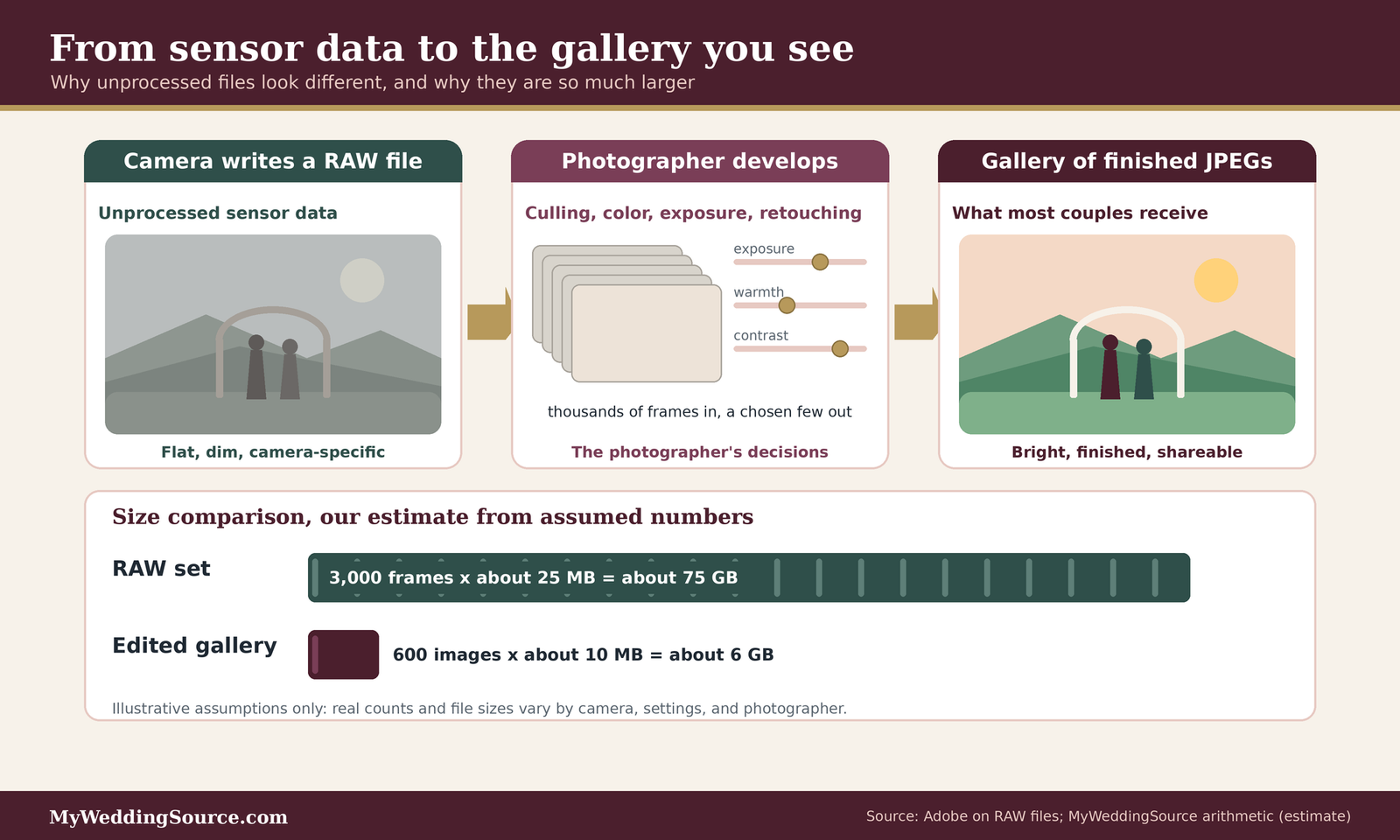
When a camera saves a JPEG, it makes a set of decisions for you: how bright to make the image, how warm or cool to render the colors, how much to sharpen, and how much information to throw away so the file stays small. A RAW file keeps the sensor’s record and leaves those decisions open. Adobe says this gives an editor more room to change brightness, contrast, and color without damaging the original data. The tradeoff is that the file cannot be shared as it is. Someone has to make those decisions before the picture can be viewed the way a person expects.
Why each camera brand writes a different file
Adobe notes that RAW is not a single standardized format, so some software cannot read files from certain cameras. Camera makers write their own versions, and the Library of Congress format description for Adobe’s Digital Negative (DNG) lists camera-specific raw formats as a group that DNG can contain, with manufacturer-specific details stored in private tags. In practice, this means the file extension on your photographer’s cards depends on the camera body they used, and a second photographer using a different brand may produce a different type of file from the first.
Why RAW files look different from the gallery you saw
If you open wedding photo raw files in a basic viewer, you may see something dim, gray, and a little lifeless, and wonder whether the photographer was any good. That reaction is the main reason professionals are cautious. The files are meant to be developed, and what you see in a gallery is the developed result.
Flat and dim on purpose
A photographer quoted by PictureCorrect in 2016 said that photographers often expose a little dark on purpose so that the brightest parts of a scene keep their detail, which makes unprocessed files look dim and flat before editing. Lauren Hamm, a Calgary wedding photographer, makes a similar point on her own blog: RAW files look dull straight out of the camera and are meant to be edited. These are photographers describing their own workflows, so treat them as one professional perspective, though the description matches Adobe’s explanation that raw data is a starting point.
Culling and editing happen after capture
A finished gallery is also a selection. Hamm describes reviewing many near-identical frames to choose the strongest, and says clients hire her partly for that judgment. Fstoppers, summarizing a video by one wedding photographer, adds that a wedding can produce thousands of images, many of them duplicates, test shots, or out-of-focus frames. So wedding photo raw files are not only unedited. They are also unselected, which means the set you receive can be many times larger than the gallery you were picturing.
What you would need to open and use them
Even a couple who really wants wedding photo raw files should know what receiving them involves, because the practical burden is part of why the answer is often no.
Software and updates
Adobe says you need editing software to open a RAW file and names Photoshop and Lightroom as examples. Adobe also says it releases frequent updates that add support for newer cameras, and its support pages point to a troubleshooting article about versions that do not support a given camera. We read that as a sign that an older version of your software may not open files from a newer camera, though Adobe’s page does not say it outright. If you plan to edit the files, ask the photographer which camera bodies were used so you can check compatibility before you pay for anything.
Storage and time
Wedding photo raw files are larger than JPEGs, which Adobe notes means extra storage on cameras and computers. We estimate the scale later in this guide. The time cost is just as real: someone has to sort thousands of frames, choose the keepers, develop them, and export them. If nobody in your household wants that job, the raw set may sit unopened on a drive, which is a common outcome and not a failure on your part.
Why many photographers do not deliver wedding photo raw files
The refusal is rarely about secrecy. When photographers explain the policy, the same few reasons come up, some about quality, some about workload, and some about money. It helps to hear them in order, because some are more persuasive than others and some are simply business choices. The sources below are photographers and photography publications, so they describe how professionals reason and not what any law requires.
The reasons photographers give
Unfinished work that carries their name
The most common reason is that unedited files misrepresent the photographer’s work. Daniela Bowker, writing in a piece republished by PetaPixel, compares wedding photo raw files to an unedited manuscript, including the passages that never made it into the book, and argues that couples choose the format of delivery, such as a USB drive or an album, but not the content. Hamm uses a kitchen comparison, saying clients who hire her for finished cupcakes should not be handed batter. Both are analogies, not arguments from law, but they show how a photographer thinks about the product they are selling.
Culling, volume, and trust
Fstoppers reports a photographer’s view that clients should not have to sort through thousands of near-duplicates and that a curated selection is what matters. Reader comments on that article add a reputation concern, that unskilled edits of wedding photo raw files posted online can reflect on the photographer. Both points come down to trust: you are hiring someone to decide which moments made the cut and how they should look, and many photographers see a request for the full raw set as a request to skip that part of the service.
The burden on you
PictureCorrect’s summary lists the technical burden as a separate reason. Formats can require specialized software, and the files can strain a client’s storage. Fstoppers says a wedding can generate hundreds of gigabytes of raw files. This reason is the easiest to test: if the photographer is willing to explain the camera, the file type, and the total size, and you have the tools and the time, the technical objection loses force, though other reasons may remain.
Business reasons behind the policy
Photography is a business, and policies about files are partly policies about price and control. That does not make them unfair, but it is worth naming so you can negotiate honestly.
Editing is part of what you pay for
Mike Hess, quoted in a Fstoppers reader comment, says clients are paying for his time, including the editing. The point is that a package price covers capture, selection, development, and delivery together. A raw-only set removes the largest block of post-production work, so a photographer may wonder whether the price should change, and some of them respond by quoting a higher number or declining. Neither response is unreasonable, and neither is guaranteed. Ask directly how they price it.
Control over how the images appear
Hamm says her style comes through in her editing, and she wants every image in circulation to reflect it. PictureCorrect’s summary adds that handing over wedding photo raw files lets others change the images without the photographer’s consent. Under U.S. copyright law, making a derivative work from a photograph is one of the exclusive rights of the owner, according to the Copyright Office, so a photographer who owns the copyright has a legal as well as a creative reason to care about who edits their files. We explain that point in the section on ownership.
The contract usually already says so
Many photographer contracts promise a specific number of edited, high-resolution images and say nothing about unprocessed files. A Photography Stack Exchange answer republished on Unique Photo’s community pages says the photographer generally has no obligation to provide wedding photo raw files unless the contract says otherwise. That page is a community answer from 2013 and not a rule, but it matches the practical reality: the contract is the deciding document.
Where the disagreement is real
Not every professional or client sees it the same way, and a fair guide should say so.
The contractor analogy
A commenter on PictureCorrect argues that photographers are more like contractors, so clients should be able to receive the source files, much as a client receives source code from a web developer. That is one opinion, and the photographers above would answer that a wedding is a personal service where the creator’s judgment is the product. The analogy is useful mainly because it shows why some couples feel the request is reasonable.
Commercial clients and couples differ
A Fstoppers commenter notes that commercial clients often require raw files and that the article’s advice applies mainly to weddings and couples. That is a reminder that no universal rule exists. The expectation depends on the kind of work and the contract. For a couple, the practical conclusion is simple: do not assume either answer. Ask, and read what the agreement says.
Who owns the files: copyright, copies, and licenses
The question behind most requests for wedding photo raw files is really a question about ownership: “We paid for the photos, so aren’t they ours?” The law separates several things that everyday speech lumps together, and the separation explains why a photographer can hand you thousands of images and still keep the right to decide who edits or publishes them. What follows is general information drawn from the U.S. Copyright Office and the statute, not legal advice, and the details of your own contract control.
The default rule for who owns a photograph
The creator starts as the owner
The Copyright Office’s Circular 1 explains that copyright starts with the person who created the work, with an exception for works made for hire. So the default for a wedding photograph is that the photographer who pressed the shutter owns the copyright, including in the unedited capture. That default does not depend on whether you paid, and it does not disappear when the gallery is delivered. It changes only if something in writing changes it.
Transfers need a signature
The statute is specific about how ownership moves. Under 17 U.S.C. section 204, a transfer of copyright ownership is valid only if it is in writing and signed by the owner or the owner’s authorized agent. Circular 1 repeats the point and adds that non-exclusive permissions, such as a license to use the images, do not require the same formality. For a couple, the practical meaning is that a friendly email saying “the photos are yours” is weaker than a signed clause that actually says the copyright is assigned. If someone promises you ownership, ask for the sentence in the contract.
A copy is not the copyright
Owning the file versus owning the rights
Section 202 of the Copyright Act states that ownership of a copyright is distinct from ownership of any material object in which the work is embodied. The Copyright Office’s Circular 1 makes the same point, noting that owning a physical copy does not give you the copyright. Applied to your wedding, a USB drive of images is a material object that you may own outright, while the copyright in the pictures on it stays where it started. So even a photographer who hands you full-resolution wedding photo raw files may be giving you copies, not ownership, unless the contract also assigns the copyright.
Why editing is a rights question
Circular 14 explains that the copyright owner has the exclusive right to prepare derivative works and that someone who adapts a work without permission may infringe. A developed, retouched photograph built from a raw capture is a kind of adaptation. That is the legal reason a photographer who keeps the copyright may be careful about who edits their files and how the results are shared. It also shows why a couple who receive raw files without any written permission to edit them are in a gray area, which is a good reason to ask for the permission in writing, as the contract section below describes. Whether a specific edit or use would infringe is a question for a lawyer.
Work made for hire and why it rarely applies
The narrow list in the statute
Circular 30 explains that a commissioned work counts as a work made for hire only if it falls into one of nine listed categories and the parties sign a written agreement that says so. Photographs are not among the nine categories named in the circular, though the circular does not specifically discuss photographs and says it cannot give legal advice. Our reading is that a freelance wedding photographer’s pictures are unlikely to qualify, which is why couples rarely receive ownership through this route. If a contract says “work made for hire,” ask a lawyer what it accomplishes before you rely on it.
What an assignment would look like instead
Because of that, a couple who really want ownership, including of the unprocessed files, would normally ask for a copyright assignment, which is a separate written transfer. The Copyright Office’s FAQ says registration is optional for protection but needed before an infringement suit on a U.S. work, which is a reminder that these rights have real consequences even when nobody expects a dispute. Assignments are unusual in wedding work and often priced accordingly, so expect a different conversation from the one about a simple file request.

Why couples ask for wedding photo raw files
Before deciding what to ask for, it helps to be honest about what you want. Different motives call for different answers, and often the thing you want is not the raw set at all. None of these motives is unreasonable. They are simply easier to meet when you name them.
The honest motives
Wanting everything
Some couples ask for wedding photo raw files because they are afraid the gallery will leave something out: a moment, an expression, a relative at the edge of a frame. Fstoppers reports that clients may think receiving every shot adds value. The underlying worry is real. It is usually better solved by asking the photographer how many images to expect, how they choose, and whether you can request specific additional images from the full set.
Disliking the editing style
Other couples worry that the photographer’s color or contrast will not suit them, and they want wedding photo raw files so a different editor could redo the look. This motive is worth raising before you book, not after. Look at full galleries, not only highlights, and ask whether the photographer can adjust the style within reason. A photographer whose style you dislike is a booking problem that wedding photo raw files only partly fix.
Wanting to edit or hire your own editor
Some couples, or friends in their circle, are skilled editors and enjoy the work. That is a legitimate wish, and it is the one case where the raw set is the actual product. Mike Hess, in the Fstoppers comments, says he lets clients edit raw files themselves but asks not to be tagged in the results, which shows how a photographer might say yes with conditions. Ask whether such a path exists and what it costs.
What each motive usually needs instead
More images from the same shoot
If your concern is completeness, ask whether the photographer can deliver a larger selected set, or provide a proof gallery with unedited selects you can pick from. Some photographers may offer this for a fee or as part of a package. We did not find a source that says how common it is, so ask and do not assume.
A style conversation and a trial edit
If your concern is the look, ask for a sample edit of a few frames from a photographer’s own portfolio and tell them what you like. Whether a contract allows revisions to edited images varies, so ask what the process is. The goal is to find out how much flexibility exists and who decides.
Reproduction rights and editing permission
If your concern is who may edit or print, the thing to negotiate is permission, not necessarily the raw set. The Copyright Office’s discussion of the right to prepare derivative works shows why. A written license that allows you to retouch the delivered images for personal use may meet your need without the burden of wedding photo raw files. Our wedding photography deliverables guide covers print releases and licenses in more detail.
A gallery download and use-rights question script
This is the working part of the guide. The script below is built in the order a couple actually meets a photographer: first conversation, contract review, and after the wedding. Each step gives you what to say, what a clear answer sounds like, and what should make you pause. The wording is ours and is meant to be adapted, not read aloud. None of it is legal advice, and the contract you sign is what counts.
The five questions that settle most of it
- Do you deliver unprocessed wedding photo raw files, to anyone, for any package?
- If not, what exactly do I receive: how many edited images, at what resolution, in what file type, and for how long is the gallery available to download?
- If yes, what is the price, the timing, the format, and what may I do with the files?
- Who owns the copyright, and what is my license to print, share, and edit the delivered images?
- How long do you keep your own archive of the full set, and what happens to it if you close your business?
The first conversation, before you book
Raise this early and calmly. A photographer who sees the question as a normal part of planning is usually easier to work with than one who is irritated by it, and the first call is where you learn which kind you have.
The opening question
Try something like: “Before we go further, I’d like to understand what we receive after the wedding. Do you deliver unprocessed RAW files, or only edited images? And can you point me to where that is written down?” The second sentence matters. A verbal “we can work something out” is pleasant to hear and impossible to enforce. A clear answer names the policy and the document, such as the contract or a deliverables page. A pause-worthy answer is vague (“don’t worry about that”) or changes between the call and the contract.
If the answer is no
Many photographers say no, for the reasons covered earlier. A calm reply is: “Understood. What do we receive instead, and how many images should we expect from a day like ours?” You are asking for a number, a resolution, a file type, and a delivery window. If the photographer says “it depends,” ask for the typical range for a wedding of your length and size. Do not argue the policy on the first call. The point is to learn what the product is and decide whether it fits, and our wedding photographer shot list guide can help you describe what must be captured.
If the answer is maybe or yes
A conditional yes is possible with some photographers, so know what to ask next: “What is the fee and timing for wedding photo raw files? Do you edit them first or deliver them straight from the cards? What may we do with them, and do you want credit if we share edited versions?” Take notes, because every item is a term you will want in the contract. Fstoppers records a commenter describing a contract that delivers raw files on request for twice the base fee, with no pre-delivery editing and no photographer credit, which is one photographer’s arrangement and not a market standard, but it shows the shape of a conditional yes.
Reviewing the contract
Most disputes about files come from a gap between what the sales call implied and what the contract says. The review is where you close the gap.
Four clauses to find
Look for four things. First, the deliverable: a promised number or range of images, resolution, format, and delivery date. Second, the license or copyright clause: who owns what and what you may do. Third, any sentence about unedited, raw, or “proof” images. Fourth, retention and delivery: how long the gallery stays online and how long the photographer keeps backups. If one of the four is missing, that is a question for the photographer, not a reason to guess. For a wider look at what to read before signing, see our wedding vendor contract guide.
Wording to request when you want raw files
If you want wedding photo raw files and the photographer agrees, ask for the agreement to say, in plain words: that wedding photo raw files will be delivered, in which format, by what date, for what fee; whether the photographer will do any processing first; what license you receive to edit, print, and share, and whether commercial use is allowed; whether credit or tagging is required; and that the license survives if the photographer’s business changes. Because a transfer of copyright must be signed in writing under section 204, and because you will want to find the terms in ten years, ask for the license text in the signed contract and not only in an email thread.
Wording to request when the answer is no
Ask for the substitute to be specific. A useful sentence is: “The photographer will deliver a minimum of a stated number of edited, full-resolution images in a named file type, with a personal-use license to print and share, within a stated number of weeks, and will keep an archive of the full set for a stated period.” You can leave the numbers to the photographer, but the sentence should have blanks filled in. A contract that only says “digital images” is the vaguest version of a deliverable.
After the wedding
Things sometimes change after delivery. You may find the gallery lighter than expected, or realize a particular frame matters to you.
Asking for specific images later
If you regret not asking for raw files, a polite request for particular frames is more likely to work than a demand for the whole set. Say which moment you mean, ask whether it was captured, and ask about options: a retouched version, an additional edited file, or a different crop. Be ready for a fee or a limit. The Unique Photo community answer suggests asking about high-resolution purchase options and citing any specific promise in the contract, and that advice applies here too.
If the gallery seems incomplete
Compare the delivered count with the contract, the file type, and the resolution. If something is missing, write to the photographer with the contract clause and a short, specific list, and give a reasonable time to answer. Keep the tone factual. If the issue is a promised deliverable that was not provided, the contract is your document. For anything beyond a simple resolution, consider a short consultation with a lawyer, since we do not give legal advice.

| Moment | What to say | A clear answer sounds like | Pause if |
|---|---|---|---|
| First call | “Do you deliver RAW files?” | A yes or no, and where it is written | “We’ll figure it out later” |
| First call | “What do we receive instead?” | A count range, resolution, file type | “A lot of images” with no numbers |
| Contract | “Where is the license?” | A named clause, signed | No license language at all |
| Contract | “Who edits our images?” | Photographer only, or named permission | Silence on editing |
| Delivery | “How long will the gallery stay up?” | A stated number of months or years | “As long as the platform lasts” |
| Closing | “How long do you keep the full set?” | A stated retention period | “I try to keep everything” |
If a photographer will deliver wedding photo raw files
Some will. The terms matter more than the yes, because wedding photo raw files carry practical and legal baggage that a gallery of edited images does not. The three groups of terms below are the ones most likely to cause trouble if left vague.
Price and timing
What the sources say about cost
We did not find a reliable, independent price list for delivering wedding photo raw files. The only figure we found is one photographer’s contract described in a Fstoppers reader comment: raw files on request for twice the base fee, with no editing beforehand and no credit. That is one person’s policy, not an industry rate. The Copyright Office does not set prices for licenses or transfers either, so ask each photographer for an itemized quote that separates the fee for the files from any fee for an assignment, and state whether the quote includes the cost of the second photographer’s files.
The fee and what it covers
Ask whether the fee covers only the files or also a broader license, and whether it changes the base price of the package. A photographer who edits less may or may not charge less, and one who treats the file set as a separate product may charge more. The only sensible approach is to compare quotes in writing, line by line.
When the files arrive
Raw files are large, and a photographer may deliver them after the edited gallery or after the final payment. Ask when, by what method, and how long the download stays available. If the date matters to you, put it in the contract with a plain consequence, such as a stated delivery window.
Use terms
Permission to edit
Because editing is an exclusive right of the copyright owner under the Copyright Office’s description, ask for a sentence that grants you permission to process the files and share the results for personal use. If you plan to hire an editor, ask whether the editor may use the files and whether the photographer wants the results kept private.
Credit, tagging, and sharing
Some photographers ask not to be credited for edits they did not make, and some ask to be credited when images are shared. The Fstoppers comment from Mike Hess, who asks clients not to tag him in their own edits, is one example. Settle the preference in writing and also decide what you do if your edit is shared widely.
License versus transfer
A license grants permissions. A transfer moves ownership. Section 204 requires a signed writing for a transfer, and Circular 1 explains that a non-exclusive permission is different. Ask the photographer in plain words which one the contract provides, and ask a lawyer if the answer matters to your plans, for example if you hope to sell prints.
Technical handoff
Format and compatibility
Ask which camera bodies were used, what file type each writes, and whether the photographer can supply files in a more open form such as Adobe’s DNG. The Library of Congress describes DNG as a fully documented format that stores raw camera data and lists it as an acceptable format for digital photographs in its Recommended Formats Statement, while noting that the encoded image data may still need specialized tools. Conversion may change the files, so ask what is preserved.
Companion files and metadata
Some editing programs store adjustments in separate companion files. Ask whether any settings, ratings, or keywords will be included, and whether the photographer will leave them out. A set with no organization is harder to use. If the photographer culls, ask whether the delivered set is the full capture or a selection.
Verifying what arrives
On delivery day, count the files, open a sample from each part of the day, and confirm that each camera’s files opened. Then copy everything to two locations before you do anything else. If a file will not open, tell the photographer right away, because a complete record from the day may not exist elsewhere.
Storage, backups, and what happens to the originals
Whether or not you receive wedding photo raw files, the originals live somewhere, and the practical question is who keeps them and for how long. Couples often focus on the gallery link and forget that the photographer’s archive is the only complete record of the day.
How big the files get
A rough estimate of the volume
Fstoppers says a wedding can generate hundreds of gigabytes of wedding photo raw files. To make that concrete, here is our own arithmetic, an estimate based on assumptions and not a measurement. If a photographer keeps 3,000 frames and each raw file is about 25 megabytes, the set comes to about 75 gigabytes. At 6,000 frames it is about 150 gigabytes. A gallery of 600 JPEGs at about 10 megabytes each would be about 6 gigabytes. Real files vary a great deal with the camera, the settings, and the number of shooters, so treat the numbers as a way to compare sizes and not as a promise.
What that means for your drive and your cloud account
A set of that size does not fit on most small flash drives, and uploading it to a consumer cloud account can take a long time and may use much of the free storage. If you ask for wedding photo raw files, ask the photographer how they will deliver them: by physical drive, by a large-file transfer service, or through a gallery platform. Then decide where you will keep the set long term, since a single copy on one device is not a plan.
What is worth keeping
The gallery first
For most couples the edited gallery is the file set that matters. Download it as soon as it arrives, in the largest size offered, and keep copies in at least two separate places. Our after-wedding checklist puts that task alongside the other things that are easy to forget in the weeks after the day.
Raw files as a second tier
If you do hold wedding photo raw files, treat them as a second tier: valuable if you ever want to re-edit, but not a substitute for the finished images. Because raw formats are camera-specific, the Library of Congress’s description of DNG is a useful reminder that long-term readability is a real concern. Ask the photographer whether a DNG version is available and note the camera models so a future you knows which software to look for.
The photographer’s own archive
Ask about retention in writing
Even couples who decline wedding photo raw files can ask how long the photographer keeps the full set and in what form. A stated period is better than an informal assurance. If you want something longer than the photographer’s standard, ask whether an extended retention can be added to the contract and what it costs, and be prepared for a plain no.
Plan for a business that closes
Photographers retire, move, and close businesses, and an archive can disappear with them. We did not find a source that says how often that happens, so we cannot attach a number to the risk, but it is a fair thing to raise. Ask whether the photographer has a plan for client archives and whether you can receive a final set of files if the business closes. The answer will tell you something about how they run the business.
Edge cases: when the plain rule does not fit
Most weddings follow the simple pattern of one photographer, one contract, and one gallery. Some do not, and these are the situations where a clear question beforehand saves the most frustration.
More than one photographer
Second shooters and associate photographers
A second shooter may be an employee, a contractor, or an independent professional, and the files they capture may be covered by a different arrangement. On rights, the question is simple: ask whether wedding photo raw files from every shooter fall under the same policy and the same contract, and whether the lead photographer has the right to license the second shooter’s frames to you.
Friends, family, and guests with cameras
If a relative photographs the day as a favor, the same default applies: the person who takes the photograph generally holds the copyright, according to the Copyright Office, so ask for permission and a copy of what you want to use. The same goes for a content creator you hire. Our comparison of a wedding content creator versus a photographer explains how those roles differ, and our unplugged ceremony guide covers guests’ phones.
Video and aerial footage
Raw footage is a different product
Our wedding photography deliverables guide notes that many videographers do not hand over raw footage, partly because it is unfinished and partly because it is large. The same questions apply: ask early, ask for the price and the terms, and ask how long the footage is archived. Confirm any footage terms in your video contract, not only your photography contract.
Drone images and aircraft rules
If a drone is part of your plan, the unprocessed images and video raise the same ownership questions, and a separate set of rules about who may fly. Do not assume that a photographer who owns a drone is authorized to use it for paid work at your venue. We cover that topic in our guide to wedding drone photography, and the contract should say who is responsible for permissions. We have not verified any particular operator’s authorization, and neither should you without asking.
When something goes wrong
Missing or corrupted files
If files are missing, damaged, or unreadable, start with the contract and the delivery record: what was promised, what arrived, and what the photographer’s archive may still hold. Tell the photographer promptly and in writing with a short list. A photographer who retains the full capture may be able to restore a file, which is one more reason to ask about retention before the wedding.
Disagreements about files
If the photographer and you disagree about what the contract requires, the document itself is the first stop. The Unique Photo community answer treats the contract as the deciding factor, and nothing we found suggests otherwise. For serious disputes, such as a refused delivery or an unauthorized use of your images, a consultation with a lawyer is appropriate, and we cannot provide one. Our vendor due-diligence checklist can help you document what you were told.
Questions to ask before you sign
Use these as a printable list. Ask for answers in writing and attach them to the contract.
Questions about files, editing, and rights
- Do you deliver unprocessed RAW files, and if so at what price and with what license?
- What do I receive, in which file type and size, how many images, and by what date?
- Who may edit the delivered images, and may I have them retouched elsewhere?
- What is my license to print, share, and post the images, and does it allow commercial use?
- Do second shooters’ files follow the same policy?
- How long does the gallery stay online, and how long do you keep the full set?
- If your business closes, what happens to my archive?
Questions for the photographer
About the files
Ask for the count range, resolution, format, delivery window, and gallery duration. Then ask whether the full capture is retained and for how long. If the answers are inconsistent between the call and the contract, ask which version applies and have the contract updated.
About rights
Ask for the license text and read it, or have a professional read it, before you sign. Ask whether you may edit, whether you may print, whether you may share online, and whether the photographer needs credit. If you hope to use the images commercially, say so now.
Questions for the rest of the team
Planner, venue, and second shooters
Ask your planner or venue coordinator whether the venue has photography rules, restrictions, or fees that affect when and where the photographer may work. Ask the lead photographer how any second shooter is engaged. Our wedding vendor contract guide explains how to compare these terms across vendors.
Your own household
Decide who will download, back up, and keep the files, and who will be the contact if the photographer needs to reach you later. Write the plan down. A good policy on the photographer’s side is only useful if someone on yours opens the gallery in time.
FAQ: wedding photo raw files
Policy and ownership
Do wedding photographers have to give you the RAW files?
Generally no, unless the contract says so. A community answer republished by Unique Photo says photographers usually have no obligation to provide raw files unless the agreement requires it. Copyright usually starts with the photographer, per the Copyright Office. Read your contract, and ask a lawyer about anything unclear. This is not legal advice.
Why do some photographers refuse to deliver raw files?
Photographers cite several reasons: raw files are unfinished, they come in large numbers, they need specialist software, and editing is part of the service. Writers at PetaPixel, PictureCorrect, and Fstoppers describe these views. They are professional opinions, not legal requirements, and some photographers will deliver raw files under agreed terms.
If I pay for the photos, do I own the copyright?
Not automatically. The Copyright Office says copyright starts with the creator, and owning a copy of a work is different from owning the copyright. A transfer must be in a signed writing under section 204 of the Copyright Act. Look for an assignment clause, or a license that lists what you may do.
Can I edit my wedding photos myself?
It depends on your license. Preparing adaptations of a photograph is an exclusive right of the copyright owner, according to the Copyright Office, so ask for written permission to retouch delivered images for personal use. Some photographers allow it and some limit it. Ask before you apply filters, crop heavily, or hire an editor.
Files and delivery
What can I ask for instead of RAW files?
Ask for a specific number of edited, full-resolution images in a named file type, a clear license, a stated gallery period, and an archive period. You can also ask whether extra selected images are available for a fee. Adobe describes JPEG as the converted, shareable result of raw data, which is what most couples actually use.
How big are wedding photo raw files?
It varies. Fstoppers says a wedding can produce hundreds of gigabytes. Our own estimate, using assumed numbers, is about 75 gigabytes for 3,000 frames at 25 megabytes each. Your photographer’s camera and settings will differ, so ask for the real total before you arrange storage or pay for delivery.
Do I need special software to open RAW files?
Usually yes. Adobe says you need editing software, such as Photoshop or Lightroom, to open a RAW file, and that raw formats are not standardized, so some software cannot read some cameras. Check your software version against the photographer’s camera models before you ask for the files.
What if my photographer loses the files or closes?
Ask about retention in writing before you book, and download and back up your gallery the week it arrives. We found no source on how often photographers lose archives, so we cannot give a rate. If something goes wrong, start with the contract and write to the photographer with a short list.
Your next steps
Before you book
Ask the five questions
Use the short list in the script above on your first call, and note the answers with a date. If a photographer’s answer is vague, ask where the policy is written. Our wedding photography guide and candid wedding photography guide can help you describe the style you want to see in full galleries.
Get the substitute in writing
If the photographer does not deliver raw files, ask for the edited deliverable to be specific: count, size, type, license, gallery period, and archive period. For a broader look at files and licenses, read our wedding photography deliverables guide. Related guides on wedding photo retouching requests and wedding photography usage rights for vendors and social media go deeper on edits and sharing.
After the wedding
Download and duplicate
When the gallery arrives, download every file, count them against the contract, and copy them to two separate places. Store your login details and the contract with the files. If you hold raw files, keep the camera models with them.
Share carefully
Think about who can see your gallery link and your family’s images. Our guide on wedding planning website privacy and security covers sharing and account basics. If a dispute arises, document what was promised and consider a short consultation with a lawyer.
Sources & methodology
How we built this guide
What we relied on
This guide combines U.S. Copyright Office circulars and the text of the Copyright Act on ownership, transfers, derivative works, and work made for hire; Adobe’s and the Library of Congress’s descriptions of raw files and the DNG format; and statements by working wedding photographers and photography publications about why they do or do not deliver raw files. Where a statement comes from a photographer, a community answer, or a reader comment, we say so, because those are opinions and business practices and not legal rules. The file-size figures are our own arithmetic from assumed values and are estimates. We checked the sources on November 12, 2026, and pages may change.
What we did not do
We did not review any photographer’s contract, test any software, or give legal advice. We did not verify any photographer’s or drone operator’s authorization. We did not find reliable independent pricing for raw file delivery and did not invent any.
Source list
Government and legal sources
- U.S. Copyright Office, Circular 1, Copyright Basics: https://www.copyright.gov/circs/circ01.pdf
- U.S. Copyright Office, Circular 14, Copyright in Derivative Works and Compilations: https://www.copyright.gov/circs/circ14.pdf
- U.S. Copyright Office, Circular 30, Works Made for Hire: https://www.copyright.gov/circs/circ30.pdf
- U.S. Copyright Office, Frequently asked questions, general: https://www.copyright.gov/help/faq/faq-general.html
- 17 U.S.C. section 202, Ownership of copyright as distinct from ownership of material object (Cornell Legal Information Institute): https://www.law.cornell.edu/uscode/text/17/202
- 17 U.S.C. section 204, Execution of transfers of copyright ownership (Cornell Legal Information Institute): https://www.law.cornell.edu/uscode/text/17/204
Software and preservation sources
- Adobe, RAW file format overview: https://www.adobe.com/creativecloud/file-types/image/raw
- Adobe, Camera Raw supported cameras: https://helpx.adobe.com/camera-raw/using/supported-cameras.html
- Library of Congress, Adobe Digital Negative (DNG) 1.6 format description: https://www.loc.gov/preservation/digital/formats/fdd/fdd000628.shtml
Photographer and publication sources
- PetaPixel, Why Your Wedding Photographer Won’t Give You a Disk of Unedited RAW Files: https://petapixel.com/2014/10/27/let-wedding-photographers-do-their-jobs-or-why-you-cant-expect-a-disc-of-unedited-images-on-the-cheap
- Fstoppers, The Best Way to Respond to Clients Asking for Raw Photos (September 13, 2024): https://fstoppers.com/wedding/best-way-respond-clients-asking-raw-photos-679383
- PictureCorrect, Why Photographers Shouldn’t Give RAW Files to Clients (February 16, 2016): https://www.picturecorrect.com/why-photographers-shouldnt-give-raw-files-to-clients/
- Lauren Hamm Photography, Why I never send raw files (2018): https://laurenhammphoto.squarespace.com/lhpblog/2018/1/17/why-i-never-send-raw-files
- Unique Photo community, Can I demand RAW files or high-resolution wedding photos if my photographer only delivered low-res images: https://www.uniquephoto.com/community/qa/can-i-demand-raw-files-or-high-resolution-wedding-photos-if-my-photographer-only-delivered-low-res-images