

A curved wedding band is made to sit around the shape of an engagement ring, so the right one depends less on taste than on the exact outline, height, and contact points of the ring you already own, and a few careful measurements and one honest try-on will tell you most of what you need to know.
Quick answer
Start with the engagement ring, not the band. Look at it from the side and from above, find where a straight band would stop short, and note what sits near that spot: a pointed stone, a low basket, a halo, a gallery, a bezel wall, or filigree. Then choose a shape that answers that specific problem: a soft contour curve, a sharper chevron V, a notched band, an open band, or a thin spacer. Bring your own ring to every try-on, wear the pair for a few minutes with your fingers bent, and ask the jeweler to check what touches what before anything is made or soldered. A curved wedding band can be a stock design or a custom piece, and a custom one usually takes longer, so leave room in your schedule.
What a curved wedding band is, and when you need one
Plenty of people buy a straight band, slide it next to the engagement ring, and find that the two rings sit comfortably side by side. Others discover a gap, a tilt, or a band that pushes the engagement ring sideways. A curved wedding band is the most common answer to that second experience, and it is worth understanding what it does before you decide you need one.
Curved wedding bands in plain words
The words used in shops are not always consistent, so it helps to settle on a vocabulary before you read product pages. In this guide, a curved wedding band is any band whose top edge is shaped, rather than straight, so that it follows part of the engagement ring.
Contour, crown, and shadow bands
A jeweler’s blog from Berlinger describes a curved or contour band as one shaped to wrap around the center stone of an engagement ring and follow the ring’s profile, instead of leaving the visible gap that a straight band often leaves. The curve can be soft and subtle or more dramatic and scooped. The Knot’s guide to pairing bands with unusual rings says the same family goes by several names, including crown, curved, chevron, and V bands, and that these bands can be plain metal or set with stones. Robinson’s Jewelers, a retailer, calls this type a contour or shadow band and describes it as the first and most popular solution to a gap, though that popularity claim is the seller’s own and is not backed by data.
Chevron, notched, open, and spacer bands
Other shapes solve related problems in different ways. A chevron or V-shaped band dips to a point and cradles the tip of a pear or marquise, according to Goodstone and Robinson’s. A notched band keeps a mostly straight top but has a small cut so that part of the engagement ring can seat into it. An open band, sometimes called a gap band, has a wider opening that holds the center setting, so the space becomes part of the design. A spacer is a thin plain band worn between two rings, and the retailer sources we read describe it as a way to fill a small space and to keep delicate rings from rubbing on each other. Later sections show which shape fits which ring.
Why a straight band leaves a gap
The reason a curved wedding band is ever needed is geometry. A straight band is a ring with a level top edge, and it can only slide as close to the engagement ring as the engagement ring’s lowest-reaching part allows. If any part of the engagement ring extends toward the neighboring finger more than the shank does, the straight band stops at that part.
The engagement ring’s profile decides
Robinson’s explains that the main cause is the profile of the engagement ring, meaning how high the center stone sits off the finger. A low-set stone, or a setting with a basket or prongs that stick out, can physically block a straight band from sitting flush. The same article names pear, marquise, and oval shapes as common culprits because their points or curves extend out from the setting, and it says a low-profile solitaire can cause the same problem. It also stresses that the gap is not a flaw in the ring but a mismatch in shape.
Height can help or hurt
A separate Robinson’s article on setting height says a higher setting can leave room for a straight band to sit beside the engagement ring, while a very low setting may extend outward near the finger, which can stop a straight band from sliding fully underneath. Brilliant Earth, another retailer, makes a similar point: high-set rings usually allow a flush straight band, while low-set rings, side stones, galleries, and hidden halos often do not. In other words, the setting can be tall or short and still cause trouble. What matters is whether anything blocks the band’s path.
Do you actually need a curved wedding band?
A curved wedding band is a solution, not a requirement, and several sources are clear about that. Before you pay for a curved wedding band, check whether your pair already works without it.
When a straight band is fine
Brilliant Earth says high-set rings usually allow a straight band to sit flush. Filigree Jewelers, in its stacking guide, says low-profile and bezel rings are often fine with straight bands and that contour bands are frequently unnecessary for them, while the Knot’s low-set guide says a flush fit is the goal that jewelers aim for with custom low settings. A practical test is to hold a straight band against the engagement ring in good light and look from the side and from above. If you cannot see daylight between them and the rings sit still when you turn your hand, you may not need a curve.
When a curve earns its place
A curved wedding band earns its place when the engagement ring has a pointed or elongated stone, a low-set head that sticks out, a cathedral or high-profile design that leaves open space, or a custom or vintage outline. Berlinger lists low-profile rings, toi et moi styles, vintage-inspired settings, and custom-shaped center stones as the kinds of rings that benefit. Filigree Jewelers recommends contour or V-shaped bands for high-profile and cathedral settings and curved wedding bands for marquise, pear, and elongated shapes. If your ring fits one of those descriptions, a curved wedding band is worth trying, and the sections below show you how to test it.
Read your engagement ring before you shop
You can learn most of what you need without leaving home. The goal is a short written description of your engagement ring that you can give to any jeweler, so every band suggestion answers your real ring and not a general idea of rings. The checks below are our suggested routine, drawn from what the sources describe, not a standard.
Look from the side first
The side view is the one most buyers skip, and it is the one that explains the gap. Photographs of engagement rings are almost always taken from above or at a three-quarter angle, so the side shape rarely appears on the product page.
What the side profile shows
Rest the ring on a table at eye level and look across the shank. The Knot’s low-profile guide tells shoppers to check the side view when shopping online because there are no standard measurements for low-set rings. Look at how far the head, the basket, the prongs, and any gallery extend past the line of the shank. Those extensions are what a band has to curve around, and the point where they extend farthest is usually the point where a straight band stops.
How to record what you see
Take a clear photo of the ring from directly above, from directly to one side, and from the palm side, and write one short note under each: “stone tip extends past the shank,” “basket flares out,” or “gallery has open space under the stone.” Robinson’s profile article suggests judging a ring by its support, balanced proportions, and fit with daily life, and it recommends looking at rings from the side and bending the fingers before deciding. Notes like these turn that advice into something you can hand to a jeweler.
Find the contact points
A curved wedding band does not have to touch the engagement ring everywhere to cause a problem. It only has to touch one fragile spot. Knowing where the contact will happen tells you what to protect.
Prongs, accent stones, and exposed bottoms
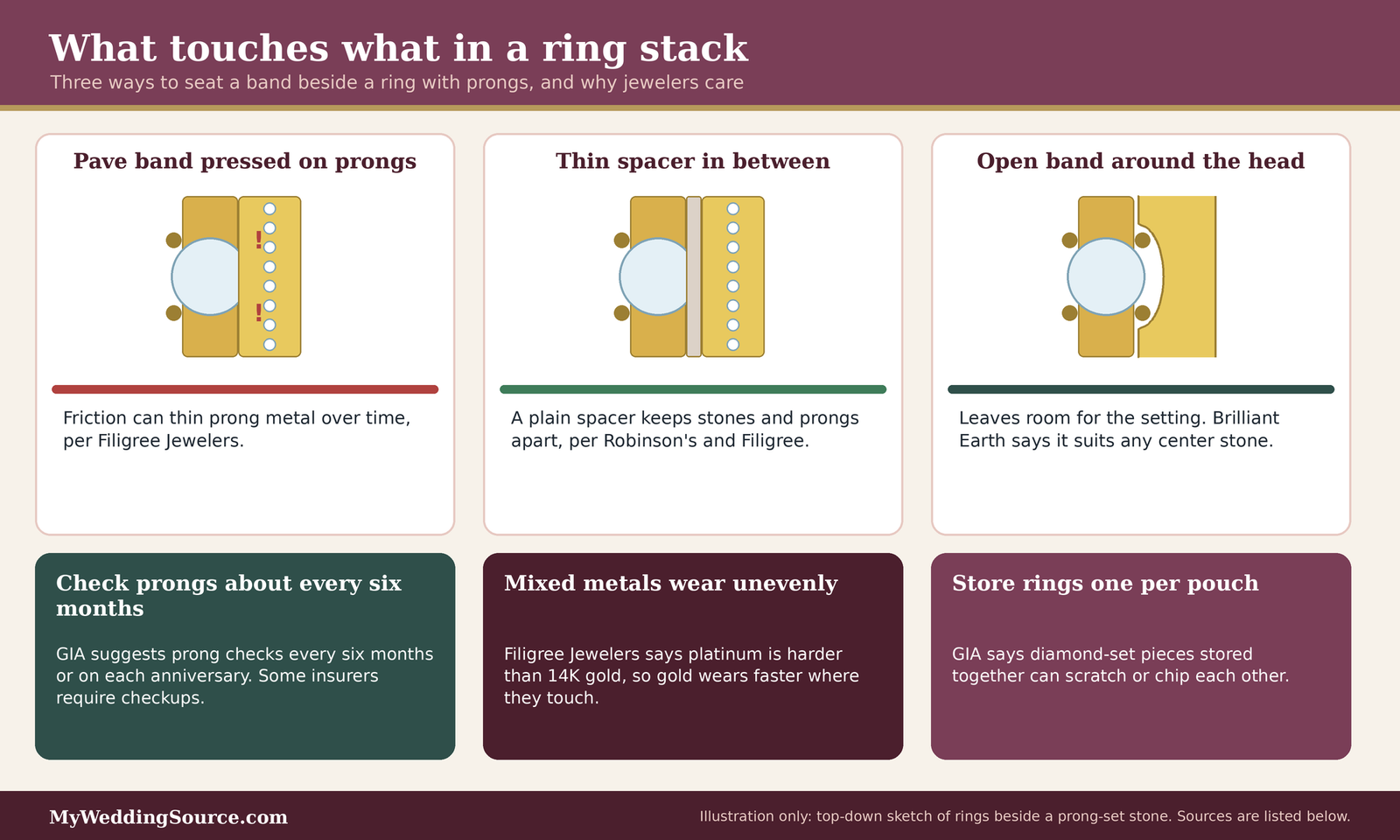
Filigree Jewelers lists the contact points that worry jewelers: pavé or channel bands pressed against prongs can thin the prong metal through friction over time, diamond-on-diamond contact between an eternity band and accent stones can chip stones along thin edges, and a band pressed against an exposed culet in an open-back or cathedral setting puts pressure on the stone. GIA adds that diamond-set pieces worn together can scratch or chip each other. These are the places to look at on your ring before you bring a band close.
Surface detail you may want to keep visible
The same Filigree guide warns that a band pressed flush against intricate side detailing, open gallery work, or filigree along the shank can hide that detail, and it says a band should not press into filigree along the sides of a setting. If part of what you love about your ring is its detail, note it. A good curved wedding band can leave breathing room around that detail, and a jeweler can only plan for it if you point it out.
Name the setting type
Setting types change how a band can approach, so it helps to know which words describe yours. GIA separates setting types, which describe how a stone is held, from setting styles, which describe the overall arrangement.
How the stone is held
GIA describes prongs as metal arms that rise from a base and bend over the stone’s edges, bezels as a metal rim around the stone, flush settings as stones set level with the surface of the band, and channel, bar, and tension settings as other holding methods. It describes a basket as a prong setting with horizontal supports under the stone, used for larger or deeper stones. Each of these changes how much metal sits near the finger and how much sits beside the neighboring ring, so the type is worth writing down.
The overall style
GIA’s style list includes solitaire, halo, three-stone, toi et moi, pavé, cathedral, cluster, and trellis. A cathedral setting uses metal arches rising from the shank to raise the center stone, a halo surrounds the center stone with smaller accent stones, and a toi et moi sets two stones side by side. If you are not sure which words apply to your ring, the jeweler who sold it, or any gemologist, can name them in a minute. Our own guide to engagement ring settings and the engagement ring prong settings article explain the vocabulary in more detail.
Matching a curved wedding band to unusual rings, one at a time
Unusual rings are unusual in different ways, so no single curve suits them all. The pairings below combine what several jewelers and retailers say. Where only one seller says something, we say so, because sellers describe their own products.
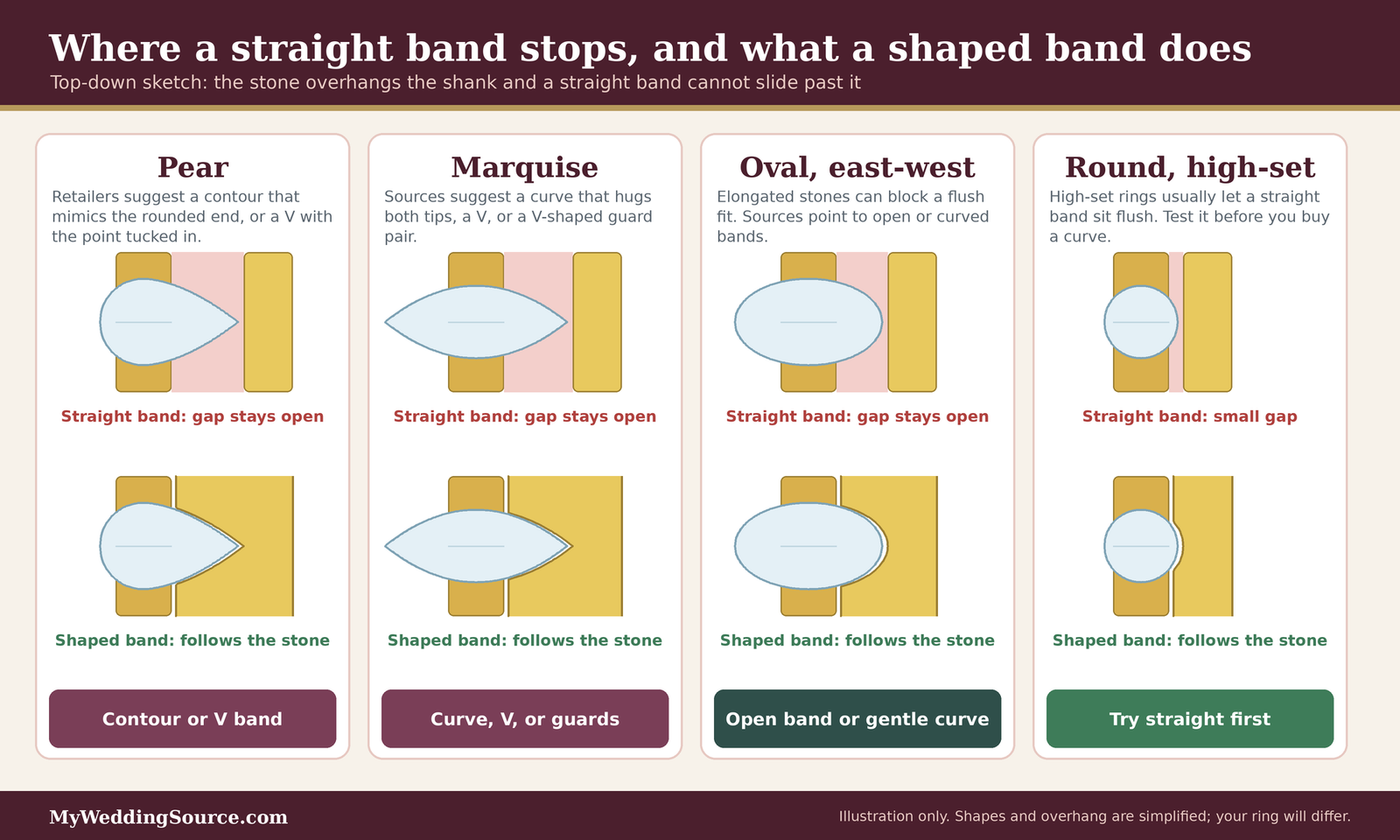
Pointed and elongated stones
Marquise, pear, and other elongated centers extend across the finger instead of sitting in a compact round head. That is why they are named so often in advice about gaps.
Marquise and pear
Goodstone says marquise and pear shapes often gap with straight bands, and it suggests curved wedding bands that hug the pointed tips, or chevron and V bands, for a marquise, and contour bands that mimic the rounded bottom of a pear. The Knot suggests a V or chevron band with a pear’s point facing down into the V, and a curved wedding band or a pair of V-shaped guards for a marquise. If the engagement ring has pointed tips, it is also worth knowing that GIA says shapes with points or corners, including marquise and pear, are more vulnerable to chipping, so a band that presses on a tip is a risk worth avoiding.
Oval, emerald, and east-west settings
Brilliant Earth says elongated centers such as oval, marquise, and pear extend across the finger and can block a flush fit, and that curved or open bands give a cleaner result. The Knot says open bands suit oval, emerald, elongated cushion, marquise, and pear shapes, and that an open band can also act as a spacer between the engagement ring and a straight band that does not sit flush. If your stone is set east-west, meaning the long axis runs across the finger, the elongated shape reaches toward the neighboring finger on both sides, and an open band or a very gentle wide curve is more likely to work than a tight V. This is our reading of the geometry, so check it against your own ring.
Low-set, bezel, and flush rings
Low rings are the opposite problem for a curved wedding band. They hug the finger, which is practical, but they can leave very little room for a band to approach.
Why low settings gap
The Knot’s low-profile guide explains that low-set rings sit close to the hand and can be harder to pair with a wedding band, and that most jewelers can customize a low-profile setting so a band sits flush. It also lists benefits: less snagging, better stone protection, and stability for active lifestyles. Robinson’s says a low setting with prongs or a basket sticking out can stop a straight band from sliding fully underneath.
Bezels and when straight works
Filigree Jewelers says straight bands usually fit flush against low-profile and bezel rings, while Lebrusan Studio, a British jeweler, says claw settings tend to allow flush pairings and halos and bezels are a little trickier. Those two statements do not conflict, because bezels vary. A thin low bezel can leave room for a straight band, while a bezel with a flared base or a wide wall can behave like a basket. Melanie Casey, a jewelry designer, shows curved wedding bands that dip in the center to wrap around a focal stone and a curved wedding band that sits flush with one of its own ring designs, and it leaves negative space between bands for a low-profile bezel, so even one maker uses both approaches. Test your own ring instead of assuming.
Halo, hidden halo, and cluster rings
Rings with many small stones around or under the center add bulk exactly where a curved wedding band wants to sit.
Halos add width at the sides
GIA says a halo surrounds a prong- or bezel-set center stone with smaller accent stones. Filigree Jewelers notes that halos are wider and add bulk, and it suggests slimmer or contoured bands that tuck under the halo. Brilliant Earth lists hidden halos and galleries among the features that often stop a straight band from sitting flush. If you are choosing between a plain contour band and a diamond-set one, remember the earlier contact warnings: stones against stones can chip.
Clusters and busy rings
GIA describes a cluster as multiple small stones grouped to look like one larger stone or to form patterns such as flowers. The Knot advises that toi et moi and halo rings call for simple, minimal bands because they already have strong focal points, and it suggests avoiding wide or busy bands with them. A plain, narrow, gently curved wedding band is often easier to match to a busy ring than a detailed one, and it leaves room to add a more detailed band later.
Toi et moi and three-stone rings
These rings put visual weight on both sides of the center, which changes how a curve reads.
Toi et moi
Berlinger names toi et moi styles among the rings that benefit from a curved wedding band and sells custom contour bands. Lebrusan Studio describes a toi et moi band made with a scan of the engagement ring, a resin mock-up, and a cast band that slots together with the ring like pieces of a jigsaw puzzle. Because a toi et moi ring has two stones, the outline can be uneven, and a custom curve is more likely than a stock one.
Three-stone and high-set solitaires
Goodstone warns that three-stone and high-set solitaires may sit taller, so some bands will not nest properly, and says it designs its own three-stone rings at a calculated height. That is a reminder to check height as well as outline. A tall ring can leave open space below that a flush straight band cannot fill, and a cathedral or tall three-stone ring is often the case where Filigree Jewelers recommends a contour or V band.
Vintage and antique rings
Older rings were often made to be worn alone, and the sources are cautious about adding a curved wedding band to them.
Respect what the ring was built to do
Filigree Jewelers says many vintage rings look best without a stacked band, that intricate side detailing can be hidden by a band pressed against it, and that Art Deco rings can take a slim angular contour band that echoes their lines, while Edwardian rings suit thin plain or milgrain-edged bands. For retro rings from the 1940s and 1950s, it says bold sculptural designs are hardest to stack and often look better alone. It also offers an alternative: wear the wedding band on the opposite hand.
Custom mirroring for detail
Robinson’s offers custom bands that mirror the detailing of an existing ring and claims this prevents rubbing, scratching, and spinning, which is a seller’s claim and worth testing at the try-on. If your ring is old, also read our guide to buying an antique engagement ring without overlooking repairs, because a band pressed against worn prongs is a problem to solve before it becomes a repair.
Choosing the curve: contour, chevron, notch, open, guard, or spacer
Once you know where your ring stops a straight band, you can choose a shape on purpose. Each shape trades fit, look, and flexibility differently, and none is correct for every ring.
Soft curves and sharp curves
The two curved shapes most people mean are the rounded contour and the pointed chevron. Both follow the ring, but they look different on the hand.
Contour bands
A contour band swoops around the stone in a rounded line. The Knot says it can be a soft U or a sharper V, solid or stone-set, and may have a straight edge with a notch for the diamond. Berlinger says the curve can be subtle or dramatic. A contour band is a sensible first curved wedding band to try when your stone is round, oval, or pear shaped and you want the rings to read as one line.
Chevron and V bands
Goodstone says a chevron band frames and cradles the center stone and that the angle of the V can range from sharp to soft, with a sharp V suiting angular or architectural settings and a gentler curve suiting rounded or organic ones. Robinson’s describes the V as a more modern, architectural look. A V works best when the ring has a point to receive it, such as a marquise tip or a pear point.
Notched, open, guard, and spacer options
These shapes are less common in product photos, but they solve problems a simple curve cannot.
Notched and open bands
Robinson’s describes a notched band as having a small notch cut from the metal so the engagement ring can snap into place, and offers it for angular, specific settings. An open band has a small opening that fits around the center stone. Robinson’s recommends it for very low-set rings, and Brilliant Earth says open bands work with virtually any center stone, whatever the setting height. Open bands leave the center setting unrestricted, which is useful for a ring you may someday have reset or enlarged.
Guards and spacers
The Knot describes guard bands, sometimes called ring jackets, as a pair with one on each side of the engagement ring, some connected underneath, and says they suit round, oval, and marquise rings in solitaire or three-stone settings. A spacer is a thin plain band between two rings. Robinson’s says it can fill minor space and keep delicate rings from scratching each other, and Filigree Jewelers says to use one between diamond-heavy rings so stones do not touch.
Reading a shape against a ring
A short comparison makes the choices easier. The table reflects how the sources describe each shape, plus our own summary of when it helps.
| Band shape | What it does | Often suits | Watch for |
|---|---|---|---|
| Contour (soft curve) | Follows the outline of the setting | Pear, oval, low-set, custom outlines | Made for one ring, so a ring change may break the fit |
| Chevron (V) | Cradles a point | Marquise, pear | A point that needs to line up exactly |
| Notched | Straight top with a small cut | Angular or specific settings | Needs precise measurement of the notch |
| Open (gap) | Leaves a space for the setting | Very low-set, elongated, many shapes | The open space is a visible design choice |
| Guard (pair) | Frames both sides | Round, oval, marquise solitaires | Adds width and a second piece to buy |
| Spacer | Thin plain band between rings | Diamond-heavy pairs, small gaps | Adds one more ring to the finger |
How to use the table
Treat the table as a list of questions to answer at the try-on, not a verdict. Ask the jeweler to place your engagement ring on a finger next to each shape and walk through what each leaves open.
What to do when two curved wedding band shapes seem right
Choose by what you want to protect. If you want maximum protection for a point, the chevron or open band keeps metal away from it. If you want a continuous silhouette, a contour band does that. If you want freedom to change later, open bands and spacers are more flexible than a ring cut for one specific outline.
Measuring the stack: a ring-stack fit diagram and profile measurements
Jewelers can read a ring and a curved wedding band at a glance, but you can bring them better information if you describe the ring in measurements. These steps are our suggested method, not an industry standard, and a jeweler may use different ones. The point is to replace “it looks like there is a gap” with specific observations.
Four things to note from the side
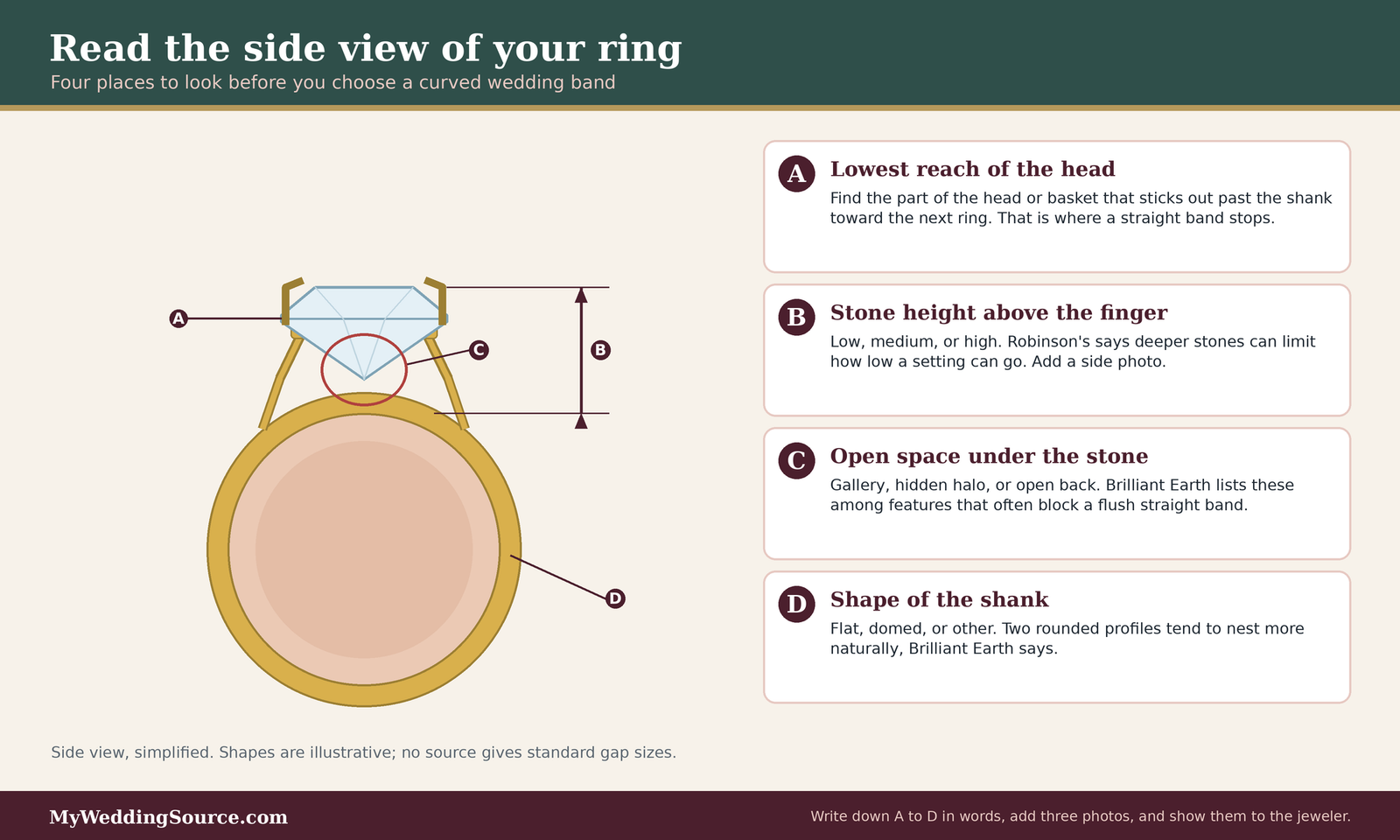
The diagram above shows a side view of an engagement ring and four places to look. We use letters instead of numbers because no source we read publishes standard gap tolerances.
A, the lowest point of the head
Find the part of the head, basket, or gallery that reaches closest to the neighboring finger. Compare it with the shank. If it sticks out past the shank, it will stop a straight band there. Point to it with a fingertip when you talk to a jeweler.
B, the height of the stone above the finger
Note whether the stone sits low and close to the finger or high with open space under it. Robinson’s says profile is how high the center stone sits off the finger, and that the pavilion needs clearance, so deeper stones can limit how low a setting can go. Write down “low,” “medium,” or “high” and add a photo.
C, anything under the stone
Look for a gallery, a hidden halo, or open space beneath the stone. Brilliant Earth lists these among the features that often block a flush straight band, and Filigree Jewelers warns against pressing a band against an exposed culet. Note what is there and whether it looks fragile.
D, the shape of the shank
Look at the cross-section of the shank where the band will lie. Brilliant Earth’s pairing advice says a flat band against a rounded shank can look disconnected and that two rounded profiles tend to nest more naturally. Lebrusan Studio adds that a court or D-shaped band suits a gently domed engagement ring band. Write down whether your shank is flat, domed, or something else.
Make a take-home record
Most of what a custom maker needs can be captured without special tools. A few photographs and a paper outline are often enough to start a conversation.
Photos and a paper outline
Take the three photos mentioned earlier, and place the ring on a sheet of paper and lightly trace the outline of the head and shoulders with a sharp pencil held straight up. Hold the pencil vertical so the line does not drift. This is our own approach, and a jeweler’s scan or impression will be more accurate, but the outline helps you check whether a curve you are looking at online is plausibly the right shape.
Describe, don’t diagnose
Write what you see, not what you think the problem is. “The point of the stone sits about at the edge of the head” is more useful than “I think I need a V.” Jewelers sometimes see a ring differently from the owner, and your notes leave room for their judgment.
Try-on checks that reveal problems
A try-on is the cheapest test you have for a curved wedding band. Spend a few minutes on it instead of rushing.
Check the fit with fingers bent
Robinson’s advice to bend your fingers before deciding applies to the pair as well as the ring. Put both rings on, make a fist, hold a pen, and turn your hand under a bright light. Brilliant Earth says a stack that feels awkward at try-on will likely feel the same later, and that you should check that the combined width is comfortable and that the rings do not shift or pinch.
Look for movement, tilt, and rubbing
Gently rotate each ring. If the engagement ring tilts toward the band, if the band tries to slide away from the curve, or if you can see metal touching metal at one point, mention it. Brilliant Earth notes that poor alignment can lead to unnecessary wear over time. A jeweler with a loupe can see wear points you cannot.
Metal, width, and wear: what touches what
A curved wedding band that fits perfectly can still scratch or wear your ring if the metals, widths, and stones are mismatched. These choices are easier to make once you know where the two rings meet.
Metals that sit side by side
The sources agree that mixing metals is accepted and that wear is the concern, not looks.
Hardness and gradual wear
Filigree Jewelers says platinum is harder than 14-karat gold, so contact causes gradual wear on the gold, and advises regular inspection when mixing metals. Brilliant Earth says harder metals can scratch softer ones and suggests matching karat weight for gold even when colors differ. Goodstone ranks platinum as the most durable, followed by 14-karat and 18-karat gold. For more on this, see our guide to gold vs. platinum wedding bands and our wedding ring metals article.
Matching versus contrasting metals in a curved wedding band
Matching metals gives a seamless look, while mixing adds contrast. Filigree Jewelers suggests keeping roughly sixty to seventy percent of the stack in the dominant metal, with the other as an accent, and notes that many antique rings mix metals by design, such as a platinum top on a yellow gold shank. Lebrusan Studio’s custom example used recycled platinum for the band to match the hardness of the engagement ring. If you have a metal allergy, read our wedding band metal allergies guide before choosing.
Width and weight
A curved wedding band can look different depending on its width, and width affects how the pair sits.
Proportion and visual weight
Goodstone says too many wide bands can feel heavy while mixing widths, textures, and stone sizes tends to look more balanced. Robinson’s gives an example of a slim engagement ring of about two millimeters paired with a wider band of about three and a half millimeters, which is one retailer’s illustration of width contrast and not a rule. For general width guidance, see our guides on wedding band width and band width.
Halos and wide curves
Filigree Jewelers suggests slimmer or contoured bands beside halos, since halos are already wide. Lebrusan Studio says matching band widths generally work best. A narrow band with a deep curve can look delicate around a large stone, while a wide band with a deep curve looks heavy and can crowd the setting. The right balance depends on the stone, so look at the pair in a mirror, not only on a screen.
Protect the weak points
A few habits protect a delicate setting from its neighbor.
Prongs and accent stones
Filigree Jewelers says not to press a pavé or channel-set band against prongs because friction can thin the metal over time, and not to allow diamond-on-diamond contact. GIA recommends prong checks about every six months, or yearly on your anniversary, and says some insurers require regular checkups. A loupe at ten times magnification can reveal loose stones or gaps. If you are unsure about coverage, our article on engagement ring insurance hidden costs explains what to ask an insurer, and our upcoming guide to engagement ring insurance appraisals covers appraisals.
Storage and daily wear
GIA says diamond-set pieces stored together can scratch or chip each other, and recommends keeping each piece separately in a padded box or pouch. It also recommends removing rings for gardening, exercise, and washing dishes. Filigree Jewelers adds that three rings is described as the sweet spot and that four or five can feel snug as fingers swell during the day.
Buying the band: stock, custom, or mirrored
Once you know the shape, the next decision for your curved wedding band is who makes it and when. The sources describe three routes, each with different strengths.
Off-the-shelf curves
Many retailers sell curved wedding bands in standard shapes. They are the quickest route and the easiest to compare in person.
What stock curves do well
Berlinger sells simple minimal curves, chunkier sculptural curves, and bands with mismatched diamond shapes, and lets customers bring in their ring or book a virtual appointment to find a compatible curved wedding band. Goodstone sells a mixed-shape stone-set version and a plain version curved to fit the finger. These are seller descriptions, and a stock curve may fit a common outline well and an unusual one poorly.
What to test before you pay
Bring your engagement ring and try several curves. Ask for the return or exchange policy in writing. Brilliant Earth suggests having a jeweler assess how the rings fit together. If a curve sits close at the front but leaves space at the sides, or if it presses on a prong, keep looking.
Custom contour and mirrored bands
A custom curved wedding band is made for one ring, which helps with unusual outlines and creates trade-offs.
How a custom contour is made
Lebrusan Studio describes scanning the engagement ring with computer-aided design software, making a resin mock-up, and casting a band with a recess so the rings slot together, with the toi et moi example following the same process. Berlinger also offers fully custom contour bands made for a specific ring, and Robinson’s offers custom bands that mirror existing detail. These are seller descriptions, and none of the pages we read gave lead times or prices.
Trade-offs of a custom curved wedding band
By design, a contour band is shaped to one outline, so it may not sit well if the engagement ring changes; that is our reading of how the shape works, and our guide to engagement ring and wedding band pairing discusses the same trade-off. If you expect to reset the stone or upgrade the ring, ask whether the band can be reshaped or whether an open band would be safer.
Timing and order
The order in which you buy affects your options, and the sources disagree a little, which is useful to know.
Buying together or later
Brilliant Earth says buying both rings together can make a flush fit easier, though couples often buy the band closer to the wedding. A custom route needs the engagement ring present for scanning, so schedule that time. Because the sources give no standard lead times for a curved wedding band, ask the maker for a written date and add a buffer of your own before the wedding.
Keeping the engagement ring in good shape first
A curved wedding band is built around the ring as it is today. If the prongs are worn or the stone is loose, repair first and make the band second. Our guide to ring resizing before the wedding covers the timing of work on rings that will be worn together.
What this can cost, and what we could not verify
None of the sources we read published prices for custom contour bands, so we are not giving a figure. The cost-related numbers we found are for related services: The Knot’s resizing guide says resizing typically runs about $20 to $200 depending on complexity, and its soldering guide quotes one jeweler’s average of over $100 for 14-karat gold and over $150 for platinum, with intricate work or gemstones raising the price. Ask every maker for a written quote that lists the metal, the stone-setting, the design work, and the timeline. Prices and policies change, so confirm them before you pay.
Sizing, resizing, and soldering a curved wedding band
A curved wedding band is made to sit in a particular place, so anything that changes its size or position deserves a plan. This section covers what the sources say about resizing and soldering and where they say nothing.
Resizing when a curve is involved
Our article on ring resizing before the wedding covers the general rules. The points below are specific to bands with a shaped top edge.
What the sources say about limits
The Knot’s resizing guide says most rings can be resized about one to two sizes up or down depending on the design, that eternity bands are generally not meant to be resized, and that intricate designs and rings with stones may need extra work and cost more. GIA says channel and bar settings can be hard to resize, and that tension settings are very difficult, sometimes impossible, to resize. None of the pages we read addressed curved wedding bands specifically, so ask any jeweler whether a particular curve can be resized without changing the shape of the curve.
Size the engagement ring before the band is made
If the engagement ring might need adjusting, do it before a custom band is cast, because the band is shaped to the ring as it is on the day of scanning. Our ring sizing guide explains how finger size changes during the day. A band that fits at the front but sits loose at the base will rotate, and a curve that rotates away from its stone defeats its purpose.
Soldering and wearing the pair together
Some couples join the rings after the wedding. The Knot’s guide to soldering describes both sides.
Reasons people solder
The Knot’s guide says soldering keeps rings from shifting or spinning, lets a contoured band sit around the center stone at all times, reduces friction and scratches, and removes friction between different metals. The guide adds that a set that does not shift is easier to manage during daily tasks.
Reasons people wait
The same guide lists drawbacks: you lose the option to wear a ring alone, the joined set is thicker and may need a larger size, and bands of different thickness may not align well. It says soldering can be undone, but separating usually means melting the joint, which can damage one or both rings, and that resizing a soldered set is harder and more expensive. It quotes one jeweler’s turnaround of three to four business days, another’s of a few hours, and an average over $100 for 14-karat gold and over $150 for platinum. Brilliant Earth also mentions that some couples solder after the wedding. Our suggestion is to wear the pair unsoldered for a while first, since you can always solder later but can rarely undo it cleanly.
Edge cases: when the usual advice does not fit
Unusual rings produce unusual situations. Here are the ones that come up most often and what the sources say about them.
Rings that may change
Engagement rings are sometimes reset, resized, or upgraded, and a curved wedding band should not make that harder than it has to be.
Planning a curved wedding band around a future reset
If you might replace the center stone, ask whether the new setting would keep the same outline. A contour made for one outline may not fit a different one, which is our own reading of how the shape works. An open band, per Brilliant Earth, works with virtually any center stone regardless of setting height, which is why it may suit a ring you expect to change. Ask the maker whether a custom band can be reworked, and get the answer in writing.
Asymmetrical and sculptural rings
Goodstone quotes a trade writer noting an uptick in asymmetrical and curvier designs and thicker bands overall, which is a retailer’s trend claim, not a measurement. Brilliant Earth says a custom band may suit unusual or asymmetrical settings. If your ring has an irregular outline, a custom piece or a spacer plus an open band is likely to work better than a stock curve, since stock curves follow common shapes.
When nothing seems to fit
Sometimes no curved wedding band follows the ring without a trade-off. That is not a failure, and you have options.
Wear the band separately
Filigree Jewelers suggests wearing the wedding band on the opposite hand for rings that look best alone, which keeps the engagement ring as the focus and allows a bolder or wider band. Our engagement ring and wedding band pairing guide covers the gap, metals, and contact options in more detail.
Accept a small gap
Robinson’s notes that some people like the gap, and the Knot’s low-profile guide frames flush as a goal rather than a rule. A small, even space can look intentional. What matters is that the rings do not press on each other’s weak points, so check contact before you decide that a gap is acceptable.
Photos, engraving, and everyday wear
A curved wedding band also changes details you may not think about until later.
Ring photos on the day
If ring photos matter to you, tell the photographer how the pair nests and whether the rings are soldered or separate, since a curve can look different from different angles. Our wedding photographer shot list shows how to ask for detail shots.
Engraving the inside
Engraving the inside of a curved wedding band is usually possible, but the shaped edge can change the available space. Our ring engraving guide explains the options, and you should ask the maker whether engraving is done before or after shaping.
Questions to ask before you order
Good questions protect you from vague product pages about any curved wedding band. Ask for the answers in writing and keep them with your receipt.
Questions to ask a jeweler or maker
- Have you looked at my engagement ring from the side, and where do you see the band stopping?
- Which shape do you recommend, and what would you pick as a second choice?
- What touches what on the finished pair, and how will you protect the prongs and any accent stones?
- Is the band made for this one ring, and what happens if I reset or resize the engagement ring?
- What metal, purity, and finish will it be, and is it stamped?
- Can the band be resized, and does the curve survive resizing?
- What is the timeline in writing, and what happens if it runs late?
- What is the return, exchange, or remake policy if the fit is wrong?
About the fit
These questions confirm that the band actually works with your ring.
Questions about the curve
Ask the jeweler to show the curved wedding band and the engagement ring together on a finger and to point to every place they touch. Ask what they would adjust if the curve is a little too tight or too loose. A jeweler who can answer these without hesitating has probably done the work before.
Questions about contact and wear
Ask whether the band presses on prongs, whether metal hardness is a concern, and whether a spacer would help. Filigree Jewelers lists these as the contact points to watch, so a good jeweler will already know them.
About the purchase
These questions confirm what you are paying for and what happens if something goes wrong.
Materials and marking
The FTC’s Jewelry Guides say it is unfair or deceptive to misrepresent the metal content or another material aspect of a jewelry product, that a gold alloy needs a karat designation, and that an unqualified “platinum” requires at least 950 parts per thousand pure platinum. Ask the seller to state the metal and purity in writing and check that the stamp matches. Ask whether the piece is solid or plated.
Handmade and custom claims
The FTC’s guides treat “handmade” claims in Section 23.2, which requires shaping, forming, and finishing to be done by hand labor and manually controlled methods, though the agency declined to say whether hand-cast items qualify. If a seller calls a band custom or handmade, ask what was done by hand and what was done by machine. This is consumer information, not legal advice.
FAQ: curved wedding band questions
Fit and shape
Do I need a curved wedding band with my engagement ring?
Not always. A curve helps when a straight band cannot sit close to the engagement ring, which commonly happens with pointed or elongated stones, low-set heads, cathedral settings, and halos. Hold a straight band against your ring and look from the side and from above. If there is no gap and nothing presses on a prong, you may not need one.
Which curved band shape suits a marquise or pear ring?
Jewelers we read suggest a contour band that follows the tip or a chevron V that cradles it, and The Knot suggests pointing a pear’s tip into a V. A guard pair is another option for marquise rings. Bring your own ring and try each shape, because tips vary and a poor match can press on a point.
What if my engagement ring is vintage or has a lot of detail?
Filigree Jewelers says many vintage rings look best alone and warns against pressing a band into filigree or side detail. If you want a band, consider a slim contour, a thin plain band, a custom piece that mirrors the detail, or wearing the band on the other hand. Ask a jeweler to check what touches the delicate parts.
Buying and cost
Is a custom curved wedding band better than a stock one?
It depends on your ring. A stock curve is faster and easier to compare in person, while a custom curve is made to follow an unusual outline. The sources we read did not publish custom prices or lead times, so ask for both in writing, and ask whether the band can be changed if you reset the engagement ring.
Should I buy the band before the wedding or after?
Either can work. Brilliant Earth says buying together can make a flush fit easier, while many couples buy the band closer to the wedding. A custom band needs your engagement ring present for scanning, so schedule that early. Because the sources give no standard lead times, ask for a written date and keep a buffer.
Can I mix metals between the engagement ring and a curved wedding band?
Yes, and jewelers describe mixing as accepted. The concern is wear, since a harder metal can scratch a softer one where they touch. Filigree Jewelers notes platinum is harder than 14-karat gold. If you mix metals, plan regular checkups, and ask whether matching hardness suits your ring.
Care and later changes
Can a curved wedding band be resized?
Sometimes. The Knot’s guide says most rings can move about one to two sizes depending on design, while eternity bands and many stone-set designs are harder. None of the sources discussed curved wedding bands specifically, so ask the jeweler whether resizing would change the curve, and what it would cost and take.
Should I solder the engagement ring and band together?
Some couples do, to stop shifting and reduce friction. The Knot’s guide also lists drawbacks: you lose the option to wear one ring alone, resizing becomes harder and costlier, and separating can damage rings. Consider wearing the pair unsoldered for a while first, then decide with your jeweler.
Your next steps
Prepare at home
Photograph and describe your ring
Take photos from above, the side, and the palm side, and write a short note under each describing what extends past the shank, what sits under the stone, and what looks delicate. Add the setting type if you know it. These notes make every conversation with a jeweler more precise.
Test a straight band first
Hold a straight band beside the ring and look for a gap or pressure on a prong. If it sits well, you may be done. If not, you now know where the gap is, which helps you choose a shape.
Try, then decide
Bring your ring to every fitting
Try a contour, a chevron, an open band, and a spacer next to your own ring, with your fingers bent. Ask the jeweler to point out every contact point and to explain how they would protect it.
Put it in writing and leave a buffer
Get the metal, purity, timeline, return policy, and care instructions in writing. For the wider plan, use our wedding planning checklist and our wedding rings guide, and see our engagement ring settings and engagement ring shapes pages for background.
Sources & methodology
How we built this guide
What we relied on
This guide combines the federal rule on how jewelry is described and marked, GIA’s guides to ring settings and diamond protection, and published pairing, setting-height, resizing, and soldering advice from jewelers, retailers, and wedding publishers. Where a statement comes from a retailer or jeweler, we say so, because sellers describe their own products and habits. The measurement steps in this guide are our own suggested routine, not a standard. We checked the sources on November 12, 2026, and page contents, policies, and prices may have changed since.
What we did not do
We did not test rings, measure hands, or inspect any engagement ring. We did not find published gap tolerances, custom band prices, or lead times, so we do not give them. This is not legal, financial, insurance, or gemological advice. Ask a qualified jeweler to examine your actual rings, get quotes in writing, and check your insurer’s requirements.
Source list
Government and gemological sources
- Federal Trade Commission, Guides for the Jewelry, Precious Metals, and Pewter Industries, 16 CFR Part 23, final revisions (Federal Register, August 16, 2018): https://www.govinfo.gov/content/pkg/FR-2018-08-16/html/2018-17454.htm
- GIA, Guide to engagement ring settings: https://4cs.gia.edu/?p=39609
- GIA, How to protect your diamond engagement ring: https://4cs.gia.edu/en-us/blog/how-to-protect-your-diamond-engagement-ring/
Publishers, jewelers, and retailers
- The Knot, How to pair a unique engagement ring with a wedding band: https://www.theknot.com/content/commandments-of-wedding-rings
- The Knot, What are the benefits of a low-set engagement ring: https://www.theknot.com/content/low-profile-engagement-rings
- The Knot, Engagement ring resizing: https://www.theknot.com/content/engagement-ring-resizing
- The Knot, Should you solder rings together: https://www.theknot.com/content/pros-cons-solder-rings-together
- Berlinger Jewelry, Curved and contour wedding bands: https://berlingerjewelry.com/blogs/berlinger-journal-blog/curved-contour-wedding-bands
- Goodstone, How to pair a wedding band with an engagement ring: https://www.goodstoneinc.com/blogs/news/how-to-pair-wedding-band-with-engagement-ring
- Robinson’s Jewelers, Why some wedding bands create a gap next to the engagement ring: https://robinsonsjewelers.com/blogs/news/why-some-wedding-bands-create-a-gap-next-to-the-engagement-ring-and-how-to-fix-that-awkward-space-forever
- Robinson’s Jewelers, Why some engagement rings sit high and others sit low: https://robinsonsjewelers.com/blogs/news/why-some-engagement-rings-sit-high-and-others-sit-low-the-secret-behind-a-rings-perfect-profile
- Filigree Jewelers, Stacking rings with your engagement ring: https://filigreejewelers.com/blogs/articles/stacking-rings-with-your-engagement-ring-dos-and-donts
- Brilliant Earth, How to match a wedding band to your engagement ring: https://www.brilliantearth.com/news/how-to-match-a-wedding-band-to-your-engagement-ring/
- Lebrusan Studio, How to make a wedding band fit flush to your engagement ring: https://lebrusanstudio.com/blogs/commitment/how-to-make-a-wedding-band-fit-perfectly-flush-to-your-engagement-ring
- Melanie Casey, Wedding band styling for a bezel-set engagement ring: https://melaniecasey.com/pages/wedding-band-styling-for-a-bezel-set-engagement-ring