

Wedding hairstyles work best when you decide the result first, test it against the conditions it will actually face, and then build the dress pairing, the morning schedule, and the touch-up plan backward from the moment your photographer needs you ready.
Quick answer
Choose from the outside in. Start with the length of the day, the weather, and your hair texture, because those decide how secure a style has to be. Then fit the style to your neckline and veil, book a trial one to three months before the wedding that lasts long enough to wear the look for hours, and photograph it in more than one kind of light. Back-time the wedding morning from your photo deadline, with a buffer before you get dressed. In the final weeks, stop trying new treatments and products, and decide who carries the touch-up kit. The Knot’s study of 2025 weddings reports an average of about $150 for the bride’s hair on the wedding day, and trials and tips are usually extra.
This guide is about the decisions around wedding hairstyles, not about trends or product reviews. It will not tell you which brand of spray to buy or which stylist to hire. It gives you a way to compare options, questions to put in writing, a trial checklist, and a morning schedule you can adapt. Where we cite prices or timing, we name the source. Where we do our own arithmetic, we label it as an estimate. Where we offer a recommendation that no source states, we say it is our view.
Hair is also a medical and cosmetic topic, so one limit up front. Nothing about wedding hairstyles here is medical advice. If you have scalp pain, hair loss, a rash, or a reaction to a product, a board-certified dermatologist is the right person to ask, not a blog or a stylist.
Start with the result, and the conditions your wedding hairstyles must survive
Most people planning wedding hairstyles open a search box or a saved folder of photos and start with the style. That is understandable, and it is also the order that causes the most disappointment. A photo shows one moment, in one kind of light, usually on hair that was prepared for hours by someone with a full kit. Your wedding is a different assignment. The style has to look good at the ceremony, hold through photos, survive hugs, dancing, wind, and heat, and still look like you at the end of the night.
So we start from the other end. Define the result in plain words, list what it must survive, and only then pick a style that fits both. Doing it in that order keeps wedding hairstyles from becoming a guessing game on the morning of the wedding.
Define the finish, the texture, and the hold you want
Three words cover most of what people mean when they describe a style: finish, texture, and hold. Finish is how polished the hair looks, from sleek to deliberately undone. Texture is how much movement the style has, whether that is smooth, wavy, curly, or braided. Hold is how long it lasts without help. Naming all three gives your stylist something concrete to work with and gives you something to check at the trial.
Name the feeling before the style
The Knot’s guidance on choosing a style starts with confidence and with the feeling you want, not with a particular look. We agree with that order. Write two or three sentences before you collect any photos: how you want to feel walking in, what you want to look like in photos, and what you want to be able to do (hug people, dance, take a veil off) without thinking about your hair. Those sentences are the brief you will hand to a stylist, and they are easier to match against wedding hairstyles than a mood board is.
Let hair type set realistic expectations
The Knot describes hair type as the biggest factor in setting realistic expectations, and it lists texture, thickness, length, and how your hair reacts to heat and humidity as the things to consider. It also points out that some hair needs help to do what a photo shows, whether that is extensions, a cut, or color. That is useful to hear early. One of the most common surprises with wedding hairstyles is that a look that seems effortless in a photo may depend on added hair, a specific cut, or hours of work, and it is much better to learn that at a trial than on the morning of the wedding.
Decide how long the style must last
The Knot also notes that the length of the event matters, since looking photo-ready for an hour is different from looking photo-ready for ten hours or more. Write down your actual schedule from the first photo to the last dance. If the ceremony is at four and the reception ends at ten, the hair has to work for roughly eight or nine hours after it is finished, plus the hours before that. A longer day favors a more secure base, with the option to loosen or change the style partway through, and that is true of nearly all wedding hairstyles.
Match wedding hairstyles to your hair texture
Texture is where good intentions for wedding hairstyles meet physics. We are not going to claim that one texture is better than another, and no source we found says so. What the sources do say is that you should work with your natural texture, ask a stylist what is realistic, and consider added hair when a style needs it. Here is how that plays out for the most common situations, framed as questions to ask rather than rules.
Straight and fine hair
If your hair is straight, ask how long a smooth style will hold on your hair in the weather you expect, and whether the stylist plans to add texture so pins and the veil comb have something to grip. Ask whether the style depends on curling or volume that may relax over a long day, and whether a touch-up is realistic or whether the style should be built to need none. Our recommendation is to judge a straight-hair style at the three-hour mark of the trial, not just right after it is finished.
Wavy and curly hair
Zola’s styling guidance suggests working with your natural hair type, with waves defined using salt spray and curls enhanced with a hot iron, and it cautions against feeling pressured into a style your hair cannot reach. The Knot adds a washing note: for natural curls, wash them the morning of the wedding, while for heat-styled wavy or curly hair, wash and air-dry the night before. Ask your stylist which routine applies to the style you chose, because the two instructions point in opposite directions.
Coily hair and protective styles
The Knot notes that if you plan braids or other protective styles, you should check how they fit with a honeymoon that follows right after, since the style may affect those plans. If you choose braids, the American Academy of Dermatology (AAD) advises keeping them loose, especially at the hairline, and not wearing them longer than six to eight weeks. We cover the scalp-health side in the risk section below. Whichever of the wedding hairstyles you choose, ask any stylist you consult how long they have worked with your texture and to show examples on similar hair.
When added hair makes sense
The Knot and Zola both mention extensions, weaves, or clip-ins as options for adding volume or length, and The Knot says they can cover most of your natural hair, which helps in humidity. Zola advises budgeting for them and asking your stylist about the right type and color match. It also recommends a comfort test: wear the accessories or pull your hair back for a while to check for pressure or headaches. Extensions are a choice, not a requirement, and short wedding hairstyles can be just as elegant.
Avoid choosing from filtered inspiration alone
Inspiration photos are useful for vocabulary and misleading as promises. Most are edited, lit, and posed, and many show a style on a person whose hair differs from yours in color, density, or texture. Use them to learn which wedding hairstyles you like, then ask what it would take to get close on your hair.
Look for similar hair, not only a similar style
The Knot’s trial guidance suggests bringing inspiration photos, and an expert quoted in one of its articles recommends photos of people whose hair color, eye color, and face shape are similar to yours, so your expectations match what is possible. We would add hair texture and density to that list, since those matter at least as much. Save a few photos you love and a few you dislike, because The Knot notes that the dislikes help too.
Ask what the photo needed
For each saved photo, ask the stylist three questions. Is this natural hair, or does it include added hair? How long did the style likely take? How well would it hold through a long day? The answers turn a photo from a wish into a plan. If the honest answer is that it needs a longer appointment, added hair, or a touch-up during the day, you can decide whether that is worth it.
Mind the trend date
The Knot recommends timeless, classic styles over trends so the look will not date, and bases the decision on your dress, your comfort, and the wedding’s theme. That is sensible advice, and it does not mean avoiding anything current. It means asking yourself whether you will still like the photos in twenty years and choosing the element that carries the trend (a small accessory, a texture) separately from the structure.
Let the dress decide: neckline, veil, and accessories for wedding hairstyles
Your hair and your dress will be photographed together, so your wedding hairstyles and the gown should be planned together. The neckline and back tell you what the hair can reveal or cover, the veil tells you how much structure the hair needs, and accessories are the last layer. The order matters. Settling the dress and veil first prevents the common problem of falling for a style that fights the one thing it has to sit beside.
Let the neckline suggest up or down
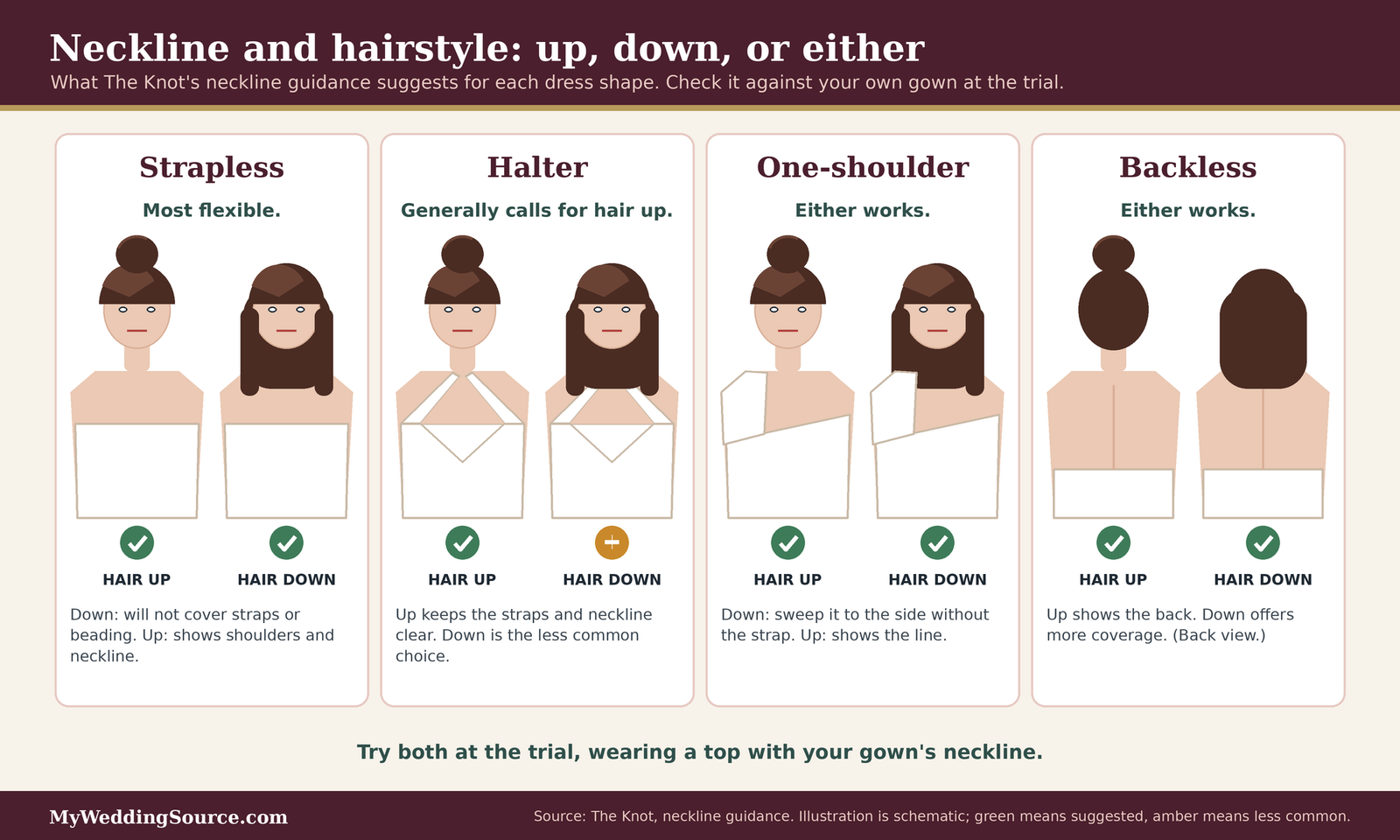
The Knot’s neckline guidance for wedding hairstyles is a good starting grid, and it is worth treating as a starting point and not a rule. The point is to decide what you want to show and what you want to cover, then check it against your own dress at the trial.
Strapless and halter necklines
According to The Knot, strapless gowns give the most flexibility: hair worn down will not cover straps or embellishments, and an updo shows off the shoulders and neckline. A glamorous wave or a half-up, half-down style also suits a strapless dress. Halter necklines, by contrast, generally call for hair up, since hair down would sit against the straps and crowd the neckline. If your halter has a detailed back or a closure you love, an updo also keeps it visible.
One-shoulder and backless necklines
For a one-shoulder gown, The Knot says either up or down can work, and that with hair down you should sweep it to the side without the strap. A backless gown also works either way: an updo shows the back, and hair down offers more coverage. We would add one practical note, which is our view and not a sourced fact. Hair that moves across a low back or a delicate fabric can catch on beading or closures, so check how your style behaves against the dress when you turn, sit, and hug.
Wear the neckline to the trial
The Knot recommends wearing a top with the same neckline as the gown to the trial, and in a separate guide suggests something that unbuttons so you do not pull it over your head and undo the style. Bring photos of the dress too, showing details and color. If your dress has a high collar, a lot of lace, or a dramatic back, a stylist who sees a picture of it can plan the style around it. Without it, you are guessing.
Pick the veil before the hairstyle
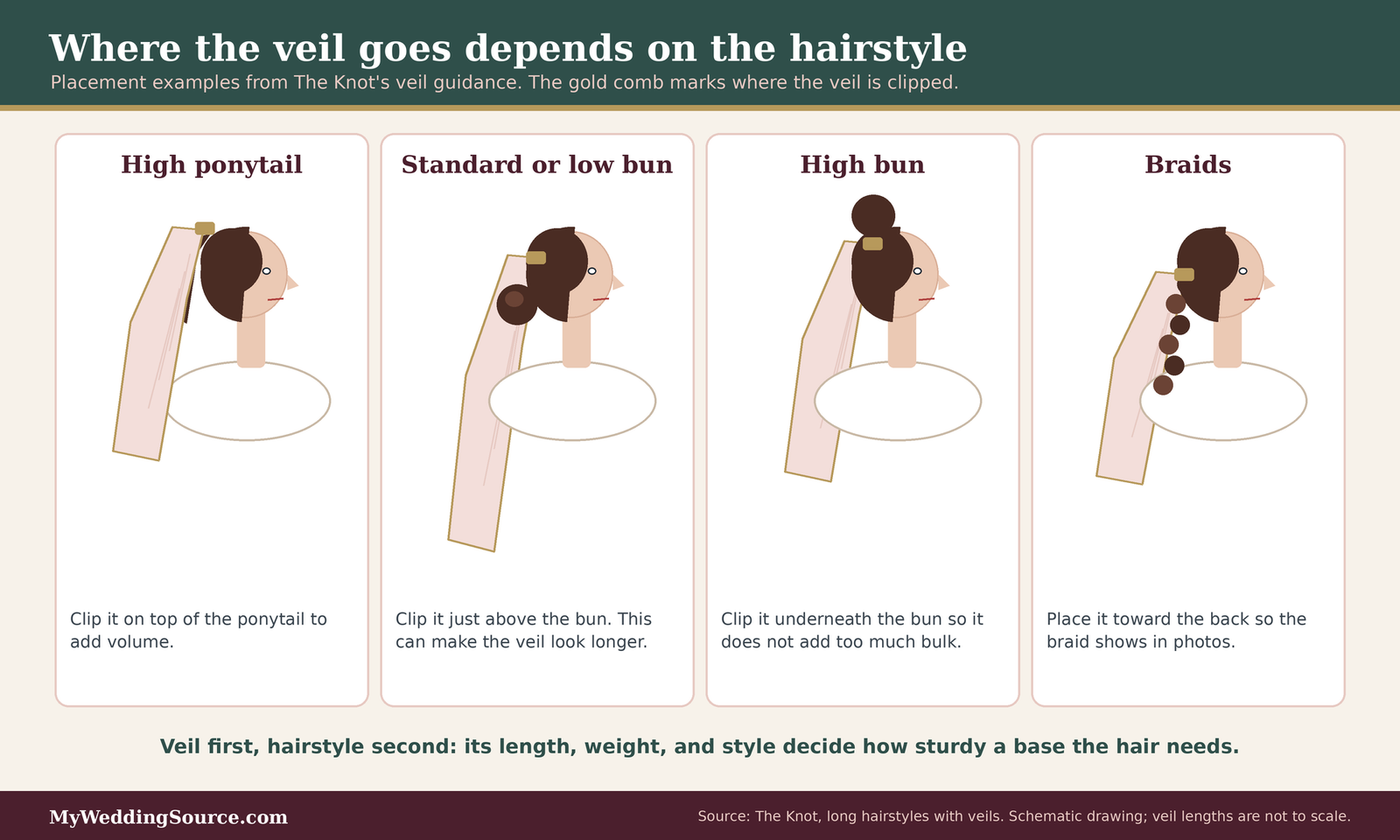
This is the most useful sequencing tip we found. The Knot’s veil guidance says to choose the veil before the hairstyle, because the length, weight, and style of the veil decide how sturdy a base the hair needs. A light, short veil sits on almost anything. A long, heavy one needs an anchor.
Length and weight set the base
A shorter veil, ending at the shoulders, elbows, or fingertips, changes how much of the hairstyle shows from behind. The Knot says longer and heavier veils need a more secure base, especially when they fan out on the floor, and that cathedral-length veils pair best with a full updo or textured braids that can hold their weight. If you love loose hair and a very long veil, ask your stylist how they will anchor the comb. Do not assume it will stay by itself.
Placement changes the silhouette
The Knot gives several placement examples, and they are a useful vocabulary for the conversation with your stylist. For a high ponytail, it suggests clipping the veil on top to add volume. For a standard or low bun, clip it just above the bun, which can make the veil look longer. For a high bun, clip it underneath so it does not add bulk. For braids, place it toward the back so the braid shows in photos. High placement reads as classic and voluminous, and low placement as more romantic and modern, so let the back of the dress guide the choice.
Over or under, and how it comes off
The Knot says a veil placed over an updo looks more formal, and one placed under looks more modern and lets the style stand out. It also notes that hair worn down needs a hidden foundation, such as light backcombing, concealed braids, or crossed bobby pins, so the comb does not slip. Because many people remove the veil after the ceremony, ask your stylist to do the trial both with and without it, so you know what the hair looks like afterward. Our guide to wedding tiaras and headpieces covers combs and crowns in more detail.
Keep accessories small and easy to remove
Accessories are optional, and The Knot describes them as mainly decorative or sentimental. They are also the part of a hair plan most likely to fail quietly: a clip that pinches, a headband that slips, a pin that shows. Keeping them modest makes the whole plan easier to carry out.
Match scale and metals to the rest of the look
The Knot advises keeping accessories small, in your color palette, and matched to your gown’s embellishments, and notes that if you skip the veil, an accessory can take its place. A useful test is to look at a photo of the full look and ask whether your eye goes to the face first. If the accessory competes with earrings, a necklace, or the veil, one of them has to give way. Our wedding jewelry guide walks through earrings and necklaces, which often decide how much the hair can carry.
Plan the order of what goes in and out
According to The Knot, accessories are often added after the veil comes out, usually after the ceremony. That means the hair should look finished both with the veil and without it, and that the accessory you add later should have a place to go. Ask your stylist where it will sit, how it attaches, and who will put it in. A bridesmaid or your mother can learn to place a comb in a few minutes at the trial, which saves a trip back to the stylist.
Do a comfort check
Zola’s guidance suggests wearing accessories or pulling your hair back for a while to check for pressure or headaches, and the same logic applies to any heavy clip, headband, or comb. A style that feels fine for ten minutes can start to ache after two hours. Wear everything you plan to use during the trial, and note when you first become aware of it. If the answer is within an hour, try a lighter option.
Schedule a realistic trial for your wedding hairstyles
A trial is the cheapest way to find out whether a plan works. It is also the only point at which changing your mind about wedding hairstyles costs little. The Knot says trials are not required but are recommended, and we agree. The value of a trial for wedding hairstyles is less in seeing a style once than in testing it the way the wedding will test it: for hours, in different light, with your dress, veil, and accessories.
Decide when to book and when to try
Timing advice for wedding hairstyles differs between sources, and the differences are small enough that you can reconcile them with a simple rule.
Book the stylist early for popular dates
Both The Knot and Zola suggest booking six to twelve months ahead. The Knot adds that during peak season, some artists offer trials only on weekdays, and that if you will wear the style to an event such as an engagement party or a rehearsal, you should schedule the trial within a week or two of it. Zola suggests booking a consultation early to learn pricing and ask questions. If your date is a popular Saturday, start asking early, and reserve the date once you have it.
Reconcile the trial timing advice
The Knot’s two articles give slightly different windows, two to three months before the wedding in one and one to three months in the other, with the reasoning that the trial should be close enough to reflect your final hair length and the season, yet early enough to rebook if it goes wrong. Zola suggests scheduling it about a month before. A sensible rule that fits all three is to schedule the trial after your last cut and color decisions are made, and no later than about a month before the wedding. If you choose a late trial, ask whether the stylist can fit a short follow-up.
Keep a pre-trial checklist
Arrive with clean, dry hair, without oils, heat styling, or product, unless you have paid for a wash or blowout, as The Knot advises. Bring your veil, accessories, and any extensions you will wear, photos of your dress, and your inspiration photos. Bring one trusted person, and keep the group small so the feedback stays manageable. Wear a top with your dress’s neckline. That list takes ten minutes to assemble and prevents most trial disappointments with wedding hairstyles.
Run the trial like a test
A trial of wedding hairstyles that lasts forty-five minutes and ends with a mirror selfie tells you almost nothing. The Knot says trials usually last one to three hours each, and that trying multiple looks takes extra time and costs more. Plan for enough time, and decide in advance what you want to learn.
Test the look for several hours
After the stylist finishes, do not go home and sit still. The Knot recommends photographing the look right away and again after a few hours. We recommend building the test around what will happen at the wedding. Walk outside, turn your head quickly, hug someone, sit in a car seat, and dance for a few songs in your kitchen. Then check what moved. If the style was meant to last through a ten-hour day, the three-hour mark is your first real reading, not the last.
Photograph it in daylight, flash, and indoor light
Take photos from the front, side, and back in daylight near a window, under warm indoor light, and with direct flash. The Knot suggests photographing in different lighting and sharing photos with one to three trusted people for feedback. Pay attention to the back and the sides, since those are the views you cannot see in a mirror. Flash can show flyaways and pin lines that daylight hides, and indoor light can change how color reads, so a style that looks even in daylight may look different at a reception.
Write the verdict while it is fresh
Right after the trial, write three lines: what you love, what you would change, and what worried you at the three-hour mark. The Knot suggests telling your artist what you liked and did not, and asking for tweaks. If you feel unsure, it says to consider a different artist or direction. A written note makes that conversation easier, and it gives your stylist the same instructions you gave yourself.
Use a trial matrix to keep the test honest
The table below is our own planning tool. It turns the trial into six checks, each with a condition to test and a correction to ask for. It is a worksheet, not a standard, and it uses the sourced guidance above where noted.
| Desired result | Condition to test | Photography check | Wear-time check | Correction to ask for |
|---|---|---|---|---|
| Secure through a long day | Turn, hug, sit in a car, dance for several songs | Back and side views in daylight | Photograph again after a few hours | More pins, a firmer base, or a lower style |
| Looks right with the dress | Wear the same neckline and bring dress photos | Front, side, and back with the neckline visible | Check at the end whether hair rubs on beading | Move the style up or down, or adjust the sweep |
| Works with the veil | Try it with and without the veil | Veil on and veil off, from behind | Check the comb after movement | Add a hidden anchor or change the placement |
| Comfortable | Wear the accessories and any added hair | Look for tension marks at the hairline | Note when you first notice pressure | Use a lighter accessory or loosen the base |
| Holds in the weather | Step outside in wind or humidity if you can | Outdoor photos near the venue’s light | Check frizz and flyaways after an hour | Add product or choose a more contained style |
| Looks like you | Ask two trusted people for honest feedback | Compare with your inspiration photos | Look again the next morning | Change the finish or the amount of volume |
How to read the matrix
If a row fails, do not assume the style is wrong. Often the correction is small, such as one more pin, a slightly lower placement, or a different product. If three or more rows fail in the same way, the choice among wedding hairstyles may be a poor match for your hair or the day, and it is worth discussing a different direction while there is still time to rebook.
Bring the matrix to the stylist
Hand the stylist the table at the start, or read the rows aloud. Most stylists welcome a clear brief, and it signals that you want a style that works, not only one that looks good in the chair. Ask them how they would handle each row, and note any answer that surprises you. A stylist who wants to talk through the failures is usually a good sign.
Plan for weather, venue, and the dance floor
Wedding hairstyles are judged by their worst hour, not their best. The best hour is the one in the chair. The worst might be a humid afternoon on a lawn, a gust across a rooftop, or the third hour of dancing. If you know your venue and season, you can plan for that hour in advance.
Heat and humidity
Humidity is the factor The Knot raises first when it discusses wedding hairstyles. It says that if your hair handles humidity well, you can wear it more freely, but that for most brides it does not, so a secure style is the safer choice.
Favor a secure structure when the air is damp
The Knot recommends updos, such as a sleek bun with glowy makeup, for humid weather, because they can hold up all day. It also notes that extensions, weaves, or clip-ins can add volume and cover most of your natural hair, which helps in humidity. Zola’s styling advice similarly suggests choosing a style that can handle heat and moisture for a spring or summer wedding. If your heart is set on loose hair in a humid place, ask for a trial in similar conditions, or ask the stylist what they would do to give it structure.
Use the heat index as a planning number
The National Weather Service explains that the heat index combines air temperature and relative humidity to show how hot it feels. Its example is that 96 degrees Fahrenheit with 65 percent relative humidity produces a heat index of 121 degrees. It also notes that the values assume shade and light wind, and that full sunshine can raise them by up to 15 degrees. For an outdoor ceremony in summer, check the heat index forecast for your date and place, not just the temperature. Our summer wedding heat plan looks at this from the guest side.
Protect the scalp and the part
Hair is also skin, so when you plan wedding hairstyles for an outdoor day, remember that the part line in particular is exposed. The Skin Cancer Foundation lists the scalp along the part line among the easy-to-miss areas for sunscreen, and advises reapplying about every two hours. If your ceremony is outdoors, ask your stylist how to apply sunscreen to the part without disturbing the style, and add that step to the touch-up plan. That is a health question as much as a styling one, and a dermatologist can advise on products for your skin.
Wind, rain, and cold
Heat is not the only weather that affects wedding hairstyles. Zola’s styling advice warns that snow, rain, and wind can change a hairstyle quickly, and suggests testing your look outdoors during the trial.
Test outdoors if the ceremony is outdoors
If you can, step outside during the trial and stand in whatever the day will bring: wind from a fan or an open door, damp air from a shower, or a cold car ride. Take photos and look for what moves. Our guides to garden wedding venues and beach wedding dresses discuss how open air affects other parts of the look, and the same logic applies to hair. A veil is an extra sail in wind, so ask how the comb will hold.
Plan for a cold-weather cover-up
If you will wear a wrap, hat, or scarf between the car and the ceremony, test it at the trial. For wedding hairstyles worn under a cover-up, the AAD notes that hats, head scarves, and coverings can rub the hair, especially when hair is pulled back tightly beneath them, and suggests silk or satin coverings, which are gentler. For a one-time wedding day this is a small concern, but it is a reason to test the cover-up and not discover on the day that it flattens the style. Our winter wedding weather plan covers the rest of the cold-weather checklist.
Pick the backup before the day, not during it
For each weather risk to your wedding hairstyles, decide in advance what you will do if it happens. If rain moves photos indoors, which style holds up better, and what if the veil is too heavy for a windy terrace? A backup does not need to be elaborate. It can be as simple as agreeing with your stylist that the veil will be pinned in a second place on the day if wind picks up, and that someone knows how.
The dance floor and the long day
Dancing is the test most people forget when they choose wedding hairstyles, and it is the one that most often undoes a style. We could not find a source that measures how long a style survives dancing, so what follows is our view, based on the planning logic above.
Test movement at the trial
Move the way you will move at the wedding. Dance for a few songs in the studio or at home, turn your head quickly, lean into a hug, and put your head back to laugh. Photograph again. If pins show or sections loosen, tell the stylist, since a few additional pins or a firmer base usually fixes it. Our guide to the wedding last dance may help you picture the end of the night.
Plan a mid-day change if you want one
The Knot says you can change your hairstyle between the ceremony and reception, especially with a dress change, and that going from down to up is the quickest change. Moving from a sleek, product-heavy updo to soft, loose hair, or from curly to straight, is very hard without washing the hair or using a wig. It suggests planning a change window of about thirty minutes and practicing the change at the preview. If you want a change, choose a simple one and rehearse it.
Decide when the veil comes off
The veil is easiest to remove right after the ceremony, with a stylist or helper nearby to unclip it carefully, which The Knot notes is trickier with loose or tendril-heavy styles. Decide who will do it, where, and what happens to the hair afterward. A wedding party member who attended the trial can learn the removal and the touch-up in a minute, and that is often the whole plan.
Build the wedding-morning schedule backward from the photo deadline
A trial tells you what wedding hairstyles will look like. A schedule tells you whether it will be finished in time. Most morning-of problems come from adding up the services incorrectly, forgetting transitions, or leaving no buffer before dressing. The fix, for any set of wedding hairstyles, is to start from the moment you must be ready and subtract.
Calculate service time for each person
Zola provides typical durations, and they are the best published starting point we found. They are estimates for planning, and your stylist’s own numbers should replace them.
Start from published durations
Zola reports that bridal hair takes about sixty to ninety minutes, though a simple low bun can take around twenty. Bridesmaid hair takes about thirty to forty-five minutes, and the mother of the bride or mother-in-law about thirty to forty-five minutes each. Groom and groomsmen hair takes about five to fifteen minutes. Intricate styles add time. Ask your stylist for their own numbers per person and write them down, since a stylist who works slowly or quickly will change the total.
Add setup, transitions, and travel
Services are not back to back. Zola notes that stylists often arrive earlier to set up, so ask when the stylist needs access to the room and power. Add a few minutes between clients to reset tools and change capes, and add travel time if you are leaving a hotel or home for the venue. The Knot adds that travel fees may be included in the bride’s hair cost, so ask about that when you collect the quote. We use a thirty-minute setup and a five-minute reset in the example below, and both are our assumptions.
One stylist or two
Zola says two stylists can finish a group in roughly half the time of one, and that asking stylists to bring assistants can save hours. The cost is higher, and The Knot reports extra artists at about $100 to $250 per hour per stylist. A second stylist can be a good trade if the wedding party is large or the photo deadline is early. For a small group, one stylist with a longer start may be cheaper and less stressful.
Add a buffer before you get dressed
The most common error is finishing the hair at the exact minute the photographer arrives. Dressing, adding the veil, and photographing the details take time, and anything that runs late comes out of that buffer.
Size the buffer by what can go wrong
Zola’s sample schedules leave about forty-five to ninety minutes of spillover and travel before the ceremony. Our view is that the buffer should grow with the number of services, the number of transitions, and whether anything depends on a delivery or a drive. A larger group, a longer drive, or a stylist you have not worked with before all point to the larger buffer.
Decide who goes first and who goes last
The usual approach, reflected in Zola’s examples, is to schedule the bride’s makeup last. For hair, the logic is similar, with the bride’s hair late enough that it is fresh and early enough that nothing is rushed. Put people with simpler styles or a long drive first, and keep the bride’s slot protected from running over. Tell everyone the order the night before so that nobody is still in a robe at the wrong time.
Work through a sample
The table below is an illustrative schedule for wedding hairstyles, not a rule. It assumes a first look at 2:30 p.m., one stylist, a bride, four bridesmaids, and one mother. It uses seventy-five minutes for the bride (the midpoint of Zola’s range), forty minutes for each other person (within Zola’s thirty to forty-five), thirty minutes for setup, five-minute resets, a thirty-minute buffer, forty-five minutes to dress and place the veil, and twenty minutes of travel. Those assumptions are ours.
| Time | Step | Minutes |
|---|---|---|
| 7:25 to 7:55 a.m. | Stylist setup | 30 |
| 7:55 to 8:35 a.m. | Bridesmaid 1 | 40 |
| 8:40 to 9:20 a.m. | Bridesmaid 2 | 40 |
| 9:25 to 10:05 a.m. | Bridesmaid 3 | 40 |
| 10:10 to 10:50 a.m. | Bridesmaid 4 | 40 |
| 10:55 to 11:35 a.m. | Mother | 40 |
| 11:40 a.m. to 12:55 p.m. | Bride | 75 |
| 12:55 to 1:25 p.m. | Buffer and touch-ups | 30 |
| 1:25 to 2:10 p.m. | Dress, veil, accessories | 45 |
| 2:10 to 2:30 p.m. | Travel to the first look | 20 |

With one stylist, the work starts at 7:25 a.m. for a 2:30 p.m. deadline. Zola says two stylists can finish a group in roughly half the time of one. If we split the six services as evenly as possible (the bride and two bridesmaids for one stylist, the other three people for the second), the longer chair runs 155 minutes plus two five-minute resets, and a 30-minute setup brings the total to about 195 minutes. The start then moves to about 9:40 a.m., roughly two hours and fifteen minutes later than with one stylist. That is our estimate, and the saving has to be weighed against the added cost. It also assumes makeup runs separately. Our guide to bridal makeup covers that side of the schedule, and our wedding vendor timeline shows where the beauty team fits into the rest of the day.
Coordinate clothing and accessories with the beauty plan
The last step is to make sure the getting-ready clothing, the dress, and the accessories do not undo the work. These are small details with large consequences.
Plan what everyone wears while getting ready
The Knot suggests wearing something that unbuttons for the trial, and the same logic applies on the wedding morning. A button-up shirt or robe avoids pulling anything over styled hair. Tell the wedding party the same thing and ask them to arrive with clean, dry hair, unless their package includes a wash, and with their own clips or accessories ready. Our wedding party attire guide and bridesmaid dresses guide cover the clothing side.
Dress with the veil and accessories planned
Decide who puts on the dress, the veil, and the accessories, and in what order. The Knot notes that accessories are often added after the veil comes out, so the veil goes in last and carefully. If your dress is zipped or buttoned over the head or shoulders, rehearse the sequence with the stylist at the trial or at a fitting. Our wedding dress alterations guide explains how fittings can be used to rehearse this.
Avoid last-minute product or color changes
Zola advises sticking to your usual color appointments in the six months before the wedding, and an expert quoted by The Knot suggests starting new treatments about six months ahead so you know how your skin and hair respond. The morning of the wedding is the wrong time to try a new dry shampoo, serum, or hairspray. If the stylist suggests a product you have not used, ask whether it was used at the trial, and decline it if not.
Prepare your hair in the final months and control risk in the final weeks
Good wedding hairstyles are made weeks and months before the wedding, by the cut, the color, and the care that come first. They are also protected by what you decide not to do. The advice below comes mainly from The Knot’s and Zola’s hair timelines, with health guidance from the AAD and the FDA.
Follow a simple timeline for cuts, color, and conditioning
A timeline turns scattered advice into a sequence. The versions below are the sources’ own recommendations, and where they differ slightly, we say so.
Cut timeline
The Knot suggests trimming every six to eight weeks to remove dead ends and reduce frizz, making your last cut about a month before the wedding, and keeping it to a light trim. Zola likewise recommends a trim about a month before and a light dusting of split ends about two weeks before if needed, and it advises doing nothing drastic in the two weeks before the wedding. If you want a short cut for the day, The Knot says to get it several months ahead so you can grow it back if you change your mind. Tell your stylist right away about any cut after the trial, since it can change how the style looks.
Color timeline
The Knot says to test any new color at least three months before, and to try bigger changes four to eight months out, since results sometimes take more than one session. Zola is more cautious, advising a major change at least six months ahead and routine coloring or a touch-up two to four weeks before the wedding. The two agree on the main point: do not try something new late. Check with your stylist before any major change, because lightening or removing color can change what the final style looks like.
Conditioning and the wash routine
For long hair, The Knot suggests a deep conditioning treatment once a week on the mid-lengths and ends, left on for fifteen to twenty minutes and rinsed with cold water. Zola suggests a clarifying shampoo about a week before the wedding to remove buildup, and cautions against putting conditioner on the scalp, which can make roots oily and hair flat. For the night before, The Knot says most hair types should be washed and air-dried, and that natural curls are washed the morning of the wedding. Ask your stylist which routine suits your plan.
Stop experimenting close to the wedding
The sourced guidance on wedding hairstyles here is consistent: the weeks before a wedding are for repeating what works. A new product, treatment, or tight style can create a problem you cannot fix in time.
Patch-test and respect reactions
The FDA advises doing a patch test on your skin every time before dyeing your hair, since sensitivity can develop with repeated exposure and formulas can change. It identifies PPD as the ingredient most often linked to allergic reactions, notes that a negative patch test does not guarantee you will not react, and says not to dye or relax hair if your scalp is irritated, sunburned, or damaged. If you react, the FDA says to contact your healthcare provider first. Follow the product’s own directions for how to patch-test.
Ask a professional about scalp and skin concerns
If you have itching, burning, pain, a rash, or hair that is breaking or falling out, make a dermatologist appointment well before the wedding. This is general information, not medical advice, and we cannot assess your scalp. Our view is that a medical question is not the same as a styling question, and that a stylist should not be asked to treat what a clinician should evaluate. If the answer changes your style plan, you will want to know early.
Watch for tension from tight styles
The AAD says traction alopecia is hair loss from tight or repeatedly pulling hairstyles and can be permanent if left untreated. It lists tightly pulled buns, ponytails, and updos, braids, and extensions among styles that can cause it when too tight, and warns of pain, a stinging scalp, crusts, or sections of scalp pulled up like a tent. It advises occasional tight styles are acceptable, but that you should change the style immediately if you feel pain. A secure style should be firm, not painful. Tell your stylist if you feel pulling.
Be careful with extensions and heavy accessories
The AAD also notes that extensions or weaves, especially on relaxed hair, can contribute to traction alopecia, and recommends wearing them for shorter periods, removing them promptly if they cause pain or irritation, and preferring sewn-in over glue-bonded versions. That matters for wedding hairstyles because added hair is a common way to get the volume a style needs. If you add it, try it at the trial, wear it for the full test, and plan when it comes out after the wedding.
Prepare touch-up and contingency supplies
A short, organized kit is better than a large one. Zola’s trial guidance suggests an emergency kit with lip color, blotting paper, and extra bobby pins, and it says to ask the stylist how they would keep the look fresh through the day and whether they recommend a touch-up plan. Our own list focuses on wedding hairstyles.
Assign who carries it
Choose one person to carry the kit and to know your style, ideally someone who attended the trial. Give them a list in your phone or on paper of what is in the kit, which pins and combs belong where, and who to call if something goes wrong. Ask your stylist whether they will stay for photos, and how much a longer stay costs. If they leave after the ceremony, the helper needs to be able to do the rest. Our wedding emergency kit guide covers the general kit.
Plan for humidity, tears, wind, heat, and veil removal
For each risk, write one line. For humidity, decide what product or technique your stylist recommends, and whether you will carry it. For tears, tissues and blotting paper are enough, and a gentle press does less damage to the style than a rub. For wind and heat, decide whether the style needs extra pins and where the sunscreen goes at the part. For veil removal, decide who unclips it. The Knot suggests practicing any mid-day change at the preview, which is a good habit for all of these.
Know what the stylist will and will not do on the day
Ask whether the stylist stays after the hair is done, whether touch-ups are included, how long they will be available, and whether they leave pins and spray with the helper. Ask what happens if they are ill, late, or delayed, and whether they have a backup. Put the answers in the contract, along with the arrival time, the number of people, and the services. A clear agreement is the best protection against a missed start.
What wedding hairstyles cost, and how to compare quotes
Cost is part of the plan for wedding hairstyles, not an afterthought. The numbers below come from The Knot’s published study and guidance. They are reported averages and ranges, not quotes for your area, and we label our own arithmetic as an estimate.
What this actually costs
The Knot’s study of couples married in 2025 (10,474 respondents) reports an average of about $150 for the bride’s hair and $150 for makeup, so about $300 for both, covering wedding-day services only, not trials or gratuity. The Knot says a combined hair and makeup trial typically adds $225 to $350, and elaborate updos, braids, or extensions can add $30 to $50. It suggests budgeting 15 to 25 percent of the final beauty total as a tip, after checking contracts for a built-in service fee. These are national averages. Your quote will depend on your region, stylist, and travel. Our wedding budget calculator can hold the line item while you collect quotes.
Read the reported numbers for what they measure
Two prices for wedding hairstyles that look similar can describe very different things, so it helps to know what a figure includes before comparing it with a quote.
What the averages include
The Knot reports that the hair average includes the stylist’s time and any travel fees if they come to the venue or hotel, and that hair is typically styled dry, so a blow-dry may cost extra. It also reports regional totals for the bride’s hair and makeup together: $360 in the Northeast and New England and in the Mid-Atlantic, $320 in the West, $290 in the South and Southeast, $280 in the Southwest, and $260 in the Midwest. About 72 percent of couples hired a wedding beauty professional. In a separate guide, The Knot gives a range of $150 to $400 per service for wedding-day hair or makeup, and trials of about $75 to $200 for a single service.
What the ranges leave out
Averages hide the extras. The Knot lists upcharges for elaborate updos, braids, or extensions of about $30 to $50, and extra artists at about $100 to $250 per hour per stylist. Bridal party hair averaged about $110 per member. Travel, early start fees, and a trial are often separate, and the guide notes that a quoted price may not include the trial unless stated. When you read any figure, ask whether it covers the trial, the tip, travel, and the veil placement, and whether it is a planned figure or a paid one.
Normalize your quotes before you compare them
Two stylists can quote very different totals for the same job because they include different things. A short method keeps the comparison fair.
Use the same five lines
For each quote, write down the same five numbers: the price for your hair on the wedding day, the price for each other person, the trial fee, travel and early-start fees, and any minimum or deposit. Then ask what the stylist includes in each, whether a blow-dry, accessories placement, and touch-ups are part of it, and what the cancellation and substitution terms are. With those lines side by side, the cheapest quote is often not the cheapest total.
A worked estimate, labeled as one
Here is an illustration. If a stylist charges the national average of $150 for the bride’s hair, adds $30 to $50 for an elaborate updo, and you tip 15 to 20 percent of that total, the cost is about $180 to $200 before the tip and about $207 to $240 with it, using The Knot’s figures and our arithmetic. Add a trial at $75 to $200 for hair only, and the bride’s hair could land between about $280 and $440. This is an estimate for illustration, not a quote, and real prices vary.
Questions to ask before you book
- Do you style weddings regularly, and can I see wedding work on hair like mine?
- What does the wedding-day price include: blow-dry, accessories, veil placement, touch-ups?
- Is the trial separate, and how long does it last?
- How long do you need per person, and do you bring assistants?
- How do you handle travel, early starts, and parking?
- What are your cancellation, substitution, and backup terms?
- Will you stay after the hair is done, and what do you charge for it?
Put the agreement in writing
A written agreement does not need to be long. It needs to say what will happen, when, and what it costs.
Confirm the details that decide the morning
The contract should state the date, arrival time, location, people and services, trial date, price, deposit, and the policy if either side cancels or something changes. Ask the stylist to confirm the arrival time and room needs in writing the week before. If you have a larger group, ask for the final per-person order in writing, too.
Keep the tip in the plan
The Knot says tips are not expected but are appreciated, with a common guideline of 15 to 20 percent of the overall fee in one guide and 15 to 25 percent of the final beauty total in another, and Zola’s contributors note that stylists often start very early, travel, and clean their kits. Check first whether the contract includes a service fee, since The Knot advises that. Our wedding etiquette guide covers the wider question of tipping.
Wedding hairstyles in the context of the whole day
Wedding hairstyles do not exist apart from the rest of the plan. It touches your photographs, your schedule, your clothing, and your budget, and the sections above link to guides for each of those. Here is how the pieces fit, and where to go next.
Connect hair to photography and lighting
Your photographer sees the style more than anyone, so involve them in the plan.
Share the plan with your photographer
Tell your photographer about your wedding hairstyles, including the veil change and any mid-day style change so they can schedule detail shots and portraits when the hair looks its best. Our wedding photographer shot list and wedding photography guide explain how to plan these requests. If flash photography is part of the evening, your trial flash photos are a preview.
Check the lighting where you will be
Lighting changes how hair color, shine, and texture appear, so it matters for wedding hairstyles. Our wedding lighting guide explains how venue lighting affects the look. If you can visit the venue at the same hour as the wedding, take a photo of yourself in the space, even without the full style.
Fit hair into the larger timeline
Wedding hairstyles are one of the first services of the day, so a delay at the start moves everything after it.
Place hair in the day’s schedule
Our wedding planning timeline shows where beauty bookings fall relative to other vendors, and our wedding planning checklist gives a longer view. Booking early, as The Knot and Zola advise, is the easiest way to protect your date.
Remember the week before
Our wedding week checklist covers the final days, including the things that should be done and the things that should not. For wedding hairstyles, the answer is usually to keep routine and avoid anything new.
Planning and trials
How far ahead should I book a stylist for wedding hairstyles?
The Knot and Zola both suggest six to twelve months ahead for popular dates. During peak season, some artists offer trials only on weekdays, according to The Knot. Ask about availability early, reserve your date once you have it, and put the arrival time, services, and trial date in writing.
When should I have my hair trial?
Sources differ slightly. The Knot suggests one to three months before the wedding, with one article saying two to three, and Zola suggests about a month before. A practical rule is to schedule it after your final cut and color decisions and no later than about a month out, so there is time to rebook if needed.
Choosing the style
Should my hair be up or down?
It depends on your neckline, veil, weather, and day length. The Knot suggests updos for humidity and notes that halter necklines generally call for hair up, while strapless and one-shoulder gowns work either way. Try both at the trial, with the dress neckline and veil, and photograph each from behind.
Do I choose the veil or the hairstyle first?
The Knot recommends choosing the veil first, because its length, weight, and style decide how secure a base the hair needs. Longer, heavier veils need a firmer anchor, and cathedral veils pair best with a full updo or textured braids. Ask your stylist to try the style with and without the veil.
Cost and timing
What do wedding hairstyles cost?
The Knot reports an average of about $150 for the bride’s hair for couples married in 2025, with combined hair and makeup near $300, excluding trials and tips. Elaborate updos, braids, or extensions can add $30 to $50. Prices vary by region and stylist, so collect written quotes and compare the same five lines.
How much should I tip a hairstylist?
The Knot says tips are not expected but are appreciated. One guide suggests 15 to 20 percent of the overall fee, and another suggests 15 to 25 percent of the final beauty total. Check your contract for a built-in service fee first, and ask how the stylist prefers to receive a tip.
Care and risk
When should I stop trying new hair products or treatments?
There is no universal date. Zola advises sticking to your usual color appointments in the six months before the wedding and keeping the final two weeks hands-off. The FDA advises a patch test before every hair dye. Ask a dermatologist about your own scalp, and avoid anything new in the final weeks.
Can a tight updo damage my hair?
The AAD says tight, repeatedly pulling styles, including tight updos, braids, and extensions, can cause traction alopecia, and that occasional tight styles are acceptable. Warning signs include pain, a stinging scalp, crusts, and scalp that looks pulled up. Tell your stylist if you feel pulling, and see a dermatologist about persistent symptoms.
Your next steps
Decide the brief
Write the three sentences
Write down how you want to feel, what your wedding hairstyles must survive, and what you want to be able to do without thinking about your hair. Share them with your stylist before the trial, and check the style against them at the end.
Choose the veil and the neckline first
Settle the veil and confirm the neckline, then ask for wedding hairstyles built your stylist to build the base around them. Our wedding planning guide can help you place this decision among the others.
Book and test
Reserve the stylist and the trial
Ask for written quotes for your wedding hairstyles using the same five lines, reserve your date, and put the trial one to three months before the wedding, after your last cut and color decisions. Bring the trial matrix.
Back-time the morning and name the helper
Use the sample schedule with your stylist’s own durations, add the buffer, and choose one person to carry the touch-up kit. If you are still choosing a date, our plan a wedding guide is a good place to start.
Next step if you are comparing options: Black Wedding Dress: What to Wear, What to Avoid, and How to Shop Smarter.
Sources & methodology
How we built this guide
What we relied on
This guide combines published planning guidance from The Knot and Zola on wedding hair, trials, timing, and costs; The Knot’s Real Weddings Study figures for couples married in 2025; dermatology guidance from the American Academy of Dermatology on tight hairstyles and traction alopecia; FDA guidance on hair dyes; National Weather Service information on the heat index; and Skin Cancer Foundation sunscreen guidance. Where a statement comes from a wedding publication, we say so, because those guides reflect editorial judgment and survey methods that differ. The sample schedule, the worked cost estimate, and the trial matrix are our own and are labeled as such.
What we did not do
We did not test styles, products, or stylists, and we did not survey stylists. We could not find a published source on how long a style lasts while dancing, so our guidance on that point is a recommendation. We also did not give medical advice. Scalp, skin, and hair health vary from person to person, so ask a board-certified dermatologist about symptoms, and ask your stylist about your own hair.
Source list
Government, clinical, and professional sources
- U.S. Food and Drug Administration, Hair dyes: https://www.fda.gov/cosmetics/cosmetic-products/hair-dyes
- American Academy of Dermatology Association, Hair loss: hairstyles and traction alopecia: https://www.aad.org/public/diseases/hair-loss/causes/hairstyles
- National Weather Service, Heat index: https://www.weather.gov/safety/heat-index
- Skin Cancer Foundation, All about sunscreen: https://www.skincancer.org/prevention/sun-protection/sunscreen/sunscreens-explained
Wedding industry sources
- The Knot, How to choose a wedding hairstyle: https://www.theknot.com/content/choosing-a-wedding-day-hairstyle
- The Knot, Working with a wedding hairstylist: https://www.theknot.com/content/working-with-a-wedding-hairstylist
- The Knot, Average cost of wedding hair and makeup (Real Weddings Study, 2025): https://theknot.com/content/average-cost-wedding-hair-makeup
- The Knot, Wedding hair care tips: https://www.theknot.com/content/wedding-hair-care-tips
- The Knot, Things no one tells you about wedding hair and makeup: https://www.theknot.com/content/things-no-one-tells-you-about-wedding-hair-and-makeup
- The Knot, Long hairstyles with veils: https://www.theknot.com/content/long-hairstyles-with-veils
- Zola, How long does wedding hair and makeup usually take: https://www.zola.com/expert-advice/how-long-does-wedding-hair-and-makeup-usually-take
- Zola, How to prepare for your wedding hair trial: https://www.zola.com/expert-advice/how-to-prepare-for-your-wedding-hair-trial
- Zola, The dos and don’ts of bridal hair styling: https://www.zola.com/expert-advice/the-dos-and-donts-to-bridal-hair-styling