

The cape vs veil question looks like a style choice, but on the day it behaves like an engineering problem: one piece catches wind, one piece covers the back of your dress, both need an anchor, and your ceremony layout decides which one gets in the way. This guide gives you a four-check test so you can decide with evidence instead of a mirror.
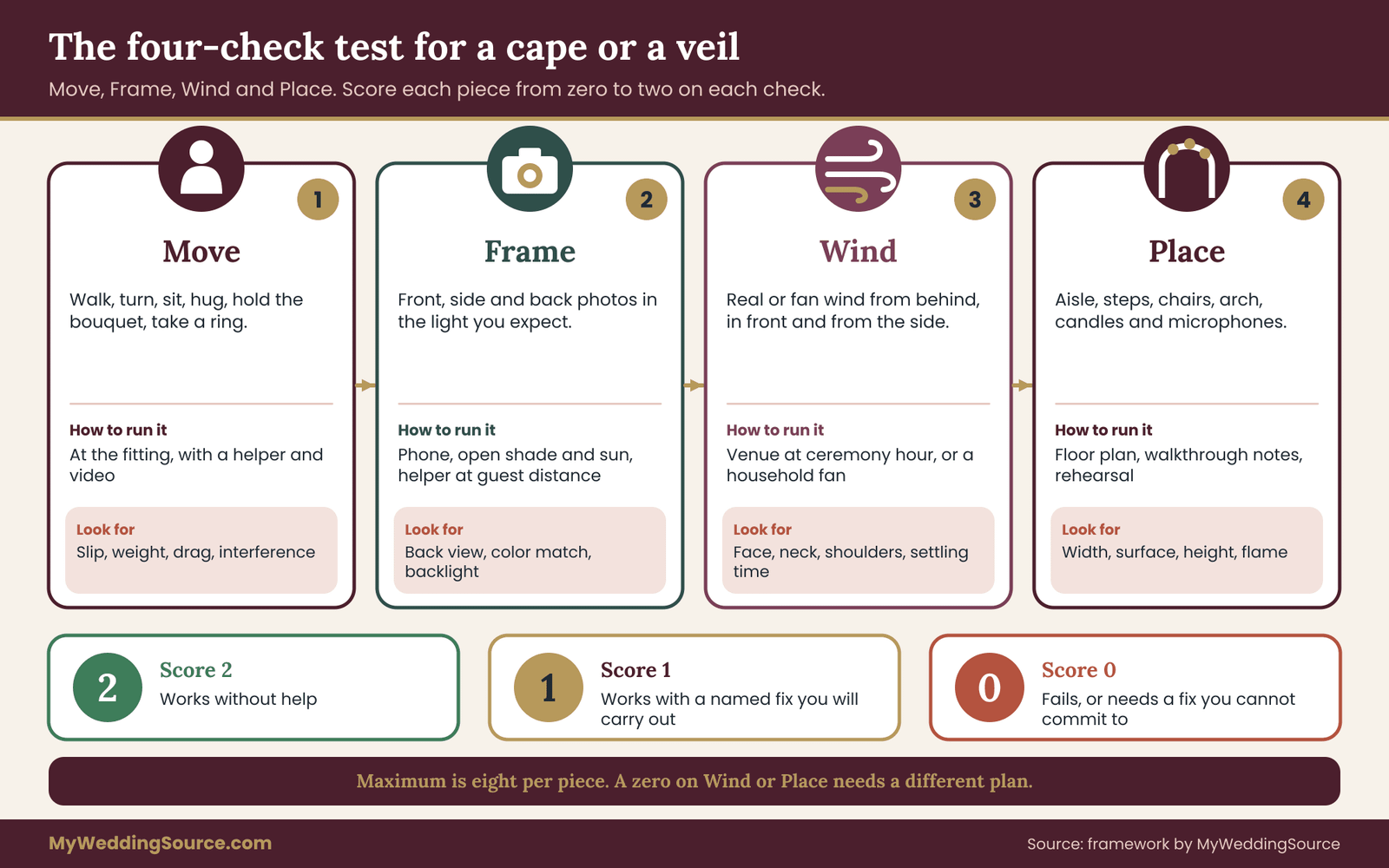
Decide the cape vs veil question by testing each piece four ways: Move (walking, turning, hugging, holding a bouquet), Frame (how it looks from the front, side and back in photos), Wind (what it does in a real breeze, from three directions) and Place (your aisle, steps, seating and altar). Score each piece from zero to two on each check. A zero on Wind or Place means that piece needs a different plan. If the scores are close, choose the piece that is easier to fix, remove or replace on the day.
Most advice about the cape vs veil choice stays at the level of mood. A veil is romantic, a cape is dramatic, and that is about as far as it goes. Mood matters, but it is the easy part. The hard part is that you will spend perhaps forty minutes in the ceremony and photo window with a large piece of fabric attached to your head or shoulders, in a place you do not control, while the weather and a crowd of people do things you cannot predict.
That is why this article treats the cape vs veil decision as a repeatable test rather than a verdict. We do not know your dress, your hair, your venue or your climate, so we cannot honestly tell you which one wins. What we can do is show you how to find out, and how to make the answer hold up when the wind picks up at four o’clock.
A note on scope. This is general information, not legal, tax or financial advice. Fabric, fit, hair and weather vary from person to person, so the final word on your own pieces belongs to your seamstress or tailor, your hairstylist and the venue. Where a rule or a safety point matters, the article points to the agency or professional who owns it.
If you are still choosing every accessory for the day, the wedding day accessories planning guide covers the whole set, from jewelry to shoes to backups. This article stays on one decision inside that set: the cape vs veil choice, with both and neither as allowed answers.
What the Cape vs Veil Choice Really Decides
Before any testing, it helps to see how much rides on the cape vs veil decision. A veil or a cape changes four things at once, and each one touches a different person on your team.
It changes your silhouette from every angle. The front view in a doorway, the side view on the aisle, and the back view that every guest sees for most of the ceremony. A cape adds width at the shoulders and length down the back. A veil adds a vertical line from the head and, depending on its length, a soft layer over the back of the dress.
It changes what your dress shows. A cape can frame a beautiful dress or hide the best part of it. A sheer veil can soften a back or hide a seam that you would rather not photograph. If the back of your dress carries the design, whether buttons, beading, lace or an open neckline, this is the first question to settle.
It changes your hair and head. A veil needs a secure anchor in your hair or on a headpiece. A cape, particularly one that ties or clasps at the neck, needs space and a collar line that does not fight your hairstyle or necklace. Your hairstylist has a vote here, and so does anyone who will need to put their hands near your head after the ceremony.
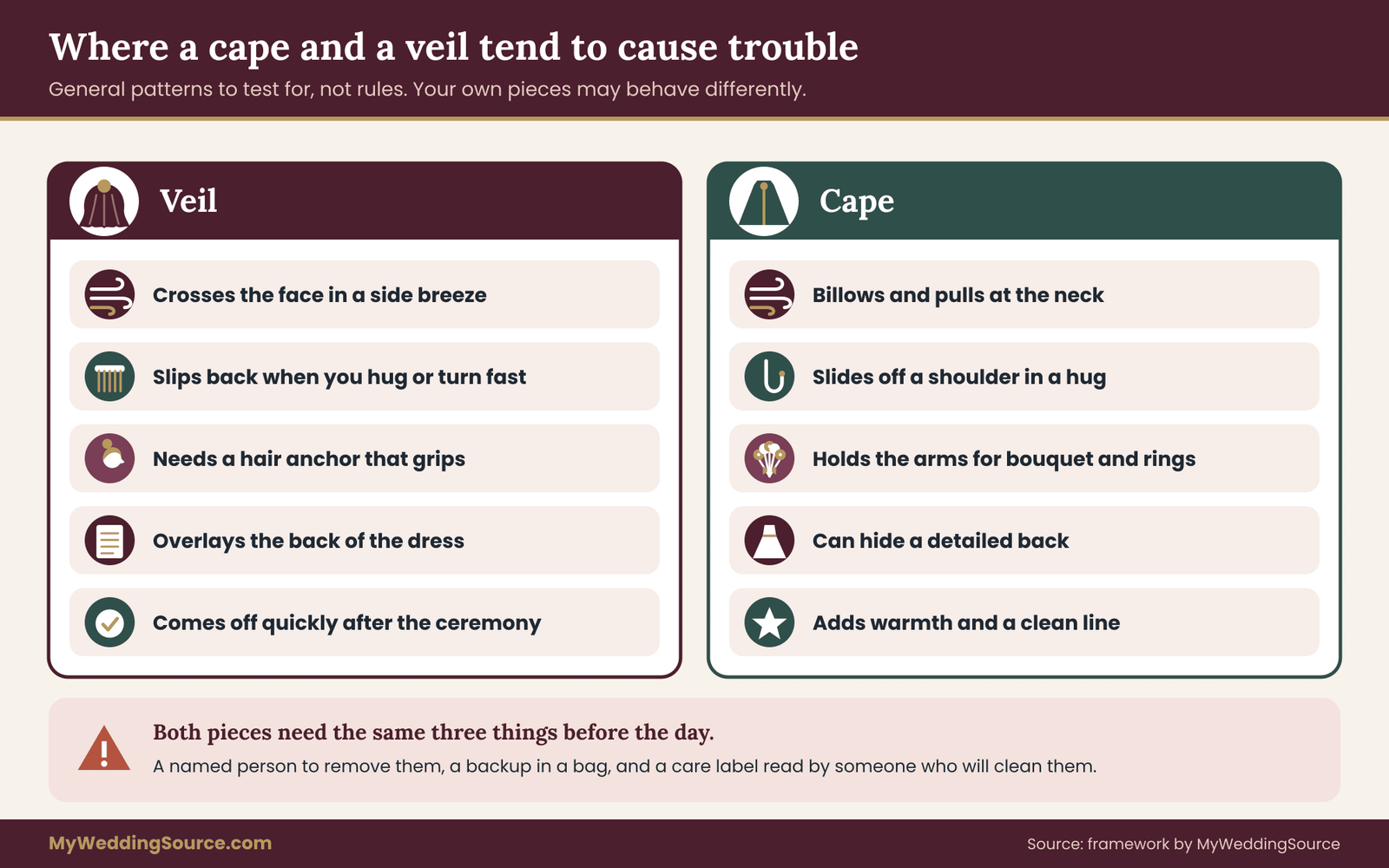
It changes how you move. A veil that rises in the wind can drag across your face and mouth during the vows. A cape can slip off the shoulders when you hug, trap your arms during the ring exchange, or wrap around your legs in a gust. Neither problem is dramatic, and both are visible.
Seeing these four effects separately makes cape vs veil trade-offs easier. A cape that wins on silhouette but fails on movement is not a bad cape. It is a cape that belongs to a different part of the day, and the plan can say so.
Why a Cape vs Veil Test Beats a Preference
Preference tells you what you hope for. A test tells you what happens. The two often disagree, and the gap is where most wedding-day accessory regrets live.
Consider a plain cape vs veil example. You love the look of a long, soft veil. In the salon, in front of a mirror, standing still, the veil is perfect. Outdoors, on the lawn where you will marry, a light breeze lifts the edge and lays the tulle across your shoulder. You can live with that in photos.
But in the same breeze, your hand goes up to move it twice in a minute, and the person behind you in the processional has to dodge it. A test would have shown you that in ten minutes, and the fix (a shorter length, a second comb, a different hairstyle) could have been settled weeks earlier.
The reverse is also true. People sometimes rule out a cape because they imagine it as heavy and costume-like, then try a light chiffon cape in motion and find that it moves more gracefully than any veil they tried. A cape vs veil test protects you from your assumptions in both directions.
Cape, Capelet, Cape Veil and Veil: The Terms
Shops, designers and stylists use these words loosely, and a cape vs veil conversation goes wrong quickly when each person means something different, so clarify them early. If you ask a salon for “a cape” and they bring you a pair of different pieces, you will waste a fitting.
Veil. A piece of tulle, lace-edged net or similar fabric attached to the hair or a headpiece. Common lengths run from a short blusher or birdcage style that stays near the face, through shoulder and elbow lengths, to fingertip, waltz, chapel and cathedral lengths that reach the floor or trail behind. Veils can be single-tier or layered, plain-edged or trimmed with lace, beads or thread.
Cape. A separate garment worn over the shoulders and back, usually open at the front, that hangs from the neck or shoulders and moves independently of the dress. Lengths range from just past the shoulders to floor length or longer. It may tie, hook or clasp at the neck.
Capelet. A shorter, shoulder-covering piece, often finished at the upper arm or the bust line. It is closer to a shrug in function and usually much easier to wear in motion.
Cape veil (or cape-style veil). A veil with an attached shoulder or back panel that sits at the shoulders. It sits between the two categories and is sometimes the compromise people reach for. We treat it as a veil with cape features, and the tests below apply to it twice: once as a veil, once as a cape.
Cape sleeves and dress capes. Some gowns have an attached cape layer built into the dress. That is part of the dress, not an accessory you can choose, and it belongs in your dress fitting rather than in this decision.
A short vocabulary exercise helps here. Write down exactly which piece you mean, its length and its fabric, and keep that description with you for every appointment. “Floor-length tulle cape that ties at the neck” is a useful description. “A cape” is not.
The pieces that do not fit neatly
Wraps, shawls, bolero jackets and fur-style stoles solve the same practical problem as a cape, which is warmth or coverage, but they behave differently. A wrap sits on the arms and is easier to take off. A bolero stays on because it has sleeves. They are not the focus here, but they appear again as backup options, and the test works on them without changes.
How to Run the Cape vs Veil Test
The cape vs veil test has four checks, run in a fixed order. The order matters because the early checks are cheap and the later ones need a venue or weather.
Check one: Move. You can do this at home or in the salon in thirty minutes. It tests walking, turning, sitting, hugging, holding a bouquet and handling a ring.
Check two: Frame. You need a phone, a helper and decent light. It tests how each piece looks in photos from the front, side and back, and how it interacts with the dress, the hair and the background.
Check three: Wind. You need either the real venue at a similar time of day, a fan, or both. It tests what each piece does in moving air and from which direction it causes trouble.
Check four: Place. You need a plan of your ceremony layout, ideally from the venue walkthrough. It tests the aisle, steps, chairs, altar, officiant position, microphones and any candle or ritual objects against each piece.
Each check is scored per piece, so a cape and a veil are scored separately. If you are considering two specific veils or two capes, treat each as its own candidate. The scale is deliberately blunt.
Score 2: It works without help. You do not need a fix and you would not worry about it on the day.
Score 1: It works with a named fix that you have actually decided to carry out. A fix is a specific thing, such as a second comb, a hem weight, a shorter length or a hook at the neckline. “Be careful” is not a fix.
Score 0: It fails, or it needs a fix you have not committed to or cannot test before the wedding.
The maximum for any piece is eight. We will return to how to read the totals later, in the section on scoring the decision. For now, notice what the scale does. It forces every worry into a named fix with an owner, and it stops you from carrying vague unease into the wedding day.
Who Should Help You Run the Cape vs Veil Test
Do not run the test alone. You cannot see your own back, and you will be too close to the piece to judge it. Bring one person who will be honest, ideally the person who will help you dress on the day. If your seamstress or tailor is available for the Move check, take advantage of it, because they can often make a fix on the spot with a pin. If your hairstylist is doing a trial, ask them to look at the Wind and anchoring questions with the actual veil attached.
The bridal hair and makeup planning guide explains how to organize the trial itself, and the dress fit and alterations guide covers fitting timelines. Both help you schedule the cape vs veil test around appointments you probably already have.
What to record
Keep a short log. For each check and each piece, write the score, the reason in one sentence, and the fix if there is one. A page per piece is plenty. This log is the main deliverable of the cape vs veil test. It lets your stylist, seamstress and photographer see the same facts you see, and it lets you stop reopening the decision every time someone offers an opinion.
“Veil, Wind check: lifts across the face from the left at the lawn. Score 1. Fix: second comb and elbow length. Owner: stylist, confirm at trial.”
A line like that costs thirty seconds to write and saves a conversation later.
Move: Walking, Turning and Hugging in a Cape vs Veil
The Move check is the most forgiving part of any cape vs veil test, because you can repeat it as often as you like. It is also the one most people skip, because standing in front of a mirror feels like testing. It is not. A mirror shows a still image. Your wedding is a sequence of movements, and each one stresses a different part of the piece.
Set aside thirty minutes in your final or near-final fitting for the cape vs veil circuit, with the dress, shoes, hair piece and any jewelry you plan to wear. Run the following circuit for each candidate, with a helper watching and a phone recording video. Video is better than still photos here, because a snag or a slip often lasts one second.
- Stand and turn. A slow full turn, then a quick turn to look behind you. Watch where the piece swings and whether it settles or keeps moving.
- Walk at ceremony pace. The processional is slower than normal walking. Walk the length of a hallway at that pace for a full minute. Pieces that look fine at normal speed sometimes lag or twist at slow speed because they never build momentum.
- Stop and start. Photographers ask for pauses. Stop abruptly, then start again. A long veil or cape will keep moving for a moment after you stop.
- Climb and descend stairs. Use real stairs, not one step. Hold your bouquet. See whether you can see your feet, whether the piece catches under your heel, and whether you need a hand free to manage it.
- Sit and stand. Sit on a standard chair, as you might at a signing table, and stand again. A cape bunches behind you. A long veil can end up under your seat.
- Hug a taller person and a shorter one. This is the test people forget. A hug pulls on a cape at the neckline and pushes a veil against a shoulder or a comb. Do it with the person who will hug you first on the day.
- Hold the bouquet, then hand it off. Pass the bouquet to a helper and take it back. Note whether the cape holds your arms or sleeves, and whether the veil brushes the bouquet.
- Practice the ring exchange. Hold out your hand. Take a ring. Watch your sleeves, the cape’s armholes and the edge of the veil.
- Get into and out of a car. Sit, swing your legs, stand. This tests both pieces against a door frame and a seat belt.
- Dance two songs. If you plan a first dance in the same accessory, spin once and dip once. If you will remove the piece before dancing, skip this step and write that decision down.
Reading the Move Results for a Cape vs Veil Choice
Do not judge each step as pass or fail. Look for patterns. If the piece slips in three of the ten steps, ask what those steps have in common. The common cause is usually one of four things.
Weight. A heavy piece pulls on its anchor. For a veil, that means a comb that slides back or a headband that tilts. For a cape, it means the neckline pulling backward and choking you slightly while you walk. Weight can be fixed by shortening, swapping fabric or changing the anchor.
Slip. The piece does not grip what it sits on. Satin capes on satin dresses are classic sliders, and so are smooth combs in fine, silky hair. A fix is usually a grip surface, such as a tiny hook, a stitched loop, a ribbon tie or a stylist’s pin pattern.
Drag. The piece trails and catches. Long veils and floor-length capes collect on stairs, chair legs and grass. Drag fixes involve length, a loop that lifts the piece, or a helper whose job is to manage it.
Interference. The piece fights something else you are wearing. A cape clasp rubbing a necklace, a veil comb catching a hair clip, or a cape’s neck tie sitting right where a lavalier microphone pack would clip.
Naming the cause matters because it tells you who can fix it. Weight and drag usually go to the seamstress. Slip often goes to the seamstress or stylist, depending on where it happens. Interference tends to be solved by editing what else you wear.
Move Tendencies in the Cape vs Veil Choice
These are general patterns, and your own pieces may differ.
A veil tends to do well on Move when it is light, single-tier and anchored securely. It tends to do poorly when it is long, layered or heavily embellished, because the extra weight pulls on the comb, and when it is anchored in loose or very fine hair. The most common veil movement problems are slipping backward during a hug, tangling with the bouquet and shifting when the head turns quickly.
A cape tends to do well on Move when it is cut to hang cleanly from the shoulders, sits in a fabric with a little grip and has a closure that is secure but quick to open. It tends to do poorly when it is long and wide, when it has no closure and relies on the shoulders alone, and when the fabric is slippery. The most common cape movement problems are sliding off one shoulder, pulling at the neck and restricting the arms.
A cape also changes how you use your arms. You may need to lift it slightly to hold a bouquet, to hug someone or to take a ring. If the cape has armholes or slits, test them with your actual sleeves. If it is an open cape, find out whether it stays on your shoulders when your arms are forward.
“Please watch the cape at my shoulders when I hug you. Tell me if it slides, even a little.”
Give your helper a request like that. It turns a vague observation into one specific job.
Frame: How the Cape vs Veil Choice Looks on Camera
Photographs fix your accessories in place for decades, and a few specific effects are worth checking before the wedding, not in the gallery afterward. The Frame check for a cape vs veil choice is about three views: front, side and back. Add a fourth, the movement shot, if your photographer will take it.
A note on what we can and cannot say. We do not know your photographer’s style, lighting or the images you want, so the best approach to the cape vs veil question is to test with your own phone and then ask the photographer. A photographer with years of ceremony experience has seen how both pieces behave in light, and a five-minute conversation can save you a surprise.
The front view
The front view is how people see you in the doorway, during a first look and in portraits. Here the cape vs veil difference is mostly about the neckline and face.
A veil worn down, as a blusher, covers the face and changes how the first look and the lifting moment work. A veil worn back frames the head and, depending on length, falls past the shoulders. A cape, in contrast, frames the neck, the shoulders and the upper chest. If your necklace, your neckline or your collarbones matter to you, a cape may hide them.
Test this with a photo. Stand in the light you expect on the day, and take a front photo with each piece. Compare what you notice first.
The back view
The back view deserves more attention than it usually gets. During most ceremonies, your guests see your back for the majority of the time. In the cape vs veil comparison, ask yourself what they will see.
If your dress has a design at the back, such as buttons, a low neckline, lace or beading, a cape either hides it or frames it. A cape in sheer tulle or lace may do both, softening the detail while keeping it visible. An opaque cape hides it entirely. A fingertip or longer veil in sheer tulle can overlay the back but also create a visible line across it, so check where the veil’s edge falls on the back of the dress.
If your dress is plain at the back, a cape or a long veil may add the interest the dress lacks, and a cape can add a clean, dramatic line.
Take the back photo with the helper standing where a guest would, about the distance of the first few rows. A photo from three feet away shows detail that no guest will see, and a photo from fifty feet hides detail that the photographer will capture. The most useful distance is the one that matches your ceremony.
The side view
The side view matters for the aisle and for the recessional. Here the accessory’s volume is the question. A cape adds width at the shoulders, which looks strong from the front and can feel heavy from the side. A veil adds depth behind you. A long veil’s edge may flare out at the sides while you walk.
Color, Texture and Light in a Cape vs Veil Photo
White, ivory, champagne and blush are different colors, and they photograph differently from how they look indoors. A veil that matched your dress under salon lights may look gray or yellow in daylight, particularly if the dress is a different dye lot or fabric. Tulle, chiffon, lace and satin each take light differently. Satin reflects, lace scatters, tulle often appears lighter than it is, and chiffon can look transparent in backlight.
Test the colors next to each other, and test them in the light you will use. Take photos in open shade, in direct sun, and under any indoor lighting you expect, with and without flash, if your photographer uses flash. Check that the veil, cape and dress match to your eye in each photo.
Backlight and transparency
Sheer fabrics in backlight can glow beautifully or turn into a smudge. A veil with a lace edge may produce a lovely halo in low sun. A chiffon cape may become transparent and reveal the dress beneath it, which may be the effect you want or may be a surprise. Ask your photographer how they handle backlit scenes, and look at their past work for veils and capes in low light. Do not ask them to promise results. Ask what they would do.
Photographer Questions About the Cape vs Veil Plan
Bring the photographer into the cape vs veil decision with a short list of questions.
- Which of these two would you be able to shoot more reliably in our ceremony light?
- Do you want me to remove either piece for portraits, and at what point?
- Will you need a few minutes for veil or cape detail photos, and when?
- If we use both, do you prefer a specific order for removing them?
- Do you need an assistant for arranging the piece, or will someone in my party do it?
A photographer who answers these concretely is telling you how they work. If they say they have no preference, ask them to review your test photos and tell you what they see.
For couples who want written boundaries on photography, our guide on wedding photography consent covers guest rules and image use, which is a separate topic from accessories but part of the same photographer conversation.
Scoring the Frame Check for Each Cape vs Veil Candidate
Score a piece two when it looks right from the front, side and back, in the light you expect, and its color matches your dress. Score it one when it works with a fix, such as removing the cape after the processional, swapping to a veil one shade lighter, or asking the photographer to remove the veil for portraits. Score it zero when it hides or fights something you care about and the fix, such as never wearing it in photos, defeats the purpose of having it.
One quiet rule: do not give a piece a high Frame score because it looks good in one photo. Look at the worst photo of the set, not the best. The worst photo tells you what happens when the piece is not perfectly arranged, and that is the one that matters in a crowded ceremony.
Wind: Cape vs Veil on an Open Site
Wind is the check that most often reverses a cape vs veil decision, and it is the one you cannot fully control. The aim of a cape vs veil wind test is not to find a piece that ignores wind. No light fabric does. The aim is to know what each piece does in moving air, from which direction it causes trouble, and whether you have a fix or a backup ready.
Start with a simple fact about wind and fabric. Light fabric reacts to air movement at speeds much lower than people expect. The National Weather Service describes the Beaufort wind scale in terms of what wind does to everyday objects, and the lower and middle steps of that scale describe loose paper moving, leaves rustling and small branches swaying. A veil is lighter than paper in many cases and has far more surface area than a leaf. The day you describe as “a little breezy” is often a day that your veil will notice.
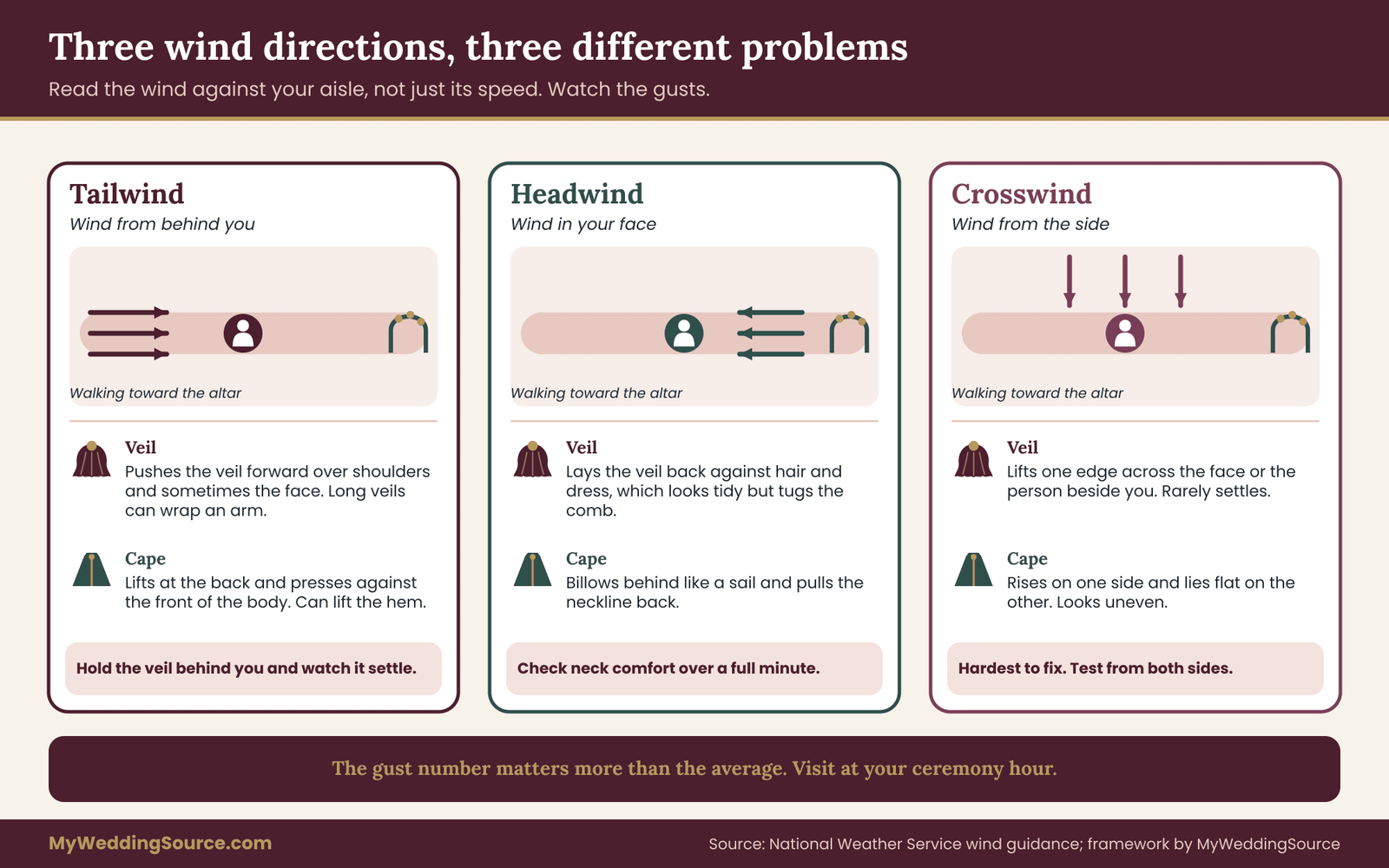
Check the forecast for your wedding date from the agency that issues it, not from an app summary. The National Weather Service forecast for your venue’s location gives wind speed and gusts, and often a direction. The gust number is the one to watch, and in a cape vs veil comparison it usually matters more than the average speed. A steady breeze that your veil handles well can still come with gusts that lift it sharply.
Three wind directions, three different problems
Wind relative to your aisle matters as much as its speed. For a fair cape vs veil comparison, walk the aisle in your head, or better, in person, and picture the wind arriving from each of three directions.
Tailwind (from behind you). The wind pushes toward the altar. A veil or cape is pushed forward, around your shoulders and potentially across your face and arms. A long veil may wrap around you or fly over your head. A cape is pushed against the front of your body and can lift at the back. This direction is often the most disruptive for the processional, because the piece is trying to travel in the same direction you are.
Headwind (from in front of you). The wind pushes against you. A veil lies back against the dress and hair, which usually looks tidy, though it can pull on the comb. A cape billows behind you, catching air like a sail, which pulls on the neckline. A headwind can be flattering in photos and tiring at the neck.
Crosswind (from the side). The wind lifts one side of a veil or cape. A veil may drift across your face from one side. A cape rises on one side and lies flat on the other, which often looks uneven. Crosswinds are the hardest to fix, because the piece never settles into a consistent position, and your officiant, partner or bouquet may be affected.
Your ceremony may also have wind that shifts as you move. An aisle that runs between a building and a tree line may be calm at the entrance and breezy at the altar. A lawn that opens onto water may channel wind straight across the front rows. Walking the venue at a similar time of day tells you far more than a general forecast.
How to Test Wind for a Cape vs Veil Choice Without Waiting for the Wedding
You can test wind in three ways, and each has limits.
At the venue, at the right hour. This is the most useful test. If your ceremony is at four in the afternoon, visit at four. Bring the veil or a similar piece of tulle, and have someone hold it as you stand where you will stand. Watch the direction and strength of the breeze for at least ten minutes. Take notes about gusts. If you can do this on two different days, better.
With a household fan. A fan is a rough test, not a faithful one. Set it at a distance and use it to see how each piece moves. A fan gives you a steady stream, which is unlike real wind, so use it only for the cape vs veil comparison, not as a verdict. Ask a helper to move the fan to your front, back and side. Check whether the veil reaches your face from any direction, whether the cape lifts from the shoulders and whether the piece settles back quickly when the fan stops.
With a long hallway or doorway. Open both ends of a hallway on a breezy day, and stand in the moving air. This is the least precise but sometimes the most available.
What to Watch for in a Cape vs Veil Wind Test
When you test, look for specific behaviors, not general impressions.
- Does the veil cross your face, and from which direction?
- Does the veil wrap around your arms or bouquet?
- Does the veil lift enough to reveal or snag on the back of the dress?
- Does the comb or anchor move, even slightly?
- Does the cape rise from the shoulders and expose the dress?
- Does the cape billow enough to pull at your neck?
- Does either piece reach another person, such as the person beside you at the altar?
- How long does each piece take to settle after a gust?
Record each behavior with the direction and rough strength of the wind. “Veil crosses face from the left in a medium gust” is far more useful than “veil is breezy.”
Wind Fixes for Cape vs Veil Problems, Ranked by Reversibility
Most wind fixes fall into a few categories. We list them from the least permanent to the most permanent, because you should try the reversible fixes first.
Reposition the piece. A veil can be anchored lower, nearer the nape of the neck, or higher, near the crown. A lower anchor often holds better in wind and sits under a bun, and a higher anchor suits an updo and looks more traditional. A cape can sit slightly forward on the shoulders so that it catches less air. This costs nothing but requires a hair or dressing change.
Add anchoring. A second comb on a veil, with the stylist pinning both into the hair, spreads the load. A pin discreetly secured through the veil and the hair, at the stylist’s discretion, adds grip. A cape can have an extra hook or a hidden snap, placed by a seamstress, so it stays at the shoulder. These are small, local fixes.
Add weight at the edge. Some seamstresses add small weights to the hem of a cape or the edge of a veil. The principle is simple: a slightly heavier edge falls faster after a gust. Ask a professional whether this suits your fabric. Weights that are wrong for a fine tulle can distort it, and a heavy weight on a delicate lace is a poor idea.
Shorten the piece. A shorter veil, such as elbow or shoulder length, catches much less wind than a cathedral veil. A shorter cape or a capelet catches less than a floor-length cape. Shortening may involve cutting, which is permanent, so confirm the length first with a test piece or a loaner.
Change the piece. If the fix needs to be so large that the piece no longer looks like what you wanted, change it. Switch from a cape to a capelet or from a long veil to a short one, or use a different fabric, such as a heavier crepe instead of chiffon.
Plan to remove it. Many couples decide in advance that the piece will come off after a specific moment. A veil may come off after the ceremony and photos. A cape may come off after the processional. This is a legitimate fix as long as you decide the moment and the person who handles it, and as long as the piece does not matter for later photos.
Cost Logic for Wind Fixes in a Cape vs Veil Plan
Fixes cost money and time, and it is worth thinking through the numbers. We are not giving prices, because they vary by region and by shop. Instead, ask for quotes and compare them to the cost of a replacement piece.
A good rule: if the combined cost of the fixes comes close to the price of a different piece that scores higher on the test, buy the different piece. A fix that costs more than the problem is not a fix. This applies particularly to bespoke alterations on lace and beaded fabric, where the labor can be substantial.
Also consider the lead time. Alterations need weeks, and weather-specific fixes need a test in real conditions. A fix that you can only confirm on the wedding day carries a risk. Prefer fixes that you can verify before the wedding.
A Cape vs Veil Wind Backup Plan in Three Lines
Write a three-line wind plan and share it with the people who need it.
- Trigger. The wind condition that changes the plan, stated in plain words, such as “if the morning forecast shows strong gusts, or if the veil crosses my face twice in a minute at the venue.”
- Action. What you will do instead, such as “switch to the elbow-length veil” or “leave the cape in the car and wear the wrap for photos only.”
- Owner. The person who makes it happen, with the spare piece and any pins in their bag.
Having a trigger and an owner converts a stressful decision into a task. For more on building backup kits that match this plan, the section on emergency backups and who carries the kit in our accessories guide explains what to pack.
Scoring the Wind Check
The Wind score often settles the cape vs veil question outright.
Score a piece two when it stays put or settles quickly in real wind from all three directions, and you did not need a special fix. Score it one when it works with a fix you have named and tested, or when the plan involves removing it at a set time. Score it zero if it fails from any direction at the venue’s usual wind, and the fix is a prayer. If your ceremony is fully indoors with no open doors, the Wind check can score a two for both pieces by default, but test for indoor air, as the next section explains.
Indoor air is still air
Indoor ceremonies sound safe from wind, but several indoor sources of moving air catch light fabric. Air conditioning vents and heating registers often blow onto the aisle or altar. Ceiling fans may run during the ceremony, particularly in summer venues. Doors at the back of the room open and close, producing a draft along the aisle just as you enter. Outdoor-to-indoor transitions, such as a pergola by a doorway, can funnel air.
At the walkthrough, ask the venue manager where the vents are and whether the fans and cooling can be turned off or reduced during the ceremony. Venue staff often can, and a quick request is easier than a fix to your veil. The venue technical walkthrough guide explains what else to measure and confirm during that visit.
Hairstyles: What Each Piece Needs From Your Hair
Hair is the quiet partner in the cape vs veil decision. A veil depends on your hair for its entire attachment. A cape depends on it far less, but the two interact at the neck and shoulders, where hair, necklace, collar and cape tie all compete for the same few inches. If you settle the hairstyle first and the cape vs veil question second, you will often find the decision has been made for you. If you settle the accessories first, you may find that the hairstyle you wanted cannot carry them.
The right way to work out the cape vs veil question is at your hair trial, with the actual pieces. Bring the veil, bring a cape or a similar neckline piece, and bring photos of the styles you are considering. A stylist who sees the real fabric can judge weight and grip in a way that photos never allow.
What a veil needs from your hair
A veil needs an anchor, which is a point where something will hold. Anchors come in a few forms.
A comb. Most veils come with a comb at the top of the gathered fabric. A comb grips hair that has some texture, volume or structure. It grips poorly in very fine, very smooth hair, in hair that has just been washed and conditioned without any product, and in hair that is pulled tight and flat.
A clip or a barrette-style attachment. These suit short or thick hair, and they provide a firmer bite than a comb, though they are more visible and may need a hair piece to cover them.
A headband or crown. The veil attaches to a band or crown that sits on the head. The band is the anchor, so the hair matters less, but the band must fit your head and your hairstyle, and it can look heavy in some styles.
Pins through hair. The stylist can stitch or pin the veil’s gathered edge to a base of braided or twisted hair. This is the most secure anchor, and it works well for heavier veils. It also takes the longest to place and remove.
Five Common Hairstyles in the Cape vs Veil Decision
The following are general patterns, and a skilled stylist can adapt any style. They are not rules.
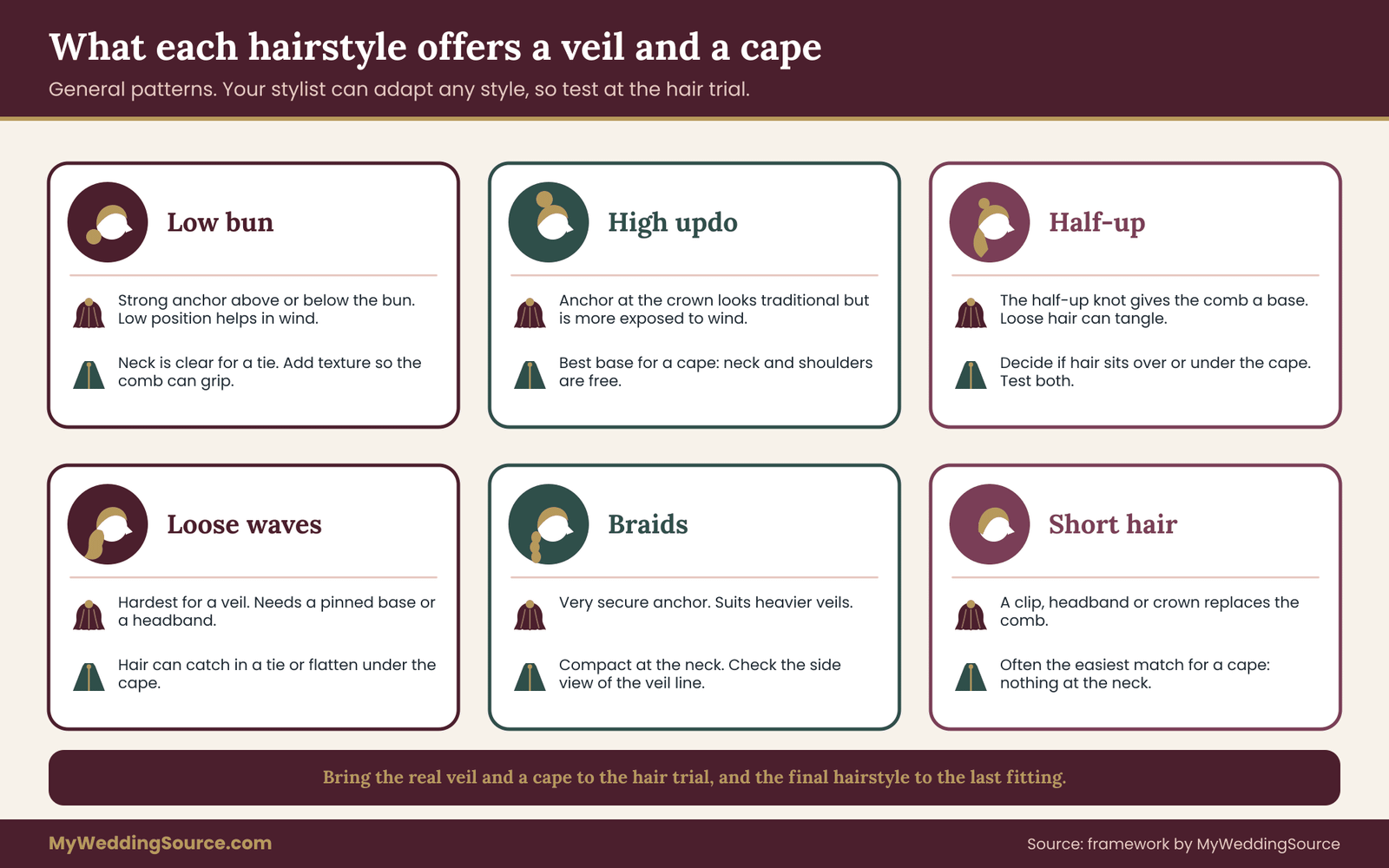
Low bun or chignon. This is a classic base for a veil. A veil can sit above the bun, which keeps the veil’s gathered edge secure, or below it, which creates a different look. The bun gives the comb something to grip, and the low position helps in wind. A cape sits easily with a low bun because the neck is clear. The main risk is a bun that is too smooth, which gives a comb nothing to hold, so ask your stylist to add texture at the anchor point.
High updo or high ponytail. A veil can be placed under the updo, which hides the attachment but may cause the veil to stand away from the head, or at the crown, which looks traditional. In wind, a high anchor leaves the veil more exposed. A high updo is excellent for a cape, since it leaves the neck and shoulders completely free, so the cape’s tie or clasp has room.
Half-up, half-down. This offers a natural anchor in the half-up section, and a veil placed at the crown or under the half-up knot can hold well. Loose hair below, however, can tangle with the veil in wind, and long hair under a cape can get caught in the neck tie. Ask your stylist to test with the cape on, and to decide whether the hair stays over or under it.
Loose waves or loose straight hair. This is the hardest style for a veil, because it offers few anchor points and the hair itself moves in wind. A veil can still work with a base of pinned or twisted hair at the crown, or a headband anchor. With a cape, loose hair requires a decision. Do you wear it over the cape, which covers part of the cape and can catch in the clasp, or under it, which can flatten waves? Test both.
Braids. A braided crown or a low braid gives a very secure anchor and works well for heavier veils. Braids also sit comfortably with a cape, because they are compact. The main risk is a braid that interferes with the veil’s visible line, so check the look from the side.
Short hair or a cropped style. A comb may not grip, but a clip, a headband or a halo-style crown does. A cape is often easier for short hair, because there is nothing at the neck to conflict. A short veil, such as a birdcage or blusher, tends to work well, and a longer veil may need a headpiece anchor.
Head coverings and religious or cultural customs
Some brides wear a head covering for religious or cultural reasons, such as a hijab, a headscarf, a mantilla or a covering required by a particular ceremony. In the cape vs veil question, a veil can often be worn with or over a covering, and the anchoring differs from hair. Ask your officiant or a trusted elder about any customs, and then ask your stylist or seamstress how the piece attaches in practice. A scarf is a grip surface that holds a comb, a clip or pins differently from hair. Test it at a fitting.
Customs about what a veil or a covering means differ among traditions, and it is not our place to interpret them. If a custom matters to you or your families, make sure the person who knows it is part of the decision. The wedding ceremony step-by-step guide explains how to talk through ceremony elements with an officiant, and the same conversation covers accessories with cultural meaning.
The Interference Zone: Where a Cape vs Veil Choice Gets Crowded
Draw a mental circle around the back of your neck and the top of your shoulders. In a cape vs veil setup, this is where problems cluster, because six things can occupy it at once: hair, a necklace, a collar or dress neckline, the cape’s tie or clasp, the veil’s lower edge and sometimes a microphone pack or a clip. Work through the circle one item at a time.
Necklace. A necklace under a cape can be hidden, which wastes it, or can catch on the cape’s lining. A chain with a clasp at the back can snag lace. If you want the necklace visible, choose a cape that opens at the front, or consider a cape that sits behind the shoulders only. If the cape covers the necklace, you might skip it or wear earrings instead.
Neck tie or clasp. A ribbon tie at the neck sits where hair sits. A tie that goes over a bun or under it needs thought. A clasp or hook rests on the skin and may need padding for comfort over several hours.
The veil’s lower edge. A veil that falls over the cape’s neckline can catch on the clasp. If you wear both, make sure the veil sits behind the cape’s closure or above it, whichever the stylist and seamstress agree on.
Microphone and clips. If your officiant or venue uses a wireless microphone on you, the pack and clip need a place. A cape may cover the pack but rub the microphone and create fabric noise, and a veil may drag across a lavalier microphone. Ask the sound person to test with each piece on.
Dress Details That Decide the Cape vs Veil Question
Some dresses make the cape vs veil decision easy. Others have details that conflict with one of the two pieces.
A statement back. If the back of the dress is the main feature, a veil in sheer tulle usually shows it, and a cape usually hides it. If you love the back, favor the veil or a very sheer cape. If you love the front and want the back to be low-key, a cape may do the work.
Heavy beading or lace. These catch tulle. A veil’s edge may snag on beadwork, and a cape’s lining may rub it. A seamstress can check the veil’s edge against the back, and a smooth lining can protect the beads. Test by walking and sitting, as in the Move check.
Sleeves. A dress with long sleeves leaves less need for a cape’s warmth, and a cape’s armholes may crowd the sleeves. A dress with no sleeves invites a cape, but a cape with no armholes and a strapless dress can slip.
Neckline. A high neckline leaves little room for a cape’s tie, and the cape may bunch. A plunging neckline may leave a cape with nothing to rest on. A sweetheart or off-the-shoulder neckline gives a cape a clean line. Look at the neckline when you test.
Train. A dress with a train and a floor-length cape or a cathedral veil produces three layers of fabric on the ground. Count how many people it takes to manage them, and decide whether the layout and the day can handle it.
Hair and Dress Fit Inside the Cape vs Veil Scores
The cape vs veil test does not have a separate hair check, because hair appears in two of the four checks. A piece that cannot be anchored fails Move. A piece that hides or clashes with the dress or hair fails Frame. Record the hair information in the log, however, because a stylist can fix it, and it is the cheapest category of fix. Hair fixes usually cost an extra pin or a different style, and they can be confirmed at one appointment.
One rule: always take the final hairstyle to the final fitting if you can, and take the final accessories to the hair trial. The two appointments together catch what either one alone misses, and they are the strongest reason to schedule the trial and the fitting in the same month.
Ceremony Layout and the Cape vs Veil Decision
The Place check asks what your ceremony space does to each side of the cape vs veil choice. Layout is the least glamorous part of the cape vs veil decision and often the most decisive, because a layout is fixed long before you try anything on. An aisle that is eighteen inches too narrow will not become wider because you prefer a longer cape.
Get a floor plan or at least a clear description of the space from your venue contact. If you have already done a technical walkthrough, use its notes. If not, ask for these specifics: the length and width of the aisle, whether it is grass, gravel, stone, carpet or boards, the number and height of any steps, where the guests sit and how close the chairs are to the aisle, where the officiant and the couple stand, and what is behind and around the altar.
Then walk the path in the order the day will unfold. The following stages cover most ceremonies. Skip any that do not apply, and add your own.
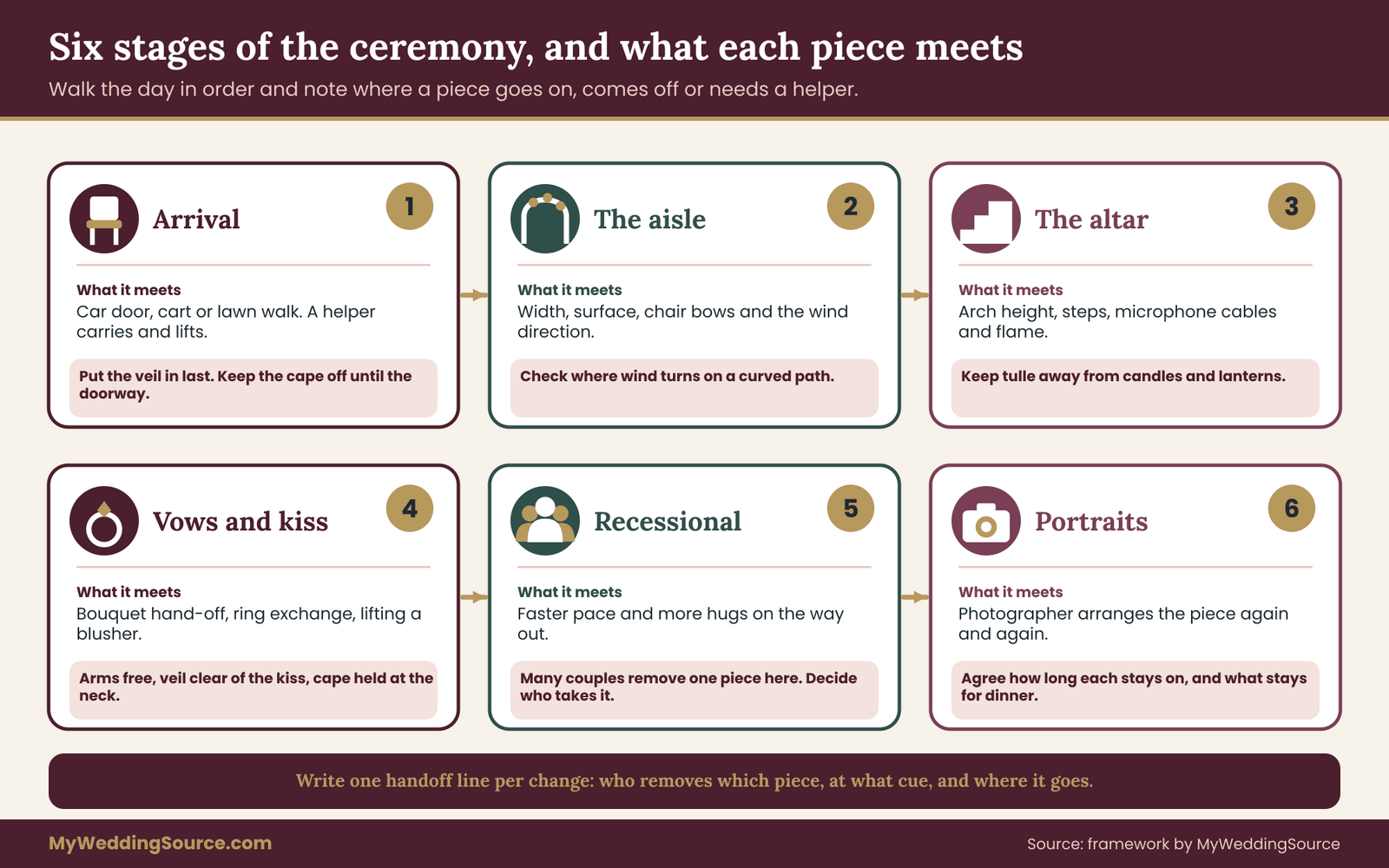
Stage one: arrival and the walk to the start
You may arrive by car, golf cart, on foot from a nearby building or from a hidden spot behind trees. Each route has its own demands. A car door and a seat belt test any long piece. A golf cart has open sides and nothing to shield fabric from wind or wheels. A walk across a lawn tests the hem, and heels sink into soft ground.
Plan who carries or lifts each piece of the cape vs veil pair. Many couples assign one person to manage the cape and veil during arrival, and to put them on at the last possible moment. If you wear a cape through a car ride and a long walk and remove it at the start of the aisle, say who takes it, where it goes and what happens if no one is there.
Stage two: the aisle
The aisle is where the cape vs veil trade-offs show up most clearly.
Width and edges. A narrow aisle with chairs close on both sides catches wide pieces. Check whether chair backs have decor, such as ribbon, flowers or signs, which can snag lace or tulle. A veil or cape with a train that spreads can catch on an aisle end. If petals, runners or aisle markers are used, the surface may change the way the piece drags.
Length. A long aisle gives wind more time to work and gives you more time to be seen from behind. A short aisle makes the piece’s entrance less dramatic and limits wind. Note whether the aisle is straight or curved. A curve changes the wind direction relative to your path, so a tailwind can become a crosswind halfway down.
Surface. Grass drags and stains, gravel and stone abrade hems, and carpet or runners can bunch. A floor-length cape or a veil that touches the ground will pick up whatever the surface offers. If the hem or the edge touches the ground, ask your seamstress about a loop or lift and what cleaning it will need afterward.
Escort. If a family member or an attendant walks with you, a cape or a veil must clear them as well. A tall person on one side may block wind and create a calm pocket. A shorter person may be hit by the cape. A person who offers an arm needs that arm free, and a cape that hangs over the arm may complicate it.
Stage three: the altar or ceremony spot
At the front, the couple faces the officiant or each other, and the cape vs veil question changes with what is behind and around you.
Arches, canopies and arbors. A floral arch or a fabric canopy may be lower than you expect, and a tall headpiece or a veil with height at the crown may catch. Fabric canopies may react to the same wind that moves your veil. Check height and anchoring with the florist or the venue.
Steps and platforms. A step up to the altar tests a long cape or train. If you must climb, plan to lift the piece or have someone assist. A platform may also expose the pieces to more wind, since it raises you above the shielding of the chairs.
Candles, lanterns and ritual objects. An open flame near tulle or chiffon is a hazard. Fabric can ignite quickly, and wind moves flames toward fabric. The National Fire Protection Association publishes candle safety guidance, and your venue may have rules about open flames. If your ceremony includes a unity candle, lanterns or a ritual with fire, discuss placement with the venue and officiant, and choose the piece with that in mind. A shorter veil, a cape removed before the ritual, or an electric candle are all reasonable decisions.
Microphones and speakers. A podium or a standing microphone may be in your path. Capes and veils can brush against stands. Tell the sound person what you will wear so that they can place cables and stands accordingly.
Where the couple stands. If you face your partner and the officiant, your back is to the guests. If you face the guests, the front of you is the view. Decide which, because a cape and a veil show different things in each. A veil that covers the face has its own logic at the lifting moment, and some ceremonies skip the lifting entirely.
Stage four: the vows, the ring exchange and the kiss
Here the Move check meets the Place check, and the cape vs veil differences show up at close range. Imagine the sequence: hand the bouquet to a maid of honor, turn toward your partner, take hands, take a ring, take a kiss. Each step is a possible conflict.
Handing off the bouquet. A cape may drape over the arm that holds the bouquet, and the hand-off needs a clear motion. Practice the hand-off in the cape.
Lifting the veil. If your ceremony includes lifting a blusher, decide who does it and when. A veil that is secured too firmly resists lifting. A veil that is not secured firmly may come off with it. Ask your stylist how the blusher attaches and whether it comes up with a gentle lift.
The kiss. A veil in front of the face must clear the kiss, and a veil behind the head must not be caught in your partner’s arms. A cape may slide when your partner embraces you. Practice at the fitting, with the partner if possible, though you may prefer to keep the dress a surprise, in which case a trusted stand-in works.
Rings and hands. A cape with narrow armholes restricts your arms. A long veil can fall into the ring exchange. If you wear gloves, the logistics multiply, and the accessories guide covers that in detail.
Stage five: the recessional and the receiving line
The recessional is faster than the processional. You walk out with your partner, often with music and cheering, and you may hug a few people along the way. The cape and the veil are now moving at speed and meeting more bodies.
This is the moment many couples choose to change something. A veil may come off after the recessional so that you can hug people without tangling. A cape may come off for the same reason, or stay on for portraits. Decide before the day which piece of the cape vs veil pair stays on.
Stage six: portraits and the move to the reception
Portraits are where the cape and veil often look their best, with good light and a few minutes of control. They may also be where each piece needs the most management, because a photographer arranges it again and again. Decide how long each side of the cape vs veil choice stays on for portraits, and let the photographer know the plan.
At the reception, decide what stays. Many couples remove the veil, because it is hard to dance, eat and hug in. A cape, which stays on the shoulders and can be removed quickly, sometimes remains through dinner or is swapped for a warmer wrap. A short cape or capelet can stay on longer than a long one.
Weather Beyond Wind: Cold, Heat, Rain and Sun
Wind is one piece of the weather picture. The other pieces affect the cape vs veil decision too, and each one can make a cape more useful or a veil more difficult.
Cold. A cape or capelet does real work in cool weather, which a veil cannot do. The National Weather Service publishes cold safety guidance, including advice on wind chill, which describes how moving air makes cold feel colder. If your ceremony is outdoors in cool weather, a cape may be a practical piece as well as a beautiful one, and a heavier fabric, such as crepe or wool blend, may suit better than tulle. Check the care label, as heavier fabrics may need professional cleaning.
Heat. A cape in hot weather is a burden. Fabric over the shoulders and back traps heat, and a lined cape is warmer still. The National Weather Service and the Centers for Disease Control and Prevention publish heat safety guidance. If your ceremony is in the heat, choose the lightest fabric, plan to remove the cape quickly, and think about the people who will stand outside for the ceremony as much as yourself. A veil adds little heat, though a heavy comb or a dense hairstyle may.
Rain. Tulle and chiffon are generally light, and rain can make them cling and darken. A veil may stick to your face or shoulders. A cape in a water-absorbing fabric may become heavy and carry water onto the dress. Plan an umbrella handler and a dry place for removing pieces. Ask your seamstress which of your pieces tolerates damp, and follow the care label for drying.
Sun. Strong sun creates glare through light fabric and can make sheer pieces look more transparent. A veil provides little shade, and a cape can give some on the shoulders. If your wedding is in strong sun, check how each piece looks in a mid-afternoon photo.
Plan one weather trigger for each condition that is realistic for your date and place, and attach it to your cape vs veil plan. Then match it to a piece or a backup, and write it down.
Wearing Both: Staging the Cape and the Veil
Some people want both pieces, and the cape vs veil test can say yes. The condition is that each piece scores well on its own and the pair does not interfere. Wearing both is a staging problem, not a styling problem. Decide what you wear when, and who handles each change.
The pair check
Before you commit to both, run a short extra test with both on.
- Snag test. Walk and turn, and watch whether the veil’s edge catches on the cape’s lace, beads or hooks. Pull gently on each piece to see whether it drags the other.
- Weight test. Wear both for fifteen minutes. A veil’s comb and a cape’s neck tie can each be comfortable alone and uncomfortable together.
- Order test. Find which goes on first. Often the cape goes on first, and the veil goes on top or behind. Ask your stylist whether the veil’s anchor stays accessible.
- Removal test. Take off one piece without removing the other. If you must remove the veil to take off the cape, you have just doubled the work of every change.
Three common ways to stage both
Cape for the entrance, veil for the ceremony. The cape arrives with you, adds drama at the door and in the first photos, and comes off before the processional or just after it. The veil stays on through the vows. This keeps your arms free for the ring exchange and shows the back of the dress during the ceremony.
Veil for the ceremony, cape for portraits and the evening. The veil does its work at the altar, and the cape appears for the photographs afterward and for the cooler hours. The cape’s weight does not fight the vows, and it handles evening temperature changes.
Veil over cape for a single dramatic moment. Some couples wear both only for the processional and the first photos and then drop one. This suits a short outdoor shoot more than a long ceremony.
In each stage plan, write the handoff in a single sentence: who removes which piece, at what cue, and where it goes. The ceremony cue sheet guide explains how to put these moments into the written timing the officiant and coordinator will use.
“After the recessional, please take the veil, then the cape, in that order, and hang both on the rack by the side door.”
A written line like this one, given to a named person, removes a decision at a moment when you will not want to make one.
Scoring the Cape vs Veil Decision
Once you have run the four checks, you will have a page of notes and eight numbers per piece. Now turn them into a cape vs veil decision. The scoring is simple on purpose, and the rules for reading it matter more than the arithmetic.
Step one: apply the gates
A gate is a rule that overrides the total. Two checks carry gates.
The Wind gate. If your ceremony is outdoors or semi-outdoors and a piece scores zero on Wind, it does not go down the aisle as planned. It can still appear elsewhere in the day, such as indoors or for portraits, but the ceremony plan must have a different piece or a clear removal point.
The Place gate. If a piece scores zero on Place, the layout rejects it. A long cape on a steep, narrow flight of steps with no helper is a layout problem, and no amount of styling fixes it. Either change the layout, change the piece or change where the piece is worn.
Move and Frame do not carry gates, because the fixes for them are usually cheaper and the stakes are lower. A zero on Move or Frame still counts against the total, and it is a flag to find out why.
Step two: compare totals
After the gates, add the four scores for each piece of the cape vs veil pair. Use these ranges as rough guides, not laws.
Seven to eight. The piece is a strong candidate. Use the log to confirm that each fix is booked or purchased.
Five to six. The piece is workable with attention. Check that you have the fixes lined up and that each has an owner and a date.
Three to four. The piece is a risk. Use it only for a limited moment, or choose another piece.
Zero to two. Change the piece.
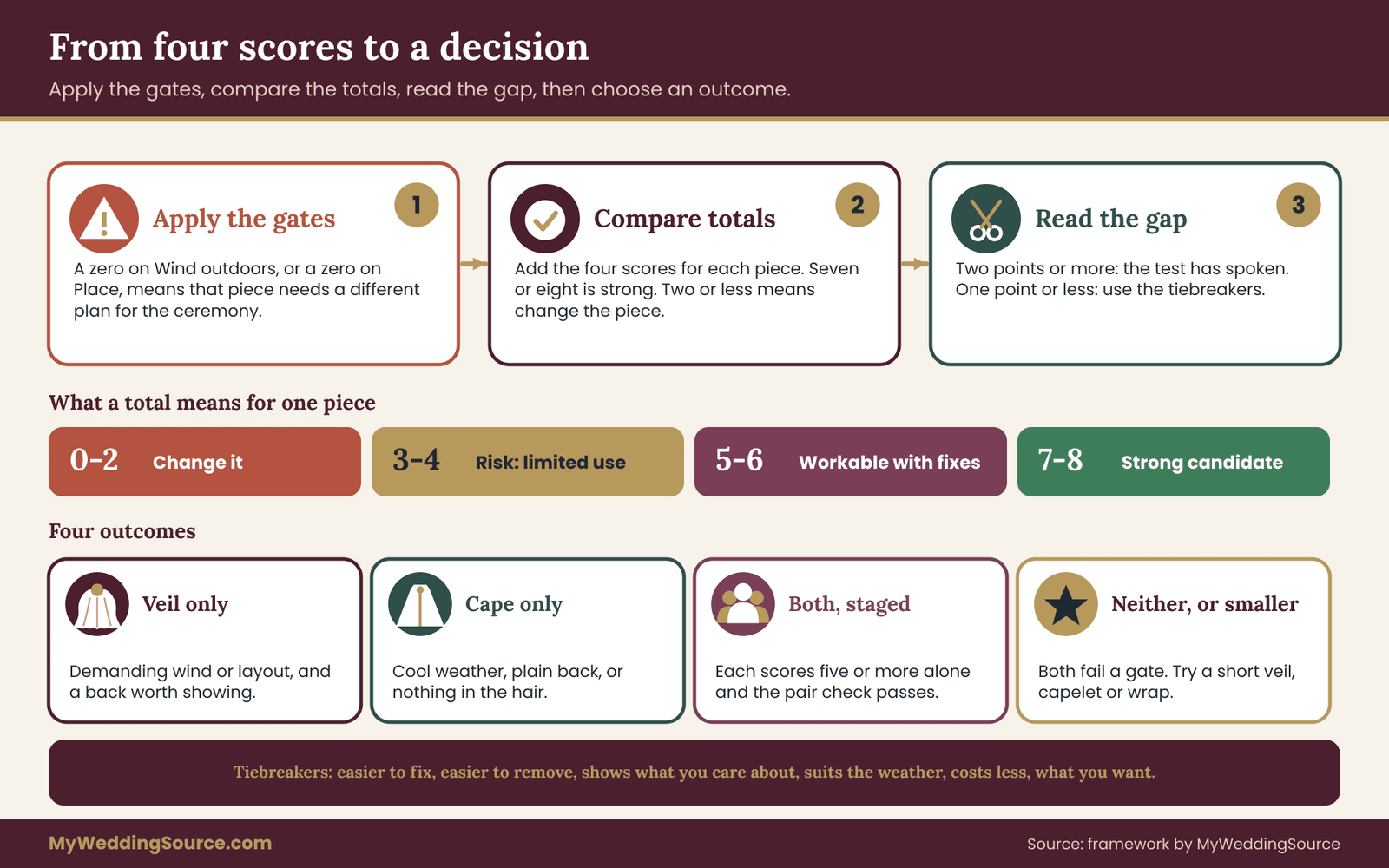
Step Three: Read the Gap in the Cape vs Veil Scores
Compare the totals of the two pieces. If one piece leads by two points or more, the test has spoken. If the gap is one point or zero, the test is a tie, and you need a tiebreaker. A tie in the cape vs veil scores is common, since both pieces may work well, and you can choose by what matters to you.
Tiebreakers for a Close Cape vs Veil Result, in Order
- Which piece is easier to fix or replace on the day? A veil with two combs can be re-pinned in thirty seconds. A cape with a failed clasp may need a seamstress. Prefer the piece with the quicker fix.
- Which piece is easier to remove? A piece that you can drop at a named moment is safer than one you are locked into.
- Which piece shows what you care about in the dress? If the dress back is the focus, the sheer veil usually wins. If the front is the focus and the back is plain, the cape may win.
- Which piece suits the weather you are most likely to have? Cold favors the cape, and strong wind often favors the shorter veil, or neither.
- Which piece costs less to get right? Add the price of the piece and its fixes, and compare.
- Which piece do you want? This comes last, not because it matters little, but because it is the tiebreaker that remains when everything else is equal, and then it should settle the question without guilt.
The Four Outcomes of the Cape vs Veil Test
The cape vs veil scores lead to one of four outcomes.
Veil only. The usual result when wind and layout are demanding and the dress back is the feature.
Cape only. The usual result when the weather is cool, the dress’s back is plain, or you do not want anything attached to your hair.
Both, staged. The result when each piece scores at least five by itself and the pair check passes. Write the staging plan.
Neither, or a smaller alternative. The result when both fail a gate. A short veil, a capelet, a wrap or nothing at all is a legitimate answer, and the dress may look best without either.
Verifying Fabric, Care and Handling With the People Who Know
The cape vs veil test tells you how a piece performs. It does not tell you what the piece is made of, how to clean it or whether it can take the fixes you plan. For those you need the label and the professionals who handle fabric.
Read the label
Textile products sold in the United States generally carry a label that gives the fiber content, and most garments carry a permanent care label. The Federal Trade Commission publishes guidance on both. The fiber content label tells you whether the piece is polyester, silk, nylon, cotton or a blend. This matters, because it affects wind behavior, heat tolerance and cleaning.
Different fibers and finishes react differently to heat, steam, solvents and adhesives. Synthetic tulle may melt or distort under a hot iron, silk may water-spot, and lace may snag. The care label gives the maker’s recommended cleaning method. If a piece is custom made, handmade, vintage or borrowed, it may not carry a label, and you need to ask the maker, the shop or a cleaner.
Do not treat this guide as a cleaning manual. Treat the label and your cleaner’s advice as the authority, and use this section as a list of questions.
Questions for the Salon or Maker About a Cape vs Veil Piece
- What is the exact fiber content of the cape, the veil, the lining and any trim?
- What does the care label say, and does the trim or beading change that advice?
- Can the piece be altered (shortened, weighted, fitted with hooks), and how much does that cost and how long does it take?
- If you alter it, does that affect the return policy or the warranty?
- Will you give me the piece’s specifications and the alteration estimate in writing?
- Is the piece available for a trial in my fabric and color, or only for a standard sample?
Questions for the tailor or seamstress
- Can you add a closure, a loop or a weight to this fabric without marking or distorting it?
- How should I store the piece between fittings and the wedding?
- What do you recommend for steaming or pressing before the day, and who does it?
- Can the fix be reversed, in case I change my mind?
Questions for the cleaner
Plan to take the piece to a professional cleaner after the wedding, not just before it. A cleaner who handles formalwear can tell you what a veil, a cape or a lace trim can take. Mention beading, glue, tape, adhesive, makeup, food and drink stains, and anything that was pinned or taped to the fabric. The Drycleaning and Laundry Institute is a trade association that provides consumer information about professional garment care, and it is a reasonable place to start if you need a general explanation of what cleaners do.
- Have you cleaned bridal veils, capes or lace before?
- What method do you recommend for this fabric and trim?
- Do you offer preservation or storage, and what does it include?
- What do you need to know about stains that I cannot see?
Borrowed, rented and vintage pieces
A borrowed veil from a relative or a rented cape adds a layer. You still run the test, but the fixes change, because you cannot always alter what is not yours. Ask the owner or the rental shop what changes are allowed, what damage costs and how it must be returned. A vintage piece may be fragile, and its fabric may not take the tension of pins or combs. A seamstress who knows vintage work can tell you quickly.
Never alter, cut or glue a borrowed piece without written permission, and keep a short note of the piece’s condition before the wedding, with photos, so any later discussion starts from facts.
Safe handling at the venue
Fabric near candles, heaters and fireplaces should be handled with care, and a cape or a long veil near an open flame is the clearest example. If your ceremony uses fire, ask the venue about its rules, and decide who keeps the piece away from it. If the venue has a fireplace or heater near your dressing area, keep the veil and the cape on the opposite side of the room.
Keep adhesives, sprays and perfumes away from the piece until after you dress. Hairspray and perfume can leave marks on some fabrics, so put the veil on after the hair and spray are finished, and ask your stylist to spray away from the fabric.
Keep the piece on a clean hanger or in a garment bag when it is not being worn, away from pets, children and food. A person assigned to hold the piece should know the rules and carry a small kit, which the accessories guide explains.
A Worked Example: Leila and Sam’s Lakeside Ceremony
The following example is invented to show the cape vs veil test at work. It is not a case study of a real couple, and the details are chosen to make the reasoning clear.
Leila and Sam plan an October ceremony on a lawn beside a lake, at four in the afternoon, with around a hundred guests in rows facing the water. Leila’s dress is an ivory crepe column with long lace sleeves and a low back finished with a row of small covered buttons. She is wearing her hair in a low chignon. She has two candidates in the cape vs veil question: a fingertip-length, single-tier tulle veil with a comb, and a floor-length chiffon cape that ties at the neck.
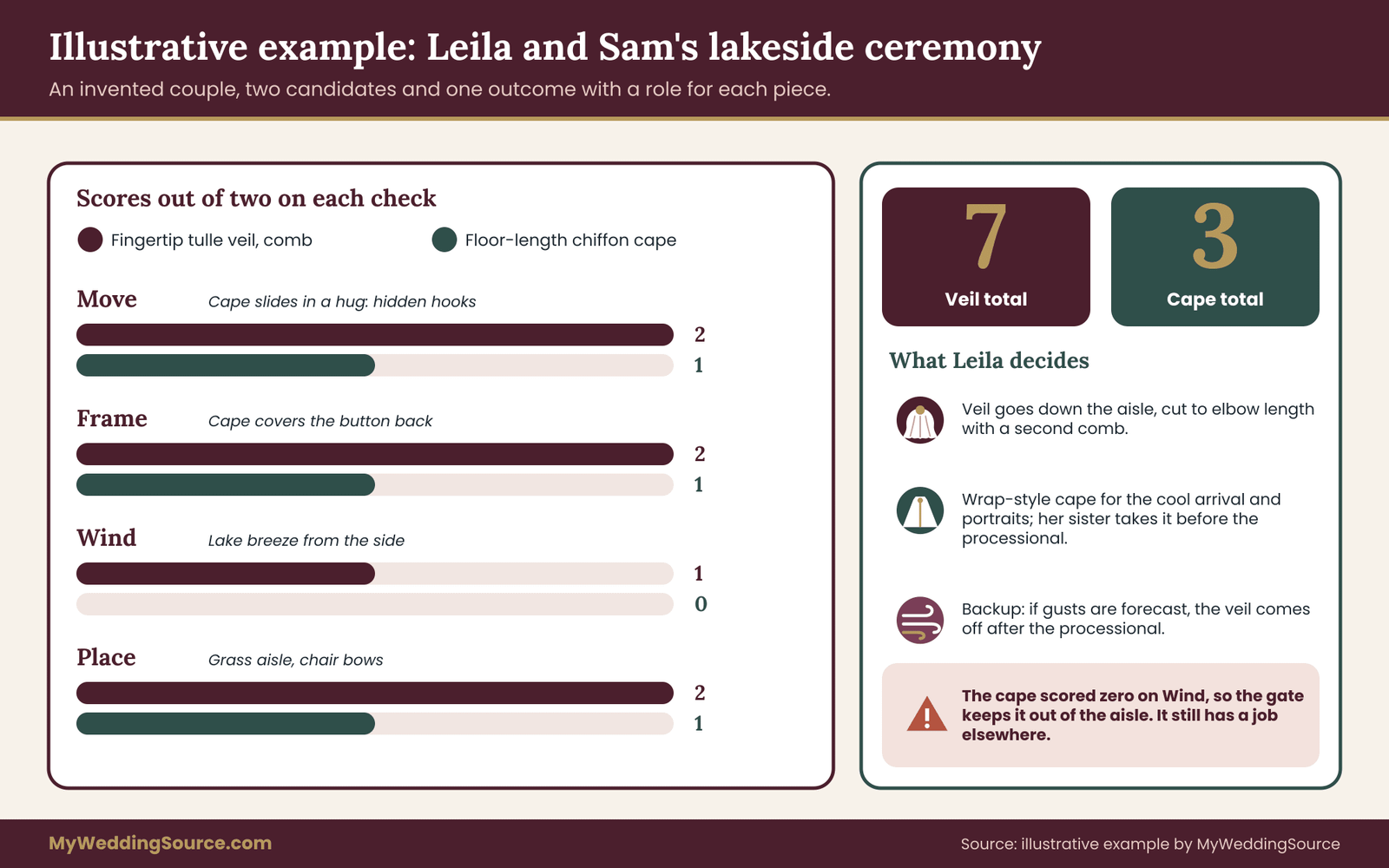
Move. At the fitting, the veil moves well. It lags slightly in a hug, so Leila scores it a two. The cape slides toward one shoulder when she lifts her arms to hug her sister and pulls against the neck tie. Her seamstress says a small hidden hook at each shoulder would hold it. Leila scores the cape a one, with a named fix.
Frame. In front photos, both look elegant. From the back, the cape covers the row of buttons, which Leila loves. The veil, being sheer, shows them. Her helper takes photos in open shade and in late sun. The veil photographs well in both. The cape looks strong in the entrance but hides the dress’s best feature during the ceremony. Leila scores the veil a two and the cape a one, on the plan to remove the cape before the vows.
Wind. At the lake on a Thursday at four, Leila and her sister test in the real breeze. The wind comes across the lawn from the water, so from the side as she walks down the aisle. The veil lifts across her face twice in a minute. Her stylist suggests a second comb and a shorter, elbow-length cut. Leila scores the veil a one with that fix.
The chiffon cape billows on the windward side, wraps her legs and takes several seconds to settle. Leila does not want to commit to a weighted hem, because the seamstress warns that it may distort the chiffon. She scores the cape a zero.
Place. The aisle is grass, with chairs close on both sides and ribbon bows on the aisle ends. A wide chair bow catches the veil’s edge slightly, and the venue says it can move the bows. A cape’s hem would drag on the grass. Leila scores the veil a two, after the bows are moved, and the cape a one.
Totals. The veil scores seven. The cape scores three, with a zero on Wind, which triggers the gate for the ceremony. The test has spoken, and Leila’s decision is a veil, with the elbow-length cut and a second comb, confirmed at the next hair trial.
She still loves the cape, and the test gives it a role. It scores well for the cool arrival, so she decides to wear a lighter wrap-style version for portraits, handed off to her sister before the processional. The plan is written in the cue sheet, with the sister as owner. A wind backup is added: if the morning forecast shows strong gusts, the veil comes off after the processional, and the stylist keeps the second comb and pins in a pouch.
What matters in this cape vs veil example is not the outcome. It is that every score has a reason and every reason has a fix or a decision. Leila did not need to rely on a feeling about which piece was nicer. She also kept what she loved, since the test did not say no to the cape. It said where the cape belongs.
What the Cape vs Veil Example Does Not Show
An example is a model of a method, not a prediction. Another couple, with the same dress and a different lawn, might score the cape higher. A couple married indoors, with calm air and a wide aisle, might choose the cape and ignore the wind check. A couple with a hair covering might put the veil’s anchor in a different place. Run your own test with your own pieces. The scores belong to you.
Special Situations and Common Cape vs Veil Mistakes
When the Standard Test Needs Adjusting
The four checks of the cape vs veil test work for most weddings, but some situations change what each check means. If any of these applies to you, read the note and adapt the test rather than skipping it.
Wheelchair users and mobility aids. A cape or veil that trails behind can catch in wheels, casters or the frame of a mobility aid. A floor-length cape draped over a wheelchair’s back may also hang into the wheels or bunch against the seat. Run the Move check seated, with the actual chair or aid, and ask the person who assists you to watch the wheels. Shorter lengths, capes cut to sit above the seat, and veils that clear the push handles are common solutions.
For aisle surfaces and routes, the Americans with Disabilities Act design standards, published at ADA.gov, are the reference for accessible routes in public venues, and your venue should be able to tell you about its accessible path.
Carrying a baby or leading a child or dog. A child or an animal may grab a trailing veil or tug a cape. If a child will walk with you, a shorter piece reduces the risk, and a carrying arm needs a cape that stays put. Decide who walks where, and keep the longest part of the piece behind the child.
A very tall or very short bride. Proportion affects what a length means. A veil that reaches the fingertips on one person reaches the hip on another. Judge length against your own body and the layout, not against a catalog name.
A ceremony with sitting or kneeling. Some traditions include kneeling, sitting at a table or bowing. A long cape and veil bunch when you kneel. Test the move in the actual outfit and decide whether the piece comes off first.
A ceremony with a processional of family. If parents, grandparents and attendants walk in a line, the space around you may be limited. A wide cape may crowd the person beside you. Practice the line at the rehearsal.
A ceremony in a place of worship. Some places of worship have requirements for head or shoulder coverings, or customs about what is worn at the altar. Ask the officiant or the person responsible for the building. A cape may satisfy a shoulder-covering custom, and a veil may satisfy a head-covering one, though the specifics vary, and only your community can say.
A beach or sand ceremony. Sand and salt get into fabric, wind is usually constant and a floor-length piece drags. Many couples here choose a shorter veil or a capelet, or neither. Test in the real wind, and plan a clean, dry place for each piece.
An evening or candlelit ceremony. Low light changes color and transparency, and candles add a fire hazard. Test the pieces under the lighting you will have, and keep sheer fabrics away from open flames.
Allergies and skin sensitivity. Some people react to adhesives, metal clasps or certain fabric finishes. If you have sensitive skin, wear the piece for an hour before the wedding, and check the neck tie and the comb. Tell your stylist and seamstress about any known reactions.
A destination wedding. A long veil and a cape pack differently, and a damp or crushed piece is hard to repair far from home. Carry both in the cabin, in a garment bag or a hard case, and ask your airline about storage. Find out in advance whether your destination has a steamer, a cleaner and a seamstress you can reach.
Two outfits. If you change for the reception, the cape or veil may belong to only one. Decide which one and write it on the plan.
Mistakes That Cause Most Cape vs Veil Problems
Most cape vs veil problems repeat. A short list of patterns is worth reading before the final fitting.
Choosing in a mirror. The mirror answers one question: does it look good standing still? It does not answer the other ones. Run the four checks.
Testing only indoors. A salon has no wind, no grass, no chairs with bows and no afternoon sun. Test at least the Wind and Place checks in the real or similar conditions.
Testing without the hair. A veil that sits perfectly on a clean, smooth head may not hold on the styled one. Bring the pieces to the trial.
Fixing at the last minute. A hook, a weight or a second comb can be added in a day, but a failed fix a day before the wedding leaves no recourse. Book each fix at least a few weeks ahead, and test it afterward.
Wearing both without testing the pair. Two pieces that work alone may fight together. Run the pair check.
Forgetting the handoff. A piece that comes off at the altar needs a person, a hanger and a cue. Write it down.
Ignoring the person behind you. The processional is a line. A long veil, a wide cape or a trailing hem affects the attendants and the escort. Put them in the rehearsal.
Over-trusting the forecast. A forecast gives a probability, and the venue’s local wind can differ. Check the morning of the wedding, and keep the trigger and the plan.
Treating a fix as free. Alterations cost money and time, and some change the look. Ask first, and compare the cost to a replacement.
Skipping the care label. The label tells you what a cleaner needs to know and what steam, heat or glue will do. Read it before anyone touches the piece with an iron.
Limits of This Guide
This guide offers a method for the cape vs veil decision, not a verdict on your pieces. It cannot see your dress, hear your officiant or feel your venue’s breeze. It does not replace a fitting, a hair trial or a conversation with the venue and your photographer. It also does not claim that either side of the cape vs veil choice is better than the other. Both can work, and both can fail, and the difference is local.
The guidance on fabric, care and handling is general. Fibers, finishes and trims vary, and the maker’s care label and a professional cleaner’s advice take priority. The guidance on weather points to the National Weather Service and the Centers for Disease Control and Prevention for current safety information. The guidance on accessibility and fire safety points to the ADA standards and the National Fire Protection Association, and your venue and local authorities may have specific rules. Check each of these directly for current requirements, because rules and recommendations change.
Prices and lead times are not given, because they vary by region, shop and season. Ask for written quotes.
Your Next Steps
Work through these cape vs veil steps in order, at your own pace. Each step produces something you can use at the next appointment.
- Write down your candidates. Describe each piece exactly: type, length, fabric and anchor. Add any alternatives, such as a shorter veil or a capelet.
- Collect the layout facts. Ask your venue for the aisle, surface, steps, seating and altar details, and request that fans and vents be reduced during the ceremony if you are indoors.
- Book the test appointments. Schedule the Move and Frame checks for a fitting, and the anchoring check for your hair trial. Bring the helper.
- Visit the venue at the right hour. Run the Wind and Place checks at the ceremony time of day, with a helper and a piece of tulle if you do not have the veil yet.
- Score and log. Fill in the page for each piece, with a reason, a fix and an owner for each score above zero.
- Apply the gates and tiebreakers. Choose veil only, cape only, both staged, or neither.
- Book the fixes. Order the hooks, combs, weights or alterations, and set a date to verify each.
- Write the handoff and the weather trigger. Put them in the cue sheet, with a named person for each.
- Confirm care. Check the labels, and book a cleaner for after the wedding.
If you are still assembling the rest of the plan, the wedding planning checklist shows where accessory decisions sit among the other tasks.
FAQ
Is a cape or a veil better for a windy wedding?
In the cape vs veil question for a windy day, neither wins automatically. A short, well-anchored veil often handles wind better than a long one, and a short cape or capelet handles it better than a floor-length cape. A long chiffon cape can billow and wrap in a crosswind, and a long veil can cross your face. Test both at the venue in real wind, from three directions, and use the Wind score to decide.
Can I wear a cape and a veil together?
Yes. In a cape vs veil decision, both is a valid result if each piece scores well alone and the pair does not interfere. Run a pair check for snags, weight, order and removal. Many couples stage them instead of wearing both all day, with the cape at the entrance and the veil at the altar, or the other way around. Write down who removes each piece and when, so the change is quick.
Which works better in a cape vs veil choice with a low bun or loose hair?
A low bun gives a veil a secure anchor and leaves the neck free for a cape. Loose hair is harder for a veil, since a comb has little to grip, though a pinned base or a headband can solve it. Loose hair with a cape needs a decision about whether it sits over or under the cape. Test both at your hair trial.
Will a cape hide the back of my dress in photos?
An opaque cape will hide the back, and a sheer one may soften it. A sheer veil usually shows the back, with a faint overlay. If the back is the best feature, consider a veil, a very sheer cape, or a cape you remove before the vows. Take back photos at the distance your guests will see you.
How far ahead should I test a cape vs veil choice?
Early enough to fix what you find. Run the Move and Frame checks at a fitting well before the wedding, and the Wind and Place checks as soon as you can visit the venue at the right time of day. Allow weeks for alterations and a final trial afterward. Last-minute tests leave no room to change anything.
What if the weather forecast changes right before the wedding?
Use the cape vs veil trigger and backup you wrote. A wind or cold trigger might switch you to a shorter veil, a wrap or a cape worn only for portraits. Give the spare piece, pins and instructions to a named person in advance. Check the National Weather Service forecast for your venue the morning of the wedding.
Do I need a professional to settle a cape vs veil choice?
It is wise. A seamstress or tailor can see how a cape hangs, add hooks or loops and judge whether alterations suit the fabric. A hairstylist can judge the anchor. Neither replaces your own test, but each can fix what you find, and a short appointment is far cheaper than a failed piece on the day.
How should I clean a veil or cape after the wedding?
Start with the care label and ask a professional cleaner who handles formalwear. Mention beading, adhesive, makeup, food, drink and anything pinned or taped to the fabric. Do not iron or steam tulle or lace without checking the fiber content. Ask about preservation and storage, and take the piece in soon after the wedding, before stains set.
Sources
- Clothes Captioning: Complying with the Care Labeling Rule, Federal Trade Commission
- Threading Your Way Through the Labeling Requirements Under the Textile and Wool Acts, Federal Trade Commission
- Beaufort Wind Scale, National Weather Service JetStream
- Heat safety, National Weather Service
- Cold safety and wind chill, National Weather Service
- Heat and your health, Centers for Disease Control and Prevention
- Candle safety, National Fire Protection Association
- Design standards, Americans with Disabilities Act
- Consumer information on garment care, Drycleaning and Laundry Institute