

The wedding content creator vs photographer choice is less a contest than a question of which job you need done: a gallery you will print and keep for decades, or a stream of vertical clips and candids your guests can watch by the next morning.
Quick answer
For most couples the wedding content creator vs photographer question is not either-or. A photographer produces the lasting, high-resolution record. A content creator, who usually works from a phone, produces fast, informal, social-ready clips. Survey data from Zola puts the average photographer at $4,400, while more than 60% of the couples who hired a creator spent $500 to $999. If you can afford only one, hire the photographer, and ask whether they will deliver a small set of quick social files. If you can afford both, define in writing who covers what so you do not pay twice for the same moments.
What a wedding content creator and a photographer each deliver
Before comparing prices or contracts in the wedding content creator vs photographer decision, it helps to be precise about the two jobs. The phrase “content creator” gets used loosely, and a couple can read one vendor’s website and assume they are buying a cheaper photographer. They are usually not. The wedding content creator vs photographer decision starts with understanding that each role is built around a different end product, a different pace, and a different relationship to the schedule.
Two different jobs, two different products
Both vendors point a camera at your wedding, which is why they get confused. The difference is what happens to the material afterward, and who it is meant for.
The photographer’s job: a lasting, curated record
A wedding photographer works from a plan. They scout light, pose family groups, cover the ceremony from agreed positions, and then spend weeks selecting and editing images into a gallery. Zola’s published package tiers describe basic coverage of about six to eight hours with one photographer, standard coverage of about eight to ten hours, and premium coverage of ten hours or more with two or more photographers, usually with an album and an engagement session at the higher tiers. The product is a high-resolution gallery, and often prints or an album, meant to last.
The content creator’s job: fast, informal, shareable clips
Zola describes a wedding content creator as a professional who captures behind-the-scenes photos and short-form video for social media, mostly on a mobile device rather than a professional camera. The Knot describes the same role as candid, phone-shot footage, sometimes with the creator managing social posting for the couple. Their product is a high volume of raw material plus a handful of quick edits sized for apps such as TikTok or Instagram Reels. The aim is to let people who could not attend feel included, and to give you something to post while the day is still fresh.
Where the two roles overlap
The overlap is real, and it is where most of the confusion and most of the double-paying happens. Knowing exactly where the two jobs touch is what makes the comparison useful instead of abstract.
Candid moments and detail shots
In any wedding content creator vs photographer comparison, both will photograph a ring on a bouquet, a grandparent laughing, or a first look. A photographer approaches those moments as part of a curated gallery. A creator treats them as raw material for a clip. If you hire both, that shared territory is the first thing to divide. Our guide to candid wedding photography explains how a photographer captures unposed moments, which is useful context for deciding how much candid coverage you actually need from a second vendor.
Short social edits from a photographer or videographer
Some photographers and videographers now offer social cuts themselves. Zola’s videography article lists social cuts among the deliverables of premium packages, and Zola’s content creator article notes that some photographers also offer content creation, which may allow a package deal. That means a third option exists beyond hiring separate specialists: a single vendor who delivers both a gallery and a few fast clips. It is worth asking about before you add a second contract. Our overview of wedding photography covers the larger picture of styles, coverage, and what a standard photography package includes.
The speed gap is the clearest difference
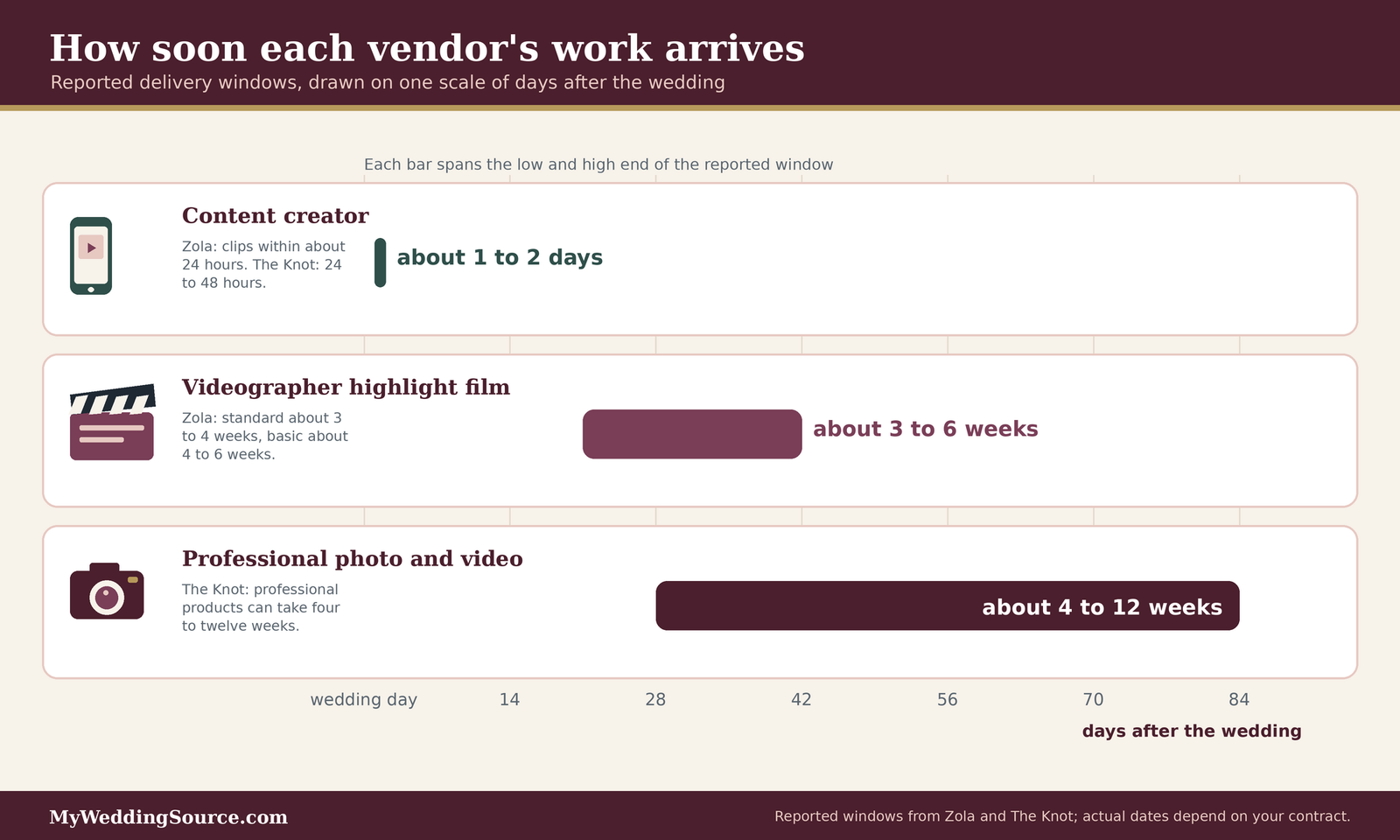
If you remember one contrast from the wedding content creator vs photographer debate, make it timing. The Knot reports that professional photo and video products can take roughly four to twelve weeks to arrive, while a content creator typically delivers within a day or two. Zola’s own figures are consistent with that range: a creator’s edited clips typically arrive within 24 hours, and its videography article describes a basic highlight film arriving about four to six weeks after the wedding and a standard package in about three to four weeks.
Why a creator can be fast
In the wedding content creator vs photographer split, a creator shoots in the format they will publish, usually vertical video on a phone, so there is little conversion between capture and post. They also work with smaller files and a lighter editing workflow. Speed is a design feature of the job, not a sign of sloppiness.
Why a photographer is slower
Culling hundreds or thousands of frames, color-matching, retouching, and building a coherent gallery takes time, and a photographer often handles several weddings in a season. A slower turnaround is not a defect. It is the cost of a curated, high-resolution result. What matters is that the contract states a delivery window so that a slow gallery is never a surprise.
Wedding content creator vs photographer: the criteria that change the choice
A long list of features does not help you decide. A short list of criteria that genuinely change the answer does. This section separates what is a deal-breaker from what is a preference in the wedding content creator vs photographer choice, and gives you a way to compare quotes that are not written in the same language. The comparison below uses figures from Zola and The Knot, and it labels our own judgment where we are not reporting a source.
Deal-breakers, preferences, and the weighting between them
Start by sorting your needs for the wedding content creator vs photographer decision. A deal-breaker is something that, if missing, would leave you disappointed regardless of price. A preference is something you would enjoy but could live without.
Separate deal-breakers from preferences
For many couples, the deal-breakers are print-quality portraits of family, a professional record of the ceremony, and clear ownership or license of the files. Preferences might include a social-ready clip by the next morning, a behind-the-scenes montage, or content to post for guests who could not travel. If your answer to “what would I regret not having in ten years” is portraits and ceremony, the photographer is the deal-breaker vendor and the creator is a preference. If your answer is “something to share with a far-flung family that cannot travel,” the order may be different. This is editorial judgment, and your own list should drive it.
Weight cost, logistics, experience, and flexibility
Give each of four factors a weight that adds up to one hundred percent, then rate each option. In a wedding content creator vs photographer decision, cost is the one most couples overweight. Logistics covers hours of coverage, travel, and how much of the schedule the vendor needs to control. Experience covers whether the vendor has worked in your type of venue and light. Flexibility covers how well the vendor handles a delayed ceremony or a rainy backup plan. A couple who is tight on budget but has a complicated timeline might weight cost at forty percent and logistics at thirty. A couple with a larger budget and a social-first guest list might weight experience and flexibility more. The weights are yours; the exercise simply forces the trade-offs into the open.
Cost check
Reported averages are not quotes, and that is especially true in the wedding content creator vs photographer comparison. Zola’s Wedding Cost Index puts photography at about $4,400 nationally and videography at about $3,993, and Zola’s survey of recent couples puts most content creator spending at $500 to $999, while The Knot says creator packages usually start around $1,000. Those figures come from different sources, dates, and methods, so treat them as a rough frame. Always compare real written quotes for the same hours and deliverables, and use our wedding budget calculator to see what each option does to your total.
Compare like with like
Two quotes can look similar on price and describe entirely different services. Normalizing them is the most practical skill in the whole wedding content creator vs photographer decision.
Normalize package contents and time coverage
Write each quote on one line using the same four measures: hours of coverage, number of people on site, number and format of finished deliverables, and the day the finished files are promised. Then calculate cost per hour of coverage and cost per delivered item, and keep the delivery day beside both, because speed has value that neither number captures.
Here is an illustrative example with invented quotes, not real vendors. Quote A is a photographer at $4,400 for eight hours, one photographer, and 500 edited images, delivered in eight weeks. That is $550 per hour and $8.80 per image. Quote B is a content creator at $900 for four hours, with 40 short clips and 60 edited photos, delivered in 24 hours. That is $225 per hour and $9.00 per item. The per-item cost is nearly the same, which tells you that price alone cannot separate the two. What differs is the format, the polish, the ownership terms, and the delivery day. The arithmetic is our own estimate for illustration.
Expose features that sound equivalent but are not
Several phrases sound alike and mean different things. “Highlight reel” may be a three-to-five-minute film from a videographer or a fifteen-second vertical clip from a creator. “Raw footage” may mean every file the vendor shot or only a selected set. “Unlimited photos” says nothing about how many are edited. “Full rights” may mean you can print and post but not sell, which is a license, not ownership. When you see any of these, ask for the definition in the contract. Zola’s photography article makes the same point in a narrower way, advising couples to confirm whether full rights to the digital images are included.
| Criterion | Wedding content creator | Wedding photographer |
|---|---|---|
| Main product | Raw clips and photos plus a few short vertical edits (Zola, The Knot) | Curated high-resolution gallery, often prints or an album (Zola) |
| Usual equipment | Mostly a phone (Zola, The Knot) | Professional cameras (Zola, The Knot) |
| Delivery speed | About 24 to 48 hours (The Knot, Zola) | Roughly four to twelve weeks for professional photo and video (The Knot) |
| How they work | Captures moments as they happen, with little staging (The Knot) | Follows a shot plan and a defined package (The Knot) |
| Reported spending | Most couples $500 to $999 (Zola 2026 survey); packages often start near $1,000 (The Knot) | Average about $4,400 (Zola Wedding Cost Index) |
| Strongest at | Speed, social reach, candid atmosphere | Portraits, family groups, ceremony coverage, print quality |
| Weakest at | Large prints, formal portraits, long-term archive | Same-day sharing, informal behind-the-scenes content |
| Rights to confirm | Raw versus edited files, music, posting credits | License, print rights, vendor marketing use |
What the comparison table shows
The wedding content creator vs photographer table above summarizes how each role differs on the criteria that most often change the decision. It does not rank them. It simply shows that a creator is built for speed and social reach, while a photographer is built for permanence and polish. If your priorities sit entirely on one side, the choice is easy; if they are split, that is a signal to consider both, or a single vendor who offers both.
Read the table against your own priorities
Highlight the two or three rows that matter most to you and ignore the rest. A couple who cares most about speed and sharing will find that the speed and format rows decide the question. A couple who cares about heirloom prints will find the resolution, album, and rights rows decide it. Resist the urge to treat every row as equal, because the weighting you chose earlier is what turns this table into a decision.
Ownership is the part of the wedding content creator vs photographer decision that couples most often overlook until after the wedding. It does not affect how the day looks, but it affects what you can do with the pictures and video for years. This section is general education, not legal advice. For your own contract, ask the vendor to put terms in writing, and consider asking a qualified attorney to review anything you are unsure about.
Who owns the photos and video
By default, the person who creates a work owns the copyright. That is the starting point under U.S. copyright law, and it does not change simply because a couple paid for the session.
The default: the creator owns the copyright
The U.S. Copyright Office explains that copyright generally belongs to the person who created the work, that protection begins automatically when the work is fixed in a tangible form, and that owning a physical copy of a work does not give you the copyright in it. Applied to a wedding, that means your photographer or creator typically owns the copyright to the images and clips they make, and you receive files under whatever license the contract grants. A contract can change that, but only in writing.
Licenses and transfers must be written
The Copyright Office notes that transferring exclusive rights generally requires a writing signed by the owner. In practice, most wedding vendors keep the copyright and grant the couple a personal-use license to print, share, and post. Some will sell a broader transfer for an extra fee. Because “work made for hire” is sometimes mentioned in contracts, note that the Copyright Office’s circular on the topic says a commissioned work by an independent contractor qualifies only if it falls within certain listed categories and the parties sign a written agreement stating it is a work made for hire. Whether a particular wedding photo or video fits is a legal question for your own attorney, so do not assume that paying for the work transfers ownership.
What you are allowed to do with the files
Having the files is different from having every right to use them. Check the license for the following uses before you assume anything.
Printing, posting, and sharing with guests
A typical personal-use license lets you print, post to your own accounts, and share with family and guests. Ask whether you must credit the vendor, whether a watermark is removed, and whether the files are delivered in a resolution suitable for print. For a creator, ask whether you receive edited clips, raw footage, or both, since The Knot advises confirming that point.
Commercial use, resale, and vendor use of your images
The reverse question matters too. Many photographers and creators ask for permission to use your images in their own marketing. Read that clause and decide whether you are comfortable. If you want privacy, for example if a family member has asked not to appear online, ask to opt out or restrict use to specific images. This is a negotiable term, not a fixed rule.
Music, disclosure, and platform rules
In the wedding content creator vs photographer question, short clips often include music, and creators often post tagged content. Both create obligations that surprise couples.
Music in videos
Adding a popular song to a wedding video can raise copyright issues. The Copyright Office describes fair use as a flexible doctrine decided case by case, with no fixed amount of a work that is automatically safe, and it states that it cannot give individualized advice. Platforms also have their own licensing arrangements and rules, which change. A practical approach is to ask your creator or videographer which music they use, whether it is licensed or from a platform library, and whether a clip might later be muted or removed on a particular app. Do not assume that a credit or a disclaimer fixes a rights problem.
Disclosure when vendors trade goods or services for exposure
The Federal Trade Commission’s guidance for social media influencers says that a material connection includes more than cash. Free or discounted products and services count, and a disclosure should sit next to the endorsement, in plain words such as “ad” or “sponsored” rather than vague shorthand. For videos, the FTC advises showing the disclosure on screen and saying it aloud, not only in a caption. This matters if your creator, or you, post about a venue, florist, or dress shop that provided anything free or discounted. It is general guidance, not a legal opinion about your situation.
Venue, guest, and equipment limits
Even with a license in hand, the day itself has rules, and a few of them affect creators and photographers differently.
Unplugged ceremonies and vendor phones
If you plan an unplugged ceremony, tell your creator, because a phone-based creator can look like a guest who ignored the request. Decide in advance whether the creator is exempt, where they will stand, and how guests will be told. Our guide to the unplugged wedding ceremony walks through the wording and the common ways couples handle vendor exceptions.
Drones and venue restrictions
Some creators and videographers offer drone footage. The Federal Aviation Administration says that flying a small drone for work or business falls under its Part 107 rules, which require a certified remote pilot and a registered aircraft. Ask any vendor who offers aerial footage to confirm the pilot certificate and registration, and ask your venue whether drones are allowed at all. Our list of questions to ask a wedding venue includes vendor access and restriction questions that apply here.

What each option costs, and where the real money goes
Price is where the wedding content creator vs photographer comparison gets slippery, because the published numbers come from different surveys, different years, and different definitions of a “package.” This section separates reported averages from vendor quotes and from our own arithmetic, so you know which is which.
What couples report paying
Treat these as reference points for the wedding content creator vs photographer question, not predictions. Your market, date, and coverage will move them.
Photography and videography averages
Zola’s guide to photographer costs reports a national average of about $4,400, citing its Zola Wedding Cost Index, with most couples falling between roughly $3,500 and $5,300, or about nine percent of a total wedding budget. It lists New York City at about $5,000 and Salt Lake City at about $3,600. Zola’s videographer guide reports an average of about $3,993, with most couples between $3,200 and $4,800, or about eight percent of a budget, and overtime typically running $200 to $400 per hour. Zola’s pages do not state the year of the underlying pricing data, and the videography page mentions a 2026 spend survey of 720 couples married within the previous 180 days. For a wider look at how these lines fit into a full budget, see our guide to average wedding cost.
Content creator spending
Zola’s content creator article, last updated in March 2026, says more than 60% of couples in its 2026 Wedding Spend Survey, which covered more than 700 couples married in the prior six months, spent between $500 and $999 on a creator. It also reports that about one in five couples hired a unique or niche vendor and that content creators were the most requested of those. The Knot’s article, updated in March 2023, says creator packages usually start around $1,000 and rise with the number of deliverables, the amount of editing, and the speed of delivery. The two figures differ because they come from different dates, samples, and definitions, so do not average them. Use the range as a conversation starter, and get written quotes.
What the figures do not tell you
In the wedding content creator vs photographer comparison, averages hide hours, deliverables, and location. A photographer at $4,400 for six hours is a very different offer from the same price for ten. A creator quote of $900 may cover four hours or the whole reception. These reports are also self-reported spending in specific samples, so they are best used as a sanity check on whether a quote is wildly high or low. They cannot tell you whether a particular vendor is a good fit.

Hidden labor, fees, and coordination
The base price is rarely the final price, and the extras show up in different places for each role.
Fees that appear after the quote
For videographers, Zola notes that raw footage, extra copies, and rush delivery can add charges. The Knot notes that out-of-state or destination weddings may add travel costs for a creator. Photographers commonly charge for extra hours, albums, and additional shooters, though your own quote is the only reliable source. Ask each vendor for a list of every possible add-on, and ask what the overtime rate is, because a reception that runs long is the most common reason a total grows.
Coordination costs that do not appear on an invoice
Two vendors mean two sets of timeline questions, two meal counts, two sets of venue permissions, and a small risk that they get in each other’s way. The extra work is real even if it costs nothing. Our guide to wedding vendor meals covers how to plan food for vendors, which is a line that couples forget when they add a creator. Our wedding vendor timeline guide helps you build a schedule that every vendor can see.
The point where one option stops being cheaper
In the wedding content creator vs photographer cost question, a creator looks cheap per package and can look expensive per hour. Where the lines cross depends on how much coverage you want.
A transparent break-even calculation
Using the illustrative creator quote above, $900 for four hours is $225 per hour. Stretched across a ten-hour day at the same hourly rate, that would be about $2,250. That is our own arithmetic, not a vendor price, but it makes a point: Zola’s overtime range for videographers is $200 to $400 per hour, so a creator’s hourly rate can end up in the same neighborhood as a videographer’s when coverage grows. A creator is cheapest when you use them for a short, targeted window, such as the getting-ready hours, the ceremony, and the first dance, rather than for the whole day.
Combining vendors without paying twice
Add the averages for a rough sense of scale. A photographer at $4,400 plus a creator between $500 and $999 comes to between $4,900 and $5,399, and adding a videographer at $3,993 to the photographer comes to about $8,393. These are sums of national averages, not what any one couple will pay, and they are our own estimates. The practical lesson is that a creator adds value only if the job is clearly different from the others’. If the creator and the videographer both shoot the ceremony in vertical clips, you are paying for the same coverage twice.
How the work flows from planning to posting
In the wedding content creator vs photographer setup, the workflow is where the two roles either support each other or collide. A simple plan, shared with both vendors, prevents most of the friction. The advice below is our own recommendation, built on the differences in pace and product reported by Zola and The Knot.
Before the day
Most of the value is created before anyone picks up a camera.
Share one timeline and one list of must-have moments
Give every vendor the same schedule and the same list of priority moments. Our wedding photographer shot list guide is a good starting template for the photographer. For a creator, add a short list of the moments you want shared quickly, such as the reveal, the vows, the first dance, and a toast, and note which moments you would rather keep off social media. A creator and a photographer who both see the list will not both ask you to repeat the same shot.
Decide who covers what
Divide the day in writing. For example, the photographer owns portraits, family groups, and the ceremony from agreed positions, while the creator owns behind-the-scenes moments, guest reactions, and the reception atmosphere. Name any shared moments, and say which vendor has priority in the frame. This is a recommendation, not a rule, but it removes the most common source of awkwardness on the day.
During the day
Two people with cameras need a few ground rules, whichever way the wedding content creator vs photographer decision falls.
Positions, sight lines, and the photographer’s frame
Agree where the creator may stand during the ceremony and portraits, and make sure they stay out of the photographer’s frame and sight lines. A creator who walks into a posed portrait can ruin it. The reverse is also true: a photographer who blocks an aisle can end up in a creator’s shot. Brief both before the ceremony.
Guest phones and the unplugged question
If guests are unplugged, the creator’s phone is the one phone that is not. Tell guests about the exception in advance, perhaps in the program or by the officiant, so that nobody feels singled out. If guests are not unplugged, a creator’s coverage is more likely to overlap with the dozens of guest phones that are already shooting, which may change how much coverage you need. Our guide to a wedding photo booth is worth a look as another way to collect casual, shareable pictures at the reception.
After the day
The first week and the first two months are different phases.
The first 48 hours
The Knot says creators typically deliver within 24 to 48 hours, and Zola says edited clips typically arrive within 24 hours. Decide in advance when you will post, and whether you want to post anything before the photographer’s sneak peek. If your photographer has a sneak-peek policy, ask whether a creator’s posts may precede it. Some couples prefer one coordinated reveal.
The final gallery and film
The Knot says professional photos and video can take four to twelve weeks, and Zola’s videographer figures suggest about three to six weeks for a highlight film. Put a delivery window, a backup policy, and a revision policy in the contract. After delivery, download everything to two places, since a cloud gallery may expire. Delivery windows and expiry dates are contract terms, so confirm them rather than assuming.
Which option fits which wedding: worked scenarios
Scenarios for the wedding content creator vs photographer decision are useful only if they are honest about assumptions. The cases below are illustrative, with invented details, and the recommendations are our own editorial judgment, not survey findings.
Four example weddings
Each example shows a different priority at the center of the decision.
A small backyard wedding with a modest budget
Imagine a wedding with forty guests, a short ceremony, and a modest total budget. The photographer is the stronger first choice, because the couple wants a lasting record of a small gathering, and a short coverage window keeps cost down. A creator is a luxury here. A more economical idea is to ask the photographer whether they provide a small set of quick social files, as Zola notes that some photographers do. Our guide to small wedding planning discusses how to spend carefully when guest count is low.
A large ballroom wedding with relatives who could not travel
Now imagine a hundred and fifty guests and a large group of relatives watching from another country. A photographer remains the foundation, but a creator earns their fee here because of the 24-hour turnaround, which lets absent relatives feel included while the day is still fresh. If the budget allows only a short creator window, concentrate it on the ceremony and the first dance. A videographer is optional if the creator’s clips and the photographer’s gallery cover the main needs, but a couple who wants a full ceremony film should keep one.
A courthouse ceremony or elopement
For a short ceremony with a handful of guests, a photographer for an hour or two is usually enough. A creator adds little unless the couple’s main purpose is to post content. In that case, a creator’s quick clips may actually be the better first purchase, provided the couple accepts that they will not have a high-resolution portrait set.
A couple who plans to post heavily
Suppose the couple has an active online presence and wants material for posts across several weeks. Here the creator may deliver more usable material than a photographer alone, and the couple should negotiate for raw files and editing, with clear rules on credits and disclosure if any vendors provide free or discounted services, as the FTC guidance describes. Even so, the couple should keep a photographer for the family portraits and the ceremony, because phone footage is not designed to be printed large.
| Scenario (illustrative) | Likely better first choice | What flips the answer |
|---|---|---|
| Backyard wedding, about forty guests, modest budget | Photographer, short coverage | Many absent relatives who want to watch live moments |
| Ballroom wedding, about 150 guests, relatives abroad | Photographer plus a creator for a short window | A budget so tight that the creator quote nears a short photo package |
| Courthouse ceremony or elopement | Photographer for an hour or two | The main goal is posting quick clips, not prints |
| Couple who plans to post heavily | Creator first, photographer kept for portraits | No need for print-quality portraits at all |
Why the recommendation changes
The wedding content creator vs photographer scenarios differ because the deciding factor changes. Understanding the factor lets you apply the logic to your own case.
The factor that flips the answer
In each example, a single threshold changed the recommendation: the number of absent audience members, the length of the coverage window, the importance of print quality, and the couple’s intent to post. When those four factors point to the photographer, hire a photographer alone. When two or more point to speed and reach, add a creator. When all four point to speed and reach, consider a creator first, but keep a photographer for the portraits that cannot be recreated.
What stays constant across weddings
Some points do not change. The photographer’s gallery is the long-term record. Rights terms need to be written down. Both vendors need the same timeline. And neither vendor can promise something the venue prohibits. These constants are a good checklist to return to when the details of your own wedding make the choice feel complicated.
A decision rule you can actually use
After the criteria, costs, and scenarios, your wedding content creator vs photographer choice needs a rule short enough to act on. This section gives a simple rule and the exact points to check before you sign.
Choose a photographer when, choose a creator when
The matrix below is our own synthesis of the sources above. It is a starting point, not a guarantee.
The threshold that changes the answer
Use this test for the wedding content creator vs photographer choice. If the loss you would most regret is a missing high-quality record of the ceremony and the people in it, hire the photographer first. If the loss you would most regret is a missing way to share the day with people who are not there, and you already have a photographer, add a creator. If you can only afford one and both losses feel serious, hire the photographer and ask for quick social files. A rough budget threshold is useful too: when a creator quote approaches the cost of a short photographer package, the creator is no longer a low-cost supplement, and you should reconsider whether you need that coverage at all. That threshold is our own rule of thumb.
Cases where neither option is ideal
Neither fits perfectly when the venue restricts outside vendors, when your priorities are a long documentary film, or when the budget is too tight for any professional. In those cases, consider a videographer for a film, an in-house venue photographer if one is offered, or a friend with a good camera and a written shot list. A friend is not a professional, and there is a risk of missed moments, so manage expectations and keep a backup of the most important shots.
The verification step before you sign
The last step is to ask for evidence and then to make sure the contract says what the vendor told you.
The evidence to request
For a wedding content creator vs photographer shortlist, ask each vendor for two complete wedding galleries or clip sets, not only highlights, from weddings in venues like yours. For a creator, ask for examples of the same-day or next-day delivery they promise, and for a sample of raw files. Ask for references, a certificate of insurance if your venue requires one, and a drone pilot certificate and registration if aerial footage is offered. Our guide to wedding insurance explains how event insurance fits into a plan if a vendor cancels.
The contract line that should settle the question
The line that matters most is the one that defines deliverables and rights together. It should state the hours of coverage, the number of people, the number and format of finished items, the delivery date, the license you receive, whether raw files are included, and what happens if the vendor cannot attend. If a vendor will not put a delivery date and a license in writing, that is a sign to look elsewhere. This is general education and not legal advice.
Questions to ask before you book
Good questions make quotes comparable when you are weighing a wedding content creator vs photographer. Ask for the answers in writing and keep them with your contract.
Questions worth asking before you book
- Exactly how many hours, people, and finished items does this quote include?
- On what date will each deliverable arrive, and what happens if it is late?
- Who owns the copyright, and what license do I receive for printing, posting, and sharing?
- Are raw files included, and what does raw mean in your workflow?
- What is the overtime rate, and what other add-ons might apply?
- What happens if you are ill or unavailable on the wedding day?
- Do you work with other vendors, and how do you avoid overlapping coverage?
About the work
These questions confirm what you will actually receive.
Deliverables and timing
Ask for the number of edited photos or clips, the format, the resolution, and the delivery date. If a vendor offers a “highlight reel,” ask for its length. If a creator offers same-day content, ask how many pieces and by what hour.
Style and examples
Ask to see complete samples, not curated highlights. Look for consistency across a whole event and across different lighting, since a single beautiful image does not show how a vendor handles a dim reception hall.
About the agreement
These questions decide what happens if something goes wrong.
Rights, credits, and music
Ask what license you receive, whether the vendor may use your images in their marketing, and how they handle music. If you want any images kept private, say so before signing.
Cancellation and substitution
Ask for the cancellation and refund terms, what happens if the vendor must send a substitute, and what you must do if you reschedule. The answers belong in the contract, not in an email thread.
FAQ: wedding content creator vs photographer questions
Hiring and budget
Can a content creator replace my photographer?
Usually not. The Knot describes a creator as a supplement to the existing vendor team, and Zola notes that photographers deliver high-resolution galleries while creators focus on social clips. A creator’s phone footage may not suit large prints or an album, so a photographer remains the safer choice for a lasting record.
Is a content creator worth it if I already have a photographer and videographer?
It depends on whether your creator’s job is clearly different. If you want fast, vertical clips posted within a day for guests who could not attend, a creator can add something new. If the videographer already offers social cuts, which Zola lists in premium packages, you may be paying twice for the same coverage.
How much should I budget for a wedding content creator?
Zola’s 2026 survey reports that more than 60% of couples who hired one spent $500 to $999, while The Knot says packages usually start around $1,000. The ranges differ by source and date, so request written quotes and compare hours and deliverables rather than relying on a single number.
Rights and sharing
Who owns the wedding photos and videos?
Under U.S. copyright law, the creator generally owns the copyright by default, and a transfer generally needs a signed writing. Most couples receive a personal-use license instead. Read your contract for printing, posting, and commercial terms, and ask a qualified attorney if the wording is unclear.
Do I need to disclose free services if I post about vendors?
The FTC says a material connection includes free or discounted products and services, and a disclosure should be clear and placed next to the post, with spoken and on-screen wording in videos. Ask your creator how they handle disclosures, and consult an attorney for your specific situation, since this is general guidance.
Can I use any song in my wedding video?
Not automatically. The Copyright Office says fair use is decided case by case and has no fixed safe amount, so a clip with popular music may be muted or removed. Ask your vendor which music they use, whether it is licensed or from a platform library, and what happens if a platform objects.
Timing and logistics
How fast will I get my content from each vendor?
The Knot says creators typically deliver within 24 to 48 hours, and Zola reports edited clips within about 24 hours. Professional photo and video products can take roughly four to twelve weeks, according to The Knot. Always confirm delivery dates in your contract, because promises that are not written down are hard to enforce.
Should my creator be allowed to film at an unplugged ceremony?
That is your decision. If you choose an unplugged ceremony, decide whether your creator is exempt, tell guests in advance, and agree where the creator will stand so they do not block the photographer. Without that explanation, a phone-based creator can look like a guest ignoring your request.
Your next steps
Define what you need
Write your two lists
For your wedding content creator vs photographer decision, write one list of the moments you must have professionally captured and one list of the moments you want shared quickly. The overlap between those lists tells you whether you need one vendor or two. Our wedding planning checklist can help you place this decision among the others on your calendar.
Set a ceiling before you shop
Decide the most you will spend on photography, video, and content combined, since the wedding content creator vs photographer choice affects all three, and use the wedding budget calculator to see what remains for everything else. Knowing the ceiling keeps a persuasive package from setting your budget for you.
Collect comparable quotes
Ask every vendor the same questions
Use the question list above and the quote-normalization method to write each quote on one line, with hours, people, deliverables, delivery date, and license. Compare the lines side by side, which is the heart of a fair wedding content creator vs photographer comparison, and eliminate quotes that leave any of those blanks.
Check the venue and the rules
Confirm the venue’s policies on outside vendors, drones, and photography restrictions before you sign, and plan the unplugged question with your officiant. For help preparing a venue conversation, see our wedding planning guide, which links to the other decisions on your path.
A useful companion piece: Wedding Family Photo List: Cost, Timeline, Shot Priorities, and Contract Questions.
Sources & methodology
How we built this guide
What we relied on
This guide combines U.S. Copyright Office circulars on copyright basics, work made for hire, and fair use; Federal Trade Commission guidance for social media influencers; the Federal Aviation Administration’s commercial drone rules; and published cost and package information from Zola and The Knot. Where a figure comes from Zola or The Knot, we name it and its update date, because those organizations are also wedding businesses and their data reflect their own samples and methods. The break-even and combined-cost figures, the worked quote comparison, and the scenarios are our own arithmetic and editorial judgment, and they use invented example quotes labeled as such.
What we did not do
We did not interview vendors, review contracts, or test any photographer or creator. We did not give legal advice, and rights, music, disclosure, and contract questions depend on your facts and your contract, so ask a qualified attorney about anything specific. Prices and policies change, so verify every figure with the vendor in writing.
Source list
Government and legal sources
- U.S. Copyright Office, Circular 1, Copyright Basics (revised September 2021): https://www.copyright.gov/circs/circ01.pdf
- U.S. Copyright Office, Circular 30, Works Made for Hire (revised August 2024): https://www.copyright.gov/circs/circ30.pdf
- U.S. Copyright Office, Frequently asked questions, definitions: https://www.copyright.gov/help/faq/faq-definitions.html
- U.S. Copyright Office, More information on fair use: https://www.copyright.gov/fair-use/
- Federal Trade Commission, Disclosures 101 for Social Media Influencers: https://www.ftc.gov/business-guidance/resources/disclosures-101-social-media-influencers
- Federal Aviation Administration, Becoming a commercial drone pilot (Part 107): https://www.faa.gov/uas/commercial_operators
Wedding industry sources
- Zola, How much does a wedding photographer cost (updated February 2026): https://www.zola.com/expert-advice/how-much-does-a-wedding-photographer-cost
- Zola, Wedding videographer cost: https://www.zola.com/expert-advice/wedding-videographer-cost
- Zola, Wedding content creator (updated March 2026): https://www.zola.com/expert-advice/wedding-content-creator
- The Knot, Wedding content creator (updated March 2023): https://www.theknot.com/content/wedding-content-creator