

Honeymoon travel during hurricane season is a reasonable choice for many couples, but only if you decide how much money and time you can afford to lose before you pay anything, then book flights, rooms, and insurance that match that answer.
Quick answer
For honeymoon travel during hurricane season, flexibility matters more than the forecast you read at booking, because nobody can tell you in spring where a storm will go in September. Ask every business the same four questions: what triggers the policy, what do I get, how do I claim it, and what is written down? Buy travel insurance before any storm is named, read what it says about named storms and evacuations, and keep the airline, the hotel, and the insurer in separate columns of your plan, since each follows its own rules. This guide is planning help, not legal, financial, or insurance advice.
What honeymoon travel during hurricane season really involves
A honeymoon is usually booked months ahead, paid in large pieces, and tied to a wedding date you cannot move. Hurricane season is a long stretch of the year when a fast-changing weather system can interrupt exactly that kind of trip. Honeymoon travel during hurricane season is not dangerous by default, and it is not risk-free either. The useful question is how exposed your particular dates, destination, and payments are, and how much room you have to change course. The sections below build that answer one piece at a time, starting with what the season actually is.
The calendar behind honeymoon travel during hurricane season
Before you compare resorts, it helps to know the shape of the season. The National Hurricane Center, part of NOAA, publishes the climatology, and the short version is that “hurricane season” is a long window with a hump in the middle, not a single dangerous week.
The Atlantic season
NOAA’s National Hurricane Center says the Atlantic hurricane season runs from June 1 to November 30, although storms occasionally form before or after those dates. Using 1991 to 2020 averages, a typical season produces 14 named storms, 7 hurricanes, and 3 major hurricanes. The first named storm usually appears in mid-to-late June, and activity peaks around September 10, with most storms forming between mid-August and mid-October. Individual seasons can differ a great deal from those averages, so treat them as a rough outline and not a forecast for your week. Most plans for honeymoon travel during hurricane season start here, since the dates set everything else.
The eastern Pacific season
The same source says the eastern Pacific season runs from May 15 to November 30, and a typical season brings 15 named storms, 8 hurricanes, and 4 major hurricanes. Activity there peaks in late August, and the peak is less pronounced than the Atlantic’s, with storms spread over a longer stretch, mostly from late June to early October. If your honeymoon travel during hurricane season includes Mexico’s Pacific coast, that is the calendar to read, not the Atlantic one.

Why a storm is more than wind
Many people picture a hurricane as a wind event on a beach. The National Weather Service describes a wider set of hazards, and several of them reach people who never see the center of the storm. Understanding them helps you judge whether a “near miss” forecast is really harmless for a trip.
The hazards the Weather Service lists
The National Weather Service lists storm surge, wind, rain flooding, tornadoes, and dangerous surf and rip currents. It describes storm surge as a wind-driven rise in water that has historically been the leading cause of hurricane deaths in the United States. It says rain flooding is the second leading cause of deaths from landfalling tropical cyclones and can strike hundreds of miles inland and last for days after a storm weakens. Surf and rip currents can be deadly even when the storm is more than a thousand miles offshore. That list is why honeymoon travel during hurricane season needs a plan even when the beach looks calm.
Why the forecast cone can mislead
A track forecast shows where the center of a storm is likely to go, and that is only one piece of the risk. A University of Georgia climate extension explainer notes that the cone is drawn at about a two-thirds historical probability threshold, that it does not show where impacts will occur or how large the storm is, and that strong winds, heavy rain, storm surge, and tornadoes can reach well beyond it. For honeymoon planning, the practical lesson is that a resort outside the cone can still lose power, close its pool, or see its airport shut down. Keep this in mind when you read headlines about honeymoon travel during hurricane season in a given week.
Why the honeymoon is an unusual kind of trip
Most vacation advice assumes you can shift your dates. A honeymoon often cannot move, because it follows a wedding and a short leave from work. That changes the math in ways that are easy to miss when you are looking at a good rate.
A fixed window and a full prepayment
Many honeymoon packages ask for large deposits early, and some require full payment well before travel. A prepaid, nonrefundable booking turns a weather event into a financial one. Our honeymoon budget guide shows where these payments tend to land, and the point for this guide is simple: the less of your trip that you prepay without a way out, the more freedom you have when a forecast changes. This is the main financial reason couples ask about honeymoon travel during hurricane season at all.
Several businesses, several rulebooks
A single trip usually involves an airline, a hotel or resort, perhaps a transfer company, tours, and an insurer. Each has its own policy and none of them is obliged to match another’s. A resort may let you cancel while your airline refuses, and your insurer may pay for one and not the other. Keeping those rulebooks separate in your mind, and in your notes, is the single most useful habit for honeymoon travel during hurricane season.
Deciding whether to go at all
Some couples are comfortable with the season and some are not, and both reactions are sensible. This section helps you decide with the facts that matter, not with a general feeling about weather, and it includes a few alternatives that reduce exposure without giving up a honeymoon.
Reading your dates against the season
Your wedding date picks your honeymoon dates for you, so the realistic question is what the calendar says about those dates and how much flexibility you can build around them.
The edges of the season
The first weeks of June and the last weeks of November sit at the edges of the Atlantic season, and NOAA’s description of when storms typically form is the clearest guide to what that means. Its climatology says the first named storm usually appears in mid-to-late June and the first hurricane in early-to-mid August, so the early edge tends to be quieter than the middle, though storms can and do form outside the typical windows. We cannot quote a probability for your specific week, and neither can anyone responsible. Use the edges as one input, not a guarantee. Whether honeymoon travel during hurricane season feels comfortable at the edges is a personal call.
The peak weeks
Activity around September 10, and the broader mid-August to mid-October stretch that NOAA identifies, is when you most need flexibility. If your honeymoon falls there, the case for a refundable room, a flexible flight, and insurance bought early becomes much stronger. That does not mean you should avoid travel altogether, and it does mean you should decide in advance what you will do if a storm is named a week before you leave. If you are set on honeymoon travel during hurricane season in these weeks, build in the most slack.
Alternatives that reduce exposure
You do not have to choose between a full trip in the middle of the season and no trip at all. A few structural choices lower the stakes of any single forecast.
Shorten the first trip
Our guide to the mini-moon versus a full honeymoon explains how a short trip right after the wedding can be paired with a longer trip later. A short, inexpensive trip close to home leaves less money exposed, and the longer, more elaborate trip can be scheduled in a season you prefer. For some couples that is the calmest answer. A small first trip is one of the quietest ways to handle honeymoon travel during hurricane season.
Change the destination or the date
A destination outside the Atlantic and eastern Pacific basins removes this particular concern, though it brings its own seasonal questions. Our honeymoon destinations guide is a starting point for comparing options. If you love a hurricane-exposed destination, another route is to keep the place and move the dates later, if your work and the wedding allow it.
A simple go, wait, or change test
Rather than weigh everything at once, answer four short questions and let the answers sort the decision. These are our own prompts, not an official method, so adjust the thresholds to your circumstances.
Four questions to answer honestly
How much of the trip cost would you lose if you could not go and had no insurance? Could you take a different week off work if the first one fell through? Would a delayed return create a problem, such as a job start or a family event? Would you be comfortable making a decision about a storm from a hotel lobby with a phone and a laptop? If the first answer is a large number and the others are “no,” you need more flexibility than a standard booking offers. These questions apply to any version of honeymoon travel during hurricane season, whatever the destination.
What the answers suggest
Mostly comfortable answers point toward going, with sensible insurance and refundable bookings. Mixed answers point toward booking only what you can cancel, and choosing a destination with several backup options. Mostly uncomfortable answers point toward the alternatives above, or toward a flexible plan in which the honeymoon is a modest first trip with a bigger one later. None of these is a wrong choice. None of these outcomes means honeymoon travel during hurricane season is a mistake.
The booking flexibility question script
This is the part of the guide to copy into an email. A flexible booking is not a single feature. It is a set of answers that you can only collect by asking, and the answers differ between the hotel, the airline, and the insurer. The script below keeps the same four ideas in every conversation: the trigger, the remedy, the process, and the paperwork. Send the questions in writing so you have a record, and file the replies with your confirmation numbers.
Questions for the hotel or resort
Resorts in storm-prone regions often publish a hurricane policy, and the terms vary a great deal. Ask the property to explain its policy in your own booking context, not in general terms.
Questions to ask the hotel or resort
- Does the property have a written hurricane or severe-weather policy, and may I have a copy that applies to my reservation and rate?
- What exactly triggers it: an official watch, an official warning, a storm of a certain category, a government order, or the property’s own decision?
- Who issues that trigger, and does it have to be for the island or town where you are located, or can a storm anywhere in the region qualify?
- If I cancel before I arrive, do I receive a refund, a credit, or a rebooking, and what is the deadline in hours or days?
- If the airport closes or my flight is cancelled, can I arrive late and keep my nights, and are unused nights refunded or turned into a credit?
- If the storm hits during my stay and I leave early, what happens to the nights I did not use?
- If I cannot leave because flights are cancelled, will the room rate be held, discounted, or charged at the standard rate?
- Does the policy cover package extras, such as transfers, spa credits, and prepaid dining, or only the room?
- Are credits transferable, how long are they valid, and can they be used for any date or only some?
- Does the policy apply to the rate I booked, or only to standard rates?
- How will I be notified of a trigger, and who can I contact if I cannot reach the front desk?
- Will you confirm the answers in a reply email that I can save?
Ask what sets off the policy
The trigger is where policies differ most, and a vague promise of flexibility is not the same as a clear one. The Cayman Islands Department of Tourism describes a guarantee in which participating accommodation providers offer cancellations or rebooking after an official hurricane watch is issued by the Cayman Islands Hazard Management office. By contrast, a Sint Maarten resort policy from Sonesta, as published on its site, was tied to a hurricane warning for a Category 1 or stronger storm issued for that island. A “watch” and a “warning” are different alerts, and the one in the fine print decides when your options open. For honeymoon travel during hurricane season, this single question separates useful policies from decorative ones.
Ask what you actually receive
After the trigger, ask what the remedy is. The Sonesta policy offered those who could not arrive a choice among arriving after the storm with the same number of nights, rebooking at the reserved rate within a stated window, or cancelling under the standard cancellation terms, and it turned unused nights into travel credit valid for one year for guests who left early. That is one resort’s published terms, from a page that said it applied only through a date in 2022, so it is useful as an example of what to look for and not as a promise about any current policy. Couples planning honeymoon travel during hurricane season should compare remedies, not slogans.
Ask for it in writing
A phone call is helpful and an email is better. Ask the property to confirm the policy, the trigger, and the remedy in a reply that names your reservation. If a guarantee is advertised on a tourism website, find the property’s own page as well. The Cayman tourism page says plainly that its guarantee is a contract between the guest and the accommodation provider, so the provider’s own terms are what apply. Written terms matter most for honeymoon travel during hurricane season because the claim comes weeks later.
Questions for the airline or travel agent
Airline rules are federal in part and company-specific in part. Before you book, find out which rules apply to your ticket and who is responsible when something changes.
Questions to ask the airline or agent
- If you cancel my flight for any reason, including weather, how do I receive a cash refund to my original payment method, and not a credit?
- What counts as a significant schedule change on this ticket, and what do I do if the new flight does not work for me?
- Does this fare allow changes or cancellation, and what fees apply before and after a storm is named?
- Does the airline issue a travel waiver for storms, and how do I find out when one is in effect for my route?
- If I booked through an online agency or a travel agent, who is the merchant of record, and who handles my refund?
- Can you rebook me on another carrier if the airline cannot get me home soon, or is that at your discretion?
- If my bag fees or seat fees are not used because a flight is cancelled, how do I request a refund?
- How will I be notified of a change, and can I confirm that my contact details on the booking are current?
Know the federal baseline
The U.S. Department of Transportation says that if an airline cancels your flight for any reason, including weather, you are entitled to a refund if you do not travel and do not accept credits, vouchers, or other compensation. It also says a refund is due if the airline significantly changes your flight and you decline the new itinerary. The Department’s examples of a significant change include departing or arriving three or more hours off schedule on a domestic flight, or six or more on an international one, a different airport, or more connections than originally booked. These are the rules for tickets that the airline sells and operates, so read the full page for current details. It is a useful floor for honeymoon travel during hurricane season, though it is only the floor.
Know what the baseline does not promise
An older DOT consumer page, which the Department notes is archived and may be out of date, says weather delays are often outside an airline’s control and airlines may not offer amenities for them. It also says federal rules do not require airlines to provide meals, hotels, or phone calls for delayed passengers, and that each airline sets its own policy. In practice that means you may need to pay for a night in a hotel while you wait, and the insurance and credit card questions later in this guide matter. Plan for those gaps when you budget honeymoon travel during hurricane season.
Questions for your insurer
Travel insurance is the layer that most couples assume is more complete than it is. The questions below are designed to expose the gaps.
Questions to ask the insurer
- Is a named storm a covered reason for trip cancellation, interruption, and delay under this plan, and what must be true for it to apply?
- By what date and time must I buy for a storm to be covered, and how does the policy define “named” and “foreseeable”?
- Does a mandatory evacuation order at my destination count, and what about an order at my departure city?
- Is a hurricane warning enough, or does the property have to be uninhabitable or the airport closed?
- If I cancel because I am afraid of the storm, am I covered, or do I need a cancel-for-any-reason upgrade?
- What percentage of my prepaid costs does the upgrade reimburse, and what are its deadlines for buying and for cancelling?
- What is the delay benefit, how many hours must pass before it starts, and what receipts do I need?
- Are refundable or credit-protected bookings excluded from reimbursement?
- How do I file a claim, what documents are required, and what is the deadline?
Ask about the named-storm line
Many couples learn too late that insurance has a cutoff. NerdWallet says most insurers do not sell policies specifically for hurricanes, and that standard policies usually do not cover storm claims once a storm is named, because insurers do not cover foreseeable events. It advises buying at least 24 hours before a storm receives a name. Squaremouth, an insurance comparison site, similarly says to buy before a storm is named and that exact rules vary by policy. Read the policy language and do not rely on a summary. This cutoff is the most common surprise in honeymoon travel during hurricane season.
Ask about “fear of the storm”
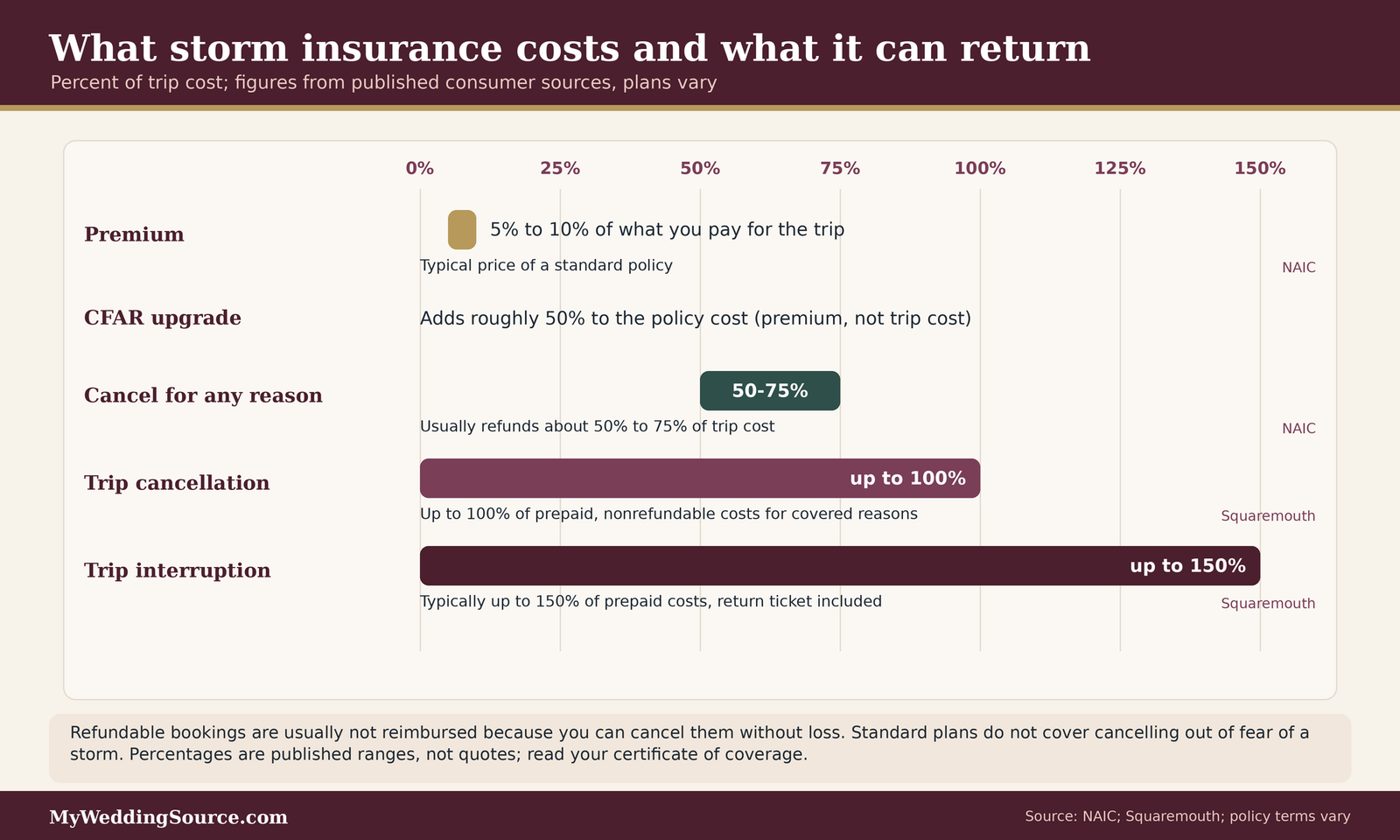
Squaremouth notes that standard policies do not cover trips cancelled out of fear of a storm or because beaches, pools, or restaurants are closed, and that a cancel-for-any-reason or interruption-for-any-reason upgrade is needed for those cases. The NAIC, the association of state insurance regulators, describes the cancel-for-any-reason add-on as one that usually refunds around 50 percent to 75 percent of the trip cost and typically requires buying early, insuring the full trip cost, and cancelling at least 48 hours before departure. Our honeymoon travel insurance guide covers the broader choices.
Questions for everyone else
Tour operators, transfer companies, car rental desks, and your payment method each carry their own terms. A short list keeps these from being forgotten.
Ask the smaller vendors
Prepaid tours, private transfers, and activity bookings often have separate cancellation windows that do not match the hotel’s. Ask each one whether weather cancellations are refunded, credited, or rescheduled, and whether a credit expires. Also ask whether the vendor cancels on its own when conditions are unsafe, and whether you would receive a refund in that case. If you are renting a car, our guide on honeymoon rental car insurance covers that piece separately. The small bookings are easy to forget in honeymoon travel during hurricane season, and they add up.
Ask your card issuer
The Federal Trade Commission explains that you can dispute a credit card charge in writing within 60 days after the first bill showing the error was sent, and that billing errors include items not delivered as agreed. It adds that for services not delivered, you should contact the seller first and quickly, and that certain protections apply to purchases above a threshold made within a distance of your billing address. A card dispute is a backstop and not a plan, and your issuer’s own benefits, such as trip protection on some cards, vary, so ask which events they cover. For honeymoon travel during hurricane season, think of the card as a late backstop.
How to read a hurricane policy without a law degree
Hurricane policies are marketing and contract language at the same time. A few reading habits make the difference between a promise you can rely on and one you cannot. These habits apply to hotels, tour operators, and insurers alike.
Triggers: what must happen first
The trigger is the event that opens your options. Everything else depends on it, so read it first and read it twice.
Watches, warnings, and categories
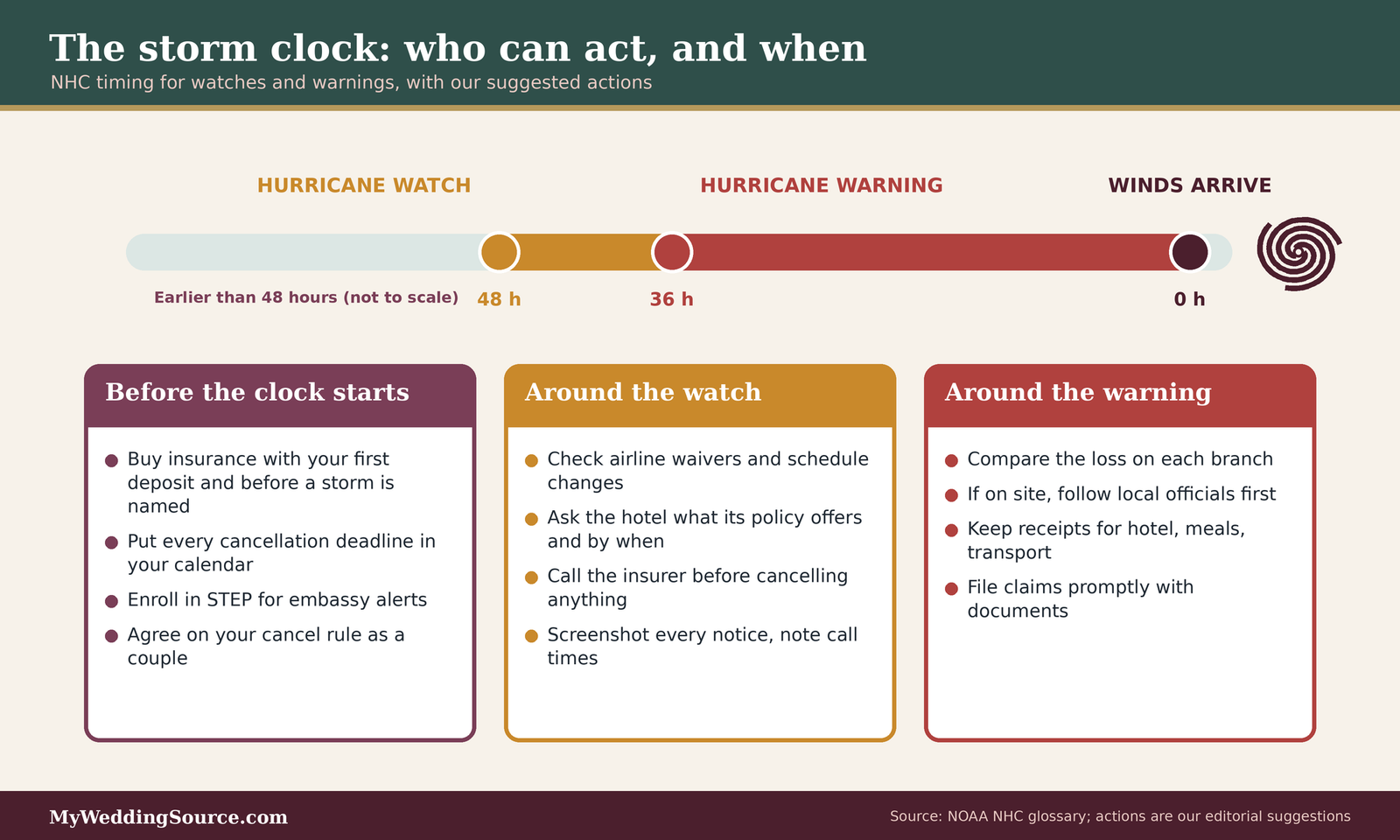
The National Hurricane Center defines a hurricane watch as meaning sustained winds of at least 64 knots, or 74 miles per hour, are possible in the area, and says it is issued 48 hours before tropical-storm-force winds are expected to begin. A hurricane warning means those winds are expected and is issued 36 hours before. Tropical storm watches and warnings use the same 48 and 36 hour timing for winds of 34 to 63 knots. Those definitions are for U.S. forecasts, and other countries’ agencies issue their own alerts, so ask which agency your property follows. These terms show up in almost every policy for honeymoon travel during hurricane season, so learn them once.
Official orders and the property’s own decision
Some policies depend on a government order, such as an evacuation, and some depend on the property’s own judgment, such as closing the hotel. The difference matters. A policy that depends on a decision only the hotel can make leaves the timing in its hands, and a policy that refers to an official alert from a named agency is easier to verify. Ask which type you have, and who makes the call.
Remedies: what you actually receive
After the trigger, look at what the policy gives you. Words like “flexibility” and “protection” do not say whether you get cash, credit, or a new date.
Cash, credit, or a new date
A refund returns money to your card. A credit keeps the money with the business, often with an expiration date and restrictions. A rebooking keeps your stay but moves it, subject to availability. Each can be reasonable, and they are not the same, so ask which one applies and whether you can choose. The Cayman tourism page describes its guarantee as a cancellation or compensation arrangement, and the Sonesta example offered a mix of rebooking, credit, and standard cancellation, which shows how much policies can differ. Choose the remedy that fits your honeymoon travel during hurricane season, not the one that sounds friendliest.
What is left out
Most hotel policies cover the room and little else. The Sonesta page states that its policy does not cover third-party services such as airline tickets, car rentals, or travel insurance, and that guests must contact those providers about their fees. The Cayman tourism page makes a similar point for flights, directing travelers to contact their airlines directly. Assume your flights, transfers, and tours are separate until a business tells you in writing that they are not. Keep a separate list of what is left out when you plan honeymoon travel during hurricane season.
Expiration dates and fine print
Policies change. A page that was accurate last year can be out of date this year, and that is a real risk when you are relying on a screenshot.
Check the dates on the page
The Sonesta page we reviewed said it applied only through November 30, 2022, which is a good reminder that a hurricane policy is often tied to a season. Check that the policy covers your travel dates, and ask the property to confirm it applies to your booking. If you cannot find a date, ask for one. Stale pages are a quiet hazard in honeymoon travel during hurricane season.
Save what you were told
Take a screenshot of the policy with the date visible, save the email in which the property confirms it, and keep both with your reservation. If a dispute comes later, the version you booked under is the one that matters, and you will want proof of it.
Flights: what the airline owes you and what it does not
Your flight is often the weakest link in a honeymoon plan, because it is the one part you cannot move around yourself. Knowing the federal baseline lets you ask better questions and judge offers from the airline when a storm is in the forecast.
Refunds, credits, and rebooking
When a flight is cancelled, most travelers are offered a new flight or a voucher before they think about a refund. Knowing the difference helps you choose with open eyes.
The refund right
The Department of Transportation says a cancelled flight entitles you to a refund if you decline alternatives, and that when you reject a rebooking offer or do not respond, the refund should be issued automatically. It gives roughly seven business days for credit card payments and about 20 days for other payment methods. It also says that if you take the changed flight or an alternative the airline offers, a refund is generally not owed, so do not accept a substitute before you decide what you want. Few travelers planning honeymoon travel during hurricane season realize the refund is a right and not a favor.
Vouchers and credits
The Department says airlines may offer credits or vouchers instead of cash, but they must be valid for at least five years, and any material restrictions must be disclosed. A credit can be a fair outcome for a couple who plans to travel again, and a poor one if you will not. Decide ahead of time which you want, and ask for the refund in plain language if that is your choice. Decide your preference before the airline asks, especially for honeymoon travel during hurricane season.
Who is responsible when you booked through an agency
Booking channels matter more than most travelers expect. The party that took your payment is the party you chase for a refund.
Merchant of record
The Department says the merchant of record, the name that appears on your card statement, is responsible for airfare refunds. That is the airline if you bought directly, and the agency if you bought through one. For add-on fees such as bags, it says to request the refund from the airline. Before you book through a third party, ask who handles storm-related changes and how long they take, and save a screenshot of the answer. This detail changes who you call first during honeymoon travel during hurricane season.
The twenty-four hour rule
For tickets bought at least seven days before departure, the Department says airlines must either allow a full refund within 24 hours of booking or hold the reservation at the quoted price for 24 hours, and that it does not have to offer both. The rule does not apply to tickets bought through agents or online agencies, which you should contact directly. It is a useful window for double-checking dates, names, and routes, and our name mismatch guide is worth reading before you commit.
Delays, hotels, and meals
The most common storm disruption is not a cancellation. It is a delay or a missed connection that leaves you in an airport with luggage and no room.
What is not required
The archived DOT consumer page says that for domestic trips, federal rules do not require compensation for delays or cancellations, and that on international trips you may be able to seek reimbursement of delay-related expenses under the Montreal Convention by filing a claim with the airline. It repeats that meals and hotels are not federally required and depend on the airline’s policy. The Department’s newer cancellation dashboards cover only disruptions within an airline’s control, so ask the airline directly whether weather delays are included. Budget for the night in a hotel when you plan honeymoon travel during hurricane season.
How to prepare for a long delay
Keep the first night’s hotel cost in your emergency plan, and check whether your insurance has a delay benefit. Squaremouth says delay benefits usually start after a delay of three to twelve hours depending on the plan, and that a missed-connection benefit may help with costs to catch up with a trip. Keep receipts, and ask the airline in writing whether it will reimburse reasonable expenses, since the Department notes bag-related emergency expenses are negotiable.
Travel insurance for storm season
Insurance is where couples most often expect more than they receive, so this section sticks to what the sources actually say. Nothing here is advice about a particular policy, and policy wording always controls.
What standard coverage tends to include
A standard policy is not a hurricane policy, and it works through covered reasons. Understand those reasons before you rely on them.
Cancellation, interruption, and delay
The NAIC describes trip cancellation, interruption, and delay as the most commonly purchased type of coverage, reimbursing prepaid, nonrefundable trip costs if you cannot take all or part of the trip for a covered reason. Squaremouth says cancellation can reimburse up to 100 percent of prepaid, nonrefundable costs for covered reasons such as a hurricane warning at your destination, an airline cancellation, or an uninhabitable hotel, and that interruption typically reimburses up to 150 percent of prepaid costs, including a return ticket, if you must head home early. Those are one comparison site’s descriptions, and your plan may differ. These are the three benefits that matter most for honeymoon travel during hurricane season.
Evacuation orders
Squaremouth says a mandatory evacuation at your destination is a common covered reason, and that about 53 percent of its hurricane-covered policies include it, while a mandatory evacuation at your departure city is covered far less often, by about 8 percent of its policies. Those are its own data, so treat them as an illustration of how much plans vary. Ask your insurer directly which type of order counts.
What storm protection can cost
The NAIC says travel insurance typically costs about 5 percent to 10 percent of the trip price, and that cancel-for-any-reason can add roughly 50 percent to the policy cost while reimbursing around 50 percent to 75 percent of the trip. As our own illustration, not a quote: on a $6,000 honeymoon, a 5 to 10 percent policy would be roughly $300 to $600, and an upgrade adding about half again would bring that to roughly $450 to $900, with a reimbursement of roughly $3,000 to $4,500 if you cancel for a reason the base plan does not cover. Compare that with the nonrefundable portion of your booking, and with the room-rate difference for a refundable option. Our honeymoon budget guide shows where to put these lines.
The timing rules that trip people up
Most disappointment with storm insurance comes from timing, not coverage. A few rules explain why.
The named-storm cutoff
NerdWallet says that once a storm is named, newly purchased policies typically will not cover claims for it, and it advises buying at least 24 hours before a storm receives a name. At booking, buying generally works if no storm is already forecast. Mid-trip, it says, options are limited, may have waiting periods, and trip cancellation coverage no longer applies. The safest habit is to buy when you pay your first deposit. Put the purchase date on your calendar for honeymoon travel during hurricane season, since it cannot be repaired later.
The early-purchase window
NerdWallet adds that buying within 14 days of your first trip payment keeps pre-existing medical conditions eligible for coverage, and Squaremouth says cancel-for-any-reason may cover a storm named before your purchase, but usually only if you buy within 14 to 21 days of your initial trip deposit. The NAIC says the add-on typically requires insuring the full trip cost. These windows are short, so put the dates in your calendar on the day you book.
What the policy will not do
Insurance does not make a trip risk-free, and understanding its limits protects you from false confidence.
Refundable bookings are usually not reimbursed
NerdWallet notes that refundable or penalty-free bookings usually are not covered, since you can cancel them without loss. If you book a flexible room, your insurance may have little to reimburse on that part of the trip. That is not a problem, since the flexibility already protects you, and it is a reason to put the insurance money where the nonrefundable costs are. That overlap is worth mapping before you pay for coverage for honeymoon travel during hurricane season.
Fear and closures are different from a covered reason
Squaremouth says standard policies do not cover cancellations out of fear of a storm or because amenities are closed. The NAIC adds that add-ons bundled with a booking, such as cancellation fee waivers, are often not insurance and are not overseen by state insurance departments. Read the full policy document, the exclusions in particular, and check whether your credit card already offers a benefit that overlaps, since some do, with terms that vary by issuer.
A decision timeline from booking to the storm clock
Decisions are easier when you know when they come due. The timeline below combines what the sources say with our own suggestions, and it is organized around the point at which you know the most, which is usually late.
Before you book and while you wait
The cheapest moment to create flexibility is before you pay. After that, every option costs more or is simply unavailable.
At booking
Choose rates and fares with cancellation terms you can live with, ask the hotel the question script above, and buy insurance with the first deposit. Save every policy and confirmation in one folder. Check the passports and names on each ticket, and read our honeymoon booking checklist for the rest of the paperwork. Every step in this guide to honeymoon travel during hurricane season gets cheaper if it happens here.
In the weeks before you travel
Check the National Hurricane Center’s outlooks periodically, and set a date, such as ten days before departure, when you will review each booking’s cancellation deadline. This is our suggestion, not an official step. The goal is to make decisions on your own schedule and not in a rush after a storm is named. The State Department’s free Smart Traveler Enrollment Program, STEP, sends alerts from the nearest U.S. embassy or consulate, including weather and disaster notices, so enroll before you go. A small habit of checking in keeps honeymoon travel during hurricane season from turning into a scramble.
When a storm appears on the map
A named storm in the forecast is the moment all your preparation gets tested. Slow, written decisions beat fast, spoken ones.
Watches and warnings as a clock
The National Hurricane Center issues a hurricane watch 48 hours before tropical-storm-force winds are expected and a hurricane warning 36 hours before, which means airlines, hotels, and airports may act before you can. A hotel policy tied to a watch opens earlier than one tied to a warning, and a policy tied to the storm’s name may open earlier still. Check each business’s trigger against the alert, and write down the time of any call or message. The clock is the core of any plan for honeymoon travel during hurricane season.
The questions to ask in order
First, check whether your airline has announced a waiver or a schedule change. Second, ask the hotel what its policy offers and by when you must choose. Third, call the insurer to confirm what the plan covers and whether you need to notify it before you cancel. Fourth, decide with the facts in hand, and write down what you chose and why. Our guide is not a substitute for official local instructions, which you should follow if you are at your destination.
Making the call with partial information
You will rarely have a perfect forecast. The decision is about acceptable loss, not certainty.
Compare the loss on each branch
If you cancel and the storm misses, what do you lose? If you go and the storm arrives, what do you lose, and what can you recover? Write both numbers down, include the cost of a delayed return, and weigh them with the refund rules for each booking. A calm comparison on paper often shows that one branch is clearly cheaper, and when it does not, you can pick the option that lets you live with the outcome. This comparison is the most practical tool for honeymoon travel during hurricane season, and it needs only a pencil.
Agree on the rule before the stress
Couples often disagree about risk, and the middle of a forecast is a poor time to discover it. Before you travel, agree on a rule, such as “we cancel if the property closes or an evacuation is ordered, and we wait if it is only a watch.” A shared rule keeps the decision from becoming an argument. A shared rule is the kindest thing you can add to honeymoon travel during hurricane season.
If a storm threatens before or during your trip
The plan changes depending on where you are when the storm shows up. Each stage has its own priorities, and none of them is “wait and see.”
Before you leave home
At home you have the most options, and they shrink with every hour.
Contact the airline first
Check the airline’s app and website for waivers and schedule changes, and look at the DOT’s rules on refunds if the flight is cancelled. If the airline cancels, you can seek a refund by declining the alternatives. If it does not, your ticket’s change and cancellation terms apply. Keep screenshots of the notices. In honeymoon travel during hurricane season, the airline’s notice often arrives before anyone else’s.
Then the hotel and the insurer
Ask the hotel which option applies and by what deadline, and ask the insurer whether to notify before you cancel. Do not cancel the insurance-covered portion until you know what the plan requires, since a premature cancellation can complicate a claim. Our wedding insurance guide explains how that kind of policy differs, in case you hold one for the wedding itself.
While you are at the destination
A storm that arrives during your trip is a safety matter before it is a money matter. Follow local officials and your hotel’s instructions.
Safety comes first
The National Weather Service lists storm surge, wind, rain flooding, tornadoes, and rip currents among the hazards, and its guidance for acting as a storm approaches is on its hurricane pages. Follow evacuation orders, keep your phone charged, and keep your passports and medications together. If you enrolled in STEP, watch your email for embassy messages, and contact the nearest U.S. embassy or consulate if you need help. No part of honeymoon travel during hurricane season outranks following official instructions.
Paperwork while you wait
If your flight is cancelled or delayed, keep every receipt, note the time of each call, and ask the airline in writing what it will reimburse. Squaremouth says delay benefits can reimburse extra hotel, meal, and transportation costs, so photograph your receipts. Staying calm and organized now makes the claim process much easier later.
After the storm
The storm passing does not end the decisions. Airports reopen in stages, and damage can change what is available.
Rebooking and re-entry
Expect crowded flights and limited seats, and ask the airline early about other carriers, which it is not required to arrange, the DOT notes. If your hotel is closed, ask about credits and rebooking. Keep the original confirmation and any messages that show the property’s promise. Expect friction here during honeymoon travel during hurricane season, and give yourself patience.
Filing the claims
File insurance claims promptly with every document the insurer lists, and request refunds in writing. If a refund does not arrive, the FTC’s guidance on card disputes, including its 60-day window, is the next step. Keep copies of everything, and note the dates, because deadlines are short.
A money map: who pays for what when the plan changes
The easiest way to stay calm when a forecast changes is to know in advance which dollars are protected and which are not. This section turns the rules above into a simple map you can fill in for your own trip.
Build your own flexibility map
List every payment you have made or will make, and mark each with the way out. The exercise takes about fifteen minutes and replaces a vague worry with a short list.
Sort each cost into a bucket
Put each cost in one of four buckets: refundable by the business, creditable by the business, reimbursable by insurance, or at risk. Flights usually belong in the first or second bucket if the airline cancels and in the third if you cancel for a covered reason. A hotel with a published hurricane policy may belong in the first or second, depending on the trigger. Prepaid tours and transfers often belong in the fourth until you ask. Filling in the buckets is the quickest way to see how exposed honeymoon travel during hurricane season really is for you.
Add the dates
Next to each item, note the deadline for cancelling, the deadline for a claim, and the date any credit expires. A cost that is refundable until a date next week and at risk after that is a different item from one that is refundable until the day you fly. Those dates are what you will check first when a storm shows up on the map.
Which costs deserve protection first
You cannot protect everything equally, and you do not need to. Focus on the largest and least flexible items.
Large and nonrefundable first
Rank the items by size and by how hard they are to get back. A prepaid resort package and a nonrefundable flight usually sit at the top, and a refundable transfer sits at the bottom. If a flexible rate costs a little more than the nonrefundable one, compare that difference to the loss you would face without it, using your own numbers. Start with the biggest line, since that is where honeymoon travel during hurricane season costs the most.
Check overlapping protection
Some credit cards provide trip protection, some resorts publish hurricane policies, and some airlines offer flexible change rules. Before buying more, check what already exists. NerdWallet says some cards include travel protections that may cover hurricanes and that terms vary, so ask the issuer, and the NAIC advises comparing what your existing health, homeowner’s, and credit card coverage already provides.
Edge cases couples ask about
Real trips do not fit tidy rules. These situations come up often enough to be worth thinking about in advance.
When the storm misses but the trip suffers
A storm can disrupt a trip without ever reaching your resort. Those cases are often the hardest to resolve because they sit between policies.
Rough surf and closed amenities
The National Weather Service says dangerous surf and rip currents can occur even when a storm is more than a thousand miles offshore. A beach closure, a closed pool, or a cancelled excursion is often not a covered reason, because Squaremouth says standard policies do not cover cancellations because amenities are closed. If you want that protection, it comes from a cancel-for-any-reason upgrade or a flexible rate, not from a standard plan. These smaller disappointments are common in honeymoon travel during hurricane season.
Flights cancelled for a storm elsewhere
A storm near a connecting hub can cancel your flight even if both your home and your destination are fine. In that case, the airline’s cancellation triggers the refund right described above. If you are rebooked on a flight that works, you can accept it, and if it does not, decline it and request your refund. Ask the hotel what happens to your nights if you arrive late.
When the honeymoon is part of a larger plan
Honeymoons often connect to a destination wedding, a family visit, or a work return date, and the interactions are easy to miss.
Destination weddings and honeymoons together
If the wedding itself is in a storm-prone place, read our guides on destination weddings and the destination wedding checklist, since the wedding and honeymoon may be on different contracts and different insurance. A single policy rarely covers both the same way, so ask your insurer how it treats an event followed by a trip. Combining a wedding with honeymoon travel during hurricane season multiplies the contracts to track.
Return dates and work
If your return date is fixed, add the cost of a delayed return to your comparison, and plan a buffer day if your schedule allows. It is a quiet way to reduce stress, and it costs less than a missed start date. Some couples also build in a flexible extra night at the end, which a flexible rate makes easier. Return dates are the hidden risk in honeymoon travel during hurricane season.
Payments, points, and special situations
A few booking methods carry their own rules, and it is worth looking them up before you rely on them.
Bookings made with points or credits
Our sibling guide on honeymoon using points covers award travel in detail. For storm planning, ask the program how a cancellation returns points or fees, and whether a change costs extra. We did not research individual loyalty programs for this guide, so check the current terms yourself.
Cruises and other trips we did not research
We did not review cruise line policies for this guide, and cruises have their own rules for itinerary changes and refunds. If a cruise is part of your honeymoon, ask the line for its written policy before you book, using the same four questions: trigger, remedy, process, and paperwork. Cruises add their own layer to honeymoon travel during hurricane season, and we cannot speak to it here.
Frequently asked questions
Timing
Is honeymoon travel during hurricane season a bad idea?
Not necessarily. NOAA describes a long Atlantic season, June 1 to November 30, with activity peaking around September 10. Whether it is wise depends on how much of your trip is nonrefundable and whether you can change dates. Many couples go with flexible bookings and insurance bought early, and others pick a different destination or month.
When is the riskiest part of the Atlantic season?
NOAA says most storms form between mid-August and mid-October, with a peak around September 10. Individual seasons vary a great deal, and storms can form outside those dates. We cannot give a probability for your week, so use the calendar to decide how much flexibility to build in, not to predict a storm.
Risk and safety
Does a storm have to hit my resort to affect my trip?
No. The National Weather Service says surf and rip currents can be dangerous even when a storm is far offshore, and the forecast cone does not show where impacts will occur. Flights can also be cancelled because of weather at a connecting airport. A near miss can still cost you flights, amenities, or days.
What should I do if a storm is forecast while I am abroad?
Follow local officials and your hotel’s instructions first. Enroll in the State Department’s STEP program before you leave so the nearest embassy or consulate can send alerts and reach you in an emergency. Keep passports, medications, and receipts together, and contact your airline and insurer early. Do not rely on this guide over official local guidance.
Flights and hotels
Can I get a refund if my flight is cancelled for weather?
According to the Department of Transportation, if an airline cancels your flight for any reason, including weather, you are entitled to a refund if you do not travel and do not accept credits or other compensation. A refund is also due after a significant change that you decline. Read the Department’s current page, and ask your airline how to claim.
Does a hotel hurricane guarantee cover my flights?
Usually not. The Cayman Islands tourism page says travelers must contact their airline directly, and a Sonesta policy we reviewed excluded airline tickets, car rentals, and travel insurance. A hotel guarantee generally covers the room, and the trigger can differ, such as a watch or a warning. Ask for the terms in writing.
Insurance
When should I buy travel insurance for a storm?
Buy it with your first deposit, and before any storm is named. NerdWallet says new policies typically will not cover a storm once it is named, and advises buying at least 24 hours before naming. Squaremouth says cancel-for-any-reason may cover earlier storms only if bought within 14 to 21 days of the deposit. Policies vary, so read yours.
What does cancel for any reason actually do?
The NAIC says it lets you cancel for reasons your base policy does not cover, usually refunding around 50 to 75 percent of trip cost, and that it typically requires buying early, insuring the full cost, and cancelling at least 48 hours before departure. It can add roughly half again to the cost. Compare that with your nonrefundable exposure.
Your next steps
Decide and document
Choose your loss limit
Write down how much of the honeymoon you can afford to lose and how many days you can move. Use the go, wait, or change test above, and settle the question for honeymoon travel during hurricane season before you pay a deposit. Our honeymoon planning guide can help you place this work in your overall schedule.
Send the question script
Email the hotel, airline or agent, and insurer the questions in this guide, and file the replies. Drop any option that will not answer in writing. For the paperwork around names and tickets, see our honeymoon booking checklist.
Protect and prepare
Buy the right coverage at the right time
Buy insurance with your first deposit, read the named-storm and evacuation language, and decide whether you need a cancel-for-any-reason upgrade. Our honeymoon travel insurance guide covers the broader choices.
Set your checkpoints
Put the cancellation deadlines, claim deadlines, and credit expiration dates in your calendar, enroll in STEP, and agree on a shared rule for when you will cancel. If the trip has several parts, review the honeymoon destinations guide for alternatives.
Sources & methodology
How we built this guide
What we relied on
This guide combines NOAA and National Weather Service material on hurricane season dates and hazards, Department of Transportation consumer rules for airline refunds, the Federal Trade Commission’s guidance on credit card disputes, the NAIC’s consumer page on travel insurance, a State Department page on traveler alerts, and published policies and explainers from a tourism board, a hotel, and travel insurance comparison sites. Where a statement comes from a hotel, tourism board, or insurance seller, we say so, because sellers describe their own products. The sample cost figures are our own arithmetic from published percentages and are estimates, not quotes. We checked these pages on November 12, 2026. Policies and rules change, so recheck the terms that apply to your booking.
What we did not do
We did not review cruise lines or loyalty programs, test any insurance policy, or give legal, financial, or insurance advice. One State Department international travel page we opened was out of date, so we relied on its separate traveler-alert page. The DOT consumer page on delays is archived and may be outdated, so we used it only for background. Some official pages did not load when we tried them. We did not use them.
Source list
Government and regulatory sources
- NOAA National Hurricane Center, Tropical cyclone climatology: https://www.nhc.noaa.gov/climo/
- NOAA National Hurricane Center, Glossary of terms (watches and warnings): https://www.nhc.noaa.gov/aboutgloss.shtml
- National Weather Service, Hurricane safety: https://www.weather.gov/safety/hurricane
- U.S. Department of Transportation, Refunds: https://www.transportation.gov/individuals/aviation-consumer-protection/refunds
- U.S. Department of Transportation, Fly rights (archived page): https://www.transportation.gov/airconsumer/fly-rights
- U.S. Department of Transportation, Airline customer service dashboard: https://www.transportation.gov/airconsumer/airline-customer-service-dashboard
- U.S. Department of State, Smart Traveler Enrollment Program: https://travel.state.gov/content/travel/en/international-travel/before-you-go/step.html
- Federal Trade Commission, Disputing credit card charges: https://consumer.ftc.gov/articles/disputing-credit-card-charges
Insurance, destination, and explainer sources
- NAIC, Travel insurance: https://content.naic.org/insurance-topics/travel-insurance
- NerdWallet, The guide to hurricane travel insurance: https://www.nerdwallet.com/article/travel/hurricane-travel-insurance
- Squaremouth, Hurricane travel insurance coverage explained: https://www.squaremouth.com/current-event-information-centers/extreme-weather-and-travel-insurance-information-center/fact-sheet-squaremouth-explains-travel-insurance-coverage-hurricanes/
- Cayman Islands Department of Tourism, Hurricane guarantee: https://www.visitcaymanislands.com/planning/weather/hurricane-guarantee
- Sonesta Sint Maarten, Hurricane policy: https://www.sonesta.com/sintmaarten/hurricane-policy
- University of Georgia Extension climate blog, What the forecast cone does and does not show: https://site.extension.uga.edu/climate/?p=17752