

Planning a honeymoon without checking a bag means choosing what two people will wear, wash, carry, and protect for the whole trip, then proving on your own floor that it fits before the airport proves it for you.
Quick answer
Planning a honeymoon without checking a bag works when you pack for one outfit cycle, not the whole itinerary: a small, mix-and-match wardrobe in two or three colors, one planned wash for trips longer than about a week, and a quart-sized bag of liquids that you build first. Confirm the exact size rule for each airline on your tickets, confirm that your hotels offer the laundry, iron, and storage you are counting on, and keep passports, rings, medication, and power banks in the bag that stays under your seat. Do a full dry run at home, with the real bags, a week before you leave.
What planning a honeymoon without checking a bag really means
Most travel advice about carry-on luggage is written for one person on a business trip, and planning a honeymoon without checking a bag asks for something else. A honeymoon is different. Two people are traveling on a single itinerary, there are usually a few dressier evenings, there may be a beach day and a city day in the same week, and there are often wedding gifts, rings, and paperwork that nobody wants to lose. Planning a honeymoon without checking a bag is therefore less about squeezing clothes into a suitcase and more about making a set of decisions in the right order.
Planning a honeymoon without checking a bag: fewer failure points, not a smaller suitcase
People are drawn to the idea of a carry-on-only trip for a mix of reasons: no waiting at a carousel after a long flight, no worry about a late bag on the first day of a once-in-a-lifetime week, and often a lower cost. Those reasons are all about removing failure points. A smaller bag is just the tool.
What a carry-on-only trip removes
When nothing is checked, a bag cannot be delayed, misrouted, or opened for inspection while you are in the air. You also skip the carousel, which on a tight connection can be the difference between making the next flight and not. On a trip with one or two flights, that may not matter much. On a trip with a transfer in a large airport, it matters a lot, and it is a good reason to take the idea seriously.
What it adds in return
Carry-on-only travel moves risk from the airline to you. You now carry every item through security, you choose what to leave behind, and you rely on your own packing discipline. It also puts a hard ceiling on how much you can buy and bring home. This guide treats those trade-offs honestly, because an honest approach to planning a honeymoon without checking a bag includes the cases where checking one bag is the sensible choice.
Who this guide is for
This guide on planning a honeymoon without checking a bag is written for engaged couples and newlyweds who are flying within the United States or abroad on a leisure trip of roughly three days to three weeks, and who want to keep every bag with them. It assumes an ordinary trip, not an expedition. If your honeymoon involves a specialty activity such as diving, skiing, or a long trek, the equipment alone may decide the question, and we cover those cases later as edge cases.
Couples who benefit most
The method for planning a honeymoon without checking a bag works especially well for couples with short or medium trips, with a mostly warm or mild climate, and with a plan to stay in places that have laundry access or a laundry service. It also suits couples with a tight connection, couples who are flying several short legs, and couples whose lodging is a long walk, a ferry, or a stairway away from the nearest road. Hauling one light bag up a flight of stairs is a different experience from hauling two heavy ones.
Couples who should think twice
If you are bringing gifts for hosts, bulky formal wear, or equipment for a sport, or if your destination is cold enough that a single coat fills a third of a bag, the plan still might work, but it takes more care. We are not trying to talk anyone into planning a honeymoon without checking a bag. We are trying to help you decide with evidence, and to build the plan well if you decide yes.
Decide whether a carry-on-only honeymoon fits your trip
Before you buy new luggage or a set of packing cubes for planning a honeymoon without checking a bag, run the decision. A few facts about your trip settle most of the question, and it is much cheaper to answer it in the planning stage than at the airline counter.
Length, climate, and laundry
Three numbers set the shape of your packing: how many nights you will be away, how warm or cold the weather will be, and how often you can wash clothes. Change any one and the whole list changes. When people struggle with this style of travel, it is usually because they chose a bag size first and tried to make the trip fit it.
Count nights and wash days
Count your nights, then count how many times you can realistically do laundry. A hotel laundry service, a self-service machine, or a bathroom sink wash each counts as a wash day. Our rule of thumb is to pack enough for about one outfit cycle, which is roughly four to seven days of clothing, and to plan a wash for everything beyond that. This is a planning estimate based on common packing practice, not a rule from an airline or a regulator.
Match clothing weight to the climate
Warm-weather clothing is light and compressible, so a week of it takes little space. Cold-weather clothing is bulky, and a single insulated jacket can take up a large share of the room in a carry-on. If your trip crosses climates, such as a ski town followed by a beach, plan to wear the heaviest layers on the plane and look closely at the edge cases section of this guide.
The itinerary stress test
Walk through your itinerary day by day and note every moment that puts a demand on your bags when you are planning a honeymoon without checking a bag. This takes about twenty minutes and often changes the plan.
List every transfer and carry
When planning a honeymoon without checking a bag, write down each flight, train, ferry, and long walk. Note any leg that is on a small regional aircraft, because overhead space on those is limited. Delta, for instance, states that on its Delta Connection flights with 50 seats or fewer only personal items are allowed in the cabin, and larger carry-on bags are checked at the gate at no charge and returned when you step off the plane. If your itinerary includes a small plane, your plan has to work with only a personal item, or it has to tolerate a gate check.
Mark the dressiest evenings
Underline every evening that needs something other than a casual outfit: a special dinner, a show, a ceremony of any kind. For most couples, that is one to three evenings. When planning a honeymoon without checking a bag, those outfits get priority in the bag, and everything else is built around them, as the capsule section explains.
A quick go or no-go check
After the first two checks, a simple pass over your answers gives you a decision. If your trip is short, warm, and has laundry access, planning a honeymoon without checking a bag is almost always reasonable. If it has a heavy piece of equipment, a cold climate, and no laundry, think about a hybrid plan.
The hybrid options
A hybrid version of planning a honeymoon without checking a bag keeps carry-on-only travel for the flights where it matters most, such as the outbound leg and the connection, and uses another method for the rest. Some couples ship a box to their first hotel, others check one shared bag only for a specific leg. Our guide to planning a honeymoon covers the broader decisions, and the honeymoon booking checklist helps you place bag decisions in your overall order of tasks.
When checking a bag is the better call
Check a bag when the cost of not doing so is higher than the cost of the fee or the risk, even if you started out planning a honeymoon without checking a bag. Examples include a sport that needs gear, a destination where you must bring items that cannot go in a carry-on, or a trip where a medical need requires bulky supplies. Choosing to check a bag in those cases is not a failure of planning. It is the result of planning.
Know the bag rules before you pack
The most common mistake in planning a honeymoon without checking a bag is assuming that one set of carry-on rules applies everywhere. Rules differ by airline, by aircraft, and often by fare type. Each of the points in this section comes from an airline or government page, and we name the source so you know how far to trust it. Always check your own airlines on the day you buy and again a week before you fly.
Carry-on and personal item sizes differ by airline
Most large U.S. airlines allow one personal item and one carry-on bag, but the numbers are not identical. The table below combines figures from Delta’s and American’s own carry-on pages with a November 2026 roundup from TravelAwaits for the other airlines. The roundup is a secondary source, so confirm the airline’s own page before you buy a bag.
| Airline | Carry-on bag | Personal item | Notes from the source |
|---|---|---|---|
| American | 22 x 14 x 9, including handles and wheels | 18 x 14 x 8 | Must fit the sizer; soft garment bag total can reach 51 inches |
| Delta | 22 x 14 x 9, total of 45 inches | Must fit under the seat | Jacket, umbrella, food bought after security, and a duty-free bag do not count |
| United | 22 x 14 x 9 | 9 x 10 x 17 | Figures from a secondary roundup |
| JetBlue | 22 x 14 x 9 | 17 x 13 x 8 | Figures from a secondary roundup |
| Southwest | 24 x 16 x 10 | Must fit under the seat | Figures from a secondary roundup |
| Frontier | 24 x 16 x 10, 35 lb limit | 14 x 18 x 8 | Roundup lists a weight limit; another guide says the personal item and carry-on are capped together |
Read the table as a floor, not a promise
For planning a honeymoon without checking a bag, the safest carry-on is one that fits the smallest limit on your itinerary, not the most generous one. If you fly one airline on the way out and another on the way home, buy for the tighter of the two. A bag that is fine at 24 inches on one airline can be refused on a 22-inch airline, and a gate check in that moment is the situation you set out to avoid.
Measure with the handles and wheels
Both Delta and American say their limits include handles and wheels. Skyscanner’s guidance makes the same point: measure the whole bag, not the empty shell. Put a tape measure on the bag at home, with the wheels on and the pockets full, and write the numbers on a note on your phone. It is much easier to answer a gate agent with a number than with a guess.

Fare type and flight type can change the answer
Two tickets on the same airline can have different baggage terms, and two flights on the same day can use different aircraft. This is where a plan most often goes wrong, because the quiet details do not appear on the first page of a booking.
Basic economy and the cheapest fares
We could not verify from the Delta and American carry-on pages whether the cheapest fares allow a full-size carry-on, because those pages do not address fare types. Skyscanner’s guidance notes that an oversized bag can be forced into the hold, sometimes with a charge that depends on your fare class. Read the fare rules on your booking confirmation, and if they are unclear, ask the airline in writing and save the reply. Our honeymoon booking checklist suggests where to store that confirmation.
Regional jets and full flights
Even a bag that meets the size rule can be gate-checked when overhead bins fill up. The Department of Transportation’s archived Fly-Rights page notes that airlines may gate-check carry-ons when cabin space runs out, often for the last passengers to board. Plan for it by keeping valuables and essentials in the bag that stays with you, as described in the packing-day section, and by boarding in your assigned group rather than waiting at the back.
What security and the cabin allow
Security rules are national and quite consistent, and they are the part of planning a honeymoon without checking a bag that you can fully control with a clear list. The Transportation Security Administration and the Federal Aviation Administration both publish them.
The quart bag and the three-point-four-ounce rule
TSA allows a quart-sized bag of liquids, aerosols, gels, creams, and pastes in a carry-on, with each container holding 3.4 ounces (100 milliliters) or less. TSA recommends keeping that bag separate from the rest of your carry-on for faster screening, and says larger containers go in checked baggage. When you are planning a honeymoon without checking a bag, that means every sunscreen, shampoo, moisturizer, and toothpaste has to be travel-sized or bought at the destination.
Batteries stay in the cabin
The FAA says spare lithium-ion batteries, including power banks and phone battery cases, must travel in carry-on bags only. If a carry-on is gate-checked, you must take the spare batteries out and keep them with you. Lithium-ion batteries are limited to 100 watt-hours each unless an airline approves a larger one, and the terminals must be protected from touching metal, for example by keeping the battery in its retail packaging, a sleeve, or a plastic bag. This is one more reason a carry-on-only plan is a good fit, because nothing here has to be moved at the last minute.
Build a capsule wardrobe for two
For planning a honeymoon without checking a bag, a capsule wardrobe is a small set of clothes in coordinated colors where nearly every top works with nearly every bottom. For two people on a honeymoon, the aim is not to look identical or to look minimal. The aim is to make a set of outfits that you each feel good in, from the airport to the best dinner of the trip, using the fewest pieces.
The formula
Planning a honeymoon without checking a bag works from a formula that you scale to the length of your trip. Our version below is a planning heuristic that we developed from common packing practice, not a standard, so adjust it to your habits.
Anchor colors and one accent
Pick two anchor colors that work with everything, such as navy and cream, or olive and sand, and one accent for a few pieces. Shoes and a belt in a single neutral make nearly everything coordinate. The point is to make every top work with every bottom, so you never have to ask whether something goes with something else while you are getting dressed on vacation.
The count per person
A workable start for each person is four to five tops, two to three bottoms, one dressier outfit, one layer for evenings or air conditioning, sleepwear, underwear for about a week, and a swimsuit if the destination calls for it. If your trip is longer than a week, do not add more clothes. Plan a wash instead. The inventory worksheet later in this guide turns these counts into a checklist you can print.
Fabrics and shoes decide the space
Two outfits of the same count can take very different room, depending on the fabric and the shoes. Shoes are the most underestimated space user in a small bag.
Choose fabrics that tolerate a sink wash
When planning a honeymoon without checking a bag, look for fabrics that dry quickly and do not need an iron, and test them before you go. Wash a top in the sink, hang it overnight, and see what it looks like in the morning. This is a thirty-minute test at home that saves you from discovering a problem in a hotel bathroom. We are not claiming any particular fiber is best, because the right answer depends on climate and comfort.
Limit shoes to what you will wear
Planning a honeymoon without checking a bag usually means about three pairs of shoes per person: the pair you wear on the plane, one dressier pair, and one pair for the beach or pool. Wear the bulkiest pair on the plane. Pack shoes so that the dirty soles face the outside of the bag, and put small items inside them to use the space.
Wear your heaviest items on the plane
A jacket, boots, or a bulky sweater take up far more space in a bag than on your body. Delta’s carry-on page lists a jacket as something that does not count toward the allowance, and Skyscanner’s guidance says a jacket and an umbrella usually travel free. Wearing the heaviest layer on board is the classic solution, and it works well for couples because each person’s jacket can carry a few small items in its pockets.
Pocket rules and the security line
You can use pockets to move items through security, but remember that a jacket usually goes in the bin at screening, so do not leave anything fragile or valuable in it. Wallet, phone, and keys belong in a zipped pocket or in your personal item, which you will keep in sight throughout.
When the jacket becomes the carry
On the plane, a jacket doubles as a pillow or a blanket. It is a useful thing to have on a long flight, and it is a good reason to bring a good one on a cool-weather honeymoon rather than leaving it at home.
The carry-on inventory worksheet
This is the working tool for planning a honeymoon without checking a bag. It turns the capsule formula into a list for two people, with a column for each trip length and a column where you record what you actually packed. Print it, or copy it into a notes app, and fill it in over two evenings rather than one.
How to use the inventory
The counts below are our planning estimates, built from the formula above. They assume mild weather, one planned wash for trips beyond a week, and one dressier outfit per person. Change them to match your habits, because a person who runs warm and re-wears nothing will need more tops than a person who is comfortable re-wearing a shirt.
| Item | Up to five nights | About a week | Ten nights or more | Notes |
|---|---|---|---|---|
| Tops | 4 | 5 | 5 to 6 | Mix of short and long sleeves in anchor colors |
| Bottoms | 2 | 3 | 3 | At least one that works for a dressier evening |
| Dressier outfit | 1 | 1 | 1 to 2 | Choose pieces that fold flat and tolerate a steamer |
| Layer for evening or cool air | 1 | 1 | 1 | Worn on the plane when possible |
| Underwear and socks | 5 | 7 | 7 plus a wash | Fast-drying fabrics help |
| Sleepwear | 1 | 1 | 1 | Can double as lounge wear |
| Swimwear, if needed | 1 | 2 | 2 | Two lets one dry |
| Shoes, packed | 1 | 2 | 2 | Plus the pair worn on the plane |
| Planned wash | none | optional | 1 | Hotel service, laundromat, or sink |
Counting for two people
Do the count for each person, then compare. Couples often find overlaps: one phone charger, one set of adapters, one first-aid kit, and one hair dryer if you will use one at all. Sharing those items is the biggest single saving of space in a two-person plan, and it is a good reason to treat the pair as a team with one shared list.
Assigning bags
Decide who carries which bag and why when planning a honeymoon without checking a bag. A common split is one roller carry-on and one backpack-style personal item per person, with the heavier items in the bag whoever is carrying it can lift overhead. Skyscanner notes that when an airline sets no weight limit, the practical test is whether you can lift the bag into the overhead bin yourself, so test-lift each bag at home with its real contents.
The packing order
For planning a honeymoon without checking a bag, pack in layers by how often you need access, not by category. The items you need during the trip’s travel day go on top or in the personal item. The items you want at your destination go in the carry-on.
Build from the bottom up
Start with the bulkiest and least-needed items at the bottom of the carry-on, near the wheels: shoes, a spare layer, and sleepwear. Roll or fold the rest into packing cubes by outfit or by person. Put the quart bag at the top, so it comes out in one motion at security.
Keep a reserve pocket
Leave one pocket or a small cube empty or nearly empty. It is the space for a souvenir, a bottle bought after security, or a last-minute item. Skyscanner points out that food or drink bought after security does not count toward the carry-on allowance on many airlines, but the empty space still matters on the way home.
The inventory sheet
Use the sheet below to record what each person packs. It is also useful for the return trip, because it tells you what should be in the bag when you leave.
| Zone | Item | Person A | Person B | Packed |
|---|---|---|---|---|
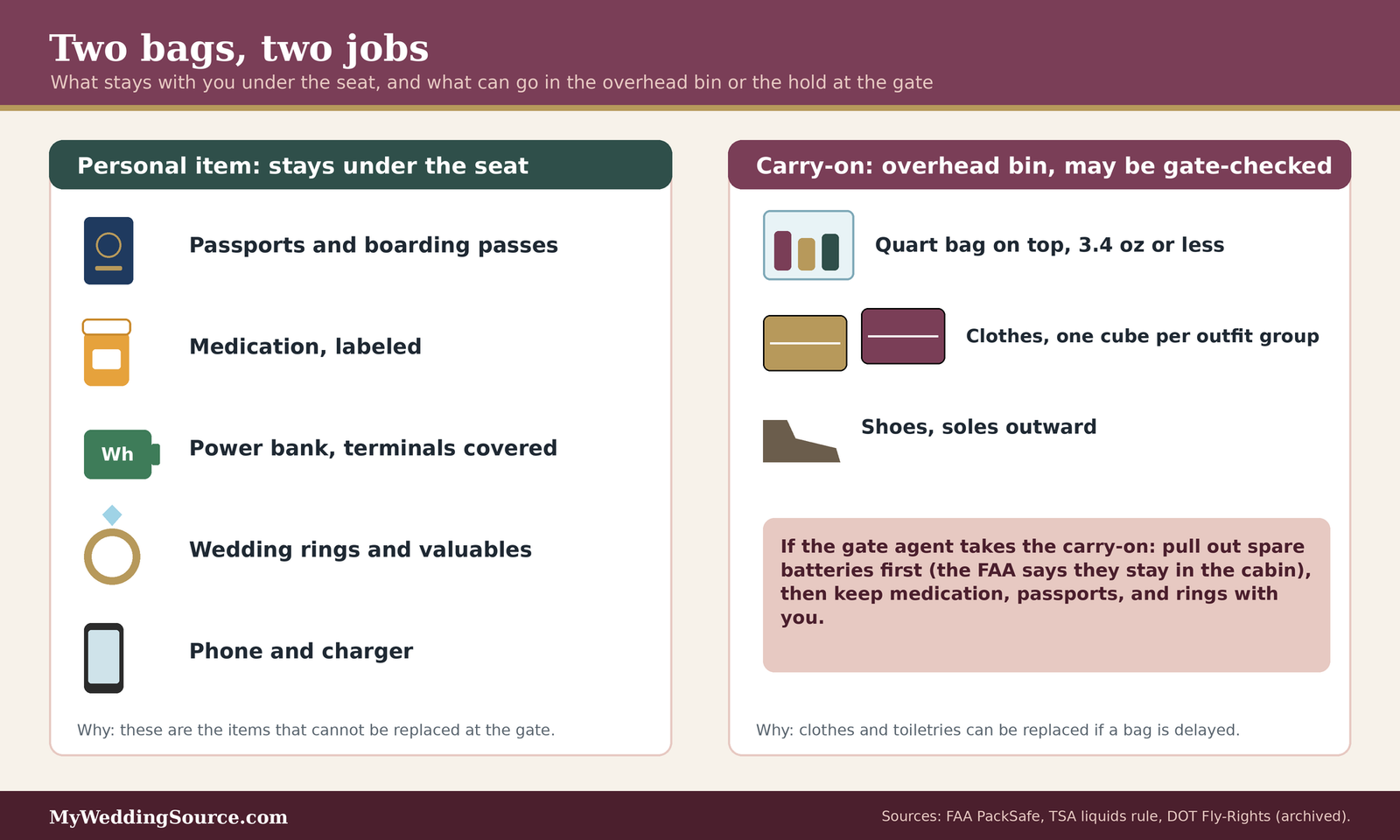
| Personal item | Passports, boarding passes, and any visa or entry paperwork | [ ] | ||
| Personal item | Medication in labeled containers, with a copy of prescriptions | [ ] | ||
| Personal item | Phone, charger, power bank with protected terminals | [ ] | ||
| Personal item | Wedding rings or any jewelry you wear | [ ] | ||
| Personal item | One change of clothes and a swimsuit | [ ] | ||
| Carry-on | Clothes in packing cubes, one cube per outfit group | [ ] | ||
| Carry-on | Shoes, soles outward, small items inside | [ ] | ||
| Carry-on | Quart bag of liquids at the top | [ ] | ||
| Carry-on | Adapters, cables, headphones | [ ] | ||
| Worn on the plane | Heaviest shoes and layer | [ ] |
What belongs in the personal item
Put anything that is irreplaceable, expensive, or required for the trip in the bag that stays under your seat. The Department of Transportation’s archived Fly-Rights page advises keeping cash, jewelry, medication, passports, and keys with you rather than in checked bags, and the same advice applies to a gate-checked carry-on. If your roller bag is taken at the gate, you can walk off the jet bridge with the items that matter.
What can wait in the carry-on
Clothing, shoes, and ordinary toiletries are replaceable. If the worst happens and the bag is gate-checked and delayed, you can buy basic replacements. Keep that in mind when you are deciding where an item goes, and do not let the fear of losing a bag push everything into the personal item until it will not fit under the seat.

Verify the hotel before you rely on it
Planning a honeymoon without checking a bag quietly depends on the places you stay. If you are counting on a laundry, an iron, a hair dryer, or a place to store a bag, you want to confirm those things before you leave, in writing, instead of discovering a gap when you arrive. We call this a hotel verification, and it covers two things: the amenities that make light packing possible and the physical access that makes carrying a bag possible.
The amenity check
For each place you will stay, write down what you are relying on and where you learned it. A listing page, a review, and a reply from the front desk are three different levels of evidence, and only the last one is worth building a plan on.
Laundry options
Ask whether the property has a guest laundry, a laundry service with a stated turnaround, or an arrangement with a nearby laundromat. If it is a service, ask for the price list and the turnaround time in writing, because a three-day turnaround does not help on a two-night stay. Do not assume that a laundry service is cheap or fast. This guide does not publish any price, because prices vary a great deal by property and country.
In-room items you can leave at home
In planning a honeymoon without checking a bag, confirm whether the room has an iron or a steamer, a hair dryer, a safe, and basic toiletries such as shampoo and body wash. Hotel toiletries can save you space, but the quality and the quantity vary, and if you have a skin sensitivity, you may prefer your own. This is a judgment call, and we do not claim that any one approach is better.
The access check
Planning a honeymoon without checking a bag makes carrying easier, but the property still needs to be reachable. This check also matters for couples where one person has limited mobility, or where either of you will be using an assistive device.
Stairs, elevators, and distance
Ask how you get from the street or the dock to the room: how many stairs, whether there is an elevator, and what the surface is like between the road and the entrance. A cobblestone lane or a gravel path is hard on wheels. Delta and American both state that assistive devices and mobility aids do not count toward the carry-on allowance, which helps, but it does not replace asking about the physical route. For a fuller treatment, see our guide to a honeymoon with mobility needs.
Luggage holding and early arrival
Ask whether the property will hold your bags before check-in, which matters when you are planning a honeymoon without checking a bag or after check-out, and whether there is a charge. A holding service lets you explore on arrival day without carrying your bag, and on departure day it lets you enjoy a late checkout without a full pack on your back. Ask what the policy is in writing, and take a photo of the claim tag.
A message you can send
When planning a honeymoon without checking a bag, a short written message is the simplest way to get evidence. It gives the property a chance to answer clearly, and it gives you a record. Our version below is a template, not a script, and you should adapt it to the property.
| What to confirm | Why it matters | Evidence to keep |
|---|---|---|
| Laundry service or machines, hours, turnaround | Lets you pack for one outfit cycle | Written reply with date |
| Iron, steamer, hair dryer in room | Saves packing space | Listing text and a reply |
| Route from street to room: stairs, elevator, surface | Determines how easy it is to carry a bag | Reply or a photo |
| Luggage storage before check-in and after check-out | Frees arrival and departure days | Written policy and tag photo |
| Toiletries supplied | Reduces the quart bag | Listing text |
| In-room safe, size | Place for passports and rings | Reply |
| Check-in and check-out times | Affects your bag plan | Confirmation email |
The message itself
Write something short and polite: say who is traveling, the dates, and the two or three questions that matter most. For example, ask whether there is a guest laundry or a laundry service with a same-day option, whether the room has an iron and a hair dryer, and whether the property can hold bags on arrival day. A message that is easy to answer gets a faster reply.
What to do with a vague reply
If you get a vague answer, such as “we can usually help,” treat it as a no for planning purposes and plan around it. Ask once more, politely, for a specific answer. If the property cannot say, build your plan so that it works without that service, for example with a sink wash and an extra pair of underwear.
Toiletries, beauty, and the quart bag
Liquids are where most plans for a honeymoon without checking a bag fall apart, because nearly every beauty and grooming product is a liquid, a cream, or a gel by TSA’s definition. The good news is that the rule is simple, and a short list makes it manageable for two people.
Build the quart bag first
Because the quart bag is the one fixed constraint in planning a honeymoon without checking a bag, build it before anything else and see how much room is left for the rest. Every container must hold 3.4 ounces or less, and everything must fit in one quart-sized bag, according to TSA.
One bag per person or one for two
TSA’s page describes the limit as a quart-sized bag of liquids in your carry-on. We read that as one bag for each traveler, which is the common practice, but confirm it on TSA’s page before you fly. Giving each of you a bag roughly doubles your liquid capacity and keeps each person’s items separate at the checkpoint.
Prioritize what has no easy substitute
Put into the bag the items that are hard to replace or that you are sensitive to: a particular sunscreen, a skin-care product you rely on, contact lens solution, and any cosmetic you use daily. Leave out the items that every hotel and pharmacy sells, such as basic shampoo, and buy them when you arrive if you need them.
Solids, sticks, and powders
Many products come in forms that are not a liquid. Solid shampoo bars, stick deodorant, solid perfume, and powder cosmetics avoid the liquid rule altogether, though TSA’s liquids page says anything that alarms gets extra screening. American Airlines adds that powders over 12 ounces in a carry-on may receive extra screening on trips to the United States.
Swap liquids for solids
A solid alternative can free a surprising amount of room in the quart bag when you are planning a honeymoon without checking a bag. This is an optional step, and we do not claim that solid products work better, only that they take a different place in the TSA rules. Test any swap at home before you commit, since a product that does not suit your skin or hair on a honeymoon is a bad trade.
Check the destination’s own rules
If you are traveling abroad, your outbound airport and your return airport may have their own liquids rules. The TSA page covers duty-free liquids on inbound international flights: larger duty-free liquids can be carried on only if they were bought abroad, you are connecting to a U.S.-bound flight, the retailer sealed them in a transparent tamper-evident bag, and you hold the original receipt dated within 48 hours. TSA still recommends packing them in checked baggage, which is not an option on a carry-on-only trip. In practice, that means buying large duty-free bottles on a carry-on-only honeymoon needs a plan, or a decision to skip them.
Medication and health items
Medication gets different treatment in the TSA rules, and it is the one category where you should be careful about what goes into the personal item rather than a bag that might be gate-checked.
Declare medically necessary liquids
TSA says you may bring reasonable quantities of medically necessary liquids, gels, and aerosols above the usual size, but you must declare them to the officer at the checkpoint. It also says to place them in a separate bin from the rest of your belongings, along with related supplies such as freezer packs and syringes, and that officers may test them. Pills and other solid medications should be clearly labeled.
Keep a written list and copies
A list of your medications and a copy of each prescription is a sensible habit. We do not give medical advice here, and what you carry is a matter for you and your clinician. If you need a medication, ask your clinician how much to bring and what to do if a bag is delayed, and carry all of it in your personal item.
Electronics, documents, and the small valuable things
Two people on a honeymoon often travel with two phones, a camera, a charger or two, and a power bank. They also carry the items that matter most to the trip: passports, boarding passes, and rings. This section is about keeping those safe and in the right bag.
Electronics and batteries
Planning a honeymoon without checking a bag is the simplest way to follow the battery rules, because spare batteries have to be in the cabin anyway. The details still matter.
Count your watt-hours
The FAA says to find a battery’s watt-hour rating by multiplying volts by amp-hours if the rating is not printed on it. Compare the result with the 100 watt-hour limit the FAA gives for lithium-ion batteries, and check the label on your own power bank. If you plan to bring a larger battery for a camera or laptop, read the FAA’s page and your airline’s policy first, because airlines can set stricter limits, including on the number of power banks.
Protect terminals and know what to do if one overheats
Keep spare batteries in their retail packaging, a sleeve, or a plastic bag, so the terminals do not touch metal. The FAA tells passengers to alert the flight crew immediately if a battery or device overheats, expands, smokes, or burns. Know where your power bank is during the flight, so you can reach it quickly.
Documents and money
The documents that make a trip possible are small, and that makes them easy to misplace. A short routine protects them.
Passports and entry requirements
When planning a honeymoon without checking a bag for an international trip, check the entry requirements for each country on your route before you buy tickets and again a few weeks before you travel. The State Department’s international travel pages are the primary reference. When we fetched the main travel page for this guide, it returned an old notice, so we could not use it to confirm any current rule, and we recommend that you check the current country page directly. If either of you changed your name after the wedding, read our guide to passport name changes after marriage and our article on name mismatch on airline tickets before you book.
Cash, cards, and copies
Keep a small amount of cash and one card in your personal item, and a second card in a different place, such as the carry-on. Photograph the passports and keep the images in a secure place. These are common habits, not a regulatory requirement. If you are protecting a significant sum or planning to bring wedding gift money, think about where it is safest and consider your insurance. Our honeymoon travel insurance guide explains what to ask about baggage and trip coverage.
Rings and jewelry
When planning a honeymoon without checking a bag, remember that rings are among the few items you can wear. Most couples wear their wedding rings and leave other valuables at home, which is itself a way of packing light.
Wear, do not pack
The Department of Transportation’s archived Fly-Rights page advises keeping jewelry with you instead of in checked bags. On a carry-on-only trip, wearing the rings keeps them closest to you. If you take rings off for swimming or for activities where they could slip off, have a plan, such as a small zipped pouch kept in the in-room safe.
Decide what to leave at home
A honeymoon is a good moment to leave behind the jewelry you will not wear, the second watch, and the expensive item you would worry about. Every item you leave at home is one fewer to protect.
Edge cases that change the plan
Real trips are rarely simple, and planning a honeymoon without checking a bag has to account for that. The following situations come up often on honeymoons, and each one pushes a carry-on-only plan in a particular direction. For each, we describe the problem, the options, and what we would verify.
Multi-stop and multi-climate trips
A honeymoon that begins in a city and ends on a beach looks easy to pack for, until you add a hike or a cool evening in the middle.
Packing for contrast
When planning a honeymoon without checking a bag across climates, build the capsule around the climate you will spend the most days in, then add a small kit for the other: a light layer for a cooler stop, or a swimsuit for a warm one. Resist the urge to pack for every possibility. The honest answer to “what if it is cold” is a layer you can buy there, which is a reasonable trade for the space you save.
Gear for activities
If there is an activity that requires equipment, such as snorkeling, diving, or hiking, ask whether the operator supplies it. Many do, and renting for a day is often easier than carrying gear for the whole trip. If you bring your own, the gear may decide the bag question for you, and a hybrid plan from earlier in this guide is the sensible option.
Gifts, souvenirs, and the trip home
Gifts you receive on your wedding day and souvenirs you buy on the trip add weight to the return leg of planning a honeymoon without checking a bag. Plan the way home before you leave, not at the end.
Souvenirs that fit
For planning a honeymoon without checking a bag, think about buying flat, light, and unbreakable items, and avoid liquids that would need to be checked. If you plan to buy something in a duty-free shop on the way home, the TSA rules on duty-free liquids above apply, and the item may be allowed only in specific circumstances. Our advice is to ask the retailer how the purchase will be sealed and to read the TSA page before you buy.
Ship what does not fit
Shipping a box home from a post office or a hotel is a cost you can estimate in advance and add to your budget. It is an easy way to avoid the added stress of a bag that does not close. Ask the property or the shipper for the cost, the timeline, and the tracking before you commit, and keep the receipt.
Mobility, medical, and accessibility needs
For some couples, a carry-on-only plan is about more than convenience. For others, it is not an option, and that is fine.
Assistive devices and the allowance
Delta lists strollers, wheelchairs, and assistive devices such as crutches among the items that do not count toward its allowance, and American says medical or mobility devices do not count either. Neither page replaces a conversation with the airline about your specific device, so contact the airline in advance. For travelers with larger needs, a different approach may be best, and our guide to a honeymoon with mobility needs goes into more detail.
Allergies and dietary needs
If either of you has a food allergy and carries emergency medication, that medication belongs in the personal item. Our guide to a honeymoon with food allergies covers how to plan around it, and the TSA’s medication guidance above covers what to declare at the checkpoint.
Weather, delays, and disruption
A tight connection and planning a honeymoon without checking a bag work well together, until the flight is canceled or delayed. Knowing your rights helps.
Delays and cancellations
The Department of Transportation’s 2024 final rule, published in the Federal Register, requires automatic refunds when an airline cancels a flight or significantly changes it and you do not accept the alternative. It defines a significant change as a departure or arrival that is at least three hours different for a domestic flight or six hours for an international one, among other criteria. It took effect June 25, 2024, so verify that it is still current before you rely on it. This is general information, not legal advice. For hurricane-season trips, read our guide to honeymoon travel during hurricane season.
What if a bag is delayed anyway
Even when planning a honeymoon without checking a bag, a bag can be gate-checked and then delayed. The same rule requires airlines to refund checked-bag fees automatically if a bag is significantly delayed, which it defines as 12 hours for a domestic flight, 15 hours for an international flight of 12 hours or less, and 30 hours for a longer international flight, after you file a mishandled baggage report. The archived Fly-Rights page advises reporting a missing bag before leaving the airport, keeping receipts for reasonable emergency purchases, and asking about the claim deadline.
The packing-day dry run
A plan for a honeymoon without checking a bag is a hypothesis until you test it. A dry run takes about an hour and answers the questions that a list cannot: does it close, can each of you lift it, and can you find the passport in under ten seconds?
One week before you leave
Do the test for planning a honeymoon without checking a bag with the bags you will really carry, not with a different bag that is roughly the same size.
Pack, close, and carry
Pack everything for real, including the quart bag and the items you will wear on the plane. Zip the bags, then carry each one around your home for ten minutes, up and down a flight of stairs if you have one. Weigh the bags if your airline states a weight limit, as the Frontier listing in the TravelAwaits roundup does. A bag that feels fine at the door often feels heavy at the end of a long airport.
Measure the bags with the contents
Measure the full bag, with the wheels, handles, and a stuffed outer pocket, and compare it with the strictest airline on your itinerary. If it is over, take out the least important item and measure again. This is the point at which a bag becomes a decision, so do it now, not at the gate.
The gate-check rehearsal
Even when your bag meets every rule, you may be asked to check it at the gate. A rehearsal makes that a two-minute event.
Know what leaves the bag
Decide ahead which items move from the carry-on to the personal item if the carry-on is taken, because planning a honeymoon without checking a bag still has to survive a gate check: spare batteries and power banks (the FAA and American both say they must be removed and kept with you), medication, passports, rings, and anything fragile. Put a cube or a pouch in the personal item that is always ready for them.
Label the bag
American’s carry-on page advises labeling your carry-on in case it has to be checked. Put a luggage tag with your name and a phone number on the bag, and a photo of the bag on your phone. If a gate check turns into a delay, a photo and a tag make a mishandled baggage report faster to file.
The day of travel
The last step is the shortest, and it is a checklist. Walk through it the evening before and again at the door.
The door check
Check passports, tickets or boarding passes on your phone, wallet, keys, rings, medication, charger, and power bank. Then check that the quart bag is at the top of the carry-on. Many couples assign each person to check the other’s list, which catches the item one person always forgets.
The airport routine
At security, take out the quart bag, declare any medically necessary liquids, and place electronics and the jacket in the bins as directed. After security, put everything back in its place before you walk away from the table. Most lost items go missing at the point of repacking, when people are hurrying.
What it costs, and what it saves
Money is one reason people start planning a honeymoon without checking a bag, but the savings are easy to overstate. The fair comparison includes both sides.
What this actually costs
We do not publish bag-fee prices, because they change by airline, route, fare, and date. Instead, use this estimate: the fee for one checked bag at your fare, times two travelers, times each flight leg, minus whatever you will spend on gear, laundry, and replacement items because you packed light. If the number is small, the choice should rest on convenience and risk. If it is large, it may settle the question. Always take the figure from your airline’s current fee page or your booking, and label it as your own arithmetic.
Savings and the costs that offset them
The part of the arithmetic that most people forget is the cost of the light-packing plan itself.
Savings you can count
The savings from planning a honeymoon without checking a bag are the checked-bag fees you avoid, if your airline charges them, and the time you save at the carousel. The Department of Transportation’s rule on bag refunds only applies to checked bags, so planning a honeymoon without checking a bag also removes the occasions on which you would need to file a claim.
Costs people forget
Laundry service, a bag or a set of packing cubes you buy for this trip, a replacement item you purchase abroad, and a shipped box home all add up. None of these makes the plan a bad idea. They belong in the estimate. Our honeymoon budget guide shows where to record them, and the mini-moon versus honeymoon article is useful if you are weighing a shorter trip that makes light packing easier.
Using points and fare choices
If you are paying with points or choosing a fare to include a bag, the calculation changes again. Our guide to using points for a honeymoon explains the main trade-offs.
Fare terms that include a bag
Some fares include a checked bag and some do not, and some include a full-size carry-on and some do not. Read the terms on your booking, because the cheapest fare on the screen is not always the cheapest once bags are added. We could not verify the carry-on terms for every fare type, so treat this as a prompt to read your own booking.
Keep a record
When planning a honeymoon without checking a bag, save the fare rules and baggage terms as they were when you bought the tickets, by taking a screenshot of the page. If a policy changes, or if a gate agent says something different, the record is your starting point.
Questions to ask before you commit
Ask these before you buy tickets for a plan like planning a honeymoon without checking a bag, and again before you pack. Ask for answers in writing and keep them with your itinerary.
Questions worth asking before you fly
- What are the carry-on and personal item size limits for my fare on each airline and each aircraft on my itinerary?
- Does my fare allow a full-size carry-on, and what happens if I am asked to check it at the gate?
- Do any of my flights use small regional aircraft where only personal items fit in the cabin?
- Does each hotel have a laundry service, an iron, and luggage storage, and can you confirm that in writing?
- What is the route from the street to the room, and is there an elevator?
- What are the entry requirements for each country on my route, and when do my passports expire?
Questions for the airline
The airline is the only authority on its own bag rules, so for planning a honeymoon without checking a bag its answer is your evidence.
About size, weight, and fare
Ask for the carry-on and personal item dimensions in inches and centimeters, whether there is a weight limit, and whether the answer depends on your fare. Ask whether the rule differs on the operating carrier if your ticket is a codeshare, because the airline that sold your ticket may not be the one flying the plane.
About disruption
Ask what the airline does if your carry-on is gate-checked, how to file a mishandled baggage report, and how long you have to submit a claim. Ask how it handles a delayed or canceled flight, and cross-check the answer with the Department of Transportation’s refund rule.
Questions for each hotel
Each property can answer questions that no guide can, and your question is a signal of what matters to you.
About what is in the room and the building
Ask about laundry, an iron, a hair dryer, a safe, and toiletries. Ask about the route from the street to the room, and ask about stairs. If you have a particular need, say so plainly.
About storage and timing
Ask whether bags can be stored before check-in and after check-out, and for how long. Ask about early check-in and late check-out, which change how long you carry your bag on arrival and departure days.
FAQ: carry-on-only honeymoon questions
Planning and rules
Can two people share one carry-on for a honeymoon?
When planning a honeymoon without checking a bag, many airlines give each passenger a carry-on and a personal item, so sharing is possible but not required. Sharing only works if both of you accept one bag’s limits on every flight. Most couples find two small bags easier, because one person can still travel if the other bag is gate-checked.
How much can I pack in a carry-on for a honeymoon?
For planning a honeymoon without checking a bag, it depends on the airline, the fare, and the bag. Delta and American list a carry-on limit of 22 by 14 by 9 inches including wheels and handles, which is about 45 liters by our rough estimate. Plan for one outfit cycle and one wash, not a fixed number of items.
Does the TSA limit apply to sunscreen and skin care?
Yes, if it is a liquid, gel, cream, or paste. TSA says each container must be 3.4 ounces or less, and all must fit in one quart-sized bag. Solid alternatives such as sticks may avoid the rule, though anything that alarms gets extra screening. Medically necessary liquids can exceed the size if you declare them.
Packing choices
What if my carry-on is taken at the gate?
Remove spare batteries and power banks, medication, passports, rings, and anything fragile first. The FAA says spare lithium batteries must stay with you in the cabin, and American’s page repeats it. Keep a ready pouch in your personal item for these items, and be polite but clear with the gate agent.
Can I bring my wedding gifts home in a carry-on?
Possibly, but plan for it. Ask the people who gave the gifts whether they can be shipped, and choose flat, light, unbreakable items for the bag. If something does not fit, shipping it home is a cost you can estimate beforehand. Check the airline’s rules for the way home, which may differ from the outbound leg.
How do I pack a dressier outfit without wrinkles?
When planning a honeymoon without checking a bag, fold it flat, put it in a cube or garment bag, and put it near the middle of the bag where it is less compressed. Ask the hotel for a steamer or an iron, as the verification sheet suggests. We cannot promise a wrinkle-free result, since fabric and packing differ, so test the outfit before you go.
If something goes wrong
What happens if a bag is delayed on an international flight?
Under the Department of Transportation’s 2024 final rule, airlines must automatically refund checked-bag fees when a bag is delayed more than 15 hours on an international flight of 12 hours or less, or 30 hours on a longer one, after you file a report. Verify that the rule is current, and keep receipts.
Does a carry-on-only trip need travel insurance?
It is a separate decision. Insurance policies differ in what they cover for baggage, delays, and cancellations, and planning a honeymoon without checking a bag does not remove those risks. Read the actual policy, not the summary, and note any limits on jewelry and electronics. Our guide to honeymoon travel insurance explains what to ask. This is not financial advice.
Your next steps
Decide and test
Run the go or no-go check
Count your nights, wash days, and flights, mark any regional aircraft, and decide whether planning a honeymoon without checking a bag fits each leg. Write the decision and the reason on one page, so you can revisit it if your itinerary changes.
Build the quart bag and the inventory
Fill the inventory worksheet for each person, build the quart bag first, and then do the dry run a week before you fly. Our wedding emergency kit guide has a short list of small items that also travel well.
Confirm and connect
Verify airlines and hotels in writing
Use the questions above, save the answers, and compare them with your bookings. If you are also planning other trips around your wedding, the destination wedding checklist and destination wedding guides cover the shared logistics, and our honeymoon destinations article helps with climate and timing.
Plan for the body clock
Planning a honeymoon without checking a bag helps you arrive ready, but the flight itself still takes a toll. Our guide to a honeymoon jet lag plan for a short trip covers the first days, and the wedding planning checklist keeps the rest of your tasks in order.
Sources & methodology
How we built this guide
What we relied on
This guide combines federal pages from the Transportation Security Administration, the Federal Aviation Administration, and the Department of Transportation, two U.S. airlines’ own carry-on pages, and two travel-industry roundups. The airline figures come from the airlines or, where noted, from a secondary roundup. The inventory counts, the one-outfit-cycle rule, the volume estimates, and the cost formula are our own planning estimates, not rules. We checked these pages on November 12, 2026, and airline and federal rules change, so confirm each one for your own travel dates.
What we did not do
We did not test bags, weigh luggage, or verify fare-specific carry-on terms for basic economy, because the pages we reviewed did not state them. The State Department’s main international travel page returned an outdated notice when we fetched it, so we did not rely on it for any current requirement.
Source list
Government sources
- Transportation Security Administration, Liquids rule (3-1-1): https://www.tsa.gov/travel/security-screening/liquids-rule
- Transportation Security Administration, Medications: https://tsa.gov/travel/tsa-cares/disabilities-and-medical-conditions/medications
- Federal Aviation Administration, PackSafe: Lithium batteries: https://www.faa.gov/hazmat/packsafe/lithium-batteries
- Department of Transportation, Refunds and Other Consumer Protections, final rule (Federal Register, April 26, 2024): https://www.govinfo.gov/content/pkg/FR-2024-04-26/html/2024-07177.htm
- Department of Transportation, Fly-Rights (archived): https://www.transportation.gov/airconsumer/fly-rights
- U.S. Department of State, International travel: https://travel.state.gov/content/travel/en/international-travel.html
- U.S. Department of State, Passports: https://travel.state.gov/content/travel/en/passports/need-passport.html
Airline and travel-industry sources
- Delta Air Lines, Carry-on baggage: https://www.delta.com/us/en/baggage/carry-on-baggage
- American Airlines, Carry-on baggage: https://www.aa.com/i18n/travel-info/baggage/carry-on-baggage.jsp
- TravelAwaits, Carry-on size restrictions from major U.S. airlines (November 2026): https://www.travelawaits.com/3029153/carry-on-size-restrictions-for-suitcase-from-major-us-airlines/
- Skyscanner, Guide to carry-on luggage size and weight restrictions: https://www.skyscanner.com/tips-and-inspiration/guide-to-carry-on-bag-sizes-and-weight-restrictions