

Honeymoon rental car insurance is really four separate questions: who pays if the car is damaged, who pays if you hurt someone else, what happens to your belongings and your own injuries, and what extra fees follow a claim, and the coverage you already have (a personal auto policy, a credit card benefit, a homeowners or renters policy) usually answers some of them and quietly skips others.
Quick answer
Before you pay for anything at the rental counter, make three calls: your auto insurer, your card issuer, and the rental company. Ask each what it covers on your exact trip, in writing if possible. The usual gaps are liability limits, loss-of-use fees, rentals outside the United States, long or unusual rentals, certain vehicles, and anything the rental agreement says voids the waiver. If a hurricane could touch your route, add a fourth question: what does the agreement say about storms, flooding, early returns, and evacuations? This guide gives you a decision path for that, plus the exact questions to ask. It is general information, not insurance or legal advice.
A honeymoon is an odd time to be making insurance decisions. You are tired from a wedding, you may have a new last name that has not reached every document, and the person at the counter is offering a form with several boxes to tick. This guide slows that moment down. It explains what honeymoon rental car insurance can include, what your existing coverage tends to leave out, and how a tropical-storm forecast should change the way you read your rental agreement.
We checked the claims below against government pages, insurer guides, and the rental companies’ own published pages, and we say whose claim it is each time. Where a source could not be reached, we did not fill the gap from memory. The date we checked is in the Sources section.
What honeymoon rental car insurance actually covers
The phrase sounds like one product. It is not. When people shop for honeymoon rental car insurance, they are really sorting a handful of different protections that come from different places, with different rules about who pays first.
The four jobs honeymoon rental car insurance has to do
Think of the car, the other driver, the passengers, and the paperwork as four separate exposures. Each has its own answer, and a single tick-box at the counter rarely addresses all of them.
Damage to the rental car itself
This is the exposure most people mean first. If the car is dented, stolen, or damaged by weather, someone has to pay the rental company. The Federal Trade Commission explains that a collision damage waiver, sometimes called a loss damage waiver, means the rental company agrees to cover damage to the car, and that without a waiver or personal coverage you could be responsible for the car’s value. In honeymoon rental car insurance terms, this is the damage piece, and it is the one most people think of first. The same FTC page notes that a waiver can be voided if the car is damaged while you drive recklessly or impaired, or if an unauthorized person drives it.
Injury or damage you cause to other people
Liability coverage pays for harm to other people and their property when you are at fault. It is a different thing from a damage waiver. The FTC says a collision damage waiver does not cover injuries to you or your personal property, and GEICO makes a related point: credit card rental benefits usually do not cover liability at all. Enterprise, for example, describes its Supplemental Liability Protection Of everything in honeymoon rental car insurance, liability is the piece a card is least likely to touch. as a separate optional product with a stated limit.
Your own injuries and your belongings
Injuries to you and your spouse, and the luggage in the trunk, are a third category. Rental companies sell personal accident and personal effects products. GEICO notes that personal effects coverage often comes from a homeowners, renters, or condo policy instead, and applies after your deductible. Progressive makes the same general point: belongings in a rental car should generally be covered by a homeowners, renters, or condo policy if you have one. Health insurance and travel insurance are other places to check Your own injuries and belongings are the least tidy part of honeymoon rental car insurance, because several policies may overlap., which our honeymoon travel insurance guide explains.
Fees that follow a claim
Even when the repair bill is covered, there can be charges around it. GEICO points out that your policy may not pay the “loss of use” fees a rental company charges while a damaged car is being repaired, and that a rental company’s waiver usually does. We could not confirm from the sources we reached how companies treat administrative or diminished-value charges, so treat those as questions to ask, not assumptions. Fees are the quiet corner of honeymoon rental car insurance, so ask about them directly.
Who sells what in honeymoon rental car insurance
Coverage comes from four places, and they do not behave the same way. Knowing which is which makes the counter conversation much shorter.
Your personal auto policy
According to Progressive, a personal auto policy generally carries over to rentals with the same limits and deductibles, so if you carry comprehensive and collision you are protected against physical damage to the rental, and your liability coverage applies when you drive it. GEICO says coverage usually extends to rental cars within the United States, but that limits and exclusions vary. The words “usually” and “generally” matter: this is a starting point for a phone call, not a guarantee. Start your honeymoon rental car insurance check here.
Your credit card benefit
Several cards offer rental damage coverage when you pay for the full rental with that card and decline the rental company’s waiver. The FTC makes the same point. Whether the benefit is primary or secondary, how many days it lasts, and which countries it excludes are set in each card’s own guide to benefits, which is the document that actually governs a claim. Treat the card as one layer of honeymoon rental car insurance, not the whole structure.
The rental company’s optional products
Enterprise states on its U.S. page that its protection products are optional and not required to rent a car. It describes its damage waiver as not insurance but a contractual agreement to waive some or all of your responsibility, subject to conditions. Enterprise also says it cannot judge whether your existing coverage is adequate and tells renters to review their own policies or other sources. For many couples, the company’s menu is the most visible part of honeymoon rental car insurance, and the easiest to accept in a hurry.
Other policies in your name
A homeowners, renters, or condo policy may respond to belongings stolen from a car, and travel insurance may include rental car damage in some plans. The details vary widely by plan, so read the policy wording or ask the insurer a direct question instead of assuming. These policies are the supporting cast in honeymoon rental car insurance.
What your existing coverage may exclude
This is the heart of the article. People are rarely uninsured on a honeymoon; they are usually partly covered, in ways they have not read. The gaps below come from the published sources we reviewed, and each one is a prompt for a specific question to your insurer or card issuer.
Gaps in a personal auto policy
A personal auto policy is the most likely foundation for honeymoon rental car insurance in the United States, so it is the first document to read.
Deductibles and your premium
Progressive lists several reasons a traveler might still buy the rental company’s coverage even with a personal policy: a high deductible on your own policy while the rental coverage often has a low or no deductible, a wish to avoid filing a claim that could raise your rates, no comprehensive or collision coverage on your policy, a liability limit that is only the state minimum, and travel somewhere your policy does not reach. Each of these is a decision for you; none is automatically right. Deductibles often decide whether honeymoon rental car insurance feels adequate or thin.
Loss of use and similar fees
GEICO notes that a personal policy may not pay loss-of-use fees, which rental companies charge for the time a damaged car cannot be rented. If your policy is silent on this, ask your insurer whether it reimburses those charges and whether there is a cap. Do not assume the answer from a friend’s experience; policies differ by insurer and state. Loss of use is a classic hole in honeymoon rental car insurance, and a friend’s experience does not settle it.
Vehicle type and purpose of the trip
GEICO says that if the rental is similar in value to your own car, your coverage is likely adequate, and that for luxury or sports cars your coverage may have gaps the rental company’s waiver can fill. It also says coverage generally applies to personal travel, not work-related rentals. If you are renting a convertible for a coastal drive, the vehicle type is worth saying out loud to your insurer. Say the vehicle type out loud when you ask about honeymoon rental car insurance.
Territory
Progressive notes that most U.S. policies cover only the United States and Canada. The State Department’s driving guidance says a U.S. auto policy generally will not cover you overseas, though some policies extend to Canada and Mexico, and that even a policy that applies abroad may fall short of local minimum requirements. If your honeymoon crosses a border, the first question is whether your policy follows you at all. Territory is where honeymoon rental car insurance most often changes shape.
Gaps when a card is your honeymoon rental car insurance
A card benefit is useful, but it is built for a narrow situation, and the narrowness is where honeymooners get surprised.
You usually must decline the rental company’s waiver
Visa’s published benefit page says you must decline the rental company’s collision or loss damage waiver, and must be the primary renter on the agreement, with any other drivers listed. It also says you have to reserve and pay for the entire rental with an eligible Visa card. A card used for only the deposit, or a rental split across two cards, may not qualify. Other networks and issuers have their own wording, so read yours. Those rules decide whether a card works as honeymoon rental car insurance for your trip.
Secondary versus primary
Visa’s page describes domestic rentals as secondary, meaning your personal auto insurance pays first and the card covers remaining costs such as your deductible and certain fees. For international rentals, Visa describes the benefit as primary, though if you have other insurance that covers the loss, that applies first. NerdWallet says the same general thing: card coverage is usually secondary, some cards offer primary coverage, and you should check with your issuer.
Rental length, vehicles, and countries
Visa’s page lists up to 15 consecutive days per contract for domestic rentals and up to 31 for international ones, and says trucks, cargo vans, and expensive vehicles are not covered. It says coverage is not available in Jamaica, Ireland, or Israel. NerdWallet adds that Visa, Mastercard, and American Express each exclude specific countries, that American Express excludes Australia, Italy, and New Zealand, and that sanctioned countries are excluded. These are the published terms we found; your own card’s guide controls.
What card benefits generally leave out
Visa’s page says the benefit does not cover lost or stolen personal belongings, injuries, medical expenses, or personal liability. NerdWallet says damage from off-road or unpaved-road driving, negligence such as leaving a running car unattended, or driving under the influence may not be covered. If a driveway on your island is unpaved, you want to know that before you accept the keys.
Gaps in everything else
Two more places deserve a quick look before you decide, because a gap in one can be filled by another.
Homeowners and renters policies
Both GEICO and Progressive point to homeowners, renters, or condo policies for belongings stolen from a rental car. Ask whether your policy covers personal property away from home, what the limit is, and whether you would pay a deductible. This is usually a ten-minute conversation.
Travel insurance
Some travel insurance plans include rental car damage coverage and some do not, and a plan bought for trip cancellation may not include it. Check the benefit schedule, not the marketing page. Our guide to honeymoon travel insurance walks through the questions, and our wedding insurance guide explains why event policies and travel policies are different animals.

Rental companies publish their optional protections online, which means you can read them at home instead of at the counter. We reviewed Enterprise’s U.S. pages because they were reachable and detailed. Other companies differ, and we could not reach their pages, so read your own company’s terms.
Damage waivers
The waiver is the most expensive and most misunderstood item on the menu, partly because its name sounds like insurance.
What a waiver is and is not
Enterprise says its damage waiver is not insurance. If you buy it, the company agrees to waive your responsibility for all or part of the cost of damage, loss, or theft of the car, subject to conditions listed in the rental agreement. The FTC similarly describes a waiver as the company agreeing to pay for damage, and notes it can be voided in certain situations. The practical lesson is that the conditions in the agreement matter more than the product name. A waiver is a central decision in honeymoon rental car insurance, so read its conditions closely.
Where a waiver does not apply
Enterprise states that its damage waiver does not apply in Mexico. The FTC and NerdWallet list situations that may void or limit protection, including unauthorized drivers, reckless or impaired driving, and unpaved roads. Before you rely on any waiver, ask: which conditions invalidate it, and where in the agreement are they listed?
Liability protection
Liability is the exposure with the largest potential size, and it is the one most likely to be thin when you are relying only on a card.
What Enterprise describes
Enterprise describes Supplemental Liability Protection as providing up to $300,000 combined single limit for third-party liability claims, with Enterprise covering up to the minimum financial responsibility limit and Zurich American Insurance Company covering the excess. The company lists an average daily charge range, which we use in the cost section. Other companies may structure it differently. Liability is the part of honeymoon rental car insurance with the widest range of possible outcomes.
When your own liability coverage may be thin
Progressive lists a liability limit that is only the state minimum as one reason to consider buying more. GEICO says your own liability coverage may let you skip the rental company’s add-on if it is adequate. Whether yours is adequate is a personal and financial judgment that we cannot make for you, and an independent insurance professional can.
Personal effects, accident, and roadside products
The remaining items are smaller in price but easy to duplicate.
Personal effects and accident products
Enterprise says its Personal Effects Coverage covers the belongings of the renter, additional drivers, and travel companions, in addition to any other coverage, and that it may duplicate existing coverage. Enterprise’s U.S. page does not describe a personal accident product for car rentals; its FAQ says that product is offered only at Enterprise Truck locations. Other companies sell accident products, so ask what a given product covers and whether your health insurance already does.
Roadside assistance
Enterprise says its Roadside Assistance Protection lets renters waive responsibility for chargeable roadside incidents such as lost keys, lockouts, and running out of fuel. The FTC notes that your auto club or credit card may already cover roadside assistance charges. If you have an auto club membership, check whether it works in a rental.
Honeymoon edge cases that change the answer
Most rental car guides assume an ordinary business trip. A honeymoon has its own quirks, and several of them touch the fine print directly.
Who is on the agreement
The rental agreement is the document that decides whose coverage counts, so it helps to know who is named on it before you arrive.
The renter, the cardholder, and the new name
Visa’s benefit page says the cardholder must be the primary renter on the agreement for personal cards. If you are newly married and your driver’s license, your card, and your reservation carry different versions of your name, sort that out ahead of time. Our guide on passport name changes after marriage covers one slice of this, and our name mismatch on airline tickets article covers the airline side. We did not find a source that spells out how rental companies treat a name mismatch, so ask the company directly. Names matter for honeymoon rental car insurance because the agreement decides whose coverage applies.
Listing both of you as drivers
The FTC says a waiver may be voided if an unauthorized person drives the car, and its fee list includes additional driver charges. Visa’s page says other drivers must be listed too. If you both plan to drive, ask what the additional driver fee is, and whether spouses are treated differently. Some companies may waive the fee for spouses; we could not confirm that from the sources we reached, so verify it for your company and location. Drivers named on the agreement are part of honeymoon rental car insurance too.
What you drive and where
Honeymoon itineraries often involve a different kind of car and a different kind of road than a normal week.
Convertibles, off-road trims, and expensive models
Visa’s page says economy through luxury cars, qualifying vans, and on-road SUVs are covered, while trucks, cargo vans, and expensive vehicles are not. NerdWallet says luxury and high-value cars are often excluded from card coverage, and RVs, motorcycles, trucks, and trailers may be too. If the car you want is the exciting one, check whether it is the one your card or policy skips. Vehicle choice affects honeymoon rental car insurance as much as price does.
Unpaved roads and beach access
NerdWallet says damage from off-road or unpaved-road driving may not be covered, whether the protection comes from a card or a purchased policy. Many scenic destinations have a famous unpaved road, and rental agreements often address them. Read the geographic and road-type restrictions, and ask in plain words: if I drive to this specific beach, am I still covered?
The shape of the trip
Length, route, and pickup logistics all appear in the terms.
Length and one-way routes
Visa’s page lists rental-length limits of up to 15 consecutive days domestically and up to 31 internationally. The FTC lists drop-off, out-of-state, and early or late return charges among fees to watch for. A honeymoon that is a long road trip with a one-way drop-off touches several of those at once, so price it with every fee included.
Airport pickup, tolls, and fuel
The FTC warns that the advertised rate may not reflect the final price, and lists airport surcharges, toll service fees, higher fuel rates if you do not return the car full, and taxes and fees. These are not insurance items, but they sit on the same bill and are easy to miss when you are comparing a counter quote with a card benefit.
A hurricane-season decision tree for honeymoon rental car insurance
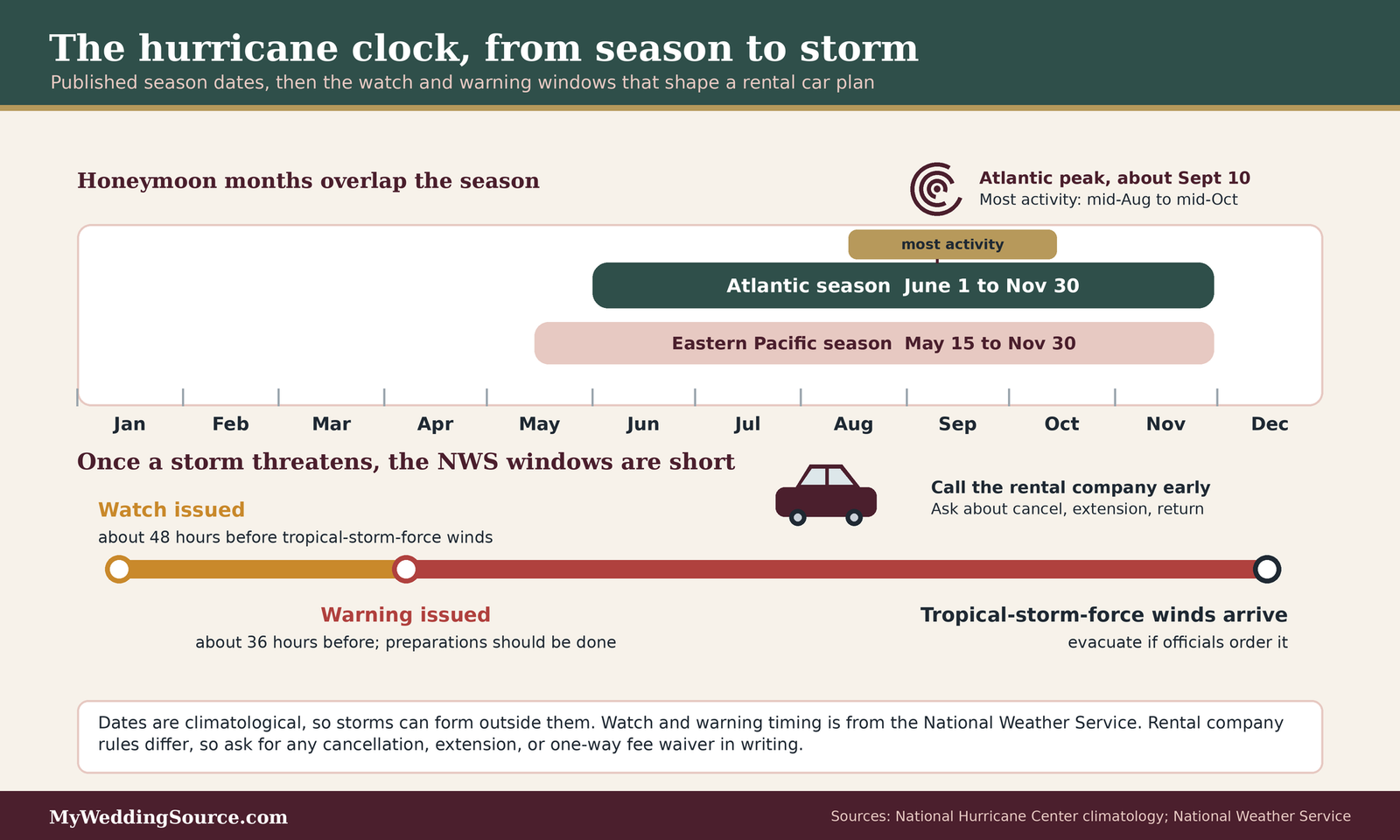
Hurricane season overlaps a good share of popular honeymoon months. If your route runs near a coast or through the Caribbean, your rental car is part of your storm plan whether you intended it or not. Our hurricane season honeymoon guide covers trip timing; this section covers the car. Hurricane season is where honeymoon rental car insurance deserves its closest reading.
Know the clock first
A decision tree only helps if you know how much time you will have when a storm is forecast.
Season dates
The National Hurricane Center says the Atlantic hurricane season runs from June 1 to November 30, and the eastern Pacific season from May 15 to November 30. The Atlantic season peaks around September 10, with most activity between mid-August and mid-October. If you are traveling in those weeks, check forecasts as well as your policies. These are climatological dates, and storms can form outside them.
Watches and warnings
The National Weather Service says a hurricane watch is issued about 48 hours before tropical-storm-force winds are expected, and a hurricane warning about 36 hours before. A storm surge watch or warning means life-threatening flooding from seawater pushed inland is possible or expected within roughly those windows, and the NWS says to follow local evacuation orders. The clock matters because rental companies, airlines, and insurers all behave differently once an official watch or warning is in effect, so ask each what its trigger is. Your honeymoon rental car insurance decisions should be finished before a warning arrives, not after.
The decision tree in words
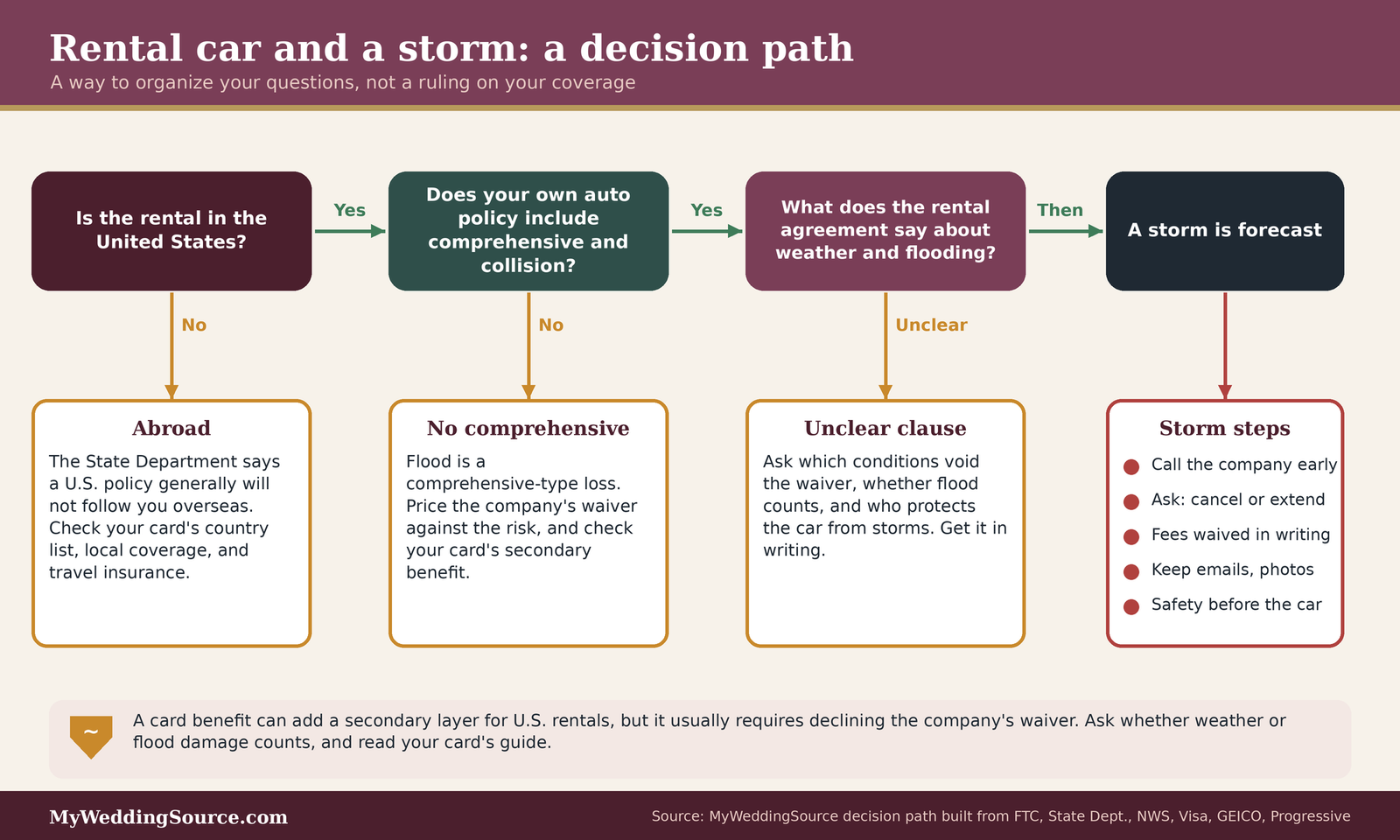
Here is the path in plain language. It is a way to organize your questions, not a ruling on your coverage.
Step one: is the rental in the United States?
If yes, your personal auto policy is likely the first layer, per both Progressive and GEICO. If not, the State Department says a U.S. policy generally will not cover you overseas, so the decision shifts to local coverage, your card’s international terms, and any travel insurance. Read the abroad section below before you book, because the border is where honeymoon rental car insurance changes first.
Step two: does your policy include comprehensive and collision?
GEICO says collision generally covers accident damage and comprehensive covers non-collision losses such as theft, vandalism, or weather. The insurance app Jerry says personal comprehensive coverage may extend to a rental and cover flood damage, though you would still pay the deductible, and that without comprehensive it suggests buying the waiver. If you do not carry comprehensive, a storm is the situation where that gap can hurt, so price the rental company’s waiver against your deductible.
Step three: what does the card add?
For a domestic rental, Visa’s page describes the card benefit as secondary to your own insurance, covering things like your deductible. Ask your issuer whether weather or flood damage counts as covered physical damage; we did not find a source that answers this for any particular card, so get it in writing. Remember the card benefit usually requires you to decline the waiver.
Step four: what does the agreement say about weather?
Read the section on acts of nature and responsibility for the vehicle. As one example of how this can work, Auto Rental News reported in January 2006 that Hertz changed its rental agreement to make all renters responsible for protecting vehicles from acts of nature such as tornadoes and hurricanes. That report is old and about one company, and we cannot say what any agreement says today, but it shows why you should read this clause for your own company and location instead of assuming a storm is the company’s problem.
When the storm changes your plans
The decision tree branches again depending on whether the storm arrives before pickup, during the rental, or at return.
Before pickup
AutoSlash, a rental-booking service, says that if you have not prepaid you can cancel without a fee, and that if you prepaid and the pickup location closes because of the storm you should be able to cancel without a cancellation fee, though refunds can take up to 10 business days. It also says a canceled or delayed flight that prevents pickup of a prepaid car outside the storm’s path can support a refund. These are AutoSlash’s descriptions, so confirm the policy with your company and keep a record. Write down who told you what about honeymoon rental car insurance, and when.
During the rental
AutoSlash says to call the company to see whether your return location is affected, since locations may close or reduce hours. If it is open, return the car on time, or tell the company if you need to keep it longer, which AutoSlash says is billed as an extension. If you are told to evacuate, personal safety comes first. Ask for the instruction in writing or by email so you have a paper trail.
At return
If the return location is closed, AutoSlash says you may be told to return the car after it reopens or, during an evacuation, to drop it at another location within a radius that can be as large as 100 or even 500 miles. It advises confirming that extension, late, and one-way fees will be waived. If you cannot return the car, it says to contact the company as soon as possible and keep records. Leaving a car behind is a last resort, and AutoSlash warns it will likely cost you.
Flooding specifically
AutoSlash’s page does not address flood policies directly and advises avoiding standing water. The practical point for coverage is that flood damage is a comprehensive-type loss, and whether your policy, your card, or the rental company’s waiver treats it as covered is exactly the question to put to each of them before you travel, not after. Flooding is where honeymoon rental car insurance deserves the most careful reading.
Honeymoon rental car insurance abroad: a different set of rules
Many honeymoons involve a passport, and the moment the car is rented in another country almost everything on this page can change. Honeymoon rental car insurance abroad follows different rules from the domestic version.
Licenses and local rules
Coverage is only one part of renting abroad. The legal ability to drive is another.
Driver’s licenses and permits
The State Department says many countries do not recognize U.S. driver’s licenses, and that most accept an International Driving Permit, available from AAA. It says a permit may have time limits or be valid only alongside a U.S. or local license, and that driving without a valid license and insurance is illegal in most countries. It recommends confirming requirements with the destination’s embassy or consulate.
Road conditions and customs
The same State Department page says road conditions, traffic laws, and driving customs vary widely from the United States, with poor road maintenance, unclear signs, and different vehicle safety standards as common concerns. It suggests checking roadside assistance availability and carrying required documents. A honeymoon driver who is jet-lagged on the wrong side of the road is a good reason to ask whether a transfer is simpler, and our honeymoon jet lag plan for a short trip helps you decide when the first drive should happen. Our mini-moon versus honeymoon guide covers trip shapes that avoid long drives.
Whose coverage applies abroad
Three sources can apply abroad, and each has conditions.
Your personal auto policy
Progressive says most U.S. policies cover only the U.S. and Canada. The State Department says some extend to Canada and Mexico and that a policy that applies abroad may still fall short of local minimums, in which case you can buy supplemental coverage in the U.S. or locally. Enterprise separately states its damage waiver does not apply in Mexico, so ask any rental company about Mexico before crossing the border.
Your card benefit
Visa’s page describes international rentals as primary, though other applicable insurance pays first, lists a 31-day limit, and excludes Jamaica, Ireland, and Israel. It also says some countries require a minimum level of collision coverage, naming Australia, New Zealand, Costa Rica, and Italy, which the card benefit supplements. If your destination is on a card’s exclusion list, you may need local coverage, and you should find that out before the trip.
Local coverage
The State Department notes that rental companies abroad offer insurance, but that the included coverage can be minimal in some countries, so you may want coverage comparable to your home policy. If you buy local coverage, ask for a plain-language list of what it covers and what the deductible is, and confirm it in the rental agreement.
Honeymoon destinations worth pre-checking
A short list of questions, not recommendations, is more useful than a ranking.
Islands and coastal drives
Many island honeymoons are in hurricane-prone regions and some are on a card’s excluded-country list. Our honeymoon destinations guide lists popular choices. For each, check three items: country exclusions on your card, whether your auto policy follows you, and whether the rental agreement addresses unpaved roads and storms.
Cross-border road trips
If the plan involves driving across a border, ask the rental company in advance whether the car may leave the country at all, and what insurance is required on each side. The State Department says some policies extend to Canada and Mexico and Enterprise says its waiver does not apply in Mexico, so the answer can differ even within one trip.
What honeymoon rental car insurance may cost, and how to compare
Price is where most people decide, so it helps to do the arithmetic before you are standing at a counter.
Cost reality check
Enterprise’s U.S. page lists average daily charges of $8.44 to $20.75 for Supplemental Liability Protection and $5.99 to $15.67 for Personal Effects Coverage. Our own estimate for a seven-day rental, before taxes and fees: roughly $59 to $145 for liability protection and $42 to $110 for personal effects, from multiplying those daily averages by seven. The page gives no average for the damage waiver, which varies by location and vehicle type, so ask for the quote. These are one company’s published averages, not what you will pay.
Building a quick comparison
Put the offers side by side before you travel, using the same trip length for each.
The total for the full rental
Ask for the all-in total for the same pickup and return times with no protections, then with each one you are considering. Include the fees the FTC lists: airport surcharges, taxes, additional drivers, toll services, and one-way or out-of-state charges. A sum you can compare is more useful than a daily rate. Price honeymoon rental car insurance as one sum for the whole rental.
Your deductible as the alternative cost
Your deductible is the price of declining. If your policy’s deductible is large compared with the waiver’s total cost, the waiver may look different. Progressive lists a high deductible as one reason to buy the company’s coverage. Whether the trade is worth it is your decision, and the aim is to make it knowingly.
The cost of a claim you did not plan for
The insurance question is partly about probability and partly about what a bad day would cost.
Premium impact and claim hassle
Progressive notes that a person may want to avoid a claim on their personal policy because it could raise rates. If your own policy would respond, ask whether a rental-car claim is treated like any other claim. A card benefit may avoid that, but remember that it is often secondary for domestic rentals.
Time limits for card claims
Visa’s page says to report damage within 45 days of the incident, return the claim form within 90 days, and submit all supporting documents within 365 days. Your card’s own guide may differ, and a new honeymoon schedule is a good reason to put those dates in your calendar before you leave.
Questions to ask before you accept or decline honeymoon rental car insurance
Good answers are specific, and good questions make specific answers easier to give. The block below is built to be copied into a note on your phone. Use it to test any honeymoon rental car insurance offer.
Questions to ask, by who you are asking
- Auto insurer: Does my policy extend to a rental for this trip, in this country, for this vehicle type? Do my collision, comprehensive, and liability limits carry over? Does it pay loss-of-use or administrative fees? What is my deductible?
- Card issuer: Is the benefit primary or secondary here? Does it require declining the rental company’s waiver? What is the maximum rental length, and is my destination excluded? Which vehicles are excluded? Does weather or flood damage count? What are the claim deadlines?
- Rental company: What are the exact conditions that void the waiver? What does the agreement say about storms, flooding, and early returns? Are spouses listed as additional drivers at no charge? Are unpaved roads restricted? Can the car cross a border?
- Travel insurer: Does my plan include rental car damage, and is it primary or secondary? What does it exclude?
Questions for your insurer and your card
These two calls take about fifteen minutes combined and are worth doing at least a week before you leave.
What to say on the call
Open with the facts of your trip: dates, country, vehicle type, who is driving, and whether a storm is forecast. Ask for answers in writing, or ask for a reference number and the name of the person you spoke with. Insurers and issuers can give general descriptions over the phone that do not match your specific contract, which is why the written version matters.
What a vague answer looks like
“You should be fine” is not an answer. Ask the follow-up: fine for damage, fine for liability, fine for loss of use, fine in that country? If the person cannot say, ask where in the policy or benefits guide the answer is, and read that paragraph yourself.
Questions for the rental company
The company controls the agreement, so its answers matter most for conditions and fees.
Before you book
Ask by phone or chat what the agreement says about the points above and request the full rental agreement terms ahead of arrival. If the company will not send them, consider that a signal. Many companies post their terms and conditions online, and reading them at home is calmer than at the counter.
At the counter
Read the agreement before you sign, check the driver names against your licenses, and photograph the car before you leave the lot. Enterprise’s page says its protections are optional and not required to rent a car, so you can say no. You can also say “I’d like to think about that and call you back” if you are not ready.
Your paper trail, and what to do if something happens
You do not need a binder, just a folder you can find on a tired day.
Before the trip
A small amount of saved evidence pays off if a claim ever arises.
What to save
Gather the paperwork for honeymoon rental car insurance in one place. Save your auto policy declaration page, your card’s guide to benefits, the rental confirmation, and any written answers from your insurer or issuer. Take dated photos of the car’s condition at pickup. Our honeymoon booking checklist is a good place to add these items to your wider trip records.
Where to keep it
Keep copies in two places, such as a cloud folder and your phone, because a storm or a lost bag can take one of them out. A shared folder with your spouse helps too, since either of you might be the one who has to make the call.
If something goes wrong
The steps are simple, but the order matters.
Right away
Get to safety first. Then report the incident to the rental company as the agreement directs, and to the police if the situation calls for it. Take photos and notes. If a hurricane is involved, AutoSlash says to contact the company as soon as possible and keep records of conversations, including emails.
In the days after
Notify your insurer and your card issuer promptly, and watch the claim deadlines. Visa’s page lists 45, 90, and 365 days for different steps. Keep every receipt, and dispute any fee you believe is unfair, as AutoSlash suggests, in writing. If a dispute is not resolved, an insurance professional or an attorney can advise on your specific situation, which we cannot.
Planning the rest of the honeymoon around the car
Insurance is one line in a larger plan, and treating it that way keeps it in proportion. Honeymoon rental car insurance is one line in a larger plan, and treating it that way keeps it in proportion.
Fit the car to the budget
A rental car is a flexible way to see a place, but it is also a cost line with fees attached.
Put it in the honeymoon budget
Add the full rental total, with the protection decision made, to your trip budget. Treat honeymoon rental car insurance as part of the line item, not a surprise. Our honeymoon budget guide shows how to build the rest of the line items, and our honeymoon planning guide covers the order of decisions.
Consider whether you need the car every day
Some destinations are easier with a car for two or three days and a transfer or walking for the rest. A shorter rental can reduce both the cost and the number of days you carry the exposure. If you are unsure, our honeymoon booking checklist helps you list what you actually want to do each day.
Keep it calm
The goal is not to remove every risk. It is to know which risks you are carrying on purpose.
Decide once, ahead of time
Make the insurance decision at home, write it down, and tell your spouse. Make the honeymoon rental car insurance decision at home, write it down, and tell your spouse. At the counter, the decision is already made, which means you can handle the paperwork and get on with the trip.
Revisit if the plan changes
A changed itinerary, a new storm, a new driver, or a different car is a reason to revisit the decision. A five-minute check beats an assumption that has quietly expired.
FAQ: honeymoon rental car insurance questions
Existing coverage
Does my personal auto insurance cover a honeymoon rental car?
Often within the United States, but not always. Progressive and GEICO both say a personal policy generally extends to rentals, with your same limits and deductibles, while noting that limits and exclusions vary. Ask your insurer about your specific trip, vehicle type, and whether loss-of-use fees are paid, and get the answer in writing.
Is my credit card enough on its own?
It depends on the card and the trip. Visa’s published benefit covers physical damage, vandalism, and theft, but not liability, injuries, or belongings, and it requires you to decline the rental company’s waiver. It also has rental-length and country limits. Read your own card’s benefits guide, because that document controls any claim.
What does a damage waiver actually do?
Enterprise says its damage waiver is not insurance. For a fee, the company agrees to waive some or all of your responsibility for damage to, loss of, or theft of the car, subject to conditions in the rental agreement. The FTC notes a waiver can be voided, for example by an unauthorized driver or reckless driving.
Honeymoon situations
Do we both need to be listed as drivers?
If both of you will drive, yes, ask to list both. The FTC says a waiver may be voided if an unauthorized person drives the car, and Visa’s benefit page says other drivers must be listed. Additional driver fees can apply, so ask the company whether spouses are charged at your location.
Does rental car coverage change if a hurricane is forecast?
The coverage itself may not change, but your choices do. Read the agreement’s clause on weather and responsibility for the vehicle, check whether your policy covers flood as a comprehensive loss, and call the company about cancellations and returns. AutoSlash describes cancellation and return options, but each company sets its own rules.
Abroad and claims
Will my U.S. insurance work if we rent a car abroad?
Usually not. The State Department says a U.S. auto policy generally will not cover you overseas, though some extend to Canada and Mexico, and Progressive says most cover only the U.S. and Canada. Check your card’s international terms and country exclusions, and ask the local rental company what coverage is included.
Which countries do cards often exclude?
Visa’s published page lists Jamaica, Ireland, and Israel as not covered. NerdWallet says Visa, Mastercard, and American Express each exclude specific countries and that sanctioned countries are excluded. Lists change by issuer and over time, so check your card’s current guide before you book a rental there.
How long do I have to file a card claim?
Visa’s page says to report damage within 45 days of the incident, return the claim form within 90 days, and submit all supporting documents within 365 days. Your card’s own guide may differ, so confirm the deadlines before you leave and put them in your calendar if a claim ever seems possible.
Your next steps
Do the calls
Call your insurer and your card issuer
Use the question block above, give the trip facts, and ask for answers in writing. Use the question block above to review your honeymoon rental car insurance, give the trip facts, and ask for answers in writing. Do this at least a week before you travel so there is time to buy coverage if a gap turns up. If points pay for the trip, our honeymoon using points guide covers how card choices can affect protections.
Read the rental agreement terms
Download the terms from the company’s site and read the sections on waivers, weather, additional drivers, and restricted roads. If anything is unclear, ask before you book. If a driver in your party has mobility needs, our honeymoon with mobility needs guide covers vehicle and logistics questions to raise.
Write the decision down
Decide once and record it
Note which coverage you are relying on, which you are buying, and why, then share it with your spouse. If a storm, a new driver, or a changed route appears, revisit the note and use the decision path above again.
Keep your paper trail
Save the policy pages, card guide, rental confirmation, and written answers in a folder you both can reach. Add it to the records in your honeymoon booking checklist.
Sources & methodology
How we built this guide
What we relied on
This guide combines a Federal Trade Commission consumer page on renting a car, State Department driving guidance for travelers abroad, National Weather Service and National Hurricane Center pages on storm timing, published terms from Visa and Enterprise Rent-A-Car, and guidance from insurers and consumer-finance publishers. Where a statement comes from a company or publisher, we say so, because their descriptions reflect their own products. The cost figures for a seven-day rental are our own arithmetic from Enterprise’s published daily averages, and they are estimates.
What we did not do
We did not read your policy, your card’s benefits guide, or your rental agreement, and we cannot tell you what they say. This is general information, not insurance, legal, or financial advice. Several sources we tried to reach, including the Insurance Information Institute, the National Association of Insurance Commissioners, the Department of Transportation’s airline page, and Hertz and Avis pages, could not be retrieved, so we did not rely on them. The Auto Rental News item is from 2006 and is cited only as an example of a type of clause. We checked the pages below on November 12, 2026, and terms change, so verify current wording with each company before you travel.
Disclosure
Source list
Government and public-safety sources
- Federal Trade Commission, Renting a car: https://consumer.ftc.gov/articles/renting-car
- U.S. Department of State, Driving and road safety abroad: https://travel.state.gov/content/travel/en/international-travel/before-you-go/driving-and-road-safety.html
- National Hurricane Center, Climatology and season dates: https://www.nhc.noaa.gov/climo/
- National Weather Service, Hurricane watches and warnings: https://www.weather.gov/safety/hurricane-ww
- NOAA, Hurricane preparedness: https://www.noaa.gov/hurricane-prep
Card and rental company sources
- Visa, Auto rental collision damage waiver: https://usa.visa.com/supporting-info/auto-rental-collision-damage.html
- Enterprise Rent-A-Car, Rental car insurance and other protection products (U.S.): https://www.enterprise.com/en/help/faqs/us-protection-products.html
- Enterprise Rent-A-Car, What insurance options are available for my rental car: https://www.enterprise.com/en/car-rental-faqs/us-insurance-and-protections/car-rental-insurance.html
Insurer and consumer publication sources
- GEICO, Does car insurance cover rental cars: https://www.geico.com/more/driving/auto/car-safety-insurance/does-car-insurance-cover-rental-cars/
- Progressive, Do I need rental car insurance: https://progressive.com/answers/rental-car-insurance
- NerdWallet, What your credit card rental car coverage does not include: https://www.nerdwallet.com/credit-cards/learn/credit-card-rental-car-coverage-what-it-doesnt-include
- Jerry, Does rental car insurance cover flooding damage: https://getjerry.com/questions/does-rental-car-insurance-cover-flooding-damage
- AutoSlash, What to do if a hurricane impacts your car rental: https://blog.autoslash.com/what-to-do-if-hurricane-impacts-car-rental/
- Auto Rental News, Hertz rental agreement amended to hold renters liable for acts of nature (January 2006): https://www.autorentalnews.com/news/hertz-rental-agreement-amended-to-hold-renters-liable-for-39acts-of-nature39