Choosing between a wedding DJ vs band is less a contest of quality than a question of fit: your venue’s space and power, your guests’ ages and tastes, your end time, and how much of the budget you want music to take, in that order.
Quick answer
Settle the hard limits first: floor space, electrical capacity, sound rules, and curfew. A band needs more of all four than a DJ, so a tight room or an early cutoff often decides the wedding DJ vs band question before taste enters. If the venue allows either, compare quotes on the same terms (hours, breaks, sound, lighting, travel, meals). The Knot’s 2026 study, covering couples married in 2025, reports an average of $1,800 for a DJ and $4,500 for a live band, and 71% of couples hired a DJ against 12% a band. A hybrid is a legitimate middle path when guests, budget, and venue pull in different directions.
Couples often start this decision with a mental picture: a packed dance floor, a horn section, or a booth with a laptop. Pictures are useful for knowing what you want and poor at predicting what a room can hold or what a contract will include. This guide is organized around the questions that actually change the answer, in the order they should be asked. It does not recommend a winner, because there is not one. It gives you a method for settling wedding DJ vs band for your own wedding, and it labels which figures come from published surveys, which are our own arithmetic, and which are illustrations we made up to show how the arithmetic works.
A note on scope. Music is one piece of the evening, and our guide to the wedding reception covers the flow from entrance to send-off, while our piece on wedding entertainment ideas looks at activities beyond music. Here we stay on the wedding DJ vs band decision and take it as far as a contract.
Define the decision before declaring a winner for wedding DJ vs band
Most arguments about the wedding DJ vs band choice go in circles because the two sides are using different criteria. One partner is thinking about atmosphere and the other about cost, and a parent is thinking about whether grandparents will recognize the songs. Writing the criteria down separates what is negotiable from what is not, and it keeps the wedding DJ vs band conversation from drifting.
List the criteria that genuinely change the choice
Not every factor deserves the same weight. Some factors can eliminate an option outright. Others only tilt the scales. Sorting them first, before you look at any wedding DJ vs band quotes, prevents a preference from being treated like a rule, and a rule from being treated like a preference.
Separate deal-breakers from preferences
A deal-breaker is a condition that makes an option impossible or unacceptable, whatever else is true. A preference is something you would like but can trade away. Here are the deal-breakers that most often settle a wedding DJ vs band decision:
- Space. If the dance area and the spot for equipment cannot hold a band, a band is off the table unless you accept a smaller lineup.
- Power and sound rules. A venue with limited circuits, a noise ordinance, or a firm volume limit may not suit a loud full-band setup.
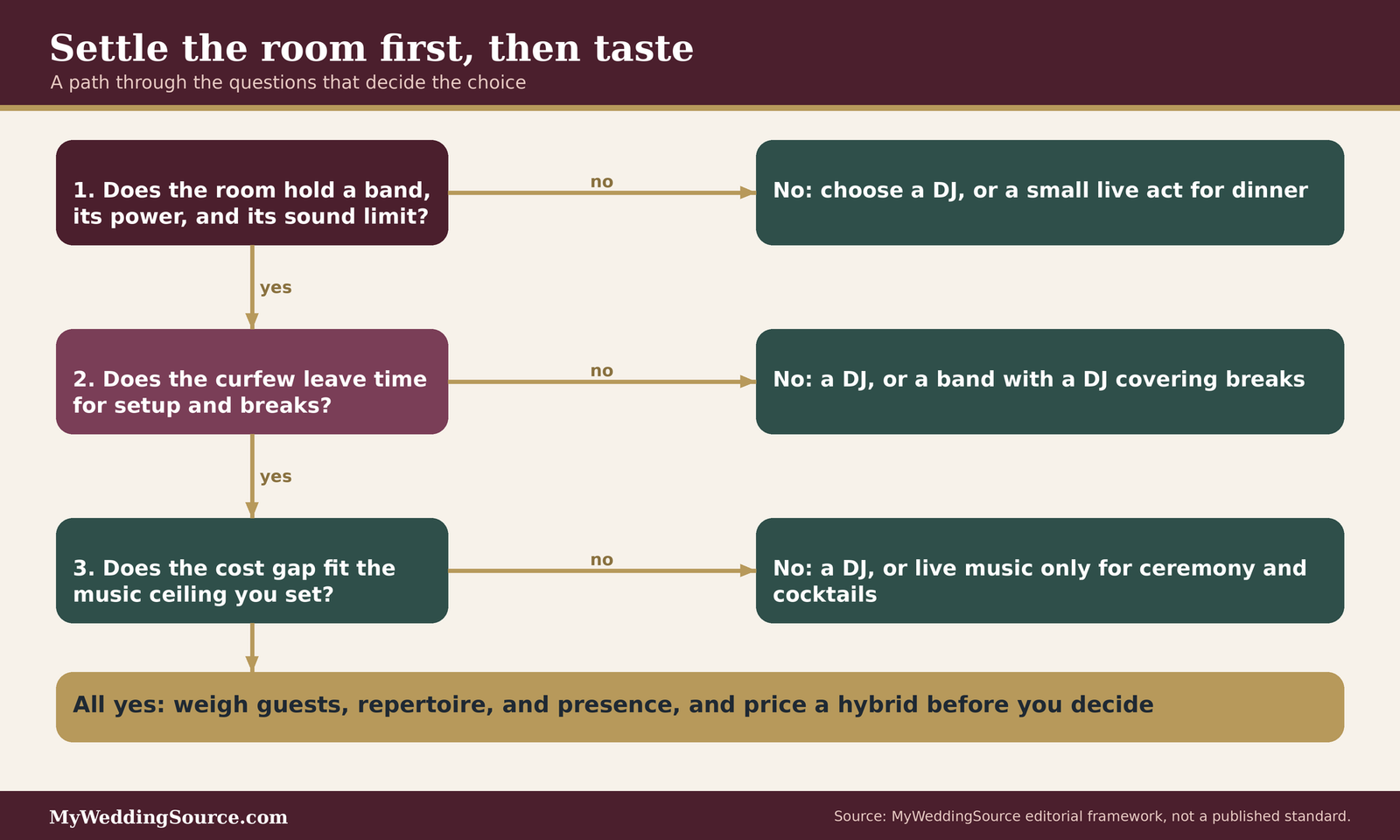
- End time. If the venue requires music to stop early, a band’s setup and breaks consume a larger share of the time you have.
- A hard ceiling on cost. If the music line cannot exceed a set number, compare only the options that fit under it.
- A must-have. If a specific song, language, or live instrument is essential, test whether each option can actually deliver it.
Everything else in a wedding DJ vs band decision, including whether you like the look of a stage, belongs in the preference column. Be honest about the sorting. A couple who says live music is a must-have and then books a DJ because of cost has simply reclassified it as a preference, which is fine, but it is better done on purpose.
Weight cost, logistics, experience, and flexibility
After the deal-breakers, four broad areas shape the rest of the choice. In a wedding DJ vs band comparison, cost is the amount you pay and the amount you could pay later in overtime, travel, or add-ons. Logistics covers space, power, setup time, and staffing at the venue. Experience is the feel of the evening: presence, energy, and how personal it is. Flexibility is how well the option adapts to requests, a delayed schedule, a surprise toast, or a crowd that wants something you did not plan.
A simple way to weight them is to give each area a score from one to five for how much it matters to you, then compare options within each area. Do not total the scores and declare a wedding DJ vs band winner by arithmetic alone. Use the exercise to see where you disagree with your partner. If one of you scores cost a five and experience a two, and the other the reverse, you have found the real conversation, and it is more useful than arguing about guitars.
Compare like with like in the wedding DJ vs band decision
The most common reason a wedding DJ vs band comparison misleads is that the quotes are not for the same service. A DJ quote may cover four hours of music and one microphone. A band quote may cover four hours on stage with breaks, sound, and lighting. Treating them as equivalent is how a DJ looks cheap or a band looks expensive for reasons that have nothing to do with value.
Normalize package contents and time coverage
Start with time. For a fair wedding DJ vs band comparison, ask each vendor how many hours of music you would actually hear, not how many hours they are present. A band that performs three 50-minute sets in a four-hour booking delivers fewer minutes of live music than the booking suggests, and the breaks must be filled with something, which is a point we return to later. A DJ booked for four hours usually plays continuously, but ask whether setup, ceremony sound, or cocktail-hour music is inside those hours or billed separately.
Next, list what each package includes: the number of performers, sound system, microphones for toasts, lighting, an emcee, a sound technician, travel, and meals. The Knot’s cost guide describes quotes as typically accounting for hours, the number of performers, music for each segment of the event, sound and microphones, lighting, and travel and meals. Use that list as a wedding DJ vs band template and fill it in for each vendor. A blank cell is a question to ask, and a “no” is an additional cost to price.
Expose features that sound equivalent but are not
Several phrases in wedding DJ vs band quotes sound alike and mean different things. “Emcee services” might mean a few announcements or a full hosting role with introductions, cue management, and coordination with the photographer. “Backup equipment” might mean a second laptop or a second complete system. “Custom song” might mean a bandleader learning a new piece, which often takes rehearsal time and may cost extra, or a DJ simply playing a track. “Lighting” might mean a small effect on a stand or uplights around the room. “Sound included” might cover the dance floor but not the ceremony location or the cocktail area.
When two items sound the same, ask for the specific details in writing, such as the number of microphones, the number of speakers, and the locations covered. Vague wording in the quote becomes a dispute on the day. Our guide to vendor contract red flags has more on what to watch for in any vendor agreement.
What national figures say about wedding DJ vs band
National averages for a wedding DJ vs band choice are a starting point, not a quote. They tell you roughly where the market sits and how large the gap between the two options tends to be. They do not tell you what a vendor in your city will charge. With that caution, the published figures are useful for calibrating expectations before you request any quotes.
Reported spending and how many couples hire each
The most cited source for the wedding DJ vs band decision is The Knot Real Weddings Study. The Knot describes the 2026 edition as a survey of U.S. couples who married in 2025, drawn from The Knot and WeddingWire users. Its cost guide for bands and DJs reports a sample of 10,474 couples married between January 1 and December 31, 2025, and notes that the study has run for 20 years.
What The Knot’s study measured
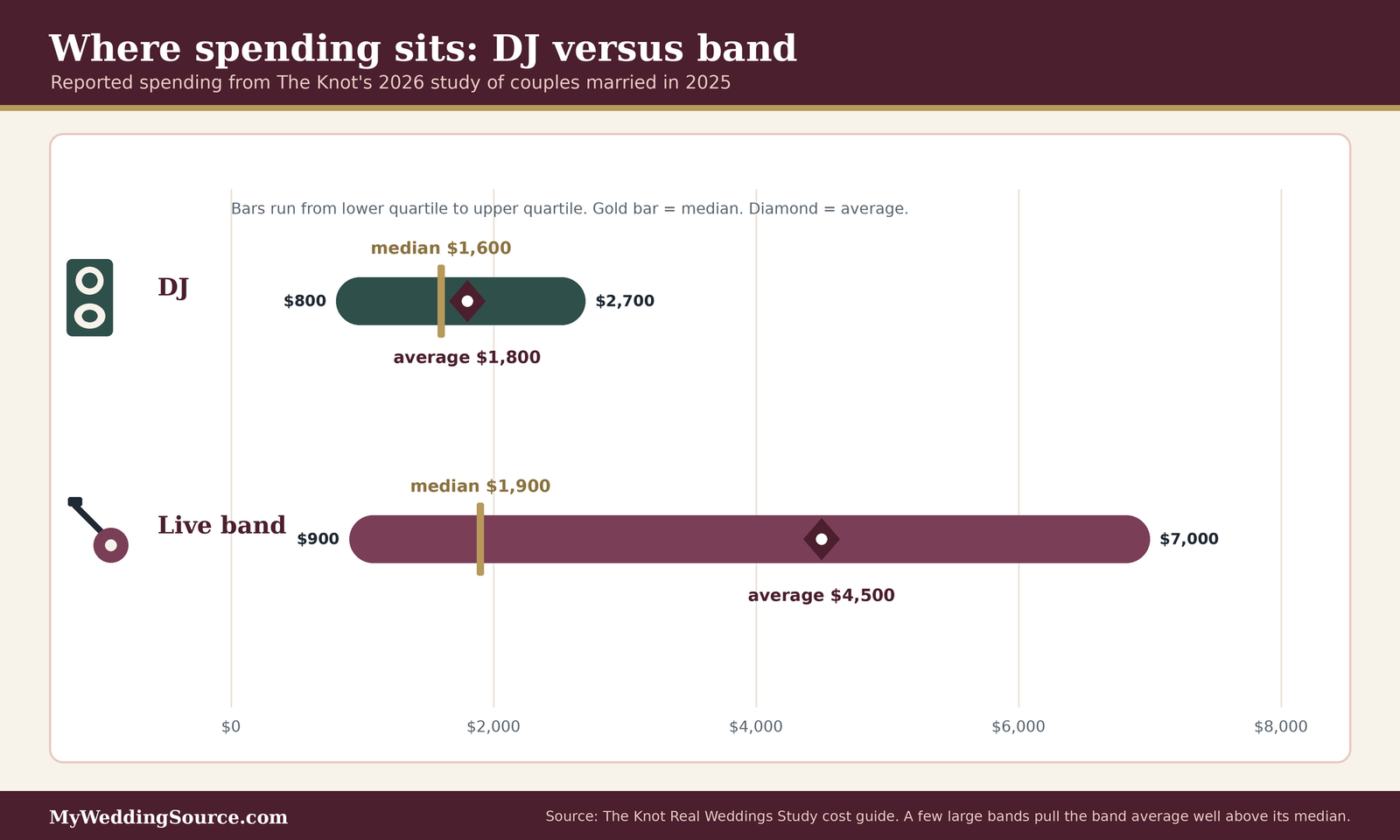
Reported averages are $1,800 for a DJ and $4,500 for a live band. The Knot describes the band average as about 150% above the DJ average, which matches simple arithmetic: $4,500 is 2.5 times $1,800. Those averages describe what couples who hired each type reported paying. They are not the same as the cost of an average wedding, which The Knot’s read-out puts at about $34,000, with a median of $24,000 and an average guest count of 117.
The hiring rates differ sharply: The Knot reports that 71% of couples hired a DJ and 12% hired a live band. That does not mean bands are rare for a reason; it means that most couples choose the less expensive, more flexible option, and the 12% are a self-selected group who wanted live music enough to pay for it. The Knot also reports that price was the main factor couples weighed when choosing wedding music. We cannot say from the data why each couple chose as they did.
What the averages hide
An average is pulled upward by expensive outliers. The Knot also reports quartiles, which are more honest about the spread:
| Measure | Live band | DJ |
|---|---|---|
| Lower quartile | $900 | $800 |
| Median | $1,900 | $1,600 |
| Average | $4,500 | $1,800 |
| Upper quartile | $7,000 | $2,700 |
The median for a band ($1,900) is far below its average ($4,500), because a minority of large, expensive bands lift the average. Half of the couples who hired a band paid $1,900 or less, according to the report, and a quarter paid $7,000 or more. For a DJ the picture is tighter: the median and average are $1,600 and $1,800. In practice, for a wedding DJ vs band budget, this means the DJ line is more predictable, while a band budget depends heavily on lineup size and region. If someone quotes you the average for a band, ask whether they mean the middle of the market or the top of it.
How guest count and region move the gap
The gap in the wedding DJ vs band decision is not constant. It widens as the wedding grows, and it differs by region. Both patterns matter when you decide how much a band’s advantages are worth to you.
Guest count moves the gap
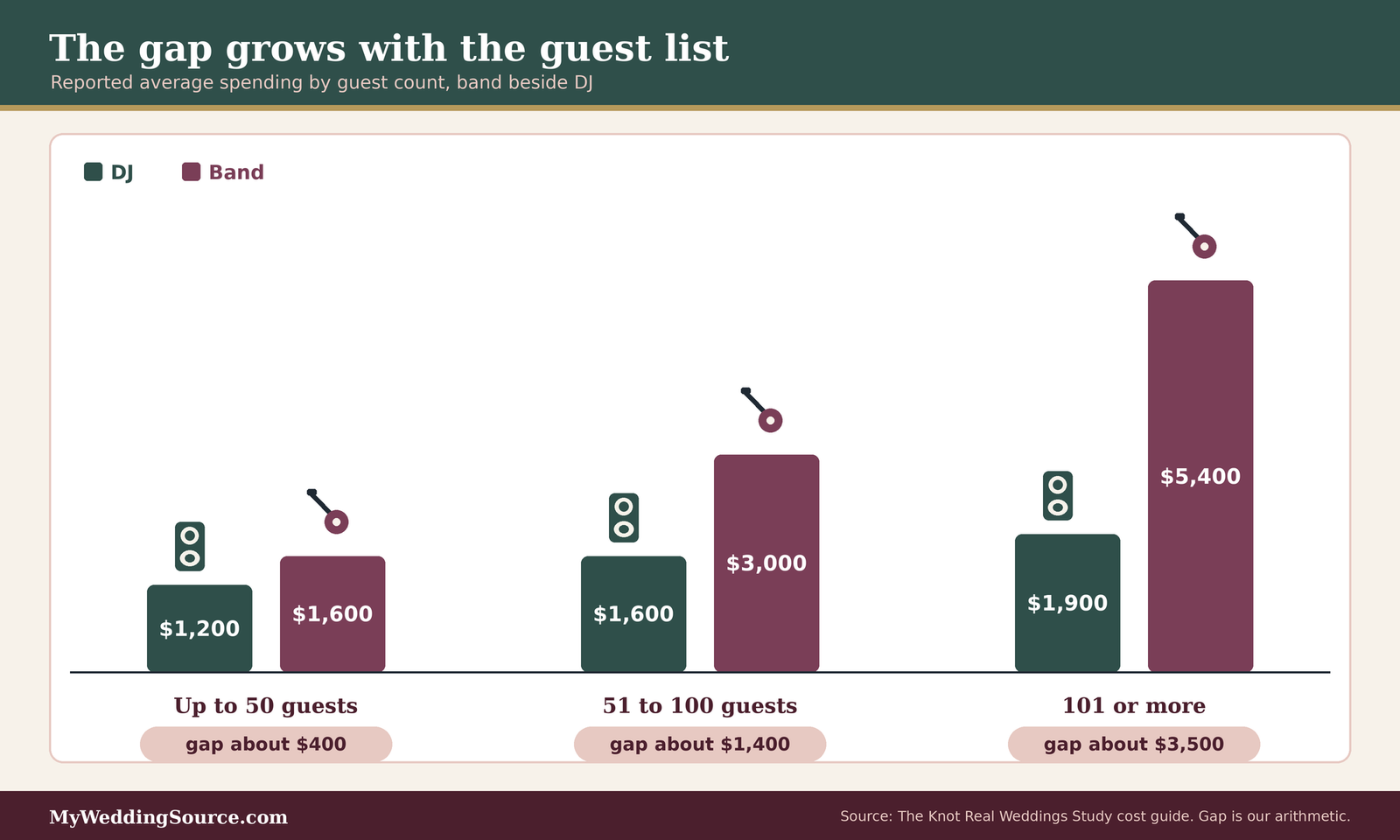
The Knot reports these averages by guest count, with the band first:
| Guest count | Band | DJ | Gap (our arithmetic) | Band as a multiple of DJ (our arithmetic) |
|---|---|---|---|---|
| 1 to 50 | $1,600 | $1,200 | $400 | about 1.3 times |
| 51 to 100 | $3,000 | $1,600 | $1,400 | about 1.9 times |
| 101 or more | $5,400 | $1,900 | $3,500 | about 2.8 times |
The DJ figure moves modestly, from $1,200 to $1,900, while the band figure more than triples. A plausible explanation, which is our inference and not The Knot’s, is that larger rooms need larger lineups and more sound equipment, while a single DJ scales more easily. For a wedding of 40 people, the gap is about $400, and the question becomes mostly one of taste. For a wedding of 150, the gap is large enough to fund other priorities, and the decision becomes a trade-off.
Region and couple type
Regional averages differ more for bands than for DJs. The Knot reports the highest spending in the Mid-Atlantic, at $7,300 for a band and $2,500 for a DJ, followed by the Northeast at $6,800 and $2,200. The Midwest is $3,500 and $1,600, the South and Southeast $4,000 and $1,500, the Southwest $4,200 and $1,400, and the West $3,200 and $1,600. The band gap across regions is wider than the DJ gap, which suggests that local market conditions affect bands more.
The Knot also breaks down spending by the couple’s generation: Gen Z reported $3,500 for a band and $1,600 for a DJ, Millennials $5,300 and $2,000, and Gen X $2,300 and $1,300. We would not read much into this, since generation also correlates with budget, region, and guest count, but it shows how much the averages vary by group. The takeaway is to calibrate with your own region and guest count, and then to get actual quotes.
Reading the gap in proportion
A dollar figure in the wedding DJ vs band debate means more when you compare it to the whole. Putting music in the context of the total wedding budget keeps it from either crowding out other priorities or being starved.
Share of an average budget
Using The Knot’s average wedding cost of about $34,000, our arithmetic gives the following rough shares: a $1,800 DJ is about 5.3% of the average budget, and a $4,500 band is about 13.2%. These are estimates that combine two different samples in the study, so treat them as a sense of scale. They show that choosing a band at the average price takes roughly two and a half times the share of the budget that a DJ does. Whether that is a good trade depends on what else you would cut. Our wedding budget calculator and average wedding cost guide can help you see where music fits against the venue and catering.
Why other surveys give different figures
Zola reports a different picture because it measures differently. Its 2026 cost guide, based on the Zola Wedding Cost Index and a 2026 spend survey of 720 couples surveyed within 180 days of their wedding, groups bands and DJs together under music and entertainment, with an average of $1,567 and a typical range of $1,300 to $1,900. Zola’s overall average wedding cost is about $36,000. By our arithmetic, $1,567 is about 4.4% of that total. A combined category blends DJs, bands, ceremony musicians and other entertainment, and since most couples hire a DJ, the combined average sits close to the DJ figure. Differences between The Knot and Zola come from different samples, different category definitions, and different years of data collection, so neither is wrong. Use them as a range, and let local quotes replace both as soon as you have them.
What each option delivers on the dance floor
Cost and logistics set the boundaries of the wedding DJ vs band decision. Within them, the choice comes down to what you want the room to feel like. Both options can create a lively evening, and both can fall flat if the fit is poor.
Repertoire and flexibility
The clearest practical difference in a wedding DJ vs band choice is how each option handles the music itself. One draws on a very large catalog played from recordings, the other on a rehearsed set performed live.
What a DJ library makes possible
A DJ plays recordings, so the available repertoire is limited mostly by the DJ’s library and by licensing on the platform they use. That makes it easy to move between decades, genres, and languages in the same evening, to play a song exactly as the original artist recorded it, and to respond to a request within a minute. If your guests span several generations or several languages, this flexibility is a real advantage. It also means a DJ can honor a do-not-play list and a must-play list without extra rehearsal. Our guides on wedding songs and first dance songs can help you build both lists.
What a live band makes possible
A live band plays what it has rehearsed. Bands vary in how many songs they have ready and in how willing they are to learn new ones, and The Knot notes that custom arrangements add to a band’s cost. Live performance changes the sound: songs are interpreted rather than replayed, tempos can flex with the room, and a good bandleader can read the crowd and extend a song that is working. The trade-off is that a band cannot play what it does not know, and a cover rarely matches the recording that guests expect to hear. If a particular recording matters to you, such as the one you danced to on a first date, ask whether the band can perform it or whether a DJ should play it.
Energy, presence, and hosting
The mood of a room depends on more than the song list, and the wedding DJ vs band choice shapes it. Presence, pacing, and hosting matter, and they differ by option.
Visual focus and pacing
A band gives guests something to watch. Musicians on a stage become a focal point, and some guests respond to that energy, particularly those who attend weddings partly to enjoy live performance. A DJ’s booth is smaller, and the energy comes from the music and from how the DJ builds the evening. Neither is inherently more energetic. A skilled DJ who reads the floor can sustain a dance set for hours, and a band that plays a stiff, predictable set can empty a floor. When you audition vendors, watch how they respond to the room and not just how they sound.
The emcee role
Someone has to run the evening: introduce the couple, call the toasts, announce the cake cutting and the last dance. Many DJs routinely take this role, and some bands do as well, although the arrangement varies. Do not assume. Ask who will be the emcee, whether it is included in the price, and how they handle cues from the photographer and the planner. If the emcee is a separate person, ask who pays. The flow of the reception also affects the photographer, so share the plan with them. Our wedding speeches guide covers how toasts fit into the evening.
Breaks, silence, and set length
In any wedding DJ vs band discussion, remember that live musicians are people, and people need breaks. This is the least glamorous difference between the options, and the one most likely to cause a dead spot on the dance floor.
Plan band breaks on purpose
A band typically performs in sets with breaks between them. We did not find a reliable national standard for how long sets and breaks run, and sources differ, so put the number of sets and the length of each break in the contract and do not assume. The usual solution is to fill breaks with a playlist, which means someone must run it: the band’s own equipment, a DJ, or a friend. Ask who will play the music during breaks, what it will be, and who controls the volume. Time the breaks around the evening: a break during dinner costs nothing, while one right after the first dance can drain the energy you just built.
Here is a simple illustration, with figures that are ours and not drawn from a survey. Suppose a band is booked for four hours, from 7:00 to 11:00 p.m. If it takes two 20-minute breaks, it performs for three hours and twenty minutes, which is about 83% of the booking. If you want continuous dancing for the full four hours, you would need a break-time solution or a longer booking. The arithmetic is simple but easy to overlook when comparing a band’s hourly price to a DJ’s in a wedding DJ vs band decision.
Quiet stretches: dinner, toasts, and the ceremony
Not all of the evening needs a dance beat, whichever side of wedding DJ vs band you choose. Dinner and toasts often call for quiet background music or none at all, and the ceremony may need separate sound for the officiant’s microphone and processional music. A DJ commonly provides microphones and background music for these segments, sometimes for an additional fee, and a band may or may not. If the band does not provide a microphone system for toasts, you may need to rent one or ask the venue what it supplies. Ask the vendor, and make sure the quote names each segment. See our wedding ceremony guide for planning the ceremony itself.
Space, power, sound, and curfew for a wedding DJ vs band
This is the section that most often decides the wedding DJ vs band question, and the one couples tend to learn about last. A venue is a physical place with rules, and those rules apply differently to a single person with a speaker setup than to five musicians with amplifiers and drums. We do not state numbers for power or space here, because they depend entirely on the vendor’s equipment and your venue. We tell you what to ask and who should answer.
Stage and equipment footprint
In the wedding DJ vs band decision, a band occupies more room than a DJ, and the room it occupies cannot be used for dancing, seating, or the buffet. The size depends on the lineup, and the venue may have opinions about where equipment can go.
Ask for dimensions in writing
Ask each vendor for the footprint of its setup in feet, including any stage or riser, and ask the venue where it can go. Walk the room with a tape measure or the venue’s floor plan, mark the equipment area, and then see what is left for the dance floor. Our guide to wedding venue capacity explains how to count the room’s seating and standing space, and the same floor plan helps here. A dance floor is usually sized by guest count, so if the equipment area shrinks it too much, you either accept a more crowded floor or choose a smaller lineup.
We have seen figures for the stage size of a band and the booth size for a DJ in some vendor guides, but those figures came from unnamed sources and we did not verify them, so we do not repeat them. Use the vendor’s own number for the lineup you are considering.
Load-in and setup time
Equipment has to get into the room and be checked before guests arrive. A band generally needs more time for load-in and a sound check than a DJ, and it may need access to a loading door, an elevator, or a quiet window during which the venue is not hosting another event. Ask the venue when vendors may arrive, whether there is a loading dock or only a front entrance, and whether the room is available early enough. If the ceremony and the reception share a space and the flip happens during cocktail hour, setup time can be the tightest part of the day, and a band that cannot get in early may not fit your schedule. Our wedding vendor timeline guide shows how to sequence arrivals.
Power, sound limits, and neighbors
Two practical questions follow from the physical ones: whether the room can power the equipment, and whether the sound is allowed to leave the building.
Power questions to put in writing
Ask the vendor how much electrical capacity the setup needs and whether it needs dedicated circuits, and ask the venue what it can provide and where the outlets are. Sound and lighting equipment can draw considerable power, and a room that handles a laptop and two speakers without trouble may struggle with a full band plus lighting. If the answer is unclear, ask the venue’s coordinator or electrician, and ask the vendor whether it carries power distribution equipment. A mismatch discovered at load-in on the wedding day is hard to fix. Do not rely on guesswork; ask for the vendor’s technical requirements in a document and the venue’s answer in an email.
Sound limits and hearing comfort
Venues and cities set limits on amplified sound, and they vary widely. Some venues have a house limit or require a sound limiter, and some cities have noise ordinances with an end time for outdoor music or a limit measured at the property line. We cannot give you a rule for your area, so ask the venue for its policy in writing and check your local government’s rules if the event is outdoors. Because a band’s volume can be harder to adjust than a DJ’s, a firm limit can favor a DJ. That is a general observation, not a rule, and an experienced band may be able to play at a controlled volume.
Volume also matters for people, not just rules. Older guests, young children, and people with hearing sensitivity may find a loud dance floor uncomfortable. Place the speakers so the dining and conversation areas stay at a comfortable level, ask the vendor to adjust the volume during dinner, and consider a quieter lounge area. You can also ask the vendor how it manages volume across the room. See our guide to wedding lighting if lighting equipment will share the same circuits.
Outdoor and unconventional venues
Barns, gardens, tents, and rooftops each add their own constraints. The rules that make a ballroom simple can be missing outdoors.
Weather and equipment
Amplifiers, laptops, and mixers do not tolerate rain, and wind can carry sound away from the audience or knock over lightweight equipment. Ask each vendor how it protects equipment outdoors, whether the setup is under a cover, and what happens if the weather forces the event indoors. Check that the tent or covered area is large enough for the equipment and the dance floor, and that power is available at the location or that the vendor brings a generator and knows how to use it safely. A band’s equipment is larger and more expensive to protect, so an outdoor wedding adds to the considerations on that side. Our guide to wedding insurance explains what coverage may apply if a vendor cannot perform.
Curfews and overtime
Many venues set a hard end time for music, and outdoor venues often have earlier ones than indoor halls. Work backward from that time: cleanup, the last dance, and your send-off. If the evening could run late, ask each vendor what overtime costs per hour and whether it is available, since a band may have a booking after yours or a set time it cannot extend. If the venue forbids extensions, overtime rates are moot. Put the end time and the overtime rate in the contract, along with who approves an extension on the night. Our guide to the last dance can help you plan a clean ending.
Pricing a fair comparison between a wedding DJ vs band
In a wedding DJ vs band decision, a price is a number attached to a promise. Comparing two numbers without comparing the promises is the most common budgeting mistake on this decision. This section gives you a method for turning two different quotes into a comparison you can trust.
What this actually costs
The Knot’s 2026 study reports averages of $1,800 for a DJ and $4,500 for a band, with medians of $1,600 and $1,900. The gap grows with guest count, from about $400 at 50 guests or fewer to about $3,500 at 101 or more (our arithmetic from The Knot’s averages). Quotes add to the base price through overtime, travel, sound, lighting, meals, and tips, so compare totals, not headline rates. National averages are not local quotes, and our worked examples are illustrations, not market prices.
Build a quote-normalization method
The aim of a wedding DJ vs band worksheet is to put every quote on a common footing so the difference you see reflects the vendors and not the paperwork.
Steps to normalize
Use the same worksheet for every vendor. First, write the event hours you want covered, such as ceremony, cocktail hour, dinner, and dancing, with start and end times. Second, for each vendor, record the hours of music you would actually hear, after setup and breaks. Third, list each included item: performers, sound system, microphones, lighting, emcee, technician, backup equipment. Fourth, list each possible extra: overtime per hour, travel, meals, lodging, load-in fees, ceremony sound, and extra requests. Fifth, add the base price to the extras you expect to need, and divide by the hours of music you will hear to get a cost per music hour. Sixth, record the deposit, due dates, and cancellation terms. The cost per music hour is a helpful number for comparison, and the total is what you will pay.
A worked illustration with made-up numbers
Here is an illustration using invented figures, which are not market prices. A DJ quotes $1,800 for four hours of continuous music with a microphone, plus $300 for ceremony sound, for $2,100. That is four hours of reception music, so about $525 per music hour, with the ceremony sound extra. A four-piece band quotes $4,500 for four hours on site, with two 20-minute breaks, sound and basic lighting included. The band performs about 3.3 hours, so about $1,350 per music hour. If you add $400 for travel, the band total is $4,900 and the cost per live music hour is about $1,470. These numbers are only meant to show the method. The point is not that one is cheaper per hour, which is obvious, but that the difference is easy to compare once the hours, breaks and extras are written down. A couple who then decides that live music is worth the premium is making an informed decision, and a couple who decides it is not is too.
Fees that appear later
Quotes shaped by a flat price can hide variable charges. These show up late, and they are easier to negotiate before signing than after.
Overtime, travel, and meals
Ask each vendor for its overtime rate per hour and per half hour, how the clock is counted, and whether the rate changes after a certain time. Ask what travel is included and what the charge is beyond it. The Knot notes that non-local talent adds travel fees and that quotes may account for meals. Ask whether the vendor expects a meal and whether the quote assumes you will feed the whole group, which for a band means each musician and any technician. Our guide to wedding vendor meals explains how to plan and count them. Lodging may also apply when a band travels a long distance.
Tips and gratuity
Tipping is optional, and it is customary in some places. The Knot’s tipping guide describes tipping a DJ as optional but preferred, at $50 to $150 depending on the total cost of service, and tipping band members as optional but preferred at $15 to $50 per member, given as a lump sum to the bandleader or in individual envelopes, and including any sound technicians. Some contracts already include a service charge, so check before adding more. A band of five at the high end of that range would add $250 to the budget, which is our arithmetic and a small number against the base price, but easy to forget. See our vendor tipping guide for how to plan it.
Hybrid setups and alternatives to a wedding DJ vs band
The binary framing of wedding DJ vs band is often a false one. Some of the most practical solutions combine the two or step outside them entirely.
Combination setups
A combination can capture the strengths of both and soften the costs of each, but it adds coordination, and you should price it the same way you would a single option.
Band for the main set, DJ for the rest
The Knot’s cost guide suggests a hybrid, such as a band for the reception and a DJ for an after-party, if your budget allows. A DJ can also fill the band’s breaks, play the ceremony and cocktail music, and keep the dance floor going after the band’s last song. The advantage is continuous music and the live energy of a band during the peak of the evening. The cost is two vendors, two contracts, and the need to coordinate sound equipment and the handoff. Ask whether the two will share a system, who controls the microphone, and who is responsible if something fails between sets. Our wedding photo booth guide covers another add-on that some DJ packages bundle.
DJ with a live musician
Another approach is to hire a DJ and add one or two live musicians for a part of the evening, such as a violinist or saxophonist playing alongside recorded tracks. This provides a live element and the flexibility of a recorded catalog at a lower cost than a full band. The Knot notes that a specialty performer such as a saxophonist can raise band rates, and the same principle applies when adding one. Ask the DJ whether it has done this before, who coordinates with the musician, and how the sound is balanced. Check the details so you are not paying twice for equipment or microphones.
Other formats
Not every reception needs the same structure, and the wedding DJ vs band framing is not the only one. A few alternatives deserve a brief mention, mostly as ways to reduce cost or to tailor the evening.
Silent disco and playlist-only options
The Knot lists a silent disco, in which guests listen through headphones in place of a speaker system, as an alternative format. It can suit venues with strict sound limits, though headphones are an added cost and a different guest experience. A playlist managed by a friend or a venue staff member is the least expensive option, and it carries risks: no one is responsible for the pacing, the microphone, or the announcements, and a technical issue has no backup. If you choose it, put a person in charge, test the sound system in advance, and check what the venue provides. Our wedding entertainment ideas guide explores other options.
Ceremony and cocktail-hour musicians
Live music does not need to occupy the whole evening. Some couples hire a soloist or small group for the ceremony and cocktail hour and a DJ for the reception, which puts live music where it is most noticed and quiet and keeps the cost of a full band out of the budget. The Knot’s tipping guide mentions ceremony musicians, soloists and ensembles, as a separate category, and its music advice pages include guidance on hiring them. Ask whether they will play to a track or require separate sound equipment and whether they can start and stop at specific cues, since the ceremony schedule is less flexible than the dance floor’s.
Scenarios where the wedding DJ vs band answer changes
Examples make the wedding DJ vs band criteria concrete. The three wedding DJ vs band couples below are invented for illustration. Their budgets and venues are not drawn from real events, and the dollar figures come from The Knot’s published averages for their guest-count group, so they are national numbers and not local quotes.
Three couples, three different answers
Each scenario applies the same method to different constraints, so you can see how the same criteria produce different results.
A small gathering of about 40 guests
This couple is hosting 40 guests in a restaurant’s private room, with a firm 10:30 p.m. end time and a small dance area. The Knot’s average for the 1 to 50 guest group is $1,600 for a band and $1,200 for a DJ, a gap of $400. The cost difference is small, but the room is the deciding factor: there is little space for a stage and a noise limit applies. A DJ fits easily. If live music matters to them, a solo guitarist or a duo during dinner and a DJ for dancing may give them live sound without the footprint. The recommendation here follows the space, not the budget.
A mid-size wedding of about 100 guests
This couple has 100 guests in a hall with a stage, a generous floor, and an 11:30 p.m. end time. The average for the 51 to 100 guest group is $3,000 for a band and $1,600 for a DJ, a gap of $1,400. Both options work physically, so the decision turns on the experience and the budget. If the guest list is mixed in age and the couple wants a wide range of songs, a DJ is the safer choice and the $1,400 can go to other priorities. If both partners love live music and the guests are likely to dance to a rehearsed set, a band is a reasonable splurge. A hybrid, with a band for two hours and a DJ for the rest, is an option if the budget stretches. This is a close call, which is why a written scoring of priorities helps.
A large wedding of about 160 guests
This couple expects 160 guests in a ballroom with ample space and power. The Knot’s average for the group of 101 or more guests is $5,400 for a band and $1,900 for a DJ, a gap of $3,500. A band is physically feasible and may suit the scale of the room, since a DJ’s booth can look small in a large space and a band adds a focal point. The cost gap is large enough, though, that the couple should ask what $3,500 would buy elsewhere, such as additional catering hours or photography. If they choose a band, they should negotiate break coverage and overtime terms. If they choose a DJ, they could add lighting or a live musician for the cocktail hour to bring in some presence.
Why the recommendation shifts across scenarios
The three wedding DJ vs band answers differ because different criteria dominated. Seeing which criterion decided each scenario is more useful than memorizing the outcomes.
The triggers that flip the answer
In the small wedding, space flipped the decision. In the mid-size wedding, nothing was decisive, so priorities and budget settled it. In the large wedding, scale and cost were in tension. As a rule of thumb, which is our own and not a published standard, check for a hard constraint first. If one exists, it decides. If none does, look at the cost gap: when it is small relative to your total budget, let taste lead, and when it is large, make sure that the experience you are buying is worth what you would give up. If a couple’s priorities are split, a hybrid is worth pricing.
Mixed crowds, languages, and traditions
Some guest lists change the picture regardless of size. If guests speak several languages or come from different cultural traditions, ask each vendor how it would handle music for each group. A DJ with a broad library can often fulfill requests across traditions with little preparation, while a band may need to learn pieces or may not know them at all. Some bands specialize in a particular tradition, and for a wedding built around that tradition, a specialist band can be the right choice. Ask for references from similar events, and ask a guest from each tradition to review the music list. Our guide to wedding etiquette can help with sensitive requests.
End with a decision rule for the wedding DJ vs band choice
A decision rule for wedding DJ vs band is a short test you can run when you are tired of deliberating. It does not replace judgment, and it keeps you from relitigating the same question every week.
A choose-DJ and choose-band matrix
The table below summarizes the conditions that tend to favor each option. It reflects the trade-offs discussed above and our own editorial judgment, and it is not a published standard. Treat it as a conversation starter.
| Condition | Tends to favor a DJ | Tends to favor a band | What flips it |
|---|---|---|---|
| Room is small or power is limited | Yes | Only with a small lineup | Venue confirms space and circuits in writing |
| Strict sound limit or early curfew | Yes | Possible with volume control | Band shows it can meet the limit |
| Guests span ages, genres, or languages | Yes | Only if repertoire matches | Band’s song list covers your guests |
| Specific recordings are essential | Yes | Not reliably | Band agrees to perform the song |
| Live performance is a priority | Only with a live add-on | Yes | Budget cannot cover the premium |
| Guest count is 101 or more and budget is firm | Often | If the gap fits the budget | Gap of about $3,500 is acceptable |
| Venue has a stage, space, and long hours | Either | Yes | Budget or taste |
| Dancing should run continuously | Yes | With a DJ for breaks | Hybrid or a longer booking |
State the threshold that changes the answer
Pick a number before you request wedding DJ vs band quotes: the most you are willing to spend on music in total. If every band quote exceeds it, the question is answered, and you can focus on finding a good DJ or a hybrid. If some band quotes fall under it, the question moves to the experience. A second threshold is the difference you would pay for live music. By The Knot’s figures the average gap is about $400 for a small wedding and about $3,500 for a large one, so ask yourself whether the live feel is worth that amount to you. Writing the number down before the sales conversation protects you from deciding on enthusiasm alone.
Call out cases where neither option is ideal
Sometimes neither side of the wedding DJ vs band choice fits. If a venue bans amplified music entirely, a silent disco, acoustic musicians, or a quiet background playlist may suit it better. If the budget is minimal and no one on your side can run a playlist, a recorded setup managed by a friend may be the only option, and the tradeoffs described above apply. If a guest list is very small and the event is more of a dinner, a live acoustic duo or no dance music at all may be the right answer. Choosing neither is a legitimate result of the method.
Give the next verification step before booking
The wedding DJ vs band decision rule narrows the field, and verification confirms it. Before you sign, you need evidence that the vendor can do what the quote says.
List the evidence to request
Ask for recent video of a full set at a real wedding, not only a highlight reel, along with references from couples with similar guest counts and venues. Ask for proof of liability insurance if your venue requires it, a written list of equipment and power needs, a sample timeline, and the vendor’s policy on song requests and do-not-play lists. For a band, ask for the lineup and its song list, and whether the musicians you see in the video are the ones you would get. For a DJ, ask who will actually attend, whether the person you meet is the person who performs, and whether the company has a backup if that person is unavailable.
Name the contract line that should settle the question
If a single line in the contract would settle your decision, identify it now. For a band it is often the break plan and the substitution clause: what happens if a musician is ill and who may replace them. For a DJ it is usually the backup clause: what happens if the DJ or the equipment fails. In both cases, check the hours, the overtime rate, and the cancellation terms. If a vendor will not put an answer in the contract, treat the answer as a no.
Booking, contracts, and backup plans for a wedding DJ vs band
Once you have settled the wedding DJ vs band question, the contract protects the choice. Most problems that couples report with music vendors come down to something that was discussed but not written.
Questions worth asking before you sign
- How many hours of music will we hear, counting breaks and setup?
- Who is the emcee, and is hosting included in the price?
- What are the space, power, and setup-time requirements, in writing?
- Can you meet the venue’s sound limit and end time?
- What is the overtime rate, and who approves an extension?
- Who will actually perform, and what happens if that person or a musician is ill?
- What is the backup plan for equipment failure?
- Who plays music during breaks?
- How are song requests and do-not-play lists handled?
- What are the deposit, balance, and cancellation terms?
Audition and verify
Meeting the vendor and watching its work is the best way to turn a quote into a decision. A few simple steps make the meeting more informative.
See real events
Ask to watch a full set, either in person at a public event or on video, and notice how the performer handles requests, pacing, and the room. Recorded highlights are edited to impress. A longer clip shows what happens between the highlights. If a vendor will not share any recent footage, note that, and weigh it against its other strengths. Our guide to wedding venue questions can help you confirm that the venue is also comfortable with the vendor’s setup.
Test the plan with a real song
During the planning meeting, give the vendor your first-dance song, one song you want played at dinner, and one you want avoided, and see how it responds. For a band, ask whether it would play the song in its original form, in its own arrangement, or not at all. For a DJ, ask how it would build the dance set around your tastes. A vendor that listens, asks follow-up questions, and offers realistic alternatives is likely to behave the same way on the day.
Contract terms that matter
A good contract names what you were promised and what happens if it fails. Read it the way you would read any agreement, and keep in mind that we cannot give legal advice.
Hours, overtime, and breaks
The contract should state the start and end times, the hours of music, the number and length of any breaks and what plays during them, the overtime rate and how it is counted, and the setup and sound-check window. It should also name the performers or the lineup, the equipment, and any extras you agreed to, such as ceremony sound or a microphone for toasts. If it says only “four hours of entertainment,” ask for details. Our wedding planning checklist can help you track the deadlines tied to the contract.
Substitution, backup, and cancellation
Look for what happens if the named performer or a band member is unavailable, whether a replacement of comparable quality is guaranteed, and whether the vendor has a backup for equipment failure. Check the deposit and whether it is refundable, the due date for the balance, and the cancellation schedule for both you and the vendor. If the contract allows the vendor to substitute without notice, ask to add a clause requiring notice and your approval. Vendors vary in what they will agree to, and a refusal is information.
Licensing and legal context
Music licensing is a topic where a short, accurate statement is more useful than a long, speculative one. It is general information and not legal advice.
Who is responsible for licensing
The U.S. Copyright Office explains that owners of musical compositions hold the exclusive right to perform them publicly, and that protection covers compositions and sound recordings. The Copyright Office’s overview adds that owners can authorize others to exercise those rights, which is why permission, usually called a license, matters for music played in public. We could not verify the details of how those licenses apply to a private wedding at your venue, so ask the venue and the vendor who handles licensing and have that answer in writing. If you need legal advice about a particular contract or license, consult an attorney.
Insurance and liability
Some venues require vendors to carry liability insurance and to provide a certificate. Ask your venue whether it has such a requirement and ask each vendor to provide the certificate if so. The reason is practical: if equipment is damaged or someone is injured, you want to know who is covered. If you are buying event insurance, ask what it covers if a vendor fails to perform. We cannot assess insurance coverage for your situation, and the policy language governs.
Choosing between the options
Is a DJ or a band better for a wedding?
Neither side of the wedding DJ vs band debate is better in general. A DJ offers a wide repertoire, flexible requests, and a smaller footprint. A band offers live performance and presence at a higher average cost. The Knot reports averages of $1,800 and $4,500. Check your venue’s space, power, and sound limits first, then weigh guests, genre, and budget.
What do most couples choose?
In The Knot’s 2026 study of couples married in 2025, the wedding DJ vs band split was lopsided: 71% hired a DJ and 12% hired a live band. The survey does not explain why. Price was the main factor couples reported weighing, so cost likely played a role, but your own priorities matter more than the national pattern.
Can I have both a DJ and a band?
Yes. Common arrangements include a band for the main reception with a DJ for breaks or an after-party, or a DJ with one or two live musicians. The Knot suggests a hybrid when the budget allows. Expect two contracts or a combined package, and confirm who controls sound and the handoff between them.
Cost and contracts
How much more does a band cost than a DJ?
The Knot reports averages of $4,500 for a band and $1,800 for a DJ, about 150% more, with medians of $1,900 and $1,600. The gap grows with guest count, from about $400 at 50 guests or fewer to about $3,500 at 101 or more by our arithmetic. Local quotes may differ.
What extra fees should I expect?
Ask about overtime, travel, sound, lighting, ceremony sound, meals, and any custom song requests. The Knot notes that travel, hours, equipment, and custom requests affect cost. Tips are optional, with The Knot suggesting $50 to $150 for a DJ and $15 to $50 per band member. Request an itemized quote in writing.
What should the contract say?
It should name the hours of music, breaks, performers, equipment, overtime rate, setup window, and extras, plus the substitution, backup, deposit, and cancellation terms. If the venue has sound limits or insurance rules, add them. This is general education, not legal advice, so read the contract carefully before you sign.
Venue and logistics
What does a band need that a DJ does not?
A band generally needs more floor space, more power, more setup time, and a plan for breaks. Exact needs depend on the lineup and the venue, so ask each vendor for written requirements and ask the venue what it can provide. Bring these answers to the decision before you compare prices.
Who plays music while a band takes a break?
It depends on the contract. Common solutions are a playlist run on the band’s equipment, a DJ, or a venue-provided system. Ask who controls the music and volume and what plays. We did not find a reliable standard for break length, so write the number of sets and the length of each break into the contract.
Your next steps
Decide what you are deciding
Write the deal-breakers and the budget ceiling
List the conditions that would rule an option out and the most you will spend on music, then share them with your partner and any planner. Doing this before talking to vendors keeps the wedding DJ vs band conversation anchored to your priorities and not a sales pitch.
Get the venue’s answers in writing
Ask your venue about floor space, equipment placement, power, sound limits, end time, and loading access. Our wedding planning checklist can help you place these questions in your timeline.
Compare and confirm
Request itemized quotes and normalize them
For the wedding DJ vs band comparison, ask each vendor for quotes on the same hours and the same list of included items, then use the worksheet method above to compare cost per music hour and total cost. Include a hybrid option if it fits your budget.
Audition, then read the contract
Watch a full set, test the plan with a song, and check the contract for hours, breaks, overtime, substitution, and backup. For more on reading vendor agreements, see our guide to vendor contract red flags.
::: {.mws-sources} ## Sources & methodology
How we built this guide
What we relied on
This guide draws on The Knot’s 2026 Real Weddings Study materials, which cover couples married in 2025, including its cost guide for bands and DJs, its full data read-out, and its tipping guidance. It also draws on Zola’s 2026 cost guide and on the U.S. Copyright Office’s descriptions of public performance rights. Averages and hiring rates come from those sources. Differences, shares, and per-hour figures are our own arithmetic and are labeled as estimates. The couples and quotes in the examples are invented for illustration.
What we did not do
We did not collect vendor quotes, test equipment, or audit contracts, and we did not verify local noise rules, venue licensing arrangements, or insurance terms. Where a published figure could not be confirmed from a source we reviewed, such as stage sizes, power needs, or break lengths, we left it out and told you to ask. Nothing here is legal, insurance, or financial advice.
Source list
Surveys and industry data
- The Knot, Average cost of a wedding band and DJ (The Knot Real Weddings Study data, couples married in 2025): https://theknot.com/content/average-cost-wedding-band-dj
- The Knot, Real Weddings Study overview page: https://www.theknot.com/content/wedding-data-insights/real-weddings-study
- The Knot, Real Weddings Study 2026 data read-out (PDF): https://images.theknot.com/rules/2026/the-knot-real-weddings-study-data-read-out-2026.pdf
- Zola, How much does a wedding cost: https://www.zola.com/expert-advice/how-much-does-a-wedding-cost
Etiquette, music, and legal context
- The Knot, Wedding vendor tipping cheat sheet: https://www.theknot.com/content/wedding-vendor-tipping-cheat-sheet
- The Knot, Wedding music advice index: https://www.theknot.com/content/wedding-music-advice
- U.S. Copyright Office, What is copyright: https://www.copyright.gov/what-is-copyright/
- U.S. Copyright Office, Circular 1, Copyright basics: https://www.copyright.gov/circs/circ01.pdf