

Wedding vendor tipping is easier when you treat it as a short list of decisions made in a calm order: read what is already on each contract, decide who works hands-on for you on the day, set a range for each person, and put the money in labeled envelopes before the wedding starts.
Quick answer
Tips are voluntary, so nothing here is a rule, but a service charge or gratuity line on a contract changes the math: if it is written into your contract, it is part of the price, and you should find out in writing whether it reaches the people who work your event. Where it does not, The Knot’s published guidance suggests about 15% to 20% of the bill for food, drink, and drivers, and flat amounts for most other vendors, typically $10 to $200 depending on the role. Budget the range, label envelopes ahead of time, and give them out near the end of each person’s work.
Most couples meet wedding vendor tipping late, usually in the last month, when the big deposits are paid and someone asks, “Do we tip the DJ?” That timing is the main problem. By then the contracts are signed, the budget is spent, and the easy questions (is gratuity already included?) can only be answered by rereading paperwork you have not opened in months.
This guide to wedding vendor tipping is built to be used in the opposite order. It starts with the difference between a tip and a service charge, because that single distinction decides whether you owe anything extra. It then walks through a way to read your contracts, a vendor-by-vendor set of ranges with the source of each number named, a worked budget you can adapt, a timeline for handing out envelopes, and answers for the awkward moments: a vendor who asks for a tip, a venue that forbids them, or a budget that is simply spent.
A note on numbers. Wedding vendor tipping amounts in wedding media are conventions, not measurements. They come from editors, planners, and etiquette writers, and they differ from one source to the next. Where we give a figure, we say whose it is. Where we do the arithmetic ourselves, we label it as our own estimate. If you are weighing the whole cost of the day, our wedding budget guide covers the bigger picture, and this page stays focused on the last layer of spending.
What wedding vendor tipping is, and what it is not
Before choosing amounts, it helps to be precise about words, because contracts and conversations use them loosely. A “tip,” a “gratuity,” and a “service charge” can be three different things or the same thing, depending on who is talking.
Tips, gratuities, and service charges are different things
A tip is a decision you make. A service charge is a price someone else set. A gratuity can be either, which is why the word causes so many mistakes in wedding vendor tipping. The three paragraphs below separate them so you can read a contract without guessing.
A tip is voluntary and set by you
Federal wage rules describe a tip as money a customer gives a worker as thanks for service, and they say that whether to tip and how much are decisions made solely by the customer. The IRS puts it in nearly the same terms: a payment is a tip only if the customer decides, voluntarily, to pay it and decides the amount. That is the cleanest working definition for a wedding. If you hand an envelope to your hair stylist and decide what is in it, it is a tip.
The Knot, which publishes one of the most widely read wedding tipping guides, frames tipping the same way. Its guide, updated in January 2026, treats tips as at the couple’s discretion and says they are expected for good work but not required. In practical terms, that means a tip is a thank-you with a customary range, not a debt.
A service charge is part of the price
A service charge works differently. The IRS explains that charges added to a bill, or fixed by the employer, which the customer must pay, are not tips. They are treated as the business’s own wages and receipts. The federal wage regulations make a similar point with an example: a compulsory 15% charge added to a customer’s bill is not a tip, even when the business later passes the money to its employees.
For a couple, this means that a line on your catering invoice reading “service charge” or “administrative fee” is part of what you agreed to pay, in the same way as the cost of the chicken. Whether any of it reaches the servers is a separate question, and it is one the contract may not answer. We come back to that question below, because it drives most of the confusion about wedding vendor tipping.
“Gratuity” can mean either, so read the line item
On a contract, “gratuity” sometimes means a mandatory percentage the vendor adds, and sometimes means a suggested amount you may add later. An IRS ruling on this exact problem is helpful. It says an employer’s label does not control. Instead, the IRS looks at whether the payment is free from compulsion, whether the customer sets the amount, whether the amount is negotiated or dictated by the employer, and whether the customer chooses who receives it. If a factor is missing, the payment may be a service charge. Its examples are plain: an automatic 18% charge for a large party is a service charge, while a receipt that merely lists sample percentages, leaving the amount to the customer, produces a tip.
You are not a payroll auditor, and you do not need to apply a four-part test to your invoice. The practical takeaway is simpler: a mandatory line is a price, a suggested line is a tip, and the word on the page does not settle which one you are looking at. If the contract says gratuity and the amount is already calculated and due with the final balance, treat it as a charge you owe. If it says “suggested gratuity” and leaves the amount open, it is a tip.
Where etiquette ends and rules begin
Three different forces shape wedding vendor tipping. Etiquette sets customs. Law sets a small number of general rules about what counts as a tip and who may keep it. Your contract sets the terms you actually agreed to. Mixing them up is how couples end up tipping twice or not at all.
What the law says, in general terms
This is general education, not legal or tax advice, and rules vary by state and by how a vendor is organized. At the federal level, wage regulations say that employers may not keep employees’ tips, and that employers may not require employees to share tips with managers or supervisors. Sharing among employees who customarily receive tips is allowed. The rules also say that when a business collects tips and redistributes them, it generally needs to do so by the regular payday, or as soon as practicable after it.
For a couple, the main consequence is reassuring: when you hand a tip to a worker or to the person designated to pass it along, it is meant to be theirs. That is one reason many planners suggest giving the envelope to the person who did the work, or to a lead who will distribute it, rather than adding the amount to a card payment that goes into a business account.
On the worker’s side, the IRS treats cash tips as income that employees report, and tips received by self-employed vendors are business income. This is why a vendor may prefer a check or an app to a stack of bills. It is not a reason to feel awkward about cash. It is just useful to know that a tip is never “off the books” from the vendor’s point of view.
What your contract says
Contracts rule over etiquette for anything they cover. A caterer’s contract might include a service charge, a labor fee, and a gratuity, each calculated differently. A transportation company might add a flat driver gratuity to the invoice. A venue might ask that staff not accept tips. A photographer who is an owner-operator might say nothing at all.
The Knot’s guide gives the contract-first rule in its own words: tips are unnecessary for caterers if gratuity is already listed on the contract or invoice. It adds that additional tips are still welcome when staff go beyond expectations, which is the right way to read an included charge: it covers the baseline and leaves room for a thank-you.
Our wedding vendor contract guide goes through the clauses most likely to cost couples money, and the gratuity line is one of the places where language varies the most.
Where reputable sources differ
Etiquette sources do not agree on every number in wedding vendor tipping, and it is better to know that than to pick one authority and defend it. Here are three places where published advice differs.
First, hair and makeup. The Knot suggests 15% to 25% of the bill for makeup and hair. Emily Post’s general tipping guide, which does not show a date, gives 15% to 20% for hair salons and for spa and salon services, and notes that you can ask for the tip to be split among everyone who served you. Both are reasonable, and the difference is the top of the range for exceptional service.
Second, valet. The Knot gives $1 to $5 per car, split among attendants, and says the tip may be given at the end of the event or at the start. Emily Post’s general guide says $2 to $5, paid when the car is returned. The difference is mostly about who pays: a couple covering valet for all guests is in a different position from an individual guest tipping for their own car.
Third, bartenders. The Knot suggests 15% to 20% of the drink fee, split among bartenders, when a service charge is not already included. Emily Post’s general guide gives $1 to $2 per drink or 15% to 20% of the tab. These are written for different situations (a couple paying for an open bar versus a guest at a cash bar), but they point to the same percentage range.
The pattern in wedding vendor tipping is useful. The percentage ranges for service-time vendors overlap heavily, and the flat-dollar ranges for event vendors differ at the edges. Choose a number within the overlap, and you will be within published norms.
Reading your contracts before you plan wedding vendor tipping
The most useful hour you can spend on wedding vendor tipping happens at a desk, not at the reception. Pull every signed contract and invoice and look for the lines that touch gratuity. You are doing two things: finding money that is already committed, and finding vendors whose staff you will want to thank separately.
Find the lines that look like gratuity
Vendors use a surprising range of labels for money that is not the base price. Some of those lines are meant for staff. Others are meant for the business. The label rarely tells you which.
Words to search for
Search each document for these terms: gratuity, service charge, service fee, administrative fee, admin fee, labor fee, staffing fee, coordination fee, convenience fee, and surcharge. A line described as a percentage of food and beverage is the most likely to be intended as staff compensation. A flat line with a vague name is more likely a business fee.
Also look at the payment schedule. Gratuity that is “due with the final balance” and calculated for you is almost always a mandatory charge. Gratuity described as “at the client’s discretion” is a tip. Our hidden costs guide explains how fees like these show up late in the planning process and why they can change the final total.
Who the money goes to
On the question of wedding vendor tipping, The Knot notes that a service charge, typically around 2%, is often built into food and drink fees, and that it advises tipping bartenders 15% to 20% of the drink fee only when no charge is included. That 2% figure is the Knot’s description of what is common, and it is much smaller than the 15% to 20% range used for tips. It is a good example of why you cannot infer where money goes from the label. A small built-in charge may not resemble a tip at all.
The only reliable answer is the vendor’s own. The question is simple: does this charge go to the staff who work our event as gratuity, or is it a business fee that covers costs? Ask for the answer by email, so you have it in writing.
Ask the right questions, in writing
A short email to each vendor about wedding vendor tipping takes ten minutes and replaces guesswork with facts. The goal is not to challenge the vendor. It is to learn their policy so you can plan.
Questions to ask each vendor about tipping
- Is any gratuity or service charge included in our contract total? What percentage, and what does it cover?
- Does that charge go to the staff who work our event, or is it a business fee?
- If we want to thank the team separately, who should receive it, and how is it shared?
- Do you prefer cash, check, or an app? Is there a policy that limits staff from accepting tips?
- How many people will work our event, and in what roles?
- When in the day is the best time to give a thank-you?
Ask in a way that does not imply a complaint
Frame the message as logistics. For example: “As we finalize our budget, can you tell us whether the service charge on our invoice goes to the team working our event? We want to plan any additional thank-you appropriately.” That wording asks for information without accusing anyone of anything.
What a good answer looks like
A good answer is specific. It tells you the percentage, says whether it is distributed to staff, names the roles that share it, and states whether additional tips are welcome. A vague answer, such as “gratuity is included,” is incomplete. If the answer is unclear, ask a second time or ask the planner or venue coordinator, who often know how the caterer handles it.

Worked example: two catering quotes
The same dinner can produce very different wedding vendor tipping decisions depending on how the quote is written. The example below uses invented numbers to show the method. It is an illustration, not a price for any real caterer.
Quote A: a stated gratuity that goes to the team
Suppose a caterer quotes $9,000 for food and service for 100 guests, and the contract states that a 20% gratuity of $1,800 is added and distributed to the servers, captain, and kitchen team. In this case, the tipping decision is already made. You are paying $10,800 in total, and the service team is being compensated through the contract. A small extra envelope for a captain who solves a problem is a thank-you, not an obligation.
Quote B: an administrative fee with no staff language
Now suppose another caterer quotes $9,000 and adds a 22% “administrative fee” of $1,980, with no statement about where it goes. You are paying $10,980, which looks similar to Quote A. But the money may be the business’s overhead. If the caterer confirms that the fee is not distributed to staff, a tip of 15% to 20% of the $9,000 food and beverage total, or $1,350 to $1,800 by our arithmetic, becomes a real question, and the true cost of Quote B is closer to $12,330 to $12,780. The headline numbers were nearly the same. The true cost was not.
What this actually costs
Compare quotes on total cost to you after any extra tip you would choose to give, not on the base price. A lower base price with an administrative fee and no staff gratuity can end up higher than a quote with gratuity built in. The tip range in this guide comes from The Knot; the totals in the examples are our own arithmetic on invented figures.
If you are comparing caterers, our wedding catering guide explains what typically appears on a catering invoice, and our cost per guest guide helps you normalize quotes before you decide.
Who to tip and how much: a vendor-by-vendor guide
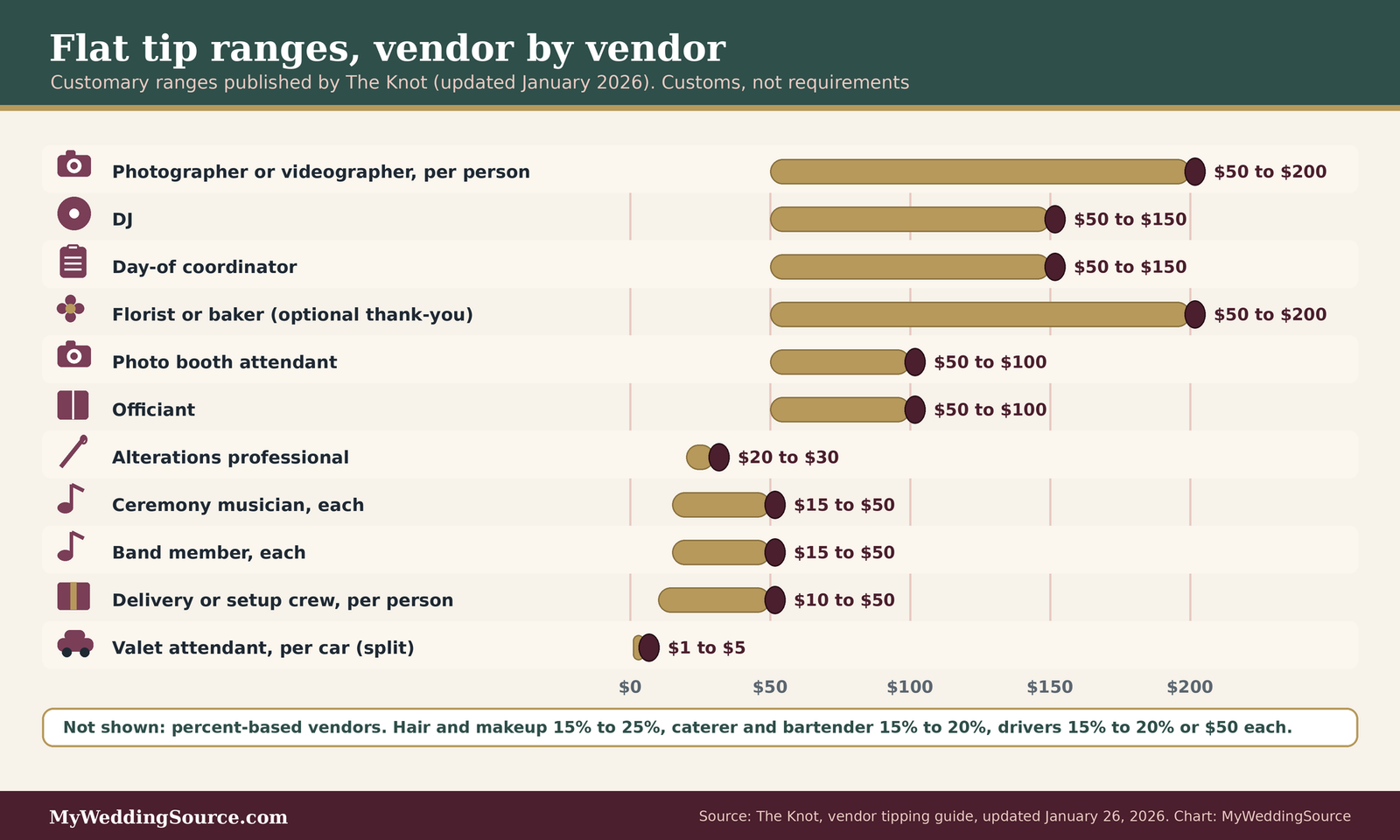
This section organizes wedding vendor tipping by how each vendor works with you, because the logic follows the type of work. The ranges come from The Knot’s guide, updated January 2026, unless stated otherwise. They are customs, not requirements. If your contract includes a gratuity, use the earlier section to decide whether an additional tip makes sense.
Vendors who serve you one-on-one
In wedding vendor tipping, these vendors spend hours with you personally. Their work is billed by service, and the tip is usually a percentage.
Hair and makeup artists
The Knot suggests 15% to 25% of the total bill for both hairstylists and makeup artists, with extra for last-minute rescues. Emily Post’s general guide gives 15% to 20% for salon services. If you have several people working on your bridal party, tip each artist separately, based on their share of the bill. If the studio has a policy on tips, such as pooling them or not accepting them, ask before the day so you are not guessing.
A trial appointment is its own service. If you want to thank someone for a trial, our hair and makeup cost guide helps you plan the total so the tip percentage is based on the full amount.
Alterations professionals
The Knot suggests $20 to $30, with more for major restructuring, given in an envelope at the final fitting. This is a good example of a vendor where timing matters: the tip goes with the last appointment, not on the wedding day, because that is when the work is finished. Our guide to dress alterations covers the fitting schedule so you can plan the envelope.
Vendors who work your event
These vendors are present for part or all of the day. Most are tipped a flat amount, given near the end of their work.
Photographers and videographers
The Knot suggests $50 to $200 per team member, or 5% to 15% of the contract, at the end of the reception, and says to tip each person if the photographer does not own the business. The wide range reflects the wide range of contracts: a lead photographer with a long package and an assistant who works six hours are not in the same position. Our wedding photography guide explains how packages are built so you can estimate the team size and hours.
DJs, bands, and ceremony musicians
The Knot suggests $50 to $150 for a DJ depending on total cost, and to include sound technicians if present. For a band, it suggests $15 to $50 per member, given as a lump sum to the bandleader or in individual envelopes. Ceremony musicians receive $15 to $50 each at the end of the ceremony. For a four-piece band, that is $60 to $200 in total by our arithmetic, which is a useful reminder that per-person ranges add up as the group grows.
Photo booth attendants
The Knot suggests $50 to $100, given by the planner or a member of the wedding party at the end of the reception. Our photo booth guide covers what is included in rental packages so you know who will be on site.
The food and drink team
This is the largest single category in most weddings, and it is where an included service charge matters most.
Caterers and waitstaff
The Knot suggests 15% to 20% of the food and beverage fee, split among the staff, and $200 to $300 for the maître d’. If your contract includes a gratuity, the Knot says additional tips are unnecessary but still welcome for going above and beyond. If the contract does not include one, the final bill with tip is typically due before the reception, according to the Knot, or an envelope goes to the maître d’ at the end of the night.
Bartenders
The Knot suggests 15% to 20% of the drink fee, split among the bartenders, given to the head bartender in the same way as the caterer’s tip, and only if a charge is not already included. If you host an open bar, our open bar guide explains how bar packages are priced so you can calculate the percentage on the right base.
Planning, coordination, and the ceremony
These people shape how smoothly the day runs. Tips here are often flat amounts or thoughtful gifts.
Planners and coordinators
The Knot suggests 15% to 20% of the planner’s total fee, or a thoughtful gift, with assistants included. A month-of or day-of coordinator receives $50 to $150. The planner’s tip may be an envelope at the end of the reception or a thank-you note with a check or gift afterward. If the planner has assistants, the Knot says to include them, so ask how many people worked on your wedding. Our wedding timeline guide shows who is present at each stage so you can decide who to include.
Officiants
The Knot suggests $50 to $100 for an officiant, more for extensive premarital counseling, and a $100 to $500 donation if the officiant works through a religious institution. Fees are usually paid beforehand, and the thank-you is handed over at the rehearsal dinner or right after the ceremony, often through the planner. For a friend who is ordained for the day, we think a gift usually fits better than cash, though that is our suggestion rather than a published rule. Our officiant guide explains how fees and customs differ by type of officiant.
Delivery, setup, and transportation
These teams arrive early or leave quietly, and they are the easiest people to forget.
Delivery and setup crews
The Knot suggests $10 to $50 per person, given in envelopes the day before to the lead staff member accepting deliveries. If the florist, baker, and rental company each send crews, ask the planner or venue coordinator how many people to expect. Our wedding decor guide shows what a typical setup involves.
Drivers and valet attendants
The Knot suggests 15% to 20% of the total transportation bill, or $50 per driver, given at the end of the night or after the last ride, and $1 to $5 per car for valet attendants. The Knot specifically says to read caterer and transportation contracts for gratuities that are already included, so check before adding anything. Our wedding transportation guide explains how charters and shuttles are billed.
Owners and business-only vendors
The Knot says florists and cake bakers are typically not tipped, and suggests $50 to $200 or a small gift in a thank-you card after the wedding if you want to. This reflects a general pattern: vendors who own the business and set their own prices are often thanked with a note, a review, or a referral, while employees who work the day receive cash. Neither is wrong, and the point is to be intentional.
| Situation | Customary range (The Knot, January 2026) | Best channel | Exception logic |
|---|---|---|---|
| Hair and makeup | 15% to 25% of the bill | Cash or check at the end of service | Lower end if the contract already includes a service fee |
| Alterations | $20 to $30, more for major work | Envelope at the final fitting | Raise for rush or restructuring |
| Photographer or videographer | $50 to $200 per team member | Envelope at the end of the reception | Tip each person if the lead does not own the business |
| DJ | $50 to $150 | Envelope via planner or attendant | Add sound technicians if present |
| Band | $15 to $50 per member | Lump sum to the bandleader or individual envelopes | Scale with performance length |
| Caterer and waitstaff | 15% to 20% of food and beverage | Contract line or envelope to the maître d’ | Skip if gratuity is written into the contract |
| Bartenders | 15% to 20% of the drink fee | Envelope to the head bartender | Skip if a charge is included |
| Planner or coordinator | 15% to 20% of fee, or $50 to $150 for day-of | Envelope or note with check | A gift fits if you prefer |
| Officiant | $50 to $100, or $100 to $500 donation if religious | Rehearsal dinner or after the ceremony | A gift fits for friends |
| Delivery and setup | $10 to $50 per person | Envelope the day before | Ask for headcount in advance |
| Drivers | 15% to 20% of the bill, or $50 per driver | End of the night | Check the contract for included gratuity |
| Florist or baker | Typically not tipped, or $50 to $200 as a thank-you | Card after the wedding | Owners often prefer a review |
Building a tipping budget you can defend
Wedding vendor tipping feels unpredictable because the amounts are scattered across a dozen vendors. A short method turns wedding vendor tipping into a single number you can plan around, and it keeps you from making the decision at 11 p.m. with a stack of bills.
A three-pass method
The method below for wedding vendor tipping is our own, not a published standard. It works because it separates three questions that couples tend to blur together: who works your day, what range applies to each, and what is already paid.
Pass one: list who actually works your day
Write every vendor on a page, and next to each, the number of people who will work your event. You can ask the vendor, or ask the planner or venue coordinator. A photographer might be one person or three. A caterer might send eight servers or twenty. A delivery crew might be two people or five. The headcount matters because several of the ranges are per person. Our wedding planning checklist is a good place to cross-check that no vendor is missing.
Pass two: set a low and a high for each
For each vendor, use the range that applies. For percentage-based vendors, multiply the base by the low and high percentages. For flat-rate vendors, multiply the per-person range by the headcount. Keep the low and high as two separate columns. You will not know in advance which end you will land on, because it depends on how the day goes, and the spread is information. A narrow spread means a predictable budget. A wide spread tells you where the decisions sit.
Pass three: subtract what the contract already covers
Return to the contract review for wedding vendor tipping. Any vendor whose gratuity is written into the contract and confirmed to reach staff drops to zero in the baseline, or to a small optional amount for exceptional service. Anything that is a business fee stays in. The result is your baseline tipping budget, and the difference between the high and low columns is your flexibility.
A worked scenario: 100 guests
The wedding vendor tipping scenario below is an illustration with invented figures, using The Knot’s ranges. It is not a prediction for your wedding, and your vendors may be priced differently. All totals are our own arithmetic.
The flat-rate vendors
Assume a lead photographer and one second shooter (two people), one videographer, a DJ, three ceremony musicians, a day-of coordinator, an officiant, a photo booth attendant, a four-person delivery and setup crew, a final-fitting alteration, and two shuttle drivers tipped at $50 each. Using the low and high ends of The Knot’s ranges, these total about $555 to $1,580.
The percentage-based vendors
Add hair and makeup with a combined bill of $700, which at 15% to 25% is $105 to $175. If catering is $9,000 for food and service with no included gratuity, 15% to 20% is $1,350 to $1,800. If the bar fee is $2,500 with no included charge, 15% to 20% is $375 to $500.
What the totals tell you
Without catering and bar tips, the scenario totals about $660 to $1,755. With catering and bar tips, it totals about $2,385 to $4,055. Against an assumed $35,000 total budget, which is an arbitrary figure chosen to make the arithmetic easy, that is roughly 1.9% to 5.0% without food and drink, and 6.8% to 11.6% with them.
Two lessons about wedding vendor tipping stand out. First, the food and drink team is most of the money, which is why checking the contract matters so much. A written gratuity on the caterer’s contract can remove more than half of the high-end total. Second, the flat-rate vendors are a small amount in total, which is why leaving them out is a poor trade. Our wedding budget calculator can hold a tipping line next to your other categories, and our average wedding cost guide puts your own totals in context.
Where to trim without shortchanging people
If your wedding vendor tipping total is higher than you can afford, trim deliberately rather than quietly. These are our suggestions, not published rules.
Prioritize by hours and hands-on work
For wedding vendor tipping, staff who spend the longest time on your event, and those whose work is physical and visible, are the people most likely to appreciate a tip. That usually means the food and drink team, the delivery crew, and the people who work through the evening. Vendors who own their business and set their prices, such as a florist, are the easiest to thank with a note and a review instead.
Use the low end of the range for the right reasons
Staying near the low end of a published range is entirely within convention. It is not a snub. A DJ who played a straightforward set can be thanked at $50 to $75; a DJ who solved a sound problem and stayed late can be thanked more. The range exists so you can respond to what happened.
Pair a smaller tip with a specific note
A short, specific note, naming what someone did, is a real form of thanks. It does not replace a tip where one is customary, but it helps when the amount is modest. Our vendor meals guide covers another common courtesy: feeding the people who work through dinner.
Timing, envelopes, and who hands them out
Even a well-planned wedding vendor tipping budget fails if the envelopes do not reach the right hands. Timing is the second half of wedding vendor tipping, and The Knot’s guide gives clear markers for most vendors.
When each tip is due
The timing for wedding vendor tipping follows each person’s last moment of work. A tip given before the work is finished can feel like a payment for an outcome. A tip given long afterward can be missed. The markers below are drawn from The Knot’s guide.
Before the wedding day
Delivery and setup staff receive their envelopes the day before, handed to the lead person who accepts deliveries. Alterations professionals are thanked at the final fitting. Officiants are often thanked at the rehearsal dinner, though some are thanked immediately after the ceremony. If you want a calm day-of, front-loading these is helpful, and our wedding planning timeline is a natural place to note them.
During the wedding day
Hair and makeup artists are tipped at the end of their service. Ceremony musicians are thanked at the end of the ceremony. Valet attendants may be tipped at the start or end. If a caterer’s final bill including gratuity is due before the reception, it will already be paid.
At the end of the reception and afterward
Photographers, videographers, DJs, bands, planners, coordinators, and photo booth attendants are typically tipped at the end of the reception, often through the planner or a wedding party member. Drivers are tipped after the last ride. Florists and bakers, if you choose to thank them, receive a card with a tip after the wedding, and their delivery staff are tipped separately.

Cash, checks, and apps
The Knot describes cash in envelopes as the most traditional and preferred approach, with mobile payments as a way to decide amounts after the event and checks as a way to give vendors a record. Each has trade-offs.
Cash envelopes
Cash is immediate and requires no setup for the vendor. It also requires you to carry a large amount on a busy day, which is a reason to assign a person to hold it. Use a mix of bill sizes so you can adjust amounts without needing change. The IRS says workers who receive cash tips report them as income, so cash is not an informal arrangement from the worker’s side.
Checks and payment apps
A check gives the vendor a record, and works well for planners, officiants, and anyone who prefers it. An app lets you decide after the day, when you can think clearly about how it went. Ask the vendor which they prefer, and write a short note to go with it either way.
Handing it off
Most couples do not hand out wedding vendor tipping envelopes themselves. The Knot suggests preparing them a few days before and delegating distribution to a planner or a member of the wedding party.
Pick one point person
Choose someone calm and organized who knows the vendors by name and will be present at the end of the night. A planner is the natural choice. If you do not have one, a parent, sibling, or friend who is not in the wedding party can do it. Give them a list with names, roles, amounts, and the right time for each.
Label envelopes and plan a backup
Write the vendor’s name and role on each envelope, and put a small thank-you note inside. Keep a few extra blank envelopes and some cash in reserve for the person who unexpectedly goes above and beyond, or for a vendor you did not know would be there. Our wedding emergency kit guide is a good place to tuck the extras, and our day-of timeline guide explains where schedules slip.
When wedding vendor tipping gets awkward
Most awkward moments in wedding vendor tipping have the same root: a mismatch between what someone expects and what you planned. The response to wedding vendor tipping questions is usually a short, consistent sentence, and sometimes a change to logistics.
Responses to common situations
The table below summarizes the most predictable wedding vendor tipping situations. The sentences are suggestions in plain language that you can adapt.
| Situation | Response principle | Boundary | Graceful alternative | Escalation risk |
|---|---|---|---|---|
| A vendor asks for a tip before the work | Stay calm and point to the contract | Tip after service, not before | Offer a thank-you at the end of their work | Low, but note it if pressure continues |
| A vendor presents a tip as mandatory | Check whether it is a contract charge | Pay what the contract says, no more | Ask for the term in writing | Medium, since it may be a misdescribed fee |
| A venue forbids staff from accepting tips | Respect the policy | Do not slip cash against a stated rule | Write a review, send a note to management | Low |
| Service was poor | Separate the person from the problem | Tip lower within the range, if at all | Raise the issue with the vendor | Medium, as it may affect refunds |
| A parent says tipping is unnecessary | Explain the contract and the worker’s perspective | Keep the plan you chose | Offer to share the list | Low |
| The budget is spent | Rank by hours and hands-on work | Keep to the budget you set | Notes, reviews, referrals, meals | Low |
When a vendor asks for a tip
A vendor who asks you directly for a tip, especially before the work is done, is asking for something that is meant to be voluntary and set by you. You can respond kindly: “We plan to thank the team at the end of the night, as is our custom.” If the request is repeated, or the vendor suggests that service depends on it, treat it as a contract issue and write to the business owner.
When service was poor
A tip is a response to service. If the work was clearly below what you contracted for, it is reasonable to tip at the low end of the range or not at all. Separate the individual from the problem: a caterer’s server may have done well even if the kitchen ran late. If the issue is serious, raise it with the vendor in writing, and keep the tip decision separate from any refund conversation.
When a venue or vendor policy bars tips
Some businesses ask that staff not accept tips. Respect the policy. A review, a note to management, or a referral is a way to say thanks that fits inside it. If the policy is unclear, ask the venue coordinator directly before the day.
When money is tight
Wedding vendor tipping can feel like one expense too many, and it is fine to say so to yourself. The Knot’s ranges are customs, not a bill.
Rank by impact, then fund in order
Start with people who work longest and hardest on your event. Fund those first at the low end of the range. Then add others as the budget allows. Our guide on how to pay for a wedding covers building a reserve so late costs do not squeeze this line.
Use non-cash thanks well
A public review that names specific staff, a referral, a handwritten note, and a meal for the team are all meaningful. They do not replace cash for people who customarily receive it, but they are a good addition and sometimes a good substitute for vendors who own their business.
Do not promise what the budget cannot deliver
If you tell a vendor you will tip generously and then cannot, that is worse than saying nothing. Make no promises you have not budgeted. Our wedding etiquette guide covers other places where a small, honest message is better than a big gesture.
Deciding whether to tip
Is wedding vendor tipping required?
No. Federal wage rules describe a tip as something the customer chooses to give and sets the amount of, and The Knot calls tips expected for good work but not required. Your contract can still contain a mandatory service charge, which is a price, so read it before deciding what extra to give.
Do I tip if a service charge or gratuity is already on the contract?
Usually not extra, but confirm first. The Knot says tips are unnecessary when gratuity is listed on a contract or invoice, and that more is still welcome for exceptional work. Ask the vendor in writing whether the charge goes to the staff who work your event, because a business fee is different from gratuity.
Should I tip the owner of the business?
It is optional and varies. The Knot suggests $50 to $200 or a small gift for florists and bakers, who are typically not tipped, and tips for photographers, videographers, and planners depend on the contract. For owners, a note, a review, or a referral is a reasonable alternative, and that is our suggestion rather than a published rule.
What if the vendor already includes a tip in the price?
Then you have already paid it, and a further envelope is a thank-you rather than an obligation. A line labeled gratuity that is calculated for you and due with your final balance is part of the price. Ask whether it is distributed to staff, so you can decide whether an extra thank-you fits.
Handling amounts and timing
How much should I budget for wedding vendor tipping in total?
It depends on your vendors. In our invented 100-guest scenario using The Knot’s ranges, flat and hair-and-makeup tips came to about $660 to $1,755, and about $2,385 to $4,055 with catering and bar tips. Your total will differ, so build your own list with low and high amounts for each vendor.
When should I give the envelopes?
Near the end of each person’s work. The Knot suggests delivery crews the day before, alterations at the final fitting, hair and makeup at the end of service, musicians after the ceremony, and most event vendors at the end of the reception. Florists and bakers are thanked with a card afterward.
Who should hand them out?
Not you, if you can avoid it. The Knot suggests preparing envelopes a few days ahead and delegating the handoff to a planner or a wedding party member. Choose one calm person, give them a list of names, roles, and amounts, and label every envelope with the vendor’s name.
Is cash better than a check or an app?
Cash is the most traditional choice, according to The Knot, but checks give vendors a record and apps let you decide after the day. Ask each vendor what they prefer. Workers report cash tips as income, so no method is informal for them, and a short note helps with any of them.
Your next steps
Gather the facts
Pull every contract and mark the gratuity lines
For wedding vendor tipping, highlight any line labeled gratuity, service charge, administrative fee, or labor fee, and send each vendor the written question about where it goes. Our wedding vendor contract guide lists other clauses worth checking while you are there.
Count the people who will work your day
Ask your planner, venue coordinator, or each vendor how many people will be on site and in what roles. That headcount turns per-person ranges into real wedding vendor tipping numbers.
Set the plan
Build the low and high budget
List each vendor, apply the range, subtract what is covered by the contract, and add the total to your budget in the wedding budget calculator. Keep the spread visible so you know where you can flex.
Assign the handoff
Choose your point person, prepare labeled envelopes with notes a few days before, and give them a timeline. Our wedding planning guide shows where this fits among the other final tasks.
Sources & methodology
How we built this guide
What we relied on
This guide combines The Knot’s published vendor tipping guide (page updated January 2026), Emily Post’s general tipping guidance, IRS pages and a revenue ruling on tips and service charges, and federal wage regulations that distinguish tips from charges for service. Where a figure comes from The Knot or Emily Post, we say so. The Knot’s page does not cite a survey; it gives editorial ranges and one planner’s anecdotal comment. The scenario totals and the quote comparisons are our own arithmetic on invented figures and are estimates.
What we did not do
We did not survey vendors or couples, and we did not verify any vendor’s practices. We could not read every etiquette source, because several sites did not load for us, so the ranges here reflect the sources we could read. Emily Post’s general guide shows no publication date. This is general education, not legal, tax, or financial advice. State rules and individual contracts vary, so check yours.
Source list
Government and regulatory sources
- Internal Revenue Service, Topic no. 761, Tip income and allocated tips: https://www.irs.gov/taxtopics/tc761
- Internal Revenue Service, Tip recordkeeping and reporting: https://www.irs.gov/businesses/small-businesses-self-employed/tip-recordkeeping-and-reporting
- Internal Revenue Service, Revenue Ruling 2012-18 (tips versus service charges): https://www.irs.gov/pub/irs-drop/rr-12-18.pdf
- 29 CFR 531.52, General characteristics of tips: https://www.law.cornell.edu/cfr/text/29/531.52
- 29 CFR 531.54, Tip pooling: https://www.law.cornell.edu/cfr/text/29/531.54
- 29 CFR 531.55, Examples of amounts not received as tips: https://www.law.cornell.edu/cfr/text/29/531.55
Wedding and etiquette sources
- The Knot, How much to tip wedding vendors (updated January 26, 2026): https://www.theknot.com/content/wedding-vendor-tipping-cheat-sheet
- Emily Post Institute, General tipping guide: https://emilypost.com/advice/general-tipping-guide
- Emily Post Institute, Finer points of tipping: https://emilypost.com/advice/finer-points-of-tipping