
A first dance song edit is any change you make to a recording so it fits your dance: a shorter length, a cut intro, a softer ending, a clean version of a lyric. This guide explains how to plan a song edit, who should make it, what the rights holders and the DJ each need to know, and how to keep a simple review log so nothing about the music is left to memory on the day.
Treat every song edit as a small project with one line in a review log: the cue, the exact source file, the version, what was changed, who changed it, the rights path, the test result and the fallback. Edit for the dance you will actually do, not for the length of the original. Give the DJ the final file early and confirm in writing that it is the one they will play. Check the rights questions with the venue and the DJ, and ask the rights holders directly before you share or publish anything made from the song edit.
Most couples do not choose a first dance song for how it is arranged. They choose it because it means something. Then the song turns out to be four and a half minutes long, with an eighty-second instrumental opening, a key change at the end and one line in the second verse that does not suit a room with grandparents in it. The question stops being “which song” and becomes “what do we do to it.”
That question is where a song edit comes in, and it is where small mistakes pile up. A trim that lands mid-phrase. A file ripped from a streaming app that the DJ’s software will not open. A radio edit that is shorter than you wanted and has a different ending from the one you rehearsed. A remix someone found online that turns out to be a different performance. A cut that the couple loved at home and that clips the first beat in a venue’s sound system.
This guide covers the practical side. It starts with what a song edit is and which kinds exist, then gives you a review log to keep, a way to decide who should do the work, a plain explanation of the rights questions involved, scripts for working with the DJ, a testing routine, a fully worked example, and a set of failure conditions with fallbacks. It is about the song edit itself. For the whole evening’s music, the site’s reception music planning guide covers the bigger picture.
A note on scope. This is general information, not legal, tax or financial advice. Copyright and licensing rules are set by statute and by the organizations that administer them, and your venue, DJ and music source may each have terms of their own. Where a rule matters, this article names the agency or organization that publishes it so you can confirm the current version.
What a first dance song edit is, and what it is not
A song edit, in the sense used here, is a deliberate change to a piece of recorded music so that it serves a single moment. For a first dance that moment is usually between two and four minutes long, has a clear start and a clear end, and is watched by everyone in the room.
It helps to separate a song edit from three things that get confused with it.
A song edit is not a different song. If you swap the recording for a cover by another artist, an acoustic version or a live performance, you have chosen a different recording. That may be a better solution, and later sections cover it as an alternative, but it is a selection decision, not an edit.
A song edit is not a performance. If a singer or a band plays the song live and shortens it, the shortening is an arrangement decision made in rehearsal. The review log still works, but the permission questions differ, and the section on live music handles them.
A song edit is not a mix of the whole night. Your DJ may blend tracks, adjust volume and fade between songs as part of their normal work. That is their craft and their equipment. A song edit is the specific, fixed change that you and the DJ agree on in advance for one cue.
With those boundaries clear, a song edit can be described by four properties. What is cut or changed. Where in the track it happens. Who made the change and with what software. And what the finished file is called, so everyone is talking about the same one.
Why a song edit is worth planning
There are three reasons to treat this as more than a casual favor.
The first is time. A first dance that runs longer than the couple wants is uncomfortable for everyone. A first dance that ends abruptly because the file was cut badly is worse. The song edit is what protects the length you rehearsed.
The second is control. A first dance happens once, in front of every guest, and the couple has no chance to fix it afterward. Any element that is under your control, including the exact audio file, should be settled before the day.
The third is rights. Editing a recording does not make it yours, and it does not remove the permissions that apply to the original. Handled carelessly, an edit can also create a file that is awkward to share, post or add to a video later. That is the reason this guide pairs the song edit with a permission review rather than treating them as separate chores.
The people involved in one song edit
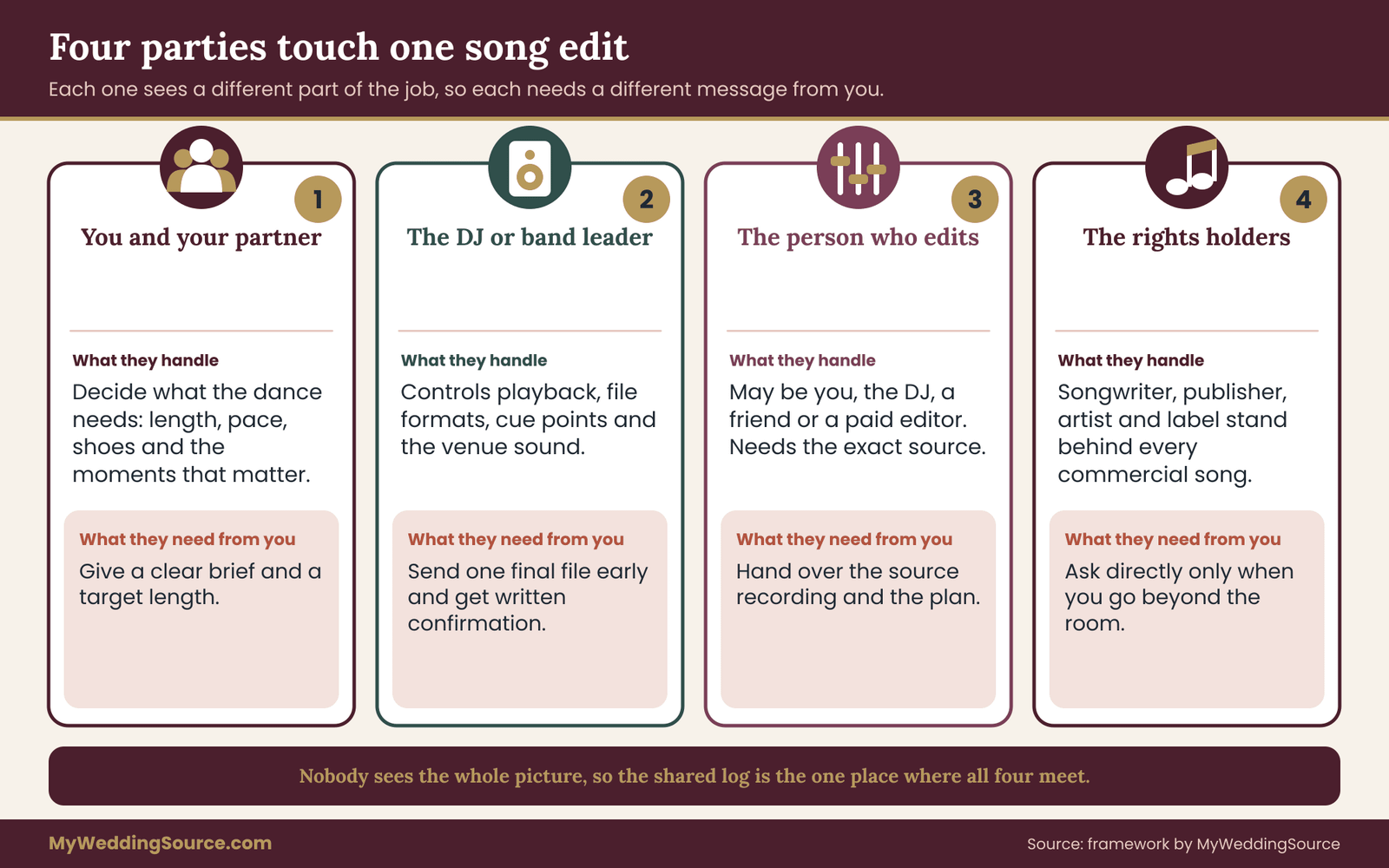
Even a simple edit usually touches four parties, and each one sees a different part of it.
You and your partner decide what the dance needs. You know how long you can comfortably dance, what you are rehearsing, and which moments in the song matter to you.
The DJ or band leader controls the playback system, knows which file formats work, and knows what the venue’s sound system does to a recording. They are the person who must play your file, so their needs set the technical limits.
The person who makes the song edit may be you, the DJ, a friend or a paid audio editor. Whoever it is, they need a clear brief and a copy of the exact source recording.
The rights holders sit behind everything else. A commercial song usually involves a songwriter and publisher on one side and a recording artist and label on the other. You rarely deal with them directly for a private edit played at your own reception. You do need to know when you would.
Why a song edit goes wrong: the common failure points
Before building a process it is worth looking at how song edits fail, because each failure suggests a line in the review log. None of these are dramatic. They are small, specific and avoidable.
The wrong source. A couple falls in love with a version they heard on a video, a playlist or a wedding film. The recording is an alternate take, a live version or a remaster with a different intro. They edit that file, but the DJ’s library has the album version. On the day the cue points are wrong. The fix is to name the exact recording, with artist, title, album or release, and running time, in the log before anyone edits anything.
The wrong format. A file exported from a phone app might be a low bit-rate compressed file, or a protected file the DJ’s software cannot read. A good song edit is delivered in a format the DJ has confirmed they can play, with a name they can find quickly under pressure.
The abrupt ending. Cutting to a target length is easy. Cutting so the ending still sounds like an ending is harder. A hard cut at two minutes and forty seconds can stop on a half-finished chord and leave both of you standing still while the room waits. The standard fix is a short fade or a spliced ending taken from the song’s own finale, and it needs to be listened to, not just calculated.
The unfinished dance. The song edit was built for a length of time, but the choreography or the simple walk-and-sway pattern the couple uses was never timed against it. If you have a practice plan, timing it against the final edit is part of that plan. A practice plan with a stopwatch is the place for that side.
The version mix-up. Over a few weeks it is easy to end up with “final”, “final2” and “final_real” on a laptop, a phone and a shared folder. Then the DJ receives the second one and the couple rehearses with the third. A single naming rule and a single delivery point prevent this.
The lyric surprise. A line that seemed harmless in a playlist is startling at full volume in a room with several generations. Reading the lyrics once, slowly, with the guest list in mind, finds this before the DJ does. The question of what to do about it, and whether changing a lyric is a small edit or a larger rights issue, comes later in the article.
The assumption that someone else checked. The DJ assumes the couple confirmed the file. The couple assume the DJ would say if something was wrong. The venue assumes the DJ has it covered. Each party sees only part of the process, and nobody owns the whole thing. The review log fixes this by giving every line a named owner.
What goes right when the edit is planned
When the process works, nothing dramatic happens. The couple walks to the floor, the first note lands where they expect it, the dance ends where they planned, and nobody in the room thinks about the music at all. That quiet outcome is the target. It is built from a handful of unremarkable decisions made weeks earlier, and the rest of this guide is a way to make those decisions in the right order.
Six kinds of song edit and what each one asks of you
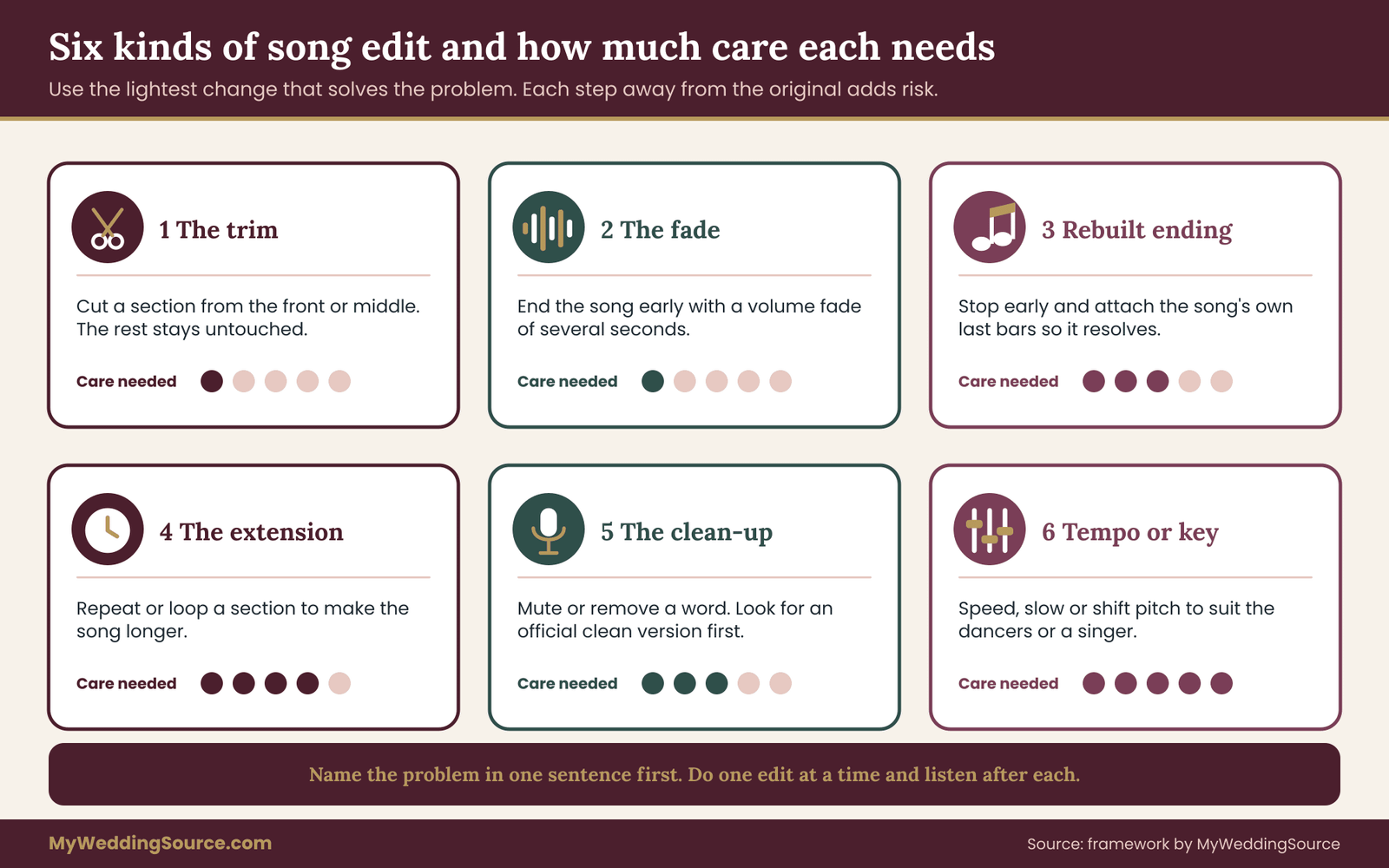
Not every edit is equal. Some are trivial and carry almost no risk. Others change the recording enough that you should slow down and ask questions. Sorting your plan into the six kinds below tells you how much care each one needs.
1. The trim. You cut a section out of the middle or off the front, for example removing a long instrumental opening or a second chorus. The audio that remains is untouched. This is the most common song edit and the easiest to do well, provided the cut points fall on a beat and the join does not click.
2. The fade. You keep the song as recorded and end it early with a volume fade. It is quick and reliable, and it can sound polished if the fade is long enough, usually several seconds. A fade that is too short sounds like a mistake. The choice here is between a fade and a real ending, and the dance itself should decide.
3. The rebuilt ending. You stop the song earlier and attach the song’s own final bars, taken from the end of the track, so the music resolves. This takes more skill than a fade, and it needs a careful listen to catch mismatched tempo or a held note that does not line up.
4. The extension. You make the song longer by repeating a section, looping an instrumental passage or adding a few seconds of silence or applause space at the start. Couples who want a slow, unhurried dance sometimes ask for this. It is also the kind of change that moves furthest from the original recording, so it deserves the most scrutiny.
5. The clean-up. You remove or mute a word or a line so the track suits the room. The industry calls the result a clean or radio edit when a label publishes it. Sometimes an official clean version already exists, and using it is simpler than making your own. Reviewing lyrics across a whole night is a separate job from editing one track.
6. The tempo or key change. You speed up, slow down or shift the pitch so the song suits the way you dance or the singer who will perform it. A small tempo change can make a slow dance more comfortable. A large one changes the character of the performance and can make voices sound odd. This is the kind of change that most often needs a trained ear, and it is the one a DJ or an editor is best placed to judge.
Choosing the lightest edit that solves the problem
A useful rule for any song edit is to use the lightest change that fixes the actual problem. The reasoning is simple. Every step away from the original recording adds some risk: a risk of sounding wrong, a risk of a file that does not play, and a risk of a rights question that did not exist before.
Start by naming the problem in one sentence. “The song is too long.” “The first minute is quiet and we will be standing still.” “One lyric does not suit the room.” “It is too fast for the way we dance.” Each sentence points to one kind of edit, and often a trim or a fade is enough.
If the problem is length, try a trim and a fade before trying an extension. If the problem is an awkward opening, trim the front or start the dance partway in rather than rebuilding the whole structure. If the problem is a lyric, look for an official clean version first, then a short mute, then consider a different song. If the problem is tempo, listen to a slightly slower pass before assuming you need a large change.
A second rule follows from the first. Do one edit at a time and listen after each. A song with a trim, a rebuilt ending and a tempo change applied together is hard to judge, and when something sounds wrong you cannot tell which step caused it.
Decide the dance length first
The most useful number in the whole process is the length of the dance, and it should come from the dance. Before opening any software, do the first dance once with a stopwatch, at a pace that you could keep up in formal clothes, in the shoes you will wear, on a floor that resembles the venue’s.
If you have no choreography, the same logic applies to a simple sway and a few turns. Time it, add a margin, and compare the result with the length of the original track. Many couples find that the dance feels long at around two minutes when they are being watched, and short when they practice at home. Plan for the second feeling to turn into the first on the day.
Some couples also want a joint element: a second part where parents or the wedding party join the floor. That changes the music requirement, because the edit now has to serve two sections. It is easier to plan this as two cues in the log than as one long file with a hidden join in the middle.
For couples with limited stamina, a seated or partly seated dance, or a partner who uses a mobility aid, the same method works with the length set by comfort rather than by the original track. Settle the dance with a qualified instructor first, and let the song edit follow that decision.
The song edit review log: one line per music cue
The core of this guide is a document you can build in an evening: the review log. It has one line for every music cue that involves a song edit or a special version, and it follows each cue from first idea to confirmed playback. It can live in a spreadsheet, a shared note or a printed page. What matters is that every line is complete and that the DJ sees the same version you do.
A first dance is one cue. Many couples add a few more, such as a parent dance, an entrance song, a cake cutting cue and a final song, and the same log serves them all. This guide keeps the first dance as the main example, because the log is easiest to understand with a single concrete cue.
The nine fields of a log line
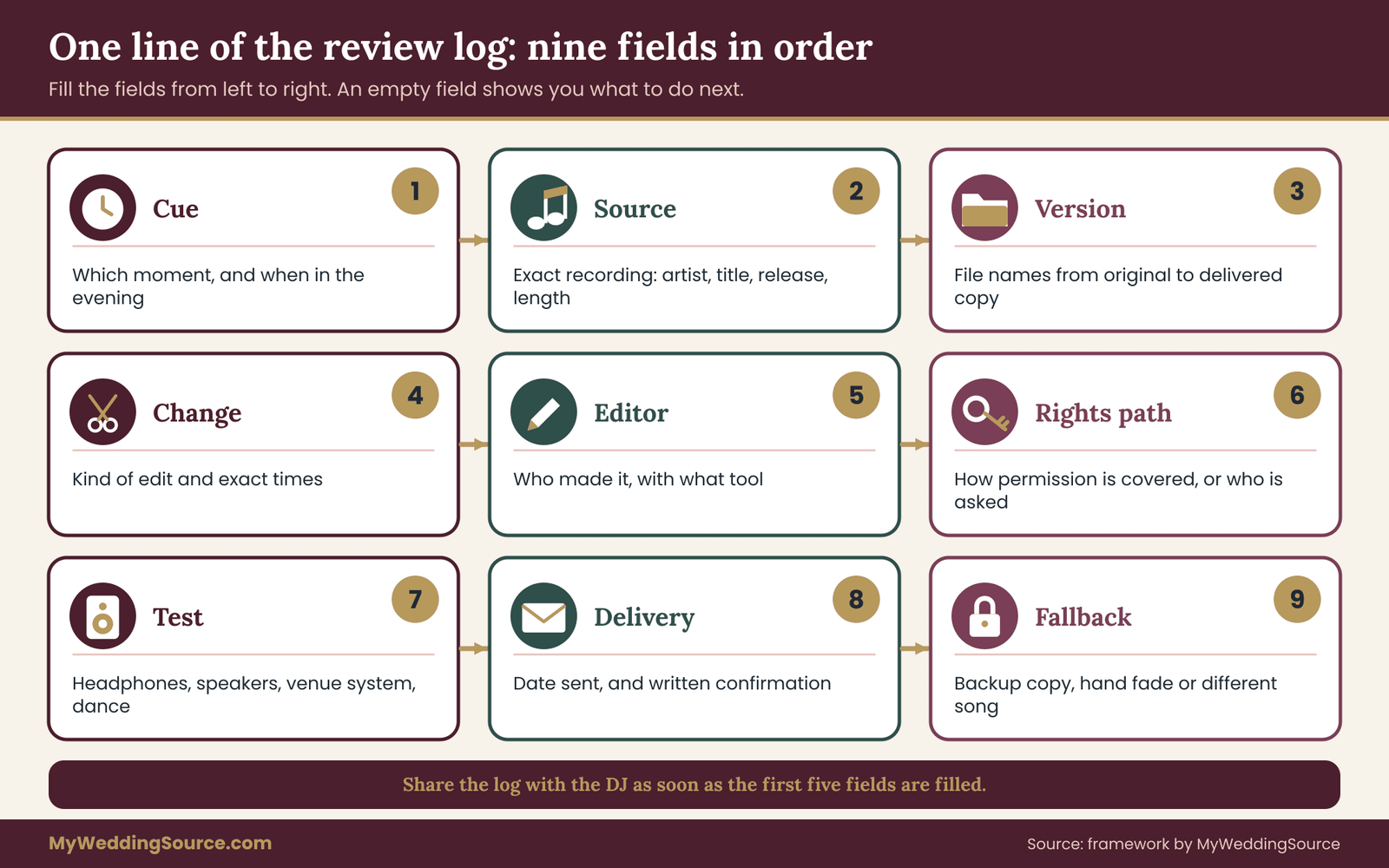
Each line has nine fields. They are arranged in the order in which decisions are normally made.
Cue. What moment this music serves and when it happens in the evening, for example “first dance, after the toasts, about two minutes after the cake.”
Source. The exact recording you are editing: artist, title, release, and running time. If you also have a file, note where it came from and in what format, without screenshots of any account details.
Version. The name of each file in the chain, from the original through the song edit to the delivered copy, using one naming rule. A simple rule is cue, song title, date, and a version number, with the final one labeled as final only when it is.
Change. Which of the six kinds of edit applies, and the exact times in the original, for example “trim 0:00 to 1:20 from the front, fade out from 3:10.”
Editor. Who made the change and with what tool. If it is a person, put their name. If it is the DJ’s software, say that.
Rights path. A short note on how permission is covered: the venue’s license, the DJ’s license, a purchased copy, an official alternate version, or “to be confirmed with” a named party. This is a note on what has been asked, not a legal conclusion.
Test. Where and when the song edit was played and who listened, including the one test that matters most: played through the venue system or a comparable system at performance volume.
Delivery. The date the final file went to the DJ, how it was sent, and the written confirmation that the DJ received it and can play it.
Fallback. What happens if the file fails: a backup copy on a second device, the unedited original with a fade by hand, or a different song.
How to use the log in practice
Build the log early. A good starting point is about three months before the wedding, when the song is chosen and the DJ is booked. At that stage most lines are empty, which is fine. The log is a map of what still has to be decided.
Fill the lines from left to right. You cannot write a change before you know the source, and you cannot test before you have an edit. The order of the fields keeps the work in a sensible sequence, so you are not choosing an editor before you know which kind of edit you need.
Share the log with the DJ as soon as the first five fields are filled. Most DJs have a routine for special cues and will tell you quickly whether your plan works with their equipment. That conversation is easier before anyone has spent time on the song edit.
Keep one copy of the log as the master. When the DJ suggests a change, update the master, not a note in a message thread. After the wedding the log belongs with the rest of your paperwork, and the site’s guide to wedding records after the event shows where it fits among contracts, receipts and files.
What the log does not do
A log is a record, not a guarantee. It will not make a bad edit sound good, and it will not settle a rights question on its own. What it does is make every decision visible. If the rights path field says “to be confirmed” three weeks before the wedding, you know what to do next. If the test field is empty a week before, you know what is missing.
It also has a quieter benefit. When several people each hold part of a plan, a single shared log reduces the number of things that depend on memory. The DJ, the planner and both of you can read the same line and see the same state.
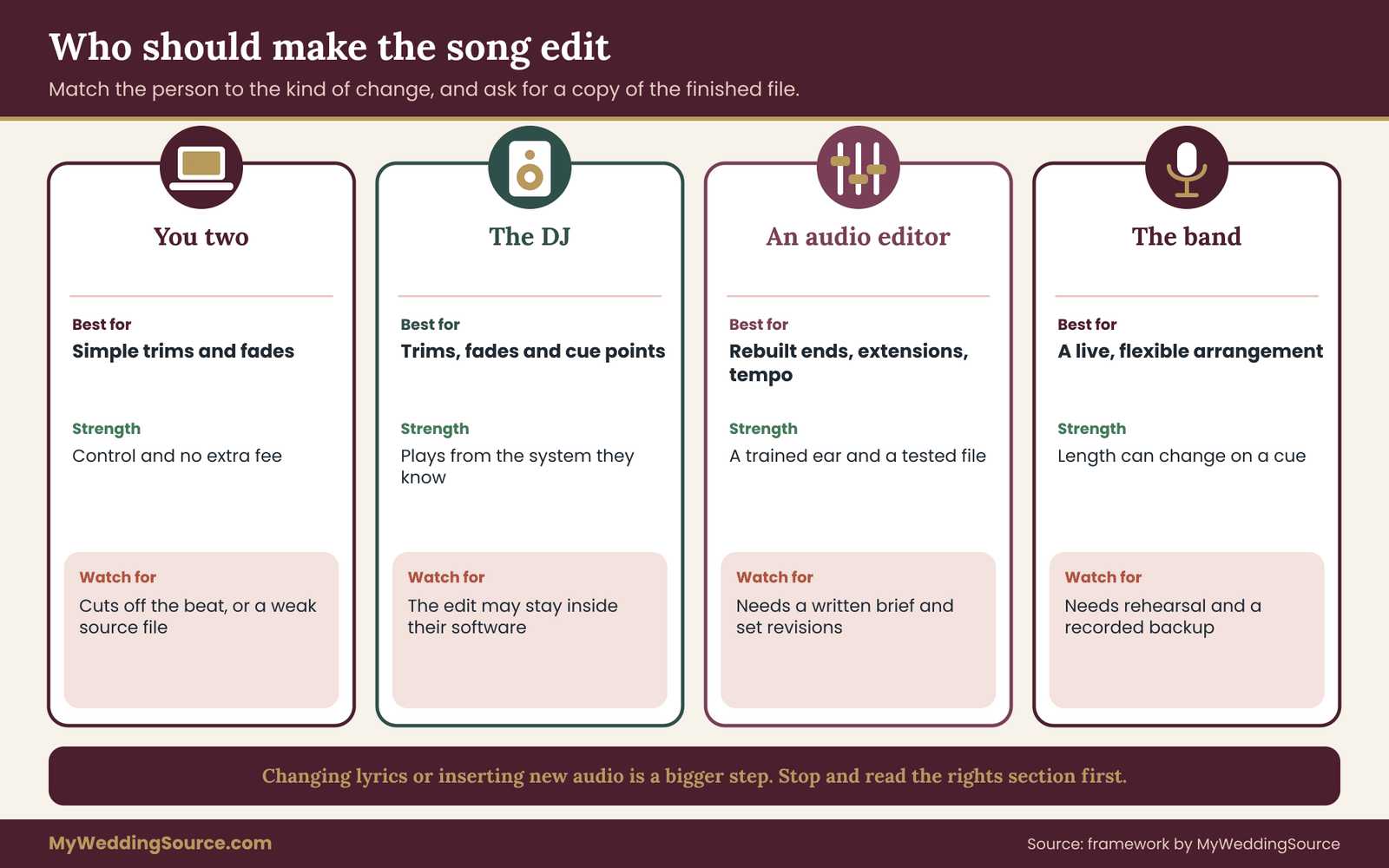
Who should make the song edit: you, the DJ, an editor or the band
Once you know what kind of edit the song needs, the next decision is who does it. There is no single right answer. The choice depends on how much the edit changes, how comfortable you are with audio software, and how the DJ prefers to work.
Doing the song edit yourselves
Free and low-cost audio editors exist, and a simple trim or fade is within reach of most people who are willing to watch a short tutorial. The advantages are control and cost. You decide every cut and you can listen as often as you like.
The risks are quieter. Many people edit by eye, looking at the waveform, and cut where the picture looks right rather than where the music works. A cut that is a fraction of a second off the beat is audible to anyone who has rehearsed the dance. Another risk is the source file itself.
If you start from a compressed copy and export a second compressed copy, the quality drops each time. And if the source came from a streaming service, its terms often limit what you may do with downloaded or captured audio, so read them before you assume the file is yours to alter.
A fair test for doing it yourself is this: can you play the finished edit twice in a row, loud, and find nothing you want to fix? If you can, it is probably fine. If you keep hearing small things, hand it to someone who edits for a living.
Asking the DJ to make the song edit
Many DJs make edits as a normal part of the job, and they do it in the software they will use on the night. That removes a whole category of format and timing problems. A DJ can also set cue points, so that the first note starts the instant they press play, and can build a safe fade into their system.
The trade-off is that the DJ’s edit lives in their system. If the equipment changes or the DJ is replaced because of illness, the song edit may not travel. Ask for an exported copy of the finished edit and keep it in your own records.
Ask, too, whether the song edit is included in the contract or billed separately. Some DJs include a small number of custom edits and charge for more. Others charge by the hour. The answer belongs in the written agreement, and the site’s wedding vendor contract guide explains how to get changes like this into the document rather than leaving them as a spoken promise.
Hiring an audio editor
A professional editor, such as a music editor or a mastering engineer, is the right choice for a rebuilt ending, an extension or a tempo change. These need a trained ear, and the result can be handed to the DJ as a finished, tested file.
Give an editor a written brief. State the source recording, the target length, the dance’s start and end moments, and any parts of the song that must stay untouched. Ask for the file in the format the DJ has confirmed, plus a second copy at higher quality for your records. Agree on how many revisions are included, and ask what the editor needs from you, since some will ask you to confirm you own or have licensed the source file before they work on it.
Do not accept an invented claim from any editor, such as an assurance that the song edit “needs no permission.” Nobody can promise that without knowing the song, the use and the setting. A careful editor will tell you what they can and cannot confirm and will leave the rights questions to the rights holders.
When a live band or singer performs the song
If musicians will play the song live, the edit becomes an arrangement. The band leader decides where to cut, how to end, and what key to play in. This is often the easiest way to get a shorter, more flexible version, because live musicians can add a repeat or a held ending in real time.
The questions shift. You no longer deal with a file, but you do need agreement on the arrangement. Ask the band to play the planned version in a rehearsal or a sound check, and write the structure into the log in plain words: “intro four bars, verse, chorus, final chorus, hold last chord.” For the licensing questions around live performance, which are mostly the venue’s and the band’s concern, the site’s reception music planning guide and the separate guide on live music licensing give the question list.
A quick decision rule
If the song edit is a trim or a fade and the DJ offers to do it, accept, ask for the exported copy and log it. If the song edit is a rebuilt ending, an extension or a tempo change, hire an editor or ask the DJ whether they do that work, and ask for a sample first. If the song edit changes lyrics, stop and read the rights section below before anyone touches the audio. If musicians are playing the song, skip the file and write the arrangement.
What a song edit changes about rights, and what it does not
This is the part many couples worry about, and it is also the part where careful wording matters most. The aim here is to give you the questions, not to give you legal conclusions, because those depend on facts about your song, your venue and how the edit will be used. The U.S. Copyright Office publishes plain-language information, and a lawyer who handles music matters can answer questions about your situation.
Two rights sit behind most songs
A commercial recording usually involves two separate sets of rights. One belongs to the composition, which is the melody and lyrics, often owned by a songwriter and a publisher. The other belongs to the sound recording, the particular performance captured on the track, often owned by a record label or the artist. The Copyright Office explains the difference in its circulars on musical works and sound recordings.
An song edit to a recording touches both, because the audio you are shortening is the sound recording, and the notes and words in it are the composition. This is why “I only trimmed it” does not make the question disappear. It also does not make it large. For most wedding uses it simply means the permission path, whatever it is, belongs to the original, and your song edit does not replace it.
Editing does not create new ownership
A common assumption is that a heavily edited version becomes a new thing that belongs to the person who edited it. Copyright law does not work that way. Under U.S. law, the owner of a copyrighted work generally holds the exclusive right to prepare derivative works based on it, and changing a recording substantially can fall into that area. The Copyright Office’s information on derivative works describes the idea.
The practical point is modest. A personal edit made so a song works for your own dance, played in the room by your DJ, is the everyday situation that wedding DJs and venues deal with, and the usual questions are about the venue’s and the DJ’s licenses. A wider use, such as posting the edited track, adding it to a video, distributing copies, or having it performed with changed lyrics, raises different questions and calls for a direct ask.
The public performance question belongs to the room
Playing recorded music at an event is generally a performance of the composition. In the United States, performing rights organizations such as ASCAP, BMI, SESAC and Global Music Rights license public performances of the compositions they represent, and venues and businesses often hold blanket licenses with some of them. Whether your event is covered depends on the place, the arrangement and the license terms.
You do not need to resolve this yourself. You need to ask two parties one clear question each. Ask the venue which music licenses it holds and whether they cover a private event with a DJ. Ask the DJ whether they hold their own licenses, what their usual practice is, and whether they play from a licensed source.
Put the answers in the rights path field of the log. The same question is covered at greater length in the site’s guidance on wedding music licensing, and the ASCAP and BMI websites explain their licenses in plain language.
Where a song edit does call for a direct ask
Some uses go beyond playing the file in the room, and these are the cases where you contact the rights holders or a licensing service, or choose a different path.
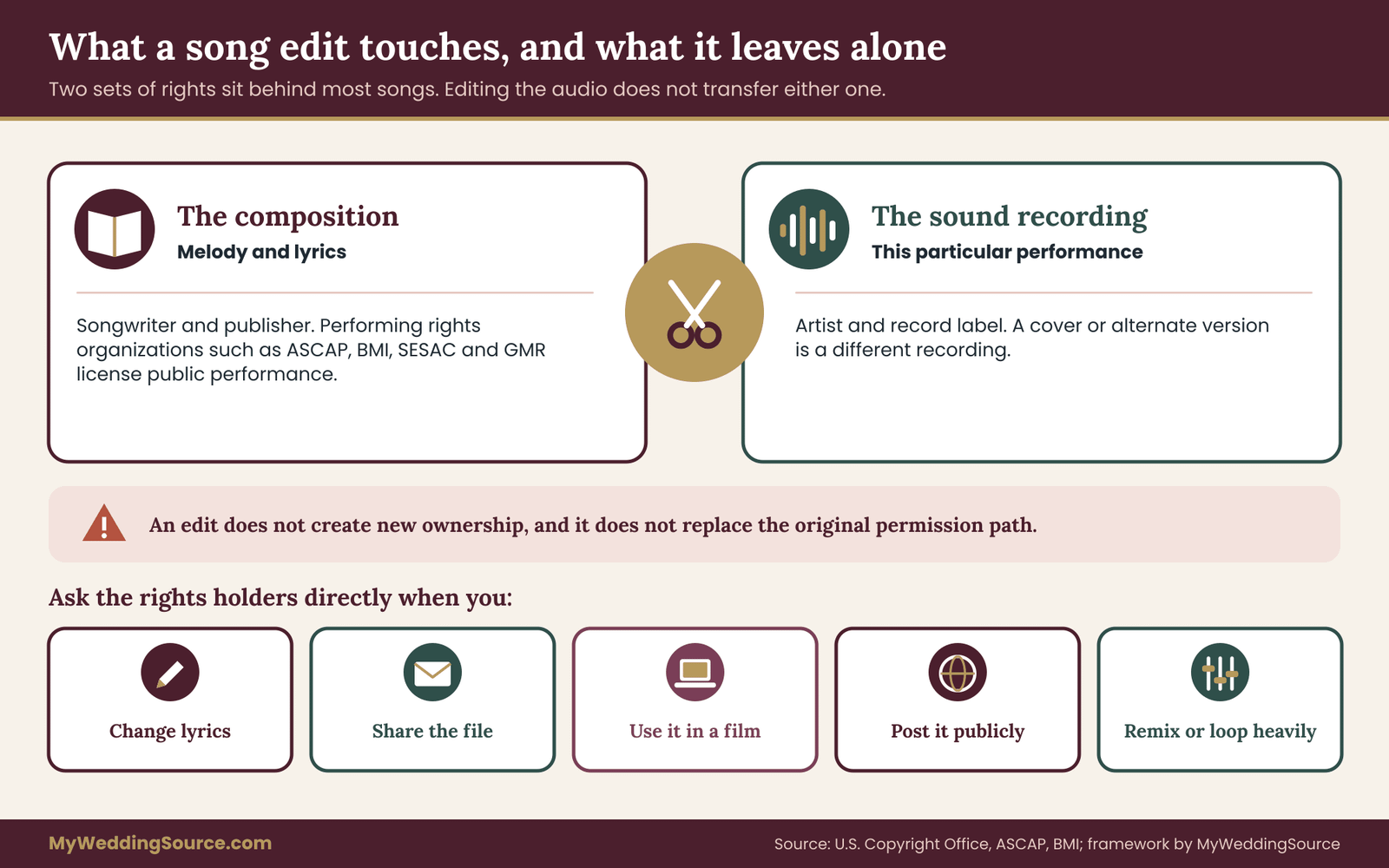
Changed lyrics. If a person will sing new words to a song, or if the song edit inserts new audio, such as your names, you are making a derivative version. The publisher of the composition is the party to ask. Many couples avoid this by speaking the personal words over an unaltered instrumental passage, which is a different and simpler design.
Sharing the edit as a file. Sending it to guests, posting it online or giving it to a videographer for a film all go beyond in-room playback. For video, see the site’s guide to wedding video music, which explains the separate synchronization permission film uses require.
Commercial or public posting. If the song edit will appear on a public account, a website or an advertisement, platform rules and licensing apply, and you should check the platform’s own music policy.
Heavy remixing. An extension that loops, layers or rearranges the song starts to look like a new arrangement. A plain edit is a simple version of the original. Treat a remix as a different category and ask first.
How to ask a rights holder, if you need to
Start with the publisher of the composition and the label that owns the recording. Their names are usually in the track’s credits or in the databases that the performing rights organizations and the Mechanical Licensing Collective maintain. Write a short request: who you are, what you want to do, how long the song will be used, where it will be played, and whether it will be shared. Keep it factual and polite, expect a slow answer, and do not rely on silence as a yes.
If the answer is no, or does not come in time, that is not a failure of the plan. It is a reason to move to one of the alternatives covered later: an official shorter version, a licensed cover, a live arrangement, or a different song.
Working with the DJ on a song edit: questions, scripts and written confirmation
The DJ is the person who has to make your song edit play correctly, in a room they may be seeing for the first time, with the whole party watching. A good working relationship here is mostly about asking early and putting answers in writing. The conversation does not need to be long.
Questions to ask before anyone edits anything
Send these as a short message or raise them at a planning call. The answers shape the rest of the work, so get them before the song edit exists.
What file formats and quality do you prefer for a custom edit? Which software do you play from, and do you use cue points? Can you play a file I deliver, or do you only play from your own library? If you make the song edit, is it included in the price, and can I have a copy of the finished file? Do you carry a backup of every special cue on a second device? Who is your contact on the night if the file does not open?
Add the licensing questions from the previous section: whether the DJ holds their own licenses, what the venue’s coverage is as far as they know, and what their practice is for tracks sourced from a streaming service versus purchased files. A professional answers these without fuss. Hesitation is useful information too.
A script for the first conversation
Plain language works better than jargon. Something like this carries everything the DJ needs.
“We have chosen a song for our first dance. The original is long and we want about two and a half minutes. We would like to trim the opening and end with a short fade. Can you do that edit, or would you prefer we deliver a file? Either way, we would like to keep a copy and confirm the exact version a week before the wedding.”
That short message states the song, the goal, the kind of change, the question of who does it and the timeline. The DJ can reply with a single answer and a plan. If the DJ prefers to make the song edit, ask them to send back the finished file for approval, with the exact start and end times.
What to put in writing
Spoken agreements about a first dance are easily lost between the planning call and the wedding. A short written confirmation covers the gaps. It should name the cue, the song and the song edit, state who will deliver the file and by what date, state that the DJ will play that file at the agreed moment, and say what the backup is.
Where the song edit affects the price or the services, include it in the contract or an amendment. The site’s guide to the wedding vendor contract shows how to add specific line items without rewriting the agreement. If the DJ works from a standard form, an email confirming the details and replying “confirmed” is usually enough to create a clear record, and you can store it with the log.
Where the song edit sits in the evening’s schedule
The first dance is one cue in a longer run of events, and the DJ needs to know what happens just before and just after it. A cue sheet that lists the announcement, the walk to the floor, the song, and the next event keeps the transition clean. The site’s ceremony cue sheet guide shows the format for the ceremony, and the same layout works for the reception.
Give the DJ the exact announcement text and any pronunciation notes for names. Tell them whether you want a moment of silence before the first note, whether the lights change at the start, and whether the next song begins right after the fade. These small details decide whether the edit feels smooth in the room. For the evening’s overall flow, the reception guest flow guide explains where a first dance fits among dinner, toasts and open dancing.
Version control and testing for a song edit
A song edit usually produces several files over a few weeks, and the simplest way to avoid confusion is a naming rule and a single delivery point.
A naming rule that survives pressure
Choose a pattern and use it for every file. A workable example is: cue, song title, version number, date, and a status word. “FirstDance_SongTitle_v3_0612_FINAL” tells anyone what it is, which version it is and when it was made. Avoid spaces and special characters, which some software handles badly. Use “FINAL” only for the file that has been tested and confirmed, and never reuse a name for a different file.
Keep the original untouched. Store it in a folder labeled with the source and never edit it directly. Every edit should be a new file made from a copy. If something goes wrong, you can return to the starting point in seconds.
One folder, one delivery point
Create one shared folder for all special music files and give the DJ access, or send files through one agreed channel. Do not send the file by three routes. When the DJ has a copy that arrived by email, a copy on a drive and a copy on a phone, one of them will be an older version.
Tell the DJ which file is the live one by name. A short message works: “The file to play is FirstDance_SongTitle_v3_0612_FINAL. Please confirm you have it and that it opens.” A confirmation reply goes into the log under the delivery field.
Format and quality
Ask for the highest quality the DJ’s system accepts, within reason. Uncompressed or lossless files are larger but avoid the quality loss that compressed copies suffer when re-exported. Keep a lossless master, and give the DJ whatever format they ask for. Confirm that the file is not protected by a service that will block playback on other devices, because a protected file can refuse to play in an unfamiliar system.
If the source is a purchase, keep the receipt or the confirmation with the log. If the source is a streaming service, note that the service itself is the source, and rely on whatever your DJ confirms about how they handle such tracks. The goal is not to prove anything to anyone. It is to be able to answer “where did this file come from” in one sentence.
The backup chain
Plan for equipment failure as you would for any other vendor failure. The DJ should carry the file on at least two devices. You should carry a copy too, on a phone or a small drive, in case the DJ’s system fails entirely. The site’s digital contingency guide covers backups for the whole day, and the first dance file is one line in that plan.
Decide in advance who may trigger the backup. On the night, someone needs authority to say “use the backup,” and it should not be a guest. The planner, the DJ, or a named friend works. Put the person’s name in the fallback field of the log.
Testing a song edit before the wedding day
An song edit that has never been played in a room is a theory. Testing is what turns it into a plan, and it takes about as long as a coffee.
Three listening tests
The first test is at home, on good headphones, listening for clicks, jumps and abrupt endings. Play it twice. The second pass is where you hear what you missed.
The second test is through speakers at a volume similar to the party. Bass, vocals and any cuts sound different on a large system. A cut that was clean in headphones can reveal a faint click or a clipped note when played loud.
The third test is on the real system, ideally at the venue or at the DJ’s setup. Many venues allow a short sound check before the event, and the site’s venue technical walkthrough guide explains how to use that visit. If you cannot attend, ask the DJ to play the song edit through their rig and send you a recording of the room or the speakers.
The dance test
Run the song edit with the dance. Start the track and begin where you would begin on the day, in the shoes you will wear. Check three moments: the first note, the midpoint, and the final seconds. Does the first beat arrive when you expect? Does anything in the middle make you hurry or wait? Do you finish before the fade does, or does the music end before the dance does?
Time it with a stopwatch and write the length in the log. If it differs from your target by more than a few seconds, either adjust the edit or adjust the dance, but decide which. Changing both at the same time makes the problem harder to find.
Test with someone who has not heard it
Ask someone who does not know the plan to listen once and say what they notice. A fresh listener often catches a clipped word or an odd ending immediately. This is not a request for taste. It is a request to hear what you can no longer hear after twenty plays.
Record the result
Write the test date, the system used and the result in the log. If the test found a problem and you fixed it, note what changed. A short sentence is enough. The record shows that the file in the DJ’s hands is the file that passed.
A worked case of a first dance song edit
The following example is invented to show how the log works. The couple, the song and the numbers are made up for illustration, and the song is not a real recording. Nothing here describes a real wedding or a real test.
The situation
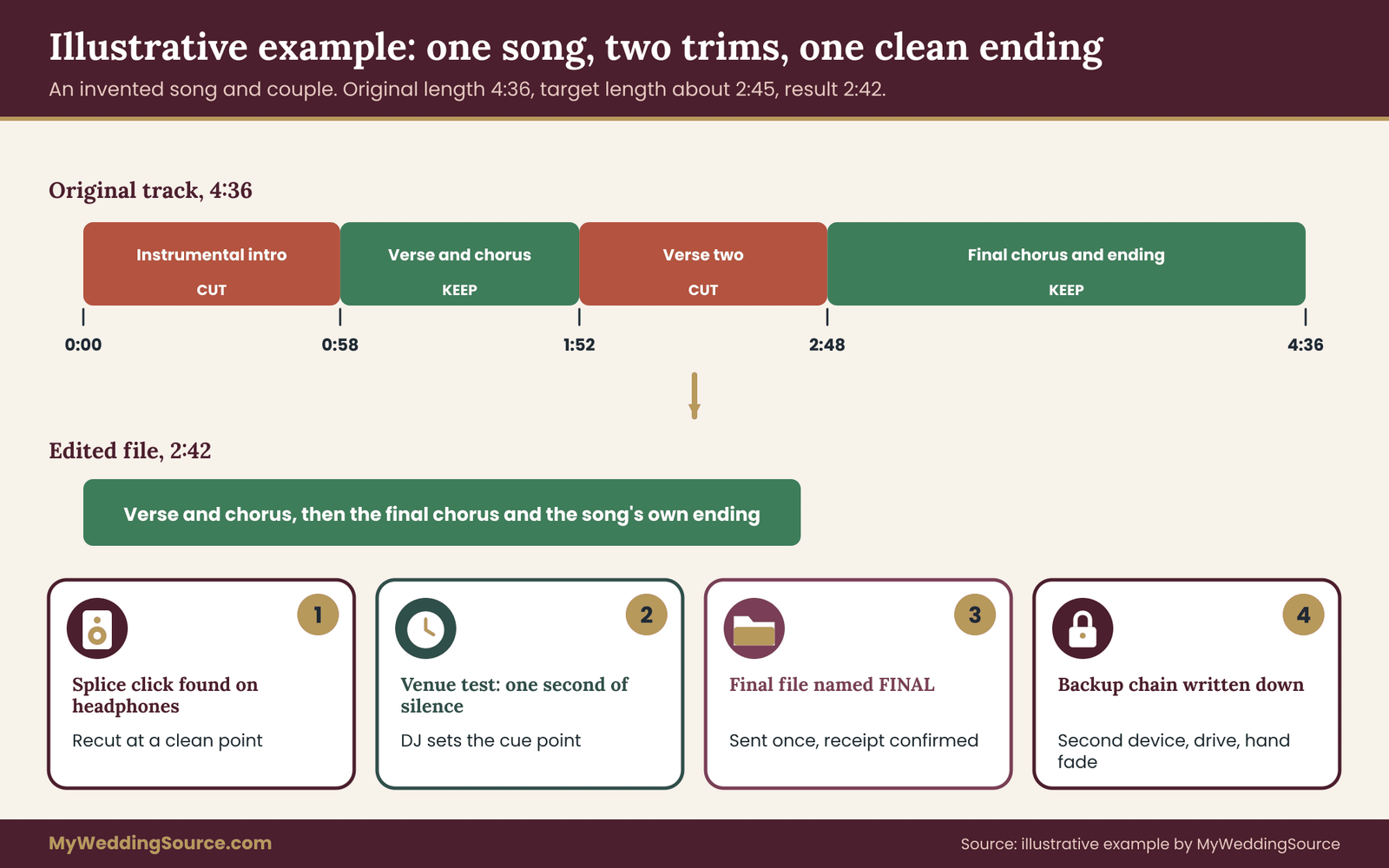
Marisol and Dev have chosen a slow song called “Harbor Lights.” The album version runs four minutes and thirty-six seconds. It opens with a long instrumental section of about fifty-eight seconds, has a second verse with a line about a breakup that Dev’s grandmother would not enjoy, and ends in a key-change chorus that they both love.
They timed a practice dance at home, in the shoes they will wear. A simple turning pattern with a pause felt natural for two and a half minutes, and they added a margin of about fifteen seconds for the walk to the center of the floor and for nerves. Their target length is two minutes and forty-five seconds.
Step one: name the problem and choose the lightest edit
Marisol writes three sentences. The opening is too long. The second verse does not suit the room. We want to keep the last chorus. Each sentence points to a trim rather than a heavy change.
They decide on two trims: remove the first fifty-eight seconds, and remove the second verse. No fade is needed, because the song’s own ending stays intact. No tempo change, no extension, no new lyrics. That keeps the song edit in the lightest category.
Step two: the log line
Their first dance line, filled in as of three months before the wedding, reads in plain words as follows.
Cue: first dance, after the toasts, about ten minutes before cake cutting. Source: “Harbor Lights,” album version, four minutes thirty-six, a lossless file bought from a download store, receipt saved. Change: cut from 0:00 to 0:58 at the front; cut the second verse from 1:52 to 2:48; the song’s own ending stays. Result length: two minutes forty-two seconds. Editor: a friend who edits audio, using a free editor. Rights path: not yet confirmed.
The empty rights field is the first thing they act on. They ask the venue’s event manager which music licenses it holds for private events and ask the DJ about the DJ’s own coverage. The venue replies that it holds licenses from performing rights organizations that cover recorded music at events held there, and the DJ replies that he holds his own license and plays from files supplied by clients or from purchased libraries.
They paste both answers, with dates, into the log. This is an invented answer used for illustration, and a real venue’s answer could differ.
Step three: edit, listen and fix
The friend sends the first version. On headphones, Marisol hears a faint click at the second splice. She sends a note: “Click at 1:52 in the new file, just before the chorus.” The friend redoes the cut at a point where the waveform crosses zero and adds a very short crossfade. The click is gone in version two.
They renamed the file following their rule, “FirstDance_HarborLights_v2_0609”, and keep the untouched original in a separate folder. Dev plays the new version through a pair of small speakers at party volume and times the length with the dance. The dance finishes two seconds before the music, which is comfortable.
Step four: DJ confirmation and the venue test
They send the file through one shared folder and message the DJ with the file name. The DJ replies that it opens and that he will set a cue point at the first note. At the venue sound check, the DJ plays the track through the room system.
Everyone notices that there is about a second of silence before the first note, caused by a gap at the start of the file. The DJ fixes it by setting the cue point a fraction of a second into the file and notes the change.
The final file is renamed “FirstDance_HarborLights_v3_0620_FINAL” and re-sent. The DJ confirms receipt. A second copy goes on a small drive that Marisol’s sister will carry. The log’s fallback field reads: the DJ plays from his backup device; if that fails, the sister’s drive; if that fails, the original album track with a hand fade by the DJ at the two-minute-forty mark.
Step five: the later request
Weeks later the couple asks the videographer to use the song edit under their highlight film. This is a different use. They note it in the log as a separate line, “film use, not cleared,” and contact the videographer to discuss a licensed alternative or to ask the rights holders about a license for the film. The song edit played in the room does not carry over into the film.
What the example shows
Three things stand out. The song edit itself was simple and took a short evening. Most of the value came from the surrounding steps: naming the problem, finishing the rights path before the final file, listening at three levels, and getting a written confirmation from the DJ. And the one use that went beyond the room was spotted and kept separate instead of being assumed to be covered.
A timeline for a song edit: from song choice to the night
A song edit can fit into a few weeks, but a timeline with some slack avoids last-minute pressure. The schedule below runs backward from the wedding. Adjust it for how much work your edit needs and for your DJ’s own deadlines.
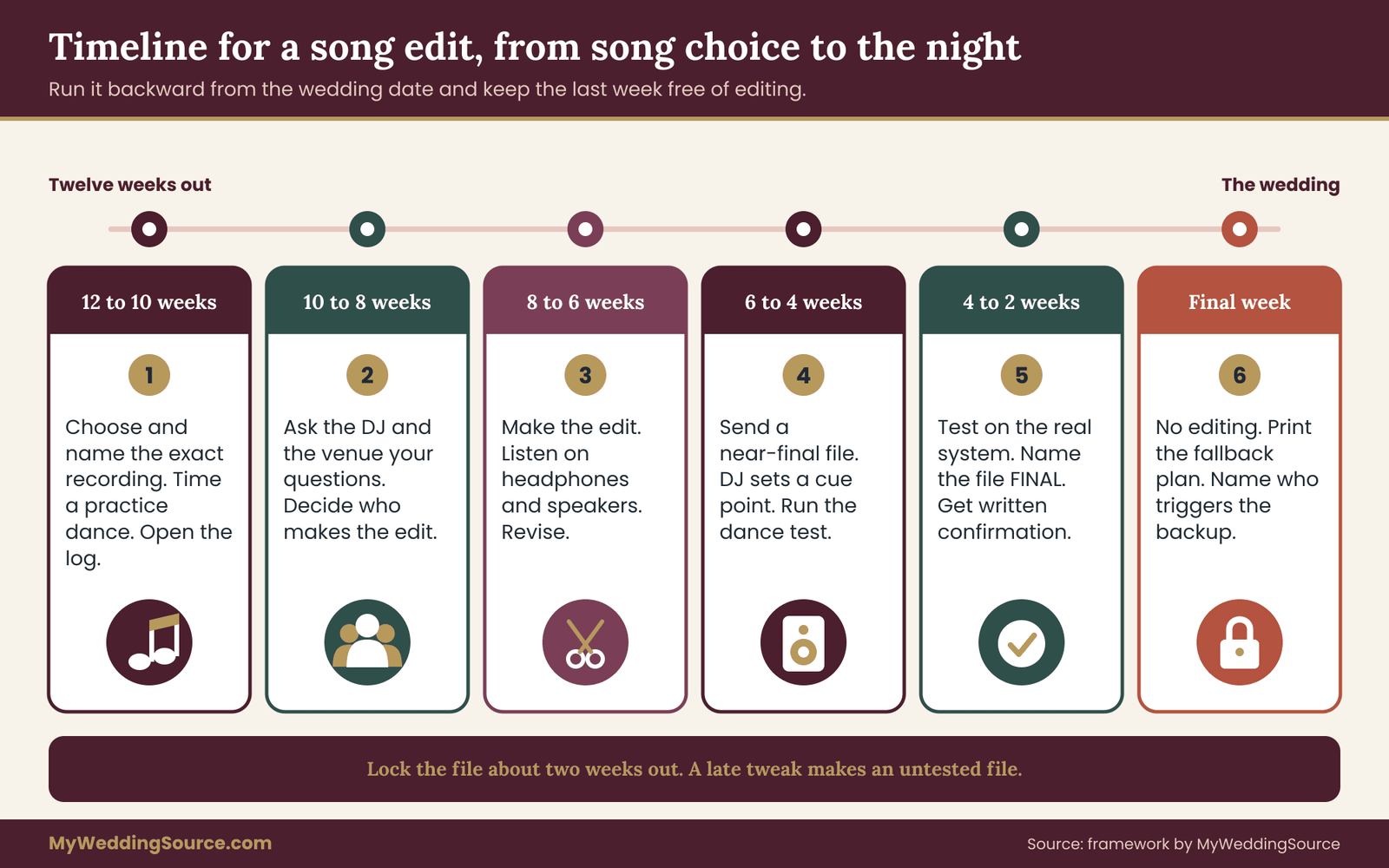
Twelve to ten weeks out. Choose the song and confirm the exact recording. Time a practice dance. Write the problem sentences and pick the kind of edit. Open the log with the first four fields. The site’s wedding vendor timeline shows where this fits among other vendor deadlines.
Ten to eight weeks out. Ask the DJ the early questions and settle who makes the song edit. Ask the venue and the DJ the licensing questions and record the answers. If the song has lyrics you worry about, check whether an official clean version exists.
Eight to six weeks out. The song edit is made, listened to on headphones and speakers, and revised. If you hired an editor, confirm what is included and the number of revisions.
Six to four weeks out. The near-final file goes to the DJ. The DJ confirms it opens, sets a cue point and adds it to the cue sheet. Run the dance test with the song edit. If a change is needed, there is still time.
Four to two weeks out. Final test through the venue system or the DJ’s rig. Name the file FINAL only now. Send it, get the written confirmation and set up the backups.
The final week. Do not edit anything. Confirm the DJ has the file and the cue sheet. Print the log line and the fallback plan and give a copy to the planner or the friend who carries the backup. If something goes wrong in the final week, use the fallback rather than a new edit.
The day. Confirm at sound check that the file plays from the right start. Brief the person who can trigger the backup. Then leave it alone.
Why the last week is a no-edit week
Late changes are the usual source of version mix-ups. A tempting tweak a few days before the wedding, such as shaving a few more seconds, creates a new file that nobody has tested through the venue system. The dance has been rehearsed to the old length. Unless there is a real problem, lock the file two weeks out and use the final week for rehearsal, not editing.
Alternatives when a song edit is not the right answer
Sometimes the edit you want is too heavy, a rights holder says no, or the DJ cannot support the file. None of these ends the plan. There are several other routes to a first dance that fits the room, and each one has its own trade-offs.
An official shorter or alternate version
Many songs already exist in a radio edit, a single version, an acoustic take or a clean version released by the label. Check the artist’s releases and the major purchase and streaming catalogs. An official version has an advantage a home edit cannot match: it is a finished release with its own listing, so the question of where it came from is easy to answer.
The trade-off is that official versions rarely match your exact length or your exact cut. A radio edit might remove the intro you dislike but keep the verse that bothers you. Listen to the official version in full before committing, and log it as the source instead of the album track.
A licensed cover or instrumental version
A cover by another artist, a string or piano arrangement, or an instrumental recording can bring the same melody in a form that suits your dance. These are different recordings, and they are chosen, not edited. Some are made specifically for weddings and sold through legitimate catalogs.
Treat the recording as a new source. Check how the DJ can obtain it, confirm the length, and run the same listening tests. Note that a cover recording still involves the composition’s rights, so the venue and DJ questions stay the same. What changes is that the sound recording belongs to a different party.
A live performance
A singer, a pianist or a small band can perform the song in an arrangement that you set. This is the most flexible answer for length, because live musicians can extend or end the song on a cue. It also changes the logistics. You need a rehearsal, a clear structure written down, and agreement on key and tempo.
If a friend or family member will perform, be gentle about the stakes. A first dance is a high-pressure moment for an amateur performer, and it helps to have a recorded backup ready. The performer should know that the backup exists and that using it is not a verdict on their playing.
Spoken words over an instrumental
If the real goal is to personalize the moment, you do not need to alter a song with lyrics. Some couples use an instrumental recording and speak a short message before the dance begins, so that the personal content is theirs and the music remains unaltered. This avoids the lyric question altogether, since you are not changing anything in someone else’s composition.
A different song, honestly considered
If a song needs several heavy changes to work, step back and ask whether it is the right song for this moment. Sometimes the best edit is to choose a track whose natural length and structure already fit. This is not a loss. Many couples find that a slightly different song removes all the work and sounds better, because it was written to be played start to finish.
Choosing between the alternatives
A simple way to decide is to rank by risk and by closeness to what you want. If an official alternate version exists and fits, use it. If not, and the song edit is light, make the song edit. If the song edit is heavy or a rights answer is missing, move to a licensed cover, a live arrangement or a different song. Write the decision and the reason into the log so that the DJ sees the same plan.
Cost logic is straightforward without any invented figures. An official alternate version usually costs the price of one more track. A home edit costs your time. An editor costs their rate times the hours. A live performance costs the performer’s fee and rehearsal time. Compare these against how much the exact song matters to you, and set a limit before you start so the edit does not quietly grow into a project.
Special situations that change the plan
Several special cues. If you also plan a parent dance, an entrance and a last song, put each in the log as its own line, since each may need a different length and a different rights check. A father-daughter dance with a short, trimmed song and a first dance with a full-length one are two separate edits.
Songs in another language. If the lyrics are not in English, ask someone fluent to read them with you before you approve a clean-up or a trim, since a cut can fall mid-phrase in a way you cannot hear. The same person can check that the translation you have in mind matches what is sung.
Wedding with a stage show or a cultural dance. If the first dance leads into a choreographed piece or a family tradition, the song edit may need to include a transition. Treat the transition as part of the cue and test the hand-off to the next song.
A very short song. Some meaningful songs are barely two minutes. Do not stretch them just to fill time. A short dance that ends cleanly is better than a padded one, and the following song can begin right away.
A partner who dislikes dancing in front of people. A shorter edit and a plan for friends to join the floor after a minute can lower the pressure. The song edit serves the comfort of the couple, and a length that suits the shyer partner is the right target.
Failure conditions and what to do when they appear
A plan is only as good as its failure conditions. For a song edit, the useful question is not “what could go wrong” in general but “what specific signal means we change course, and to what.” Writing the conditions in advance removes the need to decide under pressure.
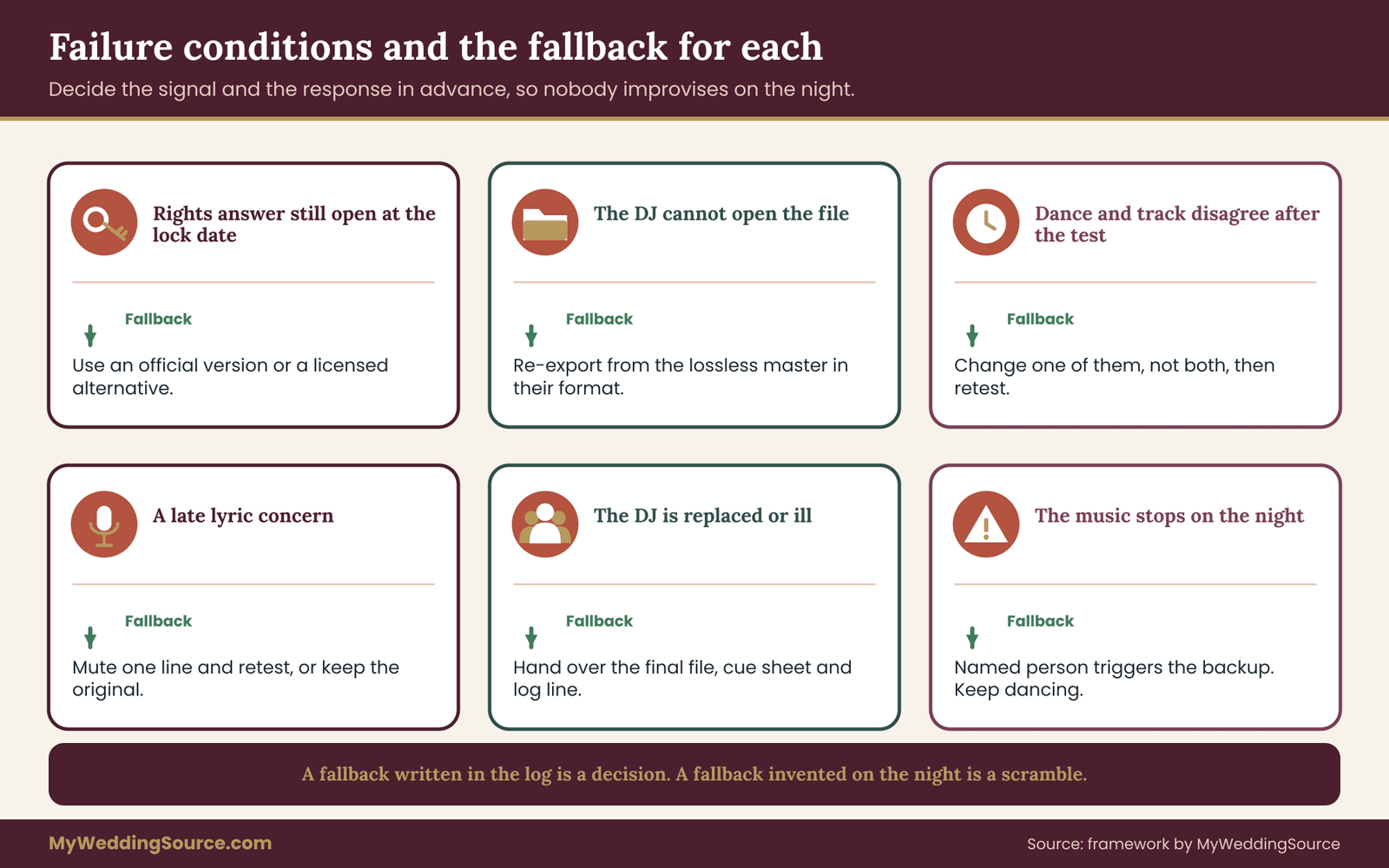
Conditions to decide in advance
The rights question is still open at the lock date. If the venue or the DJ has not answered by the time the song edit should be final, which is usually four to six weeks before the wedding, do not guess. Choose the official version or a licensed alternative and note the reason in the log.
The file does not open for the DJ. If the DJ cannot play your file, ask what format they can play and re-export from your lossless master. If they cannot play it at all, ask them to build the song edit in their own software from a source they can use.
The test shows the timing is wrong. If the dance and the track disagree after the venue test, change one of them, not both. If the dance needs to be shorter, trim the dance. If the track needs to be shorter, make a small adjustment and retest.
A late lyric concern. If a relative or the officiant raises a concern about a line close to the wedding, decide whether to mute that line or accept it. A short mute is a simple edit, but it creates a new file and needs a quick test. If time is too short, accept the original and tell the DJ.
The DJ is replaced or ill. If the DJ changes, the new DJ needs the final file, the cue sheet and the log line. This is the reason the exported copy matters, and why the backup is in your hands as well as theirs.
The room sound is different from the test. If the venue’s system changes, a different sound check shows a problem such as a delayed start or a harsh bass. The DJ can adjust levels and the cue point, and you should accept their judgment on the equipment while checking that the first note arrives at the right time.
A power or equipment failure at the moment. If the music stops, the fallback plan applies. Whoever holds the authority triggers the backup, and the couple continues the dance. Brief the couple on this ahead of time so that they are not surprised: a stopped song is a reason to smile and wait, not to stop dancing.
Common mistakes and what to do instead
Editing from a compressed source instead of a lossless one leaves a thin, tinny result. Start from the best copy you have. Judging an edit only on headphones hides splice problems and bass issues. Test on speakers and on the real system. Skipping the dance test produces a track that fits the song and not the dance. Time the dance against the final file.
Letting the DJ and the editor work from different versions causes mix-ups. Use one delivery point and one name. Assuming that a clean-up is harmless can lead to a muted word in the middle of a phrase. Listen to the whole passage in context. Treating an in-room edit as cleared for a film leads to a problem later. Log each use separately.
Another common mistake is leaving the music to the last week. A song edit is quick to make and slow to verify, and the verification steps need room in the calendar. Give the work the same early start you would give any other vendor deliverable.
When to stop editing
A song edit is finished when the log line is complete, the DJ has confirmed the file, the test has passed, and the fallback is arranged. After that, more tinkering adds risk and no benefit. Couples who keep refining a nearly finished edit tend to introduce new problems. Lock the file, tell the DJ it is final, and spend the remaining time on the dance itself.
Keeping the log afterward
After the wedding, move the log and the final files into your records. A short note on what was played, which version, and what permissions were confirmed is useful if you later want to share a video, order a film or recall exactly what was used. Keep the original source receipt, the DJ’s written confirmation and the final file in one folder, and the log in the same place. Give it a folder of its own, next to the contracts and receipts.
Your next steps
Work through these in order. Each one takes an evening or less, and none depends on special software.
- Name the exact recording. Write the artist, title, release and running time in the first line of your review log.
- Time one practice dance with a stopwatch and add a small margin. That number is the target length for your song edit.
- Write one sentence naming the problem, then pick the lightest of the six kinds of song edit that solves it.
- Send the DJ the early questions about file formats, who makes the song edit, licensing and backups, and ask for the answers in writing.
- Ask the venue which music licenses it holds for private events, and record the reply with its date.
- Make or commission the edit, keep the original untouched, and listen on headphones, on speakers and on the real system.
- Lock the file about two weeks before the wedding, send it through one delivery point, and get a written confirmation that it opens and plays.
- Choose who carries the backup and who may trigger it. Write both names in the fallback field.
- After the wedding, store the log, the final file and the confirmations with your other records. If you want the song edit under a video, treat that as a new request.
FAQ
Do we need permission to edit our first dance song?
For a personal edit made so a song works for your own dance, the usual questions are about the venue’s and the DJ’s licenses for playing it in the room. A wider use, such as sharing the file, posting it, putting it under a video or changing lyrics, raises separate questions for the rights holders. The U.S. Copyright Office explains the basics, and a lawyer can advise on your own case.
How long should a first dance song edit be?
Let the dance decide. Time a practice dance in the shoes and clothing you will wear, then add a margin for the walk to the floor and for nerves. Many couples land between about two and three minutes, but your comfort matters more than any average. If the dance is seated or limited by stamina, set the length by what feels easy.
Can the DJ make the edit for us?
Often, yes. Many DJs make simple edits in the software they will use on the night, which avoids format and timing problems. Ask whether it is included in the price, ask for an exported copy of the finished file, and get the details in writing. For a rebuilt ending, an extension or a tempo change, ask whether they do that work or hire an editor.
Is it fine to cut a lyric from the song?
A short mute of a single word or line for a personal in-room edit is a small change, and an official clean version may already exist, which is simpler. Writing new lyrics or having someone sing changed words is a bigger step, because it creates a derivative version. In that case, ask the publisher of the composition first, or speak personal words over an instrumental passage instead.
Can we use the edited song in our wedding video?
Not automatically. Playing a song in the room and attaching it to a film are different uses, and film generally needs separate permission for both the composition and the recording. Ask your videographer about licensed library music or a cleared track, or contact the rights holders. Keep any license or written permission with the video file.
What file format should we give the DJ?
Ask the DJ, because their software and equipment decide. Keep a lossless master of your song edit and export whatever format they request, at the highest quality they accept. Avoid files that are protected by a service and may refuse to play on other devices, and always confirm in writing that the DJ opened the file.
What if the DJ cannot play our file on the day?
That is what the fallback field is for. The DJ should carry the file on a second device, and you should have a copy too. If both fail, the DJ can play the original track and fade it by hand at an agreed time. Decide in advance who may trigger the backup, so nobody has to improvise.
When should the song edit be finished?
Aim to lock the final file about two weeks before the wedding, after a test through the venue system or the DJ’s rig. Use the last week for rehearsal, not editing. Late tweaks create untested files and version mix-ups. If a real problem appears in the final week, use the fallback instead of building a new edit.
Sources
- U.S. Copyright Office: circulars on musical works, sound recordings and derivative works, and general information on copyright.
- ASCAP: information on public performance licensing for musical compositions.
- BMI: information on public performance licensing and its music repertoire.
- SESAC: performing rights organization information on licensing.
- Global Music Rights: performing rights organization information.
- The Mechanical Licensing Collective: information on mechanical licensing for digital audio uses in the United States.
- SoundExchange: information on digital performance rights for sound recordings.
- The Harry Fox Agency: information on mechanical licensing for reproduction of musical works.
- Library of Congress: research guidance on copyright and recorded sound.
- ADA.gov: U.S. Department of Justice information on accessibility requirements for events and venues.