
Looking for alternatives to a father daughter dance does not mean something went wrong. It means one of the people in the traditional slot cannot be there, cannot dance, or would rather not, and you want a replacement that feels chosen instead of forced. This guide gives you a four-check opt-in test, a menu of alternatives and the exact words to use with each person involved.
Run four checks on each person you have in mind: willing, able, meaningful, placed in the evening. A yes on all four means plan it. A no on any one means change the format, not the person. Alternatives to a father daughter dance include a dance with a mother, stepparent, grandparent or sibling, a seated version, a group parent dance, a song with a short tribute, or no parent dance. Ask privately, offer an easy way out and give the DJ the plan in writing.
The father daughter dance is a tradition, not a requirement. It became common because it fits a simple script: a father, a daughter, a slow song, a room that watches. Plenty of real families do not fit that script. A father may have died, may live far away, may have a health condition that makes standing hard, may be estranged, or may simply hate being watched. Some brides were raised by a mother, a grandmother or two dads. Some grooms want a parent dance too, and some couples have no interest in the custom at all.
The trouble is rarely the missing dance. It is the silence around it. A DJ announces a dance nobody discussed, a relative asks why there is no father daughter dance, or a parent finds out in the middle of the reception that they were expected to perform. Each of these is avoidable with a few private conversations and one clear plan.
This article covers the planning side: how to decide, what the options are, how to phrase the invitation, where the father daughter dance sits in the evening, and what to do when the plan falls apart. It is general planning information, not legal, medical or mental health advice, and anyone with a health condition should follow the guidance of their own clinician.
Why a father daughter dance does not fit every family
A father daughter dance asks several things of several people at once. The father must be present, mobile, comfortable in front of a crowd and on good terms with the bride. The bride must want the moment, and want it with him. The guests must be willing to watch quietly. Take any one of those away and the dance can become awkward, painful or just flat.
It helps to name the situations honestly, because each calls for a different kind of alternative. Five come up again and again.
The father has died. The dance may feel like a gap in the program. Some brides want a moment that acknowledges him, and others want to move on without ceremony. Both are fine, and neither is a mistake.
The father is absent or not in the picture. The bride may have been raised by others and has no wish to make a public gesture toward someone she barely knows. The loss is not the issue so much as the pressure to perform a relationship that does not exist.
The father is estranged or the relationship is strained. He may be invited and unwilling, or willing while the bride is not. Here the father daughter dance can turn into a public referendum on a private conflict, which is the situation to protect everyone from.
The father cannot dance. Mobility, balance, stamina, pain, vision or a chronic condition may make a standing slow dance risky or tiring. He may badly want to take part. The answer is a different format, not a lesser role.
The father does not want to dance. Shyness, stage fright or plain dislike of being the center of attention is a legitimate reason. Some people would happily walk down an aisle but cannot stand a silent room watching them sway.
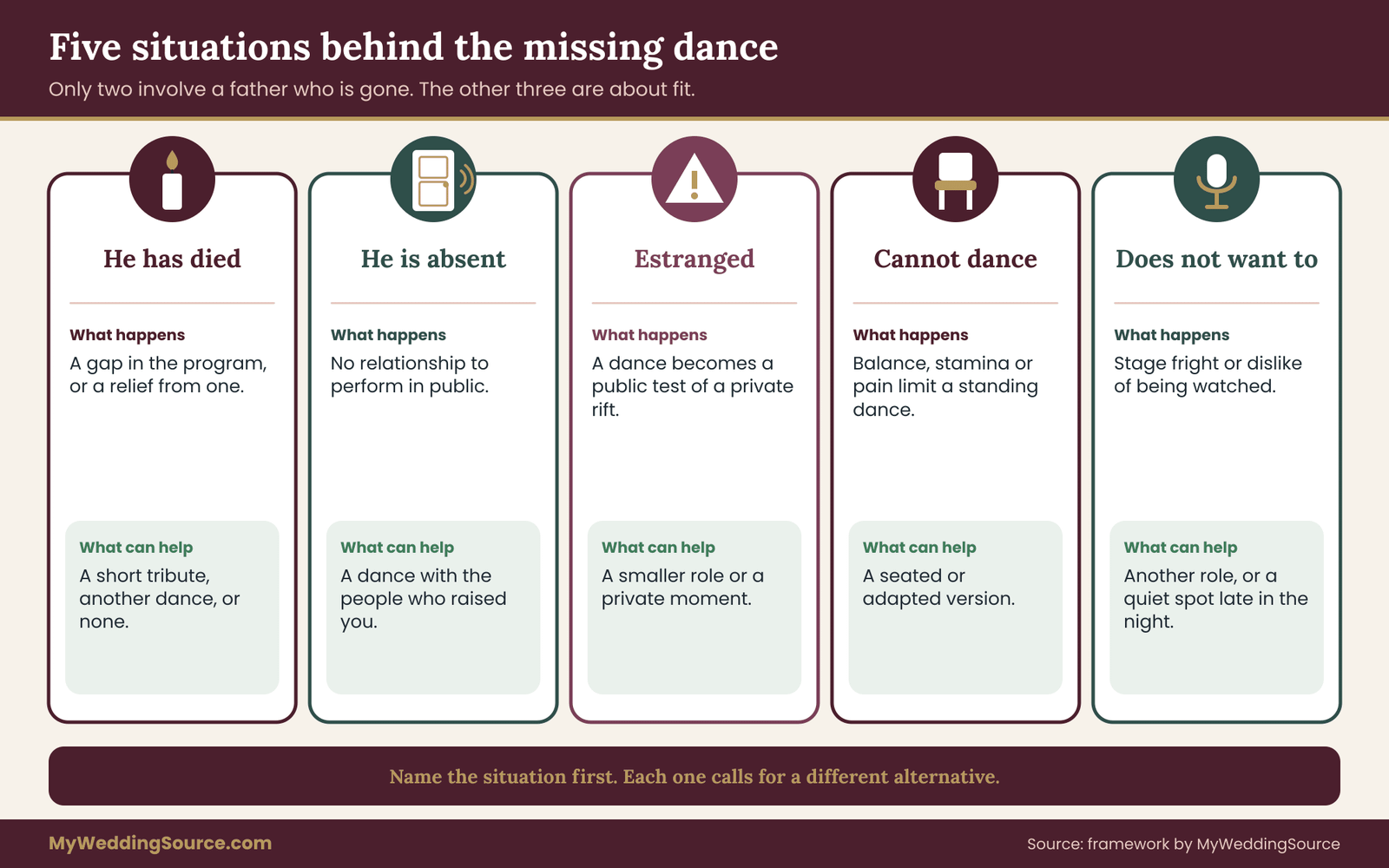
Notice that only two of these five are about the father’s absence. The other three involve a father who is alive and often loving. That matters, because the right response to a father who cannot dance is almost never to replace him. It is to adjust the father daughter dance so he can still be in it.
The traditions behind the dance
The father daughter dance usually comes after the couple’s first dance and before the open dance floor, though some families fold it into the same segment as a mother son dance or a combined parent dance. Nothing in any law, religion or standard ceremony requires it. It is a reception custom, and reception customs are the part of a wedding that couples are free to shape.
That freedom cuts both ways. Because the father daughter dance is optional, skipping it needs no apology. Because it is optional, adding a different version needs no justification either. The only real obligation is to the people involved: do not surprise them, do not pressure them, and do not leave them guessing about what is expected.
What this guide does and does not cover
This guide is about the decision and the wording. It does not teach choreography. For a general plan for learning and rehearsing your own first dance, see the guide to reception music planning, and for the larger question of how the reception moves from entrance to exit, read the guide to wedding reception guest flow. It also does not replace a conversation with a counselor if a family relationship is raw, and it does not give medical advice about what any individual can safely do.
What it does give you is a repeatable way to choose. The same method works whether you are working around a death, an illness, a family rift or a shy dad.
The four-check opt-in test for father daughter dance alternatives
The simplest way to avoid hurt feelings is to treat every parent dance, including any alternative, as an invitation that the other person may decline. The four-check opt-in test turns that principle into a short routine you can run for each candidate.
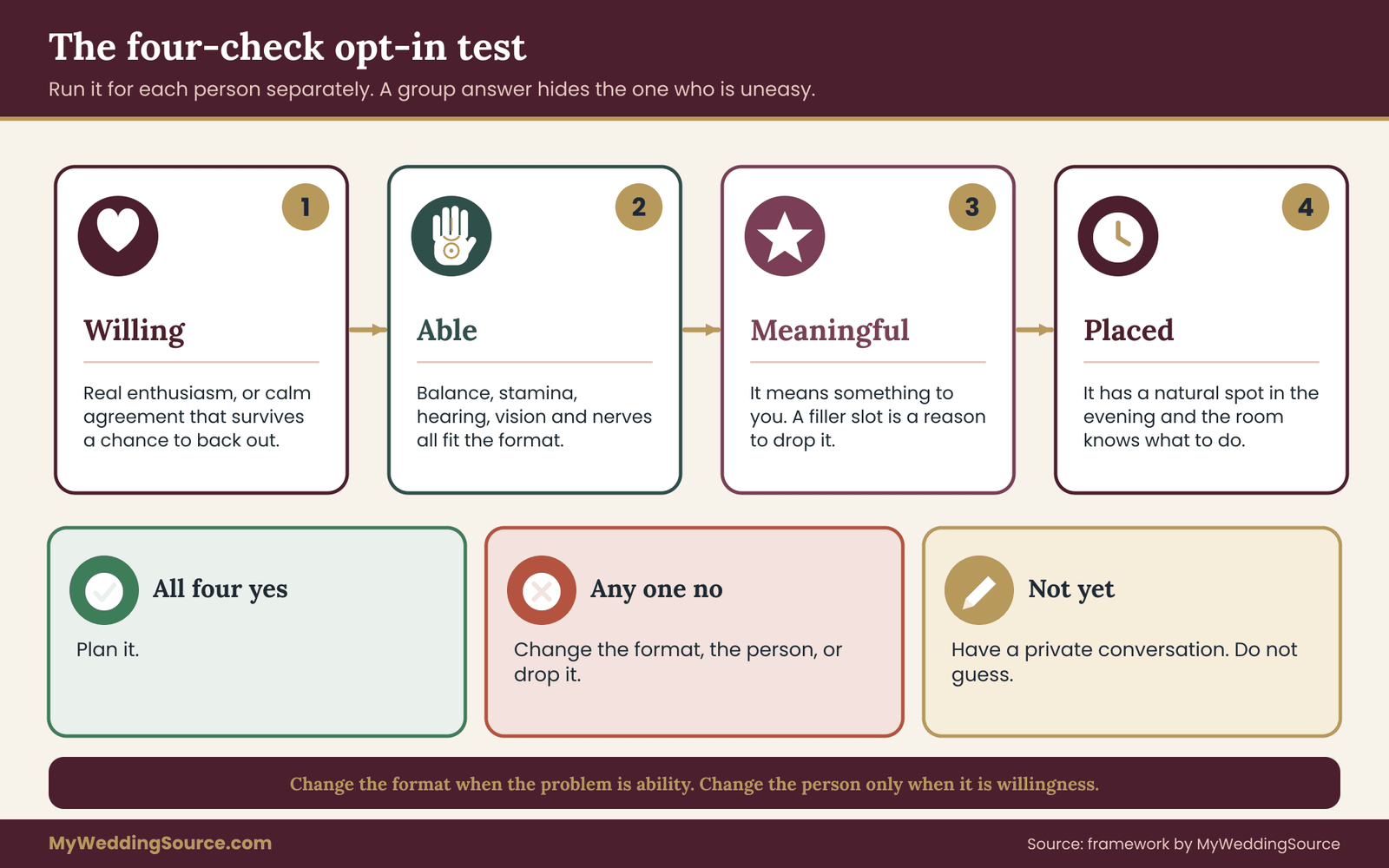
Run it for each person separately. Do not run it for a group, because a group answer hides the one person who is quietly uncomfortable.
Check one: willing. Does this person want to do it, as far as you can tell from a private, low-pressure conversation? Willingness is not the same as saying yes. People say yes to avoid conflict. You are looking for real enthusiasm, or at minimum calm agreement that survives a chance to back out.
Check two: able. Can this person take part safely and comfortably in the format you have in mind? Ability covers balance, stamina, mobility, hearing, vision, anxiety in crowds and travel. A person can be willing and still not able, and the answer then is to change the format.
Check three: meaningful. Does the father daughter dance, or whatever replaces it, mean something to you? A dance with a grandfather because he is the oldest man in the family is not the same as a dance with a grandfather who taught you to waltz in the kitchen. If the honest answer is “it would just fill a slot,” drop it. An empty obligation is the worst reason to put anyone on a dance floor.
Check four: placed. Does the dance have a natural spot in the evening, and does the room know what to do while it happens? A dance with no clear place becomes a pause in the party, and a pause nobody explained can feel like an awkward silence.
How to score the four checks
Keep the scoring honest and simple. For each person, write the four checks on a page and mark each one yes, no or not yet. Then apply three rules.
If all four are yes, plan it. If any one is a no, change something before you proceed: change the format if the problem is ability or placement, change the person if the problem is willingness, or drop the dance if it fails the meaning check for every candidate. If any check is “not yet,” that is a signal to have a conversation, not to guess.
The rules sound strict, but they protect you from the two most common planning errors. The first is assuming a parent is willing because they would never say no. The second is treating a format problem as a person problem, such as removing a father from the father daughter dance because he cannot stand for four minutes, when a seated version would have kept him in it.
A short example of the test in use
Suppose a bride wants a father daughter dance with her father, who uses a walker. Willing: yes, he has said so twice. Able: not for a standing dance across a floor. Meaningful: yes. Placed: undecided. The person is right and the format is wrong, so the work is to design a version he can do comfortably. Now suppose the same bride considers a dance with an uncle because the tradition seems to call for a man. Willing: probably. Able: yes. Meaningful: not really. The test says drop it, and she can drop it without guilt.
The test also works as a way to explain yourself. If a relative asks why there is no father daughter dance, you can say that you thought about it and chose a format that suited everyone, which is a complete answer that needs no further detail.
Questions to ask yourself before you talk to anyone
Before the first conversation with a parent, spend ten minutes alone, or with your partner, on four questions. What do I actually want from the evening, as opposed to what I think the room expects? Who would I miss if they were left out of a parent dance? Who would be relieved to be left out? And what would I regret not having done a year from now?
The answers shape everything else. A bride who realizes she wants the quiet moment more than the public one will ask differently from one who wants a big, joyful family dance. A groom who sees that his mother would be relieved to skip the floor will offer her another role from the start. Writing the answers down keeps you steady when a relative offers an opinion, because you can return to what you decided before anyone else weighed in.
It also helps to decide your own limit in advance. If a family member pushes for a father daughter dance you do not want, know what you are willing to offer instead. Having a smaller yes ready, such as a toast, a photo or a private minute, makes a hard conversation easier to end kindly.
Alternatives to a father daughter dance when he has died or is absent
When a father has died, or was never part of the bride’s life, the question is not how to fill his space but whether to fill it at all. Some brides find that an empty father daughter dance slot in the program is a sharper reminder than any gesture. Others find that a loud, busy, joyful reception is easier without a formal moment that calls attention to the loss. The test from the previous section applies here too, with the checks pointed inward: are you willing, would it be meaningful, and would it fit.
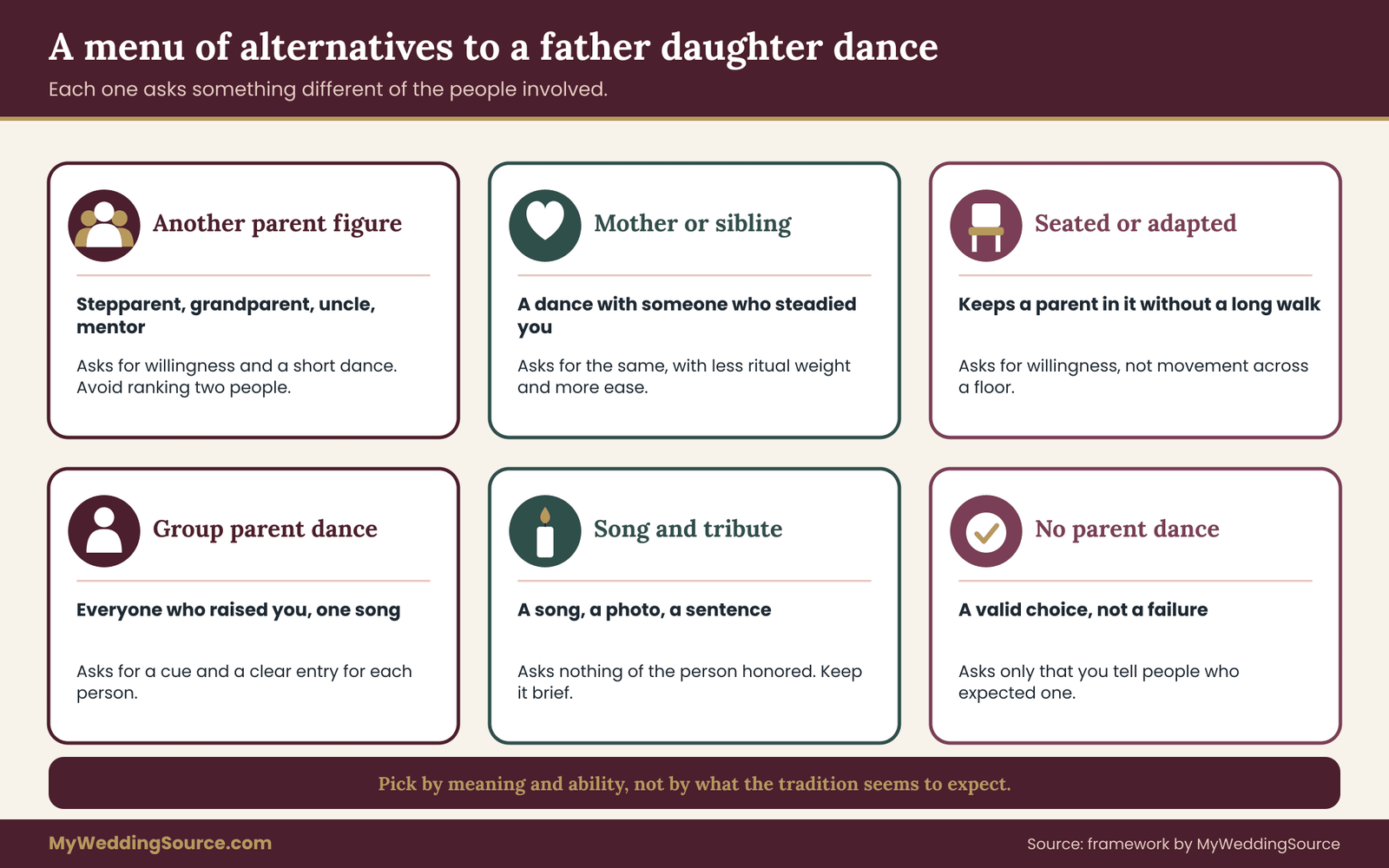
Below are the main alternatives to a father daughter dance, grouped by what they ask of the people involved. None is better than the others. They suit different families.
Dance with another parent or parent figure
The most common substitute for a father daughter dance is a dance with a mother, a stepfather, a grandfather, an uncle, a godparent, a family friend or a mentor who played the role. Willing and able are usually easy to answer. Meaning is the check that decides.
A stepfather who spent twenty years driving you to school and coming to your recitals has an obvious claim. A man who married your mother last spring and is still learning your middle name may not feel the same way, and he may feel awkward being asked. The kinder approach is to ask each candidate privately and let them say they would be glad to do it or they would rather not.
If two people have a real claim, such as a stepfather and a birth father who are both present and on good terms, the combined version in a later section may suit better than choosing one.
A dance with your mother
Many brides replace the father daughter dance with a dance with their mothers, and many mothers are delighted to be asked. The dance can follow the same format as a father daughter dance, with a short song and a room that watches, or it can be looser, with the two of you on the floor and others joining in halfway.
A mother who has been the main parent for years may feel that the father daughter slot is hers anyway. Asking her directly, instead of assuming, matters. A line as simple as “I would love to dance with you, and I want to choose a song that is ours” gives her the chance to say yes with real warmth.
A dance with a grandparent, sibling or other relative
A grandparent can be a natural choice, but ability matters more than it does for a parent, since many grandparents are older and may tire or have limited mobility. The seated and adaptive formats described later can keep a grandparent in the moment without asking them to cross a floor.
A sibling, an aunt or a cousin who has been the family’s steady presence is a fine choice as well. The dance does not need to imitate a parent and child. It can be a dance between two people who love each other, and the room will understand that.
A tribute instead of a dance
If the father has died, some brides choose a tribute rather than a father daughter dance. The song can play while a photograph is on display, while a short line is read, or during a moment of quiet before the dancing begins. Another option is a reserved seat, a framed photo on a table, or a favorite song folded into the dinner music with no announcement at all.
A tribute is a choice, not a cop-out, and it works well when the person who would have danced is the one missing. Keep the reception tribute brief, a song and a sentence at most, and give any larger remembrance to the ceremony, where the room is already quiet and attentive.
A group dance of all the people who raised you
When more than one person has played a parent role, a group dance can honor all of them without ranking them. The song starts with the bride and one person, then others cut in or join over the verses. The effect is generous, and it avoids the sting of being the one chosen or the one left out.
The risk is crowding and timing. A group dance with six people takes longer to organize than a two-person dance, and some of the people may not know each other. Assign one person to cue the others and give everyone a clear moment to enter.
No parent dance at all
Skipping the father daughter dance is a legitimate option, and for some families it is the kindest one. The test does not require that you have a parent dance. It asks whether the dance would be willing, able, meaningful and placed. If every candidate fails a check, the right answer is none.
If you skip it, the main work is communication. Tell the DJ so no announcement is made. Tell close relatives who may ask. Let the schedule move from the couple’s first dance straight to the open floor with no gap that guests might read as an oversight.
A comparison in prose: what each option asks of the person
A replacement for the father daughter dance with another parent asks for willingness and the ability to dance, and offers a clear public role. A mother or sibling dance asks for the same, with less ritual weight. A seated or adaptive version asks for willingness but not for movement across a floor. A group dance asks for coordination and is gentle on any single person. A tribute asks for nothing from the person honored and gives the room something to witness. A skipped dance asks only that you tell the people who might have expected it.
Alternatives to a father daughter dance when the father is alive but the relationship is hard
A father daughter dance with a father who is present and difficult is a harder case than a father who is gone, because the dance becomes a visible test of a private relationship. This is where couples most need a plan and a way out.
Separate the invitation from the dance
The first step is to separate three questions that tend to blur together. Is he invited to the wedding? Is he walking you down the aisle, if you have an aisle walk? Is he dancing? These are three separate decisions. A father can be at the wedding, can be spared the father daughter dance, and can have a smaller role such as a toast, a reading or simply a seat with the family.
Many couples feel they must grant the whole package or none of it. They do not. Giving a strained parent a smaller role is a way of keeping the relationship intact while protecting the day.
Ask yourself what the dance would say
A father daughter dance in front of 120 guests says something to the room, whatever you intend. For a relationship that is warm, it says closeness. For a relationship that is guarded, it can say a closeness that is not there. Some brides find that performing the closeness is a small price. Others find that it feels false and tires them out before the party has started.
There is no correct answer. The useful question is whether the father daughter dance would make you feel supported or watched. If watched, choose a smaller format, such as a private moment before the ceremony, a few words in a toast or a photograph the two of you take with no audience.
A private moment instead of a public one
A private moment can carry the meaning without the audience. A few minutes before the ceremony, in a quiet room, with the photographer present or not as you prefer. A short letter delivered that morning. A walk to the car. For a father who would hate the stage, this is often the better gift.
If the relationship is strained, a private moment also gives you a graceful exit. If the conversation goes badly, nobody saw it, and the day continues as planned.
When he is invited and unwilling to dance
If a father says no to the father daughter dance, treat it as an answer, not an insult. Many people who say no to a performance still want to be part of the day. Offer another role, such as sitting at the head table, giving a toast, standing for a photograph or joining a group song. If he declines every role, accept that too, and consider that the decision may be about the setting and not about you.
Be wary of the bargaining that tends to follow a refusal. Pressing a reluctant parent to dance turns a tradition into a hostage situation, and the result tends to look exactly like that on the video.
When you do not want to dance with him
You do not owe a public performance to anyone, a parent included. If you would rather not, you can say so privately and kindly, and decide whether to give a reason. A short, steady sentence is usually enough: “I am keeping the evening simple, and I would love for you to be there.” You can follow it with whatever role you are comfortable offering.
A parent who pushes back is usually worried about how it will look. It can help to say that the schedule has no parent dances at all, which removes the sense that he alone is being left out. If more than one person would be surprised, the guidance in the wedding decision-making guide on sharing input without losing control covers how to hold a line with family kindly.
Keeping the father daughter dance when he cannot dance standing
This is the situation where the most useful change is the smallest one. A father who is willing and loving but cannot stand for several minutes, cross a floor or sway on his feet does not need to be replaced. He needs a version of the dance that fits his body. The father daughter dance is a moment between two people, and the choreography is only the delivery.
A word of caution first. Nothing here is medical guidance. What a particular person can safely do depends on their health, their medications, their mobility aids and the floor in front of them, and those questions belong to him and to his clinician. Your job is to offer options and let him choose.
Ask him what he wants before you design anything
Start with a private conversation and a plain question: “What would you like to do, if anything?” Do not open with a plan, because a plan can sound like a decision already made about his limits. Some fathers will say they want to stand for thirty seconds and then sit. Some will prefer to stay seated the whole time. Some will say they would rather skip it, and their reason may be pride, fatigue or worry about falling in front of everyone.
All of these are reasonable answers. Write down what he says and use his words, not yours, when you plan. If he names a limit, treat it as a design constraint, not an obstacle to argue away.
Formats that keep him in the dance
There is a range of formats, from nearly traditional to quite different. Each one can be done well when it is planned in advance and rehearsed once with the people who will be involved.
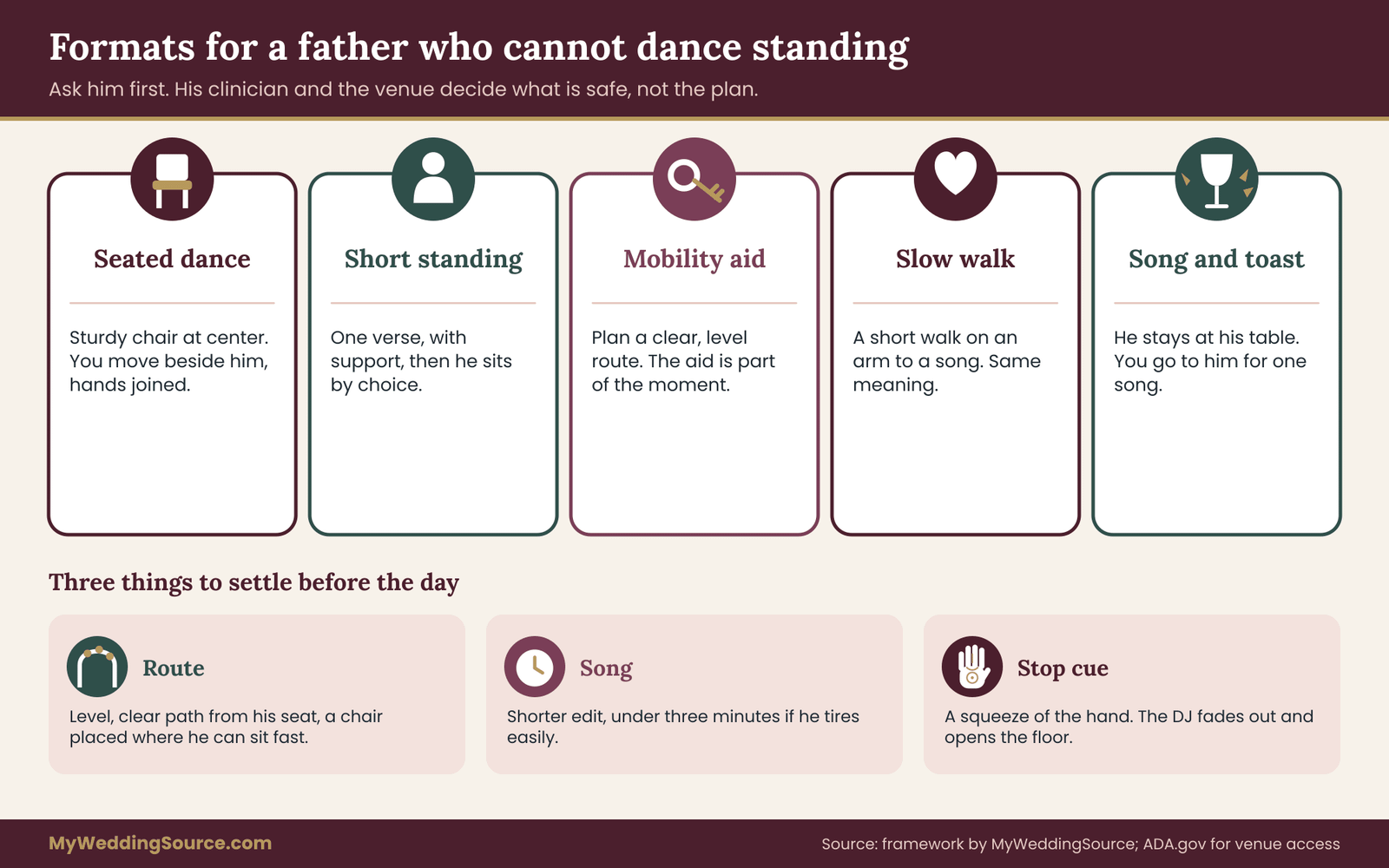
The seated dance. He stays in a sturdy chair with no wheels or arms that would get in the way, and you dance beside him, or take his hands and move in time to the music while he does. It reads as a father daughter dance because the music, the eye contact and the closeness are all present. It also avoids any worry about balance.
The short standing dance. He stands for one verse or less, with support from you or from a nearby chair or rail, and then sits. The rest of the song is a seated moment or a spoken line. The time on his feet is limited and chosen by him.
The wheelchair or mobility aid dance. A father who uses a wheelchair or walker can take part with the aid as part of the moment. You can move around him, turn him gently if he agrees, or move together in time to the music. Plan the route with the venue so a clear, level path exists, and confirm the floor surface can handle the aid.
The walk instead of a dance. Some fathers cannot dance but can walk a short distance on an arm. A slow walk across the floor to a song can carry the same meaning. It also works as the “entrance” to a seated moment at the center of the room.
The song and a toast. He stays at his table, a song plays, and he stands or stays seated for a short toast. You go to him, hug him and sit with him through the song. The dance floor stays empty or opens to everyone.
Plan the floor, the chair and the exit
An accessible plan is mostly logistics. Walk the route with the venue contact before the day and confirm four things: the path from his seat to the dance area is clear and level, the floor surface is stable and free of loose cables or ramps, a chair is placed where he can sit quickly, and there is a quiet exit if he needs to leave.
The Americans with Disabilities Act sets accessibility requirements for many public places, and the federal ADA website explains how they apply. Those rules cover the venue, not your private family choices, so ask the venue what accommodations it offers and which routes are approved for guests with mobility aids. Do not assume. Venue staff usually know where the smoothest path runs and where a chair can be placed out of traffic.
Two more details save trouble. First, test the song’s length. A four-minute song is a long time for someone who tires easily, so choose a shorter song or edit it with the DJ’s help. Second, tell the photographer and videographer which shots work best, such as close-ups from the side instead of long shots from across a wide floor.
Rehearse once with the exact setup
A single rehearsal removes most of the surprises. Bring the chair, the aid, the shoes and the song, and do the father daughter dance once at the venue or in a similar space. Watch for the moments that feel rushed or tiring and adjust. Rehearse the first thirty seconds more than the rest, since that is when people are most nervous.
If a dance instructor is available for the father daughter dance, ask for an instructor who has experience with adaptive movement. Many dance studios can adapt choreography for different abilities, and a short lesson is often enough. Keep the instructor’s guidance and the clinician’s guidance in charge, and keep your own ideas in second place.
Make the exit easy
Decide in advance what happens if he wants to stop. A simple cue, such as a squeeze of the hand or a quiet word, lets him end the father daughter dance without a scene. The person who is dancing with him, whether you or another family member, then walks him to his seat while the song fades or continues with the room joining the dance floor.
Tell the DJ about the cue as well, so that the song can move smoothly into the next segment. A father who knows he can stop whenever he likes is much more likely to relax and enjoy it.
Parent dances for every couple, not only a bride and her father
Part of the reason couples look for alternatives to a father daughter dance is that the traditional version assumes a bride, a father and a particular family shape. Many couples do not match it. Two grooms, two brides, a nonbinary partner, a groom who wants a dance with a parent, or a couple raised by a single parent or grandparents all have good reasons to think about the format afresh.
Rename the dance to fit the people
You do not have to call it a father daughter dance. “Parent dance,” “family dance,” “a dance for the people who raised us” or just a song title announced by the DJ are all accurate and warm. The name is part of the planning, and a better name often solves a problem before it starts.
If you want to keep the tradition for one partner, you can have a second one for the other. Beside the father daughter dance you can offer a mother son dance, a dance with two mothers, a dance with a grandfather, or a two-parent dance for each partner are all common ways of keeping balance.
Order the dances so nobody is left waiting
When two or more parent dances appear, sequence them from the shortest to the most formal, or let the couple’s first dance lead and the parent dances follow in a single block. A single block of about six to eight minutes, with two or three short songs, avoids a long run of separate announcements.
If one parent is nervous, put that dance in the middle, not first. The first dance sets the tone and the last one closes the segment, while the middle ones carry less weight.
Two partners, one family
When partners have different family situations, comparing them is a trap. One may have a father who is eager to dance while the other has no parent who is available. Avoid forcing a symmetrical program. A single dance for one partner, a tribute for the other and an open floor for everyone is a perfectly balanced evening if both partners agree to it.
Talk it through as a couple before you talk to anyone else. The wedding decision-making guide explains how couples can share decisions while holding a line with family, and the same habits apply here: decide privately, then communicate together.
A parent who wants to dance with the groom
Some grooms want a parent dance, and some parents hope for one. The format is the same as for a bride: ask privately, check willingness and ability, choose a song and place it in the evening. A groom who wants a dance with his mother, father or grandparent needs no special reason, and the parent dance does not need to match the bride’s father daughter dance in length or style.
If both partners have a parent dance, a joint segment can be warm. Each partner dances with a parent for one verse, and then the two pairs trade or the two couples join together. It saves time and gives the room a sense of the two families coming together.
Same-sex couples and nontraditional families
For a couple raised by two mothers or two fathers, or by a single parent and a grandparent, the old script offers no obvious place to start. The four-check test does the work. Each person who might dance is a candidate, each is asked privately, and the format is chosen to suit them.
Do not assume that the “right” pairing is gendered. A dance with the parent who made the biggest difference in your life is a better rule than copying a father daughter dance for the parent of a particular gender.
Other limits that deserve the same care
Mobility is the limit people think of first, but it is not the only one. A father or other parent may have limited hearing, so a loud room and a soft song make it hard to follow the music. Planning a spot near a speaker, or asking the DJ to lower the volume for the father daughter dance, can help. A parent with low vision may need good light, a clear path and a steady arm.
Anxiety deserves the same respect. A person who freezes in front of a crowd may do well with a smaller group, a darker room or a dance at a quiet moment. Fatigue matters too, especially for a parent who has traveled or who has had a long day of ceremony and photographs.
The pattern is the same each time. Ask what would make it easier, offer a few choices and let the person decide. A father daughter dance that suits the father is worth more than a perfect one that he dreads, and a quiet, well-planned version often looks better on the day than a grand one that strains everyone.
Family wording: how to ask, how to decline and how to change the plan
Most of the hurt around a father daughter dance does not come from the dance. It comes from the way the plan reached the people it affects. A parent who hears a change secondhand, or a relative who learns about a dropped tradition from the program, can feel excluded even when the decision was kind.
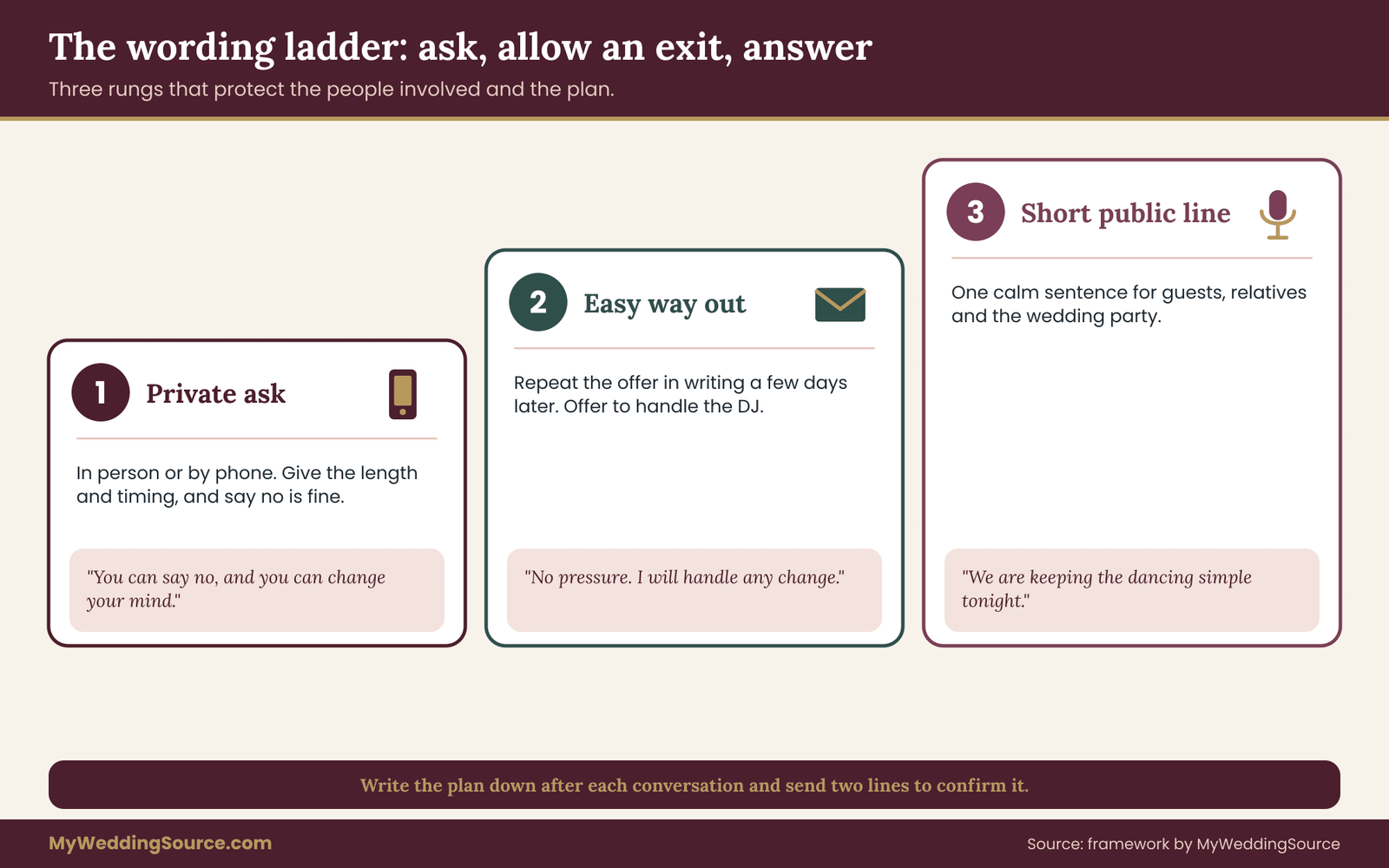
The fix is a wording ladder with three rungs: a private ask, an easy way out and a short public line. Each rung has a purpose, and you can use it for any alternative to a father daughter dance.
Rung one: the private ask
Ask in person or by phone, not by text and not in a group message. Choose a calm moment, not the week of the wedding rehearsal. Say what you are asking, say that no is an acceptable answer, and say when you need a reply.
Here is a plain script for a parent or relative:
“I am planning a short parent dance, and I would love to dance with you. It would be one song, about three minutes, after the first dance. You can say no, and you can change your mind any time before the day.”
Notice what the script does. It names the length, the timing and the freedom to decline. People who feel trapped by an invitation tend to say yes and then dread it. People who feel free to say no tend to say yes more warmly.
For a parent who may struggle with the format, add a line about options: “If you would rather do it seated, or do a shorter version, we can set that up.” This signals that you have thought about their comfort before they have to raise it.
Rung two: the easy way out
Every invitation needs a graceful exit that the other person can use without explaining. Offer the exit in the same conversation and again a few days later in writing.
A short follow-up can say: “No pressure on the father daughter dance. If you want to change anything, tell me and I will handle the DJ.” The offer to handle the DJ matters, because it removes the social cost of backing out.
If someone declines, thank them and move on. Do not ask why unless they offer. Do not offer a counterproposal in the same breath, since a quick substitute can feel like a dismissal. Give it a day, then follow up with another role if one seems right.
Rung three: the short public line
Some guests will notice that there is no father daughter dance or that it looks different. A short, calm line prevents rumors and awkward questions. Prepare one sentence and let your parents, the wedding party and the DJ use it.
Examples that work in different situations:
“We are keeping the dancing simple tonight, so we skipped the parent dances.”
“Dad is sitting this one out, and we are glad he is here.”
“We are dancing to this song for people who are not with us tonight.”
Each of these says something true, closes the topic and does not invite follow-up. Avoid explaining a family conflict, a diagnosis or a loss to guests who ask. A short, warm line is complete.
Wording for the father who has died
If your father has died and you are including a tribute, the wording to guests can be brief: “This next song was one of his favorites.” No further announcement is needed, and silence in the room is a fine response.
If you are not including a tribute, you do not need to explain. If a relative asks, a gentle “we decided to keep the evening light, and we are carrying him with us in our own way” ends it. You can adapt the wording, and you can say nothing at all if you prefer.
Wording for a stepparent who is asked to dance
A stepparent often wants to be asked and fears being presumptuous. A direct invitation helps: “You have been part of my life in a way I do not take for granted. Would you dance with me?” If the birth father is also present, tell both before the day so neither hears about the other from a guest.
When both a father and a stepfather are in the picture, avoid ranking. A combined dance, a shared toast or two short dances with equal time can say the same thing to both men.
Wording for a father who is unwilling
If a father says he does not want to dance, a short and respectful reply keeps the door open: “Thank you for telling me. I would still love to have you there, and I will keep the day simple.” Then offer another role in a separate conversation if one fits.
Do not argue, do not guilt, and do not tell other relatives that he refused. Letting him decline without comment protects him and you.
Wording for a father who cannot dance standing
For a father with limited mobility, the invitation can name the format as a gift: “I would like us to share a song, and I would like you to sit through it with me. It does not have to be a dance across the floor.” Then ask what he prefers.
Avoid language that implies he is being accommodated as a problem. Say what the moment will be, not what he cannot do. “We will have a chair ready at the center of the floor” is better than “we will make an exception for you.”
Wording for the DJ and the host
The DJ needs the plan in writing, because the announcement shapes how guests react. Give the exact words you want, the song title and length, who is involved, and what to do if someone steps out. If you want no announcement, say so explicitly.
A short note to the DJ might read: “After the first dance, play the first song on the list. No announcement of names. If the person steps away, fade out and open the floor.” The full playlist and DJ briefing guide covers how to build the full playlist and brief the DJ.
Wording for relatives who ask
Close relatives tend to ask early and persistently. Choose one person in the family to answer questions so that you do not repeat yourself. Give them the short public line and ask them to use it with everyone who asks.
If a relative objects, listen once and thank them. You do not have to defend the choice. A sentence such as “We have thought about it, and this is what feels right for us” is polite and final.
Wording on printed materials
The program, the website and any signs rarely need to mention the father daughter dance at all. If you list the evening schedule, use neutral titles such as “Parent dances” or “A song for family” instead of “Father daughter dance.” A neutral title avoids confusion if the plan changes, and it protects a parent who might otherwise see their name or role in print before they have agreed.
Check names, titles and spellings with each person before printing. For related guidance on guest-facing wording, see wedding etiquette for general courtesy norms, and keep any family-specific wording out of print unless the people involved have approved it.
When a parent pushes back on the alternative
Sometimes the problem is not a refusal but a disagreement about what the alternative should be. A mother may want the father daughter dance to go to her, a father may want it to happen despite his limits, or a stepparent may feel passed over. These conflicts are about feelings, and the answer is rarely a different dance format. It is a short conversation that acknowledges the feeling and restates the decision.
A useful pattern is: acknowledge, explain once, offer a role. “I know this matters to you, and I want you to be part of it. The dance this time will be a group song, and I would like you to be the first one on the floor.” Then stop talking. Repeated explanations invite more argument.
A written plan beats a verbal one
After each private conversation, write down what was agreed and send a short message to confirm. It can be two lines: “Just confirming: one song after the first dance, seated if you prefer, and you can step out at any time.” A written plan removes disputes about who said what, and it gives the person a chance to correct a misunderstanding before the day.
Keep the messages calm and short. If the plan changes, send a new message the same day and tell the DJ at once. The cost of a clear note is a few minutes. The cost of a surprise on the dance floor is much higher.
Choosing the song, the length and the moment for a father daughter dance alternative
Once you know who is dancing and in what format, the remaining choices are practical: the song, how long it runs, where it falls in the evening and what the room does while it happens. These choices are small, but they decide whether the moment feels easy or strained.
Pick a song that works for the person, not only for the memory
A song with deep meaning can be a poor dance song. It may be too fast, too slow, too long or too emotional for someone who is already nervous. Test the song against three questions. Can the person move to it comfortably at its tempo? Is it a length they can handle? Will it bring up feelings that are hard to manage in public?
For a father who tires easily, a shorter song or a trimmed version keeps the moment gentle. For a bride who may cry, a song with a steady, warm rhythm gives her something to hold onto. For a stepparent or grandparent who is nervous, a familiar song lowers the pressure.
If you want a song that carries a loss, consider playing it as a tribute while the floor is empty, then moving to a lighter dance song for the father daughter dance itself. Combining the two in one track can leave everyone emotionally stranded in the middle of a party.
Keep it to one song, or a short edit
Three minutes is a comfortable length for a parent dance. Anything beyond four starts to feel long for the people watching and may be tiring for the people dancing. A DJ can edit a song so it fades after the second chorus, or cut the introduction to start on the verse.
When more than one person dances, a single song with two or three short handoffs works better than separate songs. Plan the handoffs in advance so nobody stands waiting, and decide who cues them.
Check the music rights and format
If a DJ or band is performing, the venue and the performer usually hold the licenses for public performance. If you are playing a recording from a phone or a laptop, check that the file quality is good and that the venue’s sound system can play it. A song that sounds great on headphones can sound thin through a room speaker.
Copyright rules for music use are published by the U.S. Copyright Office, and the performing rights organizations explain licensing for public performance. For a private wedding, a licensed DJ or venue generally handles this, and it is worth asking the venue what it covers rather than guessing. If you plan to share a video of the father daughter dance online, check the platform’s rules, because recorded music can trigger takedowns.
Where the dance sits in the evening
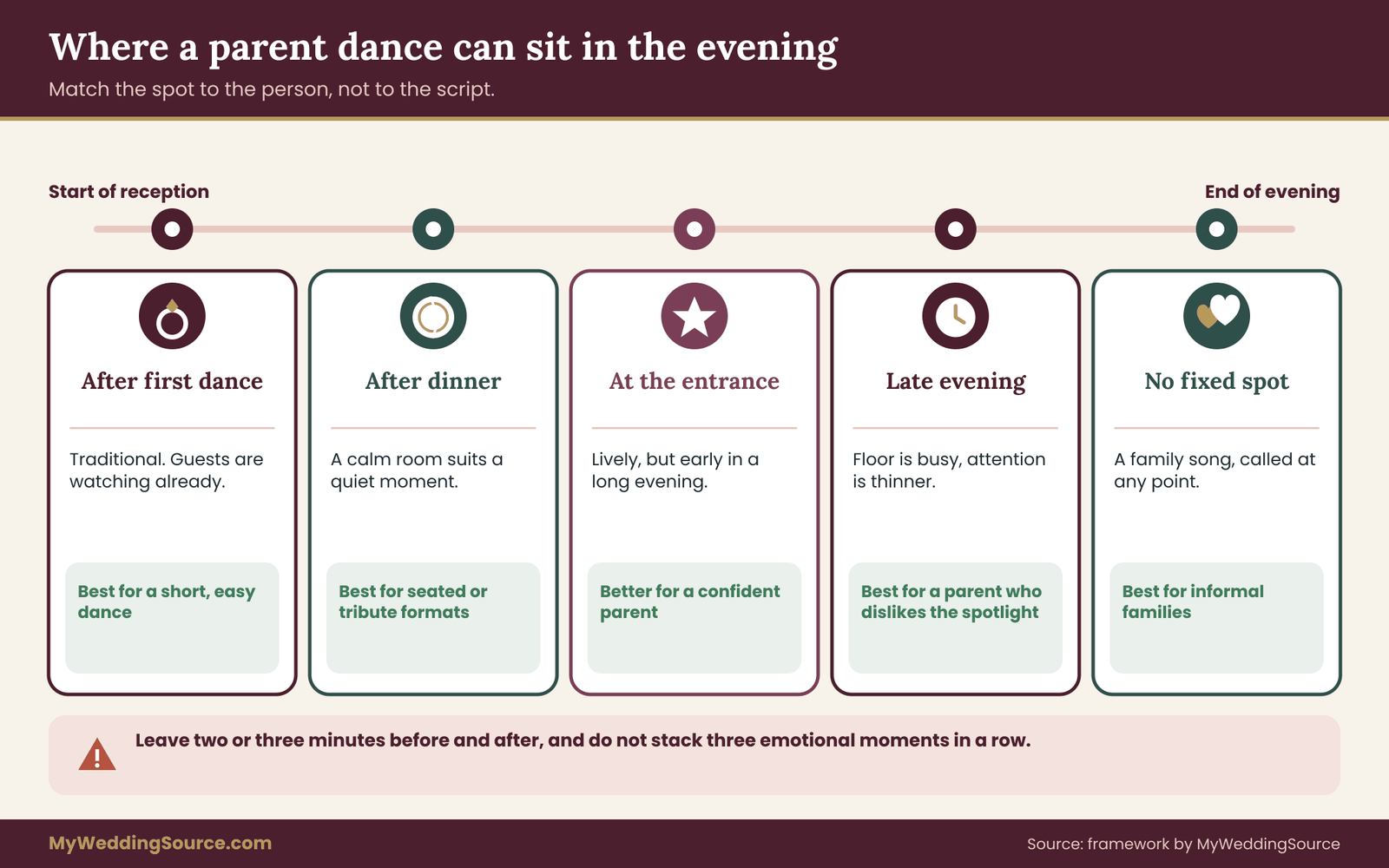
A parent dance has a few natural spots. Each has a different feel, and each suits a different situation. The guide on how a reception flows shows how these moments fit into the larger reception, and the points below add the detail that applies to this one.
After the first dance. This is the traditional spot. Guests are already on their feet and watching, and the transition is easy. It works for most families, especially when the father daughter dance is short.
During or after dinner. Some couples place the father daughter dance after the main course, when guests are relaxed and the room is calm. This works well when the dance is seated or when a tribute is part of it, because a quiet room suits a quiet moment.
Before dinner, at the entrance. A parent dance as part of the grand entrance can be a lively option, but it puts the dance at the start of a long evening, when a nervous parent has not yet had a chance to relax.
Late in the evening. A late dance, after most of the energy has moved to the floor, can feel more casual and less like a performance. It works for a parent who dislikes being watched, because the room is busy and the attention is thinner.
No fixed spot. A group dance or an open “family song” can be called at any point, and guests join in. This format avoids the spotlight and suits families who prefer something informal.
Match the spot to the person
If a parent is nervous, an early spot gets it over with. If a parent has limited stamina, place the father daughter dance before the evening gets long. If the dance carries emotion, give it a quiet spot with a little time on either side. If the mood is lively, choose a moment when the floor is already warm.
The wedding vendor timeline matters here, since the DJ, the photographer and the caterer all work from the same schedule. The wedding vendor timeline guide explains how to share a single schedule across vendors, which helps keep the father daughter dance from running into a cake cutting or a toast.
Leave room around it
A short buffer before and after the father daughter dance helps. Two or three minutes beforehand let the parent get to the floor without rushing. A minute or two afterward lets the room clap, the people involved hug and the next song start smoothly.
Do not stack three emotional moments in a row. A toast, a parent dance and a slideshow back to back can drain a room. Space them with food, music or a break.
What guests do while it happens
Guests tend to follow the cue the room gives them. If the DJ announces a dance and the floor clears, they watch. If the song starts and the couple walks out with no announcement, guests may keep talking. Decide which you want.
For a quiet or emotional moment, ask the DJ to dim the music slightly under any announcement and to bring up the song gently. For a lively group dance, an announcement that invites everyone to join is useful. A line such as “We would love for everyone to join us on the floor for the second verse” removes any uncertainty.
Photography and video
The photographer and videographer need to know the plan in advance. Tell them who is dancing, what format it will take, and where the best light is. If a parent is seated, ask them to shoot from the side and avoid blocking the chair. If the moment is private, ask them to stay at a distance or to skip it.
The guide to the wedding family photo list covers how to plan family portraits so that a parent who tires easily is photographed before the dancing starts. A portrait taken earlier means the father daughter dance can be a short, unposed moment with no pressure to produce a perfect picture.
A backup plan for the song
Technology fails at odd moments. Carry a second copy of the song on a separate device, and give the DJ a file in a standard format. Ask them to test it on the venue’s sound system before the guests arrive.
If the song fails mid-dance, the parent should have a cue to carry on, such as waiting for the DJ to restart, or simply holding the moment in silence. A calm plan keeps a technical glitch from becoming a visible stumble.
A short checklist in prose
Before the day, confirm in writing the person, the format, the song and its length, the spot in the schedule, the announcement wording, the cue to stop, and the photographer’s position. Confirm the chair or aid, the route to the floor and the exit. Then run the four-check test one last time. If all four checks still read yes, you are ready.
Time and cost logic for each alternative
Most alternatives to a father daughter dance cost little, but they do cost time, and time is the real budget. A dance with a parent takes a conversation, a song and perhaps one rehearsal. A seated or adaptive version adds a walk-through with the venue and possibly a short session with an instructor. A group dance adds coordination among several people. A tribute adds a photograph, a candle or a framed item, which may cost a modest amount for printing or a frame.
Ask the DJ whether editing a song, preparing a special file or adding an announcement carries a fee, because policies differ and a simple question avoids a surprise on the invoice. If a dance instructor helps, ask for the lesson length and rate before you book. Do not rely on a rule of thumb for prices, since they vary widely by region and supplier. Collect two or three quotes, and write the scope of each in a sentence so you can compare them fairly.
The other cost is attention. A plan with five moving parts asks a lot of the people involved. If you feel stretched, remove a part. A single song and a hug cost almost nothing and are often remembered longest.
Keeping the rest of the room comfortable
Not every guest knows what a father daughter dance alternative means, and some will feel awkward if the usual script changes. Children may ask why a grandfather is sitting while others dance. Older guests may wonder whether something is wrong. A short, friendly cue from the DJ, or a line in the program that reads “A song for family,” sets the tone without drawing attention to anyone.
If a tribute is part of the moment, give the room a clear cue to be quiet, such as a dimmer light or a pause in the music, and a clear cue to resume, such as a lively song. Guests are generally happy to follow the lead when they know what is happening.
The family photo planning mentioned above also helps with the room’s comfort, because a family portrait taken early means older parents can rest before the evening, and a parent who rests is a parent who is more likely to enjoy the dance.
A worked case: one family, four candidates and a short plan
The following example is invented. It is an illustration of how the four-check test and the wording ladder work together, not a report about a real family. Names and details are made up.
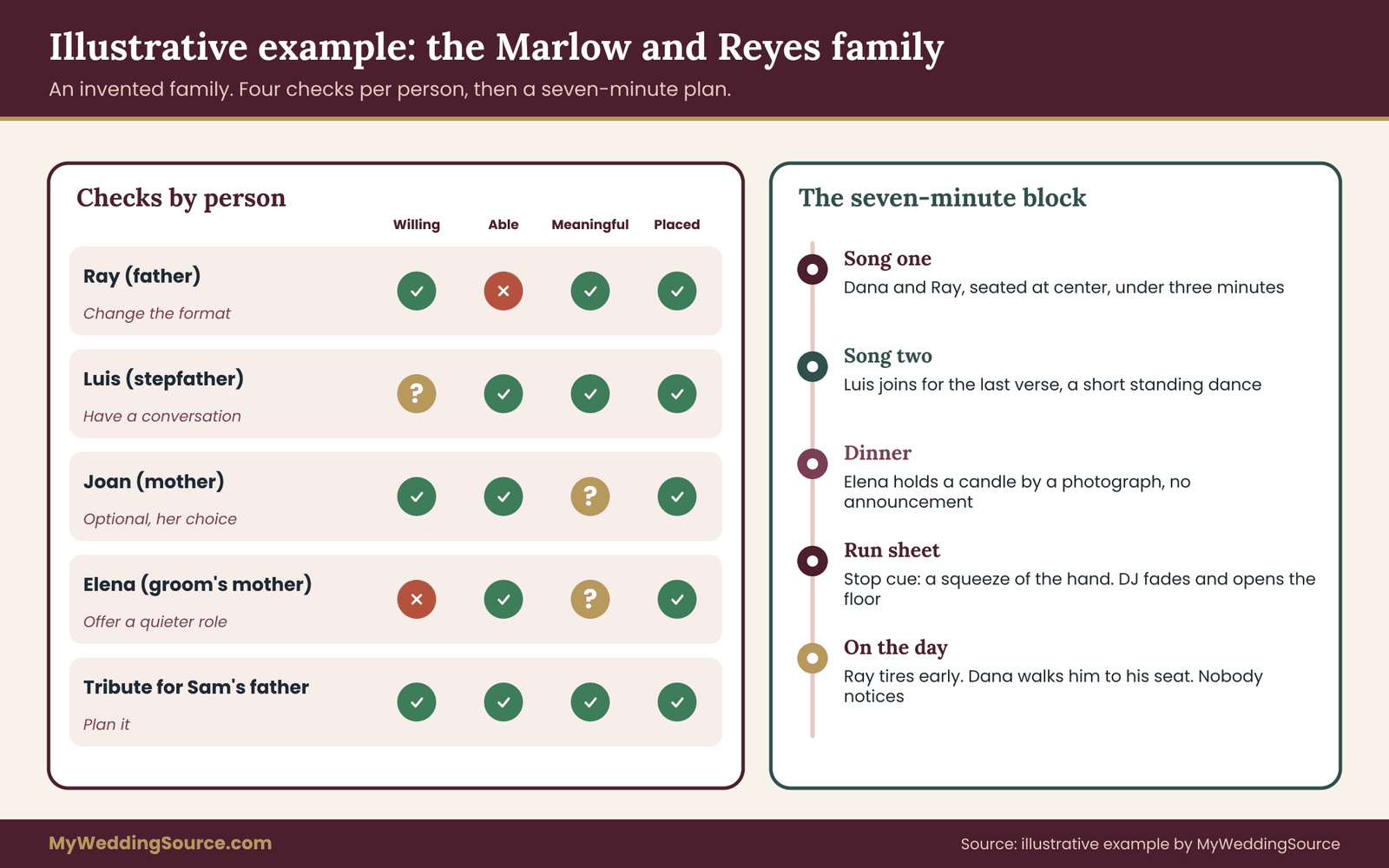
Dana Marlow and Sam Reyes are planning a reception for 110 guests. Dana’s father, Ray, is warm and proud but uses a walker and tires after a few minutes on his feet. Dana’s mother, Joan, remarried when Dana was nine, and Dana’s stepfather, Luis, has been a steady parent ever since. Sam’s father died four years ago, and Sam’s mother, Elena, is not fond of being watched. The couple originally pictured a father daughter dance because it felt expected, and then realized it fit no one neatly.
Step one: list the candidates
Dana and Sam sit down together and list everyone who might have a parent dance. Ray, Luis and Joan for Dana. Elena for Sam, plus a possible tribute for Sam’s father. They write the four checks beside each name and, instead of guessing, they decide to ask each person privately.
Step two: run the four checks
Ray. Willing: yes, he told Dana he would be honored. Able: not for a standing dance across the floor. Meaningful: very. Placed: open. The test says the person is right and the format needs work.
Luis. Willing: unsure, because he does not want to take Ray’s place. Able: yes. Meaningful: very. Placed: open. The test says the issue is a feeling, not a logistic, and the answer is a conversation.
Joan. Willing: yes. Able: yes. Meaningful: moderately, since she would be glad to take part but does not need a spotlight. Placed: open. The test says it is optional, and Dana can choose.
Elena. Willing: no, she is uncomfortable in front of crowds. Able: yes. Meaningful: Sam says it would mean something, but not at the expense of her comfort. Placed: open. The test says change the format, since the person is willing to be included in a quieter way.
Tribute for Sam’s father. Willing: not applicable. Able: not applicable. Meaningful: yes. Placed: yes, as long as it is short. The test says plan it.
Step three: design the formats
Dana and Sam choose a short block of about seven minutes after the first dance. First, Dana and Ray share a seated song, with a chair placed at the center of the floor. Ray stays seated for the whole song, and Dana kneels or sits beside him. Second, Luis joins for the last verse of a different song, and Dana dances a short standing dance with him while Ray watches from his chair. This design avoids ranking the two men, because both have time and both are included.
Sam asks Elena privately whether she would like a family dance later in the evening, when the floor is crowded. She says she would rather not dance at all but would like to hold a candle near a photograph of her husband during dinner. That becomes the tribute.
Step four: the wording
Dana tells Ray in person: “I would like us to share a song, and I would like you to sit through it with me. You can stand for a few seconds if you want, but you do not have to.” Ray says yes and asks for a shorter song. She picks one under three minutes.
Dana tells Luis separately: “I want you to be part of this, and I want Dad to be in it too. Would you be willing to take the last verse with me?” Luis asks for a day and calls back to say yes.
Dana’s mother Joan is told by text, then in person. Elena is offered the tribute by Sam and accepts. The DJ gets a written plan with the order, the songs, the cue to stop and the exact announcement, which is simply “Parent dances.”
Step five: the day
On the day, Ray tires during the second song and signals with a squeeze of the hand. Dana walks him to his seat, the DJ fades the song and the segment ends. Luis and Dana have a shorter dance than planned, and nobody notices a difference. The tribute for Sam’s father happens during dinner with no announcement, and Elena holds the candle for a minute.
The point of the example is not that everything went perfectly. It is that every moment had a plan and an exit, so a change did not become a crisis.
What the example shows
Three things stand out. First, the traditional father daughter dance was not dropped. It was reshaped to fit the person. Second, the biggest obstacle for Luis was a feeling about ranking, which a direct conversation solved. Third, Elena’s refusal was treated as information, and a different gesture met her need.
A second short case: a bride raised by her mother
Here is another invented case, shorter than the first. Priya was raised by her mother, Anita, and has had little contact with her father, who has been invited and said he would attend. Priya does not want a father daughter dance, and she does not want her father to feel singled out by its absence.
She runs the test. Her father: willing, perhaps, but she is not, so the test says no. Her mother: willing, able, deeply meaningful. A grandfather who helped raise her: willing, able, and a steady, quiet presence. The plan is a family dance in which Priya starts with Anita, her grandfather cuts in for the second verse, and the room is invited to join. There is no announcement of names, and the schedule simply lists “Family song.”
For her father, Priya sends a short, kind message: “I am glad you are coming. The evening is simple, and I am not doing a father daughter dance or any other single parent dance.” She offers him a seat with the family and a place in the group photograph. He replies with thanks. The tone of the message and the open invitation matter more than any dance.
The lesson is that a father daughter dance alternative can also protect a person who is not dancing. A neutral title, a group format and a short note allowed the father to attend without being put on display.
Failure conditions: how a father daughter dance alternative goes wrong
Every plan has ways to fail. Naming them in advance lets you check for them before the day. The failures below come up in many families, and each has a fix.
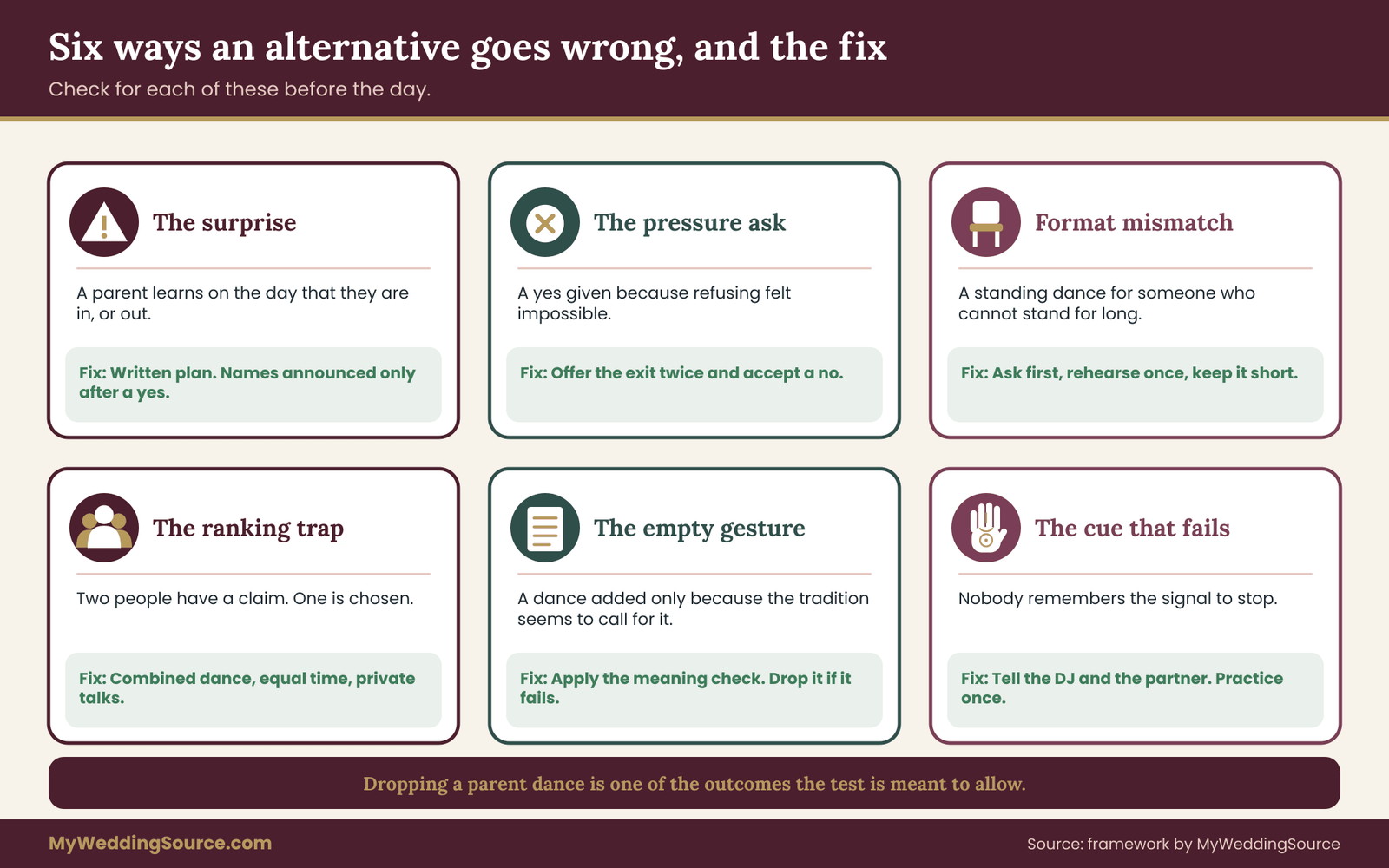
The surprise
A parent discovers on the day that they are expected to dance, or that they are not. The cause is skipped conversations or an announcement that went beyond what was agreed. The fix is the written plan and a rule that nobody is named in the announcement unless they have said yes.
The pressure ask
A parent says yes because refusing feels impossible. They arrive nervous and resentful, and it shows on the video. The fix is the easy way out, offered twice, and a real willingness to accept a no.
The mismatch of ability and format
A format is chosen without asking what the person can do. A standing dance is planned for someone who cannot stand for long, or a long song for someone who tires easily. The fix is to ask first, rehearse once and keep the father daughter dance short.
The ranking trap
Two or more people have a claim, and choosing one feels like rejecting the other. Left unspoken, the choice can hurt. The fix is a combined format, equal time and a private conversation with each person before the day.
The empty gesture
A dance is added because the tradition seems to demand it, not because anyone wants it. It feels flat, and the people involved know it. The fix is the meaning check, and a willingness to drop the father daughter dance if it does not pass.
The cue that fails
The plan relies on a signal to stop, but nobody remembers it or the DJ does not know. A parent has to endure a father daughter dance they cannot finish. The fix is to tell the DJ and the dance partner in advance and to practice the cue once.
The technical slip
The song does not play, the file is the wrong version, or the sound system cuts out. The fix is a second copy of the song, a sound check and a calm plan to continue without music for a moment.
The conflict that surfaces
A strained relationship flares during the father daughter dance or the day. The fix is a smaller format, a private moment instead of a public one, and a trusted person who can step in. If the situation is more than a planning problem, a counselor or the family’s own support system can help, and the national helplines listed by public health agencies can point toward further support.
When to drop the dance
Drop it when the people involved do not want it, when the format cannot be made safe or comfortable, when it would highlight a conflict, or when the meaning check fails for every candidate. Dropping the father daughter dance is not failing. It is one of the choices the test is meant to allow.
Recovery in the moment
If something goes wrong on the day, the first move is to protect the person. Stop the music, end the dance or let a family member walk the person away. The second move is to give guests something to do, such as a toast or an open floor. The third is to say nothing about it later unless the person wants to talk. A calm response is often the best recovery.
The day-of run sheet: who owns each step of the plan
A parent dance is short, but many people touch it. The DJ starts the song, the photographer frames the shot, the venue staff place the chair, a family member walks a parent to the floor and someone watches the clock. Without an owner for each step, small gaps open, and the gaps are where surprises happen.
Build a one-page run sheet
Write one page and give a copy to the DJ, the planner or day-of coordinator, the photographer and one family member. The page lists, in order: the time of the segment, the people involved, the format, the song and its edited length, the announcement wording or the instruction to make none, the chair or aid location, the cue to stop, and the next item in the schedule.
Keep the language plain. “After first dance, play Song A, no names announced. Dana and Ray seated at center. If Ray squeezes Dana’s hand, fade out and open the floor” is clear enough that anyone can follow it. The vendor timeline guide mentioned earlier explains how to share a single schedule so every vendor works from the same version.
Assign a family point person
Choose one relative who is not dancing to be the point person for the segment. This person confirms that the parent is ready five minutes before, carries any aid or bag, and sits within reach of the floor. If something changes, the DJ turns to this person, not to the couple.
The point person should know the cue to stop, the short public line and the plan for what happens if a parent needs to leave. A calm, familiar face makes a difference, particularly for an older or nervous parent.
Brief the DJ in person
A written note is a start, and a short conversation is better. Ask the DJ to repeat the plan back to you. Confirm the song file, the edit, the announcement and the fade-out cue. Ask what happens if the father daughter dance runs longer or shorter than planned, and who calls the next segment.
If a band is performing, confirm that the band can play the song in the key and tempo you need, or whether a recording will be used. Share the length limit and the cue to stop with the bandleader as well.
Brief the photographer and videographer
Tell them which moments matter most and where the best light is. For a seated dance, ask for a position at an angle that shows faces, not the back of a chair. For a tribute during dinner, ask them to be discreet. If a parent prefers not to be photographed in a particular moment, tell the team in advance.
Brief the venue contact
Confirm the route to the floor, the chair location, the floor surface and the nearest exit. Ask whether any part of the floor is uneven or has cable covers. For a parent with a mobility aid, ask staff to keep the path clear of chairs, bags and decor. The federal ADA site and the Access Board explain accessibility standards, and the venue should be able to say what it provides.
Brief the wedding party
The wedding party does not need the full plan, but the people near the father daughter dance need the short version. They should know not to ask a parent to dance on the spot, and not to comment if the plan changes. A single sentence is enough: “Please follow the DJ’s lead, and let us handle any changes.”
Do a final check the day before
The day before, send a short message to each person involved: “Just confirming tomorrow’s plan. One song after the first dance, seated if you prefer. You can step out at any time. See you there.” Their reply, or the lack of one, is information. If anyone sounds unsure, call.
Also check the physical items: the chair, the shoes, the aid, the printed run sheet, the second copy of the song and a bottle of water for a parent who may need it.
Your next steps
Start with a single evening and a single page. Write down every person who might have a parent dance, and run the four-check test on each, marking yes, no or not yet. For every “not yet,” schedule a private conversation within the week, using the wording in this guide.
Then decide the format for each person who passed: a dance with another parent, a mother or sibling dance, a seated or adaptive version, a group dance, a tribute or no dance. Choose the song and its edited length, decide where it sits in the schedule, and write the one-page run sheet for the DJ, the photographer and your family point person.
A week before the wedding, confirm the plan in writing with everyone involved, test the song on the venue’s system and walk the route to the floor. If anything feels uncertain, simplify it. A shorter, calmer plan beats an ambitious one that nobody can relax into, and your father daughter dance alternative can be as small as one song and a hug.
FAQ
Is it rude to skip the father daughter dance?
No. The father daughter dance is a custom, not a rule, and many couples skip it for good reasons such as a loss, an estrangement, health limits or personal taste. What matters is telling the people who might have expected it, so they are not surprised. A short, warm line to relatives, and clear instructions to your DJ, are usually all it takes.
What can I do instead of a father daughter dance if my father has died?
You have several choices. You can dance with a mother, stepparent, grandparent or sibling, play one of his favorite songs as a short tribute, set a framed photo at a table, or skip the dance entirely. Choose what feels right to you, not what the tradition suggests, and keep any announcement brief and gentle.
How do I include a father who cannot dance standing?
Ask him what he would like, then offer formats such as a seated dance, a short standing moment with support, a slow walk, or a song with a toast. Confirm the route, floor and chair with the venue, rehearse once, and agree a simple signal to stop. His clinician and the venue’s accessibility information should guide anything physical.
Can I have a dance with a stepfather and my father?
Yes. Ask each man privately, tell both about the plan before the day, and avoid ranking them. A combined dance, where each takes a verse, or two short dances of equal length works well. If either man would feel uncomfortable, change the format. Willingness matters more than symmetry.
What if my father refuses to dance?
Treat it as an answer, not an insult. Thank him, do not argue and do not tell other relatives he refused. Offer a different role if one fits, such as a toast, a reading, a photograph or a seat at the head table. If he declines every role, accept that and keep the invitation to the day itself open.
Where should the parent dance go in the reception timeline?
The traditional spot is right after the couple’s first dance. Other good spots are after dinner, late in the evening or as part of an open family song. Choose based on the people: early for a nervous parent, before a long evening for someone who tires, and a quiet moment for an emotional dance. Leave a few minutes before and after.
How long should a parent dance last?
About three minutes is comfortable for most people. Longer than four can feel long for the room and tiring for the dancers. Ask your DJ to trim the song, fade it after the second chorus or skip the intro. If several people dance, use one song with short handoffs instead of several separate songs.
Do we have to announce the dance?
No. You can ask the DJ to play the song with no announcement, or use a neutral line such as “parent dances.” Announce names only if each person has agreed. If you want guests to join midway, ask for a short invitation. For a private or emotional moment, a quiet start usually feels most natural.
Sources
- Americans with Disabilities Act, U.S. Department of Justice
- Introduction to the ADA, U.S. Department of Justice
- Accessibility guidelines and standards, U.S. Access Board
- STEADI: older adult fall prevention, Centers for Disease Control and Prevention
- Health information on aging and loss, National Institute on Aging
- Copyright and music, U.S. Copyright Office
- Child Welfare Information Gateway, family relationships and support, U.S. Department of Health and Human Services
- Mental health and substance use support, SAMHSA
- Performing rights licensing for public performance, ASCAP
- Government services and information, USAGov