
A pumping space at a wedding is a private, powered, clean and cool place where someone can express milk without an audience and without missing the whole event. This guide gives you a four-station checklist for privacy, power, cleaning and storage, a worked example, a set of questions for your venue, and the conditions that tell you to pick a different room.
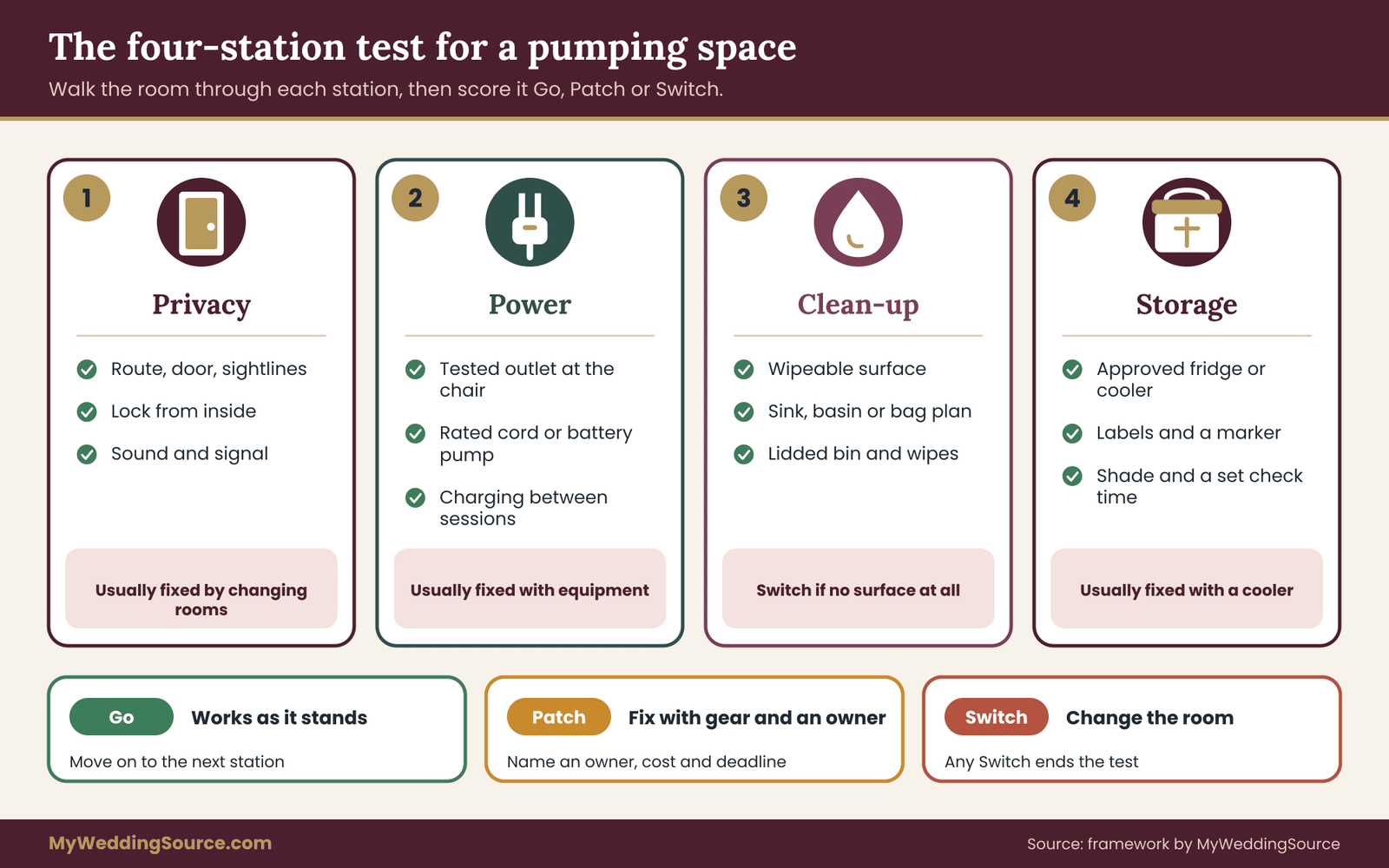
Test any candidate pumping space at four stations before you promise it to anyone. Privacy means a door that locks or a screen that cannot be moved by accident. Power means a working outlet at the chair, or a plan for a battery pump. Clean means a surface and a place to rinse or bag used pump parts. Store means a cooler or refrigerator the parent can reach. If privacy or cleaning fails, change the pumping space. If power or storage fails, patch it with equipment.
Most couples who think about feeding space at their wedding picture a rocking chair and a curtain. A pumping parent needs something a little more specific. Expressing milk takes a set amount of time, usually longer than a short bottle feed, and it needs a power source or a charged battery, a flat surface, somewhere to put used parts, and cold storage for what comes out. A pumping space that looks charming but has no outlet near the chair will fail by the second hour of the reception.
The good news is that these needs are ordinary. A spare office, a bridal suite, a meeting room or a hotel room can serve well if it passes a short test. The test below takes about fifteen minutes during a site visit, and it turns a vague promise (“we will find them a room”) into a yes, a fix or a no.
A note on scope. This guide is general planning information, not legal or medical advice, and it does not replace the rules of your venue, your city or your state. Questions about a person’s own feeding, pumping schedule or health belong with their clinician, and the guide points to the agencies that publish current rules.
This article is about the facility side of one narrow task. The wider plan for babies, children and older relatives, including how to ask families what they need, is in the wedding guest care guide. If you have not yet walked your venue with a tape measure and a list of access routes, the venue technical walkthrough is the right place to start, and this checklist slots into it.
What a wedding pumping space has to do
A wedding pumping space has one job: to let a person express milk comfortably, privately and safely, on a schedule that suits their body rather than the program. Everything else on the checklist serves that job. It is worth being precise about the job, because a room that is good for one kind of feeding can be poor for another.
Nursing a baby at the breast needs a seat, some privacy and a quiet minute. Giving a bottle needs a seat and a place to warm or hold the bottle. Pumping needs all of that plus equipment. The parent usually brings a pump, tubing, flanges, bottles or bags, a cooler bag and often a hands-free bra. That equipment is bulky, it is tethered to a power source or a battery, and the parts have to be dealt with afterward.
How pumping differs from a nursing corner
A nursing corner can be a screened chair in a corner of a lounge. A pumping space cannot, because pumping tends to be longer, noisier and more exposed. Most pumps hum or click while they run. A person who is pumping is often partly undressed and connected to equipment, which makes it harder to cover up quickly if someone walks in. The privacy standard is therefore higher than for a quick feed.
That is why this article treats the space as a small room with a door whenever possible. A screened corner can work for a nursing parent who is comfortable feeding in view of a quiet area, and the couple should say so. For pumping, a door is the default and anything less needs a reason.
What the space is not
A pumping space is not a restroom. The federal rule for workplaces, which this article returns to later, says a lactation space cannot be a bathroom, and most parents would say the same thing about a wedding. A bathroom stall has no seat worth sitting on, no surface and a door that everyone else keeps knocking on. It also puts milk in a place most people would not choose for food.
It is not a storage closet, a coat room or the catering staging area, even when those are the only rooms with locks. It is not a car in the parking lot, though people do pump in cars, and it is not a replacement for the right every guest has to feed or pump wherever they are comfortable. The couple can offer the space as a kindness and say so plainly, without implying it is the only acceptable place.
Why a separate checklist makes sense
Many guides cover the whole subject of feeding at an event: where to sit, what to say to guests, how to word a sign. Those questions matter, and the guest care guide above covers the people side. This article goes narrower. It treats the space as a small piece of facility planning with four testable systems, because the failures that ruin a pumping session are almost always physical. The door has no lock. The outlet is across the room. The sink is in a kitchen the parent cannot enter. The refrigerator belongs to the caterer.
Testing those four things in person, before the wedding, turns most surprises into line items. A power strip costs little. A cooler and ice packs cost little. A door sign costs less. What costs a great deal is discovering at the cocktail hour that the only quiet room is locked and the person with the key has gone home.
Who needs a pumping space at a wedding
Start with a plain headcount, because the answer changes the whole plan. A pumping space for one person can be a small room used for a handful of sessions. A pumping space for four people across a long day needs a schedule, more storage and a person who manages the door.
Guests with infants. A sister, cousin or friend with a baby under about a year old is the case most couples picture. She may nurse, pump, or do both, and she may be traveling with the baby and a partner. Ask early. The best time is when you send a family-friendly invitation or an accommodation question on your wedding website, because the answer arrives when you still have time to act on it.
People in the wedding party. A bridesmaid, groomsman, parent or officiant may be pumping without having said so. Some will not mention it because they do not want to make the day about themselves. A short, general line in the wedding party message (“tell us if you need a private space at any point”) gives them an easy way to speak up.
The couple. A person who gave birth in the past year may be the one getting married. For that person the pumping space is not a guest amenity. It belongs in the day’s schedule, next to hair and makeup, and it deserves the same protection as any other fixed commitment. The practical point is simple: put the sessions on the timeline.
Vendors and venue staff. Photographers, caterers, planners, musicians and venue staff may also be pumping parents. This group matters because of a specific legal point. The federal PUMP for Nursing Mothers Act extended workplace lactation protections to more employees, and the U.S. Department of Labor publishes the rules. If a vendor’s employee needs a space, the vendor, not the couple, is generally the party responsible for the employee’s rights. Even so, a couple who offers the pumping space to the vendor team gets a calmer day.
Counting people and sessions
Write down each person, how many sessions they expect and how long each may run. Many sessions run roughly fifteen to thirty minutes, and the parent will know their own pattern better than anyone else. Add time to walk to the pumping space and time afterward to pack up and wash or bag the parts. A session that takes twenty minutes on a pump can take forty-five minutes door to door.
A simple multiplication tells you how long the pumping space has to stay free. Three parents, two sessions each and forty-five minutes per session is four and a half hours of room time. That is a very different request from “a quiet corner,” and it tells you why one room usually needs a booking sheet and a door sign.
The people who will not ask
Some of the people who need the space will never raise a hand. They may be shy, new to the group, worried about seeming demanding, or unsure whether a wedding is the place to ask. The most useful move is to make the offer routine and unremarkable. Put a line in the guest information, put a sign on the door, and tell the wedding party and vendors in the same plain wording you use for the coat check and the restrooms. When an offer is ordinary, using it costs nothing socially.
The four-station test for a pumping space
The checklist in this article has four stations: privacy, power, clean-up and storage. You walk a candidate room through them in that order and give each station one of three results. Go means it works as it stands. Patch means it fails in a way you can fix with equipment or a small arrangement. Switch means the pumping space cannot be repaired and you should look at another one.
The three-result rule is the part most checklists skip. A list of questions with no consequence just produces anxiety. A list where each answer points to an action produces a decision. Privacy and clean-up failures usually mean Switch, because you cannot buy a door that does not exist or build a sink in a room with no water. Power and storage failures usually mean Patch, because a cord, a battery or a cooler solves them.
How to run the test
Walk the pumping space with the person who will use it, or with someone who has pumped before, whenever you can. Sit in the chair. Look at the door from the chair. Reach for the outlet. Imagine setting down a bottle, a bag and a cooler. Five minutes of this reveals more than a floor plan does.
Bring a short kit. A phone with a flashlight, a three-prong outlet tester if you own one, a tape measure, a small extension cord you know is rated for the load, and a notebook are enough. The venue’s own contact should be there, because several answers depend on rules only the venue knows.
Score each station right there, in writing, with one line of evidence. “Door locks from inside, tested” is evidence. “Seems private” is not. If you later hand the pumping space to a planner or a friend, the written lines let them repeat your judgment without reconstructing it.
Why four stations and not more
You could add stations for seating, signage, lighting, temperature and sound. Those details count, and the later sections touch on them. They are not on the core test because none of them alone makes a room unusable. A hard chair is a nuisance, and a cushion fixes it. A cold room is a nuisance, and a space heater, if the venue allows one, or a different room, fixes it.
The four stations are the ones where a failure stops the session or compromises the milk. A session with no privacy does not happen. A session with no power does not happen on a plug-in pump. A session with nowhere to clean the parts leaves the parent carrying contaminated equipment back to the party. A session with nowhere to store the milk forces a choice between wasting it and risking it.
Comfort details after the four stations pass
Once a pumping space passes the four stations, add comfort in this order. First, a chair with a supportive back and, if possible, arms, since the parent will sit still for a while. A dining chair with a folded blanket or a cushion works. Second, a small side table within reach, so the parent does not have to balance a bottle on a knee. Third, soft light and a comfortable temperature. Fourth, a mirror turned toward the wall or removed, because many people prefer not to see themselves in a room that doubles as a dressing space.
Fifth, small touches: a bottle of water, a snack the parent can eat one-handed, a phone charger and a note with the room manager’s name. These cost very little and tell the parent that someone thought about them. None of them replaces the four stations, but each one makes a good pumping space feel looked after.
A scoring habit that keeps you honest
Give each station a short evidence line and one of the three results. Then apply one rule: any Switch ends the test for that room, and you move on to the next candidate. Do not let a lovely room talk you out of a Switch. A room with a Switch on privacy will cause the same trouble in the same place on the day.
Keep every Patch on a single list with a cost, an owner and a deadline. A patch with no owner will not happen. The most common version is a power strip that everyone assumed someone else would bring. Name the person.
What a passing pumping space looks like on one page
Here is the picture in words, so you know what you are aiming for. A passing pumping space is a room at the end of a short, step-free route. It has a door that locks from inside and a sign that flips to “in use.” The chair sits in a corner, out of the line of the door, with a small table beside it. A lamp, a power strip and a clock sit on the table.
A lidded bin, a pack of wipes and a few sealable bags wait on a second surface. A cooler with frozen ice packs sits on a shelf, off the floor and out of the sun.
Nothing in that picture is expensive. Most of it is a matter of choosing the right room and bringing a few ordinary things. A venue that cannot offer the door and the route cannot be rescued by any quantity of accessories, and a venue that offers them can be finished with a cart of supplies and a friend who cares.
Station one: privacy for a pumping space
Privacy is the first station because it decides whether anyone will use the pumping space at all. It has five parts: the route, the door, the sightlines, the sound and the signal that the pumping space is in use.
The route. The parent has to get from the party to the pumping space without crossing the dance floor, the photographer’s setup or the cake table, and without climbing stairs while carrying a cooler bag and a pump. Walk the route at the pace of someone carrying a bag. Count the doors and turns. Check the route against the rules for accessible paths if anyone using a wheelchair or a stroller will need it, and read the accessible wedding venue red flags before you commit to a room on an upper floor.
The door. A door that closes and locks from the inside is the standard. A door that closes but does not lock is a Patch only if a sign and a staff member can reliably stop people from entering. A curtain or a folding screen across an open archway is weaker still, and it belongs in the alternatives section rather than here. Test the lock yourself. Some venue locks are keyed from outside, meaning a staff member with a master key can walk in. Ask whether that is likely and who has keys.
The sightlines. Stand at the doorway with the door open and look at where the chair will sit. A parent in a chair directly opposite the door is visible to anyone who opens it. Arrange the chair in a corner out of the line of the door, or place a screen a few feet inside. Check for windows, glass panels in doors and mirrors. A glass-paneled door onto a corridor is a quick Switch unless you can cover it with something the venue allows.
Sound and the signal
Pumps are not silent, and neither are party speakers. The room should be far enough from the music that the parent can talk on the phone or hear the baby cry, and close enough that they can get back before the toast. A room next to the speaker stack makes pumping unpleasant, and a room two floors away makes returning to the toasts unlikely. Walk the route during the sound check if you can, because a quiet afternoon does not predict a loud evening.
Add a way to signal that the pumping space is occupied. A reversible sign, a door hanger or a simple “in use” card is enough, and it only works if guests and staff know it. Tell the venue manager, the planner and the person who manages the door. The wording can be warm and short: “Feeding and pumping space. Please knock, and thank you for waiting.”
Privacy failures that mean Switch
Some privacy failures cannot be patched at a reasonable cost. A room with a door that does not close, or no door, is one. A room whose only access is through a space where the caterer is working is another, since staff will move in and out constantly. A room that is also the path to the restrooms, the coat check or the exit has the same problem.
A shared space with another group is a Switch as well. If the venue hosts two events, a room that belongs to the other party’s bridal suite is not yours to promise. The wedding venues guide covers how to compare venue rules, and the answer should be in writing.
Privacy for people who do not want a room
Some parents will prefer to pump in a quieter corner of the main room, in a car or in their own hotel room. That is their call. The goal of the pumping space is to make the private option easy, not to move anyone out of the party. A line in the guest note such as “a private room is available if you would like one” respects both groups.
Station two: power in the pumping space
The second station is power. Plug-in pumps need an outlet within reach of the chair. Battery pumps need a charge that lasts the whole day, and some parents carry both. Either way, the pumping space has to deal with electricity honestly, because a dead pump is the one failure no amount of kindness repairs.
Begin with a plain question to the parent: which pump, and does it run on a wall outlet, a battery or both? Pumps differ. Some hospital-style pumps need a wall outlet and are heavy. Some wearable pumps run on an internal battery and need only a charge before the event. The parent knows, and the answer sets the patch.
Outlet location and reach
Check where the outlets are relative to the chair. A standard pump cord is not long. If the nearest outlet is across the room, you need an extension cord or a power strip, and you need to place it so nobody trips over it. Run a cord along a wall, not across a walking path, and tape it down with a cloth tape the venue approves of if it crosses a floor at all.
Test the outlet, not the idea of the outlet. Plug in a phone charger or an outlet tester and look. Outlets in old buildings and in rooms used for storage are sometimes dead, loose or on a circuit that trips under load. A lamp that flickers when you plug it in tells you something. If you find a problem, tell the venue, because they are the only party who can reset a breaker or approve a repair.
Load and cord safety
A pump draws little power compared with a hair dryer or a space heater. The risk is not usually the pump itself. It is what else shares the circuit and which cord you use. A thin craft-store extension cord, a daisy chain of power strips or a cord run under a rug are all poor choices. The U.S. Consumer Product Safety Commission publishes guidance on extension cords, and the short version is to use a cord rated for the use, avoid overloading, and never run it where it can be pinched or walked on.
Ask the venue whether they have rules on extension cords or power strips. Some historic buildings and some insurers prohibit them. If that is the case, the pumping space has to be a room with an outlet in the right place, or the parent has to use a battery pump. Do not assume you can work around the rule. A venue that says no usually means no, and a fire marshal’s rule outranks anyone’s convenience.
Battery and backup plans
Battery pumps solve the outlet problem but create a charging problem. Ask the parent to charge fully on the morning of the wedding, to bring a power bank or the charging cable, and to confirm the pump’s run time per charge. Then place one outlet in the pumping space for charging between sessions even if the pump itself does not need it.
A backup is worth planning. A manual pump is cheap, silent and needs no power. It is slower and less comfortable than an electric one, but it prevents a dead battery from becoming a crisis. A parent who owns one can pack it in the same bag as a precaution. This is a personal choice, and the couple’s role is to offer the space and the outlet, not to select anyone’s equipment.
What Power looks like as Go, Patch and Switch
Go: a working outlet within reach of the chair, tested, with no cord crossing a walking path. Patch: an outlet that is farther than a standard cord reaches, solved with a rated extension cord or a power strip the venue approves, taped or routed along a wall. A battery pump with a charging outlet also counts as a Patch. Switch: a room with no working outlets and a parent who needs one, or a venue rule that bans every workaround.
Power also touches lighting. A room lit only by an overhead switch that someone else controls is a small risk. A table lamp on the same outlet gives a softer light and keeps the pumping space usable if the main lights are set to a timer. Check that the switch is in the room, not in a hallway.
Station three: clean-up in the pumping space
The third station is clean-up. After a session the parent has used pump parts that touch milk: flanges, valves, membranes, tubing connectors and bottles. Health agencies advise cleaning these parts after each use. The Centers for Disease Control and Prevention publishes pump cleaning guidance, which recommends washing parts that touch the breast or milk in a clean basin with soap and warm water, rinsing and letting them air dry on a clean surface, and it advises against washing parts directly in a sink because sinks can carry germs.
A wedding venue rarely supports that fully, and it does not need to. The goal is a workable arrangement that keeps used parts from becoming a problem during a few hours of the event. The arrangement has three parts: a clean surface, a rinse or bag plan and a place for dirty and clean items to stay separate.
A clean surface
The parent needs a flat, wipeable surface for the pump, the bottles and the cooler bag. A table, a desk or a counter works. A bed or a sofa does not, because the pump and bottles can tip and the fabric cannot be wiped. Check the surface height against the chair. A low coffee table forces the parent to hunch for twenty minutes.
Wipe the surface before the day with an appropriate cleaner, and stock disposable wipes in the room. Do not assume the venue has cleaned it to the standard a parent expects. A quick wipe by a friend an hour before the first session is a small kindness that nobody will notice and everybody will benefit from.
Rinse, bag or wash
There are three ways to handle used parts during an event, and the right one depends on the water situation.
The first is a wash on site. This needs a sink with warm running water, a basin that the parent brings or you provide, soap, a clean towel or drying rack, and a surface. A kitchenette, a staff break room or a bridal suite with a bathroom sink can support this. A sink in a kitchen where the caterer is working does not, and neither does a restroom the whole party is using. Ask before you plan around it.
The second is a bag-and-wash-later method. Many parents do this at work. The parent puts used parts in a clean, sealed bag or container, often in the same cooler as the milk or in a separate zip bag, and washes them at home or in the hotel. Public health guidance generally treats a refrigerated bag as an acceptable short-term holding method, though a parent should follow their own clinician’s or pump manufacturer’s instructions. This is the realistic choice for most weddings, and it needs only a sealable bag and a spot for it.
The third is a wipe method. Some pump makers sell sanitizing wipes for use when washing is not possible. They are designed for the gap, not as a full replacement for washing, and the parent will know whether they use them.
Trash, waste and hygiene supplies
Put a lidded bin in the pumping space. Used wipes, disposable breast pads and paper towels need somewhere to go that is not an open basket. A small amount of hand sanitizer and a hand-washing option near the room reduce the number of things the parent has to ask for.
Do not put a baby-feeding area where food is prepared or served. The kitchen, the buffet and the bar are the wrong neighbors for a room that holds milk and used pump parts. A room on the other side of the building is better than one next to the prep area, even if it is less convenient.
Clean-up as Go, Patch and Switch
Go: a wipeable surface, a sink nearby that the parent can use, soap and a basin, and a place to air dry.
Patch: a wipeable surface and no sink, solved with a bag-and-wash-later plan, wipes, a lidded bin and an agreement with the parent about how they prefer to handle parts. Switch: no flat surface, a room that is also a food prep or storage area, or a venue that will not allow any container of milk or used equipment on site. The last case is rare, and a polite conversation usually resolves it.
Station four: storing milk at the pumping space
The fourth station is storage. Expressed milk is food, and it has to be kept cool enough, for a short enough time, in a container that is labeled and sealed. The venue does not have to become a milk bank. It has to give the parent a reasonable way to keep the day’s milk safe until they leave.
The Centers for Disease Control and Prevention publishes storage guidance for expressed milk. At the time of writing, its guidance treats freshly expressed milk as acceptable at room temperature for a few hours, in a refrigerator for several days, and in an insulated cooler with frozen ice packs for up to about a day. Those figures vary by source, by the baby’s age and health, and by whether the baby was born prematurely. Ask the parent what their clinician told them, and check the CDC page for the current numbers, because the couple should not be the one deciding.
Three storage options
A venue refrigerator. A staff kitchen or break room refrigerator is the most convenient option and often the least available. Venues and caterers have food safety rules, and a guest’s milk may not be allowed in a refrigerator used for food service. Ask the venue directly, and if the answer is yes, ask for a shelf, a labeled container and a time when the parent can retrieve it. Do not place milk in a refrigerator that holds raw meat or open food without the venue’s approval.
A cooler the parent brings. This is the simplest and most reliable. An insulated cooler bag with frozen ice packs keeps milk cool for the length of a wedding day. The parent brings it, packs it and carries it. The room needs only a place to set it down, off the floor and out of direct sun.
A cooler the couple provides. If you offer a cooler, treat it as an amenity rather than a requirement. Choose a clean, small cooler, add several frozen ice packs, and keep it in the pumping space with a sign that says what it is for. Ask each parent whether they want to use it, because many will prefer their own. Do not pack the cooler with drinks, and do not let anyone else open it.
Labels and handling
Each container should have the parent’s name, the date and the time. This is a basic habit in any shared storage, and it prevents mix-ups when two parents use the same cooler or refrigerator. Provide a marker and a few small labels in the pumping space. A strip of masking tape works.
Keep the milk out of the party. A parent should not have to hand a bag of milk to a bridesmaid, store it in the bridal suite mini-fridge with the champagne or leave it in a diaper bag under a chair. Make one place the place, tell the parent where it is and tell the person who manages the room.
When the day is long
A wedding that runs from a morning ceremony to a late reception, with travel in between, is a long storage problem. If the parent will pump three or four times, the cooler needs enough ice packs to stay cold across the whole span. Ask whether the pumping space can hold the cooler for the whole day or whether the parent will carry it. If the parent will leave early, make sure the cooler goes with them.
For a destination or multi-day wedding, the hotel room refrigerator may be the better answer. The wedding guest hotels guide covers how to ask a hotel about room features, and a refrigerator and a quiet room are both worth asking for when a feeding parent is booking.
Keeping the handling chain short
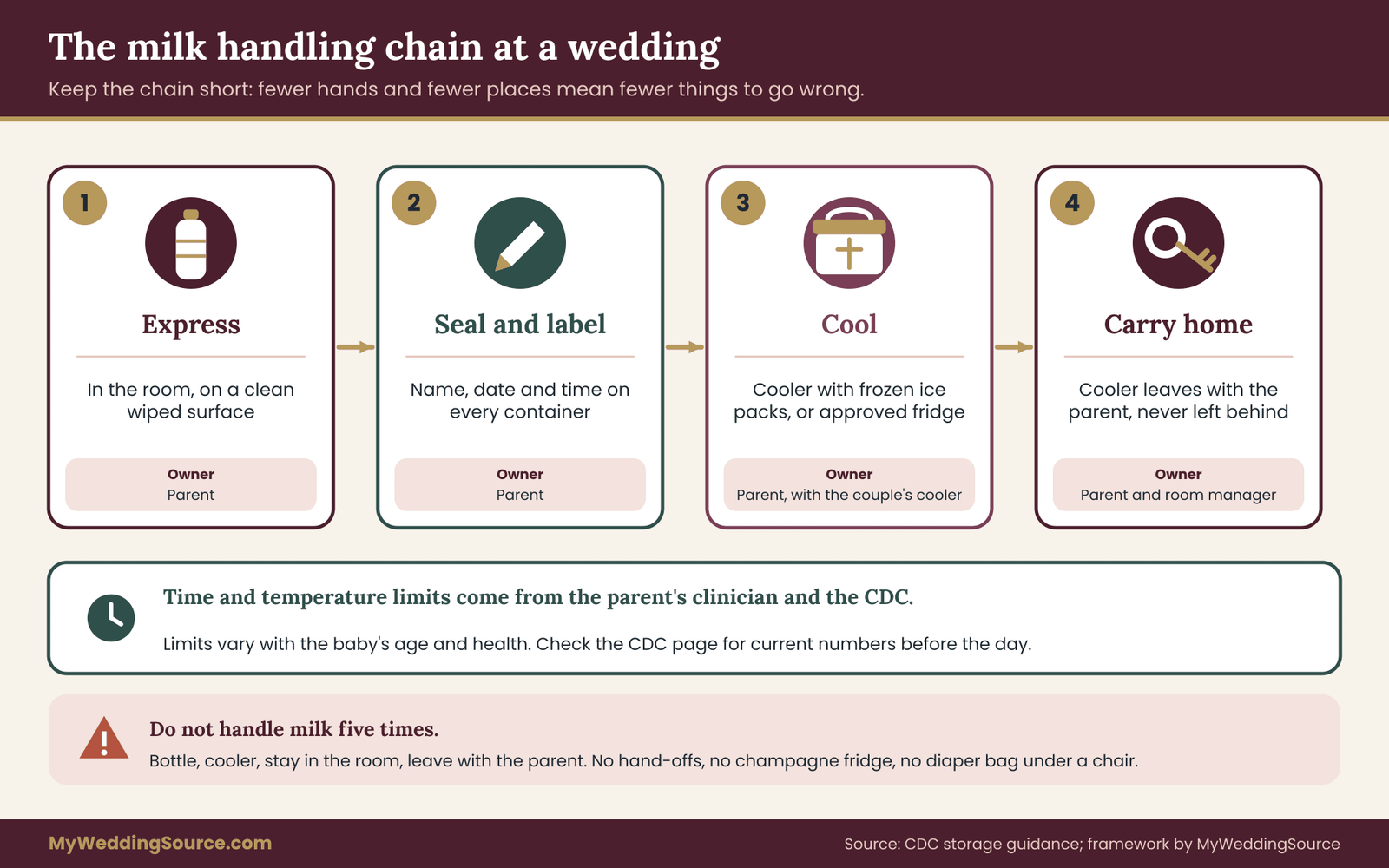
Think of milk handling as a short chain with four links: express, seal and label, cool, and carry home. Each link has one owner, and the parent owns most of them. The couple’s part is to make the cooling link easy. A pumping space that offers a clean shelf, a cooler and a clock on the wall gives the parent the information they need to follow their own clinician’s advice about time and temperature.
Keep the chain short in a second sense: reduce the number of places the milk travels. Milk that moves from the pump to a cooler, to a bag, to a bridesmaid, to a mini-fridge and finally to a diaper bag has been handled five times. Milk that goes from the bottle to the cooler in the same room and stays there until the parent leaves has been handled twice. The simpler route is safer and less stressful, and it is worth designing the pumping space around it.
Storage as Go, Patch and Switch
Go: a refrigerator the venue has approved for this use, with a labeled shelf, or a parent-supplied cooler with a place to sit. Patch: no refrigerator, solved with a cooler and frozen ice packs placed in the room and checked at a set time. Switch: this station rarely forces a Switch on its own, because a cooler solves it. It does force one if the pumping space is hot, has no shade and no place to put a cooler out of the sun. In that case the problem is the pumping space, not the storage.
Where a pumping space can go, and the alternatives
Once you know the four stations, you can compare places. Most venues offer one or two candidates. Look at each against the test and be willing to reject the nicest-looking room.
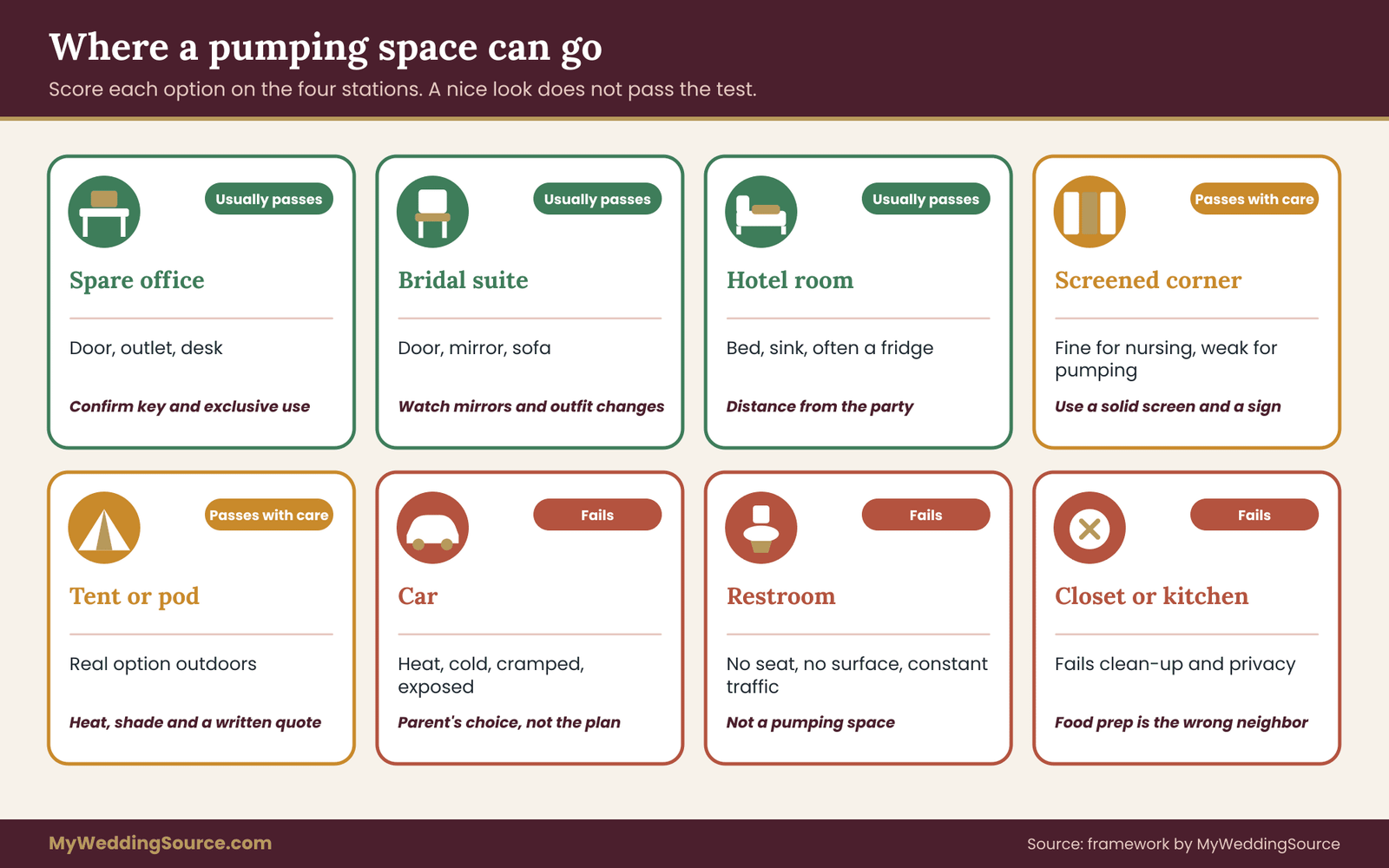
A spare office or meeting room. This is often the best candidate. It has a door, an outlet, a table, a chair and sometimes a sink nearby. The downside is that it belongs to the venue, so ask for exclusive use during the event and for the key arrangement. Confirm that nobody will walk in to fetch a file.
The bridal suite or a getting-ready room. These rooms usually have a door, a mirror, a sofa and an outlet, and they are often empty after the ceremony. The problems are the mirrors, which affect sightlines, and the fact that wedding party members may need the space for outfit changes. Block out the times and keep the pumping space clear.
A room at the hotel. For weddings at or near a hotel, a guest room can serve as a pumping space. It has a bed, a bathroom sink, a refrigerator in many cases and complete privacy. The distance from the party matters, and an elevator ride plus a long hallway adds ten minutes each way. A room on the same floor as the event space is best.
A screened corner. A portable privacy screen across a corner of a quiet lounge is the weakest option, and it is acceptable for nursing, less so for pumping. If it is the only choice, use a solid screen rather than a curtain, put the chair out of sight of the entrance and place a sign. Be honest with the parent about what this is.
A tent or temporary structure. For outdoor weddings, a small tent with a floor, a chair and a battery pump is a real alternative. Heat is the main risk, so look at shade, ventilation and whether a tent can hold a cooler safely. Event rental companies offer private structures, and prices and terms vary by supplier, so get a written quote before you count on one.
Options that fail
A car is not a pumping space, even though some parents choose it. Heat, cold, tight space and exposure make it a poor default, and it should be the parent’s choice rather than the couple’s plan. A restroom is not a pumping space either. A closet fails the clean-up station and often the privacy one.
Do not treat a room as acceptable because it exists. A room that the venue calls a “bride’s lounge” and that sits next to the catering kitchen with a door that does not lock fails on privacy. A room on the third floor with no elevator fails on route for a parent carrying equipment and an infant. Write down why a room fails, so nobody revisits it.
Alternatives when no room passes
Some venues are simply bare. A barn with one large room, an outdoor park pavilion or a small restaurant may have nothing that passes. The alternatives are to rent a private structure, to book one hotel room nearby for the pumping parent’s use, to host the pumping space at a home within a short drive, or to change the schedule so that the parent can leave for a short period.
None of these is a failure of planning. The failure would be to say nothing and discover the gap at the event. Tell the parent early, offer the best alternative and let them choose. Some will prefer to step out to a nearby hotel room, and some will prefer a screened corner. The point is to give a real choice.
Questions to ask the venue about the pumping space
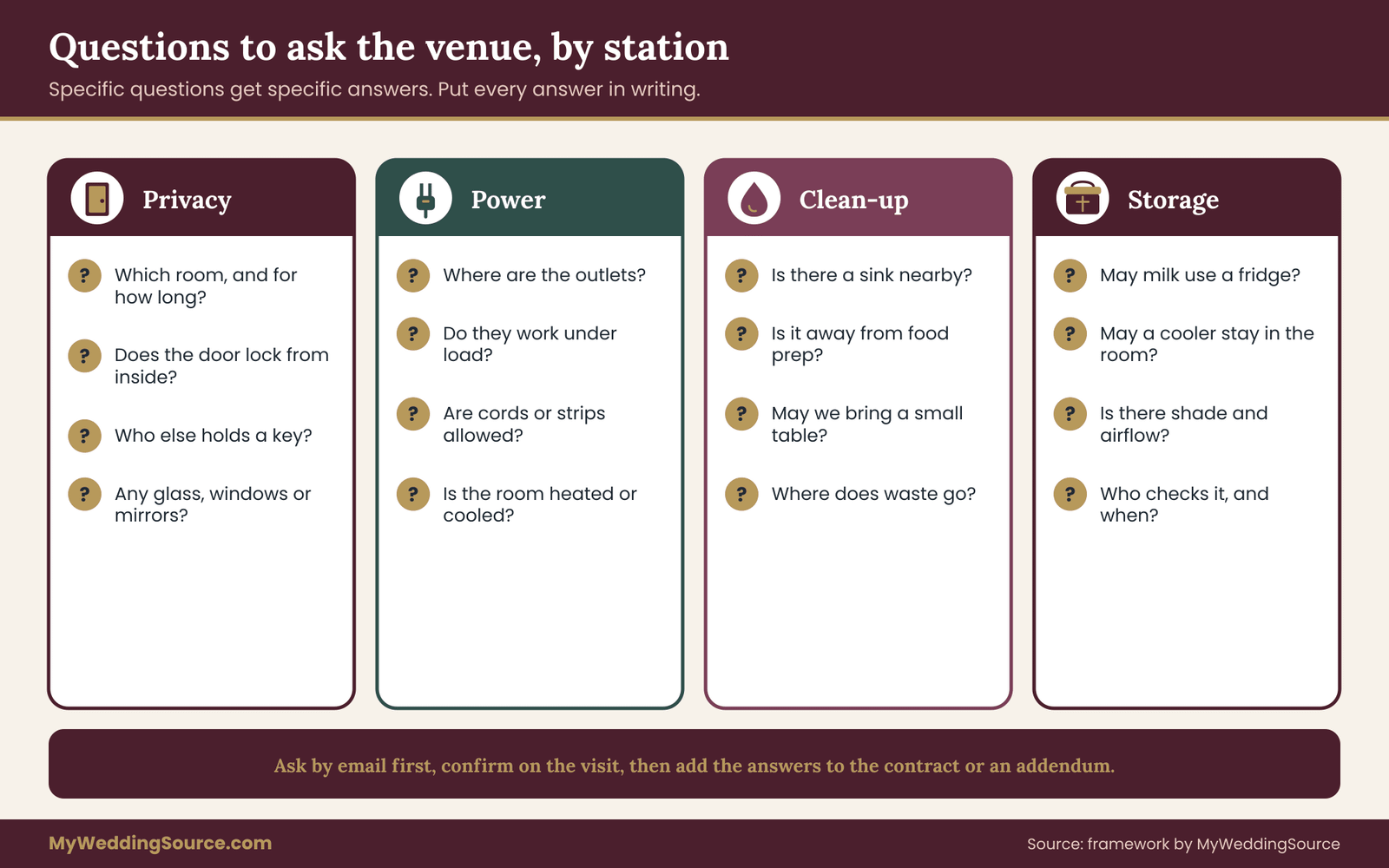
Venue conversations go better when you arrive with specific questions. “Do you have a room for a nursing mother?” invites a quick, hopeful yes. “Which room, who holds the key, and is it free from five to ten on the wedding day?” invites a real answer. Ask in a way that makes the answer easy to write down, and then write it down.
Put the questions in order of the four stations, then add a few about access and rules. You can send them by email before the visit and confirm in person during it. Email gives you a record, and a record matters, because a room promised by one staff member in March can be forgotten by another in September. Anything that matters, such as exclusive use or refrigerator access, should end up in the contract or an addendum. The wedding vendor contract guide explains how to get a verbal promise into writing.
Questions about the room
Ask which room you are being offered and whether it is available for the full event, including setup and breakdown. Ask whether the pumping space is used by staff, caterers or another event on the day. Ask whether the door locks from the inside, who else holds a key and whether the lock can be set so staff do not enter without knocking. Ask whether the pumping space has windows or glass panels and whether they can be covered.
Ask about the route. Where is the entrance, is there a step or a ramp, and how long does it take to walk from the reception space? Ask whether a guest using a stroller, a wheelchair or a walker can reach it. If you get a vague answer, ask to walk it yourself.
Questions about power, water and storage
Ask where the outlets are and whether they work. Ask whether the venue allows extension cords or power strips, and if so what type. Ask whether there is a sink the parent can use and whether it is in a food prep area. Ask whether a guest’s milk can be stored in a venue refrigerator, and if not, whether a cooler may stay in the pumping space. Ask whether the room has a table or surface and whether you may bring a small table.
Ask about temperature. A room with no air conditioning in July or no heat in January is a real problem for a person sitting still for twenty minutes, partly undressed. Ask whether the pumping space’s climate can be set and who controls it.
Questions about rules, liability and staffing
Ask whether the venue has a policy on lactation spaces or has hosted guests who needed one. Some do and will have a ready answer. Ask whether the venue’s insurance or contract limits what you can place in the pumping space, such as a small cooler, an extra chair or a screen. Ask whether a staff member can check on the door and keep guests out.
Ask the same questions of the planner, the caterer and any vendor who employs staff. If a photographer’s second shooter needs to pump, the vendor will need a plan, and the couple can offer the pumping space. Do not assume vendors will ask. A short email to each vendor lowers the chance of a problem.
A sample message to the venue
“We are planning for a few guests who may need a private space to feed or pump. Could you tell us which room we can use, whether it locks from inside, where the outlets are, whether there is a sink nearby, and whether a small cooler can stay there during the event? We would like to confirm the answers in writing.”
Short, polite and specific. If the venue sounds unsure, offer to visit and test the room with them. Most venue managers welcome the chance to solve a problem before the day.
What to do with the answers
Record each answer under the station it belongs to and mark Go, Patch or Switch. If an answer is “I will check,” set a date for when you will ask again and write it in your planning timeline. For a longer list of tasks to build into the schedule, the venue walkthrough method shows how to record measurements and access routes alongside vendor needs, so this checklist becomes one page in a larger file rather than a separate worry.
Scheduling the pumping space around the program
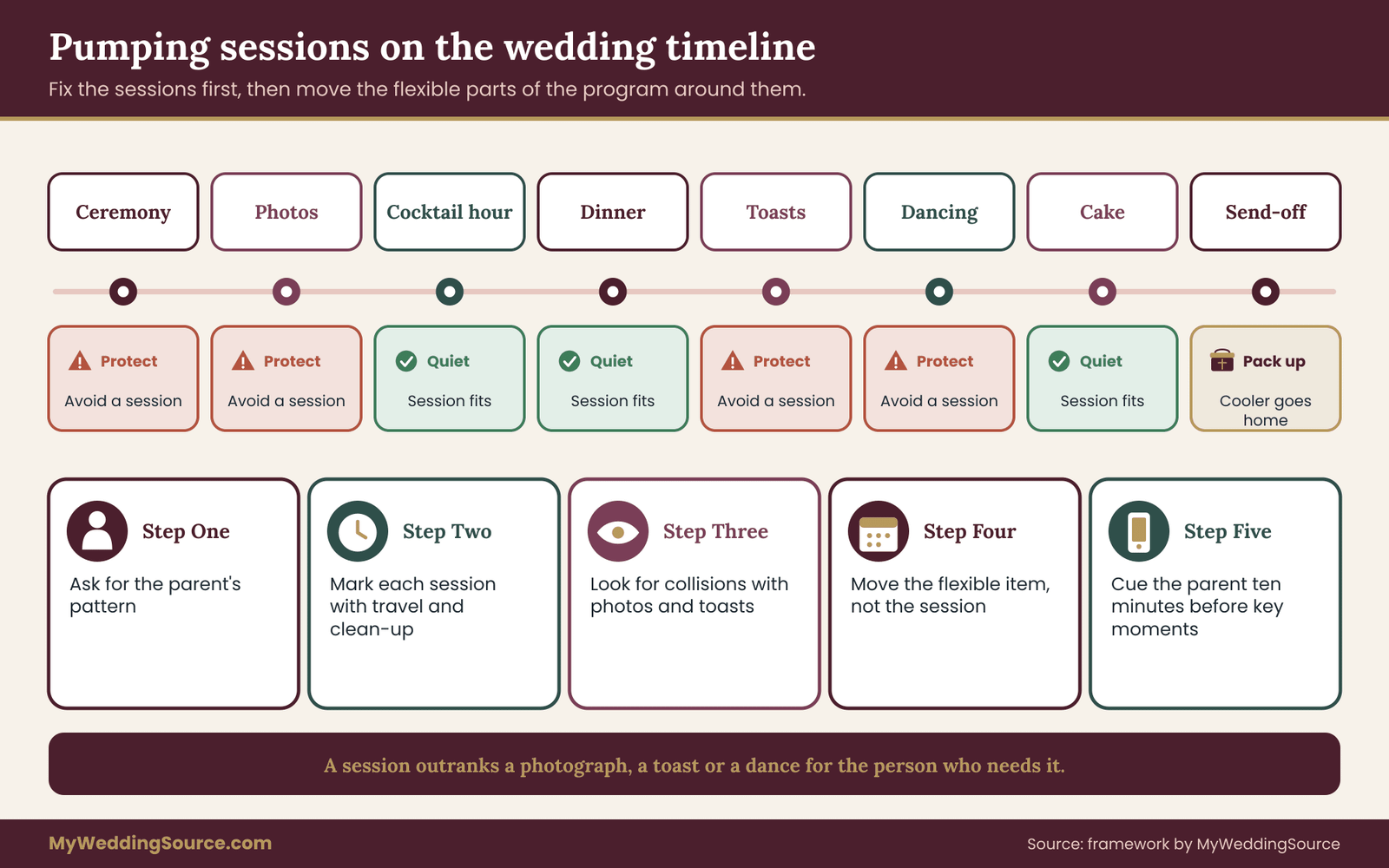
A pumping space only works if the pumping parent can use it at the times their body needs. That is the opposite of how most weddings run, where the program is fixed and everyone fits around it. The fix is to treat the pumping parent’s sessions as fixed points in the timeline and move flexible items around them.
Start by asking the parent for a rough pattern. Do they pump every three hours, or at set times, and which sessions will fall inside the event? A parent who pumps at ten in the morning and two in the afternoon, and is at the wedding from one until nine, has a session at two and perhaps one around six. That is the schedule you protect.
Mapping sessions to the program
Lay the program out on a single timeline. Mark the ceremony, the photographs, the cocktail hour, the dinner, the toasts, the first dance, the cake cutting and the send-off. Then mark the pumping sessions with their travel and clean-up time.
Look for overlaps. The most common collision is a session that falls during photographs, when the parent is needed in the family photograph. The next is a session that falls during toasts, when the parent wants to be in the room. A third is a session in the middle of the ceremony. If you see an overlap, you can move the photograph, change the order of the toasts or add a buffer. The wedding reception guest flow guide shows how the reception moves from entry to exit, which helps you find the natural quiet windows.
Quiet windows
Several moments in a wedding are quieter than others. The cocktail hour is long and loose. The time between the end of the ceremony and the start of dinner often has slack. The period after dinner and before dancing can be a lull. These are good windows for pumping because the parent will miss very little.
Avoid the toasts, the first dance and the cake cutting. Tell the parent what time each begins and offer to send a quiet message ten minutes before so they can return. A cue should not require a phone call or a runner banging on a door.
Pumping parents on your vendor team
The pumping space is also a vendor question. A photographer, a caterer or a band member may need to pump during a long shift, and the arrangement depends on who employs them. The U.S. Department of Labor explains that many employees have a right to reasonable break time and a private place, other than a bathroom, to express milk, and that the place must be shielded from view and free from intrusion. The employer is generally responsible for providing it. State law may add to that rule.
What does that mean for a couple? Mostly it means a short, friendly message. Tell each vendor that a private room is available on the day and ask them to tell their team. Do not ask who needs it. Include the pumping space in the vendor load-in notes, with its location and the name of the room manager. The vendor handles its own employees, and your offer makes the day easier for everybody. If a vendor says it has a plan, take that at face value.
A room manager
Someone should look after the room. Their duties are small: open the door, check the supplies, keep the sign current, mind the cooler and cue the parent before key moments. A friend, a cousin or a planner’s assistant can do it. Choose someone who is calm, discreet and will not make a fuss.
Brief the manager on what the pumping space is for and what to say if a guest asks. “It’s a private room for feeding parents, so I’m keeping it free” is a complete answer. The manager should not ask who is using the pumping space, and should not discuss who has used it.
For the couple who is pumping
If one of the couple is pumping, the schedule is part of the wedding day plan. Build sessions into the morning before the ceremony and again after photographs. Leave enough time for the dress or the suit. A session cut short because of a hair appointment is more than an inconvenience. Ask the planner or the day-of lead to hold the pumping space and the timing, and tell the photographer so they do not wait around.
If the person getting married is also feeding a baby, the question of where the baby is during the ceremony and the photographs belongs in the same plan. The guest care planning section covers care for babies and older relatives, and the two plans should sit side by side.
Telling guests about the room
Tell guests in plain words. A line on the wedding website or the day-of program is enough: “A private room is available for feeding and pumping. Ask any member of the team.” No guest should have to ask a stranger. A small sign on the door and a sentence in the welcome note do the rest.
Avoid wording that implies a rule. “Nursing mothers must use the room” is both wrong and unkind. “Please feel free to feed anywhere, and a private room is available if you want one” is better. The room is an offer.
A worked example: scoring a pumping space at a vineyard barn
The following case is invented to show the method. The couple, the venue and the details are illustrative, not a real event, and the numbers are planning assumptions rather than findings. Treat it as a model for the way the scoring and the patch list work, not as a template for any venue.
A couple, Dana and Marcus, are planning a late-afternoon wedding at a converted vineyard barn. Dana’s sister Priya has a four-month-old and will pump during the day. The photographer’s second shooter, Tomas, mentioned that she is also expressing milk and asked, politely, where she could do it. That makes two people, with roughly two sessions each across a seven-hour window.
Candidate one: the barn office
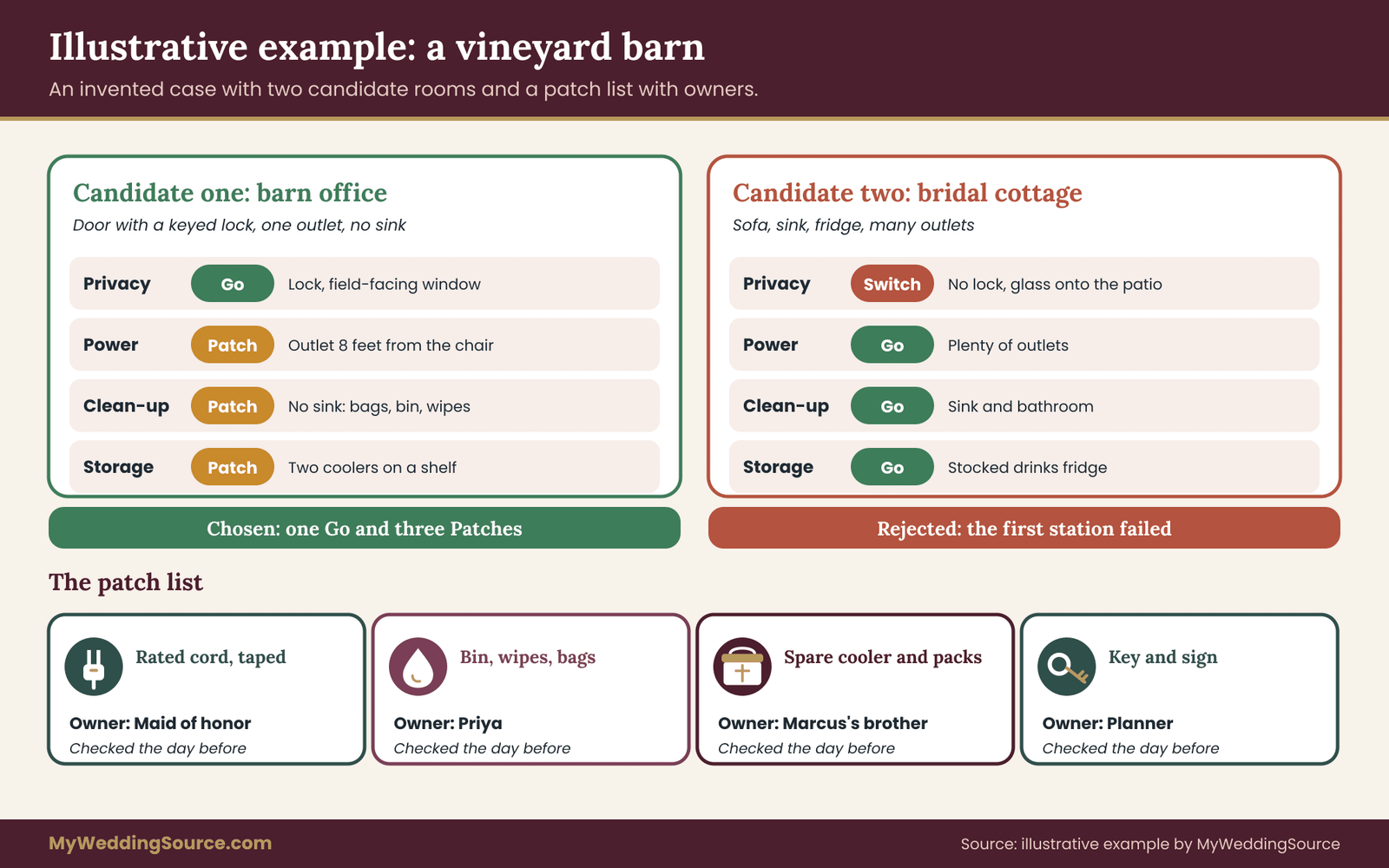
The venue manager offers the upstairs office, used by staff on weekdays. It has a door, a desk, a chair, a small window facing a field and a filing cabinet. Dana and Priya visit with the manager on a Tuesday and walk it through the four stations.
Privacy. The door closes and has a lock, but the manager says it is a keyed lock and staff keep a key on a hook in the kitchen. The window faces the field, not the patio, so no one will see in. The stair is steep but solid, and it is thirty seconds from the reception floor. The sound of the band will be audible, though muffled. Result: Go, with a small note to ask staff not to use the key on the day and to put the key in the room manager’s hands.
Power. One outlet sits behind the desk. The chair would be eight feet from it. Priya says her pump needs a wall outlet and has a short cord. Result: Patch. A rated extension cord, run along the wall, solves it, and the manager confirms that cords are allowed if they are flat to the floor. Owner: Dana’s maid of honor, who will bring the cord and test it the day before.
Clean-up. The office has a desk with a wipeable top. There is no sink, and the nearest one is in the caterer’s kitchen, which is off limits. Priya says she usually bags used parts and washes them at home. Result: Patch. A lidded bin, a roll of wipes and a few zip bags go on the desk. Owner: Priya, with supplies from the couple.
Storage. There is no refrigerator available, since the only one belongs to the caterer. Priya will bring an insulated cooler bag. Tomas will bring one too. Result: Patch. The couple will supply a spare cooler and a few frozen ice packs, and a small shelf by the desk will hold both. Owner: Marcus’s brother, who will check the packs at six.
Candidate two: the bridal cottage
The second option is a small cottage near the barn, used for getting ready. It has a sofa, a bathroom with a sink, a refrigerator stocked with drinks and plenty of outlets. On paper it looks better than the office.
Privacy. The door has no lock. The front has a glass panel onto the patio where guests gather for cocktail hour. The route runs across the lawn in front of the photograph area. Result: Switch. The glass cannot be covered, according to the manager, and the lawn will be busy at the exact times the sessions fall. No other station can make up for that.
The couple records why the cottage failed so nobody reopens the question. They keep it as a place for the dress and for hair, which is its real strength.
The decision
Candidate one passes with one Go and three Patches. Candidate two fails on its first station. The couple chooses the barn office and writes a short patch list with owners.
The cord, the supplies, the cooler and the key all have a name beside them. The manager agrees to keep staff out of the office during the event and to put the key in an envelope with Dana’s planner. A sign for the door is printed. The couple sends a brief message to the photographer confirming that Tomas can use the pumping space.
The day
On the day, the planner opens the office at four. Priya’s first session falls in the cocktail hour, and the planner’s assistant, who is the room manager, sits near the door with a book. Tomas uses the pumping space in the dinner break. Priya’s second session is scheduled for a quiet window after the cake, and a message goes to her phone at the ten-minute mark before the toasts.
One thing goes wrong. The extension cord, laid along the wall, comes loose when a chair is moved, and the pump loses power for a moment. Nothing is lost. The room manager sees it, retapes the cord and Priya carries on. The couple adds a line to their notes: tape the cord at both ends and at the corner.
What the example shows
The decision did not come from the pumping space that looked best. It came from the test. The cottage had a refrigerator, a sink and plenty of outlets, and it failed because it could not be private. The office had none of those conveniences and passed, because the things it lacked could be bought, brought or arranged. That ratio, one unfixable fault against several fixable ones, is the pattern to look for.
The example also shows the value of owners. Each patch had a name and a time. Nothing in the plan depended on someone remembering. If a patch has no owner a week before the wedding, it is not a patch yet. It is a hope.
Variations on the example
Change one fact and the answer changes. If the barn office had no lock and no way to add one, the test would have ended at the first station, and the couple would have looked at a hotel room nearby. If the venue banned cords, Priya would have needed a battery pump, and the plan would have shifted to charging and a backup manual pump. If the barn had a staff refrigerator that the manager approved, the cooler would have become a backup instead of the main storage.
If the wedding were outdoors on a hot day, the heat would dominate. Shade, airflow and a cooler placed out of the sun would move to the top of the list, and a hotel room within a short drive would look much better than a tent. The method is the same. The weights change with the setting.
A budget view without invented prices
Most of the costs in the example are small, and none of them needs a price from this article. The cord, the bin, the wipes, the bags, a spare cooler, ice packs, a sign and a screen are ordinary household and hardware items. The larger costs, such as a rented private structure, a hotel room or extra staff time, depend on local suppliers. Ask for written quotes and compare them against the value of a calm day for the people who need the space.
Cost logic is simple. A fix that costs little and removes a failure is worth doing at once. A fix that costs a lot should be compared with a cheaper alternative that meets the same need. A hotel room for the afternoon can cost more than a rented structure and offer more privacy, a bed and a sink. Which one wins depends on where you are, who needs it and for how long.
Failure conditions: when to switch the pumping space
A checklist is only useful if it says when to stop. The Go, Patch and Switch results handle the room itself. Failure conditions go one step further, because a room that passes in March can fail by the day, and a plan that looked solid can unravel when one fact changes. Write these conditions into the plan so you recognize them early.
Conditions that mean switch now
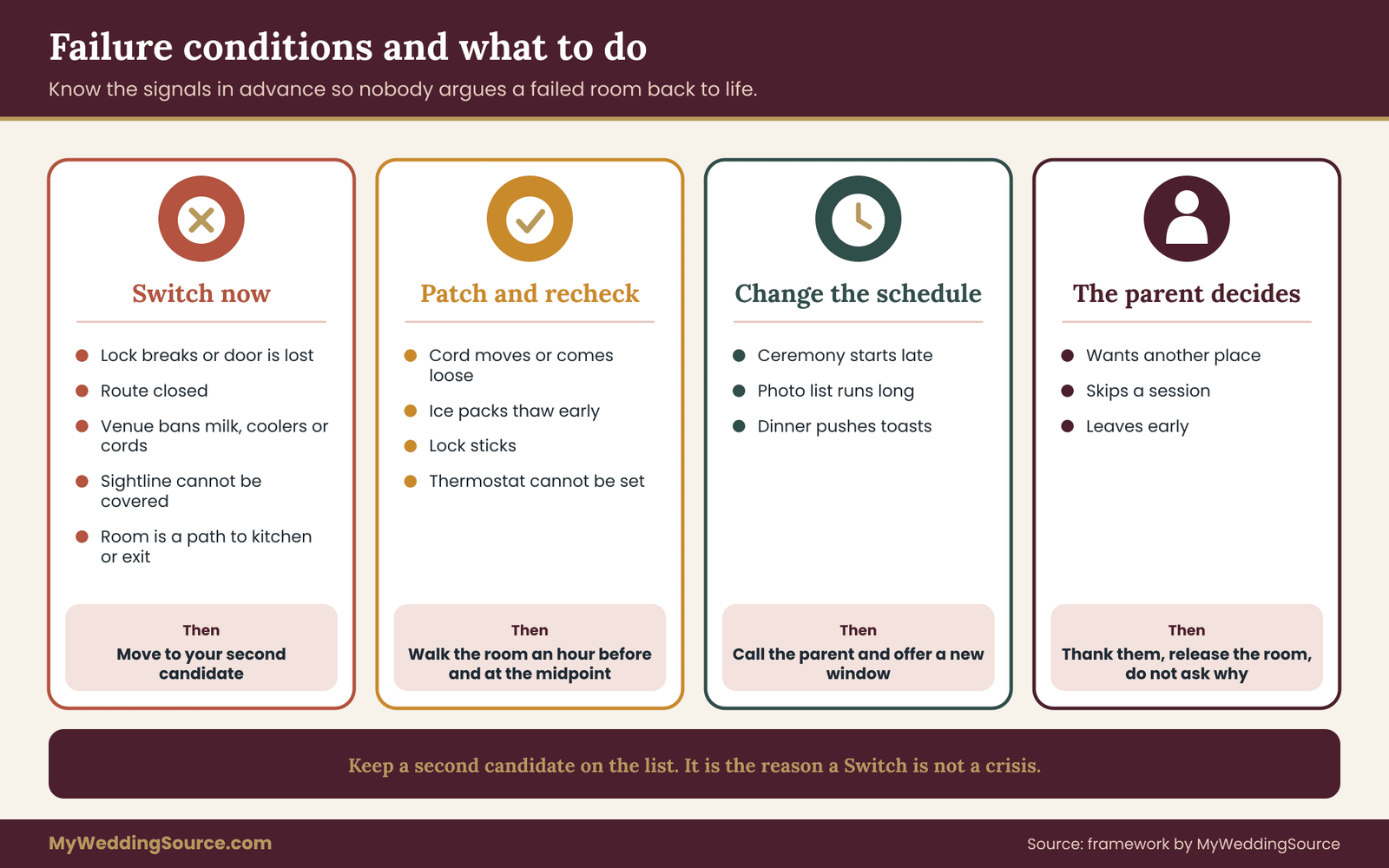
Some conditions end the room’s candidacy immediately. The first is any loss of the door: the lock breaks, the venue withdraws the pumping space or another group claims it. The second is a change in the route, such as a stairwell closed for repairs. The third is a venue ruling that bans milk, coolers or cords after you have already counted on them.
The fourth is a sightline you cannot fix. If a window, a glass door or a mirror exposes the chair and the venue will not allow a cover, the pumping space fails regardless of every other score. The fifth is shared use. If the pumping space turns out to be a path to the kitchen, the restrooms or the exit, no amount of signage will hold.
When any of these happens, do not argue the pumping space back to life. Move to your second candidate, or to the alternative you named in advance. This is the reason to keep a second option on the list.
Conditions that mean patch, then recheck
Other failures call for a patch and a second look. A cord that moves, an ice pack that thaws early, a lock that sticks or a thermostat that cannot be set are all patchable, and each of them can recur. Recheck the pumping space an hour before the first session and again at the midpoint. A thirty-second walk-through catches most of them.
A power failure in the whole building is a different kind of problem. The principle is the same as for a dead outlet: have a battery pump, a manual pump or a hotel room as a backup, and tell the parent about it before the day.
Conditions that mean change the schedule
Sometimes the room is fine and the day is the problem. A ceremony that starts an hour late shifts every session. A photograph list that runs long cuts into the cocktail hour. A delayed dinner pushes toasts into a session window. When this happens, the room manager or the planner should call the parent and offer an adjusted window, not wait for them to ask.
The couple should set one rule in advance: a pumping session outranks a photograph, a toast or a dance for the person who needs it. If a family photograph has to wait twenty minutes, it waits. Say so to the photographer and the planner before the day, so nobody has to defend the delay in the moment.
Conditions that mean the parent decides
Some parents will decide, on the day, that they would rather pump somewhere else, or not pump at all, or leave early. That is their right. The room’s value was in making the choice real. If the parent changes the plan, thank them for telling you, release the room and move on.
Do not ask why. Do not remind them of the plan. Do not report to the couple who did or did not use it. The standard is the same as for any private matter: offer the resource, step back and let the person use it.
A short list of stop signals
Write the signals down and hand them to the room manager. A stop signal is any of the following: the door will not lock, the cooler is warm, the outlet is dead, the pumping space is occupied by someone else, a guest is waiting outside and the parent has been in the room unusually long, or the parent asks for help. The first four mean fix or move. The fifth needs a polite, brief knock and a calm sentence. The sixth means do what they ask.
Your next steps
Work through these in order, and give each one an owner and a date.
- Count the people. Ask guests, the wedding party and vendors in one plain line whether anyone needs a private space, and note how many sessions to expect.
- Name two candidate rooms. Ask the venue for two, not one, so a Switch does not leave you with nothing.
- Visit and score. Walk each room through the four stations with the person who will use it, and write one line of evidence per station.
- Build the patch list. For each Patch, write the item, the owner, the cost and the deadline.
- Get it in writing. Ask the venue to confirm the pumping space, the key arrangement, the cord rule and the cooler rule, and add them to the contract or an email thread.
- Put the sessions on the timeline. Add each session, with travel and clean-up, to your vendor timeline and move flexible program items around it.
- Name a room manager. Brief them on the sign, the supplies, the cooler and the cue before the toasts.
- Recheck the room. Walk it again an hour before the first session and at the midpoint.
Keep the one-page score sheet with your venue file. If you plan another event at the same venue, such as a rehearsal dinner or a farewell brunch, you can reuse it and spare the next family the same questions.
FAQ
Do we have to provide a pumping space at our wedding?
No law requires a private couple to provide one for guests, and rules for employers and venues differ by state and situation. Still, offering a room is a kind and low-cost step when a parent with an infant is on your list. For vendor staff, the employer usually carries the legal duty. Check the U.S. Department of Labor and your state agency for current rules.
How is a pumping space different from a nursing room?
A nursing room mainly needs privacy and a comfortable seat for a short feed. A pumping space also needs a power source or charged battery, a flat wipeable surface, a way to deal with used parts and cold storage for milk. It also tends to be used for longer sessions, so the door, lock and sightlines matter more.
How long should a pumping session at a wedding take?
Ask the parent, because patterns differ. Many sessions run roughly fifteen to thirty minutes, and walking to the room plus packing up can double the time away from the party. Plan the pumping space for the full window, mark each session on the timeline and avoid scheduling toasts or photographs on top of it.
Can milk be stored in the venue’s refrigerator?
Only if the venue agrees. Food service rules often restrict what can go in a kitchen refrigerator, so ask in advance and request a labeled shelf if they say yes. If not, an insulated cooler with frozen ice packs is the usual solution. Check the Centers for Disease Control and Prevention for current storage times, and follow the parent’s clinician.
What if the venue has no suitable room?
Name the alternatives early: a nearby hotel room, a rented private structure, a home within a short drive or a screened corner for nursing. Tell the parent what exists and let them choose. For outdoor weddings in heat, a cooled indoor room usually beats a tent. Get written quotes for any rental, since prices and terms vary by supplier.
Is a car or a restroom acceptable?
Both are poor defaults. A car can be hot, cold, cramped and exposed, and a restroom is unhygienic, has no good seat and is in constant use. A parent may choose either for their own reasons, and that is their decision. The couple’s plan should offer a better room and treat these only as a fallback.
Who should manage the room on the day?
Choose a calm, discreet person such as a cousin, friend or planner’s assistant. Their tasks are small: unlock the door, keep the sign current, check supplies and the cooler, and cue the parent before key moments. They should not ask who is using the pumping space or report on it. A written one-page brief helps.
What should we say to guests about it?
Keep it short and optional. Something like “A private room is available for feeding and pumping, and any team member can show you” is enough. Say that guests are welcome to feed wherever they are comfortable, and avoid wording that implies the pumping space is required. Put the line in the welcome note, on the website and on a small door sign.
Sources
- American College of Obstetricians and Gynecologists: patient guidance on breastfeeding and postpartum care.
- Centers for Disease Control and Prevention: guidance on storing expressed milk and cleaning pump parts.
- U.S. Department of Labor, Wage and Hour Division: Nursing Mothers: federal lactation space and break rules for employees.
- National Conference of State Legislatures: summaries of state breastfeeding laws.
- Office on Women’s Health: breastfeeding and pumping information.
- U.S. Food and Drug Administration: breast pump safety and use information.
- ADA.gov, U.S. Department of Justice: accessibility requirements for routes and entrances.
- HealthyChildren.org, American Academy of Pediatrics: infant feeding and safe sleep guidance.
- U.S. Consumer Product Safety Commission: extension cord and electrical safety guidance.