
First dance mistakes are far more common than they look from the guest side, and almost all of them can be recovered in front of a room without anyone noticing. This guide gives you a four-rung reset plan, a set of partner cues, a rehearsal method and clear stop rules, so that a blank mind on the dance floor becomes a small pause instead of a public meltdown.
If you forget your steps, do not try to remember the whole routine. Stop thinking forward and use the Reset Ladder: pause for one breath, drop to an anchor step you can do without thinking (a slow sway or box step), use a pre-agreed cue so your partner knows you need a restart, and only then rejoin the choreography at the next landmark in the song. If that fails, shorten the dance or invite others onto the floor. Agree the cue, anchor and exit signal before the wedding.
Almost everyone who plans a first dance worries about the same moment. The room goes quiet, the song starts, the lights are on you, and the sequence you practiced for weeks drains out of your head. Your partner is waiting for the next move and you do not have one. It feels like a disaster. From the chairs, it usually looks like two people who are enjoying a slow song, which is the first thing to remember about first dance mistakes.
That gap between how a stumble feels and how it looks is the main reason this article exists. First dance mistakes are rarely the problem. The reaction to them is. A couple who freezes, apologizes loudly, laughs nervously and then starts over from the top turns a two-second lapse into a visible event. A couple who has agreed on a quiet reset turns the same lapse into nothing at all.
For first dance mistakes, this guide is built around a single practical tool, which we will call the Reset Ladder, plus the habits that make it work.
Those habits are a shared cue, a rehearsal routine that deliberately includes errors, and a short briefing for the people who run the room. It does not teach choreography, and it does not promise a world without first dance mistakes. If you are still choosing a style or a lesson format, the lesson and practice material on the site covers that; here the assumption is that you already have something planned and you want a recoverable plan behind it.
A note on scope. This is general information, not legal, tax or financial advice, and it is not medical advice either. If either of you has an injury, a balance concern, a health condition or a mobility need, talk with your doctor and your dance instructor about what is safe, and use the stop rules later in this guide as a minimum, not a limit.
What first dance mistakes look like from the guest side
Before building a plan, it helps to see what an audience actually perceives. Guests at a wedding are not judging a competition. They are watching two people they care about, usually with a drink in hand, usually thinking about the next course or the next song. Most of them have never seen your rehearsed routine, so they cannot tell the difference between a planned move and an improvised one.
That is the first useful fact about first dance mistakes: a mistake needs a reference to exist. If nobody knows what the next move was supposed to be, a missed move is invisible. A skipped turn, a half-count pause or an extra sway looks the same as a deliberate choice. The mistakes that guests do notice are the ones that break the mood: a sudden stop, a frantic whisper, a dramatic restart, a visible argument or a fall.
So the plan has two jobs. The first is to make errors small, by giving you a way back into the dance. The second is to make your reaction to errors quiet, by agreeing in advance what you will do. Both jobs are about behavior, not talent, and both apply to every kind of first dance mistakes you are likely to meet.
The three kinds of lapse
Not every slip is the same, and the right response depends on which kind it is. It is worth being able to name them in the moment.
A memory lapse. You know there is a next move, but you cannot recall it. This is the classic “blank.” It usually lasts only a few seconds if you do not fight it, and it is the lapse the Reset Ladder is designed for.
A timing lapse. You remember the move but you are off the beat, or you started a turn late, or you and your partner are no longer in sync. The fix here is usually to go back to the music rather than to the choreography.
A physical lapse. A shoe slips, the dress catches, a partner stumbles, someone’s balance goes. This is not a mistake in the usual sense, and the response is about safety first and the dance second. The stop rules later in the guide cover it.
Keeping these three kinds of first dance mistakes apart matters because the instinct to “fix it” can make each one worse. Rushing to remember the steps makes a memory lapse longer. Speeding up to catch the beat makes a timing lapse bigger. Pushing on through a physical lapse can turn it into an injury.
Why the room is more forgiving than you expect
Guests are on your side. They came to see you married, and they want the dance to go well. Laughter at a slip is almost always warm. A couple who shrugs, smiles and carries on usually gets more applause than a couple who executed everything perfectly, because the shrug is human and the audience likes it.
That does not mean a stumble is irrelevant. You may care a great deal about how the dance goes, and that is a fair thing to care about. It means the standard to plan for is not “no first dance mistakes.” It is “no visible panic.” That is a much easier target, and it is one that preparation really can reach.
The Reset Ladder at a glance
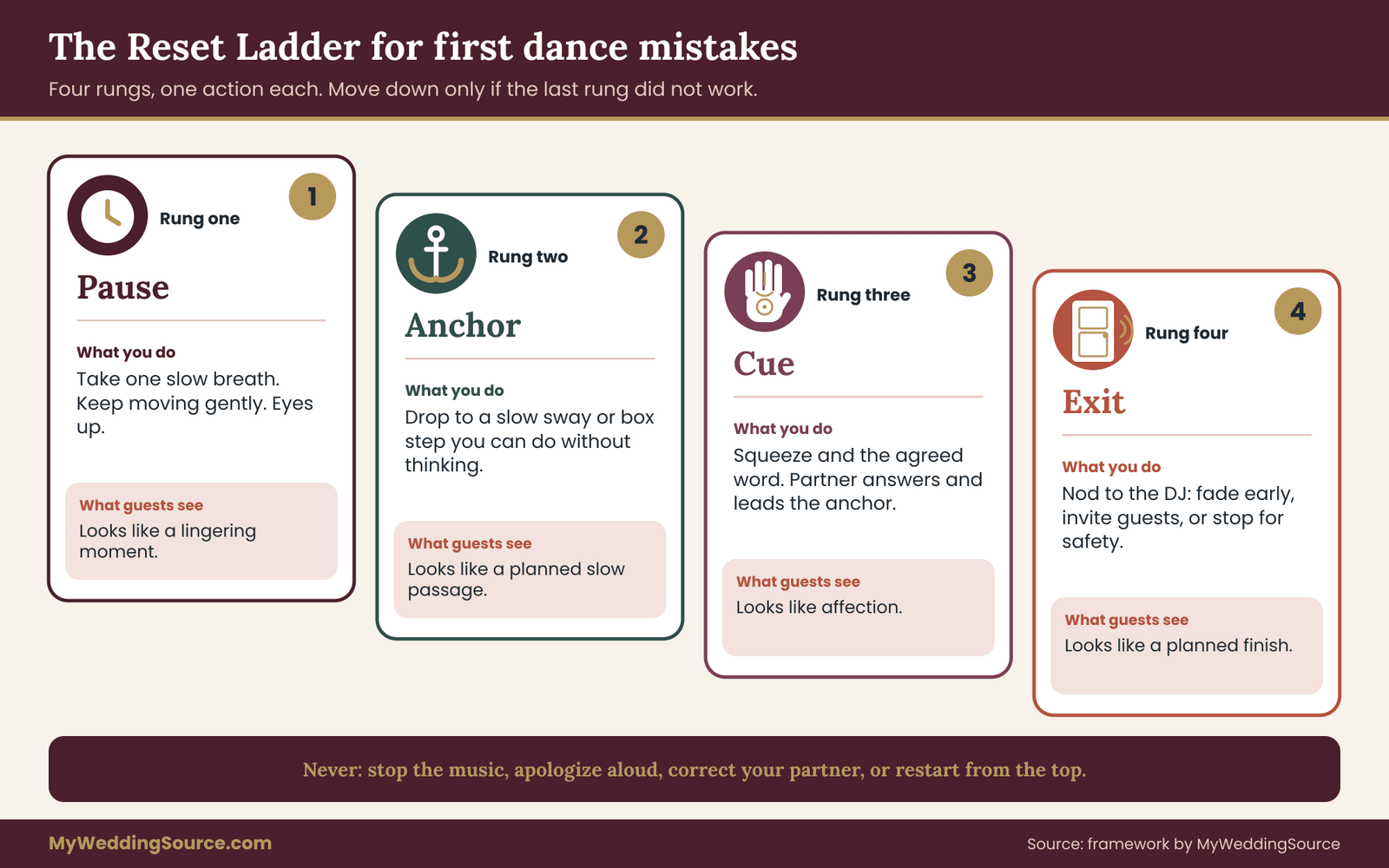
The Reset Ladder is a four-rung sequence. You climb down it one rung at a time, and you only move to the next rung if the current one has not worked. The point of the ladder is that you always know what to do next, so you never have to invent a response while your mind is blank.
Rung one: Pause. Take one slow breath and keep moving gently. You do not stop dancing; you stop trying to remember.
Rung two: Anchor. Drop to an anchor step, a movement so simple you can do it under stress, such as a slow sway, a basic box step or a gentle rotation in place. You stay in the music while your head resets.
Rung three: Cue. Give your partner a short, agreed signal that says “I lost my place.” Your partner answers with either a lead into the next move or a reassuring “stay with me.”
Rung four: Exit. If rungs one to three have not restored the dance, or if anything feels unsafe, you shorten the dance or invite others to join. This is a decision, not a failure, and it is agreed in advance with your DJ.
Each rung is covered in its own section. For now, notice what the ladder does not include: it does not include starting over, apologizing out loud, correcting your partner in the moment or stopping the music. Those are the reactions that make first dance mistakes visible. Every rung exists to keep first dance mistakes small.
Why a ladder and not a rule list
A list of tips works when you are calm. A ladder works when you are not. In the moment, your working memory is full of nerves, the music, the lights and your partner’s face. You cannot scan a list. You can, however, follow a sequence you have rehearsed enough that it feels automatic. The ladder for first dance mistakes is short on purpose: four rungs, each with one action, each tied to something your body can do.
It also gives you a shared language. If you and your partner both know that “rung two” means “go to the sway,” you can recover together without a word. The labels are yours to change. Some couples prefer “breathe, sway, signal, shorten.” What matters is that you both use the same four steps in the same order.
Where the ladder sits in the wider plan
The ladder is one layer of a first dance plan, not the whole of it. The song, the length, the style and the practice schedule come first, and the broader decisions about music and the dance floor belong in your wedding reception music planning work. The ladder is the safety layer underneath: what happens if all of that preparation does not survive contact with a room full of people.
Think of it the way a stage manager thinks of a cue sheet. A good one does not assume the performance will be flawless. It assumes something will go slightly wrong and it makes sure someone knows what to do. The same thinking applies to a three-minute dance.
Why blanking out happens and what it means
Understanding why you forget your steps makes the problem less frightening, and it also shows where the ladder needs to be strong. This section is general explanation, not a clinical claim, and it avoids guessing about any one person.
Most people who blank, and so produce first dance mistakes, during a performance are not forgetting in the way they forget a name. The information is still there; access to it is blocked by attention being pulled elsewhere. When you are being watched, a lot of attention goes to the watching: how you look, what people think, whether you are doing it right. Less attention is left for the task, and the task is the thing that needed it.
For a first dance that has been rehearsed mostly in a living room, the room itself adds more load. The floor is different. The lighting is different. The music is louder and may sound slightly different from the practice track. Your partner is dressed differently and may move differently in a gown or a jacket. Your body is also dealing with adrenaline, a long day and possibly a drink or two. Each change is small. Together they are enough to knock a fragile sequence loose.
Fragile sequences versus sturdy ones
This explains why some dances survive stress and others do not. A fragile sequence is one that depends on remembering a long chain of moves in order, where each move is the trigger for the next. If one link goes, everything after it goes with it. A sturdy sequence is built in blocks with landmarks, so you can rejoin at the next block even if you lose one.
You cannot change the fact that you are nervous. You can change how the dance is built. Later sections show how to mark landmarks in your song and how to rehearse rejoining at them, which is the most useful single thing you can do about first dance mistakes before the wedding.
What the ladder asks of your body
Notice that every rung of the ladder uses a skill that does not need memory. Breathing is automatic. A sway is automatic. Holding your partner and listening to the beat is automatic. The signal is a single learned gesture. The exit is a nod to the DJ. Under stress, the body can do automatic things and has trouble with sequenced things, so the ladder routes you through the automatic ones until the sequenced ones come back.
That is also why rehearsing the ladder matters as much as rehearsing the routine when you want to handle first dance mistakes calmly. A reset you have never practiced is just another thing to remember.
Rung one: pause and breathe before you fix anything
The first rung is the one that does the most work and costs the least. When you notice you have lost your place, the strongest instinct is to start correcting at once: look down, whisper, speed up, try a different move. Each of those makes first dance mistakes more visible, which is why the first rung is built on stillness of mind, not stillness of body. The first rung asks for the opposite. You keep your frame, you keep the gentle motion of the song and you take one slow breath.
One breath sounds like nothing, and that is the point. It is short enough that nobody sees a gap, and long enough to break the loop of “what is next, what is next.” With first dance mistakes, the goal is not to feel calm. It is to interrupt the panic cycle for a couple of beats so that the next rung can start.
What the pause looks like in practice
A pause is not a freeze, and it is the first tool against first dance mistakes of every kind. If you stop moving, you have turned a private lapse into a public one. Instead, shift to the smallest motion that still fits the music: a weight shift from one foot to the other, a slow turn of the shoulders, a small step to the side and back. To the room, it reads as a lingering moment, which is exactly what a first dance is supposed to contain.
Keep your eyes up. Looking at your feet is the single most obvious tell that something is wrong, and it also tilts your balance forward. If you need to look somewhere, look at your partner’s face or just past their shoulder. Keep your expression soft. You do not have to smile broadly; a relaxed face is enough.
The count that goes with the breath
Many couples find it easier to tie the breath to the music. In a slow song with a steady pulse, breathe in over two beats and out over two beats. That gives you a ready-made reason to be doing nothing complicated, and it brings your attention back to the pulse, which is the thing you will need for rung two.
If your song is faster, you can take the breath across four beats instead. Either way, the rule is the same: the breath lasts as long as it takes the music to give you a clear beat to step on, and no longer. You are not pausing the dance; you are containing first dance mistakes while you wait for the next downbeat to restart it.
What to say to yourself
Silent self-talk should be short and instructional, not reassuring. “I am fine, I am fine” asks your brain to evaluate something. “Breathe, sway” gives it two things to do. A few couples keep a single word that works as their private pause cue, something like “slow” or “easy.” The word has no meaning other than that you have agreed it triggers the pause. Rehearse it until it is boring.
When the pause is not enough
Sometimes one breath does not bring the steps back. That is expected, and it is what the other rungs are for. The pause is not a test you pass or fail. Its function is to buy a moment and to keep first dance mistakes small while you move to the anchor step. If after the breath you still have no next move, go straight to rung two without waiting.
A useful rule of thumb is that you do not make a decision about the rest of the routine during the pause. You are not asking “should we skip the spin?” or “should I start over?” Those questions come later, if at all. During the pause the only question is whether you can feel the beat, and the answer is almost always yes.
Rung two: the anchor step you can always fall back on
The second rung is a movement you can perform without thinking. We call it the anchor step because it holds you in place in the music while the rest of the dance drifts. It is the most important piece of preparation in the whole plan, because it is what you will actually be doing during most first dance mistakes.
A good anchor step has four qualities. It works at any tempo your song uses. It needs no memory of what came before. It does not require space beyond a small patch of floor. And both partners can do it together without leading or following in a complicated way.
Choosing your anchor step
For most couples the anchor is one of three things.
The slow sway. Hold your partner in whatever closed position you are using and shift your weight slowly from side to side with the beat. It needs almost no skill, works in a gown or a long jacket, and looks natural at any point in a ballad.
The box step. A basic box moves one foot forward, to the side, together, then back, to the side, together. If you have had even one lesson you probably already know it. It adds movement without needing travel, and it looks like a deliberate dance choice.
The rotation. A slow turn in place, one quarter or half turn per phrase, lets you keep a frame while changing what the room sees. It is useful when you want the anchor to feel more like choreography than stalling.
Choose one, and choose it with your instructor if you have one. A well-chosen anchor handles most first dance mistakes without any further help. Whichever you pick, both partners must be able to do it without cueing. The test is simple: can you do it for thirty seconds while talking about something else? If so, it is ready.
Where the anchor step fits in the song
The anchor is not only an emergency measure. It can be built into the dance as a visible section, such as the opening of the first verse or the instrumental break. Couples who do this get two benefits: the anchor is already part of the routine, so reaching for it in a lapse looks the same as the planned version, and they have rehearsed it in the actual song, at the actual tempo.
If your choreography already has a quiet passage, make that passage your anchor. A gentle section in the middle of the song, where you simply hold and sway, is both a pleasant moment for the room and a ready-made landing spot during first dance mistakes. It also gives you a clear place to restart.
The anchor step and the dress
If one partner is wearing a full skirt, a train or a long jacket, the anchor should be chosen with that in mind. A box step that travels may catch fabric. A small sway or a rotation with a controlled turn is usually easier.
This is something to test in the real garments, or in garments of the same length, and not in rehearsal clothes. The shoe and floor details are their own topic and are covered on the site in the guides about wedding shoes and floors; here the point is only that the anchor must work in what you will wear.
How long to stay on the anchor
Stay on it until you feel two things: your head is clear and you can identify the next landmark in the song. A landmark is a musical event that you recognize without counting, such as the start of the chorus, a key change, a drum entry or a repeated lyric. Landmarks are the way back into the choreography after first dance mistakes, and the section after next shows how to mark them.
If a landmark is coming, you can restart there. If it is not, you can keep the anchor going for as long as the musical phrase lasts. Thirty seconds of sway in a three-minute song looks like a slow dance, not an error. The risk is not staying too long; it is leaving too early and landing in the wrong place.
An example of the first two rungs together
Imagine a couple who planned a turn into a dip at the second chorus. At the start of the chorus, one partner loses the sequence.
They do not stop and they do not look down. They take a breath for two beats while shifting weight, drop to the sway, and keep the closed hold. Their partner, who felt the change, stays with the sway. They hold the anchor for the length of the chorus line. At the next verse, which they both recognize, they rejoin the box step from the middle of the routine. The dip never happens. Nobody in the room knew there was a dip.
This is the shape of most successful recoveries from first dance mistakes. The missed element is dropped, the dance continues and the next landmark is the way back. The same logic applies to almost any element, and to nearly all first dance mistakes, and the section on common first dance mistakes later in the guide applies it item by item.
Practicing the anchor until it is boring
An anchor you only use in emergencies will not be there in an emergency. The fix is to use it often in rehearsal, deliberately, in the middle of the routine, until switching to it takes no thought. A useful drill is to have your partner call “anchor” at random moments during a run-through, and for both of you to drop into it immediately, hold for eight counts and then rejoin. After a handful of rounds it becomes a reflex.
A related habit, useful against first dance mistakes, is to start every practice session with thirty seconds of anchor alone, in the real song. That keeps the pulse in your body and makes the anchor feel like the home position of the dance, not the failure position. When you finally have to use it under pressure, it will not feel like a retreat.
The landmarks that make rejoining easy
Rejoining the choreography is the part most couples skip, and it is the part that makes recovery clean. Without landmarks, even a calm reset leaves you wondering where you are in the song. With landmarks, you pick a recognizable musical moment and restart your sequence from the block that begins there.
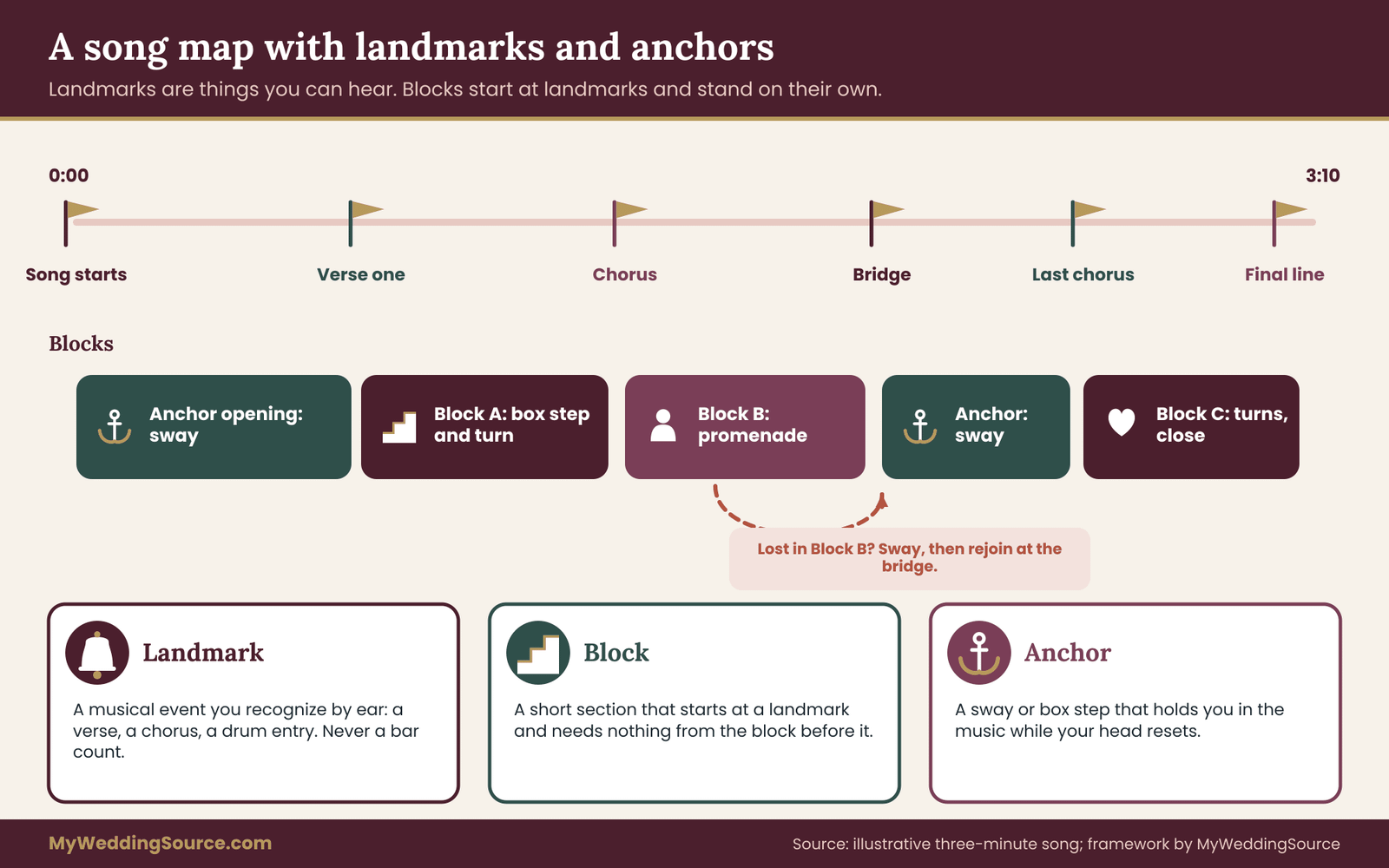
To set landmarks, listen to your song and write down four or five moments that you can identify by ear alone. Good ones are the start of the first verse, the start of each chorus, an instrumental break, a drum entry, a key change and the final line. Avoid anything that depends on counting bars, because counting is the first thing to fail under stress.
Next, divide your choreography into blocks that begin at those moments. Each block should be able to stand on its own, so that if you land at the start of the second chorus you can do the second-chorus block without needing the first. If your current routine does not divide that way, ask your instructor to restructure it. This single change makes first dance mistakes far less costly, because a lost block costs you a block, not the rest of the dance.
A simple map of the song
A song map is a one-page sheet with the song’s timeline down the side and your landmarks, blocks and anchor sections next to it. It does not need to be elaborate. It can be a hand-drawn list. What matters is that both of you have the same map and that you have walked through it with the music playing. The infographic below shows a typical three-minute song and where the landmarks and anchors fall.
Keeping the map short enough to use
Resist the urge to make the map detailed. A map with fifteen entries is another thing to forget. Four landmarks and three blocks are enough for most songs under four minutes. If your routine is long enough to need more than that, consider whether the routine is too long, a question the guide to reception guest flow touches on from the room’s point of view, because the dance has to fit the evening as well as the song.
Rung three: partner cues and reassurance
The third rung is the one that involves the other person, and it is the one most couples have never discussed. When one partner goes blank, the other partner is the only person in the room who can tell. What happens next depends almost entirely on what they do with that information. A frightened glance, a whispered “what are you doing,” a sharp tug, or an obviously forced smile can turn a lapse into a scene. A steady hand and a calm face can end it.
Rung three, which deals with the partner side of first dance mistakes, is therefore two things: a way for the person who is lost to say so, and a way for the partner to respond. Both have to be agreed beforehand, practiced and kept deliberately small.
The cue that says “I lost my place”
The cue has to be something you can do without speaking, without looking worried and without anyone else understanding it. Several kinds work well.
A pressure cue. A single gentle squeeze of the hand or a light pressure on the partner’s back. It is invisible to the room, it can be done mid-sway and it needs no vocabulary.
A movement cue. Tilting the head slightly toward the partner’s shoulder, or resting the forehead briefly against theirs. It reads as affection, so the room reads it as romance.
A word cue. A single quiet word that has no other meaning in the dance, for example “slow.” It should be a word you are unlikely to say by accident and short enough to say on an exhale.
Pick one primary cue and one backup. The pressure cue is usually the easiest to rehearse. The word cue is the clearest. Many couples use both together: a squeeze and the word. Whatever you choose, practice it until it can be given and received without a break in the movement.
The response that says “I have you”
A cue needs an answer, especially in the middle of first dance mistakes. If the cue is given and nothing changes, the person who is lost may take that as proof that the situation is as bad as it feels. Decide in advance what the partner does on receiving the cue. The best answer is a pair of actions: lead the anchor step and offer a steady, wordless reassurance.
Leading the anchor means the partner simply starts the sway or the box and holds the frame firmly enough that the person who is lost can follow without thinking. Offering reassurance means a calm expression, a slight smile, a soft squeeze back. Nothing about the response should signal urgency. The message is that nothing is wrong and the dance continues.
If the partner who received the cue is also unsure of the next block, they do not need to know it. They only need to lead the anchor, and then both of you wait for the next landmark. That is why the landmarks and the anchor step were set before the cue.
What not to do
A short list of reactions is worth ruling out in advance, because they are the ones that make first dance mistakes bigger.
Do not correct your partner out loud, because that is how first dance mistakes become public. “No, left,” even whispered, makes the error public and makes the other person feel judged. Do not look down at feet or at the floor. Do not stop dancing to “reset.” Do not laugh in a way that signals you think it is a disaster, though a genuine laugh, shared, is often fine. Do not rush to catch up by doing double speed. Each of these converts a small recoverable slip into something the room will remember.
Agree, ahead of time, that nobody is allowed to be the one who got it wrong, because blame makes first dance mistakes more likely. If either of you feels responsible for a lapse, the shame makes the next lapse more likely. A simple rule helps: in the moment, any mistake belongs to both of you.
Reassurance is a plan, not a mood
People often assume that a supportive partner is simply someone who happens to be calm. In a first dance it is better to treat reassurance as a skill with a script. Scripts matter because under stress we do not find words; we repeat what we have rehearsed.
Here is a short exchange a couple might agree on. It takes about five seconds, uses almost no breath and does not interrupt the music.
Cue: a squeeze and the word “slow.”
Reply: a squeeze back and “with you.”
That is the entire conversation. It says that one person needs a restart and the other person is steady. It works because it is brief and because both people have heard it fifty times in rehearsal, which is how first dance mistakes stop being frightening.
A longer reassurance for the aftermath
Not every lapse ends cleanly. Sometimes the dance wobbles for a minute and then comes back, and one partner is shaken even after the music has moved on. For those moments, agree on a slightly longer line that the steady partner can say quietly during the rest of the song. It should be kind, specific and forward-looking: “We are fine, I love this part, stay with me.” It should not be an analysis of what went wrong.
After the dance, give each other a moment before anyone else does. A short embrace, a quick “that was great,” a look. The room will gather around you with comments in seconds, and your partner should not have to hear the first version of the story from someone else.
Writing your cue card
A cue card is a half-page you and your partner both keep, with the Reset Ladder, the cue, the reply, the anchor step and the exit signal written in plain words. It sounds like a small thing. It is the thing that turns a vague intention into a plan.
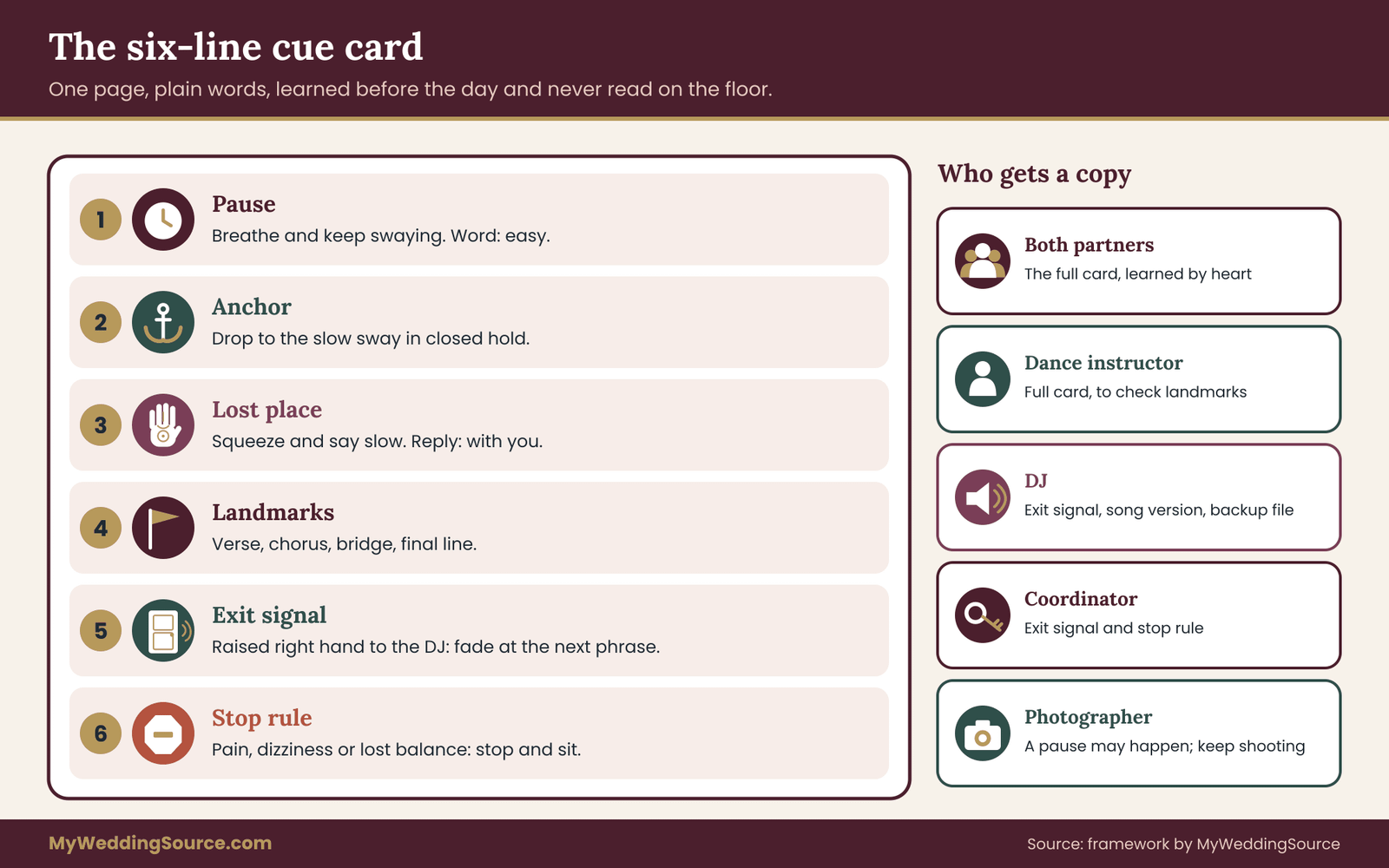
The card has six lines. The first is the pause cue: the word or touch that says “breathe.” The second is the anchor: which step, in which hold. The third is the lost-place cue and the reply. The fourth is the landmarks: four moments in the song. The fifth is the exit signal and what it asks of the DJ. The sixth is the stop rule: what ends the dance immediately for any reason. The infographic below shows how the six lines fit together.
How to write the lines so they are usable
Write each line as a short instruction in the second person: “Breathe and keep swaying.” “Drop to the box step.” “Squeeze and say slow.” Avoid explanations, because explanations are for when you are calm. Use the same words you use in rehearsal. If you have started calling the anchor “home,” write “home.”
Keep the card to one side of a page. If it does not fit, it is too complicated. A card that is too long will not be read, and a card that is not read will not be remembered. A good test is to cover the page and try to say all six lines from memory. If you cannot, the plan is too heavy.
Who else gets a copy
Give the card to your instructor and ask them to check it against the dance. They will often spot a landmark that does not work or an anchor that does not fit the choreography. Give a short version to your DJ, with the exit signal, and to your photographer, so they know what you have agreed. The ceremony side of your day has its own sheet, covered in the guide to ceremony cue sheets, and many couples find it natural to add the dance as a one-page insert to the same set of documents.
Do not hand the card to guests or family. The aim is for the plan to be invisible. A relative who knows about the cue may well be well-meaning and still draw attention to it.
Keeping the card out of your pocket
It is tempting to tuck a copy somewhere in your outfit as a safety net. For the dance itself that does not help: nobody is going to read a card while holding a partner under stage lights, and it adds an item to be dropped. The card exists to be learned beforehand, not to be consulted in the moment. If you want a physical backup, give it to your best person or your planner, with a note that it is to be used only for the exit signal if the DJ needs a reminder.
A rehearsal of the card
Spend one evening running the card, not the dance. Stand in your living room with the song playing and run through each line as a drill. Give the pause cue and breathe. Drop to the anchor. Give the lost-place cue and receive the reply. Call a landmark and rejoin. Practice the exit signal and the DJ’s response, using a friend if you can. Twenty minutes of this will do more for first dance mistakes than another hour of the main routine.
Common first dance mistakes and the fix for each
The ladder is general. In practice, couples run into particular kinds of first dance mistakes, and each has a specific, practical fix. The list below does not cover every possibility, but it covers the situations most often described by dance instructors and wedding planners, and it shows how the four rungs apply to each.
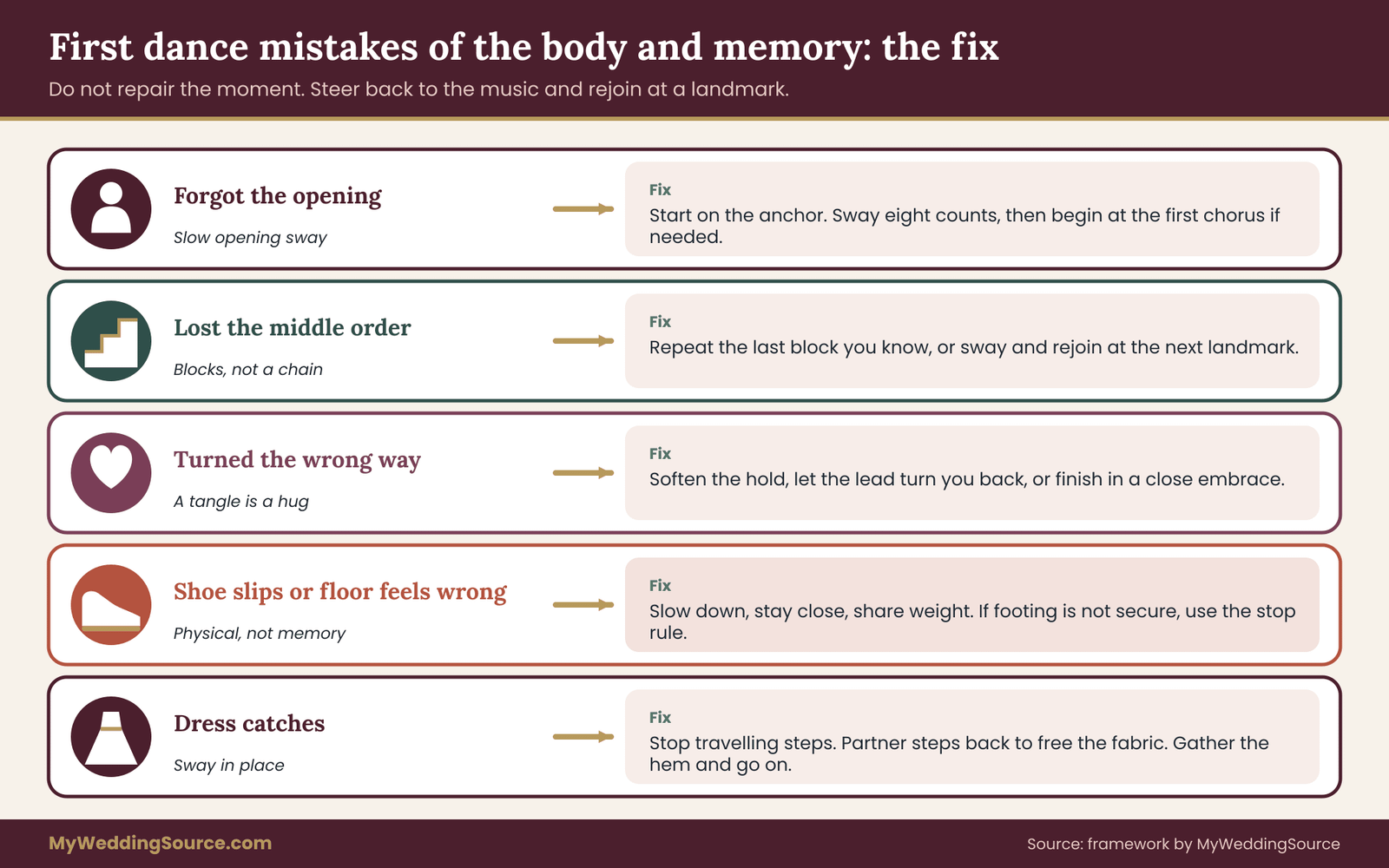
Every fix for first dance mistakes follows the same logic: do not try to repair the moment, steer back to the music and rejoin at the next landmark. The infographic after the list gives the same set at a glance.
You forget the opening
The song starts, you step off, and the first move is gone. This is the most common version of first dance mistakes and it is also the easiest to fix, because the opening of a slow song is always a sway.
Fix: start on the anchor. Take the closed position, breathe and sway for the first eight counts. The room will read it as an intimate opening. By the time the first verse lands you will usually have the sequence back. If you do not, wait for the first chorus and start the choreography there.
You lose the order of the middle moves
You remember the beginning and the ending but not what is in between.
Fix: treat the middle as a set of blocks. If the order has gone, repeat the last block you remember, or drop to the anchor and rejoin at the next landmark. Repeating a block looks like a theme. Dropping to the anchor looks like a pause.
You go the wrong way
You turn left, your partner turns right, and you are suddenly facing each other with arms crossed.
Fix: do not unwind quickly. Laugh if you feel like it, soften your hold and let the lead partner turn you back into position with the music. If the tangle is bad, go to the anchor with a light embrace, which turns the error into a hug.
The step trips you
A shoe catches, a heel slips, the floor is not what you expected.
Fix: treat this as physical, not memory. Slow down, stay close, shift weight evenly and let your partner support you. If your footing is not secure, apply the stop rule: slow to the sway and consider the exit signal. A fall in a first dance is a safety matter; the dance is not worth a sprain.
The dress catches
A train or hem gets trapped under a foot, or a skirt wraps.
Fix: stop the travelling steps and move to a sway in place. Your partner can step back to free the fabric. If the hem is the issue, a quick pause to gather it is fine and looks natural. Rehearse in garments of the same length so you know how much floor the dress needs.
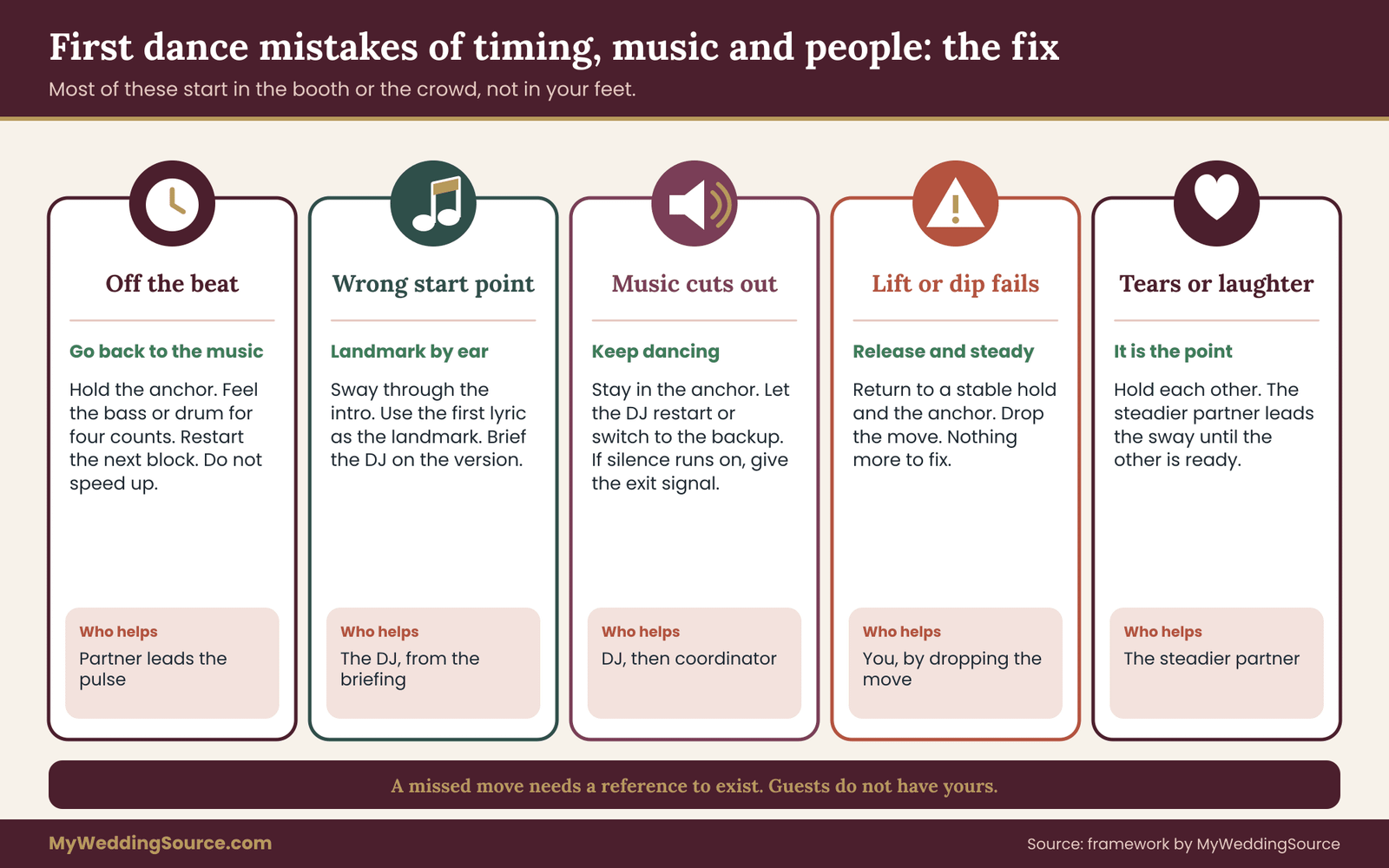
You are off the beat
You and your partner have drifted out of time with the song, and the steps feel wrong even though you remember them.
Fix: go back to the music, not the steps. Hold the anchor and listen for the drum or bass pulse. Match your sway to it for four counts and then restart the next block. Do not speed up to catch up, because speed adds error. The leader sets the pace, and the follower matches it.
The music starts at the wrong point
The DJ cues the wrong version, or the song begins with an intro you did not rehearse, or the track starts mid-way.
Fix: use the anchor for the intro and treat the first lyric as your landmark. This is one reason first dance mistakes are partly a technical problem; a note to your DJ about which version and which start point you want will prevent most of them. The briefing section later in this guide covers that.
The music cuts out
A speaker fails, the file skips or the microphone feeds back in the middle of the song.
Fix: keep dancing. Stay in the anchor and hold the frame. A brief silence in a romantic moment can be quite touching, and guests often start to clap or hum. Your DJ should restart the track or switch to a backup file, and both of you should treat the silence as part of the dance. If the silence continues beyond a few seconds, use the exit signal and invite guests to the floor.
A lift, dip or spin goes wrong
You attempted a bigger move and it did not land.
Fix: treat this as a physical lapse. Release the move, return to a stable hold and drop to the anchor. If either of you is uncomfortable, stop. Many dance instructors suggest that couples who are not confident in a lift or a dip drop it from the routine altogether and replace it with something simpler, a point covered on the site in the guides on simpler first dance choreography. Nothing about a missed lift needs to be remembered after the dance.
One of you cries, laughs or loses composure
The emotion arrives and the steps go.
Fix: this is not a mistake, it is the point of a first dance. Hold each other, hold the anchor and let it pass. Photographers often prize these moments. If one partner needs a moment, the other can lead the sway until they recover. There is no rule that a first dance must be composed.
A guest steps in or a child runs onto the floor
An overenthusiastic relative joins, a toddler runs in, a phone is shoved in your face.
Fix: smile, stay with your anchor and let your coordinator or best person redirect. If a child is nearby, a quick scoop or a quiet wave to a parent is better than a stop. Decide in advance who is responsible for the dance floor boundary, usually the DJ or a planner.
Dizziness, discomfort or pain
Someone feels faint, overheated, nauseated or in pain.
Fix: this is not a first dance mistake at all, and it overrides the ladder. Stop moving, find a chair or a wall and tell your partner. Give yourself time and call for help if needed. Nothing about the dance matters more than your health. If you have any medical concern about dancing, discuss it with your doctor before the day and with your instructor so the routine is adapted.
The song is too long
Three and a half minutes is longer than you remember, and you have run out of material.
Fix: repeat the anchor, add a rotation and ask the DJ to fade the song early. Songs can be edited in advance, which is often the best solution. A song that is too long is a planning issue and can be solved before the day by trimming. After the lapse, make a note to edit the track if you rehearse again.
You forget the ending
The song is nearly over and you cannot remember how it finishes.
Fix: finish with the simplest closing you have: a held embrace, a slow turn, a kiss. The final line of a slow song is a good landmark, and most guests applaud at the last note whatever you do. If you have no planned ending, use a pause and a bow or a held hug. It will look intentional, and first dance mistakes at the very end are the easiest to hide.
Rung four: shorten, hand off or end the dance
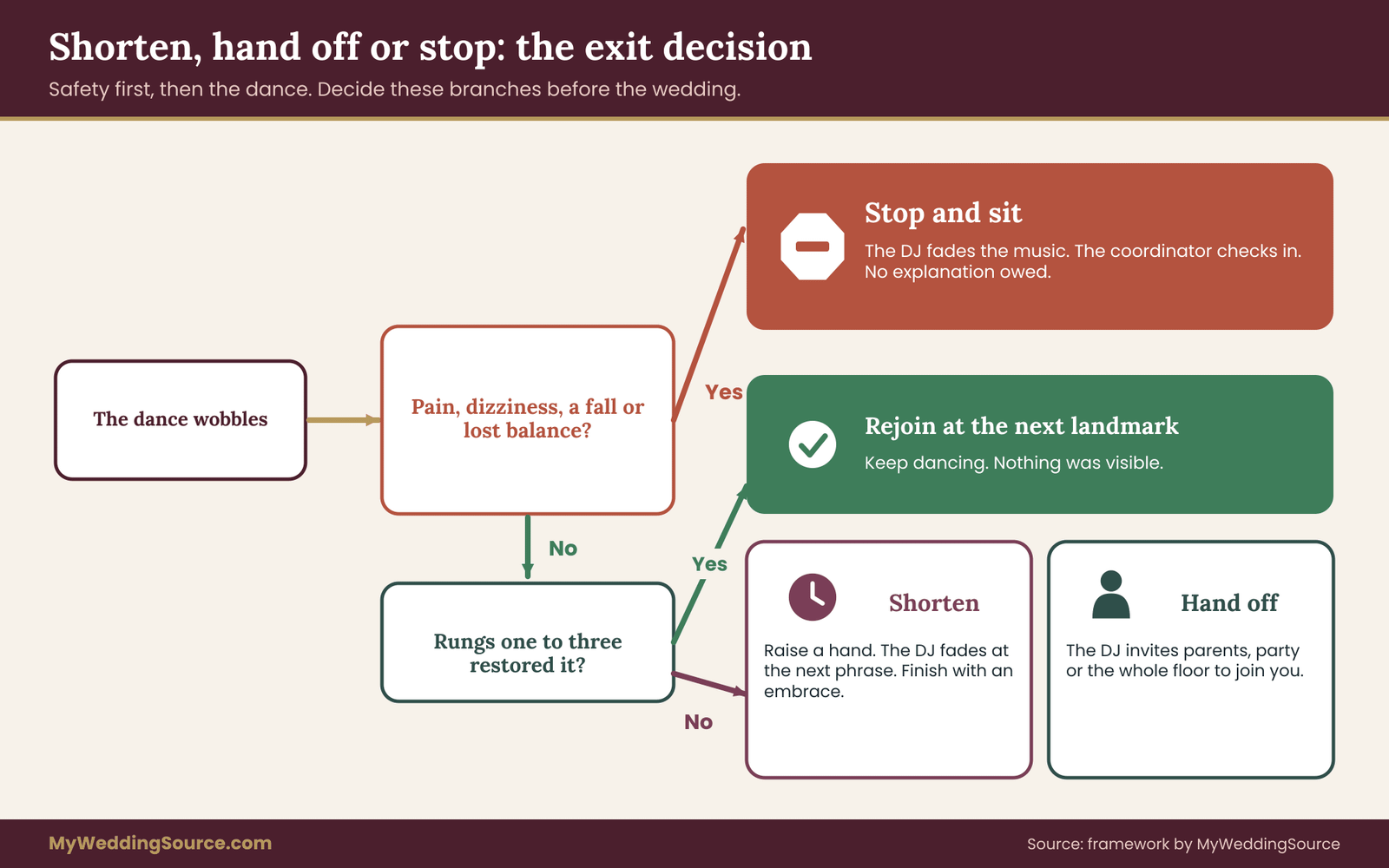
The fourth rung is the one nobody wants to use and everyone should plan. It is the decision to change the shape of the dance rather than repair it, and it is the last answer to first dance mistakes. There are three versions, in order of how much they change: shorten, hand off, end.
Shortening means ending the dance earlier than planned. A signal to the DJ fades the song a verse early, and you finish with an embrace. Handing off means bringing other people onto the floor so the focus moves from the two of you to the room. Ending means stopping now, for safety or because the dance has become too uncomfortable to continue.
All three are legitimate. None is a defeat, and none means the first dance mistakes won. The reason to plan them, as with all first dance mistakes, is that deciding in the moment, with the lights on and the music running, is the worst time to be making decisions.
When to shorten
Shorten when the dance is recoverable but the remaining time is not worth it. A couple that has blanked twice by the second chorus, for example, may reasonably decide that the third verse is not a good use of the room’s attention. A pre-agreed signal tells the DJ to fade out at the end of the next phrase. You finish with the anchor and a kiss, and the dance ends on your terms.
The signal should be something the DJ can see or hear from across the room. Common options are a raised hand, a slow nod toward the booth or a message through a coordinator. It should not be a wave, which looks like a greeting. Agree the signal, practice it and confirm it again in the final timeline.
When to hand off
Handing off works after first dance mistakes, when the dance has lost its footing but the mood is still good. The DJ invites parents, the wedding party or the whole floor to join, usually with a line like “Please join the couple on the floor.” Guests are generally happy to be asked. The spotlight shifts, the pressure drops and you can dance with anyone near you, without choreography.
It helps to have a planned moment in the song where guests are invited anyway. Many couples arrange for the second half of the song to include the wedding party or parents. That makes a hand-off look like part of the plan, not a rescue, which keeps first dance mistakes from being read as mistakes at all. How the floor opens up to guests is part of the broader flow of the evening described in the reception guest flow guide, and the dance should be consistent with it.
When to end
End when anything is unsafe: a fall, a pain, a dizzy spell, a wardrobe failure, a medical concern or any fear that continuing will make things worse. The stop rule overrides the ladder entirely, whatever first dance mistakes have occurred. There is no need to explain, no need to finish and no need to apologize. The DJ stops or fades the music, the coordinator checks in and the evening continues.
Ending also applies when emotion takes over and one partner simply cannot go on. A stopped dance is a long hug, a breath and a short walk to the edge of the floor. Many guests will find it moving. The couple does not owe the room a finished routine.
Making the exit signal work
An exit that has not been rehearsed will not be used. Run the signal at least twice with your DJ or with a friend playing the role. Confirm where the DJ will be looking, what each signal means and what the DJ will say. The wording matters: “Please join us” works for a hand-off, “Let’s give them a round of applause” works for an ending, and a fade works for a shortening.
Tell your DJ in plain words, since first dance mistakes often start with a technical hiccup: “If one of us gives this signal, please do this.” Tell them also that they do not need to ask. A DJ who hesitates because they are unsure whether the signal was intended can turn a good exit into an awkward gap. The lines in the contract or timeline that cover the dance are worth reading closely, and the broader role of the vendor schedule is explained in the guide to the wedding vendor timeline.
Deciding the stop rule in advance
A stop rule is a plain sentence that says what ends the dance immediately. It should be short enough to say in one breath: “If either of us feels pain, dizziness or a loss of balance, we stop and sit.” Agree to it together, write it on the card and give a copy to the DJ and the coordinator.
The rule matters most to the partner who is least likely to speak up. People who dislike making a fuss tend to keep going when they should stop. For first dance mistakes that are really safety problems, a written rule, agreed beforehand, takes the awkwardness out of the decision. It also gives your DJ and coordinator permission to step in if they see something you do not.
Rehearsing first dance mistakes on purpose
Most couples rehearse the routine and hope the first dance mistakes will not come. A better approach is to rehearse the first dance mistakes themselves. This sounds backwards, but it is the same logic as a fire drill. People who have practiced the response do it without thinking. People who have only practiced the ideal case have to invent it under stress.
The idea is to build deliberate first dance mistakes into your practice sessions, so that the Reset Ladder becomes as familiar as the choreography. You do not need extra time for this. You need to change how you use the time you already have.
The five drills
Each drill takes five to ten minutes and can be added to a normal practice session. Do them with the real song at the real tempo.
Drill one: the random call. One partner calls “reset” at an unpredictable moment, and both drop to the anchor, breathe, hold for eight counts and rejoin at the next landmark. Repeat five times in a session. After a week it becomes automatic.
Drill two: the blank. One partner deliberately stops leading at a random point and pretends to have no idea what comes next. The other partner gives the reassurance response and leads the anchor. Swap roles. The aim is to make the response feel ordinary.
Drill three: the wrong turn. On a signal, one partner turns the wrong way. The other practices unwinding smoothly without dropping the hold. This drill is useful because it shows how much small errors can be absorbed by a calm frame.
Drill four: the music glitch. Pause the music mid-song, count to five while staying in the anchor, then restart from a different point. Practice using the first lyric as a landmark. This prepares you for the technical first dance mistakes, such as sound problems, and for a DJ who cues the wrong spot.
Drill five: the exit. Practice the shortening signal with a friend or a family member playing the DJ. Run the whole thing: the signal, the fade, the final embrace and the applause cue. It feels silly in a living room. It is the most useful drill on the list for first dance mistakes that cannot be fixed on the floor.
Rehearse under conditions closer to the real thing
Practicing only in sweatpants on a carpet leaves you unprepared. Wherever possible, add the conditions that will be present on the day. Wear the shoes and, if you can, something close to the outfit. Practice on a floor like the venue’s. Use music at wedding volume. Have a few friends or family watch, because being watched is the stress you most need to practice with.
You do not need a crowd. Two or three people sitting on a sofa are enough to change how it feels. Ask them to clap at the end, to talk quietly while you dance and, once in a while, to look at their phones. Dancing in front of someone who is not paying close attention is good practice for the real room.
Practice recovering from first dance mistakes, not just restarting
When something goes wrong in practice, the usual response is to stop, laugh, say “again” and restart from the top. That builds a habit of restarting, which you cannot do on the day. Instead, make a rule that if you slip in practice, you do not stop. You use the ladder, recover and carry on to the end.
This one rule changes the nature of rehearsal. After a few sessions, you will have recovered from dozens of real small errors, and each one will have taught your body that a slip is survivable. By the wedding, a mistake will feel familiar. First dance mistakes lose most of their power. First dance mistakes lose most of their power once they have happened a few times in private.
How many rehearsals are enough
There is no fixed number, and it depends on the length and difficulty of the dance, your experience and your schedule. A useful test is whether you can run the ladder without looking at the card and whether you can name your landmarks without thinking. If both are true, you have rehearsed enough. If you have to stop and recall, add a session.
A reasonable pattern, if you have a month, is to add the five drills to the last two weeks of practice rather than to the first two. The early sessions are for learning the routine. The later ones are for stress-testing it. If you are working with an instructor, ask them to run a session where they deliberately interrupt you.
What to do if one of you hates practicing
Not every partner enjoys rehearsing. If one of you is reluctant, keep the sessions very short, ten minutes at most, and focus on the ladder rather than the routine. Present it as insurance, not as extra work. It also helps to make practice part of an ordinary evening, with a drink and the song on, rather than a scheduled task.
If the reluctance comes from anxiety about performing, take that seriously. A dance that causes real distress may not be the right choice, and there are options that remove the pressure while keeping the moment, a topic the site discusses in its guides on alternatives to a traditional first dance. The ladder can still help, but a plan that protects someone’s comfort matters more than a plan that protects a routine.
Telling your DJ, photographer and venue what to do
Your plan only works if the people running the room know it. A first dance is a collaborative event: the DJ controls the music, the photographer shapes how the moment looks and the venue controls the floor and the lights. None of them can help with first dance mistakes unless they know what you want.
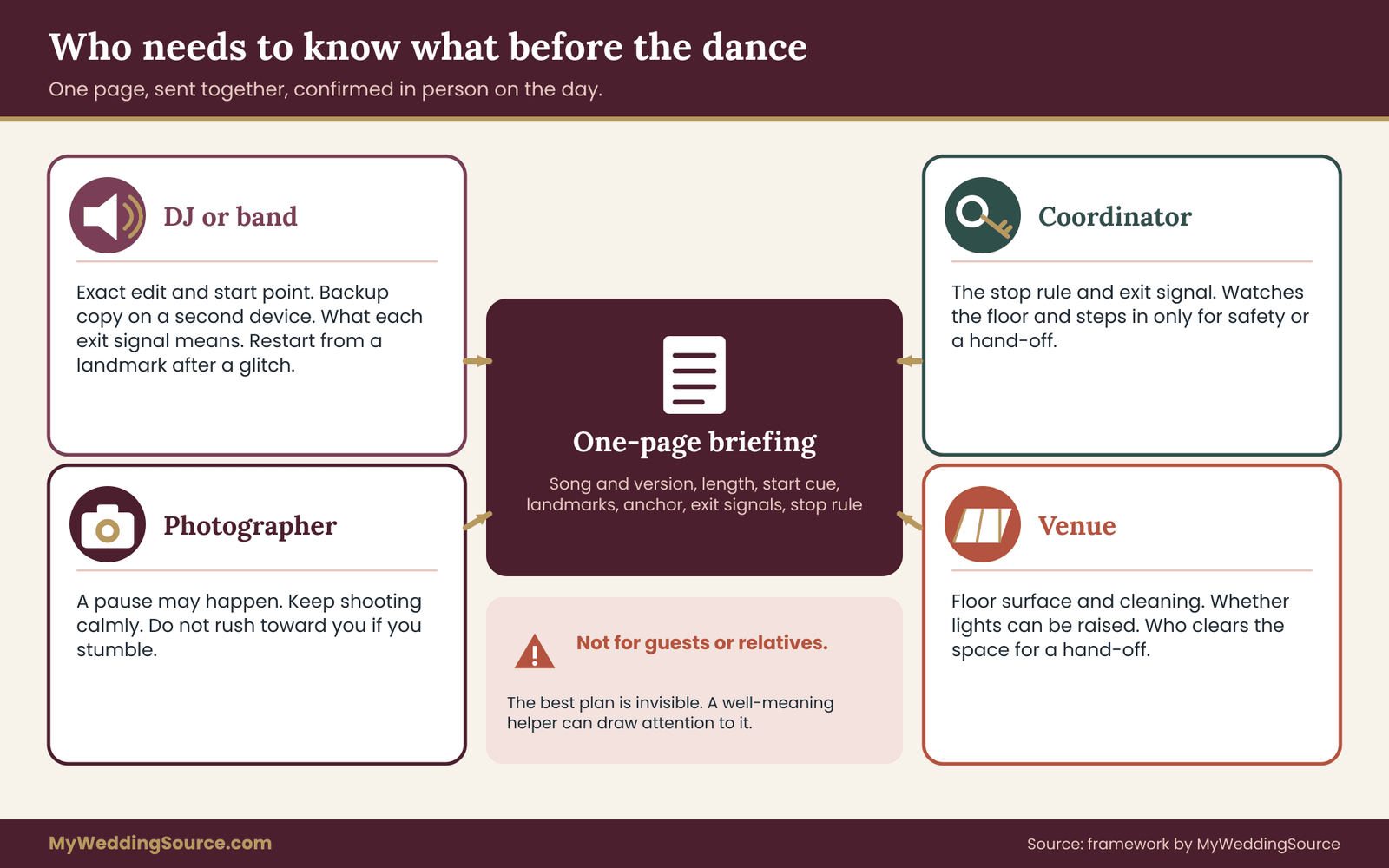
A short briefing about first dance mistakes is enough. It should be written, kept to one page and sent several days before the wedding, then confirmed in person on the day.
The DJ or band
The DJ needs more detail than anyone else, because many first dance mistakes begin in the booth. Tell them the exact version of the song, the start and end point of any edit, the file format and where the backup is. Tell them the exit signal and what each signal means. Tell them what to do if the music fails, which is one of the likelier first dance mistakes: restart from the beginning, play the backup or let the silence run for a count of five before acting.
Give the DJ the song map too. If they know where your landmarks are, they can restart the music from a useful point after a glitch. The wider planning of the evening’s music is described in the guide to wedding reception music, and the first dance fits inside that larger plan, so check that the order of events matches.
Ask your DJ to confirm that they have a spare copy of the song on a separate device. Files go missing and phones lose signal, and a second copy kept somewhere else is a cheap form of protection. The digital side of this, including backup files and permissions, is covered in the guide to wedding day digital operations.
The photographer and videographer
Photographers can be a great help with first dance mistakes, because they know how to make a pause look deliberate. Tell them that you may slow down or stop for a moment, and that you would like them to keep shooting rather than react. Ask them not to move toward you if you stumble, which draws the room’s eye.
Also ask them to let you know, before the day, if there are positions they would like you to hit in the dance. A few couples find it easier to build the photographer’s requests into the anchor section, so the pause is also a posed moment. This turns a potential lapse into a good photograph.
If a videographer is covering the dance, it is worth asking in advance how they handle a restart or a cut. Some will drop in alternate footage. It is not your job to edit the film, but it is worth knowing that a hiccup in the dance does not have to appear in the final video.
The venue and coordinator
The venue controls the floor, the lighting and sometimes the sound. Ask about the floor surface and whether it will be cleaned or treated before the dance. Ask whether the lights can be raised if the dance needs to stop. Confirm who is in charge of clearing the space if a hand-off happens.
The coordinator, whether professional or a friend, is the person who can act on the exit signal when the DJ is occupied. Give them a copy of the card. Ask them to watch the floor during the dance and to step in only if the stop rule applies. A coordinator who knows the plan is the person who turns a stop into a graceful pause.
The one-page briefing
The briefing does not need to be long. Include the following in plain language: the song and version, the length, the start cue, the landmarks, the anchor section, the exit signals, the stop rule, who is on the floor and who to call. Keep it to a page and send it to the DJ, coordinator and photographer together so everyone has the same information.
A few lines you can adapt
Short messages are easier to send and easier to read. A note to the DJ might say: “We want the dance to end early if either of us gives this signal. Please fade the track at the next phrase and invite guests to the floor.” A note to the photographer might say: “If we pause or slow down, please keep shooting calmly. We might take a moment.” A note to the venue might say: “Please confirm the floor surface and that the lights can be raised if we stop.”
These are not demands and they do not require long explanations. They tell professionals what you have decided, which is what they most need to know. Most are glad to be told. It also shows them that you take first dance mistakes and the dance itself seriously, which tends to make them more careful.
A worked case: one illustrative first dance and its recovery
The case below is invented to show how the plan handles first dance mistakes. The couple, the song and the timings are not real, and nothing here is a statistic or a report of an actual wedding. It is a walk-through of decisions, to make the ladder concrete.
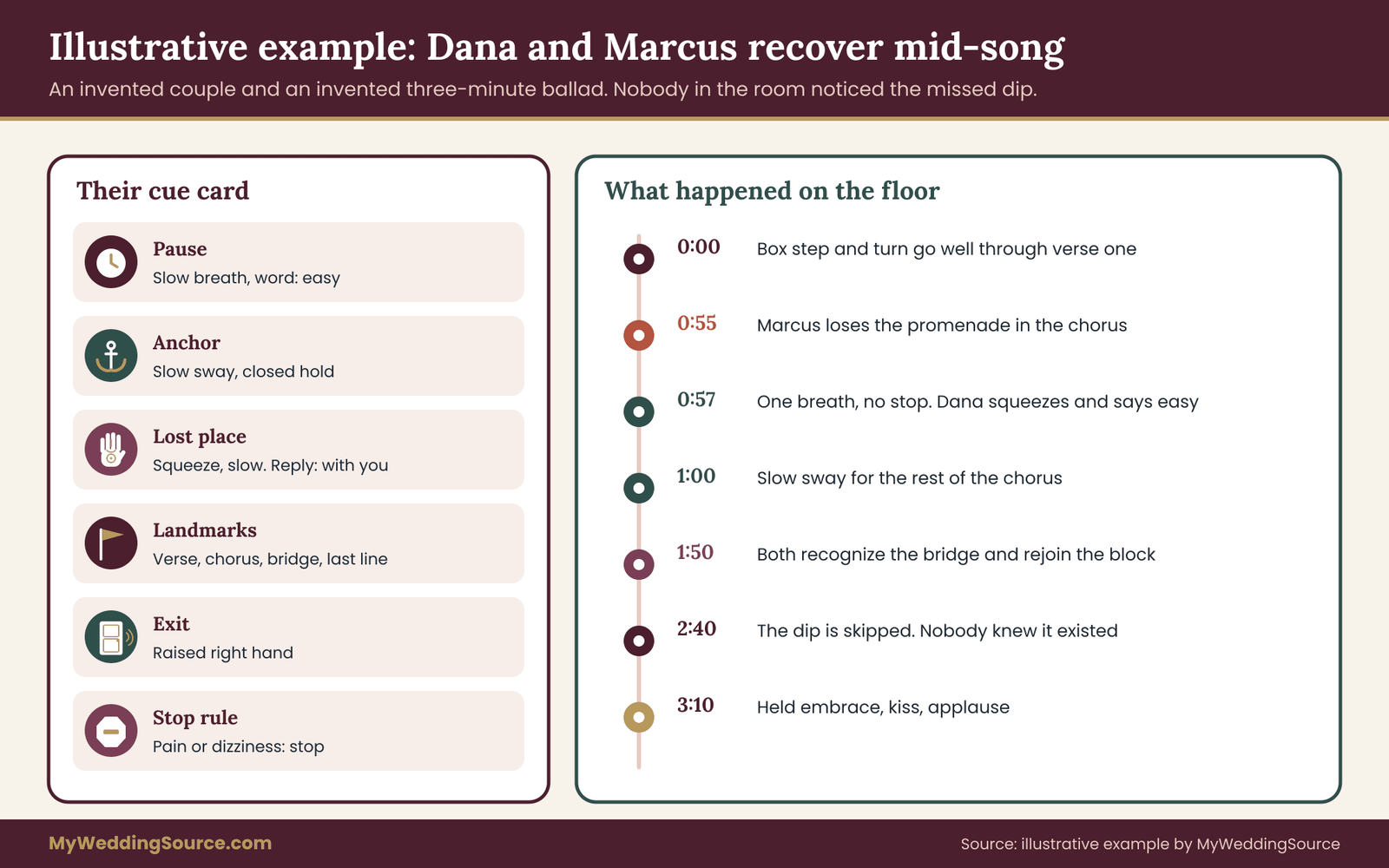
Imagine two people, call them Dana and Marcus, who have a ballad of about three minutes and ten seconds. They had four lessons and practiced for five weeks. Their choreography has three blocks: a box step with a turn, a promenade across the floor and a closing dip. They also have a plan for first dance mistakes, which they put together in one evening using the six-line cue card.
The setup
Their cue card reads as follows. The pause cue is a slow breath and the word “easy.” The anchor is a slow sway in closed hold. The lost-place cue is a squeeze and the word “slow,” with the reply “with you.” The landmarks are the first verse, the first chorus, the instrumental bridge and the final line. The exit signal is a raised right hand toward the DJ, meaning “fade at the next phrase and invite guests.” The stop rule is that either of them can stop for pain or dizziness, no questions asked.
They sent the card to their DJ and coordinator four days before the wedding. They gave a short briefing to the photographer. On the day, they confirmed the signal with the DJ during sound check.
The first minute
The song starts. Dana and Marcus step into the box step with the turn. It goes well for the first verse. At the first chorus they move into the promenade, and Marcus realizes halfway across the floor that he has forgotten where the promenade ends. His body stalls.
Marcus does not stop. He takes a slow breath over two beats and says nothing. Dana feels the change in his hold and sees his eyes flick down. She does not look down. She gives the squeeze and, because Marcus has not given the cue, she adds the word “easy” in a low voice. It is not quite the plan, but it is close, and it works.
The recovery
Marcus drops to the sway. Dana leads it, holding the frame firmly. They sway for the rest of the chorus, about twenty seconds. To the room, it looks like a romantic pause in the middle of the floor. A guest later says it was her favorite part. The photographer, who knew a pause was possible, captures a quiet, close frame.
At the instrumental bridge, which both recognize, Marcus gives the squeeze and says “slow.” Dana answers “with you.” They rejoin the choreography at the bridge block, which is a short turn sequence that stands on its own. They do the second verse as planned. They skip the dip, since they are now past the block where it would fit.
The ending
At the last line, Dana and Marcus finish with the held embrace and a kiss. The room applauds. Nobody mentions the promenade. The dip never existed as far as anybody else knew.
Afterward, they talk about the moment. Marcus says he felt panic for two or three seconds and then felt the sway take over. Dana says she did not think about it until the dance was over. They agree that the cue word helped more than they expected, and that next time they would write the landmarks larger on the card.
What the case shows
Three things stand out. First, the recovery relied on automatic behaviors: a breath, a sway and a squeeze. Second, the landmarks made rejoining easy, so the dance did not have to restart. Third, the missed element, the dip, was dropped without comment. Most real first dance mistakes are handled in the same way, by absorbing them rather than repairing them.
Notice also what did not happen when the first dance mistakes arrived. Nobody stopped the music. Nobody apologized. Nobody restarted. The couple did not discuss whether to continue. Their plan removed all of those decisions in advance, which is exactly why it worked.
What would have changed the outcome
It is worth looking at where the case could have gone differently. If Dana and Marcus had not agreed on landmarks, the instrumental bridge would not have been recognizable as a restart point, and they might have stayed in the sway until the song ended. That would still have been acceptable for first dance mistakes of this size, but it would have shortened the dance considerably.
If they had not agreed on a cue, Dana might have asked “what’s wrong?” aloud, which would have turned a private lapse into a public one. If the DJ had not been briefed, a pause in the movement might have prompted an early fade. And if either of them had felt faint or hurt, the stop rule would have taken over, and the dance would have ended safely and without drama.
Alternatives to the ladder and when it fails
The Reset Ladder is one approach to first dance mistakes. It suits couples who have a planned routine and want a quiet way to recover. It is not the only approach, and it is not right for every dance or every couple. This section describes alternatives to the ladder for first dance mistakes and the conditions under which the ladder itself breaks down.
Alternative one: a looser dance with no routine
Some couples choose not to choreograph at all. They plan a song and a starting position and agree to sway. With no sequence to forget, first dance mistakes mostly disappear, because there is no script to lose. The trade-off is that there is less to show and less to photograph, and some couples feel a looser dance is too exposed.
If you find yourself dreading the routine and the first dance mistakes that come with it, consider whether a simpler approach would serve you better. The ladder still helps, since the anchor is the whole dance, but the plan becomes lighter. Choosing a simple dance is a legitimate decision, not a retreat from a harder one.
Alternative two: a shared dance with the wedding party
Another option is to open the floor early. The couple begins alone for a verse, and the DJ invites the wedding party or parents to join for the rest. This shortens the time you are alone in the spotlight and offers a natural hand-off if the dance wobbles. The cost is that you lose some of the intimacy and you need the cooperation of the people you invite.
Alternative three: a lesson-led routine with a rehearsed fallback
If you want a more polished dance, ask your instructor to build a fallback into the choreography itself. The instructor creates a version in which each block can stand alone and each transition passes through a held position. That is essentially the ladder written into the routine. It takes more lesson time but gives you a more reliable result, and it is worth asking about if you are booking lessons.
Alternative four: a pre-planned short dance
A shorter song or a trimmed edit is the single most effective alternative. A ninety-second dance gives first dance mistakes less time to occur and less time to hurt. Many couples find that a short version feels more intense and more memorable than a long one. If you are unsure about the length, ask your DJ about edits and try the shorter version in rehearsal.
When the ladder fails
The ladder is a tool for first dance mistakes, and every tool has conditions under which it does not work. It helps to know them so you are not surprised.
It fails if the cue is not shared. If only one partner knows the plan, the other will not respond, and the signal will confuse rather than help. Both must have rehearsed it.
It fails if the anchor is not truly automatic. An anchor that requires thought is no better than the routine. If you have to decide how to sway, you have not rehearsed enough.
It fails if the landmarks are unclear. Landmarks that depend on counting or on memory are not landmarks. Choose moments you can hear.
It fails if the DJ does not know the exit signal. The shortening and hand-off options depend on the person at the booth. A signal nobody is watching is not a signal.
It fails if either of you is physically unwell. In that case, the stop rule applies, not the ladder.
It fails if the stakes feel too high. Some people are so anxious about the dance that no plan helps. If that is you, please consider an option that lowers the stakes, such as a shorter dance, a shared dance or none at all.
Deciding between the ladder and the alternatives
A simple way to decide is to ask three questions. Do you want a choreographed dance? Are you both willing to practice the ladder as well as the steps? Do you trust your DJ and coordinator to act on a signal? If the answer to all three is yes, the ladder suits you. If one of the answers is no, an alternative may serve you better, and there is no shame in choosing it. A plan that fits your actual temperament is better than a plan that is impressive on paper.
After the dance: photos, video and what to say
The dance ends, along with any first dance mistakes, and the evening moves on, but a few things are worth handling in the hour after and the week after. They matter less for the room than for how you remember the moment.
The first five minutes
If the dance went smoothly, enjoy it. If first dance mistakes crept in, read on. If it wobbled, do not rush into an analysis. Take a breath with your partner and a drink of water. Accept the applause. If people mention a stumble, a light reply is enough: “We lost the steps and kept the song.” That is honest, short and closes the topic. Nobody needs a longer explanation.
Avoid comparing notes on what went wrong in front of guests. A private word of thanks is better: “Thank you for staying with me.” The partner who felt the lapse may need to hear that the other was not upset. The partner who did not may need to hear that the lapse was not a problem. Both are quick to say and long to remember, and both help when first dance mistakes have left someone shaken.
Looking at the photos and video
When the gallery arrives, you may find a frame where you look lost or a clip where the step falters. It helps to know in advance that most of these frames will not look the way they felt. A held pause often reads as a tender one. A tangled turn often reads as a laugh. Look at the images a few days after the wedding, not the night of, when you may still be sensitive about it.
If there is a clip you truly do not like, ask your videographer what editing is possible. Many are willing to choose a different angle or trim a short section, though this depends on the contract and the footage. It is a reasonable question to ask politely. For still photos, you are usually free to choose which frames to print and share.
What you may learn from it
If you plan to dance again, at an anniversary or a family event, it is worth a short debrief. Which rung did you use? Was the cue clear? Did the DJ know the signal? Which landmark worked, and which did not? Write three lines in a note and keep them. A first dance is a small event, but the same habits apply to speeches, toasts and any moment when you are watched.
It is also worth remembering that first dance mistakes in small ways are normal. Most couples have at least one slip. The ones that people remember with fondness are usually not the flawless ones but the ones in which the couple were visibly with each other.
When a lapse stings anyway
Some people feel first dance mistakes more deeply than others, even when nobody else noticed. If that is you, give it time. The feeling tends to fade as the rest of the wedding fills your memory. If the embarrassment lingers or affects your enjoyment of the day, talk with your partner or someone you trust. It is a very ordinary reaction and it passes.
Your next steps
You do not need all of this at once to handle first dance mistakes. A sensible order, if you have a few weeks, is as follows.
- Pick your anchor step with your instructor, or on your own if you are not taking lessons. Practice it until you can do it while talking.
- Choose four landmarks in your song and write them down. Walk through the song with the music playing and mark each one.
- Agree on a lost-place cue, a reply, and a pause cue. Say them out loud and use them in a run-through.
- Write the six-line cue card on one page. Check it with your instructor.
- Add the five drills to the last two weeks of practice. Do not restart when you slip; use the ladder.
- Agree the exit signal and the stop rule. Confirm them with your DJ and coordinator, and send the one-page briefing to the DJ, photographer and venue.
- Do one full run-through in the real shoes and, if possible, the real outfit, in front of two or three people.
If you are still at an earlier stage of planning, the wedding planning checklist is a useful place to keep track of everything else that is going on. The dance is one small part of a long list, and a short plan is enough to keep it in proportion.
FAQ
What should I do if I forget my first dance steps in the middle of the song?
Keep moving and do not look down. Take one slow breath, drop to a simple anchor step such as a sway or a box step, and wait for a recognizable landmark in the song, such as the chorus. Rejoin your routine there. Most guests have not seen your choreography, so a skipped move looks like a choice. If you remain lost, give your partner the agreed cue.
Will guests notice if we make first dance mistakes?
Usually much less than you fear. Guests do not know your planned routine, so a missed move rarely registers. What they notice are visible reactions: a sudden stop, an argument, an apology or a restart. If you keep dancing, stay close and keep your expression soft, most guests will see a couple enjoying a slow song. Warm laughter is the most common response to a slip.
Should we stop the music if one of us forgets the steps?
Generally no. Stopping the music turns a private lapse into a public event. Use the anchor step and your cue first. Stop the music only if the stop rule applies, such as pain, dizziness, a fall or a wardrobe problem, or if you both agree the dance has become uncomfortable. Agree this with your DJ in advance so the signal is clear and nobody has to guess.
What is a good cue to tell my partner I have lost my place?
Choose something small that does not look like distress: a gentle squeeze of the hand, a light pressure on the back or a single quiet word you have agreed. Pair it with a reply, such as a squeeze back and a short phrase. Practice both until they are automatic, and keep a backup cue in case the first is missed in the noise.
How many times should we practice recovering from first dance mistakes?
There is no fixed number, but practice recovery as often as you practice the routine. A useful rule is to add short recovery drills to every session in the last two weeks and not to restart when you slip. If you can run the ladder without looking at a card, you have probably practiced enough. If you cannot, add another session.
What if my partner freezes and I do not know what to do?
Do not correct them out loud. Take the frame firmly, start the anchor step and give a calm, brief reassurance such as “with you.” Keep your face relaxed. You do not need to know the next move; you only need to hold the sway until a landmark arrives. If they seem unwell or distressed, stop and check in. Their comfort comes before the dance.
Can we shorten the first dance if it is going badly?
Yes. Agree an exit signal with your DJ beforehand, such as a raised hand, so they can fade the song at the next phrase or invite guests to join. Shortening is a normal, planned choice, not a failure. Guests often assume it was intended. Practice the signal at least twice and confirm it with the DJ at the sound check or in the final timeline.
Is it normal to be nervous about forgetting the steps?
Yes, it is very common. Being watched takes attention away from the task, which makes blanking more likely even in people who know the routine well. Preparation that builds sturdy habits, such as an anchor step, a cue and landmarks, helps more than trying to memorize harder. If anxiety is strong, consider a shorter or simpler dance and talk it through with your instructor.