
An accessible first dance is a first dance built around how both partners actually move, with the steps, tempo, floor and rest points agreed before the day. This guide gives you an instructor-led adaptation brief, five format options, a worked case and the stop rules that keep the dance calm if something changes on the night.
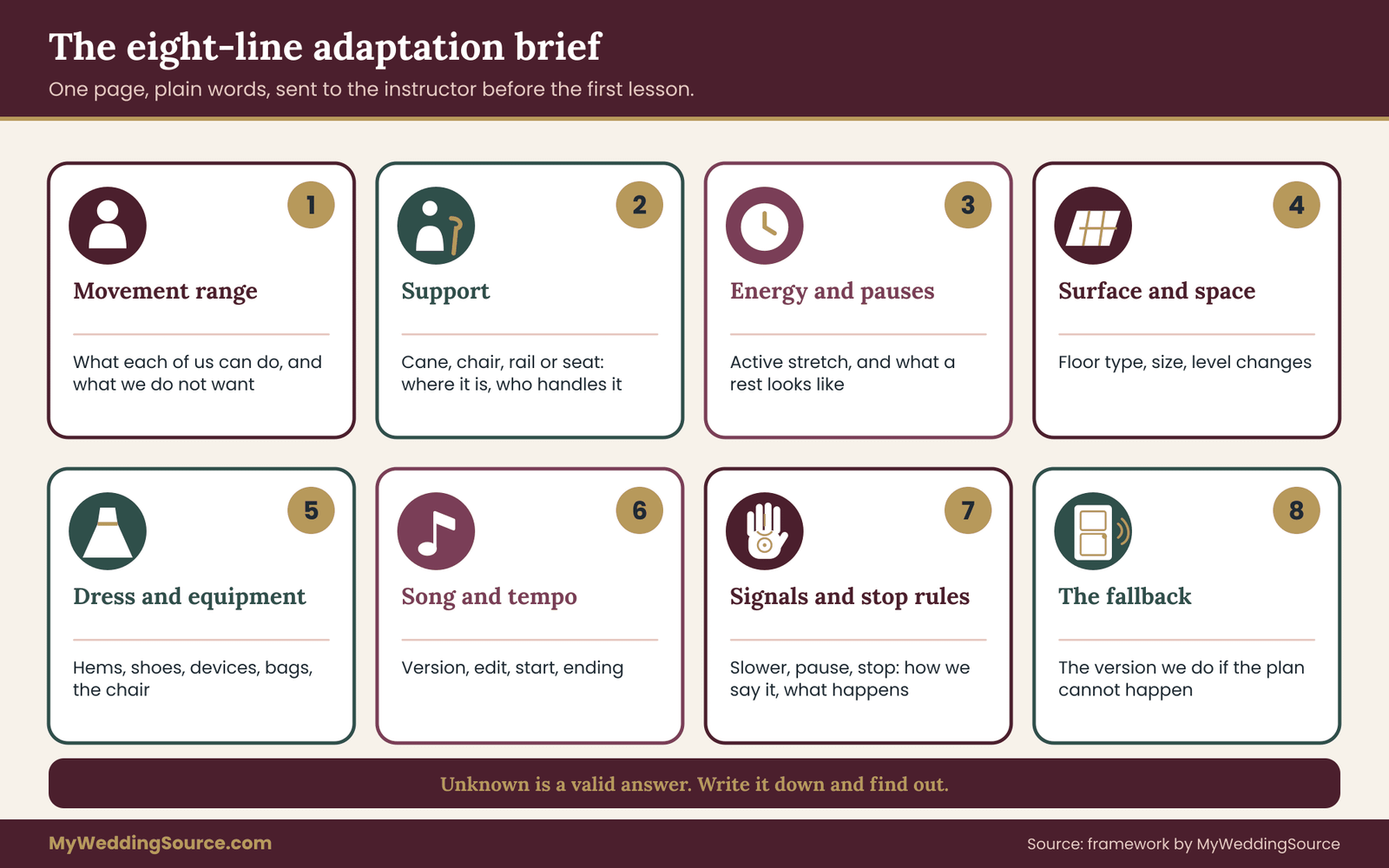
Do not start by asking which steps you can do. Start by writing a one-page adaptation brief with eight lines: movement range, support, energy and pauses, surface and space, dress and equipment, song and tempo, signals and stop rules, and a fallback. Give it to your dance instructor in the first lesson, and give the same page to your DJ, venue and photographer. Pick one of five formats, rehearse it on the real kind of floor, and decide in advance what ends the dance early without anyone feeling it failed.
Most advice about a first dance assumes two partners who can stand, turn, dip and travel across a floor on cue. When one or both of you move differently, that advice stops being useful by the second paragraph. What is left is usually a vague suggestion to “just keep it simple,” which tells you nothing about what to ask an instructor, what to ask a venue or what to do if the plan does not work.
This article is written for couples planning an accessible first dance, when mobility differences are involved, and for the instructors and planners who work with them. It treats the accessible first dance as a small production with a clear brief, a clear rehearsal path and clear exit conditions. It does not tell you what your body can or cannot do. That belongs to you, and to your own clinician or therapist if you work with one.
A note on scope. This is general planning information, not legal or medical advice. Accessibility rules, venue obligations and health questions depend on your situation and location, so where a rule or a safety question matters, the article points you to the agency or professional who can answer it for you.
What an accessible first dance actually means
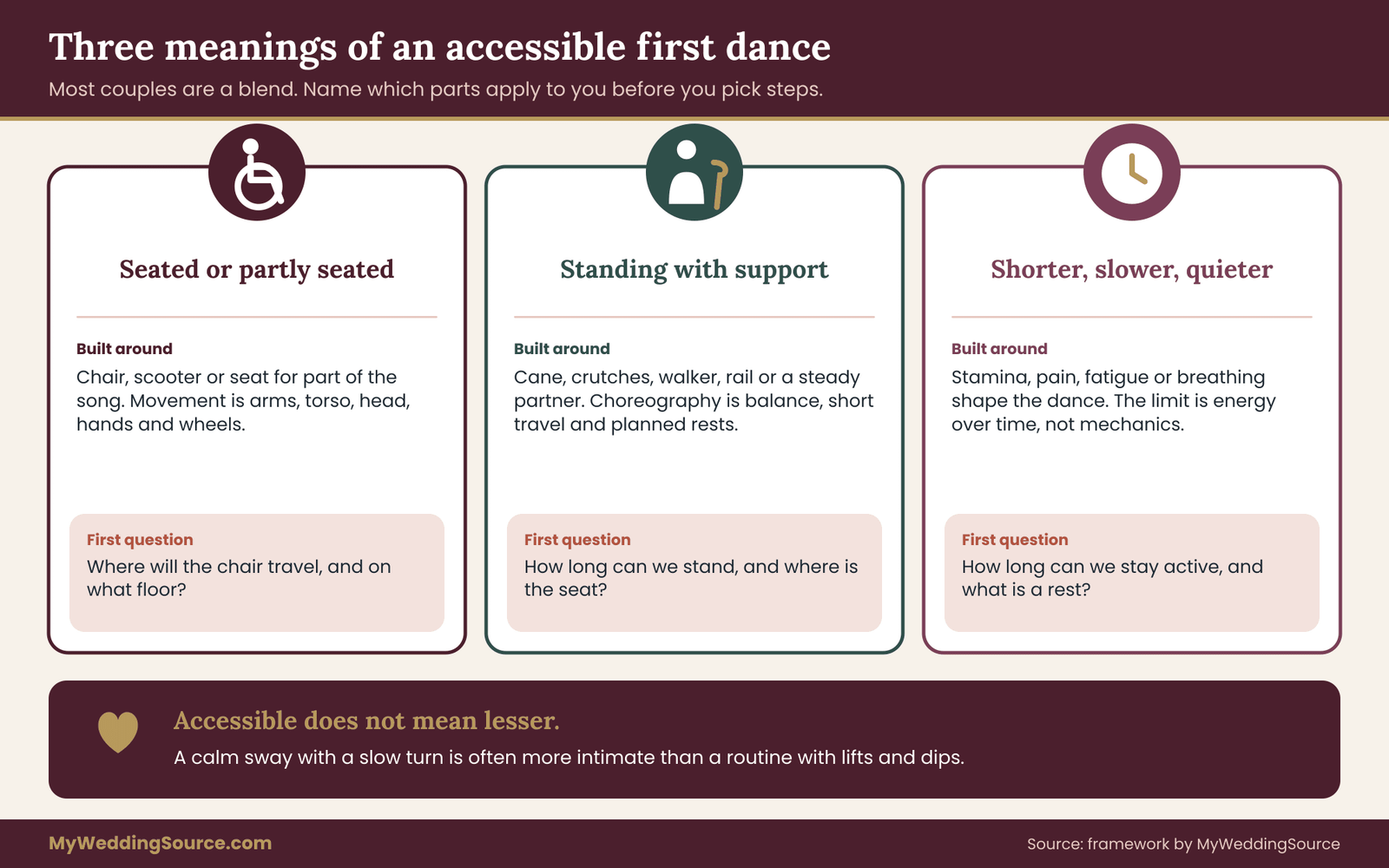
The phrase can mean three different things, and mixing them up is the most common reason couples feel stuck.
The first meaning is a dance performed seated or partly seated. One or both partners may use a wheelchair, a scooter or a chair for part of the song. The movement is arms, torso, head, hands and wheels, and the accessible first dance choreography is built around those.
The second meaning is a standing dance with support. A partner may use a cane, forearm crutches, a walker, a brace or the other partner’s steady frame, and the accessible first dance choreography is built around balance, short travel and well-placed rests.
The third meaning is a dance that is simply shorter, slower or quieter than the usual version, because stamina, pain, fatigue, breathing or the day’s schedule make a long dance a poor idea. Here the limit is energy over time, not mechanics.
Many couples are in more than one of these at once. A partner may stand well for forty seconds and need to sit after that, and the other partner may use a wheelchair all day. The point of the word “accessible” is not to pick a category. It is to make the dance fit the two real people in it.
What it does not mean
An accessible first dance is not a lesser dance. A calm sway with a slow turn, filmed well and held at the right moment in the evening, often reads as more intimate than a routine with lifts and dips. Guests are watching two people they love, not scoring technique.
It is also not a medical exercise. A choreographer or instructor can adapt movement to what you tell them you can do. They cannot assess a condition, set limits for your body or replace advice from the professionals who know your history. Good instructors say this themselves, and a good brief makes it easy for them to say it without awkwardness.
Finally, it is not only about the couple. The path to the floor, the surface, the lighting, the photographer’s position and the guests’ sightlines all shape whether the accessible first dance feels easy. Those are logistics, and logistics are where a brief earns its keep.
Start with the goal of the dance, not the steps
Before any choreography, answer one question in a sentence or two: what do we want these two or three minutes to do? Couples give very different answers, and the answers lead to very different dances.
Some want a private moment that happens to be public. They want to be close, slow and unhurried, and they do not care about visible steps. Some want to surprise guests with a short, polished piece. Some want the accessible first dance to honor a family tradition, a song from a shared history or a joke only the two of them understand. Some want to get through it and move on to dinner.
Each of these goals points to a different shape. A private moment suggests a stationary sway with one or two memorable gestures. A polished surprise suggests a short routine with a clear start and finish and one or two practiced showpiece moments. A tradition suggests building around the specific steps or gestures that matter and simplifying everything else. A “get through it” goal suggests the shortest edit of the song that still feels like a dance, plus an early invitation for guests to join.
Write the goal in one sentence
A useful goal sentence has three parts: the feeling, the length and the one thing that must happen. For example: “We want it to feel unhurried, we want it under two minutes, and we want to end with our foreheads together.” It is not a quote to print. It is a tool for the instructor, who can now say yes or no to every idea against a clear standard.
When partners disagree on the goal, resolve it before the first lesson, not during it. A partner who wants a showpiece and a partner who wants a quiet sway will pull the accessible first dance choreography in opposite directions, and an instructor who tries to satisfy both will produce something that satisfies neither. If you cannot agree, the next sections give you a way to test both options in the same lesson without committing to either.
Decide what guests should see
It helps to decide what the audience will notice. Guests at a first dance mostly see faces, hands and the overall shape of the movement. Footwork on a dim floor is hard to read from the back tables, and wheel work or seated arm work is often more visible than stepping. If you want a particular moment to land, such as a slow turn, a hand held overhead or a close embrace, build the accessible first dance choreography so that moment is not hidden behind a table, a flower arrangement or the DJ’s equipment.
This is where the dance connects to the room. The wedding reception guest flow guide covers how guests move through entry, seating, food and exit, and the position of the dance floor in that flow decides who sees what. If you have not settled where the floor sits and where guests will be standing, settle it before you settle the choreography.
Who is involved, and who decides what
An accessible first dance involves more people than the two of you, and a lot of frustration comes from not knowing who owns which decision. A clear split saves time.
The two of you decide the goal, the format and the limits. Nobody else can tell you what feels comfortable, what feels like too much or what feels like your own. If someone suggests a lift or a dip and you do not want it, the answer is no, with no explanation required.
The instructor decides how to build the movement. That includes counts, transitions, where the pauses go and how to cue the next move without looking at each other’s feet. A good instructor will ask many questions and will adapt rather than impose.
The venue decides what the floor and the space allow. Surface type, level changes, ramps, lighting and ceiling height are the venue’s facts. The venue’s coordinator can usually tell you what has been done before, but they cannot tell you what is right for you.
The DJ or band decides how the music is delivered. Song edits, entrance cues, volume at the start and the transition into the next song are theirs, and they will do them well only if they know the plan.
Your clinician or therapist, if you have one, decides nothing about the choreography, but may answer a specific question. If you want to know whether a certain movement, a rotation, a transfer or a long time on your feet is reasonable for you, that is a question for them. The instructor should not be asked to guess.
Pick one person to hold the plan
On the day, someone has to be the point of contact for the accessible first dance: the person who tells the DJ it is time, tells the photographer where to stand and tells the venue coordinator that the floor must be clear. This is often the planner or a day-of coordinator, and sometimes a friend. It should not be either of you. If you are tracking every cue for your own first dance, you are not dancing.
The wedding vendor timeline guide explains how vendor handoffs are normally sequenced across the day, and it is worth reading before you decide when in the evening the dance happens and who is told what. The briefing described next is the document that makes those handoffs short and unambiguous.
The adaptation brief for an accessible first dance
The core tool in this guide is a one-page adaptation brief. It is not a medical form and it is not a contract. It is a plain document you write, in your own words, so that every person who touches the accessible first dance starts from the same facts. It has eight lines, and each line is a question the instructor would otherwise have to ask over several lessons.
The value of writing it down is not the paper. It is that writing forces the two of you to decide things you might otherwise leave to chance, and it lets the instructor arrive at the first lesson already knowing what to plan. Many instructors ask these questions in the first twenty minutes of a lesson, and couples often answer them hesitantly because they have never said the words aloud. A brief takes that hesitation out.
Line one: movement range
Describe what each partner can do comfortably, in everyday words. Not diagnoses, and not what you wish you could do. For example: “A can stand without support for about a minute, can take small steps forward and sideways, cannot turn quickly. B uses a manual wheelchair, can spin the chair on the spot, and has full use of both arms.”
Include what each of you does not want to do, even if you could. If you dislike being held at the waist, say so. If a partner does not want the wheelchair turned by the other, say so. This line is about comfort as much as capacity, and it is the line instructors use most often to rule out ideas.
Line two: support and stability
Name the supports each partner uses and how they should be handled. A cane, crutches, a walker, a rail or a seat. State where they will be during the accessible first dance and who is responsible for them. If a support has to be put down, say where it goes so that nobody trips over it and so that it is within reach when needed.
Also name how you steady each other. A hand on a shoulder, a forearm hold, a hand on the chair’s push handle, a forehead touch. The instructor can build these in as choreography instead of treating them as workarounds.
Line three: energy and pauses
Say how long each of you can comfortably be active and what a rest looks like. A rest might be sitting, holding still in an embrace, leaning on a rail or simply slowing to a sway. Give a realistic number for the active stretch, and be honest rather than optimistic. The instructor will use this to place the pauses and to decide how long the song should be.
This is also where you mention anything that changes during an evening: fatigue after a long ceremony, medication timing, a need to eat before the accessible first dance, heat. You do not need to explain why. You need to say what the instructor should plan around.
Line four: surface and space
Describe the floor you will actually dance on. Hardwood, tile, carpet over concrete, grass with a rented floor on top, a temporary dance floor laid by a rental company. If you do not know yet, write “unknown” and plan to find out. Also record the size of the space and any level change between the dance floor and where you will start.
A wheelchair, a cane tip, a walker and a smooth-soled shoe all behave differently on different surfaces. Rehearsing on a surface that is unlike the real one means rehearsing for a different dance. The venue technical walkthrough guide covers how to measure and record a space with vendors in mind, and it is worth borrowing its approach for the dance floor.
Line five: dress and equipment
Describe what each partner will wear and how it affects movement. A long skirt can catch wheels or tangle with crutches. A train can be a trip hazard. Heels are often swapped for something steadier, and some couples change shoes for the accessible first dance and change back afterward. A formal jacket may restrict the arms.
Equipment includes any device that must stay within reach, any bag or pouch, any hearing aid or other device that can be dislodged by a close embrace, and the chair itself. If the chair has been decorated or has had parts removed for the wedding, note that too. The wedding dress fit and alterations guide is useful for the part of this line that concerns movement in the dress, and a seamstress can usually adjust hem length or bustle position with a specific request.
Line six: song and tempo
State the song, the version you want and whether it can be edited. Tempo matters more than most couples expect. A song with a steady, moderate beat is easier to build around than one with a long, free-form intro, many tempo changes or a very slow pulse that makes every move feel stretched. If you do not yet have a song, write the feeling you want and the length you can sustain.
Also say how the song starts and ends. A slow fade can make an ending ambiguous, and a hard stop can feel abrupt. The brief should say how you want the ending to read, so that the DJ and the instructor build to the same moment. The wedding reception music planning guide covers how a first dance fits into the larger music plan, including the handoff into the next song.
Line seven: signals and stop rules
Agree on how each of you signals “slower,” “pause” and “stop,” and agree that either of you can use them at any time without explanation. A squeeze of the hand, a word, a tap on the shoulder. Then write what happens after each: slower means the next four counts become a sway; pause means we hold and the DJ keeps the music going; stop means we end with the closing gesture or we sit and wave to guests, whichever we decided.
This line is the most important in the brief, and the one couples skip most often because it feels negative. It is the opposite. Knowing that you can stop gracefully is what lets you relax into the accessible first dance. The failure conditions section later in this guide builds these into a short ladder you can print.
Line eight: the fallback
Describe the version of the accessible first dance you will do if the plan cannot happen. The floor is wrong, a partner is not feeling well, the music fails, the schedule runs late. A fallback can be a thirty-second version, a seated version, a dance that moves from the floor to the head table, or a first dance that becomes a first sway with guests invited in early. It is a real plan, not an apology.
Put the fallback on the brief, rehearse it once, and tell the people who need to know. A fallback that exists only in your head is not a fallback.
How to use the brief with your instructor
Send the brief before the first lesson, not at it. An instructor who reads it beforehand can arrive with a proposed structure and a short list of questions. An instructor who meets it at the door has to use the first lesson to start from zero.
Do not worry about wording it perfectly. A brief with plain sentences and some “not sure yet” entries is more useful than a polished one that hides doubts. The goal is to surface questions early.
What to ask in the first conversation
A first conversation with an instructor, by phone or video, is worth ten minutes. Ask whether they have worked with dancers who use wheelchairs, canes or other supports, and what that looked like. Ask how they adapt choreography and how they handle a partner who tires during a lesson. Ask whether they will work with your clinician or therapist if you want them to. Ask how many lessons they usually recommend for an adapted routine and how they structure the early ones.
You are not looking for a credential, because there is no single credential that guarantees fit. You are looking for someone who asks questions, listens to the answers and describes a process rather than a promise. If an instructor tells you what you will be able to do before asking you anything, that is a signal to keep looking.
What the instructor should send back
After reading the brief, a good instructor replies with a short outline of the proposed accessible first dance: the format, the rough count of moves, where the pauses fall and which questions remain open. This is the moment to push back. If the outline includes a move you listed as unwanted, say so before it is rehearsed, because a move practiced twice starts to feel like a decision.
Ask for the outline in writing, even if it is three lines in a message. You will want it later when you brief the DJ, and again if the plan changes and you need to see what was originally agreed. The same outline is what you hand to a stand-in instructor if your first one becomes unavailable close to the date.
Five formats for an accessible first dance
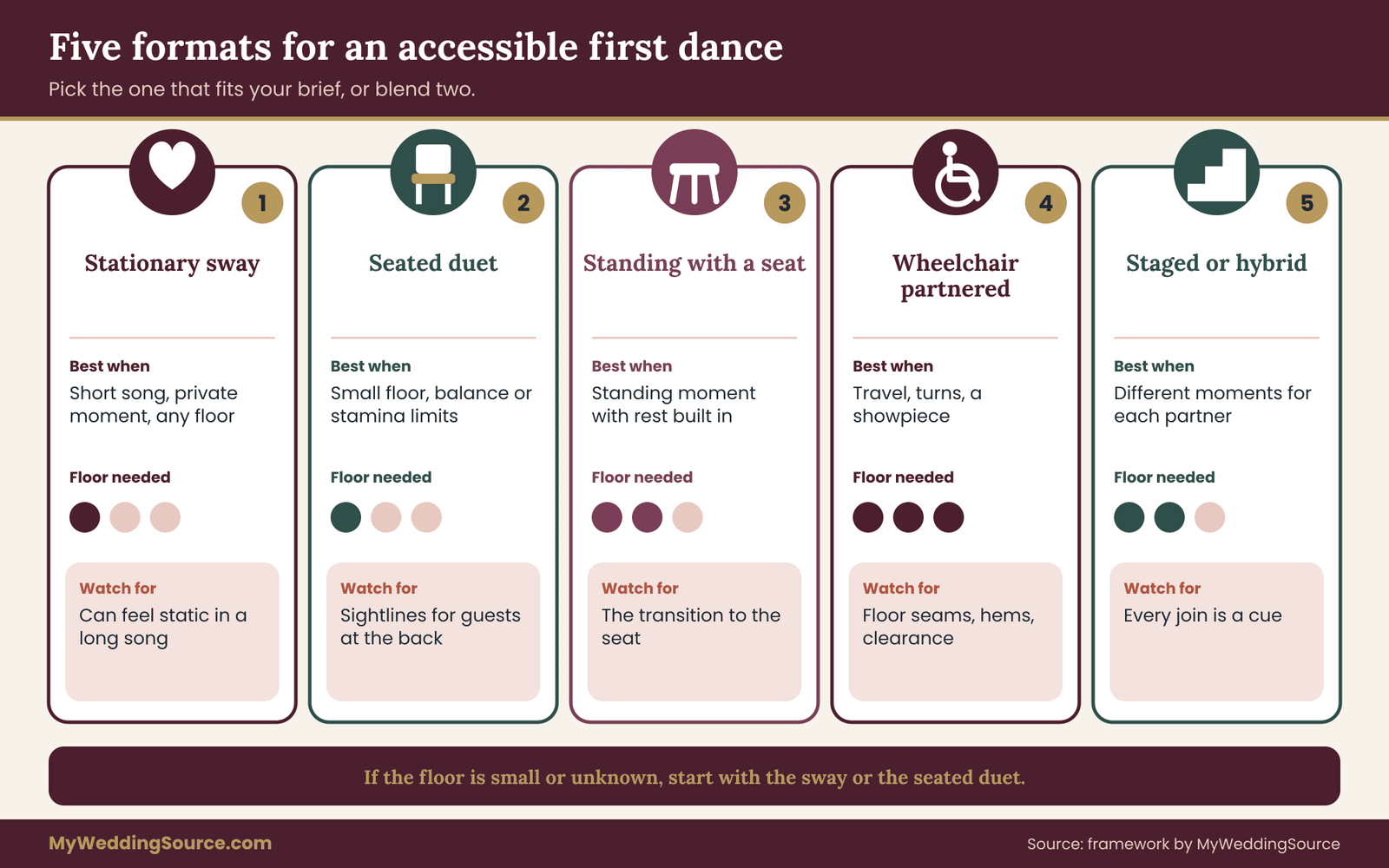
Once the brief is written, the next decision is the format. There are five that cover most couples, and most real dances are one of them or a blend. Each has a different strength, a different risk and a different set of questions for the venue. None is better than the others in the abstract. The right one is the one that fits your brief.
Read all five before you pick. Couples often assume their format on the first day, then find that a different one suits the song, the floor or the feeling they want.
Format one: the stationary sway
Both partners stay roughly in place. The accessible first dance is built from close contact, slow weight shifts, small turns of the upper body, arm movements and a defined ending. If one partner is seated, the standing partner can sit or kneel nearby, or stand close with a hand on the chair or shoulder.
Its strength is that it asks for no travel and very little floor. It works on almost any surface, in almost any room, in almost any dress. Its risk is that it can feel static if the song is long, so it suits a short edit and a clear arc: start close, add one small turn or hand gesture in the middle, finish in an embrace.
A stationary sway demands more from the music and the camera than from the dancers. A song with a clear build, a photographer who knows when to move and a DJ who fades the lights slightly can make this format the most moving of the five. It is also the easiest to shorten or extend on the night without anyone noticing.
Format two: the seated duet
Both partners are seated, facing each other or side by side. The movement is arms, hands, shoulders, head and sometimes chair rotation. The accessible first dance choreography borrows from seated dance traditions, where the upper body carries the whole performance and the feeling of movement.
Its strength is that it removes questions about balance and stamina on the feet, and it gives the couple an equal footing in the literal sense. Its risks are about sightlines and framing. Guests seated far back may not see two people in chairs at floor level, so the venue has to consider elevation, lighting and where the chairs sit on the floor. A small, slightly raised floor or a spot lit area helps considerably.
Chairs matter. If a partner who does not use a wheelchair will be seated, a sturdy chair without arms that matches the height of the other partner’s seat will look more balanced than a banquet chair that sits a few inches higher or lower. Test this in the venue, not at home.
Format three: supported standing with a seat
One or both partners stand for part of the song with support, then sit for the rest. The support might be a cane, a walker, a rail, a high stool or the other partner. The seat is part of the accessible first dance choreography, not an escape from it, and it is placed where the dance will naturally end up.
The strength of this format is that it shows the couple standing together at the moment many guests expect, while building rest into the accessible first dance plan. Its risks are the standing time and the transition to seating. The transition is where choreography matters most: it should be a planned move, on a count, with the chair or stool positioned in advance and a clear cue for the partner who is helping.
Instructors often build this format backward. They decide where the seat is and how the final moments look, then work out the standing section that leads into it. If you can describe the last ten seconds you want, you can get a good plan from the end.
Format four: the wheelchair partnered dance
One or both partners use a wheelchair as the center of the accessible first dance choreography. The chair travels, turns, circles and pauses, and the standing partner, if there is one, moves with it or around it. Partnered wheelchair dance is an established practice in its own right, and the sport side of it is overseen internationally by the World Para Dance Sport body within World DanceSport, so there is a body of technique to draw on if your instructor knows it.
The strength is movement. A chair can glide, spin and sweep across a floor in ways that look graceful and require little effort from the standing partner. The risks are the floor and the dress. A hem that catches a wheel, a floor seam that stops a caster or an uneven rental floor can derail the accessible first dance. This format almost always needs rehearsal on a surface like the real one, and it benefits from a venue that has been measured.
If you want a chair to travel, tell the venue. Ask how much clear floor there is, whether there are cable runs or thresholds, and whether the dance floor sits level with the surrounding floor. The accessible wedding venue red flags guide is a good checklist for the kinds of surface and access problems that often turn up late.
Format five: the staged or hybrid dance
The accessible first dance has two or three phases. It might begin seated and end standing, begin close and end with the whole room joining, or move from a short private moment into a shared dance. Each phase uses a different format from the list above, and the transitions are choreographed.
The strength is flexibility. It lets you give each partner a moment that suits them, and it lets you control energy by changing the type of movement. The risk is complexity. Every transition is a cue, and every cue is something that can go wrong. Keep phases few, keep transitions simple and rehearse the joins more than the phases.
A common and effective hybrid is the invited dance: the couple does a short first section alone, then the DJ cues guests to join. This gets you off the floor of attention quickly and turns a performance into a party. It also lets you ask the DJ to start the second half with a song that is easier to move to for anyone.
A decision rule for choosing the format
Choosing between five formats can feel arbitrary. These rules help you narrow it down quickly, and they are intended as starting points for a conversation with your instructor, not a ruling.
If the floor is small, unknown or likely to be uneven, begin with the stationary sway or the seated duet. These need the least from the surface. If the floor is large, smooth and tested, the wheelchair partnered dance and the hybrid open up.
If either partner’s active stretch is under about a minute, plan the accessible first dance around a short song edit and either the sway or the supported standing format with a seat. If the active stretch is two or three minutes, nearly every format is possible. If it varies from day to day, choose a format with a ready fallback, which is usually the sway.
If the dress is long, full or has a train, avoid formats that rely on travel until you have rehearsed in the dress. If either of you is in heels, ask whether a change of shoes is acceptable. If one of you is anxious about performing, favor the sway or the invited hybrid, where attention moves quickly to the room.
If your goal is a private moment, pick the sway. If your goal is a surprise or a showpiece, pick the wheelchair partnered or the hybrid. If your goal is tradition, pick whichever format best supports the specific gesture or step that carries the tradition.
Test two formats in one lesson
If you cannot decide, ask your instructor to teach you the first thirty seconds of two formats in a single lesson. You do not need the full dance, only enough to feel what each is like. Most couples know within ten minutes which they prefer. It is a cheap way to avoid committing to a choreography that does not feel right.
Make notes straight after the lesson about what felt easy, what felt like effort and what felt like yours. These notes are the first real data you have, and they are more useful than any description in a guide.
What changes the format late
Formats change for practical reasons. A venue change moves you from a large floor to a small one. A new dress changes the movement. A partner’s health changes. A song changes. When something shifts, go back to the brief and update the line that changed, then check whether the format still fits. Do not try to patch the accessible first dance choreography around the change in your head. The brief exists so that you can say what is different and let the plan follow.
The guest flow planning page helps with the room-level version of the same question: what happens to the dance when seating, the bar or the buffet moves. An accessible first dance that was designed for a particular room has to be checked again if the room changes.
Building the choreography: counts, pauses and the energy map
With a format chosen, the instructor builds the movement. You can follow most of this without any dance training, and understanding it helps you give useful feedback during lessons. The central idea is the energy map: a plan for how much effort each part of the song asks for, drawn before any steps are fixed.
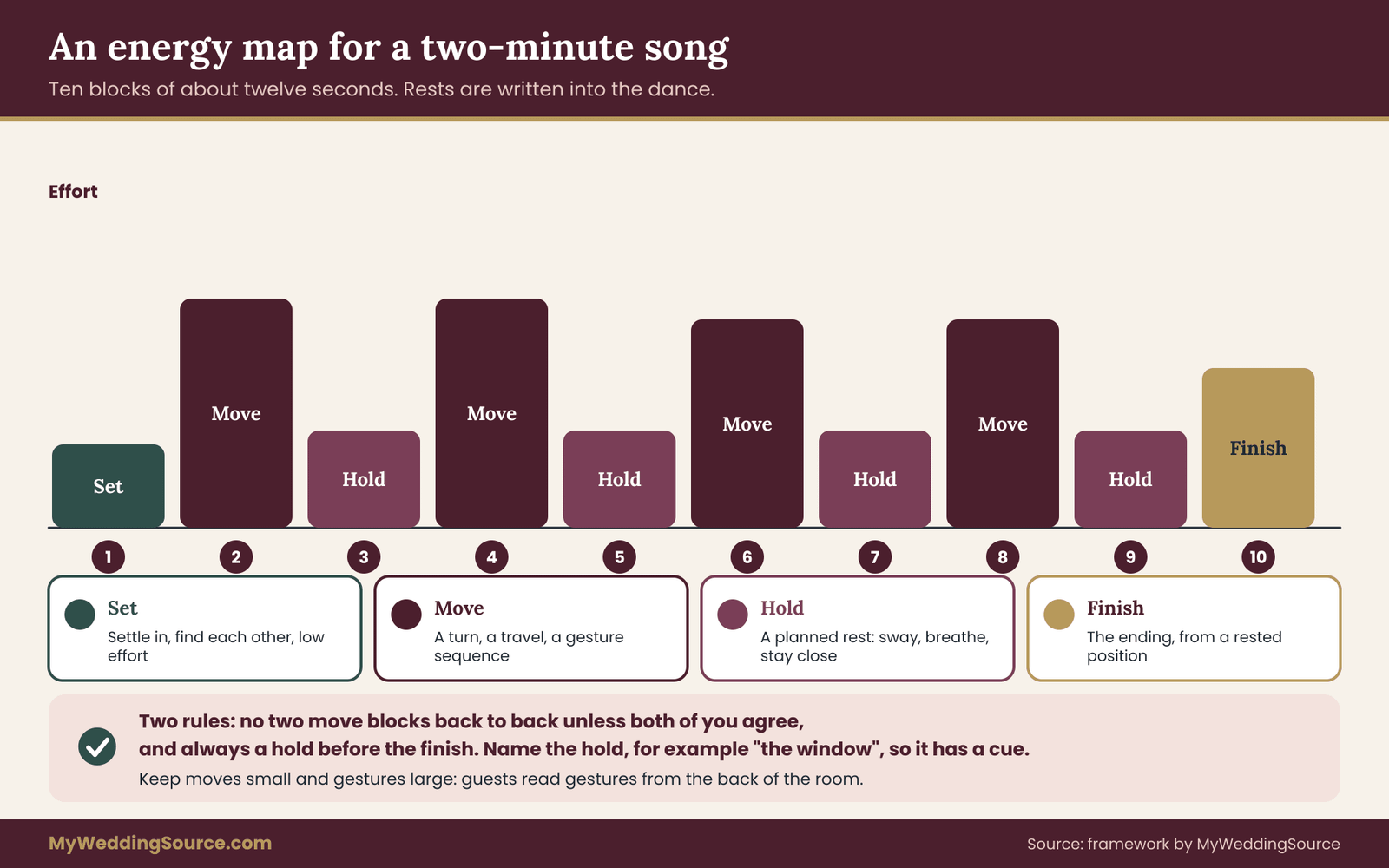
A typical first dance runs somewhere between one and three minutes. Within that time, the accessible first dance has a start, a middle and an ending, and the effort should not be flat across them. A flat energy line either tires the dancers early or leaves the middle limp. An energy map lets you place high points, rest points and the ending where they help you most.
Mapping the song in blocks
Divide the song into blocks of eight counts, which is about ten to sixteen seconds at a moderate tempo. Label each block as one of four types: set, move, hold or finish.
A set block is the opening. You come into position, find each other and settle. It is low effort and sets the tone. A move block carries the movement: a turn, a travel, a gesture sequence. A hold block is a planned rest where you stay close, sway or simply breathe while the music continues. A finish block carries the ending.
A one-minute dance might be set, move, hold, move, finish. A two-minute dance might add another hold and another move. The pattern is not fixed, but the rule is: never put two move blocks back to back unless both partners have said that is comfortable, and always put a hold before the finish. The final gesture should come from a rested position, not a tired one.
Put the rests inside the choreography
The most common mistake in adapted choreography is treating rests as something that happens when someone gets tired. In a good plan, the rests are written in. A hold block is not a pause in the accessible first dance. It is part of the dance, and it often becomes the most intimate moment of the song. Guests see two people close together in a quiet moment and do not see a rest at all.
Write the rest into the brief, give it a name and give it a cue. “Window” is a nice, neutral word: “at the window, we hold.” Then if someone needs more time, you extend the window without any change in the plan, and the DJ’s music keeps going underneath.
Cues without looking
Dancers normally watch each other, the floor or the music. Couples at a wedding are often watching guests, a camera or the nerves in their own head. Plan cues that do not depend on eye contact. A squeeze of a hand on the count of the last beat of a block. A slight pressure at the shoulder before a turn. A spoken word, quiet and agreed, such as “turn” or “hold.”
Verbal cues are not a failure of style. Many dancers use them in rehearsal and sometimes in performance. A whispered word during a slow song is rarely audible past the first row, and the couple often finds it comforting rather than awkward. Decide in advance which cues are touch and which are spoken, and rehearse them together.
Building transitions
Every format has joins: the moment you step onto the floor, the moment you settle into position, the moment you move from one block to the next, the moment you end. These are where adapted dances most often go wrong, not because they are hard but because they are not planned.
For each join, ask the instructor three things. Who moves first? What is the cue? What is the recovery if it goes wrong? Recovery matters more than the move. If a chair does not line up at the start, the recovery might be to take two extra counts and let the music cover it. If a transition to a seat is off by one count, the recovery might be to hold the embrace until the next phrase.
Rehearse the recovery as often as the plan. When you have practiced the recovery, a mistake in front of guests becomes a small pause rather than a visible stumble.
Keep gestures big and moves small
An effective rule of thumb for accessible first dance choreography is to keep the individual moves small and the gestures large. A small move might be a slow, three-count weight shift. A large gesture might be a raised hand, an open arm, a bow of the head or a deliberate, slow look. Guests read gestures easily from a distance and miss small footwork altogether.
This rule also protects the dancers. A move that asks for fine control under pressure is harder to repeat on the night than a gesture. Lean on the gestures, which are forgiving, and let the moves be simple.
Music, tempo and song edits for an accessible first dance
The song is the part of the dance couples have the most feeling about and the least control over. Tempo, length and structure affect an accessible first dance more than they affect a standard one, so it is worth treating the song as a design choice and not only an emotional one.
Tempo: slow is not always easy
Many couples assume a very slow song will be easier. Often it is the opposite. At very slow tempos each count is long, and a dancer has to hold balance, position or a gesture for longer. A song with a moderate, steady pulse gives the dancers more frequent beats to anchor to and keeps the movement flowing.
Ask the instructor to count the song in the first lesson and tell you how many beats per minute it has and whether the pulse is steady. If the answer is “very slow” or “uneven,” ask whether a different version of the song exists, such as a live recording, an acoustic version or an instrumental arrangement with a clearer pulse. Many songs have several versions, and they differ more than couples expect.
Length: edit the song to the dance
The standard recommendation for a first dance is to edit the song to about a minute and a half to two minutes. For an accessible first dance, the right length is whatever the energy map says it is, and it can be shorter. A well-made edit sounds natural: it cuts a verse or a long instrumental passage, joins phrases at a musical boundary and ends with a proper resolution, not a fade.
Ask whether the DJ or a music editor will make the cut, and how many days before the wedding you will hear the final edit. Test the edit with the accessible first dance, not only by listening. A cut that sounds good in the car can land at a strange moment in the choreography.
If you are working with a band, the equivalent is a conversation with the bandleader about arrangement, key and length. Bands can often start slowly, hold a phrase or extend a passage if a signal is agreed, which is a useful kind of flexibility.
Intros, endings and the next song
Plan the start and the end of the song as part of the accessible first dance. Does the song begin with an introduction while you walk or roll to the floor? Is there a spoken introduction from the MC? Will you hold your closing gesture for a few seconds while guests react? What plays next, and is it a song that invites guests onto the floor?
The transition into the next song is a useful tool. If the second song is upbeat and familiar, guests will move quickly onto the floor, and the couple can step back, sit or leave the floor as part of the flow rather than as a retreat. The reception music plan covers how to sequence the opening songs of a reception, and it is worth reading alongside your dance plan.
Volume and the room
Music volume affects the accessible first dance in two ways. If it is too loud, cues spoken softly are lost and the dancers may feel rushed. If it is too soft, the room feels flat and the counts are harder to feel. Ask the DJ to run a sound check on the dance floor itself, standing where you will stand, with the sound you will actually hear.
Monitor speakers aimed at the floor can help, and a DJ will usually know whether one is worth setting up. If you use hearing devices, tell the DJ and the instructor so that they can check the level at your position and plan a gentler start.
A song that carries too much
Some songs carry a great deal of memory. They are a shared joke, a song played at a first meeting or a family favorite. If a song is that important, the accessible first dance choreography should serve it, not the reverse. If the tempo or structure does not suit the dance you want, consider a hybrid: use the meaningful song for the ending, or for a quiet moment at the end of the evening when the pressure is lower. Many couples find that the right place for a precious song is not the first dance.
Floor, space and dress checks for an accessible first dance
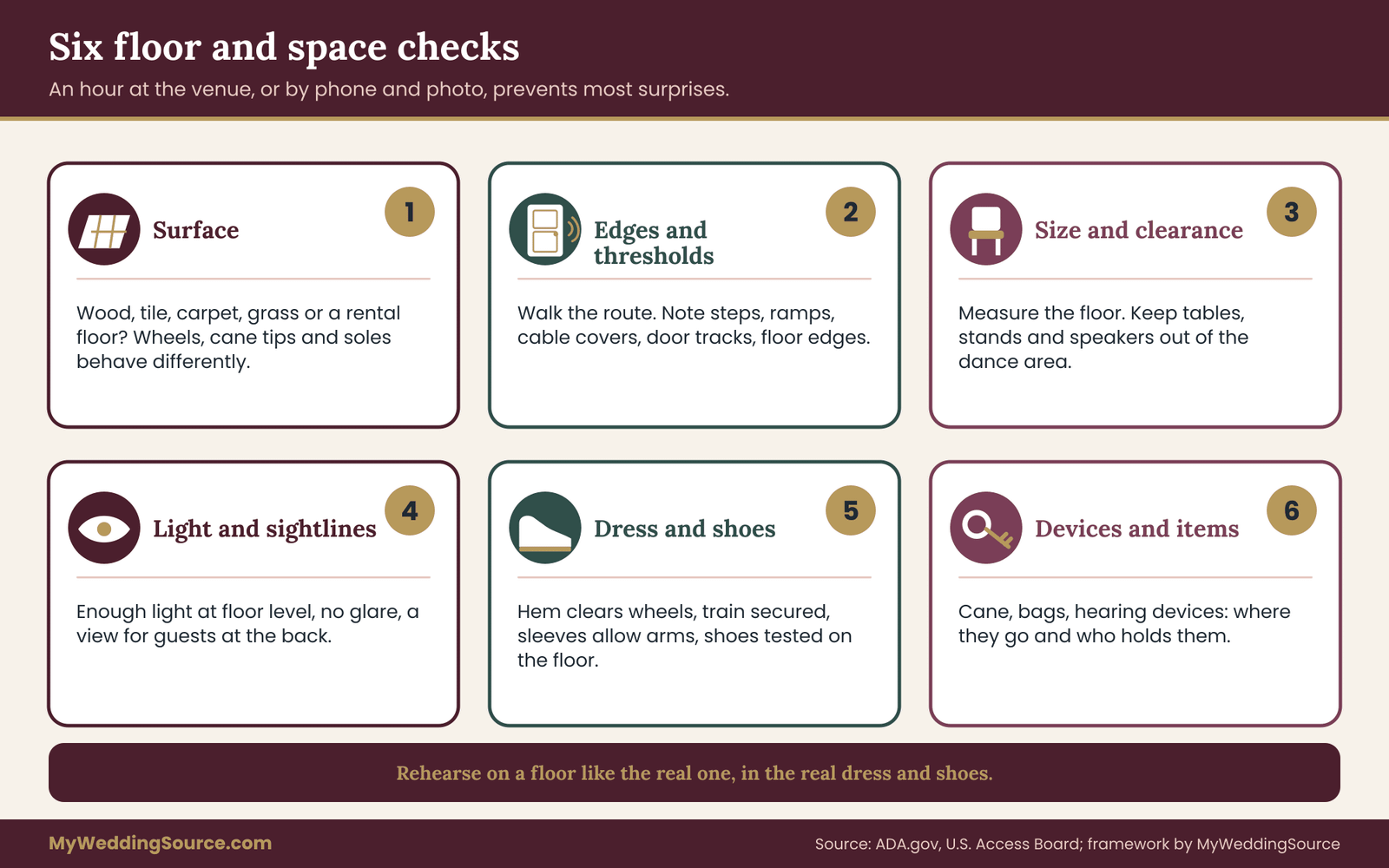
A choreography that works in a studio can fail on a wedding floor, and the failures are almost always about the surface, the edges and the clothing. These checks take an hour and prevent most of the surprises. Do them at the venue if you can, and by phone and photo if you cannot.
The floor surface
Ask the venue exactly what you will be standing or rolling on. Polished hardwood, stone, tile, carpet, concrete, grass, gravel, decking or a temporary floor of interlocking panels each behave differently. Smooth surfaces suit chair wheels and gliding, and can be slippery for soft-soled shoes or cane tips. Carpet slows a chair and can catch a toe. Grass and gravel are poor for almost every adapted format.
If the floor is a rental, ask the rental company what the surface is, whether it is level with the surrounding floor and whether it has edge pieces. The wedding rental planning checklist covers the questions to ask a rental company about delivery, setup time and what is included. Add three of your own: how are seams finished, how is the edge handled, and can the floor be laid on the surface where it will sit.
A rental floor laid over grass or uneven ground can flex and move. A rental floor laid on a hard, flat surface behaves very differently. The difference is not obvious in photos, which is why it is worth asking.
Edges, thresholds and level changes
Walk the route from where you wait to where you dance. Note every threshold, step, ramp, cable cover, door track and change of surface. A raised dance floor edge of even a small height is an obstacle for a chair or a cane. A cable cover is a trip risk. A door threshold at the entrance can stop a caster.
Where a change in level cannot be avoided, ask whether a ramp or edge transition can be provided. The U.S. Access Board publishes the ADA Accessibility Standards, which set out requirements for ramps, routes and surfaces in covered spaces, and the Department of Justice explains how the Americans with Disabilities Act applies to places of public accommodation. Check the current text on the agencies’ own sites, because the details matter and a venue coordinator may not know them. A venue’s willingness to discuss these points plainly is itself useful information.
Venue access problems tend to appear late in planning, so settle them before the accessible first dance choreography is locked in, not after.
Size and clearance
Measure the accessible first dance floor and note the clear space around it. A seated duet needs less room than a traveling chair. A traveling chair with a train or a long skirt needs more. Leave a margin around the dance area so that tables, chairs, flower stands and speaker stacks are not close enough to catch a wheel or a hem.
Ask where the DJ’s cables run, where the photographer will be standing and where any other equipment sits. Floors that look clear in a floor plan often have cable runs and stands where nobody expected them. If you can, stand in the empty room with your instructor and mark the accessible first dance area with tape.
Light, sightlines and elevation
Dim light is flattering and makes footwork hard to see for both dancers and guests. If either partner relies on seeing the floor, tell the venue and the DJ so that the lighting plan leaves enough light at floor level. Spotlights can be dazzling for someone looking up from a chair, so ask for a test.
Sightlines matter more for seated formats. Guests at the back of a room will not see two people at chair height unless the layout helps. Consider arranging guests closer to the floor, standing behind the front tables for the accessible first dance or, if the venue has one, a low riser. A photographer or videographer can also lift the experience for those who cannot see directly, but the room itself should do most of the work.
Dress, shoes and equipment on the day
Rehearse in what you will wear. This is not about looks. It is about hems, trains, sleeves, jackets, ties, shoes and anything you carry. A hem that clears the floor in a studio may catch a wheel in motion. A jacket that is comfortable standing may restrict the arms when seated.
Ask the seamstress or tailor about three things: a hem that clears wheels and shoes, a way to secure a train or bustle for the accessible first dance, and sleeves that allow full arm movement. Bring the shoes and the dance plan to the fitting.
Shoes are a separate conversation. A pair that works for walking down an aisle may be wrong for a dance floor. Some couples choose a pair that is comfortable and stable for the accessible first dance, then change back afterward. Test shoes on the kind of surface you will dance on, with the real dress.
Devices and personal items
Decide where each partner’s devices, bags and personal items will be during the accessible first dance, and who will manage them. A cane or crutch that is put down needs a safe place within reach. A hearing device or other worn device may need checking before an embrace. A bag, pouch or phone should be with a trusted person, not on the floor.
Put this on the brief and tell the person who holds the plan. A single sentence, such as “A’s cane goes to the chair by the DJ table and stays within reach,” is enough to prevent an awkward scramble.
A rehearsal plan for an accessible first dance
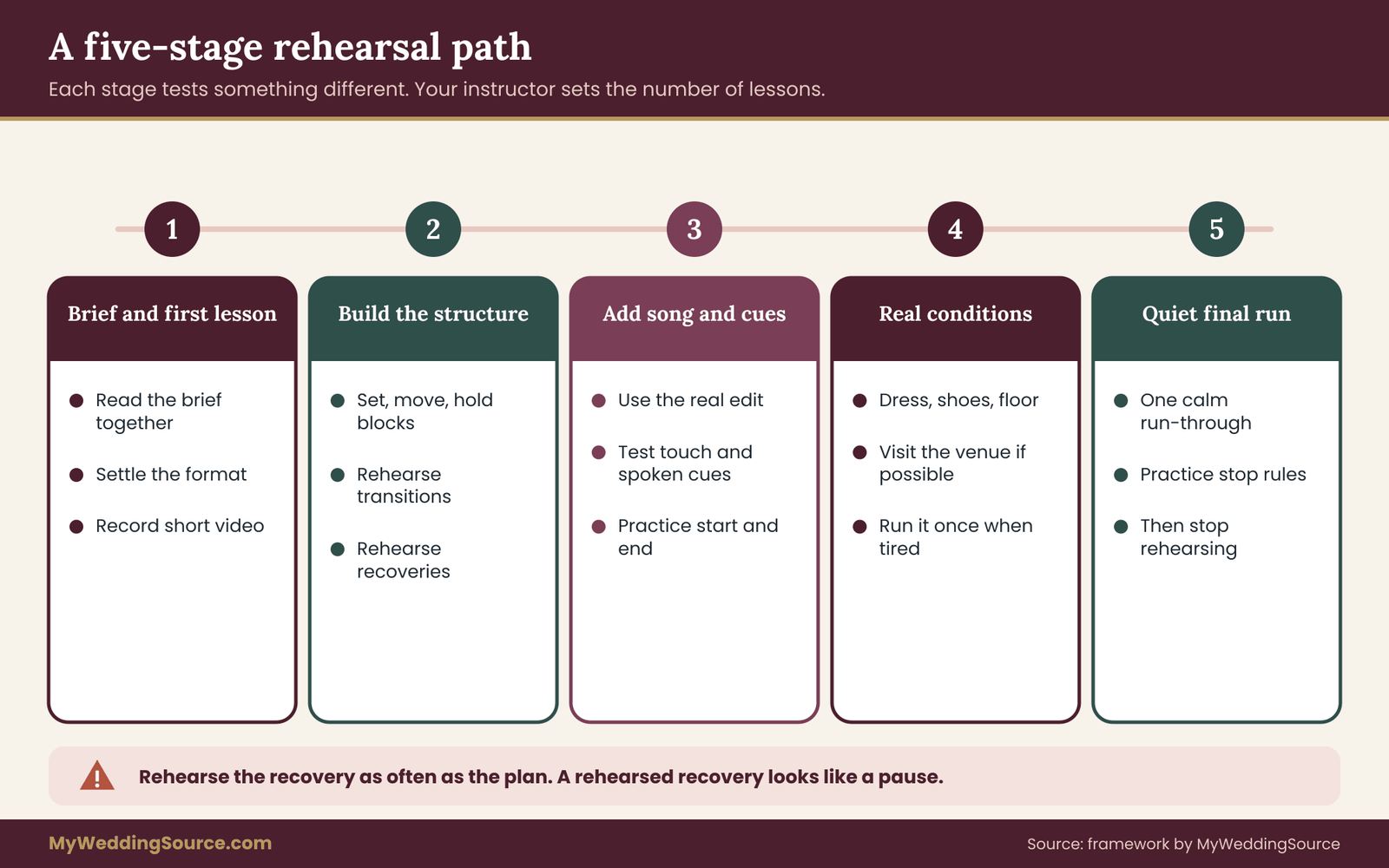
A good rehearsal plan is short, specific and shaped around the things most likely to go wrong. It is not a schedule of lessons. Your instructor will tell you how many lessons they recommend and how often. This section is about what each stage of rehearsal needs to test.
Stage one: the brief and the first lesson
In the first lesson, the instructor reads the brief with you, asks questions and teaches a first short section. The goal is not to learn a dance. It is to find out what feels natural and what does not, and to settle the format. Take notes, and record short video if the instructor agrees, so you can compare later.
Stage two: build the structure
Over the next few lessons, the instructor builds the structure: set, move, hold, move, finish, or whatever block pattern you chose. Rehearse the transitions and the recoveries as much as the moves. When something feels like effort, say so. The instructor can change a count, a position or a gesture much more easily in rehearsal than on the day.
Stage three: add the song, the edit and the cues
Once the structure is stable, rehearse with the real edit of the song. Test the cues you agreed on, touch and spoken. Rehearse the start and end, including how you come onto the floor and what you do after the last note. If the DJ can attend a lesson, or send the final edit, even better.
Stage four: the real conditions
Rehearse at least once under conditions as close to the wedding as possible: the dress, the shoes, the surface, the light, and ideally the venue. If you cannot rehearse at the venue, find a space with a similar floor. Ask the venue whether a short visit before the wedding is possible. Many venues will allow a short walk-through with a coordinator if you ask, and it is the single most useful rehearsal.
Also rehearse when tired. A first dance does not happen when you are fresh. It happens after a ceremony, photos, a meal and a lot of conversation. Run the accessible first dance once after a long day, or after some deliberate activity, so you know how it feels at the real energy level. If it feels harder than in the studio, adjust the plan now.
Stage five: the quiet final run
In the last week, do one calm run-through, not a push. The aim is familiarity, not polish. Practice the stop rules and the fallback once, so they are as familiar as the main dance. Then stop. Over-rehearsing in the final days risks fatigue and nerves, and an accessible first dance that feels a bit loose is usually fine.
The wedding vendor contract guide is a reminder that anything you need from a vendor, such as a song edit, a sound check or an arrival time for the DJ, should be in writing. If the brief says the DJ will attend a sound check on the floor, confirm that it is in the agreement and not only in conversation.
A worked case: one couple, one brief, one dance
The following case is invented for illustration. It is not a real couple and it does not report any outcome. Its purpose is to show how the brief turns into a format, a block plan and a set of rules. Any couple’s own details will differ, and a real plan should be based on what the two of you and your instructor decide.
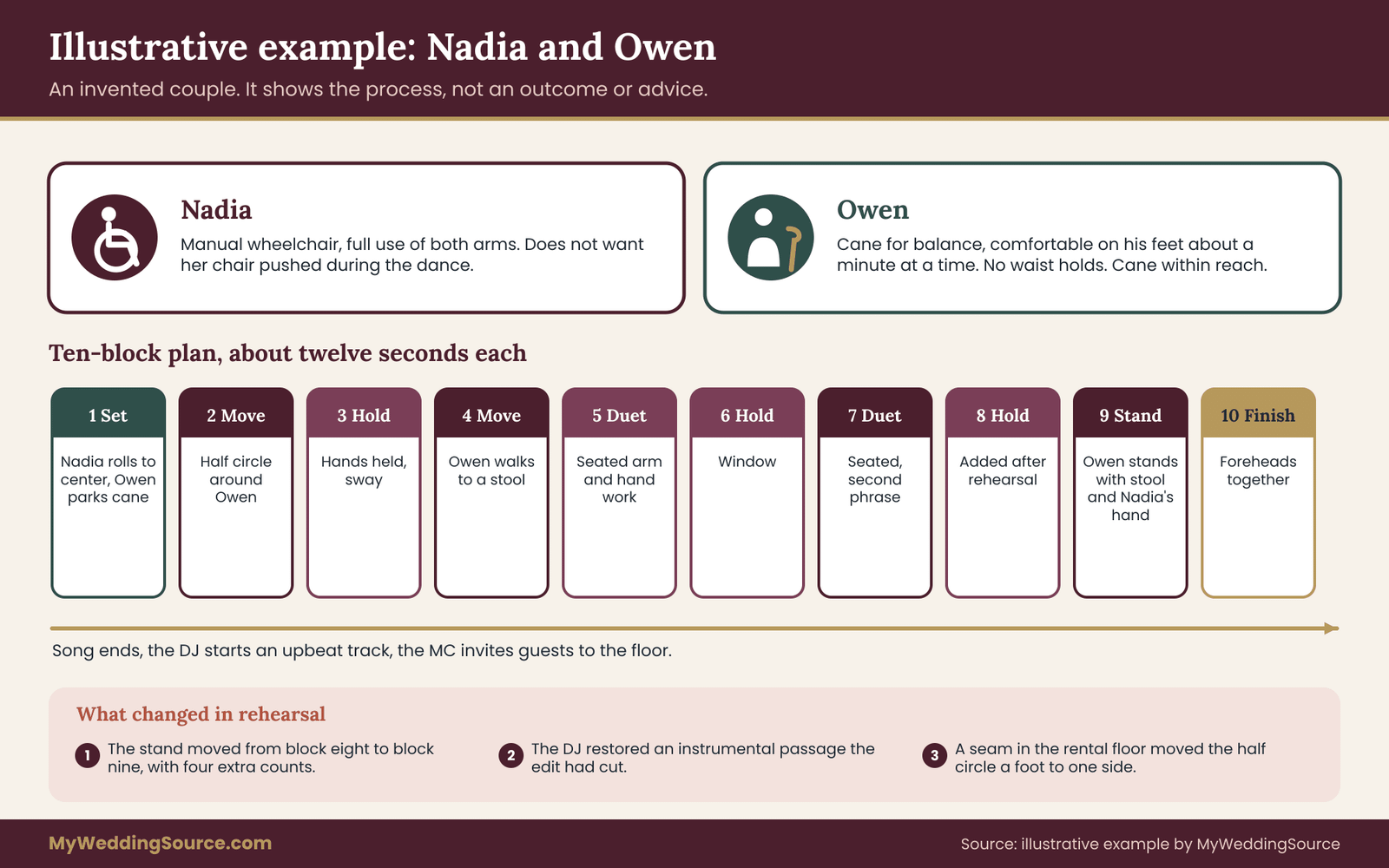
Imagine Nadia and Owen. Nadia uses a manual wheelchair and has full use of her arms. Owen walks with a cane for balance and is comfortable on his feet for about a minute at a time before he wants to sit. Both are nervous about being watched. They want the accessible first dance to feel unhurried, to last about two minutes and to end with their foreheads together. They are planning an accessible first dance for their reception in a hall with a rented panel dance floor laid over a hard, flat surface.
Step one: filling in the brief
Their brief says Nadia can spin and travel on a smooth floor and does not want her chair pushed by anyone during the dance. Owen can stand and take small steps for about a minute, does not want to be held at the waist and wants his cane within reach at all times. Both prefer a moderate-tempo song. The floor is a rental, so the surface is listed as “unknown, to be confirmed.” The dress is a mid-length gown with no train, chosen partly so that it clears the wheels.
Their signals are a squeeze of the hand for slower, two squeezes for pause and a spoken “window” for a hold. Their fallback is a thirty-second sway.
Step two: choosing the format
Their instructor reads the brief and suggests a hybrid. Owen’s active stretch is short, Nadia’s chair travels well and they want quiet over spectacle. The plan is a short first phase where Nadia rolls to Owen, a middle phase with Owen seated on a stool and a seated duet of arm and hand movement, and a finishing phase where Owen stands with the stool’s support and they end forehead to forehead. They agree to avoid any move that has Owen kneeling or being lifted.
Step three: the block plan
The instructor maps the song as ten blocks of about twelve seconds each. Block one is a set: Nadia rolls to the center while Owen, standing, places his cane on a chair beside the floor. Block two is a move: Nadia makes a slow half circle around Owen while he turns in place. Block three is a hold at the window: they hold hands and sway.
Block four is a move: Owen takes four small steps to a stool placed on the floor. Blocks five to seven are the seated duet, with hold blocks between phrases. Block eight is a move: Owen stands, using the stool and Nadia’s hand. Block nine is a hold. Block ten is the finish.
At the end of the song, the DJ starts a familiar upbeat track, and the MC invites guests to the floor. Owen’s cane is handed to him by a friend who has been told in advance.
Step four: rehearsal and what changed
During rehearsal, the transition from the stool back to standing in block eight felt rushed. Owen was tired by that point and the stand felt like effort. The instructor changed the plan: block eight became a hold, and the stand was moved to block nine with an extra four counts. They also found that the song edit cut off an instrumental passage that had given them time for the stand, so they asked the DJ to restore it.
In the venue walk-through, the panel floor had a slight seam near the center. Nadia’s chair noticed it, and the accessible first dance plan was adjusted so that her half circle in block two moved a foot to one side. A small tape marker kept the position during the night.
Notice what happened. Nothing dramatic. The brief identified the questions, the rehearsals tested them, and the changes were small. The accessible first dance that emerged was not what either had imagined at the start, and they were happy with it.
What this case does not show
It does not show that this format suits every couple with similar needs, or that these timings are right for anyone else. It does not show what a clinician would say about a particular movement. It does not prove that any choreography is safe. It shows the process: brief, format, block plan, rehearsal, adjustment. That is the part you can reuse.
Failure conditions and stop rules
Every plan has conditions under which it should change. Naming them in advance is not pessimism. It is what lets a dance end well when something goes differently from the plan. There are two kinds: conditions that should change the plan before the day, and stop rules that apply during the accessible first dance.
Conditions that change the plan before the day
Treat each of these as a prompt to revise the brief, not as a defeat.
The floor fails the test. If the real surface catches a wheel, slips a shoe or flexes underfoot, the format that relies on it should change. Move to a stationary sway or a seated duet, or ask the venue or rental company to change the floor.
The accessible first dance costs more than the brief said. If a real-conditions rehearsal shows that the active stretch is shorter or the effort higher than you thought, shorten the edit, add holds or change the format. Revising the brief is the right response, not pushing through.
The dress or shoes interfere. If the hem catches, the sleeves restrict or the shoes are unstable, fix the clothing or change the accessible first dance choreography. Do not rehearse around a problem that will recur on the night.
A partner no longer wants to do it. This is a valid reason to change the accessible first dance plan at any time. A dance that one partner dreads is not a gift to the other. A shorter or quieter version is always available.
A vendor cannot deliver. If the DJ cannot do the edit, the venue cannot confirm the floor or the instructor is no longer available, rely on the fallback and the written outline. This is why a written outline matters.
Stop rules during the dance
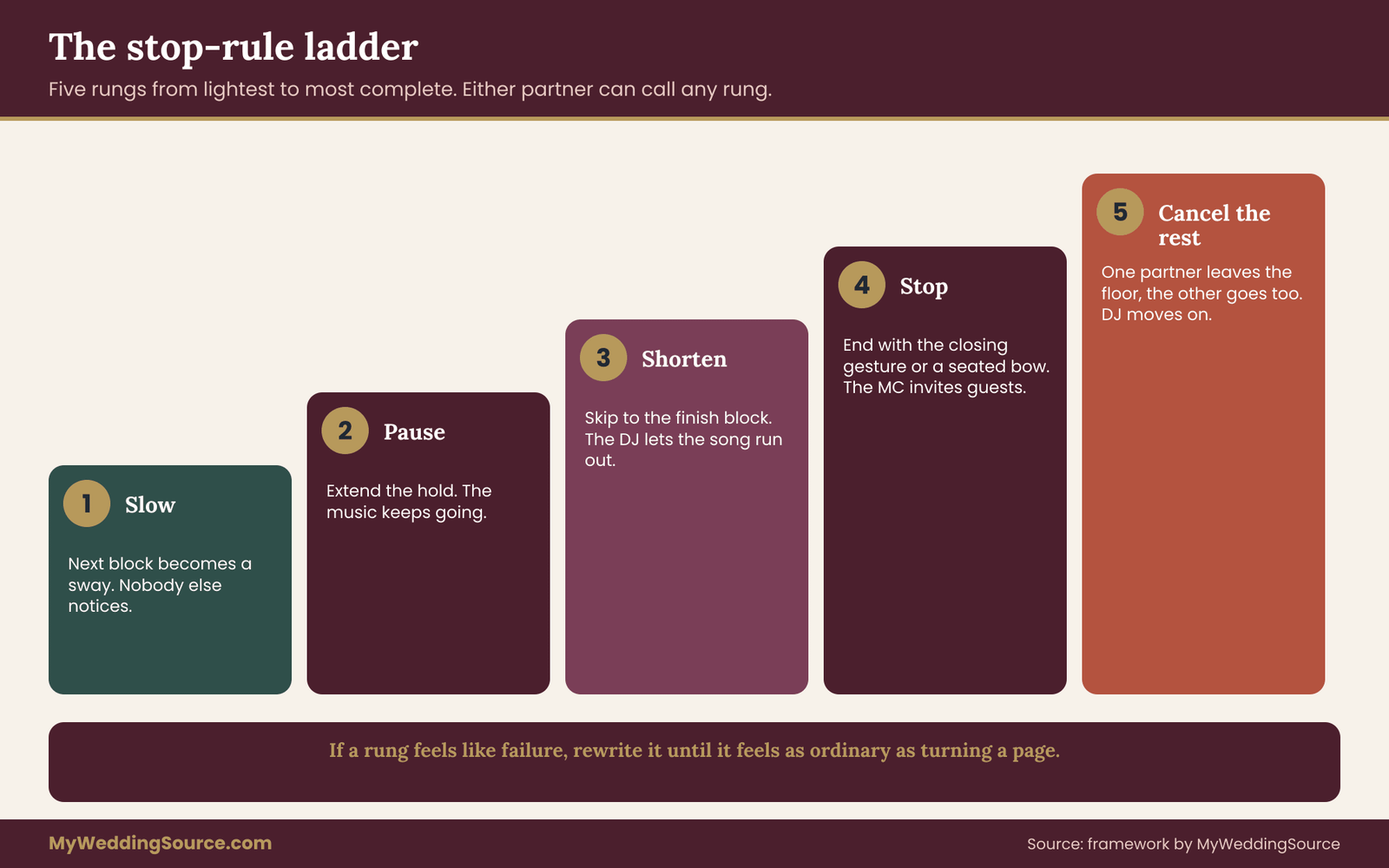
Stop rules work best as a short ladder, with each rung agreed in advance. The ladder has five rungs, from lightest to most complete.
Rung one is slow. Either of you signals, and the next block becomes a sway. Nobody else notices. Rung two is pause. You extend the hold and the music continues. Guests see a quiet moment. Rung three is shorten. You skip to the finish block, and the DJ, who has been told, lets the song run out.
Rung four is stop. You end with the closing gesture or with a seated bow, and the MC invites guests to the floor. Rung five is cancel the rest. If one of you needs to leave the floor, the other goes with them, and the DJ moves to the next song or a short pause.
Each rung should feel acceptable. If a rung feels like failure, rewrite it until it does not. The ladder works only if using it feels as ordinary as turning a page.
Who calls the rungs
Either partner can call any rung at any time, without explanation. In addition, the person who holds the accessible first dance plan, the coordinator or a friend, can signal the DJ to move to the next rung if they see something the couple cannot, such as a floor problem or a guest in the way. Agree this in advance so that nobody feels overruled.
After a stop
If a dance is stopped early, do not apologize to the room. A short, warm sentence from the MC, such as thanking everyone and inviting them to the floor, is enough. Later, if you wish, you can offer a private dance at the end of the night, with the lights low and the room nearly empty. Couples often find that this is the accessible first dance they remember best.
Day-of coordination: who tells whom
On the wedding day, the brief becomes a short set of handoffs. The goal is that nobody has to ask the couple a question in the hour before the accessible first dance.
Give the person who holds the plan a printed copy of the brief and the block plan. They tell the DJ the order of events, confirm the edit is loaded and agree the cue for the entrance. They tell the venue coordinator that the dance floor must be clear and the route open. They tell the photographer and videographer where to stand, which moments to catch and which to leave alone. They tell the MC what to say and what not to say.
A useful script for the DJ is short: “The dance is about two minutes, using the edit you have. We may extend the hold in the middle, and either of us may signal to move to the finish. When it ends, please start the next song straight away, and invite guests to the floor.”
Timing in the evening
The point in the evening where the accessible first dance happens affects how it feels. Right after a long ceremony and photo session, energy may be low. After a meal, it may be better, or it may be worse. Ask yourselves when each of you feels best and place the dance there. A vendor timeline shows how the day is usually sequenced, and many couples find that a dance after dinner and a short rest suits them better than one at the very start of the reception.
Allow ten minutes of quiet before the accessible first dance. A short break, a drink of water and a moment together reduce nerves and fatigue. If the schedule is tight, protect that ten minutes before protecting a speech.
Tell the guests what to do
Guests often crowd the floor edge to see, which blocks sightlines for others and reduces clear space. A short instruction from the MC helps: “Please stay at your tables until the song ends, and then we will invite you onto the floor.” If a particular area must be kept clear for a chair, mark it or have a friend stand in it.
Guests also take photos, and phones held up in front of the floor can block the camera and crowd the space. Couples often set expectations for guest photos in advance, which is worth a line from the MC too.
The photographer and the dance
A photographer or videographer can make or miss the accessible first dance. Tell them the format, the key gestures and the ending. Ask them to stay at the edges and low, so that they do not stand in the path of a chair or crowd the dancers. If you want a particular moment, such as foreheads together at the end, name it so they are ready.
Alternatives to a traditional first dance
Not every couple wants to dance, and not every couple should feel they must. If the brief shows that none of the five formats feels right, there are other ways to mark the moment.
A first entrance can carry the weight. Rolling or walking into the reception to a song, with a pause for applause, is a moment guests respond to. A shared first song without a dance, where you sit or stand together, listen and perhaps hold hands, is quiet and personal. A toast, a reading or a short spoken message can replace the accessible first dance. A family dance, in which relatives join you from the start, spreads attention across the room.
A private dance can happen away from guests: after the reception, in a corner, in a hotel room or at a different moment during the day. Some couples film it or have the photographer record a short clip for later. This gives you the accessible first dance without the audience.
None of these is a lesser choice. The best alternative is the one that suits what you wrote in the goal sentence. If your goal was an unhurried moment, a private song can serve it better than a staged dance.
Your next steps
This week, write the goal sentence and the eight-line brief. Keep it to one page, so the whole accessible first dance fits on a sheet, and leave blank anything you do not yet know. Send it to your instructor before the first lesson, and ask for a short written outline in return.
Next, find out the floor your accessible first dance will use. Ask your venue or rental company what the surface is, whether there are level changes and how much clear space there is. Plan a short visit if you can. Then pick a format for the first lesson, or ask the instructor to teach two so you can compare them.
Finally, write the stop rules and the fallback on the same page, and share them with the person who holds the plan. When the brief, the floor, the format and the stop rules are written down, the accessible first dance becomes a plan you can follow, and a calm, well-prepared couple is the best thing the room will see.
FAQ
How early should we start planning an accessible first dance?
As soon as the venue and the date are settled, and no later than a couple of months before the wedding if you can manage it. Early planning gives you time to write the brief, find an instructor who fits, test a floor and change the format if something does not work. Your instructor can advise on how many lessons suit your plan.
Do we need an instructor with specific experience in adapted dance?
Experience helps, but the way an instructor works matters more. Look for someone who asks about your movement and your goals, describes a process and treats your brief as the starting point. Ask whether they have worked with dancers who use chairs, canes or other supports. Nobody can promise an outcome, and a good instructor will not try.
Can a person who uses a wheelchair dance with a standing partner?
Yes, and there are several ways to build it. The chair can travel and turn while the standing partner moves with it, or both partners can stay close in a sway or a seated duet. The best format depends on the floor, the dress and what each partner wants. Many couples start an accessible first dance as a sway and add movement later.
What if the dance floor at our venue is not suitable?
Ask the venue or the rental company what can change: a different surface, edge ramps, a clearer layout or a different position in the room. If nothing can change, choose a format that needs less from the floor, such as a stationary sway or a seated duet. The Americans with Disabilities Act and the Access Board’s standards are good starting points for conversations about access.
How long should an accessible first dance be?
As long as the energy map allows and no longer. Many first dances run between one and three minutes, and an adapted dance can be shorter. A song edit to match the accessible first dance, with built-in holds, usually feels better than a full-length song. Choose a length you could do comfortably when tired, not only when fresh.
What if one of us needs to stop during the dance?
Use the stop rules you agreed in advance. Either partner can signal slower, pause, shorten, stop or cancel the rest, without explanation. The DJ and the MC know what to do at each step, and the accessible first dance plan includes a fallback. A planned stop looks calm to guests and often feels warm, not awkward.
Should we ask our doctor or therapist about the choreography?
If you have a specific question about a movement, a transfer or a length of time on your feet, ask the professional who knows your situation. An instructor can adapt movement to what you say you can do, but cannot assess your condition. Bring the draft block plan to your appointment if that is helpful.
Is a private dance a good alternative?
For many couples, yes. A private version of an accessible first dance, away from guests or at a quiet moment, can feel more personal and less pressured. You can still invite a photographer to record a short clip, or hold a brief public moment first, such as an entrance or a toast. It is a valid choice, and it meets the goal many couples have in the first place.
Sources
- ADA.gov, U.S. Department of Justice Civil Rights Division
- ADA laws and regulations, U.S. Department of Justice
- Guidelines and Standards, ADA Accessibility Standards, U.S. Access Board
- ADA National Network, information, guidance and training on the ADA
- Disability.gov, U.S. Department of Labor Office of Disability Employment Policy
- Older adult fall prevention, Centers for Disease Control and Prevention
- National Center on Health, Physical Activity and Disability
- American Physical Therapy Association, find a physical therapist
- World DanceSport Federation, Para Dance Sport
- National Institute on Aging, National Institutes of Health