

Long sleeve wedding dresses change more than the look of a gown: they change how far you can reach, how warm you feel at the ceremony, how long the fittings take, and which alterations land on your invoice, so it pays to decide on the sleeve with the same care you give the silhouette.
Quick answer
Choose the silhouette first, because sleeves can usually be added later but the shape of a gown is harder to change, according to The Knot. Then test long sleeve wedding dresses the way you will actually use them: arms overhead, a full hug, a seat at a banquet table, and a dance. Expect a sleeve to add fitting time, more so for illusion lace than for detachable sleeves, and ask for the sleeve style, fabric, fittings, and price in writing before you pay a deposit. Detachable sleeves are the most flexible choice if your day runs warm.
What long sleeve wedding dresses change about a gown
A sleeve is not a trim, and long sleeve wedding dresses make that obvious. It is a tube of fabric that has to move with your shoulder, bend at the elbow, and stay put while the rest of the gown is doing something else. That is why long sleeve wedding dresses behave differently from sleeveless or strapless gowns, and why a dress that looks wonderful on a hanger can feel restrictive once the sleeves are on a real body. This section sets out what a sleeve actually does so the later sections on fabric, season, and fittings make sense.
The rest of this guide stays on the sleeve decision itself. For the broader picture of silhouettes, necklines, and fabrics across every gown, our wedding dresses guide and our wedding dress styles article cover the ground that this one does not repeat.
How a sleeve works on the body
Think of a gown with sleeves as two garments joined at the shoulder. The bodice has to hold its shape and support its own weight, and the sleeve hangs from it and moves independently. When the two are well matched, you stop noticing the sleeves. When they are not, you feel a pull across the back every time you lift your arm.
The armhole sets the range of motion
The armhole, where the sleeve meets the bodice, controls how freely your arm can rise. A high, tight armhole looks clean and sits close to the body, but it limits how far you can lift your arm before the whole bodice rides up with it. A lower, roomier armhole allows more movement but can look less tailored. This is an editorial observation about how garments are cut, not a measured finding, but it is the single most useful thing to check in a mirror: lift your arm to shoulder height and watch where the bodice goes.
The sleeve adds weight to the bodice
Sleeves hang from the shoulders and pull on the bodice. Azazie, a bridal retailer, notes that the bodice needs support such as boning, structured seams, or a stable lining, and that heavy sleeves can tug on a delicate bodice, so the weight should be balanced. If the gown you love has a very soft, unstructured top, ask the salon how the sleeves would be anchored. A sleeve that slowly drags the neckline backward over the course of an evening is a problem you can see coming in the fitting room.
The long sleeve family
“Long sleeve” is a broad label. The Knot describes the long sleeve as running from shoulder to wrist, pairing with any silhouette, fabric, or neckline, with three-quarter length and off-the-shoulder versions as variations. Within that family, the fit, fabric, and cuff change how long sleeve wedding dresses feel a great deal.
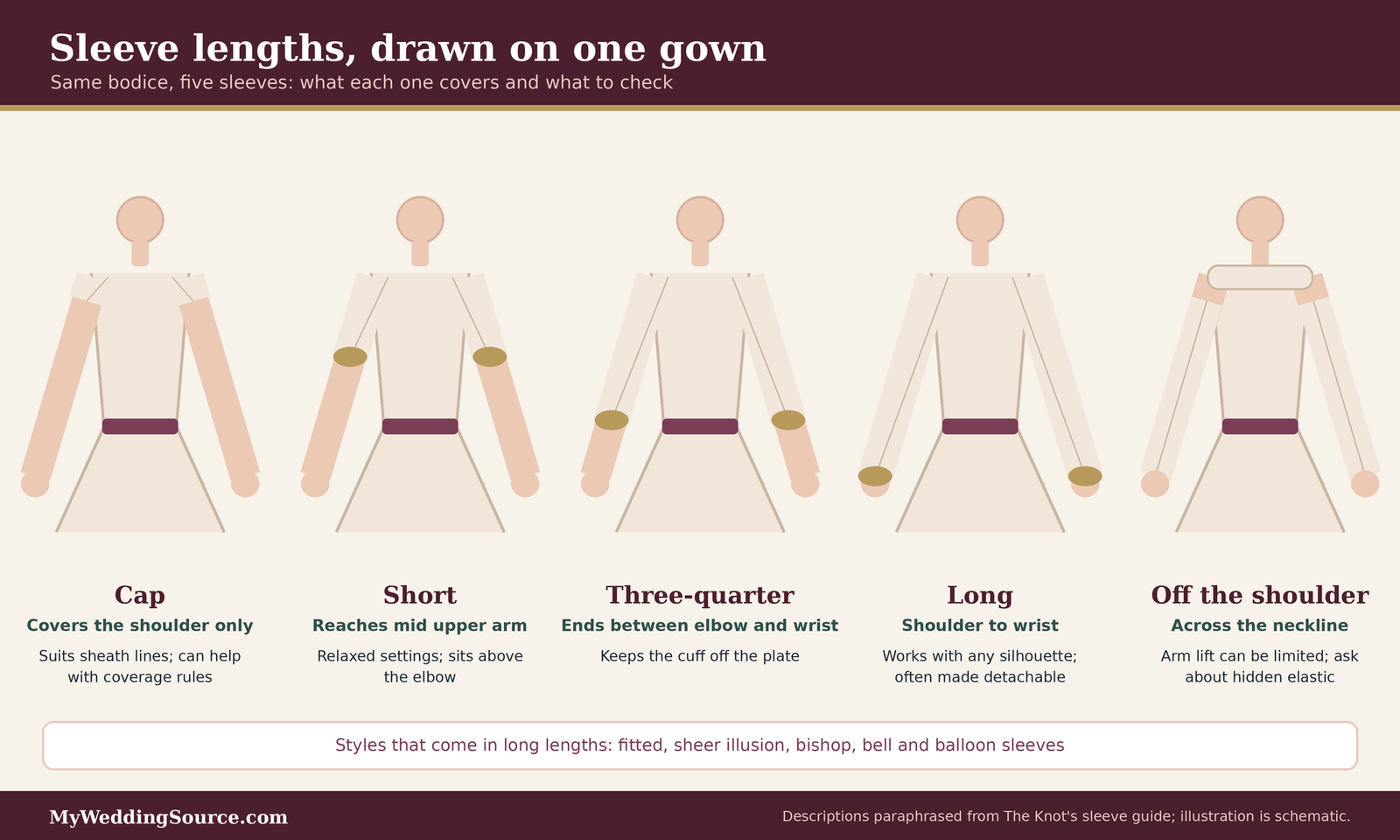
Full length, three-quarter, and off the shoulder
A full-length sleeve ends at the wrist and gives the most coverage. A three-quarter sleeve stops between the elbow and the wrist, which lets the forearm breathe and keeps the cuff away from your plate and your bouquet. An off-the-shoulder sleeve, often called a Bardot sleeve, forms a straight line across the neckline; The Knot notes that its length, fit, and draping vary. Off-the-shoulder styles can limit how high you can lift your arms, and Azazie suggests hidden elastic or a small gusset to keep them from riding up.
Fitted, full, and sheer
Fitted sleeves follow the arm and read as streamlined. Full sleeves, such as bishop, bell, and balloon, add volume and movement. Sheer sleeves, usually illusion tulle often decorated with lace, give the look of coverage with less visual weight. The Knot describes the bishop sleeve as fitted at the shoulder, fuller down the arm, and gathered at a wrist cuff, and says the fabric weight decides whether it looks puffy or drapey. We take up each style in its own section below.
Fit and function come before aesthetics in long sleeve wedding dresses
Every fashion article tells you to try dresses on, but long sleeve wedding dresses raise a specific set of fit questions that a sleeveless gown does not. This section covers the measurements worth bringing to an appointment and the ways that sample sizes can mislead you when sleeves are involved. Nothing here replaces the judgment of a stylist or seamstress who can see you in the garment; the aim is to help you ask better questions.
Translate your body and movement needs into design choices
You do not need a particular sleeve for a particular body, even with long sleeve wedding dresses. The Knot says plainly that no body type requires a specific sleeve, or any sleeve at all, and calls the idea that curvier brides must cover their arms a myth. What matters is comfort, personal style, and whether the garment lets you do what you plan to do on the day. If you shop for a larger size, our guide to plus-size wedding dresses goes deeper on fit and sourcing, and if you are shorter, our petite wedding dresses article covers proportion and hem.
The measurements that matter for sleeves
Your stylist or seamstress will take their own measurements, but it helps to understand what they are looking at. For long sleeve wedding dresses the useful numbers are upper arm circumference at its fullest point, ideally with the arm bent, because a sleeve that fits a relaxed arm can bind when you flex it; wrist circumference, which matters for a fitted cuff you must be able to slide a hand through; and arm length from shoulder to wrist with the elbow slightly bent. Azazie advises measuring in thin, fitted clothing with a soft tape and a helper, and says not to shrink your measurements in anticipation of weight loss. Write the numbers down and bring them along, because they let you compare a salon’s sample against your own arm.
Bring the undergarments and shoes that change the armhole
Azazie also notes that undergarments and shoes should be settled before the first fitting because they change how the armhole fits. A different bra changes the line under the arm, and a different shoe height changes where the hem and the waist sit. Justin Alexander, another bridal designer, tells brides to bring their wedding shoes, undergarments such as a padded bra or shapewear, a veil, and jewelry to every appointment. If you change one of those after the sleeves have been fitted, ask the seamstress to recheck the armhole.
Know where sample sizing distorts expectations
Bridal salons stock sample gowns, including long sleeve wedding dresses, so you can see a style, not so you can see yourself in it. With sleeves, the gap between sample and finished garment is wider than usual, because a sleeve that fits the sample’s arm may be loose or tight on yours.
Bridal sizes follow your largest measurement
Maggie Sottero explains that wedding dress sizes are based on your largest measurement among bust, waist, and hips, not on your usual street size, which is why a bridal size often looks like a bigger number than you normally wear. The stylist measures you and orders on the largest of the three because taking fabric out is much easier for a seamstress than adding it. For sleeves, this means the arm of the gown you receive is cut for the size the bodice requires, so the sleeve may be roomier than your own arm needs. A good seamstress can narrow it; ask whether the sleeve can be taken in without disturbing lace or beadwork.
A sample cannot show your final sleeve
Samples are typically a few sizes in a style, and the stylist pins or clips them to give you the general effect. Maggie Sottero notes that samples rarely fit perfectly and most wedding dresses need alterations anyway. For sleeves, this has a practical consequence: if the sample has no sleeves and the salon would add them, you are judging the gown from a sketch, a different sample, or a photograph. Ask to see a sleeved sample in the same fabric, and ask exactly what would differ in the gown made for you.
Match fabric and construction to season and venue
The warmth of long sleeve wedding dresses depends less on the sleeve length than on what the sleeve is made of and what is under it. A long sleeve in sheer tulle can be cooler than a short sleeve in heavy satin that clings. This section sorts fabric, season, and venue for long sleeve wedding dresses so you can match them to the day you are planning instead of defaulting to the season rule of thumb.
Weight, drape, and breathability of common fabrics
The Knot’s sleeve roundup features gowns in lace, tulle, chiffon, satin, silk crepe, stretch crepe, organza, and iridescent satin, and notes that each fabric affects warmth, weight, and drape. The following is our editorial reading of how those materials generally behave; fabric blends and linings vary, so treat it as a starting point for questions, not a rating.
Light and sheer fabrics
Tulle, chiffon, and organza are the usual choices when you want long sleeve wedding dresses without bulk. The Knot says long sleeves also work in warmer months when the fabric is lightweight, such as tulle or chiffon, and notes that sheer and lightweight sleeves help you stay cool. These fabrics move easily, which helps with reaching and dancing. Their trade-off is fragility: sheer sleeves can snag on jewelry, hooks, and rough surfaces, and Azazie describes illusion mesh as sleeves that look like a second skin, which also means there is nothing to hide a snag.
Structured and heavier fabrics
In long sleeve wedding dresses, satin, crepe, and mikado hold their shape and give a polished, sculpted look. The Knot says puff and balloon sleeves tend to be made in fabrics that keep their form, with balloon sleeves best in light fabrics such as tulle or net that hold their shape. Heavier fabrics are warmer and have less give, so a long sleeve in a firm material depends on a well-cut armhole. If the sleeve is the same fabric as the skirt, it will carry the same weight, which adds up over a long day.
Linings and stretch
Stretch panels, stretch crepe, and a lining that breathes make a large difference to comfort even though they are invisible in photographs. The Knot suggests open backs, side cutouts, and stretch fabrics for breathability and ease of movement. When a salon shows you a gown, ask what the sleeve lining is, whether there is stretch at the underarm, and whether any of those details can be adjusted. Our editorial advice is to ask about the underarm area in particular, since it is where a sleeve is most likely to bind.
Season: heat, cold, and the long middle
Long sleeve wedding dresses are associated with cold weather, and The Knot says long sleeves suit fall and winter weddings. The same article says they can work in warmer months with the right fabric and mentions a well-known long-sleeve gown worn to a late-May wedding. In other words, season sets the starting point, not the ending point. The questions that decide comfort are how hot the venue will be, how long you will be outdoors, and whether you can change or remove the sleeves.
Warm-weather weddings
If the day is warm, heat is a safety question as well as a comfort one. The CDC says that anyone can become ill from overheating, lists symptoms such as heavy sweating, dizziness, headache, weakness, and nausea, and recommends staying in the shade, taking breaks, and drinking water through the day while limiting alcohol and caffeine. The page does not give clothing advice, so what follows is our editorial reading: if you choose long sleeve wedding dresses for a hot day, pick the lightest fabric you can, plan for shade during photos, keep water within reach, and consider sleeves you can remove for the reception. Our guide to beach wedding dresses covers lighter silhouettes for warm and windy settings.
Cold-weather weddings
For cold weather the logic reverses for long sleeve wedding dresses, but the sleeve alone rarely does the job. The Knot’s fall-attire guidance, written for guests, recommends layering, wind-resistant fabrics such as velvet and brocade, and warm wraps for November. That applies to the couple too, as an editorial point: a long sleeve covers your arms but not your shoulders, back, or hands, so many brides add a wrap, a faux-fur stole, or a coat for outdoor photos. Plan where the layer goes during the ceremony, who holds it, and how it will look in photographs.
Shoulder seasons and unpredictable weather
Spring and early fall are the hardest to plan because the forecast can swing. Weather is hard to predict months ahead, which is one reason detachable or convertible sleeves are popular, since you can adjust late. For an outdoor ceremony with a rain plan, our article on outdoor wedding rain plans is a useful companion, because wet weather affects sleeves, trains, and hems together.
Venue, ceremony, and dress code
The venue sets practical limits on long sleeve wedding dresses as well as an atmosphere, and the ceremony may set expectations about coverage. Long sleeves can solve some of these questions and create others.
Religious and formal ceremonies
The Knot notes that cap sleeves, and detachable caps on strapless dresses, can help meet coverage requirements for a church or other sacred ceremony. Long sleeve wedding dresses go further, and some couples choose them because their ceremony traditions call for covered arms. If this is part of your day, ask the officiant or venue about their expectations early and describe what you are considering instead of guessing. Our wedding ceremony guide covers planning the ceremony itself.
Formal dress codes and wedding style
A black-tie evening and a backyard lunch ask for different sleeves. Long sleeves in a structured fabric look at home at a formal event; the dress code for the day, and what your guests will wear, are worth weighing together. Our black-tie wedding guide and wedding guest dress code article explain how formality is signaled. The Knot suggests short sleeves for relaxed settings such as a backyard or small outdoor wedding, which is a reminder that long sleeves are a style choice, not a requirement of formality.
Choose the sleeve style, not just the length, for long sleeve wedding dresses
Two long sleeve wedding dresses with the same sleeve length can feel completely different. This section walks through the families of sleeve most often paired with them and what to check in each. The descriptions of the shapes come from The Knot’s sleeve guide, and our own comments are marked as editorial.
Fitted and sheer sleeves
Fitted sleeves are the most common route to a clean look in long sleeve wedding dresses. Many are sheer, which changes the way the sleeve photographs and the way it ages over a long day.
Illusion sleeves
The Knot describes an illusion sleeve as a fitted sheer tulle sleeve, often with lace or embroidery, noting that when the tulle matches skin tone the embellishments appear to float. Azazie suggests matching the mesh to your skin tone. That match matters in photographs and in different light, so look at the sleeve outdoors and under flash as well as in the salon’s lighting. Illusion sleeves are delicate, so ask about snag risk and about repair.
Lace sleeves
Lace sleeves can be cut from the same lace as the bodice or applied as separate motifs. Azazie describes lace motifs placed on the sleeves, often hand-appliquéd and aligned with the bodice so the sleeves look grown on. Alignment is the thing to verify: if the pattern on the sleeve does not continue the pattern on the bodice, the sleeve will look like a separate piece. Because lace work is slow, expect more fitting time, which we return to in the timeline section.
Full and statement sleeves
Full sleeves give long sleeve wedding dresses a sense of occasion and can lift a simple silhouette. They also carry more fabric, which you will notice when you sit, hug, and get in a car.
Bishop, bell, and balloon sleeves
The Knot says a bishop sleeve is fitted at the shoulder, fuller down the arm, and gathered at a cuff, a bell sleeve widens toward the hem and has a bohemian feel, and a balloon sleeve is fullest in the middle and tapers at the shoulder and cuff. Bell sleeves can extend past the hand, which makes dining and hugging interesting. In all three, fabric weight determines whether the sleeve looks crisp or soft, and a cuff that gathers can feel snug on a thick wrist.
Puff sleeves and where they fit
Short puffs sit on the shoulder, and longer puffs fall under balloon sleeves, according to The Knot. Some have elastic that lets you wear them off the shoulder. A puff sleeve adds volume at the shoulder, which can affect how a coat, wrap, or veil sits. If you plan to wear outerwear for photos, bring it to the fitting.
Detachable and convertible sleeves
Detachable sleeves are the tool that lets long sleeve wedding dresses work across a day that changes from ceremony to dance floor.
How detachable sleeves work
Azazie says detachable sleeves attach with hidden loops or snaps and come off for dancing, giving you two looks, and calls this the fastest route to adding sleeves. Kleinfeld Again, a bridal resale retailer, says skilled designers build nearly invisible attachment points and that a seamstress can adjust the attachment so you can remove them without help. The Knot notes some gowns convert to strapless when the sleeves come off. Practice taking them off and putting them on, because Azazie says attachment points need careful engineering and rehearsal.
What to ask and what to expect
The Knot says brides often wear detachable sleeves for the first half of the day, including the first look, photos, and ceremony, and remove them for the reception, and recommends photographs in both looks. A designer quoted by The Knot says detachable elements add versatility but also increase the overall cost. Ask the salon who removes them, how long it takes, where they go afterward, whether the bodice looks finished without them, and whether the gown is photographed well in both versions. Our wedding first look photos guide can help you plan when in the day to change.
Use the fitting room to test the wedding day
A fitting room is a short, quiet place for judging long sleeve wedding dresses, and a wedding is a long, busy one. The goal of this section is to close the gap by turning your day into a set of physical tests. Azazie advises testing mobility at every fitting, including reaching, hugging, and raising your arms overhead, and the checklist below builds on that.
Move, sit, dance, hug, and climb in the garment
Do these in the long sleeve wedding dress you plan to wear, with the shoes, undergarments, and accessories you plan to wear. If something is not final, say so to the seamstress so the result can be rechecked later.
The arm tests
Raise both arms overhead, then forward to shoulder height as if hugging someone, then behind you as if reaching for a seat belt. Bend your elbows fully, as you would to raise a glass or touch your hair. Watch the bodice in a mirror and ask a friend to watch from behind. A sleeve that pulls the neckline back, or a bodice that lifts away from your body, tells you something about the armhole or the sleeve width. The seamstress may be able to fix it, but it is much easier to ask while pins are still in.
The sit, stand, and stair tests
Sit in a standard chair, then at a table, with the sleeve on the tabletop. Check that you can lift a fork, cut food, and sip a drink without a cuff dragging through the plate. Stand up from the seat with your arms at your sides to see how the dress moves. Walk up and down stairs if the venue has them. These tests matter for long sleeve wedding dresses because the sleeve is the part of the gown closest to the table, the glass, and everyone who hugs you.
Dance and hug tests
Ask the stylist to put on music, or hum, and move the way you plan to at the reception. Take a slow turn, a quick turn, and a hug with someone of a different height. If the gown has detachable sleeves, do these tests with the sleeves both on and off, and time how long it takes to remove them. If that takes much longer than you expected, decide where it will happen and who will help.
Check shoes, neckline, and support under photography movement
Photography adds a set of movements that rarely occur in a fitting room: raising your chin, lifting your arms for a group shot, leaning toward the camera, and holding a pose for several minutes.
Test the actual shoes
Heel height changes the hem and the waist, and it changes how you stand, which changes how the sleeves hang. The Knot’s timeline advice is to settle shoes before the first fitting. If you plan to change into flats later, ask the seamstress how the hem would look with them, and see our wedding dress alterations article for how hems and bustles are handled.
Check the neckline and the support
When you raise your arms or lean forward, the neckline should stay where you want it. Ask a friend to take photographs from several angles while you move, and review them with the seamstress. Long sleeves can add tension on the shoulders, so check that straps, boning, and the bra or built-in support hold their place. Our wedding photographer shot list can help you think through which poses and moments you will actually be in.
Document what must change before the next fitting
Alterations are a conversation across several appointments. Written notes protect you from forgetting, and from misunderstanding.
Photograph pins and notes
Take photographs of any pin placements and write down what each one is meant to do. Note which tests you did, which ones failed, and what the seamstress proposed. Bring the photographs to the next appointment so you can see what has changed. If a sleeve was adjusted, photograph both arms, since the two sides may not match exactly.
Get scope and deadlines in writing
Ask the seamstress to write down what will be done, what it will cost, and when each stage will be finished. Our guide to wedding vendor contract red flags is about vendor contracts generally, and the same principles apply to a seamstress: scope, price, deadlines, and what happens if something goes wrong. The Knot says to schedule fittings close enough to the wedding that your body shape has not changed, but early enough to avoid rush fees.
Plan for alteration reality with long sleeve wedding dresses
Every gown needs alterations, and sleeves add their own. This section covers what is usually involved in adding, changing, or fitting long sleeve wedding dresses and what the reported price ranges are. Nothing here is a quote; prices depend on your seamstress, your region, and the gown.
What sleeve work involves
Work on long sleeve wedding dresses ranges from a quick narrowing of an existing sleeve to building a new set of sleeves from scratch.
Adding or removing sleeves
Justin Alexander gives a range of $50 to $300 to add or remove sleeves. Azazie says most wedding dresses can take sleeves, though not every one, and that structured bodices and fabrics that accept stitching, such as crepe, satin, mikado, tulle, organza, and lace, work best. Sleeve fabric should match the gown’s weight, sheen, and texture. A gown with a delicate, stretchy bodice may need support added, which will be an additional cost.
Narrowing, shortening, and reshaping
If the sleeves are already on the gown, the work is typically in the width, length, and cuff. Justin Alexander lists related alterations that can touch the sleeve area: the neckline at $100 to $300, reshaping the bust at $200 to $500, and adding appliqué or beadwork at $20 to $100. Lace and beadwork can make a narrowing job slower, since the seamstress must work around the motifs.
Which design details make alterations complicated
Not all details are equal. Some add an hour of work, and others add days.
Lace, beading, and sheer panels
Anything that has to be taken apart and put back adds time. Maggie Sottero notes that ordering a very large size may require removing lace, beading, or other details that drew you to the dress. By the same logic, narrowing a heavily beaded sleeve is slower than narrowing a plain one. Sheer panels also show every seam and stitch, so the work needs to be neat on both sides.
Cuffs, buttons, and closures
A row of small buttons at the wrist looks beautiful and can be hard to fasten without help. A zipper at the cuff is easier but may show. A cuff that slides over the hand needs room for your hand, not just your wrist. Ask whether you can dress and undress yourself in the sleeves, and if not, who will help you on the day.
Build the shopping timeline for long sleeve wedding dresses
The timeline for a gown is well documented, though long sleeve wedding dresses add questions; the extra time for sleeves is less so. This section combines the published timelines from The Knot, Azazie, and Justin Alexander and shows how to work backward from your wedding date. The figures come from retailers and a wedding publication, so confirm every one with your own salon.
Work backward from fittings and delivery
The easiest way to plan is to start with the wedding date and subtract.
The general gown schedule
The Knot recommends starting to shop 9 to 12 months before the wedding and buying 8 to 10 months before. It says a made-to-order dress takes 16 to 20 weeks to arrive, the dress usually arrives at the salon 3 to 4 months before the wedding, a second fitting happens 6 to 8 weeks out, and a final fitting 2 to 3 weeks out. It suggests allowing for up to three alteration sessions. Elsewhere in the same guide it says shipping can take up to five months in total, so ask the salon for a firm date. Justin Alexander suggests the first fitting 8 to 12 weeks before the wedding, and allowing extra time for weddings between May and September, when seamstresses are busiest.
The extra time for sleeves
Azazie gives these estimates for sleeve work: detachable sleeves take 4 to 6 weeks with two fittings, set-in fitted sleeves take 6 to 10 weeks with two to three fittings, illusion lace takes 8 to 12 weeks with three fittings, and complex couture takes 10 to 14 weeks or more with three to four fittings. For the fittings themselves, Azazie suggests a first fitting 8 to 10 weeks out, a second 4 to 6 weeks out, and a final fitting 1 to 2 weeks out. These are one retailer’s estimates for custom sleeve work, and a salon’s own timeline may be shorter or longer.

Know when a custom order, rush, or off-the-rack changes the schedule
Where the gown comes from decides how much room you have.
Custom and made-to-order
If you are ordering a gown with sleeves from the designer, the sleeves are part of the production schedule and should be in the order confirmation. If you are adding sleeves later through a seamstress, the build time starts after the gown arrives. Our own arithmetic, as an illustration: if a gown arrives 15 weeks before the wedding and the sleeve build is the longest estimate from Azazie, 14 weeks, there is almost no room for fittings. That example is the reason to ask the salon whether sleeves are built in at the factory.
Off the rack, sample sales, and resale
An off-the-rack or sample gown with sleeves can shorten the wait, but it brings its own fit questions, since you are altering what exists. Kleinfeld Again notes that pre-owned gowns may include sleeve options no longer sold in current collections, so availability can be limited. Our guide to renting wedding dresses is worth a look if you are weighing a rental, and you should ask what alterations a rental allows before you commit.
Add buffer for corrections, steaming, and accessories
A schedule with no slack is a schedule that breaks.
Buffer for corrections
The Knot says to plan for up to three alteration sessions. If any one of them uncovers a problem with the sleeves, a fourth may be needed. Keep the last two to three weeks free of major work, so that the final fitting is a check and not a rescue.
Steaming, accessories, and the last look
Ask who will steam the gown and when, and whether the sleeves need special handling. Bring your veil, jewelry, and any wrap to the final fitting. Our wedding veil meaning and history and wedding jewelry articles can help you choose accessories that sit well with sleeves, since a bracelet at the wrist competes with a cuff. Our plan wedding timeline article puts the gown schedule in the context of the whole wedding.
Budget for the finished garment, not the rack price
A price tag on long sleeve wedding dresses is the start of the cost, not the end. Sleeves are rarely free, whether they come with the gown, are built later, or are detachable. This section separates the pieces so you can compare quotes on the same basis.
Separate purchase, alteration, undergarment, and preservation costs
Break the cost of long sleeve wedding dresses into parts, and ask each seller to quote the parts you are comparing.
What the gown itself costs
The Knot’s 2026 Real Weddings Study, which surveyed 10,474 U.S. couples who married between January 1 and December 31, 2025, puts the average wedding dress at about $2,100, with a low tier of about $1,200 and a high tier of about $3,200. The Knot says the average mostly reflects off-the-rack and made-to-order dresses and does not include alterations. It also says retailers typically require a deposit of 30 to 50 percent to confirm an order, with the balance due at pickup. That is a survey average of what couples paid, not a price for long sleeve wedding dresses specifically, and no source we found breaks out the cost of sleeved gowns.
What the finishing work costs
Justin Alexander’s reported ranges are $50 to $300 for adding or removing sleeves, $80 to $400 for hemming, $100 to $450 for taking in or letting out the sides, $200 to $500 for reshaping the bust, $100 to $300 for the neckline, $20 to $100 for appliqué or beadwork, and $50 to $200 for a bustle. The Knot gives a wider spread, from about $200 for a basic hem to over $1,000 for major work. Neither source claims these are quotes, and Justin Alexander advises a buffer above its figures. Undergarments, shapewear, and preservation are separate lines. See our average wedding cost and wedding budget calculator pages to place the gown within the whole budget.
Cost check: an illustrative finished-gown estimate
Our own arithmetic, using The Knot’s $2,100 average and Justin Alexander’s ranges for a sleeve change, a hem, a bustle, and taking in the sides. Low end: $2,100 + $50 + $80 + $50 + $100 = $2,380. High end: $2,100 + $300 + $400 + $200 + $450 = $3,450. A deposit of 30 to 50 percent of $2,100 would be $630 to $1,050. This estimate leaves out bust reshaping, the neckline, beadwork, undergarments, shoes, steaming, and preservation, and it is not a quote. Ask your own salon and seamstress for written prices.

Show which design details drive alteration complexity
Two sleeves can have the same length and a very different price.
Details that tend to raise the price
Our editorial reading, supported by the way the sources describe the work: hand-placed lace motifs aligned with the bodice, sheer sleeves with matched seams, beaded cuffs, and sleeves added to a bodice that needs extra support are all likely to take longer. Azazie lists couture-level sleeve work as the slowest category. Time is what a seamstress sells, so ask which parts of the sleeve are the time-consuming ones.
Ways to keep the cost in check
Choosing a gown that already has the sleeves you want avoids the cost of adding them. Detachable sleeves, which Azazie calls the fastest route, may cost less than a custom set-in sleeve, though The Knot’s quoted designer says detachable pieces add to the overall cost. Ask for two quotes in writing: sleeves built in, and sleeves detachable. If you pay with a credit card, the Federal Trade Commission’s guidance on billing disputes explains time limits for written disputes and the steps to follow; it is general consumer information, not legal advice about your purchase.
Pull it together with a decision matrix and worked scenarios
By now you have a lot of separate considerations about long sleeve wedding dresses. This section puts them into two reusable tools: a matrix you can fill in at each appointment, and three scenarios, which are illustrations we made up to show the trade-offs, not real brides or real quotes.
A decision matrix for long sleeve wedding dresses
Use it as a conversation starter, not a score.
| Factor | What to look at | Design implication | Alteration risk |
|---|---|---|---|
| Warm venue or season | Fabric weight, lining, shade | Sheer or detachable sleeves | Low for detachable, higher for set-in lace |
| Cold venue or season | Wraps, indoor and outdoor time | Structured fabric, add a layer | Check the armhole with the layer on |
| Lots of dancing | Armhole height, stretch at the underarm | Convertible or roomy sleeves | Medium: armhole changes are hard to reverse |
| Many hugs and photos | Cuff, sleeve width, neckline hold | Soft fabric, secure bodice | Medium |
| Formal or religious ceremony | Venue expectations | Sleeves with coverage you can adjust | Low if planned early |
| Tight timeline | Salon schedule, build type | Detachable or off-the-rack | Higher for custom lace |
| Tight budget | Quote for each option | Choose built-in sleeves | Lower when no adding is needed |
How to use the matrix
Fill in the factors that apply to your day, then ask each salon how its gowns address them. The rows with higher alteration risk are the ones to discuss first, since they are the most likely to change your timeline or budget. Keep the same matrix across appointments, so you compare like with like.
What the matrix cannot tell you
It cannot tell you how a particular sleeve will feel on your arm, and it cannot predict a seamstress’s availability. It also cannot replace a fitting. Treat it as a way to organize your questions and your notes.
Three worked scenarios
These are invented to show how the trade-offs play out. They use the ranges above, and none of them is a prediction.
Scenario one: a summer garden ceremony
Imagine a garden wedding in a warm month, with a ceremony outdoors and a dance indoors. The couple wants long sleeves for the ceremony photographs and a freer feel for the reception. Detachable illusion sleeves on a light gown fit that plan: sleeves on for the first half of the day, as The Knot describes, and off for dancing. The cost to check is the build of the sleeves and the finish of the bodice without them. The risk is heat during photographs, which the CDC’s guidance suggests handling with shade, water, and breaks.
Scenario two: a late-fall formal evening
Imagine a formal wedding in a cool month in an indoor venue with a brief outdoor photo session. A structured gown with set-in long sleeves is comfortable indoors, and a wrap handles the outdoor session. The matrix points to testing the armhole with the wrap on, and to booking extra fittings, since set-in sleeves take longer. If the dress is made to order, the build and shipping dates come first.
Scenario three: a short timeline and a firm budget
Imagine a couple with a few months to go who wants sleeves and has a set limit. The matrix points to an off-the-rack or sample gown that already has the sleeves, and a short list of seamstresses booked early. Bring every accessory to the first fitting, so that nothing changes later. Ask for the gown and alteration quotes together, and check the deposit and refund terms in writing.
Think about photographs, hair, and the rest of the outfit
Long sleeve wedding dresses change the frame of a photograph. It also changes how hair, jewelry, and wraps sit.
Photographs in both looks
The picture of you in the gown is the one that remains, so plan for it.
Plan photographs with the sleeves in mind
If your sleeves are detachable, decide which photographs will be taken with them on and which without, and tell your photographer. The Knot recommends photographs in both looks. For sleeved gowns, ask the photographer to include a few photographs with your arms relaxed, and a few with them raised, to show how the sleeves behave. See our wedding photography guide for how to brief a photographer.
Sheer sleeves, flash, and skin tone
Sheer sleeves can look different in flash, in bright sun, and in shade. Ask to see the sleeves outdoors in the salon’s daylight, and photograph them with a phone flash to see how they react. If the tulle does not match your skin tone, the embellishments will not appear to float, as The Knot describes. This is a quick check that avoids an unwelcome surprise in photographs.
Hair, makeup, jewelry, and accessories
The details around the sleeve either complement it or compete with it.
Jewelry and cuffs
A wrist-length sleeve hides a bracelet or a watch, so you may want to skip them or choose earrings and a necklace instead. A cuff with buttons can catch on delicate jewelry. Our wedding jewelry article covers choosing pieces for different necklines, and the same thinking applies to sleeves.
Hair, makeup, and getting dressed
Sleeves go on before the veil and often after hair and makeup, so ask your stylist and the person helping you dress how to avoid smudging makeup or catching hair in a sleeve or cuff. Our bridal makeup guide covers planning hair and makeup around the gown. Decide who will help you into and out of the sleeves, and rehearse once at the final fitting.
Dressing the wedding party around long sleeves
If you have chosen long sleeve wedding dresses, the dresses around you may be worth a glance.
Bridesmaids and the wedding party
There is no rule that the wedding party should match your sleeves. Some couples echo the sleeve shape or fabric; others keep the party’s dresses simple so the gown stays the focus. See our bridesmaid dresses and wedding party attire guides.
Guests and dress code
If your gown is long-sleeved and the venue is warm, consider how your guests will feel as well. A clear dress code on the invitation and wedding website helps them plan. The Knot suggests checking the invitation and wedding website for the dress code, which is also good advice for you as host.
Questions to ask and what to verify before you pay
This is a checklist for long sleeve wedding dresses that you can carry to a salon and a seamstress. Answers matter more when they are written down.
Ask the salon
The salon sells you the gown and sets the terms.
Questions about the gown and the sleeves
Questions to ask before you pay a deposit
- Are the sleeves part of the gown, or an add-on, and is the price for each stated separately?
- Are the sleeves detachable, set-in, or lace-appliquéd, and who builds them?
- What is the lead time for the gown with the sleeves, and what date is in writing?
- Can I see a sample with the same sleeves in the same fabric?
- What is the deposit, and what is the refund or cancellation policy?
- Which alterations does the salon include, and which do I need to book separately?
- How many fittings are typical for this sleeve, and when should the first be?
- What happens if the sleeves do not fit or the delivered gown differs from the sample?
Questions about the contract
Get the style, size, fabric, sleeves, price, deposit, balance, and delivery date written on the receipt or contract. Ask what happens if the designer is late, discontinues the style, or ships the wrong size. If you pay by credit card, keep your receipts and the correspondence, and read the FTC page on disputes in the Sources.
Ask the seamstress
A seamstress who knows bridal work is as important as the long sleeve wedding dress itself.
Experience and availability
Justin Alexander advises choosing a seamstress experienced with wedding gowns and asking recently married friends for referrals, and The Knot says good seamstresses fill up, so book one when the gown arrives or earlier. Ask whether they have worked on sleeves in your fabric, and whether they can show examples.
Scope, price, and deadlines
Ask for a written estimate that lists each alteration, the price, the number of fittings, and the finish date. Tell the seamstress about any planned weight change before the final fittings, as Justin Alexander advises, and tell them what shoes, undergarments, wrap, and jewelry you will wear.
FAQ: long sleeve wedding dresses
Fit and comfort
Are long sleeve wedding dresses too hot for a summer wedding?
Not always. The Knot says long sleeves can work in warmer months in lightweight fabrics such as tulle or chiffon. Heat is still a health question, so plan for shade, water, and breaks, and consider detachable sleeves. If you feel unwell, the CDC lists symptoms such as dizziness, headache, and nausea.
Can I still move my arms in long sleeve wedding dresses?
You can if the armhole and sleeve width are right. Azazie advises testing reaching, hugging, and raising your arms overhead at every fitting. Off-the-shoulder styles tend to have less mobility. Do the arm tests in your final shoes and undergarments, and ask the seamstress to adjust anything that pulls.
Do I need a certain body type for long sleeves?
No. The Knot says no body type requires a specific sleeve or any sleeve at all, and calls the idea that curvier brides must cover their arms a myth. Choose what you feel comfortable in and try several styles, since fit varies by cut and fabric.
Alterations and cost
Can sleeves be added to a gown that has none?
Often, but not always. Azazie says most gowns can take sleeves, and that structured bodices and fabrics that accept stitching work best. Justin Alexander reports $50 to $300 for adding or removing sleeves, though prices vary. Ask a seamstress to look at your gown before you buy.
How much do long sleeve wedding dresses cost?
No source we found gives a price for sleeved gowns as a group. The Knot reports an average of about $2,100 for a dress in its 2026 study, and alterations are extra. Sleeve prices vary by style, fabric, and seller, so compare written quotes for the finished gown.
How long do sleeves add to the timeline?
Azazie estimates 4 to 6 weeks for detachable sleeves, 6 to 10 for set-in fitted sleeves, 8 to 12 for illusion lace, and 10 to 14 or more for complex couture work. These are one retailer’s figures, so ask your salon for its own schedule.
Planning and photos
Should I choose detachable sleeves?
They suit a day that changes, since you can remove them for dancing, according to Azazie and The Knot. They also add engineering and cost, so practice taking them off and decide who will help. Ask how the bodice looks without them and plan photographs in both looks.
Will sheer sleeves look different in photographs?
They can. Illusion sleeves rely on matching the tulle to your skin tone, and lace or embroidery can look different in flash or bright light. Look at the sleeves outdoors, take a test photograph with flash at the fitting, and tell your photographer which looks you plan to wear.
Your next steps
Narrow the gown
Choose the silhouette, then the sleeve
Pick the silhouette you feel best in, then compare two or three long sleeve wedding dresses built on it. Write down how each one passed the arm, sit, and hug tests, and which one you would choose if the price were the same.
Set the sleeve plan in writing
Ask each salon for the sleeve type, fabric, lead time, fittings, and price in one document, so that you can compare like with like. Our wedding planning checklist and wedding planning guide place the gown within the wider plan.
Protect the schedule
Book fittings and a seamstress early
Count back from your wedding date to place, for long sleeve wedding dresses, the first, second, and final fittings, and book your seamstress when the gown is ordered. Use the plan wedding timeline article to see where the gown fits among other deadlines.
Confirm the protections
Check the deposit, refund, and delivery terms, keep your receipts, and consider whether wedding insurance is worth a look for your situation. For the gown category as a whole, return to the wedding dresses guide.
Sources & methodology
How we built this guide
What we relied on
This guide draws on The Knot’s pages on sleeves, costs, and timelines, including its 2026 Real Weddings Study figures, and on guidance from bridal retailers and designers: Azazie, Justin Alexander, Maggie Sottero, and Kleinfeld Again. We also used the CDC’s page on heat and health and the FTC’s consumer page on credit card disputes. Where a statement comes from a retailer, we say so, because retailers sell what they describe. Any total, scenario, or timeline example marked as our own is editorial arithmetic and an estimate.
What we did not do
We did not test gowns, measure arms, or interview seamstresses, and we found no source that prices sleeved gowns as a category. Price and timeline figures come from a few sellers and a publication and may differ from yours. Fabric and fit comments labeled editorial are our reading, not measured findings. Nothing here is legal, medical, or financial advice; confirm terms with your seller and your card issuer, and ask a clinician about health concerns.
Source list
Wedding publications and survey data
- The Knot, Wedding Dresses with Sleeves: https://www.theknot.com/content/wedding-dresses-with-sleeves
- The Knot, Types of Wedding Dress Sleeves: https://www.theknot.com/content/types-of-wedding-dress-sleeves
- The Knot, Average Cost of a Wedding Dress: https://www.theknot.com/content/average-cost-of-wedding-dress
- The Knot, When to Buy Your Wedding Dress: https://www.theknot.com/content/wedding-gown-shopping-checklist
- The Knot, What to Wear to a Fall Wedding: https://www.theknot.com/content/what-to-wear-to-a-fall-wedding
- WeddingWire, Wedding Dress Sleeve Styles: https://www.weddingwire.com/wedding-ideas/wedding-dress-sleeve-styles
Government and consumer-protection sources
- Centers for Disease Control and Prevention, About Heat and Health: https://www.cdc.gov/heat-health/about/index.html
- Federal Trade Commission, Using Credit Cards and Disputing Charges: https://consumer.ftc.gov/articles/using-credit-cards-and-disputing-charges
Designer and retailer sources
- Azazie, Can I Add Sleeves to My Wedding Dress?: https://www.azazie.com/blog/can-i-add-sleeves-to-my-wedding-dress/
- Azazie Help Center, How to Measure for Your Custom Size Dress: https://support.azazie.com/hc/en-us/articles/43514202260763-How-to-Measure-for-Your-Custom-Size-Dress
- Justin Alexander, Everything You Should Know About Wedding Dress Alterations: https://justinalexander.com/blog/everything-you-should-know-about-wedding-dress-alterations-2025-05-01/
- Maggie Sottero, Your Guide to Wedding Dress Sizes: https://www.maggiesottero.com/blog/wedding-dress-sizes/
- Kleinfeld Again, The Art of Transformation: Detachable Lace Sleeves for Wedding Dresses: https://kleinfeldagain.com/blogs/dress-guide/the-art-of-transformation-detachable-lace-sleeves-for-wedding-dresses