
A wedding while pregnant, or a wedding in the first months after a birth, is still an ordinary wedding with one unusual feature: the most important date in the plan, the day the baby arrives, cannot be booked. This guide gives you a way to plan around that uncertainty with flexible dates, clear checkpoints, a family care worksheet and honest limits for when to scale the day down.
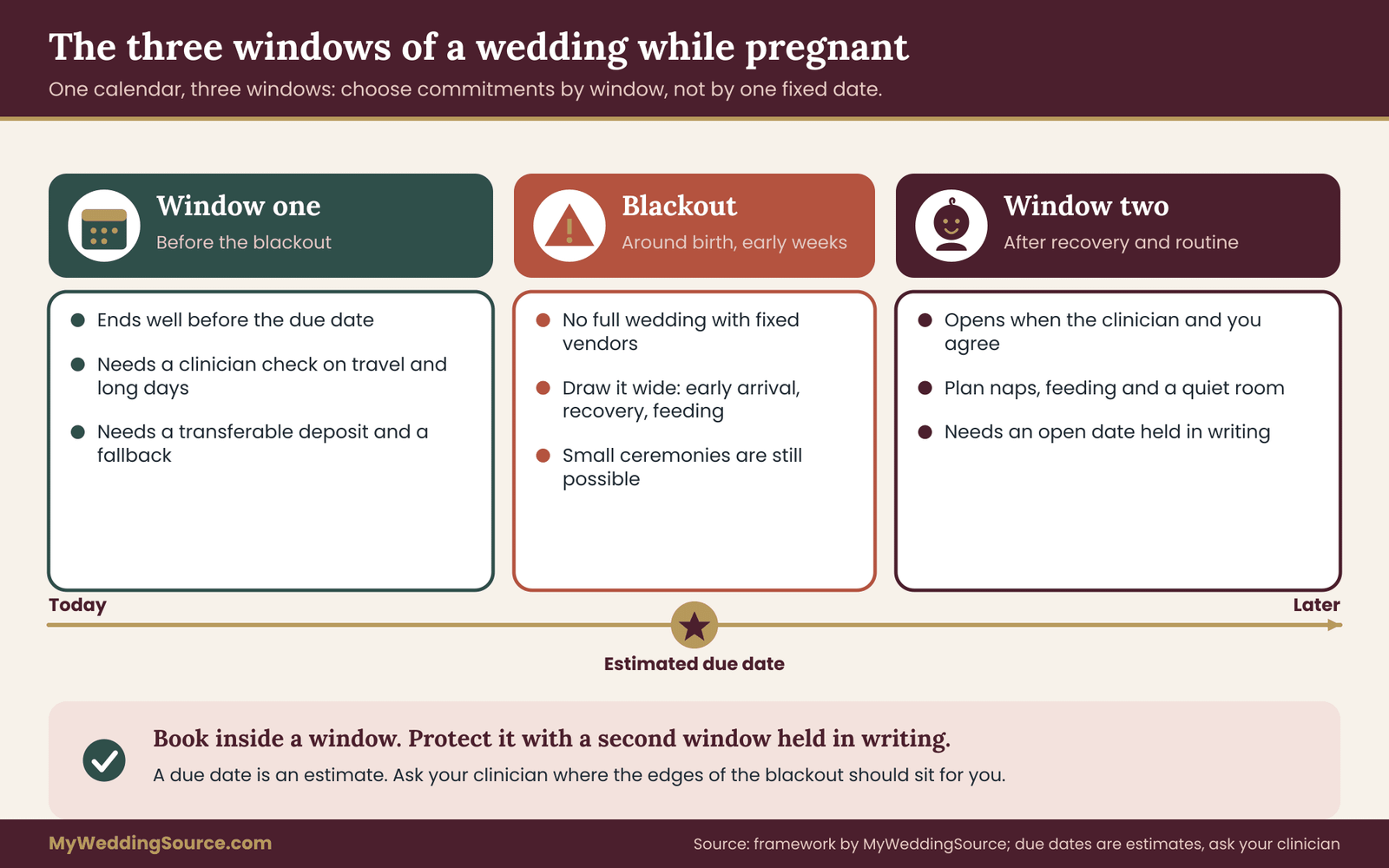
For a wedding while pregnant, stop treating the date as a single point. Pick three windows instead: one before the weeks your clinician considers risky for long events and travel, one blackout window around the due date and early newborn weeks, and one later window after recovery and routine have settled. Put a go or no-go checkpoint ahead of every non-refundable commitment, assign a named person to each care task, and write down in advance the conditions that would make you shrink the wedding or move it.
Couples planning a wedding while pregnant tend to get two kinds of advice. One kind says to relax and enjoy it, which is kind but not much use when a venue wants a signed contract by Friday. The other kind is a long list of things to avoid, usually written by people who have never had to keep a deposit schedule and a prenatal appointment calendar side by side. Neither helps you decide.
What helps is structure. A wedding while pregnant has three moving parts that rarely line up on their own: a medical timeline that belongs to you and your clinician, a business timeline that belongs to your contracts, and a family timeline that includes older children, grandparents who will travel, and whoever will hold the baby during photographs. This article lines the three up in one place, using a worksheet you can fill in over one evening.
A note on scope. This is general planning information, not medical, legal or financial advice. Every medical question in it, including what you can safely do, eat, wear or attend, and how far you can travel, belongs with your own obstetric clinician or midwife, who knows your history. Contract and insurance rules vary, so confirm them with the vendor, the plan issuer or the office that sets them.
Planning a wedding while pregnant: what changes and what stays the same
Most of a wedding while pregnant is unaffected by the pregnancy. The guest list, the menu structure, the music, the ceremony script and the invitation wording work the way they always do. If you need a general plan for those parts, the site’s guide to planning a wedding from the first decision to the last covers the full sequence, and this article does not repeat it. What changes is a short list of constraints, and they are easier to manage once you name them.
The date becomes a range. A due date is an estimate, not an appointment. Babies arrive earlier and later than predicted, and the clinician’s calendar for you may change as the pregnancy goes on. A wedding that depends on a particular week being medically comfortable is therefore a wedding with a soft date, whether or not the invitations say so. The general logic of picking a wedding date still applies, with one more constraint added.
Your energy and comfort change on a schedule you do not set. Some people feel strong through most of a pregnancy and others have a hard first trimester, a tiring third one, or complications that appear without warning. You cannot know in advance which kind you will be, so a wedding while pregnant needs a plan that works in either case.
Travel and long days carry their own questions. How far to travel, how long to stand, how much heat to tolerate and when a long event stops being sensible are medical questions with individual answers. The plan should have a place to record the clinician’s answer, and a fallback if the answer changes.
Money has to tolerate a change of date. Deposits, rental holds and non-refundable fees are what turn a flexible plan into a rigid one. The most useful early work is reading contracts for what happens if you move, which the contract section of this guide covers in detail.
More people carry out care tasks. A newborn, a toddler or a pregnant parent with a long list of small needs adds jobs to the day: someone to hold things, someone to keep a bag, someone who knows when to take the baby out of the room. Those jobs need names before the day, not on it.
What stays the same is the point of the event. A wedding is a ceremony, a legal act and a gathering. Each of those can be done in more than one way, which is the reason alternatives to a full celebration appear later in this guide as ordinary options, not as consolation prizes.
The three timelines behind a wedding while pregnant
It helps to picture three calendars on one wall.
The medical calendar has prenatal visits, tests, the due date, and afterward the postpartum checkups. You own this one, with your clinician, and it can change.
The business calendar has the date you have signed for, the deposit dates, the final headcount deadline, the dress fitting dates and the cut-off after which a vendor will not move you. Your contracts own this calendar, and most of its dates are fixed.
The family calendar has the guests’ flights, the older children’s school and care schedules, the grandparents’ availability, and the time off that you and your partner have arranged from work. Those people own parts of it.
Trouble starts when one calendar quietly overrides the others. A couple signs for a date because the venue is free, without checking where the due date sits. Or a couple keeps a date out of loyalty to the business calendar after the medical calendar has changed. The three-window map in the next section keeps all three calendars visible together, and the four gates keep any one of them from winning by default.
Who this guide on a wedding while pregnant is for
The guide fits four situations, and they differ more than they seem to.
You are pregnant now and the wedding is a few months away, so the live question is whether the current date still works. You are pregnant and have not booked anything, so the live question is where to place the date. You have a baby already and are planning a wedding for the first year, which is a care-logistics question. Or you are not yet pregnant but may be, and want a plan that survives the news.
The same worksheet serves all four versions of a wedding while pregnant or just after, but you will use different sections first. If you are in the second situation, read the next section carefully, because it deals with the choice between getting married before the birth and getting married afterward.
Choosing between a wedding while pregnant and a wedding after birth
Couples often frame this as a question of which date is better. A better framing is which risks you would rather carry, because each choice moves risk from one place to another instead of removing it.
What a wedding while pregnant trades away
Having your wedding while pregnant gives you a date that you can anchor to the one thing that is predictable: the first and second trimester are in the past and the due date is still ahead. That has real advantages. Guests who would otherwise find a newborn nearby tricky to schedule around can attend freely. You are not managing infant feeding during the reception. If you want the legal status of marriage in place before the birth, for instance for paperwork or insurance reasons, you can have it.
The costs are those of any plan that depends on a body doing something unpredictable. You carry the risk that an appointment, a complication or an early arrival disrupts the day. Your clothing has to fit a changing shape, which affects dress timing. Your comfort on a long day is uncertain. And a date placed close to the due date is exposed to the largest forecast error of all.
A rough decision rule helps here. The further the wedding is from the due date, in either direction, the more you can trust the date. A wedding placed well ahead of the due date carries less early-arrival risk. A wedding placed well after the birth carries less recovery risk. The risky zone is the middle, and the worksheet later in this guide asks you to draw that zone on a calendar before you sign anything.
What a wedding after the birth trades away
Waiting until after the baby arrives gives you a firm medical situation. You know when the baby was born, you know how recovery is going, and you can ask the clinician about activity, travel and alcohol with a clear picture in front of both of you. You are no longer planning around an unknown.
What you give up is some control over the early months. A newborn has no schedule and no interest in yours. A wedding in the first weeks means planning around feeding, sleep and recovery, and many couples find that a later window, once routines are more predictable and the parent who gave birth feels more like themselves, is less strained. That is a judgment, not a rule. Some people feel ready quickly and some need much longer, which is the point of choosing the window by checkpoint instead of by calendar date.
Waiting also has financial and social costs. Deposits already paid may be tied to a date. Guests may have booked travel. A family that expected a ceremony before the birth may feel the change. Those costs are real, and you should weigh them against the risks of staying with the early date, without assuming that either choice is the responsible one.
A short decision test for a wedding while pregnant
Answer these five questions in writing, separately if you can, and then compare answers. Disagreement is useful information.
First, how important is it to be legally married before the birth? If the answer is very, then a small legal ceremony before the birth and a larger celebration later is a standard solution, and it is described in the alternatives section.
Second, how much would a changed date cost in money, in goodwill and in stress? Read your contracts to answer this and do not guess.
Third, what has your clinician said about travel, long events and activity at the point in pregnancy where the wedding would fall? If you have not asked, ask before you decide.
Fourth, who would be hurt most by a change? Sometimes the answer is a grandparent for whom the date is a matter of health, sometimes it is a vendor, sometimes it is simply you.
Fifth, what would you regret more: a rushed day you could not enjoy, or a delayed one that people had already planned around? Most couples have a clear answer to this once the question is put plainly.
If the answers point to a single window, take it. If they point to more than one, you do not have to choose among the three windows yet. You can book a date, protect it with the contract terms described later, and keep a second window warm as a documented fallback. That is the whole idea behind this approach to a wedding while pregnant, and it is usually cheaper than it sounds.
The three-window date map for a wedding while pregnant
The central tool for a wedding while pregnant is a map of three windows on a calendar. You draw it once, early, and you revise it at every gate described later. It replaces the question “what is our date?” with a better one: “which windows are open, and which commitments does each one allow?”
Window one: before the blackout of a wedding while pregnant
The first window is the stretch of pregnancy in which your clinician is comfortable with you attending a long event and, if needed, traveling. Its start depends on how early you have decided to plan and how you feel. Its end is the date by which you and your clinician want the wedding finished, set well before the due date to leave room for a baby who arrives early.
You do not need to know that end date exactly on the day you start planning. You need a working estimate, a note to ask the clinician at your next appointment, and a rule: nothing that depends on you traveling or standing for hours is scheduled inside the last stretch before the blackout begins.
Window one suits couples who want a wedding while pregnant for legal, family or personal reasons, who live near the venue, and who have vendors with firm but transferable dates. It is the most exposed window to a change in how the pregnancy goes, so it should always be paired with a fallback.
The blackout window
The blackout is the period around the due date and through the first weeks of a newborn’s life. It is not a statement that nothing can happen in it. Some people marry in a hospital room or at home in these weeks, and the alternatives section describes that kind of day. The blackout is instead the period in which you decline to schedule a full wedding with fixed vendors, traveling guests and a non-refundable deposit, because neither the arrival date nor the recovery are things you control.
Draw the blackout generously. A common mistake is to draw it from the due date alone, as if arrival and recovery were a single day. The window should start well before the due date to allow for early arrival and extend well past the birth to allow for recovery, feeding and sleep. Ask your clinician what the sensible edges are for you, since the answer differs by person and by pregnancy, and write the answer on the map.
Window two: after recovery and routine
The later window opens when the parent who gave birth has recovered enough to be comfortable for a long event, as judged with the clinician, and when the baby’s care has a rhythm you can plan around. For many couples that is some months after birth, though the right moment is an individual one and nobody else can set it for you.
This window has advantages: your body and schedule are more predictable, you know your baby’s habits, and you can plan feeding and care logistics from observation instead of guesswork. It also introduces the baby as a wedding guest, which means designing for naps, noise, a quiet room and a care person. The guest-care side of that is covered in the site’s guide to wedding guest care for babies, children and older relatives, and this article only describes how it fits the date decision.
How to draw the map for your wedding while pregnant
Take a plain calendar with at least eighteen months visible. Mark four things in this order.
First, mark the estimated due date and draw a wide band around it for the blackout. Use a pencil, since it will move.
Second, mark every fixed date from your contracts: the date you have signed for if any, the deposit dates, the headcount deadline, the final payment, and any “last day to move” clause. These are your business-calendar anchors.
Third, mark the clinician checkpoints that matter: the appointments at which travel and activity advice is likely to be given or updated, and the point after which you want a written note on file if airlines or venues ask for one.
Fourth, mark the family anchors: school terms, work leave you or your partner plan to take, relatives’ availability, and any occasions you cannot move, such as another family event.
Now look for the open stretches. Any stretch that clears the blackout, respects the contract anchors and avoids the family anchors is a candidate window. Most couples find two or three, which is enough.
What to do with a window you cannot use
Sometimes the map shows that no window works for a wedding while pregnant. A venue may be booked solid in the only open stretch, a key relative may be unavailable, or the money may not allow a move. That finding is useful because it tells you that the original plan needs to change shape instead of date. Skip ahead to the downshift ladder, where the same wedding is reduced in steps, with a legal ceremony kept as the first step and the larger celebration kept as a later one.
Reading contracts for flexible dates
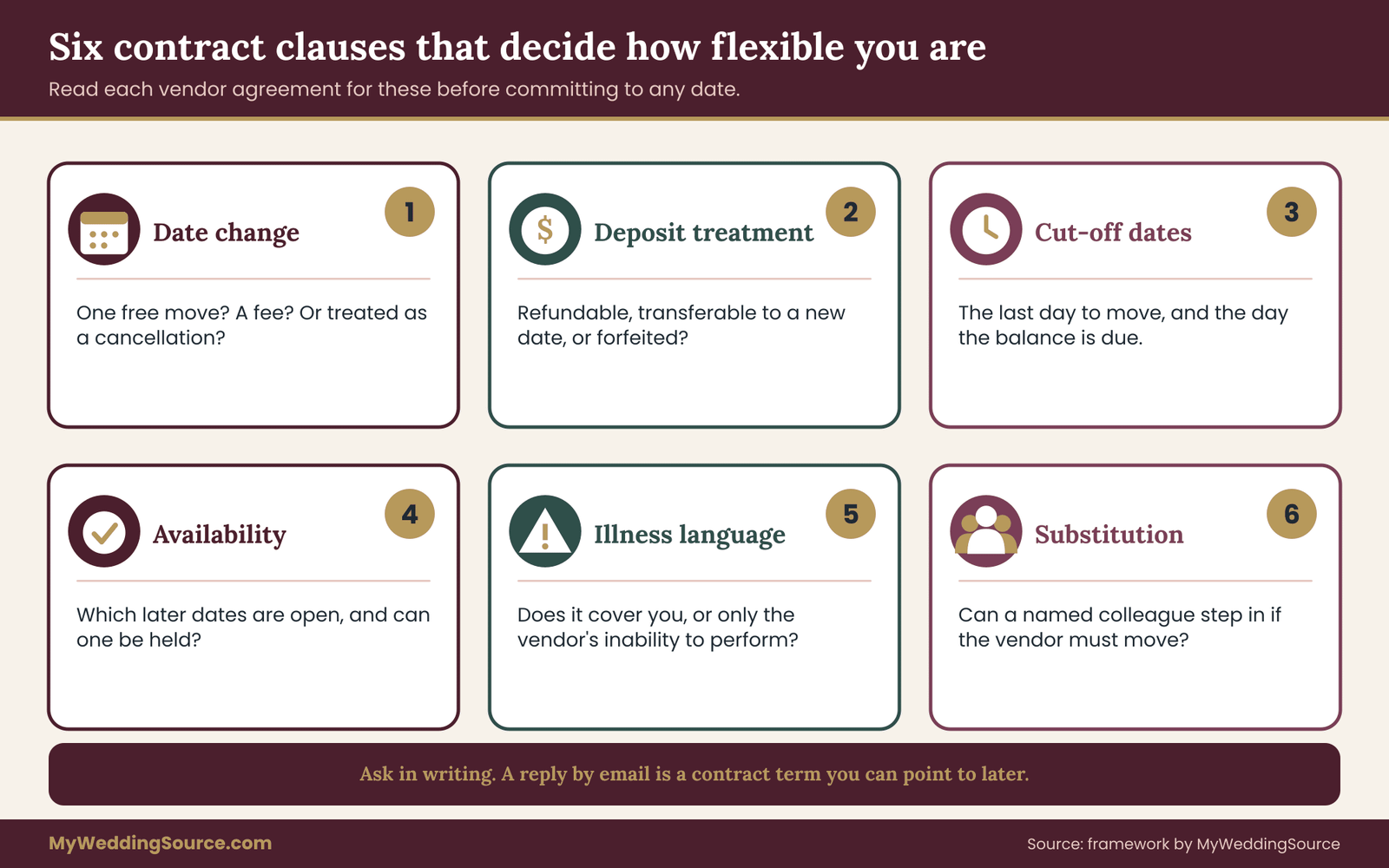
A wedding while pregnant is only as flexible as your weakest contract. Before you commit to a date, read each agreement for six things. The site’s general guide to wedding vendor contracts covers the full document; this section only extracts what matters for a date that might move.
Six clauses that decide how flexible a wedding while pregnant can be
Date change. Does the vendor allow one change of date, and on what terms? Some contracts permit a transfer to another date at no cost if the new date is available; others charge a fee, or treat a change as a cancellation and a new booking. You want the first kind, or at least to know exactly which kind you have signed.
Deposit treatment. Is the deposit refundable, transferable or forfeited if you cancel? A transferable deposit is nearly as good as a refundable one for a couple who intends to hold the wedding eventually. A forfeited deposit tells you the true price of a change.
Cut-off dates. Many contracts set a date after which changes are not permitted or after which the full balance is due. These dates convert a soft plan into a hard one, so mark them on the three-window map.
Availability. A transfer clause means little if the vendor has no open dates in your second window. Ask in writing which dates are open and whether they can be held for you. Some venues will place a courtesy hold on a second date for a short time, and some will not, which is a question for the vendor, not an assumption.
Illness and emergency language. Look for what the contract says about illness, medical emergency or other events that stop you from attending. Many agreements address only the vendor’s inability to perform. Some address both sides, and an ordinary pregnancy-related change may or may not fit within the clause, so ask rather than assume.
Substitution. If a photographer or musician cannot attend on a changed date, can they send a colleague? A contract that allows a named substitute protects you in the other direction, because a vendor with a baby of their own, or a booking clash, is just as capable of needing to move.
Questions to ask before signing for a wedding while pregnant
Put these in an email, so the answers exist in writing.
“If we need to move our date once for a medical or family reason, what is the process, the deadline and the cost?”
“Is our deposit refundable, transferable to a new date, or forfeited? Please confirm in writing.”
“Which dates in the following months are open now, and can you hold one for us while we decide?”
“What is the last date on which we can move without losing the deposit?”
“If we need to reduce our guest count or shorten the event, are there minimum spend or minimum headcount terms we should know about?”
The last question matters more than it looks. A reduced day is the usual fallback, and a minimum spend can turn a smaller wedding into one that costs almost the same as a larger one. You want to know that before the first gate, not after.
Matching payments to gates
The sequence of payments is a design choice you can influence. If a deposit has to be paid to hold the date, pay it, but try to delay larger commitments until a gate has been passed. Payments that fall before the gate that would justify them are the ones to challenge. For example, final payments to a travel-dependent vendor should come after the gate that confirms you are well enough to travel, not before.
The site’s explanation of wedding cash-flow planning shows how to lay deposits, balances and reserves against a calendar. The only addition here is that each payment gets a gate label, so you can see at a glance which money is committed before the medical picture is clearer.
Insurance for a wedding while pregnant, with realistic expectations
Couples planning a wedding while pregnant sometimes ask whether event insurance covers pregnancy-related changes. Policies differ widely in what they treat as a covered reason, and many exclude conditions that exist at the time of purchase, which usually includes a known pregnancy. Do not assume coverage. If you are considering a policy, read the exclusions and the definition of covered reasons before purchase, ask the issuer directly whether a pregnancy that already exists is excluded, and take the answer in writing.
Your state’s insurance regulator publishes consumer information on how policies work and can tell you where to complain if an issuer behaves badly.
Whatever the policy says, the real protection is the contract terms above, which you control by negotiating before you sign, not after.
When the contract cannot be changed
If a venue will not move a date or refund a deposit for a wedding while pregnant, you are not stuck, but you have a clearer set of choices. You can hold the date and reduce the event, which converts a large wedding into a small one at the same location. You can hold the date and treat the guest count as the variable.
You can pay the penalty and move. Or you can hold the date on the business calendar and keep a legal ceremony, quiet and brief, on that day, with the celebration happening later elsewhere. Each choice has a cost that you can calculate from the contract, and the ladder later in this guide helps you compare them.
The four gates for a wedding while pregnant
In a wedding while pregnant, a gate is a checkpoint placed just before a commitment that is hard to undo. At each gate you ask the same three questions: what has changed, what does the clinician say, and what does the contract allow? The answer is either go, adjust or switch to the fallback. Gates replace the vague feeling that you will “see how things go” with dates on a calendar and a person responsible for each decision.
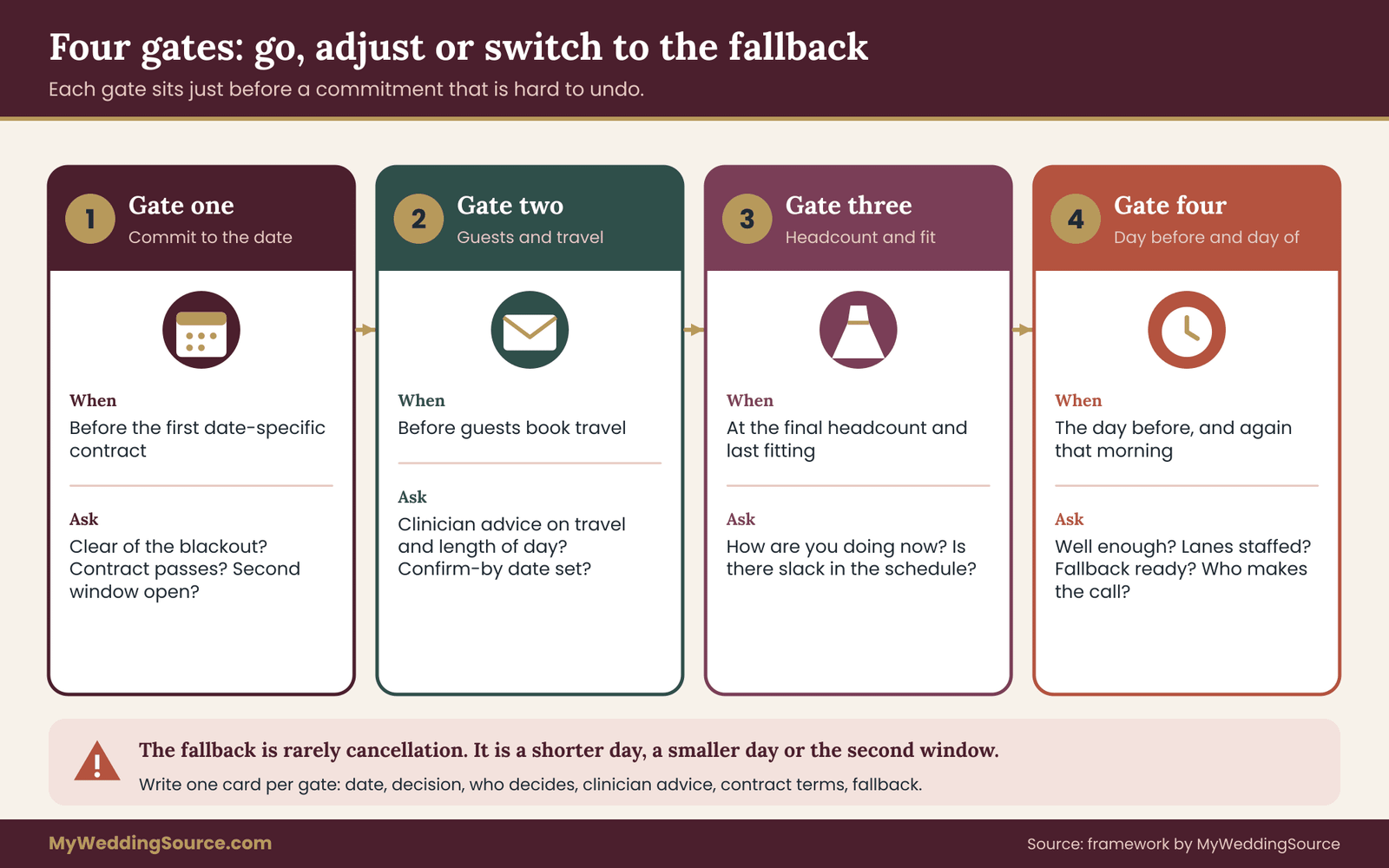
The framework has four gates because a wedding while pregnant has four natural points at which the cost of changing course jumps. You may add gates, but you rarely need fewer.
Gate one: commit to the date
This gate sits before you sign the first date-specific contract, usually the venue. At gate one you confirm, in this order, that the date clears the blackout on your map, that the contract passes the six-clause test, and that the second window has at least one open date with a venue or vendor who will hold it.
The clinician question at this gate is broad: given what is known about the pregnancy so far, is there any reason this date would not be sensible to plan? A clinician cannot promise how the rest of the pregnancy will go, so the useful answer is a conditional one, such as “plan it, and ask me again at a certain point.” Write down that point. It becomes the trigger for gate two.
The go decision at gate one for a wedding while pregnant is a commitment to the date with a documented fallback. It is not a commitment to hold the date at any cost.
Gate two: commit to guests and travel
Gate two sits before guests buy tickets or book rooms, which is usually when invitations or save-the-dates go out, and before you pay for travel-dependent vendors. For a wedding while pregnant, it is the most important gate for the relatives who will spend money on your behalf.
The clinician question at gate two is specific: is travel, if any is involved, sensible for me at the time of the wedding, and is there anything that would change that advice? Ask about the length of the event too. A ceremony of thirty minutes and a reception of five hours place different demands on a pregnant body.
If the answer is a clear go, tell guests the date and say plainly that it may change for health reasons. A short sentence in the save-the-date or on the website does the job. If the answer is uncertain, delay the announcement until it is clearer, or announce the wedding with a “date to be confirmed” note and a stated confirmation date. Guests tolerate uncertainty better than they tolerate a cancellation after they have paid for flights.
The site’s guide to choosing a wedding date around guest availability and travel covers the guest-side logic of timing. At this gate, the only addition is to weigh how many guests need to travel and how much notice they would need to adjust.
Gate three: commit to the final headcount and fit
Gate three sits at the final headcount deadline, which is typically a few weeks before the wedding, and at the point where the dress or suit must be ordered or fitted. It is the last moment before the largest money goes out and the point at which a reduced version of the day becomes harder to arrange.
The clinician question here is about how you are doing now: is the plan on track, are there any restrictions to add, and what warning signs should lead you to switch plans? Ask for the answer in plain terms you can write on a card.
At this gate you also decide how much slack the day has. If the schedule has no buffer, add one. If you are carrying a heavy list of tasks, hand some of them off. The rule at gate three is simple: if you are not comfortable with the plan as it stands, change the plan now, while changes are cheap.
Gate four: the day-before and morning-of check
The last gate of a wedding while pregnant is a conversation, not a form. On the day before, and again on the morning, you and your partner ask whether you are well enough to proceed as planned, whether the care lanes are staffed, and whether the fallback is ready if the answer changes during the day.
The person who will make the call on the day is named in advance. Naming them matters because the person who most wants the day to go ahead is the least reliable judge of whether it should.
The fallback at gate four is not cancellation. It is usually a shortened day: ceremony, one meal, a quiet exit. Vendors can be told that the reception may end early and what the trigger is. Some vendors, like a photographer, can shift coverage hours at short notice if asked in advance, and the contract section above showed how to ask.
Writing the gate card for a wedding while pregnant
Each gate gets a single card that fits on a phone screen. Write the date, the decision, who decides, the clinician’s current advice in your own words, the contract terms in play, and the fallback. When a gate is reached, you read the card, update it, and send the relevant line to the people affected. The discipline is useful in itself: when decisions are written down, nobody has to remember what was agreed during an appointment or a tiring week.
What pulls a gate forward in a wedding while pregnant
Gates have dates, and they also have triggers that pull them forward. A change in the clinician’s advice about travel or activity, a new complication, an unexpected early arrival, a vendor change of terms or the loss of a care helper should each prompt you to pause, open the relevant gate card and decide again. Do not wait for the scheduled date. Write this list of triggers at the top of the worksheet so that both partners react to the same signals.
Family care lanes: who covers what at a wedding while pregnant
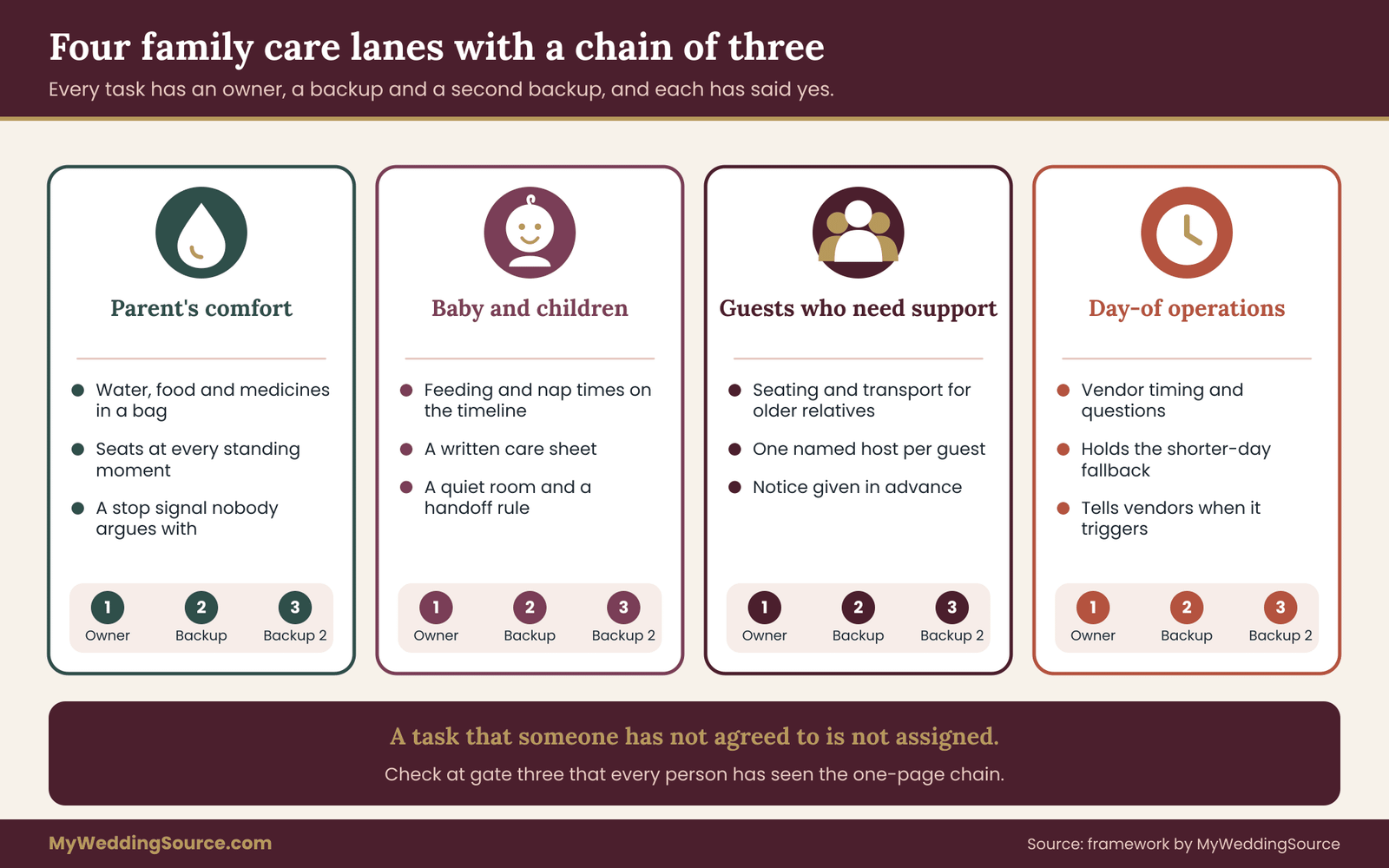
The second half of the worksheet for a wedding while pregnant is a set of care lanes. The aim is to turn a vague feeling that someone will deal with things into named people, written tasks and a short chain of backup. Think of four lanes, each with an owner and a backup.
Lane one: the pregnant or postpartum parent
This lane covers rest, food, drink, medication, comfort and a quiet place. Its owner is not the parent themself, because the parent will be busy being married. A named person, usually a close friend or relative who is not in the bridal party’s visible roles, holds the bag, watches the clock for breaks, and keeps a list of what the clinician has advised: when to sit, when to eat, what to avoid and what changes would prompt a call.
The task list is short and practical. Bring any medicines and a copy of the clinician’s contact details. Keep water and snacks within reach at the ceremony and during photographs. Put a seat at the ceremony and at every standing moment, including during portraits. Agree on a signal that means “I need to stop,” and agree that nobody will argue with it.
Lane two: the baby or toddlers
If the baby is already born, or if older children are involved, this lane covers feeding, sleep, changing, noise and handoffs. Its owner is a caregiver who is not a guest focused on the ceremony. For a young baby, the care person needs a short written sheet: feeding times, how the baby is soothed, where the nap happens, who may hold the baby and what to do if the baby is unwell.
The details of nursing rooms, quiet rooms and handoffs are covered in the guides on wedding guest care and on setting up a nursing space, and this guide does not repeat them. The worksheet only asks that the lane exists, has an owner and has a backup. For safety topics such as safe sleep for infants, follow your pediatric clinician and recognized guidance, including the American Academy of Pediatrics and the Centers for Disease Control and Prevention.
Lane three: guests who need support
Older relatives, guests with limited mobility and any guest traveling a long way have needs of their own, and a wedding while pregnant adds a competing set of demands. This lane has an owner who is not you, and who handles seating, transport, hotel questions and what happens if a guest has a problem during the day.
The decision here is mostly about expectations. If you cannot host a grandparent personally, name the person who will, tell the grandparent beforehand, and give that person the authority to act. A short note in advance, something like “my sister will look after you at the reception and will be at your table”, is more reassuring than a general promise that everyone will be looked after.
Lane four: the wedding-day operations
This lane covers vendors, timing, last-minute questions and the people who would otherwise come to the couple. It is the ordinary role of a coordinator or a trusted organizer. In this plan, though, the lane carries one extra duty: it holds the fallback. The lane owner knows what the shortened schedule is, which vendors have been told about it, and what the trigger is. When something changes, they carry it out, so that the couple does not have to.
If you hire a coordinator, tell them about the fallback during the first meeting. Ask how they handle a schedule that might shorten, and whether their contract allows it. If you do not hire one, assign the lane to someone with the temperament for it, which is rarely the person with the strongest opinions about the flowers.
Backups and the chain of three
Each lane has an owner and a backup, and the backup has a backup. The chain of three is deliberate. A wedding while pregnant puts people under strain, and any one of them may be unavailable. A lane with three names is a lane that holds.
Write the chain on one page. Check, at gate three, that each person has seen it and agreed. A task that someone has not agreed to is not assigned, no matter how obvious it seemed.
Guests, travel and notice for a wedding while pregnant
At a wedding while pregnant, guests are the people most affected by a date that might move, and also the people you can protect most easily with clear communication. The goal is to give them what they need to decide, early enough to decide, and to tell them honestly what could change.
What to tell guests and when
A guest needs four facts: the date, the place, the amount of flexibility, and the date by which you will confirm. Everything else is detail. The mistake to avoid is silence. A guest who learns about a change from a friend, or after buying a ticket, will remember it far longer than they will remember the original news.
For a wedding while pregnant, the wording of the first message should be plain. Something like: “We are getting married on this date at this place. Because I am expecting, the date could change for health reasons. We will confirm by this date, and we recommend booking refundable travel until then.” That is a complete message. It does not overshare, and it does not ask for sympathy.
Some couples prefer not to announce a pregnancy before they are ready. In that case, the message can say that the date may need to move for family or health reasons without stating which. Guests generally understand that without explanation. What matters is that the flexibility and the confirmation date are stated.
Traveling guests
Guests who must fly or book hotels need the longest notice and carry the greatest cost of a change. Divide them into three groups on a sheet of paper.
Local guests can adjust easily. Tell them the date and the flexibility and move on.
Regional guests drive or take a short trip. They need enough notice to book a room and arrange time off, and a clear confirmation date.
Distant guests fly, book hotels, and often take leave from work. For them, delay the firm announcement until after gate two, or ask them to hold the date without booking until you confirm. If a guest insists on booking early, tell them directly that the date may move, and let them choose with full information.
The site’s guide to coordinating wedding guest hotels across different budgets and mobility needs covers room blocks and cancellation terms. For this article, the relevant point is that a room block with a generous cancellation window is worth more to you than a discount. Read the attrition and cancellation terms before you sign one.
Your own travel to a wedding while pregnant
If the wedding is away from home, the travel question belongs to your clinician. Pregnancy-related travel questions include how far, by what means, how long before the due date and what to do if something goes wrong away from home. Airlines set their own rules about travel late in pregnancy, and some ask for a letter from a clinician, so check the specific airline’s current policy early.
The Centers for Disease Control and Prevention publishes general travel guidance for pregnant travelers, and the American College of Obstetricians and Gynecologists publishes patient information on travel during pregnancy. Use both as background, and take the individual answer from your clinician.
A simple rule for this guide: a destination wedding while pregnant is a high-commitment choice and should pass gate two with a clear clinician answer, a plan for medical care at the destination, and travel arrangements that can be changed. Many couples decide that a local ceremony, with a travel celebration later, is the better version of the same idea.
Guests with children
Some of your guests will bring babies and young children, and some will ask whether they can. Decide in advance and say so on the invitation or website. If children are welcome, decide who looks after them during the ceremony, and whether there is a quiet space. If they are not, say so kindly, and consider offering a care arrangement for out-of-town guests, as discussed in the guest-care guide.
If you already have a baby, remember that the baby is a guest with a very short list of needs and a very loud way of stating them. Plan for the ceremony to be interrupted and be at peace with that.
Gifts and the registry for a wedding while pregnant
Pregnancy changes what people want to give you. Some will send gifts for the baby with a wedding card. Some will hesitate about what is suitable. A short note on the website saying what you are most grateful for, and a registry that makes sense for your household, reduces awkwardness. The site’s guide to alternative registries explains ways to handle this, and the registry itself is a separate decision from the wedding plan.
Responding to comments about a wedding while pregnant
Pregnant couples sometimes face comments about timing, order and choices. These come from relatives who mean well and, now and then, from relatives who do not. The simplest approach is a prepared sentence: “We have thought it through and we are happy with the plan.” Say it once, calmly, and change the subject. The site’s guide to handling unwanted wedding advice offers more scripts, but you do not need to defend your timeline to anyone who is not paying for it or living in it.
Dress, fit and clothing for a wedding while pregnant
Clothing is the most visible practical problem in a wedding while pregnant, and it follows the same logic as the date: a body that changes on its own schedule needs a plan that tolerates change. The site’s guide to wedding dress fit and alterations covers the ordinary process of ordering and fitting. The notes below cover only what changes in this situation.
The timing problem for a wedding while pregnant
A dress that is fitted early may not fit later, and a dress that is fitted late leaves little time for alterations. The risk is highest for a wedding while pregnant in its later months, and for one in the early months after birth, when the body is changing in less predictable ways.
The practical response is to choose a design that tolerates change and to schedule the final fitting as late as the seamstress can manage. Ask the seamstress or boutique how many days they need for final alterations, and schedule the last fitting no earlier than that. Tell them about the pregnancy at the first appointment, since it affects their advice about fabric and construction.
Designs that adapt
Some garment structures allow for change, and others do not. Designs with adjustable closures such as lacing, a corset-style back or ties can be taken in or let out over a range. Empire or A-line cuts leave room at the waist. Wrap styles and separates with stretch panels can accommodate different shapes. A dress with a fitted, boned bodice and a fixed zipper has the least tolerance and the greatest risk.
For a postpartum wedding, the same ideas apply but the uncertainty is different. Bodies after birth differ widely and recover at different rates. Many people prefer a dress that can be adjusted at the last moment, and some choose a second option in a different size as a backup. Do not size the dress to an imagined future body or to a body you used to have. Size it to the body you have at the final fitting, with a closure that tolerates a small change.
Buying, renting and borrowing a dress for a wedding while pregnant
The more flexible the purchase, the lower the cost of a size surprise. A rented or borrowed dress with a return date may be a poor fit for an uncertain size, though rental shops with alteration services can work. A sample or pre-owned dress can be bought at a lower cost and altered, which reduces what you lose if you change your mind. The site’s guide to pre-owned wedding dresses covers buying carefully. Before buying anything, ask about return, exchange and alteration limits in writing.
Check how the order process treats size. Many made-to-order dresses are cut to measurements taken at the order date, and a long production time means the body may be different at delivery. Ask whether the order can be adjusted and what each adjustment costs. A dress that cannot be changed is a risk, and the price of the risk should be in your decision.
Comfort, shoes and underlayers
Comfort often matters more than appearance by the third hour. Flat or low shoes, a breathable fabric, an underlayer that does not bind and a cover-up for temperature changes are practical choices. Swelling in the feet and legs is common in pregnancy, and your clinician can tell you what is typical and what is not. Shoes in a half size larger as a backup are a modest cost. The site’s guide to bridal flats for formal weddings explains how to make low shoes look finished.
Plan the bathroom too. A dress that takes three people to manage is a dress that will keep you out of the room. Ask during fittings how you will manage a bathroom visit in the dress, and practice at least once.
Partners, bridal party and guests
Clothing questions do not end with the dress. If your partner or a member of the wedding party is also the parent who gave birth, the same timing logic applies to their outfit. A guest who is pregnant or postpartum is best served by a dress code that allows flexibility, so say so plainly, or choose a code that does not require tailoring.
Hair, makeup and treatments
Check with your clinician before booking any treatment you have not had before, including skin treatments, hair coloring and massage, and tell the provider that you are pregnant. Providers have their own policies and, now and then, their own professional guidelines. A trial run with the same products you will use on the day is sensible, and so is a schedule that leaves time to rest between appointments and the ceremony. Keep the morning short and the list of services shorter.
A fitting calendar that works backwards
Work backwards from the wedding. Put the last date at which you could change anything on the dress, that is, the alteration deadline, then subtract the days the seamstress needs, then add a buffer for an early or late arrival or an unexpected change. That is your final fitting date. Schedule an earlier fitting a few weeks before it to catch big changes.
If you are planning a wedding while pregnant and the wedding is near the due date, ask for a written note on what happens if the dress does not fit on the day: a pre-agreed backup outfit prevents a crisis on the morning.
The day of a wedding while pregnant: comfort, food, drink and pacing

A wedding while pregnant is not a different kind of wedding on the day. It is a normal wedding with a few adjustments that most guests will never notice, provided you have made them in advance. This section lists them, and it leaves medical specifics to your clinician.
A schedule with slack for a wedding while pregnant
The most effective adjustment is slack. A standard wedding timeline is tight, with photographs, travel and the reception stacked back to back. For a wedding while pregnant, add buffers: extra time for the morning, a gap between the ceremony and the reception, shorter portraits and a rest period before the evening. A quiet half hour in a cool room is worth more than another set of photographs.
Think about the length of the whole day. Ask yourself whether you need ten hours of coverage or whether six would do. A shorter reception with a clear end is easier to manage, and guests often prefer it. If the venue and vendors allow it, put the longest and most physically demanding parts of the day early, when energy is highest, and leave the evening for lighter activities.
Seating and standing at a wedding while pregnant
Standing is the part of a wedding people forget. Ceremonies, receiving lines, group portraits and cocktail hours all involve it. Ask your clinician how long you can comfortably stand at your stage of pregnancy, and then plan around the answer. Place a chair at the ceremony. Ask the photographer to arrange portraits seated where possible. Put a stool or chair by the receiving line and cocktail area, and keep one at the sweetheart table.
If you are postpartum, the same principle applies, with different needs. Recovery after birth varies, and your clinician can tell you what is sensible in terms of lifting, standing and activity. Share the answer with the lane owner so that they can step in.
Food and drink at a wedding while pregnant
Food safety in pregnancy is a medical topic with official guidance. The Food and Drug Administration and the Centers for Disease Control and Prevention publish advice for pregnant people about foods that carry higher risk, and your clinician can tell you how it applies to you. For catering, the practical step is a conversation with the caterer well before the day. Tell them you are pregnant, ask how the food is prepared, ask for ingredient lists and ask for a plate you can eat without questions.
The site’s guide to building a wedding menu that works across ages and dietary preferences shows how to give guests clear information about ingredients. Use the same method for yourself: a short list of what you can eat, given to the caterer and to the lane owner.
Some higher-risk items turn up at weddings without much notice: raw or lightly cooked foods at stations, soft cheeses on grazing boards, and cold cuts. You do not need to fear the food. You need to know what is in it and to have a safe alternative at hand. A dedicated plate, prepared by the kitchen and delivered to you, is the simplest way to manage the risk.
Alcohol is a question for your clinician, and many pregnant people choose not to drink at all. A toast with a non-alcoholic drink is entirely normal. Ask the bar to prepare something that looks like a celebratory drink so that you are not asked about it repeatedly. Some couples pass this role to a friend at the bar, who understands what to pour and what to say.
Heat, hydration and breaks at a wedding while pregnant
A long day in warm weather is harder when pregnant. Indoor and shaded spaces, easy access to water and a cool place to retire to matter more than decoration. Check the ceremony site for shade and the reception for ventilation, and ask the venue what is available in case of heat. In winter, the equivalent is warm cover and a place free of drafts.
Schedule breaks. Two or three planned breaks of ten minutes each, with a place to sit and something to drink, are a good starting point. Put them on the timeline and ask the coordinator or lane owner to enforce them. A break written on the schedule is much easier to take than one you have to ask for.
The bathroom and the bag
At a wedding while pregnant, you may need the bathroom more often than usual, and a postpartum parent may have other needs. Choose a space for changing and resting that is close to the ceremony and the reception, check its access and size, and know where the closest accessible restroom is. Keep a small bag with the lane one owner, containing any medicines, snacks, a copy of the clinician’s contact details, a change of clothing, spare underlayers and any supplies you might need.
Photographs at a wedding while pregnant
Tell the photographer about the pregnancy and about the schedule adjustments, and ask for a plan that puts the key shots first. The photographer can often adapt: seated portraits, shorter family photograph lists, and a quiet window for more relaxed images. The site’s guide to the family photo list helps you decide who must be in which photographs. Fewer combinations means less standing and shorter time away from guests.
The early exit from a wedding while pregnant
Plan your exit as carefully as your entrance. Decide when you will leave, how you will get to the car, who will carry your things and what the farewell looks like. An exit at an agreed hour, announced on the schedule, lets guests say goodbye and lets you rest. The site’s guide to wedding exit routes and crowd control covers the mechanics, and the point here is simply that the exit is a decision you make beforehand.
Warning signs and the plan for them
Your clinician will tell you which symptoms, in your case, need a prompt call or a trip to hospital. Write them down. Give the list, with the clinician’s contact details and the address of the closest hospital, to the lane one owner and to your partner. Keep the venue’s address and entrance details with them, so that help can find you.
If a symptom appears, the fallback triggers: the schedule changes, the day shortens or ends, and you act on medical advice instead of on the timeline. Tell your vendors during planning that this might happen. That one sentence costs nothing and removes the awkwardness later.
After birth: the newborn wedding and recovery realities
Some couples are not planning a wedding while pregnant but around a baby who is already here. The same worksheet applies, with a different centre of gravity. The blackout has passed, the date of birth is known, and the uncertainty is about recovery, feeding, sleep and the baby’s health.
Recovery is not a schedule
Postpartum recovery varies widely and cannot be read off a calendar. The American College of Obstetricians and Gynecologists describes postpartum care as an ongoing process, not one visit, and your clinician will tell you what to expect and when to check in. For the wedding, the useful step is to ask at a postpartum visit what you can sensibly take on, and to keep that answer current.
If you had a complicated birth, a surgical delivery or any health issue, plan for a longer timeline and ask for specific guidance on activity and travel.
Do not plan a wedding at a pace that only works if recovery goes well. Include a gate, like those described earlier, at which you and your clinician review how recovery is going before the final commitments.
Sleep and the schedule of a baby
Newborns feed and sleep in short cycles, day and night. A wedding that needs the parent who is feeding to be present and alert for a long period is a wedding that needs planning. If you are nursing or pumping, the feeding times become fixed points in the timeline. If you are using formula, similar fixed points apply, though with more flexibility on who feeds.
Put the baby’s schedule on the timeline as you would a vendor’s arrival. The ceremony is better placed after a feeding than before one. A reception can be built around nap times if you can predict them. The site’s guide to wedding guest care discusses practical arrangements for babies. At the planning stage, the point is that the baby sets constraints that must be written on the timeline before anything else is added.
Noise, crowds and illness
A newborn in a crowd is a matter for your pediatric clinician. Ask about crowded spaces, exposure to many guests and handling by relatives, and ask what steps to take if someone attending is unwell. Many families set a simple rule: anyone who is ill stays home, and everyone who holds the baby washes their hands first. A sign or a quiet word from the lane two owner makes it easier to enforce. Tell guests in advance, kindly, what your rules are.
If your pediatric clinician advises avoiding crowds in the early weeks, that advice is a reason to use a later window or a smaller gathering. It is not a failure of planning. It is the plan doing its job.
Time away from the baby
Deciding how long you will be away from a young baby is personal. Some parents are comfortable leaving the baby with a trusted caregiver for a few hours, some prefer to keep the baby close the whole time, and many want something in between. Neither is right. What matters is that you decide before the day, and that the care plan fits the decision.
If the baby will be with you, set up a base: a quiet room with a chair, a changing area, somewhere to sleep and a person to share the work. If the baby will be with a caregiver, plan how you will stay in touch, how often and through whom. A caregiver who has been briefed, written down the schedule and has a phone number for the clinician is better equipped than one who has been told to call if anything happens.
Honeymoon, leave and the weeks after
The weeks after a wedding with a newborn are rarely a honeymoon in the traditional sense, and planning one without the baby is a decision with its own constraints. Work and leave policies also matter. In the United States, the Department of Labor administers the Family and Medical Leave Act, which covers certain employees and employers and which may affect how you time leave around a birth and a wedding. Check the current rules with your employer and the Department of Labor, because eligibility depends on the specific situation.
If your employer provides a benefits form, note that both marriage and the birth of a child can be qualifying life events for health insurance changes, and that windows for making changes are often short. The federal marketplace, HealthCare.gov, describes special enrollment periods, and your employer’s plan has its own rules. Put those dates on the same calendar as the wedding, since the two events can trigger two separate deadlines.
A worked case: one couple, three versions of the plan
The case below is invented to show the worksheet in use for a wedding while pregnant. The people, dates and decisions are illustrative, not a record of real events, and no costs are stated because yours will depend on your own contracts.
The starting point
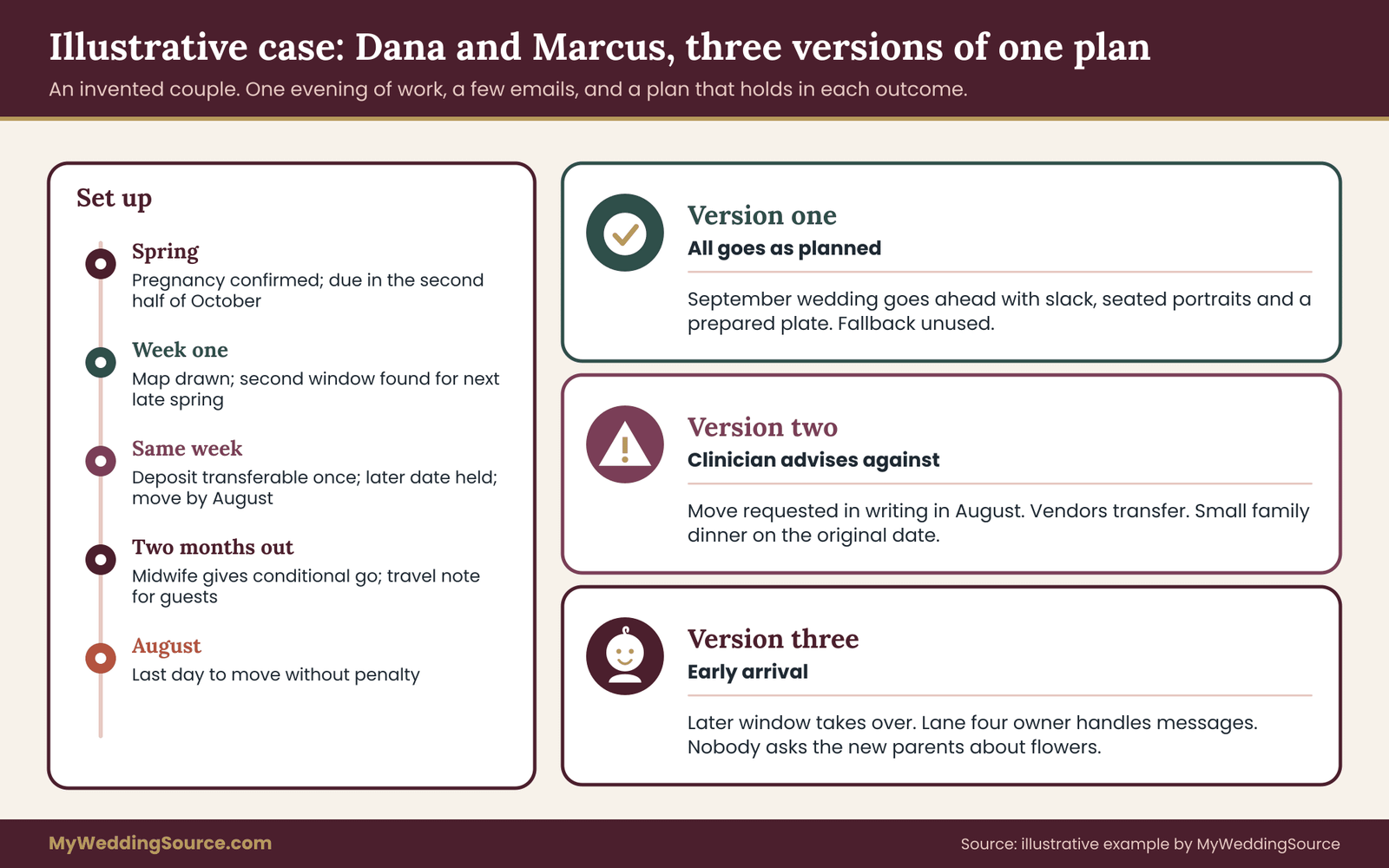
Dana and Marcus live in one city, and most of Marcus’s family lives a long flight away. Dana learns in early spring that she is expecting, with a due date in the second half of October. They had talked about a wedding in the coming year but had not booked anything. A friend offers them a small garden venue for a Saturday in September. It is cheap for the date, and it needs a deposit within the week.
Their first instinct is to say yes. Marcus’s grandmother is elderly, and they want her to be there. Dana’s instinct is the same, but she is uneasy about the timing. This is where they open the worksheet.
The map for their wedding while pregnant
They mark the due date and draw a wide blackout from some weeks before to a long stretch after. They mark the September date and see that it sits a few weeks ahead of the blackout. That is thin. They ask Dana’s midwife at the next visit what she would want to see before a long event and a flight for guests, and she gives a conditional answer: plan it, and ask again as the date gets nearer, since the picture may change.
They write down the follow-up point as the trigger for gate two.
They mark a second window, in late spring of the following year, when the baby will be several months old. The venue has a Saturday open then. They ask the venue manager three questions in writing: can the deposit transfer to the later date, can the later date be held for a few weeks, and what is the last day to move without penalty.
The manager says the deposit is transferable once, the later date can be held until a set day, and the move must be requested by a date in August.
Gate one: commit to the date
At gate one, the contract passes four of the six clause checks. The deposit transfers, the last-move date is workable, and a second date is open. Illness language is silent, and no substitution clause applies because the venue has no assigned staff. They decide to go, paying the deposit for September, with the later date held as the documented fallback. They write the gate card in four lines and put the August deadline on the calendar next to the midwife follow-up.
They also ask the caterer, photographer and florist for the same three things: transferable deposit, one free move, and an open date in the second window. The photographer agrees without trouble. The caterer says a change costs a modest fee after a certain date. The florist is flexible because flowers are ordered late. They record each answer.
Gate two: guests and travel
Two months before the wedding, the midwife’s answer is the one gate two needs: Dana is doing well, a ceremony and meal on that date are reasonable, and she should keep an eye on symptoms and call if anything changes. She also advises against any long trip for Dana herself at that stage, which does not matter because the wedding is local.
Marcus’s family needs flights. Dana and Marcus send the date with a clear note: the date could move for health reasons, confirmation will come by a stated date, and refundable fares are wise until then. Marcus’s grandmother books a refundable ticket and asks her niece to travel with her. Dana and Marcus name Marcus’s cousin as the person who will look after the grandmother at the reception.
Three versions of the plan
Here the worksheet shows its value for a wedding while pregnant, because the same plan handles three different outcomes.
Version one: all goes as planned. Dana feels well, the confirmation date passes, and the September wedding goes ahead. They use the slack in the schedule: a two-hour gap between ceremony and dinner, seated portraits, and a plate prepared by the kitchen after a conversation about ingredients. They leave at the time written on the schedule. The fallback is never used, and they are glad it existed.
Version two: the clinician advises against the date. In August, Dana develops a condition that her midwife asks her to manage with more rest. The midwife is cautious about a long event and about guests flying in. Because the August move deadline is on the calendar, Dana and Marcus act within hours. They request the transfer in writing, the venue confirms the held date, the photographer and florist move without cost, and the caterer charges the modest fee.
They tell the relatives with the following message: the wedding is moving to the later date for health reasons, they are well, and refundable fares can be cancelled. The grandmother cancels her ticket. They hold a small family dinner on the original date at home, with no vendors.
Version three: early arrival. The baby comes before the September date. Dana and Marcus have already agreed that if this happens the September wedding does not go ahead and the later window takes over. The venue has a clear transfer process and the vendors have been told. Marcus calls the lane four owner, who handles the messages, while Dana and the baby are looked after. No one asks the new parents to decide anything about flowers.
What the case shows about a wedding while pregnant
Three points stand out. First, the time spent on the worksheet was one evening and a handful of emails. Second, the fallback was cheaper because it was arranged before it was needed. Third, in every version, the people who mattered were told early and plainly. The structure did not predict what would happen. It made each outcome manageable.
Dana and Marcus did one more thing worth copying. After the fact, they wrote down which of their assumptions had been wrong and which clause had saved them. That note is useful if you are planning your own wedding while pregnant, because the pattern repeats: the clause that matters is rarely the one you expected, and the cheapest protection is the one you negotiated early.
When to downshift: failure conditions and alternatives
A plan for a wedding while pregnant is only honest if it states in advance what would make it fail. The conditions below are the points at which this guide recommends changing the plan, not pushing on. Write them on the first page of your worksheet and agree them with your partner while nothing is at stake.
Failure conditions for a wedding while pregnant
The plan has failed, and a downshift is due, when any of the following is true.
Your clinician advises against the event, the travel or the length of day you have planned, and the advice does not change after you ask about options. Medical advice outranks every contract and every guest list.
A contract’s terms make the date impossible to move and the cost of staying is lower than the cost of moving, but staying requires you to do something your clinician has advised against. In that case, change the event to fit the advice and treat the lost money as a sunk cost.
The care lanes cannot be staffed, so that the pregnant or postpartum parent would have to manage tasks that should belong to others. A wedding that works only if you do everything yourself is already failing.
The baby arrives, or a health issue appears, inside the blackout window. The trigger on the gate card applies, and the later window takes over.
You and your partner disagree about whether to go ahead, and the disagreement cannot be settled by the information you have. Do not push through a disagreement on the grounds that the date is booked. Ask the clinician for the specific advice that would settle it.
The downshift ladder for a wedding while pregnant
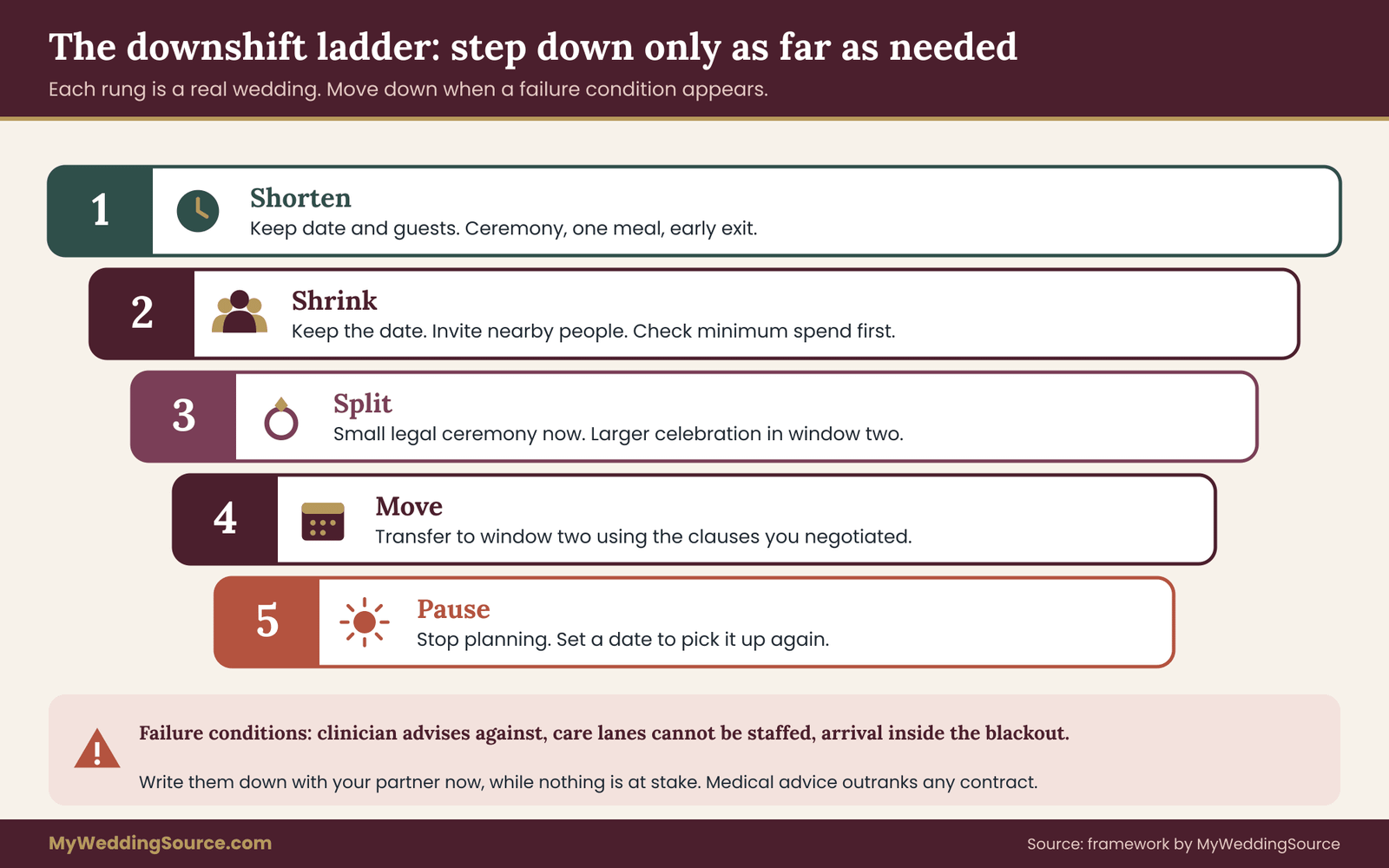
When a failure condition appears, you do not have to cancel everything. Think of a ladder with five rungs, and step down only as far as the situation requires.
Rung one: shorten. Keep the date and the guests, and shorten the day. A ceremony and a meal, with an early exit, uses the same bookings with less strain. Tell vendors early, since coverage hours and menus are easier to adjust in advance.
Rung two: shrink. Keep the date and reduce the guest list to the people who matter most and live nearby. Check minimum spend and headcount terms first, because a smaller event is not always a cheaper one.
Rung three: split. Hold a legal ceremony on one day, small and brief, and a larger celebration in the second window. The ceremony can be at a courthouse, at home or at the original venue with a handful of people. The celebration happens when the family can attend and you are well.
Many couples find this the most satisfying form of downshift, because it keeps the commitment on the date that mattered and gives the party its proper space. For the paperwork side, ask the county or state office that issues marriage licenses about validity periods and officiant rules, since both vary.
Rung four: move. Transfer everything to the second window using the clauses and deadlines you negotiated at gate one. Tell guests promptly and clearly, and update payments against the new dates. If you have kept the gate cards up to date, this step is administrative.
Rung five: pause. Stop planning for a stated period, and set a date on which you will pick it up again. A pause is allowed. It has the same legitimacy as any other rung, and it relieves you of the pressure to produce a decision during a stressful period.
Alternatives that are real weddings
Several alternatives are weddings in their own right, not substitutes. A small ceremony at home or in a hospital room is generally the same legal act as a large one when the license and officiant requirements are met, which your local marriage license office can confirm. A weekday ceremony followed by lunch is shorter and often cheaper.
A weekend elopement near home needs no guests to travel. A brunch reception is gentler on energy than an evening one. Each can later be followed by a larger party, which some couples call a celebration or a vow renewal,.
None of these is a failure. They are options with different costs, and the worksheet’s job is to help you choose the one that fits the situation you are actually in.
Telling people about a downshift in a wedding while pregnant
Say it once, clearly and early. A short message works: “We are changing our plans for health and family reasons. We are well. Here is what is happening and when we will share more.” Add practical details, such as refund guidance for travel. Avoid long explanations. People who love you will want to help, and they can do that best when they know what you need.
The site’s general guide to planning a wedding lists the usual communication steps, and the wedding change notice approach used by other guides applies here too: tell the people with the most to lose first, and the rest after.
Your next steps
You can build the whole system in one evening and a week of emails. Work through these in order for your wedding while pregnant.
- Draw the three-window map. Mark the estimated due date, a wide blackout around it, every fixed contract date and every family anchor. Circle the open stretches.
- Ask your clinician two questions. What would you want to see before a long event and any travel at the point in pregnancy where the wedding falls, and when should we revisit the answer? Write the replies on the gate cards.
- Read every contract for the six clauses. Date change, deposit treatment, cut-off dates, availability, illness language and substitution. Email the vendors the five questions and keep the answers.
- Label each payment with a gate. If a large payment falls before the gate that would justify it, ask to move it, or pay it knowing the risk.
- Fill in the four care lanes. Name an owner, a backup and a second backup for each. Confirm each person has said yes.
- Write the failure conditions and the ladder. Agree them with your partner now, while nothing is at stake, and write down who makes the call on the day.
- Choose your communication wording. Draft the message to guests, with the date, the flexibility and the confirmation date, and decide when it goes out.
- Put the deadlines on one calendar. The clinician follow-up, the move deadline, the headcount date, the final fitting and any insurance enrollment windows.
If you want a broader sequence for the rest of the wedding, the site’s wedding planning checklist and the broader date guidance cover the ordinary tasks. Come back to the worksheet at each gate and update it. A wedding while pregnant is planned in short, repeated passes, not in one long push.
FAQ
Can I plan a wedding while pregnant without knowing my due date exactly?
Yes. A due date is an estimate, so treat it as a band, not a point. Draw a wide blackout around it on a calendar, place the wedding well outside it, and name a fallback window in advance. Your clinician can refine the estimate as the pregnancy goes on. The plan works because it tolerates the uncertainty instead of depending on a single predicted day.
How far ahead should I book vendors for a wedding while pregnant?
Book as far ahead as you need to secure the date, but only after reading each contract for date-change and deposit terms. The key is not the lead time but the flexibility: a transferable deposit, one free move and an open second date. A vendor who refuses all three is a risk, and the price of that risk belongs in your decision.
Is it safe to travel for a destination wedding while pregnant?
That is a question for your own clinician, who knows your history and the stage of your pregnancy. Official sources such as the Centers for Disease Control and Prevention and the American College of Obstetricians and Gynecologists publish general travel guidance, and airlines set their own policies. Ask early, ask about medical care at the destination, and keep bookings changeable until you have a clear answer.
Should I wait until after the baby is born to marry?
Neither choice is automatically better, because each moves risk somewhere else. Marrying before the birth carries the uncertainty of arrival and comfort. Marrying after carries recovery and newborn logistics. A common middle path is a small legal ceremony now and a larger celebration later. Use the five-question decision test, and let your clinician’s advice settle any medical point.
How do I tell guests the date might change?
Say it once, plainly, with the date, the flexibility and a confirmation date. For example, that the date could move for health reasons, that you will confirm by a stated day, and that refundable travel is wise until then. You do not have to share medical details. Tell distant guests first, since they carry the most cost, and keep wording calm and brief.
What should I do about the dress if my size changes?
Choose a design with adjustable closures or room at the waist, schedule the final fitting as late as the seamstress allows, and tell the boutique about the pregnancy at the first visit. Ask in writing what happens if the size changes after ordering. Many couples also arrange a backup outfit, which turns a possible crisis on the morning into an inconvenience.
Does event insurance cover a pregnancy-related change of date?
Often not. Many policies exclude conditions that already exist when the policy is bought, and definitions of a covered reason vary. Ask the issuer directly whether a known pregnancy is excluded, read the exclusions before purchase, and get the answer in writing. Contract terms such as a transferable deposit are usually the stronger protection, and you control them by negotiating before you sign.
What is the cheapest way to protect a wedding while pregnant from a change?
Ask for contract flexibility before you sign: a transferable deposit, one date change and a courtesy hold on a second date. Then delay large payments until the gate that justifies them. These steps cost only a few emails and some patience, and they make every later option, including shortening, moving or splitting the wedding, cheaper to carry out.
Sources
- American College of Obstetricians and Gynecologists: patient resources on pregnancy, travel and postpartum care
- Centers for Disease Control and Prevention: pregnancy, travel health and infant safe sleep
- American Academy of Pediatrics HealthyChildren.org: newborn care and infant safe sleep
- U.S. Food and Drug Administration: food safety for pregnant people
- U.S. Department of Labor, Wage and Hour Division: Family and Medical Leave Act
- HealthCare.gov: special enrollment periods and life changes
- U.S. Equal Employment Opportunity Commission: Pregnant Workers Fairness Act
- Consumer Financial Protection Bureau: consumer guidance on contracts, payments and disputes
- Federal Aviation Administration: passenger travel information
- USAGov: state and local government offices, including marriage license offices