
Wedding officiant legal requirements come down to three questions your license-issuing office can answer: is this person on the state’s list, do they need to register first, and who returns the signed license and by when.
Quick answer
Wedding officiant legal requirements are set by each state and checked by the office that issues your license, so the safe move is to ask that office before you book anyone. Ask three things: whether your chosen person qualifies under the statute, whether any registration, permission, or court order is needed first and how far ahead, and who returns the signed license and by what deadline. The four states we read show how much the answers differ: Texas has no officiant registry, New York City requires registration, Virginia uses court orders for people who are not clergy or listed officials, and California sets a ten-day return window. This is general information, not legal advice.
Couples tend to treat the officiant as a casting decision, and the wedding officiant legal requirements as a footnote: warm voice, good stories, right tone for the room. That is a fair thing to care about, and our guide to choosing a wedding officiant covers it in depth. But the officiant is also the person who makes the ceremony legally count. In most places that means being someone the law recognizes, doing whatever the law requires before the ceremony, signing the license correctly, and getting it back to the right office in time. If any of those steps fails, the problem is not a bad toast. It is a marriage whose paperwork is incomplete or open to question.
This guide explains wedding officiant legal requirements in plain language, with the actual rules from the pages we read. It is built around a simple idea: the law does not care how well someone speaks, so you should check the legal facts first, in writing, and then choose on style. We use Texas, Florida, New York, California, and Virginia as examples because those were the official pages we could read in full. We do not cover all fifty states, and where we could not confirm a detail, we say so instead of guessing.
A word about what this guide is not. It is not legal advice, and it cannot tell you what your county will accept. Offices differ, rules change, and a friendly summary on a website is never a substitute for the answer from the clerk who will record your marriage. Use this guide to know what to ask and what a good answer sounds like. If something unusual is involved, such as a ceremony in another country or a marriage that involves a prior divorce, a family-law attorney is the right person to ask.
If you are still early in planning, our wedding planning checklist shows where officiant and license tasks fit among everything else, and our marriage license guide covers the application side that comes before any of this.
What wedding officiant legal requirements actually cover
The phrase sounds technical, but it covers three ordinary questions. Who is allowed to perform the marriage? What does that person have to do first? What happens to the paperwork afterward? Keeping the three apart makes the whole subject easier, because couples often solve one and assume the other two are handled.
The three tests of a valid officiant
A useful way to think about wedding officiant legal requirements is as three tests, and a ceremony needs to pass all three. The tests are our own framing, not a legal standard, but each one maps to something the official pages we read actually say.
Qualification: is this person on the list?
Every state we read has a list of who may solemnize a marriage. Texas’s law library points to a list in the Family Code that includes certain clergy, officers of religious organizations, and judges. Florida’s statute lists ordained clergy, judicial officers, clerks of the circuit courts, and notaries public. California’s health department lists a longer set of religious officers, judges, commissioners, and officials. Qualification is the first of the wedding officiant legal requirements, a yes-or-no question about the person’s role, and the answer lives in the statute for the state where you marry, not in the officiant’s marketing.
Authorization: does the person need permission first?
Under most wedding officiant legal requirements, qualification and authorization are not the same thing. Some places let a qualified person officiate without telling anyone. Texas’s law library says the state has no official registration for officiants. Other places add a step. New York’s health department says officiants must be registered with the City of New York to perform ceremonies within city limits, and Virginia uses court orders for certain people. A person can qualify on paper and still be unable to officiate until the extra step is done.
Filing: will the signed license reach the office on time?
The ceremony does not finish the job. The signed license has to be returned to the issuing office, and deadlines are set by the place. Texas’s law library says the officiant must return the license to the issuing county clerk no later than the thirtieth day after the ceremony. California’s health department says ten days. Filing is the test couples overlook most, because it happens after the party, when everyone is tired and the officiant has already gone home.

Why the rules sit with the state and the issuing office
It is tempting to look for one national rule. There is not one for officiants. FindLaw’s overview says the officiant must be someone your state legally recognizes, that requirements vary by state, and that the safe path is to check with the city or county clerk. That sentence is worth remembering whenever you read a general article, including this one.
The place of the license sets the rules
The wedding officiant legal requirements that matter are those of the place that issues your license and where the ceremony occurs. A couple who lives in one state and marries in another cannot rely on home-state rules. This is also why a friend who officiated a cousin’s wedding in one state may not be able to officiate yours in another, even if the credential is the same. Our guide to destination wedding legal requirements covers the extra layer that applies when the ceremony is far from home.
Why a venue or vendor cannot answer for the clerk
Venues, planners, and officiant agencies often know the local routine, and that knowledge is useful. But they are not the office that records your marriage, and what they say is a secondhand report. If a venue coordinator says “any ordained person is fine here,” treat that as a reason to ask the clerk, not as an answer. The clerk’s answer is the one you can point to later if a question arises.
What we relied on, and what we left out
We researched wedding officiant legal requirements by reading official or near-official pages for the five jurisdictions named above, plus a legal-information overview and wedding-industry cost pages. We could not read every office’s page of wedding officiant legal requirements. Several pages we tried to open for places such as Nevada, Hawaii, and Massachusetts did not load, so we do not state their fees, lead times, or procedures here. Where we describe general patterns, such as one-time authorizations, we attribute them to the source that described them. A gap in this guide means we did not verify it, not that the rule is absent.
Who counts as a qualified wedding officiant
Most people picture a clergy member or a judge when they think about wedding officiant legal requirements. Those are the largest categories, but the full lists are longer and differ from state to state. Reading a few of them side by side shows both the common core and the surprises.
Clergy and religious officers
The religious category is the broadest and the one most weddings rely on. It is also where wording matters most, because the statute’s description of who counts can be narrower or broader than people assume.
What FindLaw says about religious officiants
FindLaw’s overview says every state allows an authorized member of any religious denomination in good standing to perform marriages, that states cannot require a particular faith or a specific clergy member, and that some states set standards for who counts as a religious officiant. In practice, that means a religious route exists everywhere, but the proof you need to show it can vary by place. A priest, rabbi, imam, or minister with an active standing in a recognized body is the straightforward case.
How Texas and Florida describe clergy
Texas’s law library describes the Family Code list as including a licensed or ordained Christian minister or priest, a Jewish rabbi, and an officer of a religious organization authorized to conduct marriages. Florida’s statute refers to ministers of the gospel, elders in a church, and other ordained clergy who follow the rules set by law. The two states use different words for similar roles, which is a reminder to read the statute for your own state instead of assuming a phrase means the same thing everywhere.
New York’s wider reading of ministers
New York’s health department says ordained clergy and ministers qualify, and it adds that this includes ministers chosen by a spiritual group without church authorization. That is a broader description than the other two, and it is one reason New York comes up so often in discussions of unconventional ordination. Even so, the state’s description does not settle every question for every county or for New York City registration, so a couple relying on this route should still ask the clerk directly.
Judges, civil officials, clerks, and notaries
The second large category is civil. These are people whose public role gives them authority to solemnize marriages, usually without any religious credential.
Judges
Judges appear in the wedding officiant legal requirements of every state we read. Texas’s law library includes current, former, and retired federal or state judges. Florida lists judicial officers, including retired judges. California lists judges and retired judges of its courts, and also certain federal judges, including justices of the Supreme Court and federal magistrates. Virginia’s statute says judges and justices of courts of record, district court judges, retired Virginia judges, and certain federal judges who live in Virginia may perform marriages without a court order or bond. If you want a short, simple civil ceremony, a judge is often the clearest legal route, though availability and format depend on the court.
Elected and appointed officials
Many states let certain officials perform marriages while they hold office. New York’s health department lists governors, mayors, and town, village, or county justices, along with specified legislators. California lists state legislators, state constitutional officers, and members of Congress representing a California district while in office, plus county supervisors, city clerks, and mayors, who must review the county clerk’s solemnization instructions before their first ceremony. Virginia includes the Governor, the Lieutenant Governor, the Attorney General, members of the General Assembly, and Virginia members of Congress. If you know such an official personally, the list for your state tells you whether they could officiate and whether any conditions apply.
Notaries and court clerks
Some states add notaries. Florida’s statute lists notaries public, and FindLaw says some states, such as South Carolina, let notaries perform ceremonies, while New York City does not. Florida also lists clerks of the circuit courts, and Virginia lists circuit court clerks who live in Virginia. Notaries are a good example of why a rule that applies in one state should not be assumed in another. A notary friend in one state may be a perfectly valid officiant, and in another may have no authority at all to solemnize a marriage.
Narrow and local routes
Beyond the big categories are routes that exist in some places for particular situations. They are easy to miss, and they can solve a problem when the usual routes do not fit.
Quaker custom in Florida
Florida’s statute says marriages performed under Quaker or Society of Friends customs are valid and that, for the chapter, the words minister and elder also cover Friends who conduct ceremonies under their own rites. This is a narrow route that applies to a particular religious tradition, not a general loophole. If it fits your faith community, it reflects how the law recognizes forms of worship that do not use a single ordained officiant.
Deputy commissioners in California
California’s health department lists deputy commissioners of civil marriages, who it says may perform marriages in any California county. The pages we read did not describe how someone becomes one, what it costs, or whether it can be done for a single day, so we do not claim that here. If you want a friend to officiate in California without a religious credential, ask the county clerk what options exist and what each requires.
A limit worth noting in New York
New York’s health department says ship captains cannot perform marriages in New York State. It is a small detail, but it illustrates that the list is a list. People who seem authoritative, such as a captain or a business owner, have no legal standing unless the statute says so. The practical lesson is to start with the statute and the clerk, not with what seems plausible.
Qualification tells you whether a person is on the list. Authorization tells you whether they must do something before the wedding. The range between “nothing” and “a court order” is wide, and it is the part of wedding officiant legal requirements that most often changes a couple’s timeline.
A ladder of effort
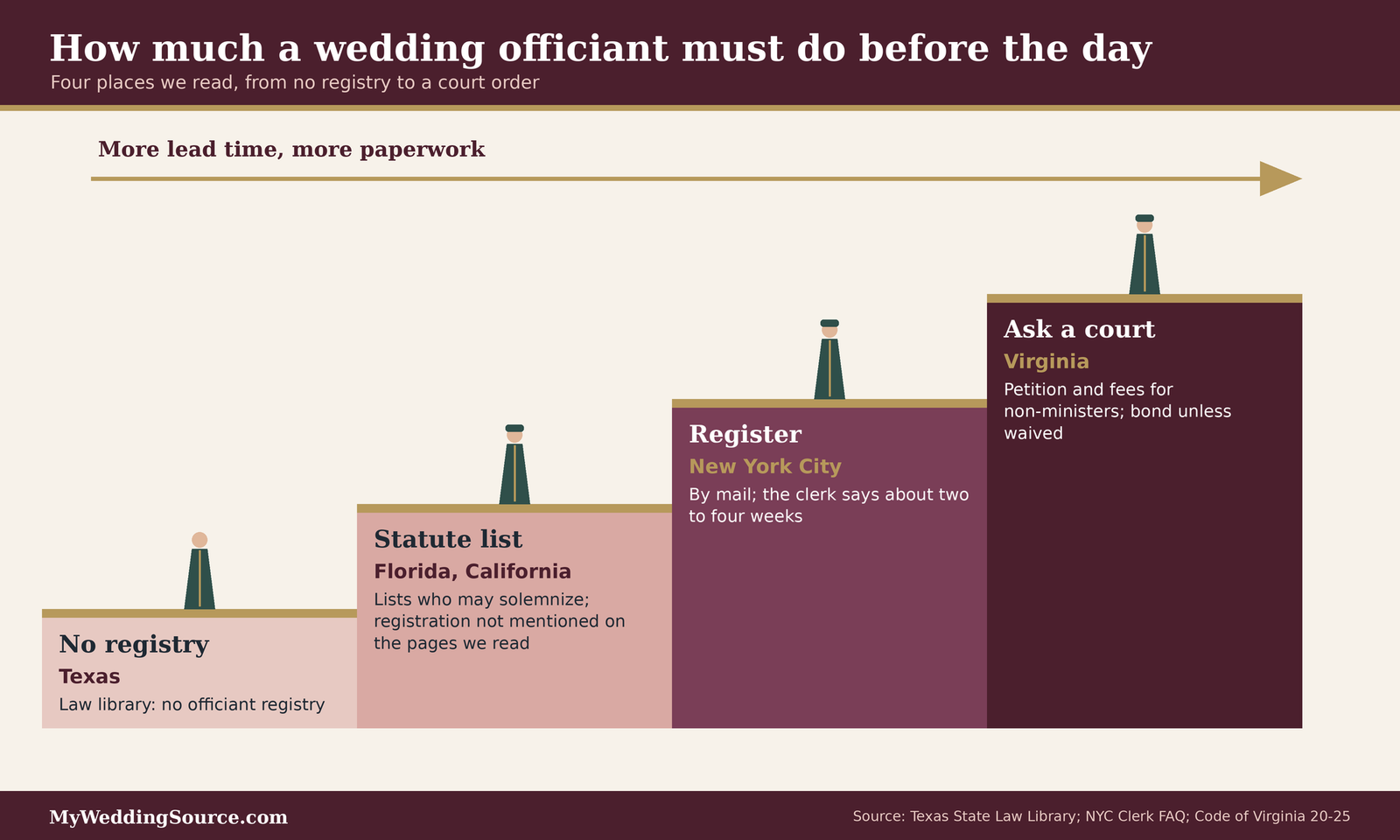
Think of authorization within wedding officiant legal requirements as a ladder. At the bottom, a qualified person simply officiates. Higher up, they register. At the top, they ask a court. Our illustration shows the rungs we found among the places we read.
The bottom rung: no officiant registry in Texas
Texas’s law library says Texas has no official registration for officiants and that a person who reviews the law and believes they qualify may perform the ceremony. That sounds easy, and for someone who clearly fits the list, such as a judge or an ordained minister, it is. The catch is that no registry means no office will confirm in advance that the person qualifies. The responsibility to read the statute correctly sits with the officiant and the couple.
The middle rung: registering with New York City
New York’s health department says officiants must be registered with the City of New York to perform ceremonies within city limits and need not be New York State residents. The City Clerk’s FAQ says registration is by mail only, takes about two to four weeks, and can be sped up with an overnight courier and a prepaid return envelope. The same FAQ says private officiants must perform ceremonies in person and that virtual ceremonies by private officiants have not been permitted since June 25, 2021. Registration, in other words, is a real step with a real lead time.
The top rung: court orders in Virginia
Virginia’s statute says a circuit court judge may authorize a person who lives in that circuit, and who is not otherwise covered, to perform marriages; the person files a petition with the clerk and pays the applicable fees, and the judge can revoke the authorization at any time. A separate section lets a minister apply to a circuit court for an order, showing ordination and good standing or a qualifying pastoral role. The same section (20-25) also says a person authorized by the court must post a five-hundred-dollar bond before performing any marriage, though the court may waive it for someone who qualifies as indigent. This is the heaviest process we found, and it takes planning.
Planning around registration lead times
A registration step in the wedding officiant legal requirements is not just a form. It is a delay that has to fit between your engagement and your wedding day, and it can interact with other tasks in ways couples do not expect.
Mail-only and multi-week processes
If your officiant must register by mail and the office says two to four weeks, you need a buffer on top of that for postage, for corrections if the form is rejected, and for your own slow replies. Our wedding planning timeline is a good place to place the step. As an estimate of our own, treating the clerk’s four-week upper bound as the minimum you should leave, and then doubling it, is a calm way to avoid a last-minute scramble.
Officiants from out of state
New York’s health department says officiants do not need to be New York State residents to register for New York City ceremonies. That is helpful for a couple who wants a friend or relative from elsewhere. It also shows that residence is a rule that varies: Virginia’s court-order route for non-ministers is tied to living in the circuit. Ask whether your officiant’s home state matters in the place where you marry.
When registration is the route for a friend
For a friend who is not clergy, a registration or authorization process is often the route that makes their role legal. FindLaw says a county clerk or judge may deputize a loved one in some places and that, in some places, the permission applies only to a single wedding on a single day. Because the pages we read did not describe other states’ one-time routes in detail, treat any specific fee or lead time you read elsewhere as something to confirm with your own clerk.
Online ordination, friends, and family as wedding officiants
This is the question couples ask most often, and it is the one where confident internet answers are least reliable. The honest summary of wedding officiant legal requirements for online ordination is that a route often exists, that it differs by place, and that you should get your clerk’s answer in writing.
What an ordination certificate does and does not do
An online ordination is a credential from an organization. It is not a license from the state. Whether it satisfies the law depends on how the statute defines who counts.
A credential is not a permission
FindLaw says anyone can be ordained through an online ministry, sometimes for free and sometimes for a fee, and that most states accept these credentials but not all do. It also says New York does not accept Universal Life Church certificates as proof of clerical authority and that Tennessee recognizes ministers ordained through a deliberate and responsible process. Notice that those are two different statements about two different states, and neither is a blanket rule. A certificate can be the first step and still not be the last.
Where the sources disagree
Different sources describe the same place differently. New York’s health department says ordained clergy and ministers qualify, including those chosen by a spiritual group without church authorization. FindLaw says New York does not accept Universal Life Church certificates as proof. Both can be partly true at the same time, because the first describes the category in the statute and the second describes how a particular credential is treated as proof. When sources conflict, the answer that counts is the one from the office that will record your marriage.
Ask in writing, and keep the answer
Ask the clerk a narrow question, such as whether the office accepts a specific ordination for a ceremony in your county, and ask for the answer by email. Keep it with your contract and your license paperwork. If a question ever comes up later, a dated answer from the issuing office is far more useful than a memory of a phone call.
Asking a friend or relative to officiate
A friend officiating can be the most personal choice in a ceremony. It can also be the most fragile if the legal steps are skipped, so the friend deserves a clear explanation of what the job involves.
Match the friend to a real route
Start by finding the route under your local wedding officiant legal requirements, not by asking the friend. For your location, ask the clerk which of these applies: the friend already qualifies, the friend can register or be authorized, or the friend cannot officiate legally. If the answer is no, there is a graceful alternative. A civil official can handle the legal step in a short ceremony, and your friend can lead a personal moment at the ceremony or the reception. Our guide to courthouse weddings covers what that civil step can look like.
Tell the friend what they are signing up for
A friend who agrees to officiate is agreeing to more than a speech. They may need to complete a registration, review the license before the ceremony, sign with a recognizable title, and return the paperwork on time. Zola’s advice notes that a loved one may be inexperienced and nervous and that the person needs time for meetings, writing, rehearsal, and the wedding day. Zola suggests offering to cover any certification cost, and The Knot suggests a thank-you gift.
Give them the hand-off sheet
Write a one-page sheet on the wedding officiant legal requirements for the friend with the clerk’s name and contact details, the registration status, the license return deadline, the return method, and the date you will check in. The sheet is not legal advice. It is a memory aid, so the friend does not have to reconstruct details from an email thread weeks later. Our wedding vows guide and wedding ceremony guide can help a friend plan the speaking part.
The license paperwork the officiant must handle
The paperwork part of wedding officiant legal requirements begins when the vows end. A license is a legal document with a validity window, signature blocks, and a return deadline. Treating it as a document to manage, not an item to carry, prevents most paperwork trouble.
Before the ceremony
The license is a time-limited permission. Checking its dates and its contents before the day is a small task that can prevent a large problem.
Know the validity window
Licenses expire, and the dates are part of the wedding officiant legal requirements too. New York’s health department says its license is valid for 60 calendar days starting the day after issuance, extendable to 180 calendar days for a party on active U.S. military duty with proof at application. California’s health department says its license is valid for 90 days from the date of issue and that a new license must be purchased if the marriage does not take place in that period. Different places, different windows, and different wedding officiant legal requirements. Write the expiration date on your calendar the day you receive the license.
Mind any waiting period
New York’s health department also says the ceremony cannot occur within 24 hours of issuance unless a judge waives the wait. We did not confirm waiting periods for other states in the pages we read, so ask your clerk whether one applies. A waiting period matters most for couples who are traveling in, because a license picked up the day before the wedding may not be usable the next morning.
Have the officiant look at the license in advance
An officiant who sees the license for the first time at the ceremony may discover a missing field or a wrong name when it is too late to fix. Ask the officiant to review the license beforehand, and confirm the names, dates, and signature blocks match what the issuing office expects. California’s health department says officials such as mayors and city clerks must review the county clerk’s solemnization instructions before their first ceremony, which shows how seriously that office treats the officiant’s preparation. Our marriage license guide explains what the application stage involves.
During and after the ceremony
The ceremony is the moment the law cares about, and the filing is the step that finishes it. Both have conditions worth knowing.
Presence, witnesses, and the ceremony itself
California’s health department says the officiant must be physically present with the two parties at the same place when the ceremony takes place, that proxy marriages are not permitted, and that a witness must also be physically present if one is required for the marriage. The New York City Clerk’s FAQ says private officiants must perform ceremonies in person and that virtual ceremonies by private officiants have not been permitted since June 25, 2021. If you were hoping for a video officiant, remember that wedding officiant legal requirements may bar it, so check your own clerk’s rule first. Our wedding rehearsal guide helps you rehearse the signing moment along with the walk.
The return deadline and who watches it
Return deadlines are the part of wedding officiant legal requirements that people forget, and they are short. California’s health department says ten days after the ceremony, returned to the County Clerk or County Recorder. Texas’s law library says the officiant records the ceremony date, the county, and their own information on the license and returns it to the issuing county clerk no later than the thirtieth day after the ceremony. New York’s health department says the officiant returns the completed license to the issuing clerk. Agree in advance who will return it, by what method, and on what date, and set a reminder for yourself a few days before the deadline.

What happens after the license is filed
Once the issuing office receives the license, it records the marriage. New York’s health department says the clerk then sends a Certificate of Marriage Registration to the couple within 15 calendar days of receiving the license and that, if the couple has not received it within four weeks of the wedding, they should contact the issuing clerk. That certificate is what you will use for a name change or for benefits, so it is worth following up. Our guide to the difference between a marriage license and a marriage certificate explains the two documents.
What the legal side of a wedding officiant costs
Money questions around wedding officiant legal requirements fall into three groups: what the officiant charges, what a one-time authorization costs, and what the license itself costs. They are often mixed together in people’s minds, which makes quotes hard to compare.
What this actually costs
The Knot’s 2026 Real Weddings Study, which surveyed 10,474 U.S. couples married in 2025 and recruited them through The Knot and WeddingWire memberships, reports an average officiant cost of $260. The Knot says hometown weddings average $240 and international destination weddings $460. Zola’s editors describe a typical range of about $200 to $450, and say a friend who gets ordained online usually spends under $50. These are orientation figures from industry sources with their own audiences, not legal costs, so ask your clerk for registration or authorization fees and your officiant for a written quote.
Fees by type of officiant
Who you choose changes the price more than anything else, and the cost of meeting wedding officiant legal requirements varies with that choice. The ranges below come from two wedding-industry sources, and they are not a substitute for a real quote.
Professional and secular officiants
The Knot says secular officiants charge roughly $200 to $1,000 or more, with simple legal signings costing less and fully custom ceremonies costing more. Zola says professional officiants generally charge $300 to $800 and top names can exceed $1,000, and that fees drift higher in major cities and on peak-season Saturdays. Zola also lists drivers such as travel, ceremony complexity, experience, and extras like rehearsal attendance or vow-writing sessions. Our wedding budget calculator can hold the figure once you have it.
Religious officiants and donations
The Knot says religious officiants usually do not set a fee but expect a donation, commonly around $200 to $300 plus possible travel. Zola says donations are often $300 to $800 for non-members and that a donation to the place of worship is often preferred over a personal tip. The Knot says a donation is separate from the officiant’s base fee and that tipping is optional and separate from both. Ask what is customary, because practices differ by congregation.
Civil officiants and friends
The Knot describes civil officiant costs as mainly the marriage license fee, which it says ranges from about $30 to $100 depending on the state, plus a possible ceremony fee, and says some states discount the license if you complete premarital counseling. For friends or family, The Knot gives about $10 to $100 for ordination or state registration plus a thank-you gift. Zola says courthouse civil ceremonies can cost under $200. Treat these as ranges and confirm the wedding officiant legal requirements and fees with your own office.
Extras that move the total
Beyond the officiant’s fee, a few small costs belong in a legal budget. They are easy to forget because they do not come from the same vendor.
Travel and time
Zola says officiants may charge mileage, often $0.50 to $1.00 per mile, plus possible overnight stays for distant venues. If your officiant is traveling from another state to handle a registration or to be present, ask for the travel terms in writing. The Knot’s questions page suggests asking what time the officiant will arrive and whether extra calls or meetings are charged, which are two other places a quote can quietly grow.
Paperwork costs
Under some wedding officiant legal requirements, registration or authorization may carry its own fee and its own mailing cost. The New York City Clerk’s FAQ says officiants can send their application by overnight courier and include a prepaid return envelope, which adds postage but can shorten the wait. Virginia’s statute says a person seeking court authorization pays the applicable fees and that a court-authorized person posts a bond, which the court may waive in some circumstances. We did not read the current dollar amounts for most registrations, so ask each office for its total and its accepted payment methods.
Thank-you gestures
A tip, a donation, and a gift are three different things. The Knot says a tip is optional, and Zola says a tip is not expected for professional officiants who run their own businesses, though $50 to $100 is a generous gesture for exceptional service. For a friend, a gift or a meal is a natural thank-you. Our wedding etiquette guide covers thank-you gestures more broadly.
When something goes wrong with the officiant paperwork
Most weddings go through without a legal hiccup. When one occurs, it is usually a gap noticed late: an officiant who was never authorized, a license returned past its deadline, or a name signed in a way the office does not recognize. Knowing the options in advance makes a gap feel manageable.
Gaps found before the wedding
The best time to find a problem with your wedding officiant legal requirements is when you can still fix it. A check at the start of planning, and another a few weeks before the date, catches most issues.
Finding out early
If the clerk tells you your chosen officiant does not qualify, you have time to respond. Options include having the person complete a required registration, choosing a different officiant, or using a short civil ceremony for the legal step. FindLaw says that if an officiant is not recognized in your jurisdiction, the marriage’s legal status could be challenged, which is why the early check matters. A short, dated email to the clerk is the cheapest insurance in wedding planning.
Keep a backup officiant
Illness, travel trouble, and double bookings happen. Ask your officiant who the backup is, and ask whether that person is authorized in your location. The Knot suggests asking about the officiant’s backup plan, and the Better Business Bureau advises asking who the vendor would send if they got sick. If your officiant’s authorization is for one ceremony and one person, as FindLaw says some one-time permissions are, a backup may need to be authorized separately. Our wedding insurance guide explains what deposit protection can and cannot cover.
Use a civil route for the legal step
If the legal route for your preferred officiant is closed or too slow, a civil official can perform the legal step while someone else leads a personal ceremony. FindLaw describes civil officiants as typically county justices of the peace and, depending on the place, retired judges or certain officials. This is a practical solution, not a failure. Many couples find the legal and ceremonial pieces are easier to plan when they are separate.
Questions that arise after the wedding
Sometimes a question about wedding officiant legal requirements comes up later, for example when a name change or an immigration or benefits application needs the certificate. The best defense is a clean paper trail.
What a challenge to validity could mean
FindLaw says that if an officiant is not recognized in your jurisdiction, the legal status of the marriage could be challenged, and it advises confirming the officiant’s eligibility with the clerk and making sure the certificate is properly completed and signed. We did not find a plain statement of how every state treats such a case, and courts differ, so this is a question for a family-law attorney, not for a website.
A pointer to Texas’s savings provision
Texas’s law library says Section 2.302 of the Family Code governs whether a marriage remains valid when an unauthorized person conducts the ceremony, but the page does not describe what the section provides. We could not read the statute text, so we do not summarize it. If you are in Texas and a question arises, read the section itself or ask an attorney. Do not treat any savings provision as a reason to skip the verification step.
Keep a paper trail
Keep a folder on your wedding officiant legal requirements, paper or digital, with the clerk’s emailed answer, the officiant’s credentials, the contract, the license copy if your office allows one, and the date and method of filing. Our wedding permits guide covers the venue and site permissions that sit beside the marriage paperwork, which is a different kind of document that is easy to confuse with the license.
How to verify your own wedding officiant legal requirements
You do not need a law degree to check wedding officiant legal requirements for your situation. You need the right office, a short list of questions, and a habit of asking for answers in writing.
Questions to ask the clerk and the officiant
- Does our state’s statute cover this person, and under which category?
- Is registration, a license, or a court order required before the ceremony, and how far ahead must it be filed?
- Do you accept this specific online ordination for a ceremony in our county, and can you confirm by email?
- What are the total fees and the accepted payment methods for any authorization?
- Who returns the signed license, by what date, and how will we confirm it was recorded?
- Officiant: how do you qualify, and can you show documents?
- Officiant: have you performed a legal ceremony in our county before?
- Officiant: who is your authorized backup if you cannot attend?
Questions for the issuing office
The issuing office is the authority. Questions to it should be narrow, specific, and written, so the answers can be saved.
Ask about the person, not the category
When you ask about wedding officiant legal requirements, a general question such as “can friends officiate?” gets a general answer. A specific question such as “can a person ordained through an online ministry officiate in our county, and is any registration needed?” gets an answer you can use. Include the date and location of your ceremony, since rules can depend on both.
Ask about timing and fees together
Registration lead times and fees belong in the same conversation. The New York City Clerk’s FAQ says registration is by mail and takes two to four weeks, and Virginia’s court route involves a petition, fees, and a bond. Ask for the total cost, the earliest filing date, the typical processing time, and whether expedited handling exists.
Ask what happens after the ceremony
Ask who returns the license, by what deadline, what the late consequences are, and how you will know the marriage has been recorded. The Knot’s questions page also suggests asking what steps make the marriage recognized afterward, such as obtaining a certified copy for a name change. Our guide to passport name change after marriage shows why that copy matters.
Questions for the officiant
A good officiant will not be offended by questions about wedding officiant legal requirements. A hesitant answer to a simple one is information.
How do you qualify?
Because wedding officiant legal requirements turn on the person’s role, ask the person to name the category they qualify under and to show documents. The Knot’s questions page includes asking whether the officiant is legally authorized in your location, including abroad. A prepared officiant can answer in a sentence and send a copy of the credential.
Who is the backup?
Ask for the name or the process, not just the reassurance. Get it in the contract, and ask whether the backup is authorized in your location. The Better Business Bureau advises getting every promise in writing, including anything said verbally, and that is especially true for a promise about a substitute.
Who files, and when?
Agree on the filing person, the deadline, and the method. The Knot’s questions page lists who signs what and who returns the document to the clerk’s office as questions to settle in advance. A written line in the contract, such as “officiant will return the signed license to the clerk by a stated date,” removes ambiguity.
A record worth keeping
Good records turn a stressful question into a quick answer. They also help the next person in your family who has to deal with the certificate.
The folder
Keep the clerk’s written answers, the contract, the officiant’s credential, the registration confirmation if there is one, and proof of filing in one place. Name the files with dates. If your officiant uses a paper receipt, photograph it.
The calendar
Add four dates: the license start date, the license expiration date, the registration deadline if one applies, and the filing deadline. Our wedding planning timeline and wedding planning guide show how to place these among your other milestones.
The follow-up
A week after the filing deadline, check that the office recorded the marriage. If the certificate has not arrived within the time the office states, contact them. New York’s health department says to contact the issuing clerk if the certificate has not arrived within four weeks of the wedding.
Frequently asked questions about wedding officiant legal requirements
Who is allowed to officiate
Who can legally officiate a wedding in the United States?
It depends on the state. FindLaw says every state allows an authorized member of a religious denomination in good standing, and civil officiants such as justices of the peace are common. Judges, certain officials, and in some states notaries also qualify. Check the statute and the clerk for the place where you marry.
Can a friend or relative officiate our wedding?
Sometimes. FindLaw says a county clerk or judge may deputize a loved one in some places, occasionally for one wedding on one day, and that online ordination is accepted in most states but not all. Ask the clerk who will issue your license before your friend invests time or money.
Authorization and ordination
Do wedding officiants need to register first?
In some places. Texas’s law library says Texas has no official registration, while New York’s health department says officiants must register with the City of New York for ceremonies inside city limits, and Virginia uses court orders for people not otherwise covered. Ask your issuing office whether anything must be filed, and how far ahead.
Is an online ordination certificate enough?
Not always. FindLaw says most states accept online ordination but not all, and that New York does not accept Universal Life Church certificates as proof of clerical authority. A certificate is a credential, not a state license, so ask the issuing office in writing whether it accepts yours for your county.
The license and the deadline
Who returns the signed marriage license, and by when?
Usually the officiant, and the deadline depends on the state. Texas’s law library says by the thirtieth day after the ceremony, and California’s health department says within ten days. Agree on who returns it, by what method, and by what date, and confirm with the office that the marriage was recorded.
How long is a marriage license valid?
It varies. New York’s health department says its license is valid for 60 calendar days starting the day after issuance, with a 180-day extension for active military duty, and California’s says 90 days from issue. Write the expiration date on your calendar when you receive the license, and ask about any waiting period.
Cost and problems
How much does a wedding officiant cost?
The Knot’s 2026 Real Weddings Study reports an average of $260 for couples married in 2025, and Zola describes a typical range of about $200 to $450. Religious officiants often welcome a donation, and registration fees, travel, and a custom script can change your total, so ask for a written quote.
What if our officiant turns out not to be authorized?
FindLaw says that if an officiant is not recognized in your jurisdiction, the marriage’s legal status could be challenged. If you find a gap before the wedding, you may be able to register, change officiants, or use a civil official for the legal step. After the wedding, ask a family-law attorney.
Your next steps
Confirm the legal facts
Write down six facts from the issuing office
To pin down your wedding officiant legal requirements, use the clerk’s page or a call and record who qualifies, whether registration or a court order is needed, whether your chosen ordination is accepted, the total fees, the application lead time, and the license return deadline. Ask for the answers by email, and keep them with your contract. Our marriage license guide covers what comes before.
Choose with the facts in hand
Once you know the wedding officiant legal requirements for your place, compare candidates on style and price. Our wedding officiant guide walks through briefs, quotes, and contracts, and our wedding ceremony guide helps you shape the ceremony itself.
Protect the paperwork
Calendar the dates and a buffer
Add the registration deadline, the license start and expiration dates, and the return deadline to your calendar, with a reminder a week before each. Our wedding planning timeline and wedding planning checklist show where each date fits.
Name who files and a backup
Put the name of the person who returns the license, the deadline, and the method in the contract or in a note to your officiant. Name a backup officiant who is also authorized. Our wedding budget calculator can hold the fees you collect.
Sources & methodology
How we built this guide
What we relied on
This guide combines statute and agency pages from Florida, Texas, New York, and California, a Virginia statute, the New York City Clerk’s FAQ, a general legal-information overview from FindLaw, and cost and question lists from The Knot, Zola, and the Better Business Bureau. Where a statement comes from a wedding-industry source, we say so, because those sources describe their own audiences and habits. The Knot’s average reflects a survey of its own members. The estimate about leaving a buffer for registration is our own judgment, not a rule.
What we did not do
We did not read every state’s rules, and several official pages for other places did not load, so we do not state their fees or lead times. We did not read the text of Texas Family Code Section 2.302 or the Colorado, Nevada, Hawaii, or Massachusetts rules. This is general information, not legal advice. For your marriage, rely on the office that issues your license and, for a legal question, a family-law attorney.
Source list
Government and public-agency sources
- Florida Legislature, Florida Statutes, section 741.07: https://www.leg.state.fl.us/statutes/index.cfm?App_mode=Display_Statute&URL=0700-0799/0741/Sections/0741.07.html
- Texas State Law Library, Marriage in Texas, Conducting the Ceremony: https://guides.sll.texas.gov/marriage-in-texas/conducting-the-ceremony
- New York State Department of Health, Information on Getting Married in New York State (publication 4210): https://www.health.ny.gov/publications/4210/
- California Department of Public Health, California Marriage License General Information: https://cdph.ca.gov/Programs/CHSI/Pages/California-Marriage-License-General-Information.aspx
- New York City Clerk, Frequently asked questions (August 30, 2022): https://www.cityclerk.nyc.gov/assets/cityclerk/downloads/pdf/FAQs%20as%20of%208.30.2022%20final.pdf
- Code of Virginia, section 20-25: https://law.lis.virginia.gov/vacode/title20/chapter2/section20-25/
- Code of Virginia, section 20-23: https://law.lis.virginia.gov/vacode/title20/chapter2/section20-23/
Consumer-protection and legal-information sources
- FindLaw, Who can officiate my wedding: https://www.findlaw.com/family/marriage/who-can-officiate-my-wedding-.html
- Better Business Bureau, BBB wedding tips: https://www.bbb.org/article/news-releases/16783-bbb-wedding-tips
Wedding-industry sources
- The Knot, Wedding officiant fees, donations and basics: https://www.theknot.com/content/wedding-officiant-fees-donations-basics
- The Knot, The Average Wedding Cost, According to The Knot Data (2026 Real Weddings Study): https://www.theknot.com/content/average-wedding-vendor-costs
- The Knot, Questions to ask potential officiants: https://www.theknot.com/content/questions-to-ask-potential-officiants
- Zola, Wedding officiant cost: https://www.zola.com/expert-advice/wedding-officiant-cost
- Zola, How to choose a wedding officiant: https://www.zola.com/expert-advice/how-to-choose-wedding-officiant