
Mother of the bride dresses have to meet an unusual brief: they need to look right beside the couple and the other parent, stay inside a color etiquette that nobody has written down in one place, survive a long day on your feet, and arrive and be altered on a schedule that is less forgiving than it looks.
Quick answer
Settle three things in order when choosing mother of the bride dresses. First, formality and color: ask the couple what the dress code is and which colors are off the table before you shop, because the sources we reviewed agree that white, ivory and often champagne belong to the bride unless the couple says otherwise. Second, fit and function: choose a design you can sit, hug, walk stairs and dance in at your actual venue and season. Third, timing: retailers and etiquette guides we reviewed point to about six to eight months before the wedding for shopping, with the tailor booked about eight to twelve weeks out, but one etiquette authority says two to three months can be enough. Ask the seller for a written delivery date, and budget for the finished outfit, not the rack price.
This guide is for the mother of the bride, for the couple helping her, and for anyone standing in for her, such as a stepmother, a grandmother or another relative taking the role. It assumes the wedding has a date and a rough idea of its style. The broader picture of who wears what in the wedding party lives in our wedding party attire guide, and the bridesmaids’ side of the same problem is covered in our bridesmaid dresses guide. This page stays with mother of the bride dresses, the one garment that has to coordinate with both.
A note on how to read the numbers and rules here. Etiquette sources such as The Knot, Zola and the Emily Post Institute describe customs, not laws, and they sometimes disagree with each other, so we say where they do. Timelines and prices from dress retailers reflect that retailer’s own production and sales, so we name the seller each time. Where we did arithmetic ourselves, we label it an estimate. Nothing here is a quote from a specific shop, and prices change, so confirm every figure with the seller you actually use. We are not a legal, medical or financial adviser; where a rule, a health concern or a contract matters, check the specifics yourself.
Settle formality and color boundaries before you shop for mother of the bride dresses
Most advice about mother of the bride dresses starts with styles. For this role it works better to start with limits, because two of them are set by other people: the formality is set by the wedding, and the color is bounded by the couple and the bridal party. Once those are fixed, the rest of the decision gets smaller and the shopping gets faster.
Read the formality as a floor and a ceiling
The dress code on the invitation tells you the level, but it does not tell you where within the level to land. The mother of the bride walks in the processional at many weddings, sits in the front row, and appears in the family photographs, so mother of the bride dresses are read as part of the wedding party’s look. The Knot’s guidance is that her outfit should lean slightly more formal than what the other guests wear.
Match the length to the dress code first
For mother of the bride dresses, The Knot says black-tie and formal weddings call for floor-length gowns, often in sheath or A-line shapes, while cocktail and semi-formal weddings suit jacket dresses, jumpsuits and tea-length styles, and casual weddings suit elevated separates or festive dresses. Zola gives similar examples: a floor-length gown or sequined dress in a neutral tone for black tie, a mid-length cocktail dress or a wide-leg pantsuit in an elegant fabric for semi-formal, and a flowing sundress in a breathable fabric with dressy sandals for a beach wedding. If you are unsure what a code means in practice, our guides to black-tie wedding attire and cocktail attire explain the two codes mothers most often ask about.
Not every authority treats the length of mother of the bride dresses as a rule. The Emily Post Institute says gown length is a personal choice, even at formal weddings, and that long dresses and skirts work for any wedding from noon on. Our reading is that the codes set a safe default and a mother who prefers a different length can choose one, as long as the fabric, the embellishment and the overall polish stay at the wedding’s level. A knee-length dress in a crisp crepe with a structured jacket can sit comfortably at a formal wedding. A knee-length dress in a casual cotton cannot.
Dress slightly above the guests without competing with the couple
Dressing a notch above the guest level is not the same as dressing to be noticed. A practical test, which is our own suggestion and not a rule from any source, is to ask whether a stranger scanning the family photo would look at you before the couple. Heavy sequins across the whole dress, a train, or a high-contrast color can pull the eye. A dress that carries its formality through fabric, cut and a few details, such as a clean neckline, good lining and one considered piece of jewelry, stays in the background while still looking finished.
If the wedding has a very specific theme, such as a barn reception after a church ceremony, ask the couple how the two settings differ, because mother of the bride dresses have to work across both settings. Dressing for the more formal part and bringing a wrap or flat shoes for the less formal part is usually easier than changing outfits.
Draw the color boundaries
Color is where shoppers for mother of the bride dresses get the most conflicting advice. Several sources give lists of safe shades, but the lists differ, and the real boundary is usually set by what the couple has chosen for the bridal party and the room. The most reliable route is a short conversation early, with a swatch or a photo in hand.
Clear these colors with the couple before you buy
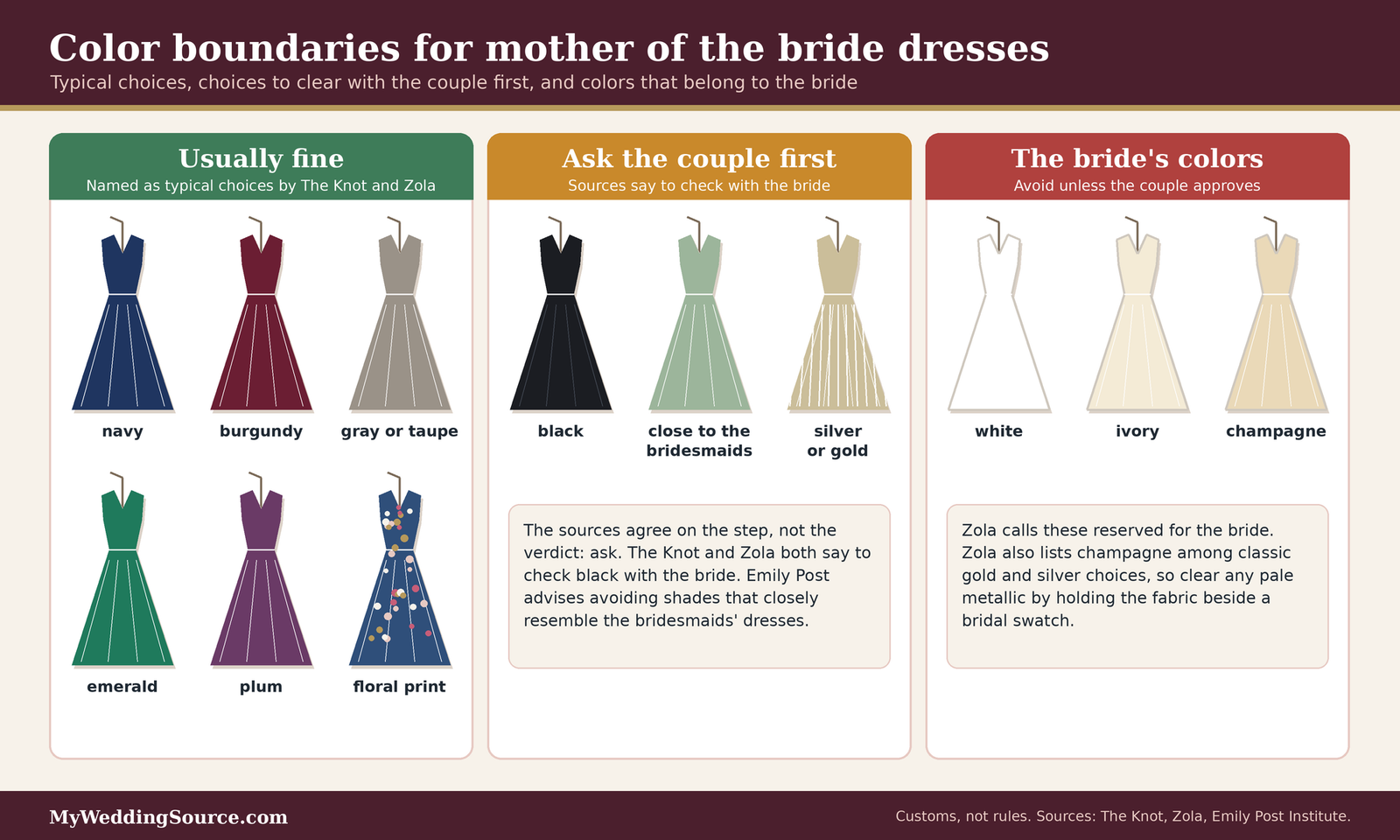
The Knot says white, ivory and champagne are generally avoided unless the couple approves, so that the bride stays the focus. Zola says to avoid white, ivory, champagne and off-white, which it describes as reserved for the bride, and also lists champagne among classic silver and gold options. That overlap in a single source shows how fuzzy the champagne line is, because some champagne shades read as pale gold and others as cream, and a photograph under warm lighting can shift them further. If you love a pale metallic, put the actual fabric next to a bridal gown swatch, or ask the bride whether she is comfortable with it.
Black is the second color to confirm. The Knot calls black acceptable, especially for black-tie events, but suggests checking with the bride and considering the venue, the mood and the season. Zola lists black among safe neutrals and also advises avoiding it unless the event is formal or the bride approves. Our takeaway is that sources agree on the practical step: ask. Some couples find black dramatic and elegant for an evening wedding, and some associate it with a more somber mood at a daytime garden ceremony.
The third boundary is the bridal party. The Emily Post Institute advises avoiding colors that match or closely resemble the bride’s and the bridesmaids’ dresses so you do not blend in or stand out in the wrong way. The Knot says matching the bridesmaids is optional, and many couples prefer coordination, and that with mismatched bridesmaids a complementary look works. These are different pieces of advice, and the difference is your cue to ask what the couple prefers and bring a swatch of the bridesmaids’ fabric, as the Emily Post Institute suggests, when you shop. Our bridesmaid dresses guide explains how color names and dye lots vary, which is useful when you are matching to a color you have only seen on a screen.
Prints, metallics, and what “complement” means
For mother of the bride dresses, The Knot calls navy and burgundy classic choices in any season and says multicolored floral prints have become more popular. Zola lists neutrals such as navy, gray, taupe and black, silver and gold tones, and jewel tones such as emerald and plum for fall and winter weddings. These are starting points for browsing. Each is described as typical, not required.
“Complement” is the word most guides use and the one that causes the most confusion. In practice it means sitting in the same visual neighborhood as the bridal party without repeating it. If the bridesmaids wear sage green, a navy or a deep gray-green is in the neighborhood, while a bright sage dress in a different fabric competes with them. If the bridesmaids wear several colors, a neutral or a shade from the same palette is easier. If you cannot tell, a swatch photographed next to a bridesmaid swatch in daylight settles it faster than a debate.
Both mothers also need to coordinate with each other. The Knot says the two mothers should not wear identical dresses and may wear different dresses in the same color, though that is not required. The Emily Post Institute advises that the two mothers wear different colors. Zola says neither mother should match the other or the bridesmaids unless the bride asks, that their colors should complement each other for photos, and that both should dress at the same level of formality so neither seems to outshine the other. Most of this is common ground for mother of the bride dresses: avoid twins, keep the formality level similar, and let the lengths differ if they want to.
Start with fit and function before aesthetics for mother of the bride dresses
Once the formality and the color zone are clear, the next decision is whether a dress will work on your body for a whole day in a specific place. This is where mother of the bride dresses most often go wrong, because the dress is bought months ahead, usually from a photograph, and tried properly only when it is too late to choose a different one.
Translate body proportions and movement needs into design choices
A design has to suit how you move as much as how you look standing still. The wedding day asks you to stand for the ceremony, sit through a meal, hug dozens of people, climb or descend steps and possibly dance, and some of those movements put more stress on a dress than a fitting-room mirror suggests.
Know which measurements matter
Retailers of mother of the bride dresses ask for bust, waist and hips, and those are the numbers to bring when you compare a size chart. For this role we would add three measurements that charts rarely ask for but that decide whether the dress works. The first is the distance from your shoulder to the point where you want the hem to land, measured while you wear the shoes you plan to wear, because the hem depends on the shoe, a point both Jovani and Couture Candy make about fittings. The second is your upper-arm circumference, if you want sleeves, because sleeve width is a common reason a dress that fits elsewhere feels tight when you raise your arms. The third is the bust-to-waist difference, because it determines whether a structured bodice will gape or pull. These are our suggestions for what to measure, drawn from the fitting issues the tailors and retailers we cite describe, and a tailor can tell you which matter for a specific dress.
When you take measurements for mother of the bride dresses, wear the undergarments you plan to wear, or at least without bulky layers, and write the date next to them. Bodies change over months, and a measurement taken in the autumn may not be exact for a June fitting. The point of writing the date is to notice, at the first fitting, whether anything has shifted.
Notice where sample sizing distorts expectations
A dress in a photograph or on a store rack is a particular size on a particular body, and mother of the bride dresses ordered online may arrive untried. Two things follow. First, the drape you see belongs to the sample size, and your size may fall differently, especially in fabrics that rely on structure, such as a stiff skirt or a boned bodice. Second, store samples are often not in your size at all, so the first time you see the dress on your frame may be the day it arrives from the factory. Jovani describes the first fitting as the point where problems are identified and a plan is agreed, and it lists changes that may not be possible, such as enlarging a tight bodice or moving a waist seam, so ordering the right size matters more than hoping for a fix.
The practical response is to ask for the seller’s garment measurements (the flat measurements of the dress, not only the body measurements it is intended for), to read the return policy before you buy, and to ask how much seam allowance a tailor can let out. If you are between sizes, ask whether the seller recommends the larger one, because most garments are easier to take in than to let out. That is a general tailoring principle and a good question for your tailor; it is not a guarantee for any particular dress.
Match fabric and construction to season and venue
For mother of the bride dresses, a fabric is a weather decision. The same dress that looks elegant in an air-conditioned ballroom can feel punishing at an outdoor ceremony in July, and a thin dress in a drafty historic venue in December can mean spending the evening in a coat.
Connect weight, lining, sleeves, and ventilation
Zola’s guidance for the season is that lighter colors and lace suit warm-weather weddings, flutter sleeves suit warmer months, and long sleeves suit winter weddings or a more modest preference, with jewel tones for cooler seasons. Zola also presents crepe and chiffon as formal options for black tie and chiffon as breathable for a beach wedding. For a hot venue, our suggestion is to ask about the lining as well as the outer fabric, because a heavy or non-breathable lining defeats a light shell. For a cold venue, think in layers: sleeves, a jacket, a wrap, or a dress with enough structure to wear a coat over without crushing.
The National Weather Service explains that the heat index describes how hot it feels when humidity is added to air temperature and that exposure to full sunshine can raise heat index values by as much as 15 degrees Fahrenheit. If the ceremony is outdoors and in direct sun, that is a reason to favor breathable fabrics, a shorter exposure time, a shaded place to wait before the processional, and water. Our garden wedding venues guide and beach wedding dresses guide explain how those venues change what people wear and how they stay comfortable.
Flag mobility, heat, snag, and transparency risks
Four risks show up again and again in fitting conversations about mother of the bride dresses. Mobility risk is a skirt or a sleeve that restricts a hug, a step or a seat. Heat risk is a fabric or lining that traps warmth. Snag risk comes from lace, beading and embellishment on a venue with rough surfaces: wooden pews, brick, gravel paths, a grass lawn. Transparency risk is a sheer fabric, such as chiffon or lace, that looks opaque indoors and shows through in direct sunlight or flash photography.
Jovani notes that crepe can show old needle marks or puckering, chiffon needs careful handling across multiple layers and satin can reveal seam impressions, and those are alteration risks as well as appearance risks. Our synthesis is that a fabric that cannot be easily re-hemmed or re-sewn is best chosen for a dress that already fits well. The matrix below translates these into design questions.
Read the fit-and-function matrix before you commit to a style
The table below is our synthesis of the retailer and etiquette guidance cited in the sources, applied to mother of the bride dresses. It describes tendencies, not guarantees, and it is best used as a set of questions to put to a seller or a tailor.
| Factor | What it suggests | Alteration risk | What to ask |
|---|---|---|---|
| Hot, sunny, or outdoor ceremony | Breathable fabric such as chiffon or crepe, a breathable lining, flutter or cap sleeves | Chiffon needs careful hemming across layers (Jovani) | Is the lining breathable, and does the seller list a fabric content on the label? |
| Cold, indoor, or winter venue | Long sleeves or a jacket; heavier crepe, jacquard or velvet; space for a wrap | Structured or heavy fabrics can mean more bodice work (Jovani) | Can a jacket be fitted with the dress, and how much does that add? |
| Floor-length gown at a formal wedding | Sheath or A-line shape, as The Knot describes | Hem depends on the exact shoe height; full skirts may need each layer leveled (Jovani) | Can the hem be set with my shoes at the first fitting? |
| Beaded, sequined, or lace detail | A statement look; check that it does not compete with the couple | Highest: taking in beaded seams can mean removing and restoring trim (Jovani) | Does the alteration price differ for embellished fabric? |
| Sheer fabric such as chiffon or tulle | Needs full lining or layers for opacity | Lining adds hem and seam work | Can I see it in daylight and under a flash? |
| Sleeves or a jacket added or changed | Coverage for arms, sun, or modesty | Sleeve work takes 2 to 4 weeks at Azazie; adding sleeves is a separate assessment at Jovani | Is the sleeve part of the design, or will it be added by the tailor? |
| Long dinner, many hours seated | Fabric with some give, a waist that does not pinch when seated | Often lower, but a fitted bodice shows every line | Have I sat in the dress for 20 minutes in the fitting room? |
| Between sizes or a changing body | A forgiving cut such as a wrap or A-line | Letting out depends on seam allowance (Jovani) | How much seam allowance is there, and what is the largest size change a tailor can make? |
How to use the matrix
Pick the two or three rows that describe your wedding and write the question next to each one in your notes. Take those questions to the seller and to a tailor. If a seller cannot answer a question about lining, seam allowance or fabric, treat that as information about the seller.
Where the matrix is least reliable
The matrix generalizes about mother of the bride dresses. A well-made lace dress with a good lining can be comfortable in warm weather, and a poorly made chiffon one can be miserable. The row to trust most is the one about alteration risk, because it follows from how garments are constructed; the row to trust least is any statement about how a fabric feels, because that depends on the specific cloth. When in doubt, ask for a swatch or try the dress in person.
Coordinate with the other mother, the bridal party, and the couple on mother of the bride dresses
Color and formality for mother of the bride dresses are decided in conversation, not in a shop. The mothers are the two people most likely to be photographed together, so the order in which they choose, and the way they tell each other, matters more than the specific dress.
Understand the order of choosing and who calls whom
Traditional etiquette gives the mother of the bride the first move and the mother of the groom the second. The reasoning is simple: the first mother sets a color and formality that the second can answer. Whether that tradition still works for your family is a separate question.
What the sources say about who goes first
The Knot says that by tradition the mother of the bride chooses before the mother of the groom, that the groom’s mother should coordinate without necessarily matching, and that the mother of the bride has the final say about her own outfit because she is the one wearing it, even though the couple may offer ideas. The Emily Post Institute says the same about order and adds that the mother of the groom should not hesitate to call if she has not heard about outfits once planning is underway. Zola puts timing on it: the mother of the bride starts about six to eight months out, once the bride and the bridal party have chosen their attire, and the mother of the groom starts around six months out, after hearing from the mother of the bride, and can ask for an update if she has not heard by about five months.
The practical step for the mother of the bride is to send the other mother three pieces of information once you have decided: the color name, a photo or a swatch, and the length. That takes five minutes and prevents most clashes.
When the order is a guideline, not a rule
Zola describes the order as a guideline that many people treat flexibly. If the groom’s mother has already bought, the mother of the bride can still choose well by asking for a photo and picking a color in a different shade. If the mother of the bride has a limited window for shopping, such as a wedding in a busy season or a complex alteration, a short conversation with the couple and the other mother can let her buy early with the color boundaries agreed. The goal of the custom is to avoid two people discovering a clash after they have bought, and any method that achieves that is good enough.
Compare what the sources agree on and where practice differs
Etiquette guides to mother of the bride dresses are written by different publishers and sellers, and their advice is not always the same. Where they agree, you can treat the advice as standard practice. Where they differ, the difference is a decision for the couple.
| Question | Where sources agree | Where they differ |
|---|---|---|
| Who chooses first | The Knot, Zola and Emily Post all describe the mother of the bride choosing first by tradition | Zola calls it a guideline many treat flexibly |
| White, ivory | The Knot and Zola advise avoiding them unless the couple approves | Not addressed in the Emily Post pages we reviewed |
| Champagne | The Knot and Zola treat champagne as something to avoid or clear | Zola also lists champagne among classic silver and gold choices |
| Black | The Knot and Zola call it acceptable at formal events and advise checking with the bride | Zola also lists it as a safe neutral |
| Matching the other mother | None of the three recommends identical dresses | The Knot allows different dresses in the same color; Emily Post advises different colors |
| Matching the bridesmaids | Emily Post and Zola advise against a close match unless the bride asks | The Knot says matching is optional and many couples prefer coordination |
| Length | Zola and Emily Post say lengths can differ between mothers | Emily Post says length is a personal choice at any level; The Knot ties formal codes to floor-length |
| How early to buy | Zola and Couture Candy: 6 to 8 months | Emily Post: at least 2 to 3 months |
Read the agreement column first
The agreement column for mother of the bride dresses is a short list: tradition gives the mother of the bride the first choice, white and ivory are the bride’s, nobody recommends twin dresses, and lengths can differ. Those are safe assumptions in most U.S. weddings. They are still customs, and an individual couple can change any of them.
Treat the disagreements as questions for the couple
The differences, especially about champagne, black, the other mother’s color and the bridesmaids’ color, are the questions to bring to the couple. The honest answer for each is “it depends on the wedding,” and the person best placed to say is the bride or the couple. Bring a swatch and a photograph, because a color name alone, such as “navy” or “champagne,” means different things to different people.
Include everyone who fills the role
Advice on mother of the bride dresses assumes one person in the role, but many families do not fit that picture. A bride may have a mother and a stepmother, two mothers, a grandmother who raised her, or no mother present at all.
Stepmothers and other relatives
Zola advises that stepmothers wait to choose until both main mothers have chosen, which puts the order in a clear sequence. We would add that if you are the stepmother or another relative, a short message to the mother of the bride about color and formality, sent before you buy, is both polite and practical. If more than two mothers or mother figures are in the photographs, give each a distinct shade within the same palette, so that the group reads as coordinated and no one is lost.
Photographs and the family portraits
The family portraits are where color decisions pay off or backfire. Our wedding photographer shot list guide explains how to list the family groupings you want, and our wedding photography guide covers how a photographer works with light and color. One practical suggestion, which is ours and not from a source: if you are worried that a very pale outfit beside a very dark one, or a fine pattern, will be difficult in the planned light, show the photographer or planner the swatch and ask.
Build the shopping timeline around alteration reality for mother of the bride dresses
The shopping window for mother of the bride dresses is shaped by two clocks that run at different speeds. The first is the seller’s clock: how long a dress takes to be made or shipped. The second is the tailor’s clock: how many weeks of fittings the dress needs once it arrives. Most late-dress stories come from planning around the first clock and discovering the second one afterward.
Work backward from fittings and delivery
For mother of the bride dresses, start with the date of your final fitting, not the date you want to buy. The Emily Post Institute says to order outfits at least two to three months ahead and to allow at least two weeks for alterations. Zola’s guidance says to buy at least three months ahead so there is time for alterations. Those are minimums. Azazie, a retailer, describes a standard mother-of-the-bride alteration as taking about four to eight weeks with two fittings, and lace, beading, sleeves or multiple layers as six to ten weeks with two or three fittings. The difference between “at least two weeks” and “four to eight weeks” is the difference between a simple hem and a dress that needs real work, so it helps to decide which kind of dress you are buying before you pick a date.
Know when a custom order, a rush, or an off-the-rack dress changes the schedule
Couture Candy, which sells mother of the bride dresses, says most mothers should begin six to eight months before the wedding, that simple ready-to-wear dresses from a department store can start four to five months out, and that custom designer gowns should start closer to nine months. It also says designer dresses often ship in four to six weeks in standard sizes and longer for custom measurements, and that made-to-order dresses typically take two to six weeks and can take up to ten additional weeks between January and March. Azazie says to shop three to six months ahead for made-to-order or custom sizes. Zola’s guidance is that the mother of the bride should start about six to eight months out, after the bride and the bridal party have chosen their attire.
These figures for mother of the bride dresses come from sellers and an etiquette publisher, not from a standard industry schedule, and they are not consistent, because sellers differ in how they make and ship. What they agree on is the direction. An in-stock dress shortens the first clock. A made-to-order or custom dress lengthens it. A winter or early-spring wedding with a made-to-order dress can hit a seasonal backlog. An off-the-rack dress that must be taken in or lengthened still needs the second clock.
If you have less than three months, Couture Candy suggests looking for in-stock dresses, asking about rush options, which carry extra fees, and contacting alteration specialists immediately. Azazie describes a rushed alteration timeline as two to four weeks or more with one or two fittings, keeping changes minimal and prioritizing the hem, a secure bodice and comfortable straps and sleeves.
Add buffer for correction, steaming, and accessories
A schedule for mother of the bride dresses with no slack becomes a problem the first time anything is wrong. A dress can arrive with a flaw, a wrong size or a color that does not match the swatch. A tailor can need a second pass. The shoes you ordered can turn out to be uncomfortable and need replacing, which moves the hem. Steaming or pressing after the final fitting takes a day, and a jacket, wrap, jewelry and undergarments need to be in hand before the last fitting, not after.
Our recommendation, which is an editorial rule of thumb and not a sourced figure, is to plan for the dress to be finished and in your hands at least two weeks before the wedding, so that a remake, a delay or a shoe change has somewhere to go. Count back from that date: the final fitting just before it, the second fitting before that, and so on to the first fitting, the tailor’s booking and the order. Everything else follows from those dates.
Both Azazie and Couture Candy say to bring your final shoes and undergarments to the fittings because they affect the hem and the fit. That means shoes and foundations need to be chosen before the first fitting, not after the dress.
Read the shopping-to-final-fitting timeline as ranges
The table below combines the published ranges into a single working schedule for mother of the bride dresses. It is our synthesis, and the ranges overlap because the sources disagree. When two ranges conflict, use the more cautious one for any step that cannot be recovered if it slips.
| Stage | When (before the wedding) | What happens | Source range |
|---|---|---|---|
| Confirm formality and color | Before any shopping | Ask the couple about the dress code, off-limits colors and the bridesmaid swatch | Etiquette guidance from The Knot, Zola and Emily Post |
| Shop and order | 6 to 8 months (typical); 3 to 6 months for custom sizes; at least 2 to 3 months at the minimum | Compare options, read the return and delivery terms, place the order | Zola and Couture Candy 6 to 8 months; Azazie 3 to 6 months for custom; Emily Post at least 2 to 3 months |
| Dress arrives | About 12 weeks or earlier (our rule; earlier for custom orders) | Check size, color and flaws immediately; raise problems the same week | Couture Candy: designer standard sizes 4 to 6 weeks plus shipping; made-to-order 2 to 6 weeks |
| Book the tailor | 8 to 12 weeks | Reserve fittings before the calendar fills | Azazie 8 to 12 weeks before the wedding; studios may book weeks ahead (Couture Candy) |
| First fitting | 6 to 10 weeks | Pin and mark with real shoes and undergarments | Azazie 8 to 10 weeks; Jovani 6 to 8 weeks |
| Second fitting | 4 to 6 weeks | Check the changes, flag corrections | Azazie 4 to 6 weeks |
| Final fitting and pickup | 1 to 2 weeks | Walk, sit and test; take the dress home; steam | Azazie and Couture Candy 1 to 2 weeks |
| Our buffer | Dress finished and in hand 2 weeks before the wedding | Absorbs a remake, a delay or a shoe change | Editorial recommendation |

Where the sources disagree, and what to do about it
The spread is real. Emily Post’s “at least two to three months” and Zola’s “at least three months” describe a floor. Zola and Couture Candy’s “six to eight months” describes a comfortable window. Azazie’s “eight to twelve weeks” for booking the tailor describes the alteration side. Jovani says to schedule the first fitting about six to eight weeks out and to start earlier for heavy beadwork, multiple skirt layers or a busy season.
The spread in these figures for mother of the bride dresses is not a contradiction, because the sources answer different questions: when to order, when to start alterations, and how long a minimum viable plan can be. If your dress is simple, in stock and you have a tailor lined up, the shorter numbers are reasonable. If it is beaded, layered, made to order, or the wedding falls in a busy month, the longer numbers are safer. When you cannot tell which case you are in, ask the seller what the longest realistic delivery time is and ask the tailor what the longest realistic alteration is for that specific dress, and plan against those.
A worked example for a June wedding
Take an illustrative wedding on Saturday, June 12. The dates below are our arithmetic from the ranges in the table, not a recommendation from any source. Six to eight months before is mid-October to mid-December, so ordering falls in that window. Booking the tailor at twelve weeks falls on March 20. A first fitting at ten to eight weeks falls between April 3 and April 17. A second fitting at six to four weeks falls between May 1 and May 15. A final fitting at two to one weeks falls between May 29 and June 5. A two-week buffer means treating May 29, the early end of the final-fitting range, as the date the dress must be finished and in hand, which leaves the last two weeks for anything that goes wrong. It also means the dress should arrive and be judged wearable well before March 20, so any problem surfaces early enough to be fixed.
Azazie’s own planner uses a similar example for a June wedding: booking by March, a first fitting in early to mid April and pickup in early June. The dates match closely, which suggests the schedule is not unusual.
Know your protections when an order is late
Late delivery of mother of the bride dresses is not only an inconvenience. In the United States, a federal rule governs how online and phone orders must be handled, and it is worth knowing before you place a deposit-sized order.
What the FTC rule on mail, internet and telephone orders says
The Federal Trade Commission’s guide to its Mail, Internet, or Telephone Order Merchandise Rule says that if a seller states a shipping time, it needs a reasonable basis for meeting it. If the seller states no time, it must reasonably expect to ship within 30 days of receiving a properly completed order. If the seller cannot ship on time, it must either get the customer’s consent to a delay or cancel and refund. A delay notice must give a revised ship date and explain that the customer can cancel for a full, prompt refund. Refunds must generally be made within seven working days and must be in money or its equivalent, not store credit.
This is a summary of an agency’s business guide, not legal advice. Whether it covers a particular purchase depends on the facts, including the seller, the order type and whether the item is made to order. Keep the order confirmation, the stated delivery date and every delay notice, and ask the seller directly what its delivery estimate is in writing before you pay.
Read made-to-order and return terms before checking out
Couture Candy cautions that made-to-order items often cannot be changed after twenty-four hours and tells buyers to check the return policy before buying. That is a retailer’s description of its own category, and policies differ. Before you order, find the answers to four questions: whether the dress is returnable, whether returns are refunded in money or credit, who pays for return shipping, and whether altering the dress ends the return window. The last one matters most for this purchase, because many sellers treat an altered dress as final sale. If the policy does not say, ask in writing.
Consider renting when the calendar is tight or the dress is a one-time wear
Renting is a real alternative to buying mother of the bride dresses, particularly for a mother who does not expect to wear the dress again. It changes both clocks, and it adds some rules of its own.
How a rental timeline differs from a purchase timeline
Rent the Runway’s company page for one-time event rentals says a dress is kept for four or eight days, reservations can be made up to four months ahead, orders are typically packed three to five days before the rental starts, and changes to the start date, size or accessories can only be made before packing. It says each event rental includes one free backup size, though not on every style, that a replacement costs $12.95 and must be requested within 48 hours, and that returns must be dropped off with the carrier by noon on or before the return date, which cannot be extended. It lists late fees of up to $50 per day and treats an item not returned within seven days as a non-return charged at the purchase price. These are the company’s own terms and may change.
The Knot’s roundup of clothing-rental sites notes that at one service, saving an item to a closet does not hold it, so it advises saving several options in case one is out of stock. The same roundup says Rent the Runway’s one-time rentals come with a free backup size.
Who rental suits, and who should avoid it
Rental of mother of the bride dresses can suit a mother who wants a designer dress without the price, who does not need a lasting garment, and who is comfortable with a standard cut that arrives ready to wear. It is less suitable if you expect to need alterations, since the page we reviewed does not describe whether alterations are allowed, so ask the company directly before you rely on that. It is also less suitable if the dress must be in your hands for an extended period for fittings, photographs or a rehearsal dinner, since rental periods are short and fixed. If you rent, do a full try-on the day the dress arrives, with your shoes and undergarments, and use the backup size window.
Budget for the finished garment, not the rack price for mother of the bride dresses
The price tag on mother of the bride dresses is the first number in a longer list. For this garment the list includes alterations, shoes, undergarments, accessories and care. A budget built only from the rack price tends to understate the real cost.
Separate purchase, alteration, undergarment, and accessory costs
Published cost data for mother of the bride dresses is thin. The Knot’s and Zola’s etiquette pages we reviewed give no cost figures for the mother of the bride’s outfit. Zola’s example dresses range from about $199 to $798, and Azazie, a retailer, publishes budget ranges. Because the data is limited, we show our method so you can substitute your own quotes.
Read the retailer’s ranges as an estimate from a seller
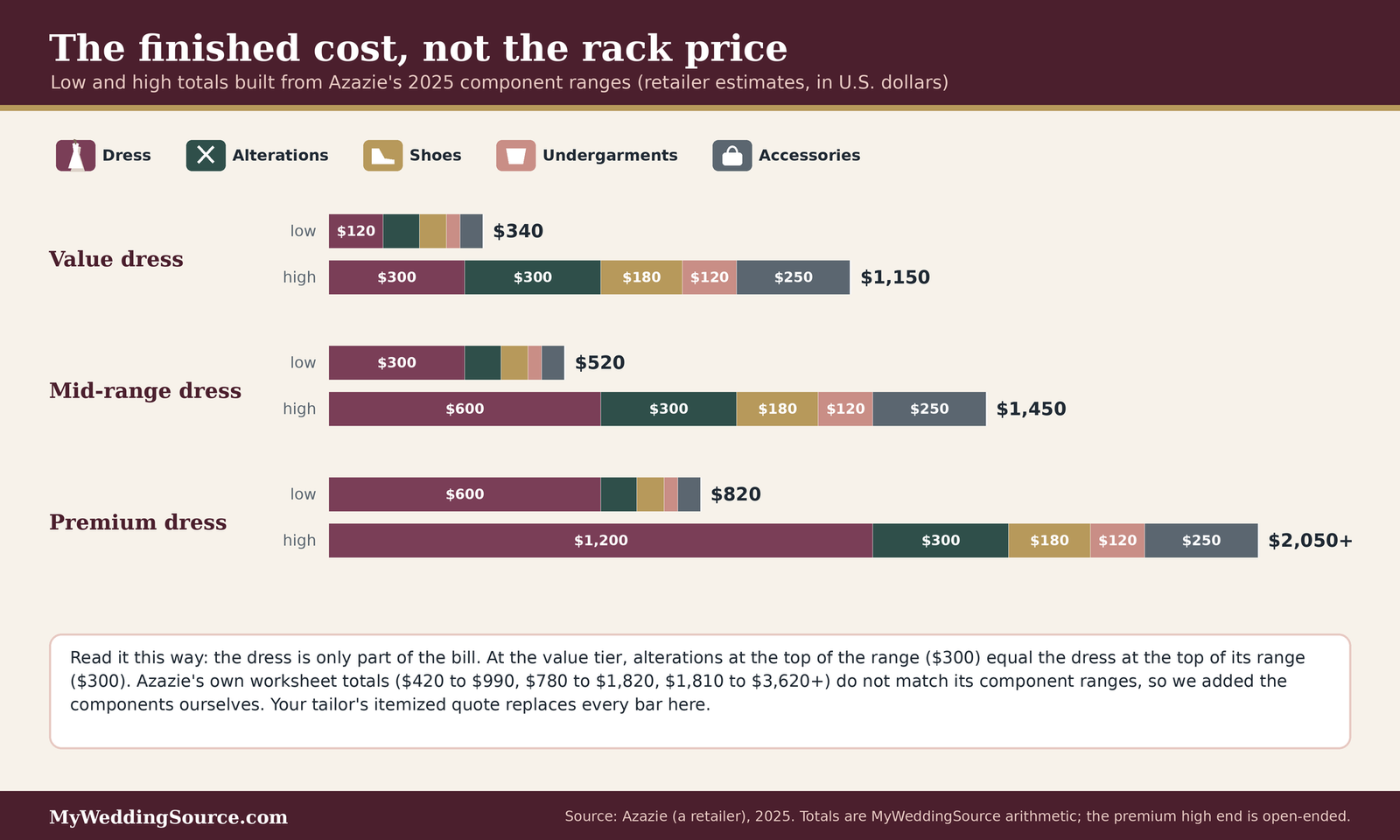
Azazie’s November 2025 budget article gives typical U.S. price tiers for mother of the bride dresses in 2025: about $120 to $300 for value, $300 to $600 for mid-range, $600 to $1,200 or more for premium and $1,500 to $4,000 or more for couture or made-to-measure. It gives alteration ranges of about $80 to $300 or more, with hemming at $60 to $150, bodice work at $45 to $150, sleeve adjustments at $30 to $90 and a modesty panel at $25 to $75. It lists shoes at $60 to $180, undergarments at $30 to $120 and accessories at $50 to $250. It adds that alteration costs can rise 10 to 20 percent in peak wedding months, May and June and September and October.
Azazie does not say how it gathered these ranges, and it sells dresses, so treat them as a starting point and not as an average of what mothers pay. Its own totals also do not line up: a worksheet gives $420 to $990 for the value tier, $780 to $1,820 for mid-range and $1,810 to $3,620 or more for premium, and a separate FAQ gives a broader $600 to $1,500 all-in estimate. We recompute the totals below so the arithmetic is visible.
Our arithmetic: low and high totals for the finished outfit
Using only Azazie’s component ranges, we add the low end of each component for the low total and the high end for the high total. The non-dress items add up to $220 at the low end ($80 alterations, $60 shoes, $30 undergarments, $50 accessories) and $850 at the high end ($300, $180, $120 and $250). Adding the dress tiers gives about $340 to $1,150 for the value tier, $520 to $1,450 for mid-range and $820 to $2,050 for premium, with the premium and couture ceilings open-ended. These are estimates from one seller’s ranges, not quotes, and they assume you buy every item new.
What the budget really covers
At the value tier, the high end of the alteration range, $300, is as much as the high end of the dress itself. That is why the rack price of mother of the bride dresses tells you less than a finished estimate does. Ask the tailor for an itemized quote after the dress is in hand, as Jovani advises, and ask whether fittings, pressing and later adjustments are included. Zola’s bridal-gown alteration article, which covers wedding gowns and not guest dresses, reports that rush fees can add 25 to 50 percent, so book early.
Show which design details drive alteration complexity
Two mother of the bride dresses at the same price can have very different alteration bills. The difference usually comes from construction, and construction is visible in the store if you know where to look.
Details that add time and money
Azazie says complexity, scope and fabric drive timing: layers, beading and lace add handwork and motif matching; sleeve reshaping, neckline changes and jacket tailoring take longer than hems and straps; crepe and stretch satin are quicker, while chiffon, tulle and lace need more care and structured fabrics such as mikado and jacquard need precise pressing. It also lists the season and shop capacity as factors, noting that spring and fall are busy.
Jovani says labor depends on the number of layers, the embellishment, how accessible the seams are and the amount of reshaping. Among mother of the bride dresses, a plain sheath in crepe is at the low end of all of those. A beaded, layered gown with a lace bodice is at the high end. If your budget is tight, a simpler construction usually costs less to fit than a decorated one at the same rack price.
Alterations that may not be possible
Jovani lists changes that can alter a gown’s support and proportions or may not be feasible: enlarging a tight bodice, raising a complex neckline, removing an integrated sleeve or moving the waist seam. It adds that taking in beaded seams may require removing trim and restoring the pattern, and that lace motifs and sheer panels may be part of the design. This is the strongest argument for ordering the right size and for testing the neckline and sleeve at the first fitting, because a design problem that cannot be fixed is better found with time to choose another dress.
Decide who pays, and include care in the plan
Money questions around mother of the bride dresses are usually quiet ones. They are easier to resolve before an order than after a receipt.
Talk about who pays before anyone buys
The Knot says that traditionally the mother of the bride pays for her own attire unless the couple says otherwise. That is a custom and not a rule, and families vary widely. If the couple has asked for a specific color, a specific designer or a specific style that is more expensive than you would otherwise choose, it is reasonable to ask whether they intend to contribute. If you are helping to fund the wedding, our how to pay for a wedding guide covers the broader conversation, and the wedding budget calculator helps place the dress in the larger plan.
Read the care label before buying and plan for after
The Federal Trade Commission’s Care Labeling Rule requires manufacturers and importers of textile apparel to attach care instructions that are permanent, legible during the product’s useful life and based on a reasonable basis. A label that says dry clean only means the maker has evidence that washing would damage the garment, and a label that says to dry clean with no steam is an instruction to follow before you steam or press. Check the label before you pay so that you know what cleaning the dress will need and so that a tailor or a steamer does not use a method that harms it.
If you plan to keep the dress, ask the cleaner about storage and preservation, and ask for the cost in advance. We did not find a reliable price for preservation of a guest dress, so we do not give one.
Use the fitting room to test the wedding day for mother of the bride dresses
A fitting for mother of the bride dresses is a rehearsal. A dress that looks right in a mirror while you stand still can fail the moment you sit, hug or climb a step, and the fitting is the only time that failure is cheap. Treat each fitting as a short test with a list.
Move, sit, dance, hug, and walk stairs in the garment
Jovani’s alteration guidance for mother of the bride dresses says to test sitting, hugging, reaching overhead, walking and stairs at the fitting. That list is a good one, and it is worth doing in order and out loud, so the tailor sees the same movements you will make at the wedding.
Test the actual shoes or heel height
Both Jovani and Couture Candy say to bring the real shoes to fittings, because they set the hem. Jovani adds that you should bring the wedding shoes at the intended heel height, and a backup pair if you have one, and that you should walk and climb a few stairs before approving the length. Shoes are also a comfort decision. A spokesperson for the American Podiatric Medical Association, Dr. Crystal Holmes, was quoted by the Sun Journal saying that heels should be no more than two inches if you will wear them for more than about two hours, that very high heels should be saved for the ceremony with lower shoes for the reception, that kitten heels under an inch are a comfortable option, and that you should never buy uncomfortable shoes expecting to break them in. She also advised shopping at the end of the day, when feet are at their largest, and choosing a deep, wide toe box.
If your wedding has a long ceremony, a receiving line and a long reception, the practical response is to bring two pairs: the pair you walk in and a pair for the dinner and the dance floor, and to set the hem for the one you will wear for most of the day. A hem set for flats and worn with heels shows an ankle, while a hem set for heels and worn with flats drags. If you change shoes, ask the tailor whether the difference is small enough to manage, or whether you should choose one height.
Check the neckline and support under photography movement
With mother of the bride dresses, the pose in a mirror is not the pose in a photograph. Photographers ask people to lean toward each other, to hug, to turn and to raise glasses. Raise your arms, lean forward and turn the way you would in a photo, and watch the neckline, the straps and the armholes. Jovani suggests checking that the neckline stays secure after sitting and that the zipper lies flat. Our suggestion is to take a short video of yourself doing those movements in the dress, so you can see what the camera might see. If you are wearing a jacket, a wrap or a shawl, test it with the dress too, because it changes the shoulder line.
Bring the undergarments you plan to wear. Emily Post advises getting specific advice on undergarments and hosiery for the dress, and Jovani suggests bringing the bra, shapewear and hosiery you will actually wear, because they affect the fit. Replacing a bra after the dress has been taken in can undo the work.
Document what must change before the next fitting
A fitting that is not recorded is a fitting that has to be repeated. The tailor sees a dozen clients a day, and you will remember the conversation differently by the next visit.
Photograph pin placements and notes
Ask permission, and then take a photograph from the front, back and each side after the tailor has pinned the dress. Write down each change in plain words, for example “take in the side seams about one inch,” “shorten the hem to clear the shoes by half an inch,” “lower the back neckline” or “add a hook at the top of the zipper.” Jovani suggests bringing your wedding date, a list of fit concerns and photos showing how the dress moves. At the next fitting, compare the photos to the current state of the dress, and mark anything the tailor did not address.
Get alteration scope and deadlines in writing
Jovani advises requesting an itemized quote after the tailor has examined the dress and asking whether fittings, pressing and later adjustments are included. Add three more items to that request: the date of each fitting, the date the dress will be ready, and what happens if a change is not finished in time. A short email or a line on the receipt is enough. If the tailor’s timeline is longer than the weeks you have, find that out at the first appointment, when there is still time to change the plan, not at the last one.
Run a full-outfit rehearsal in the last two weeks
Mother of the bride dresses are part of an outfit. The jewelry, the bag, the wrap, the shoes, the undergarments and the hair all affect how the dress sits and how you feel in it. A rehearsal, at home or at the final fitting, finds the problems that remain.
Try the whole outfit together
For mother of the bride dresses, put on everything at once, in the order you will on the day, and spend twenty minutes moving around the house. Sit in a chair like the ones at the reception, climb a staircase, carry the bag and reach for a glass. If a necklace catches on a neckline or a clasp snags a lace panel, change it now. Our wedding jewelry guide covers matching jewelry to a neckline. Check the label for any care instructions before steaming or pressing, since a label may call for professional cleaning without steam, as the FTC’s care labeling guidance shows.
Pack a day-of kit
This is our checklist and not from a source: a small kit with safety pins, a few strips of fashion tape, a sewing kit in matching thread, a lint roller, blister bandages, a stain stick suitable for the fabric, a spare pair of comfortable shoes, a phone charger, water and a snack. Hand it to someone who will be near you, not to someone who will be in the wedding party processional.
Plan for comfort, health, family customs, and changes to the plan
Standard advice on mother of the bride dresses assumes a standard day. Many mothers of the bride do not have one: the wedding is outdoors in the heat, the ceremony is in a house of worship with its own expectations, the family dresses in traditional clothing, a health condition limits standing or walking, or the plan has to change late.
Plan for comfort, mobility, and health
Comfort is not a luxury when choosing mother of the bride dresses. A mother of the bride is often on her feet longer than most guests, greeting people, posing for photographs and moving between rooms.
Standing, sitting, and long days
Before you settle on mother of the bride dresses, ask the couple for an honest schedule: how long the ceremony runs, how long the receiving line lasts, when the family portraits happen and how long dinner takes. Then plan seating. If you have a condition that makes standing difficult, discuss it with your clinician and tell the couple or the planner in advance so a chair can be available. That is a planning suggestion, not medical advice. A dress with a bit of stretch, a forgiving waist and a hem you can walk in without lifting is easier to wear all day than a rigid one.
Heat, cold, and weather
The National Weather Service describes the heat index as how hot it feels when humidity is combined with air temperature, and says full sunshine can raise heat index values by as much as 15 degrees Fahrenheit. For an outdoor ceremony in warm weather, that is a reason to pick breathable fabric, ask whether a shaded waiting area is available, drink water and keep a fan or a parasol on hand. For a cold venue, plan for a wrap or coat that fits over the dress sleeves without crushing them, and test it with the dress.
Respect venue, faith, and family customs
The etiquette guides to mother of the bride dresses that we cite are American and general. They are not a guide to every faith, culture or family, and a couple may have expectations that differ from them.
Modesty and coverage requirements
Some houses of worship and some families expect covered shoulders or arms. Zola suggests long sleeves for a more modest preference, and Azazie lists a modesty panel at $25 to $75 and says modesty adjustments can add two to three weeks for fabric sourcing. If coverage is required, plan it from the start, as a jacket, a wrap, sleeves or a dress with them built in, not as a fix at the final fitting. Ask the couple or the officiant what is expected, and our wedding ceremony guide can help you frame that conversation.
Traditional and cultural dress
Many families wear traditional or cultural clothing to weddings, and in some of them the colors, fabrics and styles carry meanings that differ from the American conventions summarized above. Where that applies, the family’s customs take priority over a general guide. Ask the couple and your own relatives, and treat the American color advice in this guide as relevant only to the extent that it fits the day. The questions about timing, fit, alterations and comfort still apply.
Keep the plan working when something goes wrong
Most problems with mother of the bride dresses are fixable if they are caught early and handled calmly. Some are not, and it helps to know which is which.
When the dress arrives wrong
Check the dress as soon as it arrives: the size, the color against your swatch, the fabric, the seams, the beading and the lining. Compare it to the order confirmation. If something is wrong, contact the seller in writing the same day, attach photos and ask for a remedy and a date. If the dress will not arrive in time, the FTC’s order-rule guidance requires a seller that cannot ship on time to seek consent for a delay or cancel and refund. For a seller that offers rush production, ask for the cost and the delivery date in writing. If time runs out, an in-stock dress or a rental is a legitimate fallback, and having one in mind from the start makes the call easier.
When the family does not agree
A disagreement over mother of the bride dresses, whether about color or length, is easier when you can point to something specific. Show the swatch, name the boundary that matters, such as “the bridesmaids are in sage and I have chosen a deep navy,” and ask for the couple’s decision. Our wedding planning stress guide offers ways to keep these exchanges short and kind, and our wedding etiquette guide covers the larger conversation about roles and expectations.
Follow two worked scenarios for mother of the bride dresses
The following two scenarios for mother of the bride dresses are illustrative. They are not case studies of real clients, and the names and dates are invented to show how the decisions interact.
A June garden wedding with six months to spare
Imagine a mother of the bride for an outdoor garden wedding on a Saturday in June, with a cocktail-attire dress code and bridesmaids in sage green.
The decisions
She asks the couple the three questions in this guide about mother of the bride dresses: what the dress code means, which colors to avoid and what the bridesmaids are wearing. They say cocktail attire, no white or ivory, and navy or deep gray would be welcome. She orders a swatch of the bridesmaid fabric and tests navy and a deep gray-green in daylight. She chooses a navy crepe dress with a lined bodice and a lightweight chiffon overlay in a tea-length cut, with a separate jacket for the shaded part of the evening. Our garden wedding venues guide explains the sun, the surfaces and the shade at such venues, which is why she chooses a block heel instead of a stiletto for the lawn.
The dates
She orders in October, using the six-to-eight-month window. The dress arrives in December, and she checks it on the day it arrives. She books the tailor for March 20, twelve weeks out. The first fitting is in early April, with the shoes and the undergarments she plans to wear. A second fitting is in early May, and the final fitting and pickup are on May 29, two weeks ahead. Because she planned to have the dress finished two weeks early, a hem that needed a second pass did not threaten the date.
A formal wedding with ten weeks left
Now imagine a mother of the bride who has ten weeks before a formal evening wedding, because the date moved earlier than planned.
What changes
She cannot choose made-to-order mother of the bride dresses, because Couture Candy describes those as taking two to six weeks to produce and longer in busy seasons, and she has no room for a fault. She looks for in-stock floor-length gowns, asks about rush shipping and books a tailor on the day she orders. She chooses a simple crepe sheath, which Azazie describes as quicker to alter than a layered or beaded dress, and avoids lace, beading and sleeve changes.
What she gives up and what she keeps
She gives up choice and some price control, since rush options carry extra fees, per Couture Candy. She keeps the parts that cannot be recovered: shoes and undergarments chosen before the first fitting, a fitting in week eight with the final one in week one, and a written pickup date. She also tells the couple which dress she chose and sends a photo to the other mother in the same week. The compressed plan works because it removes the risky choices, not because it is faster.
Questions to ask before you buy for mother of the bride dresses
Questions worth asking before you buy
- What dress code does the invitation mean, and what are the bridesmaids and the other mother wearing?
- Are there colors the couple would like me to avoid or to prefer, and may I bring a swatch?
- What is the delivery date in writing, and what happens if the dress is late?
- Can the dress be returned if it does not fit, and does altering it end the return window?
- What are the garment’s measurements and how much seam allowance is there?
- What does the care label say, and what will cleaning cost?
- What will the tailor charge, itemized, and which fittings and pressing are included?
About the dress
These questions confirm what you are buying in mother of the bride dresses and whether it will work.
Ask the seller about the garment
Ask for the fabric content, the lining, the size chart and the garment measurements, and ask to see the dress in daylight if you can. If you are ordering online, ask for a swatch. Confirm the color name and the dye lot if you need to match anything. If the seller cannot answer a basic question, that is useful information.
Ask the couple about the day
Ask the couple the questions that only they can answer: the dress code, the color boundaries, the schedule and the venue conditions. Ask the other mother about her plans, and share yours.
About the order and the alterations
These questions protect your schedule and your money.
Ask about delivery and returns
Ask for a written estimate of the ship date, the cancellation policy, the return policy and who pays for return shipping. Ask whether a rush option exists and what it costs. Keep every confirmation.
Ask the tailor about scope, price and deadlines
Ask for an itemized quote after the tailor has seen the dress, the date for each fitting, the pickup date and what is included. Ask what changes may not be possible on this dress, using Jovani’s list of risky alterations as a starting point.
FAQ: mother of the bride dresses
Color and etiquette
Can the mother of the bride wear black?
Often, yes. The Knot calls black acceptable, especially for black-tie events, and suggests checking with the bride and considering the venue, mood and season. Zola likewise advises avoiding it unless the event is formal or the bride approves. Ask the couple, and consider adding color through a wrap, jewelry or a lighter lining if the wedding is a daytime, outdoor event.
Should the two mothers’ dresses match?
No. The Knot says the mothers should not wear identical dresses, though they may choose different dresses in the same color. The Emily Post Institute advises different colors, and Zola says neither should match the other unless the bride asks. A shared level of formality and colors that look good together in a photograph are the goals.
Who chooses a dress first?
By tradition, the mother of the bride, according to The Knot, Zola and the Emily Post Institute. The mother of the groom follows and coordinates without matching. Zola calls this a guideline many people treat flexibly, and the Emily Post Institute says the groom’s mother can call if she has not heard. Share your color name, a swatch photo and the length once you choose.
Timing and cost
When should I start shopping?
For mother of the bride dresses, Zola and Couture Candy, a retailer, say about six to eight months before the wedding, and Azazie says three to six months for custom sizes. The Emily Post Institute says at least two to three months. Longer is safer for made-to-order, beaded or layered dresses, or for a busy season. Ask the seller for a written delivery date.
How long do alterations take?
It varies by dress. Azazie describes a standard mother-of-the-bride alteration as about four to eight weeks with two fittings, and six to ten weeks with lace, beading, sleeves or layers. The Emily Post Institute says to allow at least two weeks. Book the tailor about eight to twelve weeks out, and ask for the ready date in writing.
How much should I budget?
Published data on mother of the bride dresses is thin. Azazie, a retailer, lists 2025 dress tiers from about $120 to $300 for value up to $1,500 to $4,000 or more for couture, plus alterations of $80 to $300 or more, shoes, undergarments and accessories. Our arithmetic gives roughly $340 to $2,050 from value to premium. Get quotes first.
Fit and comfort
How long should the dress be?
Let the dress code and venue guide you, and wear a length you are comfortable in. The Knot ties black-tie and formal weddings to floor-length gowns and cocktail or semi-formal weddings to tea-length or jacket dresses. The Emily Post Institute says length is a personal choice, and that long dresses suit any wedding from noon on.
What should I bring to a fitting?
Bring the shoes at the heel height you will wear, the bra, shapewear and hosiery you plan to wear, any jacket or wrap, and your wedding date, according to Jovani. Add a list of fit concerns and photos of how the dress moves. Test sitting, hugging, reaching and stairs, and ask for pin photos and an itemized quote.
Your next steps
Settle the boundaries
Ask the couple three questions
Before you shop for mother of the bride dresses, ask what the dress code means in practice, which colors they would like you to avoid and what the bridesmaids and the other mother are wearing. Bring a swatch or a photo. Our wedding planning checklist is a useful place to record the answers alongside the rest of the wedding tasks.
Tell the other mother what you chose
Once you pick a color and a length, send the other mother a photo and the color name. If you are a stepmother or another relative, send the same message to the mother of the bride before you buy, as Zola’s sequence suggests.
Lock the schedule and the budget
Work backward from the final fitting
Choose the date you want the dress finished and in your hands, at least two weeks before the wedding, then count back to the final fitting, the second and first fittings, the tailor’s booking and the order date. Our wedding timeline guide helps fit those dates into the wider plan, and our wedding dress alterations guide explains how tailors work.
Write down the finished cost and the terms
Add up the dress, the alterations, the shoes, the undergarments and the accessories, using real quotes in place of the ranges in this guide. Save the order confirmation, the delivery estimate and the return policy. Then put the total into your wedding budget calculator figures, and if you want a broader frame for the planning, our wedding planning guide covers the sequence from start to finish.
Next step if you are comparing options: Wedding Spray Tan: Trial Timing, Undertone, and Transfer Risk.
Sources & methodology
How we built this guide
What we relied on
This guide to mother of the bride dresses combines two Federal Trade Commission business guides (on the care labeling rule and on the mail, internet and telephone order rule), a National Weather Service page on the heat index, etiquette guidance from The Knot, Zola and the Emily Post Institute, alteration and timing guidance from the dress sellers Azazie, Jovani and Couture Candy, Rent the Runway’s own rental terms and a podiatrist’s wedding-shoe tips reported by a newspaper. Where a statement comes from a retailer, we say so, because a seller’s timeline and prices reflect that seller. The timeline dates, the finished-cost totals and the infographic bars are our own arithmetic from those ranges, and they are estimates. The measurement suggestions, the day-of kit and the scenarios are our editorial suggestions, not sourced facts.
What we did not do
We did not test dresses, survey mothers of the bride or obtain quotes from tailors. We did not find a current, methodologically disclosed survey of what mothers of the bride spend, so we did not report one. Etiquette sources describe customs and disagree in places, and retailer pages may change without notice. We give no legal, medical or financial advice. Check the exact terms of your order, talk to a clinician about health concerns and ask your tailor and seller for written quotes and dates.
Source list
Government sources
- Federal Trade Commission, Business Guide to the Mail, Internet, or Telephone Order Merchandise Rule: https://www.ftc.gov/business-guidance/resources/business-guide-ftcs-mail-internet-or-telephone-order-merchandise-rule
- Federal Trade Commission, Clothes Captioning: Complying with the Care Labeling Rule: https://www.ftc.gov/business-guidance/resources/clothes-captioning-complying-care-labeling-rule
- National Weather Service, Heat Index: https://weather.gov/safety/heat-index
Etiquette and wedding publishers
- The Knot, Mother of the bride attire: https://www.theknot.com/content/mother-of-the-bride-attire
- The Knot, Essential mother of the bride dress shopping tips: https://www.theknot.com/content/essential-mother-of-the-bride-dress-shopping-tips
- The Knot, Best clothing rental sites for every wedding event: https://www.theknot.com/content/best-clothing-rental-sites-for-every-wedding-event
- Zola, Mother of the bride vs. mother of the groom dresses: https://www.zola.com/expert-advice/mother-of-the-bride-vs-mother-of-the-groom-dresses-whats-the-difference
- Zola, How much do wedding dress alterations cost: https://www.zola.com/expert-advice/how-much-do-wedding-dress-alterations-cost
- The Emily Post Institute, Wedding attire tips for the moms: https://emilypost.com/advice/wedding-attire-tips-for-the-moms
- The Emily Post Institute, What does the mother of the groom wear: https://emilypost.com/advice/tips-for-mom-what-does-the-mother-of-the-groom-wear
Retailers, designers, and professional voices
- Azazie, How long does it take to alter a mother of the bride dress: https://www.azazie.com/blog/how-long-does-it-take-to-alter-a-mother-of-the-bride-dress/
- Azazie, How much should I budget for a mother of the bride dress: https://www.azazie.com/blog/how-much-should-i-budget-for-a-mother-of-the-bride-dress/
- Jovani, Mother of the bride dress alterations guide: https://www.jovani.com/blog/mother-of-the-dresses/mother-of-the-bride-dress-alterations-guide/
- Couture Candy, When to buy a mother of the bride dress: https://www.couturecandy.com/blogs/fashion/when-to-buy-mother-of-the-bride-dress
- Rent the Runway, One-time rentals: https://pixel.renttherunway.com/content/one-time-rentals
- Sun Journal, Podiatrist offers tips for finding comfortable wedding shoes: https://www.sunjournal.com/?p=1477923