
Candid wedding photography is not the absence of planning. It is a set of choices about light, timing, direction, and guest behavior that let real moments happen in front of a camera that is ready for them, and you can make those choices on purpose.
Quick answer
Candid wedding photography means unposed pictures of things that are actually happening, such as a parent’s reaction, a hug in the aisle, or a toast that makes the table laugh. Most photographers still direct a few portraits, so the useful question is not “candid or posed” but “how much direction, and when.” Three things shape the result more than any label: the photographer’s temperament, the light at your venue, and how comfortable you are being watched. Ask to see full galleries, agree on a few must-have group photos, and decide early how you want flash and guest phones handled.
Couples often search for candid wedding photography after scrolling through galleries that look effortless and wondering how to get the same feeling. The honest answer about candid wedding photography is that the effortless look usually comes from a photographer who is skilled at being unnoticed, a timeline with breathing room, and a couple who has been told what to expect. This guide breaks those pieces apart so you can evaluate them one at a time.
It is written for U.S. couples who are choosing or briefing a photographer. It is general education, not a recommendation of any photographer, and it does not replace reading your own contract. If you need the broader picture first, our wedding photography guide covers hiring, packages, and planning in general, and this article goes deeper on one question: what “natural” really takes.
What candid wedding photography really means
The word “candid” gets used loosely. Some photographers use it to mean “I mostly don’t pose people.” Some use it to mean “I shoot with direct flash and a party feel.” Some use it as a synonym for “documentary.” Before you compare quotes, it helps to translate the label into things you can observe in a portfolio and ask about in a meeting.
Candid, documentary, and photojournalistic are related but not identical
The terms overlap, and photographers do not all draw the lines in the same place. What follows is a working vocabulary drawn from how wedding publications describe these styles, plus our own plain-language reading of it.
Candid wedding photography captures moments without arranging them
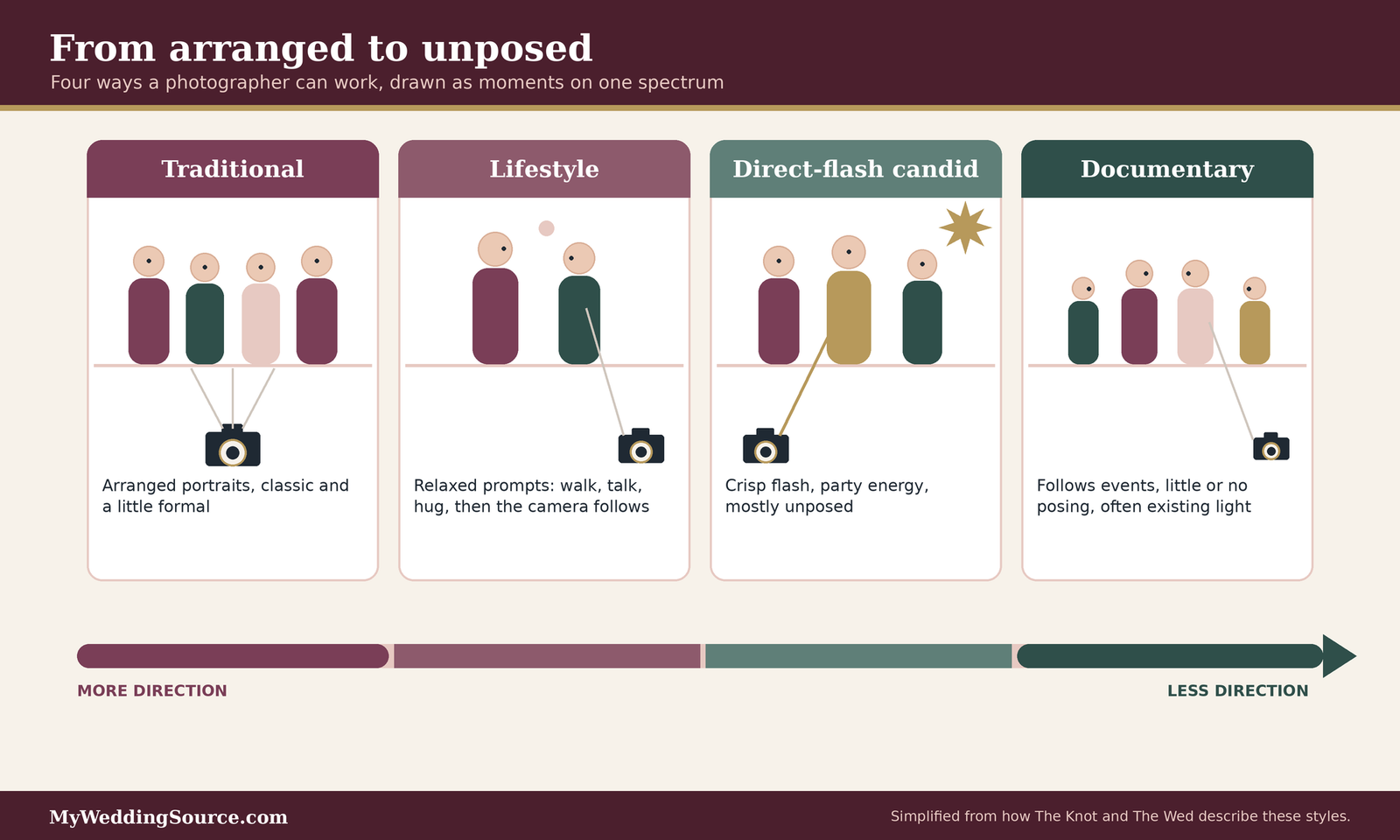
A candid photograph is taken without asking the subject to hold still or look at the lens. The Knot describes the photojournalistic or documentary approach as unposed photography that follows people, décor, and action, with a fly-on-the-wall feel and a focus on in-between moments like laughter during a first dance or a friend tearing up during a toast. In everyday use, candid wedding photography is the same instinct applied across the whole day, including the quiet parts that never make it onto a schedule.
Documentary style adds a rule: the photographer follows instead of leads
A magazine that covers weddings, The Wed, describes documentary-style wedding photography as capturing genuine, unposed moments as the day unfolds, with little or no posing, so the photos tell the story of the wedding. It also notes that this style tends to rely on existing light at the venue rather than reflectors or added lighting. That is a useful clue. Candid wedding photography can include flash and gentle direction, while a strict documentary approach usually does not.
Where candid and posed work meet
Almost every wedding includes a few moments that cannot be purely spontaneous, such as a formal family grouping or a portrait of the two of you. Understanding that overlap helps you avoid two common disappointments: expecting zero direction and feeling surprised when a photographer asks you to move, or expecting a magazine shoot and feeling uncomfortable when no one tells you what to do.
A blended approach is common and usually sensible
The Knot describes lifestyle photography as a middle ground between candid shots and styled photos, with a relaxed feel, and it describes traditional photography as blending real moments with the photographer’s artistic choices, including arranged family portraits. Many photographers move between these modes during a single wedding: they direct the group photos, give light prompts for couple portraits, and step back for the ceremony and reception. When a photographer says they are “mostly candid,” ask what percentage of the day they expect to direct, and for which parts.
Shooting style and editing style are separate decisions
The Knot also points out that how a photographer shoots, for example directing poses or shooting candids, is different from how they edit, for example bright and airy or dark and moody. That matters here because couples sometimes love a gallery’s look and assume it signals a candid approach, or the other way around. Look at the moments, not the color grading, when you judge how candid a portfolio really is.
How to read a portfolio for candid wedding photography
A portfolio is a sales tool, so it shows the best frames. You can still learn a lot from it if you know what to look for. The goal is to separate luck and a single great afternoon from a repeatable way of working.
Signs of genuine candid wedding photography
These are observations to check, not guarantees. Think of them as questions to ask yourself while you scroll.
Look at the faces of people who are not the couple
When a photographer can reliably capture a grandparent’s reaction, a flower girl losing interest, or a friend wiping an eye, it suggests they are watching the room instead of only the couple. Zola advises couples to check a photographer’s website and social media to see whether the work matches what they like. Add one more step: in each wedding, count how many frames show guests unprompted and how many show only formal portraits.
Look for variety across a full gallery, not just highlights
The Knot’s budget advice from photographers includes reviewing full galleries instead of social media highlights, since sneak peeks can mislead. For candid wedding photography this is especially important. A full gallery shows how the photographer handled a dim ceremony, a crowded dance floor, and a rainy cocktail hour, which are the situations that decide whether a “natural” feel holds up.
Signs a gallery is mostly directed instead of candid
Directed work is not bad. It is just a different product from candid wedding photography, and you should know which one you are buying.
Repeating poses across different couples
If many couples in a portfolio stand in similar positions, with similar gazes, in similar spots, the photographer is probably leading the portraits. That can look wonderful. It simply means the “natural” look comes from direction and editing, so ask how much of your day would be shaped that way.
Very few frames of people looking away from the camera
In a candid-heavy gallery, many subjects are looking at each other, at a speaker, or at something off-frame. If almost everyone in a gallery is looking into the lens, the images were probably staged or at least prompted, even if they look relaxed.
Where candid wedding photography fits in the wedding-day timeline
Most photographers capture candids throughout the day. The shape of your timeline decides whether those moments have room to happen or get squeezed out by group photos and travel.
Zola’s sample timelines give a useful reference. In its version with a first look, getting-ready photos run from noon to 2:00 p.m., the first look and couple portraits from 2:15 to 3:00, wedding party portraits from 3:15 to 3:45, the ceremony from 4:30 to 5:00, family portraits from 5:10 to 5:40, cocktail hour from 5:10 to 6:20, and the reception starting at 6:30. Those are Zola’s illustrative times, not a rule, but they show which parts of the day are naturally candid and which are directed.

The parts of the day that are naturally candid
Some stretches of the day are rich in unscripted moments simply because people are busy being themselves.
Getting ready is mostly unposed
Zola notes that getting-ready photos are often candid and include the couple and their parties getting dressed and styled, plus details such as rings, shoes, and invitations. These hours work best when the room is calm, the lighting is decent, and the photographer is welcome. If you want to see how that fits into a full plan, our wedding photographer shot list helps you decide which details to name in advance.
Ceremony, cocktail hour, and reception run on their own energy
You cannot schedule a laugh, but you can give it space. A ceremony that starts on time, a cocktail hour that is not consumed by portraits, and a reception with room for toasts and dancing all give the photographer more chances to react. Our guides to the wedding ceremony and the wedding reception describe how those parts of the day typically flow.
The parts of the day that need direction
Even the most candid photographers usually need a few minutes of structure for the images families expect to receive.
Family and wedding party portraits
Zola’s portrait guidance suggests about 30 minutes for wedding party portraits, 30 minutes for close family only, and 45 minutes for couple portraits, with those times growing or shrinking with the size of the groups. It also suggests keeping formal groupings to about 15. These numbers matter for candid wedding photography because every minute of structure is a minute not available for unplanned moments, and a long list quietly reduces the candid share of the day.
The first look as a candid opportunity
Zola describes a first look as a photo of the couple seeing each other for the first time on the wedding day, usually before the ceremony, and says it frees the couple to enjoy cocktail hour because portraits are done earlier. Without a first look, Zola warns that you may spend most of cocktail hour on portraits. A first look is partly a candid moment in its own right, since the reaction is real, and partly a scheduling tool.
Building a timeline that protects the unplanned
A timeline that supports candid wedding photography does not need to be loose. It needs buffers in the right places.
Add buffers and share the schedule
Zola suggests five-minute buffers throughout the day, including travel time between locations, and recommends sharing the timeline with everyone in the photos so people keep to it. The buffers are what turn a rushed day into one where the photographer can notice what is happening. For a broader schedule, see our wedding planning timeline and the wedding vendor timeline.
Plan separate moments for sensitive situations
Zola recommends planning separate portraits for sensitive situations, such as divorced parents who cannot be in the same room. Telling your photographer about family dynamics in advance helps them avoid a tense group scene that would be neither candid nor flattering, and it keeps the natural moments from being overshadowed by a stressful one.
A rough way to estimate the candid share of your day
You can turn the timeline into a simple estimate. This is our own arithmetic, offered as a planning aid, not a measured result.
Worked example: an eight-hour day
Here is the arithmetic behind candid wedding photography on a typical day. Imagine eight hours of coverage, which is 480 minutes. Using Zola’s portrait times, directed portraits might take about 105 minutes (30 for the wedding party, 30 for family, and 45 for the couple). That is about 22% of the day. The remaining roughly 375 minutes include the ceremony, getting ready, travel, cocktail hour, dinner, toasts, and dancing, where the photographer mostly reacts. These shares move a lot with your choices, but the example shows that even a portrait-heavy plan leaves most of the day for unplanned moments.
What changes the share
A longer family list, a second location, a long gap between ceremony and reception, or a late start all squeeze the time available for candids. A first look, a short formal list, one location, and buffers all expand it. If you care a great deal about candid wedding photography, trim the structured parts first before you cut coverage hours.
Light and flash: what “natural” looks like at night
Light is where candid wedding photography is most often won or lost. A moment can be perfect and still be unusable if the room is too dark for the camera to freeze it. The choice between available light and flash is also where photographers’ styles differ the most, so it is worth understanding in plain language.
Available light, flash, and the look each creates
Available light means the light already in the room, such as windows, candles, string lights, or an overhead fixture. Flash means adding light from a unit on the camera or placed elsewhere in the room.
Why some photographers avoid flash
The Wed notes that documentary-style photography tends to rely on existing light, which creates atmosphere tied to the venue. A PetaPixel contributor who prefers natural light says he avoids flash unless it is necessary, and uses existing ambiance for wide shots at receptions. The benefit is that the room looks as it actually felt. The trade-off is that a dim room forces a photographer toward high sensitivity settings, wider apertures, or slower shutter speeds, which can mean more image noise or more blur on moving subjects.
Why others embrace it
The Knot lists flash as its own style, with direct-flash candids that have a crisp, nightlife, almost paparazzi energy, and says it suits city weddings. Its film-photography article adds that direct flash is usually described as candid and documentary, works best in dark spaces such as late in the evening, and often pairs with film but does not require it. In other words, flash is not the opposite of candid. It is a different aesthetic of candid wedding photography, one that looks bold and a little raw.
How bounce flash and off-camera flash change the picture
If a photographer does use flash, how they use it matters more than whether they do.
Bounce flash softens and directs the light
Expert Photography explains that aiming flash at a nearby white wall or ceiling makes the light source larger and softer, and cautions that painted surfaces can add color casts and that a very high or dark ceiling returns too little light. The PetaPixel contributor describes tilting the flash head to roughly 45 degrees rather than straight up, which avoids shadows in the eye sockets, and he says bounce flash gives softer, more directional light. The takeaway for couples is that ceiling height and color are venue facts that affect flash quality, and a photographer who has worked in your venue, or who scouts it, is better prepared.
Off-camera flash gives more control and takes more setup
The same contributor describes placing flashes on stands in corners of a reception room to build a lit space, using grids to narrow the beam so guests stay darker. That kind of setup can look polished but is more visible and needs more time, space, and permission. Ask your photographer whether they use it, where the stands would go, and whether the venue and band or DJ are fine with it.
Flash and the ceremony
Ceremony rules are a separate matter from reception style, and they are often set by the venue or officiant, not by you or your photographer.
Check policies before the day
A photographer writing about flash in church ceremonies notes that many churches prohibit flash during the ceremony but may allow it during the processional, so rules can differ by part of the service. PetaPixel’s lighting article similarly advises arriving early, asking the officiant about rules, and getting permission before setting up flash. Because your officiant and venue decide, ask them directly, and share the answer with your photographer in writing.
Plan for dim rooms without flash
For candid wedding photography in a room where flash is not allowed, the church-ceremony photographer describes relying on high ISO, wide apertures, and a stabilized telephoto lens, and shooting in RAW for more room to correct color and exposure. For a candlelit or dim venue, this is a real trade-off. You may get a moody, accurate look but with grain, or a cleaner look if the photographer uses more light. Ask to see an example from a dim ceremony and decide whether you like it.

Choosing a lighting approach for your venue
You do not need to become a lighting expert. You need to give the photographer information and ask about their plan.
Questions about the room
For candid wedding photography, describe your venue honestly to your photographer: how much natural light there is, the ceiling height and color, whether there are string lights or colored uplights, and whether the ceremony is indoors or outside. Our wedding lighting guide explains how décor lighting changes a room, and uplights or candles will change what a camera can do.
Questions about the look you want
Look at a few galleries that include evening photos and decide which you like: crisp and flash-lit, soft and warm, or dark and grainy. The Knot suggests couples consider season, location, and overall aesthetic when choosing a style. Show your photographer those examples so they can tell you honestly whether they can deliver that look in your room.
Direction: what natural really takes from you
This is the part most galleries hide. Relaxed-looking photographs usually involve a person who knows what they are doing, and a couple who were gently guided into feeling at ease. “Natural” is a result, not an absence of effort.
Comfort with being watched
The Wed’s advice for documentary-style photography is blunt: results depend heavily on the couple feeling comfortable with the photographer, so a poor fit can limit the candid results. It suggests choosing a photographer you connect with and being yourselves in front of the camera, instead of trying to perform for it.
Meet the person, not just the portfolio
For candid wedding photography, the relationship matters more than usual. A portfolio shows what a photographer produced for other people. A conversation shows how they will feel next to you at 3 p.m. when you are tired. Zola recommends asking how the photographer works on the day, including whether they stay in the background or get more involved to capture shots. Use that meeting to notice whether you relax, and whether they listen more than they sell.
Practice before the wedding
Many couples find a pre-wedding session useful, because it is the first time the camera is pointed at both of you. Zola lists an engagement session as sometimes included and sometimes an add-on, depending on the package. If your package includes one, treat it as a rehearsal for being photographed, not as a performance. Walk, talk, and notice what feels awkward so you can tell the photographer.
Light prompts versus posing
Direction exists on a spectrum, and the gentle end of it is compatible with candid wedding photography.
Prompts that create real reactions
Photographers who practice candid wedding photography often use small instructions that give you something to do rather than a shape to hold: walk toward each other, whisper something silly, take a breath together, hug a parent and say what you are thankful for. These produce real expressions because the action is real. If you want that kind of guidance, say so, and say what you dislike, such as being asked to kiss on cue.
Poses worth accepting anyway
A few directed frames are useful even for couples who want candid wedding photography and dislike posing: a clean portrait of you both, a few of each family group, and a few pictures of each person alone. They are insurance. They also give you pictures to print and share, and they are part of the Zola timeline guidance on formal groupings. Accepting them makes it easier to enjoy the rest.
What you can do to help
You are not powerless in this. A few simple habits make a bigger difference than any prop.
Ask the people near you to behave normally
Candid wedding photography depends on relaxed people, so tell your wedding party and family, kindly, that the photographer will be around and that no one needs to look at the lens or pose. A relaxed group is more photogenic than a stiff one. If a relative is likely to hover and tell everyone where to stand, give your photographer a heads-up and a polite way to redirect them.
Give the photographer information, not a script
Share names and relationships for the people who matter, and one or two stories that are important to you, such as a grandparent who traveled a long way. The Wed advises sharing who is important to your story so the photographer can capture it. A short list of people and moments serves candid wedding photography better than a long list of exact poses.
When nerves are the problem
If you dread being photographed, you are not unusual, and it deserves a plan rather than self-criticism.
Reduce the time spent in front of the lens
If you dread being photographed, candid wedding photography can still work well. Shorter formal sessions, a first look, and fewer location changes all reduce how long you feel on display. Our wedding planning stress guide has general tips for keeping the day manageable, and the same logic applies to photos: fewer demands, more breathing room.
Choose a partner and a signal
Agree with your partner on a small signal, such as a squeeze of the hand, that means “I need a minute.” Tell the photographer about it. It is simple, free, and often enough to turn a tense moment into a real laugh.
Guests, phones, and venue rules
A candid wedding photograph can be ruined by a raised phone in the aisle or improved by a guest who happens to lean in at the right second. The people around you are part of the picture, so how they behave affects the result.
The case for an unplugged ceremony
Zola’s explainer on unplugged ceremonies gives several reasons couples choose them: guests stay present, photographers get clear shots without phones or tablets in the way, photos stay private until the couple is ready to share them, and there are fewer interruptions. A related risk is that a guest’s phone or tablet can block the photographer’s view of a once-only moment, such as the walk down the aisle.
A full ban, a partial ban, or a gentle request
Zola says the most common approach is limiting the request to the ceremony and allowing phones afterward. It also mentions that an officiant could offer a short moment for photos, with phones on silent otherwise. Our guide to the unplugged wedding ceremony goes into wording and options. At a minimum, ask everyone to silence their phones.
How to tell guests kindly
Zola suggests telling guests early with a note card in the invitation envelope and a line on your wedding website, using warm wording, posting a visible sign, and asking your officiant to remind people. It also advises being understanding with guests who need access, such as someone waiting on a call from a babysitter. A tone of invitation, not scolding, is easier for everyone and suits the relaxed feeling you want in the photographs.
Guest photos after the ceremony
Once the ceremony ends, the picture changes for candid wedding photography. Guests taking their own pictures at the reception are usually harmless, but they can also crowd the photographer during key moments.
Reception moments that get crowded
First dances, cake cuttings, and the exit are moments when many people want a picture. A photographer needs a clear angle for the best frame. A simple request, such as asking the DJ or emcee to invite guests to stay seated or to leave the front clear for a few minutes, helps. Tell your DJ in advance; our wedding reception guide covers how those moments typically flow.
Guest-made options that add a candid feel
Some couples set out a photo station or hire a booth to give guests a place to be silly. Our wedding photo booth guide explains the trade-offs. Booths and guest-submitted photos add candid-feeling images, but they do not replace a professional’s coverage, and you should not expect them to match the quality of a trained photographer’s work.
Venue rules and the photographer’s access
A venue can limit where photographers stand, when flash is allowed, and what equipment they can bring. These are facts you can usually learn in advance.
Ask the venue for its rules
Zola notes that many venues require photographers to carry liability insurance. Our wedding venue questions guide includes questions about vendor rules, hours, and restrictions. Ask specifically about flash policies, restricted areas, and whether a second photographer has the same access.
Feed and house your vendors
Photographers working a long day need to eat, and an unfed photographer is a tired one. Our wedding vendor meals guide explains the usual approach. Confirm in your contract whether a meal is expected, and schedule it at a time that does not cost you key moments.
Choosing and contracting a photographer for candid wedding photography
A good fit for candid wedding photography is partly about taste and partly about paperwork. The contract is where “I will capture candid moments” becomes something you can hold someone to.
What a contract should say about candid wedding photography
A promise of “natural photos” is not measurable. A contract can still make your priorities concrete.
Coverage, deliverables, and a must-have list
Zola’s list of questions to ask a photographer includes hours of coverage, the number of final images, add-ons, overtime rates, travel fees, and whether pre-wedding events are included. It also suggests bringing a list of must-have photos and asking whether the photographer can recreate them. Put the list in writing, and keep it short. A short list leaves more space for unplanned moments.
Backup plans and equipment
Zola recommends asking about a backup plan if the photographer is sick, noting that many outsource to a local photographer with a similar style, and about backup equipment in case gear fails. For candid wedding photography, ask how a replacement would be matched to the style, and whether you would approve them. Also ask whether another wedding is booked the same weekend, which Zola says is not necessarily a problem if the venues are a reasonable distance apart.
Who owns the photographs
This is general education, not legal advice. Check your contract, and consult an attorney if you have questions.
Copyright usually starts with the photographer
The U.S. Copyright Office explains that copyright initially belongs to the person who created the work and begins automatically once an original work is fixed in a tangible form, without registration. There are exceptions, such as work made for hire, and transfers generally must be in a signed writing. Zola’s contract advice reflects the same practical reality: photographers usually keep copyright and license the images to you, often with restrictions on editing. Read the license so you know what you may print, post, and share.
What to look for in a license
Ask whether you may print the photographs anywhere, share them online without a watermark, and use them for personal purposes. Ask about download limits, expiration dates, and fees for accessing photos later, which Zola recommends confirming. These details do not affect how candid the photographs feel, but they affect what you can do with them.
Galleries, delivery, and editing
What you receive at the end shapes how the day feels in memory.
Delivery timing and number of images
Zola’s guidance is to expect the full gallery about three to six weeks after the wedding and roughly 50 to 100 photos per hour of coverage, or about 400 to 800 images for eight hours. Galleries of candid wedding photography often have more frames because moments happen quickly and the photographer shoots a lot to catch them. Ask how the photographer culls and whether the number is a minimum or a target.
Retouching and re-editing
Zola notes that some photographers include minor retouching and charge for major corrections, and that many contracts limit re-editing. Confirm what is included, and make sure you like the editing style before you book, as Zola suggests.
Cost and coverage: how to compare quotes fairly
Price comparison is harder for candid wedding photography than for most services, because the scope differs more than the sticker price suggests. A reasonable way to compare is to translate each quote into the same few numbers.
What this actually costs
The Knot’s Real Weddings Study, covering 10,474 U.S. couples who married in 2025, reports an average photography cost of about $3,000, with a median of $2,800 and a range from $1,500 to $4,700 between the lower and upper quartiles. Zola’s Wedding Cost Index reports a national average of about $4,400, with most couples paying roughly $3,500 to $5,300. The two surveys use different samples and methods, so treat them as two reference points, not a price list. Your quote depends on your city, date, hours, and the photographer’s experience.
Reading survey averages for candid wedding photography carefully
Survey numbers are context, not quotes. A few points keep them in perspective.
What the numbers represent
The Knot says its figure is a flat-fee average and offers a rough hourly equivalent of about $375 for an eight-hour day, which is an assumption in that article. Zola’s page does not disclose the year of its data or its sample, so use its figures cautiously. Neither number tells you what a candid-focused photographer in your market charges. Zola reports that fine art work and extensive editing typically cost more than documentary-style shooting, which suggests that style is one of several factors, not the main one.
What moves the price
According to The Knot, price varies with location, guest count, number of photographers, travel, editing, and the scope of coverage. Its examples show averages of about $2,000 for weddings with 1 to 50 guests, $2,700 for 51 to 100, and $3,500 for 101 or more. Zola adds that Saturdays from May through October are typically the most expensive, while Fridays, Sundays, and off-season dates can cost less. If you want to understand how photography fits within your total budget, our wedding budget calculator helps you test different allocations.
A simple quote-normalization method
Use this method to compare two or three quotes. It is editorial arithmetic, so label your assumptions and double-check against the contracts.
Convert each quote to cost per coverage hour and per delivered image
Divide the total by the hours of coverage, and divide the total by the minimum number of final images. For example, imagine a quote of $3,600 for 8 hours and about 500 delivered images. That is $450 per hour and $7.20 per image. A second quote of $3,000 for 6 hours and 300 images is $500 per hour and $10 per image. In this illustration the second quote looks cheaper in total but costs more per unit. These numbers are invented to show the method, not market prices.
Adjust for what is missing
Add the cost of anything you would need that is not included, such as overtime, travel, a second photographer, an engagement session, or an album. Photographers quoted by The Knot warn that a cheap package with a photo cap can cost more later if you add hours or extra photos. Normalizing quotes helps you see whether a “low” quote is truly low.
Where to spend and where to save
Candid wedding photography rewards time and the right person more than equipment or extras.
Spend on the hours that matter most to candid wedding photography
Zola’s package guide shows basic packages of about 6 to 8 hours, standard packages of about 8 to 10 hours, and premium packages of 10 or more hours. It also advises that four to six hours covers the ceremony and reception, and that eight or more hours is needed to include getting ready or a first look. Decide which parts matter to you. If getting-ready moments with your family matter, buy those hours. If dancing matters, make sure coverage lasts long enough to catch it.
Save on extras that do not change the candid result
When budgeting for candid wedding photography, albums can often wait, and The Knot suggests considering postponing album purchases and asking about payment plans. A second shooter is useful for large weddings with two spaces in play, but may not be necessary for a small one. Hosting the ceremony and reception at one venue, which The Knot’s advice recommends for saving time and transportation costs, gives your photographer more time to react instead of drive.
Matching the approach to your wedding
Many choices about candid wedding photography come down to trade-offs. The two tables below turn the earlier ideas into reusable tools. They are our own synthesis and are meant to be tested against your situation, not treated as rules.
A decision matrix for your priorities
Use the matrix to see which factors push you toward a more documentary approach, a lifestyle blend, or a more directed one.
| Factor | Leans more documentary | Leans more blended | Leans more directed |
|---|---|---|---|
| How you feel about being photographed | Comfortable, or happy to be ignored | Fine with light prompts | Prefer clear instructions |
| Venue light | Plenty of natural light | Mixed light | Very dim, tight spaces |
| Flash rules | Flash discouraged | Flash allowed at some points | Flash allowed throughout |
| Guest count and family size | Small, close group | Medium | Large, many formal groupings |
| Time available for portraits | Short formal list | Moderate | Long formal list needed |
| What you will do with the photos | Memory and story | Mix of print and sharing | Prints, framed portraits |
| Photographer’s temperament | Quiet, observant | Friendly, flexible | Comfortable leading |
Reading the matrix
Most couples planning candid wedding photography land in the middle, and that is fine. If your answers split across the columns, a blended approach with a short must-have list is usually a reasonable start. If your venue is dim and your family is large, pay extra attention to the lighting and group-photo conversation.
When one factor dominates
If one factor is non-negotiable for your candid wedding photography, let it decide. A venue that bans flash and is very dim, for example, means you should see sample galleries from similar rooms before booking, whatever style you prefer.
Contrasting scenarios and the threshold that flips each
These scenarios are illustrative, not case studies. They show how the same goal can lead to different choices under different conditions.
| Scenario (illustrative) | Assumptions | Reasonable approach | What would flip it |
|---|---|---|---|
| Small backyard wedding | Small guest list, plenty of daylight, relaxed family | Mostly documentary with a short list of group photos | A sudden need for formal family portraits for a relative |
| Evening ballroom reception | Dim room, dancing, flash allowed | Flash-friendly candid style, with bounce or off-camera flash | A very high ceiling or a no-flash policy |
| Historic church ceremony | Dim, flash limited by policy | Available-light ceremony, ask for dim-light samples | Policy allows flash during the processional |
| Large family with complicated dynamics | Many groupings, some tension | Blended approach with a planned, separate family session | Family agrees on a short list and a calm schedule |
| Camera-shy couple | Anxious about posing, wants minimal direction | Documentary with brief prompts and a first look | Couple wants more structure after an engagement session |
How to use the table
Find the row closest to your situation, then check the last column to see whether your facts change the recommendation. If none fits, take the logic and make your own row.
Share it with your photographer
Bring the matrix and the scenario that matches you to your consultation about candid wedding photography. A photographer who engages with the details is more likely to deliver what you want than one who nods and says everything will be fine.
Questions to ask before you book
These questions turn the general advice above into specific answers you can compare. Ask for important answers in writing and keep them with your contract.
Questions worth asking a photographer
- How would you describe your style, and how much of a typical wedding do you direct?
- Can I see two or three full galleries, including a dim ceremony and an evening reception?
- How do you use flash, and what would you do in a venue that does not allow it?
- Which part of the day do you recommend I protect from portraits?
- What happens if you are sick or your equipment fails?
- Who owns the images, what license do I receive, and what are the editing limits?
- How many final images, and when will I receive them?
Questions about style and approach
These help you understand how the photographer works in practice.
Style and flash
For candid wedding photography, ask for a description in the photographer’s own words, and for examples from rooms similar to yours. Zola recommends asking how the photographer would describe their own style and whether they lean toward posed portraits or a more candid approach. Follow up with flash: when, how, and what they do if flash is not allowed.
Interaction on the day
For candid wedding photography in particular, ask how involved the photographer will be, whether they bring an assistant or second shooter, and how they handle guests who get in the way. Zola suggests asking whether they stay in the background or get more involved. The answer tells you how much direction to expect.
Questions about contract and delivery
These protect you from surprises after the day is over.
Rights, delivery, and policies
For candid wedding photography as for any package, ask about copyright and license terms, delivery timing, download limits, and what happens if you want more edits. Zola advises asking for the contract early and not hiring a photographer who does not send one, because it protects both sides. Check the deposit, refund, and cancellation policy before you sign.
Insurance and backup
Ask about liability insurance, which Zola notes many venues require, and about the backup plan if the photographer cannot attend. Confirm the replacement process in writing, including how a replacement would be matched to the style.
FAQ: candid wedding photography questions
Style and approach
What is the difference between candid and documentary wedding photography?
The terms overlap. Documentary usually means the photographer follows events with little or no posing and often relies on existing light. Candid wedding photography is broader and can include gentle prompts and flash. Ask any photographer what they mean, because individuals use the words differently.
Can I have candid photos and formal family portraits?
Yes. Most photographers blend the two. Keep the formal list short, since Zola suggests about 15 groupings, and schedule it in a protected window such as right after the ceremony. The rest of the day can stay mostly unposed.
Do I need a first look to get candid photos?
No, but it can help. Zola says a first look moves portraits ahead of the ceremony, which frees cocktail hour. That can give your photographer more time to capture unplanned moments with guests. Without one, plan portraits efficiently so cocktail hour is not consumed.
Light and guests
Is flash bad for candid wedding photography?
Not necessarily. The Knot lists direct flash as a candid, nightlife-style look, and bounce flash can soften the light. Many ceremonies restrict flash, though, so ask your officiant and venue. A photographer’s skill with both flash and available light matters more than a blanket rule.
Should we have an unplugged ceremony?
Many couples do, because guest phones can block the photographer’s view and distract everyone. Zola describes a ceremony-only request as the most common approach. Tell guests early with a note, a website line, and a sign, and be gracious with anyone who needs a phone.
What if the venue is very dark?
Ask your photographer for galleries from dim rooms. Without flash, they may rely on high ISO and wide apertures, which can add grain. With flash, results depend on ceiling height and color. Share your venue details early so they can plan equipment and test the light.
Cost and contracts
How much does candid wedding photography cost?
There is no separate price. The Knot’s 2025 survey of 10,474 couples reports a $3,000 average for photography, and Zola reports about $4,400. Your quote depends on hours, location, date, and the photographer’s experience, so compare quotes using cost per hour and per delivered image.
Who owns my wedding photos?
Usually the photographer, who licenses the images to you. The U.S. Copyright Office says copyright begins with the creator unless an exception applies and that transfers generally require a signed writing. Read your contract’s license terms, and ask an attorney if you need advice.
Your next steps
Decide what candid wedding photography means to you
A short list of preferences makes every later conversation easier.
Write down your three priorities
List the moments you most want to remember, such as parents’ reactions, the dance floor, and getting ready, and the moments you least want to perform for. Keep the list short and bring it to every consultation.
Match your timeline to your priorities
To protect candid wedding photography, cut or shorten formal portraits first, add buffers, and consider a first look. Our wedding planning checklist and wedding planning guide can help place photography in the larger plan.
Verify before you sign
A few checks prevent most regrets.
Review full galleries and the contract
Look at complete galleries, including a dim room and an evening reception, and read the contract for coverage hours, deliverables, backup plans, and the license. Use the questions above and the wedding photography guide for broader context.
Brief the people around you
Share the plan with your officiant, venue, DJ, and wedding party. Tell guests about phones, and send your photographer the schedule. A calm, informed room produces better pictures than any single piece of equipment.
Sources & methodology
How we built this guide
What we relied on
This guide combines current wedding-industry survey data from The Knot and Zola, planning and contract advice from Zola, style descriptions from The Knot and The Wed, practical lighting and flash advice from working photographers writing for PetaPixel, Expert Photography, and a photographer’s personal site, and the U.S. Copyright Office’s general explanation of copyright ownership. Where a statement comes from a publisher or a photographer, we attribute it, because those sources reflect the seller’s or photographer’s own experience. The timeline share, the quote-normalization method, and the worked examples are our own arithmetic and illustrations, and they are estimates, not measured results.
What we did not do
We did not test cameras, visit venues, or review any photographer’s work. We do not give legal advice, and the copyright section is general education only. Prices change, survey methods differ, and individual photographers and venues have their own rules, so verify every important detail in writing before you sign.
Source list
Government and legal sources
- U.S. Copyright Office, Circular 1: Copyright Basics: https://www.copyright.gov/circs/circ01.pdf
Wedding-industry survey, planning, and etiquette sources
- The Knot, Average cost of a wedding photographer: https://www.theknot.com/content/average-cost-wedding-photographer
- Zola, Wedding photographer cost: What couples really pay: https://www.zola.com/expert-advice/how-much-does-a-wedding-photographer-cost
- The Knot, The wedding photography ideas and styles couples should know: https://www.theknot.com/content/wedding-photography-styles
- The Knot, Inside the “new wave” of wedding photography: https://www.theknot.com/content/film-wedding-photography
- The Knot, Pros share how to save money on wedding photography: https://www.theknot.com/content/save-money-wedding-photos-video
- Zola, A guide to the ideal wedding photography timeline: https://www.zola.com/expert-advice/how-long-do-wedding-photos-take
- Zola, Questions to ask a wedding photographer: https://www.zola.com/expert-advice/questions-to-ask-wedding-photographer
- Zola, Unplugged wedding: How and why to ban phones at a ceremony: https://zola.com/expert-advice/ban-phones-at-my-wedding
- The Wed, What is documentary-style wedding photography: https://thewed.com/magazine/what-is-documentary-style-wedding-photography
Photographer and photography-education sources
- PetaPixel, Wedding photography lighting tips, from preparation to reception: https://petapixel.com/2018/02/03/wedding-photography-lighting-tips-preparation-reception
- Photographer’s blog (neilvn.com), Flash photography during the wedding ceremony in church: https://neilvn.com/tangents/flash-photography-during-the-wedding-ceremony-in-church/
- Expert Photography, 12 wedding photography lighting tips: https://expertphotography.com/wedding-photography-lighting-tips