

Wedding jewelry works best when you choose it in a particular order, starting with the neckline of your dress and your hairstyle, and only then picking the earrings, necklace, and bracelet that fit what is already there, so each piece has a job instead of competing for attention.
Quick answer
Let the neckline decide how many pieces you need. Open necklines such as strapless and sweetheart can carry a necklace, earrings, or both. High, halter, and illusion necklines usually do better with earrings and a bracelet and no necklace. Hair then decides how visible earrings will be: an updo shows them, hair worn down hides them. Pick one lead piece, keep the others quiet, wear everything for a few hours before the wedding, and photograph the full look in daylight. The advice below comes from jewelers, retailers, and gem-lab sources, and where they disagree we say so.
Start with the dress: how to approach wedding jewelry
Most advice about wedding jewelry begins with a shopping list. A more useful place to begin is a photograph of your dress, because the dress has already made several decisions for you. It has set a neckline, a level of detail, a color, and a sleeve length, and each of those either invites wedding jewelry or leaves no room for it.
This section explains why the dress goes first and in what order the other wedding jewelry decisions follow. The later sections go through each neckline, each type of wedding jewelry, and the practical details that decide whether you are comfortable at hour nine of a long day.
Why the neckline comes first
A neckline is a frame. It outlines a patch of skin, and the wedding jewelry you choose either sits inside that frame, sits on its edge, or sits above it near the face. Once you see it that way, many choices become easier, because you are no longer asking what looks pretty in general. You are asking what fits in this particular frame.
The neckline frames the area wedding jewelry can occupy
A strapless or sweetheart dress leaves the collarbone and upper chest open, so a necklace has somewhere to go. A high neck or a halter covers most of that area, so a necklace would sit on fabric or fight with it. Retail style guides from Brilliant Earth and Gabriel & Co. both make this point in their own words: open necklines give the most freedom, and high necklines push the focus toward earrings and bracelets.
Detail on the dress sets the volume limit
Lace, beading, and sheer panels already give the eye something to look at. Brilliant Earth’s styling guide puts it simply: a detailed neckline calls for simpler jewelry, and a clean, open neckline allows more flexibility. David’s Bridal makes a similar point in its own neckline guide, saying to match the wedding jewelry to the embellishment and overall style of the gown. Treat the dress as having a fixed amount of visual attention to spend, and give the wedding jewelry what is left.
The order of decisions that saves rework
Wedding jewelry gets expensive and frustrating when decisions happen out of sequence. A necklace bought before the dress is final may not suit the neckline, and earrings chosen before the hair trial may disappear into the hair. A sensible order reduces returns and last-minute substitutions.
Dress, hair, veil, then wedding jewelry
Gabriel & Co. suggests finalizing the veil or hair accessories first and then choosing wedding jewelry to complement them, and scheduling a final hair appointment before settling on earrings, because hair changes how visible they are. That order makes sense for a practical reason. Hair and veil are the two things most likely to cover or crowd your ears and neck, so they should be settled before you commit to anything that depends on being seen.
Our wedding planning timeline shows where attire fittings and hair trials usually fall in the months before the date, and the wedding jewelry decisions sit right behind them.
Choose a lead piece and let the rest follow
Several of the sources we read converge on one idea, though each says it differently: pick a focal point. Brilliant Earth lists “focal point” as a step in its own process, and Gabriel & Co. notes that a single bracelet can be the lead piece when paired with subtle earrings. In practice you have three candidates for the lead: the earrings, the necklace, or the bracelet. Choose one, then size the other two down. Two bold pieces tend to compete. Verstolo notes that a simple gown can carry a bolder piece or layering, while a heavily detailed gown calls for one focal point.
Wedding jewelry by neckline
Below we go through how wedding jewelry is usually matched to the common necklines, in three groups: open, angled or structured, and already-busy. For each, we describe what retailers and jewelers generally recommend, and we label our own suggestions as suggestions. These are style conventions, not rules, and your own taste and comfort outrank all of them.

Open necklines: strapless, sweetheart, and off-the-shoulder
An open neckline shows the collarbone and upper chest, and that is the most flexible starting point. The risk is not too few options but too many, so decide early whether the necklace or the earrings will lead.
Strapless
Brilliant Earth suggests a short necklace, a pendant, or statement earrings for a strapless dress, to draw attention to the open neckline. David’s Bridal lists chokers, collars, and delicate princess-length necklaces as options, with long teardrop earrings also working well. Brian Gavin Diamonds leans toward a statement collar and small earrings if you wear a necklace, or chandelier earrings if you skip it. Verstolo adds a caution: avoid thick collars, stacked pieces, and heavy earrings worn together with a bold necklace. The consistent thread is that strapless gives you room, and the sensible way to use it is one confident piece plus quiet support.
Sweetheart
The curved top edge of a sweetheart neckline is the main feature, so the wedding jewelry either echoes the curve or stays out of its way. Brilliant Earth suggests a medium-length necklace, a pearl strand, or a delicate diamond piece to echo the curve. David’s Bridal recommends a short, simple necklace that sits a few inches above the neckline so it does not crowd the curve. Gabriel & Co. says a necklace on an open neckline should sit between the collarbone and the top of the dress. These suggestions agree more than they differ: keep the necklace modest and let the neckline’s own curve be seen.
Off-the-shoulder and boat neck
These necklines run wide across the collarbone, which shortens the space for a necklace. David’s Bridal offers a choker with simple studs to highlight the neck and shoulders, or no necklace and long dangling earrings. Verstolo recommends delicate chains, simple pendants, and small earrings, with longer drops only on a plain gown, and it warns against oversized necklaces and layers across the collarbone. Brian Gavin Diamonds keeps the wedding jewelry simple here, such as pearl studs or gemstone-accented hoops that are not flashy. If you are unsure, earrings alone are the lowest-risk choice for a wide neckline.
Angled and structured necklines: V-neck, scoop, and square
These necklines have a clear geometry, and the wedding jewelry either follows that geometry or contrasts with it. Both can work, which is why sources disagree and why a try-on matters more here than anywhere else.
V-neck and plunging
Brilliant Earth suggests pendants, lariats, or Y-necklaces that follow the downward line. David’s Bridal suggests a pendant whose drop matches the angle of the V. Brian Gavin Diamonds takes a different view, advising against necklaces that mirror the neckline’s shape: for a shallow V it suggests a shorter strand, and for a deep V a long necklace, possibly with a pendant. Verstolo says to skip chokers and short round necklaces that cut across the V. We come back to this disagreement later, because it is a good example of why you should test rather than follow one rule.
Scoop and square
For a scoop neckline, Verstolo recommends pieces that sit close to the neck, such as short necklaces, subtle chokers, or pearls, and suggests long pendants that drop into the bodice are a poor match. With Clarity, a diamond retailer, suggests matinee or opera lengths for a scoop, which is a different view, so again the sources split. For a square neckline, Brilliant Earth and Verstolo both lean toward structured, clean-lined pieces: short necklaces, small pendants, softly curved chokers, delicate pendants, pearl drops, or studs, and Verstolo adds that rounded pendants fight the lines. For the ears, Brilliant Earth’s earring guide suggests hoops, rounded drops, or cluster studs with a square neckline.
Necklines that already do the work: high neck, halter, and illusion
When the neckline is the feature, the wedding jewelry should usually step back. All the sources we read agree on the direction here, even where they disagree on details.
High neck and bateau
Brilliant Earth says a necklace may compete with the fabric and that earrings and bracelets often work better. David’s Bridal agrees, saying there is little room for a necklace and the focus should go to statement earrings and, optionally, a bracelet. Brian Gavin Diamonds takes a slightly different line for the bateau, which it describes as a high covered neckline, saying it pairs best with a shorter necklace or choker and studs. If you love a necklace, a snug choker that echoes the high line is the version most likely to work, and it should be tried on with the dress before you buy.
Halter and illusion
David’s Bridal says necklaces usually do not fit well with a halter, though a deep-cut halter can take a pendant, and otherwise suggests bold studs. For an illusion neckline, which already makes a statement, it suggests skipping the necklace and wearing sparkling dangling earrings and a bracelet. Brilliant Earth recommends climbers for halters and side-swept hair, and streamlined drops or studs. Verstolo adds that with high-neck, halter, and illusion styles you should avoid anything that competes with lace or sheer details. The shared message is that the dress is the necklace, so the wedding jewelry goes elsewhere.
Where the advice disagrees, and how to settle it
It is worth being honest that neckline advice is a set of conventions from stylists and sellers, not engineering. Two reputable sources can give opposite guidance for the same neckline and both can be right, because photographs, bodies, and tastes differ.
V-neck: echo it or contrast with it
One camp wants a pendant that points the same way as the V, and another wants a longer, softer shape that does not copy the angle. Try both on the dress. Look in a mirror and in a photo, because a mirror shows you the piece while a photo shows you the overall line. If the necklace reads as a second V, it is probably echoing too closely. If it looks like a separate accessory, it is probably contrasting. Either is a legitimate choice. The unhelpful one is a short, round necklace across the base of the V, which several sources steer you away from.
Strapless: a collar, or no necklace at all
Some guides recommend a bold collar on strapless dresses, while others recommend earrings and no necklace. A simple tiebreaker is the dress’s own detail. If the bodice is plain, a collar or pendant has room to stand out. If the bodice has beading or lace, earrings alone tend to look more finished. Neither answer is wrong, and you can choose according to what you want to be photographed.
| Neckline | Necklace | Earrings | Bracelet | Check first |
|---|---|---|---|---|
| Strapless | Open to a short pendant, choker, or collar | Drops, chandeliers, hoops, or statement studs | Optional | Do not stack a bold necklace with heavy earrings |
| Sweetheart | Short or medium, kept off the curve | Teardrops, curved drops, pearls | Optional | Necklace should not crowd the curve |
| V-neck | Pendant or lariat, or skip | Slim, elongated drops | Good partner if you skip the necklace | Echo or contrast: try both |
| Scoop or square | Short, close, or structured; sources split on length | Hoops, rounded drops, cluster studs | Optional | Avoid pendants that fight the shape |
| High neck or bateau | Usually skip; a snug choker is the exception | Studs, huggies, small hoops, or statement drops | Often the accent | Does the piece fight lace or fabric? |
| Halter or illusion | Usually skip | Streamlined drops, studs, climbers | Often the accent | Keep clear of sheer detail |
| Off-the-shoulder or boat | Delicate chain or choker; skip layers | Simple studs, or drops on a plain gown | Optional | Collarbone is crowded already |
The matrix is a starting point for your try-on. The next sections explain the pieces themselves, beginning with necklaces because their length matters more than people expect. ## Necklaces: length, weight, and how they sit with the dress
A necklace is the piece of wedding jewelry most affected by the dress, because it sits on the same patch of skin the neckline frames. It is also the piece that can be skipped most easily. Before you spend money on one, decide whether your neckline wants it at all, using the matrix above.
If it does, the two numbers that matter are length and visual weight. Length decides where the piece lands relative to the neckline’s edge. Weight decides whether it reads as a delicate accent or as the lead.
Necklace lengths in plain terms
Necklace lengths have names, and the names are useful shorthand when you talk to a jeweler. The numbers vary a little from one source to the next, so treat the ranges as approximate and confirm the actual inches before you buy.
The common names and where they usually sit
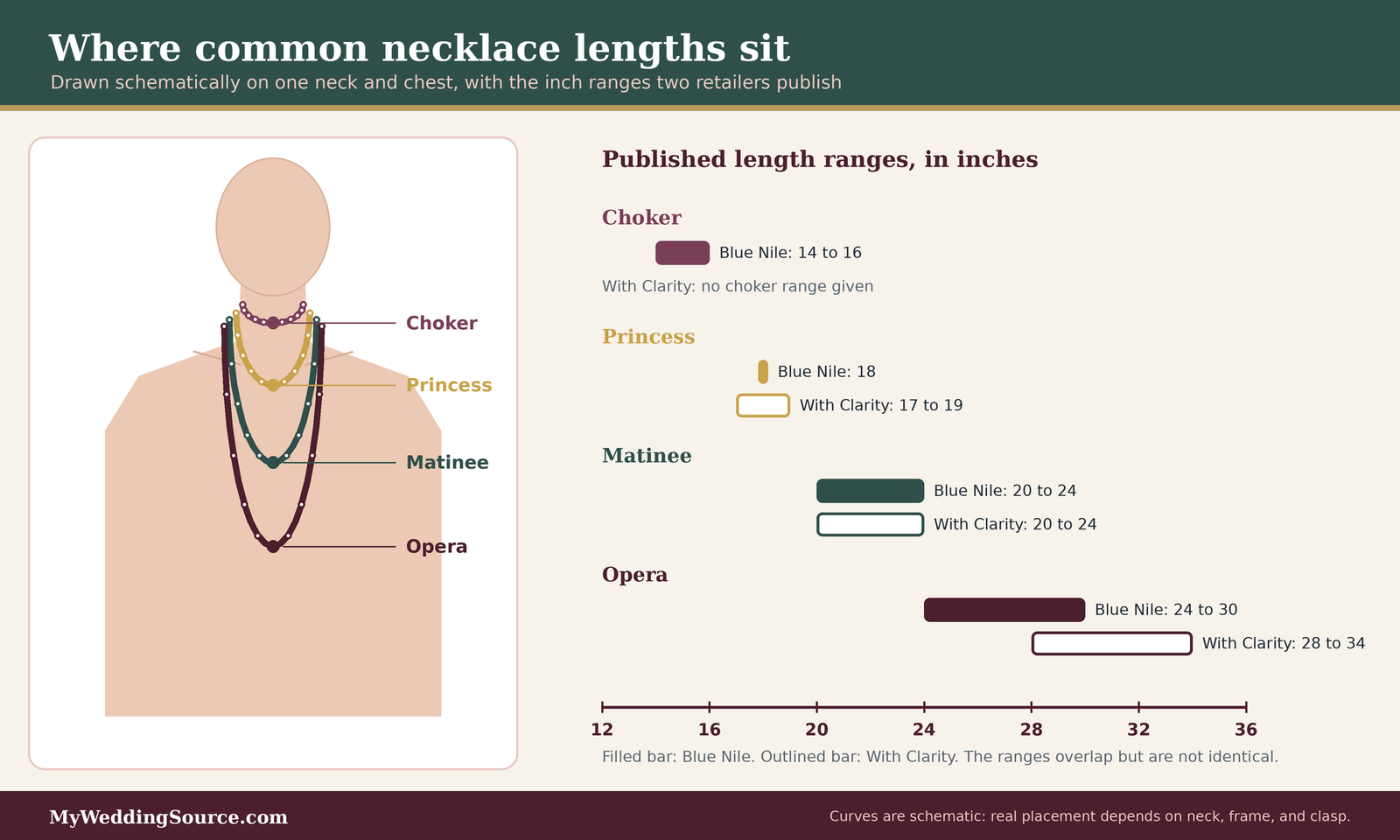
Blue Nile’s necklace length chart lists a choker at 14 to 16 inches, sitting around the base of the neck, and a princess length at about 18 inches, just below the collarbone. It places a matinee at 20 to 24 inches, at or just above the bust, and an opera length at 24 to 30 inches, below the bust. The chart also lists a collar at 14 inches or less, sitting high on the neck, and a rope at 30 inches or more. The drawing below shows those ranges as nested curves on a simple neck and shoulder silhouette. The curves are schematic, since where a chain really falls depends on your neck, your frame, and the clasp.
Why the numbers differ between sources
With Clarity gives slightly different ranges. It lists a princess length at 17 to 19 inches, a matinee at 20 to 24 inches, an opera at 28 to 34 inches, and a rope at 45 inches or more. The matinee range agrees with Blue Nile. The opera range does not, and the difference is a sign that the names are retail conventions, not standards. A practical way to use them is to ignore the label and ask for the inch measurement, then compare it with a tape or a piece of ribbon held against your own neck and collarbone.
Choosing a length for your neckline
Once you know the vocabulary, choosing necklace length for your wedding jewelry becomes a question about the edge of the dress. The aim is to let the necklace sit clearly above, clearly inside, or clearly along that edge, and to avoid landing exactly on it.
Shallow necklines want shorter pieces, deeper ones want longer
Brian Gavin Diamonds gives a compact rule: match the necklace length to the depth of the neckline, with shorter lengths for high or shallow necklines, longer for deep V-necks, and a medium length for halter or strapless designs worn with earrings. Gabriel & Co. says a necklace on an open neckline should sit between the collarbone and the top of the dress. Put together, a princess length is the likeliest choice for a shallow open neckline, and a matinee or longer is the likelier choice for a deep V. These are starting points for a mirror, not instructions.
Pendants, layers, and the one-piece rule
Pendants generally work best where there is open space beneath them. Brian Gavin Diamonds says pendants suit open necklines like sweetheart and deep V, and chokers suit high necklines like bateau. Layering is another matter. Verstolo says to avoid stacked pieces and layered necklaces across the collarbone on strapless and off-the-shoulder dresses, and suggests layering is more at home on a simple gown. Brilliant Earth’s guide has no layering advice of its own and links to separate guides for it. If you want layers, try them only with a plain dress and add them one at a time, stopping when you feel you are looking at the wedding jewelry before the person.
Practical details that change how a necklace behaves
The sources we read treat necklaces mostly as a style choice. A few practical details deserve their own attention, because they are the ones that cause trouble on the day.
Clasps, chain weight, and twisting
Gabriel & Co. warns that on a long wedding day heavy earrings can pull, bracelets can shift, and necklaces can twist. We did not find a source that quantifies this, so treat it as a reason to test, not a rule. A simple test is to wear the necklace with the dress, or with a similar neckline, for a few hours, and notice whether it rotates, catches on fabric, or shifts toward your shoulder when you hug someone. If it shifts noticeably, tell the jeweler, who may suggest a different chain or length.
Fabric, beading, and the clasp moment
A necklace chain can snag on lace, beading, and fine tulle, and a clasp that sits near a zipper or buttons is awkward to fasten. Whoever fastens it should do so after the dress is on, in good light, and with the hair out of the way. The photographer’s side of this is a small detail worth knowing: SLR Lounge’s getting-ready guide treats the necklace clasp going on as one of the close-up moments to capture while the bride is dressing, so tell your photographer if a particular piece is going on last and they will plan for it.
Earrings: hair, veil, and a very long day
Earrings are the piece of wedding jewelry that brides most often underestimate. Brilliant Earth’s earring guide notes that earrings often show up more in wedding photos than brides expect, and that is worth taking at face value: they sit beside the face, and the face is what people photograph.
Because earrings sit near hair and veil, those two things decide them more than the neckline does. A good approach is to choose the style from the neckline, choose the size from the hair, and choose the weight from how long you plan to wear them.
The main earring styles and when each suits
Earring names are broad, so here is a plain summary for wedding jewelry shopping of what each type does visually. The pairings come from Brilliant Earth’s guide and the other retailers we read.
Studs, huggies, and small hoops
Studs are described by Brilliant Earth as timeless and comfortable, suitable for nearly any neckline, and especially useful when the dress is busy near the face or the hair is down. Huggies and small hoops sit close to the lobe and stay visible when hair is down, and Brilliant Earth lists small hoops as an option for strapless, square-neck, and updo looks. They are the safest category for a high neck, a halter, or a detailed bodice.
Drops, chandeliers, and climbers
Drops and chandeliers add movement and presence, and the same guide says they show best with open necklines and updos. Climbers, which run up the ear, are recommended for halter necklines and side-swept hair. Long styles are also the ones most likely to touch the neck, snag on a veil, or tangle in hair, which brings us to the practical side.
Matching earrings to hair and veil
Hair is the biggest variable, and it changes late. A hair trial months ahead may not match the style on the day, so confirm the plan with your stylist before the earrings are final.
Updo, half-up, or hair down
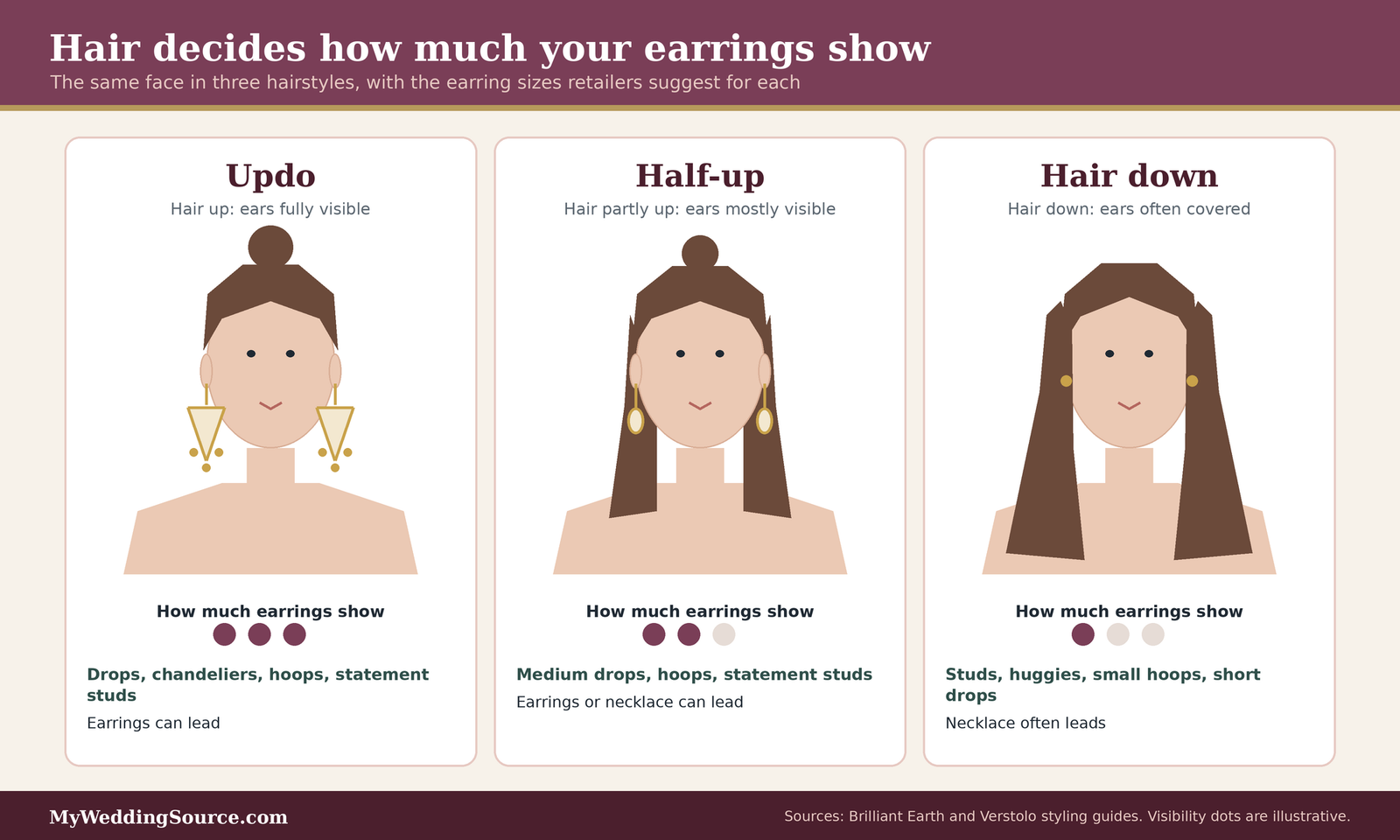
Brilliant Earth says an updo shows off drops, hoops, and other statement styles, and that earrings can become the focal point. Half-up hair works with medium drops, hoops, or statement studs, and either earrings or a necklace can lead. With hair down, studs, huggies, small hoops, or short drops are less likely to get lost or tangled, and longer pairs work if the hair is tucked behind the ears. Verstolo adds a useful corollary: when hair is down and the earrings are hidden, a necklace often becomes the main focal point. The drawing below shows the same face three ways, with the earring size that each hairstyle tends to suit.
Veils change the equation
Brilliant Earth says a detailed veil suggests simpler earrings, while plain tulle leaves more room, and that long drops and open hoops can catch on fabric. Verstolo gives the same direction: the veil already adds volume and movement, so simplify the wedding jewelry. Check how the earrings look with and without the veil, since the veil usually comes off at some point and the earrings are then seen on their own. Our wedding photographer shot list is useful here, because portraits taken before and after the veil comes off are a good moment to see both versions.
Comfort, weight, and sensitive ears
Earrings are the one piece that you wear for the whole event without being able to adjust easily, and they hang from a small piece of skin. A pair that feels fine for twenty minutes can feel different after six hours.
Weight and earring backs
Brilliant Earth cautions that large statement pieces can be tiring over a long day, and recommends checking weight and confirming the backing, whether push, screw, lever, hinged, or locking, is secure. It also recommends wearing the pair for an extended time and moving around, turning your head, and bending to see whether anything pulls or pinches. Lightweight construction helps with larger designs. Outdoor weddings add wind, which the same guide flags as a concern with long styles.
Nickel and sensitive ears
The American Academy of Dermatology says earrings, earring backs, and watches are the most common sources of nickel exposure, and that necklaces, rings, and bracelets can also cause reactions. It recommends nickel-free or hypoallergenic pieces and lists surgical-grade stainless steel, 18-, 22-, and 24-karat yellow gold, pure sterling silver, and platinum as options. A 2008 study by dermatologists, summarized by ScienceDaily, tested 277 inexpensive earrings in San Francisco and found about 31 percent contained nickel, and that neither price nor country of manufacture predicted nickel content. That is a small, old, local sample, so we use it only to make one point: do not assume a low or high price tells you what is in an earring. Blue Nile adds that labels such as “nickel-free” and “hypoallergenic” are a starting point, and that you should check the composition. If you react to jewelry, see a board-certified dermatologist, and this article is not medical advice.
Test the exact pair, not a similar one
Because small differences in backing, post material, and weight matter, test the exact pair you will wear, including the backs. If you plan to buy through a retailer, ask what the posts and backs are made of and whether you can return a pair that you have tried on, and keep the tags and packaging until you are sure. Our section on questions to ask a seller later in this guide gives wording. ## Bracelets, rings, and what your hands will be doing
Bracelets are the least discussed piece of wedding jewelry, and the one most affected by what your hands are doing. You will hold a bouquet, hug people, lift a hem, cut a cake, and sign a document. A bracelet that looks good in a mirror may be a nuisance in motion, and a bracelet that works with the sleeve in a photograph may disappear under it.
This section covers bracelets and sleeves, the relationship between wrist jewelry and your rings, and the hand photographs that many couples want.
Bracelets and sleeve length
Sleeves decide whether a bracelet is seen at all. Brilliant Earth’s styling guide goes through the progression clearly, and its logic is easy to remember.
From sleeveless to long sleeves
With a sleeveless dress, bracelets and bangles are very visible and can add balance. With short sleeves, most bracelet styles work. With three-quarter sleeves, slimmer bracelets sit more comfortably near the sleeve edge. With long sleeves, a bracelet may be unnecessary, especially when the sleeves are lace or embellished, though the guide does not rule it out. With statement sleeves, it recommends keeping wrist pieces minimal. Verstolo adds that on high-neck and halter styles a bracelet can become the main accent, which fits the earlier advice to move attention to the wrists when the neckline is full.
Bouquets, hugs, and sliding
Gabriel & Co. says stylists warn that bracelets may slide around while you hold a bouquet. A bracelet that rotates and lands its clasp or charm on the underside of the wrist is a small annoyance in person and a blur in photos. A snugger fit helps, but a bracelet that is too tight is uncomfortable by evening, so test it after you have been using your hands for a while. If a bracelet is a lead piece, fasten it with help and check it again before the ceremony. Our guide to a wedding photographer shot list suggests asking for hand and detail shots, and a bracelet that sits well makes those easier.
Wrist wedding jewelry and your rings
Your wedding band and any engagement ring are already jewelry, and they sit in the same photographs as the bracelet. They deserve to be part of the plan, not an afterthought.
One metal story across hand and wrist
Brilliant Earth says wedding jewelry does not need to match the engagement ring exactly, and that similar metals, proportions, or details help the pieces look cohesive. A bracelet in the same metal as the rings is the simplest way to keep the hand looking unified. If your rings are platinum and your bracelet is yellow gold, the mix can look deliberate when you repeat it elsewhere, which is Brilliant Earth’s advice for mixed metals. Our guides to wedding ring metals and wedding band width are the place to settle the rings themselves before choosing anything to sit beside them.
Do not let the bracelet fight the rings
In our view, a wide cuff beside a slim band can make the band look smaller, and a sparkly bracelet can pull attention from a modest engagement ring. The practical rule is to decide which piece on your hand is the lead and let the others be quieter. If you plan to engrave your rings, our ring engraving guide covers that decision separately.
Hand photographs and ring shots
Many couples want a close photograph of the hands, with rings and sometimes a bracelet. That affects choices more than people expect, because hands photographed up close show every detail of the wedding jewelry.
Flatlay or worn
SLR Lounge’s guide to bridal-prep photography advises asking in advance whether smaller accessories should be photographed as a styled flatlay or on the body once the bride is dressed, since preferences vary. It also recommends that the wedding jewelry details be photographed first, before the room gets busy and people start handling the rings and other pieces. The same article says the bride gathers her earrings, necklace, and bracelet in one spot before the photographer arrives, which is an easy habit to copy.
Keep the finish simple for close-ups
A close-up shows every detail of a piece, so check each one in good light before the day and give it a quick wipe with a soft cloth beforehand. GIA suggests having wedding jewelry checked and cleaned regularly, with a professional check about every six months, so schedule a check a few weeks before the date and not the week of.
Metals, pearls, and plating: making a set that looks intentional
A matching set of wedding jewelry is not required, but a coherent one reads as deliberate. Coherence comes from a few repeated qualities: a metal color, a stone shape, a size, or a finish. This section covers the practical questions about metals, pearls, and plated pieces.
Match, mix, or echo the metals
Metal color is the simplest unifying thread in wedding jewelry, and the advice from jewelers is more relaxed than many people expect.
What retailers say about mixing
Gabriel & Co. says matching is not required and that mixing metals, such as yellow gold rings with white gold or platinum earrings, is common, with the goal being visual harmony with the rings. Brilliant Earth says mixing silver and gold is fine when it looks intentional, ideally by repeating the mix in more than one piece. Both are retailers with their own catalogs, so read this as common practice, not as a neutral ruling. If you do mix, make sure the mix shows up at least twice, for example a white metal band and white metal earrings with a yellow gold bracelet and a yellow gold pendant.
Metal and dress color
Gabriel & Co. also notes that white metals tend to look brighter against a white dress and make diamonds the focus. That is one retailer’s observation, and it depends on the dress shade and the lighting. Ivory, champagne, and blush dresses can look different against warm and cool metals, so hold a sample or wear the real piece against the fabric in daylight. Do not rely on a product photograph, because screens change both metal color and fabric color.
Pearls: sizes, types, and care
Pearls are a traditional choice for wedding jewelry, and they come with a few facts worth knowing before you buy.
Common pearl types and sizes
GIA’s comparison of pearl types gives typical sizes: freshwater pearls usually 6 to 12 millimeters, Akoya most commonly 6 to 9 millimeters, Tahitian 8 to 14 millimeters, and South Sea roughly 8 to 18 millimeters. It describes Akoya as known for round shapes and a sharp, mirror-like luster, freshwater as having a wide range of shapes and colors, Tahitian as dark gray, silver, green, and brown, and South Sea as white, silver, or golden with a soft, satiny luster. For earrings, size affects both look and weight, so a larger pearl stud is a bigger decision than the millimeter number suggests.
Care and the last-on rule
GIA says pearls can be damaged by many chemicals and by all acids, including hair spray, perfume, cosmetics, and perspiration, and that cultured pearls should be wiped with a soft, clean cloth after each wearing. It warns against ultrasonic and steam cleaners and notes that heat can burn or crack cultured pearls. GIA’s traveling-jewelry article gives the practical corollary: put pearls on last and take them off first. That is a simple rule for a wedding day, since hair spray, perfume, and makeup are all being applied on the same morning. Put the pearls on after hair, makeup, and fragrance are finished.
Plated, vermeil, and other labels
Not all wedding jewelry is solid precious metal, and the labels describing plated pieces have specific meanings in the United States.
What the federal guides say
The Federal Trade Commission’s Jewelry Guides, revised in 2018, give definitions. Under the guides, “vermeil” means sterling silver coated on all significant surfaces with at least 10-karat gold, to a thickness of at least 2.5 microns, and a base metal between the layers must be disclosed. “Gold filled” requires the gold layer to be at least one-twentieth of the metal weight. “Sterling” requires at least 925 parts per thousand pure silver, and an unqualified “platinum” requires at least 950 parts per thousand. For cultured pearls, the word “cultured” or a similar term must accompany the word “pearl.” These are guidelines for marketing, not a guarantee about any individual piece, and this is general information, not legal advice.
Ask for the composition in writing
Because labels vary, ask for the metal, the purity, and the plating thickness in writing, along with any stamp on the piece. Blue Nile describes rhodium plating on white gold or silver as a thin coating that acts as a barrier against skin, so the metal underneath still matters, particularly for earrings that sit in a piercing. A seller who cannot give you a clear answer about what the piece is made of has told you something useful.
What wedding jewelry costs, and how to plan the money
Prices for wedding jewelry run from very modest to very large, and we did not find a reliable published average for bridal jewelry as a category. The Knot’s 2026 report on 2025 weddings, summarized in a press release, surveyed 10,474 U.S. couples who married during 2025 and reported an average total wedding cost of about $34,000, so a wedding jewelry line is one small line inside a large number. That figure describes whole weddings and says nothing about jewelry specifically.
Cost note
We did not find a published average for what couples spend on wedding jewelry such as earrings, necklaces, and bracelets, so any number we gave would be a guess. The example below is our own illustration with made-up round numbers, meant to show how to divide a budget, not what you should spend. Insurance, cleaning, and alterations are separate lines that are easy to forget. For the larger picture, use our wedding budget calculator.
How to divide a wedding jewelry allowance
A budget for wedding jewelry is easier to manage when it is attached to the roles each piece plays, not to a total for the category.
An illustrative split
Suppose you set aside $900 for the day’s wedding jewelry and you have a strapless dress with a plain bodice, so the necklace is the lead. One illustrative split is $450 for the necklace, $270 for earrings, and $180 for a bracelet or a backup pair. If instead your dress is a long-sleeved high-neck, the necklace and bracelet drop out and the earrings become the lead, so the same $900 might move to $600 for the earrings and $300 for care, a jeweler check, and a backup. This is arithmetic on invented numbers, intended to show that the neckline moves the money, not to set a target.
Existing, borrowed, and inherited pieces
Many couples include a family piece or a borrowed one in their wedding jewelry. A piece you already own costs nothing to buy but may need a jeweler check, a new clasp, or a different length, and an inherited necklace may be longer or shorter than your neckline wants. GIA recommends professional checks about every six months, so a family piece intended for the day is worth taking in a few weeks ahead. Budget for that check as a real line item.
Insurance and documentation
Wedding jewelry is easy to lose and expensive to replace, and the days around a wedding involve travel, changing rooms, and many people nearby.
What a standard policy may cap
Country Financial’s guide says standard homeowners and renters policies include jewelry but cap the coverage, and that the cap may fall well short of a piece’s actual value. It describes a rider, also called scheduled personal property, that adds named items and insures each up to its appraised value. We are not insurance advisers, and policies differ by insurer and state, so read your own policy and ask your agent. Our guide to engagement ring insurance and hidden costs covers the insurance side for rings, and it is worth asking your agent whether the same approach applies to other jewelry.
Appraisals and paperwork
Country Financial recommends an appraisal from a reputable jeweler with credentials such as a graduate gemologist or licensed appraiser, bringing receipts and paperwork, and refreshing appraisals every few years for valuable items. For wedding jewelry, keep receipts, photographs of each piece, any stamp or serial detail, and the written composition from the seller in one folder, physical or digital. ## Ordering and testing wedding jewelry with a way to correct mistakes
Most regret about wedding jewelry comes from one of three things: a piece that does not fit the neckline, a piece that is uncomfortable by evening, or a piece that cannot be returned. All three can be caught early if you order and test in the right sequence.
The idea in this section is to put the riskiest decisions first, leave room to change your mind, and run one full rehearsal before the last week.
Order the highest-risk pieces first
Not all wedding jewelry carries equal risk. A pair of studs is easy to replace. A necklace chosen for a specific neckline, or a custom piece, is much harder to swap late.
Fit, lead time, and return rules
Rank the pieces by how hard they would be to replace. Anything that depends on the neckline, such as a necklace length, goes first and should be tried with the dress or a similar one. Anything that must fit you, such as a bracelet, goes next. Studs and simple earrings go last, because they are the easiest to change. Before paying for any piece, ask for the return window, who pays return shipping, and whether worn or tried-on pieces can be returned, and ask for the answers in writing. Lead times and return policies vary by seller and we cannot give you a typical number, so ask each seller directly and add a buffer in your own calendar.
Hold custom work until measurements and palette are stable
Custom work is where a changed decision costs the most. If the dress is still being altered, the neckline may change, and a necklace length chosen against the old line may be wrong. If the hair plan is not final, earrings may be the wrong scale. Our suggestion is to commission custom or engraved pieces only after the final dress fitting and the hair trial, and to ask whether a piece can be resized, lengthened, or adjusted afterward. For the rings themselves, our wedding ring metals guide covers material choices that affect whether a ring can be resized later.
Run a full-look test before the last week
A full-look test of your wedding jewelry is a rehearsal. It is the single most useful thing you can do, and most sources we read recommend some version of it.
Photograph the combination in similar light
Brilliant Earth’s earring guide recommends trying the full look, including dress, hair, and veil, and photographing it from several angles and distances. Take photographs in the kind of light you will have, so indoor ceremonies get indoor photographs and outdoor ceremonies get outdoor ones. Look at the photographs on a phone and on a larger screen. Ask a friend which piece they noticed first, because that is your actual focal point, and it may not be the one you intended.
Wear it long enough to find the problem
Gabriel & Co. recommends wearing the wedding jewelry for a few hours before the wedding to confirm it feels right, and Brilliant Earth recommends moving around, turning your head, and bending. Do both, and do it after the final hair trial so that the hair is as it will be. Note which piece you touched, adjusted, or forgot about. Pieces you keep touching should be replaced or simplified, because you will keep touching them on the day.
Pack, dress, and travel without losing a piece
The last stage for your wedding jewelry is the day itself, and for some couples the trip before it. Small routines prevent most of the problems.
The getting-ready order
A simple order that matches the sources: gather everything in one place before the photographer arrives, which is what SLR Lounge’s getting-ready guide describes; put pearls on last, as GIA’s travel article advises; and have someone fasten the necklace after the dress is on. Keep a small pouch with a spare pair of earring backs, a lint-free cloth, and your backup pieces, and give it to a trusted person. Our wedding planning checklist is a good place to add these items so they do not get lost in the larger plan.
Travel and destination weddings
The Transportation Security Administration says jewelry is allowed in carry-on and checked bags, and recommends keeping valuable pieces with you instead of packing them in checked luggage. It also says you can ask for private screening if you are carrying valuables, and that the officer makes the final decision on any item. GIA’s traveling-jewelry article gives similar guidance, recommending that jewelry go in carry-on bags, with each piece stored separately in a soft pouch so pieces do not scratch each other. The Jewelers Mutual 2025 travel study, a February 2025 survey of more than 1,500 U.S. adults, reported that earrings were the most frequently lost or stolen items, that beaches were the top location for loss, and that hotel rooms were common sites for theft. It is an insurer’s survey and not an independent count, but it fits common sense: keep small items in a pouch and put them away in the same place each time.
Three worked examples: how the same rule gives different answers
The easiest way to see how the pieces interact is to follow three people through the decision. The examples are invented for illustration. They show how the advice above combines, and which change would flip each recommendation.
Reading the scenarios
Each scenario states the dress, the hair, and one assumption that matters. The recommendation follows from the sources above, and the last column names the change that would reverse it.
How to use the table
Find the scenario closest to yours, then look at the flip point, which is the one fact that would change the answer. If your situation matches the flip point, use the opposite recommendation.
What the table does not decide
The table does not choose a style, a price, or a metal. It only shows how neckline, hair, and veil move the decision. Your taste and comfort decide the rest.
| Scenario and assumptions | Recommendation | What flips it |
|---|---|---|
| Strapless dress with a plain bodice, hair in an updo, no veil | Choose one lead: a short pendant or a pair of drops, and keep the other quiet | If hair comes down for the reception, move the lead to the necklace |
| Long-sleeved lace dress with a high neck, hair half-up, long veil | Small studs or huggies, no necklace, no bracelet; let the lace lead | If the veil comes off for the reception and you want a second look, add one statement pair then |
| V-neck dress, hair down, outdoor ceremony with wind | Pendant that follows the V or a longer soft pendant, with studs or short drops | If the day is calm and hair goes up, drops become an option |
Walking through the scenarios
The three scenarios below follow the rows of the table, with the sources that support each recommendation.
Scenario one: strapless and plain
This is the classic open-neckline case, and the advice from Brilliant Earth, David’s Bridal, and Verstolo agrees that you have room and should use it for one piece. The risk is adding a second bold piece because the room is there. If you are planning a change of look for the reception, our cocktail attire guide is a useful reference for how that dress code is usually described.
Scenarios two and three
In the lace high-neck case, the dress is already the feature, and the sources agree that wedding jewelry steps back. In the V-neck case with hair down, Verstolo says a necklace often becomes the focal point when hair hides the earrings, and Brilliant Earth says hair down calls for studs, huggies, or short drops. Wind is the extra variable, and Brilliant Earth flags it as a concern for long styles at outdoor weddings.
Questions to ask before you buy wedding jewelry
A short list of questions protects you from vague product pages for wedding jewelry and from your own enthusiasm. Ask for the answers in writing and keep them with the receipt.
Questions worth asking before you buy
- What exactly is this made of, including the metal, the purity, and any plating, and where is it stamped?
- What are the earring posts and backs made of, and are there options for sensitive ears?
- What is the exact length or weight of the piece, in inches or grams?
- Can this piece be resized, lengthened, or adjusted afterward, and at what cost?
- What is the return and exchange policy for a piece I have worn briefly, and who pays for shipping?
- What does the warranty cover, and what does it exclude?
About the piece
These questions confirm what you are buying and how it will behave on the day.
Materials and marking
Ask for the metal, purity, plating, and stone details in writing. In the United States the Federal Trade Commission’s Jewelry Guides set out how precious metals, plated goods, and cultured pearls should be described, and the stamp and description on a piece should match your receipt. If a piece is described as plated, ask how thick the plating is and what the base metal is.
Size, weight, and adjustment
Ask for inches for necklaces and bracelets, and for weight in grams for larger earrings. Ask whether the clasp can be changed, whether an extender is included, and whether the earring backs can be swapped. Request a photograph of the piece on a person if the seller has one, because product shots rarely convey scale.
About the seller
These questions decide what happens if your first guess is wrong.
Returns, exchanges, and lead time
Ask for the exchange window, the cost of returning a piece, and the lead time for any adjustment, and write the dates in your calendar. If a piece is made to order, ask whether it can be returned at all. Many sellers treat custom work differently from stock items, so do not assume, and get the answer in writing.
Care and repair
Ask what care the seller recommends, whether they offer cleaning, and what repairs they will do and at what cost. GIA recommends choosing a well-reputed jeweler with professional training, and it offers a retailer lookup on its site. For rings, our engagement ring guide covers how to evaluate a jeweler and what to ask about settings and service.
FAQ: wedding jewelry questions
Choosing pieces
Do I need a necklace if my dress has a high neckline?
Usually not. Brilliant Earth and David’s Bridal both say a necklace may compete with a high neckline and that earrings and sometimes a bracelet work better. A snug choker is the most common exception, and it should be tried on with the dress first. If you skip the necklace, put the attention in the earrings.
Should my earrings match my necklace?
No. Brilliant Earth says earrings and necklace do not need to match exactly, but shared details such as metal color or stone shape help them feel cohesive. Bold earrings often look best with a simple necklace or none. If both are statement pieces, they will compete, so pick one lead and keep the other quiet.
Metals and materials
Can I mix gold and silver tones in my wedding jewelry?
Yes, if it looks intentional. Gabriel & Co. says mixing metals is common, and Brilliant Earth suggests repeating the mix across more than one piece so it reads as a choice. For example, pair white metal rings and earrings with a yellow gold bracelet and pendant. Both are retailers, so treat this as common practice, not a rule.
What should I know if I have sensitive ears?
The American Academy of Dermatology lists earrings and earring backs as common sources of nickel exposure and suggests nickel-free or hypoallergenic pieces, naming options such as platinum and high-karat gold. Ask the seller what the posts and backs are made of, and see a board-certified dermatologist if you react. This is general information, not medical advice.
Comfort and timing
How long before the wedding should I choose my wedding jewelry?
Choose your wedding jewelry after the dress is final and the hair plan is settled, because both change what works. Gabriel & Co. suggests finalizing veil or hair accessories first, then jewelry. Leave time for returns and a few hours of wear testing. Lead times vary by seller, so ask each one and add a buffer.
How do I know whether earrings are too heavy?
Wear them for an extended time and move around, as Brilliant Earth advises. Turn your head, bend, and notice any pulling or pinching. Large statement pieces can feel fine at first and tiring later, so test for hours, not minutes. Lightweight construction helps with larger designs, and a secure backing matters as much as weight.
Day-of and travel
Can I fly with my wedding jewelry?
The Transportation Security Administration says jewelry is allowed in carry-on and checked bags but recommends keeping valuables with you. You can ask for private screening. GIA also suggests carry-on storage with each piece in its own soft pouch. Check your insurance coverage before you travel, since standard policies may cap wedding jewelry.
When should pearls go on?
Last. GIA’s traveling-jewelry article says to put pearls on last and take them off first, and GIA’s care guide says hair spray, perfume, cosmetics, and perspiration can damage pearls. On a wedding morning that means putting them on after hair, makeup, and fragrance are finished, and wiping them with a soft cloth afterward.
Your next steps
Decide the plan
Name the lead piece
Write down your neckline, your hair plan, and your veil, then choose one lead piece of wedding jewelry among earrings, necklace, and bracelet. Use the decision matrix to size the other two down. If you are still choosing a dress, our plan a wedding guide places attire in the larger sequence.
Set a testing date
Put a date for the full-look test in your calendar, after the final fitting and the hair trial and well before the last week. That date also sets your return deadline, since you will want to know what stays before the window closes.
Lock in the details
Collect the paperwork
Keep receipts, written compositions, return terms, and photographs of each piece of wedding jewelry in one folder. If any piece is valuable, ask your insurer whether to schedule it, and read your own policy first.
Pack a day-of pouch
Put spare earring backs, a soft cloth, and a backup pair in a small pouch and hand it to someone you trust. For the rest of the plan, use our wedding planning checklist and wedding planning timeline.
Sources & methodology
How we built this guide
What we relied on
This guide combines the Federal Trade Commission’s Jewelry Guides, the American Academy of Dermatology’s nickel allergy guidance, the Transportation Security Administration’s jewelry page, gem-laboratory care and pearl guidance from GIA, and published styling advice from jewelers and bridal retailers. Where a statement comes from a retailer, we say so, because retailer advice reflects the seller’s products. Neckline pairings are conventions from these guides, and several of them disagree, which we point out in the text. The budget split in the cost note and the scenarios are our own invented illustrations, and we say so where they appear.
What we did not do
We did not test jewelry, measure necks, or survey brides, and we did not find a published average for what couples spend on bridal jewelry, so we give none. We do not give medical, legal, insurance, or financial advice. Skin reactions, policies, and seller terms vary, so ask the seller for terms in writing, read your own policy, and see a clinician about persistent skin problems.
Source list
Government, professional, and clinical sources
- Federal Trade Commission, Guides for the Jewelry, Precious Metals, and Pewter Industries, 16 CFR Part 23, final revisions (Federal Register, August 16, 2018): https://www.govinfo.gov/content/pkg/FR-2018-08-16/html/2018-17454.htm
- Transportation Security Administration, Jewelry: https://tsa.gov/travel/security-screening/whatcanibring/items/jewelry
- American Academy of Dermatology, Nickel allergy: https://www.aad.org/public/diseases/eczema/insider/nickel-allergy
- GIA, Pearl care and cleaning guide: https://www.gia.edu/pearl-care-cleaning
- GIA, Tips on caring for jewelry: https://archive.gia.edu/gia-news-research-tips-caring-jewelry
- GIA, Traveling style guide: traveling with jewelry: https://4cs.gia.edu/en-us/blog/traveling-style-guide-traveling-jewelry
- GIA, Differences between pearl types: https://www.gia.edu/articles/differences-between-pearl-types
- ScienceDaily, report on the 2008 San Francisco earring nickel study: https://www.sciencedaily.com/releases/2008/05/080512144306.htm
Industry, insurer, and retailer sources
- The Knot Worldwide, 2026 Real Weddings Study press release (Business Wire): https://www.businesswire.com/news/home/20260218045442/en
- Jewelers Mutual, 2025 Travel Study: https://www.jewelersmutual.com/2025-travel-study
- Country Financial, How to insure jewelry: https://www.countryfinancial.com/en/planning/common-topics/insurance-coverage/how-to-insure-jewelry.html
- SLR Lounge, Bride getting ready: a wedding photographer’s guide to prep coverage: https://www.slrlounge.com/how-to-master-bride-prep-wedding-photography-guide-pt-3/
- Brilliant Earth, What jewelry to wear with a wedding dress: https://www.brilliantearth.com/jewelry/buying-guide/what-jewelry-to-wear-with-wedding-dress/
- Brilliant Earth, What earrings to wear on your wedding day: https://www.brilliantearth.com/guides/what-earrings-to-wear-on-wedding-day/
- Gabriel & Co., How to choose jewelry for a wedding: https://www.gabrielny.com/blog/how-to-choose-jewelry-for-a-wedding/
- David’s Bridal, Neckline and jewelry combos: https://davidsbridal.ca/inspiration/accessories/jewelry-neckline-guide
- Brian Gavin Diamonds, Choosing the right jewelry for your wedding dress neckline: https://www.briangavindiamonds.com/blogs/news/choosing-the-right-jewelry-for-your-wedding-dress-neckline
- Verstolo, How to choose jewelry for your wedding dress neckline: https://www.verstolo.com/how-to-choose-jewelry-for-your-wedding-dress-neckline/
- Blue Nile, Necklace length chart: https://www.bluenile.com/blog/fashion/necklace-length-chart
- With Clarity, Necklace length guide: https://withclarity.com/blogs/jewelry/necklace-length-guide-how-to-choose-the-perfect-length
- Blue Nile, What is hypoallergenic jewelry: https://www.bluenile.com/blog/diamonds-jewelry/what-is-hypoallergenic-jewelry