
These 35 wedding florist questions show you what a proposal really includes, what the day will demand from the florist and your venue, and which contract terms to settle before you pay a deposit.
You have two or three florist proposals open in different tabs, and none of them look alike. One lists “ceremony florals: $1,850” as a single line. Another spells out stem counts but leaves delivery as “to be determined,” and a third quotes a flat package that covers the bouquet and boutonnieres but not one table arrangement. Choosing among them by the bottom line alone is like comparing three menus when only one of them lists the sides.
The Knot’s 2026 Real Weddings Study, which surveyed 10,474 U.S. couples married in 2025, puts the average floral spend at $2,800, with a median of $1,900 and a quartile range from $900 to $4,800. That spread is the first clue that “flowers” is not a fixed product. It is a bundle of design time, perishable inventory, labor, transport, rentals and risk, and every florist packages the bundle differently. The questions below unbundle it so you can compare proposals apples-to-apples and spot the gaps before they turn into line items on a final invoice.
This guide is about hiring, not shopping for blooms. It walks through six groups of questions: fit and availability, proposals and pricing, delivery and strike, the flowers themselves, contracts and backup plans, and what happens after the wedding. Each question is numbered from 1 to 35 so you can carry the list into a consultation, and a scorecard near the end helps you compare florists side by side. For cost ranges by item and region, see our guide to wedding flowers cost, and for choosing stems, palettes and styles, see wedding flowers. Here we stay on the conversation with the person you are about to pay.
A note on limits. Florist pricing, contract language and sales tax rules vary by business and by state, so everything below is general education rather than legal or financial advice. Where this article uses a number, it names the source and the year, and where it uses an example, it says so.

What Should You Settle and Bring Before You Contact a Florist?
Florists can only price what you can describe, so the quality of the quote you get is tied to the quality of the information you send. A vague inquiry gets a vague range, and a vague range makes comparison impossible. This section covers the two things worth doing before the first email: setting a realistic starting range and assembling the handful of facts that turn a guess into a proposal.
How much should you plan to spend before you have a quote?
What do the national numbers say, and what do they leave out?
The Knot’s study of 2025 weddings reports an average floral spend of $2,800, a median of $1,900, and a quartile range from $900 to $4,800. The gap between the average and the median tells you that a minority of large floral budgets pulls the average upward, so the median is the more honest “typical” figure for most couples. The same study found that 59% of couples included a florist among their vendors, which means roughly four in ten handled flowers another way, such as through a venue package, a grocery-store buy, a friend or DIY. It also found that 70% named price as their top priority when choosing a florist. None of these figures is a quote for your city, your date or your design, so treat them as a sanity check on your first conversation, not a target.
How do you set a starting range without anchoring on an average?
The Knot’s flower article calls roughly 10% of the total budget the industry standard and suggests 15% for couples with high floral expectations, using a $75,000 wedding and a $7,500 floral line as its example. For context, $2,800 is about 8% of the study’s $34,200 average total wedding cost, so the typical couple spends a little under the rule of thumb. Guest count moves the number more than most people expect: the study’s averages run $1,600 for 1 to 50 guests, $2,400 for 51 to 100, and $3,300 for 101 or more. A sensible approach is to pick a range from your own total budget, check it against your guest-count band, and tell the florist the range rather than a single figure. Florists generally design to a number, so a range gives them room to propose options at more than one price point.
| Benchmark | Average floral spend | How to use it |
|---|---|---|
| All surveyed couples | $2,800 | Sanity check, not a target |
| Lower quartile | $900 | Minimal personal flowers and few arrangements |
| Median | $1,900 | The more typical couple |
| Upper quartile | $4,800 | Larger scale, installations, many tables |
| 1 to 50 guests | $1,600 | Small weddings and micro-weddings |
| 51 to 100 guests | $2,400 | Mid-size guest lists |
| 101 or more guests | $3,300 | Larger lists with many tables |
| Mid-Atlantic / West | $3,600 / $2,400 | Highest and lowest regional averages in the study |
What should you bring to the first conversation?
Which facts take the guesswork out of a quote?
Start with the date, the ceremony and reception locations, and a headcount you would be comfortable defending, then add the number of tables and their shape if you know them. Add the personal flowers you expect, such as bouquets, boutonnieres, corsages, flower-girl pieces and parent flowers, because these are small items that add up quickly in a proposal. Mention anything that changes the work: a ceremony arch, a staircase, an aisle, a cake table, a head table, or a second location that needs the flowers moved between events. Tell the florist about your rain plan as well, since an indoor backup changes what you decorate and where. Our guide to outdoor wedding rain plans covers how to build that backup, and the florist should know which version of the day they are designing for.
Which inspiration photos help, and which ones mislead?
Photos help most when each one comes with a note about what you like in it: the color, the texture, the scale, the loose shape or the greenery. A photo with no note forces the florist to guess whether you want the flowers, the vase, the lighting or the entire room. Be careful with images shot in a different season or at a different scale, because a lush peony arch photographed in May is not a reliable request for a January wedding. Trend data can be useful as a prompt but not as a price signal: Pinterest’s 2026 wedding report lists alternative bouquets such as fuzzy-wire designs at +1,275%, though the page does not state the comparison window, so read it as a direction of interest rather than a measure of demand. Sort your photos into “must have,” “love it,” and “fine to skip,” and share all three groups so the florist can protect the budget around your priorities.
Is This Florist the Right Fit for Your Date, Your Size and Your Venue?
Fit is the part of hiring that a proposal cannot show you. A florist can be talented and still be the wrong match if they are already committed to three other events that weekend, if the person you meet is not the person who designs your arrangements, or if their portfolio is mostly styled shoots in a scale unlike yours. The first six questions screen for capacity, authorship and experience before either of you spends time on price.
Can this florist actually take on your date well?
Are they available, and what else is on their calendar that weekend?
Question 1 is “Are you available on our date?” and question 2 is “How many other weddings or events do you have that weekend, and what is your team’s capacity?” Availability is a yes-or-no gate, so ask it first and save everyone the time of a consultation if the answer is no. Capacity is the less obvious half: The Knot’s florist guide includes a question about how many events a florist handles in one weekend, and WeddingWire’s list asks whether a small business running several events needs follow-up questions. A larger studio may handle multiple weddings smoothly with separate crews, while a solo designer with three events may be stretched thin on the Friday-night build. Neither answer is a red flag by itself; you are looking for a plan that matches the number of events.
Who designs your flowers, and who shows up on the day?
Question 3 is “Who will design our flowers, and who will be on site for delivery and setup?” In some studios the owner leads the consultation, a lead designer builds the pieces, and a delivery team installs them, so the person you meet may not be the person who touches your flowers. That is a normal division of labor, but you are entitled to know the names, the team size and who has authority to make a call if something changes at the venue. Ask whether the lead on site has worked at your venue before, and whether you will have one point of contact for last-minute questions. Write the answer down in the proposal or email thread, because a verbal “don’t worry, we’ll handle it” is hard to point to later.
Does their work match what you are actually asking for?
Can you see full-wedding galleries, not just highlight reels?
Question 4 is “Can we see full galleries from real weddings similar to ours in size, season and venue type?” The Knot’s florist guide recommends preferring real weddings to styled shoots and notes that portfolios of full wedding weekends help you judge scope. Highlight reels show the strongest centerpiece from the best light, while a full gallery shows the ceremony, the head table, the entrance and the leftover corners where budgets tend to show. Pay attention to scale: a studio that photographs well at 60 guests may or may not have shown what it does at 200. Look for the kind of piece you are buying, whether that is low and loose table arrangements, a large installation or a classic bouquet, and ask which of those the studio does most often.
Have they worked at your venue, and do they know its rules?
Question 5 is “Have you worked at our venue, and do you know its load-in, access and decor rules?” WeddingWire’s list notes that established working relationships between vendors and venues usually make planning smoother. A florist who knows the loading dock, the elevator, the ceremony-to-reception flip and the house rules on candles or hanging items will spot problems before they turn into change orders. If the florist has not worked there, ask how they plan to learn the site, and whether a walk-through is included or billed. Share your venue contact’s name and ask whether the florist or your planner will coordinate access, because “I assumed you were handling that” is one of the most common day-of gaps. If you have a planner, our list of wedding planner questions covers how to divide those handoffs.
How do feedback, revisions and communication work?
Question 6 is “How do you take feedback, how many rounds of revisions are included, and how quickly do you respond?” The Knot’s guide suggests asking about communication style and the best way to reach the florist, and that is useful because proposals often go through three or four rounds before they settle. Ask whether revisions are free until a cutoff date or whether each round carries a design-time fee. Ask about the usual response time during busy seasons, because a florist who replies in two days in April may reply in five in June. If you want a mock-up or sample arrangement, ask now whether it is included, since WeddingWire’s list notes mock-ups are usually an extra charge. Good answers name a process, a timeline and a person, and they put the revision limit in writing.
What Should a Florist Proposal Spell Out Before You Compare Prices?
A proposal is the florist’s description of your wedding in flowers, and it is also the document most likely to be misread. Two proposals with the same total can include very different things, and two with different totals can turn out nearly identical once delivery, rentals and tax are added. The eight questions in this section are about structure: how the florist charges, how much detail the quote shows, and how firm the numbers are.
How does the florist charge, and what is the minimum?
Is the price a package, a per-piece list or a share of your budget?
Question 7 is “How do you price: by package, by piece, or as a percentage of a floral budget, and do you have a minimum?” The Knot’s florist guide suggests asking exactly this, along with whether a minimum floral budget applies. A per-piece proposal gives you the most control because you can see what each arrangement costs and remove one. A package is simpler to read but can hide which parts you are paying for, and a minimum can make a small order uneconomical for a studio. Neither model is better by default; the goal is to know which one you are looking at so you can compare it fairly with the others.
Is there a consultation or design fee, and does it count toward your booking?
Question 8 is “Is there a fee for the consultation or design proposal, and is it credited to our order if we book?” Some florists charge for design time, especially for large installations or multiple revisions, while others fold it into the booking. A fee is not a warning sign, because a custom proposal takes real hours, but you should know whether it is refundable, credited or separate before you request three revisions. Ask the same question of every florist on your shortlist so the comparison stays level. Put the answer in the email thread so the credit, if any, shows up on the final invoice.
How detailed should the itemization be?
Does the proposal list each piece with quantities and sizes?
Question 9 is “Can the proposal list every piece with a quantity, size and flower type or description?” “Centerpieces: $1,200” tells you nothing, while “12 low centerpieces, approximately 10 inches wide, in your palette, at $100 each” lets you compare it with another florist and adjust a single line. Itemization also protects both sides, because it defines what “done” looks like on the day. If a florist prefers to show a design direction rather than stem counts, that is a legitimate style, but ask for quantities of each piece type, such as bouquets, table pieces and ceremony pieces. Our guide to wedding centerpieces can help you decide how many tables genuinely need one.
| Proposal element | Vague version | Clear version |
|---|---|---|
| Table flowers | “Centerpieces, as discussed” | “12 pieces, low, about 10 in. wide, palette per mock-up” |
| Personal flowers | “Bridal party flowers” | “1 bouquet, 4 attendant bouquets, 6 boutonnieres, 2 corsages” |
| Delivery | “Delivery TBD” | “Delivery and setup at venue, 2 p.m. arrival, fee listed” |
| Rentals | “Vases included” | “24 vases rented, replacement cost listed, pickup by florist” |
| Strike | Not mentioned | “Strike at 10:30 p.m. by florist, or not included” |
What is not included in the price?
Question 10 is “What is not included in this quote?” The Knot’s guide quotes a floral designer who says people focus on what is included, but knowing what they do not get is “even more valuable.” Typical gaps include delivery, setup, strike, travel, rentals, tax, a service or administrative charge, overtime for late venue access, and add-ons like flowers for the cake. Ask the florist to list these as separate lines, even if the amount is zero, because “included” and “not mentioned” feel the same until the invoice arrives. If you are comparing a florist with an all-inclusive venue floral package, ask the venue the same question so the two are measured on equal terms.
Is a mock-up or sample available, and what does it cost?
Question 11 is “Do you offer a mock-up or sample arrangement, and is there a charge?” WeddingWire’s list notes that mock-ups are usually an extra charge, and The Knot’s guide encourages asking whether one is included. A mock-up lets you see proportions, color and fullness before the order is final, which is most useful for large pieces or a palette that is hard to judge from photos. It can also reveal whether the florist’s idea of “romantic” matches yours. If a mock-up costs money, ask whether the fee is credited toward the order, and ask which pieces it will cover so you are not paying for a bud vase when your worry is the arch.
How firm is the price?
When does the price lock, and what could change it?
Question 12 is “When is the price locked, and what could change it before the wedding?” The Knot lists market uncertainty among the factors that affect floral cost, and a University of Illinois farmdoc analysis found that about 80% of the cut flower value in the U.S. market in 2023 came from imports, so wholesale prices can shift with freight and demand. Many florists build in a pricing window, then lock the price at a signed proposal or a payment date, and adjust only if you change the order. Ask which of those applies, and whether the florist reserves the right to raise prices if wholesale costs spike. A clear answer names a date and a mechanism, not “we’ll see.”
What happens if your guest count, tables or palette change?
Question 13 is “How does the price change if our guest count, table count or palette changes, and by what date must the order be final?” Guest lists shift for months, and each change can move the number of tables, the number of personal flowers and sometimes the palette. A florist who tells you the cutoff date, such as a set number of weeks before the wedding, and whether additions or reductions are possible after that, is giving you a planning tool. Ask what happens to the deposit if the order shrinks. For a refresher on how final counts ripple through other vendors, see our November wedding checklist, which walks through the confirmations due about 30 days out.
Where would the florist trim first if you needed to cut 15%?
Question 14 is “If we needed to reduce this proposal by about 15%, what would you change first?” The Knot’s saving tips include mixing greenery with blooms, since greenery costs less per stem, limiting the number of arrangements, skipping elaborate installations like arches or flower clouds, and giving the florist flexibility within your palette. A designer who answers with specific swaps, such as fewer large pieces, more greenery or a smaller ceremony focal point, is showing you how they think about trade-offs. A designer who answers “we can’t” may still be the right fit, but you have learned something. Asking this question early also protects your relationship, because it is easier to discuss limits before you love a design.
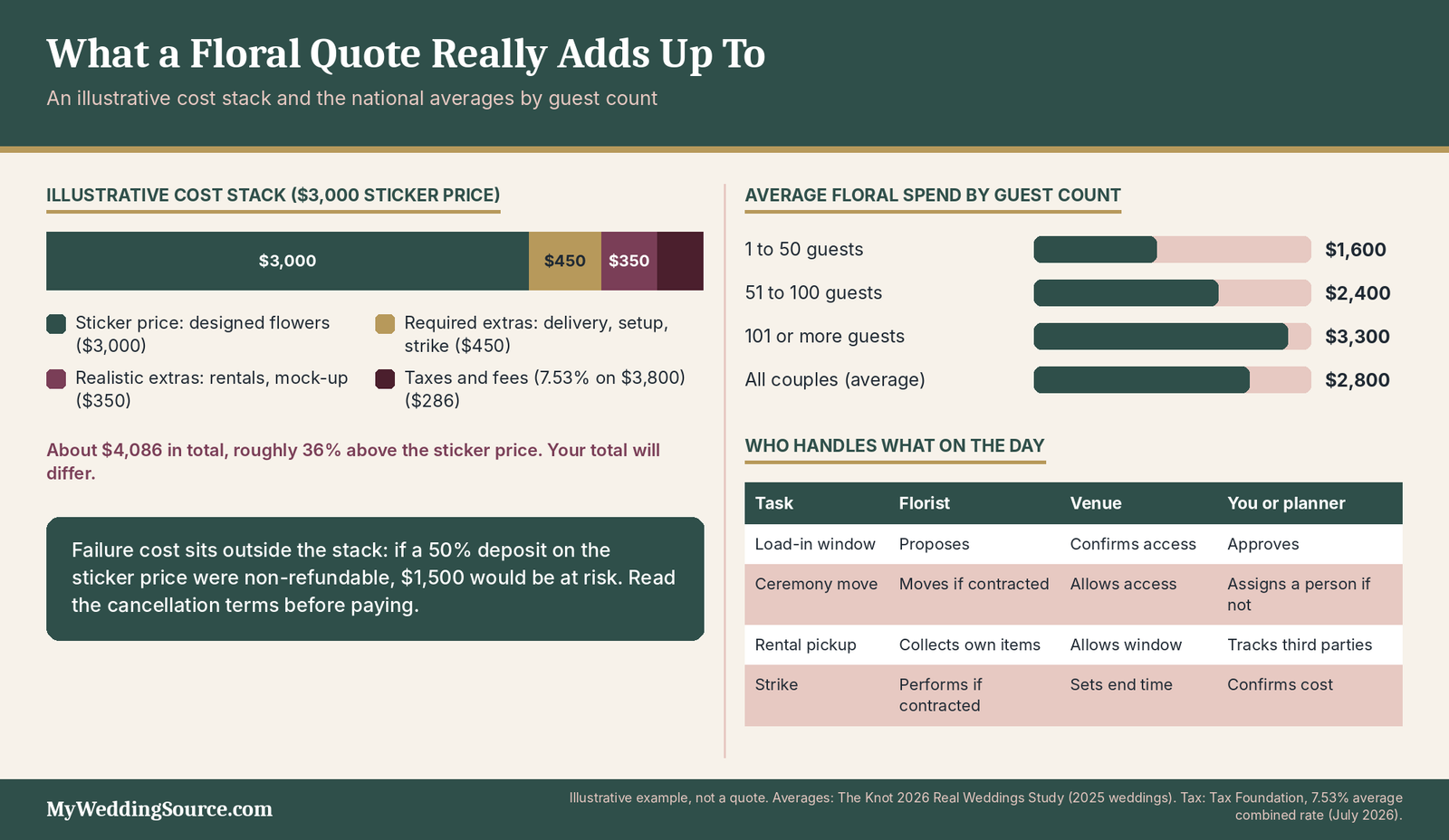
The stack is also why a lower sticker price does not always mean a lower total. Our guide to wedding budget hidden costs uses the same layered approach across other vendors, and the numbers above are a template for asking the florist to fill in their own.
What Happens on the Wedding Day: Delivery, Setup, Rentals and Strike?
Flowers are the vendor category where the work on the day is physical, perishable and time-boxed. Arrangements need a way to get from the studio to the venue, a place to wait, a window to be installed and a plan for what leaves when the party ends. The eight questions here cover that handoff, along with the rentals, the fees and the venue rules that tend to surface only when the van is already on the road.
How do delivery and setup work?
What time do they arrive, and who coordinates with the venue?
Question 15 is “What time will your team arrive, how long does setup take, and who is coordinating access with the venue and planner?” The Knot’s florist guide asks about team size and the setup time the vendor needs, and that detail is what lets your venue or planner build a load-in schedule. If the ceremony is at 4 p.m., a florist who needs three hours for a large installation must have access by midday, which may collide with a room flip or a rehearsal. Ask for the arrival window in writing and share it with the venue. Our guide to wedding linen rental hidden costs shows how rental timing creates similar handoff problems.
What are the delivery, setup, travel and overtime fees?
Question 16 is “What fees apply for delivery, setup, travel, late access and strike, and are they in this quote?” The Knot’s guide warns that delivery, setup and breakdown fees can “quickly add up,” and recommends asking whether labor, delivery and strike are charged separately and how. Travel fees tend to rise with distance, and overtime can apply when a venue delays access or the ceremony runs late. Ask for each fee as its own line and what triggers a change, such as an additional hour or a second site. A florist who gives a clear schedule of fees is not nickel-and-diming you; they are making a hard-to-predict cost visible.
What does the florist need from the venue?
Question 17 is “What do you need from the venue, such as water, power, a cooler, a staging area, parking and elevator access?” Fresh flowers need water access, a cool place to wait and space to build, and an outdoor venue may have none of these near the ceremony site. Ask the florist to send their needs to the venue contact directly, then ask the venue to confirm in writing. If the venue has a preferred vendor list or insurance requirements for outside vendors, the florist should know before you sign, not after. A short email exchange now can save a 30-minute standoff at a loading dock.
What are the rentals, and what happens at the end of the night?
Which pieces are rentals, and what happens if one breaks?
Question 18 is “Which items are rented rather than included, what do replacements cost, and who collects them?” Florists may provide vases, candle holders, arches, stands and other props, and The Knot’s guide suggests asking what these cost and whether the florist can supply them. A rented item usually has a replacement charge if lost or broken, and some studios take a deposit that is refunded when items are returned. Ask whether the florist or you are responsible for returning rentals, and by what time. If rentals come from a separate company, ask who coordinates that pickup so the vases do not sit at the venue overnight.
Who moves the ceremony flowers to the reception?
Question 19 is “Will you move ceremony flowers to the reception, and who is responsible for that move and the cost?” Reusing ceremony arrangements at the reception can stretch a budget, but it requires someone to carry, reposition and re-water them while guests are at cocktail hour. Ask whether the move is included, who does it, and how many team members will still be on site at that time. If the answer is “your venue staff,” confirm that the venue agrees. When no one is clearly assigned, the flowers stay at the ceremony site and the reception looks bare, which is a cheap problem to prevent with a sentence in the contract.
Who breaks down at the end of the night, and what happens to the flowers?
Question 20 is “Who handles breakdown at the end of the night, and what happens to the flowers and containers?” WeddingWire’s list notes that you keep the flowers, while rentals have to be removed, and The Knot’s guide asks whether guests can take table arrangements home. Decide ahead of time whether you want guests to take pieces, whether a friend will collect the bouquet for preservation, or whether the florist should take certain items back. A strike that happens at 10:30 p.m. requires a crew to return, which is often a separate charge. Name one person on your side who will say yes or no to guest take-home so the answer is not left to the DJ.
Which conditions can damage the flowers or the plan?
How do flowers stay fresh in heat, cold and long gaps?
Question 21 is “How will you keep the flowers cool, hydrated and protected from the time they are made until the ceremony, especially if it is hot, cold or windy?” A bouquet that is ready at noon and photographed at 5 p.m. needs a plan. Ask about cooler storage, water sources for bouquets, transport temperature and what happens if the venue has no shaded staging area. A vendor guide to peonies reports that peonies wilt above 85°F, a reminder that stem choice and weather interact. The answer should be specific to your season, not a general promise that “we know how to handle flowers.”
What are the rules for candles, open flames and hanging installations?
Question 22 is “Do the venue or local fire rules limit candles, open flames or hanging decor, and who confirms them?” Fire codes are set locally, so check with your venue and the local fire marshal rather than relying on a general rule. As one example, Fairfax County, Virginia, says open flames may not be located on or near decorative material and describes battery-operated candles as an alternative that avoids the permit in some occupancies. That kind of rule affects where candles can sit among greenery and whether an event needs a permit. Ask the florist to flag any design that mixes flame and foliage, and ask the venue for its written decor policy.
| Task | Florist | Venue | You or planner |
|---|---|---|---|
| Load-in window | Proposes arrival time | Confirms access | Approves schedule |
| Water, power, cooler | States needs | Provides or declines | Follows up if unclear |
| Ceremony-to-reception move | Moves if contracted | Allows access | Assigns a person if not |
| Candle and flame rules | Designs within rules | Sets house policy | Confirms permits |
| Rental pickup | Collects own items | Allows pickup window | Tracks third-party rentals |
| Guest take-home | Provides containers | Allows removal | Decides policy |
| Strike | Performs if contracted | Sets end time | Confirms time and cost |
Which Flowers Make Sense for Your Date, and What Should You Know About Sourcing and Safety?
The flowers themselves raise questions that a portfolio cannot answer. Some stems are only affordable for a few weeks a year, some are imported across several time zones, and some are poor choices for a venue with pets, hot sun or a cake table. The next six questions help you find out which parts of your wish list are firm, which are flexible and which carry a risk you should know about.
How do seasonality and substitutions affect your design?
Which flowers are in season on your date in your region?
Question 23 is “Which flowers are reliably available for our date and region, and which of my favorites carry a price or availability risk?” The Knot’s saving tips recommend choosing flowers that are in season and asking your florist what that means, and the logic is simple: scarce stems cost more and arrive with fewer options. A wedding-flower company’s guide to peonies, a vendor source whose figures are estimates, reports a domestic peony season of late April through early June, with off-season stems coming from Southern Hemisphere growers and greenhouses and costing roughly two to three times as much. Treat that as a reminder to ask rather than a price list. A good answer names two or three alternatives with a similar look.
What is the substitution policy if a flower is unavailable?
Question 24 is “If a flower is unavailable or arrives in poor condition, what is your substitution policy, who approves it and how do you protect the color and look?” Florists work with living inventory, so some substitution is normal, particularly for specialty stems. What matters is the rule: does the florist substitute within a color and style range, do they contact you before changing a focal flower, and is the price held if the replacement costs less? Ask which stems you consider non-negotiable and put them in writing. Our guide to wedding bouquet ideas can help you decide which flowers carry the most weight in your photographs.
| Situation | What could go wrong | Question to ask |
|---|---|---|
| Out-of-season favorite stem | Higher price, limited colors | Which in-season stems get a similar look? |
| Hot outdoor ceremony | Delicate blooms wilt | What is your cooling and staging plan? |
| Wholesale shortage | Unapproved swap | Who approves substitutions, and by when? |
| Cake or food contact | Flowers not grown for eating | Which flowers are food-safe, and who sources them? |
| Guests with allergies or pets | Strong scent, pollen, toxic stems | Can you flag problem stems in the plan? |
Where do the flowers come from, and what holds them together?
Where are the flowers grown, and does that affect cost or values?
Question 25 is “Where do your flowers come from, and can you source some of them from local growers?” The University of Illinois farmdoc analysis reports that nearly 80% of the cut flower value in the U.S. market in 2023 came from imports, and that Colombia supplied over 60% of imports in 2024 and Ecuador about 25%. A USDA Economic Research Service chart shows the U.S. imported nearly $3.3 billion of cut flowers, plants and nursery stock in fiscal year 2022. None of that makes imported flowers a problem, since most florists rely on them; it means local-only sourcing is a design and seasonality choice, not the default. Mississippi State University Extension notes that locally grown flowers travel shorter distances, so ask whether local stems fit your date and what that does to price.
What is used to hold the stems, and is there a floral foam alternative?
Question 26 is “What do you use to hold stems in place, and do you offer alternatives to floral foam?” A Mississippi State University Extension primer says floral foam is non-compostable and ends up in landfills, and it lists alternatives such as chicken wire, natural fiber mechanics and stems packed in a container. If this matters to you, ask what the florist already uses, whether alternatives change the price or the shape of the arrangement, and what happens to the greenery afterward. If it does not matter to you, you can skip it, as it is not a requirement of a well-made arrangement. The point of the question is to learn how the florist works, not to enforce a preference.
What about allergies, pets and flowers near food?
Can the florist flag allergenic or pet-toxic stems?
Question 27 is “Can you flag stems that are heavily scented, pollen-heavy or toxic to pets, and design around them if we ask?” The American College of Allergy, Asthma and Immunology says seasonal allergies are triggered by pollen from trees, grass and ragweed, which is why a guest who sneezes at an outdoor wedding in September may be reacting to the field and not the bouquet. Strong fragrance and visible pollen can still bother some guests, and you can ask the florist to keep scent low near the dining tables. If a pet will be at the wedding or at the home where flowers are displayed afterward, the ASPCA’s toxic and non-toxic plants database can be searched by common name. It states that its list is not all-inclusive, so confirm any stem you are unsure about.
Can any flowers touch food, drinks or the cake?
Question 28 is “Which flowers, if any, will be placed on or near food, and who is responsible for sourcing flowers that are safe to eat?” University of Minnesota Extension says plainly to not eat cut flowers, and notes that systemic pesticides cannot be washed off and that flowers grown for eating are sold in the produce department. That means florist flowers on a cake or in a drink are a question for the baker or bartender, who may source edible varieties, rather than something the florist can casually add. Decide who owns the answer before the cake is ordered, and ask the florist to keep non-edible stems physically separated from food. If a guest has a plant sensitivity, tell the caterer and the florist at the same time.
Which Contract Terms Protect You if Plans Change or the Florist Cannot Deliver?
Floral contracts are usually shorter and less formal than venue contracts, which makes the missing pieces easier to overlook. The five questions in this section cover money, changes, backup, insurance and communication. Contract terms and consumer protections vary by state, so treat this as general education and ask a qualified attorney if a clause carries serious financial risk. For a broader view, our guides to the wedding vendor contract and wedding cancellation and postponement go deeper than a florist-specific list can.
What should the deposit and change terms say?
How much is the deposit, and what is refundable?
Question 29 is “What is the deposit, what is the payment schedule, what is refundable, and what payment methods do you accept?” The Knot’s florist guide suggests asking about the refund policy and whether the deposit is refundable, and the answer should appear in the signed document, not only in a conversation. Ask for the full schedule with dates and amounts. Payment method matters too: the Federal Trade Commission explains that the Fair Credit Billing Act lets cardholders dispute charges for services not delivered as agreed, with a 60-day window from the first bill containing the error. That is a consumer-protection right worth knowing, not a replacement for clear terms, and conditions apply.
What happens if you change the date, shrink the order or cancel?
Question 30 is “What happens if we postpone, change the date, reduce the order or cancel, and what happens if you have to cancel?” The Knot’s guide asks whether a postponement carries a fee and whether the deposit is non-refundable. Read the clause for two directions: what you owe if you cancel, and what the florist owes if they cannot deliver. A fair contract usually addresses both, with a defined refund or a referral to a replacement. Ask about a transfer of the deposit to a new date, since that is a common outcome of a postponement. If the language is one-sided, ask for the florist’s reasoning and for an edit before you sign.
How are backup plans, insurance and communication handled?
What is the backup plan if the florist is ill or stems fall through?
Question 31 is “What is your backup plan if you are ill or unable to work our wedding, or if a key flower is not available?” The Knot’s florist guide does not address this directly, so this is editorial judgment rather than a standard. A studio with a team can often send another designer, while a solo florist may have a trusted colleague to call. Ask whether the plan is written in the contract and whether you will be told at once if it activates. A good answer is specific about who and how fast, such as a named backup florist or a team lead, rather than “it has never happened.”
Does the florist carry liability insurance and can they provide a certificate?
Question 32 is “Do you carry general liability insurance, and can you send a certificate of insurance to our venue?” Consumer Reports, in a 2018 article, distinguishes cancellation or postponement coverage, which reimburses deposits after covered events, from liability coverage, which pays if someone is injured or property is damaged. Those are different products, and a florist’s liability policy does not refund your deposit. Many venues require outside vendors to provide a certificate of insurance, so ask early and let the venue tell you what it requires. A vendor’s insurance and your own event insurance are separate decisions, and neither replaces a clear cancellation clause.
Who is your point of contact, and who approves last-minute changes?
Question 33 is “Who is our point of contact for the final two weeks and for the day itself, and who can approve changes on site?” The Knot’s guide notes that setting communication expectations early reduces confusion. Final-week decisions include the headcount, the delivery window and any substitution, and the person who answers texts on a Saturday afternoon may be different from the person who sent the proposal. Share the contact with your planner or a trusted friend, so you are not the one answering questions about a ribbon while getting ready. Put the final-changes deadline in the contract so both sides know when the plan is locked.
| Clause | What to verify | Why it matters |
|---|---|---|
| Deposit and schedule | Amounts, dates, refundability | Defines your exposure if plans change |
| Change and cancellation | Fees, transfer options, florist cancellation | Covers both directions |
| Substitutions | Approval rule, price effect | Protects look and cost |
| Backup plan | Named alternative, notice | Addresses illness or supply failure |
| Insurance | Liability certificate, venue requirement | Separates vendor risk from your own |
| Final changes | Deadline and contact | Prevents last-minute confusion |
What Should You Ask About Keepsakes, Leftovers and Thank-Yous?
The relationship with a florist does not end at the last dance, and a few questions answered before the wedding save awkward logistics afterward. Preservation has a short time window, rentals have to find their way home and leftover flowers need a plan. Two questions cover those items, along with a practical note on tipping.
How do you keep the bouquet as a keepsake?
Can the florist preserve it, and how soon does it have to start?
Question 34 is “Can you preserve or recommend someone to preserve my bouquet, and what is the timeline from the wedding night?” The Knot’s bouquet article recommends working with a floral professional and suggests that a trusted friend disassemble the bouquet at the reception and place the stems in water. One vendor guide says professional-quality results fade after about 24 to 48 hours without refrigeration, though that is a company’s claim and you should confirm timing with your chosen provider. Arrange the handoff before the wedding: who takes the bouquet, where it goes and who pays. Our guide to wedding dress preservation cost covers the same kind of handoff for the gown.
What do preservation options cost and how long do they take?
Prices vary by method and size, so treat the numbers below as ranges from two published sources. The Knot cites a florist’s estimate of $250 to $600 for average bouquet preservation, and a vendor guide lists freeze-drying at $250 to $700 or more, with turnaround of 4 to 12 weeks. Ask the florist whether they preserve in-house, partner with a specialist or simply refer you, and get the quote in writing before the wedding. Add the cost to your budget as a separate line so it does not surprise you after the honeymoon. If you will DIY by pressing or air-drying, ask the florist for advice on which stems dry well.
| Method | Approximate cost | Typical timing |
|---|---|---|
| Pressing, professional | $150 to $400 (vendor) | 4 to 8 weeks |
| Freeze-drying | $250 to $700 or more (vendor) | 4 to 12 weeks |
| Framed or resin keepsake | $300 to $500 and up (The Knot) | Varies; Knot cites 16 to 20 weeks at one provider |
| DIY silica gel | $10 to $30 supplies (The Knot) | About one week |
What happens to leftovers, rentals and thank-yous?
Who returns the vases, and what happens to leftover flowers?
Question 35 is “Who collects rented items and containers, when, and what happens to leftover flowers and any rental deposit?” The responsibility matrix earlier in this guide shows how easily a pickup falls between the florist, venue and couple. Decide whether guests may take arrangements, whether you want leftovers delivered to a family member or a care facility, and who carries them. If the florist holds a rental deposit, ask when it is refunded and what damage rules apply. For a day-of schedule that includes vendor breakdown, the wedding planner questions guide explains how a planner can cover these handoffs.
Should you tip your florist?
The Knot’s 2026 vendor tipping guide says florists do not typically receive tips, but you can tip if they go above and beyond, suggesting $50 to $200 or a small gift with a thank-you card. For delivery and setup staff, it suggests $10 to $50 per person, handed to the lead staff member who accepts the delivery. Check the contract first, because some studios include a service charge or have a policy about staff gratuities. A short, specific note about a piece that mattered to you often means as much as a larger tip. Our wedding vendor tipping guide covers the full vendor list.
How Do You Score Florists Against Each Other?
After two or three consultations the details blur together, and the florist you met last tends to feel like the best fit simply because you remember them. A scorecard fixes that by turning conversations into comparable numbers, and by forcing a decision about which answers matter most. The version below uses the 35 questions from this guide, a simple 0 to 2 rating for each, and a normalized total so the proposals are measured on the same basis.
How should you score the answers?
What does a 0, 1 or 2 mean?
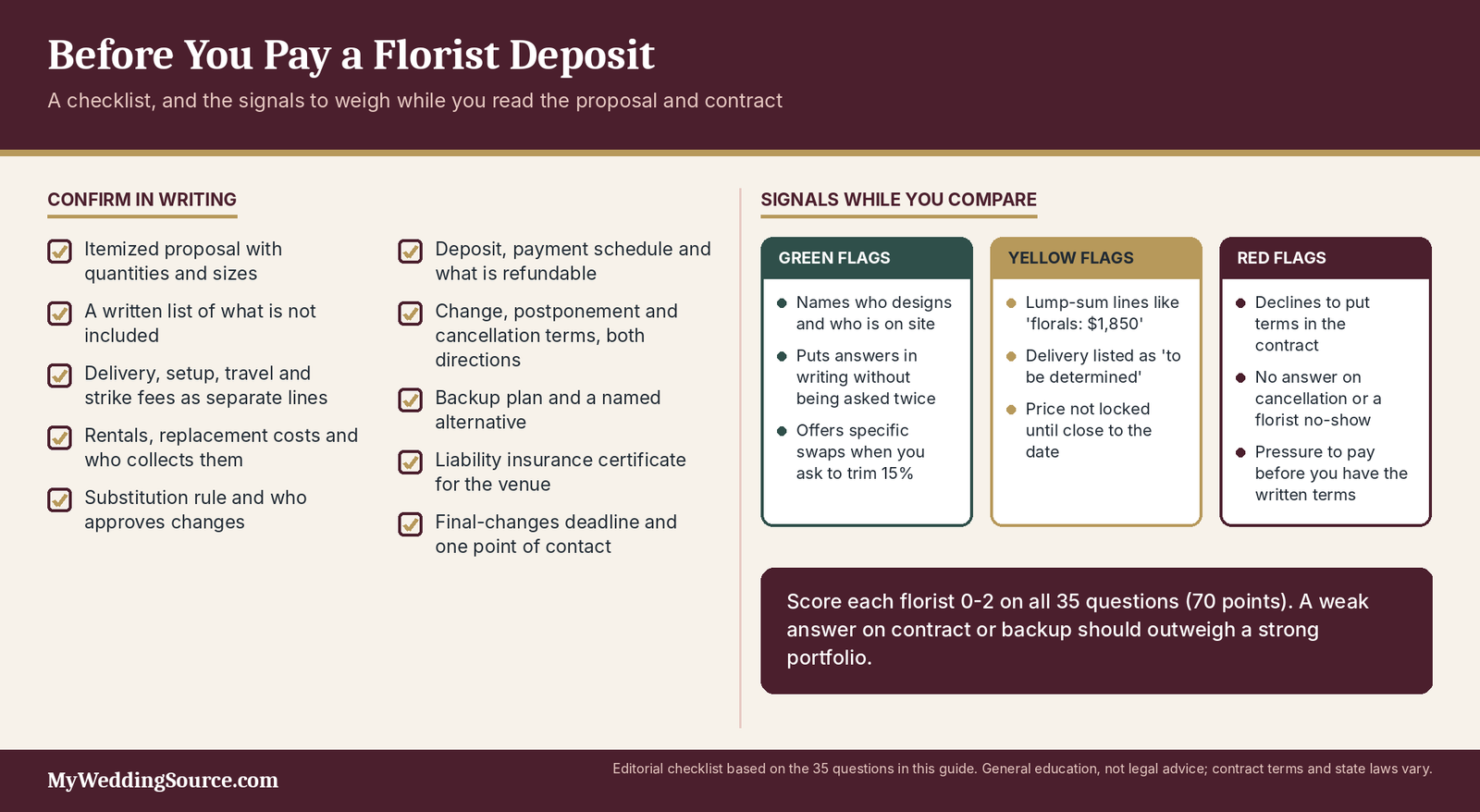
Give a 2 when the florist answers specifically and puts it in writing, such as a proposal line, an email or a contract clause. Give a 1 when the answer is reasonable but verbal, partial or dependent on something to be decided later. Give a 0 when the answer is vague, missing or conflicts with something else you were told. The maximum is 70 points: 12 for fit (questions 1 to 6), 16 for proposals and pricing (7 to 14), 16 for day-of logistics (15 to 22), 12 for the flowers (23 to 28), 10 for contract and backup (29 to 33) and 4 for after the wedding (34 and 35). Score within 24 hours of each consultation, while your notes are fresh, and do not revise a score after you see the price.
Which answers should carry extra weight?
Not every question is equal. A weak answer on substitutions (question 24), what is not included (question 10), deposit and refund terms (question 29), cancellation (question 30), backup (question 31) or insurance (question 32) can cost you money or flexibility, while a weak answer on preservation (question 34) is easy to fix after the fact. Mark a short list of dealbreakers before you start, and treat a 0 on any of them as a reason to ask again in writing. A beautiful portfolio should not outweigh a missing cancellation clause, and a polished proposal should not outweigh an unwillingness to put answers on paper. If your venue or planner has requirements, such as a certificate of insurance, add those to the list.
| # | Ask the florist | Look for |
|---|---|---|
| 1 | Are you available on our date? | Yes or no, quickly |
| 2 | What else is booked that weekend? | Team and capacity match |
| 3 | Who designs and who is on site? | Names and roles |
| 4 | Full galleries of similar weddings? | Scale, season, venue type |
| 5 | Have you worked at our venue? | Load-in and rules knowledge |
| 6 | How do revisions and feedback work? | Process and response time |
| 7 | Package, per piece or percentage? Minimum? | A clear model |
| 8 | Consultation or design fee? | Credit toward booking |
| 9 | Itemized with quantities and sizes? | Lines you can compare |
| 10 | What is not included? | A written exclusions list |
| 11 | Mock-up or sample available? | Cost and credit |
| 12 | When is the price locked? | A date and mechanism |
| 13 | What if counts or palette change? | A cutoff and price effect |
| 14 | What would you trim for 15%? | Specific swaps |
| 15 | Arrival time, setup length, coordination | Written window |
| 16 | Delivery, setup, travel, overtime fees | Separate lines |
| 17 | What do you need from the venue? | Water, power, cooler, access |
| 18 | Which items are rentals? | Replacement costs, pickup |
| 19 | Who moves ceremony flowers? | A named person |
| 20 | Who breaks down? | Time, cost, take-home plan |
| 21 | How will flowers stay fresh? | Season-specific plan |
| 22 | Candle and fire rules? | Venue and local confirmation |
| 23 | What is in season for us? | Alternatives named |
| 24 | Substitution policy? | Approval rule |
| 25 | Where do flowers come from? | Honest sourcing answer |
| 26 | What holds the stems? | Foam or alternatives |
| 27 | Allergen and pet-toxic stems? | Willingness to flag |
| 28 | Flowers near food? | Who sources edible ones |
| 29 | Deposit, schedule, refunds, payment method | In the contract |
| 30 | Change, postponement, cancellation | Both directions |
| 31 | Backup if you are ill? | Named alternative |
| 32 | Liability insurance certificate? | Venue-ready |
| 33 | Point of contact and approvals | A named person, a deadline |
| 34 | Bouquet preservation help? | Timeline and cost |
| 35 | Rentals, leftovers, deposits | Pickup and refund timing |
How do you compare three proposals fairly?
How do you turn three quotes into one comparable total?
Build a simple comparison sheet with the same rows for every florist: the sticker price, delivery and setup, strike, rentals, mock-up or design fee, tax and any service charge. If a florist has not quoted a line, write “unknown” rather than zero, and ask. Use the same headcount and the same list of personal and table flowers for every proposal, or ask each florist to price the same specification so the totals are comparable. Our guide to wedding flowers cost can help you sanity-check any line that looks unusually high or low. The cheapest proposal on the page is sometimes the cheapest overall, and sometimes the one with the most unknowns.
When does a lower score still point to the right florist?
A score is a conversation starter, not a verdict. A small studio may score lower on infrastructure but higher on design attention, and a simple, intimate wedding may not need a backup florist or a five-person strike crew. If a florist scores lower because you have not asked all the questions yet, ask them. If a florist scores lower because they refuse to put terms in writing, that is information too. The table below shows an illustrative comparison in which the lowest-priced studio also had the weakest answers on contract terms.
| Group | Max | Studio A | Studio B | Studio C |
|---|---|---|---|---|
| Fit (Q1 to Q6) | 12 | 11 | 9 | 8 |
| Pricing (Q7 to Q14) | 16 | 12 | 15 | 9 |
| Logistics (Q15 to Q22) | 16 | 13 | 12 | 10 |
| Flowers (Q23 to Q28) | 12 | 10 | 9 | 8 |
| Contract (Q29 to Q33) | 10 | 9 | 8 | 4 |
| After (Q34 and Q35) | 4 | 3 | 2 | 1 |
| Score | 70 | 58 | 55 | 40 |
| Normalized total | n/a | $4,086 | $3,900 | $3,400 |
FAQ: Wedding Florist Questions
These are the questions couples most often ask once the list above is in hand. Answers are general; your florist, venue and contract set the specifics. If a question matters to your decision, ask it in writing.
Booking and budget
When should you start contacting florists?
Start once you have a date and a venue, because florists book by date and the venue shapes the design. The Knot’s florist guide suggests confirming availability and asking how soon you need to finalize the booking, which means the florist, not a general rule, sets your timeline. Popular dates and peak months fill sooner, so couples marrying in spring or fall may want to inquire earlier than those marrying on a winter weekday. We could not verify a single national lead time, so treat any “book X months out” rule as a guess and ask each florist. If you are inside a few months of the wedding, say so in your first email.
Do you need a florist at all?
Not necessarily. The Knot’s study found that 59% of couples included a florist among their vendors, which suggests a sizable group handled flowers another way, through a venue package, a grocery or wholesale purchase, or friends and family. Each route moves work and risk onto someone, so ask who will carry, arrange, water and clean up. If the venue offers in-house flowers, ask the same questions in this guide, since The Knot’s saving tips point to venues with in-house florists or packages as one way to simplify. A florist is a service, not a requirement.
How many proposals should you collect?
Two or three proposals are usually enough to see differences in style, structure and price without creating a spreadsheet nobody finishes. Send each florist the same brief, headcount and list of personal flowers so the quotes are comparable. If one proposal is far from the others, ask why rather than assuming error, because it may be using a different specification. More proposals can make sense in a market with fewer florists or for a complex design, but each additional comparison adds time. Stop collecting when you can state the difference between the leading options in one sentence.
Day-of and aftermath
Can you bring your own vases or rentals?
Often yes, but ask before you buy. Some florists build arrangements in their own containers and charge for the labor to transfer, while others welcome supplied vessels. A florist may also be unwilling to guarantee a design in containers they have not seen. Confirm who delivers your vases, when they arrive and who takes them home. Our wedding linen rental hidden costs guide shows how rental logistics can get complicated across vendors.
What if the florist cancels or cannot deliver?
The answer should already be in the contract, which is why questions 30 and 31 matter. A fair clause names a refund or replacement process, and the backup plan names who steps in. If a florist fails to deliver as agreed and you paid by credit card, the FTC notes that card dispute rights may apply within time limits, so keep your records and act quickly. Beyond that, state law and contract terms decide your options, and a consumer protection office or attorney can advise on a specific case. This is general education, not legal advice.
Is it appropriate to ask for a written answer to every question?
Yes. Asking for answers by email is ordinary, and professional florists are used to it. A written answer protects both sides, because it records what you each understood. Keep the thread in one folder and attach the key emails to your contract. A florist who is happy to confirm in writing is usually telling you something good about how they work.
Your Next Steps
The list is long, but you do not need to use it all at once. Pick the questions that match where you are in the process, ask them in writing and keep the answers in one place. Then use the scorecard to decide, and let the contract do the rest.
This week
Build your one-page brief and shortlist two or three florists
Write down your date, venue, headcount, table count, personal flowers, rain plan and a budget range, then add three inspiration photos with a note on each. Shortlist two or three florists whose work fits your scale and venue. Use questions 1 to 6 to screen availability and fit before you spend time on proposals. Link the brief in a shared folder so your partner or planner sees what you sent.
Send the same inquiry and the same questions to each florist
Paste your brief and questions 7 to 14 into one email and send it to each shortlisted florist. Ask for itemized proposals and for the exclusions list. Note the date you sent it and how fast each replies, because response time is part of the service. If a florist prefers a call, follow up with a short email recapping what you discussed so there is a written record.
Before you pay a deposit
Compare normalized totals and read the contract
Fill in the comparison sheet with sticker price, delivery, setup, strike, rentals, mock-up, tax and any service charge, and score each florist from 0 to 2 on all 35 questions. Read the contract against questions 29 to 33, and look especially at refundability, cancellation in both directions, substitutions, backup and insurance. If a term is unclear, ask for a written clarification before signing. Our guide to wedding vendor contract red flags can help you read the rest.
Confirm logistics, rentals and the final-changes deadline in writing
Before you pay, make sure the document includes the arrival window, who coordinates with the venue, rental responsibility and pickup, the strike plan, the final-changes deadline and your point of contact. Send the delivery window and the florist’s needs to your venue and ask for a written confirmation. Put the deadline for final counts on your calendar. After the deposit, set a reminder for 30 days before the wedding to confirm details, using our November wedding checklist as a model for what to verify.
Sources & methodology
- The Knot, average cost of wedding flowers — $2,800 average, $900/$1,900/$4,800 quartiles, guest-count and regional averages, 10% budget guidance, saving tips, 59% and 70% survey findings (2025 weddings, updated May 2026)
- The Knot, average wedding cost — $34,200 average total cost and 10,474-couple sample
- The Knot Real Weddings Study landing page — study timeframe and participants
- The Knot, wedding florist questions before hiring — florist question themes, fees, cancellation and logistics (April 2024)
- WeddingWire, 10 questions to ask your wedding florist — mock-ups, venue experience, breakdown (2021)
- The Knot, wedding vendor tipping — florist and delivery staff tipping guidance (January 2026)
- The Knot, how to preserve your bouquet — preservation methods, timing and cost ranges (July 2025)
- Poppy Flowers, bouquet preservation guide — vendor estimates for preservation timing and prices
- Poppy Flowers, peonies for weddings — vendor estimates on peony season, off-season price and heat sensitivity
- University of Illinois farmdoc daily — import share of U.S. cut flower value (2023) and source countries (2024)
- USDA Economic Research Service, charts of note — fiscal year 2022 flower and nursery import values
- Mississippi State University Extension, primer for the eco-friendly florist — floral foam and mechanics alternatives
- University of Minnesota Extension, edible flowers — do not eat cut flowers; pesticide caution
- ACAAI, seasonal allergies — pollen sources and seasons
- ASPCA, toxic and non-toxic plants — searchable plant toxicity database for pets
- FTC, disputing credit card charges — Fair Credit Billing Act dispute rights and the 60-day window
- Consumer Reports, should you buy wedding insurance? — cancellation versus liability coverage (2018)
- Fairfax County Fire Marshal, open flame decorative devices — one example of local open-flame rules
- Tax Foundation, 2026 state and local sales tax rates — 7.53% average combined rate as of July 1, 2026
- Pinterest, Wedding Trend Report 2026 — alternative bouquet trend percentages (no comparison window stated)
Methodology: statistics in this article are survey findings from The Knot’s 2026 Real Weddings Study (2025 weddings), published government or university analyses, or vendor-published estimates, and each is labeled where it appears. The 35 questions, the scorecard weights, the 0 to 2 rating scale and the cost-stack example are editorial judgment and illustration, not industry standards or quotes, and the three-studio table uses invented numbers. Contract, insurance, tax and fire-code rules vary by state, county and vendor, and nothing here is legal or financial advice.
Freshness note: recheck the floral cost averages when The Knot publishes its next Real Weddings Study, likely in early 2027, and recheck local sales tax treatment, venue rules and fire codes with the relevant agencies before you sign. Vendor-published prices for preservation and peonies can change within a season, so request current quotes.