

Wedding bouquet weight is the quiet detail that decides whether your hands, wrists, and shoulders feel fine at the end of a long photo session or whether you spend the ceremony wishing someone would take the flowers from you, and it is shaped by stems, water, holder, wrap, and the way you grip far more than by the size you saw on a mood board.
Quick answer
No source we found publishes measured weights for finished bridal bouquets. One flower retailer says a typical fresh bridal bouquet weighs about 1.5 to 3 pounds and that large cascades can exceed 10 pounds, which is a reasonable planning range but not a lab figure. Wedding bouquet weight depends on stem count, flower type, retained water, and construction, so the dependable method is to ask your florist for the stem count and holder type, weigh a mock-up on a kitchen scale, and hold it for several minutes at the height you will carry it. If it tires you in the shop, it will tire you at the venue. Keep the flowers cold until delivery, plan a handoff for the ceremony, and rehearse the hold.
What wedding bouquet weight really means
Most couples never think about wedding bouquet weight until a florist hands over a finished design and the arm drops a little. The word “weight” hides several separate things: what the flowers weigh, what the water and the holder add, and how hard the whole object is to hold. Sorting those apart first makes every later decision easier, because each one has a different fix.
Weight is a property of the whole carried object
A bouquet is not just flowers, and wedding bouquet weight is the sum of everything in your hand. It is a bundle of stems, a handle, a wrap, sometimes a holder with a water source, and whatever decoration was added. The wedding bouquet weight that matters to your arm is the sum of all of it, measured when it is freshly made and wet, not the number a flower catalog lists for a single stem.
Stems, water, holder, and wrap
Stems and blooms carry most of the visible mass, and thick-stemmed flowers add more of it than slender ones. Water adds weight in two ways: stems hold it, and some designs sit in a foam cage or reservoir that holds it. The holder or handle adds its own mass, and tape, ribbon, and pins add a little more. None of these parts is large alone, and that is why wedding bouquet weight surprises people: a finished bouquet can feel heavier than any single component would suggest.
Why published figures are thin
We searched florist, retailer, photographer, and extension sources for measured wedding bouquet weight and found almost no measurements. Most pages talk about stem counts and sizes, and several say plainly that they give no weights. The only pound figure we found came from a retailer of artificial flowers, and it appears to be the retailer’s own estimate. That is why this guide tells you how to measure your own design instead of promising a number.
Weight versus leverage
Two bouquets with the same wedding bouquet weight can feel very different, because the muscles that hold a bouquet work against leverage as well as mass. Where the weight sits relative to your wrist, and how far your forearm is from your body, changes the effort a lot.
Where the load sits relative to your wrist
A simple way to see it is torque, which is weight multiplied by distance from the pivot. As a rough illustration, a two-pound bouquet whose center of mass is six inches from the wrist produces about twelve inch-pounds of twisting load, and the same bouquet held ten inches from the wrist produces about twenty. That is our own simplified arithmetic, not a measurement of any real bouquet, but the direction is reliable: gripping close to the blooms keeps the load near your hand. One retailer’s guide says the same thing in plain words, noting that gripping lower on the stems increases leverage on the wrist.
Why the same pounds feel different
Arms hold a bouquet statically, meaning the muscles stay contracted without moving, and static effort tires faster than the same effort with movement. The figure below shows the lever idea with a short grip and a long grip. Use it as a mental model for wedding bouquet weight when you test a design: if a bouquet feels heavy, ask whether it is the mass, the grip distance, or both.

How much a bridal bouquet usually weighs
Because measured numbers are rare, this section separates what a source actually says from what is arithmetic or guesswork. If you take only one thing from it, take this: wedding bouquet weight is a range, and your own design may sit anywhere in it.
Figures to treat with caution
The most specific figure we found is a retailer’s. It is useful as a starting point for wedding bouquet weight and weak as evidence, and it helps to know exactly how weak.
What one retailer reports
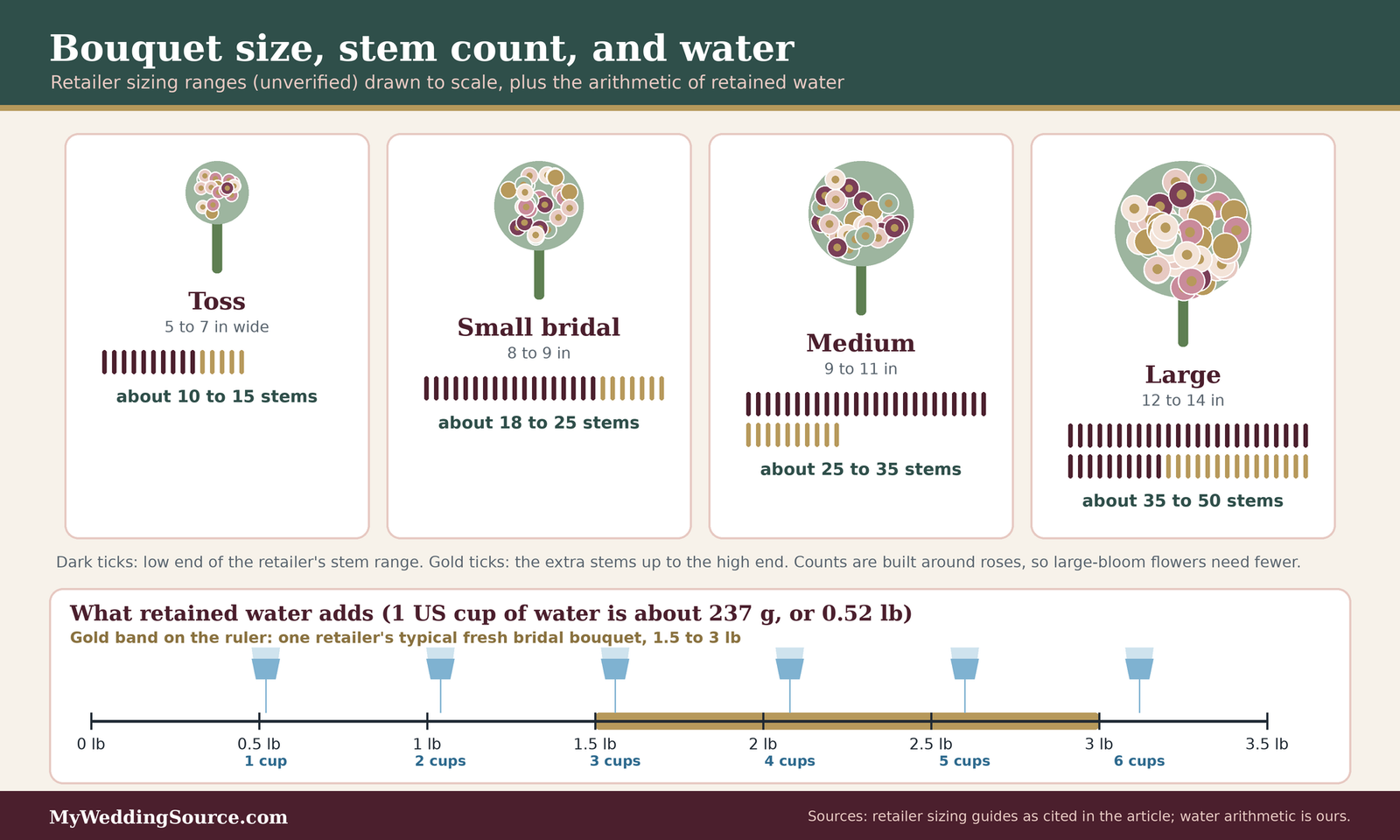
A retailer that sells artificial flowers says a typical fresh bridal bouquet weighs about 1.5 to 3 pounds, and that elaborate cascades can exceed 10 pounds. Converted, 1.5 to 3 pounds is roughly 680 to 1,360 grams, which is our own arithmetic. The same retailer compares holding a fresh bouquet to a sustained bicep curl with a three-pound dumbbell. Because that retailer sells a lighter, waterless alternative, treat the framing with some caution, but the range is plausible enough to plan around.
What no source measures
We found no published measurement of what an individual rose, peony, hydrangea, or dahlia stem weighs in a finished bouquet, and none of a typical foam holder or a wrapped handle. Wholesale weight grading of cut flowers exists as a trade idea, but the one document we found on it was a historical bulletin without usable figures. If a website quotes a precise wedding bouquet weight for a particular design, ask where it came from. Unless the author weighed the bouquet, the number is an estimate.
Stem count and size as a stand-in
Stem count is the easiest proxy for wedding bouquet weight that florists and retailers actually publish. It is imperfect, because a stem of a hydrangea is not a stem of baby’s breath, but it gives you a way to compare designs.
Round bouquets
A retailer’s sizing guide, whose figures we could not verify, lists round bouquets by width and stems: a toss bouquet of about five to seven inches uses roughly ten to fifteen stems, a small bridal bouquet of eight to nine inches roughly eighteen to twenty-five, a medium bouquet of nine to eleven inches roughly twenty-five to thirty-five, and a large one of twelve to fourteen inches roughly thirty-five to fifty. Another retailer’s rose example puts a bridal bouquet at about twenty-four to thirty-six stems. These are retailer figures built mostly around roses, so they overstate the count for large-bloom flowers.
Boho and cascade shapes
The same sizing guide gives looser, wilder bouquets higher counts for their width, about twenty to thirty stems at twelve to fourteen inches and forty-five to sixty or more past eighteen inches. For cascades it lists about twenty-five to thirty stems for a short teardrop, thirty-five to fifty for a fuller one, and more than fifty for a long trailing opera shape. A larger count generally means more wedding bouquet weight and a thicker handle, so these are the designs where you should ask about a holder and test the weight.
Weigh it yourself
You do not need a lab. A kitchen scale and a mock-up from your florist or from a grocery-store bunch of similar flowers will tell you more than any web page. This works for any design, which is why a weigh-in comes ahead of anything else when you settle wedding bouquet weight.
Before the day: build or request a mock-up
Ask your florist whether a small test bouquet is possible at your consultation, or whether they can show you a finished design from another event and tell you its stem count and holder. If you are building your own, make a sample with the same number and type of stems, wrap it, and let it sit in water as it would before the wedding. Weigh it as it will be carried, because a design that is dripping or newly hydrated weighs more than a design that has been out of water for an hour.
Convert grams to ounces and pounds
A kitchen scale often reads in grams. There are about 28.35 grams in an ounce and 453.6 grams in a pound, so a bouquet that reads 900 grams weighs about 32 ounces, or just under two pounds. Write the number down along with the stem count, the holder type, and the date. When you hold the mock-up, do it with your elbows bent near ninety degrees at belly-button height for at least five minutes, and note when your forearms first complain.
What makes a bouquet heavy
Once you know the weight is a sum of parts, you can find the parts that are cheap to change. Some parts of wedding bouquet weight are choices you make with your florist, and others are details you only learn by asking.
Stems and flower types
Flowers do not weigh the same. A thick, woody stem with a large head carries more mass than a thin stem with a small head, and the number of such stems matters more than the total.
Thick-stemmed and large-headed flowers
Roses, garden roses, peonies, hydrangeas, dahlias, and amaryllis tend to have thick stems or large heads, and they fill a bouquet quickly. One retailer’s guide notes that a single jumbo hydrangea stem spans roughly seven to ten inches and can take the place of about eight roses, which also means fewer stems to hold. Another retailer says a bouquet built around larger blooms like hydrangeas might have only four or five main stems plus accents. Fewer, larger stems can mean a lower wedding bouquet weight than many small ones, but the heads can still be heavy, so test the actual flowers.
Light flowers and greenery
Airy flowers, small-headed sprays, and foliage fill space with little mass and are often used to make a bouquet look large without making it heavy. A florist can change the recipe to lower wedding bouquet weight, and one wedding-advice site notes that you can ask a florist to swap some heavier flowers for lighter ones if carrying worries you. Greenery is also sold by weight rather than by stem in some wholesale channels, which is a reminder that foliage adds up when it is used generously.
Water and foam
Water is the hidden part of wedding bouquet weight. Fresh stems hold moisture, and designs that include a foam holder or a reservoir can add more. The amount depends on the design, so the useful step is to ask how the florist hydrates the bouquet and what the holder holds.
What retained water adds
Water weighs about one gram per milliliter, and a US cup is about 237 milliliters, so each cup of water that a design retains adds roughly 0.52 pounds, or about 237 grams. That is plain physics and unit conversion, not a measurement of a bouquet, and we have no sourced figure for how much a given holder or handle retains. The practical lesson is to ask the florist about it and to weigh a damp mock-up. A bouquet that drips onto your dress is also telling you something about its weight.
Foam holders and handling
Cascades, crescents, and nosegays are often built in foam-filled bouquet holders, according to a floral-supply manufacturer. The same source warns that careless handling of a heavy, flower-filled design can weaken the foam’s grip on the stems, and it recommends a spray adhesive designed for foam to keep a finished design together on awkward transport, in weather, or when it gets bumped. That is a manufacturer’s advice about its own products, so ask your florist what they use. The takeaway for wedding bouquet weight is simple: a heavier design needs more careful handling at every step.
Wrap, handle, and extras
The wrap is where comfort is often won or lost. Tape, ribbon, and decoration are small in weight but large in how the bouquet feels in the hand.
Tape and ribbon
Florists typically wrap stems with floral tape and cover the tape with ribbon or fabric, secured with pins. One guide advises stretching the tape as you wrap because unstretched tape unravels, and another says tape starts about four or five inches below the blooms and spirals downward. Another says to push the pins upward into the stems, not downward, so they do not stick out toward your hand. A well-wrapped handle is smoother and thinner at the grip, which matters more for comfort than the few grams of ribbon that count toward wedding bouquet weight.
Charms, brooches, and keepsakes
Decorations such as pearls, brooches, lockets, and fabric from a family dress add personal meaning, and they also add weight and sometimes sharp points. We found no sourced figures for how much these add. If you want one, ask the florist to attach it where it will not press on your grip, and keep pins pointing away from your hand. Our wedding bouquets guide covers styles and symbolism if you are still deciding what belongs in the design.
Stem construction choices and how each one carries
How a bouquet is built decides where its weight sits and how the handle feels. The three families below cover most of what a florist will offer, and each trades looks against comfort in a different way. Ask which one your design is before you judge its wedding bouquet weight.
Hand-tied bouquets
A hand-tied bouquet is gathered stem by stem in the florist’s hand, bound at the handle, and wrapped. It is the most common structure for loose, garden-style designs and for many round bouquets, and its wedding bouquet weight follows its stem count closely.
How a hand-tied handle is built
One retailer’s guide describes starting with a foundation of stiff greenery, such as a few stems of Israeli ruscus or salal, and then placing the focal flowers through it so friction holds them in place. The stems are then bound with stretched floral tape, covered with ribbon, and pinned. In other words, the handle is a bundle of real stems, and its thickness follows the number and thickness of those stems. A designer can trim leaves and keep stems straight and neat so the bouquet is more comfortable to carry, as one wedding-advice site notes.
Comfort trade-offs
The same retailer says a hand-tied bouquet of thirty to fifty thick rose stems makes a wide handle that is tiring to grip. If you have small hands, ask the florist to measure the handle at its thickest point and to taper it toward the grip. A thinner handle can be made by using fewer, larger blooms, by trimming stems shorter, or by wrapping the handle more closely. Hold a mock-up in the hand you favor and check whether your fingers can close around it without strain.
Holder-based and cascading designs
Some bouquets are not built from bare stems at all. They use a bouquet holder, which is a handle with a cage that carries foam or another support, and the flowers are inserted into it.
How holders work
A floral-supply manufacturer describes cascade designs built on a round holder with wire for structure and flowers pinned or wired into the foam. Cascades, crescents, and nosegays are listed as designs that use foam-filled holders. A holder keeps stems supplied with water from the foam, which is why many florists reach for it when the design is large or the flowers are delicate. It also adds the weight of the holder and the water the foam holds, both of which count toward wedding bouquet weight, and the weight sits at the top of the handle, where leverage is greatest.
Cascades and counterweights
One retailer says full cascades need a holder or cage, and that you can counterweight the handle by putting density in the upper bouquet so the trailing section does not pull the bouquet forward. That is a design instruction for florists, and it explains something couples notice: a cascade that is carefully balanced feels lighter than a lopsided one of the same wedding bouquet weight. If you are considering a long trailing design, ask the florist to show you how it is balanced, and hold it for a few minutes with the trail hanging as it will at the venue.
Composite and wired designs
A composite bouquet is assembled from many individual petals or small blooms that are glued or wired onto a backing, so it looks like one very large flower.
What a composite is made of
A floral-supply manufacturer describes a composite bouquet built on an eight- to ten-inch backing disk, with petals glued on in rings and a wired central flower pushed through a small center hole, finished with a handle cut to roughly nine or ten inches. It uses lightweight 26-gauge florist wire, stem tape, or floral adhesive. A design like this can look very full and still have a modest wedding bouquet weight, because it does not rely on a thick bundle of stems, though it takes skilled work and is usually priced accordingly.
Wired blooms and lighter handles
Florists also wire individual blooms through the calyx with fine-gauge wire so they can be placed exactly. One retailer mentions wire around twenty gauge for cascading blooms. Wired designs can have a slim handle, which helps small hands. The trade-off is that wires and tape need to be covered well so nothing scratches skin or snags fabric, and wired blooms may not have the same water uptake as a stem in water. Ask what is wired, how it is covered, and whether anything has a sharp end near the grip.
Comfort: arms, wrists, and shoulders
A bouquet is held at the front of your body for a long time, often with the same arm position, so comfort is a matter of posture as much as wedding bouquet weight. The suggestions below come from wedding publications, photographers, and a federal ergonomics text. They are general information, not medical advice.
Holding posture
The posture most guides recommend is also the one that is easiest on the body, because it keeps the weight close to the torso and the shoulders relaxed.
Height and elbows
For managing wedding bouquet weight, one national wedding publication recommends holding the bouquet at about belly-button height with your arms resting slightly above your hips and your elbows softly bent at around ninety degrees, not locked. A photographer in Pennsylvania suggests waist level, slightly in front, with gently bent elbows. A retailer adds that resting your wrists against your hip bones keeps the flowers at or just below navel height and prevents a “chest clutch,” where nerves pull the bouquet up toward your chin. All three describe the same idea: let your body carry the load, not your shoulders.
Grip
The national publication suggests placing the thumb of your non-dominant hand on the back of the stems and wrapping it around the front, then doing the same with the dominant hand in the opposite direction. If you are walking arm in arm with an escort, it suggests holding the bouquet with one hand and resting that wrist on the hip bone on that side. A retailer’s guidance is to hold the stems as close to the blooms as comfortable, because a lower grip increases leverage on the wrist. In practice, a handle that is short enough to hold near the head of the bouquet gives you that option.
What ergonomics research says about sustained holding
You do not need an ergonomics degree to carry flowers. Still, a federal workplace health text explains why a modest load held for a long time can tire muscles, and the ideas apply here by analogy. Workplace research is not wedding research, so use this for understanding, not as a rule.
Static load
A National Institute for Occupational Safety and Health text on shoulder musculoskeletal disorders says that arm and hand work often requires the shoulder to be stabilized, so a hand-held load can place a static load on shoulder muscles. It describes sustained low-level muscle contraction as a source of fatigue and cites one study that found fatigue at about five percent of maximum voluntary contraction when held for an hour. A bouquet is far from a worksite, but the idea carries over to wedding bouquet weight: a small, steady load adds up over a long photo session.
Shoulder elevation
The same text describes postures with the shoulder flexed or abducted more than about sixty degrees as awkward, and says the pressure on one shoulder tendon is greatest between about sixty and one hundred twenty degrees of arm elevation. A bouquet held near the chest or chin pushes your arms toward those angles. Holding it at the waist keeps your upper arms close to your sides. That is another reason the hip-level hold in wedding advice is more than a style choice. If you have a shoulder, neck, or hand condition, ask a clinician before the wedding.
When to hand it off
Even a modest wedding bouquet weight becomes a nuisance during vows, when you need both hands for the rings, the candle, or your partner’s hands. Plan the handoff the way you plan the processional.
Ceremony handoff
Photographers and retailers both suggest handing the bouquet to your maid or matron of honor at the altar and taking it back afterward for the recessional and exit photos. One retailer says a bouquet of significant weight becomes an obstruction during the vows. Decide who will hold it, where they will stand, and where the bouquet goes if that person also holds their own flowers. A bridesmaid or flower girl can also be assigned. Our wedding processional order guide helps you map who is where.
Practice at the rehearsal
A Pennsylvania photographer suggests practicing the hold at the rehearsal and taking test photos to find the most flattering position, and another source recommends practicing the handoff too. A stand-in bouquet works fine: a weighted bag of similar mass will do if the real flowers are not ready. Walk the aisle, hand it off, take it back, and note where your arm tires. The wedding rehearsal guide lists what else belongs on that run-through.
Photo handling: making the bouquet look good without tiring your arms
Photography is where wedding bouquet weight and comfort meet. The same grip that saves your wrists often photographs well, which makes the advice below easy to follow. The sources here are photographers, a wedding publication, and retailers, and they agree on more than they disagree.
Angles and height
The best position for photos is also the most relaxed. Small adjustments make the flowers look fuller and keep the bouquet from covering the dress.
Tilt the blooms toward the camera
The wedding publication says to tilt the top of the bouquet slightly forward so the blooms face the camera and the stems tuck toward your waist, with your thumbs pointing toward the sky and not toward your stomach. Tilting shows the side of the bouquet, which photographs fuller than the underside. Another photographer says to keep the flowers pointed at the lens and not at the sky or ground. If you can see the bottom knuckle of your thumb, the angle is usually about right.
Find the front before the day
Many bouquets have a front. The wedding publication says to look for a small pin along the stems that marks it, while noting that cascading or asymmetrical designs may differ, and recommends asking your florist in advance. A retailer adds that for asymmetrical designs you should identify the front and keep any corsage-style pins facing your body. Tell your photographer which side is the front, because they will otherwise guess from a single glance.
Portraits and group photos
Couple portraits, family groups, and bridal-party photos are where a heavy bouquet tends to be held awkwardly. Plan a position for each type of shot.
Couple and dress portraits
The wedding publication suggests holding the bouquet at your side near the hip or draping it along your partner’s back or shoulders, with the blooms angled toward the camera, so it is not squashed in an embrace. For portraits focused on the dress, it suggests resting the bouquet lightly on one hip and turning that side slightly toward the camera, or cradling it like a football with the stems inward and the blooms outward. A bouquet resting on the hip carries some of its own weight through your body, so it is both a flattering and a comfortable position.
Bridal party groups
A photographer suggests matching the height of everyone’s bouquets in group shots so the line looks cohesive, with a relaxed grip and slightly bent arms. Bridesmaid bouquets are typically smaller than the bridal bouquet, and one retailer’s sizing guide puts them at roughly fifteen to twenty stems about seven to eight inches wide, with flower girl bouquets at roughly eight to twelve stems, which are retailer figures we could not verify. Ask the florist whether the attendants’ bouquets can match the weight comfort of yours. Our bridesmaid dresses guide is a good companion for planning how it all looks together.
Breaks and rest
A long photo session is the part of the day that tests wedding bouquet weight the hardest. Build rest into the schedule instead of hoping for the best.
Switch hands and take breaks
A photographer’s advice is to switch hands if your arm gets tired during longer sessions, and the wedding publication recommends taking a few breaths and rolling your shoulders back and down before photos, and asking for a break if you need one. Tell your photographer in advance that you want brief pauses between groups. Our wedding photographer shot list can help you sequence portraits so the bouquet is out for the shortest necessary time.
Where the bouquet rests between shots
Between groups, ask the planner or a helper to hold the bouquet or to place it in water, so that you are not carrying it while you wait. The simplest way to keep stems drinking is a vase of clean water kept out of direct sun and away from fruit bowls, since ripening produce gives off ethylene, which can damage flowers. If your florist recommended a specific resting method, follow that instead of improvising. The wedding emergency kit is a good place to add a small towel for drips.
The refrigeration temperature and delivery window checklist
This is the deliverable this guide adds beyond wedding bouquet weight and comfort. Fresh stems that are cold, hydrated, and delivered at a sensible time are easier to work with, and flowers that wilt early are harder to photograph. The temperature figures below come from extension and industry sources, and where two sources differ we show both.

Temperature: what the references say
Two sources are enough to show that there is not one universal number. Industry and extension guidance differ a little, which is normal, so your florist’s cooler matters more than any chart.
The temperature bands
An Oklahoma State University extension fact sheet advises keeping cut flowers at 32 to 35 degrees Fahrenheit, and says that at 41 degrees flowers can deteriorate up to four times faster than at 32. An industry trade article from a floral-care company’s division says flowers should be kept between 34 and 38 degrees Fahrenheit throughout the cold chain, beginning almost immediately after harvest. The ranges overlap near 34 to 35. Ask your florist what temperature their cooler holds, and treat anything much warmer than the low forties as a reason for concern.
Humidity and condensation
Humidity guidance depends on the stage. The extension sheet advises humidity above 90 percent but below 100 percent in storage, because water droplets on petals and foliage invite gray mold. The trade article gives about 75 to 85 percent for the cold chain, and warns that lower humidity causes water loss and bent necks while higher humidity causes condensation. Both warn about condensation, and the extension sheet says to avoid moving flowers from a cool room to a warm one. For a bouquet, that means no long trips in a hot car and no unpacking in a warm room.
The checklist
Use the table as a working checklist with your florist. The timing column is our planning suggestion, not a rule from a source, and your florist’s own process comes first.
| When | What to confirm | Why it matters |
|---|---|---|
| At booking | Who makes the bouquet, where it is stored, and whether a cooler is used | Cold storage is part of normal flower care |
| At the consultation | Stem count, holder type, handle thickness, and a weigh-in of a mock-up | Settles weight before it is made |
| Two to three weeks out | Final recipe, substitutions policy, and the delivery address and contact | Avoids surprises about flowers |
| Three to four days out | Cooler space for your bouquets, if you store them yourself | Cold keeps stems firm |
| Day before | Confirm delivery window, parking, loading access, and the person who will receive the flowers | Delivery fails over access more than over flowers |
| Delivery morning | Check that boxes are cool to the touch, labeled, and upright; count pieces against the order | Catches problems while there is time |
| On arrival | Move flowers straight to a cool, shaded place, away from fruit and heat vents | Avoids temperature swings and ethylene |
| Before photos | Check the bouquet’s weight and handle; wipe drips; practice the hold | Last chance to adjust |
| After photos | Return to water in a cool spot, away from sun | Keeps flowers fresh for the reception |
Reading the checklist
Rows are written for a typical day with a florist who delivers. If you pick up flowers yourself, add the drive time and a cooler bag, and if the bouquet is made by a friend, add the hours it needs to hydrate before it is arranged. A retailer that sells wholesale roses says stems should drink for four to six hours in a cool, dark room before arranging, and that standard roses can take two to three days to open at room temperature, though that is aimed at do-it-yourself buyers.
What the checklist does not cover
It does not replace the florist’s care instructions or your venue’s rules. It also says nothing about floral products you may be told to use. If a florist recommends a particular treatment, ask what it is, who makes it, and what it does, and follow the label.
Delivery window planning
The delivery window is the stretch of time when the flowers are expected to arrive. A good window is early enough for fixes and late enough that the flowers are not sitting around warm.
Setting the window around photos
Work backward from the first time you will hold the bouquet. If portraits begin at a set time, aim for the flowers to arrive with enough margin to inspect them, fix a problem, and let you test the hold, then ask the florist to confirm a specific arrival time instead of a half-day range. A narrow window is easier to plan around. We do not have a sourced figure for the ideal lead time, so we suggest you settle it with the florist, who knows their process, and put the agreed window in writing.
When flowers arrive late or warm
If flowers are late, call the florist and the venue contact at once, and move a photo block earlier or later instead of waiting. If they arrive warm, move them to cool shade and tell the florist immediately; do not wait until you see wilting, since a delay can make a fix harder. Keep photos of the delivery as it arrived, because it helps if you need to discuss a credit. Our wedding flower logistics checklist covers the rest of the flower timeline, and our guide to wedding flower refrigeration goes deeper on cold storage.
Edge cases: when the usual advice does not fit
Most guidance on wedding bouquet weight assumes an average-sized adult carrying a standard bouquet in mild weather. Many real weddings do not fit that pattern, and a few adjustments cover most of the exceptions.
Bodies, abilities, and attendants
A comfortable wedding bouquet weight depends on the person who carries it. Hand size, strength, injuries, and mobility all change what “light enough” means.
Small hands, injuries, and conditions that affect grip
If you have small hands, arthritis, a wrist or shoulder injury, or reduced grip strength, say so at the first consultation and ask what the florist can change. Options a florist may offer include fewer stems, a slimmer handle, a smaller overall size, or a different structure such as a wired design, but we cannot promise what any particular studio will do. This is not medical advice. If a condition affects how you carry things, a clinician or occupational therapist is the right person to ask before the day, and the bouquet is a reasonable thing to bring to that conversation.
Flower girls, bridesmaids, and the people who carry for you
One retailer’s guide lists flower girl bouquets at about eight to twelve stems, but wedding bouquet weight matters more than stem count for a small child, so test the real thing in the child’s hands. Attendants also carry bouquets for long stretches, and the maid of honor may hold both hers and yours during the ceremony, as one retailer points out. If you are asking her to hold two bouquets, consider making hers a smaller design. Our maid of honor duties guide lists what else she may be holding.
Weather, venues, and movement
Wind, heat, rain, and rough ground change how a bouquet behaves. These matter more outdoors, but a warm ballroom can be just as hard on flowers.
Heat, wind, and outdoor ceremonies
The extension sheet warns that moving flowers from cool rooms to warm ones forms condensation, and that cooling flowers quickly improves their quality, so a warm day makes cold handling more important. For heat plans, our summer wedding heat plan covers shade, water, and timing. Wind is a separate problem: a large, loose bouquet catches it, so ask the florist about a tighter shape for an exposed site, and keep the grip lower on the handle so you have more control.
The bouquet toss
A manufacturer’s article describes a bouquet coming apart when it was tossed, and one retailer’s sizing guide lists a small toss bouquet of about ten to fifteen stems. If you plan to toss, ask the florist for a separate, lighter design made for throwing, and keep your own bouquet for the keepsake. This also solves a weight problem: a tossed bouquet should be easy to catch and should not hurt anyone. If you want to preserve your bouquet, our wedding bouquet preservation guide explains your options.
Alternatives and substitutions
If wedding bouquet weight is the main concern, there are options beyond a lighter recipe. Each has trade-offs in look, cost, and meaning.
Silk, paper, and keepsake bouquets
Artificial flowers do not carry retained water, and the retailer that sells them says their bouquets weigh very little for that reason. A wedding-planning site notes that pearl, wood, paper, or clay bouquets can be kept as keepsakes, though some cost more than fresh flowers. Our guide to fresh versus silk wedding flowers compares the two, and many couples combine both, using fresh flowers for the bride and lighter arrangements for others.
Substitution terms and last-minute changes
Fresh flowers can change with the harvest, so many florist contracts allow substitutions. Ask whether a substitution can change the weight or size, who approves it, and how you will be told. If you care about a particular bloom, put the recipe and substitution rules in writing. Our seasonal wedding flowers guide shows what is likely to be available when, and our guide to wedding flower substitution clauses goes through the contract language.
Cost and trade-offs
Wedding bouquet weight has a price tag, mostly because the choices that make a bouquet lighter also change the flowers, the labor, or both. None of the figures below are specific to weight, so treat them as context.
What this actually costs
A national wedding site puts typical bridal bouquet prices at about $100 to $350 (page updated September 2025), and cites one source for a florist-made bridal bouquet at about $150 to $200 against $70 to $80 do-it-yourself, with bridesmaid bouquets at about $55 to $75 from a florist. A wedding blog, Polka Dot Wedding, puts bridal bouquets at roughly $200 to $350. These are published ranges, and they vary by region, season, and flower choice. A lighter design is not automatically cheaper, because skilled wired or composite work costs labor. Ask for a written quote that lists the recipe, the holder, and any mock-up fee.
What drives the price
Wedding bouquet weight is not on the invoice, but the things behind it are. If you can pin down which choice you care about, you can decide where to spend.
Flower choice and season
The wedding site says out-of-season flowers cost more because supply is limited, and that rarer flowers such as peonies or casa blanca lilies cost more than carnations, poms, or baby’s breath. It also says pairing one costly bloom with cheaper filler flowers can lower the total. Fewer large blooms may carry less weight and cost more per stem, while many small stems may cost less and weigh more in the hand. There is no universal rule, so compare the actual quote.
Labor and structure
A holder, a cascade, or a composite takes more design time than a simple hand-tied bundle, and a wired or composite design takes the most. The wedding site notes that buying wholesale and assembling yourself can cost about half of florist prices, but do-it-yourself bouquets shift the work and the risk to you, including hydration time and the handle wrap. Add your own labor and a spare dozen stems to the estimate, and add the cost of any mock-up to your wedding budget calculator.
Foam, plastic, and the environment
Many holders use floral foam, and if you are choosing a structure partly for wedding bouquet weight, it is fair to ask what the holder is made of. Avoid sweeping claims either way, because the research is still developing.
What the research says
An RMIT University study published in December 2019 in the journal Science of the Total Environment tested floral foam on aquatic invertebrates. All of the animals ingested the foam, some showed stress responses, and leachates from the foam were more toxic to aquatic invertebrates than leachates from other plastics tested. The lead researcher said more research is needed. The same university’s release cites a survey of more than 1,200 florists in which about two-thirds used foam, and most of those poured the wastewater down a drain. The United States Environmental Protection Agency says plastics can persist for a very long time and break into microplastics, and that more research is needed on human health effects.
What to ask instead of assuming
We cannot tell you that any holder or alternative is better for the environment, because we found no source that compares them for wedding bouquets. We can suggest questions: ask the florist what the structure is made of, whether they use foam, and what they do with the used material and wastewater. A hand-tied design uses no foam, though it has its own trade-offs in handle thickness and water. Choose based on what you can verify, and be wary of any florist or retailer that promises an eco-friendly bouquet without saying why.
Questions to ask your florist and venue
Good questions turn a vague wish for a comfortable wedding bouquet weight into specifics that can go in a contract. Ask for the answers in writing, and keep them with your order.
Questions worth asking before you sign
- How many stems and which flowers are in my bouquet, and what is the holder or handle made of?
- Can I hold and weigh a mock-up, and is there a fee for one?
- What is the handle thickness at its widest point, and can it be slimmer?
- Is the design balanced to hang or trail evenly, and can you show me how?
- How are the flowers kept cold before delivery, and at what temperature?
- What is the delivery window, who receives the flowers, and what happens if you are late?
- What can be substituted, and will a substitution change weight or size?
- Is there a lighter, separate bouquet for tossing or for attendants?
- What do you do with foam or wastewater after the event?
About the build
These questions confirm what you are actually carrying.
Recipe, holder, and handle
Ask for the stem count and the list of flowers, the type of holder or whether the design is hand-tied, and the handle’s thickness and length. If the answer is “it depends,” ask which parts depend on what. The goal is to get enough detail that you could compare two quotes for the same design.
Weight and balance
Ask whether the florist has ever weighed a similar design, because wedding bouquet weight is rarely written down, and whether they can show you one. If they cannot, bring your own scale to the mock-up appointment, or ask permission to weigh it at the studio. Ask where the weight sits and whether the design can be rebuilt to shift it down toward the handle.
About delivery and the venue
These questions decide whether a good bouquet arrives in good shape.
Cold storage and delivery
Ask how the bouquet is stored and transported, whether the vehicle is cooled, what the florist considers an acceptable arrival temperature, and who will place it in cool storage if you are not there. Ask what the florist will do if the bouquet is delayed. The wedding florist questions guide lists more questions for the full order.
Venue access and rules
Ask the venue about loading access, a place to store flowers out of heat and sun, and any rules about foam, water, or open flames near flowers. Everything in this guide is about handheld flowers. If you also plan anything that hangs or is suspended overhead, do not rely on a florist’s estimate of its weight: only use rigging the venue has approved, and see our guide to wedding hanging floral installations for the questions to put to the venue. Our wedding venue questions guide has the broader list.
A weight-and-comfort plan in three steps
The plan below turns the sections above into a short sequence for settling wedding bouquet weight. It works with any budget and any structure, and it fits into the usual flower timeline in our wedding flowers guide.
Step one: decide what matters before ordering
Decide how long you will carry the bouquet, which photos it appears in, and what you are willing to trade for comfort.
Name your priorities
Write down three things in order: how it should look, how it should feel to carry, and what you will spend. If a design wins on looks but fails on comfort, you now know what to change about wedding bouquet weight. Share the list with your florist so they can suggest alternatives in a design language you understand.
Estimate your carry time
Walk through your schedule and total the minutes the bouquet will be in your hands: aisle, photos, exits, and entrances. If it is under half an hour in short bursts, a heavier design may be fine. If it includes a long portrait session, plan for a lighter design, a prop alternative, or helpers. This is a planning estimate, not a measured limit.
Step two: test a mock-up
A mock-up, even a rough one, is the closest thing to a real answer on wedding bouquet weight.
Weigh and hold
Weigh the mock-up, write down the number, and hold it at belly-button height with your elbows bent for five minutes. Switch hands, then hold it again with your grip closer to the blooms. Note which setup is most comfortable and share it with your florist.
Adjust the recipe
If it feels heavy, change one thing at a time: fewer stems, lighter flowers, a slimmer handle, or a smaller size. Weigh again after each change, so you learn which adjustment made the difference.
Step three: rehearse and protect the flowers
The last step in managing wedding bouquet weight is the one most couples skip, and it is the one that prevents most day-of problems.
Rehearse the hold and handoff
At the rehearsal, carry a stand-in or the real mock-up through the aisle, practice the handoff, and run through the photo poses described above. Give the maid of honor a chance to hold both bouquets.
Protect the bouquet until you need it
Keep the bouquet cold, hydrated, and out of sun until just before the ceremony, and ask a trusted person to handle it between photo sessions. If your florist gave care instructions, follow them. The wedding party coordination checklist is a good place to record who is responsible for what.
FAQ: wedding bouquet weight questions
Weight and size
How much does a wedding bouquet weigh?
No source we found measured finished bouquets. One retailer says a typical fresh bridal bouquet weighs about 1.5 to 3 pounds, and that large cascades can exceed 10 pounds. Your own wedding bouquet weight may fall anywhere in or beyond that range, so ask for the stem count and weigh a mock-up on a kitchen scale.
Is a bigger bouquet always a heavier wedding bouquet?
Not always. Stem count, flower type, and retained water matter as much as width. A few large blooms such as hydrangeas can fill a bouquet with fewer stems than many small flowers, and airy greenery adds volume with little mass. Judge wedding bouquet weight by weighing a mock-up, not by diameter or a photo.
Carrying and comfort
How can I carry a heavy bouquet without tiring my arms?
Hold it near belly-button height with softly bent elbows and your wrists resting near your hips, and grip close to the blooms. Switch hands during long photo sessions, ask for short breaks, and hand the bouquet to your maid of honor during the ceremony. If the design is still tiring, ask the florist for a slimmer handle or fewer stems.
Who holds my bouquet during the ceremony?
Most guides suggest handing it to your maid or matron of honor, who gives it back afterward for the recessional and exit photos. Decide who it will be, where they will stand, and where the flowers go if they are also holding their own. Practice the handoff at the rehearsal so nobody improvises at the altar.
Photos
How should I hold my bouquet for photos?
A national wedding publication suggests holding it at about belly-button height, elbows softly bent near ninety degrees, with the top tilted slightly forward so the blooms face the camera. Rest your wrists lightly against your waist so you notice if it creeps upward, and ask your photographer which angle looks best on your dress.
Will a lighter bouquet look smaller in photos?
Not necessarily. Photographers advise tilting the blooms toward the camera, which shows the fuller side of the design, and a florist can use airy flowers or greenery to add volume with less mass. Ask to see a photo of a similar lighter design at another wedding, and compare how it reads at a distance.
Cold storage and delivery
What temperature should my bouquet be kept at before the wedding?
Sources give slightly different ranges: an Oklahoma State University extension sheet advises 32 to 35 degrees Fahrenheit, and a floral-care trade article says 34 to 38. Avoid warm cars and sunny windows. Ask your florist what their cooler holds and how they transport the flowers, then follow their care instructions.
How far ahead should the bouquet be delivered?
We found no sourced ideal lead time. Choose a window that leaves enough margin before photos to inspect the flowers, fix a problem, and test the hold, and ask the florist to confirm an arrival time in writing instead of a wide range. On arrival, move the flowers straight to a cool, shaded place.
Your next steps
Plan the carry
Get the numbers
Ask your florist for the stem count, holder type, and handle thickness, then weigh a mock-up and write down the wedding bouquet weight. Compare it with the one-and-a-half to three pound range one retailer gives, and decide whether your design is where you want it to be. Our wedding bouquets guide can help you compare styles.
Rehearse the hold
Add a bouquet run-through to your rehearsal: height, grip, handoff, and a test photo. If you will walk with an escort, practice that too. The wedding ceremony guide and wedding processional order guide show where the handoff fits.
Protect the flowers
Confirm cold storage and delivery
Put the delivery window, receiving person, and cold-storage plan in writing so wedding bouquet weight is not your only worry, and use the checklist above on the day. Read our wedding flower logistics checklist for the rest of the flower timeline.
Plan the keepsake
If you want to keep the bouquet, decide before the wedding who will take it after the photos and where it will go. Our wedding bouquet preservation guide explains the options, and our wedding vendor contract guide helps you read the terms.
Sources & methodology
How we built this guide
What we relied on
This guide combines an Oklahoma State University extension fact sheet on cut-flower care, a floral-care trade article on the cold chain, a National Institute for Occupational Safety and Health ergonomics text, an RMIT University news release on floral foam, the United States Environmental Protection Agency’s plastic pollution page, advice from wedding publications and photographers, and published material from floral-supply manufacturers and flower retailers. Where a statement comes from a retailer or manufacturer, we say so, because those sources reflect the seller’s products. The torque example, the pound-and-gram conversions, and the water-weight figure are our own arithmetic and are estimates. We checked these sources on November 12, 2026.
What we did not do
We did not weigh bouquets, test holders, or measure hands, and we found no published measurements of finished bouquets. We do not give medical advice, and nothing here replaces a clinician’s guidance on pain, injury, or grip. We do not endorse any holder, foam, or retailer.
Source list
Government, university, and professional sources
- Oklahoma State University Extension, The Care and Handling of Cut Flowers: https://extension.okstate.edu/fact-sheets/the-care-and-handling-of-cut-flowers.html
- National Institute for Occupational Safety and Health, Musculoskeletal Disorders and Workplace Factors, chapter 3 (archived copy): https://webarchive.library.unt.edu/eot2008/20090116050709/http:/www.cdc.gov/niosh/docs/97-141/ergotxt3.html
- United States Environmental Protection Agency, Impacts of Plastic Pollution: https://www.epa.gov/plastics/impacts-plastic-pollution
- RMIT University, Floral foam adds to microplastic pollution problem: study: https://www.rmit.edu.au/news/all-news/2019/dec/floral-foam-microplastic
- Florists’ Review, Importance of temperature and cold chain remain key to floral care and handling: https://floristsreview.com/?p=6421
Manufacturer, retailer, photographer, and publication sources
- Oasis Floral Products, Bridal bouquets: the magic is in the mechanics: https://www.oasisfloralproducts.com/blogs/ideas/bridal-bouquets-the-magic-is-in-the-mechanics
- Oasis Floral Products, Tears on the big day shouldn’t be for wedding bouquets: https://www.oasisfloralproducts.com/blogs/ideas/tears-on-the-big-day-shouldn-t-be-for-wedding-bouquets
- The Knot, How to hold a bouquet: https://www.theknot.com/content/how-to-hold-bouquet
- Colin Hayden Photo, How to hold your bouquets for perfect wedding photos, the ceremony, and processions: https://colin-hayden.squarespace.com/wedding-blog/2024/7/29/how-to-hold-your-bouquets-for-perfect-wedding-photos-the-ceremony-and-processions
- Equally Wed, How to correctly carry a wedding bouquet: https://equallywed.com/how-to-correctly-carry-a-wedding-bouquet/
- Zola, How much is a bridal bouquet? Average cost and factors: https://www.zola.com/expert-advice/how-much-should-a-bridal-bouquet-cost
- Rinlong Flower, How to hold a heavy red rose bouquet comfortably: https://www.rinlongflower.com/blogs/news/how-to-hold-a-heavy-red-rose-bouquet-comfortably-posture-grip-silk-alternatives
- Rinlong Flower, DIY white wedding bouquets: stem counts, mechanics, and survival guide: https://www.rinlongflower.com/blogs/news/the-brutal-truth-about-diy-white-wedding-bouquets-stem-counts-mechanics-survival-guide
- Ode à la Rose, How many flowers are in a bridal bouquet: https://www.odealarose.com/blog/how-many-flowers-in-bridal-bouquet/
- Junebug Weddings, Everything to know about bridal bouquets: https://junebugweddings.com/wedding-blog/everything-to-know-about-bridal-bouquet/
- Polka Dot Wedding, Bouquets: the lowdown: https://polkadotwedding.com/2019/03/bouquets-the-lowdown/