
Wedding flowers work well when you decide what each arrangement has to do, which pieces are optional, and how your venue will treat them before you choose a single bloom.
Most couples start with pictures: an arch dense with garden roses, a table runner of ranunculus, a bouquet that looks like it was gathered from a meadow that morning. The pictures are useful, but they hide the questions that actually set the price and the risk, such as how many pieces the day needs, which flowers are in season in your month, whether the ceiling has anywhere to hang anything, and who carries a 6-foot arrangement from the ceremony to the reception. A design that looks effortless in a photo is usually the result of dozens of small logistics decisions made months earlier.
This guide is the design-and-planning hub for flowers on MyWeddingSource. It walks through what a wedding needs and what is optional, where the 2026 and 2027 style signals come from, what “seasonal” really means, how florist, wholesale, grocery, and silk or rental routes compare, how consultations and mock-ups work, and how heat, wind, ceilings, load-in, and fire rules change a design. It also covers care, allergies, pets, children, sustainability, and a copy-and-paste brief you can send to florists. Price benchmarks and hidden fees get their own deep dive, so this page keeps cost to ranges and cost drivers.
One note on tone before the details: nothing here assumes a formal wedding, a large budget, or a particular style. A single bouquet and a restaurant table with a few stems is a complete floral plan, and so is a 200-guest ballroom with a hanging installation. The aim is to help you spend on the pieces that matter to you and to avoid the surprises that tend to arrive in the final two weeks.
What pieces do wedding flowers actually include, and which are optional?
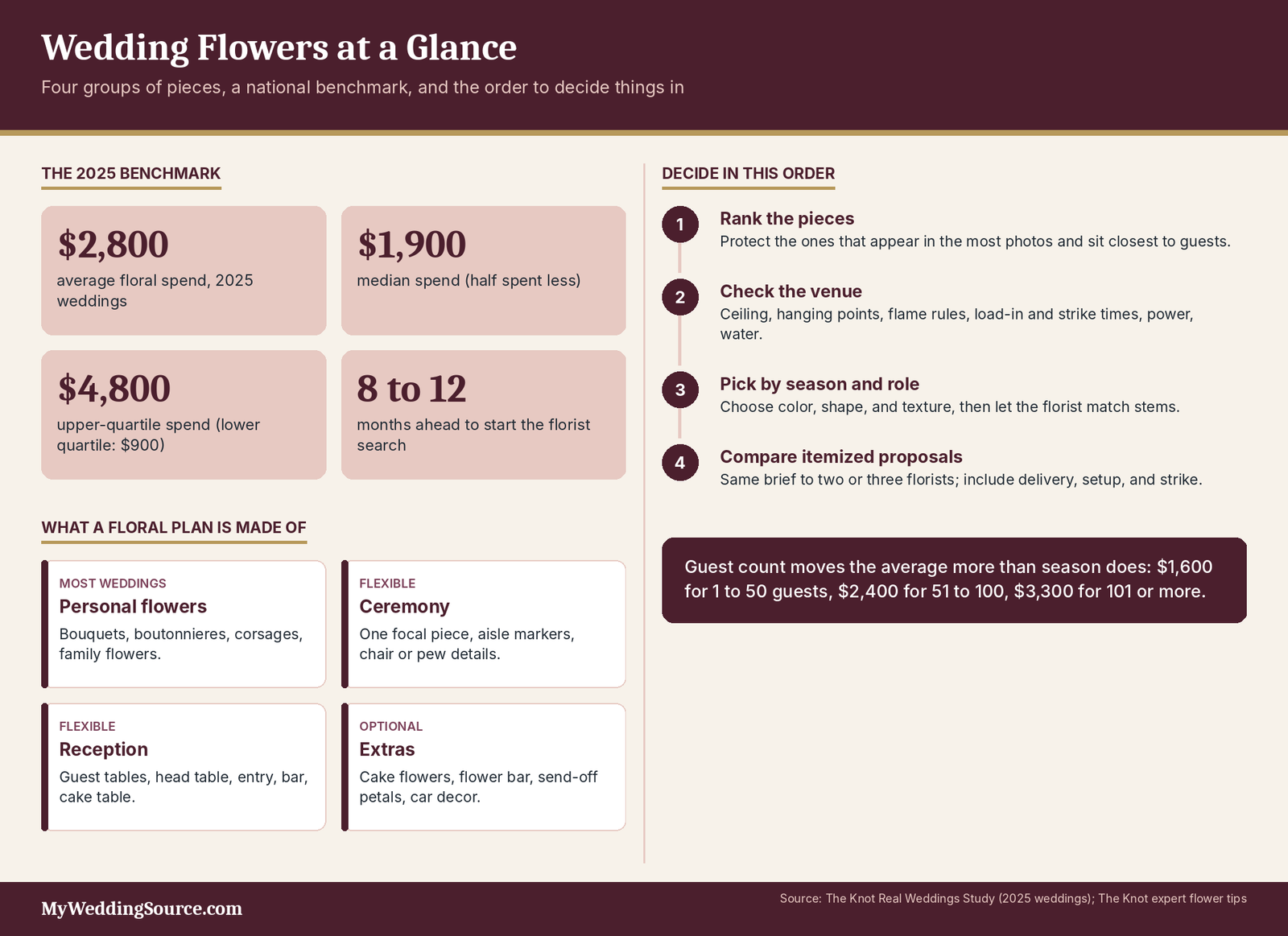
A florist proposal can look like a long list, but nearly every line falls into four groups: flowers that people wear or carry, flowers that frame the ceremony, flowers that dress the reception, and extras that make the day feel more personal. Seeing the groups side by side makes it easier to see what is structural and what is a choice. The table later in this section sorts each piece into “most weddings include,” “common but flexible,” or “optional,” which is editorial judgment rather than a rule, because couples at a courthouse, a backyard, and a hotel ballroom will draw the lines in different places.
The pieces most weddings include
Personal flowers: bouquets, boutonnieres, and corsages
Personal flowers are the pieces people carry or wear, and they are the ones photographers photograph most often. That usually means a bouquet or flower piece for each partner who wants one, boutonnieres or corsages for the people closest to you, and sometimes flowers for the wedding party, parents, grandparents, and readers. A hand-tied bouquet can be as small as a dozen stems or as large as a cascading arrangement, and the stem count is what drives the price, not the label on it. Boutonnieres and corsages look small, but each one is individually wired or taped, which is why a set of ten can cost more than a centerpiece. Because they are portable, personal flowers also take the most heat and handling, so ask your florist how they keep them hydrated between the morning delivery and the first look.
Ceremony flowers: the focal point and the aisle
Ceremony flowers answer one question: where should guests’ eyes land when the ceremony starts? The answer might be an arch, a pair of urns, a floral installation behind the officiant, a single large arrangement on a table, or nothing at all if the venue has a view or a stained-glass window that already does the work. The Knot notes that a simple arbor piece “could start at a few hundred dollars and quickly scale up to several thousand,” which shows how wide the range is for this one item. Aisle markers, pew or chair décor, and petals are the add-ons, and they multiply labor because each one has to be placed and later removed. If the ceremony and cocktail hour share a space, plan for the ceremony flowers to be moved, and name who will move them, a point the November wedding flowers guide develops for cold-season weddings.
Reception flowers: tables, entry, and the head table
Reception flowers are where the guest count shows up on the invoice. Every guest table, the sweetheart or head table, the cocktail tables, the cake table, the welcome sign, and the bar can take an arrangement, so a 150-guest wedding with 18 tables has a very different floral footprint from a 40-guest dinner at one long table. The most flexible approach is to think in layers: a statement piece or two where photos will be taken, simple arrangements on most tables, and candles, greenery, or a small vase of single stems everywhere else. Tall centerpieces use more stems and more mechanics than low ones, but they also leave sightlines open or closed, which affects how a table feels. Whatever you choose, confirm table sizes and linen colors with the rental company, and the linen rental hidden costs guide explains why sizing, delivery windows, and damage terms matter for anything sitting on top of the cloth.
The extras that are easy to cut, combine, or add later
Cake flowers, flower bars, and send-off pieces
Extras are the pieces that make a floral plan feel personal but rarely decide whether the day works. Flowers on the cake need to be coordinated with the baker and, if they touch the cake, need to be a type your baker or florist confirms is appropriate (more on that in the safety section). A flower bar, where guests build their own bouquets or boutonnieres, has shown up in Pinterest’s 2026 wedding trends report with reported search growth of 870%, and it adds an activity but also adds staffing, buckets, clippers, and cleanup. Send-off petals, car décor, and flower-girl baskets are small line items that need their own pickup and cleanup plan. If you’re trimming, these are usually the easiest places to economize because nothing else depends on them.
How to decide what to protect first
A useful way to prioritize is to ask which pieces will appear in the most photographs, which will be closest to guests, and which only exist to fill space. For many couples that ranking comes out as personal flowers first, ceremony focal point second, the head table or a feature moment third, and guest tables last. The same exercise also shows where greenery, candles, or rented plants can carry volume at a lower cost than flowers, a tactic The Knot’s cost guidance recommends when it suggests mixing in more greenery because blooms usually cost more per stem. Write the ranking down in one line each, because it becomes the foundation for your florist brief and gives you a clean answer when the proposal comes in over budget. If you plan to reuse ceremony pieces at the reception, count that reuse in the plan from the start so you don’t pay twice for the same arch.
| Piece | Most weddings include? | What drives the price |
|---|---|---|
| Bouquet for each partner who wants one | Common | Stem count, bloom type, wrapping, hydration method |
| Boutonnieres and corsages | Common | Number of recipients, wiring, delicate blooms |
| Family and wedding party flowers | Flexible | Number of people, matching versus coordinating |
| Ceremony focal arrangement or arch | Flexible | Size, structure, rental of the frame, labor |
| Aisle or chair décor | Optional | Piece count, hanging method, strike time |
| Guest table centerpieces | Flexible | Table count, height, vessel rental |
| Head or sweetheart table design | Flexible | Length of table, garland versus arrangement |
| Cocktail hour, entry, and bar flowers | Optional | Number of locations, delivery and placement |
| Cake flowers, flower bar, send-off | Optional | Staffing, supplies, coordination with other vendors |
What do wedding flowers cost, and what moves the total?
Floral pricing is complicated because a florist is selling flowers, design labor, mechanics, transportation, and time on a single day. That is a feature of the work, not a sign that anyone is padding a quote. This section stays at the level of ranges and drivers so you can recognize a sensible proposal when you see one, and the sibling guide on wedding flowers cost goes deeper on price benchmarks and hidden fees.
What the 2025 data says
The national picture: averages, medians, and quartiles
The Knot’s 2025 Real Weddings Study figures are a good starting point because it reports more than an average. The $2,800 average is pulled upward by high-end installations, so the $1,900 median is a better guide to the middle of the market. The lower quartile of $900 includes courthouse weddings, micro weddings, and couples who do most of the work themselves, and the upper quartile of $4,800 tends to include hanging installations, large guest lists, and full-service design. The Knot also reports that the industry rule of thumb is about 10% of the total budget for flowers, closer to 15% if flowers are a priority, while its expert flower tips page cites about 8% from the Real Weddings Study, so the sources agree that flowers typically take a single-digit-to-low-teens share of the total. Use these figures to sanity-check a proposal, not to set one, because your guest count and venue matter more than the national number.
How guest count, region, and season shift the number
Guest count is the cleanest predictor in the data: couples with 1 to 50 guests spent an average of $1,600, those with 51 to 100 guests spent $2,400, and those with 101 or more spent $3,300. Region also matters, with the Mid-Atlantic at $3,600 and the West at $2,400, which likely reflects a mix of labor costs, sourcing distance, and venue style, though the study does not isolate those causes. Season barely moves the average, ranging from $2,700 for October through December to $2,900 for January through June, so the national data shows little seasonal swing. The study does not explain the pattern, but it is worth remembering when someone tells you that a winter wedding automatically saves on flowers. The savings, if there are any, usually come from design choices rather than the calendar.
| Cut of the data | Group | Average floral spend |
|---|---|---|
| Guest count | 1 to 50 guests | $1,600 |
| Guest count | 51 to 100 guests | $2,400 |
| Guest count | 101 or more guests | $3,300 |
| Region | Mid-Atlantic | $3,600 |
| Region | Northeast | $3,300 |
| Region | Southwest | $3,000 |
| Region | South/Southeast | $2,800 |
| Region | Midwest | $2,500 |
| Region | West | $2,400 |
| Season | January to March, April to June | $2,900 each |
| Season | July to September | $2,800 |
| Season | October to December | $2,700 |
What actually moves a floral quote
Stem choice, stem count, and design labor
The quote starts with how many stems the design needs and what each stem costs, then adds the hours it takes to turn them into finished pieces. Some blooms are inexpensive and sturdy, while others are expensive, fragile, or only available for a short window. Illustrative arithmetic, not a quote: if a low centerpiece uses 15 stems and a tall one uses 40, then ten tables need 150 stems in one design and 400 in the other before anyone counts labor or vessels. That is why florists ask about height and style early, and why reducing the number of tables with arrangements can lower the cost more than reducing the quality of the flowers. Design labor does not shrink in proportion to stem count, because a small, intricate piece such as a boutonniere can take as long to build as a larger, simpler one.
Delivery, setup, strike, and rentals
Delivery, setup, and strike (the removal of décor after the event) are real work, and they often depend on the venue. A ballroom with a loading dock and a four-hour setup window is a different job from a field with a 40-minute drive and a golf-cart shuttle, and a proposal should reflect that. Ask whether arches, urns, stands, candles, and vessels are rented, whether you’re responsible for returning them, and whether a damage or loss fee applies. The Knot’s florist question list also asks whether labor, delivery, and strike are charged separately, and whether there is a minimum floral budget. A line-by-line proposal that lists each of those items is easier to compare than a package price, which is why the consultation section below treats the proposal as a document to read closely.
Which design styles and colors are showing up for 2026 and 2027?
Trend sources agree on a few themes for the next wedding cycle: looser and more textural flowers, fewer but larger statement moments, and richer, moodier palettes. They measure different things, though. Pinterest reports platform search growth, The Knot reports search and vendor-request signals, and the Society of American Florists publishes design direction for professionals, so none of them are Google search volume and none of them say what your local florist can source in your month. Treat the lists below as vocabulary for a conversation with your florist, and for a wider look across categories, the 2027 wedding trends guide sorts what is rising from what is worth using.
Style directions in the current trend sources
Texture-first, meadow, and curated naturalism
A florist-industry trend presentation from SAF’s 2026 Amelia Island event describes “elevated meadows and curated naturalism”: looser, seasonal designs that look as though they grew in place, with woven grasses, foraged branches, mosses, seed pods, and sculptural blooms leading and traditional flowers used as finishing touches. The same presentation names three meadow looks: English Garden Wildflower (soft and romantic), French Meadow Luxe (cream, butter yellow, lavender, and French blue), and Modern Editorial Wildflower (minimal, with airy negative space). It also recommends grouping stems in odd numbers and favoring composition over abundance. For couples, the practical upside is that a texture-driven design can look full without relying on large quantities of expensive focal blooms, although foraged and specialty materials still require sourcing time, which a florist will price as labor.
Sculptural and statement installations
The other direction in the same presentation points the opposite way, toward “fewer but more impactful” pieces: flowers shaped over armatures of chicken wire, copper pipe, or fabricated forms, and a single dramatic installation that replaces dozens of arrangements. The Knot’s 2027 Wedding Trends Report, released September 28, 2026, tells vendors to prepare for requests for “pricing monofloral installations,” and Pinterest’s 2026 report lists flower installations at +195%, a stained glass wedding arch at +750%, and a drapery backdrop at +1,510% in reported search growth. A statement piece concentrates cost into labor, structure, and transport, so the questions shift from “how many stems?” to “how does this get in the room, what holds it up, and who takes it down?” Those questions belong in the venue conversation, and the venue-smart section below walks through them.
Unexpected formats: flower bars, fuzzy-wire bouquets, and bouquet purses
Pinterest’s 2026 report also lists some alternatives to the classic bouquet, including pipe-cleaner bouquets (+1,275%), bouquet purses (+1,015%), beaded flower bouquets (+305%), and “bouquet with no flowers” (+240%). These formats are attractive for practical reasons that have nothing to do with trend: they don’t wilt, they don’t carry pollen, and they can become keepsakes. They aren’t automatically cheaper, because a handmade piece is priced for the maker’s hours, and a bouquet made of non-floral materials can still need a coordinated look with the fresh flowers on tables and arches. A flower bar sits at the other end of the spectrum, because it adds a guest activity but also needs clippers, buckets, water, staff, and a cleanup plan. If you like one of these ideas, mix it with a few fresh pieces rather than treating it as an all-or-nothing choice.
Color and palette
Palettes in the 2026 and 2027 sources
The color signals are consistent in direction even when the vocabulary differs. Pinterest reports growth for plum and olive (+1,380%), muted terracotta (+545%), fig (+515%), merlot (+370%), and dusty olive (+270%), which together describe a deeper, earthier range than the pastels of a few years ago. SAF’s 2027 palette suggestions include ivory and champagne with deep burgundy, cream with emerald green, warm neutrals with plum, mocha and terracotta with jewel tones, and burgundy with olive. The Knot’s 2027 report adds a cool-toned counterpoint, with searches for silver flatware, platinum jewelry, and cool-toned décor up 133% year over year, and it says the days of a simple color palette are over. None of that means your wedding needs to be dark or metallic; it means a palette with two or three anchors and a neutral gives a florist more to work with than a single word like “blush.”
How to test a palette against your actual room
A palette that looks right on a screen can read differently in a ballroom with warm uplighting, a tent with white fabric walls, or a barn in late afternoon sun. Start by asking your florist for swatches or photos of the actual stems they’d use, and compare them against your linen and napkin colors, a step where the linen rental guide recommends requesting a physical swatch and checking it under reception lighting. Lighting changes color: the winter wedding decor and lighting guide points out that candlelight sits around 1800 to 2000K and recommends keeping other sources in the warm 2400K to 3000K range, which can push blush toward peach and burgundy toward brown. If the reception is in the evening, plan the palette for the lighting at 8 p.m., not the lighting at the consultation at noon. A last practical test is to choose a palette you would still enjoy in your photos in ten years, with trend colors as accents that a florist can swap without redesigning everything.
What does “seasonal” really mean, and how do imported flowers fit in?
Seasonality is the most overused word in floral marketing and the least precise. A flower can be in season on a farm 20 miles away, available all year from a greenhouse, flown in from South America, or stored in a cooler for months, and each of those can truthfully be sold as “available now.” Understanding which kind of seasonal your florist means lets you ask better questions, and it keeps you from expecting a farm-fresh, field-grown look from a supply chain that is not built for it. This section covers where U.S. wedding flowers actually come from and how to read seasonality without a calendar that pretends every region behaves the same.
Where wedding flowers actually come from
Local, domestic, greenhouse, and imported supply
Florists typically draw from four kinds of supply, and they overlap more than the labels suggest. Local farms and farmer-florists provide field-grown stems in their natural windows; regional and domestic wholesalers redistribute flowers from several growers; protected-growing operations such as greenhouses extend seasons; and importers bring in flowers from warm-climate producers, particularly for items such as roses that don’t thrive in most U.S. winters. None of these is the right answer by definition. The table below summarizes what each brings and what to watch, and the same logic applies to substitutions: if a field-grown variety falls out of season, a florist’s job is to match the look from another source.
| Supply type | What it usually means | Watch-out |
|---|---|---|
| Local or farm-grown | Field-grown stems cut near the wedding date | Short windows, weather risk, limited quantities |
| Domestic wholesale | Regional growers and distributors | Variety depends on the week and the region |
| Greenhouse or protected | Extended-season growing in U.S. facilities | Cost reflects energy and growing labor |
| Imported | Flowers flown in, mainly from Latin America | Longer supply chain, handling and hydration matter |
How much of the U.S. supply is imported
The scale of imports surprises many couples. An analysis from the University of Illinois’s farmdoc daily reports that nearly 80% of the value of cut flowers in the U.S. market comes from imports, based on 2023 data, with 2024 imports reaching a record $1.98 billion, more than 60% of that from Colombia and about 25% from Ecuador. The U.S. Department of Agriculture’s Economic Research Service, looking at fiscal year 2022, similarly shows fresh-cut roses alone at more than $800 million in imports. That is a measure of value, not stems or bouquets, so it does not tell you what fraction of your own florist’s inventory is imported, but it does explain why a florist can offer roses in January and why “all local” is an unusual, specific promise. If local sourcing matters to you, ask a florist directly which pieces they can source from nearby farms in your month and which they can’t.
Reading seasonality without a one-size chart
Why a national bloom calendar can mislead
Bloom times depend on region, elevation, and weather, so a chart that says a flower is “in season in June” can be wrong for a Minnesota farm and right for a Georgia one. The UC Master Gardeners of Santa Clara County’s cut-flower planting chart, for example, tags zinnias and sunflowers as summer and fall bloomers and sweet peas as winter and spring for that county’s mild zones, a pattern that would shift in colder places. Kansas State University’s Extension guide to specialty cut flowers, published in 1992 and therefore dated on production methods, describes peony as having a “short harvest season” and a 3 to 5 year wait from planting to full production, which helps explain why peonies are expensive and tied to a narrow window. Our November flowers guide makes the related point that field dahlias may end after frost in colder regions. The most reliable source on what is in bloom is a local florist or farm checking supply about two to three weeks before your date.
Smart substitutions that keep the look
A substitution works when it matches the role a flower plays, which is usually color, shape, size, and texture, rather than its name. The Knot’s expert tips suggest garden roses as a stand-in for peonies and hydrangeas for sweet peas, and also suggest adding pricier “splurge” flowers as accents rather than the whole design. Think of each bouquet as having a focal flower, a secondary bloom, a filler, a line element, and greenery; if one of them becomes unavailable, the florist replaces that element, and the design holds. Ask your florist to tell you the likely substitutes at the proposal stage, not the week of the wedding, and to describe them by color temperature and shape. If a particular flower has personal meaning, say so; a florist can protect that one stem and let the supporting cast flex.
Florist, wholesale and DIY, grocery, or silk and rental: which route fits?
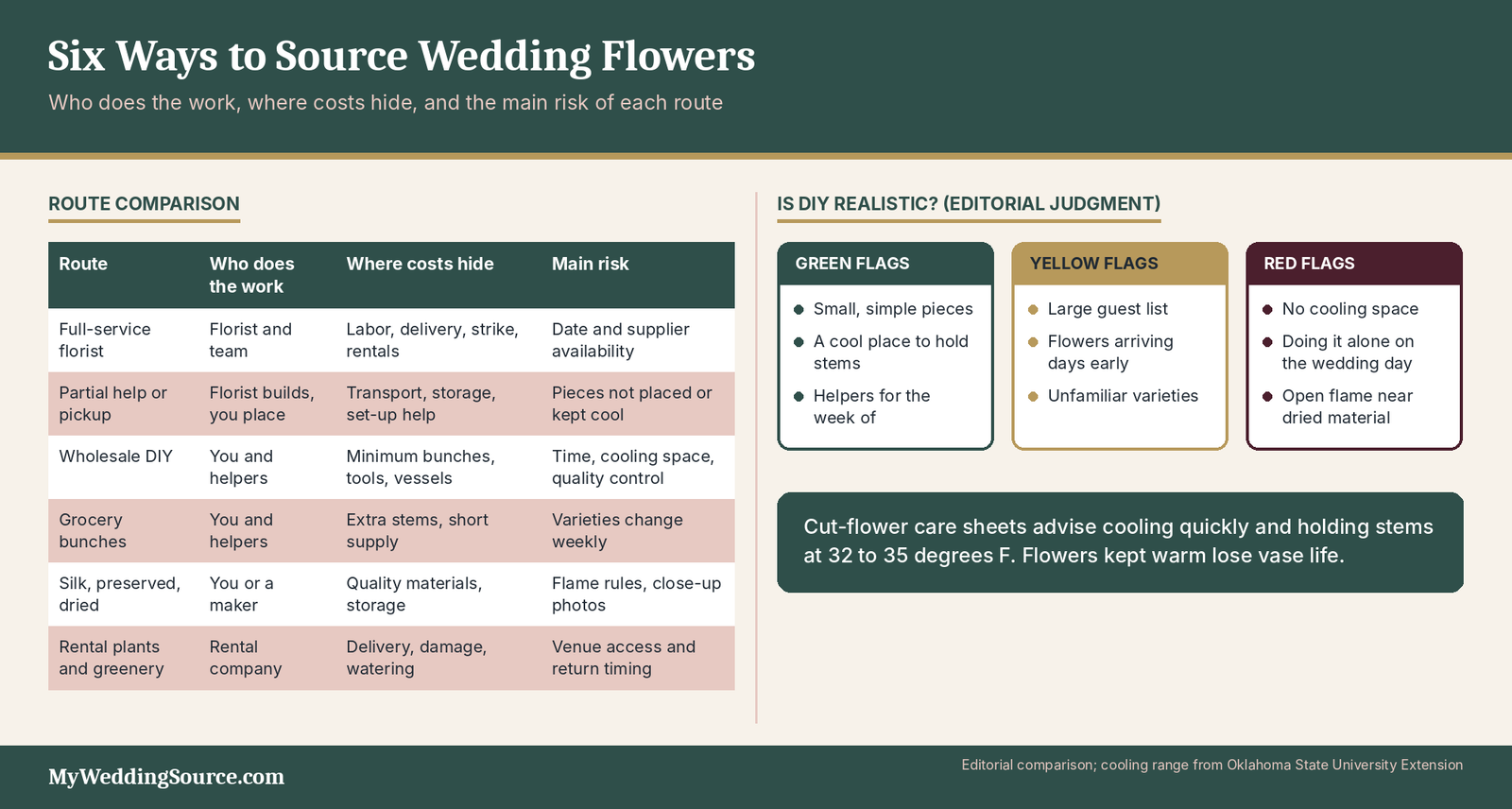
Every route trades money, time, and risk differently. A professional florist takes on the sourcing, design, labor, and logistics, which is what you are paying for. Doing it yourself shifts the labor and the risk to you and your helpers, and a hybrid approach splits the work. None of these is a lesser choice; the right one depends on how many pieces you need, how much cooler space and help you have, and how you feel about doing flower work in the week of your own wedding.
Hiring a professional
Full-service florist: what you are paying for
A full-service florist handles consultation, sourcing, conditioning, design, delivery, installation, and breakdown, and carries the risk if a shipment arrives damaged or a variety is unavailable. That is a large amount of work compressed into a few days, and it explains why labor often accounts for a significant share of a quote. The upside is predictability: the florist has a cooler, a team, a van, and relationships with growers, and has probably worked in your venue or one like it. The trade-off is cost and lead time, since The Knot’s expert tips advise starting the search 8 to 12 months ahead and note that May through October is peak season, when florists’ calendars fill quickly. If your date is in peak season and you want a specific florist, start the search before you finalize everything else.
Partial help: flower-only, pickup, farmer-florists, and in-house venue florists
Between full service and DIY are several middle options. Some florists offer a pickup or “flower-only” arrangement, where they prepare the pieces and you or a helper transport and place them. Farmer-florists grow their own stems and, as Iowa State University Extension notes, many also design for weddings and events. Some venues have an in-house or preferred florist, and The Knot notes that an all-inclusive venue with in-house florists could cover some flowers and reduce the need for a separate vendor. Each version changes who is responsible for delivery, setup, and strike, so confirm in writing who does what.
Doing part or all of it yourself
Wholesale and grocery flowers: the labor and cooling math
DIY can save money on the stems, but the savings depend on whether you have the time, a helper, and a cold place to store flowers. Oklahoma State University Extension’s care sheet advises cooling flowers quickly and holding them at 32 to 35°F, trimming stems under water, using clean containers, and adding floral preservative, which means flowers delivered to a warm garage for three days will not behave like flowers kept cool. Wholesale buying often means buying by the bunch or box, so a recipe that needs five stems of one variety may require a full bunch, and unused stems are a cost. Grocery-store bunches are convenient for small, simple pieces, but varieties and quantities change week to week, so plan around what is available and expect to buy extra. Add up buckets, clippers, vessels, floral tape, wire, ribbon, and the hours your helpers will spend, because the true savings come after those costs, and the week before a wedding is already busy.
Silk, preserved, dried, and rental plants
Silk, preserved, and dried materials trade freshness for predictability. They don’t need hydration, can be assembled weeks ahead, and can be reused or kept, and The Knot notes that dried flowers are often cheaper than fresh ones. They also behave differently around heat: the winter decor guide notes that preserved and dried greenery is more flammable than fresh and should be kept away from candles. Many venues and fire officials require decorative materials to meet flame-propagation standards; a City of Las Vegas place-of-assembly sheet, for example, says decorative materials must be tested to NFPA 701 or be noncombustible, which is a local rule but illustrates the point. Rental plants such as potted olive trees, ferns, or moss walls can add volume and return to the rental company, so confirm delivery, watering, and pickup terms the way you would with linens.
| Route | Who does the work | Where costs hide | Main risk |
|---|---|---|---|
| Full-service florist | Florist and team | Labor, delivery, strike, rentals | Date and supplier availability |
| Partial help or pickup | Florist builds, you place | Transport, storage, set-up help | Pieces not placed or kept cool |
| Wholesale DIY | You and helpers | Minimum bunches, tools, vessels | Time, cooling space, quality control |
| Grocery bunches | You and helpers | Extra stems, short supply | Varieties change weekly |
| Silk, preserved, dried | You or a maker | Quality materials, storage | Flame rules, look under close photos |
| Rental plants and greenery | Rental company | Delivery, damage, watering | Venue access and return timing |
How do florist consultations, proposals, and mock-ups work?
A florist consultation is a working conversation, not a sales pitch, and the more specific you are going in, the more useful the proposal that comes out of it. Most florists meet in person or by video, look at your inspiration and venue, ask about guest count and budget, and then send a written proposal. What happens after that varies by studio, so this section focuses on the questions that tend to matter and the contract terms worth reading with care. Terms and state laws vary, so treat the contract section as general education and not legal advice.
Before and during the consultation
When to start and what to bring
The Knot’s expert tips advise starting the florist search 8 to 12 months before the wedding and note that May through October is peak season, so a date in those months may need earlier action. Before the meeting, decide on a number you’re comfortable spending and ask the florist what they can create within it, which is far more productive than asking for a quote on an open-ended wish list. Bring photos of flowers you like and, just as useful, photos of what you don’t like, plus swatches of your attire or bridesmaid fabric, the venue name, the guest count, and your ranked list of pieces from earlier in this guide. The Knot also recommends being specific and visual about color, and describing it in terms like “dusty rose with a hint of mauve” rather than just “pink.”
Questions that reveal how a florist works
Beyond price, a few questions show how a florist will behave on the day. The Knot’s list of questions to ask a wedding florist includes asking to see photos from real weddings, not only styled shoots, asking what the rates do not include, and asking how many other events the studio is serving that weekend. It also asks about team size and setup time, who will communicate with the venue, whether the florist works with planners, the travel policy, and whether guests can take table arrangements home. These questions are not about catching anyone out; most florists welcome them because they show a couple who understands the work. If you have a planner, agree early on who talks to the venue and who talks to the florist, so that load-in details don’t fall between chairs.
Proposals, mock-ups, and contracts
Reading a proposal line by line
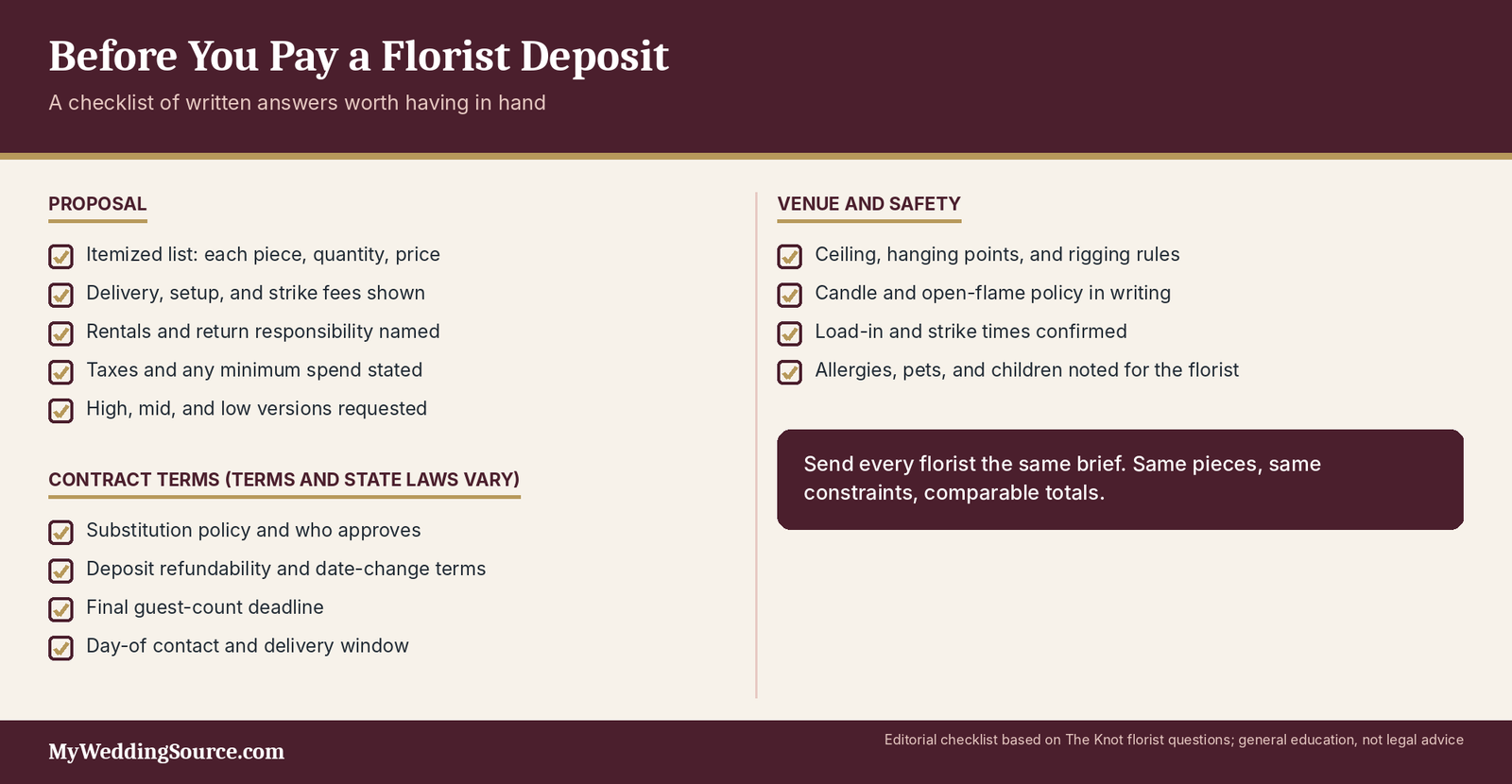
The most useful proposal is one that lists each piece, its quantity, its price, and every service charge. The Knot advises asking for itemized quotes that show each item, subtotals, taxes, and any delivery, setup, or breakdown fees, and also suggests requesting a “high” best-case proposal, a “low” bare-minimum version, and a mid-range option if needed. A three-tier approach turns budget conversations into a menu of choices, not a negotiation about quality. Compare proposals apples-to-apples by asking each florist to price the same list of pieces, because one florist’s “ceremony package” may include aisle pieces that another prices separately. Keep an eye on the language around substitutions, delivery windows, rentals, and what counts as a “final” order.
| Contract term | Why it matters | What to ask |
|---|---|---|
| Substitutions | Flowers can become unavailable | What is the substitution policy, and who approves changes? |
| Deposit and retainer | Sets what you lose if plans change | Is any portion refundable, and when? |
| Cancellation or date change | Terms differ by studio | What happens if the date or venue changes? |
| Minimum spend | Some studios set floors | Is there a minimum, and does it include fees? |
| Rentals | Arches and vessels are returned | Who collects them, and what is the damage fee? |
| Delivery and strike | Timing depends on venue access | What are the windows, and are they in writing? |
| Final count deadline | Locks quantities and pricing | When is the last day to change the order? |
Mock-ups, tastings, and the final walk-through
A mock-up is a sample of a design, and florists handle it differently. The Knot’s florist question list suggests asking whether a mock-up is included in the pricing proposal, and the answer will tell you how that studio handles samples. Some studios may build a sample bouquet or centerpiece, others may show photos of a similar design, and policies on fees and credits differ, so ask before you assume. Whichever format you choose, check the sample under the kind of light your reception will have, and take photos from guest height and from the photographer’s angle. Closer to the wedding, ask for a final walk-through of the details: delivery window, who receives the flowers at the venue, who has the florist’s day-of phone number, and what happens to flowers and rentals when the event ends.
How do heat, wind, ceilings, and venue rules change a floral design?
A floral design that works in a studio can fail at a venue for reasons that have nothing to do with taste: a 9-foot ceiling, no hanging points, a ceremony lawn in direct afternoon sun, or a venue that bans open flame. Venue-smart planning means asking about the room before the design is final and letting the venue’s constraints shape what you order. The wedding venues guide covers the broader list of venue questions and red flags, and this section focuses on the ones that change flowers. A site visit with your florist, even a 20-minute one, often prevents more problems than any later email.
Outdoor and weather-exposed spaces
Heat and sun
Heat is the most direct threat to fresh flowers. Oklahoma State University Extension’s care sheet notes that even small increases in temperature can noticeably shorten vase life, and recommends keeping flowers cool. That means a ceremony in direct sun at 3 p.m. is harder on a bouquet than one in shade at 5 p.m., and delicate blooms may wilt before the processional ends. Ask your florist which flowers hold up best in heat in your region, how they’ll keep personal flowers cool before the ceremony, and whether installations can be set up late so they spend less time in sun. Shade, a cold-water bucket in the shade for the wedding party, and a quick placement plan for the reception flowers can matter as much as the choice of stems.
Wind, tents, and structures
Wind turns a pretty setup into a safety question. A freestanding arch, tall urns, or lightweight vessels can tip, so ask about weights, anchoring, and what the florist and rental company will do if gusts are forecast. If the event uses a tent, local rules may apply: the Town of Westport, Connecticut, for example, requires hosts of certain tents to submit a safety plan to its Fire Marshal’s Office as part of a building permit, and says the host is responsible for the well-being of attendees. Permit rules differ by town and by tent size, so ask your venue and tent company who handles permits. Build a plan B for placement, such as moving ceremony flowers to a sheltered spot or swapping a tall arrangement for low ones if the forecast turns. This guide does not cite wind-speed thresholds because they differ by tent type and manufacturer, so ask the tent company for theirs in writing.
Indoor rooms, rules, and logistics
Ceilings, hanging points, and existing greenery
Indoor rooms bring their own constraints. Ceiling height decides whether tall centerpieces, hanging installations, or suspended greenery will work, and many ceilings have no approved attachment points. The winter decor guide notes that overhead elements need approved attachment points and weight ratings, so ask the venue what can be hung from where and who is allowed to do the rigging. Also ask what the venue already provides, such as plants, chandeliers, candle sconces, fireplace mantels, or permanent greenery, because those fixtures can handle some of the volume for you and may clash with a design you’d planned. Photograph the space from several angles, including the ceiling and the windows, and share those pictures with your florist before the proposal is final.
Load-in, strike, power, and water
Logistics are where beautiful plans quietly fall apart. Ask when the florist can enter, how many hours they have, whether they can bring a vehicle to the door, whether there’s an elevator, where flowers can be stored out of the heat, and whether there is a nearby water source. The winter decor guide recommends confirming load-in and strike times in writing, and it also notes that a standard 20-amp circuit provides roughly 1,900 usable watts, which matters if lighting, heaters, or sound share the same power as any floral lighting. Strike, the removal of flowers and rentals at the end of the night, needs a plan too, especially if the venue has another event the next morning. Floral installations may require additional labor, structural support, delivery access, cleanup, and venue approval, so these items should appear in the proposal.
Fire-code basics and open flame
Fire rules are local, so the safest approach is to ask your venue and, for unusual setups, the local fire marshal. As examples of what such rules can say, a City of Las Vegas sheet for places of assembly says an operational permit is required to use open flames or candles in assembly areas and that decorative materials must meet NFPA 701 or be noncombustible, and a Seattle Fire Department holiday-decoration memo states that candles and open flames shall not be used on or near decorative vegetation and that decorations cannot block sprinklers, extinguishers, or fire alarm pull stations. Neither document is a national rule, and neither addresses weddings specifically, so use them as prompts for questions, not as authority for your venue. Practical questions include whether candles are allowed, whether they must be enclosed, whether greenery must be flame-retardant, and whether any installation needs review. Get the answers in writing and share them with every vendor who touches décor.
| Venue condition | What can go wrong | Design response |
|---|---|---|
| Sunny afternoon ceremony | Wilting, stressed bouquets | Shade, late setup, sturdier blooms |
| Windy lawn | Arches and vessels tip over | Weighted bases, low arrangements, plan B |
| Tent reception | Heat, sidewalls, permit rules | Confirm permits, cooling, anchor points |
| Low ceiling | Tall pieces crowd sightlines | Low or mixed-height centerpieces |
| No approved hanging points | Rigging not allowed | Freestanding or floor-based installations |
| Tight load-in window | Late or rushed setup | Simplify design, add helpers, sequence |
| Open flame restrictions | Candles banned or limited | Battery candles, enclosed votives |
How long do wedding flowers last, and how should they be cared for?
Fresh flowers are perishable products, and the timeline from cooler to bouquet to photo to reception is shorter than most people expect. Good care starts well before the wedding day, usually with the florist, and continues through the evening and the cleanup. If you’re ordering from a florist, most of this is their job; if you’re doing any DIY, it becomes yours. Either way, knowing the basics makes you a better partner to the florist.
Before and during the wedding
Hydration, cool storage, and water quality
Oklahoma State University Extension’s care and handling sheet for cut flowers lays out the fundamentals. Stems should be cut with sharp tools, with an inch removed under water, and placed in clean containers with floral preservative, with water that is not chemically softened. The sheet also recommends cooling flowers promptly and holding them between 32 and 35°F. For couples, the practical takeaway is to ask a florist where flowers are stored in the days before the event, how bouquets are hydrated until they’re handed over, and whether the venue has any cold storage if flowers arrive early. If flowers are delivered the day before to a room that is not cool, ask about moving them.
Heat, fruit, and the delivery timeline
The same Oklahoma State sheet notes that ripening fruit gives off ethylene gas, which can damage flowers, so keep bouquets and arrangements away from fruit platters, cocktail garnish stations, and catering prep areas. Some flowers have especially short lives: the Society of American Florists describes dahlias’ short vase life as a known challenge and cites researcher John Dole’s tips on harvest timing, recutting, feeding, and temperature-controlled storage in an SAF article on making dahlias last longer. A tighter delivery timeline, such as morning-of delivery for personal flowers, is often the strongest protection, and a florist can tell you which flowers need it. If your day includes a long gap between the ceremony and reception, discuss where the bouquets will wait, in water if possible, and what that costs in extra vessels or helpers.
After the wedding
Moving flowers from ceremony to reception, and passing them on
Ceremony flowers often get a second life, but only if someone is assigned to move them. The Knot recommends repurposing ceremony arrangements as reception decor and suggests turning bridesmaid bouquets into centerpieces or giving flowers to guests as favors. Each move needs a person, a vehicle or cart, a route, a time, and a destination, which is a lot to ask of a bridesmaid in a dress. If you want to donate flowers to a hospital, nursing home, or similar organization, call first to confirm what they accept and when, because policies vary, and ask your florist or planner to arrange pickup. A rental company may need to collect arches and vessels, so mark what is rented versus owned so nothing is given away by mistake.
Keepsakes: drying, pressing, and preservation
Keepsake options range from do-it-yourself to professional services. The Knot’s sustainable flowers guidance suggests hanging flowers upside down in a dark, dry place or pressing them to keep them longer, and its florist question list suggests asking whether the florist offers bouquet preservation and what it costs. If you want to dry the bouquet yourself, pass it to someone as soon as photos are done and ask them to start the same night, since fresh flowers deteriorate quickly. Not every bloom dries well, and color usually shifts, so treat a dried bouquet as a memento, not a replica. If you’d rather keep a lasting version, a non-floral bouquet such as one made of fabric, beads, or wire can serve as the keepsake while fresh flowers are used on the day.
Are wedding flowers safe? Allergies, pets, children, and edible flowers
Flowers are plants, and plants can affect people and animals in ways that are easy to overlook in the excitement of choosing colors. This section is general education drawn from health, veterinary, and extension sources; it is not medical or veterinary advice, and it can’t tell you what is safe for a specific person or animal. If someone in your wedding has a known allergy, asthma, or a pet or child with special risks, the right people to ask are a health professional, a veterinarian, or poison control, and the right time to ask is before the order is final.
Allergies and sensitivities
Pollen, fragrance, and what couples can do
Hay fever is an allergic response to airborne substances, and Mayo Clinic explains that the common symptoms include a runny nose, sneezing, itchy and watery eyes, and congestion, with tree pollen common in early spring, grass pollen in late spring and summer, and ragweed in fall. The American Academy of Allergy, Asthma & Immunology describes hay fever as caused by pollen carried in the air, tracked as trees, grasses, and weeds. A University of Arizona Extension bulletin (updated 2007, written for one Arizona county) says insect-pollinated plants, which tend to be showy or fragrant, are generally non-allergenic, while wind-pollinated plants produce far more pollen. That is a general botany point, and it doesn’t mean any particular flower is safe for any particular person, because fragrance sensitivity, skin contact reactions, and individual allergies vary. If you or someone in the wedding party has allergies or asthma, ask a clinician before choosing flowers, then tell the florist what you were told.
Guests, the wedding party, and the room
Allergies often come up late, usually when someone sneezes through the ceremony. A short note to the florist about any known sensitivities in the couple, the wedding party, or the parents lets them adjust varieties, fragrance, and placement. Strongly scented flowers in a small, closed room can feel different from the same flowers outdoors, so ask the florist about the fragrance level of the planned stems and where they’ll sit. Guests with severe allergies may ask about the flowers when they RSVP, and having a florist’s ingredient list ready makes that conversation easy. A non-floral, dried, or silk element can substitute for a flower in a high-contact spot such as a bouquet or boutonniere, as long as those materials meet the venue’s fire rules.
Pets, children, and edible flowers
Pets at the ceremony, and flowers at home afterward
Some wedding favorites are hazardous to pets. The ASPCA warns that lilies of the Lilium or Hemerocallis genus can be lethal to cats, that even small exposures to pollen can cause kidney failure in cats, and that tulips are toxic to dogs, cats, and horses. Its toxic and non-toxic plants list is a compilation of commonly encountered plants, not a complete inventory, and the ASPCA advises verifying a plant’s name before relying on its listing. If your pet will be in the ceremony or you plan to take flowers home to a pet-friendly house, ask the florist for a full list of the varieties and check each one. For emergencies, the ASPCA lists its Animal Poison Control hotline at (888) 426-4435, and a local veterinarian is the other first call.
Children and flower-girl baskets
Children are curious, and flowers and petals look like something to taste. Poison Control’s guidance on plants notes that some plants are poisonous if eaten, that others can irritate skin, and that even non-poisonous plants can cause choking, and it advises keeping plants out of children’s reach, supervising closely, and learning the plants’ names, since expert help depends on accurate identification. In the U.S., the poison center number is 1-800-222-1222. For flower children, ask the florist to name the flowers in the basket, share that list with their parents, and consider petal-free options such as bubbles or a small pre-assembled bouquet. A quick word to the adults standing nearby about not letting little ones eat anything from the arrangements is a small step that covers a lot of risk.
Edible flowers, cake flowers, and cocktails
Not every flower on a cake or cocktail is meant to be eaten. University of Minnesota Extension warns that not all flowers are edible, advises against eating cut flowers or flowers picked from the roadside, notes that plants from garden centers and nurseries may have been treated with pesticides, and says edible flowers sold for eating are grown to be consumed. It also notes that some people may react to plants considered safe to eat, and suggests trying unfamiliar plants in small amounts. For a cake, ask your baker and florist together which flowers will touch the cake and which will sit near it, and keep florist-grade flowers away from food surfaces unless both confirm they’re food-safe. For drinks, the same rule applies: garnish with a flower grown for eating, not a leftover from the arch.
How can wedding flowers be more sustainable without adding stress?
Sustainability in floristry covers where flowers come from, how they are held up, and what happens to them afterward, and each of these has trade-offs that are easy to oversimplify. There is no single sustainable choice, and a couple who makes two or three thoughtful changes is doing meaningful work. The aim here is to give you questions to ask and options to weigh, not to add guilt to a task that is already complicated.
Sourcing choices
Seasonal and local sourcing, and where it has limits
Florists quoted in The Knot’s sustainable flowers guide say in-season flowers from local farms reduce the energy spent on packaging and transport, and that in-season flowers can be more resilient and need fewer chemicals. Those are practitioner views, and the broader picture is more mixed, because the supply chain includes protected growing, imports, and refrigeration, as the earlier sourcing section showed. A local, in-season hand-tied bouquet is probably the clearest low-impact choice, but it may not be available for every piece or every month. A practical approach is to ask your florist what share of your design can come from nearby growers in your month and to build the rest around hardy, long-lasting stems. If the answer is “very little,” the florist can still offer other ways to reduce waste.
Certifications and questions to ask
Third-party certifications are one way to check a florist’s claims. The Knot’s guide mentions Veriflora, BloomCheck, Fair Trade, and Rainforest Alliance among certifications to look for, and it suggests asking florists where they source and whether they partner with local farms. Certifications cover different things, such as labor practices or growing methods, and they don’t guarantee a lower footprint for your particular arrangement. A simple question, such as “which parts of this design are local, which are imported, and how did you choose?” often tells you more than a label. The Knot’s florist question list also suggests asking whether a florist uses sustainable practices such as composting or avoiding floral foam.
Mechanics and waste
Floral foam and its alternatives
Floral foam is the green block many florists use to hold stems, and it has become a sustainability flashpoint. A 2023 Hakai Magazine feature describes it as a single-use phenol-formaldehyde resin foam that crumbles into microplastics, and reports a study by ecotoxicologist Charlene Trestrail in which six aquatic invertebrates ate the foam and showed cellular stress, though not outright death. The manufacturer, Smithers-Oasis, disputed the work, saying it did not reflect real-world conditions, and the article notes that the Royal Horticultural Society banned floral foam at its shows in 2020. Alternatives include chicken wire, moss, flower frogs, and coir-based pouches, according to florists quoted by The Knot. Some venues also restrict floral foam, so ask both your florist and your venue.
Reuse, compost, donate, and rent
The least wasteful flowers are the ones that get a second use. Reusing ceremony pieces at the reception, giving centerpieces to guests, donating to a care facility after calling first, composting spent stems, and choosing rented plants or reusable vessels all reduce waste, and all need a named person to carry them out. Dried and preserved materials can be kept or reused, though they have their own limits around fire rules. If you want something visible but low-waste, a single large installation that stays in place, with simpler tables, can give a strong impression with fewer disposable pieces. Ask your florist what happens to the flowers at the end of the night, because the answer is part of the plan whether or not you ask.
What should a florist brief include?
A florist brief is a one-page summary that puts your priorities, constraints, and questions in the same place, and sending the same brief to two or three florists makes their proposals easier to compare. It also forces useful decisions before the first meeting. The template below is a starting point; the examples in the right-hand column are illustrative wording, not recommendations or quotes.
The template
Basics, pieces, and priorities
Start with the facts a florist needs to even begin: date, venue name and address, ceremony and reception locations, guest count, and the budget you’re comfortable with. Then list the pieces you want and rank them, so the florist knows which to protect if the total comes in high. The ranking is the most valuable part, because it turns a vague wish list into a decision tool. Give a flexible range for budget if you can, since a single number gives the florist less room to suggest alternatives, and note which items are fixed, such as a bouquet you want to be a particular shape, and which can change. A short line such as “ceremony focal piece first, bouquets second, head table third, guest tables last” saves a long email thread.
Style, color, and what to avoid
The second half of the brief describes the look. Give two or three color words with photos, name any flowers that have personal meaning, and list what you don’t like, which is often more useful than what you do. Include allergies, pet or child considerations, fragrance preferences, and any venue restrictions such as candles or foam. Add your preferences on sustainability, such as local sourcing or no floral foam, and say whether you’d like to reuse ceremony pieces at the reception. If you’ve found a venue photo that shows the space in light similar to your event, attach it so the florist can picture the setting.
| Brief section | What to write | Illustrative example |
|---|---|---|
| Basics | Date, venue, guest count, budget range | Saturday in June, 110 guests, budget range stated |
| Pieces and ranking | Each piece, in priority order | Ceremony focal, bouquets, head table, guest tables |
| Style and color | Two or three colors, photos | Olive, fig, and cream, loose and textural |
| Include and avoid | Meaningful flowers, dislikes | Include garden roses; no lilies (cat at home) |
| Health and safety | Allergies, pets, children | One attendant has pollen allergy; check varieties |
| Venue constraints | Ceilings, flame rules, load-in | No hanging points; candles must be enclosed |
| Logistics | Delivery, strike, who receives | Delivery by 1 p.m.; coordinator signs for it |
| Sustainability | Sourcing, foam, reuse | Prefer local; no foam; move arch to reception |
| Questions for you | Items you want answered | Mock-up included? Substitution policy? |
How to use it
Sending it to two or three florists
Send the same brief, in the same words, to every florist you’re considering and ask each to price the same list of pieces. That way, differences in the proposals reflect real differences in approach and not different assumptions. Ask for a high, a low, and a mid-range version, as The Knot suggests, and ask each florist to list what is and isn’t included. Read the replies for how well the florist listens as well as for price, since a thoughtful question about your venue or palette is a good sign. If one florist declines to give an itemized proposal, ask what they can provide before ruling them out, since some studios work with packages.
Updating the brief as details change
Details shift between booking and the wedding: guest counts change, attire is chosen, the venue confirms or denies a request. Keep the brief as a living document and date each version so the florist is always working from the latest one. When the guest count settles, send the final number before the florist’s deadline and ask for an updated proposal in writing. If a design change affects labor, rentals, or delivery, ask how the price moves before you approve it. A short change log at the bottom of the brief makes the record easy to follow if you or the florist need to check a decision later.
FAQ about wedding flowers
Planning and budget
How far ahead should I book a wedding florist?
The Knot’s expert tips advise beginning the search between eight and 12 months before the wedding and note that May through October is peak season, when florists’ calendars fill quickly. If your date falls in that window or you’re set on a specific studio, start toward the early end. Smaller or off-peak weddings may have more flexibility, but availability varies by studio and market. A short inquiry email with your date, venue, and guest count tells you quickly whether a florist is open. Confirm any deposit and cancellation terms before you hold a date.
How much should I budget for wedding flowers?
Industry rules of thumb put flowers at roughly 10% of the total budget, closer to 15% if flowers are a priority, and The Knot’s 2025 data shows an average spend of $2,800 and a median of $1,900. Those are reference points, not targets, and your guest count, region, and design choices will matter more. Rank your pieces first, then ask florists to price a low, mid, and high version. Add a cushion for delivery, setup, strike, taxes, and rentals so the proposal total is the real total.
Can I use grocery-store flowers for my wedding?
Yes, for small, simple pieces and with a realistic plan. Grocery varieties and quantities change week to week, so you may need to adapt the design to what’s available and buy extras. You’ll also need a cool place to hold them, clean buckets, sharp tools, and helpers, because flowers kept warm lose vase life quickly, as Oklahoma State University Extension notes. Many couples find that a hybrid, with a florist for personal flowers and DIY for tables, balances cost and stress.
Safety, venues, and logistics
Which wedding flowers are risky for cats?
The ASPCA warns that lilies of the Lilium and Hemerocallis genera can be lethal to cats, and that tulips are toxic to dogs, cats, and horses. Ask your florist to list every variety in your arrangements, including fillers, and check each against the ASPCA’s plant list, which is not exhaustive. If a pet has eaten any plant, contact a veterinarian or the ASPCA Animal Poison Control hotline at (888) 426-4435. This is general information and not veterinary advice.
Can ceremony flowers be reused at the reception?
Often, yes, and it is a common way to get more from a floral budget. The catch is logistics: someone has to move the pieces, the reception space has to be ready for them, and rented structures may need to go back to the rental company. Name the person responsible, the route, and the time, and ask your florist whether the pieces will hold up out of water. If the venue changes rooms between the ceremony and reception, confirm the access window with the venue.
Are dried or silk flowers allowed at my venue?
It depends on the venue and the local fire code. Some jurisdictions require decorative materials to meet flame-propagation standards, and preserved or dried greenery is more flammable than fresh near candles. Ask your venue in writing what is allowed, particularly around open flame, and have your florist confirm that rented or silk pieces meet any requirements. A venue coordinator will usually know the rules or know who to ask.
Your next steps
The most useful next step is a short list, not a long search. A few decisions made in the right order, with a small number of written answers from the venue and the florist, remove most of the surprises described in this guide. Use the two groups below as a checklist, and revisit it when the guest count or venue details change.
This week
Rank your pieces and set a number
Write a one-line list of the pieces you want, ranked from most to least important, and put a budget range beside it. Use the 2025 benchmarks and the cost drivers earlier in this guide to sanity-check the range for your guest count and region. Decide which pieces are optional, such as cake flowers or a send-off, and which are your priorities, such as the bouquet or a ceremony focal point. Save the list as the first draft of your florist brief. If you and a partner disagree on priorities, this is the moment to settle it, since it is easier before a proposal is on the table.
Gather the venue answers
Email your venue coordinator with the questions that change flowers: ceiling height and hanging points, candle and open flame rules, any greenery or décor already in the space, load-in and strike times, power and water access, storage or cooling space, and permit rules for tents. Ask for replies in writing and save them with your brief. If you haven’t yet booked the venue, use the venue guide linked earlier to compare these answers across options. Forward the answers to every florist so they all price the same constraints.
Before you pay a deposit
Compare itemized proposals
Collect proposals from two or three florists using the same brief and put the totals side by side with the line items visible. Check that each includes delivery, setup, strike, rentals, taxes, and any minimum, and ask for a high, mid, and low version. Look for gaps, such as one proposal that omits boutonnieres or another that includes a rented arch the others don’t. If a total is above your range, ask which pieces move the price most and what a lower-cost version of each would look like. Keep the comparison in a single document so you can see differences at a glance.
Confirm contract and safety terms in writing
Before you pay, read the contract for substitution policy, deposit and retainer terms, cancellation and date-change terms, rental responsibilities, delivery and strike windows, and the final-count deadline. Contract terms and state laws vary, so if anything is unclear, ask the florist to explain it, and consider having a professional review a high-value contract. Also put the safety information in writing: allergies in the wedding party, pet or child considerations, and the venue’s fire and candle rules. Confirm who will be at the venue to receive flowers on the day, and share that person’s phone number with the florist.
Sources & methodology
- The Knot: Average cost of wedding flowers — 2025 Real Weddings Study averages, quartiles, and breakdowns by guest count, region, and season; the greenery, dried-flower, and itemized-quote tips.
- The Knot: Top 10 expert wedding flower tips — Booking timeline, peak season, high/low proposals, substitutions, and reuse.
- The Knot: Wedding florist questions before hiring — Consultation questions, mock-up question, fee and logistics checklist.
- The Knot: Using sustainable flowers — Florist views on seasonal sourcing, certifications, foam alternatives, and waste.
- Pinterest: Wedding Trends Report 2026 — Reported search-growth figures for flower, color, decor, and bouquet trends.
- The Knot: 2027 Wedding Trends Report (Business Wire, September 28, 2026) — Monofloral installations, fine-art references, silver and cool-tone growth.
- Society of American Florists: Bringing Wedding Trends to Life (SAF Amelia Island 2026) — Industry design direction and 2027 palettes.
- University of Illinois farmdoc daily: Cut flowers in the U.S. — Import share by value, 2024 import totals, and leading source countries.
- USDA Economic Research Service: Charts of Note — Fiscal year 2022 U.S. imports of cut flowers, plants, and nursery stock.
- Kansas State University: Specialty Cut Flowers, A Commercial Growers Guide (1992) — Peony harvest season and time to production (dated publication).
- UC Master Gardeners of Santa Clara County: Cut Flower Planting Chart — Example of region-specific bloom tags.
- Iowa State University Extension: Growing and selling cut flowers in Iowa — Farmer-florists designing for weddings and events.
- Oklahoma State University Extension: The Care and Handling of Cut Flowers — Cooling range, hydration, clean containers, heat and ethylene.
- Society of American Florists: Long-live dahlias — Dahlia vase-life challenges and handling tips.
- City of Las Vegas: Place of Assembly sheet — Example local rules on decorative materials, open flame permits, and exits.
- Seattle Fire Department: Holiday decorations memo — Example local guidance on candles near decorative vegetation and blocked safety equipment.
- Town of Westport, CT: Tent emergency evacuation plan — Example of tent safety plans and permits.
- Mayo Clinic: Hay fever — Symptoms, pollen seasons, and when to see a professional.
- AAAAI: Hay fever and pollen counts — Pollen as the cause of seasonal hay fever.
- ASPCA: Toxic and non-toxic plants — Scope of the list and the poison control hotline.
- ASPCA: Which flowers and plants are toxic to pets — Lilies and cats, tulips, and other warnings.
- Poison Control: Plants — Children and plant safety, identification, and the 1-800-222-1222 number.
- University of Minnesota Extension: Edible flowers — Which flowers are edible and why not to eat cut flowers.
- Hakai Magazine: Are You Giving Flowers with a Side of Plastic? (2023) — Floral foam, microplastics research, and industry response.
Methodology. Cost figures are survey findings from The Knot’s 2025 Real Weddings Study as published on The Knot’s site; trend percentages are platform search-growth signals from Pinterest and The Knot, not Google search volume; sourcing statistics come from U.S. university and USDA analyses of import value, not stem counts. Fire, tent, and permit examples are local documents from three jurisdictions used to illustrate the kind of rules that exist, not national requirements. Seasonality guidance, the table ratings, the route comparisons, the stem-count arithmetic, and the brief template are editorial judgment or illustrative examples, and the cost and care sections are general education, not a quote, legal advice, medical advice, or veterinary advice.
Freshness. Recheck The Knot’s average-cost page when the next Real Weddings Study is published, usually early in the year, and review the trend sources each fall when Pinterest, The Knot, and SAF release new reports. Re-verify the local fire and tent examples against your own venue’s jurisdiction before relying on them, and check the ASPCA and Poison Control pages for updated lists.