
Wedding cake flavors look like a taste question, but they are really a set of constraints: the weather on the day, the dinner that comes before the cake, the guests who cannot eat certain ingredients, and the number of slices you need to cut. Settle those first, and the choice among wedding cake flavors usually gets short and easy.
Quick answer
Choose wedding cake flavors in this order: safety first, heat second, menu third, taste last. Find out which guests have allergies or dietary limits, check how hot and how long the cake will sit, match the cake to the richness of dinner, and only then let your own favorites break the tie. A simple default is a classic flavor such as vanilla, chocolate, or lemon on the large tiers, with one more adventurous flavor in a smaller tier or a separate cutting cake. The Knot reports a 2025 average of $540 for a wedding cake, so the choices below matter for your budget as well as for your guests.
This guide is written for couples who have already decided that they want a cake, or at least a cake-shaped moment, and who now face a menu of choices from a baker. It does not repeat how to hire a caterer or build the whole food plan, because our wedding catering guide covers that. Instead it stays on one question: how to choose wedding cake flavors that fit your day and your guests, and how to check that the baker’s answers hold up.
Two notes on how to read it. First, anything that comes from a survey, a retailer, or a government agency is labeled as such, and the sources are listed at the end. Second, anything labeled as an estimate is our own arithmetic or editorial judgment, not a vendor quote. Your baker’s actual prices, recipes, and policies always come first.
Why wedding cake flavors are harder to choose than they look
Most couples start a cake search by looking at photographs, which is the least useful way to settle flavor. A photo shows frosting, tiers, and decoration. It says nothing about whether the filling is perishable, whether the sponge contains tree nuts, or whether the cake will slump on a warm patio. Defining the decision properly, with its limits, saves you from falling for a flavor that your day cannot support.
The inputs that change the answer
Some inputs shift the best choice a lot, and some barely matter. It helps to separate them before you open a baker’s menu of wedding cake flavors, because the strongest preference in the room is not always the most important input. When couples list their inputs first, the arguments about wedding cake flavors tend to get shorter, since many of the options are ruled out before anyone has to defend a favorite.
Guest count, venue, budget, relationships, and timing
Guest count decides how much cake you need and how many flavors you can afford. According to The Knot’s Real Weddings Study, which surveyed 10,474 U.S. couples married in 2025, the average wedding had 117 guests. At that size most couples need a multi-tier cake, and every extra flavor adds complexity for the baker.
The venue decides how the cake is kept and served. An air-conditioned ballroom with a walk-in cooler behaves very differently from a tent in a field. Our garden wedding venues guide is a good reminder that outdoor settings change the food plan, and the same is true for the cake.
Budget decides how much custom work is realistic. Zola’s cost guidance says classic flavors such as vanilla, chocolate, and lemon tend to be the most affordable, while specialty flavors, premium liqueurs, and seasonal fruit cost more. Relationships matter in a quieter way: a parent who has baked for family events, a grandparent who loves one specific flavor, or a friend who is a pastry cook all create pressure that is worth naming early. Timing matters because tastings, ordering, and delivery all happen on the baker’s calendar, not yours. We could not find a reliable, current figure for how far ahead to order, so we are not going to invent one. Ask each baker directly and write down the answer.
Hard constraints versus social pressure
A hard constraint is a limit that cannot be negotiated without risk or without breaking the rules of the venue. A guest with a severe allergy is a hard constraint. A venue that bans outside desserts, or a caterer that requires its own cake, is a hard constraint. An outdoor reception at midday in July is a hard constraint on certain frostings.
Social pressure is anything that feels like a rule but is really an opinion: that a wedding cake must be white vanilla, that every guest must get a different flavor, that a groom’s cake is required, or that a relative will be offended if their recipe is not used. These are worth listening to and then weighing, because they are legitimate feelings, but they can be traded against each other in ways a hard constraint cannot.
A short exercise helps. Write each limit on a card, put “hard” or “soft” on it, and ask your partner to sort their own pile before comparing. If you disagree about whether something is hard, that disagreement is the real conversation about wedding cake flavors, not the flavor itself.
The second-order effects of choosing wedding cake flavors
A flavor is not an isolated choice. It changes what the baker has to do, what the caterer has to plan around, and what some guests can actually eat. Thinking through those downstream effects early is cheap. Discovering them the week of the wedding is not.
What the choice changes downstream
A perishable filling such as fresh cream or custard changes how the cake is transported, how long it can sit out, and where it is stored before cutting. A flavor that depends on fresh fruit changes with the season and can change the price. A flavor with alcohol, nuts, or coffee changes which guests can have a slice, which in turn changes whether you need a second cake.
The cake also touches the schedule. If dancing starts right after cutting, a cake that needs ten minutes of plating and a chilled filling will slow things down. Our wedding reception guide explains how the timeline fits together, and it is worth showing your baker and caterer the same schedule so the cake is not the surprise item on it.
The cake can change the table, too. If dessert is served at the tables, the plates, forks, and servers must all be accounted for. If it is a station, you need a person to cut and a plan for the line. Our wedding table settings guide covers how place settings are planned, and dessert forks are a line you can easily forget.
Fairness, workload, and guest experience
Fairness shows up in small ways. If one guest has a separate cake for an allergy, that guest should not wait longer, receive a plain slab, or feel like a problem. The same goes for guests who do not drink alcohol, who may not want a liqueur-soaked sponge, and for older guests who may prefer something lighter than a very sweet tier.
Workload matters for you. Each flavor means more tasting, more decisions, and more things to communicate on the day. A three-flavor cake that nobody remembers to label is worse than a one-flavor cake that everyone enjoys. If a friend or relative will be doing any of the cake service, keep the plan small enough that it does not become their job to remember.
The guest experience is the final test. A cake that is delicious but warm, collapsing, or half-eaten because it sat out too long fails the test, even if the flavor was what you tasted at the bakery. Planning backward from the guest at the table, not forward from the tasting, produces a better result.
How season, venue, and heat shape wedding cake flavors
Heat is the constraint couples most often underestimate. A cake that looks sturdy in an air-conditioned bakery can behave differently in a tent, and the frosting matters at least as much as the sponge, so wedding cake flavors and frostings should be chosen together. Because the two are linked, it is better to choose the frosting and filling together with the sponge.
Frosting, filling, and what heat does to them
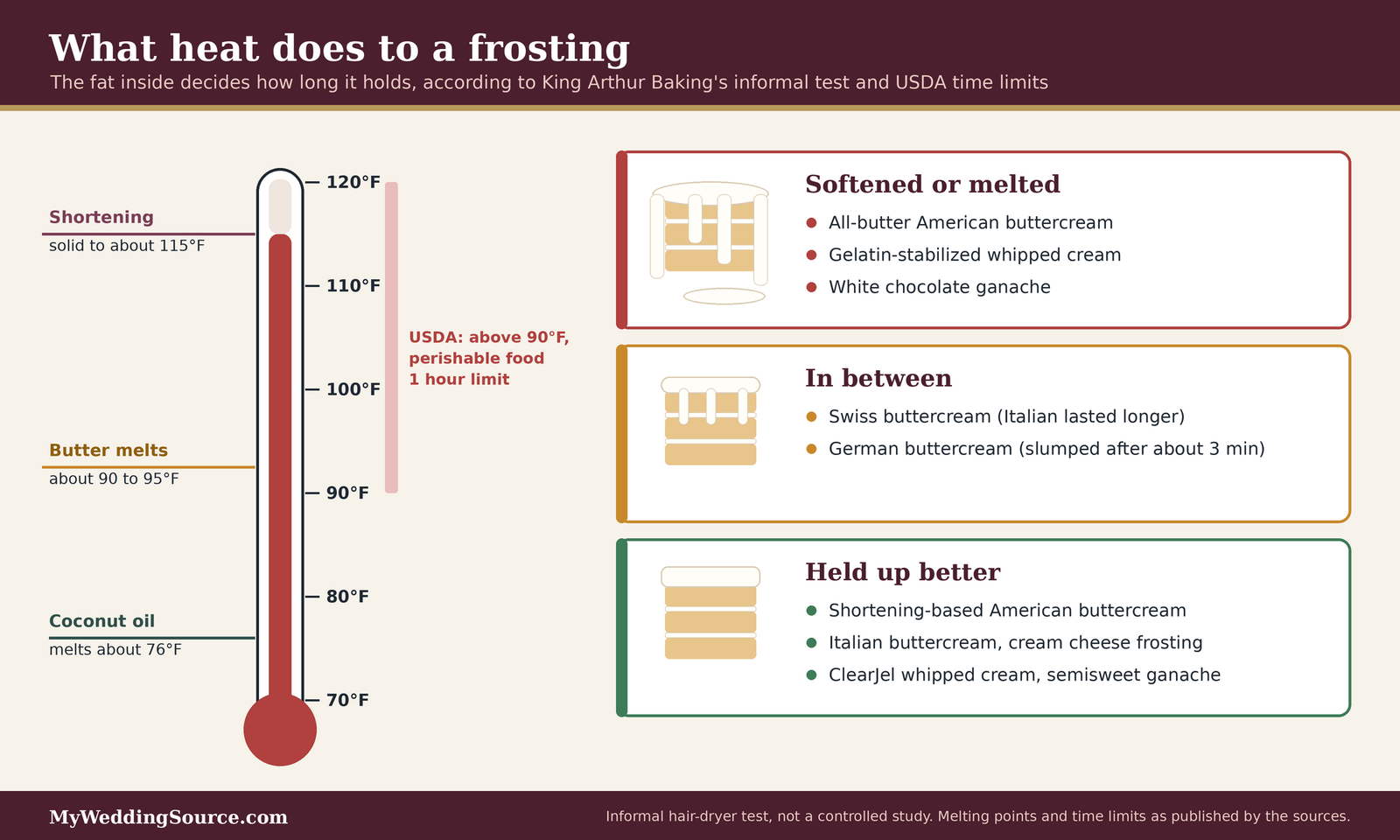
King Arthur Baking ran an informal, non-laboratory test of frostings under a hair dryer. It is not a controlled study, and the author says as much, but the ordering is a useful reality check. All-butter American buttercream softened noticeably, gelatin-stabilized whipped cream melted, and white chocolate ganache was the weakest of the ganaches. Shortening-based American buttercream, cream cheese frosting, and Italian buttercream held up better, and Italian outlasted Swiss.
The article also gives melting points for common fats: butter melts at about 90 to 95 degrees Fahrenheit, coconut oil at about 76 degrees, and vegetable shortening stays solid up to about 115 degrees. Those numbers explain the ordering. A frosting is only as heat-tolerant as the fat it is made from.
Match the frosting to the hottest hour
Think about the temperature at the hottest time the cake will be on display, not the average temperature of the day. If the cake will be out at about 90 degrees or warmer, a frosting with a high butter content is a risk, and you should ask the baker how they would handle it. Clemson University’s Home and Garden Information Center notes that American buttercream melts easily in high temperatures because of its butter content, that whipped cream melts and works best as a topping, and that fondant holds up better in heat than buttercream. That does not mean you must choose fondant. It means you should ask.
A baker may offer a stabilized recipe, a shorter display time, or a cutting cake held in a cooler while a display tier sits out. These are legitimate solutions and they change how you should think about wedding cake flavors. A lemon sponge with a heat-tolerant frosting can be a better choice among wedding cake flavors for July than a chocolate cake with an all-butter frosting, even if you like chocolate better.
Seasonal flavor ideas, and what they cost
Zola’s guide to popular flavors suggests lemon for warm-weather weddings, coconut for summer, spice cakes for winter, and cognac for a winter celebration. Treat those as editorial suggestions rather than rules. They are common pairings, and many bakers will have their own ideas.
Seasonal fruit can brighten a filling, but it can also raise the price, according to Zola’s cost guidance. Ask whether the fruit will be fresh, cooked, or from a preserve. A cooked compote or jam behaves differently from fresh berries in a cake that must sit for hours. Our seasonal wedding flowers guide takes the same approach to flowers, and it can be helpful to read the two together so the cake and the flowers are not competing for the same colors or the same budget.
Food safety, time, and temperature
Heat affects safety as well as appearance. The U.S. Department of Agriculture’s Food Safety and Inspection Service defines the Danger Zone as 40 to 140 degrees Fahrenheit, where bacteria grow fastest. It advises that perishable food should not stay in that range for more than two hours, or more than one hour when the air temperature is above 90 degrees.
Which cakes count as perishable
Not every cake is perishable in the same way. We did not find a single authoritative list that sorts every frosting into perishable and not perishable, and recipes vary, so the honest answer is to ask the baker. The ingredients are the clue. Clemson lists butter, cream cheese, egg whites, cream, and ganache made with cream among the ingredients in common frostings. A cake with a fresh cream or custard filling is more likely to be treated as perishable than a firm fondant-covered sponge with a jam filling, though that is our reading of the general rule, not a statement from the USDA about any specific cake.
Ask your baker three plain questions. Which parts of this cake need refrigeration? How long can it sit out safely at the venue’s expected temperature? What is your plan if the room is warmer than planned? A careful baker will have an answer ready.
Plan the cake’s day, not just its flavor
Work backward from the cake cutting. Decide when the cake arrives, where it is stored, when it comes out, and when it is cut. Our wedding timeline guide shows how to build the larger calendar, and the cake schedule can sit inside it as a short list of times.
If you want a cake on display for photographs for several hours, consider a smaller display cake and a separate cutting cake in the kitchen, an approach that The Knot and Zola both mention as a way to save money as well as to keep servings fresh. The photographer can still capture the cutting, and the guests receive cake that has been in the cooler. Our wedding photography guide can help you decide how much cake time is worth building into the shot plan. ## Matching wedding cake flavors to the menu and the drinks
Cake arrives at the end of a long meal, usually after guests have been sitting, eating, and drinking for hours. Among wedding cake flavors, one that sounds exciting in a quiet tasting room can feel heavy or too sweet at that point, or it can feel like an echo of dinner. Treat the cake as the last course of a meal and choose it like one.
Balance the richness of dinner and dessert
A simple rule of thumb is contrast. If dinner is rich, with cream sauces, braised meat, or a lot of cheese, a lighter cake with citrus, berries, or a clean vanilla can feel refreshing. If dinner is light, such as a fish course, vegetables, and salad, a richer chocolate or caramel cake can be a satisfying finish. This is editorial judgment, not research, and your own guests may feel differently.
Pair wedding cake flavors with the main course
Write the menu in one column and the cake in the next. Look for repeated ingredients. If the entree has a bourbon glaze, a bourbon caramel cake may feel like too much of one idea. If the dinner has a lemon sauce, a lemon cake may feel repetitive, though some couples like a deliberate echo. Our wedding catering guide explains how to read a menu proposal, and you can share the final menu with the baker so the two vendors are not working blind.
If you are serving a seasonal menu, the cake can take cues from it. A fall menu with roasted squash and apples might suit a spice cake, and a summer menu with grilled vegetables might suit a lemon or berry cake. Those are pairings, not requirements, and a classic vanilla cake works with nearly any menu.
Consider what is in the glass
Drinks change how cake tastes. A sweet dessert can taste sweeter after a dry wine, and a bitter coffee can balance a rich chocolate cake. Zola’s guide notes that a pink Champagne cake suits sparkling drinks and that a coffee-and-cream cake can take cues from a coffee-shop menu. If your bar is a feature, read our open bar wedding guide for how to plan one, and keep in mind that a cake soaked in liqueur is a poor match for a guest who has chosen not to drink.
Decide whether the cake is the dessert
The Knot’s study reports that about 72 percent of couples cut a cake, which means roughly a quarter of couples do not. Many couples also serve other desserts, such as a dessert table, doughnuts, pies, or cookies, instead of or alongside the cake. That changes how you weigh wedding cake flavors, because a cake that shares the stage with other desserts can afford to be more adventurous or smaller.
When one cake carries all the wedding cake flavors
If the cake is the only dessert, it has to please the widest group. A classic flavor that nearly everyone will eat, such as vanilla or chocolate, is usually the safer choice for the largest tiers. Zola’s guidance for plated desserts is to order enough for the full guest count. If you want something unusual among your wedding cake flavors, put it in a small tier or a separate cutting cake that guests can choose.
Our wedding reception guide shows how dessert fits into the evening, and it is worth thinking about whether you want guests to eat at the table or to come up to a station.
When the cake shares the stage
If you have a dessert table, you can order less cake. Zola’s guidance is to plan for about 75 to 85 percent of guests when you serve cake at a dessert station, and about 60 to 70 percent when there are several dessert options. Those percentages are Zola’s rules of thumb, not measured data, so ask your baker and caterer what they have seen with groups like yours.
With less cake, flavors can be more adventurous. A lemon cake, a coconut cake, or a spice cake with a flavored filling can be the star of one tier, while other desserts cover the familiar ground. Our wedding decor guide can help you plan how a dessert table fits with the rest of the look.
Allergies, dietary needs, and honest labels in wedding cake flavors
Allergies and dietary needs are the hard constraints that matter most. This section is general education and not medical advice. Guests with serious allergies or medical conditions should talk to their own clinicians, and they are the best judges of what is safe for them.
Know the major allergens and where they hide in wedding cake flavors
The U.S. Food and Drug Administration lists nine major food allergens: milk, eggs, fish, crustacean shellfish, tree nuts, peanuts, wheat, soybeans, and sesame. Sesame became the ninth when the FASTER Act took effect on January 1, 2023. A conventional cake commonly includes wheat, milk, and eggs, and may contain others, such as soy in an ingredient, nuts in a flavor, or a nut-based filling. Check the actual recipe, because ingredients vary by baker.
Wedding cake flavors that signal specific allergens
Some wedding cake flavors announce an allergen on their own. Almond, hazelnut, pistachio, and praline signal tree nuts. Peanut butter cup signals peanuts. Cookie dough, cookies-and-cream, and anything with crumbs signal wheat. Cream cheese, buttercream, whipped cream, and ganache signal milk. Meringue-based buttercream signals eggs. Less obvious sources include extracts, liqueurs, toppings, and decorations such as nut brittle or sprinkles.
Zola notes that almond cakes are often offered as a gluten-free alternative, which is a useful reminder that a swap for one guest can create a problem for another. An almond-based gluten-free cake is not safe for a guest with a tree nut allergy.
Ask about hidden sources
Ask the baker to list every ingredient in the sponge, filling, frosting, and decoration, including sub-ingredients in purchased items such as chocolate, extracts, and fondant. The Minnesota Department of Agriculture’s retail guidance says establishments should have complete ingredient information, including sub-ingredients, and staff should say so when they do not know an answer instead of guessing. That is a good standard to hold a baker to, and a baker who meets it is worth keeping.
Cross-contact, labels, and what a bakery claim really means
Cross-contact happens when a small amount of an allergen moves from one food to another, through shared bowls, mixers, tables, or hands. It matters even when the recipe itself is free of the allergen. The Food Allergy Awareness website advises caution with bakeries and ice cream shops in general, because they are higher-risk settings, and says not to assume a bakery is safe because it promotes allergy-friendly products. It suggests asking for a policy and asking the manager to walk you through how items are made.
What federal labeling does and does not cover
The FDA says the Food Allergen Labeling and Consumer Protection Act requires packaged foods to name the source of a major allergen, and that “may contain” statements are voluntary. It also says that most unpackaged foods sold at retail and food service establishments are outside the law’s scope. A fresh wedding cake made to order and delivered on a stand is usually unpackaged, so you cannot rely on a federal label to tell you what is in it. The information has to come from the baker.
What a gluten-free claim means for a custom cake
The FDA’s gluten-free rule sets a threshold of less than 20 parts per million of gluten for foods that carry the claim, and the use of the claim is voluntary. The agency’s rule covers packaged food, and it states that unpackaged items served in restaurants are not covered. A custom cake from a bakery is likely to be in the second group, so a “gluten-free” cake from a shared kitchen carries whatever assurance the baker can describe, not a federal guarantee. If a guest has celiac disease, ask the baker whether the cake is made in a dedicated gluten-free space or a shared kitchen, how equipment is cleaned, and whether the guest can see the ingredient list. Then let the guest decide.
Plan the workflow so the right guest gets the right slice
A separate cake is only safe if it stays separate all the way to the table. That means the baker, the caterer, and the servers all have to know who it is for and how it is handled.
Collect needs early and in writing
Ask about allergies and dietary needs on your RSVP, using a clear question and a place for details. Our wedding RSVP wording guide has ideas for wording, and our wedding invitations guide explains how response cards and websites fit together. Follow up with any guest whose answer is unclear. Treat what you collect as private and share it only with the baker and caterer.
Name the person and the allergen on the order
Put the guest’s name and the specific allergen on the written order, and ask the caterer how the slice will travel from the kitchen to the right table. The same site recommends confirming details with the chef or manager and not relying on a server’s memory, and the same logic applies to the cake service. Ask whether the separate cake is cut with its own clean knife, plated before other slices, and delivered by a named person. If the answers are vague, consider asking the guest whether they would prefer to bring their own dessert.
Vegan, kosher, halal, and other dietary needs
Allergies are one reason for a second cake, and values or religious practice are another. These are not safety issues in the same way, but they are no less important to the guest.
Ask for the specifics, not the label
Zola suggests asking whether a baker can make gluten-free, vegan, or kosher cakes. The word on the menu does not tell you how it is made. Practices differ from one baker to the next, and we did not find an authoritative source that sets one standard for these terms in custom cakes, so we are not going to describe one. Ask the guest what they need, then ask the baker whether they can meet it, and do not guess at either answer.
Offer a choice instead of a workaround
A small second cake in a different flavor can be a pleasant option for several guests, not only for the one it was designed for. A sorbet, fruit plate, or dessert from a certified source can also work, and it may cost less than a second custom cake. The goal is to make sure no guest is left with nothing to eat when the cake is cut. ## Guest count, slices, and cost when you choose wedding cake flavors
Flavor and quantity are linked. Each extra flavor among your wedding cake flavors is another batter, another filling, and another set of decisions for the baker, and many bakers price those differences. Before comparing wedding cake flavors, work out how many slices you need, because that tells you how much room you have to experiment.
Turn guest count into slices
A wedding slice is small. One retailer’s serving guide, which cites the Wilton cake serving chart, describes it as about 1 inch wide by 2 inches deep, cut the full height of a tier of about 4 inches. Using that chart, a 6-inch round yields about 12 slices, an 8-inch about 24, a 10-inch about 38, a 12-inch about 56, a 14-inch about 78, and a 16-inch about 100. This is a stationery retailer’s blog and not a baker’s contract, and your baker may cut differently, so treat these as planning numbers.

Count slices instead of guessing at tiers
Start with the number of people who will eat dessert. The Knot reports that an 8-inch round serves about 15 people in its guidance, which is a more generous cut than the wedding slice chart above, and that most couples need a multi-tier cake at the average of 117 guests. Zola says a two-tier cake serves about 50 and a four-tier up to 150. The sources do not agree exactly, which is a good reason to ask your own baker how they count a serving, and to ask for the slice count of the quote in writing.
As arithmetic only, using the slice chart, an 8-inch and a 10-inch tier together give about 62 slices, which would cover 50 guests with some room. Three tiers of 8, 10, and 12 inches give about 118. Those numbers assume the cake is cut in the wedding-slice style and that nothing is lost to the display or the cutting ceremony.
Decide how much buffer to build in
The same retailer guide suggests planning for confirmed RSVPs plus a 10 to 15 percent buffer. That is a reasonable cushion if every guest is expected to eat cake, and it is smaller if the cake shares the stage with other desserts. Zola’s rules for dessert stations and multiple desserts give lower targets of about 75 to 85 percent and 60 to 70 percent of guests, as noted earlier.
If you want an extra kitchen cake in the same flavor, The Knot and Zola both suggest a small display cake supported by sheet cakes as a way to reduce the total. You are paying for design on the display tier and for flavor on the sheet cake, and your baker can tell you the price difference.
What flavor choices do to the price
Neither survey separates the price of flavor from the price of design, so it is worth being careful about what you read into the numbers. The Knot’s 2025 study reports an average cake cost of $540, with a median of $480, a lower quartile of $300, and an upper quartile of $840. It also reports averages by guest count: $360 for 1 to 50 guests, $470 for 51 to 100, and $620 for 101 or more. Zola’s Wedding Cost Index lists a national average of $917 and a typical range of $700 to $1,100, with per-slice prices usually between $3 and $8.
What this actually costs
The Knot’s $540 and Zola’s $917 are different measures from different samples, so do not average them or treat either as a quote. As an editorial estimate, a cake for 117 guests at Zola’s $3 to $8 per slice would run roughly $351 to $936, before delivery, setup, and any cake-cutting fee. The only number that counts is your baker’s itemized quote.
Separate the cost drivers of wedding cake flavors
The Knot says price depends mainly on size and guest count, then on labor, decoration, specialty flavors and fillings, and accessories. Zola gives a similar list. Both note that buttercream is generally less expensive than fondant, and that sugar flowers, hand piping, and gold leaf add cost.
For flavor specifically, the Knot says custom sponges, homemade fruit compote, and liquor-infused sponges cost more because they take extra development time and labor. Zola adds that different flavors in each tier, premium liqueurs, seasonal fruit, and gluten-free or vegan tiers also add to the price. If you are weighing two wedding cake flavors, ask the baker for the price of each as a line item, so that you can see what is the flavor and what is the decoration.
Compare quotes on the same basis
A quote that looks cheap may leave out delivery, setup, a stand, a cutting set, or a cake-cutting fee charged by the venue or caterer. Zola says a venue or caterer may charge such a fee, and recommends asking when you get quotes. Our wedding catering guide shows how to put quotes on the same footing, and the same method works for cake: list what each includes, find the mandatory add-ons, price what is missing, and divide by the number of slices you need.
For the larger picture of how cake fits within the whole budget, see our average wedding cost overview, our wedding budget calculator, and our guide to paying for a wedding. If your guest list is small, our small wedding planning guide and micro wedding planning guide explain how small celebrations often handle dessert differently.
Cake insurance, contracts, and cancellation
A cake is easy to overlook in a contract, yet it is one of the few items that cannot be replaced at the last minute. Zola recommends asking to see the contract and asking about insurance options in case you need to reschedule or cancel. Our wedding insurance guide explains what event insurance generally does and does not cover. This is general education, not legal or financial advice, so read your own contract and ask the baker or an insurer about the details.
What to look for in the contract
Look for the flavor of each tier, the filling and frosting, the number of slices, the delivery time and place, the setup, the stand or equipment, the deposit and balance schedule, and what happens if the baker cannot deliver. Also look for any language about substitutions, because a baker who can swap a flavor or ingredient without telling you could undo your careful allergy planning.
Put allergy and dietary promises in writing
If a guest’s safety depends on the cake, the contract or the written order should say so. It should name the guest or the group, the ingredient to avoid, and the way the cake will be made and delivered. A friendly verbal promise is not enough, because the person who made it may not be the person who bakes the cake.
Comparing wedding cake flavors against the same criteria
With the constraints in view, you can score the common choices against the same list. The table below is our own editorial judgment, not survey data, and it is meant as a way to organize a conversation with your baker, not as a ranking of tastes. A rating of “depends” is not a dodge; it means the answer turns on the frosting, the filling, or the baker.
Score the options with transparent assumptions
The columns are the factors that actually change the answer. Crowd reach is a judgment about how many guests will accept the flavor. Heat note reflects the frosting usually paired with it, drawing on the sources above. Allergen flags list what the flavor itself tends to introduce. Cost note follows Zola’s statement that classic flavors are the most affordable and specialty flavors cost more.
| Flavor family | Crowd reach | Heat note | Allergen flags to ask about | Cost note |
|---|---|---|---|---|
| Vanilla | Very broad | Depends on frosting, not the sponge | Wheat, milk, eggs in most recipes | Classic, usually lower |
| Chocolate | Very broad | Semisweet ganache holds up better than white chocolate | Wheat, milk, eggs, sometimes soy | Classic, usually lower |
| Lemon | Broad | Light, but check the filling | Wheat, milk, eggs | Classic, usually lower |
| Red velvet or spice | Broad | Cream cheese frosting held up well in one informal test | Milk, eggs, wheat, sometimes nuts | Mid; ask about fillings |
| Almond or other nut | Narrower | Depends on frosting | Tree nuts, often wheat | Mid to higher |
| Fresh fruit filling | Broad | Fresh fruit and cream are the risk | Depends on the cream or custard used | Higher, seasonal |
| Liqueur, coffee, or coconut | Narrower | Depends on frosting | Alcohol, caffeine, tree nut in some coconut products | Higher for liqueur |
For scoring, we suggest one pass with three simple answers: yes, no, or depends. Do not add numbers to produce a total, because a total hides the single “no” that should end the conversation.
Use ranges or qualitative thresholds instead of fake precision
It is tempting to turn a flavor decision into a spreadsheet with weighted scores, but the inputs are not that exact. Guest preferences are guesses. Heat behavior depends on the recipe and the day. Prices vary by baker and region. Qualitative labels are more honest than a 7.4 out of 10.
A useful rule is to treat any “no” on a hard constraint as disqualifying, and to treat the remaining options as roughly equal until you taste them. That keeps you from arguing about decimals and moves the decision to the tasting, where it belongs.
Show where two options tie
Vanilla and chocolate often tie for crowd reach, and lemon is close. When two options tie, break the tie with the next criterion down the list, which is usually heat tolerance for a summer wedding and menu balance for a heavy dinner. If they still tie, choose the one that costs less or that the baker is more confident about, because a confident baker usually produces a better cake.
If you and your partner still tie on wedding cake flavors, put one flavor on the main tiers and the other in a small tier or cutting cake. A two-flavor cake is an entirely reasonable answer to a real tie, and it is easier to price than three or four flavors.
Test the options with contrasting scenarios
The scenarios below are illustrative, not drawn from real couples. They show how the same method gives different answers when the facts change. The slice arithmetic uses the retailer chart described above and is an estimate.
A small case and a large case
For wedding cake flavors, the small case looks like this: picture 40 guests at an afternoon backyard wedding in midsummer, with an expected afternoon temperature above 90 degrees and one guest with a tree nut allergy. Forty guests plus a 10 to 15 percent buffer is 44 to 46 slices, and a 6-inch and a 10-inch tier together give about 50. A lemon cake with a heat-tolerant frosting avoids the butter problem and the nut flag. The cake could be cut soon after the ceremony and the rest kept in a cooler. The best choice here is one simple flavor that suits the heat.
The large case: picture 160 guests at a November hotel ballroom dinner with plated service. Plated dessert means covering the full count, and a buffer of 10 to 15 percent means 176 to 184 slices. Tiers of 6, 10, and 14 inches give about 128, and adding a half-sheet kitchen cake of about 54 slices, per the same retailer chart, brings the total to about 182. In this case the best choice may be two flavors on the display tiers and one crowd-pleasing flavor in the kitchen cake, because a controlled indoor room can handle richer fillings.
| Scenario (illustrative) | Key assumptions | Suggested approach | What flips it |
|---|---|---|---|
| 40 guests, outdoor July afternoon | Above 90 degrees at cutting, one tree nut allergy | One heat-tolerant lemon or vanilla cake, no nuts, cooler on site | Shade and refrigeration on site could allow a richer filling |
| 160 guests, November ballroom, plated | Full count served, climate controlled | Two flavors on display tiers plus a kitchen cake | A guest with a severe allergy makes a separate, labeled cake the priority |
| 75 guests, winter, dessert table | Cake plus doughnuts and cookies, about 75 to 85 percent take cake | Smaller cake with one adventurous flavor, familiar desserts alongside | Venue rules or a caterer’s dessert policy may limit outside desserts |
Explain why the preferred option changes
Across the three scenarios, the flavor changed less than the reasons for it. The small summer cake was shaped by heat and an allergy. The large ballroom cake was shaped by headcount and a controlled room. The dessert-table cake was shaped by the fact that other desserts covered the familiar ground.
That is the point of using the same criteria each time. You are not asking what is the best flavor in general; you are asking which flavor survives your own constraints, and which one is left when you remove the ones that cannot work. Our wedding planning checklist can help you place the cake decision within the rest of your planning.
A rule for choosing wedding cake flavors when you are still unsure
If you have read this far and are still unsure, you do not need a complicated system. You need a default, an exception, and a short list of people and numbers to gather.
The condition that should drive the choice
The condition that should drive your choice of wedding cake flavors is the first hard constraint you find, not the flavor you like most. If a guest’s health depends on the cake, that comes first. If the cake must sit in heat, the frosting comes next. If neither applies, the menu and your own taste decide.

Give yourself a default when uncertainty remains
Our default is one classic flavor, such as vanilla, chocolate, or lemon, in a frosting the baker is confident will hold at your venue, with one smaller tier or cutting cake in a flavor you are excited about. It is easy to price, easy to explain to guests, and easy to adjust if a late allergy shows up. This is an editorial recommendation, not a rule from any source.
Name the exception that overrides the default
The exception is any situation in which the default would cause harm or break a rule. A severe allergy that makes a shared kitchen unsafe, a venue that prohibits outside desserts, a cultural or religious tradition that calls for a specific dessert, or a very hot venue that rules out most buttercreams can all override the default. When an exception applies, solve it first and fit the flavor around it.
The next conversation and the next number
Choosing wedding cake flavors takes a few conversations, not one. You do not need all of them at once, but you do need them in an order that avoids rework.
List who must agree
At a minimum, the two of you must agree on the hard constraints and on what you are willing to trade. The baker must confirm what can be made, safely, at your venue and on your date. The caterer or venue must confirm any dessert policy, fees, and service plan. Guests with allergies or dietary limits should have a say in what is made for them, and any family member who is contributing money or a recipe should be told early. Our wedding etiquette guide can help with the conversations that feel awkward.
List the quote, measurement, and guest information to obtain
Gather these before you decide on wedding cake flavors: the final or expected guest count, the number of guests who will not eat the standard cake and why, the expected temperature and the cake’s display time, the baker’s slice count and price per slice, any cake-cutting or delivery fee, and the baker’s written ingredient list. With those, the decision is mostly arithmetic and a tasting.
Questions to ask a baker before you commit to wedding cake flavors
Use the questions below at your first conversation or tasting, and ask for the answers in writing. If a baker cannot answer one, that is information too.
Questions worth asking your baker
- Which parts of this cake are perishable, and how long can it safely sit at our venue’s expected temperature?
- What is in each layer, filling, and frosting, including sub-ingredients such as chocolate, extracts, and fondant?
- Which major allergens are used in your kitchen, and how do you prevent cross-contact?
- How many slices does this quote provide, and how do you cut a serving?
- What is the price difference between flavors, fillings, and frostings as separate line items?
- Do you charge for tastings, delivery, setup, stands, and cutting sets?
- What happens if you cannot deliver, or if our venue is warmer than planned?
- Can the allergy and dietary promises be written into the order?
Questions about the cake itself
These questions confirm what is in the cake and how it behaves at your event.
Ingredients and allergen handling
Ask for a full ingredient list for each of your wedding cake flavors, including sub-ingredients, and ask the baker to describe how they handle cross-contact between allergen and non-allergen batches. Food Allergy Awareness suggests asking a bakery to walk you through how items are made and not assuming that an allergy-friendly label means a safe kitchen. A good answer is specific about equipment, cleaning, and who is in the kitchen.
Heat, display, and delivery
Ask what the cake is made to withstand, how it is transported, and what the baker does if the room is warm. Ask whether the baker will visit or speak with the venue about where the cake will be placed, away from sun, vents, and kitchen heat. If you want a long display time, ask about a separate cutting cake.
Questions about the agreement
These questions decide what happens if something changes.
Pricing, fees, and add-ons
Ask for an itemized quote with per-slice pricing and every fee: tasting, delivery, setup, stand, cutting set, and any venue cake-cutting charge. Ask what a change to the wedding cake flavors or filling would cost after the deposit, and what the deadline is for final guest count.
Contract, substitution, and cancellation
Ask what the contract says about substitutions, late changes, illness, and cancellation. Ask whether the baker has a backup plan if they cannot work your date. This is a good place to bring in your wedding insurance questions, and to remember that this is general education and not legal advice.
Tasting and choosing wedding cake flavors
A tasting is the one moment when you taste your shortlist of wedding cake flavors in the real recipe, so it is worth preparing for it. Zola advises scheduling tastings after you have compared at least three bakers and set a budget, and notes that some bakers charge for tastings while others include the cost in the total.
Get the most from a tasting of wedding cake flavors
Treat a tasting as a test of both the cake and the baker. A good baker will talk about heat, allergens, and logistics without being asked, and will tell you honestly when one of the wedding cake flavors you like is a poor fit for your day.
Bring the facts the baker needs
Bring your guest count, your venue and date, the reception timeline, the menu, and any allergy or dietary needs. Zola advises confirming how many flavors you can sample. Bring your partner, and bring the one person who will be honest with you about taste.
Taste wedding cake flavors for more than sweetness
Taste each layer and each filling on its own and together. Notice texture, since a dry sponge cannot be rescued by frosting. Notice sweetness, since a very sweet cake can be too much after dinner. Take notes at the time, because by the third bite everything blends together. Our wedding catering guide makes the same point about menu tastings.
After the tasting
A tasting is not a contract, and it is worth giving yourself a day before you decide.
Compare notes, then compare quotes
Write down which wedding cake flavors each of you liked and what each of you did not, and then put the quotes side by side on the same basis. If the baker you liked best is more expensive, ask whether a smaller cake, a simpler design, or a cutting cake can close the gap, before you give up the cake you loved.
Plan wedding cake flavors around the photographs
If you want photographs of the cake, think about how the cut slice looks, not only the whole cake. A layered interior can be as photogenic as the outside. Our wedding photographer shot list shows how to ask for detail shots, including the cake and the cutting.
FAQ: wedding cake flavors questions
Choosing wedding cake flavors
What are the most popular wedding cake flavors?
Zola’s guide to wedding cake flavors lists vanilla, chocolate, yellow cake, red velvet, funfetti, lemon, spice, almond, and coconut among common choices, and calls a few of them classics for decades. It gives no survey percentages, so common here does not mean ranked. Your guests and your baker matter more than any list.
Can I serve more than one of my wedding cake flavors?
Yes. Many couples use more than one of their wedding cake flavors, in different tiers, or a display cake plus a cutting cake. Zola says different flavors per tier can add to the price, so ask for each flavor as a line item. Keep the plan small enough that every tier is labeled and the servers know which is which.
Season and venue
Which wedding cake flavors work best in hot weather?
The sponge matters less than the frosting when you pick wedding cake flavors for summer. In King Arthur Baking’s informal test, all-butter buttercream softened and gelatin-stabilized whipped cream melted, while shortening-based buttercream and cream cheese frosting held up better. Lemon is a common summer flavor, according to Zola. Ask your baker what they would use at your venue and temperature.
Is it safe to leave a wedding cake out all day?
The USDA says perishable food should not stay between 40 and 140 degrees Fahrenheit for more than two hours, or one hour above 90 degrees. Whether a particular cake is perishable depends on its recipe, so ask the baker which parts need refrigeration and how long it can safely sit at your venue.
Allergies and diets
How do I handle guests with food allergies?
Ask about allergies on your RSVP, then give the details to your baker and caterer in writing. The FDA lists nine major allergens, but most unpackaged bakery items fall outside federal labeling rules, so ask for a full ingredient list and a description of how cross-contact is prevented. Let the guest decide what feels safe.
Is a gluten-free wedding cake safe for someone with celiac disease?
Not automatically. The FDA’s gluten-free definition of less than 20 parts per million applies to packaged foods, and the agency says unpackaged restaurant items are not covered. A custom cake depends on the baker’s kitchen, so ask about dedicated space, cleaning, and ingredients, and let the guest, who knows their own needs, decide.
Servings and cost
How much wedding cake do I need for my guest count?
It depends on how many people will eat cake and how your baker cuts it. One retailer chart suggests a wedding slice of about 1 by 2 inches, and guidance of confirmed guests plus a 10 to 15 percent buffer. Zola suggests lower targets when other desserts are served. Ask for the slice count in writing.
How much does wedding cake cost on average?
The Knot reported an average of $540 for couples married in 2025, with a median of $480. Zola lists a national average of $917 and per-slice prices usually between $3 and $8. These come from different samples, so treat them as context and decide from itemized quotes. Specialty wedding cake flavors and fillings generally raise the price.
Your next steps
Settle the constraints
Collect the facts before the tasting
Write down your guest count, venue, date, expected temperature, menu, budget, and every guest need you know about. Our wedding planning guide can help you see where the cake decision sits among the others, and our wedding catering guide shows how the food plan fits together.
Choose the default and the exception
Pick one classic flavor as your default among wedding cake flavors and write down the one situation in which you would override it. If you cannot name an exception, you probably have a clear default and can move on to bakers.
Book and confirm
Compare at least three bakers
Ask each for an itemized quote with slice count, fees, and written ingredient information, and book tastings after you have compared them. Keep the answers in one document so you can compare them side by side.
Put it in writing and add it to the timeline
Confirm the wedding cake flavors, allergy handling, delivery time, and cancellation terms in the contract, and add the cake schedule to your wedding timeline. If you want reception photos with the cake, tell your photographer when it will be cut.
Sources & methodology
How we built this guide
What we relied on
This guide combines federal information on major food allergens, gluten-free labeling, and the time and temperature limits for perishable food, a state agriculture department’s retail allergen guidance, a food allergy education site’s advice on bakeries, wedding-industry survey and cost guidance from The Knot and Zola, and baking and extension-service guidance on frostings and heat. Where a statement comes from a company or an informal test, we say so, because those sources reflect the seller’s habits or a single experiment. The slice, cost, and scenario figures are our own arithmetic or editorial judgment, and they are estimates.
What we did not do
We did not taste, test, or price any cakes, and we did not call bakers. We did not verify the methodology behind Zola’s Wedding Cost Index or the retailer slice chart, and we could not find a reliable current figure for how far ahead to order a cake, so we did not give one. This guide is general education and not medical, legal, or financial advice. Guests with allergies or medical conditions should consult their own clinicians, and anyone signing a contract should read it carefully.
Source list
Government, university, and regulatory sources
- U.S. Food and Drug Administration, Food Allergies: https://www.fda.gov/food/food-labeling-nutrition/food-allergies
- U.S. Food and Drug Administration, Questions and Answers: Gluten-Free Food Labeling Final Rule: https://www.fda.gov/food/nutrition-food-labeling-and-critical-foods/questions-and-answers-gluten-free-food-labeling-final-rule
- USDA Food Safety and Inspection Service, USDA urges consumers to keep clear of the Danger Zone this summer: https://www.fsis.usda.gov/news-events/news-press-releases/usda-urges-consumers-keep-clear-danger-zone-summer
- Minnesota Department of Agriculture, Food Allergen Risks at Retail: https://www.mda.state.mn.us/food/safety/allergen-risks-retail
- Clemson University Home and Garden Information Center, Frosting Types and Where to Use Them: https://hgic.clemson.edu/frosting-types-and-where-to-use-them/
Wedding-industry, baker, and retailer sources
- The Knot, How Much Do Wedding Cakes Cost: https://www.theknot.com/content/how-much-do-wedding-cakes-cost
- Zola, Wedding Cake Cost Guide: https://www.zola.com/expert-advice/a-guide-to-wedding-cake-costs
- Zola, What Are the Most Popular Flavors for a Wedding Cake: https://www.zola.com/expert-advice/what-are-the-most-popular-flavors-for-a-wedding-cake
- Zola, 10 Questions to Ask Wedding Cake Bakers: https://zola.com/expert-advice/10-questions-to-ask-wedding-cake-bakers
- King Arthur Baking, Best cake frosting for hot weather: https://www.kingarthurbaking.com/blog/2018/08/17/best-cake-frosting-hot-weather
- Paperlust, Wedding Cake Serving Guide: https://paperlust.co/blog/wedding-cake-serving-guide/
- Food Allergy Awareness, Dining Out: https://www.foodallergyawareness.org/education/dining-out/