

A boho wedding dress works best when two or three relaxed, romantic details lead and everything else stays quiet, so the gown reads as a considered style instead of a costume, and the practical choices about fabric, hem, fit, and timing still hold up on the day.
Quick answer
Retailers describe a boho wedding dress as relaxed and flowing, with soft fabrics such as chiffon, tulle, and lace, and details such as floral appliqués, bell sleeves, open backs, and natural tones like ivory or blush. The line between boho and costume is not any single detail. It is how many of them you stack. Pick two or three anchor elements, keep the rest of the gown and the accessories plain, check the hem and fabric against your actual venue, and order early enough to leave time for alterations. Try gowns on in person where you can, and get return and cancellation terms in writing before you pay.
Searching for a boho wedding dress usually starts with a mood board, and a mood board is a poor guide to what you will wear for eight hours. Photos crop out the walk across the lawn, the humidity, the zipper, and the person who has to bustle the skirt. This guide turns the style label into things you can see, touch, and test: the shape, the fabric, the neckline and back, the color, and the small pieces around them. It then gives you a way to decide how much boho is enough, how to match the gown to a venue, and what to ask before you pay.
We lean on bridal designers and retailers for what the style looks like, because there is no official definition. Where a claim comes from a seller, we say so, since sellers describe their own collections. Where we do arithmetic, we label it as an estimate. If you are still deciding on the broader wedding plan, our wedding planning guide covers the full sequence, and this article stays with one question: how to choose and style a boho wedding dress with confidence.
Translate the style label into observable choices for boho wedding dress
Before comparing gowns, it helps to know where the word comes from and why it is so loose. Britannica traces bohemianism to nineteenth-century Paris, where the idea of an unconventional, artistic way of life took hold in the 1830s and then spread across Europe and into the United States. It adds that a commercial market for “bohemian style,” shortened to boho, clothing and decor developed later, and that hippie fashion of the 1960s is the clearest inspiration for contemporary boho style. Britannica also notes that the French root word was originally applied to the Roma people through a mistaken belief about their origins, a use now considered pejorative, which is a reason to keep the word’s history in mind when you borrow its look.
The practical takeaway is that boho describes a mood more than a pattern. That is useful, because a mood can be turned into choices you can check one at a time. It is also why the label gets stretched to cover almost any lace gown, which we return to below.
Define the silhouette, color, material, and formality signals in the boho wedding dress decision
Designers and retailers describe the style with a fairly consistent vocabulary. Four families of signals do most of the work, and it is easier to talk about them separately than to react to a whole photograph. The first is silhouette, the overall shape. The second is material, which controls drape and movement. The third is color, which includes the shade of white and any accent. The fourth is formality, which is how dressed-up the whole look feels. A boho wedding dress can be tuned along each of these, and the choices interact, so a heavy fabric in a flowing cut behaves differently from a light one.
Because designers disagree on the details, treat the lists below as a summary of what several sellers say, not a rulebook. Allure Bridals, Adrianna Papell, Kleinfeld, and Maggie Sottero each publish their own take, and they overlap more than they conflict. Your own preferences and your venue should outrank any list.
Show what belongs to the style — boho wedding dress
Allure Bridals describes a boho wedding dress through light, airy materials that move easily: chiffon for a soft drape, layered tulle for volume without weight, and lace overlays or lace sleeves for a vintage touch. For shape, it names relaxed cuts, including A-lines, empire waistlines, and sheath or slip styles that fit gently. Kleinfeld adds fit-and-flare, which gives definition at the waist and hips, and says corsetry, boning, and seaming can shape the torso without losing softness.
On detail, Allure lists floral appliqués, botanical embroidery or prints, bell sleeves, open or low backs, and fringe or tassels. Kleinfeld mentions subtle flutter or puff sleeves, illusion backs, and layered skirts. Adrianna Papell adds high slits, two-piece sets with a crop top and skirt, and short styles for beach or elopement settings. For color, Allure points to natural tones such as ivory, off-white, and blush rather than stark white.
What these lists share is softness, movement, and nature-derived ornament. A useful working test for your own shortlist: if a gown has soft movement, at least one natural-looking detail, and a relaxed line, it is plausibly in the style. If it has none of the three, the label is probably marketing.
Show what often gets mislabeled under the same keyword — boho wedding dress
Because boho is a popular search, sellers apply the boho wedding dress label widely, and it often lands on gowns that share only one trait. Three common mislabels are worth knowing, and they are our observations from reading the retailer pages above, not claims any seller makes.
The first is the all-over lace gown with a structured, strapless bodice. Lace alone does not make a gown boho. Maggie Sottero’s boho guide, for example, files a ball gown with a glitter tulle skirt under “Modern Boho” and mermaid-style lace gowns under “Vintage-Inspired” and “Western Boho,” so the same word spans very different shapes. That is a seller choosing a broad label for its own collection, and it tells you to read the description, not the category.
The second is the plain slip or crepe sheath with one small floral detail. It can be lovely, but it may be minimalist with a boho accent, and that is a different decision with different accessories. The third is the costume reading, when a gown with several boho signals is paired with a flower crown, layered necklaces, fringe, a cape, and bare feet. Each item appears in retailer styling lists, which is exactly why stacking them all can tip a look into costume. We treat that as a risk to manage, and the third section of this guide shows how.
Fit the style to venue, season, body, and movement in the boho wedding dress decision
Style questions turn into fit questions quickly. A boho wedding dress is often chosen for an outdoor or relaxed setting, so the surface underfoot, the temperature, and the amount of walking matter as much as the neckline. Kleinfeld lists comfort, weather, venue, terrain, formality, and personal style as the factors to weigh, and it says the best gown is the one in which you feel confident. We would add one more, which is movement: how you will actually sit, dance, hug, and get in and out of a car.
Body fit is the part no article can settle for you. Kleinfeld says the same dress can look ethereal, dramatic, or understated depending on fit and finishing, and recommends an in-store appointment with a stylist to see how a gown moves on your body. Maggie Sottero likewise recommends trying favorites on at an authorized boutique. Both are sellers, so take the advice as consistent with their business, but it is also plain common sense for a garment that depends on drape.
Test temperature and terrain — boho wedding dress
Heat and ground cover decide more about a boho wedding dress than most people expect. The National Weather Service explains that the heat index combines air temperature and humidity to show how hot it feels, that its values assume shade and light wind, and that full sun can raise the heat index by up to 15 degrees Fahrenheit. For a ceremony in direct sun, that means the forecast number understates what you will feel in a lined, layered gown. This is general weather information, not medical advice. If heat is a concern for you or your guests, talk with a clinician and with your venue about shade and water.
On the fabric side, Adrianna Papell says chiffon and organza suit warm weather, cotton lace and muted tones suit rustic settings, and silk or crepe give a more polished look. Kleinfeld says lightweight, flowing fabrics such as chiffon, tulle, silk organza, and crepe suit most outdoor settings, and that heavy fabrics are harder to manage on sand or grass.
Azazie, a retailer with its own outdoor-wedding guide, gives concrete numbers for grass. It suggests a hem that sits 1 to 2 inches above standard floor length so it floats when you stand and does not drag when you walk, and 2 to 3 inches in spring when grass is soft and wet. It warns that thin stiletto heels can sink 1 to 2 inches into soft soil and suggests wedges, platforms, or block heels about 2 to 3 inches wide. It suggests keeping fabric weight under about 8 ounces per yard and using caution with heavy silk, dupioni, delicate lace, and heavy beading. It also says morning dew can soak hems until about 11 a.m. and that after rain you may wait 3 to 4 hours for the grass to dry. These are one retailer’s rules of thumb, so confirm the hem with your own fitter.
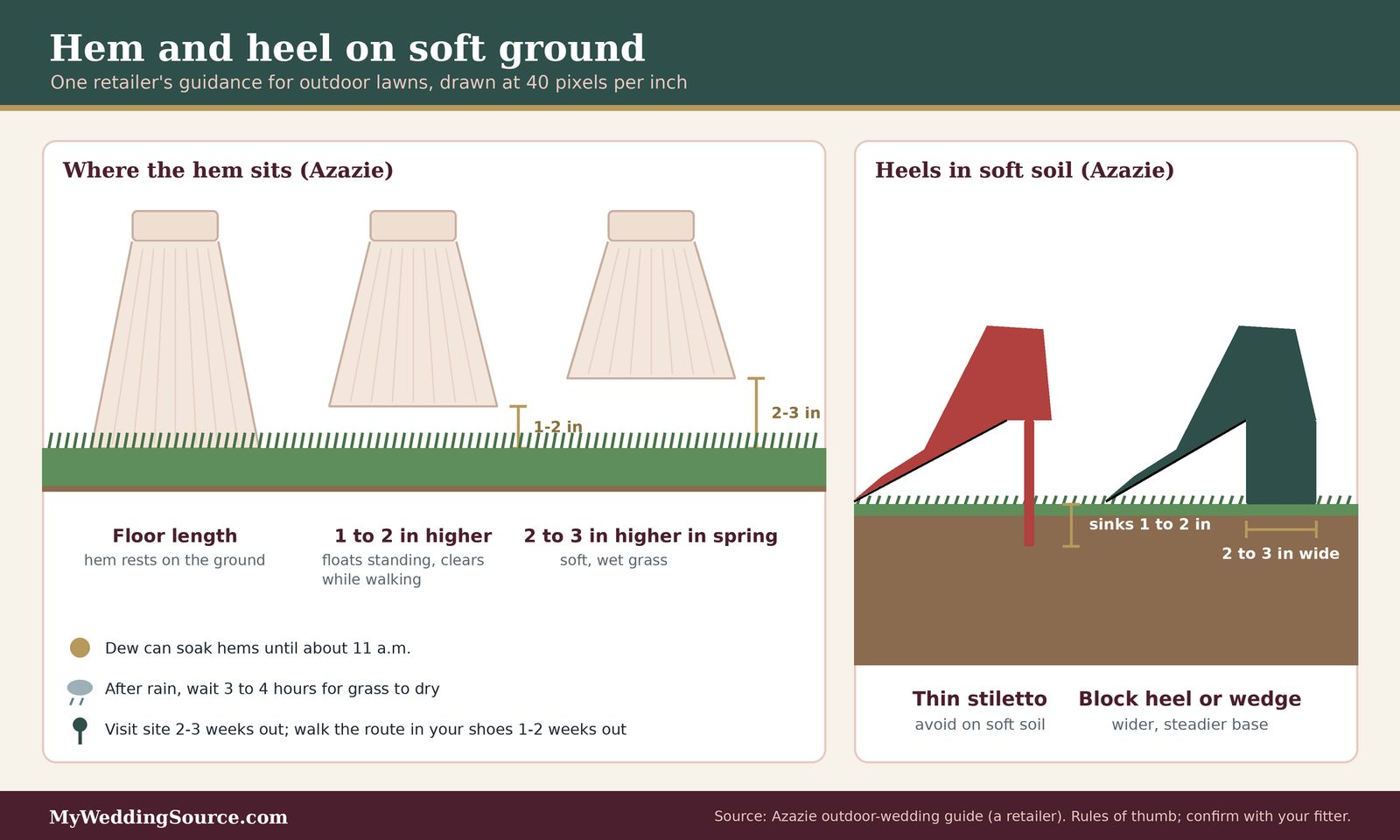
Kleinfeld adds that tea-length or midi hemlines are practical on grass or uneven ground, that a cathedral-length train needs a clear, smooth path, and that a detachable overskirt lets you shed extra fabric after the ceremony and photos. If your venue has gravel, sand, or a long lawn, ask the coordinator about the aisle surface and the path, as Kleinfeld suggests, before you commit to a train length.
Check photography and lighting effects — boho wedding dress
Soft, textured fabrics in a boho wedding dress behave differently in different light, which matters because you will see your gown in photographs for decades. Sean Lewis, writing for SLR Lounge in 2025, advises photographers to build couple portraits around golden hour, to move into open shade or use a reflector or diffuser at midday when light is harsh, and to work with existing string lights and candles at night instead of overpowering them. He also says lace gowns are part of the rustic boho look and deserve coverage, and he suggests an 85mm or macro lens to bring out texture.
Rangefinder’s 2024 guide to photographing wedding dresses suggests keeping the lighting style consistent across the dress shots, moving in close to capture lace, buttons, and stitching, and keeping backgrounds clean so they do not compete with the dress. For you, the useful translation is that fine lace and sheer panels read well in soft, even light and can lose definition in harsh sun, and that a busy background of wildflowers and pampas grass can fight a gown with heavy detail.
We cannot promise how any specific gown will photograph, and no source we reviewed tested particular fabrics. What you can do is ask your photographer how they handle your venue’s light at your ceremony time, and look at their past work in similar conditions. Our wedding photography guide and wedding photographer shot list explain how to brief a photographer on details such as lace, sleeves, and the back of the gown.
Compare the sub-styles with a decision matrix for boho wedding dress
The word boho covers several moods, and the right one depends on the setting. Maggie Sottero’s guide splits its boho gowns into flowy and ethereal, vintage-inspired, minimalist, modern boho, beachy boho, and western boho. Adrianna Papell matches styles to venues: breathable gowns for beaches, nature-inspired motifs for gardens and forests, vintage looks for barns, and cleaner cuts with metallic accents for city rooftops. Kleinfeld pairs settings with silhouettes in a similar way. We combined those three seller views into one table, then added the caution that each setting tends to raise. The table is our synthesis, so it is a starting point for conversation with a fitter and not a verdict.
Table 1. Decision matrix for a boho wedding dress, by setting
| Setting | What the sources point toward | What to be careful about | What would change the call |
|---|---|---|---|
| Garden or lawn | Flowy A-line or soft fit-and-flare in chiffon, tulle, or organza; botanical embroidery; a hem raised an inch or two (Azazie) | Soft or wet grass, dew until late morning, delicate lace dragging | A paved or boardwalk aisle makes a longer hem and train workable |
| Beach | Light sheath, slip, or relaxed A-line; breathable fabric; a short or tea-length option (Adrianna Papell, Kleinfeld) | Heavy fabric and long trains on sand, wind, salt and damp hems | A ceremony on a deck or sand-free terrace loosens the limits |
| Barn or rustic | Cotton lace, muted tones, sleeves for cooler seasons (Adrianna Papell); boots or flat shoes (Allure) | Cold evenings, dust, uneven floors | A heated, finished interior allows lighter sleeves and a polished fabric |
| Forest or woodland | Nature-inspired motifs (Adrianna Papell); a hem that clears the ground (our inference) | Branches and roots snagging tulle and beading | A cleared, graded path allows a sweep train |
| City rooftop or evening | Cleaner cuts in crepe or silk with metallic or beaded accents (Adrianna Papell) | Wind off the roof, narrow elevators and stairs for volume | A formal indoor ceremony supports a more structured gown |
| Formal evening, dressed-up boho | Refined gown with one boho element, balanced with restrained accessories (Adrianna Papell) | Gown and surroundings reading as two different weddings | A black-tie dress code may call for a more structured fabric, see our black tie wedding guide |
Read the matrix by setting, not by label
The matrix is organized by setting because the setting is the part you cannot change after you order. Silhouette and detail can be tuned at a fitting, and accessories can be swapped the week before, but a lawn is a lawn. Start in the left column, read across to the caution, and ask whether your site triggers it.
Use the matrix to narrow the shortlist
Take the one or two rows closest to your venue and write down the cautions that apply. Then hold each gown you try on up against those cautions. A lace sleeve on a July afternoon in direct sun belongs in the “be careful” column, and so does a heavy beaded train on a gravel path. If the answer is “yes, but only with a change,” note the change and whether a seamstress can make it. Our guide to wedding dress alterations explains what tends to be possible and how fittings are usually spaced.
You can also use the matrix in reverse. If you fall in love with a gown that clashes with your venue, the right column tells you what would need to change, whether that is the surface, the time of day, or the gown. Sometimes the better move is to change the venue detail, such as adding a path or moving the ceremony onto firmer ground, and our garden wedding venues guide and beach wedding dresses guide go deeper on those two settings.
Know who each direction is not for
Every direction has people for whom it is a poor fit, and naming them early saves a try-on appointment. A boho wedding dress built from light, flowing fabric suits people who want movement and warm-weather comfort, but they are less suited to anyone who wants firm shaping through the bodice without a built-in structure. Lace-heavy and beaded gowns suit people who want texture in photographs, but they are less suited to long walks on soft ground, according to Azazie’s caution about delicate lace and heavy beading on grass.
Minimalist gowns with one boho accent suit people who want the style quietly, but they are not for someone hoping the gown alone will carry the whole theme. Two-piece and short styles, which Adrianna Papell lists, suit people who want comfort and a relaxed day, but they may not match a formal religious ceremony or a venue with a strict dress code. Check your officiant’s and venue’s expectations if either applies, and see our wedding ceremony guide for what to ask.
Run contrasting scenarios and find the threshold that flips each one
A matrix gives patterns, and a scenario gives a decision. The five scenarios below are illustrative, meaning we invented the situations to show how a single variable can reverse the recommendation. They are not case studies, and the assumptions are ours.
Table 2. Contrasting scenarios for a boho wedding dress
| Scenario (assumptions are illustrative) | Recommendation | What flips it |
|---|---|---|
| Late-spring ceremony on a lawn at 4 p.m., grass dry, six hours of dancing | Chiffon or organza A-line, hem raised an inch or two, block-heel or flat shoes, optional detachable overskirt for the reception | Rain in the forecast or morning timing: raise the hem further and plan around dew and wet ground |
| October barn wedding, unheated ceremony, heated reception | Lace sleeves or a sleeve that detaches, mid-weight fabric, boots or closed shoes | A heated space for the ceremony as well: consider lighter sleeves or a wrap instead |
| Beach ceremony at golden hour, with a wooden walkway to the sand | Lightweight sheath or slip, short or tea-length option, no long train | If the aisle is entirely walkway or deck, a longer hem becomes realistic |
| Rooftop evening ceremony in a city, elevator access, formal dress code | Crepe or silk gown with one beaded or lace detail and a clean silhouette | A casual dress code or a lawn venue shifts the answer toward softer fabric |
| Short engagement, four months to the date | Ready-to-ship or off-the-rack gown, booked quickly, with a boho detail that a seamstress can add or adjust | A made-to-order quote with a confirmed delivery date that leaves room for fittings |
Read the scenarios as a set
No single row is the answer for everyone. Read them together and you will see that the same gown choice flips on one variable at a time: ground softness, temperature, formality, or time. That is the pattern to carry to your own venue. Then turn it into a rule you will follow.
Write down the threshold, not just the choice
For each scenario, the second column is only half the answer, and the third column is the other half. Writing the flip threshold next to your pick keeps you from drifting. If you chose a long, lace-heavy gown for a lawn and the forecast turns wet, you already know which line you crossed. Without the written threshold, people often defend the first choice long after the facts changed.
Decide what you will give up first
Most choices of a boho wedding dress involve a trade-off, and it helps to decide the order you will give things up. One person might protect the silhouette and give up the long train. Another might protect comfort and give up the sleeve. A third might protect the budget and give up custom embroidery. There is no right order, but there is a wrong time to choose one, which is in the final week with a deposit already paid. Our average wedding cost guide and wedding budget calculator can help you see where an attire line sits against the rest of your plan.
Build a cohesive look without copying an inspiration photo for boho wedding dress
An inspiration photo is a finished composition, shot with a stylist, a photographer, and a controlled setting. Copying a boho wedding dress photo item by item rarely works, because the parts were chosen to work together in one frame and not to be worn for a whole day. The better approach is to learn what the photo is doing and borrow the logic. Kleinfeld states the logic plainly: pick one or two romantic elements and keep the rest clean. That advice, from a bridal retailer, is the closest any source we found came to an anti-costume rule, and the sections below turn it into a method.
Choose two or three anchor elements in the boho wedding dress decision
An anchor element is a feature you want a viewer to notice first. Think of it as a loud choice, with everything else deliberately quieter. We find it helpful to sort a gown into eight areas: silhouette, fabric, neckline and sleeves, back, embellishment, color, hair and headpiece, and the accessories you carry or wear. The aim is to make two or three of those eight areas loud, and let the rest recede. That number is our editorial rule of thumb, adapted from the “one or two romantic elements” advice at Kleinfeld, and it is not a measured standard.

Here is how it might look. If the lace sleeves and open back are your anchors, the skirt can be a plain flowing chiffon, the hair can be simple waves, and the jewelry can be minimal. If the embroidered bodice is your anchor, the sleeves can be plain, the back closed, and the headpiece quiet. The point is to leave visual space, so each loud choice can be seen on its own.
Repeat them selectively across attire, paper, and décor — boho wedding dress
Once you know your anchors, repeat them lightly elsewhere. If botanical embroidery is on the gown, a small botanical line can appear on the stationery or the escort cards, and the florals can echo the same shape. Repetition makes the look feel planned, and it works best when it happens in two or three places and not in twelve. Our wedding invitations guide and wedding decor guide cover how to carry a motif through paper and tables, and the seasonal wedding flowers guide helps match blooms to the date.
For the people around you, the same idea applies. If your bridesmaids or wedding party wear soft, earthy tones, a single shared color or fabric can tie them to the gown without matching it. Allure Bridals suggests natural tones such as ivory, off-white, and blush for the gown, and SLR Lounge describes earthy boho palettes of terracotta, mustard, deep green, and burgundy with bold florals as accents. Those are two sellers’ views, not rules, but they show how a restrained palette can organize the day. See our wedding party attire guide and bridesmaid dresses guide for how to coordinate without matching.
Avoid matching every item to the same motif — boho wedding dress
The fastest way to a costume look is to put one motif on everything. If the gown has florals, the crown has florals, the bouquet is all wildflowers, the shoes are embroidered, the invitation is floral, and the cake is floral, the motif stops reading as a choice and starts reading as a theme park. This is our judgment, and plenty of couples enjoy a fully themed day, but if your goal is to avoid the costume feeling, a useful limit is to let a motif repeat in at most two or three places.
Different materials can carry the same mood without copying the same shape. Lace on the gown can sit beside linen on the tables and dried grasses in the bouquet, so the palette and the texture agree while the specific motif does not repeat. If you are unsure, take a photograph of the full outfit in the real setting and ask a friend which items they noticed first. If the answer is “everything,” edit.
Edit out competing signals in the boho wedding dress decision
Editing a boho wedding dress look is easier than adding, and it is the step most mood boards skip. A gown with detail at the neckline, sleeves, back, and skirt already has plenty to look at. Then hair vines, a cape, layered necklaces, stacked bracelets, and a statement bouquet pile on more. Allure Bridals lists flower crowns, layered necklaces, stacked bracelets, and rings with natural stones such as turquoise or opal as ways to complete the look. Each of them can be lovely alone. Together on a detailed gown they can compete. Kleinfeld’s advice is to keep accessories simple when the dress is richly detailed and to let one accessory add personality when the dress is minimal.
Use a priority hierarchy — boho wedding dress
A priority hierarchy is a simple ranking of what matters most to the overall impression. We suggest ranking in this order, and adjusting to taste: the gown first, because it is the largest and most expensive item; then the hair and headpiece, because they frame the face in nearly every photograph; then the bouquet, which is in most photos; then jewelry; and finally shoes, which are often hidden by the hem. Anything lower on the list should be quieter than anything higher.
In practice this means that if the gown is highly detailed, the headpiece should be understated, and the jewelry should be minimal. If the gown is plain, the hair or bouquet can carry more. The hierarchy is also a tiebreaker. When you cannot decide whether to add something, ask whether it would outrank something higher on the list. If it would, leave it out. Our guides to wedding jewelry and wedding tiaras show how headpieces and jewelry can be scaled to the gown.
Keep one focal point per visual zone — boho wedding dress
Think of the body as a few zones: head and hair, neck and shoulders, bodice and waist, skirt, and hands. A good rule is to let each zone have at most one focal point. A flower crown is the focal point of the head zone, so skip the veil with heavy lace trim if the lace competes. A statement necklace is the focal point of the neck zone, so choose a simple neckline. An embroidered bodice is the focal point of the bodice zone, so keep the belt plain.
This is an editorial heuristic, and it is not from a source, but it matches the restraint Kleinfeld describes. It also helps with makeup and hair, which are part of the picture. If your look already has a lot of texture, a softer makeup approach can keep the balance, and our bridal makeup guide covers how to plan a trial. Bring photographs of your trial look to your final gown fitting, so the whole picture can be seen together.
Plan the budget and timeline for a boho wedding dress
Money and time are the two constraints that quietly decide most gown choices. The style itself does not set a price, since a boho wedding dress can be an off-the-rack gown, a made-to-order design, or a custom piece, and the cost follows the construction and the seller. What you can do is separate three kinds of numbers: a survey average, a quote from a real seller, and your own arithmetic. We keep them apart below, and our broader guides on how to pay for a wedding and the wedding budget calculator show where the gown sits in the whole plan.
Separate the survey average from your own number
A survey average describes a group of past couples, and it is a useful anchor as long as you remember what it counts. A quote describes your gown from your seller. Only the quote is a price you can plan around, and the average is a reference point for checking whether a quote is wildly high or low.
What the average does and does not include — boho wedding dress
The Knot’s 2026 Real Weddings Study reports an average wedding dress cost of about $2,100. The study surveyed 10,474 U.S. couples who married between January 1 and December 31, 2025, and respondents were recruited by email invitation through The Knot and WeddingWire membership, so it is a self-selected sample and not a census. The Knot says the average mainly reflects off-the-rack and made-to-order dresses, that only 19 percent of female respondents wore custom-made attire, and that alterations are not included. It also reports budget tiers of about $1,200 (low), $2,000 (middle), and $3,200 (high).
Two cautions follow. First, nothing in that report is specific to boho styles, so it is a figure for wedding dresses in general. Second, it excludes alterations, which can add to the total. We did not find a verified alteration price in the sources for this article, so we do not give one. Our wedding dress alterations guide covers what drives alteration cost and how to get written estimates from local seamstresses.
Work out deposit and balance with our arithmetic — boho wedding dress
The Knot says retailers typically require a deposit of 30 to 50 percent of the total cost to confirm an order, with the balance due at pickup, and that some shops offer installment plans. The Better Business Bureau, in a 2024 consumer tip published by KRCU Public Radio, says expensive gowns often need a down payment of about half the price and that buyers should not feel pushed to pay everything up front.
Cost reality check
Estimate, using only The Knot’s published figures. Applying a 30 to 50 percent deposit to the reported tiers gives these approximate amounts: about $360 to $600 on a $1,200 gown, $600 to $1,000 on a $2,000 gown, $960 to $1,600 on a $3,200 gown, and $630 to $1,050 on the $2,100 average. The remaining balance would be about $1,050 to $1,470 on the average-priced gown. These figures are our arithmetic from survey numbers, not quotes. Alterations, a veil or headpiece, undergarments, shoes, and cleaning or storage are extra, and we have no sourced price for them here. Ask each seller for the deposit amount, the balance date, and the refund terms in writing before you decide.
For help placing this against the rest of your costs, see our average wedding cost guide. If your attire spending is a larger share of the plan than you expected, it can help to know that a smaller celebration shifts the balance, as covered in our small wedding planning guide and micro wedding planning guide.
Back-plan the timeline from the wedding date
A boho wedding dress timeline works backward from the date, and the part people forget is that alterations need the dress in hand. If the gown arrives late, the fittings shrink, and the stress lands on the seamstress and on you. David’s Bridal, which sells and alters gowns, publishes timing guidance that we use below, so keep in mind that it describes one retailer’s process.
Choose the buying lane by months remaining
David’s Bridal describes the ideal time to start shopping as 9 to 12 months before the wedding, with an optional early browsing visit 14 to 18 months out. It calls 6 to 9 months workable if you commit soon after the appointment, and 3 to 6 months late, when off-the-rack, sample-sale, and ready-to-ship gowns become the main options. Under 3 months, it says you need to book right away and be ready to choose a gown at the appointment. It says made-to-order gowns take about 4 to 6 months to produce, while off-the-rack and ready-to-ship gowns have no production wait.
Our reading of those numbers is that the months remaining decide the lane for a boho wedding dress before taste does. With more than nine months, you can consider made-to-order boho designs. With four to six months, you will likely be choosing from what is in stock or ships quickly. This is why the scenario table earlier puts a four-month engagement in the ready-to-ship lane. If you are building the rest of the schedule, our wedding planning timeline places attire next to the other deadlines.
Place fittings and the full-look test
David’s Bridal describes a standard alteration schedule of about 8 to 12 weeks across two or three fittings, with the first fitting 8 to 12 weeks before the wedding once the dress has arrived, the second 4 to 6 weeks before, and the third 1 to 2 weeks before for final details and a bustle lesson. It lists an optional fourth fitting the day before or the day of if needed, and says to bring your wedding shoes, undergarments, veil and accessories, a helper for the bustle lesson, and hair styled close to your wedding-day look.
Our own arithmetic, labeled as an estimate: if the first fitting needs to land 12 weeks before the wedding (about 2.8 months), and made-to-order production takes 4 to 6 months, then the order has to be placed roughly 6.8 to 8.8 months before the date, and David’s Bridal’s own “6 to 9 months from yes to wedding day” figure agrees. We would add a month of buffer for delays, which brings that to about 8 to 10 months. The buffer is our suggestion, not a retailer rule.
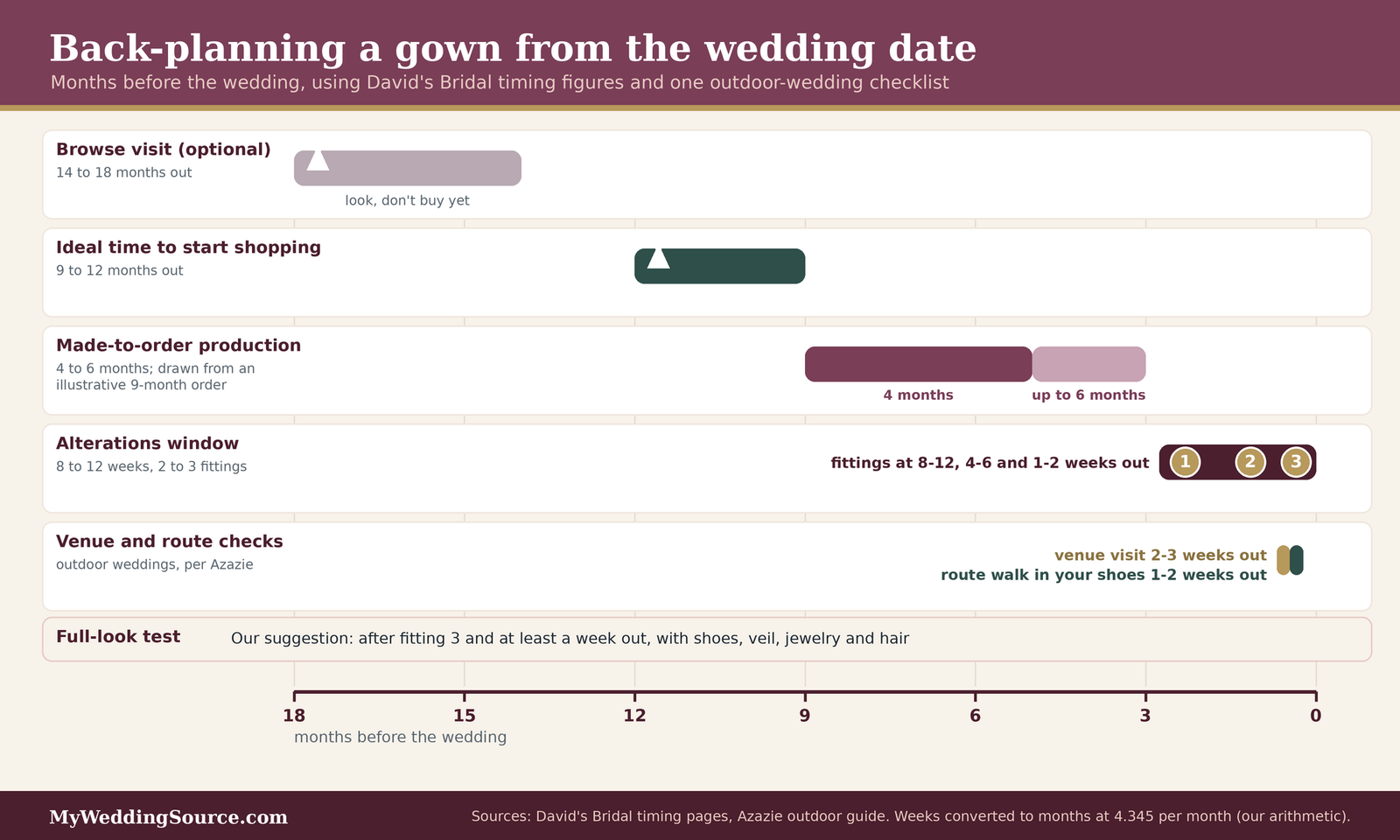
We also place two checks from Azazie’s outdoor guide on the same line: a venue visit 2 to 3 weeks before the wedding and a walk of the ceremony route in your shoes 1 to 2 weeks before. Together with the third fitting, they make the final fortnight a rehearsal and not a surprise.
Buy or assemble the look with a correction path for boho wedding dress
A correction path is a plan for what happens if something is wrong: the fit is off, the fabric disappoints, the color looks different outdoors, or the delivery slips. Buyers of a boho wedding dress often make a purchase plan with no correction path, then discover too late that the return window closed or the policy excluded their size. Building the path before you pay costs a few questions and may save a great deal of stress.
Order or test the highest-risk pieces first in the boho wedding dress decision
The highest-risk piece of a boho wedding dress plan is whatever is hardest to replace or change. For most people, that is the gown, because it is the most expensive, has the longest lead time, and is the least returnable. Smaller items such as the headpiece, jewelry, and shoes are easier to swap, so they can wait until the gown is settled. Order the pieces whose failure would cost the most time or money first, and test them first.
Prioritize fit, lead time, and return rules — boho wedding dress
On returns, The Knot says custom and made-to-order gowns generally cannot be returned because they are made to your measurements, and that ready-to-wear gowns may be returned only if the store’s policy allows it. It lists several online retailers’ policies, including a 30-day window at David’s Bridal for items that are unworn, unaltered, and clean with tags attached, and an exclusion for custom-size dresses at Azazie. Those details change, so confirm the current policy with the seller.
The Better Business Bureau advises checking the cancellation policy for your specific order, since custom orders may carry stricter terms, confirming alteration policies and fees in advance, being clear about delivery schedules, and making sure you can reach the seller if a problem comes up. A website with no contact information, it says, is a warning sign. We would add one practical step: ask for the gown’s care label information. The Federal Trade Commission’s Care Labeling Rule requires manufacturers and importers of wearing apparel to attach permanent care instructions, with several exemptions, including garments custom-made from fabric the consumer supplied. We did not verify how the rule applies to each bridal gown, so treat this as a reason to ask, not as legal advice. A gown with delicate lace or beading deserves a clear answer about how to clean it.
Questions to ask before you pay
- Is this gown ready-to-wear, made-to-order, or custom, and which return or exchange rules apply to each?
- What is the deposit, when is the balance due, and what happens to the deposit if I cancel?
- What is the confirmed delivery date, and what happens if the gown arrives late or damaged?
- Which hem length, train, and sleeve options can a seamstress change, and can you show me how?
- What does the care label say, and how should the lace, embroidery, or beading be cleaned?
- Is there seam allowance to let the gown out as well as take it in?
- Can I see the fabric in daylight, or request a swatch, before I decide?
- Can you put the return policy, the delivery estimate, and the alteration scope in writing?
Avoid custom work before measurements or palette are stable — boho wedding dress
Custom embroidery, a bespoke sleeve, or a hand-dyed color on a boho wedding dress all lock you in, and custom orders are typically the least returnable, according to The Knot. Before committing to custom work, make sure two things are settled. The first is your measurements. Bodies change over months because of weight, exercise, or other life events, and a gown made to a measurement taken early may need more work later. Ask the seller how measurements are taken, whether they will be rechecked before production, and how extra alterations are handled.
The second is your palette. If your venue, flowers, and wedding party colors are still undecided, a custom color or heavy embroidery may not suit what you end up choosing. Wait until the main palette is set. If you want a personal touch earlier, ask about ideas that can be added later, such as a detachable sleeve or overskirt, or heirloom or vintage pieces that Allure Bridals mentions, because they can be added or swapped without remaking the gown. Allure and Kleinfeld both mention convertible or detachable elements for changing the look from ceremony to reception.
Run a full-look test before the final week in the boho wedding dress decision
For a boho wedding dress, a full-look test means wearing every piece together: gown, undergarments, shoes, veil or headpiece, jewelry, and hair, as close to the wedding-day version as you can get. It is the only way to catch conflicts, such as a necklace that snags on lace or a veil that catches on a sleeve. David’s Bridal suggests bringing shoes, undergarments, veil and accessories to fittings for the same reason. We suggest doing one complete test after the third fitting and at least a week before the wedding, so there is still time to fix what you find.
Photograph the combination in similar light — boho wedding dress
Take the full outfit outdoors at the time of day your ceremony will happen, and photograph it from the front, side, and back. Phone photos are fine. Look at them on a larger screen than the phone. You are checking whether the lace shows or disappears, whether the color reads as the shade you chose, and whether sheer panels become more transparent than you expected in strong light.
SLR Lounge and Rangefinder both describe how light changes the look of texture and detail, and SLR Lounge describes golden-hour and open-shade options for portraits. If you can, repeat the test in both direct sun and shade, since a lace overlay and an illusion back can look quite different in each. If something looks off, you still have time to ask the seamstress to adjust the lining or add a layer. Share the photos with your photographer, who may suggest posing or timing that flatters the gown, and see our wedding photography guide.
Document substitutions and backup accessories — boho wedding dress
With a boho wedding dress, decide in advance what you will swap if the plan changes, and write it down. A short list is enough: flat shoes if the ground is soft, a wrap or sleeves if the evening is cold, a hairpin set if the flowers wilt, and an alternate headpiece if the first one is uncomfortable. Pack a small kit with the substitutes, safety pins, a needle and thread in a matching color, and a spare set of any small detachable parts.
Give the list and the kit to a trusted person, such as a bridesmaid or your planner, so the plan does not depend on your memory on the day. Keep copies of your contracts, receipts, and care label information in one place. If you are insuring any part of the day, our wedding insurance guide explains what such policies may and may not cover, and you should read the actual policy for the details. A calm substitution list is the opposite of a costume: it lets the look stay intentional even when conditions change.
The style itself
What makes a wedding dress boho?
There is no official definition, but retailers describe relaxed, flowing shapes in soft fabrics such as chiffon, tulle, and lace, with details like floral appliqués, bell sleeves, open backs, and natural tones like ivory or blush. If a gown has soft movement, one natural-looking detail, and a relaxed line, it is plausibly boho.
How do I keep a boho wedding dress from looking like a costume?
Choose two or three anchor elements and keep everything else quiet. Kleinfeld advises picking one or two romantic details and keeping the rest clean. Avoid repeating one motif across the gown, crown, bouquet, shoes, and paper. Photograph the full outfit in your venue’s light, and ask someone which items they noticed first.
Can a boho wedding dress work at a formal wedding?
Yes, with balance. Adrianna Papell suggests pairing a refined gown with elegant updos and restrained accessories when dressing boho up for a formal or evening wedding. Silk or crepe gives a more polished feel than cotton lace. Check the venue’s dress code and your officiant’s expectations, and see our guides to black tie and ceremony planning.
Fit and comfort
Which fabrics suit warm weather?
Adrianna Papell names chiffon and organza for warm weather, and Kleinfeld lists chiffon, tulle, silk organza, and crepe as outdoor-friendly. The National Weather Service says full sun can add up to 15 degrees Fahrenheit to the heat index, so a layered or lined gown may feel hotter than the forecast. Ask your venue about shade, and try the gown outdoors.
What hem length works on grass?
Azazie suggests a hem 1 to 2 inches above standard floor length, or 2 to 3 inches in spring when grass is soft and wet, and says tea-length or ankle-length hems clear grass entirely. Kleinfeld calls tea-length and midi hems practical on uneven ground. Wear your actual shoes to fittings, because hem length depends on heel height.
Cost, timing, and returns
How much does a boho wedding dress cost?
No source we found reports a price specific to boho styles. The Knot’s 2026 Real Weddings Study, covering 10,474 couples married in 2025, reports an average wedding dress cost of about $2,100, mainly off-the-rack and made-to-order gowns, with alterations excluded. Treat that as a general reference point, and compare it with written quotes from sellers.
When should I order a boho wedding dress?
David’s Bridal describes 9 to 12 months before the wedding as the ideal time to start shopping and says made-to-order gowns take about 4 to 6 months to produce. Off-the-rack and ready-to-ship gowns have no production wait. Alterations typically take 8 to 12 weeks across two or three fittings, so leave room for them.
Can I return a boho wedding dress?
It depends on the seller and the type of order. The Knot says custom and made-to-order gowns generally cannot be returned, and that ready-to-wear gowns may be returned only if store policy allows. David’s Bridal lists a 30-day window for unworn, unaltered gowns with tags. Get the return policy in writing before you pay.
Your next steps
Decide the look
Pick your two or three anchors
Write down the two or three elements of your boho wedding dress that you want noticed first, and sort everything else as quiet. Save three photos that show those anchors, not three photos of whole outfits, so you are borrowing the logic and not copying the picture.
Match the gown to your setting
Use the decision matrix and the scenario table to name your venue’s cautions, then note the flip threshold for your pick. Our wedding planning checklist can hold the attire items alongside everything else.
Lock in the details
Confirm the terms and the schedule
Before you pay, get the deposit, balance date, return and cancellation terms, delivery estimate, and care label information in writing. Book alterations for when the gown arrives, and keep a month of buffer if you can.
Rehearse the day
Add a venue walk-through, a route walk in your shoes, a final fitting, and one full-look test to your calendar. For how it fits the rest of the plan, see our plan a wedding guide.
Sources & methodology
How we built this guide
What we relied on
This guide combines published guidance from bridal designers and retailers on what a boho wedding dress looks like, The Knot’s 2026 Real Weddings Study for the average cost of a wedding dress, David’s Bridal’s timing guidance, a Better Business Bureau consumer tip, two photography publications, a National Weather Service explanation of the heat index, the Federal Trade Commission’s care labeling guidance, and Britannica’s history of bohemianism. Where a statement comes from a retailer, we say so, because retailers describe their own products and processes. The deposit figures, the order-date estimate, the decision matrix, the scenarios, and the two-or-three-anchor rule are our own arithmetic and editorial judgment, and they are labeled as such.
What we did not do
We did not try on, test, or photograph any gowns, and we did not obtain price quotes. We found no source that gives a price or a lead time specific to boho styles, so the cost and timing figures describe wedding dresses in general. This is general information, not legal, financial, or medical advice. Retailer policies, prices, and lead times change, so confirm current terms with your seller and read your contract.
Source list
Government, survey, and reference sources
- Federal Trade Commission, Clothes Captioning: Complying with the Care Labeling Rule: https://www.ftc.gov/business-guidance/resources/clothes-captioning-complying-care-labeling-rule
- National Weather Service, Heat Index: https://www.weather.gov/safety/heat-index
- The Knot, Average Cost of a Wedding Dress (2026 Real Weddings Study): https://www.theknot.com/content/average-cost-of-wedding-dress
- The Knot, Wedding Dress Return: https://www.theknot.com/content/wedding-dress-return
- Britannica, Bohemianism: https://www.britannica.com/topic/bohemianism
- KRCU Public Radio, Consumer Handbook: Tips for buying a wedding or special occasion dress (Better Business Bureau): https://www.krcu.org/2024-03-13/consumer-handbook-tips-for-buying-a-wedding-or-special-occasion-dress
Designer, retailer, and photography sources
- Allure Bridals, Boho Chic: Wedding Dresses for the Free-Spirited Bride: https://allurebridals.com/blogs/inspiration/boho-chic-wedding-dresses-for-the-free-spirited-bride
- Maggie Sottero, Which Boho Wedding Dress Style Is Right for You: https://www.maggiesottero.com/blog/boho-style-wedding-dresses
- Kleinfeld Bridal, Boho chic wedding gown: https://kleinfeldbridal.com/blogs/kleinfeld-bridal-guide/boho-chic-wedding-gown
- Kleinfeld Bridal, Wedding dress styles best for outdoor weddings: https://kleinfeldbridal.com/blogs/advice/wedding-dress-styles-best-for-outdoor-weddings
- Adrianna Papell, Boho wedding dress ideas: https://www.adriannapapell.com/blogs/wedding-planning/Boho-wedding-dress-ideas
- Azazie, Shoes and hemlines: a guide to outdoor wedding dresses on grass: https://www.azazie.com/blog/shoes-and-hemlines-a-guide-to-outdoor-wedding-dresses-on-grass/
- David’s Bridal, How early should you book your wedding dress appointment: https://www.davidsbridal.com/content/wedding-planning/how-early-should-you-book-your-wedding-dress-appointment
- David’s Bridal, The wedding dress alterations timeline: https://www.davidsbridal.com/content/wedding-planning/the-wedding-dress-alterations-timeline
- Rangefinder, Essential tips for capturing stunning wedding dress pictures: https://rangefinderonline.com/news-features/essential-tips-for-capturing-stunning-wedding-dress-pictures
- SLR Lounge, What every photographer should know before shooting rustic boho weddings: https://www.slrlounge.com/rustic-boho-weddings/