

A rehearsal dinner at a brewery can be relaxed, affordable, and memorable, but the bill is built differently from a restaurant’s and the evening is shaped by noise rules and house policies that most couples only discover after they sign.
Quick answer
For a rehearsal dinner at a brewery, treat a food and beverage minimum as money you have already spent, then decide what to buy with it. At smaller headcounts the minimum often absorbs a seated dinner, so the dinner costs you little more than welcome drinks. Above the break-even headcount, every extra guest costs real money. Ask three things in writing before you book: what counts toward the minimum, what is added on top of it, and when the music must stop. Policies vary by brewery and city, so confirm every figure with the venue.
Most advice about the rehearsal dinner assumes a restaurant, and a rehearsal dinner at a brewery breaks that assumption: a private room, a set menu, a per-person price. A brewery turns that on its head, and planning a rehearsal dinner at a brewery starts with seeing how. You are often renting part of a working taproom, promising a spending minimum instead of paying a flat fee, and sharing a building with beer tanks, a kitchen that may or may not exist, neighbors who may or may not enjoy live music, and a staff that has to keep serving the public. None of this is a reason to avoid a rehearsal dinner at a brewery. It is a reason to read the quote differently.
This guide is built around one tool and two risks. The tool is a welcome drinks versus dinner marginal-cost sheet: a way to see what a seated dinner really adds to your bill once a minimum is in play. The risks are the buyout terms and the noise rules, which are where most surprises happen. Along the way we cover food, alcohol, dietary needs, children, weather, timing, and the questions that protect you. Everything about specific breweries comes from pages those breweries published, checked on November 12, 2026, and every worked number is our own estimate, labeled as one. If your rehearsal dinner at a brewery is part of a larger weekend, our guide to wedding weekend event planning shows where it fits.
Why a rehearsal dinner at a brewery works, and what changes in the planning
A rehearsal dinner is usually smaller and looser than the reception. The Knot describes it as typically held the evening before the wedding, after the ceremony run-through, with a start time around 6 or 7 p.m. so guests can go home and rest. It also says the guest list should stay fairly small and more intimate than a welcome party. A rehearsal dinner at a brewery suits that scale, because the taproom offers casual seating, a bar that is already stocked, and a setting that feels like the couple rather than like a banquet hall.
What a brewery space actually is
Before you compare breweries for a rehearsal dinner at a brewery, it helps to be clear about what you are renting. A brewery is not a banquet venue that happens to serve beer. It is a licensed business with its own customers, its own staff schedule, and its own rules, and event bookings are fitted around all of that.
A taproom is a bar first
Most taprooms earn their living from walk-in customers, so an event has to fit around regular service. One Minnesota brewery says plainly that it reviews and schedules each private event individually to keep the taproom open and accessible to everyone. Another describes two kinds of rental: a partial rental that closes off one section while the rest stays open to the public, and a full rental that closes the taproom and patio to non-guests. Expect to hear about open hours, last call, and the days the brewery runs its own events, because those decide when your group can use the space.
Food and licensing are separate jobs
A brewery that pours beer does not necessarily cook. Some have full kitchens, some serve from an on-site food truck, some allow outside caterers, and some allow nothing from outside at all. Licensing rules differ by state and county, which is why the answer at one brewery tells you little about the next one. We cover this in the food and alcohol section, but keep it in mind from the first phone call: the first question is not “how much is the room” but “what is the food plan, and who is allowed to serve it.”
Who this setting fits, and who it does not
Because the setting is casual and the bill is structured around spending, a brewery suits some rehearsal dinners much better than others. Being honest about that early saves a lot of effort.
Groups that tend to do well
A rehearsal dinner at a brewery tends to work when your group is of moderate size, when most guests drink beer or are comfortable around it, and when you want conversation instead of formality. It also works when you want a space that needs little decoration. The Knot’s cost guidance notes that choosing a venue that is already decorated, such as a restaurant, helps you avoid paying for extra decor, and a taproom with its own character does the same job. A buffet or family-style dinner suits the format better than a plated multi-course meal.
When another venue is the calmer choice
A rehearsal dinner at a brewery may be the harder option if many guests do not drink, if you expect several formal toasts that need a quiet room, if you want a plated dinner with a long program, or if your date falls on a weekend when the taproom will be crowded. It can also be harder when a family member needs a quiet, low-stimulation space, because a busy taproom can be loud. None of these rules the brewery out. They are reasons to ask about a private room, a partial rental, or an earlier start. If the group is large and the budget is limited, our look at welcome drinks versus a full welcome dinner can help you decide how much of the weekend should be a meal at all.
Reading a buyout quote for a rehearsal dinner at a brewery: minimums, fees, and the bill under the bill
The word “buyout” gets used loosely. At some breweries it means exclusive use of the whole building. At others it means you reserve a section and promise to spend a set amount. The quote is rarely one number, and the number that matters most, the final bill, is usually bigger than the minimum.
The numbers that make up a quote
Most quotes for a rehearsal dinner at a brewery combine the same handful of parts. Naming each one lets you compare two breweries on equal terms instead of comparing a headline minimum to a headline fee.
The food and beverage minimum
In a rehearsal dinner at a brewery, a minimum is a spending commitment, not a charge. Pintworks Brewpub’s published page, for example, says its hourly minimum is a spend commitment on food and drink and not a rental fee, and that if your total goes over, you pay the difference at the end. Fulton Brewery’s page says its minimums can be met through in-house catering, beer, THC drinks, dessert catering, non-alcoholic drinks, gift cards, or merchandise. Because rules about what counts differ, “what counts toward the minimum” is the single most useful question you can ask.
The rental or booking fee
Some breweries add a fee on top of the minimum, and some waive it when you meet the minimum. Surly Brewing’s beer garden policy lists a $500 rental fee per reservation that covers setup, teardown, and event security. Fulton lists a $250 booking fee that secures the date. Neff Brewing’s rental sheet takes a different approach: the rental fee is waived if food and beverage meets the minimum, and if it does not, the fee is the shortfall. In that example an $800 minimum with $600 in sales produces a $200 fee. Same word, three different mechanics.
The deposit
A deposit holds the date and is usually applied to the final bill, but it may not be refundable. Surly’s policy describes a $1,000 non-refundable deposit that is applied to the final bill. Neff lists a $100 deposit. Ask whether the deposit counts toward the minimum, whether it can be refunded if the brewery cancels, and whether it can move to a new date.
Service charge, gratuity, and tax
This is the bill under the bill. Surly’s policy lists a 20% service charge on all food and beverage, plus separate tax rates for food and for beer. Breckenridge Brewery’s Littleton page says its minimums must be met before adding 8% tax, a 20% gratuity, and a 2% booking fee on food and beverage charges. Fulton adds an automatic 20% gratuity paid to on-site staff. Neff’s sheet says its minimums do not include gratuity. The pattern is consistent: charges are often added on top of the minimum, not inside it. A $2,000 minimum can become a bill in the neighborhood of $2,500 before any extras.
What published brewery pages show
To make this concrete, the table below collects what six breweries say publicly. These are examples of structure, not a price list, and they are not a recommendation of any venue. Each page was read on November 12, 2026, and any of them may have changed since.
| Brewery (space) | Minimum as published | Fee or add-ons as published | Outside food |
|---|---|---|---|
| Surly Brewing (beer garden tent) | Starts at $2,000 | $500 rental; 20% service charge; tax | Not allowed, except specialty cakes and desserts |
| Neff Brewing (taproom) | Partial from $600; full from $1,200, varying by season and day | Rental fee waived if minimum met; $100 deposit | Not allowed in the taproom; gluten-free facility |
| Fulton Brewery (rooms) | From $650 to $3,500, depending on space | $250 booking fee; 20% automatic gratuity | Page does not say |
| Breckenridge Brewery (Littleton) | Tasting room from $1,000 to $2,000 by day | Room fee for the tasting room; tax, gratuity, and booking fee added | Not allowed |
| Pintworks Brewpub | Hourly, from $300 to $1,000; buyout from $5,000 | Page lists no other fees | Page does not say |
| Redemption Rock Brewing | Quoted case by case | Not listed | Welcome, staff help coordinate |
Minimums scale with space and day
Across these pages, a larger space, a Friday or Saturday, or a peak season costs more. Neff’s sheet gives three seasonal tiers and separate rates for weekdays, Friday and Saturday, and Sunday. Breckenridge’s Littleton page lists a lower minimum on Monday and Tuesday than on Friday through Sunday. If your rehearsal dinner at a brewery can move from a Friday night to an earlier day, ask what the minimum does. Many couples have little choice because the rehearsal dinner follows the wedding date, but a weekday wedding or a Thursday rehearsal gives you room to negotiate.
Shortfall rules differ
If you do not reach the minimum, what happens? At Surly, the policy says any shortfall is added to the final bill. At Neff, the shortfall becomes the rental fee, and the sheet says that fee is not taxed. That difference can change your total even when the minimum is identical, so ask how a shortfall is billed, whether it carries a service charge, and whether it is taxed.
Add-ons and surcharges
The small lines add up. Surly’s policy lists a $4.50 per person serving fee for outside desserts, a 10% surcharge on extra food ordered during the event, and $40 per hour for a dedicated guard if you want more security. Breckenridge’s Littleton page lists $10 per guest for brewery tours with a ten-guest minimum, and says extra setup time costs extra. Fulton lists patio seating by the hour. Ask for a full list of potential charges, not just the ones that apply to your plan today.
Partial rental versus full buyout
Neff Brewing’s sheet gives a clear example of the difference. A full rental closes the taproom and the patio to the public and is recommended there for groups of 75 or more. A partial rental closes a section for groups of up to 75, while the rest of the taproom stays open to the public, so the space is not private. Breckenridge’s Littleton page describes its tasting room as fully private, which is a third option: a separate room instead of a section of the main floor.
What a partial rental gives you
For a rehearsal dinner at a brewery, a partial rental is the lower-cost option, and Neff’s published minimums for a partial rental are half those for a full rental at the same season and day. You get a reserved area, but you share the building with other customers, so expect background noise, strangers at the bar, and a restroom line that is not yours. For a small, easygoing group this is often fine. For a dinner with toasts, it can be a trade-off.
What a full buyout adds
A full buyout adds privacy and control to a rehearsal dinner at a brewery. Fulton’s page says that with a full buyout you can bring your own playlist or DJ and plan activities or a stage. A buyout also changes the staffing and noise picture, because the taproom is no longer serving a public crowd. The cost is a higher minimum and, usually, a larger guest count to justify it. Breckenridge’s page suggests full restaurant buyouts for groups of 140 or more, which is a reminder that a “buyout” is often sized for much larger groups than a typical rehearsal dinner.

How a minimum compares with typical rehearsal dinner budgets
The minimum for a rehearsal dinner at a brewery looks small next to a wedding budget, but it can be large next to the rehearsal dinner line in it. The Knot’s cost guidance, drawn from its Real Weddings Study of couples married in 2024, puts the national average rehearsal dinner at about $2,700, covering venue, invitations, catering, and decor. It reports about $1,630 on average for 50 or fewer guests and about $3,139 for more than 100, and regional averages of nearly $3,500 in the Northeast and about $2,000 in the Midwest.
Putting a minimum in context
Our own arithmetic, an estimate and not a finding: a $2,000 minimum is about 74% of that $2,700 national average. With a 20% service charge and 8% tax added, the same minimum becomes roughly $2,560, or about 95% of the average. The comparison is not like for like, because the Knot’s figure includes items a brewery quote does not, such as invitations and decor, and because a given brewery’s minimum may be higher or lower than our example. It does show why a minimum deserves attention at the start of the budget conversation, not the end. Our guides to wedding party costs and the wedding budget can help you place the rehearsal dinner in the larger plan.
Who pays, and what to tell them
The Knot notes that the groom’s parents traditionally host and pay, and that couples increasingly set their own arrangements. If someone else is paying for the rehearsal dinner at a brewery, show them the sheet, not just the headline number. A host who sees that the dinner is nearly free at a smaller headcount, and costly above a break-even point, can make a calmer decision about the guest list. Our guide to wedding cost per guest explains how per-guest numbers hide fixed costs like these.
The welcome drinks versus dinner marginal-cost sheet
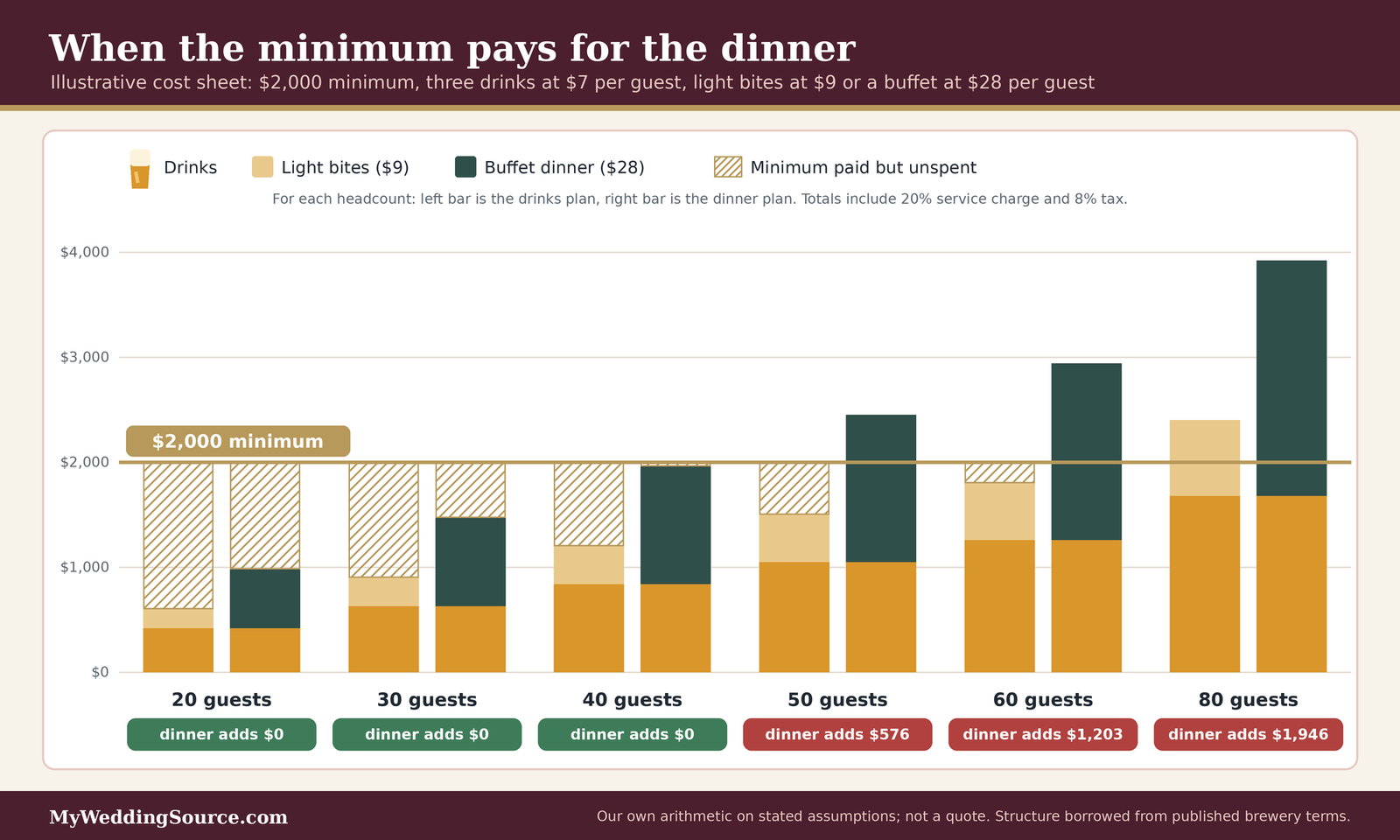
This is the tool at the center of planning a rehearsal dinner at a brewery. The question it answers is simple: if we already owe the brewery a minimum, how much more does a seated dinner cost than a drinks-and-bites evening? The answer is often “nothing” at one headcount and “a lot” at another, and the turning point is calculable before you sign.
The sheet for a rehearsal dinner at a brewery uses an illustrative contract, not a real brewery’s prices. It borrows the structure the published pages share: a minimum, a service charge, and tax added on top. Every dollar figure here is our own assumption or arithmetic, labeled as an estimate. Replace our assumptions with the numbers in your own rehearsal dinner at a brewery quote.
How to read the sheet
A marginal cost is the extra cost of one more step. Here the step is “upgrade from welcome drinks to a seated dinner.” Because a minimum makes the first dollars of spending effectively free, the marginal cost is not the price of the dinner. It is the price of the dinner minus whatever part of the minimum was going to be wasted anyway.
The assumptions
We assumed a $2,000 minimum, a 20% service charge, and 8% tax, all added on top of whichever is larger, the minimum or your actual spending. We assumed guests have three drinks each at $7, which is $21 per guest. The drinks-and-bites plan adds $9 per guest in light food. The dinner plan replaces the light food with a $28 per guest buffet, which is in the range of the in-house buffets Neff Brewing publishes at $20, $25, and $30 per person. These are placeholders. A real brewery may price beer by the pitcher, include a drink package, or charge by the hour.
The formula
For each plan, work out the spending as guests times cost per guest. The billed amount is the larger of the spending and the minimum. The all-in total is the billed amount times one plus the service rate and tax rate, plus any flat fee. The marginal cost of dinner is the dinner total minus the drinks-and-bites total. In our example the break-even headcount is the minimum divided by the dinner cost per guest, which is about 41 guests: $2,000 divided by $49.
What this actually costs
In our illustrative contract, the dinner adds nothing to the bill at 20, 30, or 40 guests, because the minimum already covers it. At 50 guests it adds about $576, at 60 about $1,203, and at 80 about $1,946. Above the break-even point, each extra guest adds roughly $24 to the dinner upgrade, which is $19 more food times 1.28. These are estimates built on our assumptions, not a quote.
A worked example from twenty to eighty guests
The table runs the sheet for a rehearsal dinner at a brewery at six headcounts. Read across a row to see what each plan bills, what it costs per guest, and what the dinner upgrade adds.
| Guests | Drinks plan spend | Dinner plan spend | Drinks plan total | Dinner plan total | Dinner adds | Dinner, all-in per guest |
|---|---|---|---|---|---|---|
| 20 | $600 | $980 | $2,560 | $2,560 | $0 | $128 |
| 30 | $900 | $1,470 | $2,560 | $2,560 | $0 | $85 |
| 40 | $1,200 | $1,960 | $2,560 | $2,560 | $0 | $64 |
| 50 | $1,500 | $2,450 | $2,560 | $3,136 | $576 | $63 |
| 60 | $1,800 | $2,940 | $2,560 | $3,763 | $1,203 | $63 |
| 80 | $2,400 | $3,920 | $3,072 | $5,018 | $1,946 | $63 |
Totals include the 20% service charge and 8% tax on the larger of spending or the $2,000 minimum. Where spending is below the minimum, you are billed the minimum, which is why the first three rows show the same total for both plans.
Where the minimum absorbs the dinner
At 40 guests the dinner plan spends $1,960 on food and beer, which is below the $2,000 minimum. The drinks plan spends $1,200. Both are billed $2,000, and with 28% added, both total $2,560. That means a host planning a rehearsal dinner at a brewery pays the same under either plan. The only difference is what guests eat. In this situation, ordering the dinner is the better value, because you are paying for the room either way. Any smaller gathering follows the same rule, and the all-in cost per guest rises as the group shrinks because the same $2,560 is divided among fewer people.
Where every extra guest costs real money
Once the dinner spend passes the minimum, the dinner plan’s bill grows with every guest while the drinks plan’s bill stays flat for a while. At 60 guests the drinks plan still bills the $2,000 minimum, while the dinner plan bills $2,940. The gap is $940 before the service charge and tax, and $1,203 after. Here the choice becomes a real budget decision, and a middle path is worth pricing: a lighter dinner, a shorter buffet, or heavy appetizers instead of a full meal.
How drinks change the picture
Our drink count is the biggest soft spot in the estimate. If the 40 guests average two drinks, dinner spending falls to $1,680 and the bill is still the $2,000 minimum. At four drinks, it rises to $2,240, so the dinner now clears the minimum and the bill becomes about $2,867. A group that drinks more reaches the minimum with beer alone, and the dinner then costs more at lower headcounts than the table suggests. Ask the brewery whether beer is priced by the glass, by the pitcher, or as a flat package, because that changes how fast the minimum fills.
Fill in your own sheet
Use the steps below with your own quote for a rehearsal dinner at a brewery. It takes about ten minutes and it is the best protection against comparing two venues on the wrong number.
Seven steps
- Write down the minimum, the rental or booking fee, the service charge or gratuity, the tax rate, and any other fee in the quote.
- Estimate guests, and then estimate drinks per guest and the average price. Ask the brewery for the price of a pint, a pitcher, and any non-alcoholic option.
- Price the drinks-and-bites plan and the dinner plan per guest, using the brewery’s own menu and published buffet prices.
- Multiply by guests to get each plan’s spending, then take the larger of that figure and the minimum.
- Add the service charge and tax to each billed amount, then add flat fees.
- Subtract the drinks plan total from the dinner total. That is the marginal cost of dinner.
- Divide the minimum by the dinner cost per guest to find your break-even headcount, and compare it with your guest list.
When the quote hides a piece
If you cannot complete a step, that is information. A quote that does not say whether service charge applies to the minimum or only to actual spending, or whether a shortfall is taxed, is a quote with a gap. Ask for the missing line in writing. Our guide to wedding vendor contract red flags explains how vague totals can turn into surprise charges, and the wedding vendor due diligence checklist helps with the rest of the vendor conversation.
Noise rules at a rehearsal dinner at a brewery: what actually limits the evening
Noise is where a rehearsal dinner at a brewery differs most from a restaurant one. A restaurant dining room is usually quiet by design and rarely needs a rule about it. A brewery with a patio, a band, or a microphone for toasts may run into a city ordinance, a zoning condition, or a house rule that decides when the music stops and how loud it can be. We could not find a single national standard, so the honest summary is that it depends on the city, the property, and the brewery.
Three layers of rules
When people say “the noise rule,” they usually mean one of three different things, and a good question to the brewery separates them.
The city or county ordinance
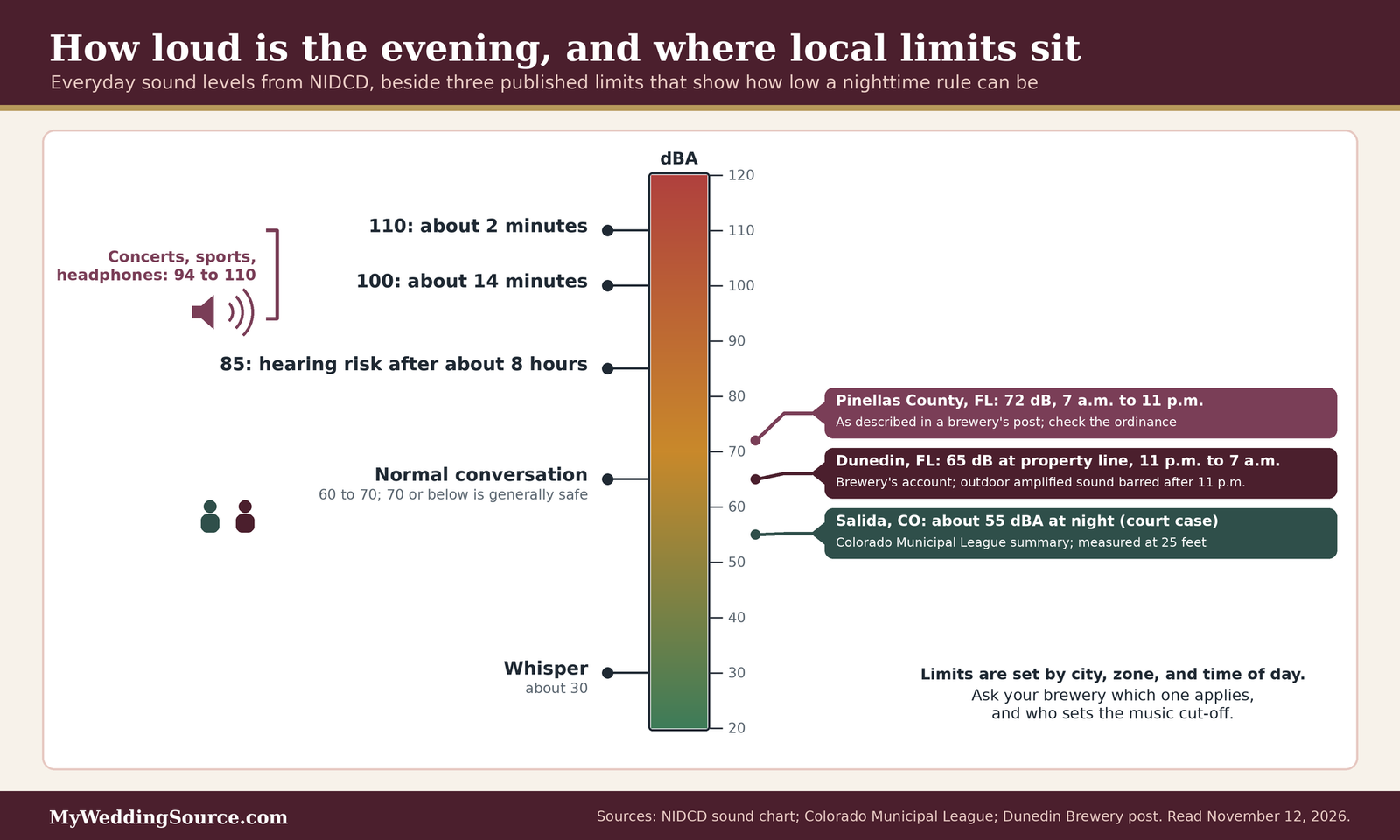
Many local ordinances set a decibel limit measured at a property line, sometimes with different limits by time of day. The Dunedin, Florida ordinance, as described by Dunedin Brewery in a post supporting a proposed clarification, sets 65 decibels at the edge of the property as the nighttime limit between 11 p.m. and 7 a.m., and bars outdoor amplified sound after 11 p.m. The same post says a nearby county ordinance allows 72 decibels from 7 a.m. to 11 p.m. That is a brewery’s account of an ordinance and the post itself is one-sided, so treat it as an example of how these rules are written, not as a statement of current law. In Colorado, a municipal league article explains that the state’s Noise Abatement Act sets limits that depend on the type of property and the time of day, applying to sound that crosses a property line, measured at 25 feet, and that local governments may be stricter than the state.
The brewery’s own house rules
Breweries often set their own limits, because they answer to neighbors and to the city. Surly’s beer garden policy says bands and DJs must be approved in advance and bring their own equipment, that a sound check is required to keep noise from reaching public areas, and that after two requests to lower the volume the brewery may stop the music. Breckenridge Brewery’s Littleton page says the beer garden stage requires a full venue buyout and that music there must end by 7 p.m. under the City of Littleton noise ordinance, and it lists the same 7 p.m. outdoor cut-off for the tasting room patio. The same page says the Great Room does not allow live music.
Zoning and permit conditions
The third layer is the least visible. A brewery in an industrial zone next to homes may have conditions attached to its permits. The Kane County Chronicle reported in September 2021 that the City of St. Charles, Illinois, voted to bar outdoor entertainment, such as live music, at microbreweries in industrial districts next to residential areas, after neighbors near one brewery complained. A rule like that can change between the day you book and the day of your dinner, so ask whether anything about outdoor music has changed recently for your rehearsal dinner at a brewery, not only what the policy was when you first inquired.
Reading the numbers
Decibel figures are easy to quote and hard to picture, so it helps to anchor them to everyday sounds. The numbers below come from the National Institute on Deafness and Other Communication Disorders.
Decibels in plain terms
NIDCD’s chart lists a whisper at about 30 dBA and normal conversation at 60 to 70 dBA. It says sounds at or below 70 dBA are generally considered safe, and that prolonged exposure at 85 dBA can damage hearing after about eight hours, at 100 dBA after about 14 minutes, and at 110 dBA after about two minutes. It places headphones, sporting events, and concerts in a range of 94 to 110 dBA. A rehearsal dinner at a brewery is not a concert, but a band or a loud speaker in a small taproom can climb quickly toward the range where people shout to be heard.
What the local examples show
Put the numbers side by side and the pattern is that local limits are often set near the level of conversation. The Colorado Municipal League summary of the Hobbs v. City of Salida decision notes that the nighttime limit at issue in that restaurant case was about 55 dBA, roughly the level of ordinary conversation, and that the court ruled cities could not broadly permit noise above state limits through private amplified-noise permits. The Dunedin example is 65 dB at the property line at night. These are different places with different rules, and none of them is a number you can apply to your venue. The point is that a nighttime limit can be low enough that an amplified band outdoors would not fit.
Why toasts and music pull in opposite directions
Toasts need a quiet room and a working microphone. Music needs volume. If both happen in one open taproom, one of them loses. Our guide to rehearsal dinner toasts covers speaking order and time limits, and the Knot’s rehearsal dinner checklist suggests giving speakers time limits and telling them when they will speak, typically during or just after dessert. Build the evening so the toasts happen before the music, not on top of it.
Making the room work for toasts
You do not need a quiet building to have a good toast. You need one quiet moment, planned on purpose.
Ask about a microphone and a quiet corner
Brewery pages show different setups. Neff’s rental sheet says a TV, an HDMI cable, and a corded microphone are available at no charge. Fulton’s page says a wireless microphone is included with the Brew Room and a full buyout, and that a Chromecast-to-TV connection comes with all rentals. Ask what is included, who sets it up, and whether the TV or music can be turned off for toasts. If a partial rental puts you beside the bar, ask whether the bartenders can pause the blender, the glass washer, or any background playlist for the length of the toasts. Our wedding audio and lighting checklist covers microphones in more detail.
Decide on a music plan before you sign
For a rehearsal dinner at a brewery, background music from the brewery’s own system is usually enough. If you want a playlist, a guitarist, or a DJ, ask whether outside entertainment is allowed, whether it must be approved, and whether it can use the house system. Surly’s policy says outside bands and DJs cannot plug into the in-house sound system. Ask when outdoor music must end, and whether that time is set by the city or by the brewery. If you want help choosing a performer, our wedding DJ questions guide lists what to ask any DJ before you hire one.
Food, alcohol, and licensing for a rehearsal dinner at a brewery
The food plan is the part of a rehearsal dinner at a brewery that varies the most, because it depends on the brewery’s kitchen, its license, and the health rules of its county. Ask about it first.
Food: in-house, trucks, or outside caterers
Published brewery pages show at least four models. Knowing which one you are dealing with tells you how much flexibility you have and how the minimum will fill.
In-house kitchens and set buffets
Some breweries run a kitchen and expect events to use it. Neff Brewing publishes in-house catering at $20 per person for a taco bar, $25 for a barbecue bar, and $30 for a pub bar, with orders due at least two weeks before the event. Fulton lists buffet-style American fare such as grazing boards, nacho bars, sliders, and charcuterie, with vegetarian and vegan options always available. Breckenridge’s Littleton page says all food is served buffet-style from the in-house kitchen. A buffet suits a brewery well, and it counts toward the minimum.
Food trucks and outside caterers
Others lean on a truck or allow outside catering. Surly’s beer garden policy says food is served from the Surly Food Truck on a prix fixe menu, that truck service is limited to two hours, and that outside food is not allowed except specialty cakes and desserts, which carry a $4.50 per person serving fee. Redemption Rock Brewing’s page says outside food is welcome and staff will help coordinate. If you want a caterer you already like, ask whether any outside caterer is allowed, whether they must be on an approved list, whether they need proof of a health permit, and whether outside food counts toward the minimum. That last question matters a great deal for the marginal-cost sheet, because spending that does not count toward the minimum leaves your shortfall unchanged.
Licensing and who can serve
The rules behind these policies vary by place. Sacramento County, California’s environmental health division says a brewery that hosts caterers needs a host facility permit, and that caterers with a valid health permit may serve tasting room customers for up to four hours in any 12-hour period. That is one county’s guidance, dated August 2019. The New Hampshire Liquor Commission’s 2018 circular says beverage manufacturers there can use caterers, food trucks, or other licensed restaurants, but food has to come from a properly licensed source. The takeaway is not a rule to memorize. It is that the brewery’s food policy often reflects a legal limit, so “we don’t allow outside food” can mean “we are not permitted to.” Ask which part of a policy is the brewery’s choice and which part is a legal limit. Our guide to wedding catering explains how to compare caterers in general.
Drinks: what is on tap and what is not allowed
A rehearsal dinner at a brewery usually means beer, and it usually means a closed bar where outside drinks are not permitted. Plan for those two facts and the rest follows.
Beer-only menus and outside alcohol
Breckenridge’s Littleton page says no wine or liquor may be served or consumed on campus, that only its beers and five flavors of gluten-free hard seltzer are offered, and that outside alcohol is confiscated, with repeated violations leading to guests being asked to leave or the event ending early. Surly’s policy says only Surly beers are served, with soft drinks and water, and that no flasks, wine bottles, or spirits may be brought in. Neff’s bar offers craft beer, wine, local ciders, and soda, but no liquor. So if the family wants a wine toast or a signature cocktail, ask first, and do not count on being able to bring your own. Our article on wedding bar service planning explains the usual bar models, and our open bar wedding guide covers the open-bar option.
Guests who do not drink, and guests who are young
Breckenridge’s page lists hosted, limited, drink-ticket, and cash bar options, which gives you a way to cap spending without cutting off drinks. For non-drinkers, ask which non-alcoholic options are on tap or in cans, and whether they count toward the minimum. Fulton’s page says non-alcoholic beverages count toward its minimum. The wedding mocktails and non-alcoholic beer and wine guides can help you pick an alternative that feels like part of the evening. Fulton and Breckenridge both say children are welcome but must be supervised, and Breckenridge notes minors are welcome with ID checks, so ask whether children are allowed in your reserved space at your time.
Dietary needs at a brewery
Brewery kitchens tend to be small, and dietary needs deserve a direct conversation instead of an assumption.
One example: a gluten-free facility
Neff Brewing’s rental sheet describes a dedicated gluten-free facility, so outside food and catering are not allowed in the taproom. On the patio, guests may serve a non-gluten-free cake if they bring their own disposable plates and cutlery, and an outside cake may come into the taproom only with a receipt showing it is certified gluten-free. That is one brewery’s rule, but it shows why a question like “can we bring our own cake?” has no universal answer.
How to communicate allergies and restrictions
Give the brewery your guest allergies and restrictions in writing, ask who prepares the food, and ask how cross-contact is handled. Fulton’s page says the kitchen has limits but the venue will consider special requests, and Surly’s policy says dietary restrictions and allergies can be accommodated. Treat those as invitations to ask, not guarantees. Our wedding dietary restrictions guide covers how to collect and communicate this information.
Edge cases that change a rehearsal dinner at a brewery
Most of the questions above have a standard answer. The cases below do not, and each one is easy to overlook until it affects your evening.
Date, season, and weather
The calendar and the patio of a rehearsal dinner at a brewery are both tied to the weather and to the brewery’s own events. Neither shows up in a per-person price.
Seasonal windows and blackout dates
For a rehearsal dinner at a brewery in the warm months, Surly’s beer garden policy says bookings run from June 1 through September 30, that it cannot host events on Festival Field dates, brewery-wide event dates, or days the brewery is closed. Breckenridge’s Littleton page says some Saturdays from May to October are reserved for concerts. Neff’s sheet uses three pricing seasons, with a holiday season running from September 16 to January 2. If your date falls in a holiday or peak window, expect a higher minimum, and if it falls near a brewery event, expect to be told no. Ask for a list of dates the space is unavailable before you fall in love with a Saturday.
Rain, heat, and cold
Surly’s policy says events proceed rain or shine with a tent provided, and that for severe weather such as lightning the brewery may require relocation or rescheduling, with date change or cancellation fees possibly applying. Fulton’s page says it does not offer patio-only rentals because of Minnesota weather. If any part of your plan depends on a patio, ask what the indoor backup is, who decides to move, and whether the minimum changes when you move. Our summer wedding heat plan and winter wedding weather plan cover practical comfort steps for guests.
Guests and access
A brewery is a public business, and its rules about who can come in apply to a rehearsal dinner at a brewery as well.
Children, ID checks, and dogs
Several breweries publish rules about each. Breckenridge’s Littleton page says minors are welcome with ID checks and that dogs are not allowed inside except registered service dogs. Fulton’s page says alcohol and THC drinks require valid ID and that dogs are allowed only on the patio. Redemption Rock’s page says children must be supervised at all times and that dogs are not allowed in its rental space except service dogs. If your rehearsal dinner at a brewery includes young cousins or a family dog, check each rule against your reserved space instead of the whole building.
Getting there and getting home
A taproom is a place where many guests will drink, and rehearsal dinners are the night before the wedding, when you want everyone rested and safe. Ask about parking, the distance to hotels, and whether a ride service can pull up close. Our wedding guest transportation planning guide covers shuttles and ride options, and our guide to wedding transportation for guests using wheelchairs is a good reference if any guest needs step-free access. Ask the brewery about entrances, restrooms, and how the reserved space is reached.
When the plan changes
For a rehearsal dinner at a brewery, headcounts shrink, dates move, and brewery policies are built to protect the brewery when they do.
Guest counts and the final order
Surly’s policy says the guaranteed guest count and menu counts are due five business days before the event and that counts cannot be reduced within those five days. Breckenridge’s Littleton page says the order must be finalized two weeks before the event. Neff’s in-house catering orders are due at least two weeks before. If you are still waiting on RSVPs at that point, ask what happens to the minimum when the count drops. Our guides to wedding RSVP etiquette and plus-one etiquette can help you close the guest list sooner.
Cancellation and shortfall
Surly’s policy lists cancellation fees that rise as the date approaches, from 75% of the food and beverage minimum more than 90 days out to 100% within 30 days, and it says cancellation fees cannot be applied as credit to a future event. Read cancellation terms as carefully as you read the minimum, because a minimum you have to pay whether or not the event happens is a fixed cost. If something might disrupt your plans, our wedding insurance guide is a starting point for what event coverage involves, though we cannot tell you what a particular policy will pay, so read the policy itself.
A timeline for a rehearsal dinner at a brewery, from first inquiry to the night itself
The Knot suggests starting to plan about four to five months before the wedding, and confirming the menu with the venue or caterer about two months out. Brewery pages add shorter deadlines that are easy to miss.
Months before
Early decisions are mostly about the space, the minimum, and the rules.
Four to five months out
To plan a rehearsal dinner at a brewery, inquire at two or three breweries, ask for the full terms in writing, and run each through the marginal-cost sheet. Ask for the date list, the music cut-off, and the food policy. Pay the deposit only after you have read the cancellation terms. If your rehearsal dinner at a brewery is part of a bigger set of events, tie it to your wedding planning checklist.
Two months out
Confirm the menu and any beverage package, and ask what happens to the minimum if the count changes. Share dietary needs in writing. Confirm the toast plan and who has the microphone. If you hired outside vendors such as a florist or a musician, send them the brewery’s rules on decorations and sound, because Surly’s policy, for example, lists glitter, confetti, flower petals, and flames among prohibited items.
The final weeks
Short deadlines are where minimums become fixed costs, so mark them on a calendar.
Two weeks out
Finalize the order and confirm the headcount. Breckenridge’s Littleton page and Neff’s catering terms both use two weeks. Ask for the final event order in writing, including the minimum, the service charge, tax, and each fee. Check it against your sheet.
Five business days out
Surly’s policy sets the guaranteed count at five business days and does not allow reductions after that. Even where the brewery is more flexible, treat this as your last chance to change a number. Confirm start time, setup access, and who your contact is on the night.
The evening itself
A short run of show keeps a rehearsal dinner at a brewery from drifting.
A simple run of show
Arrive early for setup, because published setup windows are short, for example thirty minutes at Surly and one hour at Breckenridge’s Littleton location. Plan drinks and mingling first, dinner next, and toasts around dessert, as The Knot suggests. Hold music until after the toasts. Leave a margin before the outdoor cut-off and before the brewery’s closing time.
Who handles what
Name one person to handle the brewery’s staff, the bill, and any requests to lower the volume. A rehearsal dinner at a brewery is not the evening for a couple to troubleshoot a speaker. A parent, a sibling, or a planner can do it. Our guide to the wedding rehearsal explains the ceremony run-through that comes first, and the wedding week checklist helps you place both in the final days.
Questions to ask before booking a rehearsal dinner at a brewery
Good questions protect a rehearsal dinner at a brewery from vague answers. Ask for each answer in writing, and keep the list short enough that you will use it.
Questions worth asking before you sign
- What counts toward the food and beverage minimum, and what does not?
- Which charges are added on top: service charge, gratuity, tax, booking fee, security?
- If we fall short of the minimum, how is the shortfall billed, and is it taxed?
- Is the space private, or does the public share the room?
- When must music and amplified sound end, and who sets that time?
- What is the food plan, and are outside caterers, cakes, or food trucks allowed?
- When are the final count and the final order due, and can the count go down?
- What are the cancellation terms, and does the deposit move to a new date?
About the money
These questions make sure the number you compare is the number you will pay.
On the minimum and the fees
For a rehearsal dinner at a brewery, ask for the minimum, the rental or booking fee, the deposit, and every percentage in one written quote. Ask whether the service charge applies to the minimum or only to actual spending. Ask whether drinks bought for guests who arrive early or stay late count. Ask whether the minimum changes with the day, the time, or the season, and whether you can choose a time slot where it is lower.
On payment and deadlines
Ask when the balance is due, how it is paid, and whether a card is held on file. Surly’s policy, for instance, says payment must be pre-authorized before the event starts and that it does not accept wire transfers or post-event payment. Ask when the deposit is refundable, and what happens if the brewery must cancel or close.
About the room and the rules
These questions surface the constraints that shape the evening.
On sound, space, and setup
Ask what the noise rule is and who sets it. Ask whether the space is partial or full, which restrooms and entrances your group uses, how early setup can begin, and what decorations are allowed. Ask whether the brewery has other events on your date, and how it handles the two groups.
On food, drinks, and people
Ask about the food plan, outside caterers, outside cake, and any fee for it. Ask about non-alcoholic drinks, dietary needs, and whether guests under 21 are allowed in your space at your time. Ask what happens if a guest brings outside alcohol. Brewery policies, such as Breckenridge’s, say outside alcohol may be confiscated.
Cost and minimum questions
Is a minimum for a rehearsal dinner at a brewery the same as a rental fee?
No. A minimum is a spending commitment on food and drink, and you pay it only to the extent you do not spend that much. Some breweries also charge a separate rental or booking fee, and some turn any shortfall into a fee. Ask which structure applies and whether tax or a service charge is added.
Does outside food count toward the minimum?
Published policies describe spending with the brewery, so outside purchases are unlikely to count, but confirm it. Fulton’s page lists the in-house items that count, and Surly charges a per person fee for outside desserts. Ask in writing, because spending that does not count leaves your shortfall unchanged.
Noise and music questions
Can we have live music at a rehearsal dinner at a brewery?
Sometimes. Published policies differ: Surly requires approval and a sound check, Breckenridge’s Littleton page ends outdoor music at 7 p.m. under the city noise ordinance, and its Great Room does not allow live music. Ask whether outside performers are allowed, whether they can use the house system, and when sound must stop.
What noise level is too loud for toasts?
No single number applies. The National Institute on Deafness and Other Communication Disorders lists normal conversation at 60 to 70 decibels and calls 70 or below generally safe. Local limits vary by city and time of day. For toasts, aim for a room where people can hear a speaker without shouting, and ask about a microphone.
Planning and access questions
How far ahead should we book a rehearsal dinner at a brewery?
The Knot suggests starting to plan about four to five months before the wedding and confirming the menu about two months out. Brewery pages add shorter deadlines, such as final orders two weeks before and guaranteed counts five business days before. Inquire early, because some dates and seasons are restricted.
Can children and dogs come?
It depends on the brewery and the space. Fulton and Breckenridge say children are welcome but supervised, with ID checks for alcohol, and Breckenridge and Redemption Rock restrict dogs to service dogs inside. Fulton allows dogs on the patio. Ask about your reserved space and time, not just the building.
Food and alcohol questions
Can we bring our own caterer, cake, or wine?
Often not, and sometimes the limit is legal. Surly allows only specialty cakes and desserts, Redemption Rock welcomes outside food, and Breckenridge and Surly prohibit outside alcohol. Neff allows outside cake only with a certified gluten-free receipt. Check each rule with the brewery before you hire anyone.
What if some guests do not drink?
Ask what non-alcoholic drinks the brewery offers and whether they count toward the minimum. Fulton’s page says they do. Breckenridge offers hosted, limited, drink-ticket, and cash bar options, which can cap spending. Having soda, water, and a few non-alcoholic choices ready lets every guest take part in the toasts comfortably.
Your next steps
Compare the options
Run two breweries through the sheet
For your rehearsal dinner at a brewery, pick two candidate breweries, collect the full written terms from each, and fill in the marginal-cost sheet with your guest count. Compare the all-in cost per guest, not the headline minimum. Our wedding venue questions guide can help with the broader venue conversation, and our guide to wedding venue cost shows how fees stack up.
Settle the noise and food rules
Write down the music cut-off, the microphone setup, the food plan, and the outside food rules for each candidate. If one answer is missing, ask again in writing before you move to the next step.
Protect the evening
Lock in the details
Get the final terms of your rehearsal dinner at a brewery in writing, calendar the two-week and five-business-day deadlines, and name one person to handle the brewery on the night. For toasts, see our guide to rehearsal dinner toasts, and for the larger weekend, see wedding weekend event planning.
Look at related plans
If your wedding is far from home, read our upcoming guide to a rehearsal dinner for a destination wedding. If you are deciding who needs to be at the run-through, see who needs to attend a ceremony rehearsal. To weigh a lighter evening, our guide to welcome drinks versus a full welcome dinner is a useful companion.
Sources & methodology
How we built this guide
What we relied on
This guide to a rehearsal dinner at a brewery combines event policies that breweries published on their own websites, a county environmental health guide and a state liquor commission circular on brewery food service, a National Institute on Deafness and Other Communication Disorders chart of everyday sound levels, a Colorado Municipal League legal article on state noise limits, local news and a brewery’s own account of two local noise rules, and The Knot’s planning and cost guidance. We read each page on November 12, 2026. Brewery pages are the breweries’ own statements of their policies, so we describe them as published and do not treat them as independent evidence. All cost-sheet figures are our own arithmetic on stated assumptions and are labeled as estimates.
What we did not do
We did not request quotes, visit any brewery, or measure any sound level. We did not check whether any page changed after November 12, 2026, and prices, minimums, and policies change often. Noise ordinances, alcohol licensing, and health-permit rules vary by city, county, and state, and this guide is not legal, insurance, or financial advice. Confirm every figure and rule with your own brewery and, where it matters, with your local government. We named breweries only as examples of published policy and do not endorse or recommend any of them.
Source list
Brewery event policies (as published)
- Surly Brewing Co., Beer Garden Event Policies: https://surlybrewing.com/wp-content/uploads/2024/01/Beer-Garden-Event_Policies.pdf
- Neff Brewing, Taproom Rental Information: https://www.neffbrewing.com/wp-content/uploads/2024/04/Updated-10_25_23-TAPROOM-RENTAL-INFORMATION-6.pdf
- Fulton Brewery, Host Your Event at Fulton: https://fultonbeer.com/visit/host-your-event-at-fulton
- Breckenridge Brewery, Private Event at the Farmhouse (Littleton): https://www.breckbrew.com/?p=1982
- Pintworks Brewpub, Private Events: https://touchstoneclimbing.com/tsc-brewing-co/private-events
- Redemption Rock Brewing Co., Private Events Policy: https://redemption-rock-brewing-co.squarespace.com/event-policy
Government and regulatory sources
- Sacramento County Environmental Management Department, Food Distribution at Wineries and Breweries FAQ (August 23, 2019): https://emd.saccounty.gov/EH/Documents/FOOD%20DISTRIBUTION%20AT%20WINERIES%20%26%20BREWERIES%20FAQ%2008%2023%2019.pdf
- New Hampshire Liquor Commission, Industry Circular 2018-03 (food and beverage manufacturers): https://www.nh.gov/liquor/enforcement/industry/documents/industry-circular-food-18-03.pdf
- National Institute on Deafness and Other Communication Disorders, How Loud Is Too Loud: https://www.noisyplanet.nidcd.nih.gov/sites/noisyplanet/files/ShareableImages/HowLoudisTooLoud_Bookmark.pdf
Planning guidance, legal commentary, and local news
- Colorado Municipal League, Legal Corner: State noise limits apply to local amplified noise permits: https://www.cml.org/home/publications-news/article-detail/legal-corner-state-noise-limits-apply-to-local-amplified-noise-permits
- Dunedin Brewery, Dunedin sound ordinance clarification info (a brewery’s own account): https://dunedinbrewery.com/home/blog/dunedin-sound-ordinance-clarification-info
- Kane County Chronicle, outdoor music ban for St. Charles microbreweries (September 2021): https://www.shawlocal.com/kane-county-chronicle/news/government/2021/09/09/outdoor-music-ban-to-go-into-effect-for-st-charles-microbreweries-in-industrial-districts-next-to-residential-areas
- The Knot, Rehearsal dinner checklist: https://www.theknot.com/content/planning-a-rehearsal-dinner
- The Knot, Average cost of a rehearsal dinner: https://www.theknot.com/content/average-cost-rehearsal-dinner
- The Knot, Real Weddings Study: https://www.theknot.com/content/real-weddings-study