
A prenuptial agreement before wedding day is a contract about money and property that two people sign while they are still free to walk away, and the quality of that contract depends far more on the calendar, the lawyers, and the paperwork than on how romantic or unromantic the idea feels.
Quick answer
Start a prenuptial agreement before wedding invitations go out, not after the venue deposit is paid. Most states set no minimum waiting period, but a few do, and courts look hard at agreements that were rushed. Each person should have a separate lawyer, each should share a full list of assets and debts, and the final draft should be in both people’s hands for weeks, not days. This guide is general education, not legal advice; the rules in your state control.
If you are reading this, a prenuptial agreement before wedding may already be a live question in your engagement, or someone close to you has raised it. Either way, the conversation is easier when it is concrete. This guide explains what a prenuptial agreement before wedding planning gets serious can and cannot do, how to work backward from your date, why separate counsel and honest disclosure matter, what the process tends to cost, and which parts of the agreement courts refuse to honor no matter how carefully it was drafted. It focuses on timing because timing is the part couples control. For the broader paperwork of getting married, see our marriage license guide.
We are not lawyers, and nothing here replaces one. Marital property law is state law, and it differs on points that matter, so we use a few state examples to show how the pieces fit rather than to describe your jurisdiction. Wherever we state a rule, we name where it comes from. Wherever we do arithmetic or build a calendar, we label it as our own estimate.
What a prenuptial agreement does, and what it cannot do
A prenuptial agreement before wedding day is easiest to judge once you know its job. It is a written contract between two people who plan to marry, and it takes effect when they do. Legal reference sources describe it as a contract made before marriage that sets the terms for separation. It does not predict divorce. It decides, in advance, which rules apply if the marriage ends or one spouse dies.
The job a prenup is built to do
Without a prenuptial agreement before wedding in place, your state’s default rules decide how property is characterized and divided. Those defaults can be reasonable, and for many couples with modest, similar finances they may be perfectly fine. A prenuptial agreement before wedding replaces some of those defaults with terms the two of you chose. That is the whole point, and it is also why courts want evidence that both people understood the choice.
Replacing default rules with your own
State default rules usually sort property into marital and separate categories and then divide the marital portion. A prenup can say, for example, that a business one person started before the marriage stays that person’s property, that an inheritance stays separate, or that a home bought before the wedding is treated in a particular way. FindLaw’s overview of prenups describes common uses such as protecting business interests, clarifying who is responsible for debts, and preserving inheritances for children from a prior relationship.
Not always better than the default
FindLaw also notes something couples sometimes miss: depending on your state’s rules, a prenup could give one person fewer rights than the default division would. That is not a reason to avoid one. It is a reason to ask a lawyer, before signing, to compare what you would receive under your state’s defaults with what the agreement gives you. If the agreement is worse for you, you should be signing it knowingly.
What a prenup can cover
The range of terms a prenuptial agreement before wedding may include is wide. The Texas Family Code, as one example of a state statute, lists subjects spouses-to-be may agree on. They include how property owned now or acquired later is owned and managed, what happens to property on separation, divorce, or death, changing or waiving spousal support, creating a will or trust to carry out the agreement, who owns and receives the death benefit from a life insurance policy, and which state’s law governs the agreement. New York’s Domestic Relations Law lists similar categories, including waivers of the right to elect against a will and provisions for the ownership and division of separate and marital property.
Property, debt, and income
Most versions of a prenuptial agreement before wedding focus on the money categories: premarital assets, gifts and inheritances, growth in a business or investment account, retirement savings, real estate, and debt. Debt deserves more attention than it usually gets. A prenup can set out which debts stay with the person who brought them into the marriage. The Knot’s guidance for couples recommends talking about debt before the wedding so both people begin with the same picture.
Spousal support and death
Many a prenuptial agreement before wedding includes terms on spousal support, sometimes called maintenance or alimony, and what each person receives if the other dies. These are also the terms courts examine most closely, because they can leave one spouse in difficulty. New York’s statute, for example, requires that maintenance terms be fair and reasonable when the agreement is made and not unconscionable when a final judgment is entered. Treat support and death provisions as the part of the document where a second set of professional eyes matters most.
What a prenup cannot do
Some limits come up in almost every state. A prenup cannot be used to decide matters that belong to courts and to the children themselves, and it cannot be used to punish or penalize.
Children, custody, and support
FindLaw states that courts will not uphold advance agreements about child custody and child support. The Texas statute says a premarital agreement cannot adversely affect a child’s right to support. The model Uniform Premarital and Marital Agreements Act, as summarized in a Michigan legislative analysis, likewise bars enforcement of terms that adversely affect custodial rights. Whatever else you put in a prenuptial agreement before wedding, plan on those issues being decided later, by the facts at that time and by a court if necessary.
Everyday life and anything that encourages divorce
FindLaw also lists non-monetary matters, such as who does the dishes, as unenforceable. Legal reference material from Cornell’s Legal Information Institute adds a public-policy limit: provisions that tend to unreasonably encourage divorce or separation are unenforceable. The Michigan analysis of the uniform act similarly says an agreement cannot penalize a party for seeking a divorce. In practice, this means a lawyer will usually steer you away from clauses about household chores, social media rules, or financial penalties for specific behavior. They add length and risk and rarely survive review.
Prenuptial agreement before wedding day: why the timing matters
Timing is where good intentions fail. A prenuptial agreement before wedding that is fair on paper can still be challenged if one person can say they signed it under pressure, without time to read it, or without a lawyer. Courts decide those arguments on the facts, and the facts are mostly dates.
What the law says about timing, and what it does not
Most states do not give a fixed number of days for a prenuptial agreement before wedding signing. Their statutes generally require a signed writing and ask whether the agreement was voluntary and whether disclosure was fair. A few are more specific. LegalZoom’s article on when to start a prenup reports that Minnesota and California each require a seven-day gap, with Minnesota measured from signing to the wedding. We read the California statute text (an older version, noted below), but we could not confirm Minnesota’s directly, so treat that detail as LegalZoom’s report and check it if you live there.
The California example
California Family Code section 1615, in the version we reviewed, treats an agreement as not voluntary unless a court finds several things, including that the person either had their own lawyer or waived one in a separate writing after being advised to get one, and that at least seven calendar days passed between when that person first received the agreement and was advised to seek counsel and when they signed. The version we read was the 2011 text as posted by Justia, which notes that newer versions exist, so check the current text on the California legislature’s site if the rule matters to you.
Where no minimum exists
In states with no minimum, there is still a practical test for any prenuptial agreement before wedding: did each person have a fair chance to read, question, negotiate, and decide? Texas, for example, asks whether the person signed voluntarily and whether, if the agreement was unconscionable when signed, the person received fair disclosure or waived it in writing. The law does not say “four weeks.” A judge looks at the whole record. That is why a documented, unhurried process is the best protection for both people.
How courts treat late signing
Late signing of a prenuptial agreement before wedding is a risk factor, not an automatic defeat. LegalZoom reports that courts do not automatically invalidate late-signed agreements and that timing is one factor among several, alongside disclosure, legal representation, and the reasonableness of the terms. It gives examples of a Missouri case in which a prenup signed on the wedding day was upheld and a New Hampshire case in which one signed on the wedding day was upheld because the spouse had received the draft sixteen days earlier. We did not read those opinions ourselves, so treat them as illustrations reported by a legal-services company.
Why a surviving agreement is not a safe plan
It is tempting to read those examples as permission to leave a prenuptial agreement before wedding until the end. They are better read as warnings that courts will weigh everything else heavily when timing is poor. If an agreement is signed close to the wedding, the other safeguards, separate counsel, written disclosure, a draft delivered early, need to be strong. A couple who has all of those is usually not in a last-minute situation anyway.
How the pressure shows up
Pressure does not require a villain. It can be an assumption: the guests have booked flights, the deposits are paid, and one person feels they cannot refuse a document they only just saw. Courts look at that practical reality. A wedding that is a few days away makes a prenuptial agreement before wedding harder to refuse and harder for either person to say no, and that difficulty is exactly what an unhurried calendar prevents.
A backward calendar from your wedding date
The most useful tool for a prenuptial agreement before wedding is a calendar that starts at the wedding and counts backward. The one below is our own planning model, built from the lawyer rules of thumb LegalZoom reports (some attorneys suggest about thirty days, others about two weeks, and some will not take a case closer than about three months) and from the seven-day California floor described above. It is an editorial estimate, not a legal requirement.

The stages, counted backward
Think of the work on a prenuptial agreement before wedding as five stages: decide, hire, disclose, draft and negotiate, then sign with a buffer. Each takes longer than people expect, and the stages overlap less than you would like because each needs the previous one to be finished.
Six months out: decide and hire
LegalZoom reports that starting three to six months ahead usually costs less with a traditional attorney, because no one has to rush. Six months before the wedding is a good time to decide whether you want a prenuptial agreement before wedding arrangement, tell each other, and each choose a lawyer. If one of you is surprised by the topic, that conversation alone can take a few weeks. Build that time in; it is not wasted.
Four to three months out: disclose and draft
This is when each person gathers financial information and the first draft is prepared. Complex situations, such as a business that needs a valuation, take longer. The Knot’s guidance quotes a family law attorney noting that businesses may need to be valued, which can lengthen the process. If you own a company, a property portfolio, or complicated equity compensation, start at the early end of this range.
Two months out: negotiate
Negotiation is normal and does not signal trouble. The Knot’s cost guidance explains that disagreements over how assets are divided, and extra rounds of revisions, add billable time. If the first draft is far from what either of you expected, you want weeks for the second and third drafts, not days.
Six weeks out: sign with a buffer
Our model aims for signing a prenuptial agreement before wedding about six weeks before the wedding. That is not a legal rule. It leaves a buffer for a scheduling problem, a notarization, or a last correction, and it keeps you well outside the thirty-day and two-week rules of thumb some attorneys use and the seven-day floor in California.
What to do if you are already inside the window
Many couples read this guide when they are already three months out or closer. That is workable if both people want an agreement and both act quickly. It is not workable if one person is learning about the idea this week.
Under three months
If you want a prenuptial agreement before wedding and you are inside the window some firms will not accept, call several firms and ask, in the first conversation, whether they take cases on your timeline. Also ask whether a rush changes the fee. We found no authoritative figure for rush pricing, so any number a firm quotes is theirs. Move disclosure to the top of the list, because it is the part that can be done in parallel with finding a lawyer.
Under one month
With a prenuptial agreement before wedding this close, the question is not how to speed up. It is whether an agreement is still the right decision. A signing that is rushed can be worse than none, because it creates a document that may be challenged. Some couples decide to sign a postnuptial agreement after the wedding instead. The Knot’s guidance and FindLaw both note that postnuptial agreements exist for couples already married, and The Knot adds that they carry additional legal requirements and different standing under the law, so talk to a lawyer before choosing that path.
Separate counsel: why two lawyers protect both people
The single most common shortcut in a rushed prenuptial agreement before wedding is one lawyer for both people. It feels efficient and friendly. It is also the choice that most often creates the problem a prenup is supposed to avoid.
Why each person needs their own lawyer
A lawyer owes duties to a client. When two people with different financial interests sit across from one lawyer, the lawyer cannot advise one to bargain harder against the other. FindLaw recommends that each spouse consult a separate lawyer, ideally from a different firm, to protect their own interests. The Knot’s cost guidance quotes an attorney saying each partner typically hires their own attorney to avoid conflicts of interest.
What a lawyer actually does for you
For a prenuptial agreement before wedding, a lawyer explains your state’s default rules, tells you what you are giving up, spots clauses that may not be enforceable, and makes sure the signing is done in the form your state requires. New York’s statute, for example, requires an agreement to be written, signed, and acknowledged in the manner required to entitle a deed to be recorded. The Texas Family Code requires a signed writing. A lawyer who works in your state knows which formalities apply.
How separate counsel helps the agreement survive
Counsel is also evidence that a prenuptial agreement before wedding was made fairly. The California statute text we reviewed treats an agreement as not voluntary unless the person had a lawyer or waived one in a separate writing after being advised to get one. The Michigan analysis of the uniform act lists access to independent legal representation as one of its core protections. In a later dispute, the record that each person was advised and had a lawyer is among the strongest facts supporting enforcement.
When one lawyer is involved anyway
Sometimes the facts of a prenuptial agreement before wedding push toward a single drafter. A couple may agree on every term and want an efficient process. The Knot’s cost guidance describes a common compromise: one attorney drafts for one person and recommends a colleague to review for the other.
The draft-and-review model
In this model, the first person’s lawyer prepares the draft, and the second person hires a separate lawyer to review it, explain it, and negotiate changes. The second lawyer works only for the second person. This usually costs less than two full drafting engagements and still gives each person independent advice.
Representing yourself, and why to avoid it
You may see templates and online services advertised. Zola’s article describes online options from free templates to a paid service, and notes that free templates are not very trustworthy; the article is labeled as a paid advertisement for a prenup service, so weigh that. The Knot quotes an attorney who advises against writing your own: just because you can does not mean you should. FindLaw says couples can draft a basic prenup themselves but each should have it reviewed by their own attorney. A review by an attorney licensed in your state is the minimum.
Financial disclosure: building the packet
Disclosure is the part of a prenuptial agreement before wedding that couples tend to underestimate and lawyers tend to insist on. An agreement is only as solid as the information behind it. If one person hid a debt or undervalued a business, the other person can argue they did not know what they were giving up.
What the law asks of you
The Texas and California statutes we reviewed both frame the disclosure question in the same way. A person who challenges an agreement can succeed if it was unconscionable when signed and, before signing, they were not given fair and reasonable disclosure of the other person’s property or financial obligations, did not waive further disclosure in writing, and did not have, and could not reasonably have had, adequate knowledge of those things. The Michigan analysis of the uniform act lists adequate financial disclosure as a required protection.
Fair and reasonable disclosure
The phrase suggests a good-faith, reasonably complete picture, not a forensic audit. A statement of assets and liabilities with supporting documents is the usual way to show it. FindLaw recommends full disclosure of assets and liabilities with financial statements attached to the agreement. The Knot describes the same step: each person prepares a list of assets and liabilities that the attorney uses to draft the agreement.
Waiving more disclosure
Both statutes mention a written waiver of the right to further disclosure. A waiver is not a shortcut. It works only if it is knowing and in writing, and it leaves you without information you may later wish you had. If you are asked to waive, ask your lawyer what you would be giving up.
Build the packet in a weekend
You do not need a lawyer to start gathering information for a prenuptial agreement before wedding. Doing it first speeds everything else and reduces legal time.
What to collect
A practical packet contains the following. This list is our own checklist, not a statutory form, and your lawyer may ask for more or less.
- A list of bank, brokerage, and retirement accounts with recent balances.
- Real estate, with ownership details and current mortgage balances.
- Business interests, with ownership percentages and any valuations or financial statements.
- Debts, including student loans, credit cards, car loans, and personal loans.
- Expected inheritances or trusts you know about, and any family arrangements that affect your assets.
- Income documents, such as recent pay stubs or tax returns.
Value things honestly, and say when you do not know
Where a value is uncertain, say so and give your best estimate with the basis. A range with an explanation is safer than a precise number you cannot support. If an item needs an appraisal, such as a business or unusual property, raise it with your lawyer early, because that can add weeks.
Why last-minute is risky: a risk register
A prenuptial agreement before wedding signed in a hurry rarely fails because one thing went wrong. It fails because several small things stacked together. The list below is a risk register, our own way of organizing the risks reported by courts, statutes, and attorneys. Use it to check your own timeline.
The risks that come from the calendar
The most common problems are about time itself. Each makes the others worse.
Not enough time to read and understand
If the final draft arrives days before the wedding, it is hard for either person to read it carefully, ask questions, and wait for answers. LegalZoom’s summary lists pressure into unwanted terms, higher legal fees, unease about signing, and a greater risk of enforceability problems as consequences of late starts. Giving yourself weeks removes most of that.
Not enough time to negotiate
A first draft of a prenuptial agreement before wedding is a starting point. If you have no time left for revisions, the person with less bargaining power usually accepts what is on the page. That is the exact situation that fairness rules are meant to catch, and it is a bad way to begin a marriage even if a court never sees it.
Not enough time to find the right lawyer
Some firms will not take a case close to a wedding, as LegalZoom reports. If you begin late, you may be limited to whichever lawyer will say yes, not the one who is right for your situation.
The risks that come from the process
Other problems with a prenuptial agreement before wedding come from how it was made. These are the facts a court is most likely to examine in a challenge.
One-sided disclosure
In a prenuptial agreement before wedding, if one person’s finances are well documented and the other’s are vague, the vague side creates the opening for a later challenge. Both packets should be complete, even if one person has far less.
No independent advice
A prenuptial agreement before wedding signed without a lawyer for one side is harder to defend. In California, as the statute text we reviewed shows, the absence of counsel, without a written waiver after advice to get one, can mean the agreement is treated as not voluntary.
Terms that look unconscionable
The word has a legal meaning. In the Texas and California statutes we read, unconscionability is decided by the court as a question of law. A term that leaves one spouse with nothing, or sets up a result no reasonable person would accept, invites scrutiny. Fairness is a risk-management tool as much as a moral one.
What a prenup costs, and what drives the bill
Cost is a real constraint for a prenuptial agreement before wedding, and it is also where the available information is thinnest. Published ranges come from attorneys and companies with different incentives, and none of them is a national price list. We report them with attribution and avoid calling any one of them typical.
What this actually costs
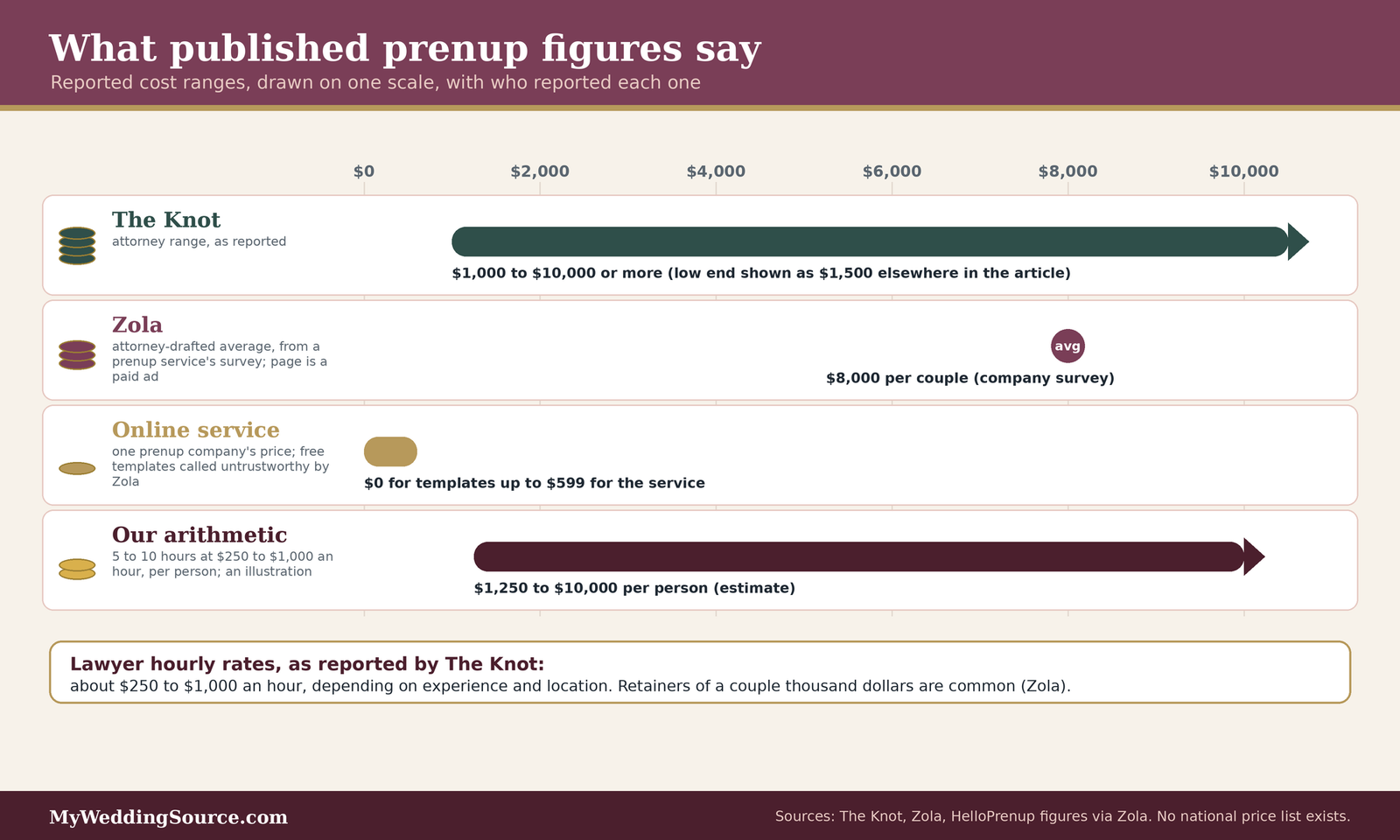
The Knot reports that couples should expect roughly $1,000 to $10,000 or more for a prenup, with attorney hourly rates of about $250 to $1,000 depending on experience and location, and one attorney it quotes says no average is possible because it varies city by city. Zola’s article cites an attorney-drafted average of about $8,000 per couple from a survey run by a prenup service, and it is a paid advertisement for that service, so treat that figure as one company’s number. Your own quote will depend on your city, your assets, and how much you negotiate.
What the published figures say
Three kinds of figures circulate: ranges from editorial guides, averages from companies that sell prenup services, and hourly rates from lawyers. They answer different questions.
Ranges, rates, and averages
The Knot’s cost article gives a range of $1,000 to $10,000 or more in one place and $1,500 to $10,000 or more in another, so the low end is not fixed. It states attorneys may charge hourly rates of $250 to $1,000. Zola’s article cites $8,000 as the average attorney-drafted prenup per couple, from a HelloPrenup survey of family law attorneys, and lists online prenups from $0 for free templates to $599 for HelloPrenup’s service, with extra attorney review options.
Why the numbers do not agree
Different samples, different cities, and different scopes explain most of the gap in what a prenuptial agreement before wedding costs. A simple agreement between two people with modest, similar finances is a different job from one that covers a business, multiple properties, and support terms. When you request quotes, ask what is included, and compare the same scope.
Where the money goes
The Knot’s cost guidance names legal fees as the largest expense, then complexity, negotiation time, and smaller fees such as court filing and notary charges. Zola’s article adds that attorneys usually require a retainer of a couple thousand dollars, billed against, and that some offer flat rates.
Complexity and negotiation
Multiple properties, business ownership, stock, and extra clauses such as spousal support or estate planning raise costs, according to the attorney quoted by The Knot. Negotiation adds hours. If the two of you agree on principles before you hire lawyers, you can reduce billable negotiation, though you should not skip the review that protects you.
An illustration of the arithmetic
Here is a simple estimate of our own, not a quote. Suppose each person’s lawyer spends between five and ten hours on the agreement. At the published hourly range of $250 to $1,000, that is $1,250 to $10,000 per person before any retainer arrangements or flat fees. A flat-fee lawyer or a smaller scope may cost less; a complex case may cost more. The point is the shape of the calculation. Ask each lawyer for an estimate of hours and a fee arrangement in writing, and add both people’s costs to your wedding budget. Our wedding budget calculator can hold the line item, and our guide to how to pay for a wedding covers how couples handle large one-time costs.
How the law differs by state
No single national rule governs a prenuptial agreement before wedding day. States write their own statutes, and many borrow language from model laws. That helps with a general picture and hurts if you assume your state matches the example.
The uniform acts and the states that borrow from them
The Uniform Law Commission publishes model acts so states can adopt similar rules. A Michigan Senate analysis of a bill to adopt the Uniform Premarital and Marital Agreements Act says the model was created in 1983 and updated in 2012, and that a version of the act has been adopted by 29 states, citing a Uniform Law Commission page retrieved on October 22, 2024. We could not re-check that count, so treat it as accurate as of that date and verify it if it matters.
What the uniform act protects
According to that analysis, an agreement must be signed in a record by both parties, is unenforceable if signed under duress or without informed consent, and cannot adversely affect custodial rights or penalize a party for seeking divorce. The required protections include access to independent legal representation, notice of waiver of rights, and adequate financial disclosure. For agreements signed after the effective date, the law of the jurisdiction designated in the agreement generally governs.
Adoption is not the same as identical rules
A state that has adopted a version of the act, however it treats a prenuptial agreement before wedding, may have changed it, and states that have not adopted it have their own statutes and case law. That is why a lawyer who works in your state, and in the state where you expect to live, is part of the process.

Three state examples, side by side
The table compares three states whose statutes we read. It is a snapshot for orientation, not a map of the country.
| Topic | California (2011 text reviewed) | New York (DRL 236(B)(3)) | Texas (Family Code ch. 4) |
|---|---|---|---|
| Formalities | Voluntariness findings, including counsel and a seven-day gap | Written, signed, acknowledged like a deed | Written and signed; no consideration required |
| Timing rule | Seven calendar days from receiving the agreement to signing | No fixed period found in the text we read | No fixed period found in the text we read |
| Disclosure | Sufficient disclosure or written waiver, when unconscionable | Not addressed in the text we read | Fair and reasonable disclosure or written waiver, when unconscionable |
| Children | Not addressed in the sections we read | Custody and support subject to DRL 240 | Cannot adversely affect a child’s right to support |
| Support limits | Not addressed in the sections we read | Fair and reasonable when made, not unconscionable at judgment | May change or waive spousal support |
Reading the table with care
A blank or “not addressed” cell means the section we read did not mention the topic, not that the law is silent. Other sections, court decisions, and later amendments may apply. The California column uses a 2011 version of the statute, and later versions may differ.
Moving states, or marrying in one and living in another
If you plan to move, ask your lawyer which state’s law should govern and whether the agreement will be honored where you end up. The Michigan analysis notes that the law designated in the agreement generally governs for agreements covered by the uniform act, and FindLaw says the law of the state where the couple resides usually governs enforcement. Those two statements do not always give the same answer, which is why you should ask a lawyer who handles your situation.
What no prenup can fix: retirement plans, children, and the limits of paper
Even a flawless prenuptial agreement before wedding leaves some things untouched. Knowing them in advance prevents the unpleasant surprise of learning, years later, that a clause you relied on does not work.
Retirement plan survivor rights
Federal law gives spouses certain rights in many employer retirement plans. Those rights cannot be waived in a prenuptial agreement before wedding alone. Treasury regulations on spousal consent state that an agreement entered into before marriage does not satisfy the consent requirements for waiving survivor benefits. We read this in Q&A-28 of 26 CFR 1.401(a)-20, available through Cornell’s Legal Information Institute.
What this means in practice
If your prenuptial agreement before wedding says one spouse gives up rights to the other’s workplace retirement plan, that promise may not be enough on its own. The plan generally requires its own consent from a spouse, given after the marriage. Ask your lawyer whether the agreement should include a commitment to sign plan waivers after the wedding, and put a reminder on your post-wedding list.
Beneficiary forms still control some assets
Retirement accounts, life insurance, and some other assets pass by beneficiary designation, not by the terms of a will or an agreement. A prenup can set expectations, but the paperwork on file decides who receives the money unless federal or state law says otherwise. Make updating forms part of your post-wedding checklist.
Children and the future
A prenuptial agreement before wedding can address what happens to property you own now, including property you want to preserve for children from a prior relationship. It cannot decide custody or child support.
Children from a prior relationship
Inheritance planning for existing children is one of the most common reasons couples sign. FindLaw lists protecting children or grandchildren from a prior marriage among the uses. A prenup is one tool; wills, trusts, and beneficiary forms are others, and an estate lawyer can explain how they fit together.
Future children and support
For children you may have together, courts retain the authority to decide support and custody based on the circumstances when the question arises. Texas states a premarital agreement cannot adversely affect a child’s right to support, and FindLaw says courts will not uphold advance agreements on custody and support. Do not rely on a prenup to settle those issues.
Raising the subject without damaging the engagement
For many couples the hardest part of a prenuptial agreement before wedding planning is not the law. It is the first sentence of the conversation. The topic can sound like a forecast of failure, so it helps to know how common it is and to bring it up early and calmly.
How common the idea has become
Axios reported results of a September Harris Poll survey, published in 2023, in which 50% of U.S. adults said they at least somewhat support prenups, up from 42% in the prior year’s poll. The same report said about one in five married couples has a prenup, and that 41% of engaged or previously married Gen Z respondents and 47% of millennial respondents said they had entered one. The report did not give the sample size or margin of error in the portion we read, so treat the figures as indicative, not precise.
What the numbers do and do not show
They show that a prenuptial agreement before wedding is no longer unusual among younger couples. They do not show that a prenup is right for you, and they do not tell you how many of those agreements were well made. Use them to reduce the sense that you are asking for something strange, then return to your own situation.
Avoid using statistics as pressure
Quoting a poll to a partner who is uneasy can sound like an argument, not an invitation. A better opening is about your own circumstances: the business you started, the debt you carry, the house you own, or the family you want to protect.
A way to start the conversation
Timing the conversation about a prenuptial agreement before wedding matters as much as the content. Do not raise it in the same week as the invitations, and do not raise it in front of family.
Begin with goals, not clauses
Ask what each of you wants to protect and what each of you wants to share. Many couples discover they agree on more than they expected. The Knot’s guidance suggests bringing up the topic and discussing debt before the wedding so you are on the same page, and talking with your attorney about shared goals for the agreement.
Treat a no as information
If one person is firmly opposed to a prenuptial agreement before wedding, take that seriously. A person pressured into signing is the situation courts are most concerned about, and it may also be telling you something about how the marriage will handle disagreement. Consider a few conversations, possibly with a counselor, before hiring lawyers. Our guide to wedding planning stress has ideas for keeping hard conversations from taking over the engagement, and our wedding etiquette guide covers how to handle family opinions that arrive uninvited.
Is a prenup right for your situation? A decision matrix
Not every couple needs a prenuptial agreement before wedding at all. The matrix below is our own aid for deciding whether to start the conversation with a lawyer. It is not a legal test, and no row is a rule. A lawyer in your state can tell you whether the default rules already serve you.
| Situation | Why it comes up | What to ask a lawyer |
|---|---|---|
| One or both own a business | Growth in value during the marriage may be treated differently from the starting value | How would my state treat the business, and does the agreement need a valuation? |
| Significant debt on one side | Debt can affect shared credit and household finances | Which debts stay separate, and how do we handle joint accounts? |
| Children from a prior relationship | Inheritance plans may conflict with default rights | What else, such as a will or trust, do we need alongside the agreement? |
| Expected inheritance or family property | Family wealth may be commingled over time | How do we keep gifted or inherited property separate? |
| Large income or asset difference | Default division may feel unbalanced to one or both | What would the default rules give each of us, compared with the draft? |
| Moving to a different state or country | Rules differ by jurisdiction | Which law will govern, and will it be honored where we live? |
| Modest, similar finances | Defaults may already be acceptable | Do we need an agreement at all, or are other documents enough? |
Reading your own row
Use the matrix as a prompt for questions about a prenuptial agreement before wedding. If two or three rows apply to you, an agreement is worth a consultation. If none do, a one-hour meeting with a lawyer to compare defaults against your wishes may be all you need.
When a consultation is enough
A consultation can end with the conclusion that you do not need a prenuptial agreement before wedding. That is a good outcome, and it costs far less than an agreement. It also gives you the information to decide for yourselves.
When to hire for a full agreement
If your finances are complex, if one of you has a business, or if either of you has children from another relationship, a full agreement may be justified. Start earlier, not later, because those situations take more time.
A worked scenario, labeled illustrative
The following example is invented to show the process, not drawn from a real couple. Two people, call them Maya and Daniel, plan a wedding on a Saturday in October. Maya owns a small design studio started before the engagement. Daniel carries student loans and expects a modest inheritance from a grandparent.
What they do in January
Nine months out, they decide to talk. The first conversation goes badly because Daniel hears it as distrust. A second conversation, framed around protecting the studio and keeping Daniel’s loans from affecting a future mortgage application, goes better. They agree to hire separate lawyers and begin collecting documents.
What the calendar looks like
By April, both lawyers have disclosure packets. A draft arrives in May. Daniel’s lawyer asks for changes on how the studio’s growth is treated, and two more drafts follow in June and July. They sign in late August, about six weeks before the wedding, with a notary, and each keeps a copy. The calendar left room for a scheduling delay in July without touching the wedding date. If they had begun in August, the same conversation would have had to happen in the same weeks as invitations, vendor payments, and travel, and every problem on our risk register would have been in play.
Questions to ask before you sign
Good questions about a prenuptial agreement before wedding protect both people. Ask for answers in writing, and keep them with your copy of the agreement.
Questions worth asking your lawyer
- Which state’s law will govern this agreement, and will it be honored where we plan to live?
- What would the default rules give me if we had no agreement, and how does this draft compare?
- Is there a waiting period in my state, and is our calendar comfortably outside it?
- What formalities do we need at signing, such as a notary or witnesses?
- Which terms are most likely to be challenged, and why?
- How should we handle retirement accounts, beneficiary forms, and plan waivers after the wedding?
- What is your fee arrangement, and what is your estimate of total hours?
Questions about the agreement
These questions test whether you understand what you are signing.
What am I giving up, and what am I keeping?
Ask your lawyer to explain each major term of the prenuptial agreement before wedding in plain language and to give an example with numbers. If you cannot repeat the effect of a clause in your own words, keep asking until you can.
What happens if circumstances change?
Ask how the agreement deals with major changes, such as children, a move, a new business, or a large inheritance. Ask whether it can be updated, and what formalities an update requires.
Questions about the process
These questions protect against a rushed or lopsided process.
Will we each have our own lawyer?
Ask the lawyer you are considering whether they will represent you alone, and if the other person is using a colleague, whether that lawyer is independent. If anyone suggests sharing a lawyer to save money, ask what conflicts that could create.
What is the schedule, and what is the buffer?
Ask for a written schedule that works backward from the wedding date and includes a buffer before signing. A lawyer who cannot meet your timeline should say so early, and you can look elsewhere while there is still time.
FAQ: prenuptial agreement before wedding questions
Timing and process
How far ahead should we start a prenup?
There is no universal answer. LegalZoom reports that starting three to six months before the wedding usually costs less with a traditional attorney, and some firms will not accept cases closer than about three months. Our calendar aims to sign around six weeks out. Ask your lawyer about your state’s rules and your situation.
Is a prenup invalid if we sign right before the wedding?
Not automatically. LegalZoom reports that courts do not automatically invalidate late-signed agreements and treat timing as one factor beside disclosure, legal representation, and reasonableness. Some states set minimum waiting periods, such as California’s seven days in the text we reviewed. A late signing makes every other safeguard more important.
Can one lawyer handle it for both of us?
It is risky. FindLaw recommends separate lawyers, ideally from different firms, and The Knot quotes an attorney saying each partner typically hires their own to avoid conflicts. A common compromise is for one lawyer to draft and the other person’s separate lawyer to review. Ask your own lawyer how your state treats shared representation.
Do we need to disclose everything?
You need to give a fair and reasonable picture of your property and financial obligations. Statutes in Texas and California describe disclosure or a knowing written waiver as part of enforceability, and FindLaw recommends attaching financial statements. Hiding debts or undervaluing assets invites a later challenge. Ask your lawyer what level of detail your state expects.
Cost and limits
How much does a prenup cost?
Published figures vary. The Knot reports roughly $1,000 to $10,000 or more and attorney hourly rates of $250 to $1,000, and Zola, in a paid advertisement for a prenup service, cites an $8,000 attorney-drafted average from that service’s survey. Complexity, location, and negotiation drive the total, so get written estimates from each lawyer.
Can a prenup decide child custody or child support?
No. FindLaw says courts will not uphold advance agreements on child custody and child support, and the Texas Family Code says a premarital agreement cannot adversely affect a child’s right to support. Courts decide those questions later, based on the circumstances at that time. A prenup can still address your own property.
Does a prenup control my retirement plan or life insurance?
Not always. Treasury regulations say an agreement made before marriage does not satisfy the spousal consent rules for waiving survivor benefits in certain retirement plans, so the plan may require a separate consent after the wedding. Beneficiary forms also control some assets. Ask your lawyer to build these steps into your post-wedding list.
What if we are already married?
You may be able to sign a postnuptial agreement. FindLaw and The Knot both note that such agreements exist for married couples, and The Knot adds that they carry additional legal requirements and different standing under the law. Because the rules differ from a prenuptial agreement before wedding, speak with a lawyer in your state before relying on one.
Your next steps
Decide and plan
Choose a signing date first
For a prenuptial agreement before wedding, pick a target signing date at least six weeks before the wedding and count backward. Put each stage on your calendar with the date by which you need a lawyer, a disclosure packet, and a first draft. Our wedding planning timeline shows where this fits among the other deadlines, and the wedding planning checklist can hold the individual tasks.
Budget for two lawyers
Add legal fees for the prenuptial agreement before wedding for both people to your budget, along with notary and filing fees. If rings are part of what you want to protect or clarify, our guides to engagement rings and wedding rings explain the purchases themselves. For the whole plan, see our wedding planning guide.
Prepare and finish
Gather your disclosure packet
For the packet, collect account statements, property records, debt balances, business documents, and income records. Organize them in one folder and update the numbers just before they go to the lawyer. A complete packet shortens legal time and strengthens the record.
Finish the paperwork after the wedding
After the wedding, update beneficiary forms, sign any required retirement plan waivers, and file your marriage documents. Our marriage license guide covers the paperwork, and our honeymoon planning guide helps you leave room for it before you travel.
Sources & methodology
How we built this guide
What we relied on
This guide combines statutory text and legislative analysis, legal reference material, a federal Treasury regulation, a published survey report, and cost and timing guidance from wedding and legal-information publishers. Where a statement comes from a company that sells legal services, we say so, because that advice reflects the seller’s products. The backward calendar, the risk register, the decision matrix, the worked scenario, and the cost illustration are our own, and they are estimates and teaching aids, not legal rules.
What we did not do
We did not give legal advice, review any real agreement, or read court opinions. We read the California statute through a 2011 copy and flagged that newer versions exist, and we could not verify Minnesota’s rule or the Uniform Law Commission’s adoption count independently. Laws change and differ by state, so confirm the current rule with a licensed family law attorney in your state before you sign anything.
Source list
Government, statute, and legal reference sources
- New York State Senate, Domestic Relations Law section 236 (agreements before or during marriage): https://www.nysenate.gov/legislation/laws/DOM/236
- Texas Family Code section 4.002, formalities: https://texas.public.law/statutes/tex._fam._code_section_4.002
- Texas Family Code section 4.003, content of agreement: https://texas.public.law/statutes/tex._fam._code_section_4.003
- Texas Family Code section 4.006, enforcement: https://texas.public.law/statutes/tex._fam._code_section_4.006
- California Family Code section 1615 (2011 version, Justia): https://law.justia.com/codes/california/2011/fam/division-4/1610-1617/1615/
- 26 CFR 1.401(a)-20, spousal consent and survivor annuities (Cornell Legal Information Institute): https://www.law.cornell.edu/cfr/text/26/1.401(a)-20
- Cornell Legal Information Institute, Wex: Prenuptial agreement: https://www.law.cornell.edu/wex/prenuptial_agreement
- Michigan Senate Fiscal Agency, analysis of S.B. 809, Uniform Premarital and Marital Agreements Act: https://hercules-milenia.legislature.mi.gov/documents/2023-2024/billanalysis/Senate/htm/2023-SFA-0809-F.htm
Publisher, survey, and consumer sources
- FindLaw, Prenuptial agreements: https://www.findlaw.com/family/marriage/prenuptial-agreements.html
- The Knot, What is a prenup and should you get one: https://www.theknot.com/content/what-is-a-prenup-should-you-get-one
- The Knot, How much does a prenup cost: https://www.theknot.com/content/prenup-cost
- Zola, How much does a prenup cost (paid advertisement for a prenup service): https://www.zola.com/expert-advice/how-much-does-a-prenup-cost
- LegalZoom, When should you start a prenup: https://www.legalzoom.com/articles/when-should-you-start-a-prenup
- Axios, America embraces prenups (Harris Poll, September 2023): https://axios.com/2023/09/24/prenup-rates-us-marriage