

Wedding vendor travel and lodging fees can look like a single tidy line on an estimate, yet that line may bundle mileage, flights, hotel nights, meals, paid travel time, and extra staff, so it pays to take it apart before you sign.
Quick answer
Ask every vendor who quotes wedding vendor travel and lodging fees for an itemized breakdown: how many miles or flights, how many nights, how many people, which meals, and whether the amounts are flat or reimbursed at cost. Then check each line against the contract, a map, and a hotel search. The fairest estimates name an included distance, state the number of nights and travelers, cap anything billed at cost, and explain in writing what happens if the traveling staff changes. This guide gives you a line-by-line audit, a decision tree for staff replacements, and scripts you can borrow. It is general education, not legal advice.
What wedding vendor travel and lodging fees actually pay for
When a vendor adds a travel charge, they are usually recovering real expenses and the time they cannot sell to someone else. That is a reasonable thing to charge for. The trouble starts when the charge is a single number with no explanation, because you cannot tell whether it covers a short drive or a two-night trip for three people. Before you judge any figure, it helps to know what wedding vendor travel and lodging fees normally contain and why vendors include them.
The five parts of an estimate
Most travel charges can be sorted into five parts. An estimate may show all five as separate lines, or hide them inside one total. Your first job is to find out which parts are present and which are missing.
Getting there
For wedding vendor travel and lodging fees, this part is transportation: mileage for a personal vehicle, airfare, baggage fees, a rental car, rideshares, parking, tolls, or shuttle rides from an airport. The Knot, a wedding publisher, describes a photographer’s travel fee as typically covering airfare, baggage, accommodations, ground transportation, and meals, and it adds that some venues bring permit fees or long-drive mileage on top. Ask which of these modes your vendor actually expects to use for your date.
Staying there
Lodging, the second pillar of wedding vendor travel and lodging fees, covers hotel nights before and after the event. Vendors often want to arrive the day before so that a delayed flight or a closed road does not endanger your wedding. Ask for the number of nights, the nights by date, the room type, and whether the vendor will share a room with a colleague. Those four answers explain most of the swing between two estimates for the same trip.
Eating there
Meals may be a flat stipend, a per diem, reimbursed receipts, or nothing at all because the venue feeds the vendor. Our guide to wedding vendor meals covers the on-site side of this. For the travel side, the point is to know whether you are paying for meals twice, once in the travel charge and again as a vendor meal at the reception.
Time away from other work
Some wedding vendor travel and lodging fees include hours spent traveling, because those hours are not available for other bookings. A guide from the print company Prints4Sure describes charging driving time at an hourly rate and charging more for very early or late travel. Other vendors treat time as part of their package price. Neither approach is wrong, but you should know which one you are buying.
The extra people
Wedding vendor travel and lodging fees grow with headcount. A second photographer, an assistant, a sound technician, or a stylist who travels with the lead adds seats, rooms, and meals. An attorney-authored photographers’ contract guide says that if a client wants an assistant, the assistant’s travel and lodging should be reflected in the fee. That is the vendor’s perspective, but it points to a useful question for you: how many people does this estimate assume?
Why vendors charge for it
Understanding the vendor’s reasoning behind wedding vendor travel and lodging fees makes the conversation calmer and more productive. You are not trying to catch anyone. You are trying to make sure the number matches the trip.
Lost bookings and unpaid hours
Behind wedding vendor travel and lodging fees there is often a lost booking: a vendor who travels for your wedding may turn down other work on those dates and on the days around them. The Knot says travel fees compensate photographers for time away from their home base and for the bookings they miss while traveling. If you hear that explanation, it is fair to ask how the vendor calculates the lost time and whether it is already included in the package price.
Costs that rise before your date
The costs behind wedding vendor travel and lodging fees move with the seasons and the news. Flights, hotels, and fuel all shift. A vendor who quotes a flat figure eight months out is taking a risk, and a vendor who bills actual costs is shifting that risk to you. Neither is automatically better. What matters is that the contract says which approach applies, so that nobody is surprised in the final month.
Who this applies to
The audit method for wedding vendor travel and lodging fees works for any vendor who must go somewhere to serve you, though the details differ by trade.
Photographers and videographers
These vendors often publish the clearest policies on wedding vendor travel and lodging fees because they travel with expensive gear and often with a second shooter. Several published photographer policies describe a base radius, a per-mile charge beyond it, an overnight rule for longer drives, and actual-cost billing for flights. Our guide to wedding photography explains what to look for in the rest of the package.
DJs, bands, and officiants
With wedding vendor travel and lodging fees for musicians, remember that they carry sound equipment and may need load-in time, so a drive that seems short can take a long day. Officiants may charge a small mileage fee or none at all. Ask whether the travel charge applies only to the ceremony or also to a rehearsal.
Florists, planners, hair and makeup artists, and rental teams
Delivery fees, setup crews, and on-location beauty teams use different vocabulary for wedding vendor travel and lodging fees, such as delivery, setup, or trip charge, but the same questions apply. Ask what the fee covers, how it is calculated, and what changes if the location or date moves. If a planner arranges the vendors, our article on wedding planner commission disclosure explains how to ask about markups on pass-through items.
How vendors price travel
There is no standard formula for wedding vendor travel and lodging fees. Published policies from working vendors fall into a few recognizable models, and each model has its own risks. If you recognize the model in your estimate, you will know which questions to ask first.
Included radius plus mileage
In this model of wedding vendor travel and lodging fees, the package includes a set distance from the vendor’s home base, and miles beyond that are billed at a per-mile rate. It is simple and easy to check with a map.
How it works
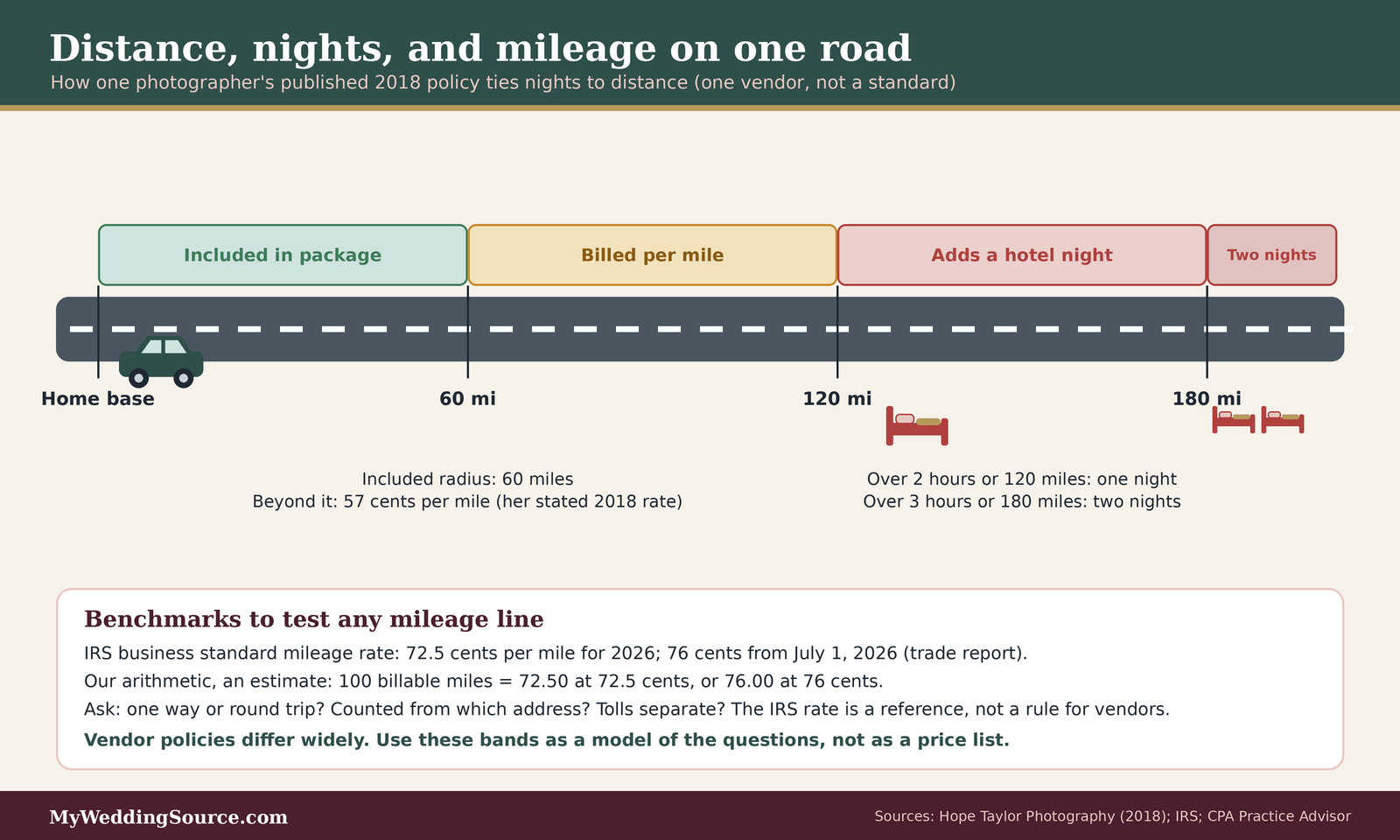
Prints4Sure suggests a local area of about 50 to 100 miles round trip, with a per-mile or hourly charge beyond it. Photographer Hope Taylor wrote in 2018 that her packages included 60 miles, and she billed miles beyond that at 57 cents per mile, a rate she said her state recommended at the time. Those are one vendor’s dated figures, not a standard. The useful lesson is to ask whether distance is counted one way or round trip, and from which address.
How to check a mileage line
Look up the route from the vendor’s home base to your venue in a mapping app, and note both the one-way and round-trip distance. Multiply the billable miles by the stated rate. As a benchmark only, the IRS business standard mileage rate was 72.5 cents per mile for 2026, and a trade report says it rose to 76 cents per mile for travel on or after July 1, 2026. The IRS says the rate reflects fixed and variable vehicle costs, and the release does not say private vendors must use it, so treat it as a reference point rather than a rule. A vendor who charges far above it may still be reasonable if the drive involves rural roads or tolls, but you can ask.
Flat fees by zone
Some vendors set a flat amount for each distance band. A trip under a certain number of hours costs one amount, a longer trip costs more, and anything beyond a limit moves to actual costs.
Why couples like zones
A zone fee for wedding vendor travel and lodging fees is predictable. You know the number before you sign, and you do not have to wait for receipts. The Easy Weddings advice page, an Australian publisher, quotes photographers who charge a flat amount for a drive of one to three hours and pass on actual costs beyond that. Those are individual practices rather than market standards, but the structure is common.
Where zone fees go wrong
Flat wedding vendor travel and lodging fees can hide the assumptions behind them. Ask which nights of lodging are included, how many staff are assumed, and what happens if your venue sits right on the boundary between two zones. Also ask whether the flat fee is refundable if the trip turns out to be cheaper or shorter than assumed. Many are not, and that is fine as long as it is stated plainly.
Actual costs, passed through
Here the vendor books the travel and bills you for what it cost, which means wedding vendor travel and lodging fees track the actual receipts. It is the most transparent model when it works and the most open-ended when it does not.
What to ask for
Ask whether the vendor adds a markup, whether you will see receipts, and whether there is a ceiling. Easy Weddings says several photographers it quoted pass on actual costs rather than marking them up, which is a helpful phrase to borrow: “at cost, with receipts.” Hope Taylor wrote that she books her own rooms, aims for reasonable value, and invoices clients at cost with a receipt. That is a good example of the level of detail to request.
Put a cap on the open-ended part
An at-cost clause for wedding vendor travel and lodging fees without a cap invites unpleasant surprises. Ask for a not-to-exceed amount for each category, such as lodging per night or total airfare, and ask the vendor to contact you before booking anything above the cap. A vendor who refuses any cap should at least agree to share the booking options before purchase.
| Model | What you know up front | What can still change | Best question to ask |
|---|---|---|---|
| Included radius plus mileage | The included distance and the per-mile rate | The route, one-way versus round-trip counting, tolls | From which address, and how is distance counted? |
| Flat fee by zone | The total for your zone | Which zone your venue lands in, nights and staff assumed | What does this flat fee assume, line by line? |
| Actual costs passed through | Nothing fixed unless a cap is set | Airfare, hotel prices, fuel, number of nights | What is the not-to-exceed amount for each category? |
How to audit wedding vendor travel and lodging fees line by line
An audit is simply a structured comparison between what the estimate says and what a reasonable trip would involve. You do not need to be an accountant. You need a one-page sheet, a map, and a willingness to ask the vendor to explain. This section walks through building the baseline, testing each line, and comparing two estimates fairly.
Build the baseline
Before you question anything, gather what you already have. A short list keeps the conversation friendly and specific.
Gather the documents
Pull together the estimate or proposal, the signed contract if there is one, the venue address, the dates of any rehearsal or additional events, and your guest hotel details. If you are comparing vendors, put each estimate in the same folder. The wedding vendor due diligence checklist can help you collect the rest of the paperwork on each business.
Turn the estimate into one page
Make a sheet with a row for each of the five parts: getting there, staying there, eating there, time away, and extra people. For each row, write the amount, whether it is flat or at cost, the assumption behind it, and where in the contract it appears. Blank cells are findings. They are the questions you need to ask.
Test every line
Each line has one test that takes a few minutes. Together they cover most of the problems couples run into.
Distance and route
To test wedding vendor travel and lodging fees on distance, check the miles using a mapping app and the vendor’s home base. Confirm whether the figure is one way or round trip, whether tolls are separate, and whether the vendor is counting trips to a rehearsal or a separate ceremony location. If the estimate uses a flat zone, check which zone your venue actually falls into.
Nights and dates
When auditing wedding vendor travel and lodging fees for nights, count them and compare them with the event schedule. A vendor arriving the day before and leaving the morning after needs two nights if the event ends late. A vendor who lives forty minutes away and works a morning ceremony may need none. Ask the vendor to explain the nights by date, and ask whether the wedding-night room is needed if the vendor is driving home.
Meals
Within wedding vendor travel and lodging fees, find out whether meals are a stipend, a per diem, or reimbursed receipts, and whether the reception also provides a vendor meal. The attorney-authored photographers’ guide mentioned earlier suggests basing a meal per diem on federal rates. The General Services Administration publishes federal per diem rates for lodging and for meals and incidental expenses, searchable by city, state, or ZIP code. Those rates are meant for federal employees, so they are a reference point, not a requirement for private vendors.
Travel days and hourly time
If travel time is part of wedding vendor travel and lodging fees, ask for the hourly rate, the number of hours assumed, and whether the clock runs for both directions. Compare it with the hours the vendor will be on site. If a charge for driving time exists, a mileage charge for the same drive deserves a polite question about overlap.
Markups and fees on fees
Ask whether wedding vendor travel and lodging fees carry a handling fee, an administrative fee, or a percentage to any pass-through item. Some vendors do, and they may have good reasons, but it should be visible. If a planner is involved, ask whether they receive anything on lodging or transportation they arrange.
Compare two estimates fairly
Comparing wedding vendor travel and lodging fees is harder than it looks, because vendors may build them on different assumptions.
Use the same scenario
Write one scenario, such as a Friday arrival, a Saturday wedding, a Sunday departure, two staff members, and the venue address. Ask each vendor to price that exact scenario. When the assumptions match, the totals become comparable.
Compare the total, not the headline
A low base package with high wedding vendor travel and lodging fees can cost more than a higher package with travel included. Add the base price and the travel total for each vendor and compare the sums. Our wedding budget guide and budget calculator can help you track the totals in one place.
What the published numbers look like
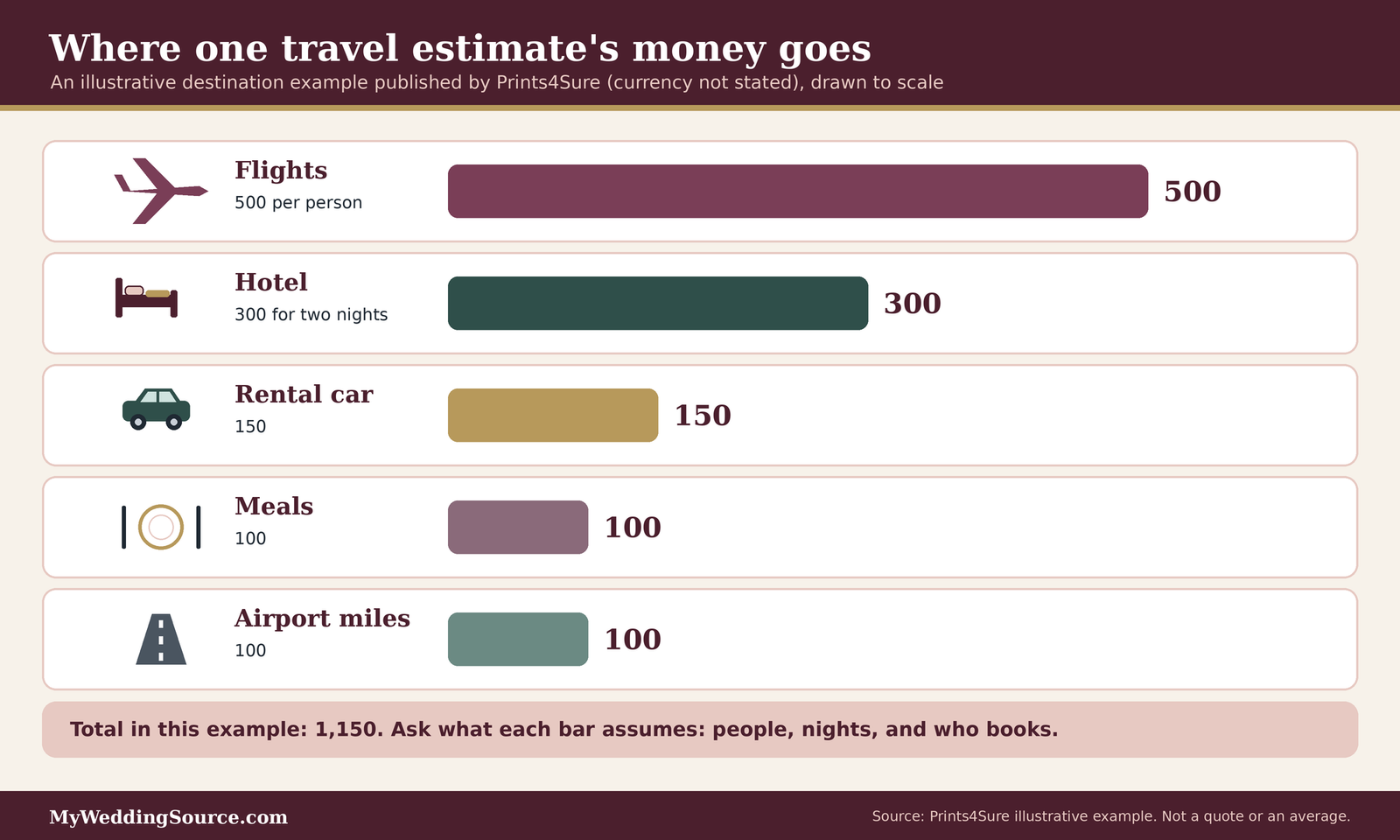
The Knot cites one expert who puts a photographer’s travel fee at roughly $1,000 to $5,000 or more, depending on distance and local costs. It also gives ranges of $300 to $1,500 or more for airfare per person, $250 to $500 or more per hotel night, and $100 to $500 or more for ground transportation. Prints4Sure shows illustrative examples in which a destination trip adds up to 1,150 and a longer overseas example reaches 2,300, with the currency unspecified. These are published ranges and examples, not quotes or averages for your market. Use them to sense-check, then rely on your own estimates.
| Line item | What to ask | Evidence to request | Flag to notice |
|---|---|---|---|
| Transportation | Mode, miles, flights, rental car | Route map, fare quote, rate per mile | Distance counted both ways without saying so |
| Lodging | Nights by date, room type, sharing | Booking options, nightly cap | Wedding-night room for a vendor who lives nearby |
| Meals | Stipend, per diem, or receipts | Daily amount in writing | Meals billed twice with the reception meal |
| Travel time | Hourly rate and hours assumed | Hours listed per direction | Time and mileage billed for the same drive |
| Extra people | Headcount and roles | Names or roles in the contract | A flat fee that assumes one person but staffs two |
| Fees on fees | Markups or handling charges | Written percentage or amount | A vague “coordination” line on pass-through items |
| Changes and cancellation | What happens if plans change | Clause text | Nonrefundable items with no explanation |
Lodging details that move wedding vendor travel and lodging fees
Lodging is often the largest swing factor in wedding vendor travel and lodging fees, because it depends on judgment calls: how early to arrive, how late the event runs, and who shares a room. Two vendors can quote the same drive and arrive at very different totals simply by assuming different nights. This section covers which nights are reasonable, who books the room, and how staff count changes the math.
Which nights are actually needed
The number of nights is the single most useful question to ask about wedding vendor travel and lodging fees. A clear answer shows the vendor has thought about your day, and a vague answer is a reason to ask again.
The arrival-day buffer
Easy Weddings notes that accommodation is commonly itemized for two nights so a photographer can arrive a day early and avoid relying on a single flight. Hope Taylor’s published policy, written in 2018, requires one hotel night for drives over two hours or 120 miles and two nights for drives over three hours or 180 miles, with the second night covering the evening before. These are individual policies, but they show how a vendor can tie nights to distance in a way you can check. For a flight, a night before the event is a reasonable thing to discuss, since a missed connection on the wedding morning is hard to repair.
The late-finish rule
A reception that ends at midnight can make a long drive home unsafe, so a night after the event may be sensible. Ask the vendor to state the condition in writing: for example, a second night applies only if the event is scheduled to end after a certain hour. A conditional rule is fairer to both sides than a blanket yes or no, because it responds to the schedule you actually choose. If you extend the evening, our article on vendor overtime rates for weddings explains how added time is billed, and the two clauses should not contradict each other.
Who books the room and at what price
Booking control matters for wedding vendor travel and lodging fees because it decides whether you can influence the price. The answer should appear in the contract, not in a hallway conversation.
The vendor books and bills you
Hope Taylor wrote that she books her own rooms for reasonable value, usually at a mid-priced chain hotel, and invoices clients at cost with a receipt. That approach is simple and puts the vendor in charge of finding availability. It works best with a cap, such as a maximum nightly rate, and a promise to share the confirmation. Without those, the amount is open-ended.
You book or you provide the room
Some couples prefer to book the vendor’s room themselves, especially at a destination wedding where they have already negotiated a group block. The Knot quotes a photographer who says photographers usually stay at the same lodging as wedding guests, which keeps them close to the events and can reduce transportation costs. If you book, put the room confirmation in writing, tell the vendor the check-in and checkout dates, and confirm who is responsible if the vendor cancels or arrives late. Our destination wedding checklist covers other items to settle before travel.
Check the lodging price like a traveler
Whoever books, compare the nightly rate with a quick search for the same dates. Hotel prices spike on wedding weekends and during local events, so a vendor quoting a rate above your search may simply be reporting reality. A rate far below it might be an out-of-date assumption that you will later be asked to top up. The FTC’s Rule on Unfair or Deceptive Fees, effective May 12, 2025, requires businesses that advertise short-term lodging to show the total price including most mandatory fees, so when you search for a room, the displayed total should be the number you compare. That rule covers lodging and live-event tickets only, so it does not govern a wedding vendor’s own fee line.
Room sharing and staff count
Headcount multiplies nearly every other line in wedding vendor travel and lodging fees. A change from one traveler to two can double lodging, meals, and airfare while the base package stays the same.
How many people, and in how many rooms
Ask the vendor to list the roles traveling, such as lead, second shooter, assistant, or technician, and whether any will share rooms. Prints4Sure notes that sharing hotels and rental cars with an assistant or colleague can lower the cost per person. Neither approach is right for every team, but you are entitled to know which one the estimate assumes.
Local hires as an alternative
The attorney-authored photographers’ guide notes that a photographer can hire a local assistant instead of flying one in. For some trades that can reduce your travel bill, though it changes who is working at your wedding. If a local hire would be a subcontractor, read our guide to wedding vendor subcontractors so you know what to confirm about their experience and insurance.
Travel costs that change after you sign
A signed contract can feel final, but travel is the part most exposed to change. Fares move, dates shift, and weather interferes. The best protection is a clause that says in advance who bears each kind of change. Without it, you may find yourself negotiating at the worst possible moment.
Price changes before the event
Between booking and the wedding, the prices behind the estimate can move in either direction. The contract should say what happens when they do.
Airfare and hotel rates
If your wedding vendor travel and lodging fees are flat, the vendor takes the risk of a price change, though some contracts include a review date. If the estimate is at cost, you take it. Ask the vendor when they plan to book, whether the fare or hotel is refundable, and whether you will see the booking before you pay for it. A vendor who books early may lock in a lower price, which is a reason to agree on a booking date.
Fuel and mileage rates
Mileage rates behind wedding vendor travel and lodging fees move too. The IRS set its 2026 business standard mileage rate at 72.5 cents per mile and, according to a trade publication, raised it to 76 cents per mile for travel starting July 1, 2026, citing higher fuel prices. A vendor who ties mileage to the IRS rate in the contract might see the charge change if the rate changes again. Ask whether your rate is fixed in the contract or tied to an outside figure, and if it is tied, ask which date’s rate applies.
A changed date or venue
If you move the date or change the venue, the math behind wedding vendor travel and lodging fees changes. Ask the vendor how they would reprice: by recalculating the distance, by rebooking at your cost, or by keeping the original amount. Your contract’s cancellation and postponement terms decide the wider questions when plans change, so read them alongside the travel clause.
Cancellation and postponement
Wedding vendor travel and lodging fees are where a cancellation becomes expensive, because bookings can be nonrefundable the moment they are made.
Nonrefundable bookings
The attorney-authored photographers’ guide recommends that the client be responsible for nonrefundable travel costs, deducted before any remaining flat fee is returned. That is advice written for vendors, so read it as a preview of what many contracts say. Ask whether your vendor books refundable fares or hotel rooms, whether they will tell you when they book something nonrefundable, and whether any credits can transfer to a new date.
What happens to a prepaid flat fee
If you paid a flat travel fee in advance and the event is cancelled, ask what portion is returned. Ask for an itemized accounting of what was spent. If your contract is silent, ask the vendor to confirm the policy in writing now, while the relationship is friendly. The same guide suggests requiring travel insurance on bookings, and you can read about event cover in our overview of wedding insurance. Check what any policy actually covers, since policies vary.
Delays and disruptions
With wedding vendor travel and lodging fees, sometimes the problem is not a change of plan but a disruption on the way.
An extra night because of weather or cancellations
A storm, a canceled flight, or a closed road can force an extra night. Decide in advance who pays for it. A fair clause might say the vendor covers disruptions that occur on the way to the event if they were not scheduled to arrive early, while you cover an extra night you request. There is no standard answer, so write down the one you agree on.
Who decides to travel early
If the forecast is bad, the vendor may want to travel earlier than planned. Ask that they contact you before booking an extra night, and ask what threshold triggers it. A vendor who suggests an early arrival is usually protecting your event, but it is reasonable to discuss the cost first. Our guide to the wedding vendor timeline can help you place arrival and confirmation dates on the calendar.
Staff replacement notice and consent decision tree
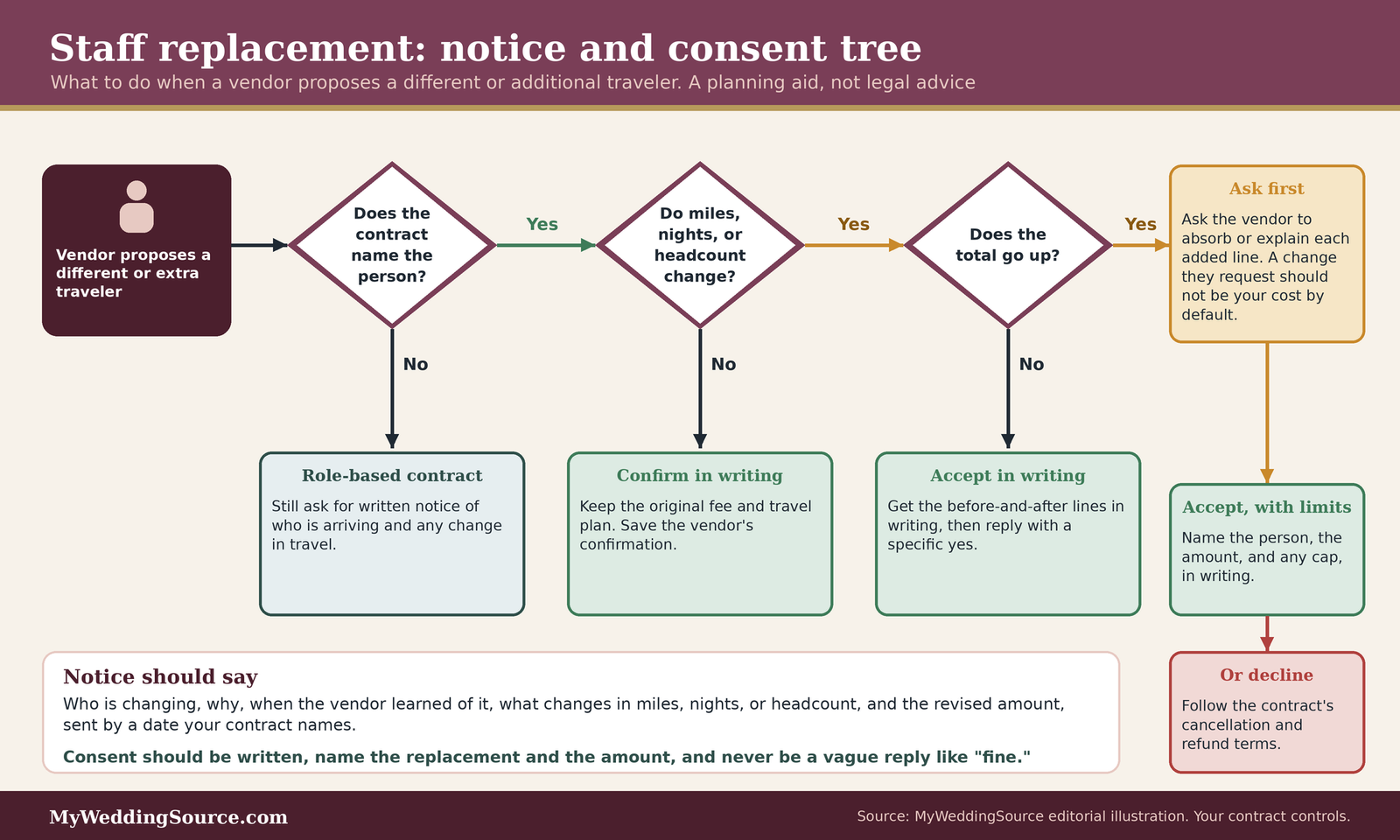
One of the least discussed risks in travel estimates is a change in who travels. A contract may be signed with a particular lead artist, and a travel charge is calculated around that person’s home base and the size of the team. If the person changes, the estimate may no longer fit. The tree below helps you decide whether to accept the change, ask for a revised estimate, or decline. It is a planning tool, not legal advice, and your contract language controls.
Why a replacement changes the travel math
The effect of a staffing change is not always obvious until you trace it through the estimate.
A different home base
Mileage and lodging in wedding vendor travel and lodging fees are calculated from where the vendor starts. A replacement who lives farther away can raise the distance, the number of nights, or the airfare. A replacement who lives closer might lower them. Either way, the original estimate no longer describes the trip, so ask for a revised version.
A different headcount
If the vendor wants to add a person, the travel and lodging for that person should be addressed. The attorney-authored guide treats extra staff as part of the travel calculation. If the vendor wants to remove a person, ask whether the travel charge goes down. A reduction in staff without a reduction in fees deserves a question.
Walking the decision tree
The tree has four questions. Each leads to an action you can take in writing.
Question one: who is changing?
Start by identifying the role. If the person named in your contract as the lead is being replaced, that is a larger change than swapping an assistant. Look at how your contract names the service: by a person, by a role, or by a company. If it names a person, a substitute is a change you may need to approve.
Question two: does the travel plan change?
Ask the vendor whether the replacement alters the mileage, the flights, the nights, or the headcount. If nothing changes, you may only need a written confirmation. If something changes, move to question three.
Question three: does the total change?
Ask for a revised estimate that shows each line before and after. If the total goes down or stays the same, accept in writing if you are comfortable with the person. If the total goes up, ask the vendor to explain why and whether they will absorb the difference, since the change is their request rather than yours.
Question four: do you consent?
You can accept, accept with conditions, or decline. Conditions might include meeting the new person by video, reviewing their portfolio or references, or a cap on the new total. If the vendor cannot offer a substitute you accept, the contract’s cancellation and refund terms are what matter, and our article on the wedding vendor replacement policy explains what to look for.
A notice and consent clause to ask for
You cannot control what a vendor’s staff do, but you can ask for a clause that sets expectations. Bring it to your attorney if the stakes are high, because wording matters and state laws differ.
What the notice should include
A useful notice describes who is changing, why, when the vendor learned of it, what changes in the travel plan, and the revised cost. It should arrive in writing by a stated date, such as a number of days before the event, so you have time to react. Ask what happens if an emergency makes advance notice impossible, such as an illness in the final days.
What consent should look like
Consent should be written and specific. A reply that says “fine” to a vague message may not cover a changed fee. Ask that your approval name the replacement, the revised amount, and any conditions, and that the vendor keep the original terms if you decline. Our article on wedding contract change orders looks at the paperwork for changes in more depth.
Paying and documenting wedding vendor travel and lodging fees safely
How and when you pay is part of the audit. A well-documented payment trail protects both you and the vendor, and it makes any later question easy to resolve. The Better Business Bureau advises getting all promises in writing and avoiding paying the entire fee up front, and those principles apply with extra force to travel amounts that may change.
Payment timing and method
Wedding vendor travel and lodging fees often follow a different schedule from the base package, so check the dates separately.
A separate invoice and due date
Hope Taylor wrote that half of her package was due at booking and the rest four weeks before the wedding, with travel costs on a separate itemized invoice due at the same four-week mark. A separate invoice is helpful because it isolates the travel amounts for review. Ask whether your vendor does the same, and ask for the invoice early enough to question it before the due date.
Pay in a way that leaves a record
The BBB says paying by credit card generally gives you dispute protections that other payment methods do not, and that you should avoid paying cash in advance. Whatever method you use, keep the confirmation, the invoice, and the contract page together. If the vendor requests payment through an unusual channel, ask for an explanation and a written invoice before sending money.
Receipts and reconciliation
If any part of your wedding vendor travel and lodging fees is at cost, the final reconciliation matters as much as the estimate.
Ask for receipts and the final accounting
Ask the vendor to send receipts for flights, hotels, rental cars, and any other pass-through items after the event, and to compare them with the estimate. Hope Taylor’s practice of invoicing at cost with a receipt is a model of what to request. If you gave an advance, ask for a refund of any unused portion, with a date by which it will arrive.
Keep your own simple log
Make a one-page record with the date, the item, the amount, who paid, and the document that supports it. Our wedding vendor contract guide explains how to keep the paperwork in order, and the same folder can hold your travel receipts. The log pays for itself if a question arises months later.
If a charge looks wrong
Most disagreements are misunderstandings that a calm, specific note can settle.
Start with the contract and a written note
Compare the invoice with your contract and your log, then write to the vendor, describing the line in question, the contract section you rely on, and what you are asking for. Keep the tone factual. Many vendors will correct a genuine error quickly, and a written note creates a record if the matter goes further.
Know the card dispute timeline
The FTC explains that a billing error dispute under the Fair Credit Billing Act must be sent in writing within 60 days of the first bill that shows the error, to the issuer’s billing-inquiry address. The issuer should acknowledge it within 30 days and resolve it within 90 days, and you may withhold the disputed amount, though you still pay the undisputed portion. That process covers billing errors, and not every disagreement over a vendor’s terms will qualify, so read your card agreement. For a large dispute, a licensed attorney in your state can advise on your actual contract. This guide cannot.
Edge cases and special situations
Not every wedding fits the standard photographer example. These situations come up often enough to deserve their own questions.
Destination and overseas weddings
Cross-border travel adds costs to wedding vendor travel and lodging fees that a domestic estimate does not show.
Baggage, gear, and insurance
Prints4Sure includes an overseas example with line items for flights, accommodations, local transport, meals, insurance, and incidentals, which shows how many categories may appear. Ask whether equipment baggage fees are included, whether the vendor carries any coverage for gear in transit, and whether you are expected to pay for insurance. Our overview of a destination wedding discusses the planning side, and the legal requirements article covers the paperwork for marrying abroad.
Currency and timing of payment
If costs are in another currency, ask which exchange rate applies and when. Ask whether the vendor will book in your currency or theirs. A clause that fixes the exchange date can prevent a surprise, and it is reasonable to ask for one.
Remote or rural venues
Distance is not the only measure of difficulty. Roads, lodging supply, and hours of travel all matter.
Few hotels, higher prices
If the venue is far from any lodging, local hotels may be scarce and expensive, and the vendor may need to stay farther away. Ask the vendor how they researched the options and whether the venue or a nearby inn offers a vendor rate. A rural wedding may also need extra travel time on the day, which is a point to raise with your vendor timeline.
Longer on-site days
When the drive between lodging and venue is long, vendors may arrive earlier and leave later. Ask how that affects their schedule and whether any charge applies. Our article on guest transportation planning addresses a related problem for your guests, and the same logic applies to your vendors.
Local vendors with a travel line
Even a vendor who lives nearby may include wedding vendor travel and lodging fees, and that is not necessarily a red flag.
When local still has a fee
A local vendor may charge for parking, tolls, load-in time, or a second venue. Ask what the line covers. If it is vague, ask to see how it is calculated. A small, clearly explained charge is usually less worrying than a large one with no explanation.
Venue-required vendors
Some venues require you to use certain vendors, who may have their own travel rules. Ask the venue and the vendor separately and compare the answers. If there is a conflict, ask the venue coordinator to confirm in writing.
Hosting your vendors
Some couples provide rooms or meals directly rather than reimbursing the vendor.
Offering a room in a guest block
If your guest block has space, you might offer it. Ask the hotel about the rate and the cancellation terms, and tell the vendor the dates and the room type. Confirm that offering a room replaces a lodging charge in the estimate, since you do not want to pay twice.
Meals at the venue
If the venue or caterer provides vendor meals, ask the vendor to remove any meal stipend from the travel line. The wedding vendor meals guide explains how to plan and count those meals.
Questions, scripts, and signals
A good conversation is usually short and specific. The scripts below help you ask clearly without sounding accusatory, and the lists of signals help you decide when to keep going and when to pause.
Questions to ask about travel and lodging
- How many miles or flights does this estimate assume, and from which address?
- How many nights, on which dates, and for how many people?
- Is this fee flat or at cost, and is there a markup or a cap?
- Are meals included, and does the reception also provide a vendor meal?
- Do you bill travel time, and is it separate from mileage?
- What happens to the fee if the date, the venue, or the traveling staff changes?
- When will you book, are the bookings refundable, and will I see the confirmations?
- Will you send receipts and a final accounting after the event?
Words to use with a vendor
Short scripts reduce friction when you discuss wedding vendor travel and lodging fees. Adapt them to your own voice.
Asking for an itemized breakdown
You might write: “Could you break the travel line into transportation, lodging, meals, time, and staff, and tell me the assumptions for each? I want to be sure I understand it before I sign.” That wording presumes good faith and gives the vendor an easy path to answer.
Asking for a cap and a notice
You might write: “Could we add a not-to-exceed amount for lodging and airfare, and a note that you will contact me before booking anything above it? Also, if the traveling team changes, could you send me a written notice with the revised estimate?” A vendor who has been transparent will often agree.
Signals to weigh
No single signal decides anything. Weigh them together.
Signs of a well-built estimate
In wedding vendor travel and lodging fees, look for named distances, nights by date, a stated headcount, a cap on at-cost items, separate invoices, and a written process for changes. These details show that the vendor has done this before and wants you to understand the number.
Signs to slow down
A single unexplained travel total, a refusal to explain assumptions, pressure to pay quickly, a request for payment by an unusual method, or a contract that is silent on cancellation are all reasons to pause on wedding vendor travel and lodging fees. Pausing is not an accusation. It is a way to protect your budget while you ask. Our broader wedding planning checklist can help you place these conversations in your timeline.
FAQ: wedding vendor travel and lodging fees
The basics
Are travel fees normal for wedding vendors?
Yes, many vendors charge them, especially photographers, musicians, and anyone who brings equipment. The Knot describes travel fees as covering airfare, baggage, lodging, ground transportation, and meals. What matters is whether the charge is itemized, reasonable for the trip, and written into your contract with clear assumptions.
What is usually included in wedding vendor travel and lodging fees?
Typically transportation, hotel nights, meals, and sometimes paid travel time or extra staff. Published policies vary, so the only reliable answer is the one in your estimate. Ask for the line items, the number of nights, the headcount, and whether the amount is flat or reimbursed at cost.
Do I have to pay for a vendor’s hotel?
Not always. Some vendors only charge for lodging beyond a certain distance, and some include a night in the package. Ask whether the estimate assumes a room, how many nights, and who books it. If your contract is silent, ask for a written answer before you pay the deposit.
Checking the number
How do I check a mileage charge?
Look up the route from the vendor’s home base to your venue, note whether the distance is one way or round trip, and multiply billable miles by the stated rate. The IRS mileage rate can serve as a rough benchmark, but private vendors are not required to use it.
Should the vendor mark up travel costs?
Some do, and some pass costs on at cost with receipts. Neither is automatically wrong, but a markup should be visible and agreed in writing. Ask whether the amount includes any handling or administrative fee, and request receipts for items billed at cost.
Changes and problems
What if the vendor sends a different person?
Ask for written notice describing who is changing, why, and what changes in travel and cost. You can accept, accept with conditions, or decline under your contract. Do not treat a vague reply as consent, and keep the original terms in writing until you approve a revised estimate.
What if I cancel or move the date?
Read the cancellation clause and ask which travel costs were nonrefundable. Many contracts make the client responsible for bookings already made. Ask for an itemized accounting and any credits that can move to a new date, and get the answer in writing.
Can I dispute a charge that seems wrong?
Start with a written note to the vendor citing your contract. If you paid by card, the FTC says a billing-error notice generally must reach the issuer in writing within 60 days of the first bill showing the error. This is general information, not legal advice, so consult an attorney for serious disputes.
Your next steps
Audit what you have
Build your one-page sheet
Copy the audit worksheet for wedding vendor travel and lodging fees from this guide and fill in one row per travel part for each vendor you are considering. Mark the blank cells. Those blanks are your questions for the next conversation, and answering them early costs nothing.
Price one scenario for every vendor
Write a single scenario with arrival, event, and departure dates, the venue address, and the staff you expect. Ask each vendor to price it. You will then be comparing like with like, which makes your final choice far easier.
Get it in writing
Add the clauses that matter
For wedding vendor travel and lodging fees, ask for itemization, a cap on at-cost items, a notice-and-consent step for staff changes, and a stated refund process. Our wedding vendor contract article explains how to read the rest of the agreement, and vendor overtime rates for weddings covers a charge that often arrives alongside travel.
Keep the paperwork together
Store estimates, invoices, receipts, and written notes in one folder. If you are comparing several businesses, our due diligence checklist can help you verify each one, and the wedding budget guide can help you track the totals. Before the day, a final vendor walkthrough confirms who is arriving and when.
Sources & methodology
How we built this guide
What we relied on
This guide combines a federal rule on lodging price display, federal mileage and per diem information, consumer guidance on contracts and card disputes, and published travel policies from wedding publishers and working photographers. Most published travel policies come from photographers, so we have noted where an idea applies to other trades by extension. Where a statement comes from a vendor or publisher, we say so, because it reflects that seller’s own practice. Our worked ideas, checklists, and the decision tree are editorial tools, not market data, and any arithmetic is our own estimate. We checked these pages in November 2026 and did not verify that they remain unchanged since.
What we did not do
We did not survey vendors, collect local prices, or give legal or financial advice. State laws and contracts differ, and your signed agreement controls. For a significant dispute, consult a licensed attorney in your state.
Source list
Government and regulatory sources
- Federal Trade Commission, Trade Regulation Rule on Unfair or Deceptive Fees, Federal Register, January 10, 2025: https://www.govinfo.gov/content/pkg/FR-2025-01-10/html/2024-30293.htm
- Internal Revenue Service, 2026 business standard mileage rate: https://www.irs.gov/newsroom/irs-sets-2026-business-standard-mileage-rate-at-725-cents-per-mile-up-25-cents
- U.S. General Services Administration, Per diem rates: https://www.gsa.gov/travel/plan-a-trip/per-diem-rates
- Federal Trade Commission, Disputing credit card charges: https://consumer.ftc.gov/articles/disputing-credit-card-charges
Consumer, publisher, and vendor sources
- Better Business Bureau, Wedding tips (July 7, 2021): https://www.bbb.org/article/money/16783-bbb-wedding-tips
- CPA Practice Advisor, Rising fuel costs prompt IRS to raise standard mileage rates for the rest of 2026 (July 16, 2026): https://www.cpapracticeadvisor.com/2026/07/16/rising-fuel-costs-prompt-irs-to-raise-standard-mileage-rates-for-rest-of-2026/186784/
- The Knot, Paying for a photographer’s hotel: https://www.theknot.com/content/paying-for-photographers-hotel
- Prints4Sure, Wedding photography travel charges: https://www.prints4sure.com/blogs/news/wedding-photography-travel-charges-a-complete-guide
- The Legal Paige, Travel fees clause for destination wedding photographers: https://thelegalpaige.com/blogs/blog/save-thousands-as-a-destination-wedding-photographer-with-this-contract-clause
- Hope Taylor Photography, Charging for travel (2018): https://hopetaylor.com/2018/08/14/charging-travel-wedding-photography
- Easy Weddings, How travel fees work for wedding photographers: https://www.easyweddings.com.au/WeddingPhotography/advice/how-far-will-wedding-photographers-travel-and-how-do-travel-fees-work