
A wedding emergency plan is a short written agreement, made with your venue weeks before the day, that says who decides, who calls whom and where everyone goes when weather, a medical event, an evacuation or a communication failure interrupts the event. This guide builds that plan around a venue-coordinated contact sheet and a one-page action outline you can finish in a few evenings.
A workable wedding emergency plan has five parts. First, a contact sheet created together with the venue, so your names and numbers match theirs. Second, a clear chain of authority, with local authorities and venue staff above couple and family. Third, trigger rules for weather that name a time and a person. Fourth, assigned roles for medical response and evacuation. Fifth, a communication ladder that tells guests what to do in plain words. Write it on one page, share it with the people named on it, and rehearse the first ten minutes.
Almost every wedding has a quiet moment where something goes sideways. A guest turns pale at the cocktail hour. A line of storms shows up on the radar during the ceremony. A fire alarm sounds because a fog machine met a smoke detector. Most of these end in a good story. A few do not, and the difference is usually not luck. It is whether anyone in the room knew who was supposed to act, and whether they had the means to do it.
This guide is about building that knowledge before the day. It is not a safety manual, and it will not make a wedding risk-free. What it can do is replace improvisation with a small number of decisions you make in advance, calmly, with the people who actually run the building. That is why a wedding emergency plan in this guide starts with the venue and not with a binder of worst cases.
A note on scope. This is general planning information, not legal, medical, tax or financial advice, and it is not a substitute for the venue’s own emergency procedures, local emergency services or a licensed safety professional.
What a wedding emergency plan is, and what it is not
Think of a wedding emergency plan as a set of answers to six questions that nobody wants to be asking out loud at 6:40 on a Saturday evening. Who is in charge right now? Who calls for help, and what do they say? Where do people go? How do guests find out? Who stays with anyone who needs help? And what happens to the event afterward?
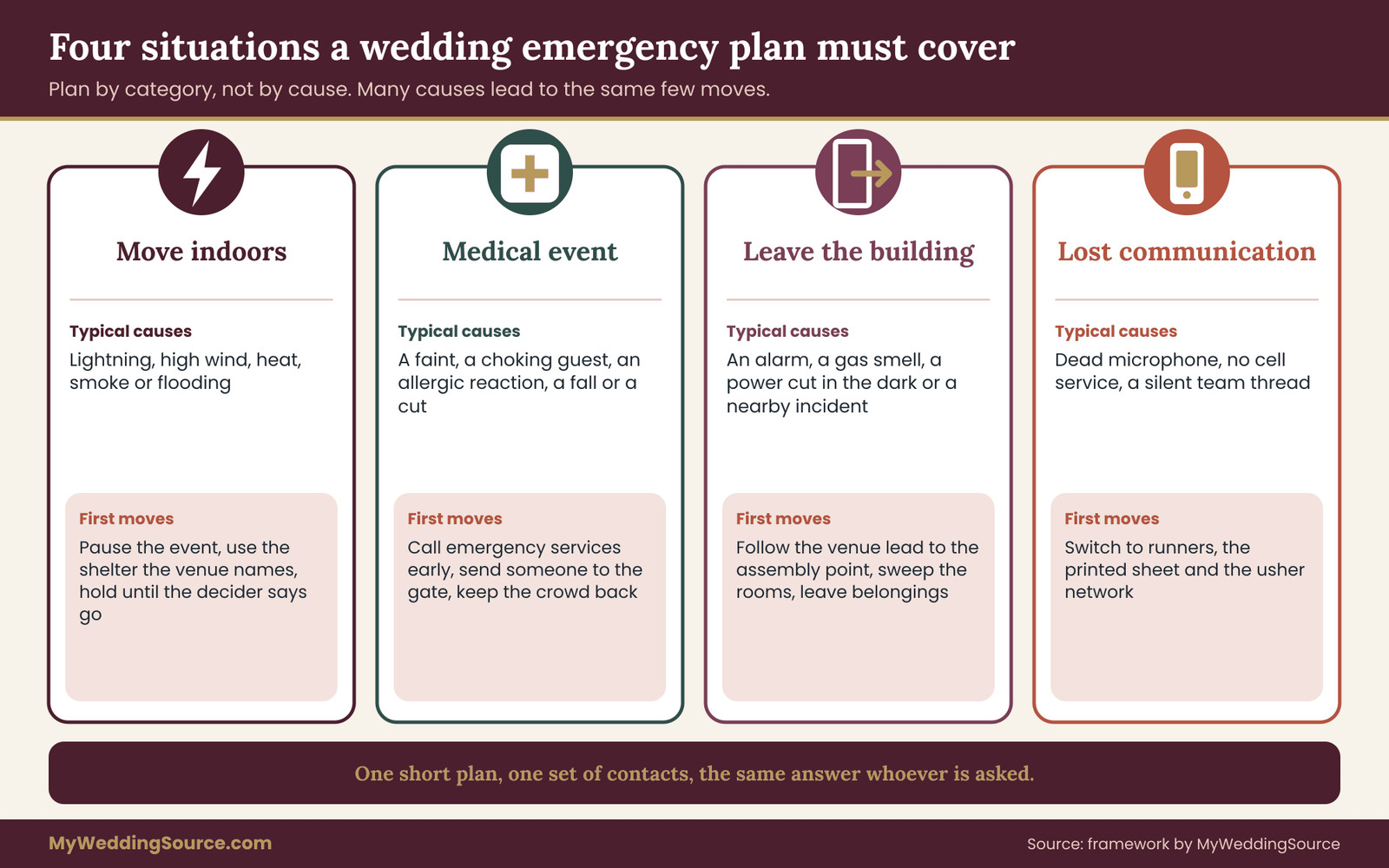
It is not a prediction. You are not guessing which emergency will occur. You are deciding how your group will behave in a few broad categories, each of which can be triggered by many different causes: a need to move indoors, a need to leave the building, a person who needs medical attention, and a loss of normal communication.
A lightning delay, a gas smell and a power cut all lead to a version of “move people to a safe place and tell them.” Planning by category is what keeps the document short enough to use.
It is also not a replacement for what trained people do. Local authorities, emergency dispatchers and the venue’s own staff are the ones with training, equipment and legal responsibility. Your wedding emergency plan exists to get them involved sooner and to keep everyone else out of their way. That sentence carries a lot of weight, so it is worth repeating in the wedding emergency plan itself: the couple and family support the professionals, they do not lead them.
A good wedding emergency plan also has a boundary on the other side. It should not turn the wedding into a drill. Guests do not need a briefing on exits at the ceremony, and nobody wants a laminated card on every chair. The plan lives mostly in the heads and phones of six to ten people: the couple’s designated lead, the planner or day-of coordinator if there is one, the venue contact, the caterer’s lead, the photographer, the DJ or band lead, and a few family members with specific tasks.
Two kinds of events do change this picture. A small backyard wedding has no venue staff, which means you are the venue, and the wedding emergency plan needs to cover things a venue would normally handle. A large hotel or event hall wedding already sits inside a building with its own alarm systems and staff trained in them, which means your wedding emergency plan should mostly plug into theirs. Both are covered later. Most weddings fall somewhere between, in a rented space where some things belong to the venue and some belong to you.
Why does this deserve its own guide, when you may already have a general wedding planning checklist with a line item that says “backup plan”? Because a line item is a reminder, not a decision. The checklist tells you that you need a rain option. It does not tell you who is allowed to call it, at what time, with whose phone number, or what happens to the florals while the call is being made. This article lives in the space between “we have a plan B” and “everyone knows what plan B actually is.”
There is also a practical reason to treat it as one document. When something goes wrong, people do not ask which category the problem belongs to. They ask a person, and that person needs to know the next step. A single plan with a single set of contacts means the answer is the same no matter who is asked.
The venue-coordinated contact sheet at the heart of a wedding emergency plan
If you only build one page, build this one. The contact sheet is a list of people and numbers, but its real value comes from how it is made. It is made with the venue, not for the venue, and that difference is the point of the whole approach.
Most couples collect contacts one vendor at a time. The planner has a spreadsheet, the caterer has a different list, the venue coordinator has a third, and the couple’s group chat holds a fourth. When an emergency happens, each of those lists is slightly wrong in a different way. A number is for the office, not the person who is on site.
A name belongs to someone who left the company. The “venue manager” on your contract is not the person working the event. Building the sheet jointly means you walk through it with the venue’s event lead and correct it against their version.
Here is what the sheet should contain. Keep each entry to a name, a role, a direct mobile number that is answered on the day, and one backup.
The venue’s on-site emergency lead. This is the person who knows the building: where the shutoffs are, how the alarm works, which doors are locked and who has keys. Ask for the person working your event, not the sales contact. Also ask for the venue’s after-hours or security number if there is one.
Your own day-of lead. One person on your side whose job is to be reachable and to make calls. This should not be either partner, and it should not be a parent who also wants to enjoy the party. A planner, a coordinator or a calm friend works, as long as they will carry their phone and stay sober enough to use it.
Backup lead. A second person with the same information, in case the first is on the dance floor, in the bathroom or helping someone. Redundancy is boring and it works.
Vendor leads. The caterer’s on-site manager, the photographer, the DJ or band lead, the transportation lead and any rental or equipment contact who might need to shut something down or move it. These are the people who control power, food, sound and vehicles.
Local emergency services and the venue’s address as dispatch would need it. This sounds trivial and is not. A venue in a park, a farm or a large complex often has a street address that is not where the front door is. Ask the venue what to say to a dispatcher, including cross streets, gate names and the best entrance for an ambulance. Write it on the sheet word for word.
Medical contacts and facts for individual guests. This is a sensitive area. The sheet should not hold anyone’s health information. It should only note, in neutral terms, which person is the contact if a particular guest needs help, and that the contact has already been briefed by that guest. Privacy and consent matter more than completeness here.
Alternate contacts for the couple. Two people outside the wedding party, such as a parent or sibling who is not working the event, who can be called if the lead cannot be reached.
The meeting itself matters as much as the document. Spend thirty minutes with the venue’s event lead, at the venue if you can, ideally during the same visit as your technical walkthrough of the venue. Bring a printed draft and take notes on it. You are asking the venue to confirm, correct and add. Your vendor timeline probably already lists when each supplier needs final details, so use those dates for sending the sheet.
Almost every venue has done this kind of conversation before, and many have a standard sheet of their own. If they do, use theirs as the base and add the missing pieces, so there is one source of truth.
Three questions turn the meeting into something useful. First, what does your staff do if they see lightning, smell smoke or find a guest who is unwell? Second, who, in your building, has the authority to stop the event, and who tells the guests? Third, is there anything in your standard procedures that the couple’s group might accidentally get in the way of? Their answers tell you where your wedding emergency plan should defer, and where it should add.
One more point deserves clarity before moving on. The sheet should show who is allowed to say “stop.” In most buildings, that is the venue’s emergency lead and the emergency services. If your wedding emergency plan quietly assumes the couple has that power, but the venue’s contract says otherwise, you have built a plan that will fail at the moment it is needed. Surfacing this at the meeting, calmly, is far better than discovering it in the moment.
Finally, put the sheet on paper as well as in phones. A phone can die, lose service or be locked in a bag. One printed copy goes with the day-of lead, one with the backup lead, one at the venue’s coordinator desk and one with the caterer’s manager. A photo of the sheet on each named person’s phone is a good addition. A photo is not a substitute for the paper.
Most disagreements during a real incident are not about what to do. They are about who gets to decide. Wedding days are unusual because ownership is blurry. The couple hired the vendors and paid for the day. The venue owns the building and carries the liability. The planner coordinates but may have no authority over the property. Parents often assume they are in charge of everything. Nobody has to be wrong for this to cause a delay.
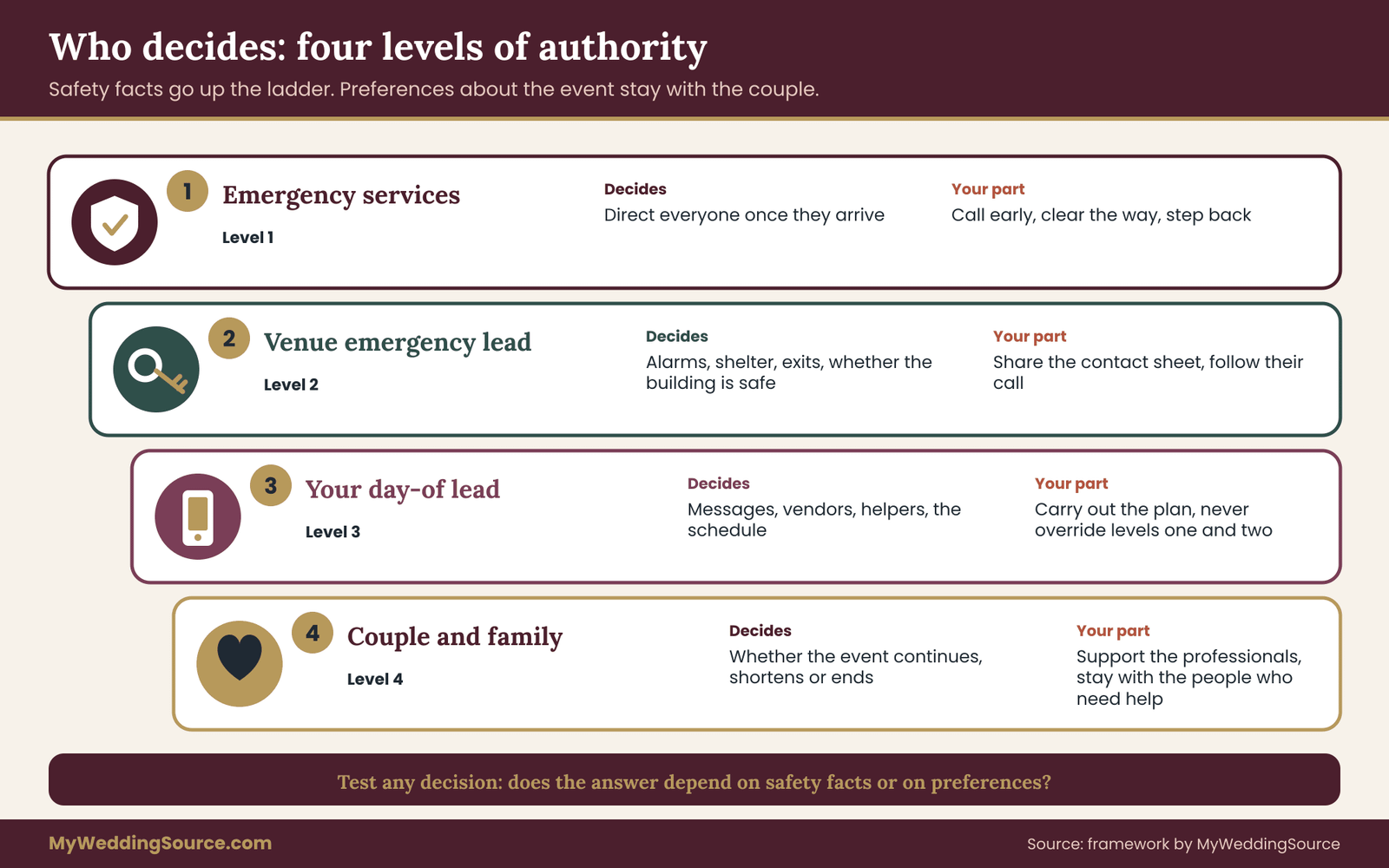
A wedding emergency plan fixes this by writing down four levels of authority and putting them in order. The order is simple, and it should match how the real world will treat the situation regardless of what you write.
Level one: emergency services. If dispatchers, firefighters, police or paramedics are on the scene, they direct. Everyone else, including the venue, follows. The couple’s role at this level is to make the first call early and to clear the way.
Level two: the venue’s emergency lead. Inside the building and grounds, the venue’s trained staff run the response until emergency services arrive and take over. They know the alarms, shutoffs, exits and assembly areas, and in many places they are bound by local fire and safety rules.
Level three: your day-of lead. This person carries out the wedding emergency plan on the wedding side: telling vendors, gathering the couple, assigning helpers, making sure guests who need extra help are accompanied, and passing messages. They do not override levels one and two.
Level four: the couple and family. The couple is the client. They decide what happens to the event afterward: whether to continue, to delay, to shorten or to end. They do not decide whether the building is safe.
That last distinction is worth slowing down on. During a lightning delay, the question “is it safe to go back outside?” belongs to the venue and the weather guidance. The question “do we restart with the ceremony or go straight to dinner?” belongs to the couple. A wedding emergency plan that mixes them up produces the situation every planner dreads, where a hopeful bride or a nervous parent starts pushing for a restart before anyone has checked the radar.
There is a useful test for any decision in the plan. Ask whether the answer depends on safety facts or on preferences. Safety facts go to the people trained to read them. Preferences go to the couple. Write both lists down. The first list will be short and boring. The second will be longer and will save time later, because it means that after the emergency is handled, nobody has to start a family debate from scratch.
A second test covers speed. If a decision must be made in under two minutes, it should already be written down. If it can wait twenty minutes, it can be decided on the day. Evacuation, a medical call and a lightning hold fall in the first group. The menu order after a delay falls in the second.
Some situations make the order messy, and it helps to name them in advance.
The venue is a private home or a rented field. There is no venue lead, so the owner or host fills level two in name only. In that case, your wedding emergency plan should name someone who has actually read the local weather guidance, walked the property for exits and talked to the nearest fire station or non-emergency line about access. Treat this as a larger task than it looks, and start earlier.
The venue’s staff are short-handed. Some venues staff a wedding with a single coordinator who is also managing the caterer. If the venue’s emergency lead is also the person plating dinner, your wedding emergency plan should assume a delay of a minute or two before they can act, and it should name who handles the first call to dispatch during that gap.
A guest or vendor is a trained professional. Wedding guests sometimes include nurses, paramedics, firefighters or off-duty police officers. It is natural to lean on them. Treat that as a welcome bonus, never as a plan. They are guests, they may have been drinking, and they carry no equipment. If one steps in, they take instruction from dispatch and emergency services the same way anyone else does.
A parent insists on being in charge. This is common and usually well meant. The cleanest solution is to give that parent a named job in the wedding emergency plan, such as being the person who gathers the older relatives at the assembly point. A real task is more satisfying than being told they are not in charge.
For a fuller look at how couples and families can divide authority over ordinary planning choices before the day arrives, the site’s guide to sharing input on wedding decisions covers the family side of the question. Use it for preferences. For safety facts, use this chain.
One last practical point. The chain of authority only works if the right people know it exists. Send the one-page plan to the venue lead, the day-of lead, the backup lead and each vendor lead, with a single sentence at the top: “In an emergency, emergency services direct, then the venue, then our day-of lead.” Do not rely on people finding the line in a long attachment.
Weather: trigger times and holds in a wedding emergency plan
Weather is the most likely reason a wedding emergency plan gets used, and it is also the most forgiving, because you usually have warning. The central trick is to convert a vague feeling (“it might rain”) into a rule with a time and a name. Without that, a forecast turns into twenty people with twenty opinions and a decision that gets made by whoever is loudest.
Start with what the wedding emergency plan needs to decide. For an outdoor ceremony, reception or photo session, there are really only three decisions: whether to hold the event outside as planned, whether to move it to the indoor option, and whether to pause entirely until conditions change. Each needs a trigger.
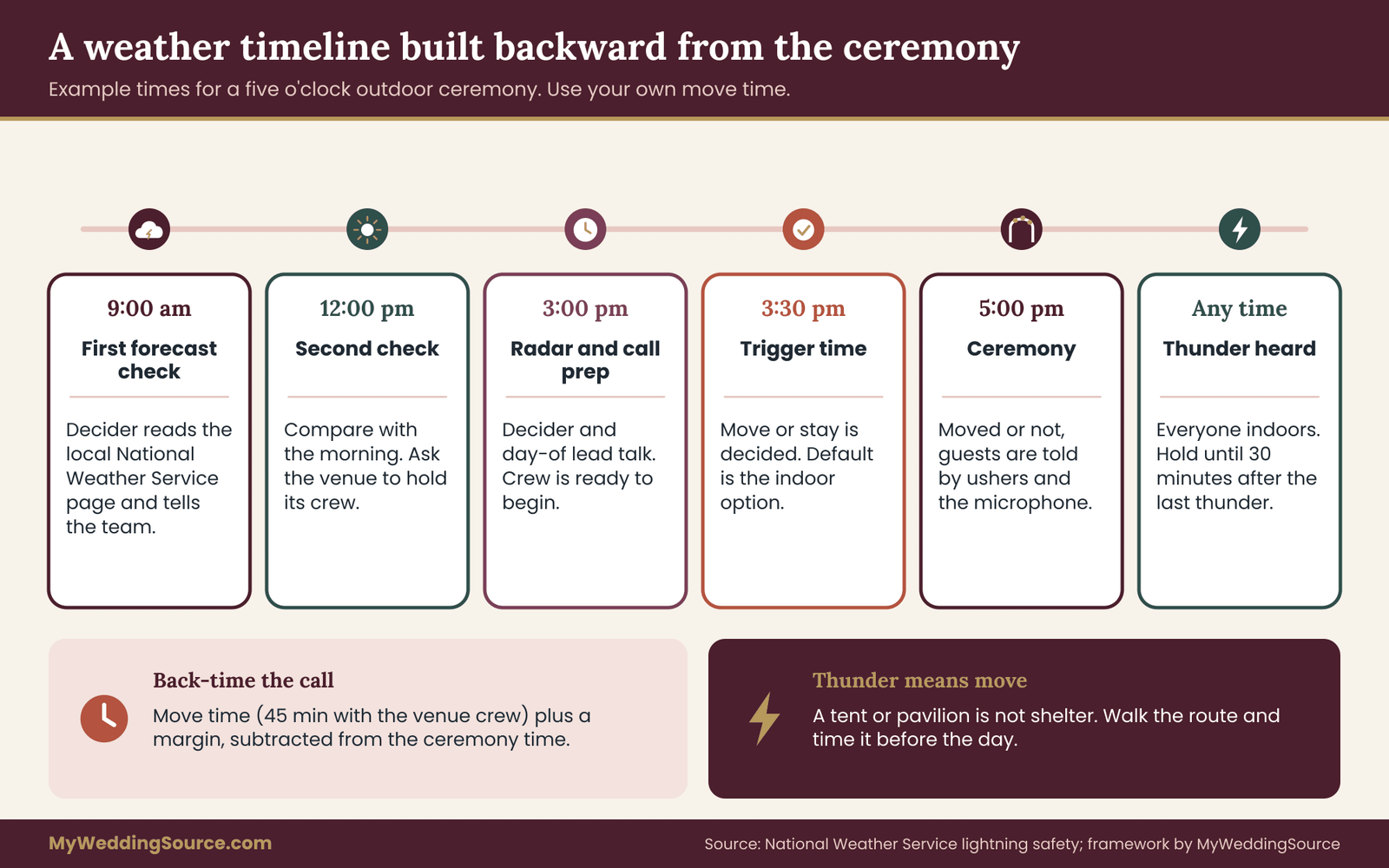
The trigger time. Pick a clock time by which the move decision is made, working backward from how long it takes to move. If moving chairs, florals and sound indoors takes ninety minutes with the venue’s crew, and the ceremony is at five, the call cannot be later than three-thirty. Ask the venue and vendors how long each of their pieces takes, then add a margin. A trigger set to “when it starts to rain” is not a trigger. It is a decision to be late.
The decider. Name one person who makes the call, and name who they consult. The best pairing is usually the venue’s event lead, who knows the space and its limits, and your day-of lead, who knows the schedule. The couple should agree beforehand that the call stands. It is much easier for a couple to say “we trust the plan” in March than to override it on the day.
The source. Agree on what information the decider uses. The National Weather Service publishes forecasts, watches and warnings for the United States, and its local office pages give detailed discussions. A radar app is a useful picture but not an authority. Write down the specific local forecast office page or app the decider will check, so that two people do not argue from two different sources.
The hold rule for lightning. The National Weather Service’s lightning safety guidance says that if you can hear thunder, you are close enough to be struck, and it recommends waiting at least thirty minutes after the last thunder before going back outside. Build this into the wedding emergency plan as a standing rule: when thunder is heard, everyone moves to a sturdy building or a hard-topped vehicle, and the clock restarts with each rumble.
A tent, a pavilion or a pergola is not a safe place. Ask the venue where the nearest fully enclosed shelter is, how many people it holds and how fast guests can reach it.
That last number matters more than most couples realize. A venue may say its indoor space holds one hundred and fifty, but if the ballroom is across a parking lot and the path is a single door, thirty seconds of warning is not enough to move one hundred and fifty people. Walk the route with a watch. The wedding emergency plan should state how many minutes it takes to move everyone indoors, and the trigger for the lightning rule should fit inside that number.
Weather is not only lightning. Several conditions deserve their own line in the plan.
Wind. Tents, arches, signs and hanging decor can fail well before the wind feels dangerous to a person standing still. Ask the tent company for its own limits in writing and give the venue lead authority to order a tent cleared when they are reached. Do not argue with a rental company about its own equipment.
Heat. Outdoor ceremonies at midday in summer produce more minor medical problems than any other wedding scenario. The National Weather Service’s heat safety pages explain the warning signs of heat illness and recommend shade, water and rest. Your wedding emergency plan can include a shaded seating option, water at the ceremony, a shorter ceremony if the heat index is high, and a quiet space indoors where anyone who feels unwell can sit down. Add the water, shade and cooling supplies to your supply list so someone is responsible for buying and placing them.
Cold, snow or ice. Winter weddings raise travel and footing problems more than comfort ones. Ask who clears and salts the paths, and who decides if a guest transport run is cancelled. Icy steps at the entrance are a liability for the venue and an injury risk for guests in formal shoes.
Smoke and air quality. In some regions, wildfire smoke can make an outdoor event unwise. Public air quality information is available from the U.S. government’s air quality resources, and the wedding emergency plan can name an air quality threshold and a person who checks it that morning.
Flooding and road closures. If guests travel by road or a vendor must cross a low-water bridge, the plan should say who checks the route at midday and what the alternate is.
After the decision, the wedding emergency plan needs a communication step, because a trigger that no one hears is no trigger. When the decider calls the move, the day-of lead tells vendors first, because they have the physical work, and then tells guests through the channels set up in the communications section.
Finally, write down what happens to the schedule. A weather delay does not have to cancel the day. It usually compresses it. A short list of “what moves, what shrinks, what is skipped” prepared in advance gives the couple a menu to choose from, instead of a blank page. For a deeper look at how the reception itself restarts, the site’s guide to reception guest flow shows how entry, seating, food and exit can be reordered without confusing everyone.
Medical response in a wedding emergency plan: roles, supplies and limits
A medical event at a wedding is far more likely than a fire or a tornado. Over a long evening, a hundred or more people eat, drink, dance, stand in heat or cold and wear unfamiliar shoes. Someone will faint, choke, cut a hand on glass, have an allergic reaction or feel chest pain. Most of these resolve with water and a chair. Some need an ambulance. The wedding emergency plan has to make the difference visible quickly and make the first call easy.
Begin with a principle that governs everything else in this section. The wedding emergency plan does not diagnose, treat or decide whether something is serious. It gets trained responders to a person faster and keeps the area calm. Anyone who is unsure should call emergency services. Dispatchers are trained to ask the right questions and to talk a caller through what to do until help arrives, and calling is never an overreaction.
The first call. Assign one named person per area to make the call, with a backup. In practice, the nearest vendor lead or venue staff member often does it, but the plan should not depend on chance. The caller needs the address as dispatch would want it, the exact location inside the venue, such as “the garden terrace behind the tent,” and the best entrance for an ambulance. All three belong on the contact sheet, so the caller reads rather than recalls.
The gate person. Send someone to the entrance or the road to meet the ambulance, open any gate and guide the crew in. In a large venue, this saves minutes and is one of the most valuable small jobs in the wedding emergency plan. Choose someone who stays calm and who can be released from the party for twenty minutes without a fuss.
The helper circle. Pick one or two people who stay with the person, keep onlookers back and bring a chair or water if dispatch advises it. This does not mean practicing medicine. It means ensuring the person is not alone and the crowd does not press in. The venue’s staff may also have a trained first responder or a first aid certificate. Ask who that is and where they will be.
The information holder. If the person is a guest, someone who knows them should be sent for. Relatives can tell responders about medications, allergies and conditions, which strangers cannot. The wedding emergency plan should leave this to the guest’s own companions, and it should not put the couple in charge of anyone’s health information.
The couple’s role. Here the plan has to be honest: the couple’s role is usually to step back. A bride in a gown surrounded by a crowd does not help the guest on the ground. Name a person who will quietly approach the couple, tell them what is happening and ask them to carry on in a way that keeps other guests occupied, such as asking the band to continue at a lower volume or the photographer to stay with the couple.
If the event has to stop, the wedding emergency plan can say who makes that decision, and the answer is likely the venue lead working with emergency services.
Supplies are where couples tend to overspend on the wrong things. A modest, practical kit is enough, and it complements rather than replaces responders.
- A basic first aid kit at a known location, checked for expiry dates and missing items.
- Bottled water and a place to sit in shade or air conditioning.
- Wound care basics for the usual small cuts, blisters and scrapes from shoes and glassware.
- Information on where the venue keeps an automated external defibrillator, if it has one, and who knows how to retrieve it.
- A list of nearby urgent care and hospital locations, for non-emergency needs.
- A pen and card for the person who accompanies someone to the hospital, to write times and names.
An automated external defibrillator is a portable device that gives step-by-step voice instructions. Many public venues have one, and the American Red Cross offers first aid, CPR and AED training courses to the public. Ask the venue whether there is one on site, where it is kept and whether staff know its location. Do not rent or buy equipment on the strength of a blog post. If a defibrillator matters for your guest group, such as a large older crowd, ask the venue and a licensed professional what is appropriate.
Allergies deserve a separate note, because they are a medical emergency that is also a catering matter. Make sure the caterer knows which guests have severe allergies, that serving staff know how to flag them and that the wedding emergency plan names a person who can reach those guests quickly. Guests who carry their own emergency medication should be encouraged to keep it on them, not in a coat check. The site’s guide to guest care for children and older relatives covers how to ask about needs without turning every guest into a form.
Alcohol belongs in this conversation too, without judgment. Alcohol raises the chance of falls, accidents and bad decisions. The plan can ask the bar team how they handle someone who has had too much and who tells the person’s companions. It is not about policing anyone. It is about having an answer ready.
Privacy matters throughout. A medical event is private even when it is public. Once the situation is handled, the wedding emergency plan should include a rule about not posting, filming or discussing it in the group chat until the family says so. The photographer and videographer can be briefed to stop recording around a medical scene.
Finally, decide in advance what happens to the wedding if a guest is taken to hospital. If it is a close family member, the couple may want to pause or end the event. If it is a more distant guest, they may continue. This is a preference decision, not a safety one, and the wedding emergency plan can leave it open as long as someone is assigned to ask the couple privately rather than announce it.
Evacuation: exits, assembly points and people who need extra help
Evacuation is the part of a plan that couples most want to skip, and it is the part where the venue’s knowledge matters most. A fire alarm, a gas smell, a power failure in the dark, a structural concern or a nearby incident can all lead to a decision to leave the building.
Rarely will the couple be the ones who make that decision. What the couple can do is make sure the wedding emergency plan matches the venue’s procedures, that wedding-specific obstacles do not block them and that people who need extra time are not forgotten.

Ask the venue for its procedure. Every licensed event venue is expected to have one. Ask where the exits are, which are lit, which are locked or alarmed, where people gather outside and who counts heads. Ask whether staff will announce an evacuation or rely on the alarm. Then ask what changes for a wedding. Venues often have different layouts for events, with extra tables, a dance floor, draping and a band that can narrow an aisle or cover an exit sign.
Check the layout against the exits. The most common wedding-specific problem is that the event setup interferes with exit routes. Tall centerpieces, a photo booth, a cake table, a draped backdrop, rental lounge furniture, or a row of chairs pushed against a wall can block a path. Ask the venue to review the final floor plan with exits in mind.
If a vendor must move a piece to keep a route clear, you want to know that before the day, not during setup. The measurements and access points you collect during the technical walkthrough feed this review.
Choose assembly points. Two assembly points are better than one: a primary and an alternate, in case the first is blocked. They should be at a safe distance from the building, away from the road the fire trucks will use, and easy for guests to find. In a rural venue, a parking lot is common. In a hotel, the venue will tell you. Write them on the contact sheet, and tell the band and the DJ so the person on the microphone can name them.
Assign sweepers. In a building with several rooms, a small group of people sweep each room on the way out, checking restrooms, the bridal suite, the kitchen and any side areas. Venue staff usually do this for their own areas. The wedding emergency plan should add the wedding-specific rooms: where the wedding party is dressing, where the gifts are kept, where the couple has their things.
Plan for people who need extra help. Some guests use wheelchairs, walkers or canes. Some have vision or hearing differences. Some are children, who will not be near their parents, or older relatives who move more slowly. Some may be unwell. The plan should not publish a list of names, and it should not single anyone out. It should make sure that a small number of helpers knows to stay with a particular person or group. If you have guests with mobility needs, ask them, privately and before the day, what would help in an evacuation, and tell the venue.
Elevators are generally not used in a fire evacuation, so ground-floor seating for those who cannot use stairs is a sensible choice, and the venue can explain its own approach to accessible routes. The U.S. Department of Justice’s ADA information is the starting point for understanding the obligations that venues have toward guests with disabilities.
Children and the wedding party. Flower girls, ring bearers and young relatives should have a named adult at each stage of the day, including during the party. In an evacuation, that adult takes the child to the assembly point. Parents will look for their children first, so a wedding emergency plan that says where children are gathered helps.
Vendors and equipment. Photographers, DJs and caterers should know to leave equipment and take themselves out. Nobody should return to the building to rescue a sound system or a cake. This must be said in the wedding emergency plan, because instinct and professional pride will push in the other direction.
Shelter in place. Some situations call for staying inside instead. Severe weather, a hazard outside the building or a security incident may lead officials or the venue to ask people to stay where they are. The plan should name the safest interior spaces, such as a windowless interior room or a lower level, and say that the venue lead makes the call. Ready.gov explains the difference between evacuating and sheltering in place, and the wedding emergency plan can link to that language rather than invent its own.
Accounting for everyone. At the assembly point, someone needs to know who is there. A full headcount at a wedding is hard, but a simple approach helps: the venue counts staff, the day-of lead counts vendors, and a small group of family members each take responsibility for a section of the guest list, such as one side of the family or a set of tables.
If the seating chart is available, it becomes a useful tool, because tables are natural groupings. The point is not accuracy to the person. It is to identify quickly whether anyone might still be inside.
Practice what you can. A short walkthrough with the venue lead, vendors and wedding party leads at the rehearsal or on the morning of the wedding, covering just the exits and the assembly points, takes five minutes and makes the wedding emergency plan real. You do not need to stage a drill. You need to make sure the people who will help have seen the doors.
Communications: telling guests what to do inside a wedding emergency plan
When something goes wrong at a wedding, the first failure is rarely the event itself. It is the message. Guests are spread across a ballroom, a patio and a parking lot. The band is loud. Phones are in pockets and bags. The one person who knows what is happening cannot be everywhere at once. A wedding emergency plan needs a communication section that works with these conditions rather than assuming a quiet room full of people who are paying attention.
Think of communication as three separate jobs. The first is reaching your own team, which is a small group with phones. The second is reaching vendors, who control sound, lighting, food and vehicles. The third is reaching guests, who are numerous, distracted and not expecting instructions. Each job needs a different tool, and the plan should name the tool for each.
Reaching your team. A single group text or messaging thread, created before the day, with only the people on the contact sheet. Name it plainly, with the couple’s names and the word “team” or “day-of.” The thread has one rule: it carries operational messages, not photos or jokes. When an incident begins, the first message should be short and use a code phrase agreed in advance, for example “Hold at the terrace” or “Medical, garden entrance, need gate person.” Voice calls are better for urgent matters, but a text creates a record and reaches several people at once.
Use both when it counts.
A second small point: cell service can be unreliable at rural venues and overloaded when many people call at once during a large public incident. The wedding emergency plan should say what happens if texts fail. A simple fallback is a runner: a named person who walks to the vendor leads and delivers the message in person. The site’s guide to digital operations on the wedding day goes into backup channels, file access and device power, and is the right companion for this part of the wedding emergency plan.
Reaching vendors. The caterer, the DJ or band, the photographer and the transportation lead each need to know three things when an incident occurs: what is happening, what they should do with their equipment or staff, and who is giving instructions. Sound is the key one. If the DJ or band lead is on the team thread and is told “stop music, hold for announcement,” the room goes quiet and the next message can be heard.
Agree beforehand that the DJ’s microphone is the main way to reach the whole room, and that only the venue lead, the day-of lead or emergency services may use it for an emergency message.
Reaching guests. This is the hard one, and it should be kept as simple as possible. Use the sound system first, because it reaches everyone in the room at once. Then use people: ushers, bridesmaids, groomsmen and family members who have been asked to pass the message to their tables or areas.
A message that is repeated by trusted faces is more reliable than one that depends on guests looking at their phones. If there is a wedding website or a group text for guests, it can carry a follow-up, but it should not be the first line of communication.
The wording matters. A good emergency announcement has four parts, spoken in plain words, repeated once:
- Get attention. “Please stop what you are doing and listen.”
- Say what is happening in the simplest honest terms. “We are moving inside because of lightning.”
- Say what to do. “Please walk to the main hall through the double doors on your left.”
- Say what happens next. “We will update you in a few minutes.”
Avoid words that cause alarm without helping. Do not shout, and do not speculate. Do not say “everyone stay calm,” which can make people feel worse. Give them something to do instead. A calm, steady voice is more useful than any particular sentence.
Here are three short scripts, written as ideas that you adapt to your venue. They are meant to be read aloud by the person authorized to use the microphone.
Weather move. “Friends and family, we are going to pause the ceremony for a few minutes and move indoors because of lightning nearby. Please follow the ushers to the main hall. Chairs and drinks are waiting. We will let you know as soon as we can restart.”
Medical event. “Please give us a little room near the terrace. Someone is receiving help. The band will keep playing quietly, and bartenders are open. Thank you for being patient.”
Building evacuation. “The venue has asked us to leave the building. Please walk to the front parking lot, not the back. Look for the gold flags. Staff and family helpers will guide you. Please do not return to collect belongings until we say so.”
The third script ends with a request that deserves emphasis: do not return for belongings. Coats and purses are the main reason people turn back, so a coat check that is easy to reach on the way out helps. A line in the evacuation script about leaving things behind is a safety instruction, not a courtesy.
Official alerts. Phones in the United States can receive Wireless Emergency Alerts, which are short messages sent by authorized government agencies for severe weather warnings, public safety threats and similar matters. The Federal Communications Commission explains how these work. They matter for wedding planning because guests’ phones may buzz in the middle of the ceremony, and the plan can include a quick check by the decider whenever many phones go off at once.
It also means the couple should not try to compete with an official alert. If phones are buzzing with a warning, the announcement should align with it.
Information for guests before the day. A line on the wedding website or a short note in the welcome bag can reduce confusion. It can say where the indoor backup is, who to ask if they need help, and where to meet if the building must be cleared. Keep it short, calm and positive. The aim is to make guests feel looked after, not frightened.
Information for the people not at the wedding. Parents, grandparents and friends who could not attend may see social media posts or hear rumors. The wedding emergency plan should name one family member who handles outside calls after an incident, with a short statement. Keep it factual and brief, and do not speculate. A message such as “There was a weather delay and everyone is safe” is enough when it is true. If it is not true, the family member may need to wait for the authorities.
Communication with the press and social media. A serious incident can attract attention. Ask the photographer and videographer to stop shooting around a medical scene or an evacuation, and ask guests, through the usher team, not to post until the family says so. This is not secrecy. It is respect for the people involved and for the investigation if there is one.
Test the channels. Before the day, send a test message to the team thread and confirm that everyone has seen it. Ask the DJ whether the microphone can be reached quickly and what the venue’s own announcement system covers. Ask the venue whether its public address system reaches the outdoor area. A system that works indoors but not on the patio is useful to know about in advance.
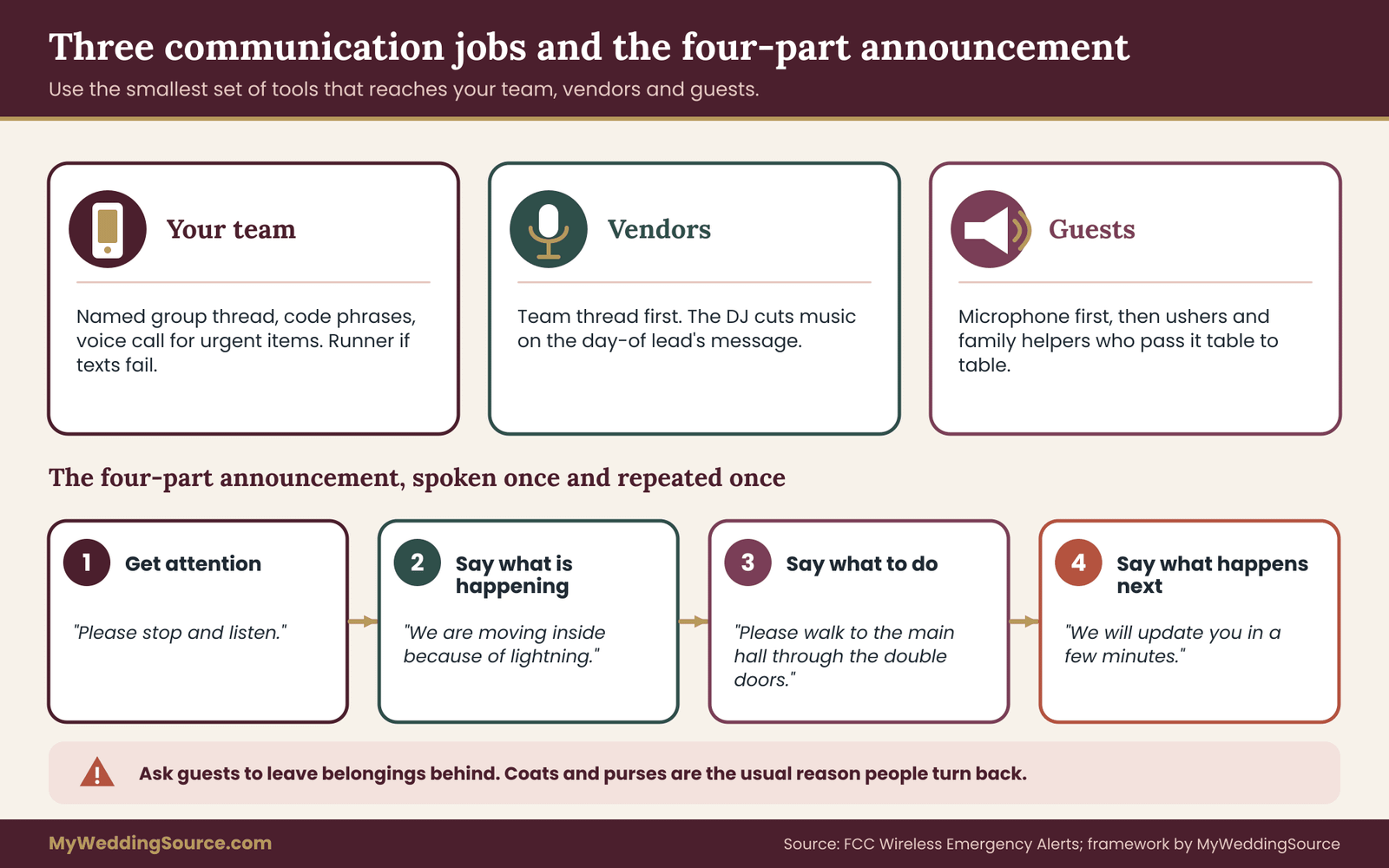
A last caution. It is tempting to fix communication with more tools: apps, walkie-talkies, a dedicated alert platform. Each tool adds a step and a thing to forget. The best wedding emergency plan uses the smallest set of tools that reach the three groups, such as a team thread, a runner, the microphone and a few trusted faces, and makes sure each works.
The one-page action outline: the core document of a wedding emergency plan
Everything above becomes useful when it is compressed into something people can hold. This section lays out an original outline for a one-page document, which this guide calls the venue-coordinated contact and action sheet. It has ten blocks. Each block is a few lines, so the whole thing fits on a single side of paper, with the contact sheet on the reverse.
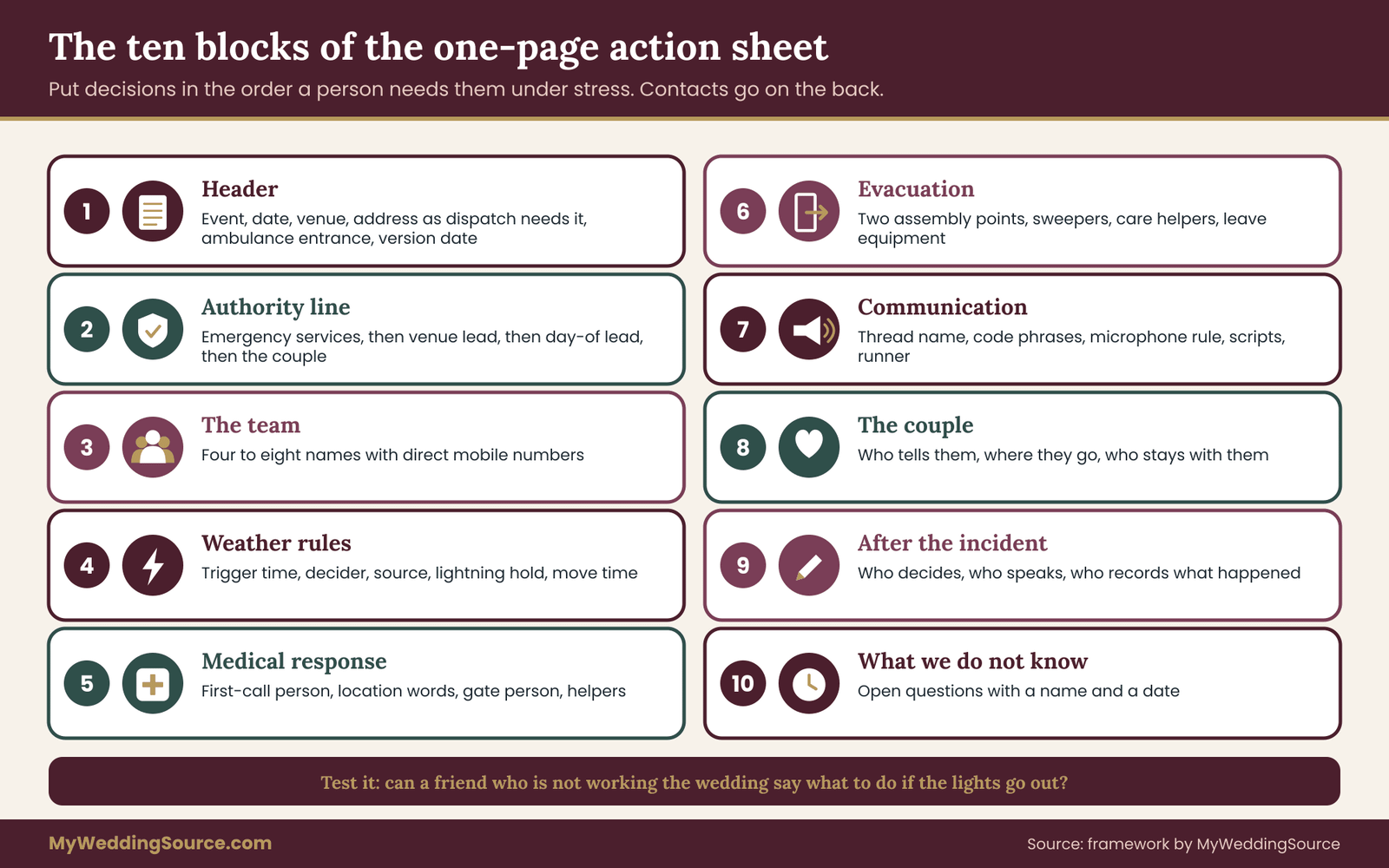
The idea is to put decisions in the order a person needs them: first who is in charge, then the three most likely situations, then the details. A person reading it under stress should be able to find the right block in five seconds.
Block one: header. The event name, date, venue name, the address as dispatch would need it, the best ambulance entrance and the version date. Put the version date in, because plans get updated and old copies get passed around.
Block two: authority line. One sentence. “Emergency services direct, then the venue’s emergency lead, then our day-of lead. The couple and family support.” This is the sentence that settles arguments.
Block three: the team. Four to eight names with roles and direct mobile numbers: the venue lead, the day-of lead, the backup lead, the caterer lead, the DJ or band lead, the photographer, the transport lead and one family liaison.
Block four: weather rules. The trigger time for the indoor decision, who makes it, who is consulted, the source of information, the lightning hold rule and the number of minutes it takes to move everyone indoors.
Block five: medical response. The first-call person and a backup, the exact location words for dispatch, the gate person, the helper circle, the location of the first aid kit and the defibrillator if there is one, and the sentence about privacy.
Block six: evacuation. The primary and alternate assembly points, the exits as the venue describes them, the sweepers, the people assigned to children and to guests who need extra help, and the vendor instruction to leave equipment behind.
Block seven: communication. The team thread name, the code phrases, the microphone rule, the three short scripts and the runner fallback.
Block eight: the couple. Who tells them, where they go, who stays with them. This is the block most couples forget, and it matters because the couple is a visible target for questions.
Block nine: after the incident. Who decides whether the event continues, who speaks to guests, who contacts families outside the event, who gathers information for insurance and for the venue’s incident report, and who takes notes about what happened and when.
Block ten: what we do not know. A short list of open questions, each with a named person and a date. Plans are never finished. Showing the gaps honestly helps people fill them.
Here is a short example of how block four might read, written in a way that fits the one-page format and uses an invented setting.
“Weather. Move-or-stay call at 3:30 pm by the venue’s event lead after talking to our day-of lead. Source: the local National Weather Service forecast page, checked at 3:00 and 3:30. If thunder is heard at any time, everyone moves to the main hall; the hold lasts until thirty minutes after the last thunder. Moving all guests takes about eight minutes; ushers start at the first rumble, not the first drop.”
That block has a time, two names, a source, a rule and a number. Nothing in it is complicated, and every part is a fact someone verified.
A good test of any block is whether a person who has never seen the wedding emergency plan could follow it. Ask a friend who is not working the wedding to read it and tell you what they would do if the lights went out. If they hesitate, the block needs another sentence or a name.
How long should the document be? One page, with the contact sheet on the back. A longer file is fine to keep as a backup, but it will not be read. The one-page version is the real plan, and the longer file is a reference.
Who gets a copy? The venue lead, the day-of lead, the backup lead, each vendor lead and the family liaison. The couple should see it, but they do not need to carry it. A short version of the weather and evacuation blocks can go to the wedding party leads, in a message sent a few days before. Guests do not need a copy.
When should it be done? Aim to finish the first draft about two months out, hold the venue meeting at least a month out, and finalize it a week before. The timeline section later in this guide spreads the work across the months and weeks, so no single evening carries it all.
If you are working with a planner or a day-of coordinator, they may already have a template. Use theirs as a starting point and make sure it contains the venue-coordinated pieces. A planner who has run many weddings will have strong opinions on what works. Ask them what they have seen go wrong. That conversation is as valuable as the template.
For the vendor side of this, a vendor timeline shows when each supplier needs information, which tells you when to send them the relevant blocks. The emergency sheet should arrive at the same time as the final schedule, not after it.
Worked example: a wedding emergency plan for an invented lakeside wedding
The following example is invented to show the process, and it is not a real couple, venue or event. It shows how the pieces fit together and where the decisions fall. Treat the specifics as illustrations, not recommendations.
Imagine a couple, Dana and Marcus, planning a wedding for about one hundred and ten guests at a lakeside event property in late summer. The ceremony is on a lawn by the water at five in the afternoon, cocktails are on a terrace, and dinner and dancing take place in a pavilion with open sides. An indoor lodge holds all guests in a pinch. They have a day-of coordinator, a caterer, a DJ and a photographer. They have no official planner.
Step one: the venue meeting. Six weeks out, Dana and their coordinator visit the property and meet the venue’s event lead. They bring a one-page draft contact sheet and ask three questions: what does your staff do for lightning, a medical event and an alarm, who can stop the event, and where do guests go? The venue lead answers that the lodge is the lightning shelter and holds everyone, that the walk from the lawn takes about six minutes at an easy pace, that the venue lead can pause any outdoor activity, and that the assembly point for a building problem is the gravel lot by the front gate.
They add that the lodge has a defibrillator in the entry hall and two staff trained in first aid. The lead gives a direct mobile number and a backup, and states the exact address text for dispatch, including the name of the road the ambulance should use.
Notice what has happened. The couple did not invent a plan. They discovered the venue’s, then fitted theirs around it.
Step two: the authority line. The coordinator writes the sentence: emergency services direct, then the venue lead, then the coordinator. Marcus’s mother, who has strong views, is given a task: she gathers the older relatives and walks them to the lodge in the event of a weather move. She is pleased to have a job.
Step three: the weather rule. The coordinator and the venue lead agree that the move-or-stay call is made at three-thirty by the venue lead after talking with the coordinator, using the local National Weather Service forecast page. The move takes about forty-five minutes for chairs, florals and sound, and the ceremony is at five.
They agree to a lightning rule: any thunder means the lawn clears and the hold runs thirty minutes after the last thunder. Because the walk takes six minutes, ushers will start moving guests at the first rumble. Dana and Marcus agree in advance that they will not override the call.
The couple also write down what the schedule looks like in each case, so the choice on the day is small. If the ceremony moves indoors, the lodge setup begins right away. If a delay of up to an hour occurs, cocktails move to the lodge and the ceremony follows. If the delay is longer, the ceremony is shortened and moved just before dinner.
Step four: medical and evacuation roles. The coordinator assigns a first-call person at each zone with a backup, a gate person at the front gate and a helper at each zone. The lodge defibrillator’s location goes on the sheet. The caterer confirms the allergy list is shared with servers. Dana’s grandfather uses a walker, so a cousin is assigned to stay with him at all times and to move him to the lodge’s ground-floor seating first.
Two nieces, ages seven and nine, are assigned an aunt who keeps them close. None of these assignments is posted anywhere guests can see.
Step five: communications. The team thread is created and named. The DJ confirms that the microphone reaches the lawn, terrace and pavilion, and agrees to cut music on the coordinator’s message. Three scripts are written and printed. Ushers are briefed to pass messages table to table. A short note on the wedding website tells guests where the indoor option is and asks them to look for ushers if anything changes.
Step six: the one-page sheet. The coordinator compresses everything into ten blocks, prints four copies, and sends a photo of the sheet to each person named on it. A friend with no connection to the event reads it and says what she would do if a storm cell appeared. She gets it right. A small correction is made to the assembly point description, because she assumed the front gate meant the road, not the gravel lot.
Step seven: the morning of. At nine, the coordinator checks the forecast and finds a line of afternoon storms. At noon, she checks again and messages the team. At three, she speaks to the venue lead, who has been watching radar and has talked with the lodge staff. At three-thirty the call is made: move the ceremony indoors. The venue crew begins the move. Dana asks, “Are we sure?” The coordinator answers, “This is the wedding emergency plan we agreed on in March.” Dana lets it go.
Step eight: the incident. During the ceremony in the lodge, an older guest feels faint. The nearest usher approaches the first-call person, who calls emergency services and reads the location words from the sheet. The gate person waits at the front. A relative sits with the guest. The DJ, told by the team thread to keep music low during cocktails, does so.
The couple are told quietly by the coordinator. The guest is taken for a check and is fine. The couple continue. At dinner, Dana quietly asks the coordinator to find out how the guest is doing. The coordinator reports back.
What the example shows. The wedding emergency plan did not prevent anything. The storm came, the guest felt faint, and the day was altered. But there was no scramble over who decided, no search for a phone number, no argument about the route and no one standing in the way. The cost of the plan was a few hours of conversation and a printed sheet.
Now consider where it could have gone wrong, because the example is also useful as a failure map. If the venue lead had been unavailable at three-thirty, the wedding emergency plan names a backup, and the call would have been made by the coordinator with the lodge manager. If the DJ had been unreachable, the runner fallback would have carried the message.
If the lodge had been full of rental furniture, the exits review would have caught it earlier. If Marcus’s mother had insisted on staying at the lawn for photos, the wedding emergency plan’s authority line, and her task, would have given her a reason to reconsider.
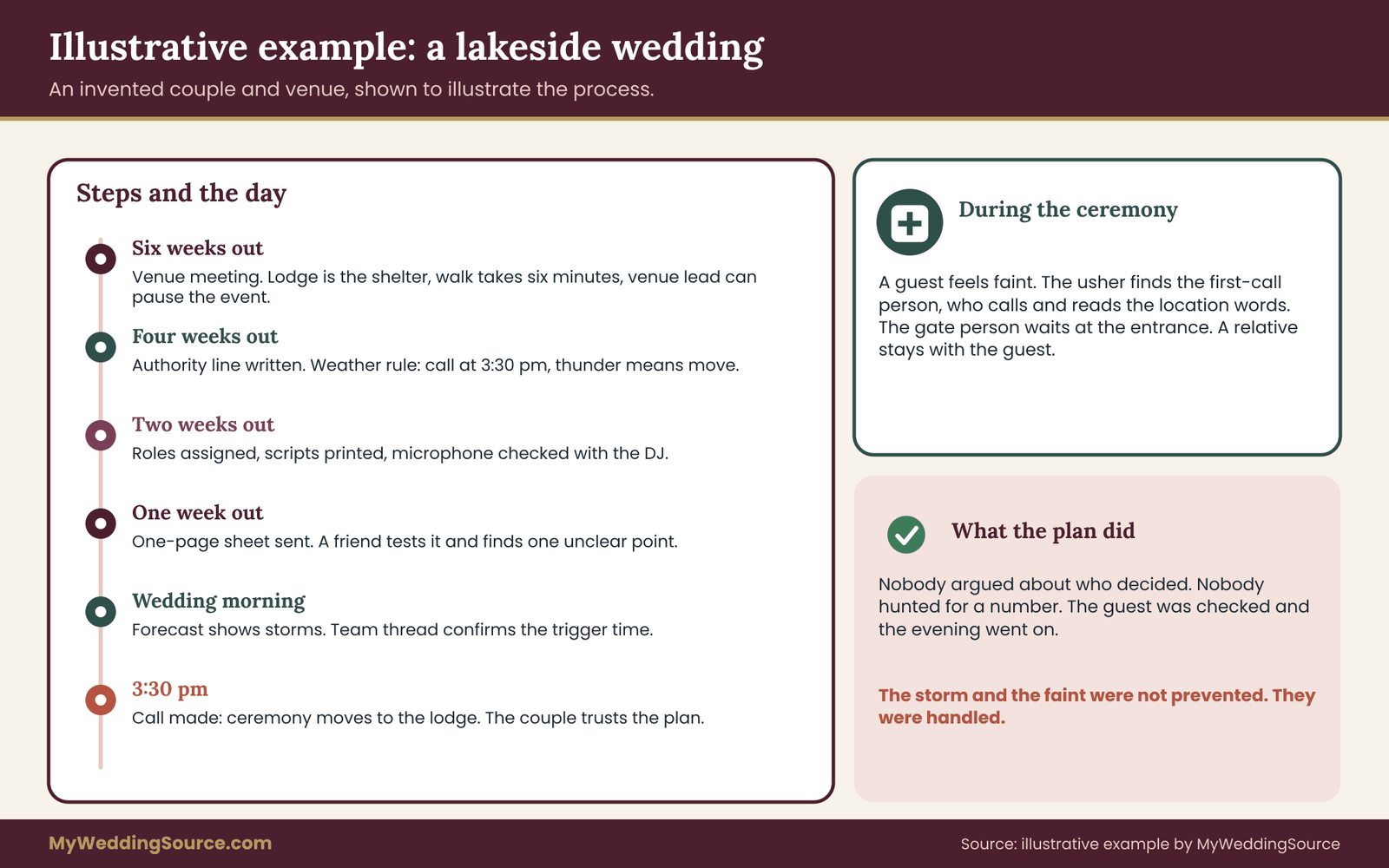
None of these details are universal. A downtown hotel will have different answers, as will a backyard or a farm. The process, though, is the same: meet the venue, write down the authority line, convert risks into rules with times and names, assign roles, choose a few communication tools, compress to one page and test it with a stranger.
When a wedding emergency plan fails: failure conditions and alternatives
A plan that has never been challenged is not yet proven. It is useful to ask where yours is most likely to break, and to decide in advance what you will do in each case. These are the failure conditions that come up most often, along with a practical alternative for each.
Failure: the decider is unreachable or unsure. The person who is supposed to make the weather call is on the phone with the caterer, or stuck in traffic, or simply uncertain. The alternative is a time-based default. If no call is made by the trigger time, the event moves to the indoor option. A default turns indecision into a safe outcome and removes the pressure from any single person.
Failure: the venue’s staff do not know the wedding emergency plan. Couples often meet the sales contact and the event lead and assume the staff on the day know what was discussed. They may not. The alternative is to send the one-page sheet to the venue lead a week before, ask them to confirm receipt, and ask them to brief staff. On the day, the first conversation with the venue lead should be a thirty-second review of the three most likely situations.
Failure: the message does not reach guests. The DJ’s microphone dies, the music is too loud, or guests have drifted to the parking lot. The alternative is the usher network and the runner fallback. It helps to have a loud, simple signal, such as asking the venue to use its own alarm or bell for weather moves if that is part of the venue’s routine. Ask what the venue already uses.
Failure: cell service drops. A rural venue, a crowded area or a damaged tower can make phones useless. The alternative is the paper sheet, in-person runners and the venue’s landline, if it has one. Plan for the loss of the thread by agreeing on a physical meeting point for the team, such as the coordinator’s table, where anyone can find the coordinator.
Failure: the assembly point is blocked or unsafe. A fire truck uses the same lot, or the area is flooded. The alternative is the second assembly point named on the sheet, and the instruction that emergency services and the venue lead can change it.
Failure: the couple or a parent overrides the wedding emergency plan. It happens. A bride wants the ceremony outside, a father says the storm will pass, or an important guest insists on staying. The alternative is the authority line and the pre-agreement. If the couple has signed off on the plan in advance, the coordinator can point to it. And if the venue lead has authority, a request to override can be redirected. Say this early, so no one is surprised.
Failure: the helper is also a guest who has been drinking. A relative named in the wedding emergency plan may be unfit to help by evening. The alternative is to name helpers with a morning and an evening role, and to have the backup lead check at a set hour that each named helper is still able to carry out their task. Replace anyone who is not.
Failure: the incident is not in the wedding emergency plan. A fight, a missing child, a power outage, a vendor who disappears or a death in the family on the day. No plan covers everything. The alternative is the core: someone is in charge, there is a way to reach people, and a way to call for help.
If your sheet makes these three things clear, you can handle most unexpected events by applying them. The site’s guides on specific wedding-day problems go further, and the broader wedding vendor contract guide helps you check what each supplier owes you if something goes wrong.
Failure: the plan is too long. People do not read it. The alternative is the one-page rule. If a block runs past five lines, move the details to the reference file and leave a pointer.
Failure: the wedding emergency plan is never updated. Phone numbers change, venue staff leave and the guest list moves. The alternative is a version date and a final review a week before, with a call to each person on the sheet to confirm their number.
A useful habit is to write each failure on a card and ask the group, at the walkthrough, what they would do. The point is not to scare anyone. It is to see whether the answer is the same for everyone. If three people give three answers, the wedding emergency plan has a gap.
There are also alternatives to the plan itself, and some couples may choose them. A smaller wedding with fewer outdoor elements has fewer weather triggers. An indoor ceremony removes the largest weather variable. A venue with full-time staff and standing procedures removes many of the questions. A planner who has experience with incidents can reduce your own workload. None of these remove the need for a wedding emergency plan, but they change how heavy the wedding emergency plan needs to be.
Finally, consider the cost logic without inventing prices. Each extra element, such as a tent, a backup indoor space, a shuttle, extra staff or insurance, has a cost that you can obtain by asking your vendors. The question to ask is not “what is the most protection we can buy?” but “which failure would hurt most, and what is the cheapest thing that would reduce it?” For many couples, the answer to the most likely failure, rain on an outdoor ceremony, is an indoor option agreed in writing, which costs a conversation more than money.
Ask your vendors for written quotes and written policies, and compare them against your own priorities.
Adapting a wedding emergency plan to the kind of venue you have
The same outline behaves differently depending on who owns the space. The questions you ask the venue, and the work you take on yourself, change with the type of location. Here is how the plan shifts in the most common settings.
A hotel or banquet hall. These venues usually have the strongest procedures, trained staff, alarm systems and security. Your job is mostly to plug in. Ask for the event manager’s direct number, the hotel’s security number, the evacuation procedure for your specific room and any rules about candles, fog or haze machines, open flame and pyrotechnics.
Many fire alarm incidents at events come from effects, so ask the venue what is allowed and tell the DJ, the photographer and any décor vendor. A hotel will often have a different plan for guests who are staying overnight, which can help if guests need to move quickly to rooms.
A restaurant or small private room. The staff are fewer, the rooms are smaller and the exits are fewer. Ask what happens during a dinner service when there is an alarm, who counts guests and where people gather. A small group is easier to manage, but a small room can empty very slowly through one door.
A barn, farm or rural event space. These can be beautiful and lightly staffed. The venue may be a family who manages everything themselves. Weather, road access, cell service and distance to emergency services all matter more. Ask how long an ambulance typically takes to arrive, whether the road is paved, who holds the gate keys and whether the property has a landline. Ask about hay, dry grass and open flame. A site visit in the same weather you expect is useful, if it can be arranged.
A park, garden or public space. The permit holder may be the couple. There may be a park office, a ranger or a city department with its own rules about vehicles, tents and power. Ask who responds if there is an incident and how a call is routed. The wedding emergency plan has to supply its own shelter, which may mean a tent with sidewalls, a nearby building you have permission to use or an agreement with a vehicle-based shuttle.
Public parks may not be closed to the public during your event, which means unfamiliar people may be present.
A private home or backyard. The host becomes the venue. That means they hold the roles that a venue normally holds, and the wedding emergency plan should say so openly. Walk the property for exits and shut-offs, locate a safe place for storms, ask a neighbor about parking and access, and check that the driveway can be reached by an ambulance.
Keep tents and heaters away from hazards. Consider a short call to the local fire department’s non-emergency line to ask about access and any permit requirements for tents, heaters or cooking. Practice the three scripts with the host.
A destination or international location. Local rules, languages and emergency numbers differ. Check the emergency number for the country, the nearest hospital and the way to reach English-speaking responders if needed. The plan’s contact sheet should include a local coordinator who knows the area. Guest travel insurance and medical coverage are matters for each traveler, and the planning of them belongs in a separate conversation.
A boat, a mountain location or a remote site. The usual assumptions break. Distance to help, access roads, weather windows and the number of people the vessel or shuttle may carry all become critical. Ask the operator for the written capacity and weather policy, and treat their decision to cancel as final. A site visit and a conversation with the operator are not optional.
Across all types, the most useful single question is: what happens here when something goes wrong during an event? A venue that has an easy, specific answer has probably thought about it. A venue that hesitates is one where your wedding emergency plan has to do more.
Contracts and insurance in the wedding emergency plan. Your contracts should match the plan. Read the venue agreement for the clauses on cancellation due to weather or unsafe conditions, who has the right to stop an event, any limits on vendors or equipment, and the security or staffing requirements. Check whether the venue requires proof of insurance from you or your vendors, which your vendor agreements should spell out.
Ask your insurer or broker, not this guide, what event insurance covers and what it excludes. Policies differ widely, and some exclude certain weather events or require notice. Treat insurance as a way to handle the financial side after an incident, never as a replacement for safety planning.
Ask also about the permissions that bear on emergencies: use of the venue’s power, generator rules, the use of heaters or cooking equipment, and where vendors may park and load. When you plan the load-in, ask where emergency vehicles will enter, so vendor trucks do not block them.
A last point on staffing. If your guest list is large, ask the venue whether they recommend security or extra staff, and ask what that costs. Do not take a number from a blog. Get it in writing and weigh it against your priorities. For some weddings, a trained professional at the door is worth the money. For others, a larger, attentive team of family helpers is enough. Make the choice knowingly.
A calendar for building a wedding emergency plan, from months out to the morning of
A wedding emergency plan is easiest when it is built in small pieces. None of the steps below takes more than an evening, and most can be combined with tasks you are already doing. Adjust the timing to your own wedding.
Eight to twelve months out: choose with safety in mind. When you compare venues, ask early about the emergency procedures, the indoor backup and the staff on site. Put the answers into your comparison with the other factors. A venue with no indoor option is not wrong, but it means the plan needs more from you. Track this alongside everything else you compare.
Six months out: collect information. Ask each vendor about their own emergency procedures, their policies for weather and their equipment limits. Ask the venue for its written emergency information, if it has any. Start a document where you keep these answers.
Three to four months out: decide on the major pieces. Choose your indoor backup and agree on the weather decision rule with the venue. Decide whether you need extra staff, a tent or shuttle vehicles. Ask your insurer or broker about coverage. Name the day-of lead.
Two months out: write the first draft. Fill in the ten blocks. Add placeholders where you do not know the answer, and a name and date for each one. Send the draft to the venue lead and the day-of lead.
One month out: hold the venue meeting. Work through the draft with the venue’s event lead, ideally during a walkthrough. Correct it, add the missing facts and confirm who has authority. Walk the routes and time them. Ask the venue to review your floor plan against the exits.
Three weeks out: brief the team. Send the revised sheet to vendors and the wedding party leads. Ask each to confirm they have read their block. Ask the DJ about the microphone, the caterer about allergies and the photographer about recording during an incident.
Two weeks out: tell guests, lightly. Add a short note to the wedding website or invitation follow-up: where the indoor option is, who to ask for help and what to bring for weather. Ask guests with mobility needs or medical conditions to contact you privately if they want something arranged.
One week out: finalize and verify. Update phone numbers. Check the forecast trend. Print the sheet. Send a test message to the team thread. Confirm that the venue’s staff have the sheet.
The week of: watch and prepare. Check the forecast daily. Confirm supplies, such as water, first aid kit, flashlights, a few rain items and a charged battery pack for the day-of lead. Place the sheet in the day-of lead’s folder.
The rehearsal: five minutes. Walk the exits and assembly points with the wedding party leads. Tell them where the indoor option is and who the helpers are. Do not make it a lecture.
The morning of: the first check. Check the forecast at set times, and tell the team thread when you have looked. Confirm the venue lead and day-of lead have the sheet. Confirm the trigger time.
During the event: stay light. The day-of lead keeps the sheet nearby and a phone charged. The venue lead and the coordinator speak briefly at key points, such as before the ceremony and before dinner. If nothing happens, nothing happens.
After the event: debrief. If any incident occurred, write down what happened and when, while it is fresh. Gather names for any follow-up, thank those who helped and contact the venue about their incident report if one is needed. If property was damaged or a vendor was affected, check your contracts and insurance notes. Keep the sheet with your other records.
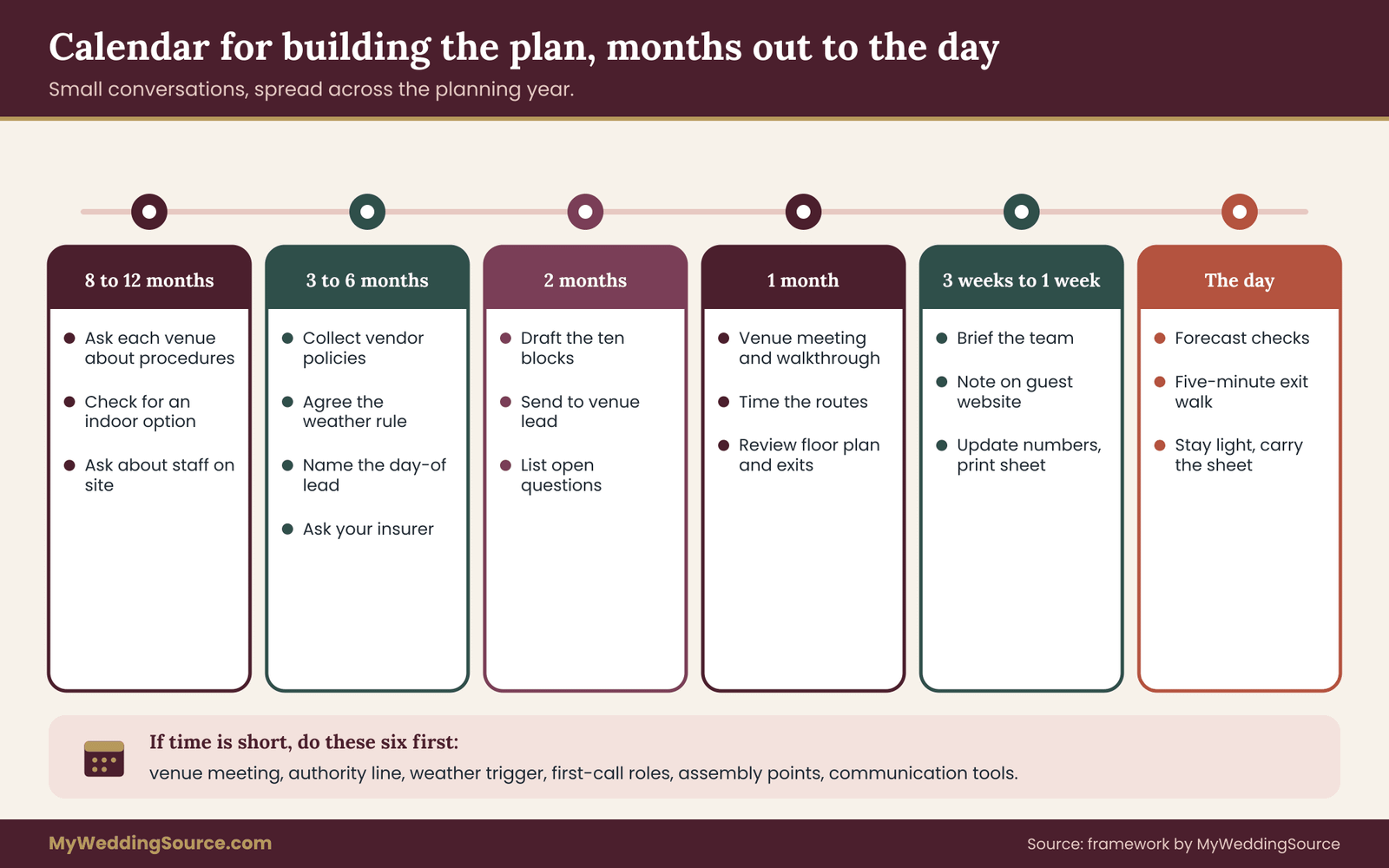
Notice what is missing from the calendar: heavy purchases, large rehearsals and daily worry. The work is mostly conversations and written decisions. If you are short on time, prioritize in this order: the venue meeting, the authority line, the weather trigger, the medical first-call roles, the evacuation points and the communication tools. Even a wedding emergency plan that only covers those six items beats having none.
For the earlier stages of your planning, the site’s general wedding planning checklist keeps all the tasks in one place, and the vendor timeline tells you when each supplier needs what from you. Use the emergency sheet as an extra row in both.
Your next steps
Start small. This week, ask your venue who the on-site emergency lead is for your date, and whether they will meet with you to review a contact sheet. Write down the answer to one question: who is allowed to stop the event? Then build the authority line and the weather trigger, since those two decisions shape everything else.
Over the next few weeks, draft the one-page sheet, assign the first-call, gate and helper roles, and choose the small set of communication tools. Send the draft to the venue lead and the day-of lead. Hold the walkthrough, correct the sheet and print it. A short, specific wedding emergency plan that people have actually seen is worth more than a thorough one in a folder nobody opens. For help from qualified people, speak with your venue, your planner, your insurer and, where the stakes are high, a licensed safety professional.
FAQ
What should a wedding emergency plan include?
At minimum, include a chain of authority, a contact sheet made with the venue, a weather trigger with a time and a named decider, medical first-call roles, evacuation routes and assembly points, and a communication method for your team, vendors and guests. Compress it to one page, with the contacts on the back, and share it with everyone named on it.
Who is in charge if there is an emergency at a wedding?
Emergency services direct once they arrive. Inside the property, the venue’s emergency lead directs until then. Your day-of lead carries out the wedding-side tasks, and the couple and family support. The couple decides what happens to the event afterward, but not whether the building is safe. Write this order into the wedding emergency plan and confirm it with the venue.
How do we handle bad weather at an outdoor wedding?
Set a clock time by which the move-or-stay decision is made, working back from how long a move takes. Name one decider and the source of weather information. Treat thunder as a stop signal, and follow the National Weather Service’s lightning guidance about waiting after the last thunder. Agree on the indoor option and schedule changes in writing with the venue.
Do we need first aid supplies and an AED at the wedding?
A basic first aid kit, water, a place to sit and a list of nearby urgent care and hospitals are sensible. Many venues have an automated external defibrillator, so ask where it is and who knows how to use it. Do not buy equipment based on general advice. Ask the venue and a qualified professional, and call emergency services when unsure.
How do we tell guests about an emergency without causing panic?
Use the sound system first, then ushers and family helpers who pass the message table to table. Keep it short and calm: say what is happening, what to do and what happens next. Give guests an action, such as walking to the main hall. Avoid speculation. A few written scripts, read by one authorized person, work better than improvising.
What do we do about guests who need extra help in an evacuation?
Ask guests privately, before the day, whether they would like help, and share only what is needed with the venue. Assign one or two helpers to stay with each person or group, and consider ground-floor seating. Do not publish names. Children should also have a named adult. Elevators are generally not used in a fire evacuation, so ask the venue how it handles accessible routes.
Is wedding insurance enough to protect us?
Insurance helps with the financial side after something goes wrong, but it does not make the event safer. Policies differ in what they cover and exclude, including some weather events and required notice. Ask your insurer or broker to explain the specific terms in writing. Treat the policy as one layer next to a plan, a venue meeting and clear roles.
Do we need a professional planner to build the wedding emergency plan?
Not necessarily. A planner or day-of coordinator brings experience and often a template, which saves time, but a couple can build a workable plan by meeting the venue, writing the authority line, setting the weather trigger and assigning roles. For larger or more complex events, or remote locations, a licensed safety professional can review the wedding emergency plan.
Sources
- Ready.gov, preparedness information from the U.S. government
- Lightning safety, National Weather Service
- Heat safety, National Weather Service
- First aid, CPR and AED training, American Red Cross
- Emergency preparedness and response, Occupational Safety and Health Administration
- Federal Emergency Management Agency
- National Fire Protection Association
- 911.gov, National 911 Program
- Wireless Emergency Alerts, Federal Communications Commission
- Americans with Disabilities Act information, U.S. Department of Justice