
A summer camp wedding puts a hundred people into buildings designed for children, and the two decisions that decide whether the weekend feels easy or exhausting are who sleeps in which cabin and when the site goes quiet. This guide gives you a cabin assignment method, a written quiet-hours policy, a worked case and the conditions that should make you change course.
For a summer camp wedding, do three things in order. First, get the camp’s actual bed count by cabin, with bathroom distance, heat and cooling, and which buildings are accessible. Second, sort guests into sleeping groups by need (mobility, infants, early risers, late party guests, couples) and assign groups to cabins, not individuals to bunks. Third, write quiet hours as zones and sources, not as one time, and get the camp director to sign off. If the bed count, the accessible rooms or the noise rules cannot be confirmed in writing, switch to a hybrid with off-site lodging.
Most advice about camp weddings stays at the level of mood: string lights, long tables, a bonfire. That advice is fine, but it skips the part guests remember at breakfast. They remember whether they slept in a bunk bed beside a stranger, whether the cabin was 40 yards or 400 yards from a toilet, and whether somebody’s speaker was still playing at one in the morning.
A summer camp wedding is an overnight event in a building type that was never meant for adults on a celebration schedule, so the sleeping and noise decisions are the real design work.
This article is narrow on purpose. It does not walk through the whole weekend, the menu, the bonfire or the ceremony site. For the broader weekend structure, the guide to choosing a wedding venue covers how to compare site types, and the guide to coordinating wedding guest hotels across budgets and mobility needs covers lodging that sits off site.
Here the question is smaller and harder: given a camp with a fixed set of cabins, how do you assign people to them and set a noise policy the camp, your summer camp wedding guests and your neighbors can all live with?
A note on scope for this summer camp wedding guide. This is general planning information, not legal, safety or insurance advice, and every rule mentioned here must be confirmed with the camp and with the local authority that governs the site.
Why a summer camp wedding is a sleeping problem first
A hotel block sells you rooms. A camp sells you beds, and the difference matters. A hotel room has a private bathroom, a lock, a thermostat and a door that closes on a corridor staffed by someone awake. A cabin may have none of those. It may hold a dozen or more beds in one open room, use a bathhouse down a path, have box fans instead of air conditioning, and sit in a cluster of identical buildings with no signs a tired guest can read in the dark.
None of this is a flaw in the camp. The buildings are built for a purpose, and that purpose is a group of campers with counselors, a bedtime and a lights-out routine. A wedding group has none of those habits built in. Your guests arrive at different times, bring luggage, drink at different rates, include people over seventy and people under two, and stay up for different reasons. The camp’s own rules of thumb about sleeping and noise assume a supervised, age-matched group. Yours is mixed, unsupervised and celebrating.
That mismatch produces the same handful of problems on overnight weddings at children’s camps. Guests who expected a private room find a shared one. Parents with a toddler end up beside the group that wants to stay up late. A grandmother is assigned to an upper bunk because the spreadsheet had her name next to a bed number. Someone’s playlist carries across the lake. And the couple, who had a clear picture of a cozy weekend, spend Saturday afternoon answering messages about who is where.
The fix is not more rules. It is a smaller number of decisions made earlier, in a specific order, using real information from the camp.
The three layers that decide the weekend
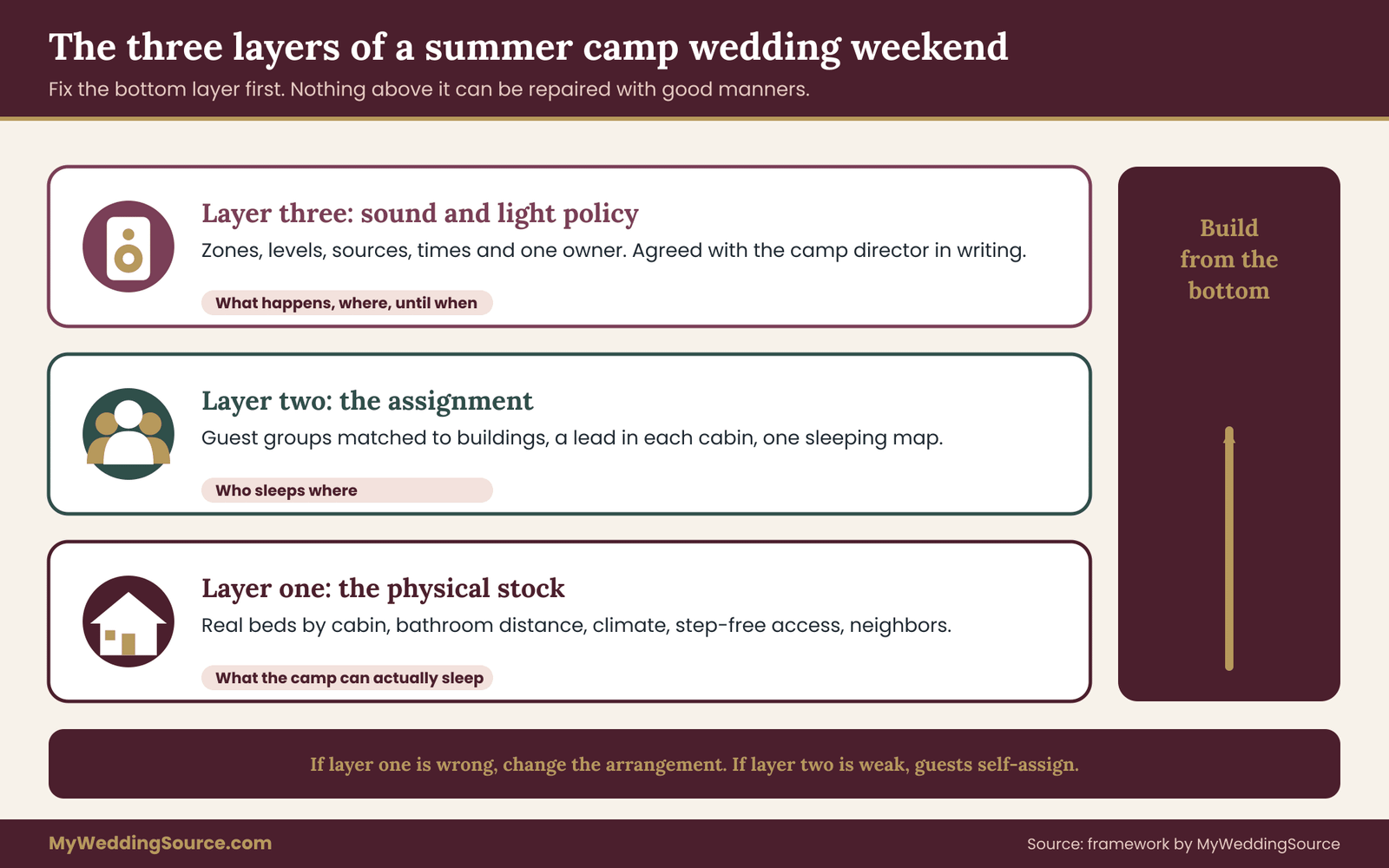
Think of the summer camp wedding weekend as three layers stacked on one another. The bottom layer is the physical stock: what beds, buildings, bathrooms and accessible routes the camp actually has. The middle layer is the assignment: which group of guests goes into which building. The top layer is the sound and light policy: what happens, where and until when.
If the bottom layer is wrong, nothing above it can be fixed with good manners. If the middle layer is weak, guests will self-assign, and the result is rarely good for the people with the least flexibility. If the top layer is vague, the camp staff will apply their own rules at the worst moment, usually at eleven at night, usually to a group that was told something different.
Everything in this summer camp wedding guide follows that order. Layer one is the next section. Layer two is the assignment checklist and the guest groups. Layer three is the quiet-hours material. Then the worked case, the enforcement script, the alternatives and the failure conditions that tell you when to stop trying to make the camp work and use a different arrangement.
What this guide does not decide for you
Three things sit outside this guide. It does not tell you whether a camp is a good value, because prices vary and any figure here would be invented. It does not replace the camp’s own rulebook, which will override anything general. And it does not decide whether your guest list suits an overnight camp at all. If more than a handful of guests have mobility limits or serious medical needs, read the section on accessibility and the section on alternatives before you sign anything.
One more framing point. A camp can be run by a nonprofit, a faith group, a school, a municipality or a private company, and the rules differ accordingly. Some rent only the dining hall and grounds, some rent the whole property exclusively, and some run the summer camp wedding weekend alongside a youth session. Ask which of these applies before you do anything else, because it changes both the bed count and the noise rules.
Reading the camp’s sleeping stock before you assign anyone
Before any assignment, build a plain inventory of what the camp can actually sleep. This is the single most useful document in the whole process, and most couples never ask for it because the camp’s brochure lists a headline capacity and that feels like enough. It is not enough. A capacity of one hundred and twenty may include bunk beds counted as two beds each, staff cabins that are not for rent, and a lodge room that is only usable in cool weather.
Ask the camp for a cabin-by-cabin list. For each building, you want eight facts, and you should write them down rather than rely on a phone call.
- How many beds, and of what type: single, bunk (top and bottom counted separately), cot, or loft.
- Whether the mattresses are the camp’s or whether guests bring sleeping bags, and whether linens are included, rented or not available.
- How far the nearest toilet and shower are, by path, and whether that path is lit and surfaced.
- Whether the building has any heating or cooling, and what kind.
- Whether the building has a ground-floor entry with no steps, and whether doors and bathroom stalls are wide enough for a wheelchair or walker.
- Whether it is a single open room or has partitions or separate sleeping areas.
- Whether it has a working light switch inside the door, outlets and a smoke alarm.
- Whether staff, other renters or another group will sleep within earshot.
Count beds the way a guest experiences them
A bunk bed is not two equal beds. The bottom bunk is the one an older guest, a pregnant guest or a parent with a baby will want, and the top bunk is a poor choice for most adults and unsafe for young children. If a cabin has ten bunk beds, the honest count for adult guests is ten good beds and ten difficult ones. Count them that way and your real capacity for a mixed adult group may be well under the camp’s headline number.
The second adjustment is privacy. Many couples assume that every guest wants a private space and that a shared cabin is a downgrade. That is not always true; friends who have not seen each other for years may love a shared cabin. But privacy is a preference with a real range, and your inventory should note which buildings could be split with a curtain or a sheet, which have a separate corner and which are truly open rooms.
The third adjustment is the real bathroom distance. A camp might describe a bathhouse as “close.” Walk it, or ask someone who has, and write down a number of steps or an approximate distance. A guest who gets up twice a night will notice the difference between thirty steps and three hundred.
Ask about what shares a wall, a path or a lake
Noise at a summer camp wedding travels in ways that a hotel’s does not. Cabins are often thin-walled, built with screens, and set close together. A dining hall with live music may be a long way from the cabin cluster by path but close by line of sight across water, and sound carries across water in the evening. A camp may also have a caretaker’s house, a staff area, a neighboring property or a public trail that matters to the noise policy even though none of them are guests.
Ask the camp director for a rough map and mark three things on it: the cabin groups, the party venue and the nearest place where someone not in your group sleeps. The distance and direction between the party venue and that nearest sleeper is the first number your noise policy has to respect. We will come back to that map when we build the summer camp wedding quiet-hours policy.
Confirm exclusive use in writing
The most consequential single question is whether your group has exclusive use of the property for the weekend. If another group, a school program or a youth session is on site, the camp’s noise and alcohol rules will be stricter, and your summer camp wedding guests will share paths and bathhouses with strangers, including children.
If you have exclusive use, say so in the contract and list what is included: all cabins, the dining hall, the bathhouses, the waterfront and the parking. If anything is excluded, such as a cabin held for staff, write that down too.
Also ask what the camp considers a “full rental” versus a “partial rental.” Some camps rent the dining hall and grounds for a day event and a separate set of cabins on a different rate and a different rule set. When the terms differ between day and overnight use, the overnight terms are the ones that govern your summer camp wedding quiet hours, and you want them in one document before you tell guests anything.
The cabin assignment checklist for a summer camp wedding
This is the working tool of the guide. It is a six-step sequence you run once, early, and then revise as RSVPs change. The point is to assign groups to buildings before you assign people to beds, because a group decision is easier to explain, easier to defend and much easier to change than forty individual decisions.
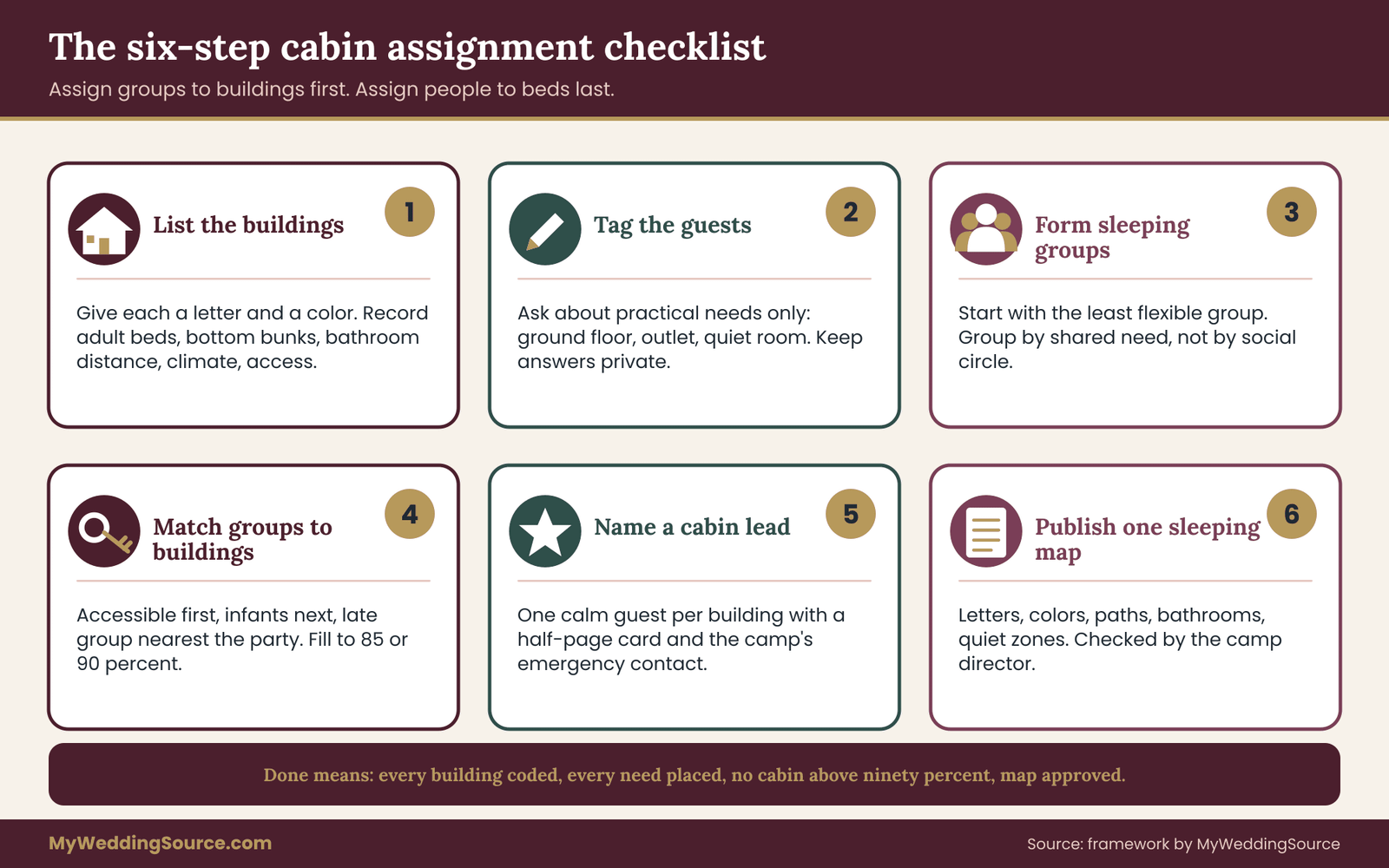
The six steps are: list the buildings, tag the guests, form groups, match groups to buildings, name a cabin lead for each building, and publish a one-page summer camp wedding sleeping map. Each step has a stopping rule, a point where you can say that part of your summer camp wedding is done. Without stopping rules, assignment work expands to fill every free evening.
Step one: list the buildings with a letter, not a name
Take the camp’s inventory and give each sleeping building a short code. Camps love names like Eagle Lodge and Cedar Cabin, and guests do too, but names are hard to read on a phone at night and some cabins on a property look nearly identical. A letter and a color, such as A in blue or D in green, is easy to match to a sign and easy to say aloud. Ask the camp whether it already has cabin signs, and whether you may add a temporary marker beside each door.
For each code, record the usable adult beds, the bottom-bunk count, the bathroom distance, the climate control, the accessibility and the neighbors. That is the building sheet from the previous section, reduced to a single line per building. Stop when every building in your summer camp wedding site has a code and a line. If the camp cannot supply a fact, write “unknown” and put the question on a list to resolve before you commit to any guest group.
Step two: tag the guests
Once you have an RSVP list, tag each guest or household with the needs that affect sleeping. Keep the tags few and practical. Useful tags are: mobility limit, needs a bottom bunk, infant or toddler, young children, teenager, wants privacy, early riser, late party, snores or sleeps lightly (guests tell you this), medical equipment that needs power, and traveling with a service animal.
Collect this information with a short, kind question on the RSVP or a follow-up form: “Is there anything about sleeping arrangements we should know?” Do not ask guests to explain a medical condition. Ask for the practical need, such as “a ground-floor room,” “an outlet near the bed” or “a quiet cabin,” and take the answer at face value. Keep the responses private, shared only with the person who does the assignment and the cabin leads who need the practical detail.
Do not tag by guessing. It is tempting to decide that your grandparents want a quiet cabin and your college friends want a loud one. Sometimes you are right, and sometimes the grandparents are the ones who stay up latest. Ask first, then assume only where you did not hear back, and say that you assumed.
Step three: form the sleeping groups
Groups are the heart of the method for any summer camp wedding. A sleeping group is a set of guests who can share a building without anyone being badly served. Start with the groups that have the least flexibility and fill the rest around them.
The least flexible group is usually guests with mobility limits and any companions who will help them. Next are families with infants and toddlers, who need a quiet room and an early bedtime, plus a place to move a crying baby without waking a cabin. Then come families with school-age children, who can often share a cabin together and tolerate some noise. After them, guests who want privacy or a quiet night. The most flexible groups are the late party group and the groups of friends happy to share any cabin.
A good group has a clear shared need and a rough size that matches a building. Resist making groups out of social preference alone. A cabin of friends who stay up until three is a fine group, but it should not be next to the infants’ cabin, and “friends of the groom” is not a sleeping category.
Step four: match groups to buildings
Now put the groups on the building list. Work in this order: accessible group to the accessible building with the shortest, most level path; infant and toddler families to a building away from the party venue, with a bottom-bunk or private-room layout and an easy walk to a toilet; the quiet and early-riser group beside them; school-age families in the middle; the late group in the building closest to the party and farthest from the infants and the nearest outside sleeper; and the remaining friends wherever beds are left.
This produces a summer camp wedding map that is not random. Buildings near the party venue absorb the party noise, and buildings far from it are the quiet end. That is what you want, and it is why the camp map matters. If the camp’s layout puts the accessible building right beside the party venue, that is a conflict to resolve with the camp early, not on Friday.
Leave a buffer. Fill each building to about eighty or ninety percent of its usable adult beds, not one hundred. A buffer absorbs late RSVP changes, a guest who arrives with an extra person and the inevitable person who cannot sleep in the assigned bunk and needs to move.
Step five: name a cabin lead for each building
A cabin lead is one trusted guest in each building who has the key information and is the first contact if something goes wrong. The lead is not a chaperone. The job is small: know where the light switch and the nearest bathroom are, know the quiet-hours rule, know who in the cabin needs what, and be the person a neighbor can find if there is a problem.
Choose leads who will be sober, rested and reachable, and tell them in advance. Give each one a half-page card with the cabin’s facts, the quiet-hours rule, the camp’s emergency contact and the couple’s or coordinator’s contact for non-emergencies. Pick leads from your wedding party, family or friends who are glad to take a quiet role. Ask, do not assign by surprise.
For a small summer camp wedding, leads may seem excessive. They are not. When the building count is above four or five, a lead per building replaces dozens of text messages with a short chain of contact.
Step six: publish a one-page sleeping map
The final deliverable is a single page, sent to guests ahead of time and posted at the check-in table. It shows the camp layout in simple form, the buildings by letter and color, each guest’s building and the path from the parking area, the bathroom locations, the quiet-hours zones and the emergency contact. Keep names off any version that is posted publicly; list cabins and a numbered or lettered key that guests can match to their own message.
Send each guest a short individual note with their building, the check-in time and one practical line: “Bring a flashlight and flip-flops for the bathhouse,” or “Your cabin has no air conditioning; a small battery fan helps.” Guests who get specific instructions arrive calm.
Stopping rules and what a finished assignment looks like
A summer camp wedding assignment is finished when each building has a letter, a bed count and a lead, each guest household has a building, every guest with a stated need is in a building that meets it, no building is above ninety percent, and the one-page map has been checked by the camp director. If any of these is missing, the assignment is a draft.
A finished assignment is still a living document. Expect it to change after the RSVP deadline, again about ten days before the summer camp wedding weekend and sometimes on arrival day. Each change should be made by one person, recorded and communicated to the affected guests and the cabin leads. Keeping a single editor prevents the common failure in which two people each fix the same problem and put the same guest in two places.
The first-night tradeoff you should decide on purpose
A summer camp wedding usually involves a Friday night arrival, a Saturday celebration and a Sunday departure. Friday night and Saturday night are different sleeping problems. On Friday, guests are tired from travel, many are meeting for the first time and the quiet hour should be easy to enforce. On Saturday, the party runs late, alcohol is involved and the sleeping map is tested.
Decide whether to fix assignments for both nights or allow a swap on Saturday. Fixed assignments are simpler, and guests know where their things are. A swap lets people move once they have learned who snores and who stayed up. If you allow swaps, put one person in charge, require a quick note to the cabin lead and never move a guest with a documented need without asking them.
When a group will not fit the building
Sometimes the numbers do not work at a summer camp wedding. You have twelve guests who need a ground-floor room and the camp has one accessible cabin with eight beds.
Do not squeeze. Work through the options in this order: ask the camp whether another building can be made usable with a temporary ramp or a bed move, whether a staff or program building can be rented for the summer camp wedding weekend, whether a guest can use a nearby hotel or rental for the nights they need and whether the camp can accommodate a smaller wedding party. Each of these has a cost, and the cost is yours to decide. The decision not to squeeze is the part that protects the guests.
Who sleeps where: guest groups and what each one needs
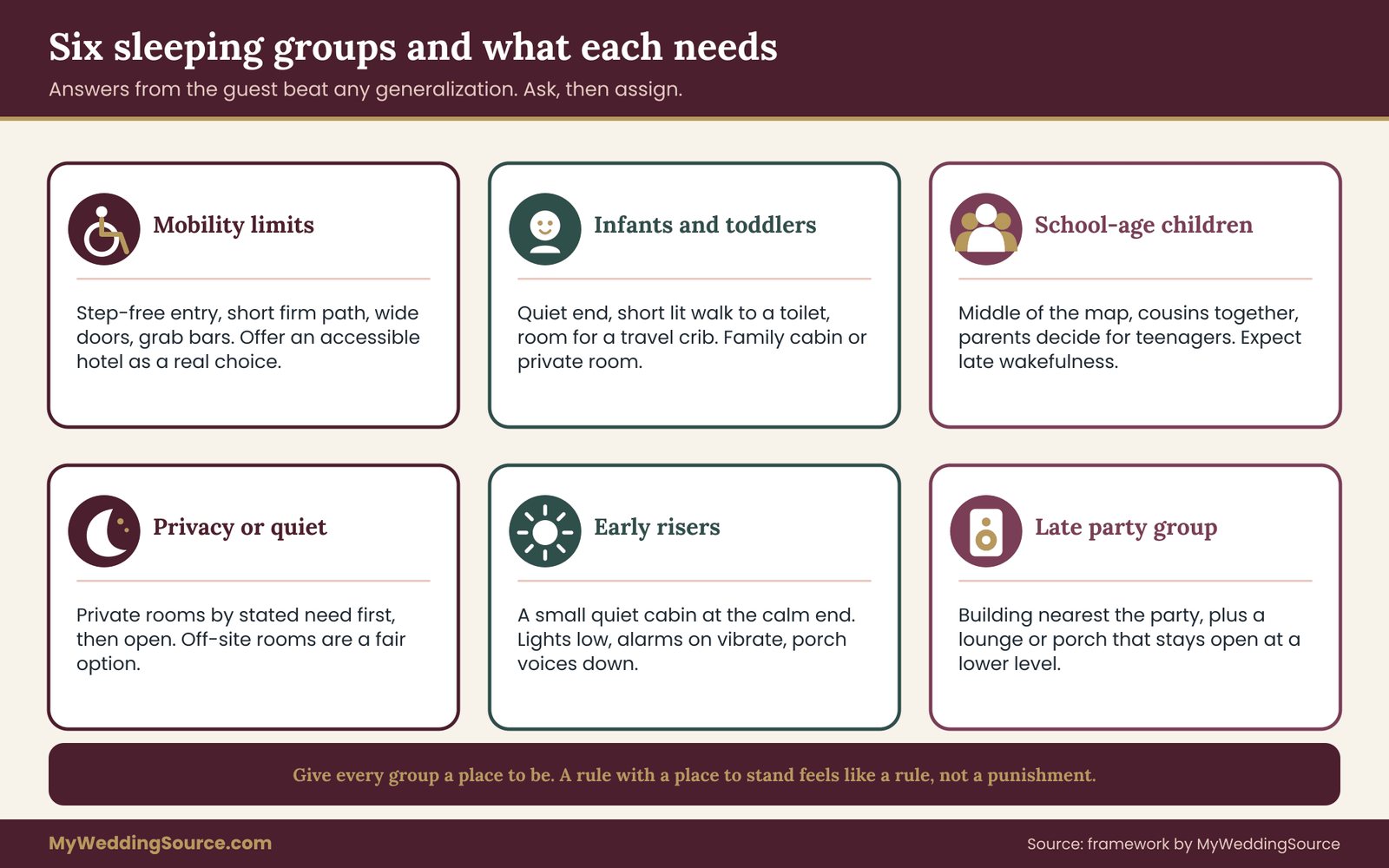
The checklist gives you the process. This section fills in the groups, because each type of guest brings a different set of needs to a summer camp wedding, and a coordinator who knows them in advance makes better matches. Treat the notes below as starting points, not as rules about people. Individuals vary, and an answer the guest gave you beats any generalization here.
Guests with mobility limits and their companions
This group gets first call on the best building, for a reason that has nothing to do with etiquette: a poor match here creates a risk of falls and a real chance that a guest cannot reach a toilet at night. Look for a building with a step-free entry, a short and firm path to the bathroom, a bed at a height the guest can use, and enough floor space to turn a walker or chair.
Ask the guest directly what they need. Some need a roll-in shower and a grab bar. Others need only a short walk and a chair in the bathhouse. Do not offer a lower bunk and call the matter closed; a bunk bed may still be the wrong piece of furniture. If the camp has an accessible building but it lacks something the guest needs, ask whether the camp can add a shower chair, a bed rail, a night light or a temporary ramp, and ask in writing so the answer is clear.
Put the guest’s companion in the same building if the guest wants that, and keep a note of who is the contact for the cabin. If the accessible building is near the party, give the guest the choice of a different arrangement rather than assuming they want the middle of the noise.
Some guests would rather sleep off site in a hotel with an elevator and an en suite bathroom, and for them the guide to wedding hotels that fit different budgets and mobility needs explains how to set up that option without singling anyone out.
Families with infants and toddlers
A baby’s schedule rarely matches a wedding’s, and a summer camp wedding makes the gap wider. A parent needs three things: a quiet place away from the late party, a way to get a crying baby out of a shared room without waking everyone and a short, well-lit walk to the toilet. They also need to know whether the cabin has any safe place for a portable crib or a cot, and whether a heater, a box fan or an exposed cord is within reach of a small child.
If the camp offers a private room or a small cabin, offer it to families with infants first. If every cabin is an open room, a family cabin is the next best choice: several families with babies in one building who understand the rhythm of a night. These parents will wake each other occasionally, but they will forgive it, and a party group will not.
Give these families an early, clear note about what to bring: a portable crib or travel bed if the camp does not provide one, a small flashlight with a red or warm light, a white-noise machine that runs on batteries and a plan for where the baby will nap on Saturday afternoon. A nap space in a cabin with a closed door is more valuable on the day than any decoration.
Families with school-age children and teenagers
At a summer camp wedding, children over about five often love a cabin. They are curious, they adapt and the novelty of a bunk bed is a gift. The trouble is not the child; it is the hour at which a group of children discovers that there is a flashlight, a bunk and a cousin in the next bed. Plan on children being awake later than the quiet-hours time on at least one night.
Place these families in the middle of the map, away from both the party and the infant cabin. Consider putting cousins or friends together in one building with a couple of adults who agree to supervise. Teenagers present a different problem: they want to be near the party and far from their parents. Be honest with parents that a summer camp wedding’s open layout gives teenagers freedom they may not have at a hotel, and let the parents decide whether their teenager sleeps in the family cabin or with a friend group.
Do not assign supervision to the couple or to cabin leads who are already managing other things.
Guests who want privacy or a quiet night
Some summer camp wedding guests want a bed they do not share. Reasons include a bad night’s sleep the last time, a snore they would rather not subject others to, a recent surgery, an illness that is none of anyone’s business or plain preference. You do not need the reason. You need to know whether a private option exists and what it costs.
Options are limited at many camps. A staff cabin, a lodge room, a single-bed cabin or a small building near the dining hall may be available at a higher price or a separate rate. If a few private rooms exist, you can offer them first-come among guests who ask, or assign them to guests with documented needs first and open the rest. Decide the rule early and tell people. A private room that goes to the first person who asked will feel arbitrary to everyone else.
Another quiet option is an off-site stay. A hotel or rental ten or fifteen minutes away is a perfectly good solution for guests who cannot tolerate shared sleeping, and it is not an insult to the couple. Say so in the invitation language: “The camp offers shared cabins. If you prefer a private room, here are nearby options.” That one sentence removes the guilt and the awkward email.
Early risers and the quiet cabin
Early risers are an underrated group at any summer camp wedding. A guest who gets up at five and wants to make coffee, take a walk or sit by the water should not be placed in a cabin full of people who went to bed at three. They also should not be placed in a cabin where their morning routine will wake someone else.
A small quiet cabin for early risers and light sleepers, placed at the quiet end of the map, solves both problems. Tell its occupants about the rule that makes it work: lights low after a given time, no loud conversation on the porch, and any alarm set to vibrate. This cabin tends to be the most popular one, and it often attracts older guests and parents of young children. Fill it with people who asked for it, not with people who happened to be left.
The late party group
The late party group at a summer camp wedding is the opposite end of the map, and it deserves a plan, not a scolding. These are the guests who want to stay up, keep talking and perhaps keep drinking, and who will be loud if they are tired and a little drunk at one in the morning. They will also be kind, fun and entirely willing to follow a rule if the rule is clear and the alternative is fair.
Give the late group a building near the party venue, farthest from the quiet end and from any outside sleeper. Give them a place to keep going after the quiet hour: a designated lounge, a screened porch, a fire pit area with a different quiet rule or a room in the dining hall where low conversation is allowed. A group with somewhere to go is much easier to manage than a group with nowhere to go but their cabin porch.
Tell this group in advance. “Quiet hours begin at this time in the cabin area. The lounge stays open until this time for conversation and music at a low level.” A rule that comes with a place to stand feels like a rule. A rule without a place feels like a punishment.
Couples, friends and the sleeping partner question
Couples who share a bed at home may be split across bunks at a summer camp wedding. Some do not mind; others do. The easy answer is to offer double beds where the camp has them, and to ask the question directly on the RSVP: “Would you like to share a room with your partner, or do you have another preference?” Do not assume that two adults who arrive together want the same bed.
For friends who want to be together, let them choose, up to the size of a cabin. Group size matters here: a group of four friends in a cabin of twelve means eight other people need to be matched too. Offer friends a way to fill a cabin completely, so the group sets the tone for that cabin and no stranger is placed in the middle of it.
The couple’s own sleeping arrangements
The couple’s own night at a summer camp wedding is a separate decision, and the usual suggestion of “give them the best cabin” deserves a second look. The best cabin in the middle of a party is a poor choice for people who will be exhausted and want to leave the party when they are ready. Consider a private building at the quiet end, an off-site room for the first night or a cabin that has a path to it that does not cross the party area.
Also decide where the couple will get ready, where their things are stored and who has the key. A short list on the summer camp wedding sleeping map answers that. For many couples the wedding night is spent in a small hotel room or a rental close by, and that is a legitimate use of the budget. The point is to decide on purpose and tell the few people who need to know.
Safety, accessibility and the limits of a cabin
Sleeping arrangements at a camp raise safety questions that a hotel stay does not. Some are about fire, some about access and some about the plain fact that a cabin is a place built for a short, supervised stay. This section lists what to ask and where to verify it. It does not tell you what is safe. That is for the camp, the local fire authority and your own judgment.
For a summer camp wedding, start with fire and life safety. Ask the camp whether each sleeping building has working smoke alarms, whether it has more than one way out, how many people the building is rated to sleep and whether any cabin uses a wood stove, a space heater or a propane appliance.
Ask whether the camp has a posted evacuation plan and an assembly point. The U.S. Fire Administration and the National Fire Protection Association publish general guidance on sleeping-area fire safety, and the camp’s insurer and local fire marshal set the actual rules for the property.
Next, accessibility. Standards for accessible lodging depend on the camp’s status and on local requirements, and a private camp, a municipal camp and a camp run by a religious group may be covered differently. The U.S. Department of Justice ADA site is the place to start for how federal accessibility rules are described, and it points to the right office for questions.
In practice, ask the camp what it can offer and put the answer in writing: which buildings are step-free, what the path surface is, which bathrooms have grab bars and how wide the doors are.
Finally, ask about weather and wildlife. A cabin with no cooling in July heat is a health consideration for infants and older guests. Heat advisories, storms and insects are local, so check the National Weather Service forecast for the site in the week before the event and tell guests what to pack. If any guest has an allergy, ask the camp about its protocol, and let that guest decide what they need. A cabin lead is not a medical resource and should not be asked to act as one.
Writing quiet hours for a summer camp wedding
Quiet hours at a summer camp wedding fail for a predictable reason: they are written as a single time. “Quiet hours begin at eleven” sounds clear, but it leaves out where, for whom, what counts as noise and who decides. Guests read it as a suggestion, the camp reads it as a hard rule and the couple has no idea which is true until someone is upset.
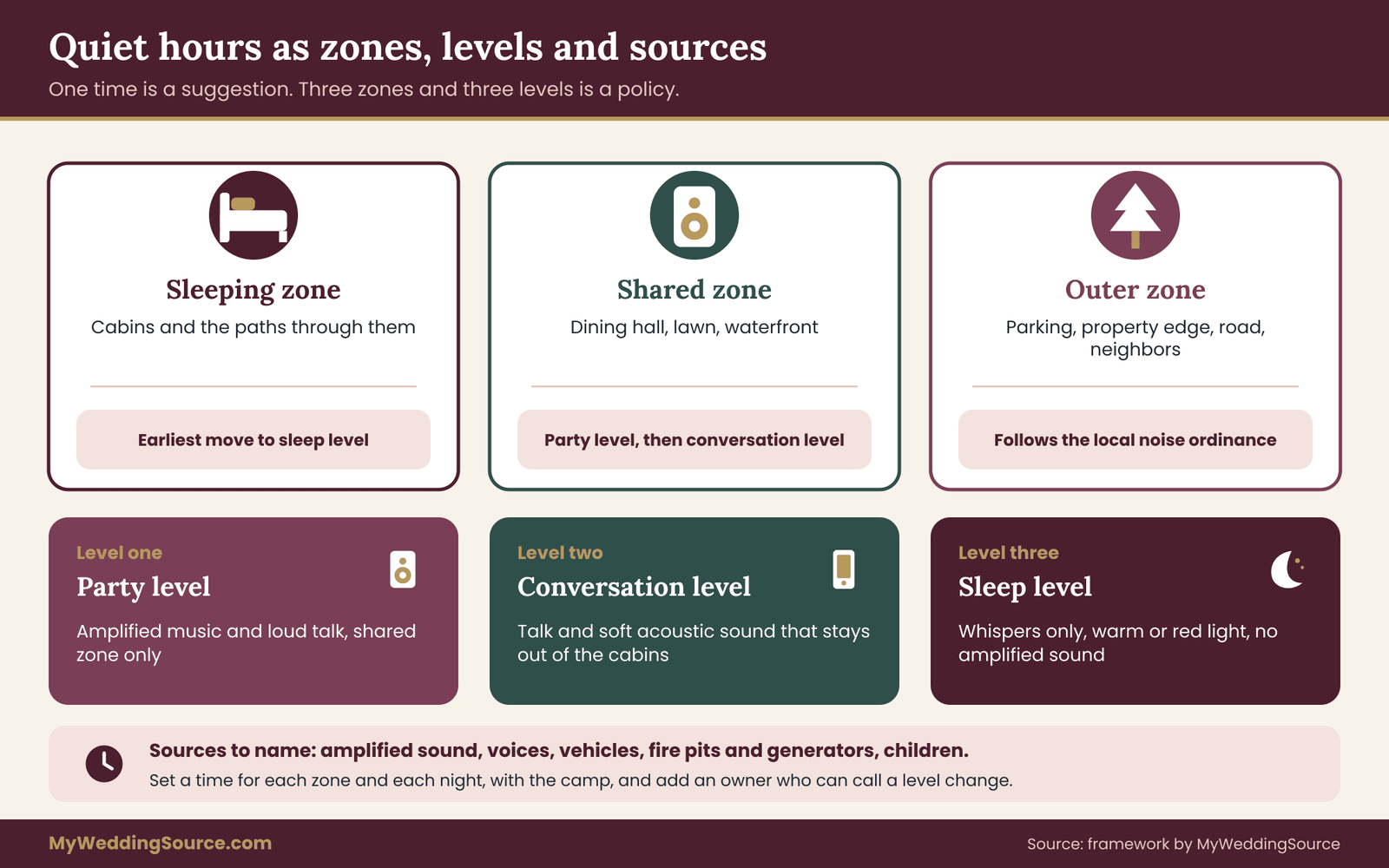
A better summer camp wedding quiet-hours policy has five parts: zones, levels, sources, times and an owner. Write each part down in a half page and get the camp director to read it. The camp’s own rules come first, and your policy sits inside them.
Part one: zones
Start with the camp map from the inventory. Mark three zones. The sleeping zone is the cabin area and any path that runs through it. The shared zone is the area where guests gather but few sleep, such as the dining hall, the waterfront and the main lawn. The outer zone is the edge of the property, the parking area and anywhere that sound reaches a neighbor or a public road.
A summer camp wedding needs zones because the same sound is fine in one place and a problem in another. A speaker at a normal volume in the dining hall during dinner is part of the wedding. The same speaker on a cabin porch at midnight is a problem. Zones let the policy say so without a list of exceptions.
Part two: levels
Instead of one quiet time, set levels. A simple three-level scheme works well for most weekends.
For a summer camp wedding, level one is party level: amplified music and loud conversation are fine, within the camp’s limits, in the shared zone. Level two is conversation level: talking, soft acoustic music and low-volume speakers are fine, but nothing that carries to a cabin. Level three is sleep level: no amplified sound, whispered conversation only and no activity that needs light or movement in the sleeping zone.
Each zone has a level at each hour. For example, the shared zone might be at level one until a set time, level two for an hour after that and level three after that. The sleeping zone might be level two earlier in the evening and level three from an earlier time. The outer zone might have its own level to respect the neighbors. What matters is that the summer camp wedding policy is a small grid in prose, not a long list of exceptions: three zones, three levels, a few times.
Part three: sources
People argue about summer camp wedding quiet hours because they argue about what counts. List the sources that the policy covers, so that nobody has to guess.
Amplified music from a DJ, a band, a phone or a speaker is the obvious source. Voices are the most common one: a group laughing on a porch carries much further than people expect. Vehicles matter too, because car doors, engines and headlights are loud at night and the sound of a late arrival can wake an entire cabin.
Fire pits and generators can be sources of both noise and light. And children, who are guests and cannot be turned down, are a source your policy should treat with kindness rather than a rule.
Decide what the summer camp wedding policy says about each. For example: no amplified sound in the sleeping zone after the set time, voices kept low on porches, no vehicle movement in the sleeping zone after a set time except for emergencies and for those with mobility needs, and no personal speakers outside the shared zone after the dining hall closes. These are easy to remember and easy for a cabin lead to explain.
Part four: times
Choose the times with the camp, not against it. Many camps have a default quiet hour, often tied to the youth program, and some have a local noise ordinance that sets a legal limit. The county or town sets that ordinance, and the camp director usually knows it. Ask for the default and for the camp’s flexibility, and write the answer down.
Then match the times to the summer camp wedding weekend. Friday night usually needs an earlier quiet hour than Saturday, because many guests arrive tired and some have children. Saturday needs a later but firm hour, plus a defined end to amplified music. Sunday morning needs a gentle start time so the early risers can have coffee without waking everyone. Writing a time for each of the three days is more useful than one rule for the weekend.
If the party venue is far from the cabins, the end of amplified music can be later. If it is close, earlier. A distance in steps or yards, from the map, is a better basis for the time than a general feeling that midnight is fine.
Part five: an owner
A summer camp wedding quiet-hours policy needs one person who can call a level change and answer a question. This is not a police role. It is the person who tells the DJ to take the volume down, who asks the late group to move to the lounge and who calls the camp’s emergency contact if a real problem arises. Often it is the planner or day-of coordinator; if there is none, a trusted family friend with a clear mandate and a phone number.
The owner needs the policy, the camp contact and the authority to ask a vendor to adjust. If you have a DJ or a band, add the end time and the sleeping-zone rule to the vendor contract, and tell the vendor who the owner is. The guide to reading a wedding vendor contract covers where such terms belong and how to confirm them. Vendors respect a clear limit that was agreed in advance far more than a request made at eleven at night.
Turning the policy into one page of guest language
The policy is for you, the camp and the owner. Guests need a short, friendly version. Aim for six lines.
The first line says what the weekend is: a shared camp, with cabins close together. The second gives the summer camp wedding quiet hours as levels and times by zone. The third says what to do after quiet hours: the lounge, the fire pit or a walk to the dining hall. The fourth says what to bring, such as earplugs and a flashlight. The fifth names the cabin lead for each building. The sixth gives one number to call for a problem.
Keep the tone warm. “We want everyone to sleep well, so we have set some quiet hours” lands better than “Violators will be asked to leave.” You are not writing a rulebook for adults; you are giving them the information a good host would give.
What the camp may require, and where its rules override yours
A camp’s rules can include a quiet hour, a no-alcohol or limited-alcohol policy, a fire policy, a ban on amplified sound outdoors, a limit on vehicles after a set time, a curfew for guests on the grounds and a policy for children’s supervision. Some of these will conflict with the idea of a wedding. A camp that prohibits alcohol is a different weekend from one that allows beer and wine, and a camp that bans amplified sound outdoors is a different venue from one that does not.
Read the camp’s rules before you sign and again before you write your policy. Where a rule conflicts with your plans, ask whether it can be changed in writing for the summer camp wedding weekend. Camps often have more flexibility than their printed rules suggest, but flexibility must be documented. A verbal “that is fine” from a staff member is not a contract term, and the staff member who said it may not be on duty on Saturday.
The local noise ordinance and the neighbors
Beyond the camp, local law may govern noise. Many counties and towns have an ordinance that limits sound after a set hour, measured at the property line or by a distance. An ordinance can apply even when the camp is rural, because a neighboring house or a campground across the lake may be close enough to hear.
Ask the camp which ordinance applies and whether the camp has had complaints. If the answer is yes, find out how complaints were handled. A single complaint can end a party early, and in some places it can lead to a fine for the camp or for the host.
The Environmental Protection Agency publishes general background on noise and leaves enforcement to local authorities, so the town or county office is the place to confirm the real limit. If the camp cannot answer, call the local office yourself and write down the date and the answer.
Where to place the amplified sound
The simplest quiet-hours tool is placement. Put the dance floor and the speakers as far from the cabins as the property allows, point the speakers away from the sleeping zone and keep the party in a building with walls when the camp has one. A dining hall with closed windows is much quieter outside than a tent or an open pavilion. A band in a pavilion that faces the lake sends sound across the water. A band in a hall that faces the parking area sends it toward the road.
If the camp has an indoor option and an outdoor option for the reception, ask for the sound pattern of each. The camp director has usually heard both and can say which one carries. If you choose an outdoor party, plan a cutoff for the amplified sound that is earlier than you would pick indoors, and plan a lower-level continuation in the lounge for those who want it.
The sounds a summer camp wedding forgets to plan for
Music gets all the attention at a summer camp wedding, but the noise complaints after a summer camp wedding rarely come from the DJ. They come from the small, steady sounds that nobody scheduled: a late arrival with a loud trunk, a group on a porch, a golf cart, a generator, a child who is awake at five and sure that everyone else should be too. A quiet-hours policy that covers only the sound system covers about a third of the problem.
Go through the summer camp wedding weekend hour by hour and ask what makes noise. This list is a prompt, not a rule, and your camp will add its own.
The first sounds at a summer camp wedding belong to arrival. Friday guests come at different times, and the last ones often arrive after dark. Car doors, rolling suitcases on gravel and a group of friends greeting each other all happen in the sleeping zone. Give late arrivals a drop-off point at the edge of the sleeping zone, a lit path and a short instruction card: park here, walk this way, keep your voice low. Ask the camp whether a staff member can meet late arrivals.
Next, the shuttle or car service. If you are moving guests between a hotel and the camp, the pickups and drop-offs are a nightly noise source and a safety matter. A shuttle that idles near the cabins at midnight will wake people. Set a pickup spot away from the sleeping zone and tell the driver where it is. The same principle applies at a summer camp wedding as anywhere: the vehicle goes where the noise is least harmful.
Then the fire pit. At a summer camp wedding a fire pit makes conversation, laughter and the occasional guitar. It also makes light and smoke that drift toward a cabin. Choose its location with the wind and the cabins in mind, and give it the same end time as the conversation level. Fire rules are a separate topic, covered by the camp and the local fire authority, and this summer camp wedding guide only treats the fire as a noise and light source.
Finally, mornings. A summer camp wedding site starts early. Dining hall staff, a bell, a kitchen delivery and a groundskeeper’s mower can all begin before a guest who stayed up late would like. Ask the camp what happens at dawn and whether any of it can be moved for your weekend. If the camp’s early sounds are fixed, tell guests, and put earplugs on the packing list.
Light is part of quiet
At a summer camp wedding, a cabin full of sleeping people can be woken by a flashlight as easily as by a voice. Camps are dark, and guests will carry lights. A shared rule helps: red or warm lights in the sleeping zone, phones on low brightness and no headlamps in a cabin after the quiet hour. A cheap red flashlight in the welcome bag is a kind gesture and a good quiet tool, and it is easy to describe in one line on the guest page.
Outdoor lighting matters as well. Strings of lights around the cabin area look beautiful, but a light that shines through a screen window wakes people. Ask the camp about existing yard lights, and aim any added light toward the path, away from the windows.
Children and the sound they make
A policy that treats children as a violation will fail, and it should. Children at a summer camp wedding will be loud at times, and a cabin of families who agreed to share is a more patient audience than a cabin of strangers. Rather than a rule, give parents a plan: a place to take a child who cannot settle, a time when a nap space is available and a clear message that a crying baby is not a problem to be solved by the parents alone.
The cabin lead can help by knowing where the quiet room is.
A worked case: sixty-four guests, nine buildings and one hard Saturday
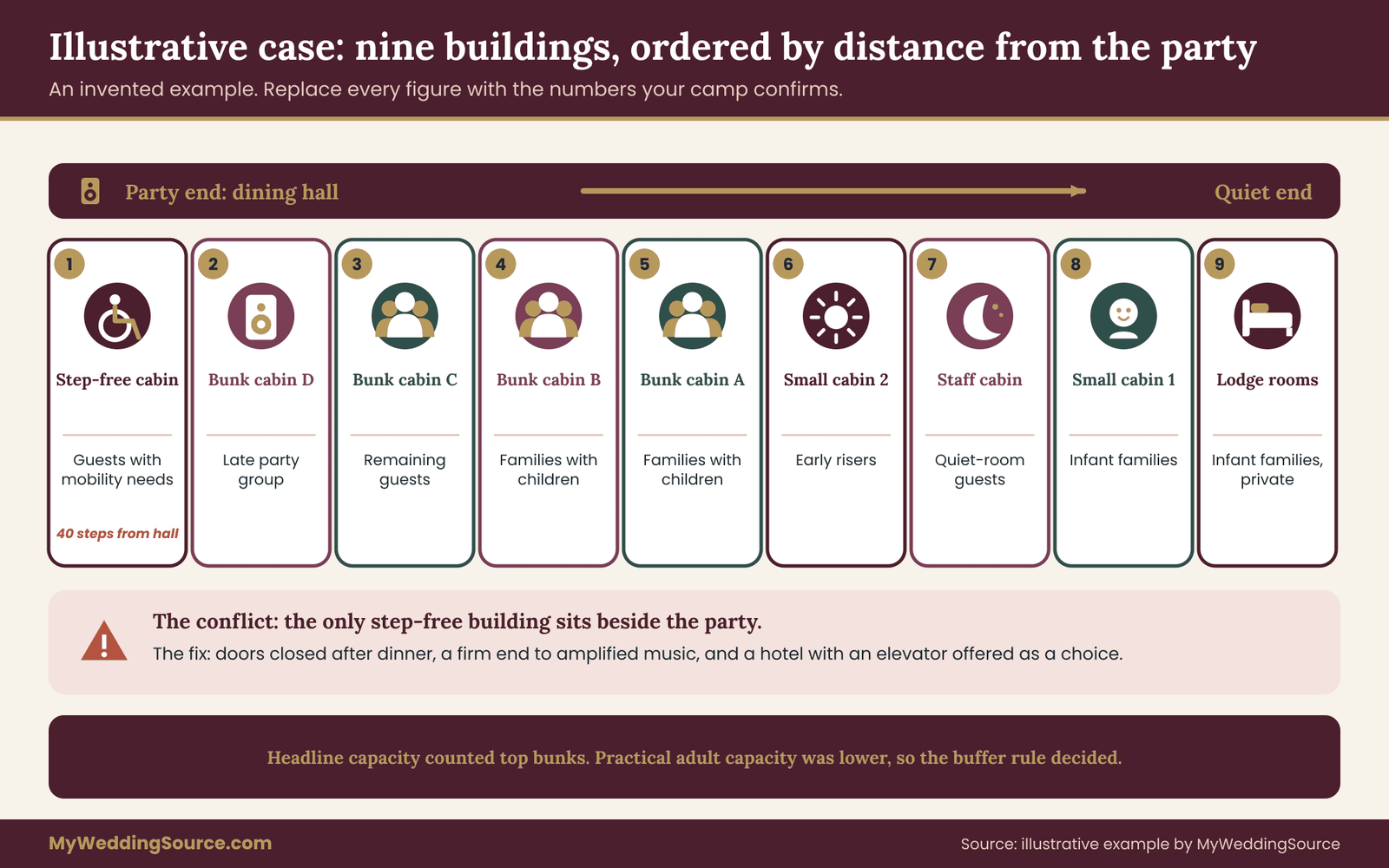
The following example is invented for illustration. It does not describe a real wedding, camp or couple, and the numbers are chosen to show how the method works, not to suggest what any camp offers. Use it to see the reasoning, and replace every figure with your camp’s real ones.
Imagine a couple planning a summer camp wedding over a Friday-to-Sunday weekend. The camp has nine sleeping buildings. The camp’s brochure says it sleeps one hundred and ten. The couple expect sixty-four overnight guests, along with twelve who will stay off site. They begin with the inventory from the camp director and find the following.
Four of the nine buildings are open-room cabins with bunk beds, which hold between twelve and sixteen beds each when top bunks are counted. Two buildings are smaller cabins with eight single beds. One is a lodge with six private rooms. One is a staff cabin with four beds that is available at an extra charge. One is a former infirmary with a ground-floor entry and four beds, which the camp director says is the only fully step-free sleeping building.
The couple’s first discovery is that the headline number of one hundred and ten is mostly top bunks. Counting top bunks as unsuitable for adults over a certain age and for children under a certain age, the practical adult capacity is less than seventy. That is enough, but not by much. They set the buffer rule at eighty-five percent and find that they cannot fill every building.
Tagging and grouping
From the RSVP follow-up, the couple learn that two guests use mobility aids, one of whom travels with a spouse. Three families have infants or toddlers. Five families have children aged six to fourteen. Six guests have asked for a quiet room or a private room. Nine guests are early risers who asked for a quiet cabin. A group of eleven friends of the couple say they will be up late and do not mind a noisy cabin. The remaining guests have no preference.
The groups follow from the tags. The mobility group of three goes into the former infirmary, the only step-free building. The three infant families, with a total of nine people, go into one of the smaller eight-bed cabins and the lodge, which gives them private rooms and a short walk.
The early risers and the quiet-room guests share the other smaller cabin and the staff cabin. The families with school-age children take two of the bunk cabins. The late group takes the bunk cabin closest to the dining hall. The remaining guests fill the last bunk cabin.
The map and the conflict
When the couple mark the groups on the camp map, they find a conflict. The former infirmary, the accessible building, sits about forty steps from the dining hall, which is where the reception will be. The couple’s mobility guests will be sleeping next to the party.
They have three options. They can move the reception to the outdoor pavilion on the far side of the lake, which carries sound toward the quiet cabins. They can keep the reception in the dining hall and add a firm end time for amplified music. Or they can offer the two mobility guests a room at a hotel with an elevator, about fifteen minutes away, and keep the infirmary as a backup.
They choose the second and third together. The dining hall stays as the party venue, with the doors closed after dinner and amplified music ending at a set time. The two mobility guests are offered a choice: the infirmary with a quiet lounge for the late group elsewhere, or the hotel with a ride after the reception. One chooses the infirmary and one the hotel. This takes three conversations, written follow-ups and a short note to the camp director, and it avoids a bad Saturday night.
The quiet-hours grid
The couple and the camp director agree on a grid. On Friday, the sleeping zone moves to level three early in the evening, and the shared zone moves to level two. On Saturday, the dining hall is level one until a set time, with the doors closed after dinner, then level two for the next hour with no amplified music.
After that, the sleeping zone is level three, and the late group has a screened porch and a lounge in the lodge with a level-two rule until a later time. On Sunday, the dining hall opens quietly, and the kitchen staff agree to hold the loudest tasks until a later hour.
The couple add the end time and the sleeping-zone rule to the DJ’s contract, name a day-of owner and give each of the nine cabin leads a half-page card. They send the summer camp wedding sleeping map and the six-line guest note two weeks ahead and again three days before.
What went wrong in the case, and the fix
Nothing is perfect, and the case includes a problem on purpose. On Saturday night, a group of guests from the late cabin carry a portable speaker to the lawn between the cabins and the lake. The cabin lead notices, speaks to them quietly and points them toward the screened porch, which has a lower level. They move. The infant cabin is not woken. The lead tells the day-of owner in the morning, and the owner makes a note of it for the cleanup list.
The lesson of this summer camp wedding is not that the plan was flawless. It is that a plan with zones, levels, a place to go and a person to ask turns a potential argument into a short conversation. Without them, the same moment becomes a confrontation at midnight, in the dark, between people who are tired and who care about the couple.
Enforcing the policy at a summer camp wedding without policing guests
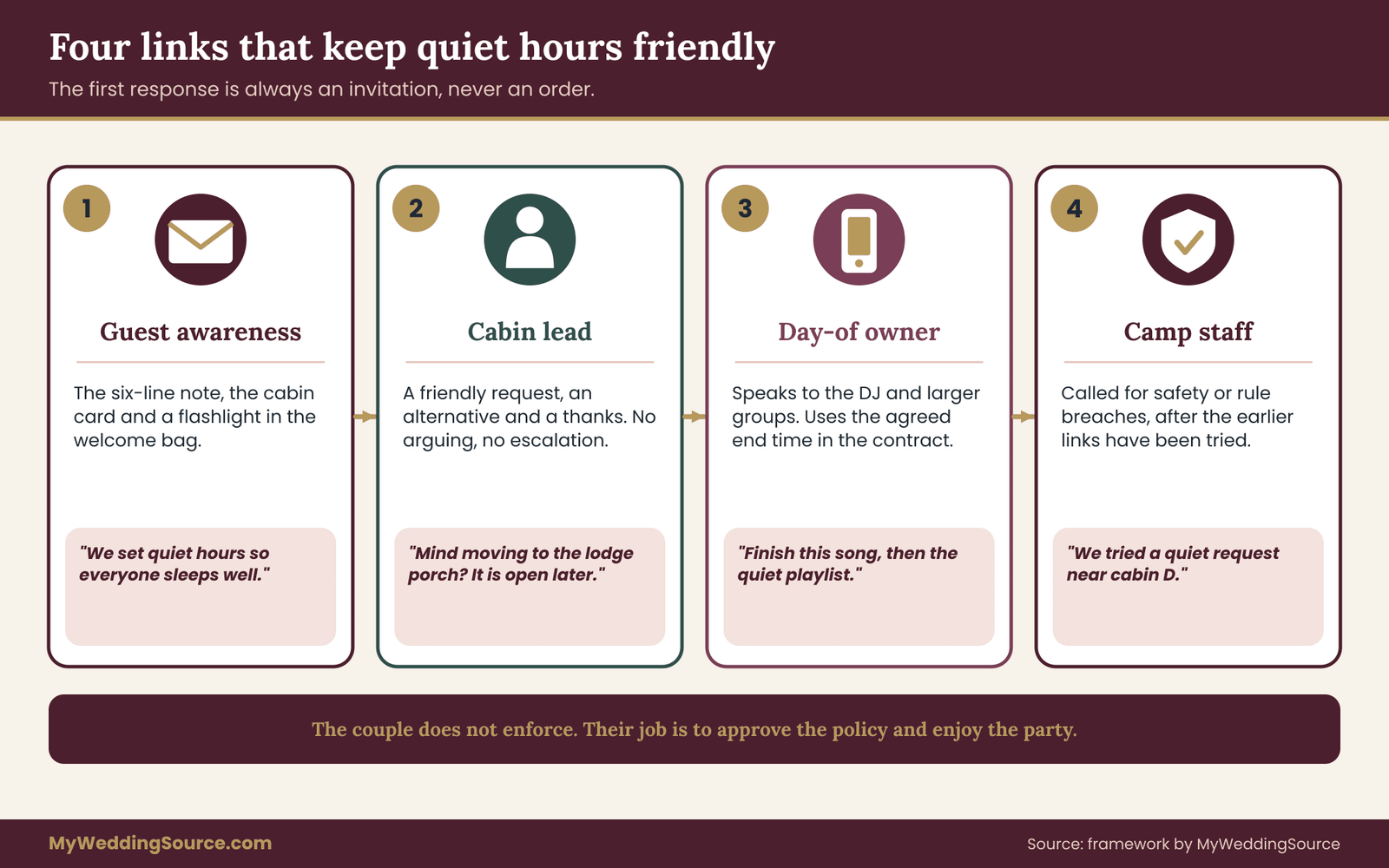
At a summer camp wedding, a policy that nobody enforces is a wish, and a policy enforced badly turns the couple into the people who ruined the party. The way through is to make enforcement boring: a small set of scripts, a clear chain and a rule that the first response is always an invitation, not an order.
The chain has four links. The first is the guest’s own awareness, which the one-page note and the cabin cards create. The second is the cabin lead, who speaks to a neighbor or a group in a quiet, friendly voice. The third is the day-of owner, who can ask a vendor or a larger group to adjust.
The fourth is the camp’s staff, who have the authority to enforce the camp’s rules for a summer camp wedding and who should be called only when the earlier links fail or when safety is involved.
Most of the work happens at the second link, so give your cabin leads real words to say. People under pressure in the dark reach for whatever phrase is nearest, and it is usually a bad one.
Scripts for the cabin lead
Keep scripts short, warm and specific. Each one has the same shape: a friendly greeting, a plain statement of the need, an alternative and a thanks.
For a group on a porch after quiet hours: “Hey, it’s getting late and there are babies asleep in the next cabin. Would you mind taking it down to a whisper, or moving over to the lodge porch? The lounge is open until a bit later.” For a person with a speaker: “That sounds great.
Could you turn it down for the cabin area? The dining hall is open for music until the end time.” For a late arrival: “Welcome. Your cabin is the one with the blue sign on the left. We are keeping voices low here, and there is a flashlight in the basket by the door.”
For a guest who is annoyed at a neighbor: “I hear you, and I am sorry. Let me go speak with them now. If you want to move to another bed, I can check with the owner.” Notice that the lead offers an action and does not argue about who was right.
If a guest refuses, the lead does not escalate. They say, “No problem, I will let the owner know,” and walk away. The owner takes over. The lead’s job is a polite request, not a confrontation.
Scripts for the day-of owner
The owner’s calls are a little more formal, because they speak to a vendor or a group that has more at stake. To the DJ: “We are at the agreed end time for amplified music. Please finish the current song, then switch to the quiet playlist for the lounge.” To a larger group: “We are moving to the lounge for the next part of the night.
The cabin area is in sleep mode now, so I will walk with you.” To the camp staff: “We have a sleeping-zone noise problem near cabin D. We have tried a quiet request. Could someone from the camp come by?”
Note the tone. Every one of these is a request with a reason and a next step. None of them is a threat. If a vendor refuses to follow an agreed end time, the owner calls the couple or the coordinator, and the contract is the answer.
What the couple should not do
The couple at a summer camp wedding should not enforce. On their wedding weekend, they are guests of honor and the hosts, not the noise police. Their job is to approve the policy in advance, to say to the owner, “You have my full support,” and to leave the summer camp wedding weekend in other hands.
If a guest approaches the couple with a noise complaint, the best answer is, “Thank you for telling me. I will pass it to the person who can fix it right now,” followed by actually doing so.
This matters more than it seems. A couple who stops dancing to settle a cabin dispute loses the one night they planned for, and a guest who gets a scolding from the groom remembers it for years. Put the structure in place so that the couple’s only job is to enjoy the party.
Dealing with alcohol and noise
Alcohol changes noise and judgment, and a summer camp wedding weekend often includes a lot of it. This is not a lecture. It is a planning point. If the camp permits alcohol, decide how it will be served and when service stops, and tie the end of service to the end of amplified music, so that the lounge crowd is not still being served at a quiet hour. A bartender with a firm last-call time is a better quiet-hours tool than any sign.
If the camp does not permit alcohol, say so in the invitation, plainly and early. Guests who expected a drink and found none are noisier than guests who knew in advance. Whatever the rule, a plan for getting guests back to cabins safely, such as a lit path, volunteers at the path and a water station near the dining hall exit, is part of the noise policy as well as the safety plan. For the broader topic of drinks at a reception, see the guide to wedding bar service planning.
Handling a complaint the next morning
Even a good summer camp wedding policy produces a complaint or two. Respond in the same way each time: thank the guest, say what happened and say what will change. Do not argue about what was loud. If a guest in a quiet cabin was woken, offer them a different bed for the second night, and if the camp has a spare room, offer a nap space on Saturday afternoon. A response in kind, a bed and some quiet, is worth more than an apology.
Keep a short log: the time, the building, the source and the fix. After the summer camp wedding weekend, use the log to write a short note for the camp, and keep it for next time. If you ever host another event there, or a friend asks you about the camp, the log is a useful record.
Alternatives when the camp cannot meet the plan
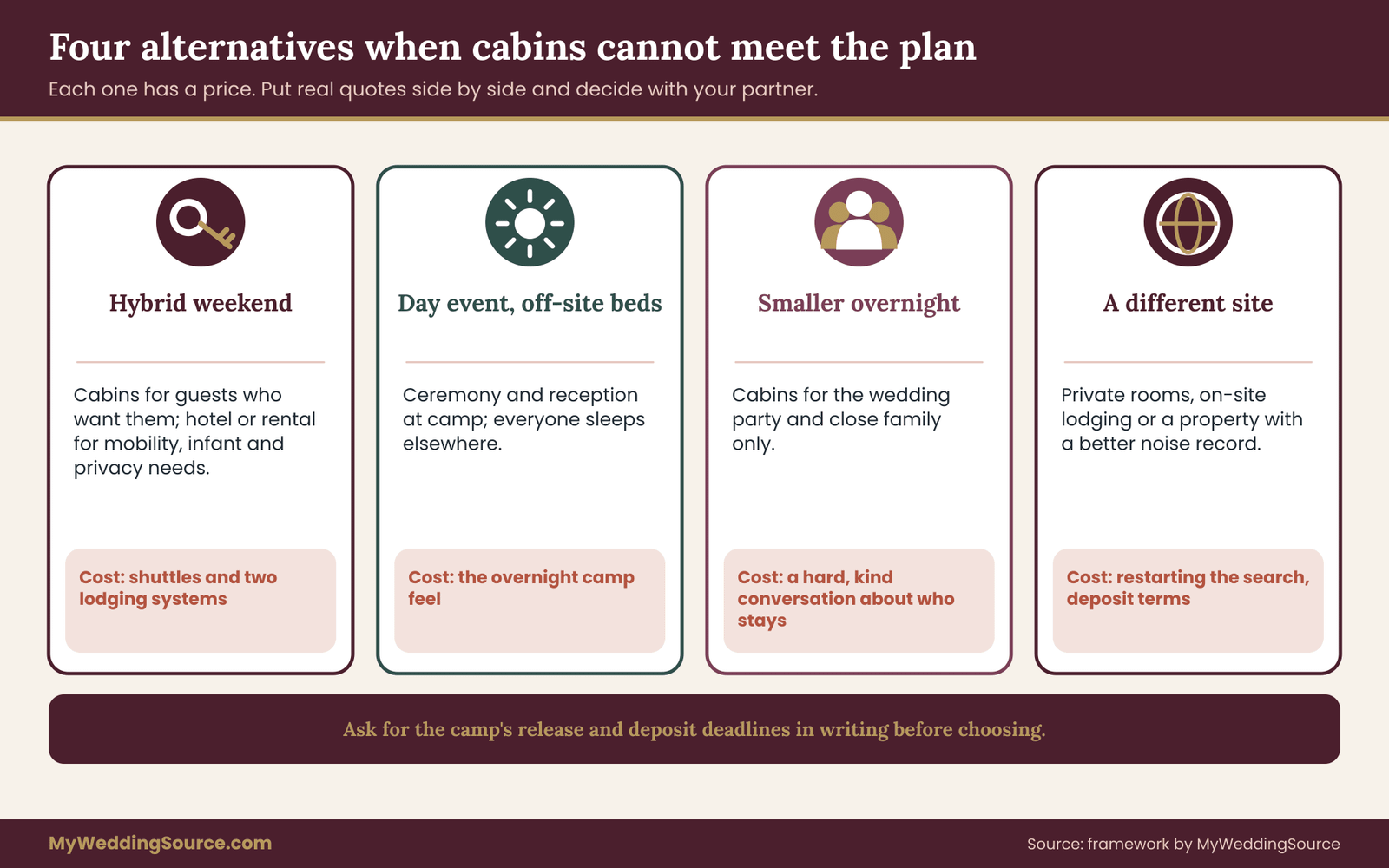
Sometimes the camp cannot meet the plan, and you find out after you have fallen in love with the idea. That is a normal result of a decision process, not a failure. The point of the inventory and the assignment checklist is to find out early, while a different arrangement is still cheap. There are four real alternatives to a summer camp wedding in cabins, and each has a price.
The first is the hybrid summer camp wedding: the wedding and some of the lodging at the camp, the rest off site. Guests with mobility needs, infants or a need for a private room stay at a nearby hotel or rental, and everyone else stays in cabins. This is often the most reliable choice, because it solves the hardest problems and leaves the camp experience intact for those who want it.
The cost is transportation and the risk of two groups: those who sleep at camp and those who do not. Plan shuttle times, a shared morning meal and an event that brings everyone together.
The second is the day event with off-site lodging. The camp hosts the ceremony and reception, and every guest sleeps elsewhere. This removes the cabin question and most of the noise issues, because the camp sees guests only during the day and evening. It also removes the overnight camp experience that drew you to the site in the first place.
If the camp’s cabins are the problem and the grounds are the draw, this is a strong choice. The guide to barn wedding venues covers a similar site type for events that do not involve a sleepover.
The third is a smaller overnight: cabins for the wedding party and immediate family, with everyone else off site. A smaller summer camp wedding overnight keeps the experience for the people who matter most to you, lowers the risk and reduces the bed count. The cost is a smaller overnight group and the need to explain, kindly, who is invited to stay and why.
The fourth is a different site for your summer camp wedding. If the camp cannot offer enough suitable beds, accessible rooms or a workable noise policy, a different property may serve better, and that is a legitimate decision. A site with private rooms, a hotel-style building on site or a campground with its own lodging may suit your guest list. Treat it as a result, not a defeat. The earlier you reach it, the more options you have.
Comparing the four in plain terms
The hybrid asks you to run two lodging systems. The day event with off-site lodging asks you to give up the overnight. The smaller overnight asks you to decide who stays. A different site asks you to start the search again. None of them is a better answer in general; each has a different set of costs, and which is right depends on your guest list, the camp’s answers and your budget.
Put the costs side by side on a single page, write the real figures from real quotes and choose with your partner.
One more thing to settle in advance is the deadline. A camp may release unused cabins or hold your deposit only for a certain time. Ask the camp for its deadlines in writing, and find out what happens to your deposit if you change the plan. The guide to wedding venue technical walkthroughs explains how to confirm the physical details on site before you commit, and it is worth doing the walk before any alternative is chosen.
Failure conditions: when a summer camp wedding should change shape
A decision tool is only complete if it says when to stop. The checklist, the zones and the scripts all assume the camp can deliver what it says. When it cannot, you need a short list of conditions that tell you to change the plan, written before you are emotionally committed. Decide these with your partner at the start, and write them where you will see them.

There are two kinds of failure condition: those you can detect before the summer camp wedding weekend and those that appear during it. The first kind lets you change the arrangement. The second lets you contain the damage.
Failure conditions you can detect early
The first is a bed count that does not hold. If, after you count bottom bunks and remove staff buildings, the camp cannot sleep your overnight guests at the buffer you set, either reduce the overnight group or move some guests off site. Do not rely on a promise that the camp will “make it work.”
The second is an accessible building that is not accessible in practice. If the only step-free building has a long, steep or uneven path, a bathroom that a wheelchair cannot enter or a location right beside the party, the camp does not meet the needs of the guests who rely on it. Offer those guests a real alternative, or choose a different site.
Do not assign a guest to a building because it has a ramp and ignore the rest of the route. The red flags covered in the guide to accessible wedding venue red flags apply to a camp as much as to any other venue.
The third is a noise rule that cannot be bent. If the camp’s rules for a summer camp wedding prohibit amplified sound outdoors, set an early curfew or have a neighbor who has complained before, and your reception depends on a late dance floor, the venue does not suit the event. A wedding that needs music until a late hour and a camp that ends it early will not reconcile.
The fourth is a camp that will not put answers in writing. If the director tells you things on the phone and then declines to email them, treat each answer as unconfirmed. This is not an accusation; some camps are staffed by volunteers or seasonal workers. But a summer camp wedding is a large decision made on documents, and you need the documents.
The fifth is a shared property. If another group will be on site and the camp cannot tell you how the two will be kept apart, the noise and the privacy of both groups are in question. Ask for the other group’s schedule, and ask how the camp separates them.
The sixth is a lack of a safety basis. If the camp cannot show working smoke alarms, an evacuation plan and an emergency contact on site, or cannot say what its insurance requires of a renting group, do not proceed until it can. Ask the camp what insurance coverage it requires of a renting group for the event itself, and get the answer in writing.
Failure conditions during the weekend
The first is a weather change that makes the cabins unusable. Extreme heat in a cabin without cooling, a storm that closes the paths or a power loss are real conditions at a summer camp wedding. Decide in advance what you will do: move vulnerable guests to the climate-controlled building, to a hotel or to the dining hall, and who calls the shots. The National Weather Service gives the forecast and any warnings for the site, and the camp’s own storm plan comes first.
The second is a medical or safety event. Know where the nearest emergency service is and how long it takes to reach the camp, and make sure the cabin leads have the camp’s emergency number. A cabin lead’s task is to call the right people, not to treat anyone. The American Red Cross and the Centers for Disease Control and Prevention publish general guidance for outdoor and group settings.
The third is a noise problem that the scripts cannot solve. If a group refuses to move and the camp’s staff are needed, let them handle it. The couple does not step in.
The fourth is a collapse of the assignment. If more than a few guests have moved themselves, the map no longer matches reality. Stop, ask each cabin lead for a headcount, redraw the map on Saturday morning and send a short note to the affected guests.
The trigger list
Write the triggers in one place, in plain words, with a decision attached to each: “If the camp cannot confirm bottom-bunk counts by this date, we move four families off site.” “If the accessible building cannot be made usable, we offer a hotel to the two guests who need it.” “If the camp will not allow amplified sound after this time, we move the dance floor to the hall and shorten the party.” A trigger without a decision is only a worry. A trigger with a decision is a plan.
Your next steps
You can finish most of the work in a few evenings, in this order.
- Ask the camp for the cabin-by-cabin inventory with the eight facts, the camp rules, the local noise ordinance and its exclusive-use terms, and ask for all of it in writing.
- Walk the property, or have a trusted person walk it, and mark the party venue, the cabin clusters, the bathhouses and the nearest outside sleeper on a simple map. The guide to choosing a wedding venue helps you judge a site you have not yet booked.
- Add a sleeping question to the RSVP and tag the answers.
- Form the sleeping groups and match them to buildings, with a buffer of at least ten percent.
- Name a cabin lead for each building, and write their cards.
- Write the summer camp wedding quiet-hours policy as zones, levels, sources, times and an owner, and get the camp director to read it.
- Add the end time and the sleeping-zone rule to every vendor contract that makes noise.
- Write the trigger list, with a date and a decision for each item.
- Send guests the summer camp wedding sleeping map and the six-line note, two weeks ahead and again three days before.
- Keep a short log of what happened, for the camp and for your own records. A broader view of looking after guests across a weekend is in the guide to wedding guest care.
If one step feels heavy, do the inventory first. Everything else depends on it.
FAQ
How many guests can a summer camp wedding really sleep?
Fewer than the brochure suggests. A camp’s headline capacity often counts every bunk, including top bunks that are poor choices for adults and children, and may include staff buildings that are not for rent. Ask for a cabin-by-cabin bed list, count bottom bunks separately and leave a buffer of ten to twenty percent. The honest number is the one the camp confirms in writing for your dates.
Should couples share a cabin at a summer camp wedding?
Only if they want to. Many cabins have bunk beds or single beds, and some couples prefer a private room or an off-site stay. Ask each couple on the RSVP what they prefer, offer double beds where they exist and do not assume. If the camp has a few private rooms, decide in advance who gets first choice and tell guests the rule.
What time should quiet hours start?
There is no single right time. Ask the camp for its default and the local noise ordinance, then set times by zone and by night. Friday is usually earlier, because guests arrive tired. Saturday is later but should have a defined end for amplified music. Choose times that fit the distance between the party venue and the nearest cabin, and write them down.
Can a summer camp wedding work for guests who use wheelchairs or walkers?
Sometimes, but it depends on the building, the path and the bathroom, not only the ramp. Ask which buildings are step-free, what the path surface is, whether doors and bathroom stalls are wide enough and where the building sits relative to the party. If the camp cannot meet the need, offer an accessible hotel nearby and say so kindly.
What should we do with babies and toddlers?
Give them the quietest building available, away from the late party, with a short lit walk to a toilet. Families with infants do best in a private room or in a cabin shared with other families who have babies. Tell parents what to bring, such as a portable crib and a battery white-noise machine, and where a nap space is available.
Who enforces quiet hours?
Use a chain. Guests follow the one-page note, cabin leads make a friendly first request, a day-of owner handles vendors and larger groups, and the camp’s staff step in for safety or rule breaches. The couple should not enforce anything on their wedding weekend. Give leads short scripts and one number to call.
What if the camp has another group on site that weekend?
Treat it as a risk to settle before you sign. Ask for the other group’s size, age range and schedule, how the camp keeps the two apart and which rules apply to both. A shared property usually means stricter noise and alcohol rules and shared paths and bathhouses. If the camp cannot answer clearly, consider a different weekend or site.
When should we give up on the camp and use a hotel?
Give up on overnight cabins when the camp cannot confirm enough suitable beds, cannot offer an accessible building that works, will not allow the music your plan needs, or will not put its answers in writing. A hybrid, with some guests off site, is often the first option. A full change of site is a sound choice if several conditions fail together.
Sources
Check each organization’s current pages for the rules that apply to your camp and your county. The list below names the issuing bodies and official sites, not specific rules.
- National Park Service for public-land camping, group-site and fire guidance used as a reference point for outdoor group stays.
- ADA.gov, U.S. Department of Justice for how federal accessibility requirements are described and where to ask questions.
- U.S. Fire Administration for general fire safety information on sleeping areas.
- National Fire Protection Association for fire and life-safety codes and public education.
- American Camp Association for camp operations and the standards camps often follow.
- U.S. Environmental Protection Agency for background on environmental noise.
- Centers for Disease Control and Prevention for general health guidance in group and outdoor settings.
- National Weather Service for site forecasts, heat advisories and storm warnings.
- Ready.gov for emergency preparedness and evacuation planning basics.
- U.S. Forest Service for fire restrictions and rules on federally managed recreation land.