
Wedding decision making gets complicated the moment other people care about the outcome. Parents, in-laws, siblings and grandparents often want a say, and many of them have good reasons. This guide shows how to build a clear system for wedding decision making in your family: who decides what, who gives input, who is only informed, and what happens when people disagree.
Write a short decision-rights charter before the arguments start. Sort every wedding choice into one of four groups: couple decides alone, couple decides after listening to named people, a family member owns it, or the family is simply told. Give each group an input window and a deadline, agree in advance what a veto can and cannot cover, and set a simple escalation path for disagreements. Tell people the plan kindly and early, and keep a written log so nobody has to argue about what was agreed.
Most advice about family and weddings is about feelings: be patient, set boundaries, keep the peace. Feelings matter, and we will spend real time on them. But the fights that wreck a wedding year rarely start as fights about feelings. They start as small ambiguities about authority. Your mother assumes she is choosing the florist because she is paying for the flowers. You assume she is giving an opinion. Nobody said anything, so both of you are quietly sure you are right, and the disagreement arrives with a deposit already paid.
That is why wedding decision making is worth treating as a design problem rather than a personality problem. When the rules of who decides are vague, even kind, reasonable people end up in conflict. When the rules are clear, the same people can disagree about a menu and still enjoy dinner afterward.
This article is long because the topic has several layers, and you will not need every part. If you are in a hurry, read the next three sections, fill in the charter worksheet near the end, and come back to the rest when a specific situation shows up: a relative who wants to pick vendors, a parent who wants more guests than the venue holds, a sibling who is hurt about the wedding party, or a family tradition you do not want to follow.
What wedding decision making really means
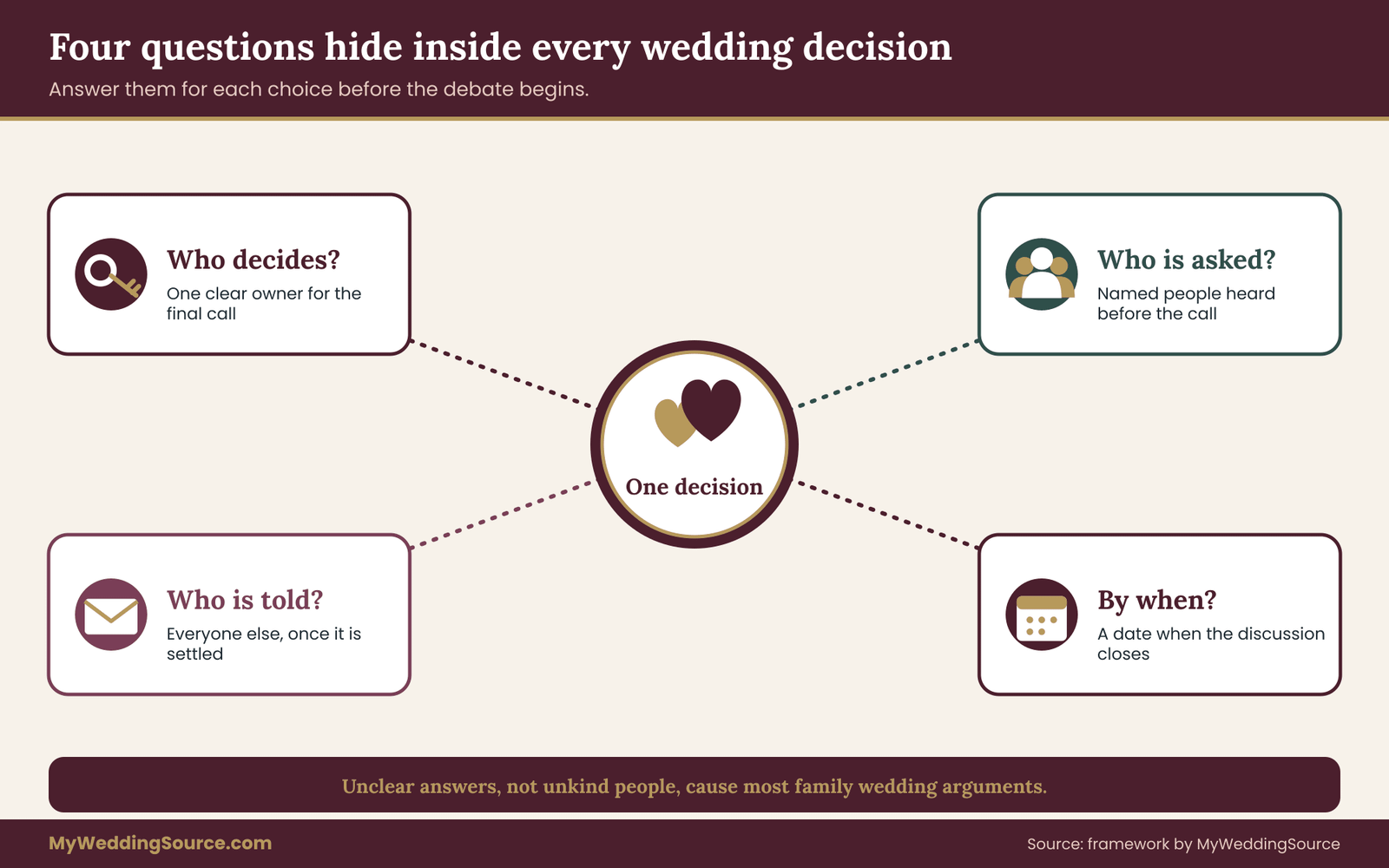
Wedding decision making is the process by which a wedding gets from a few hopes to hundreds of specific choices: the date, the place, the guest list, the ceremony, the food, the music, the budget, the schedule, the seating. A typical wedding involves a very large number of these decisions, and each one has the same four questions hiding inside it.
Who will make the final call? Whose opinions will be asked for before that call is made? Who will simply be told? And by when does the discussion end?
In a couple planning alone with their own money, those questions answer themselves. In a family, each one can have more than one reasonable answer. A parent who contributes money may expect a voice. A grandparent who has attended every family wedding for fifty years may feel entitled to a view about the ceremony. A sibling may expect a role. A future in-law may have strong ideas about the food. None of these expectations is silly. They are what happens when a wedding sits at the edge of two or more families.
The goal of wedding decision making in this sense is not to shut those voices out. It is to give each voice a defined place, so that the final choices still belong to the people whose marriage it is, and so that the people who love you feel heard rather than managed.
Why conflict in wedding decision making is so common
It helps to understand why disagreements about wedding decision making are so predictable, because understanding takes some of the personal sting out of them.
A wedding is a visible statement about family. Who is invited, who sits where, who walks whom down an aisle, and whose traditions appear all say something about how the families see one another. People who would never argue about a restaurant choice argue about these, because what they are really asking is whether they belong.
Contribution creates expectation. When someone pays for part of an event, they often expect some influence, even if nobody said so. Surveys of couples regularly find that parents and other relatives contribute to wedding costs in many households, and the pattern varies widely from family to family. The Knot publishes its annual Real Weddings Study if you want current numbers for your region and budget. The point is not the percentage; the point is that unspoken expectations travel with the money.
Roles overlap. A mother can be a guest, a host, a contributor, a family historian and a lifelong advisor on the same day. Without clear roles, she may be acting as one while you are responding to her as another.
Timing works against you. The decisions that cause the biggest friction, such as the guest list, the date and the venue, come first. They come at the moment when relationships are least settled about who is in charge, and when nobody has built any process yet.
Generational and cultural expectations differ. In many families and communities, elders are expected to be consulted as a sign of respect, and a wedding is seen as a family event rather than a private celebration. In others, the couple is expected to make decisions on their own. Neither view is wrong, but when two views meet without being named, each side thinks the other is being disrespectful.
Strong feelings arrive with high stakes. Weddings are expensive, emotional and public. Small slights feel larger, and people say things they would never say about a dinner party.
Seeing these patterns, you can plan for them. A short, friendly conversation early on will head off many conflicts that would otherwise take months to repair.
The core idea of wedding decision making: consult is not control
The most useful distinction in wedding decision making is between being consulted and being in control. They sound close, and they are very far apart in practice.
When you consult someone, you ask for their view, you listen to it, and you take it seriously. You might change your mind. You might not. The decision stays with you.
When someone has control, they decide. If you disagree, you either comply or negotiate for them to change their mind.
Most family conflict in wedding decision making is a collision between these two ideas. The relative thinks they have been asked for a decision, and the couple thinks they have asked for an opinion. Naming the difference out loud, for each decision, removes most of the friction.
Here is a sentence that does this work in a gentle way: “We would love your thoughts on the venue, and we will make the final decision together after we have heard from everyone who is close to this.” It does not shut anyone out. It also does not hand over authority. It tells the person how the decision will be made, which is what they most need to know.
A few principles follow from this idea, and the rest of the guide builds on them.
- Decide who decides before you start deciding. It is far easier to agree on roles at the beginning than in the middle of an argument.
- Honor people through process, not through control. You can respect someone by asking early, listening well and explaining your reasons, without giving them the final say.
- Be generous with input and strict with authority. In wedding decision making, wide listening and narrow deciding is the combination that works.
- Write it down. A shared note beats a dozen remembered conversations.
- Treat money as a separate question. Contribution is a gift or a loan or an agreement, and it should be discussed on its own terms, not folded silently into influence.
What a decision-rights charter does for wedding decision making
A decision-rights charter is a short written agreement, often a single page, that says who decides what, who is consulted, what the process and deadlines are, and what happens when people disagree. It is the practical heart of good wedding decision making.
The idea comes from the way organizations handle decisions. Management writers have long observed that decisions stall when people are unsure who is responsible for them, and they have developed role frameworks to fix that. One well-known example is Bain & Company’s RAPID framework, which assigns roles such as recommend, agree, perform, input and decide to different people in a decision. You do not need a formal framework to plan a wedding. But the underlying lesson transfers well: when everyone knows their role in a decision, the decision moves faster and leaves fewer hard feelings.
A good charter for wedding decision making has five parts:
- A decision list. The major decisions, sorted into groups by who holds authority.
- Input rules. Who gets to weigh in on which decisions, and when.
- Veto rules. Whether anyone can block a choice, and if so, on what grounds.
- A process for disagreement. What to do when people cannot agree.
- A communication plan. How decisions are shared and recorded.
You do not need to show the whole document to everyone. You may share only the parts that concern a given person. But you, and your partner, should have it, and you should be able to say it in plain language when someone asks.
The rest of this article takes these parts one at a time, adds the situations that most often put pressure on them, and ends with a worksheet you can fill in over an evening. ## Step one in wedding decision making: agree with your partner first
The most common mistake in family wedding decision making is to open the conversation with relatives before the two of you agree. If you and your partner have different ideas about how much say parents should have, the family will find that gap within a week, and each of you will end up defending your own family against the other’s.
Set aside an hour with your partner, away from phones, and answer five questions together.
What matters most to each of us? Name the two or three things that would make the day feel wrong if they were missing. These might be a small guest list, a specific religious element, an outdoor ceremony, a particular person standing beside you, or simply a calm day. These are your own top priorities, and they should be protected in every conversation that follows.
How do each of us feel about family involvement? Some people want their parents’ counsel and enjoy the shared planning. Others find it stressful. You may differ, and that is fine, provided you know it.
Who is responsible for which family? A strong default is that each partner leads conversations with their own parents and relatives. It spares your partner from being the messenger, and it means the person who knows the family’s habits is the one choosing the words. If one of you finds the conversation with your own family very hard, agree on how the other will help without taking over.
What is our money situation? Before anyone offers or declines contributions, you should know the total budget, what you can pay yourselves, and what you would do if no one else contributed. Our guide to the wedding budget covers how to set that number, and it is worth settling before you talk about who pays for what.
What would we do if we disagreed with each other? Agree a tiebreaker in advance. It might be a pause of two days, a list of pros and cons, or a rule that whoever cares more about a topic gets the tie. Without one, family members will try to break the tie for you.
When you have answers, write them in two or three sentences each. This is the foundation of your charter. Everything after it is about translating your answers into clear, fair expectations for other people.
Step two: sort every wedding decision into four groups
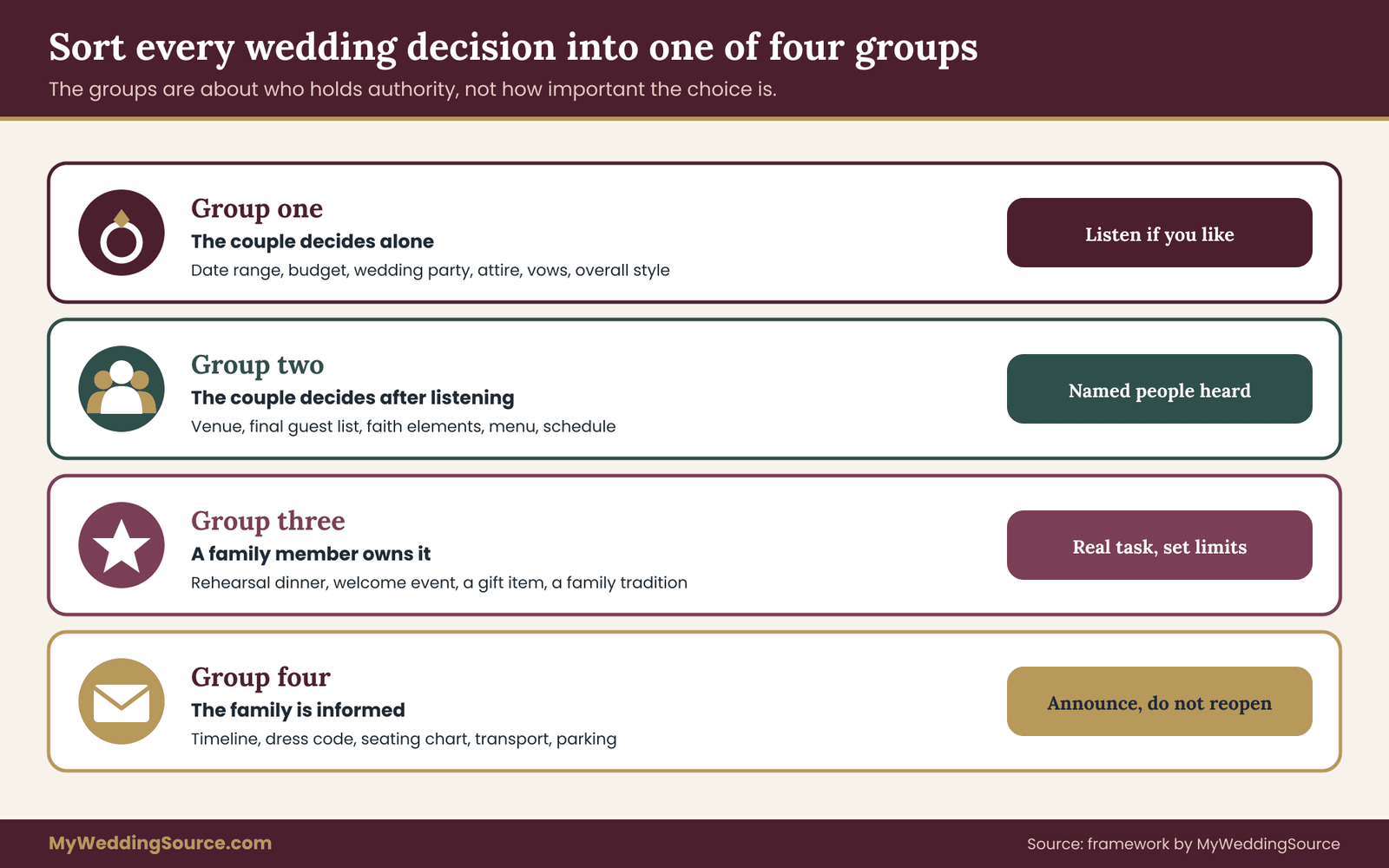
The single most useful tool for wedding decision making is a simple sort. Take the long list of decisions in front of you and put each one into one of four groups, based on who should hold authority. The groups are not about how important the decision is. They are about who needs to hold it.
Group one: the couple handles wedding decision making alone
These are decisions that define the marriage or the day in ways that belong to the two of you. You may talk about them with anyone you like, but nobody else holds authority over them.
Typical examples include the decision to marry and when, the overall tone of the wedding, the basic budget and how it is spent, your vows, the choice of officiant in most cases, what you wear, who stands beside you, and the shape of your marriage after the wedding. Our article on the difference between a wedding and a marriage is a useful reminder of why some choices belong squarely to the couple: the wedding is one day, but the marriage is yours for life.
If you pay for the wedding yourselves, many more decisions fit here. If family members contribute, you may still keep these in group one, provided you were clear about it when the contribution was offered.
Group two: shared wedding decision making, with named people heard first
These are decisions where other people have a real stake, and where the couple has agreed to ask for input before deciding. The word “named” is important. You choose who is listened to on each decision. You do not open every question to the whole family.
Typical examples include the venue, when it affects travel for older relatives; the guest list, within agreed limits; religious or cultural elements of the ceremony; the menu when dietary or cultural food rules apply; the date, when key relatives have constraints; and the reception schedule when children or older guests are involved. For the date in particular, see our guide to choosing a wedding date, which explains how to test guest availability without letting the whole family vote.
In this group, you decide, but you decide after you have heard from the people who matter on that topic and, importantly, after you have told them you are listening.
Group three: a family member owns the wedding decision
Sometimes the best way to give a relative a meaningful role is to hand over a whole decision, within limits. A parent might own the rehearsal dinner. An aunt might own the cake as a gift. A sibling might own the welcome bags. A grandparent might choose a family reading or bless the meal.
This is a gift of authority, and it works when you define the edges. The relative owns the decision inside a budget, within a style, by a date, with a point at which you review the result. Then, within those limits, they truly decide. The most common failure is giving something away and then secretly redoing it. If you do not want to accept the result, do not hand the task over.
Handing over real decisions is also one of the best ways to lighten wedding decision making for the couple. A relative with a real job usually has less time to argue about everyone else’s.
Group four: wedding decision making that is only announced
Many decisions simply need to be announced. The time of the ceremony, the dress code, the reception menu once it is chosen, the hotel block, the seating plan, and the order of events fall here. People are entitled to know the facts, and they are not entitled to vote.
The point of this group is to protect you from a form of pressure that is easy to miss: the assumption that everything is open for discussion at all times. It is not. Once a decision is made, announcing it clearly and kindly, and not reopening it, is a form of respect for everyone’s time.
Sorting the whole list of wedding decisions
Here is a practical way to do the sort. Write each decision on a sticky note or a line of a shared document. Then, with your partner, place each in one of the four groups. Where you disagree, discuss why. Where you are unsure, put it in group two for now, since listening costs little.
A fuller list of decisions follows. Treat it as a prompt, not a rule. Every family sorts these differently.
Usually group one (couple): wedding date range, overall budget, wedding party, attire, vows, officiant, overall style and size, honeymoon.
Usually group two (couple after listening): venue, final guest list, religious or cultural elements, ceremony music, menu, seating of immediate family, schedule of the day, who gives toasts.
Often group three (family owns): rehearsal dinner, a welcome event, a family tradition inserted into the day, transportation for relatives, a gift-based item such as the cake or flowers, a family photo session.
Usually group four (informed): the final timeline, dress code, parking and logistics, the seating chart, the order of toasts, the plan for photography with children.
Notice that guest list sits partly in group two. That is because it is where most family wedding decision making ends up. We return to it in detail later, and our wedding guest list guide walks through building and trimming a list in practical steps.
Step three: decide what input means in your wedding decision making
Once decisions are sorted, the next question is who is asked about which ones. You do not need a complicated system. A simple three-level model works.
Level one: full consultation. You ask for the person’s views early, discuss them, and let them know how the final decision was made and why. This is appropriate for people whose view matters deeply, such as the parents who are contributing, a grandparent for whom a religious element matters, or a sibling in the wedding party.
Level two: light consultation. You ask a specific question, such as “do you have any dietary needs we should cover?” or “is there a song you would love to hear?” and note the answer. This is appropriate for most close relatives on most topics.
Level three: information only. You share the decision when it is made.
You can use different levels with the same person on different topics. A mother may be level one on the guest list and level three on the music. That is normal and honest, and it is far better than treating everyone as level one for everything.
A simple list on one page is enough to keep track: for each decision, the name of anyone who is consulted, and the level. It will quickly show you if you have put twenty people at level one for twenty decisions, which is a sign you have not narrowed enough. ## Input windows in wedding decision making: when people can weigh in
Open-ended input is the quiet source of most wedding stress. If anyone can offer an opinion about anything at any time, then no decision ever feels finished, and the couple spends months re-defending choices they already made.
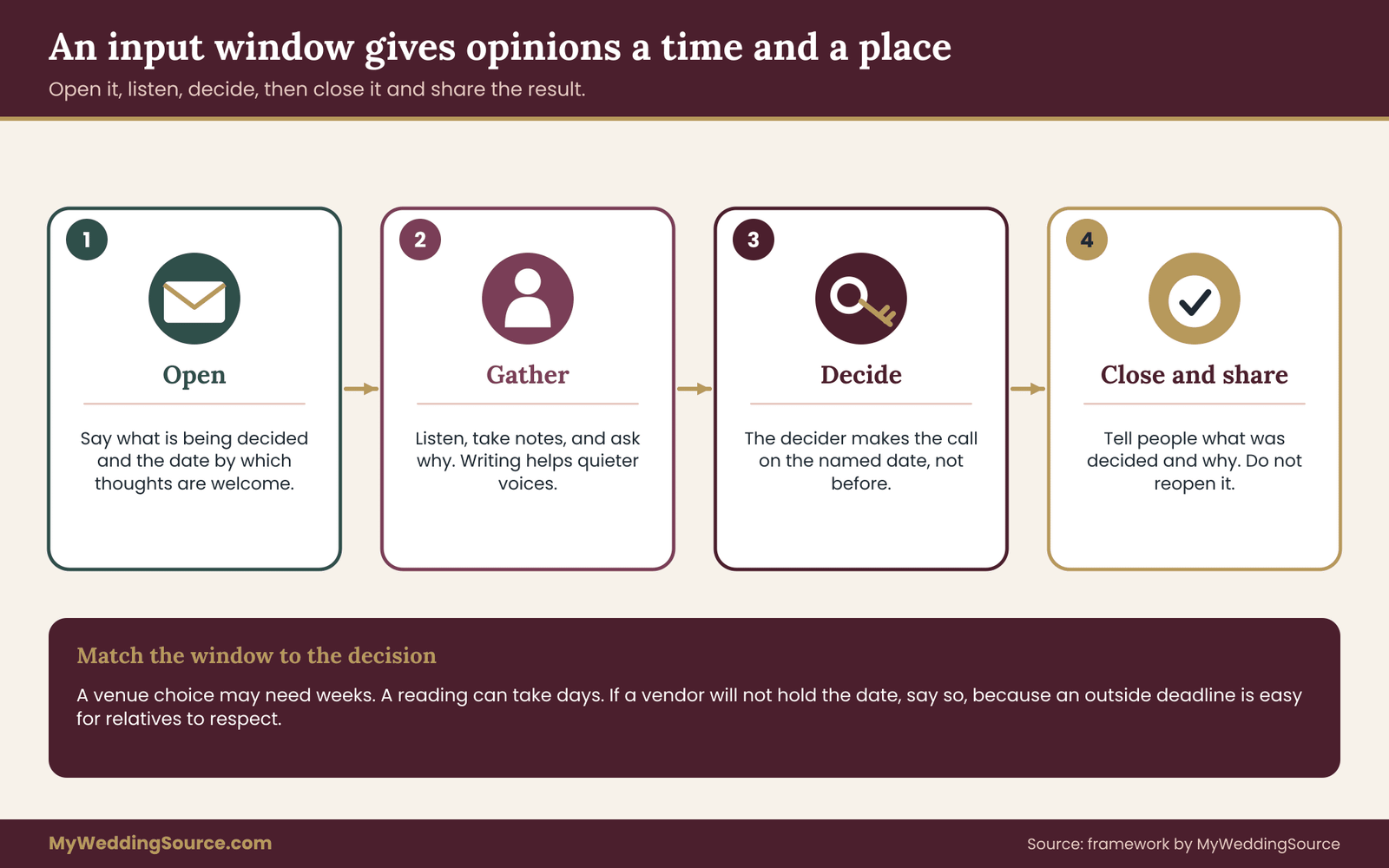
The fix is an input window: a defined period during which opinions are welcome on a given decision, followed by a clear moment when the decision is made and the window closes.
A good window has four parts.
Open. You tell the people you are consulting that a decision is coming, what it is, and by when you would like their thoughts. A message might read: “We are choosing the ceremony venue over the next two weeks. If you have strong feelings about location or access, please tell us by the end of the month.”
Gather. You listen, either in a conversation or in writing. Writing helps. It gives you a record, and it lets people who are less comfortable speaking up be heard. Take notes on what people say and, where possible, why they say it.
Decide. You and your partner make the decision, together, on the date you named. Do not announce it while you are still gathering input, and do not delay it past the date without a reason.
Close and share. You tell the people you consulted what was decided. If their view shaped the outcome, say so. If it did not, thank them and explain briefly, without arguing. Then treat the matter as finished.
The closing step matters more than any other. A decision that is not clearly closed will be reopened by the next conversation.
How long should a wedding decision making window be?
There is no standard answer, but a useful rule of thumb is to match the window to the weight of the decision and to the booking pressure behind it. A venue decision may need several weeks because it depends on dates, deposits and availability. A decision about a ceremony reading can take a few days. A decision that a vendor will not hold for you should have a short window, because the vendor will not wait for your family’s schedule.
If a decision has an external deadline, such as a contract hold that expires, say so. “We have to sign by the fifteenth” is a clean reason, and it is easy for relatives to respect. Our wedding planning checklist is useful for placing these deadlines in order across the whole planning period.
Fix the order of your wedding decision making
Another way to reduce friction is to choose the order in which you open windows. Big, structural decisions go first because everything else depends on them. Open the window for the budget and the guest count before the venue, and the venue before the menu. If you ask for opinions about the menu before you have a venue, you will get opinions that are not tied to anything, and you may end up hearing them again when the real decision comes.
A short schedule, shared early, also tells relatives something reassuring: that there will be a time for their input, and that it has not passed yet.
Veto rules in wedding decision making: what a veto can cover
A veto is the power to block a decision. In most family wedding decision making it is better to give away very few vetoes, and to be very clear about the ones you do give.
Here is why. A veto is the strongest form of authority, because it can stop a decision even when everyone else agrees. If you give one casually, you may find yourself bound by it in ways you did not intend. If you do not discuss vetoes at all, some people will assume they have one.
Three kinds of reasonable veto in wedding decision making
Most couples find that only three categories of veto make sense.
Safety. If a choice would put someone at real risk, such as a venue that cannot be reached by a relative who uses a wheelchair, a menu that contains something a guest has a serious allergy to, or an arrangement that would put an older relative in a long unsafe journey, a safety veto is reasonable. It can come from anyone, and it applies to the specific risk only.
Faith or core-belief constraints that the couple has chosen to honor. If you have decided that a ceremony will follow a particular religious tradition, then the requirements of that tradition may be binding for that part of the day. A person in your family who holds a religious office, or a clergy member you have chosen, might properly have a veto on specific ritual questions. This is a choice you make, not something anyone else can claim. If a relative objects to your faith choices and you are not working inside a tradition, that is not a veto. It is an opinion.
Venue and legal rules. A venue’s rules about noise, decorations, or hours, a local permit requirement, or the laws on who may officiate a marriage in your jurisdiction may close off some options. Here nobody in the family holds a veto. The venue or the law does.
Things that should not carry a veto
Some things feel important to someone, and that does not give them a veto. Your family’s opinions about the guest list, the style of the day, the people in the wedding party, what you wear, or what your vows say are inputs. You may take them very seriously, and you may even follow them, but they are not binding.
If you are contributing family money, as the next section explains, you can still keep these outside the scope of any veto. It is the single most useful thing to say clearly at the beginning.
Naming vetoes in advance
If you do offer a veto, put it in writing, narrow it and time-limit it. For example: “Because the ceremony will follow your tradition, your officiant has the final say on the order of rites. Everything else about the ceremony is ours.” That sentence can be easily understood by everyone. A vague “your opinion matters a lot to us” cannot.
Money and say: how contributions fit into wedding decision making
Money is the most delicate part of wedding decision making, because it carries real feelings about gratitude, fairness, control and independence. It is also where a few simple practices help a lot.
Separate generosity from control in wedding decision making
A contribution can be offered with no strings, with a few preferences, or with real conditions. These are different, and the people involved should know which one they are in. Etiquette writers, including the Emily Post Institute, have long noted that traditions about who pays have loosened considerably and that families split costs in many ways. Modern guidance tends to say that the best arrangement is the one that every party has actually discussed and agreed to.
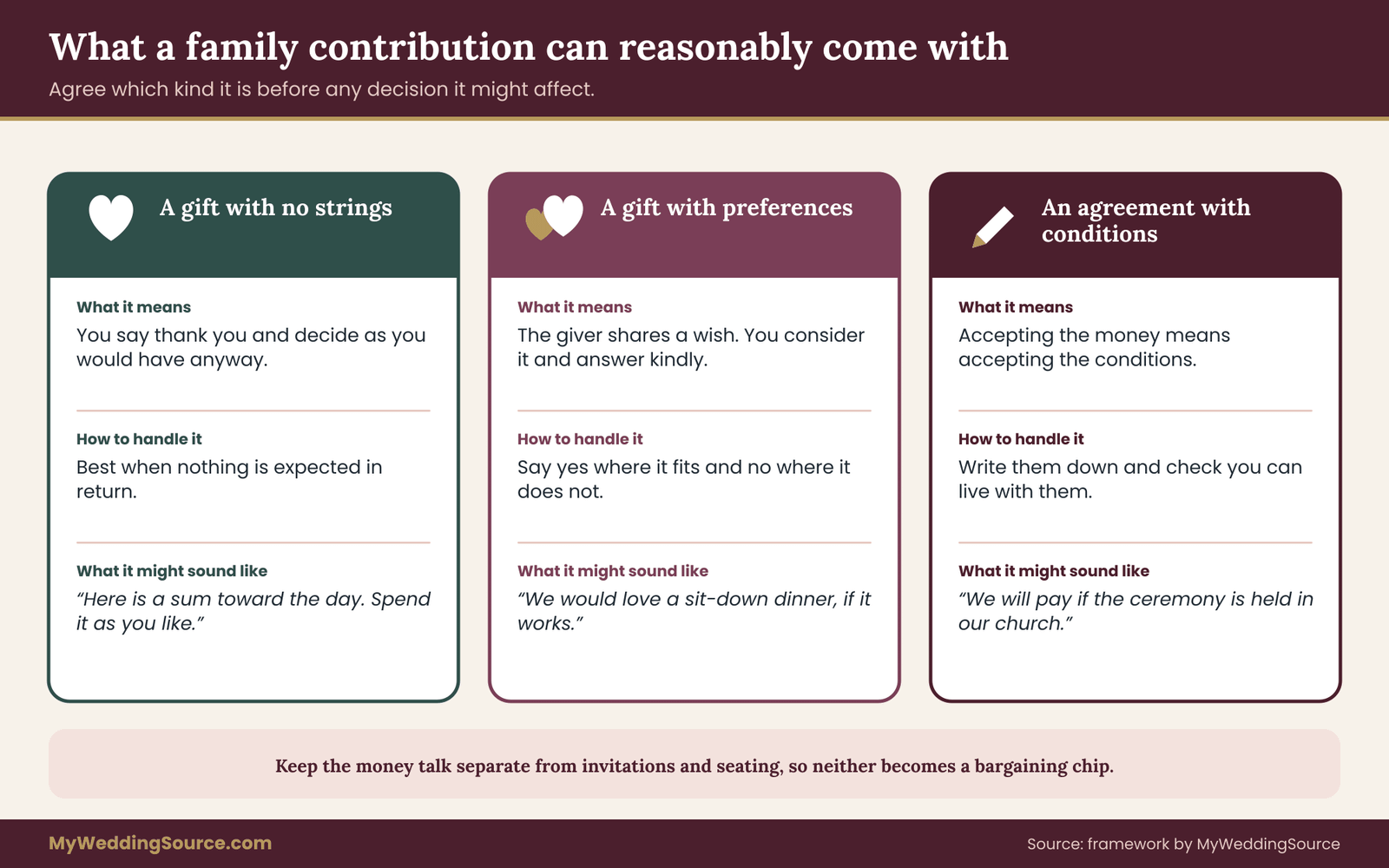
A contribution with no strings is a gift. You thank the giver and decide as you would have anyway.
A contribution with preferences is a gift plus a wish. The giver may say, “We would love it if the dinner could be a sit-down meal.” You listen and, where it fits, you say yes. If not, you say so kindly.
A contribution with conditions is closer to an agreement. If you accept it, you are accepting the conditions, so you should write them down and check that you can live with them.
Have the money conversation about wedding decision making early
Raise contributions before any decision that they might affect. A short conversation might go like this: “Thank you so much for offering to help. Before we plan anything, can we talk about how you would like to be involved? We want to be clear about what we are deciding ourselves and where we would love your input.” Then listen. Offer your own view of the budget and, if you are comfortable, your own plan for paying.
Keep the money conversation separate from the question of who is invited, who sits where, and so on. When money and invitations are discussed in the same breath, each becomes a bargaining chip for the other.
Decide whether a contribution is earmarked
Contributions can be general (“here is a sum toward the wedding”) or earmarked (“we will pay for the photographer”). Earmarked gifts feel like control to some givers and like clean boundaries to others. If a parent wants to pay a vendor directly, agree who chooses the vendor, who signs the contract, and what happens if you change your mind. The contract-holder is the person the vendor will rely on. For help with that side of planning, see our wedding vendor due diligence checklist.
If you accept money with conditions you cannot live with
You can go back. It is far better to say, “We have thought about it and we want to keep these decisions ourselves, so we will manage with a smaller budget,” than to accept the money and resent the strings for a year. People are often relieved to be told plainly. If a family member then withdraws the offer, that is their right, and a hard but honest outcome.
Contributions from both families and shared wedding decision making
When both sets of parents contribute, treat both with equal care, even if the amounts differ. Equal consultation on matters that affect everyone, and independent authority on the portion each family hosts, tends to feel fair. Do not run one family’s contribution on a different set of rules from the other’s unless both have agreed.
A note on law and contracts. If you sign a contract, you are bound by it. If someone else signs, they are. Who pays does not by itself decide who is in charge of a contract, and the details depend on the terms and the jurisdiction. If a significant sum or a binding commitment is involved, read the contract carefully and consider asking a qualified professional. ## When wedding decision making stalls: a simple escalation path
Even with a clear charter for wedding decision making, someone will disagree with a decision. That does not mean the charter failed. It means the system is now being used. What matters is how the disagreement is handled, and whether there is a path that keeps it from turning into a standoff.
An escalation path is a short sequence of steps, agreed in advance, that you follow when a disagreement does not settle on its own. It has two jobs: to give everyone a fair hearing, and to make sure the decision still gets made.

Step one: a private conversation
The first response to any disagreement is a calm, private conversation between the people directly involved. For a disagreement with your parents, the partner whose family it is should lead. Group chats are the wrong place for it; public disagreements force people to defend their pride rather than their position.
Begin by asking what matters to them. Do not begin by explaining why they are wrong. The point is to separate the position from the interest behind it. Researchers at the Harvard Program on Negotiation have long taught that people usually argue for positions, such as “we must have the ceremony in the church,” while their underlying interests, such as “I want my late husband’s memory to be honored,” can often be met in more than one way. Asking about interests is the quickest route to options you had not considered.
Step two: a written summary
If the conversation does not settle it, write a short summary and send it. Three sentences are enough: what you understood about their view, what you have decided or are leaning toward, and what the next step is. A written summary prevents the slow drift of memory, where each person remembers the conversation a little more in their own favor. It also gives the other person time to reflect before replying.
Step three: a pause
A pause is underrated. If emotions are high, agree to stop for a couple of days and return to the question. People often feel differently once they have had a night’s sleep, and decisions made in the heat of an argument tend to be regretted. A pause is not a surrender. It is a rule: no decisions in anger.
If an external deadline limits the pause, say so honestly.
Step four: a neutral third party
If the disagreement is stuck, and it matters, consider asking a neutral person to help. Who this is depends on the family. It might be a respected relative who is not a party to the dispute, your officiant or a faith leader, a wedding planner you trust, or, for a serious and lasting family conflict, a licensed mediator or family counselor. A neutral person can restate each side’s concerns in a way that is hard to hear from the other side directly.
Do not use a third party as a weapon. Gathering allies to pressure someone usually makes the conflict worse.
Step five: the wedding decision stands
At the end, the person who holds authority under the charter makes the call, and the call is respected. This is the step that people find hardest, and the one that makes the earlier steps meaningful. If the couple holds the decision, they decide and explain. If a family member owns it, they decide within their limits. If a venue or the law sets the rule, the rule applies.
You can say it gently: “We have heard you, we have thought about it, and our decision is to keep the ceremony as planned. We really appreciate how much you care.” Then move on, and resist the temptation to keep explaining.
Keep your side of the escalation
An escalation path for wedding decision making works only if everyone follows it, including you. If you ask people to be patient and then make a decision before the window closes, you have broken your own rule. If you promise to consider an idea and then dismiss it without thought, they will feel it. The best protection for a clear process is to follow it carefully yourselves.
How to talk about wedding decision making: gentle scripts
Good structure helps, but conversations are where wedding decision making succeeds or fails. The following four-move approach works for many tense moments. You do not need to use all four every time.
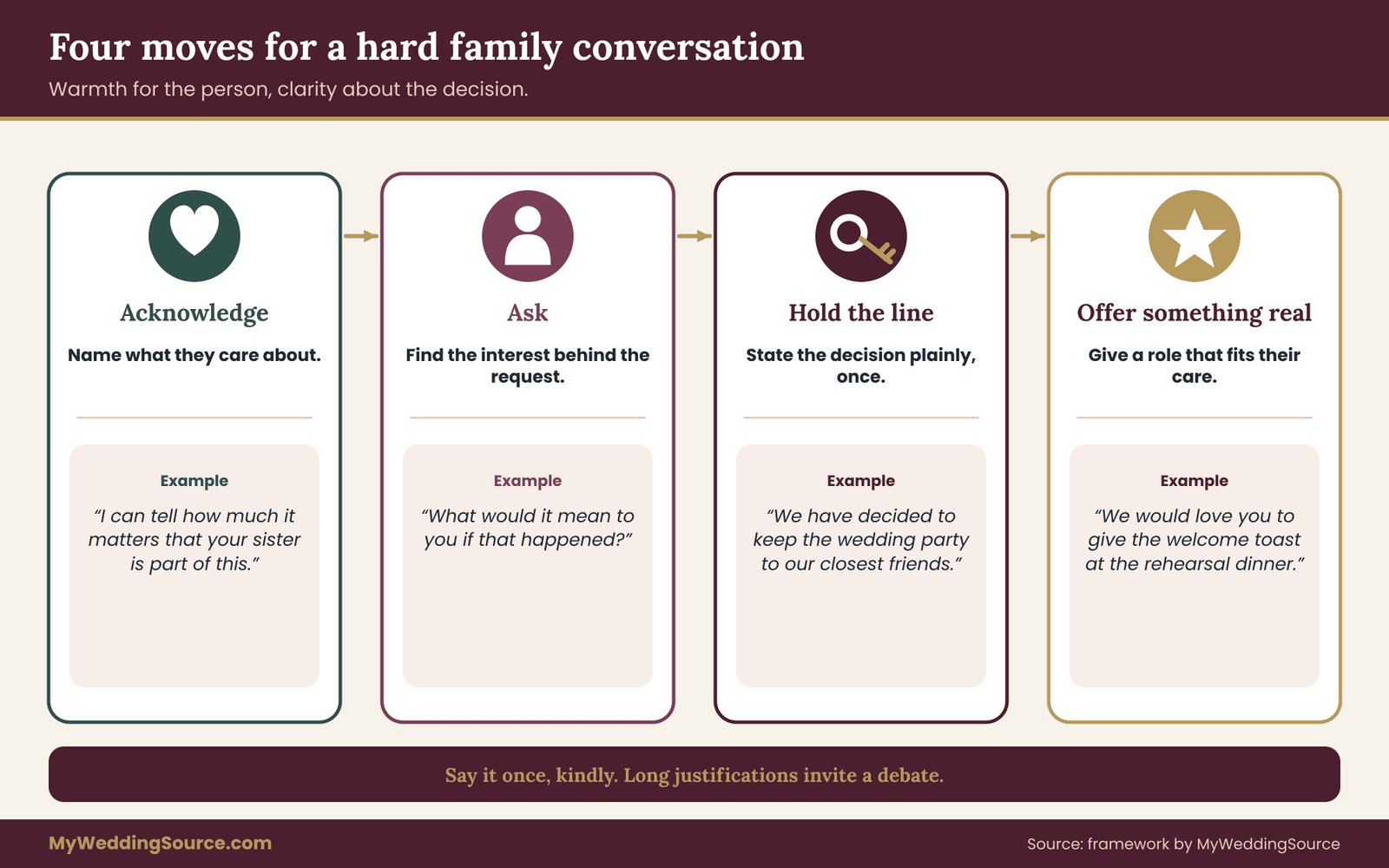
Acknowledge. Start by naming what the other person cares about. “I can tell how much it matters to you that your sister is part of this.”
Ask. Find out what is behind the request. “What would it mean to you if that happened?” or “What worries you most about the other option?”
Hold the line. State what is decided or what the process will be, without apology and without a lecture. “We have decided to keep the wedding party to our closest friends.”
Offer something real. Where you can, give something. It need not be the thing they asked for. “We would love for you to give the welcome toast at the rehearsal dinner.”
Here are original sample sentences for situations that come up often. Adapt them to your voice and your family.
- To open input on a decision: “We are starting to plan the guest list and want to hear from you first. Could you tell us the three or four relatives who matter most to you? We will take that into account, and we will make the final list together.”
- To accept an idea without committing: “That is a lovely idea. We will think about it and let you know by the end of the month.”
- To decline kindly: “We have thought carefully about this one and decided to go another way. We still want you to be part of the day, and here is how.”
- To set a limit on contribution strings: “We are so grateful for your offer. We would like to keep the decisions about the ceremony and guest list as ours. Would you be happy to help with the rehearsal dinner instead, where you would have complete say?”
- To end a repeated conversation: “I know we see this differently, and I do not want it to come between us. Our decision is made, so let us talk about something else.”
- To ask for a pause: “I want to give this the attention it deserves, and I am too upset to do that right now. Can we come back to it on Thursday?”
None of these needs to be delivered in a perfectly calm way. People are allowed to be moved. But in each of them you can see the same pattern: warmth for the person, clarity about the decision.
A note on tone in writing
Texts and group chats flatten tone, and a sentence that sounds neutral when written can read as cold. If a topic is sensitive, a phone call or an in-person conversation is usually better than a message. Follow up in writing so the content is recorded, but let the first contact be human.
Meetings, messages and the log for wedding decision making
Most wedding decision making happens in small moments, not in formal meetings. Still, a little structure goes a long way.
Choose a regular, light rhythm for wedding decision making
Rather than discussing the wedding every time you see a relative, pick a rhythm. It might be a short call with each set of parents every two weeks, a monthly family video call, or a shared update that you send on the first of the month. A regular update lets people feel included without feeling they must ask. It also gives you a natural place to say “that is on the agenda for next month.”
Use one shared place for wedding decision making
Keep decisions in one place, such as a shared document or a notes app, that includes the decision, the date it was made, who made it, and any relevant reasons. This is your decision log. Share it with the people who need it and keep the rest private. A short entry might read: “Venue chosen: June. Decided by us after hearing from both sets of parents. Reasons: access for grandparents, within budget. Closed to new input.”
The log helps in three ways. It keeps you consistent, it reminds you of reasons when a question returns, and it keeps you from contradicting yourselves.
Meet in person for the hard ones
Some topics are best handled face to face, preferably over food, with a time limit. A large family decision about the guest list or a ceremony tradition is more likely to be heard well in person than in a message thread. Bring the facts, such as venue capacity or budget numbers, so the conversation is about what is possible rather than who is right.
Watch the group chat
Large family group chats are a common source of confusion about authority. Opinions pile up, someone quotes a half-decision, and a vendor name or a date becomes “agreed” without anyone saying so. If you use a group chat for logistics, say clearly what it is for. Keep decisions and sensitive topics out of it. ## Wedding decision making in the situations that cause the most friction
A charter is a framework for wedding decision making. The real test is how it works when a specific, emotional situation arrives. The scenarios below are the ones couples describe most often. In each, the same logic applies: identify the decision group, decide who is consulted, set the limits, and communicate kindly.
The guest list: when parents want more people than you do
The guest list is the most common flashpoint in family wedding decision making, because it combines emotion, money and capacity in one number. Parents often have friends, colleagues and relatives they feel obliged to invite, and may feel strongly that their own contribution entitles them to a share of the list.
A method that works for many families is to allocate slots. Decide the total number first, based on your venue capacity and budget. Then agree a share for each side: for example, a fixed number for each partner, a fixed number for each set of parents, and a shared remainder for mutual friends. Each person fills their own slots as they wish, and nobody argues over individual names.
If your parents are contributing and want to invite people you do not know, slots make this concrete: “We have forty places for your friends and family. You can choose any of them.” That gives the parent real authority inside a clear boundary. When a parent still wants more, the honest answer is about capacity: “We do not have room.” Etiquette writers, including the Emily Post Institute, have published advice on this exact question, when parents want a bigger guest list, and it is worth reading for wording ideas.
For trimming a list that has grown too large, our practical piece on how to cut a wedding guest list fits well with a slot system, because it treats the number as a constraint first and a set of names second.
Wedding decision making when a relative wants to choose the vendors
Vendors are often a place where a well-meaning relative offers a favorite: a cousin who photographs, an aunt who bakes, a friend of the family who is a DJ. Sometimes this is a wonderful gift. Sometimes it is a trap.
Treat vendor choices as group two or group one, depending on who pays. Before you accept an offer, ask the same questions you would ask any vendor: what is included, what is the contract, what is the backup if they are ill, and how will they work with the other vendors?
If a relative insists, offer a clear alternative: “We are going to interview three photographers and choose the one who suits our style. We would love your opinion on the shortlist, and we will make the final decision together.” If you want to honor the relationship without giving up the choice, give the relative an adjacent role that matters, such as a special toast or a family-photo organizer.
Wedding decision making around religious and cultural elements
When families have different faiths or traditions, wedding decision making often becomes a negotiation about meaning. Remember that you are the ones marrying, and that you can honor a tradition without handing it control.
Start with your own questions. Which elements matter to you, which matter to your families, and which can be adapted? Then go to the families with specific choices rather than abstractions. “We would like to include the blessing of the bread, and to keep the ceremony under thirty minutes. Could you help us with the wording?” is easier to respond to than “How do you feel about our ceremony?”
Where a faith leader is involved, ask early what is required for the ceremony to be recognized in that tradition. Those requirements are real and are different from a relative’s preferences. Our wedding ceremony step-by-step guide shows where such elements fit into the sequence of a ceremony.
If a family member wants a reading or ritual that you do not, you can offer a different place for it: a blessing at the rehearsal dinner, a letter, or a short moment before the ceremony. This keeps the relationship intact without compromising the ceremony.
Siblings and the wedding party
Disappointment about the wedding party is common, and it often has little to do with the role itself. A sibling who is not asked to stand beside you may feel excluded from the family story.
If you can, tell the person yourself, early, and kindly. Explain that the wedding party is a small group chosen for a specific reason, such as close friendship or a long history, and that you want them to have a meaningful part. Then follow through: ask them to do a reading, to walk a grandparent down the aisle, or to sit in a place of honor. The principle is the same as with any family member: separate the title from the care.
The reverse also happens. A sibling who does not want a role may feel pressured by a parent. You can step in: “We have asked if they want to be involved, and they have said what they would like.”
Wedding decision making in divorced, blended and complex families
When parents are divorced or families are blended, wedding decision making needs more care, because every decision can affect more than one relationship.
Some practical approaches help:
- Talk to each parent separately about their role. Do not assume they will want to plan together.
- Avoid forcing situations. If two relatives cannot be in the same room comfortably, plan around that: separate photo sessions, different tables, staggered arrival times.
- Define roles clearly for each parent and stepparent. Who walks, who sits where, who is mentioned in the program.
- Be even-handed. If one parent is given a toast, consider a way to honor the other.
- Ask what would make the day comfortable. People sometimes have simple, reasonable requests, such as sitting near the exit, which you can grant.
A neutral person, such as a planner, can sometimes carry difficult messages more easily than a family member can.
Children in the family
Questions about children, such as who is invited, who looks after them, and how photos of them are used, often require input from parents who are not the couple. Treat each family’s rules about children as their own to decide. If you decide to exclude children from the reception, say so clearly on the invitation and in advance. See wedding invitation etiquette for wording that is clear and not unkind. If a parent wants to set a limit on photographs of their child, treat that request as one that should be honored by default, and tell the photographer.
Estranged relatives, safety and privacy
Sometimes decisions about who is invited are not about taste at all. A person in the family may have caused serious harm, or a couple may have good reasons for distance from a relative. Here, decision making belongs to the couple, and in some cases to a guest whose safety is at stake.
If a relative has been abusive, threatening or controlling, this is not a matter for negotiation or a family vote, and the couple does not owe anyone an explanation. Tell your venue and a trusted person in your family or wedding party, and plan how you will handle an uninvited arrival. If you are in danger or if someone in your family is, the National Domestic Violence Hotline in the United States can be reached at 1-800-799-7233, and it offers confidential support for planning. A licensed therapist can help with the emotional part.
Even where the situation is less serious, such as a painful but non-dangerous estrangement, you may decide that a person will not be invited, that they will be invited with conditions, or that you will make a different gesture. Whatever you decide, make the decision before the invitations go out and communicate it once, briefly and without apology.
When contributing parents expect more say in wedding decision making
If a parent has been generous and begins to take more control as the wedding gets closer, return to the charter. Thank them, restate what you have each agreed, and offer something meaningful inside the boundary. If that does not work, apply the escalation path. In the rare case where the control is escalating into pressure, intimidation or threats, treat it as a safety matter rather than a planning one.
Families far away
Remote relatives often feel left out and may be quick to feel that decisions were made without them. Include them in the update rhythm, send photos and ideas, and give them an input window on the decisions that affect travel, such as the date and the location. A short availability check with a clear deadline keeps the date from being decided by whoever answers first. ## A worked example of wedding decision making: one couple builds a charter
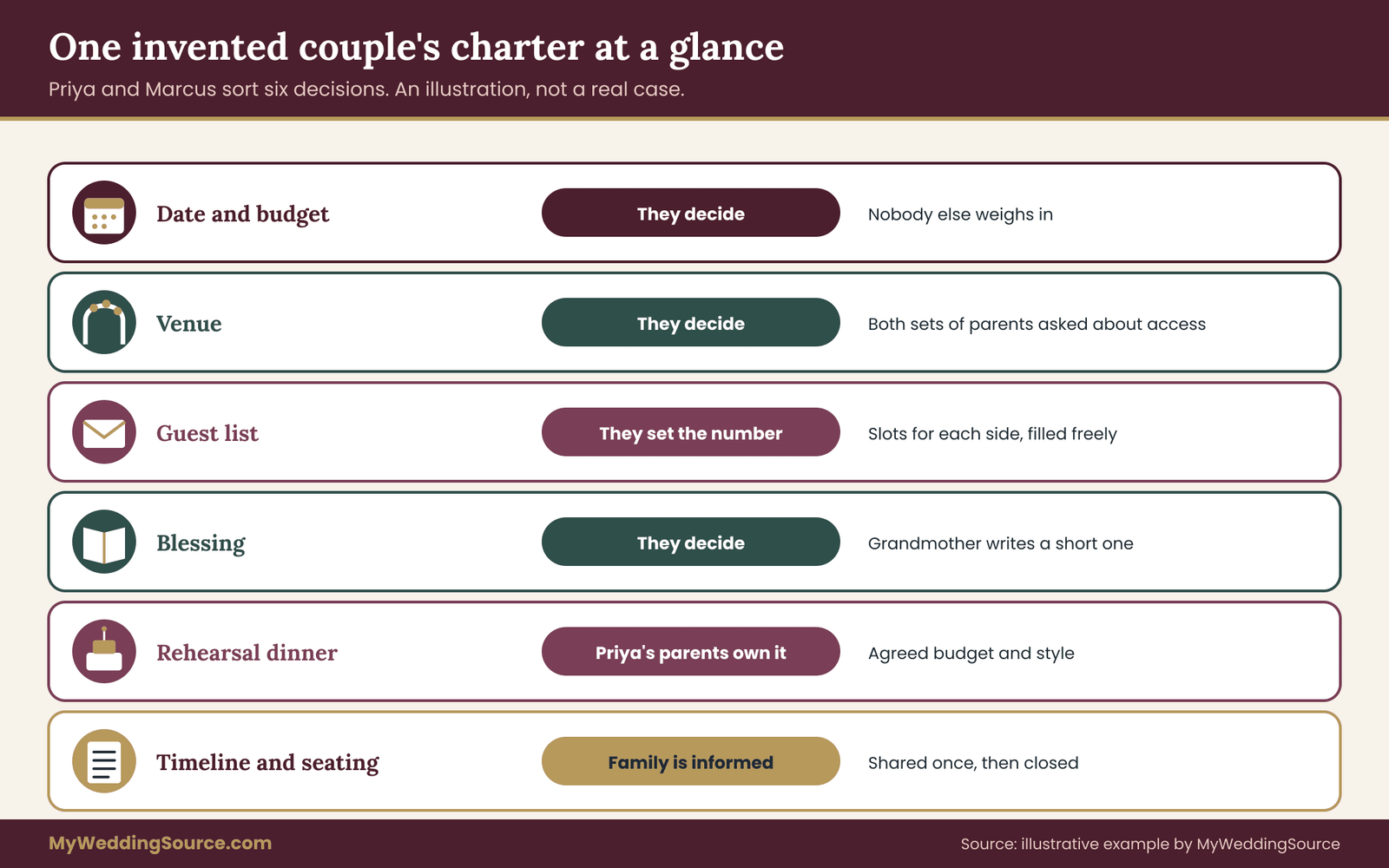
To show how this works in practice, here is an invented couple. Priya and Marcus are planning a wedding for about one hundred guests. They are paying for most of it themselves. Priya’s parents have offered a contribution. Marcus’s mother is divorced from his father, who lives in another state. Priya’s grandmother is eighty-four and cares a great deal about a family blessing. Marcus’s brother is not in the wedding party and has said he feels left out. This is an illustration, not a real case, and your own family will differ.
Their conversation with each other
Priya and Marcus begin their wedding decision making with the five questions. Both agree that a calm, medium-sized day matters most. Priya is comfortable with her parents’ involvement; Marcus finds his mother’s opinions tiring but loves her. They agree that each will lead conversations with their own family. On money, they decide they can pay for the wedding without help, which means any contribution is a gift they can accept with preferences but not conditions. They agree that if they disagree with each other, they will pause for two days before deciding.
Their sort of the decisions
They then place decisions into the four groups.
Group one, the couple alone: date range, budget, wedding party, attire, vows, overall style.
Group two, the couple after listening: venue, with input from both sets of parents about access for older relatives; final guest list, with slots; the blessing, with Priya’s grandmother and her parents; the menu, with dietary needs gathered from guests.
Group three, a family member owns it: Priya’s parents host the rehearsal dinner within an agreed budget and style; Marcus’s brother organizes the welcome bags and a morning-after brunch.
Group four, informed: the timeline, the seating chart, the transportation plan, the dress code.
Their conversations with each family
Priya talks to her parents first. She thanks them for the offer and explains that she and Marcus would like to keep decisions about the ceremony, guest list and style themselves. She asks if they would host the rehearsal dinner, where they would have full say. They say yes, a little surprised and pleased. She asks her grandmother what a blessing would mean to her, and learns that it is the words about family and gratitude that matter, not the specific form. They agree that the grandmother will write a short blessing for the ceremony.
Marcus talks to his mother and, separately, to his father. He asks each what would make the day comfortable. His mother wants to sit close to the front; his father would prefer a quieter seat with an easy exit. They arrange separate seating and plan family photos in two sessions. Marcus asks his brother to take charge of the welcome bags and the morning-after brunch, and explains that he did not choose a large wedding party because he and Priya kept it to the friends who had been in their lives longest. His brother says that makes sense, and that he likes the brunch idea.
Their guest list
They agree on one hundred guests. They allocate thirty places each to Priya and Marcus for their own friends, relatives and colleagues, twenty to Priya’s parents, and twenty to Marcus’s mother, with a few reserved for his father. Each set of parents may fill their slots as they choose. When Priya’s father wants to add six more people, Priya says: “We have twenty places for you, and we are at the limit. If you would like to swap anyone in your group, we are glad to.” He picks two to remove.
Their first disagreement
Priya’s mother suggests a venue Priya and Marcus do not like. They apply the escalation path. Priya calls her mother, asks what she loves about the place, and learns that it is the garden. She and Marcus find another venue with a garden and share photos. The decision closes. They record it in their log.
Their first veto
The venue’s rules limit amplified music after nine in the evening. Nobody in the family has a say about that; it is the venue’s rule, and they tell everyone.
What went well in their wedding decision making, and what stayed hard
Not everything was smooth. Marcus’s mother was disappointed about not choosing the flowers, and he had to say it twice. Priya’s parents slipped into a group chat about colors that was unrelated to any open decision, and Priya had to gently redirect them. But no decision was reopened after it closed, and nobody discovered at the last minute that they had assumed authority they did not have. That, more than perfect harmony, is the sign that wedding decision making is working.
Common mistakes in wedding decision making, and how to avoid them
Most of the trouble in wedding decision making comes from a short list of avoidable errors.
Opening conversations before aligning with your partner. If the two of you do not agree, your families will find the gap. Start with each other.
Letting money speak without words. Unspoken expectations around contributions create resentment on both sides. Name them early.
Giving everyone an opinion on everything. Wide listening is good. Unlimited listening produces exhaustion and contradictions. Name who is consulted on which decision.
Handing something over and then taking it back. If a relative owns a task, accept their way of doing it within the limits you set.
Leaving decisions open. If you do not close a window, it will be reopened. Close it, share the result and log it.
Using a vague veto. If you promise that someone’s view matters “a lot,” they may hear that it decides. Be precise about what is advice and what is binding.
Having hard conversations by message. Tone is lost. Use a call or a meeting for the difficult ones and follow up in writing.
Making your partner the messenger for their own family’s problem. Each partner usually leads with their own family, with the other’s support.
Treating every disagreement as a crisis. Most are small and settle with a calm conversation. Save the formal path for the ones that matter.
Waiting until the last month. The longer you wait, the more decisions pile up and the harder it is to make a clean system. Start early.
Forgetting yourselves. In the effort to be fair to everyone, couples sometimes forget that the wedding is also theirs. Protect your top priorities. ## Wedding decision making by planning phase
Good wedding decision making is not a single moment. It changes as the wedding moves from dreams to logistics. Understanding how wedding decision making shifts across the months helps you give the right kind of voice at the right time.
Early on: the big frame
In the first weeks, the biggest decisions are the budget, the approximate size, the season and the broad style. These are mostly group one and group two. This is the moment to have the money conversation with anyone who is contributing, to share your top priorities, and to explain how you plan to make decisions. Families are usually more flexible at this stage than later, because nothing has been paid for and no one has been told something different.
Resist the urge to commit to specifics in this window. A relative who hears “we are thinking of an autumn wedding” is likely to remember “autumn” and to start telling other people. If you are not sure, say so: “We are still deciding. We will tell you when we do.”
The commitment stage of wedding decision making: venue, date and guest count
This is where the heaviest decisions happen, and where families most often push. The venue and date are linked, and each affects the guest list. You may be asked to sign a contract and pay a deposit while the family is still discussing. Set a clear input window, tell people what the external deadline is, and make the decision when the window closes.
Because these decisions drive many later ones, treat them as a bundle: date range, venue, headcount and budget. Our guide to choosing a wedding date shows how to confirm the key people are available before you commit, which reduces the chance that a family member will later say the date does not work.
The middle months: vendors, ceremony and style
By now the main structure is set. Vendor choices, ceremony content and style are the typical areas for group three, because they let relatives take real roles. This is a good time to hand over tasks like the rehearsal dinner, a welcome event, transportation help or a family tradition. A task with a limit, a budget and a date gives a relative a purpose and releases you from a long list.
The detail months: schedule, seating and logistics
As the wedding approaches, most decisions move into group four. You are no longer asking whether to do something. You are working out how. This is the time to publish the timeline, seating plan, dress code and transport details, and to stop opening new questions. Relatives who offer new ideas at this point can be thanked and politely told that the plan is set. If an idea is useful, give it a small place, such as an extra song at the rehearsal dinner, rather than redoing something that is already booked.
The final weeks
In the final weeks, authority should be crisp. Give a single point of contact for each task, share a one-page schedule and avoid last-minute changes. If someone asks for a change, ask whether it is necessary for safety or comfort. If it is not, the answer is usually “we have it covered, and we would love your help in this specific way.”
Wedding decision making in wedding week and on the day: who is in charge
One of the most important decisions in wedding decision making is one most couples forget: who decides on the day, when something goes wrong.
On the wedding day, the couple should not be making decisions. If a vendor is late, a seating question arises or a relative wants to change the timeline, someone else needs the authority to handle it. If nobody has that authority, the questions flow to the couple, or to the loudest family member, or to whoever happens to be standing nearby.
Choose one person
Name one person to be the point of contact for the day. It might be a hired planner or day-of coordinator, a calm friend with a good head for logistics, or a family member who is good at staying steady and who is not in the wedding party. Tell the vendors, the wedding party and the key relatives who it is. Give that person your timeline, vendor contacts and a short list of what they can decide on their own and what they should check with you.
A useful phrase is: “If something changes, ask her. If it is not a safety issue and not about the ceremony itself, she can decide.”
Define what can change
Not every decision on the day carries the same weight. Decide, in advance, which things can be changed without asking, which should be checked, and which must not change. A late arrival of flowers might be handled by the coordinator. Moving the ceremony start by twenty minutes may need a quick check. Changing the order of a religious rite should not be done without the officiant and the couple.
Protect the couple
Tell family members, kindly and in advance, that on the day questions go to the point person, not to the couple. A short note a week beforehand does this well: “On the day, please bring any questions to Dana, our coordinator. We would love to be fully present, and she has our timeline and our plan.”
Keep the day’s authority consistent with the charter
If you gave a relative a job, such as organizing the family photos, make sure that their authority is respected on the day. Tell the photographer and the coordinator who holds the list. Without that, a well-meaning person might direct the photographer in ways that contradict the plan.
Where a planner, officiant or other professional fits in wedding decision making
Professionals can make wedding decision making easier, and they can also add confusion if their role is unclear.
A wedding planner
A planner is hired by the couple, and the contract is with the couple. In decision-rights terms, a planner is a source of expertise and a manager of tasks, not a decider on matters that belong to the couple. A good planner will ask for the charter and work within it.
If a parent is paying for the planner, be explicit about who the planner works for and who gives them instructions. Ask the planner to take direction from the couple, and to share updates with the relatives who need them. If the planner is caught between a couple and a relative, the planner’s own contract is the first thing to read.
A planner can also be a neutral third party in the escalation path, which many couples find helpful. A relative may accept “our planner has said that the schedule cannot fit this” more easily than “we have said no.”
An officiant
For the ceremony, the officiant has authority over the legal and often the ritual structure. Ask early what is required, what can be personalized and who has the final word. If your officiant is a faith leader, their rules for the ceremony are not up for family negotiation, and you can say so honestly. Our guide to the wedding ceremony step by step maps the standard sequence if you want to see where each element fits.
The venue and vendors
The venue controls its own rules. Vendors control the way they work. These are not decisions for the family, and you can use them to keep a conversation grounded: “The venue does not allow this. We have checked.” When a relative objects to a rule, the venue is the right place to take the question, and you can offer to introduce them.
Other people with authority
In some weddings, other people have a role that matters: a religious community, a cultural elder, a landlord of a family property, a host family. Where such a person has real authority, treat it respectfully and put it in your charter. Where they have an opinion only, treat that as input.
Honoring elders in wedding decision making without giving up your decisions
In many families, respect for elders is a central value, and consultation is how respect is shown. The charter approach can fit within this, and it may even help.
Respect through process
Consulting someone senior, early and in person, is a sign of respect in many traditions. It does not mean you must follow their view. You can ask for advice, thank them sincerely, and then explain how you reached your decision. Many elders care more about being asked than about the answer.
Distinguish tradition from preference
A real religious or cultural requirement is one thing. A family habit is another. Ask kindly which this is: “Is this something that is required for the ceremony, or something your family has always done?” If it is required, you can decide whether to follow it. If it is a habit, you have more room.
Offer a meaningful role
An elder who has a real task, such as giving a blessing, telling a family story or leading a toast, will often be content with a role that fits their dignity. This is the opposite of tokenism: choose a role that matters to them and that does not conflict with your priorities.
Accept that some people will remain unhappy
Despite your care, a few people may remain unhappy. You are not responsible for everyone’s feelings. You are responsible for acting with honesty, kindness and clarity. A relationship can survive a disagreement about flowers. It is harder for it to survive a feeling of having been deceived.
Make space for your own culture
Couples sometimes feel torn between the expectations of two families and a wish for their own way. A wedding can honor both and still have a character of its own. If you decide to include a tradition from each family, choose moments that give each room, and avoid making one family the guest of the other. ## Your wedding decision making charter worksheet
Copy the following into a document and fill it in with your partner. Aim for a single page. It is for you first, and you can share parts of it later.
1. Our top priorities (two or three things that must feel right):
2. Our budget and what we can pay ourselves:
3. Who leads conversations with which family:
4. Our tiebreaker if we disagree:
5. Group one, we decide alone:
6. Group two, we decide after listening (and to whom, by when):
7. Group three, a family member owns it (who, what, budget, style, review date):
8. Group four, family is informed (how and when):
9. Contribution agreements (who, how much, preferences or conditions, in writing):
10. Vetoes we give (safety, faith constraints, venue or legal rules), and what each covers:
11. Escalation path (conversation, written summary, pause, neutral person, decision stands):
12. Where we keep the decision log, and how we share it:
If you want a place to put the deadlines that come out of this, our wedding planning checklist lays out the whole period in order. For manners questions that come up along the way, such as how to word a decline or what to say to a surprised relative, wedding etiquette is a good companion.
Keeping relationships whole after wedding decision making ends
Wedding decision making is temporary. The relationships it touches are not. A few habits protect them.
Thank people specifically. A note that says what someone did, such as “your blessing made the ceremony feel like ours,” lasts longer than general thanks.
Do not relitigate afterward. Once the day is over, avoid post-mortems on who was right. Return to ordinary relationships.
Notice what worked. If your family handled a disagreement well, tell them. If they did not, decide what you will do differently in future family decisions, such as holidays, moves and children.
Keep the habit. The same ideas, who decides, who is consulted, and when the matter closes, are useful in a marriage for years. Many couples find that the charter they wrote for the wedding turns into a way of handling the next family decision, such as where to spend holidays.
Limits of this guide
This guide is general information about wedding decision making and family communication. It is not legal, financial or mental health advice. Families, cultures and laws differ, and you know yours best. If a dispute involves a contract or large sums of money, consider a qualified professional. If a relationship involves threats, coercion or abuse, or if you are struggling emotionally, reach out to a licensed professional or a crisis resource rather than relying on a planning framework.
FAQ
Who has the final say in wedding decision making when parents are paying?
The answer depends on what was agreed, so the safest path is to agree it before any money changes hands. A contribution can be a gift with no strings, a gift with preferences, or an agreement with real conditions. If you accept money, you accept whatever conditions come with it. Many couples keep the core decisions, such as the date, style, ceremony and wedding party, and hand parents a real role elsewhere, such as hosting the rehearsal dinner. If conditions were never discussed, have that conversation now rather than at the next disagreement.
How do we say no to a relative’s idea without starting a fight?
Acknowledge what they care about, ask what is behind the idea, state your decision plainly, and offer something real where you can. For example: “We know how much the tradition means to you, and we have decided not to include it in the ceremony. We would love for you to say a blessing at the rehearsal dinner.” Keep the message short, say it once, and avoid long justifications, which invite debate. If the topic returns, repeat the decision gently and change the subject.
Should every family member get a vote in wedding decision making?
Generally no. A vote suggests the result is binding, and in most families that is not what you want. A better approach is to choose who is consulted on which decision, listen carefully, and make the final decision as a couple. This way every close relative can feel heard on the topics that matter to them, without anyone having to decide on a menu by committee.
What is a reasonable veto in a wedding, and who can hold one?
Most couples find that only a few categories justify a veto: real safety risks, the requirements of a religious tradition the couple has chosen to follow in the ceremony, and the rules of the venue or the law. Everything else, including the guest list, style, wedding party and attire, is better treated as input. If you do offer a veto, write it down, narrow it to one topic, and give it an end date so it cannot grow into something bigger.
What if our partner and we disagree about how much say to give family?
Settle it between the two of you first. Share what each of you wants, and why, and work toward a shared plan for how family will be involved. Agree a tiebreaker, such as a two-day pause, and agree that each of you will lead conversations with your own relatives. Presenting a united position to families prevents either family from sensing a gap and pulling on it.
How do we handle a family member who keeps reopening decisions we have already made?
Use the closing step of the input window. State that the decision is made, thank them for their input, and decline to discuss it again. If they continue, say gently that you have already decided and would like to talk about something else. Keep a written log showing the decision, the date and the reasons, so you can point to it without a debate. If the pattern is intense or involves pressure, follow the escalation path and consider a neutral third party.
When should we involve a mediator or counselor in wedding decision making?
Consider outside help when a disagreement keeps returning despite good-faith attempts, when it is damaging a relationship you care about, or when it affects your wellbeing. A planner or a respected relative can often help with practical disputes. For deeper or longer-lasting conflicts, a licensed mediator or family counselor can help everyone hear one another. If any behavior involves threats, coercion or abuse, treat it as a safety matter and contact a crisis resource such as the National Domestic Violence Hotline, rather than trying to resolve it as a planning disagreement.
How early should we set up wedding decision making rules?
As early as possible, ideally before you share any detailed plans or accept any contributions. The conversation is easiest when no money has been spent and no one has been told something different. If you are already deep into planning, you can still start: sort the remaining decisions into the four groups, tell people what is closed and what is open, and set deadlines. A late charter is better than none.
Your next steps
Spend one evening with your partner. Answer the five alignment questions, write your top priorities and agree who leads with each family. The next day, sort the decisions you face into the four groups and write your first charter page.
Within the week, have the money conversation with anyone who has offered to contribute, and tell each person, kindly, how you plan to make decisions. Open input windows for the first two or three decisions, with dates. Start a decision log. When the first disagreement comes, follow the escalation path and see how it goes. Adjust the charter as you learn. The goal of wedding decision making is not a perfect document but a calm, shared understanding of who decides what.
Sources
- Inside weddings: dividing wedding expenses, Emily Post Institute
- When parents want a bigger guest list, Emily Post Institute
- For parents: setting a budget and splitting expenses, Emily Post Institute
- Wedding tips for moms whose children are engaged, Emily Post Institute
- Who pays for the wedding? Traditional etiquette does not always hold, Associated Press via ABC News
- Who pays for the wedding, AARP
- Real Weddings Study, The Knot
- Finding your place in your child’s wedding plans, Next Avenue
- RAPID decision making, Bain & Company
- Principled negotiation: focus on interests to create value, Harvard Program on Negotiation
- Six guidelines for Getting to Yes, University of Utah S.J. Quinney College of Law
- How to set boundaries, Cleveland Clinic
- How to set boundaries with family and stick to them, NPR
- Hotlines and helplines, Administration for Children and Families, U.S. Department of Health and Human Services